Methods: A Case Study
La Eficiencia de la Planeación del Mantenimiento Preventivo y los Métodos Multicriterio:
Estudio de un Caso
Edgar Sevilla Juárez and Carlos Enrique Escobar Toledo
Facultad de Química, Universidad Nacional Autónoma de México Distrito Federal, México
[email protected], [email protected]
Article received on January 13, 2008; accepted on August 12, 2008
Abstract
The objective of this work consists in the analysis of reliability in process plants in order to manage the failure risks and avoid them considering the probability of failure among other important criteria. The preventive maintenance is an important function for the better operation of any enterprise; we propose the ranking of process equipment according with their criticality for the operation plant to get a good preventive maintenance planning. The subjacent hypothesis is that decision makers should recognize that preventive maintenance planning does not have a single criterion as for example, costs or time, but are multicriteria by nature.
To show how this methodology functions, naphtha and intermediate distillates Hidrodesulfuration Plant is used as a case study.
The obtained results are the ranking of the process equipment; besides the parametric study that shows: the lower the budget assigned to preventive maintenance, the bigger the economic loss.
Keywords: Multi-Criteria Decision Aid, Preventive Maintenance Planning, Hidrodesulfuration Process Plant, PROMETHEE-GAIA Technique.
Resumen
El objetivo de este trabajo consiste en la realización de un análisis de fiabilidad en plantas de proceso con la finalidad de administrar los riesgos de fallas y evitarlos, para lo cual se consideró la probabilidad de falla además de otros criterios importantes, tales como los riesgos de explosión e incendio, el riesgo asociado a la severidad de la operación, el impacto del equipo dentro del equipo en caso de falla y las máximas pérdidas económicas en caso de pérdida total.
El mantenimiento preventivo es una función importante para la operación correcta de cualquier planta de proceso. Con la finalidad de obtener una buena planeación del mantenimiento preventivo, en este trabajo se propone la jerarquización del equipo de proceso de acuerdo a su nivel de criticidad en la operación de las plantas de proceso. La hipótesis subyacente es que los tomadores de decisiones deben reconocer que la planeación del mantenimiento preventivo no depende de un solo criterio, como por ejemplo los costos ó los tiempos, sino que dicha planeación es, por su naturaleza, un problema multicriterio.
Para mostrar cómo funciona la metodología propuesta, como estudio de un caso se analizó una planta hidrodesulfuradora de naftas y destilados intermedios.
Los resultados obtenidos son la jerarquización del equipo de proceso, además de un estudio paramétrico que muestra fehacientemente que “a menor presupuesto para mantenimiento preventivo, mayor es la pérdida económica”, de donde se pueden derivar políticas de asignación de presupuesto para el mantenimiento preventivo. Palabras clave: Ayuda para la toma de decisiones multicriterio, Planeación del mantenimiento preventivo, Planta hidrodesulfuradora, metodología multicriterio PROMETHEE-GAIA.
1 Introduction
In many process plants, the maintenance function does not receive proper attention. Perhaps the maintenance is performs as a mindless routine. The perception is that maintenance does not add value to a product. This has made managers to conclude that the best maintenance is the least costly one.
The aim of this paper is to build a solution for a multicriterio problem that occurs commonly in the industry. This problem is the application of preventive maintenance; the proposed solution includes the management and the ranking of the process equipment in order to apply preventive maintenance opportune. To get the solution we propose to use PROMÉTHÉE-GAIA methodology [Brans and Mareschal, 1984].
As an aid to the solution of this problem, some multicriterio decision-making (MCDM) approaches are proposed in the literature. Almeida and Bohoris [Almeida and Bohoris, 1995] discuss the application of decision-making theory in maintenance with particular attention to multi attribute utility theory. Triantaphyllou et al. [Triantaphyllou et al, 1997] suggest the use of Analytical Hierarchy Process (AHP) considering only four maintenance criteria: cost, reparability, reliability and availability. The Reliability Centered Maintenance (RCM) represent a method for preserving functional integrity and is designed to minimize costs by balancing the higher costs of corrective maintenance against the cost of preventive maintenance [Crocker and Kumar, 2000]. Another tool adopted to categorize the processes in several groups of risk, is based on the concepts of failure mode effect and criticality analysis technique (FMEA) [Bevilacqua and Braglia, 1999].
Cavalcante and de Almeida [Cavalcante and Almeida, 2007] proposed a multi-criteria decision aid model capable of overcoming two main difficulties related to preventive maintenance: establishing a replacement periodicity based on more that one criterion and the ability to provide a solution even when failure data are unavailable or incomplete. Cavalcante and de Almeida considered three criteria: 1) maintenance cost per unit of time; 2) the replacement time and 3) the operation equipment reliability in a context of an energy distribution firm. These authors took into account the economic value of the maintenance expenditure. In this paper the economic criterion was taken into account comparing the budget to give preventive maintenance for all equipment into the whole process versus the maximum economic loss due to fire and/or explosion of the equipment.
2 Methodology
The methodology consists in the following steps:
a)Select Process Equipment. The selected process was the load section in the naphtha and intermediate distillates Hidrodesulfuration Plant, chosen from a study made by people from PEMEX. [Villacaña and Gómez, 2001]. b)Study the more important criteria to get a ranking of process equipments. The criteria chosen were:
¾Operating risk severity. This criterion was evaluated from the HAZOP analysis.
¾Reliability. This criterion was figured out from the frequency failure obtained in the HAZOP analysis.
¾Fire and Explosion Index (F&EI). This criterion was evaluated with the help of Dow’s Fire and Explosion Index Hazard classification Guide [NFPA, 1994].
¾Equipment impact within process. This criterion was obtained analyzing the PandID and PFD diagrams of the process.
¾Maximum economic losses due to equipment F&E, considering the methodology performed by the F&EI. c)Ranking the process equipment, in this paper PROMETHEE-GAIA [Brans and Mareschal, 2002] technique was
used to get the ranking, this kind of methodology is applied to take better decisions more close to reality for obtain a preventive maintenance program more efficient.
d)Make a parametric analysis, in order to show to the decision makers, the behavior of budget that should have been assigned for a good preventive maintenance policy of the referred equipment versus the economic lost when the budget decrease.
Case Study Selection Reliability Analysis (as a criteria) Performing F&EI Analysis (as a criteria)
Calculations for the maximum economic loss due to equipment fire and/or explosion (as a criteria)
Cost Estimate of process equipment units Risk Analysis HAZOP
Ranking of process equipment to implement preventive maintenance through multicriteria methods (PROMETHEE I, Partial ranking, and PROMETHEE II, Total ranking).
Parametric study of the Budget for preventive maintenance (Assigned Budget vs. Maximum Economic Loss) Value of Naphtha production P&ID DOW Guide PFD Naphtha market price Naphtha production Equipment Impact within the entire
process (as a criteria) Associated risk with security (as a criteria) Process Equipment Selection (Actions)
Internal information External information Fig. 1. Flow diagram of the employed methodology
3 Tools used to evaluate the criteria
3.1 HAZOP analysis.The HAZOP (Hazard and Operability Study) [Center for Chemical Process Safety, 1992] analysis consists on the risk evaluation of the operation of the equipment process. To implement this risk process evaluation the following aspects should be taken into account.
¾It is required a complete description of the process to identify the deviations from the original design purpose of the process equipment, dealing with possible risks coming from those deviations.
¾The deviations are studied, to determine the cause and effect relationship and interpreting which wrong conditions could became.
3.2 Failure Rate Distribution.
The average of frequency in which some equipment fails is called failure rate (λ). The failure rate depends on a failure distribution, which describes the probability of failure prior to a specific time. [Creus and Sole, 1992]
Cavalcante and de Almeida [Cavalcante and Almeida, 2007] evaluated the probability of failure by means of Weibull distribution while in this paper the exponential distribution was used. The Weibull distribution is a general distribution of failures in which the exponential and the normal distributions are particular cases of the first one [Creus and Sole, 1992].
For this paper was considered a simple model, in which is enough to assume that the failure rate remains constant as time passes. This consideration corresponds to which is known as an exponential distribution, with a
mean value equals to the average failure rate. The “bathtub” curve (Figure 2) is a particular form of the hazard function. It is a typical representation of the failure rate of a system during its operating life.
λ Wear out failure Constant (Random) failures Infant Mortality T Fig. 2. The “bathtub” curve. [Creus and Sole, 1992] Probability of failure, F (t), is calculated with Eq. 1, in where: t = time, λ = failure rate.
( )
te
t
F
=
1
−
−λ (1)And Reliability, R(t), was obtained from Eq. 2
( )
t
F
( )
t
R
= −
1
(2)The data needed for calculating fault probability was provided through the HAZOP analysis made for the case study above described.
3.3 Fire and Explosion Index (F&EI)
The F&EI is one of the tools used for the evaluation of realistic fire, explosion, and reactivity potential of process equipment and its contents. The quantitative measurements used in the analysis are based on holistic loss data, the energy potential of the material under study, and the extent to which loss prevention practices are currently applied. [NFPA, 1994].
3.4 Equipment Impact within Process Equipment
It represents the continuity of the plant operation. The equipments are evaluated through the analysis of the PFD and PandID of the plant taking into account the availability of spare machines.
4 PROMETHEE-GAIA technique
The PROMETHEE methods were designed to treat multicriterio problems. The information requested to use PROMETHEE is the following:
i) Information between the criteria. A set of weights {wj, j = 1, 2, k} of relative importance of the different criteria. ii) Information within each criterion. The preference structure of PROMETHEE is based on pair wise comparisons. PROMETHEE consider that preference is a function of the deviation between the evaluations of two alternatives on a particular criterion [Brans and Mareschal, 2002].
The GAIA plane is the plane for which as much information as possible is preserved after projection of the weights, criteria and alternatives on a plane.
5 Application of PROMETHEE-GAIA technique to the case study
The actions used in PROMETHEE were obtained from HAZOP analysis, and these are: FD-401-402 Filters, V3 to V7 Bypass Valves, Feed Pump, Stabilizer Plant Pump, LV-401 Valve, LIC-401 Level transmitter, GA-401 Pump, GB-401 Compressor, FIC-403-404 Flow Indicators and Controllers and EA 401-402 A/D Heat exchangers.
Using the five criteria listed below, the intentions of the criteria to be applied in the case study are,
¾ Minimize the reliability of the operating equipment.
¾ Maximize the Down Index (risk of explosion and fire)
¾ Maximize the economic losses associated to a fault in equipment in case of fire and explosion.
¾ Maximize the importance to the process operation of the process equipment.
¾ Maximize the operating risk gravity, named as “security” in the Decision Lab solutions.
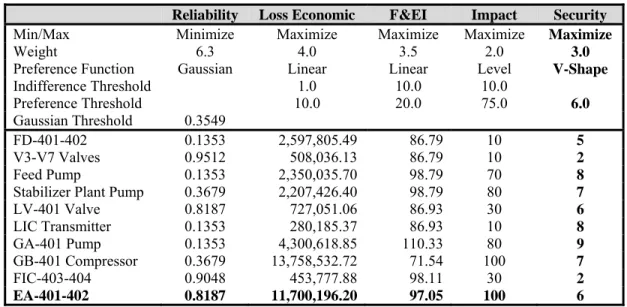
With these intentions the equipment was ranked from the most critical equipment to less important one. The Table 1 shows the complete information for application of PROMETHEE methodology.
Table 1. Complete information for the application of PROMETHEE methodology Reliability Loss Economic F&EI Impact Security
Min/Max Minimize Maximize Maximize Maximize Maximize
Weight 6.3 4.0 3.5 2.0 3.0
Preference Function Gaussian Linear Linear Level V-Shape
Indifference Threshold 1.0 10.0 10.0 Preference Threshold 10.0 20.0 75.0 6.0 Gaussian Threshold 0.3549 FD-401-402 0.1353 2,597,805.49 86.79 10 5 V3-V7 Valves 0.9512 508,036.13 86.79 10 2 Feed Pump 0.1353 2,350,035.70 98.79 70 8
Stabilizer Plant Pump 0.3679 2,207,426.40 98.79 80 7
LV-401 Valve 0.8187 727,051.06 86.93 30 6 LIC Transmitter 0.1353 280,185.37 86.93 10 8 GA-401 Pump 0.1353 4,300,618.85 110.33 80 9 GB-401 Compressor 0.3679 13,758,532.72 71.54 100 7 FIC-403-404 0.9048 453,777.88 98.11 30 2 EA-401-402 0.8187 11,700,196.20 97.05 100 6
The PROMETHEE solution is as follows.
GA-401 Pump Feed Pump GB-401 Compressor
f
f
f
Stabilizer Plant Pumpf
EA-401-402 Heat Exchangers LIC Level Transmitter FD-401-402 Filters LV-401 Valvef
f
f
f
FIC-403-404 Flow Indicators andcontrollers V3-V7 Valves.
f
It appears in the first place the GA-401 Pump, follow by Feed Pump, GB-401 Compressor, Stabilizer Plant Pump, EA-401A/D and EA-402 A/D Heat Exchangers.
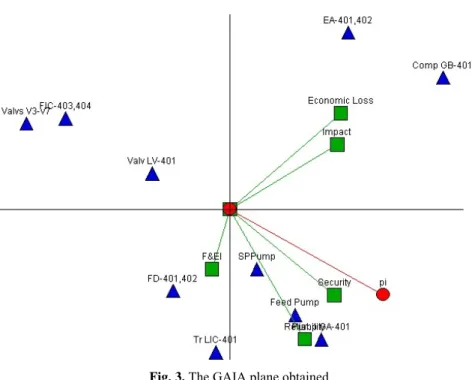
Fig. 3. The GAIA plane obtained
The GAIA plane shows that Economic Loss and Impact are expressing similar preferences, and these criteria are in conflict with the F&EI; Economic Loss and Reliability are rather independent; Heat Exchangers and Compressor are apparently good in Economic Loss and Impact; Stabilizer Plant Pump, Feed pump, GA-401 Pump are rather good in reliability; Filters are apparently good in F&EI; Valves and the Flow Indicators and controllers are never good.
6 Parametric study of the budget through PROMETHEE V
The budget was calculated on the basis of an important reference (The process Economic program, from Stanford Research Institute) [PEP, 1986] where it is recommended that the preventive maintenance cost for major equipment is calculated as 6% of the investment by replacement of the unit processes.
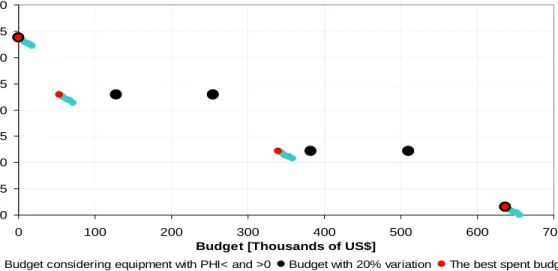
With the aim to show to the decision maker the possible variations of the needed budget to give efficient preventive maintenance, we take the recommendation done by SRI [PEP, 1986] and the real cost of the selected equipment, the needed budget for apply preventive maintenance to all process equipment selected was US$ 654,842. To build a sensitivity analysis, we decrease the budget in intervals of 20% lesser than the needed budget. Considering that PROMETHEE V maximizes the total net flows (Φ) if they are positives, then the negative ones would appears out of the budget, to include these actions with negative net flows in the real budget, a combinatory procedure was made in order to include them. The parametric study is presented in Figure 4 as a graphic measuring the consequences of diminishing the budget interpreted as economic losses.
Economic Loss vs. Budget 0 5 10 15 20 25 30 35 40 0 100 200 300 400 500 600 700
Budget [Thousands of US$]
E c o n o m ic L o s s [ M il lio n s o f U S $ ]
Budget considering equipment with PHI< and >0 Budget with 20% variation The best spent budget
Fig. 4. Behavior of Economic losses versus Budget
7 Conclusions
• The process equipment ranking is the following: GA-401 Pump
f
Feed Pumpf
GB-401 Compressorf
Stabilizer Plant Pumpf
EA-401-402 Heat Exchangersf
LIC Level Transmitterf
FD-401-402 Filtersf
LV-401 Valvef
FIC-403-404 Flow Indicators and controllersf
V3-V7 Valves.• The proposed methodology is really successful because we can obtain the hierarchy of equipment that should receive preventive maintenance considering the more important criteria used in the refinery industry.
• The parametric study of budget, through PROMETHEE 5 Methodology, in order to obtain a preventive maintenance plan, gave us a better appraisal of the whole problem.
• Lesser the maintenance budget more the economic loss that proves the initial hypothesis and objective considered solving this particular problem.
• We think that this methodology can be applied to other sections in a refinery process.
References
1. Almeida AT, Bohoris GA. (1995) “Decision theory in maintenance decision making”. Journal of Quality in Maintenance Engineering; 1(1) 39–45.
2. Bevilacqua M., Braglia M. (1999) “The analytic hierarchy process applied to maintenance strategy selection” Reliability Engineering and System Safety 70 (200) 71.83.
3. Brans J.P. B. Mareschal et al (1984) “PROMETHEE: a new family of outranking methods in multicriteria analysis”. In J. P. Brans, editor, Operational Research ’84; pp 477-490
4. Brans Jean-Pierre and Bertrand Marechal (2002) PROMÉTHÉE-GAIA Une méthodologie d’aide à la décision en presence de critères multiples. Editions de l’Université Libre de Bruxelles.
5. Cavalcante, C.A.V. and de Almeida, A.T. (2007) “A multi-criteria decision-aiding model using PROMETHEE III for preventive maintenance planning under uncertain conditions”. Journal of Quality in Maintenance Engineering. 13 (4): 385 – 397. DOI: 10.1108/13552510710829470
6. Center for Chemical Process Safety (1992). Guidelines for Hazard Evaluation Procedures, with Worked Examples, 2nd Edition, Wiley-AIChE.
7. Creus, Sole. (1992) “Fiabilidad y Seguridad. Su aplicación en procesos industriales”. Marcombo Editores, Barcelona.
8. Crocker J, Kumar UD. (2000) “Age-related maintenance versus reliability centered maintenance: a case study on aero-engines”. Reliability Engineering and System Safety; 67:113–8.
9. NFPA (1994) DOW's Fire & Explosion Index Hazard Classification Guide. Séptima edición. USA.
10. Process Economic Program (1986), PEP YEARBOOK INTERNATIONAL, Stanford Research Institute, United States, Max Sacks Editor.
11. Triantaphyllou E, Kovalerchuk B, Mann L, Knapp GM. (1997). “Determining the most important criteria in maintenance decision making”. Journal of Quality in Maintenance Engineering; 3(1); 16–24.
12. Villacaña Yépez Grethel Leticia, Gómez Rosas Eduardo (2001) Análisis de riesgos en las secciones de carga y fraccionamiento de la unidad hidrodesulfuradora de naftas de la planta hidrodesulfuradora de naftas de la refinería Miguel Hidalgo en Tula, Hidalgo. México, UNAM.
Edgar Sevilla has held his Chemical Engineering and Master in Science degrees from the Faculty of Chemistry, National University of Mexico (UNAM), 2005 and 2007. He has collaborated in a large study about the Petrochemical Industry in Mexico as a coauthor. He has also presented a paper in the 22th European conference on operational research (EURO XXII PRAGE) Currently he is at ICA Fluor as Control Project Engineer.
Carlos Escobar has held his degrees in Chemical Engineering, at Faculty of Chemistry, National University of Mexico (UNAM); Operations Research Master degree in engineering from University of Louvain (Belgium) and System Analysis PhD degree from Aix-Marseille University. He has worked for Petróleos Mexicanos (PEMEX) and also in the Energy Minister as Director General. He was joined UNAM, as full time Professor, where he develops some research in the Energy and Petrochemical fields. He has written some papers applying always System Theory, Operational Research, Chemical Engineering and Information Theory too. He has also presented a lot of papers in International Conferences.