COVER SHEET
This is the author-version of article published as:
Howick, Guy A. and Sullivan, Karen (2003) Comparing primary
heroin and primary amphetamine users’ knowledge of withdrawal
and treatment options in inner metropolitan Brisbane, Australia.
Drugs: Education, Prevention and Policy 10(4):pp. 385-393.
Accessed from
http://eprints.qut.edu.au
© 2003 Taylor & Francis
Running Head: IV drug users withdrawal knowledge
Title
Comparing primary heroin and primary amphetamine users’ knowledge of withdrawal and treatment options in inner metropolitan Brisbane, Australia.
Authors
GUY A HOWICK, B. Psych (Hons) School of Psychology & Counselling
QUEENSLAND UNIVERSITY OF TECHNOLOGY
Brisbane, Australia
& DR KAREN SULLIVAN, PhD School of Psychology & Counselling
QUEENSLAND UNIVERSITY OF TECHNOLOGY
Brisbane, Australia
Disclaimers
The opinions expressed in this paper are those of the authors and do not necessarily reflect the opinions of the Queensland University of Technology.
Correspondence
Dr Karen Sullivan, PhD Lecturer
School of Psychology and Counselling
QUEENSLAND UNIVERSITY OF TECHNOLOGY Carseldine Campus
Beams Rd, Carseldine. Qld 4034. Telephone: (07) 3864 4609 Fax: (07) 3864 4688
E-mail: [email protected]
Keywords: amphetamines, heroin, injecting drug use, treatment, amphetamine withdrawal, amphetamine symptoms, heroin withdrawal, heroin symptoms.
Abstract
The present study compared knowledge of withdrawal and treatment services among 12 primary heroin injectors (PHIs) and 14 primary amphetamine injectors (PAIs). Assessment of knowledge about withdrawal and treatment was made using the Withdrawal Knowledge Questionnaire (WKQ). Results showed that, on average, knowledge about withdrawal differed depending on the drug used. Specifically, regular amphetamine users knew less about withdrawal from amphetamine, than regular heroin users knew about withdrawal from heroin. In addition, amphetamine users appeared to underestimate the likely length of amphetamine withdrawal. There was no difference between regular amphetamine and regular heroin users' knowledge of available treatment services, such that both groups knew where to seek assistance for detoxification and rehabilitation. However, both user groups shared some important misconceptions about withdrawal, suggesting a clear need for improved dissemination of educational resources among inner metropolitan intravenous drug users, emphasizing the length and severity of amphetamine withdrawal and the risks associated with excessive self-medication of withdrawal symptoms.
Comparing primary heroin and amphetamine injectors’ knowledge of withdrawal and treatment options in inner metropolitan Brisbane, Australia.
Amphetamines and heroin are the two most commonly injected illicit drugs in Australia (Australian Institute of Health and Welfare (AIHW), 1998; McAllister & Makkai, 2001). However, a significantly smaller proportion of amphetamine users utilise treatment services compared to the proportion of heroin users in Australia (Darke, Kelaher, Hall, & Flaherty, 1996; McAllister, 2001; Webster, Mattick, & Baillie, 1992). This trend suggests a need to investigate why amphetamine users are not seeking treatment at the same rate as heroin users.
A number of studies have investigated factors that may underlie the lower rate of treatment seeking among amphetamine users compared to heroin users (Hando, Topp, & Hall, 1997; Klee & Morris, 1994; Robson & Bruce, 1997; Vincent, Shoobridge, Ask, Allsop, & Ali, 1999; Wright & Klee, 1999; Writght, Klee, & Reid, 1999). These studies suggest there are two important factors in this regard: first, amphetamine users beliefs about their drug use (e.g. Hando, 1996; Klee, 1998; McElrath & McEvoy, 2001; Wright & Klee, 1999; Wright et al., 1999) and second, perceptions about the ability of drug-treatment facilities to deal with amphetamine-related problems (Hando et al., 1997; Vincent et al., 1999; Wright & Klee, 1999; Wright et al., 1999).
The first factor thought to contribute to lower rates of treatment-seeking by amphetamine users compared to heroin users is users’ beliefs about the substances they use. For example, the literature suggests that amphetamines may be perceived as not as harmful or addictive as heroin, and that these beliefs may be partly due to stereotypes associated with use of these substances (Klee, 1998; McElrath & McEvoy, 2001). For
example, amphetamines (and amphetamine analogues such as “ecstasy” (MDMA)) may be perceived as relatively “soft” drugs (e.g., part of youth culture or the dance-music scene; recreational; energy-giving), whereas heroin may be perceived as a “hard” drug (e.g., more likely to be associated with crime, neglect of self-care or general health problems; see Klee, 1998). Thus, the stereotypes associated with amphetamines and heroin may partly account for amphetamine users’ lower rate of treatment seeking than heroin users’, particularly if they perceive their drug use as under their control
In support of the suggestion that amphetamine users may perceive their drug use as under their control, research on perceptions of the likelihood of achieving abstinence from amphetamine users suggests that amphetamine users may underestimate the difficulty of detoxification. For example, previous research has shown that twice as many treatment-seeking amphetamine users rate achieving abstinence as “very hard” as non-treatment-seeking amphetamine users (Wright & Klee, 1999). This difference suggests that amphetamine users who have never sought to control their use of
amphetamines (to the point of abstinence) may be ill prepared for treatment when they seek it (e.g., they may have unrealistic expectations). Further research is also clearly needed to examine the reasons for this difference (e.g., which aspects of detoxification are perceived differently by in- and out-of-treatment users), as this remains unclear.
The second factor thought to contribute to lower rates of treatment-seeking by amphetamine users compared to heroin users, is beliefs about treatment facilities’ abilities to deal with amphetamine dependence specifically. That is, treatment services may be seen as primarily for those experiencing dependence upon “hard” drugs such as heroin or those who are not “in control” of their drug use. Amphetamine users have been shown to believe that treatment facilities are unable to deal adequately with the
complexities of amphetamine dependence (Hando et al., 1997; Vincent et al., 1999; Wright & Klee, 1999; Wright et al., 1999).
If, as proposed above, the differential rates of treatment-seeking behaviour among heroin and amphetamine users can be partly accounted for by differences in beliefs (and stereotypes) about heroin and amphetamine use, it may be possible to demonstrate this by exploring both groups’ knowledge of the detoxification process associated with their drug of choice. That is, if amphetamine users seek treatment at a lower rate than heroin users because they underestimate the complexities of
amphetamine dependence (they believe their use of amphetamines to be relatively easy to control, for example), it should be possible to show differences in level of
understanding of the withdrawal process associated with each drug by users of that substance. Further, if amphetamine users’ treatment-seeking behaviour is negatively impacted by perceptions about the lack of availability or appropriateness of treatment facilities for them relative to heroin users, this could be explored by assessing users of each substance’s knowledge of treatment services.
Two specific hypotheses were formulated for this study. First, it was expected that knowledge of withdrawal would differ depending on the drug used such that
primary amphetamine injectors (PAIs) would know less about amphetamine withdrawal than primary heroin injectors (PHIs) would know about heroin withdrawal. Second, it was expected that knowledge of available treatment options would differ depending on the drug used, and that PAIs would know less than PHIs about the treatment options available for detoxification and rehabilitation.
Method Participants
Participants were 26 clients of the Needle Syringe Program (NSP) at the Queensland Intravenous and AIDS Association (QuIVAA) situated in inner metropolitan Brisbane, Australia. The sample comprised 12 PHIs and 14 PAIs. The mean age of the sample was 28.12 years (SD = 10.38; range = 18 - 57) and 21 participants were male (81%). All participants volunteered and were reimbursed with confectionary for their participation.
The majority of both primary heroin (91%) and PAIs (71%) were male and single. More than half of all participants were unemployed and living with one or more other drug users. Although both groups had been using their preferred drug for similar periods of time, PHIs were more dependent on their primary drug than PAIs. This finding is consistent with previous studies comparing primary heroin and PAIs’ mean SDS scores (Darke & Hall, 1995; Darke, Kaye, & Ross, 1999). In addition, PHIs reported higher levels of anxiety than PAIs.
Materials
Three self-report measures were utilised in the present study. Two of these were standardised measures: the Severity of Dependence Scale (SDS) (Gossop et al., 1995) and the General Health Questionnaire (GHQ-28) (Goldberg & Williams, 1988). The third, the WKQ, was devised for the present study and was comprised of two subscales. The first subscale of the WKQ was the Withdrawal Knowledge Scale (WKS). This subscale consisted of 24 multiple-choice items each with five-alternatives. The WKS was designed to provide a measure of participants’ knowledge of withdrawal. Three
items also assessed respondents’ knowledge of the relative severity of withdrawal associated with different drugs, including heroin and amphetamines. WKS items were based on Turning Point’s (Melbourne, Australia) “Getting Through Amphetamine Withdrawal” (Lintzeris et al., 1996a) and “Getting Through Heroin Withdrawal” (Lintzeris et al., 1996b) booklets.
The second subscale of the WKS was the Knowledge of Treatment Options Scales (KTOS). The KTOS measured participants’ knowledge of available treatment options, in this case those available to users of either drug in Brisbane, Australia. The KTOS comprised two further subscales, Knowledge of Detoxification Options (KDO) and Knowledge of Rehabilitation Options (KRO), with each subscale containing 10 true/false items.
Two versions of the WKQ were created: an amphetamine-version and a heroin-version. Versions of the WKQ given to primary heroin or PAIs differed only in terminology, such that the terms “speed” and “heroin” were interchanged. In all other respects, both groups were presented with the same questions and options for response. For some items, correct answers varied depending on the primary-substance used. For instance, as presented in Figure 1, ‘B’ is the correct answer for this question on the heroin version of the WKS, whereas ‘C’ is the correct answer for this question on the amphetamine version.
The total score for the WKQ was calculated by summing responses to individual items (1 = correct, 0 = incorrect). Copies of the WKQ are available from the corresponding author on request.
Procedure
Recruitment took place from 16 August to 28 September 2001. Clients of the NSP were approached for recruitment when collecting their injecting equipment. Eligible participants were 18 years of age or older and had to have injected heroin or amphetamines at least once in the previous six months. Completion of the questionnaires took between 15 and 40 minutes. When assigning participants to groups according to their primary drug, poly-drug users who were on the methadone maintenance program were assigned to the heroin group.
Results Sample Characteristics
Results are discussed in three sections. First data on substance use and general health of participants is presented. Second, results for the WKS, KDO and KRO based on total scores are shown. Finally, to gain further insight into the nature of gaps in withdrawal knowledge, an error analysis of WKS items was undertaken.
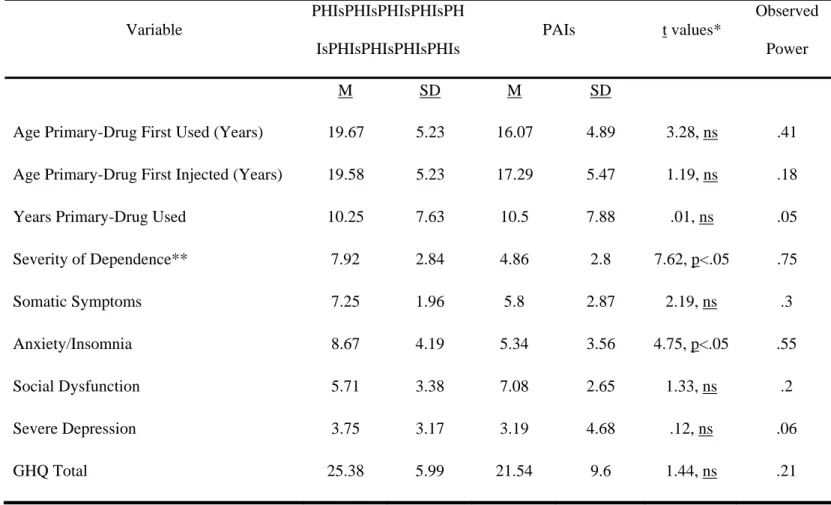
Independent samples t-tests showed that primary heroin injector’s mean SDS scores were significantly higher than PAIs’ (see Table 2). That is, PHIs were significantly more heroin-dependent than amphetamine injectors were amphetamine-dependent. However, PAIs’ SDS scores approximated the threshold of ‘five’, on
average, representing problematic amphetamine use (Topp & Mattick, 1997). Hence, both groups were considered dependent on their primary drug.
Analysis of mean GHQ total scores suggests both groups were generally experiencing similar levels of physical and psychological health (see Table 1). That is, there were no significant differences between primary heroin and PAIs’ mean subscale totals with respect to ‘somatic symptoms’, ‘social dysfunction’ or ‘severe depression’. There was one exception to this general trend: that is, PHIs scored significantly higher than PAIs on the ‘anxiety’ subscale of the GHQ.
Insert Table 1 about here.
PHIs were more experienced with respect to past episodes of withdrawal and seeking information about withdrawal than PAIs. All PHIs (100%) had previously experienced withdrawal at least once, compared to 79% of PAIs. In addition, 92% of PHIs had previously sought information on withdrawal compared to PAIs (65%). However, a similar percentage of primary heroin (58%) and primary amphetamine (50%) injectors had had previous assistance with detoxification from a treatment centre.
Analyses of Total Scores on the WKS, KRO and KDO
The data consisted of the total number of correct responses made by each participant on the WKS, KDO and KRO. Independent groups t-tests were conducted to explore significant differences between the mean number of correct responses made by primary heroin and PAIs on these three scales. As presented in Table 2, PHIs scored significantly higher on the WKS than PAIs. This suggests that PHIs knew more about
heroin withdrawal than PAIs knew about amphetamine withdrawal. However, no significant differences were found between primary heroin and PAIs’ mean total scores on the KDO or KRO. This suggests both groups were equally knowledgeable about treatment options for detoxification and rehabilitation.
Insert Table 2 about here.
Error Analysis of Individual Items on the WKS
Error analysis of the WKQ was undertaken to identify if there were patterns of errors made by the two groups that would suggest participants were either over- or under-estimating withdrawal. Items selected for error analysis were defined as those items answered correctly by less than 50% of the sample.
There were three items for which the majority of participants from each group responded incorrectly (items 1, 14 and 24). These items related to the length of withdrawal from heroin or amphetamines, the relative length of withdrawal for a variety of substances, and the role of medications in alleviating withdrawal symptoms. The pattern of errors in both groups was similar such that both groups: first, underestimated the length of withdrawal from their preferred drug (71% of PAIs thought amphetamine withdrawal takes 4 to 5 days, while 50% of PHIs estimated heroin withdrawal takes no more than 6 to 10 days) (item 1); second, chose an option suggesting they thought medications could stop withdrawal symptoms rather than provide temporary relief (item 14), and; third, underestimated the length of amphetamine withdrawal relative to other substances (50% of amphetamine users and 58% of heroin users thought withdrawal lasted longest for heroin rather than amphetamines, the latter being the correct answer
for this item) (item 24). Hence, both groups underestimated the length of withdrawal from their preferred drug and the severity of amphetamine withdrawal, and overestimated the effectiveness of medication in alleviating withdrawal symptoms.
Finally, more than 50% of PHIs also made errors on three additional items. First, errors by PHIs in this sample suggest they may overestimate when cravings can be expected to dissipate (50% of heroin users overrated the length of time cravings were likely to persist) (item 7). Second, two items dealt with the persistent of cravings and the potential need for inpatient support for heroin relative to amphetamines and other drugs. Primary heroin injectors’ responses on these items suggest that this group may underestimate the extent and severity of amphetamine withdrawal. PHIs. Hence, PHIs underestimated the severity of amphetamine withdrawal and overestimated the persistence of cravings with heroin withdrawal. Overall, both groups underestimated the length and severity of amphetamine withdrawal and shared the belief that medication can stop withdrawal symptoms altogether.
Discussion
The present study examined primary heroin and PAIs’ knowledge of withdrawal processes and treatment options related to these substances. It was expected that PAIs would know less than PHIs about both their potential withdrawal process and their available treatment options. Consistent with expectations, the results of independent groups t-tests showed that PAIs were significantly less knowledgeable than PHIs with respect to withdrawal as measured on the WKS. However, contrary to expectations there was no significant difference between primary heroin and PAIs’ knowledge of treatment services available to them. Both groups were equally aware of appropriate detoxification and rehabilitation services.
These outcomes may be attributable to differences between each group’s withdrawal experience. Around a fifth of PAIs (21%) reported that they had never previously experienced amphetamine withdrawal, despite the fact that both groups had been using their preferred drug for similar periods of time. Likewise, 36% of PAIs had never previously sought information on withdrawal, compared to 8% of PHIs. Hence, PHIs were more likely than PAIs to have been able to draw from both personal accounts of withdrawal and educational resources when responding to WKS items. This finding is consistent with previous research (to the extent that heroin users are more likely to seek treatment than amphetamine users (e.g., McAllister, 2001)), however it may also partly account for PHIs higher WKS scores compared to PAIs.
Another important interpretative caveat on the generalisability of results from this study relates to the nature of the sample used. The characteristics of the present sample suggest it was representative of amphetamine and heroin injecting samples described in previous research that have been drawn from a wide-variety of settings (Darke & Hall, 1995; Darke, Kaye & Ross, 1999; Kaye & Darke, 2000). However, the generalisability of these findings may be limited to intravenous drug users (IDUs) from inner urban districts. That is, participants in this study were mostly male, in their late twenties, single, living with one or more other drug users, and had been using for approximately ten years. The extent to which the results of the present study generalise to intravenous drug users drawn from other settings is an empirical question that merits further research.
Despite these caveats, the results of the present study provide some insight into the nature of misconceptions IDUs may have about withdrawal. As such, these findings may inform the development of relevant educational resources. For example, error
analysis highlighted three factors relating to withdrawal that may require particular emphasis in drug education programs. First, participants’ patterns of errors on the WKS showed that a high percentage of both groups underestimated the length and severity of amphetamine withdrawal. In particular, PAIs tended to underestimate the length of amphetamine withdrawal by at least two weeks. Further, education interventions for both heroin and amphetamine injectors may need to emphasise more strongly the potential return of moderate-to-severe cravings and nervous agitation in the third to fourth week of amphetamine withdrawal. These recommendations have added significance when considering that PHIs are increasingly injecting amphetamines when there is a reduced supply of heroin (McAllister, 2001).
Second, error analysis suggested that PHIs may overestimate the length of time cravings persist with heroin withdrawal. Half of the present sample of PHIs overestimated the length of time cravings are likely to continue before dissipating by at least one week. Hence, educational interventions reinforcing that cravings during heroin withdrawal may not last as long as users’ expect may be important to establish realistic expectations, particularly among those contemplating or attempting heroin withdrawal.
Finally, error analysis indicated primary heroin and amphetamine injectors might be unaware of risks associated with excessive use of medication throughout withdrawal. Specifically, IDUs in this sample reported believing that medication can stop withdrawal symptoms (rather than temporarily reduce symptoms). They did not demonstrate an appreciation of the addictive nature of medications such as benzodiazepines that are used for this purpose. These findings are consistent with previous studies showing high levels benzodiazepine misuse among both heroin and amphetamine users (Darke, 1994; Darke & Hall, 1995; Darke & Ross, 1997), especially
when undergoing self-detoxification (Gossop, Battersby & Strang, 1991). Educational interventions may therefore need to highlight more strongly risks associated with excessive self-medication during heroin or amphetamine withdrawal.
Altering educational resources in the manner outlined above may be especially important for amphetamine users who until now have not sought treatment to the same extent as heroin users. Knowing what to expect is a key ingredient to successfully completing detoxification (Lintzeris et al., 1996a, 1996b). It may be particularly important to ensure that such information is emphasised to amphetamine users given the beliefs they may have about their drug use, particularly the ease with which they believe abstinence may be achieved.
Acknowledgements
The writing up of this research was partly funded by a Manuscript Completion Grant awarded to Karen Sullivan by the School of Psychology and Counselling’s Research and Postgraduate Committee at QUT. This project was completed with the assistance of Gail Hamilton of the Alcohol and Drug Information Service (ADIS), and staff and NSP volunteers at QuIVAA, in particular Jeff DeLandelles, Bob Heaton, Pauline Smith, Roxanne De Jong and Tara Pearson. Finally, a special thank you to the clients of the NSP without whom this project could not have been possible.
References
AUSTRALIAN INSTITUTE OF HEALTH AND WELFARE (AIHW). (2000). 1998 National Drug Strategy Household Survey: Queensland Results (drug statistics series no. 4). Canberra: AIHW.
CANTWELL B., & MCBRIDE A. J. (1998). Self-detoxification by amphetamine dependent patients: a pilot study. Drug and Alcohol Dependence, 49, pp. 157-63.
DARKE S., & HALL W. (1995). Levels and correlates of polydrug use among heroin users and regular amphetamine users. Drug and Alcohol Dependence, 39, pp. 231-5.
DARKE S., KAYE S., & ROSS J. (1999). Transitions between the injection of heroin and amphetamines. Addiction, 94, pp. 1795-1803.
DARKE S., KELAHER M., HALL W., & FLAHERTY B. (1996). Characteristics of admissions to residential drug treatment agencies in New South Wales, 1988-92: I. Illicit drug problems. Drug and Alcohol Review, 15, pp. 127-32. DARKE S. (1994). The use of benzodiazapines among injecting drug users. Drug and
Alcohol Review, 13, pp. 63-9.
DARKE, S., & ROSS, J. (1997). Polydrug dependence and psychiatric comorbidity among heroin injectors. Drug and Alcohol Dependence, 48, pp. 135-41. GOLDBERG D., & WILLIAMS P. (1988). A users’ guide to the General Health
Questionnaire (GHQ). UK: NFER-Nelson.
GOSSOP M, BATTERSBY M, & STRANG J. (1991). Self-detoxification by opiate addicts: a preliminary investigation. British Journal of Psychiatry, 159, pp. 208-12.
GOSSOP M., DARKE S., GRIFFITHS P., et al. (1995). The Severity of Dependence Scale (SDS): Psychometric properties of the SDS in English and Australian samples of heroin, cocaine and amphetamine users. Addiction, 90, pp. 607-614.
HANDO J., TOPP L., & HALL W. (1997). Amphetamine-related harms and treatment preferences of regular amphetamine users in Sydney, Australia. Drug and Alcohol Dependence, 46, pp. 105-13.
HANDO J. (1996). Treatment needs of regular amphetamine users in Sydney. In: TOPP L., DILLON P. (Eds.), Looking to the future: A second generation of drug research. Proceedings from the Tenth National Drug and Alcohol
Research Centre (NDARC) Annual Symposium, October 1996. NDARC monograph no. 29. Sydney: NDARC.
KAYE S., & DARKE S. (2000). A comparison of the harms associated with the
injection of heroin and amphetamines. Drug and Alcohol Dependence, 58, pp. 189-196.
KINNER S. & ROCHE A. (2000). Queensland drug trends 1999: Findings from the 1999 Queensland Illicit Drugs Reporting System (IDRS). National Drug and Alcohol Research Centre technical report no. 87. Brisbane:
Queensland Alcohol and Drug Research Centre.
KLEE H., & MORRIS J. (1994). Factors that lead young amphetamine misusers to seek help: Implications for drug prevention and harm reduction. Drugs: Education, Prevention, and Policy, 1, pp. 289-97.
KLEE H. (1992). A new target for behavioural research – amphetamine misuse. British Journal of Addiction, 87, pp. 439-46.
KLEE H. (1998). The love of speed: an analysis of the enduring attraction of
amphetamine sulphate for British youth. Journal of Drug Issues, 28, pp. 33-56.
LINTZERIS N., DUNLOP A., & THORNTON D. (1996a). Getting through
amphetamine withdrawal. Victoria: Turning Point Alcohol and Drug Centre. LINTZERIS N., DUNLOP A, & THORNTON D. (1996b). Getting through heroin
withdrawal. Victoria: Turning Point Alcohol and Drug Centre.
MCALLISTER I, & MAKKAI T. (2001). The prevalence and characteristics of injecting drug users in Australia. Drug and Alcohol Review, 20, pp. 29-36. MCALLISTER R. (2001). Queensland drug trends 2000: findings from the illicit
drug reporting system (IDRS). National Drug and Alcohol Research Centre technical report no. 106. Brisbane: Queensland Drug and Alcohol Research Centre.
MCELRATH K., & MCEVOY K. (2001). Heroin as evil: ecstasy users’ perceptions about heroin. Drugs: Education, Prevention, and Policy, 8, pp. 177-89. MINISTERIAL COUNCIL ON DRUG STRATEGY (1998). .National drug strategic
framework 1998-99 to 2002-03. Building partnerships: a strategy to reduce the harm caused by drugs in our community. Canberra: AusInfo.
ROBSON P., & BRUCE M. (1997). A comparison of ‘visible’ and ‘invisible’ users of amphetamine, cocaine and heroin: two distinct populations? Addiction, 92, pp. 1729-1736.
TOPP L., & MATTICK R. P. (1997). Choosing a cut-off on the Severity of Dependence Scale (SDS) for amphetamine users. Addiction, 92, pp. 839-45.
VINCENT N., SHOOBRIDGE J., ASK A., ALLSOP S., & ALI R. (1999).
Characteristics of amphetamine users seeking information, help and treatment in Adelaide, South Australia. Drug and Alcohol Review, 18, pp. 63-73. WEBSTER P., MATTICK R. P., & BAILLIE A.J. (1992). Characteristics of clients
receiving treatment in Australian drug and alcohol agencies: a national census. Drug and Alcohol Review, 11, pp. 111-19.
WEISNER C., MERTENS J., TAM T., & MOORE C. (2001). Factors affecting the initiation of substance abuse treatment in managed care. Addiction, 96, pp. 705-16.
WRIGHT S., KLEE H., & REID P. (1999). Attitudes of amphetamine users towards treatment services. Drugs: Education, Prevention, and Policy, 6, pp. 71-86. WRIGHT S., KLEE H. (1999). A profile of amphetamine users who present to
treatment services and do not return. Drugs: Education, Prevention, and Policy, 6, pp. 227-41.
Panel A: Heroin Version
Heroin withdrawal symptoms generally peak (are worst) after:
A. the first day B. 2 to 4 days C. 5 to 10 days D. 11 to 14 days E. 15 to 28 days
Panel B: Amphetamine Version
Speed withdrawal symptoms generally peak (are worst) after:
A. the first day B. 2 to 4 days C. 5 to 10 days D. 11 to 14 days E. 15 to 28 days
Figure 1. An Item From the Version of the WKS Given to PHIs (Panel A) and the Version Given to PAIs (Panel B). The Correct Answer For Each Version Of This Item Is Shown (Circled).
Table 1. PHIs’ and PAIs’ drug-use history, severity of dependence (as measured on the SDS), and health and psychological functioning as measured on the GHQ-28 (N = 26). Variable PHIsPHIsPHIsPHIsPH IsPHIsPHIsPHIsPHIs PAIs t values* Observed Power M SD M SD
Age Primary-Drug First Used (Years) 19.67 5.23 16.07 4.89 3.28, ns .41
Age Primary-Drug First Injected (Years) 19.58 5.23 17.29 5.47 1.19, ns .18
Years Primary-Drug Used 10.25 7.63 10.5 7.88 .01, ns .05
Severity of Dependence** 7.92 2.84 4.86 2.8 7.62, p<.05 .75 Somatic Symptoms 7.25 1.96 5.8 2.87 2.19, ns .3 Anxiety/Insomnia 8.67 4.19 5.34 3.56 4.75, p<.05 .55 Social Dysfunction 5.71 3.38 7.08 2.65 1.33, ns .2 Severe Depression 3.75 3.17 3.19 4.68 .12, ns .06 GHQ Total 25.38 5.99 21.54 9.6 1.44, ns .21
Table 2. PHIs’ and PAIs’ mean scores on the WKS, KDO and KRO (N = 26). Variable PHIsPHIsPHIsPHIsPHIs PHIsPHIsPHIsPHIs PAIs t scores* Observed Power M SD M SD WKS (total) 12.25 2.45 9.14 3.39 6.93, p<.05 .71 KDO (total) 5.75 2.67 4.29 2.43 2.14, ns .29 KRO (total) 4.42 3.18 3.57 2.17 .64, ns .12