Privacy-Preserving Comparison of
Variable-Length Data With Application
to Biometric Template Protection
MARTA GOMEZ-BARRERO1, JAVIER GALBALLY2, AYTHAMI MORALES3, AND JULIAN FIERREZ3
1da/sec-Biometrics and Internet Security Research Group, Hochschule Darmstadt, Darmstadt 64295, Germany 2European Commission Directorate-General Joint Research Center, Ispra 21027, Italy
3Area del Tratamiento de la Voz y la Señal-Biometric Recognition Group, Universidad Autonoma de Madrid, Madrid 28049, Spain Corresponding author: Marta Gomez-Barrero ([email protected])
This work was supported in part by the German Federal Ministry of Education and Research (BMBF); in part by the Hessen State Ministry for Higher Education, Research, and the Arts (HMWK) within the Center for Research in Security and Privacy (CRISP); in part by the Spanish Ministerio de Economia y Competitividad / Fondo Europeo de Desarrollo Regional through the CogniMetrics Project under Grant TEC2015-70627-R; and in part by Cecabank.
ABSTRACT The establishment of cloud computing and big data in a wide variety of daily applications has raised some privacy concerns due to the sensitive nature of some of the processed data. This has promoted the need to develop data protection techniques, where the storage and all operations are carried out without disclosing any information. Following this trend, this paper presents a new approach to efficiently compare variable-length data in the encrypted domain using homomorphic encryption where only encrypted data is stored or exchanged. The new variable-length-based algorithm is fused with existing fixed-length techniques in order to obtain increased comparison accuracy. To assess the soundness of the proposed approach, we evaluate its performance on a particular application: a multi-algorithm biometric template protection system based on dynamic signatures that complies with the requirements described in the ISO/IEC 24745 standard on biometric information protection. Experiments have been carried out on a publicly available database and a free implementation of the Paillier cryptosystem to ensure reproducibility and comparability to other schemes.
INDEX TERMS Privacy, security, homomorphic encryption, template protection, biometrics, signature.
I. INTRODUCTION
In the last few years, the volume of data captured and pro-cessed within cloud platforms has seen a huge increase. In spite of the numerous advantages offered by cloud comput-ing, several unresolved security and privacy threats have been raised. These threats, which include privacy, confidentiality, integrity, and availability of data, are magnified by the vol-ume, velocity, and variety of Big Data [1]. Therefore, while one of the fundamental challenges for Big Data is to extract useful information from large volumes of data, a real-world concern is that such applications are in many cases related to sensitive information, such as banking transactions or medical records [2]. As a consequence, it is of the utmost importance to protect the privacy of such data and its owner, developing privacy preserving data services approaches [3], [4]. In fact, numerous efforts are being directed towards this end within very diverse areas, including genomics [5] or drones [6].
One promising approach to achieve privacy preserving technologies is the use of Fully Homomorphic Encryp-tion (FHE), which allows for computaEncryp-tions to be performed on ciphertexts, generating encrypted results which decrypt to plaintexts that match the result of the operations carried out on the original plaintexts. However, practical implementations of FHE schemes, which allow for real-time computations, still remain a big challenge [7]. Therefore, somewhat Homomor-phic Encryption (HE) schemes, which only allow a limited subset of operations in the encrypted domain, are nowadays being introduced into many signal processing based applica-tions, such as electronic voting, private information retrieval and private searches [8].
More specifically, HE schemes are used in applications where it is required to compare data in a privacy enhancing manner [7], [9]. Such comparison can be established for fixed-length data, using common distance functions, or using variable-length data, via more complex algorithms such as
8606
2169-35362017 IEEE. Translations and content mining are permitted for academic research only.
Dynamic Time Warping (DTW) [10]. Whereas systems using fixed-length data are computationally efficient even con-sidering the overhead introduced by HE, in many cases they present lower accuracy than systems working with variable-length representations. To palliate the lower accu-racy achieved, algorithms such as DTW have been proposed and implemented in the encrypted domain [11] at the cost of a big computational overhead, which is not affordable in real-time applications.
In the present work, we try to tackle those issues by applying different sub-sampling techniques to the input sig-nals in order to reduce the computational complexity of the DTW-based algorithm. Then, in order to compensate for the reduced comparison accuracy derived from this sub-sampling process, the results are fused at score level with a time-efficient approach based on a global fixed-length represen-tation of the data.
One example of the aforementioned applications is biomet-ric recognition, which has emerged over the last decades as a reliable alternative to traditional authentication systems based on something that we know (i.e., PINs or passwords) or some-thing that we have (i.e., IDs or tokens) [12]. This is partly due to the fact that biometric characteristics (e.g., signature, face or iris) cannot be lost or forgotten. On the down side, bio-metric information is very sensitive and some concerns have been raised regarding the privacy of the subjects and the secu-rity of the systems - it has already been proved that samples can be recovered from unprotected templates [13]–[16] and be subsequently used to impersonate genuine subjects [17]. As a consequence, any information leakage resulting from an inappropriate storage of the derived templates can lead to severe privacy and security issues. In fact, biometric data is considered sensitive data in European Union (EU) General Data Protection Regulation 2016/679 [18], which means that the use of these data is subjected to the right of privacy preservation. Biometric templates must be hence protected in order to prevent any potential leakage of the underlying information. Among other approaches to biometric template protection, HE allows to meet the privacy requirements estab-lished within the ISO/IEC 24745 international standard on biometric information protection [19] while preserving veri-fication accuracy [20]–[22].
In order to confirm the validity of the proposed privacy-preserving comparison scheme, we carry out a thor-ough security and privacy evaluation of a biometric tem-plate protection scheme based on the proposed comparison technique. In particular, we have chosen online handwritten signatures as biometric modality, which is one of the most widely spread characteristics due to its traditional legal and social acceptance. For the evaluation, we follow the frame-work established in [23], which assesses all requirements established by the ISO/IEC 24745 standard on biometric information protection [19] for biometric template protec-tion (BTP) schemes:
• Irreversibility: given a protected template, it should leak no biometric information (i.e., it should not be possible
to go back from the template to the biometric sample that originated it).
• Unlinkability: given two templates protected with dif-ferent keys (i.e., enrolled in difdif-ferent systems), it should not be feasible to decide whether they conceal the same biometric instance.
• Renewability: if one template is lost or stolen, it should be possible to issue a new one, not matching the old template.
In addition, and to make the experiments reproducible, a free implementation of the Paillier cryptosystem1 and the signature corpus of the publicly available multimodal BiosecurID database [24] are used.
The main contributions of the article can therefore be summarised in the following:
• First multi-algorithm approach in the encrypted domain for fixed- and variable-length data representations, and its application to the particular case of biometric recog-nition based on online handwritten signature.
• Improvement ofi) the computational complexity of the approach proposed in [25] and of ii) the verification accuracy achieved by the system proposed in [26]. • Full evaluation of the proposed multi-algorithm
biomet-ric template protection system according to the ISO/IEC IS 24745 requirements, following a reproducible exper-imental protocol.
• First unlinkability analysis of biometric template protec-tion schemes based on Homomorphic Encrypprotec-tion. The rest of the article is structured as follows. Related works on biometric template protection are summarised in Sect. II. Sect. III describes the Paillier cryptosystem. Sect. IV presents the unprotected comparison scheme. The protected comparison approach is described in Sect. V, and the complete biometric verification process to be evaluated is summarised in Sect. VI. The accuracy, irreversibility, unlink-ability and complexity overhead of the biometric template protection scheme are analysed in Sect. VII, and final con-clusions are drawn in Sect. VIII.
II. RELATED WORKS
As mentioned in Sect. I, the ISO/IEC 24745 standard on biometric information protection [19] establishes three main requirements for biometric template protection (BTP) sys-tems (i.e., irreversibility, unlinkability and renewability). At the same time, verification accuracy of encrypted tem-plates, verification time and storage requirments should be maintained with respect to the unprotected data [27].
Fulfilling the aforementioned requirements while minimis-ing the accuracy degradation is not an easy task. Different approaches, mostly based oncancelable biometrics(i.e., irre-versible transformations of the unprotected template which allow a comparison in the protected domain) or cryptobio-metrics(i.e., a cryptographic key is either bound or extracted 1Publicly available at http://www.csee.umbc.edu/˜kunliu1/research/ Paillier.html
from the biometric data) have been proposed in the liter-ature [28], [29]. More recent approaches based on Homo-morphic Encryption and Garbled circuits can be classified within a new class, known as biometrics in the encrypted domain. Unlike cancelable biometrics, protected templates can be in this case decrypted with the secret key and re-encrypted with a different key, thereby granting renewability with no re-acquisition of the biometric data. On the other hand, there is no relationship between the biometric data and the cryptographic key as in biometric cryptosystems, thereby allowing for a higher level of security.
In the present section, we review the existing BTP schemes based on signature. For an exhaustive review of works deal-ing with with cancelable biometrics and cryptobiometrics
template protection for biometric characteristics other than signature, the reader is referred to [30], [31].
A pioneering research line on BTPs for on-line signa-ture relies on irreversible transformations that obscure the extracted features (i.e., cancelable biometrics). Although these techniques grant in most cases irreversibility, they usu-ally result in some accuracy degradation. For instance, in the BioConvolving scheme [32], the original Hidden Markov Model (HMM) is trained with irreversibly transformed time sequences. On the other hand, in [33], a functibased on-line signature template protection system is proposed, where the time sequences are transformed in an irreversible manner. Performances degrade over 10% for all scenarios tested.
Another research line that has been studied for the devel-opment of template protection approaches in on-line signa-ture is the use of fuzzy-based schemes, which account for the vast mayority ofcryprobiometric systems. For instance, [34] proposes a fuzzy vault system based on minutiae extracted from on-line signatures. The fuzzy commitment paradigm was applied in [35] to a dynamic signature recog-nition system based on UBM-HMM (Universal Background Model-HMM), achieving a remarkable verification accuracy. Similarly, [36] presents a biometric cryptosystem based on hashes, while a BCH error correcting code and helper data were used in the scheme described in [37].
The main drawback of these cryptobiometric methods is that they useAuxiliary Data(AD), which can be exploited in order to obtain information about the hidden biometric data. This way, the privacy of the subject is violated, which entails that the irreversibility requirement is not fully met [38]–[40]. Additionally, as in the case of cancelable biometrics, crypto-biometric systems usually present a performance degradation with respect to the original systems relying on unprotected data.
As an alternative to the aforementioned approaches, secure multiparty computation and homomorphic cryptosystems can be used in order to carry out biometric recognition in the encrypted domain while obtaining results fully comparable to those yielded by plain data [7], [41]. In particular, cur-rent approaches tobiometrics in the encrypted domain[22] are based on Garbled Circuits (GC) [42] and Homomorphic Encryption (HE) [7], [43].
Since efficient implementations of HE schemes are very recent [44], only a fewunimodal biometric systems based on this protection technology have been proposed so far. In [21], the authors present a new fingerprint verification sys-tem based on the FingerCode fixed-length representation of fingerprints and HE. An improved version of that approach is suggested in [45]. In [46], Eigenface based templates are pro-tected with HE. Then, a more efficient approach is presented in [47] using GCs for the threshold comparison. Furthermore, the SCiFI project [48] proposes a biometric identification algorithm specifically designed for a more efficient usage in secure computation, based on fixed-length templates with a constant Hamming weight. In [49], a secure iris BTP based on a combination of HE and GCs is proposed, handling encrypted iriscodes.
More recently, a general framework for fast and privacy-preserving distance computation, known as GSHADE and based on oblivius transfers, is proposed in [50]. In this work, the authors present particular implementations based on Gar-bled Circuits for several distance metrics and apply them to face, iris and fingerprint samples.
Regarding signature-based schemes, in [25] an on-line signature verification scheme is proposed, based on HE and a direct comparison of variable length functions extracted from the input signature. Even if a state-of-the-art verification accuracy is achieved, each comparison takes approximately one minute, thereby preventing its use in real time applica-tions or where restricapplica-tions on the amount of exchanged data are low. On the other hand, a more efficient scheme based on a fixed-length global representation of the signature is described in [26]. The main drawback of this last system is the accuracy degradation with respect to that of more sophisticated comparison algorithms such as [25].
III. PAILLIER CRYPTOSYSTEM
We will use the following notation in the subsequent sections: • GXFg = {gx1, . . . ,gxf, . . . ,gxFg}: unprotected
fixed-length representation, comprisingFgfeaturesgxf. • SXU×Fs: unprotected variable-length representation,
comprisingFs sequences ofU time samples. Theu-th point of the sample is anFs-dimensional vectorSX[u]=
sxu = {sxu
1, . . . ,sxFus}. To simplify notation, to refer to
anygeneric point we will usesx= {sx1, . . . ,sxFs} • The set of both fixed- and variable-length
representa-tions belonging to a single data item (in our experi-ments one handwritten signature) will be denoted as
FX =
GXFg,SXU×Fs (where FX stands for full representation).
• m and m∗: plain message and its corresponding
ciphertext.
• m∗=Epk(m,s), whereE denotes the encryption func-tion,sa random number andpkthe public key.
• m=Dsk(m∗), whereDdenotes the decryption function andskthe private key.
The multi-algorithm comparison strategy proposed in the present work (described in Sect. V) is based on the
specific implementation of the HE paradigm proposed by Paillier in [44]. In particular, all the operations involved in the similarity score computation are carried out in the encrypted domain. Therefore, for completeness, some impor-tant concepts related to the Paillier homomorphic proba-bilistic encryption scheme are introduced here, as they are key to the understanding of the proposed privacy-preserving comparison scheme.
The Paillier cryptosystem is based on the decisional com-posite residuosity assumption: given a comcom-posite n and an integer z, it is hard to decide whether z is an n-residue
modulo n2. As any other public key encryption scheme,
it requires two separate keys: i) a public key pk = (n,g),
wheren = pqwithpandq two large prime numbers such
that gcd(pq, (p−1) (q−1)) = 1, andg ∈ Z∗
n2; andii) a secret keysk = (λ, µ), whereλ = lcm(p−1,q−1)and
µ= gλ modn2−1 modn.
Given a message m ∈ Zn, its encryption is denoted as
m∗=Epk(m,s)∈Z∗n2, and computed as follows:
m∗=Epk(m,s)=gm·sn modn2 (1) wheres∈Z∗
nis a random number, generated a each encryp-tion process, and hence providing the probabilistic nature of the cryptosystem. It should be noted that s is not needed for decryption, and a single value forsshould not be used multiple times, dince it would decrease the security level of the system.
Then, in order to decrypt the ciphertextm∗, we have
m=Dsk m∗=L
m∗λ modn2·µ modn (2) whereL(t)=(t−1) /n.
Two properties of Paillier cryptosystem will be used in the present scheme. First, the product of two ciphertexts,m∗1and
m∗2, will decrypt to the sum of their corresponding plaintexts:
Dsk
m∗1·m∗2 modn2=m1+m2 modn (3) Second, an encrypted plaintext,m∗1, raised to a constantl, will decrypt to the product of the plaintext and the constant:
Dsk
m∗1l modn2=m1·l modn (4) In order to avoid overcomplicated notation, in the descrip-tion of the algorithm the keyspkandsk, as well as the random numbers, will be omitted. Therefore, a generic cyphertextm∗
will be simply denoted asE(m).
IV. UNPROTECTED MULTI-ALGORITHM COMPARISON
In order to compare variable-length time sequences, the Dynamic Time Warping (DTW) algorithm has been widely used in the literature [10]. More specifically, within the biometric community, high accuracy rates within the state-of-the-art have been obtained for different character-istics, including EEGs [51] or handwritten signatures [25]. However, as mentioned in Sect. I, implementations of DTW in the encrypted domain show two major drawbacks [25]:
i) the high computational complexity andii) the increased storage requirements. Since both aspects are directly linked to the length of the input signals, these will be sub-sampled in order to achieve a more efficient system. However, such an approach may lead to degradation on comparison accu-racy [52]. In order to minimise that degradation, the proposed system is based on the combination of two comparison schemes:
• A variable-length based algorithm, which compares
sub-sampled sequences with the DTW algorithm. In order to obtain a similarity score between the probe (SXU×Fs) and the reference data items (SYV×Fs), a cost matrix (PathU×V), minimizing the Euclidean distance between sequence points is computed. The final dissimilarity score is the last cell of the matrix:
SDTW =Path[U,V].
• An efficient but less accurate comparison algorithm
based on a global fixed-length descriptor, GX, which compares the data items in terms of their Euclidean dis-tancedeuc. Therefore, it outputsSGF =deuc2 (GX,GY). Since this representation will comprise information complementary to that of the sub-sampled sequences compared with the DTW algorithm, it is expected to pal-liate the accuracy degradation due to the sub-sampling of the original signals.
In order to output a single similarity scoreS, after obtain-ing both partial scores SGF and SDTW, they need to be
i) normalised to a common range, and ii) fused. For the normalisation of the individual scores, several approaches are proposed in [53]. However, it is not possible to imple-ment most of them in the encrypted domain without increas-ing the computational overhead. We therefore implement a different and simpler approach, which achieves the same accuracy as the min-max rule proposed for unprotected data in [53].
Without loss of generality, we can assume that
SDTW > SGF. If the opposite is true, both scores need to be exchanged in the following computations in order to obtain integer parametersαandβ, necessary for the Paillier cryptosystem. We can then perform the following normalisa-tion, which in turn can be easily computed in the encrypted domain (see Sect. V-C):
SGF0 =βSGF ⇒E SGF0
=
E(SGF)β (5) whereβ, the normalising parameter, is estimated as the
aver-age ratio between SDTW and SGF for genuine comparison
scores.
Lastly, the final score is computed as the weighted sum of the two partial scores:
S=α·β·SGF+(10−α)·SDTW (6) whereα∈ [0,10] is the integer weight applied to the fixed-length score,SGF, andβ is the aforementioned normalising parameter.
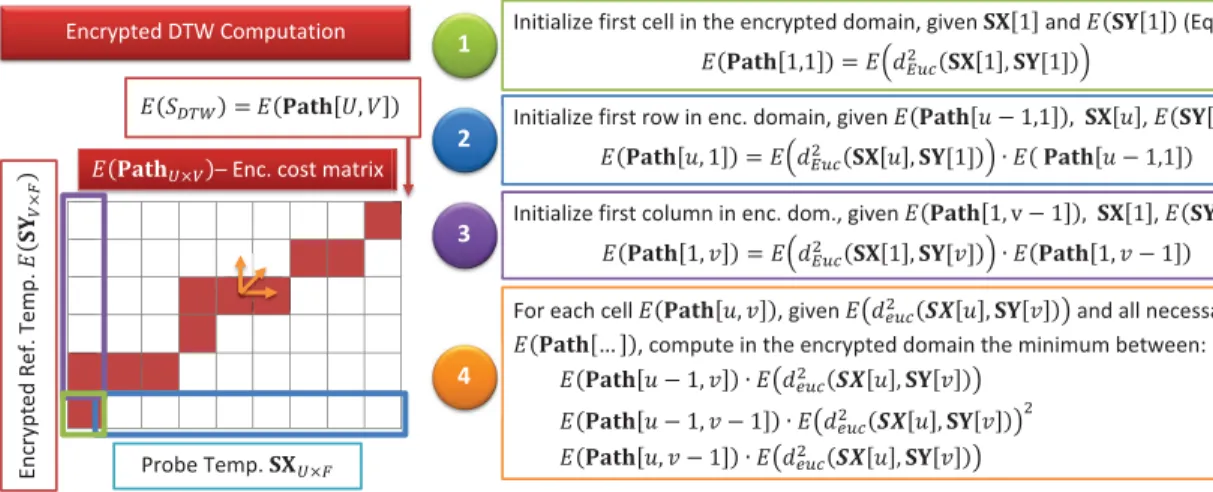
FIGURE 1. Encrypted DTW. In order to compare the probeSXU×Fsand the referenceSYV×Fsdata items, the optimal path, depicted
in red, minimizing the Euclidean distance between points, is computed following the DTW algorithm. An encrypted cost matrix,Path
is built in four steps. The last entry of the matrix contains the final encrypted scoreE SDTW
.
V. PROTECTED MULTI-ALGORITHM COMPARISON
As mentioned in Sect. IV, the proposed multi-algorithm comparison approach is based on the score level fusion of two different comparison schemes: i) one based on fixed length global descriptors and the Euclidean distance;ii) a sec-ond one based on variable-length local descriptors and the DTW algorithm. Their corresponding implementations in the encrypted domain and the score level fusion are described in the following sections.
A. ENCRYPTED EUCLIDEAN DISTANCE
Both unencrypted comparison algorithms (see Sect. IV) ultimately rely on the Euclidean distance. Given two
F-dimensional pointsxandy, in the unprotected domain the Euclidean distancedeuc2 (x,y), can be computed as
deuc2 (x,y)= F X f=1 xf2+y2f −2xfyf (7)
Then, using Eqs. 3 and 4, the encrypted distance can be directly computed in the encrypted domain without perform-ing any encryptions in the client (see Sect. VI and Fig. 2 for more details on the client-server model) as
Edeuc2 (x,y)= F Y f=1 E(1)xf2·Ey2 f ·E yf −2xf = F Y f=1 1∗x2f ·euc2∗ f · euc1∗f −2xf (8)
The reference data item (i.e., in biometrics the subject’s reference template) stored in the encrypted database is thus defined by the following ciphertexts:
E(Y)euc=1∗ ∪neuc1∗f,euc2∗foF
f=1 (9)
whereeuc1∗f =E yf
andeuc2∗f =Ey2f.
B. ENCRYPTED VARIABLE-LENGTH DATA COMPARISON BASED ON DTW
The particular implementation of the encrypted DTW pro-posed in the present article is shown in Fig. 1. In contrast to the unencrypted algorithm, all computations are now car-ried out directly in the encrypted domain. The algorithm computes an encrypted cost matrixE(PathU×V), obtained from a plain probe item SXU×Fs and an encrypted refer-ence itemE SYV×Fs
, minimising the distance between item data points in terms of their Euclidean distance. The final encrypted comparison score is the last cell of a matrix, namely
E(SDTW) = E(Path[U,V]). For the computations, Eqs. 3 and 4 are applied to convert the unprotected scheme to the encrypted domain: summations of plaintexts are substituted by products, and products of plaintexts by exponentiations.
As it may observed in Fig. 1, in order to compute the encrypted cost matrix, the encrypted Euclidean distance between data points will be calculated using Eq. 8. After initialising the first row and column of the cost matrix (steps 1 to 3), only three different directions are consid-ered to the compute the best path at each new cell of the matrix (step 4). As a consequence, in order to grant the required privacy to the subject, an additional issue needs to be solved in the encrypted domain: compute the minimum between three encrypted values in theE(Path)matrix.
Encrypted Minimum Computation: In order to compute the minimum between three values, without revealing any information about the plain values involved to the server, a two-phase protocol is established:
• The client generates a set of K random values R =
{rmin,r2, . . . ,rK}, whererk > rminfork = 2, . . . ,K. Then, the values to be minimized (m1,m2,m3) are obscured by addingrminto each of them:
E(mi)→E(mi+rmin)=E(mi)·E(rmin) fori=1,2,3
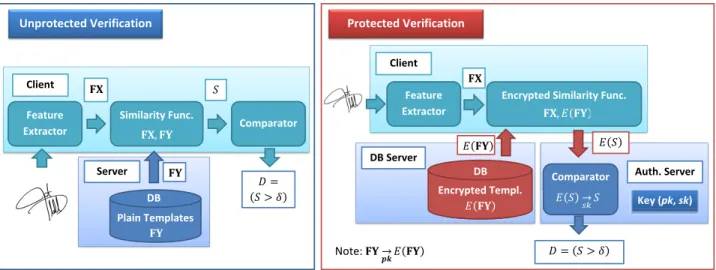
FIGURE 2. Unprotected vs Protected Biometric Verification. In the unprotected scenario (left), a probe biometric sample is acquired and its features extracted (FX). The final output is the binary decisionD= S> δ
, whereSis computed as the similarity distance with respect to the stored unprotected reference (FY). In the protected scenario (right), all the encrypted data or information flow is depicted in red:E FY
andE S
.
To further hide those values,K−1 additional numbers
are generated by i) randomly choosing one of those
original three values(E(mk))andii) obscuring it with the corresponding value inR,rk:
E(mk)→E(mk)·E(rk) fork=2, . . . ,K Therefore, the complete listE(minList)comprises the aforementionedK+2 encrypted and obscured values. • The client then sends the complete listE(minList)to
the authentication server, who decrypts all the values using its secret key sk, computes the obscured mini-mum, encrypts it again, and sends it back to the client:
E(minCost+rmin).
Finally, the client can compute the encrypted minimum value as
E(minCost)=E(minCost+rmin)·E(rmin)−1 For a more detailed description of the algorithm, the inter-ested reader is referred to [25].
C. ENCRYPTED SCORE LEVEL FUSION
As described in Sect. IV, the two, now protected, individual scores E(SGF) andE(SDTW) need to be fused into a sin-gle final encrypted score E(S). From Eq. 6, and applying Eqs. 3 and 4, it follows that the final encrypted scoreE(S)
can be directly computed from the partial encrypted scores,
E(SGF)andE(SDTW):
E(S)=E(SGF)α·β ·E(SDTW)10−α (10)
VI. BIOMETRIC TEMPLATE PROTECTION SCHEME
Taking into account the encrypted multi-algorithm compari-son scheme described in Sect. V, we can define a complete
encrypted verification process applicable to biometric tem-plate protection. To that end, we first need to define a security model and then the steps needed to carry out biometric veri-fication in a privacy-preserving manner under the constraints of that security model.
A. SECURITY MODEL
In the present section we describe the general security model considered in this work, including all the assumptions made regarding the expected behaviour (honest or malicious) of each of the entities involved in the biometric recognition pro-cess. This way the reader can have a more general perspective of how different threats have been taken into account and how the proposed scheme deals with several privacy and/or security risks.
First, a general diagram of the unencrypted biometric veri-fication system is depicted in Fig. 2 (left), where two entities are involved:
• A client, which will acquire the probe biometric sam-ple, extract the features and encode them in the tem-plateFX, generate the similarity score betweenFXand the reference templateFY, and compute the final gen-uine/impostor verification decisionD=(S > δ), where δis the pre-defined verification threshold.
• A server, which will hold the database with the refer-ence templatesFYand send them to the client during verification.
In order to increase the privacy of the subject, the server must process the client’s biometric data without disclosing at any point any unprotected sensitive information, and at the same time, the server must protect the information stored in the database [54]. To that end, a different security model is used in theprotectedsystem (see Fig. 2, right) where all the data, either stored or shared between client and server in the
FIGURE 3. General diagram of the proposed encrypted verification process. A local client acquires and extracts the features of the probe signature (SXU×FsandGXFg) and computes the encrypted dissimilarity scores (E SGFandE SDTW) between the probe and the reference
signatures (SYV×FsandGYFg), in collaboration with the authentication server, which holds the key pair (pk,sk) and outputs the final decision.
The DB server holds the encrypted database. All the encrypted values, either stored or transmitted on the communication channel, are depicted in red.
verification process, should be encrypted. Therefore, the new entities and roles are the following:
• The client acquires the probe biometric sample, extracts the templateFXand generates the encrypted scoreE(S)
(see Sect. V), sending it to the authentication server.
• The DB server holds the database comprising only
encrypted templates, and sends the encrypted reference templateE(FY)to the client during verification. • The authentication server holds the key pair (sk,pk)
and computes the final genuine/impostor decision D. It should be noted that a single key pair will be used for all subjects enrolled in the system.
With respect to the security model proposed in other bio-metric template protection approaches [55], in the present scheme the sensor and comparator have been integrated into a single entity: the client. Therefore, the requirements on the data flow described in [55] to fulfil the aforementioned irreversibility and unlinkability criteria have been adapted to the present model as:
• The authentication server should not learnFYorFX.
• The DB server should not learn FY or FX, or trace
subjects.
• The client should not learnFY.
To fulfil those requirements we assume that:
• According to the honest-but-curious adversary
model [56], all parts involved follow the protocols
honestly. As a consequence, we may assume that the scores computed by the client are correct.
• An adversary may have access to one of the servers, but the authentication and DB servers will not collude. More details on the full protected verification process are described in Sect. VI-B. In addition, a detailed unlinkability and irreversibility analysis based on this security model is provided in Sects. VII-E and VII-F, respectively.
B. ENCRYPTED MULTI-ALGORITHM VERIFICATION PROCESS
Building upon the security model described in Sect. VI-A, the final encrypted verification process comprises ten steps (see Fig. 3):
0) During enrolment, the reference templatesSYandGY
are acquired, encrypted using the server public keypk
to generate E(SY) and E(GY) (Eq. 1) and finally stored in the database.
1) The client captures the probe sample and extracts the templatesGXandSX.
2) The client sends to the DB server the encrypted ID,
E(ID), of the client to request the appropriate reference templateE(FY).
3) The DB server sends the encrypted reference templates
4) a. The client computes the global features similarity score, according to Eq. 8,E(SGF).
Steps 4b to 7 are related to the iterative encrypted DTW verification algorithm, depicted inside a green box in Fig. 3. In order to obtain the encrypted score,
E(SDTW), between de probe template, SXU×Fs, and the encrypted reference,E SYV×Fs
, each value of the encrypted cost matrix E(Path[u,v])is computed as follows (see Fig. 1 and Sect. V-B):
4) b. The client calculates the encrypted Euclidean distanceE deuc2 (SX[u],SY[v])according to Eq. 8.
5) Ifu,v6=1 (Fig. 1 step 4), the minimum between three values is computed following the two step pro-tocol established above. In this first step, the client generates an encrypted list of valuesE(minList)and sends it to the server.
6) The server decrypts the list usingsk, finds the obscured minimumminCost+rminand re-encrypts it withpk.
7) The server sends the re-encrypted minimum value to the client, setting E(Path[u,v]) =
E(minCost)=E(minCost+rmin)·E(rmin)−1. 8) When the iterative process is finished, the client
computes the fused score E(S) from E(SDTW) =
E(Path[U,V])andE(SGF)(Eq. 10).
9) The client then sendsE(S)to the authentication server. 10) The authentication server decrypts the score withsk,
obtainingS.
11) In the last step, the authentication server generates and outputs the final binary verification decision:
D=(S > δ).
VII. EXPERIMENTAL EVALUATION
In this section, we analyse whether the proposed protec-tion scheme fulfils the requirements established within the ISO/IEC IS 24745 [19]. To that end, all experiments are carried out on the BiosecurID multimodal database [24], described in Sect. VII-A, and an implementation of an on-line signature based verification system, described in Sect. VII-B. We have analysed the impact of signal sub-sampling on its accuracy in Sect. VII-C1. Then, for the encrypted system we additionally analyse: i) accuracy preservation (Sect. VII-C2), ii) time and storage complexity
preser-vation (Sect. VII-D), iii) irreversibility of the
tem-plates (Sect. VII-E), and iv) unlinkability of the
templates (Sect. VII-F).
A. EXPERIMENTAL ON-LINE SIGNATURE DATABASE Experiments have been run on the on-line signature sub-corpus of the BiosecurID database [24], which comprises data belonging to 400 subjects. Signatures were captured in four sessions over a four month period with a Wacom Intuos3 A4/Inking pen tablet, including four genuine sig-natures and three skilled forgeries per session and sub-ject. In order to allow comparisons with future studies, the unprotected templates will be made public through the http://atvs.ii.uam.es/databases.jsp website.
In addition, two different scenarios are considered:
• Random forgeries: impostor scores are computed
com-paring the subject’s signature to genuine signatures belonging to other subjects (different from the owner). In other words, an eventual impostor tries to fool the system using his own signature.
• Skilled forgeries: impostor scores are computed com-paring the subject’s signature to imitations of his own signature made by other subjects, with differ-ent skill levels. See the database description for more details [24].
B. UNPROTECTED ON-LINE SIGNATURE VERIFICATION SYSTEM
For fixed-length verification, as proposed in [57], a set of 100 global features xf is extracted from the x and y coordinates, and the pressure signal, and then normalized to the range [0,1] using tanh estimators. The bestFg = 40 normalized features according to [58] are selected to form the final templateGX40 = {x1, . . . ,x40}. Then, the Euclidean distance will be used to compute the similarity scores, as it performs better than the Mahalanobis distance proposed in [57].
For the identity verification based on variable-length tem-plates, a subset ofFs = 9 time sequences selected using the Sequential Forward Floating Selection (SFFS) algorithm from the total set of functions defined in [57], is directly compared using DTW [10]. Those time sequences include, for instance, the horizontal x and vertical y coordinates, the speed or the pressure.
C. ACCURACY ANALYSIS: UNPROTECTED vs PROTECTED SYSTEM
As pointed out in a [25], the complexity of the DTW scheme depends on the square of the number of samples of the considered signature. Therefore, sub-sampling the signatures will considerably reduce the time needed for verification as well as the storage requirements.
As a consequence, the accuracy analysis has a twofold
objective: i) assess the impact of sub-sampling
(Sect. VII-C1) on the verification accuracy of the DTW based scheme, and ii) select the adequate configuration for the final system, which will be implemented in the encrypted domain (Sect. VII-C2. In order to evaluate the accuracy, the first 350 subjects are enrolled and modelled with the four signatures captured in the first session, being the samples of the remaining 50 subjects used for the random forg-eries comparisons in order to avoid biased results. More specifically, the first four samples of each subject are used at enrolment. Then, the remaining 12 samples are used to compute the genuine scores (350×12=4,200 scores). The fifth sample of each of the 50 impostors is compared to the enrolled models for the random impostor score computation (350×50 = 17,500 scores). Finally, all 12 skilled forg-eries are used for the skilled impostor scores (350×12 = 4,200 scores).
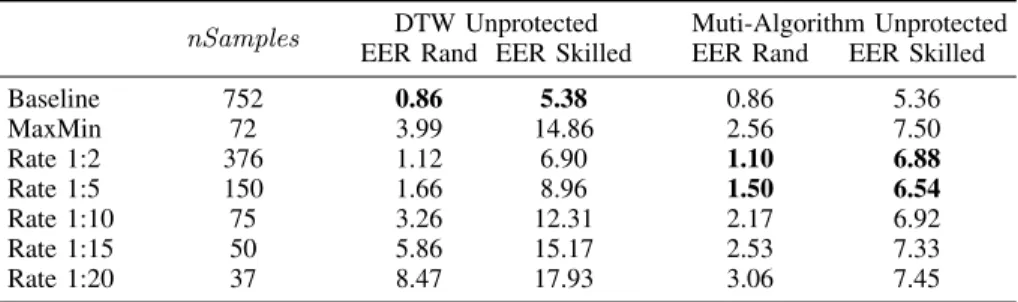
TABLE 1. Accuracy analysisof the two sub-sampling approaches, for different sampling rates, in terms ofnSamplesand the EER (in %) for the unimodal unprotected DTW-based scheme and the multi-algorithm approach.
1) SUB-SAMPLING TECHNIQUES
We will consider in the present article two different approaches for sub-sampling signature sequences:
• Fixed rate: for a given sub-sampling rate sRate, one out of eachsRatesamples will be selected (denoted as 1:sRate).
• MaxMin: in this case, first the local maxima and
min-ima of each x andy signals will be computed. Then,
the corresponding samples in all three input signals (x,yandp) will be retained. Since those are the points in which the signer changes the direction, they should contain the most discriminative information of the sig-nature, thereby providing a minimal loss on verification accuracy.
2) ACCURACY RESULTS
We now evaluate the performance of the aforementioned approaches in terms of the average number of samples of the sub-sampled signatures (nSamples) and the verification accu-racy of the multi-algorithm based scheme. Details are given in Table 1, where the Equal Error Rate (ERR) of the DTW based system (second and third columns), and for the multi-algorithm system (fourth and fifth columns) are shown for sub-sampling configuration, as well as for the baseline (first row), together with the corresponding average number of samples (nSamples, first column).
As it may be observed, the MaxMin sampling strategy offers no clear advantages: whereasnSamples is similar to a fixed rate ofsRate = 10, in both the skilled and random forgeries scenarios MaxMin yields a higher EER (3.99% vs 3.25% and 14.86% vs 12.31%). Consequently, given its higher complexity due to the maxima and minima computa-tion, in the rest of the article we will focus on the fixed rate sampling strategy.
In this latter case, we may observe that, when only the DTW scheme is taken into account, accuracy drops quickly (i.e., the EER increases), specially in the random
forgeries scenario for sRate ≥ 10. Nevertheless, it may
observed on the last two columns of Table 1, where the performance of the multi-algorithm scheme is analysed, that the highersRate, the more effective the fusion with the fixed-length scheme is. This is due to the fact that the accuracy of the DTW decreases withsRate, but the fixed-length scheme
remains the same, since those templates are computed on the original signature, where no sub-sampling has been applied.
In order to grant a low accuracy degradation, in the following subsections we will consider the schemes with
sRate= {2,5}, which achieve the lowest EERs as highlighted in Table 1.
Taking those remarks into account, we evaluate the accuracy degradation at all operating points. To that end,
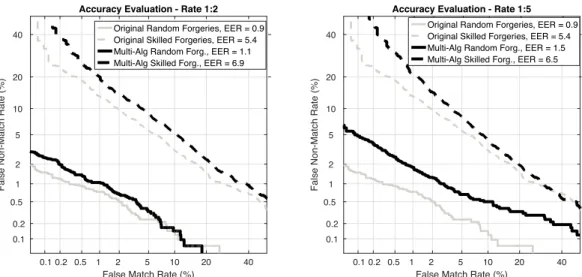
the Detection Error Trade-off (DET) curves for sRate =
2 (left) and sRate = 5 (right) are depicted in Fig. 4,
both for the random forgeries (solid lines) and the skilled forgeries (dashed lines) scenarios. In both cases, the multi-algorithm based approach (in black) is compared to the original DTW approach (in grey) where no sub-sampling is applied. Since verification accuracy is fully preserved at all operating points, the DET curves of the protected and unprotected systems overlap completely. Therefore, to make the figures easier to read, we have only depicted the protected system DETs.
As it may be observed, accuracy is almost preserved for
sRate=2, especially in the random forgeries scenario. In the
case of sRate = 5, accuracy is more severely degraded.
More specifically, the EER raises raises 75% and 22% with respect to the original DTW algorithm for the random and skilled forgeries, respectively. However, the time and storage requirements and verification time are considerable reduced (see Sect. VII-D).
D. COMPLEXITY ANALYSIS: UNPROTECTED vs PROTECTED SYSTEM
The complexity of the proposed approach is analysed and compared to the method presented in [25], in terms of the most costly operations (encryptions, decryptions, exponentiations and products), the storage requirements, the amount of data exchanged between server and client, and the time needed for verification. Results are sum-marised in Table 2, where experiments have been run on a machine with an Intel Core i7 with four 2.67 GHz cores on Java. Since the complexity of the fixed-length system is negligible with respect to DTW, only the latter will be analysed.
As indicated in [25], the number of encryptions and decryptions carried out depends on the square ofnSamples.
FIGURE 4. Accuracy analysis: DET curves of the original unimodal DTW scheme, with no sub-sampling (grey), and for the proposed multi-algorithm scheme for the corresponding values ofsRate(black), considering random
forgeries (solid) or skilled forgeries (dashed).
TABLE 2. Complexity analysisfor the proposed scheme, compared to the unimodal DTW-based schemes presented in [25].
The number of operations is showed for the client/server.
Therefore, forsRate=5, complexity is reduced by 25 times, thereby enabling a much faster comparison of signatures. Additionally, it should be noted that the single comparison of the fixed-length templates can be computed in parallel with the much more costly DTW-based algorithm, hence requiring no additional time. These facts lead to a reduction in the time needed for verification from one minute to approximately three seconds (0.04 minutes).
In a similar manner, the amount of data either exchanged or stored in the reference template are reduced from 864 MB and 3.30 MB in [25], to 36 MB and 0.66 MB, respectively. Compared to the unprotected verification, where only 0.01 MB are stored or exchanged, there is still a big gap. However, current technologies allow a real-time verification for the proposed multi-algorithm approach, at a small cost in terms of verification accuracy (see Fig. 4).
E. IRREVERSIBILITY ANALYSIS: PROTECTED SYSTEM Unlike the analysis of the accuracy and the complexity, in this case the irreversibility of the unprotectedsystem is not studied because, by default, unprotected systems have been proven to be reversible [14]–[16]. That is, in fact, one of the main purposes of developing a protected system: adding
irreversibility to the original unprotected system, as requested by the ISO/IEC International Standard 24745 [19].
To grant such irreversibility, and following the security model described in Sect. VI-A, three different pieces of information should be hidden: i) only the client can have access to the plain probe biometric data FX, ii) the plain reference templates FY should not be seen by any entity, being only their encrypted versionE(FY)stored, andiii) the plain scoreS should not be transmitted as it can potentially be used to perform hill-climbing [59] or inverse-biometrics attacks [15], [16].
For each distance measure considered, the information exchanged from the DB server to the client is the encrypted reference templateE(FY). Given that the decisional compos-ite residuosity is an NP-hard problem, decoding the templates withoutsk could be considered computationally infeasible. Therefore, since only the authentication server knows the decryption key, sk, but he has never access to any pro-tected or unpropro-tected templates, there is no way for the client or any of the servers to learn any information from it. Conversely, the client sends no information about the acquired probe samplesFXto any server. We may thus con-clude that the first requirement established by the ISO/IEC 24745 standard, irreversibility, is met.
F. UNLINKABILITY AND RENEWABILITY ANALYSIS: PROTECTED SYSTEM
As in the case of irreversibility, unprotected systems are, by definition, fully linkable and not renewable, which leads to a severe information leakage from the subject’s privacy protection perspective. As a consequence, in this section we will only analyse if the protected system is able to add unlink-ability and renewunlink-ability to the original system, as required by the ISO/IEC International Standard 24745 [19].
On the one hand, it should be noted that a different key pair(sk,pk)will be used for each application, and utilised to encrypt all the information within that particular application. Therefore, it will provide the desiredrenewabilityproperty: different protected templates can be generated from a single sample using different keys. In addition, should a key pair be compromised, the database can be regenerated by decrypting and re-encrypting all templates with a new key pair sk0,pk0. Regardingunlinkability, from a theoretic perspective, since unencrypted distances (i.e., similarity scores) between plain-texts are not preserved in the encrypted domain, given two
samples M1 and M2 belonging to a given subject, their
corresponding protected templates E FX1
and E FX2
, encrypted with the same key at different times (due to the probabilistic nature of Paillier cryptosystem) or different keys, are not related. On the other hand, since the Pail-lier cryptosystem provides semantic security against chosen-plaintext attacks [60], given a protected template E FX1
, no information can be feasibly derived about the original unprotected featuresFX1. That way, no comparison can be established in the unprotected domain between some kind of information retrieved from the protected templates.
In addition, only the encrypted ID, E(ID), is shared between the client and DB server. Such encrypted ID will have a different value at each attempt due to the probabilistic nature of the Paillier cryptosystem (see Eq. 1). As a conse-quence, an eventual eavesdropper will not be able to track the verification attempts of a single client.
In addition to that theoretical analysis, an experimental evaluation of the unlinkability of the templates is carried out, following the unlinkability analysis framework proposed in [23]. In the following we summarise this evaluation proto-col, and we referer the reader to [23] for more details on the computations.
Two templates,E(FX)andE(FY), enrolled in different applications (and eventually protected with different keys), are defined as linkable if an eventual attacker can determine whether they were extracted from mated instances, and hence conceal a unique identity. Therefore, an eventual attacker launching a cross-matching attack to take advantage of this particular vulnerability of the BTP scheme can be assumed to:
• be in possession of two protected templates,E(FX)and
E(FY), enrolled in different applications,
• following Kerckhoffs’s principle [61], know how the
system works and, in particular, theMated instancesand
Non-mated instancesscore distributions.
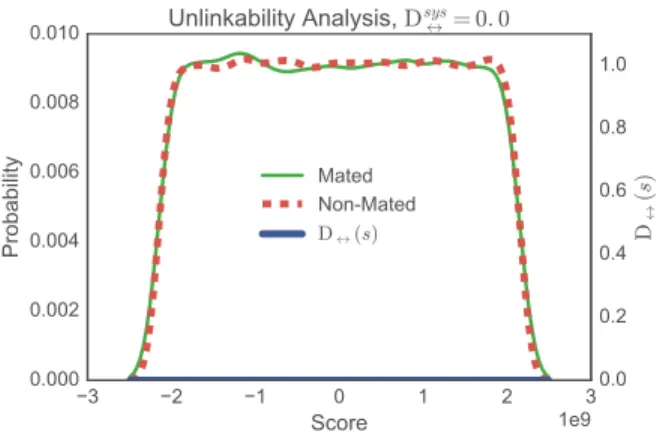
FIGURE 5. Unlinkability analysis: scores distributions for comparisons
belonging toMated instances(green) or toNon-mated instances(red). D↔(s)(blue) represents the local linkability measure.
To reach his goal of determining whether both protected templates,E(FX)andE(FY), conceal the same biometric instance (i.e., they represent different samples of biomet-ric data extracted from the same biometbiomet-ric instance - e.g., the same left index finger), he computes a dissimilarity score between them,s=DS(E(FX) ,E(FY)). This function will be defined by the attacker ad-hoc in order to compromise the unlinkability of the system (i.e., it can be the dissimilarity score of the system or any other more sophisticated function to compare the templates and link them). Then, givens, he will decided whether or not it stems from a mated instances comparison: if it does, the attack will have succeeded. On the other hand, if such a positive decision (i.e., both templates come from the same instance) cannot be made based on the computeds, the attacker will have failed in his goal.
As a consequence, in order to evaluate the unlinkabiliy of the templates, the correspondingMated instances(in green, and stemming from similarity scores between samples of the same instance protected with different keys) and Non-mated instances(in red, and stemming from similarity scores between samples of different instances protected with differ-ent keys) score distributions are depicted in Fig. 5. Those distributions are quantitatively compared in terms of two different measures:
• Local measure D↔(s): it evaluates the linkability of the templates in a score-wise basis. If for a specific scores1, a system yields D↔(s1) = 1, it means that,in casea cross-matching attack produceds1, the attacker would be able to link both templates E(FX)and E(FY) to the same instance with almost all certainty. On the other hand, D↔(s0)=0 should be interpreted as full unlinka-bility for that particular scores0. All intermediate values of D↔(s)between 0 and 1 report an increasing degree of linkability.
• Global measure Dsys↔: it gives an overall measure of the linkability of the whole system, independent of the score domain of the system at hand, thereby allowing a comparison among different systems. This way, if a system has Dsys↔ =1 (i.e., case in which both theMated
samplesandNon-mated samplesdistributions have no overlap), it means that it is fully linkable for all the scores of theMated samplesdistribution domain (i.e., whereD↔(s)=1). Similarly, Dsys↔ =0 means that the system is fully unlinkable for the whole score domain, since both distributions overlap for the whole domain of scores. All intermediate values of Dsys↔ between 0 and 1 report a decreasing degree of unlinkability (i.e., increasing degree of linkability).
In order to compute such metrics, we need to take into account the key on the success of a cross-matching attack: determining whether, given a score s, it is more likely that two templates stem from mated samples,p(Hm|s), than from non-mated samples, p(Hnm|s). Therefore, such linkability can be accounted for in terms of the difference of conditional probabilities of each hypothesis Hm and Hnm for a given scores:
D↔(s)=p(Hm|s)−p(Hnm|s) (11) However, these two conditional probabilities are unknown. What can be computed a priori, and is known for each system, are the Mated and Non-mated samples distributions (i.e.,
p(s|Hm)andp(s|Hmn)), that is, the probability of observing
sknowing that two templates belong to mated samples or to non-mated samples. We can therefore compute Eq. 11 in terms of the likelihood ratio between these probabilities.
For the global linkability measure, Dsys↔, we are interested in measuring how likely it is to get a score stemming from the
Mated samplesdistribution. This can be achieved computing the difference p(Hm∩s)− p(Hnm∩s) and integrating it over the whole score domain. However, regarding the suc-cess of cross-matching attacks, we are only interested in the probabilities stemming from theMated samplesdistribution. In addition, as in the definition of the local linkability measure D↔(s), a cross-matching attack will only be successful if
p(Hm|s) >p(Hnm|s). We can hence define Dsys↔ as: Dsys↔ =
Z smax smin
p(s|Hm)·D↔(s)ds (12) We have depicted in Fig. 5 the local linkability measure
D↔(s)in blue. As it may be observed, bothmated(green) andnon-mated(red) score distributions overlap completely, thereby preventing the success of a cross-matching attack: given a particular scores, the eventual attacker cannot deter-mine whether the corresponding templates conceal the same identity. As a consequence, the local linkability measure D↔(s) = 0 for all s, which in turn this leads to a global linkability value of Dsys↔ = 0. We may therefore conclude that the encrypted templates are fully unlinkable.
VIII. CONCLUSIONS
We have proposed a time-efficient, secure and privacy-preserving comparison scheme based on Homomorphic Encryption through combination of fixed-length and sub-sampled variable-length descriptors. As a case study, we have applied the proposed general approach to an on-line signature
based biometric system, achieving a high accuracy, almost comparable to that of state-of-the-art unprotected schemes, at the cost of a reasonably low computational overhead.
A theoretical and empirical analysis of the irreversibility and unlinkability of the protected templates has been carried out. The results show that all requirements established within the ISO/IEC IS 24745 [19] are met. Furthermore, protected templates are compressed to 20% of the original size and the amount of exchanged data is reduced to less than 5% with respect to the original approach [25]. Consequently, verification in real-time applications is allowed, solving most of the practical implementation issues detected in the original approach described in [25].
It should be also noted that, even if only a subsampling value of 1:5 has been analysed in the case of the protected system, higher rates can be considered to further reduce ver-ification time, at the cost of some accuracy degradation (as it has been seen in the case of the unprotected system). In future works, we will study how to further improve verification accuracy using subject-specific thresholds [63] or quality measures [64].
Finally, regarding the overall security and privacy pro-tection offered by biometric systems, the reader should bear in mind that these systems are vulnerable to external attacks carried out by malicious adversaries, as first stated by Rathaet al.. Biometric template protection technologies such as the one proposed in this article are not enough to tackle all vulnerabilities: additional countermeasures need to be applied. For instance, Presentation Attacks (PA) refer to the use of synthetic artifacts or the alteration of someone’s real biometric charateristics with the goal of either impersonating another subject or avoid being recognised, according to the ISO/IEC IS 30107 on Presentation Attack Detection (PAD). These attacks can be prevented by the addition of PAD tech-niques. Furthermore, internal modules of the system (e.g., feature extractor or comparator) can be overriden with Tro-jan horses such that they always output the values desired by the adversary. These attacks can be counterfeited with secure code execution practices. Similarly, an adversary can intercept and modify the data being transferred between such internal modules. A countermeasure for this attack is to use time-stamps or a challenge/response mechanism.
In this context, note that we defined an informal security model in Sect. VI-A to analyse some of the benefits of the proposed methods (e.g., eavesdroppers will obtain no information about the original biometric data and subject’s activities cannot be tracked). As future work we foresee the application of more comprehensive security models [56] to the proposed approach for privacy-preserving comparison of variable-length data.
REFERENCES
[1] I. A. T. Hashem, I. Yaqoob, N. B. Anuar, S. Mokhtar, A. Gani, and S. U. Khan, ‘‘The rise of ‘big data’ on cloud computing: Review and open research issues,’’Inf. Syst., vol. 47, pp. 98–115, Jan. 2015.
[2] X. Wu, X. Zhu, G.-Q. Wu, and W. Ding, ‘‘Data mining with big data,’’ IEEE Trans. Knowl. Data Eng., vol. 26, no. 1, pp. 97–107, Jan. 2014.
[3] R. Agrawal and R. Srikant, ‘‘Privacy-preserving data mining,’’ inProc. ACM SIGMOD Rec., vol. 29. 2000, pp. 439–450.
[4] Y. Lindell and B. Pinkas, ‘‘Privacy preserving data mining,’’J. Cryptol., vol. 15, no. 3, pp. 177–206, Jun. 2002.
[5] M. Naveedet al., ‘‘Privacy in the genomic era,’’ACM Comput. Surv., vol. 48, no. 1, pp. 1–44, 2015.
[6] R. Finn and A. Donovan,The Future Drone Use. New York, NY, USA: Springer, 2016, pp. 47–67.
[7] C. Aguilar-Melchor, S. Fau, C. Fontaine, G. Gogniat, and R. Sirdey, ‘‘Recent advances in homomorphic encryption: A possible future for signal processing in the encrypted domain,’’IEEE Signal Process. Mag., vol. 30, no. 2, pp. 108–117, Mar. 2013.
[8] X. Yi, R. Paulet, and E. Bertino,Homomorphic Encryption and Applica-tions. New York, NY, USA: Springer, 2014.
[9] J. R. Troncoso-Pastoriza and F. Perez-Gonzalez, ‘‘Secure signal processing in the cloud: Enabling technologies for privacy-preserving multimedia cloud processing,’’IEEE Signal Process. Mag., vol. 30, no. 2, pp. 29–41, Mar. 2013.
[10] A. Kholmatov and B. Yanikoglu, ‘‘Identity authentication using improved online signature verification method,’’Pattern Recognit. Lett., vol. 26, no. 15, pp. 2400–2408, 2005.
[11] H. Zhu, X. Meng, and G. Kollios, ‘‘Privacy preserving similarity evaluation of time series data,’’ inProc. Int. Conf. Extending Database Technol. (EDBT), 2014, pp. 499–510.
[12] A. K. Jain, ‘‘Biometric recognition,’’Nature, vol. 449, no. 7158 pp. 38–40, 2007.
[13] J. Galbally et al., ‘‘An evaluation of direct attacks using fake fin-gers generated from ISO templates,’’Pattern Recognit. Lett., vol. 31, pp. 725–732, Jun. 2010.
[14] R. Cappelli, A. Lumini, D. Maio, and D. Maltoni, ‘‘Fingerprint image reconstruction from standard templates,’’ IEEE Trans. Pattern Anal. Mach. Intell., vol. 29, no. 9, pp. 1489–1503, Sep. 2007.
[15] J. Galbally, A. Ross, M. Gomez-Barrero, J. Fierrez, and J. Ortega-Garcia, ‘‘Iris image reconstruction from binary templates: An efficient probabilis-tic approach based on geneprobabilis-tic algorithms,’’Comput. Vis. Image Under-stand., vol. 117, no. 10, pp. 1512–1525, 2013.
[16] M. Gomez-Barrero, J. Galbally, A. Morales, M. A. Ferrer, J. Fierrez, and J. Ortega-Garcia, ‘‘A novel hand reconstruction approach and its appli-cation to vulnerability assessment,’’Inf. Sci., vol. 268, pp. 103–121, Jun. 2014.
[17] A. Hadid, N. Evans, S. Marcel, and J. Fierrez, ‘‘Biometrics systems under spoofing attack: An evaluation methodology and lessons learned,’’IEEE Signal Process. Mag., vol. 32, no. 5, pp. 20–30, Sep. 2015.
[18] EU Regulation 2016/679 on the Protection of Individuals With Regard to the Processing of Personal Data and on the Free Movement of Such Data (General Data Protection Regulation), Eur. Parliament, Brussels, Belgium, 2016.
[19] ISO/IEC JTC1 SC27 Security Techniques, ISO/IEC 24745:2011. Informa-tion Technology—Security Techniques—Biometric InformaInforma-tion ProtecInforma-tion, Int. Org. Standardization, Geneva, Switzerland, 2011.
[20] S. Ye, Y. Luo, J. Zhao, S.-Ching, and S. Cheung, ‘‘Anonymous biomet-ric access control,’’EURASIP J. Inf. Sec., vol. 2009, no. 1, pp. 1–17, Nov. 2009.
[21] M. Barniet al., ‘‘A privacy-compliant fingerprint recognition system based on homomorphic encryption and fingercode templates,’’ inProc. Int. Conf. Biometrics, Theory Appl. Syst. (BTAS), 2010, pp. 1–7.
[22] J. Bringer, H. Chabanne, and A. Patey, ‘‘Privacy-preserving biometric iden-tification using secure multiparty computation: An overview and recent trends,’’IEEE Signal Process. Mag., vol. 30, no. 2, pp. 42–52, Mar. 2013. [23] M. Gomez-Barrero, C. Rathgeb, J. Galbally, C. Busch, and J. Fierrez, ‘‘Unlinkable and irreversible biometric template protection based on bloom filters,’’Inf. Sci., vols. 370–371, pp. 18–32, Nov. 2016. [24] J. Fierrezet al., ‘‘BiosecurID: A multimodal biometric database,’’Pattern
Anal. Appl., vol. 13, pp. 235–246, May 2010.
[25] M. Gomez-Barrero, J. Galbally, and J. Fierrez, ‘‘Variable-length template protection based on homomorphic encryption with application to signa-ture biometrics,’’ inProc. Int. Workshop Biometrics Forensics (IWBF), Mar. 2016, pp. 1–6.
[26] M. Gomez-Barrero, J. Galbally, E. Maiorana, P. Campisi, and J. Fierrez, ‘‘Implementation of fixed-length template protection based on homomor-phic encryption with application to signature biometrics,’’ inProc. IEEE Conf. Comput. Vis. Pattern Recognit. Workshops (CVPRW), Jun. 2016, pp. 259–266.
[27] K. Simoenset al., ‘‘Criteria towards metrics for benchmarking template protection algorithms,’’ inProc. Int. Conf. Biometrics, 2012, pp. 498–505. [28] P. Tuyls, B. Skoric, and T. Kevenaar, Eds., ‘‘Security with noisy data,’’ in On Private Biometrics, Secure Key Storage and Anti-Counterfeiting. New York, NY, USA: Springer, 2007.
[29] P. Campisi, Ed.,Security Privacy Biometrics. Springer, 2013.
[30] C. Rathgeb and A. Uhl, ‘‘A survey on biometric cryptosystems and cance-lable biometrics,’’EURASIP J. Inf. Sec., vol. 3, pp. 1–25, Dec. 2011. [31] V. M. Patel, N. K. Ratha, and R. Chellappa, ‘‘Cancelable biometrics: A
review,’’IEEE Signal Process. Mag., vol. 32, no. 5, pp. 54–65, Sep. 2015. [32] P. Campisi, E. Maiorana, J. Fierrez, J. Ortega-Garcia, and A. Neri, ‘‘Cance-lable templates for sequence-based biometrics with application to on-line signature recognition,’’IEEE Trans. Syst., Man Cybern., A, Syst. Humans, vol. 40, no. 3, pp. 525–538, May 2010.
[33] E. Maiorana, M. Martinez-Diaz, P. Campisi, J. Ortega-Garcia, and A. Neri, ‘‘Template protection for HMM-based on-line signature authentication,’’ inProc. IEEE Comput. Soc. Workshop Biometrics, Jun. 2008, pp. 1–6. [34] A. Kholmatov and B. Yanikoglu, ‘‘Biometric cryptosystem using online
signatures,’’ inProc. Int. Symp. Comput. Inf. Sci., 2006, pp. 981–990. [35] E. A. Rua, E. Maiorana, J. L. A. Castro, and P. Campisi, ‘‘Biometric
template protection using universal background models: An application to online signature,’’ IEEE Trans. Inf. Forensics Sec., vol. 7, no. 1, pp. 269–282, Feb. 2012.
[36] M. R. Freire, J. Fierrez, J. Galbally, and J. Ortega-Garcia, ‘‘Biometric hash-ing based on genetic selection and its application to on-line signatures,’’ in Proc. Int. Conf. Biometrics, 2007, pp. 1134–1143.
[37] M. R. Freire, J. Fierrez, and J. Ortega-Garcia, ‘‘Dynamic signature ver-ification with template protection using helper data,’’ inProc. Int. Conf. Acoust., Speech Signal Process., ICASSP, 2008, pp. 1713–1716. [38] T. Ignatenko and F. M. J. Willems, ‘‘Biometric systems: Privacy
and secrecy aspects,’’ IEEE Trans. Inf. Forensics Sec., vol. 4, no. 4, pp. 956–973, Dec. 2009.
[39] T. Ignatenko and F. M. J. Willems, ‘‘Information leakage in fuzzy commitment schemes,’’IEEE Trans. Inf. Forensics Sec., vol. 2, no. 5, pp. 337–348, Jun. 2010.
[40] C. Rathgeb and A. Uhl, ‘‘Statistical attack against fuzzy commitment scheme,’’IET Biometrics, vol. 1, no. 2, pp. 94–104, Jun. 2012.
[41] R. L. Lagendijk, Z. Erkin, and M. Barni, ‘‘Encrypted signal processing for privacy protection: Conveying the utility of homomorphic encryption and multiparty computation,’’IEEE Signal Process. Mag., vol. 30, no. 1, pp. 82–105, Jan. 2013.
[42] A. C.-C. Yao, ‘‘How to generate and exchange secrets,’’ inProc. Annu. Symp. Found. Comput. Sci., 1986, pp. 162–167.
[43] C. Fontaine and F. Galand, ‘‘A survey of homomorphic encryption for non-specialists,’’EURASIP J. Inf. Sec., vol. 2007, no. 1, pp. 1–15, Dec. 2007. [44] P. Paillier, ‘‘Public-key cryptosystems based on composite degree
residu-osity classes,’’ inProc. EUROCRYPT, 1999, pp. 223–238.
[45] T. Bianchi, S. Turchi, A. Piva, R. D. Labati, V. Piuri, and F. Scotti, ‘‘Implementing fingercode-based identity matching in the encrypted domain,’’ inProc. Workshop Biometric Meas. Syst. Sec. Med. Appl., 2010, pp. 15–21.
[46] Z. Erkin, M. Franz, J. Guajardo, S. Katzenbeisser, I. Lagendijk, and T. Toft, ‘‘Privacy-preserving face recognition,’’ inProc. Int. Symp. Privacy Enhancing Technol. Symp., 2009, pp. 235–253.
[47] A.-R. Sadeghi, T. Schneider, and I. Wehrenberg, ‘‘Efficient privacy-preserving face recognition,’’ inProc. Int. Conf. Inf., Sec. Cryptol., 2010, pp. 229–244.
[48] M. Osadchy, B. Pinkas, A. Jarrous, and B. Moskovich, ‘‘SCiFI—A sys-tem for secure face identification,’’ inProc. IEEE Symp. Sec. Privacy, May 2010, pp. 239–254.
[49] M. Blanton and P. Gasti, ‘‘Secure and efficient protocols for iris and fingerprint identification,’’ inProc. Eur. Symp. Res. Comp. Sec., 2011, pp. 190–209.
[50] J. Bringer, H. Chabanne, M. Favre, A. Patey, T. Schneider, and M. Zohner, ‘‘GSHADE: Faster privacy-preserving distance computation and biometric identification,’’ inProc. ACM Workshop Inf. Hiding Multimedia Sec., 2014, pp. 187–198.
[51] E. Maiorana, D. L. Rocca, and P. Campisi, ‘‘Cognitive biometric cryptosys-tems a case study on eeg,’’ inProc. Int. Conf. Syst., Signals Image Process., Sep. 2015, pp. 125–128.
[52] M. Martinez-Diaz, J. Fierrez, M. R. Freire, and J. Ortega-Garcia, ‘‘On the effects of sampling rate and interpolation in hmm-based dynamic signature verification,’’ inProc. Int. Conf. Doc. Anal. Recognit., vol. 2. Sep. 2007, pp. 1113–1117.