Global Journal of Computer Science and Technology
: CSoftware & Data Engineering
Volume 14 Issue 2 Version 1.0 Year 2014Type: Double Blind Peer Reviewed International Research Journal Publisher: Global Journals Inc. (USA)
Online ISSN: 0975-4172 & Print ISSN: 0975-4350
Quantifying COTS Components Selection using Multi Criteria
Decision Analysis Method PROMETHEE
By Kulbir Kaur & Harshpreet Singh
Lovely Professional University, India
Abstract-
Component Based Development relies on already existing components to develop the system. Itoffers various advantages as increase in productivity, reduced development effort and time. The biggest challenge is to select the appropriate component from number of alternatives based on the quality parameters. In this paper COTS component selection is reduced to a multi criteria decision problem by quantifying it with PROMETHEE method. PROMETHEE is an outranking method which better supports the evaluation and selection from various alternatives based on the functional and non-functional requirements. The aim of this paper is to show the application of PROMETHEE in evaluating, analysing and selecting the appropriate COTS component with respect to requirements. The paper also discusses the procedure and benefits of using PROMETHEE method over the other MCDA methods.
Keywords:
COTS, CBD, MCDA, PROMETHEE, AHP, WSM.
GJCST-C Classification:
K.6.3
QuantifyingCOTSComponentsSelectionusingMultiCriteriaDecisionAnalysisMethodPROMETHEE
© 2014. Kulbir Kaur & Harshpreet Singh. This is a research/review paper, distributed under the terms of the Creative Commons Attribution-Noncommercial 3.0 Unported License http://creativecommons.org/licenses/by-nc/3.0/), permitting all non-commercial use, distribution, and reproduction inany medium, provided the original work is properly cited.
Quantifying COTS Components Selection using
Multi Criteria Decision Analysis Method-
Kulbir Kaur α & Harshpreet Singhσ
Abstract- Component Based Development relies on already existing components to develop the system. It offers various advantages as increase in productivity, reduced development effort and time. The biggest challenge is to select the appropriate component from number of alternatives based on the quality parameters. In this paper COTS component selection is reduced to a multi criteria decision problem by quantifying it with PROMETHEE method. PROMETHEE is an outranking method which better supports the evaluation and selection from various alternatives based on the functional and non-functional requirements. The aim of this paper is to show the application of PROMETHEE in evaluating, analysing and selecting the appropriate COTS component with respect to requirements. The paper also discusses the procedure and benefits of using PROMETHEE method over the other MCDA methods.
General Terms: selection, alternative, criteria, rank, degree, preference, profile.
Keywords: COTS, CBD, MCDA, PROMETHEE, AHP, WSM.
I.
I
ntroductionomponent Based Development (CBD) relies on reusable COTS components to build the software systems. Before integrating the components into the system, the components should be quantified according to the non-functional and functional requirements.
With the rapid growing and changing of technology, number of products or tools entering in the market also increases. So it becomes a big challenge to select the best component from a number of alternative components and to build a trust on the selected components.
Component selection and evaluation is a multi criteria problem in which a component from various alternatives is to be selected which best satisfies the maximum criteria than others. A chosen option should have greater rank on all criteria than others.
Author α: Student, School of CSE and IT, Lovely Professional University, Phagwara, Punjab. e-mail: [email protected]
Author σ: Assistant Professor, School of Computer Science and Engineering, Lovely Professional University, Phagwara, Punjab. e-mail: [email protected]
II.
L
iteratureR
eviewCOTS-Aware Requirements Engineering and Software Architecting (CARE/SA) proposed by Lawrence [8] for evaluating, matching and selecting of COTS components. CARE/SA method uses the architectural aspects, functional aspects and non-functional aspects of COTS components. It indicates that each component is represented by the unique attributes which consists of its architectural, functional and non-functional aspects.
Hamdy Ibrahim et al. in [7] proposed a method named ‘UnHOS’ (Uncertainty Handling in COTS Selection) method for the evaluation of COTS components and takes into account their uncertainty. It uses Analytic Hierarchy Process (AHP) for the evaluation of COTS components and Bayesian Belief Network (BBN) to indicate their uncertainty. It also presents a tool to support the usability of the UnHOS method.
Anil Jadhav et al. in [3] tells that Multi Criteria Decision Making Methods helps the decision makers to solve the problem of selection and evaluation of software components in which problem is defined as a collection of multiple criteria that needs to be taken into account. It gives the overview of Multi Criteria Decision Making Methods like: Analytic Hierarchy Process (AHP), Weighted Scoring Method (WSM) and Hybrid Knowledge Based System (HKBS). It compares the three approaches and concludes that HKBS is better than AHP and WSM.
C
Global Journal of Computer Science and Technology Volume XIV Issue II Version I
53 (DDDDDDDD ) Year 2014 c
PROMETHEE
Various methods can be used as a solution of this problem like OSTO [2], CARE [8], AHP [3], WSM [3], Utility Theory [1], SMART [1], DesCOTS [9], UnHOS [7] etc. Multi Criteria Decision Analysis methods help
the decision maker to select the best option from number of multi criteria alternatives which best scores on multiple criteria. PROMETHEE is a multi criteria method proposed by JP Brans in 1982 [6]. It can be applied for the analysis and selection of components and solutions in various kinds of fields like Banking, Industrial Location, Manpower planning, Water resources, Investments, Medicine, Chemistry, Health care, Tourism, Ethics in OR, Dynamic management [6]. It can be applied to selection and evaluation of COTS components while making the decision to select components from repository to develop the software system. The aim of this paper is to apply PROMETHEE on the selection and evaluation of software packages and its benefits over others multi criteria methods.
Arvinder Kaur et al. in [2] provide a brief overview of the evolutionary techniques. It also derives a hierarchical decomposition method to draw goals from that impact factors. It introduces OSTO method for the selection of software components which compares the scores and cost associated to each alternative and their relative comparison. It introduces various factors in the selection of reusable software components. It also presents the evaluation criteria based on various classifications as functional requirements, product quality attributes, strategic concerns and architecture and domain compatibility. It gives the result of two case studies using OSTO method. The component which have good quality assurance score is selected for consideration.
III.
M
ultiC
riteriaD
ecisionA
nalysisM
ethodMulti criteria problem involves the selection of the best option from a number of alternatives on the basis of multiple criteria satisfaction with higher degree. As component selection is a multi-criteria problem, there are number of alternatives for the solution of problem and we have to select a candidate component which best suits for the solution on the basis of satisfying maximum criteria than others with higher degree. So problem can be formulated as:
max {c1an,c2an……ckan|an∈A}.
Let A= {a1, a2, a3………..an} be the set
of ‘n’ alternatives for the solution of the problem.
C= {c1, c2, c3………ck} be the set of ‘k’ criteria
as a basis of evaluation and selection.
Let w1,w2,w3………wk be the weight of each criterion
respectively.
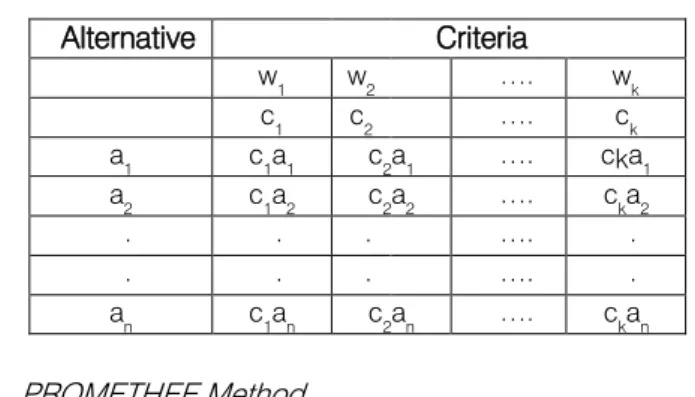
Each multi criteria decision analysis method proceeds with the decision table. Decision Table is shown in Table 1. Each column denotes the criteria, each row denotes the alternatives and ‘ckan’ represents the score of alternative ‘n’ on criterion ‘k’.
Table 1 : The decision table
a) PROMETHEE Method
There is need to have a method which is simpler and better helps in decision making while obtaining the solution of multi objective selection of trusted components from the number of available
alternatives. As COTS components selection is a multi-criteria problem. PROMPTHEE solves the problem in an optimal way with additional benefits than other MCDA methods.
PROMETHEE is Preference Ranking Organisation Method for Enrichment Evaluation. PROMETHEE is a multi criteria decision analysis method. It is an outranking method based on pair wise comparison of alternatives. It was developed by JP Brans in 1982[6]. Originally it was developed as PROMETHEE-1 (partial ranking) and PROMETHEE-2 (complete ranking).Later PROMETHEE-3 (ranking based on intervals) and PROMETHEE-4 (continuous case) were developed. PROMETHEE-5 (MCDA includes segmentation constraints) and PROMETHEE-6 (represents human brain) are also there. PROMETHEE is based on mathematical properties [6]. It can be applied on various fields for the selection and evaluation of winning solution in a multi criteria problem.
Steps for solving multi criteria problem with this method is as follows:
1. Determination of available alternatives to solve the
problem.
Let A= {a1, a2, a3………..an} be the set
of ‘n’ alternatives for the solution of the problem.
2. Determination of evaluation criteria. Let C= {c1, c2,
c3………ck} be the set of ‘k’ criteria as a
basis of evaluation and selection.
3. Problem statement stated as max{c1(an),c2(an),c3
(an),………cj(an)…….ck(an)|an∈A} Where ‘ck(an)’
represents the value of alternative ‘an’ on the
criterion ‘k’.
4. Create an evaluation table or (n*k) matrix with ‘n’
rows (number of alternatives) and ‘k’ columns (number of evaluation criteria) and place the score value of each alternative based on each criterion i.e. ‘ckan’.
5. Assign weight to each criterion i.e. wj where
(j=1,2,3…..k) and w1+w2+w3…..wk=1.
6. Find the difference between each pair of alternatives
based on each criterion i.e. dj(a,b)= cj(a)-cj(b)
where (j=1, 2…k) and (a,b∈A).
7. Find the preference of the one alternative over the
other as a function of difference between each pair of alternatives based on each criterion i.e. Pj (a,b)=
Fj [dj(a,b)] where (a,b∈ A) and (j=1, 2…k) and
0≤Pj(a,b)≤1. In case of minimizing the criteria
preference Pj(a,b)=Fj[-dj(a,b)]. Preference function
values can be taken on the basis of particular criterion function and the parameter value which you have selected.
8. Calculate the degree to which preferred option is
better than other alternative on all criteria i.e.
π(a,b)= P1 (a,b)w1+P2(a,b)w2+………Pk(a,b)wk.
And 0≤π (a,b)≤ 1.
9. If the degree of preference nearly equals to ‘zero’; it
means there is weak preference of alternative ‘a’
Alternative Criteria w1 w2 …. wk c1 c2 …. ck a1 c1a1 c2a1 …. cka1 a2 c1a2 c2a2 …. cka2 . . . …. . . . . …. . an c1an c2an …. ckan
Global Journal of Computer Science and Technology Volume XIV Issue II Version I
54 (DDDD ) Year 2014 c
over alternative ‘b’. And if the degree of preference
nearly equals to ‘one’; it means there is strong preference of alternative ‘a’ over alternative ‘b’.
10. Calculate the positive and negative outranking flow
of each option and then compute the net outranking flow of the option and if it comes out to be greater
than ‘zero’ then the option outranking the other
options and if lower than ‘zero’ then it means that the option is outranked by the other options on all criteria.
Positive outranking flow (option outranks others):
Φ+(a)=1/(n-1)[π(a1,a2)+π(a1,a3)… …π(a1,an)]
Negative outranks flow (option is outranked by others):
Φ-(a)=1/(n-1)[π(a2,a1)+π(a3,a1)… …π(an,a1)]
Net outrank flow of an option:
Φ(a)= Φ+(a)- Φ-(a).
We can say that ‘a’ is preferred over ‘b’ if Φ(a)>
Φ(b) and 0≤Φ(a) ≤1. Moreover{Φ(a1)+ Φ(a2)+…..
Φ(an)=0}
11. Obtain the outrank flow of each option on each
criterion as:
Φj(a)=1/(n-1)[(P1(a,b) - P1(b,a))+(P2(a,b)-P2(b,a))
+P3(a,b)-P3(b,a))……+ Pk(a,b)-Pk(b,a))].
12. Obtain the profile of an alternative on all the criteria as:
Φ(a)= Φ1(a)w1+ Φ2(a)w2+…. Φk(a)wk.
Profile of an alternative indicates the quality of an alternative on each criterion. Profile is shown in figure 1.
Figure 1 : Profile of an alternative
13. Select the alternative which has high ‘Φ(a)’. Values
of ‘Φ(a)’ gives the complete rank of the alternatives.
b) Promethee on Cots Components Selection
While developing system from COTS components it becomes very difficult to select best one if number of alternatives are available and to evaluate those alternatives. Application of PROMETHEE methodology on the COTS components selection better supports us in decision making.
Suppose a set of software components i.e. Alternatives set as A={A1,A2,A3,A4,A5} and evaluation criteria set as C={Performance, Reliability, Maintainability, Cost, Integrability} and the weight of each criterion respectivelyis as:0.3,0.2,0.1,0.2,0.2. Let criteria can be written as C1, C2, C3, C4 and C5. Scale and units for criteria are as follows:
C1: VG, G, A, B, VB
C2:no. of failures per 1000 hours of service C3: VG, G, A, B, VB
C4: Rs. (Rupees) C5: VG, G, A, B, VB
Where VG, G, A, B, VB stands for very good, good, average, bad, very bad.
Score for each grade is as in table 2. Table 2 : Grade scores
Grade VG G A B VB
Score 5 4 3 2 1
Evaluation table is shown in table 3. Table 3 : Evaluation table
C1 C2 C3 C4 C5 0.3 0.2 0.1 0.2 0.2 A1 3 2 4 1000 5 A2 2 1 3 1200 4 A3 5 3 5 900 3 A4 4 7 3 1000 2 A5 4 2 2 1100 1
Preference function may be used as Usual, U-Shaped, V-U-Shaped, Level, Gaussian or V-Shape with indifference criterion function. Let in the example U-Shaped criterion function is taken for C2 and C4. Level criterion function is taken for C1, C3 and C5. Level and U-Shaped criteria are shown in figure 2 and figure 3 respectively.
Figure2:
Level Criterion
Figure 3 : U-Shaped Criterion
Let parameter values for each criterion is as follows:
For C1, C3 and C5; q=2 and p=4 For C2; q=4
Global Journal of Computer Science and Technology Volume XIV Issue II Version I
55 (DDDDDDDD ) Year 2014 c
Global Journal of Computer Science and Technology Volume XIV Issue II Version I
56 (DDDD ) Year 2014 c For C4; q=100
Relative difference between alternatives on each criterion is shown in tables 4, 5, 6, 7 and 8.
Table 4 : Difference between alternatives with respect to performance d1(a,b) A1 A2 A3 A4 A5 A1 0 1 -2 -1 -1 A2 -1 0 -3 -2 -2 A3 2 3 0 1 1 A4 1 2 -1 0 0 A5 1 2 -1 0 0
Table 5 : Difference between alternatives with respect to reliability
Table 6 : Difference between alternatives with respect to maintainability d3(a,b) A1 A2 A3 A4 A5 A1 0 1 -1 1 2 A2 -1 0 -2 0 1 A3 1 2 0 2 3 A4 -1 0 -2 0 1 A5 -2 -1 -3 -1 0
Table 7 :Difference between alternatives with respect to cost
Table 8 : Difference between alternatives with respect to integrability A1 0 1 2 3 4 A2 -1 0 1 2 3 A3 -2 -1 0 1 2 A4 -3 -2 -1 0 1 A5 -4 -3 -2 -1 0
Preference function value of each alternative over other on all criteria is shown in table 9, 10, 11, 12 and 13.
Table 9 : Preference value on performance
P1(a,b) A1 A2 A3 A4 A5 A1 0 0 0 0 0 A2 0 0 0 0 0 A3 .5 .5 0 0 0 A4 0 .5 0 0 0 A5 0 .5 0 0 0
Table 10 : Preference value on reliability
A1 0 0 0 1 0
A2 0 0 0 1 0
A3 0 0 0 0 .5
A4 0 0 0 0 0
A5 0 0 0 1 0
Table 11 :Preference value on maintainability
P3(a,b) A1 A2 A3 A4 A5 A1 0 0 0 0 .5 A2 0 0 0 0 0 A3 0 .5 0 .5 .5 A4 0 0 0 0 0 A5 0 0 0 0 0
Table 12 : Preference value on cost
Table 13 : Preference value on integrability
Degree of preference of one alternative over other is shown in table 14.
Table 14 : Degree of preference Π(a,b)
Π(a,b) A1 A2 A3 A4 A5 A1 0 .20 .10 .30 .15 A2 0 0 0 .30 .10 A3 .15 .40 0 .05 .35 A4 0 .35 0 0 0 A5 0 .15 0 .20 0
Positive, negative and net outrank flow of each alternative is shown in table 15.
d2(a,b) A1 A2 A3 A4 A5 A1 0 -1 1 5 0 A2 1 0 2 6 1 A3 -1 -2 0 4 -1 A4 -5 - 6 -4 0 -5 A5 0 -1 1 5 0 d4(a,b) A1 A2 A3 A4 A5 A1 0 200 -100 0 100 A2 -200 0 -300 -200 -100 A3 100 300 0 100 200 A4 0 200 -100 0 100 A5 -100 100 -200 -100 0 d5(a,b) A1 A2 A3 A4 A5 P2(a,b) A1 A2 A3 A4 A5 P4(a,b) A1 A2 A3 A4 A5 A1 0 1 0 0 0 A2 0 0 0 0 0 A3 0 1 0 0 1 A4 0 1 0 0 0 A5 0 0 0 0 0 P5(a,b) A1 A2 A3 A4 A5 A1 0 0 .5 .5 .5 A2 0 0 0 .5 .5 A3 0 0 0 0 .5 A4 0 0 0 0 0 A5 0 0 0 0 0
Table 15 : Positive, negative and net outrank flow
Φ+(a) Φ-(a) Φ(a)
A1 .1875 .0375 .1500
A2 .1000 .2750 -0.1750
A3 .2375 .0250 .2125
A4 .0875 .2125 -0.1250
A5 .0875 .1500 -0.0625
PROMETHEE-1 Partial ranking of each alternative is shown in figure 4 and PROMETHEE-2 Complete ranking of each alternative is shown in figure 5.
Figure 4 : Partial ranking
Figure 5 : Complete ranking
Profile of each alternative on all criteria is shown in table 16.
Table 16 : Profile of alternative
Φ1(a) Φ2(a) Φ3(a) Φ4(a) Φ5(a)
A1 -.125 .250 .125 .250 .375 A2 -.375 .250 -.125 -.750 .250 A3 .250 0 .375 .500 0 A4 .125 -.750 -.125 .250 -.250 A5 .125 .250 -.250 -.250 -.375 Profile of alternative A1 on all criteria is shown in figure 6.
Figure 6 : Profile of A1
Profile of alternative A2 on all criteria is shown in figure 7.
Figure 7 : Profile of A2
Profile of alternative A3 on all criteria is shown in figure 8.
Figure 8 : Profile of A3
Profile of alternative A4 on all criteria is shown in figure 9.
Figure 9 : Profile of A4
Profile of alternative A5 on all criteria is shown in figure 10.
Global Journal of Computer Science and Technology Volume XIV Issue II Version I
57 (DDDDDDDD ) Year 2014 c Figure 10 : Profile of A5
Ranking of all alternatives on all criteria is shown in figure 11.
Figure11:
Ranking of all alternatives on all criteria
c) Benefits of using Promethee
PROMETHEE methodology helps in decision making better than other MCDA methods in number of ways:
1. The supporting software packages of PROMETHEE
like D-Sight, PROMCALC, Decision Lab, Visual PROMETHEE etc. are very user friendly.
2. PROMETHEE-GDSS supports group decision
making in this the final solution is obtained by weighted sum of net outrank flow of each alternative.
3. PROMETHEE provides partial, complete, interval
based ranking of alternatives.
4. Unlike other MCDA methods, PROMETHEE’s
preference degree tells us the degree by which an option is preferred over other.
5. PROMETHEE needs very less input for further
operations as compare to other MCDA methods.
6. Unlike other MCDA methods, new alternatives can
be added without doing much change in others. 7. PROMETHEE does not include normalization for
normalizing the units of measurement of each
criterion so there are fewer chances of errors as compare to many other MCDA methods.
8. PROMETHEE’s extensions can be used as sorting
purposes.
IV.
C
onclusionComponent selection is a wide comparison of components using a common set of criteria. Selecting the appropriate and relevant component significantly reduces the chances of risks associated with the COTS components with no source code available with them and improves the corporate competitiveness. Using PROMETHEE-GAIA methodology for the complete ranking of alternatives help decision makers to choose and analyse the highest rank component on all criteria and help to build confidence on the selected component.
R
eferencesR
éférencesR
eferencias1. Hutchinson, J., & Kotonya, G. (2006, August). A
Review of Negotiation Techniques in Component Based Software Engineering. In Software Engineering and Advanced Applications, 2006. SEAA'06. 32nd EUROMICRO Conference on(pp. 152-159). IEEE.
2. Kaur, A., & Mann, K. S. (2010). Component
Selection for Component-Based Software Engineering. International Journal of Computer Applications, 2(1), 109-114.
3. Jadhav, A., & Sonar, R. (2009, December). Analytic
Hierarchy Process (AHP), Weighted Scoring Method (WSM), and Hybrid Knowledge Based System (HKBS) for Software Selection: A Comparative Study. In Emerging Trends in Engineering and Technology (ICETET), 2009 2nd International Conference on (pp. 991-997). IEEE.
4. Becker, C., Kraxner, M., Plangg, M., & Rauber, A.
(2013, January). Improving decision support for software component selection through systematic cross-referencing and analysis of multiple decision criteria. In System Sciences (HICSS), 2013 46th Hawaii International Conference on (pp. 1193-1202). IEEE.
5. Halim, A., Sudrajat, A., Sunandar, A., Arthana, I. K.
R., Megawan, S., & Mursanto, P. (2011, December). Analytical Hierarchy Process and PROMETHEE application in measuring object oriented software quality. InAdvanced Computer Science and Information System (ICACSIS), 2011 International Conference on (pp. 165-170). IEEE.
6. Brans, J. P., & Mareschal, B. (2005). PROMETHEE
methods. In Multiple criteria decision analysis: state of the art surveys (pp. 163-186). Springer New York. 7. Ibrahim, H., Elamy, A. H. H., Far, B. H., & Eberlein,
A. (2011). UnHOS: A Method for Uncertainty Handling in Commercial Off-The-Shelf (COTS) Selection.International Journal of Energy, Information & Communications, 2(3).
8. Chung, L., Cooper, K., & Courtney, S. (2004).
COTS-Aware Requirements Engineering and Software Architecting. In Software Engineering Research and Practice (pp. 57-63).
9. Grau, G., Carvallo, J. P., Franch, X., & Quer, C.
(2004, August). DesCOTS: a software system for selecting COTS components. In Euromicro Conference, 2004. Proceedings. 30th (pp. 118-126). IEEE.
Global Journal of Computer Science and Technology Volume XIV Issue II Version I
58 (DDDD ) Year 2014 c