year in which revenue remained steady even as competition grows around our borders.
Generating more tax revenue from its casinos than any other state in the country, Pennsylvania saw a return of nearly $1.5 billion, much of that funding the sixth consecutive year of property tax reduction and, in Philadelphia, wage tax reduction. This revenue is also helping agricultural businesses through funding of our horse racing industry. Casinos tax revenue is also utilized to improve public safety and the quality of life in many communities through programs that financially assist both fire and ambulance companies and provide funding for water and sewer projects.
In fact, through the end of the 2012-2013 Fiscal Year, the total amount of tax revenue from the play of slot machines and table games is more than $7.6 billion dollars since the opening of the first casino in November 2006.
Other key elements of the impact from casinos are in jobs and outside spend. In the past fiscal year, the 11 casinos in operation provided jobs to more than 16,000 persons, while making hundreds of millions of dollars in purchases of goods and services from other Pennsylvania businesses.
In addition, the state’s 12th gaming facility, Lady Luck at Nemacolin Woodlands Resort in Fayette County has now opened, adding hundreds of additional jobs and generating tax revenue for the people of Pennsylvania.
The upcoming fiscal year will bring new challenges as the Board continues its work on applications to possibly locate a second casino in the City of Philadelphia. The board could also consider an application for the final casino at a horse racing facility in western Pennsylvania.
While we recognize these successes, my fellow Board members and I want to assure you that our collective eyes continue to be on our key mission: protecting the people of Pennsylvania and the patrons of the casinos under a strict regulatory environment.
William H. Ryan, Jr. Chair
Executive Director’s Message
Thank you for taking the time to read the Pennsylvania Gaming Control Board’s 2012-2013 Annual Report highlighting the work of our agency during the past year in regulating the Commonwealth’s casino industry.
Our professional staff is dedicated to assuring that the interests of the public are being met through strict enforcement of the law and regulations that pertain to the operation of the casinos. That dedication extends to making sure that the work of the Gaming Control Board is accomplished in a highly visible manner.
Along with reviewing this report, I invite you to explore our web site, gamingcontrolboard.pa.gov, which provides access to additional information. From our web site you can view videos of our monthly public meetings as well as various public input hearings. Access to relevant information is important as we move into the new Fiscal Year where our work will lead to the potential licensing of two additional casinos.
As always, we invite you to contact us to share your thoughts.
Kevin F. O’Toole Executive Director
William H. Ryan, Jr. Click on picture for video message
William H. Ryan, Jr. Chairman Designated by the Governor
Gregory C. Fajt Board Member Designated by the Minority Leader of the Senate Annmarie Kaiser Board Member Designated by the Governor
David W. Woods Board Member Designated by the Governor
The Honorable Dan Meuser Ex-Officio Member Secretary of Revenue The Honorable Robert M. McCord Ex-Officio Member State Treasurer The Honorable George Greig Ex-Officio Member Secretary of Agriculture Keith R. McCall Board Member Designated by the Minority Leader of the House of Representatives
John J. McNally, III Board Member Designated by the Speaker of the House of Representatives Anthony C. Moscato Board Member Designated by the President Pro Tempore
of the Senate
Board Members
Bureau of Licensing
Susan Hensel Director, Bureau of Licensing
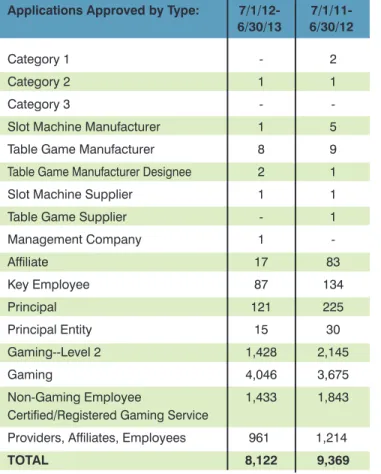
Applications Approved by Type: 7/1/12- 7/1/11- 6/30/13 6/30/12
Category 1 - 2
Category 2 1 1
Category 3 - -
Slot Machine Manufacturer 1 5 Table Game Manufacturer 8 9 Table Game Manufacturer Designee 2 1 Slot Machine Supplier 1 1 Table Game Supplier - 1 Management Company 1 - Affiliate 17 83 Key Employee 87 134 Principal 121 225 Principal Entity 15 30 Gaming--Level 2 1,428 2,145 Gaming 4,046 3,675 Non-Gaming Employee 1,433 1,843 Certified/Registered Gaming Service Providers, Affiliates, Employees 961 1,214
TOTAL 8,122 9,369 Number of Applications: 7/1/12 - 7/1/11 - 6/30/13 6/30/12 Received 8,508 8,086 Approved 8,122 9,369 Denied 47 57 Surrendered 6 14 Withdrawn 705 1,080 Not Accepted 1 6 Revoked 48 49 Suspended 11 10
The Bureau of Licensing is responsible for and oversees the licensing of the state’s casinos and other gaming related companies doing business in the state as well as the employees working in and supporting the gaming industry.
In the past year, the Bureau processed more than 8,500 applications for entities and individuals while remaining focused on other priorities including the processing of initial and renewal casino operator applications, revisions to agency regulations and Bureau policies and the opening of Pennsylvania’s second resort casino.
Bureau highlights during 2012-2013 fiscal year:
} Facilitated the opening of Lady Luck Casino Nemacolin in Fayette County, a Category 3 resort casino, in June 2013 by providing guidance on all licensing matters, delivering onsite support, and processing nearly 700 applications to ensure the casino was appropriately staffed.
} Received and processed six Category 2 applications for Philadelphia’s second and final casino and one new Category 1 application for a racetrack casino in Lawrence County while also approving and renewing a total of 14 licenses for casinos, management companies, table game and slot machine manufacturers and suppliers. } Completed the development of a policy and procedure
to conditionally license junket enterprises to allow these applicants the ability to conduct business within the Com-monwealth while their junket application package is being investigated.
} Increased the efficiency of the application process for gaming service providers by posting enhanced applica-tions to the PGCB website that allow applicants to elec-tronically complete and print the documents.
} Received and processed more than 2,100 gaming re-newal applications which included the bulk of applicants from the 2010 table games expansion.
} Printed and distributed more than 11,000 credentials for employees of casinos along with other individuals work-ing in the gamwork-ing industry.
} Scanned and catalogued more than 700,000 pages of ap-plications and supplemental information into an electronic document storage system for use throughout the agency.
License Process Begins for 2nd Philadelphia Casino
APPLICANTS
Six applications were received: } Tower Entertainment, LLC
The Provence } Wynn PA, Inc.
Wynn Philadelphia } PA Gaming Ventures, LLC
Hollywood Casino Philadelphia } PHL Local Gaming, LLC
Casino Revolution } Stadium Casino, LLC
Live! Hotel and Casino } Market East Associates
Market 8
PUBLIC MEETINGS
} Applicants made public presen-tations on February 13, 2013 in Philadelphia at the Pennsylva-nia Convention Center. } The Board gathered testimony
over a four day period with 186 individuals, community groups and government officials pre-senting: } April 11/12, 2013 – The Pennsylvania Convention Center } May 8/9, 2013 – Lincoln Financial Field PROCESS
An award decision is based on an evidentiary process that includes: } Background investigations on
each applicant person and entity
} Input from the public, com-munity groups/organizations, and government officials on the local impact of each project } Suitability hearings which
includes in-depth questioning by the Board
} A licensing decision which must be reached by a “quali-fied majority” of the 7-member Board (minimum to approve is all 4 legislative appointees plus at least 1 gubernatorial appointee)
The Board began an in-depth process during the 2012-2013 Fiscal Year that could lead to the licensing of a Category 2 Stand Alone casino in the City of Philadelphia. This process was the result of the 2010 revocation of a previously awarded Category 2 licensee that was unable to move forward in construction along with a mandate in the Pennsylvania Race Horse Development and Gaming Act that the last available Category 2 casino be located
in Philadelphia. Upon receipt of six applications before the November 15, 2012 deadline, the Board embarked on a process that has already included public presentations by each applicant, the availability of the applications and other information via the Board’s web site, public input hearings in Philadelphia to receive information for the evidentiary record from citizens, public officials and community organizations, and a public presentation by the City of Philadelphia on the impact of each of the projects. The process continues in the 2013-2014 Fiscal Year with
Office of Compulsive and Problem Gambling
Elizabeth Lanza Director, Office of Compulsive and
Problem Gambling
The PGCB’s Office of Compulsive and Problem Gambling (OCPG) remains committed to:
} Assisting Pennsylvanians affected by compulsive gambling by ensuring that every casino operator has established, and complies with, an approved compul-sive and problem gambling plan;
} Creating problem gambling materials and outreach programs;
} Heightening public awareness of the dangers of compul-sive, problem, intoxicated and underage gambling; } Developing prevention programs and harm reduction
tools for gamblers;
} Establishing education programs for residents of all ages; and,
} Directing problem gamblers and their families to compul-sive gamblers assistance organizations’ toll-free helplines for crisis counseling, referral services and treatment.
} During the 2012-2013 Fiscal Year, the OCPG’s Director and its Program Analyst maintained the Board’s Self-Ex-clusion Program. In addition, the staff collected and ana-lyzed data from Pennsylvania and other states’ Self-Ex-clusion Programs, communicated with the general public about self-exclusion and problem gambling, collaborated with other state agencies, and attended and participated in several conferences on problem gambling including the Council on Compulsive Gambling of Pennsylvania’s (CCGP) annual statewide conference.
} The office director also made public presentations at sev-eral functions both state and nationwide, including in July at the National Council on Problem Gambling’s (NCPG) annual conference in Seattle.
} The Director worked to ensure that each licensee’s Com-pulsive and Problem Gambling Plan was current and in compliance with PA laws and regulations.
} The OCPG continued its supported and participation in National Problem Gambling Awareness Week (NPGAW), a grassroots public awareness and outreach campaign held March 3-9, 2013. The OCPG created informational documents to hand out during NPGAW in Strawberry Square and the Capital.
There are a total of
5,522
individuals on the Self-Exclusion List
3,148 or
57%
are males and
2,374 or
43%
are females Individuals range between21 and 81
years of age.1,296 or
24%
of the self-excluded individuals are currently involved in a treatment program (including Gamblers Anonymous) or have sought treatment in the past.402 or 7%
have been self-excluded in other jurisdictions such as New Jersey and Delaware.3,737 or
68%
of the self-excluded persons participated in gambling in a PA casino prior to signing up for theBoard’s Self- Exclusion Program.
Through June 30, 2013, data from Pennsylvania’s program, which is based upon responses from individuals during the self-exclusion intake interview, shows that:
If you or someone you know has a gambling problem, call
Office of Diversity
Mozelle E. Daniels Director, Office of Diversity
Pursuant to §1212 of the Pennsylvania Race Horse Development and Gaming Act , the PGCB is charged with promoting and ensuring diversity in all aspects of legalized gaming. The agency developed rules and regulations, 58 Pa. Code §481a, to accomplish its goals. Diversity regulations establish the policies and procedures for promoting and ensuring that the regulated entities foster participation and diversity in all aspects of their operations in the Commonwealth.
Gaming in Pennsylvania has played a major role in statewide economic development and spurred the growth of a diverse economy resulting in a substantial number of good paying jobs and access to economic prosperity in and around the areas in which casinos are located. These accomplishments are impressive given the impact the economic downturn in the United States in 2008 has had on the lives of everyone. Despite the many challenges along the way, Pennsylvania casinos, through their sincere commitment to diversity and inclusiveness, have maintained their pledge of equal opportunity.
As of June 30, 2013, casinos employed a total of 16,644 individuals with residents of the Commonwealth comprising 89% of that workforce. Within that number, approximately 43% of the employees are females while 31% are racial minorities. In addition, Pennsylvania residents currently comprise 79% of persons identified as table-games employees. The casino operators’ Executive/ Management/Professional staff consists of a total of 2,733 individuals of which 63% are male, 37% are female and 21% are racial minorities.
The casinos continue to be committed to expanding opportunities to qualified businesses that are capable of providing exceptional services at competitive value and cost, while aggressively promoting awareness and outreach initiatives among current and potential suppliers. Moreover, the casinos support organizations promoting supplier diversity and economic empowerment, such as the Minority Supplier Development Council and the Women’s Business Enterprise Council of Pennsylvania, Delaware and New Jersey.
The Office of Diversity recently published its sixth Annual Diversity Report (2012-2013). The report not only includes the above data, but additional figures on vendor expenditures, table games employee data and statistical data from the U.S. Census Bureau for each entity. The report can be downloaded by clicking this link http://gamingcontrolboard.pa.gov/files/ communications/2012-2013_Gaming_Diversity_Report.pdf.
Statewide
Employment by Gender Employment by Race Male Female 75% 5% 100% 90% 80% 70% 60% 50%Caucasian African American Hispanic Asian Other
.4% 2% 2% 12% 69% 6% 13% 9% 71% 6% 13% 3% 82% 9% 5% FY 09/10 FY10/11 FY 11/12 FY 12/13 FY 09/10 FY10/11 FY 11/12 FY 12/13 18000 16000 14000 12000 10000 8000 6000 4000 2000 0 5062 6467 9407 7129 9514 6441 8597 6999 8% 10%
Bureau of Gaming Laboratory Operations &
Office Information Technology
Michael Cruz Chief Technology Officer
The Bureau of Gaming Laboratory Operations (GLO) and Office of Information Technology (OIT) are responsible for the performance and integrity of slot machines and associated equipment in Pennsylvania casinos, and for the overall planning, organization and execution of all information technology functions within the Board.
GLO works closely with the PA Department of Revenue who oversees the Central Control Computer System which, in addition to tracking all revenue collected and paid out by slot machines, is used to perform vital tests such as the daily authentication of every machine operating in licensed casinos.
Gaming Laboratory Operations divides its critical functions between two major areas:
Laboratory Review
All casino related products are thoroughly tested in its 5,100 square foot Harrisburg lab in order to certify regulatory compliance with all minimum design standards regarding security and, in the case of slot machines, the 85% minimum payback mandated by law. Testing also includes such items as automated shufflers, progressive systems, electronic table games, and other equipment necessary to conduct gaming.
A team of statisticians are responsible for evaluating the theoretical return for every slot machine gaming theme submitted for review and the analysis of both progressive reward payouts and random number generators. Table
game rules are also verified by the statistical review team for calculation of the house advantage. A team of engineers are responsible for evaluating all gaming devices for compliance with the minimum design standards, reviewing modifications to gaming devices and ancillary equipment, and assisting with investigations of regulatory violations. Additionally, communication between the thousands of operating slot machines and the Central Control Computer System are checked, along with the communication of each machine with a casino’s in-house monitoring system, the analysis of voucher redemption machines, and the evaluation of count room equipment.
Technical Field Operations
GLO is also responsible for the technical compliance of the slot machine floor, table game floor and the IT room of every casino. This area is responsible for monitoring the day-to-day operations of licensed casino operators, particularly with regard to software and systems at all licensed facilities, including proper connectivity to the Central Control Computer System; inspection of slot machines for configurable options; inspections of table game devices for compliance; technical investigations as well as regulatory violation investigations in regards to regulations concerning the laboratory on the gaming floor; and, enforcing the theoretical threshold (between 85% and 100%) during game inspections. Office of Information Technology
OIT is responsible for the continued support and development of applications to assist PGCB staff in both the licensing and enforcement of gaming in Pennsylvania. OIT also provides the daily support of all technology for agency employees including oversight and maintenance of all agency computers, servers, networks, software, and telecommunications equipment. OIT will continue to leverage technology solutions to enhance operational efficiencies
Gaming Laboratory Operations 7/1/2012-6/30/2013
Paytables Reviewed 13,817
Paytables Rejected 1,066
Associated SW\HW Reviewed 1,267
System and Kiosk SW Reviewed 53
Statistical Field Verifications 807
Gaming Device Inspections 35,835
Bureau of Casino Compliance
Gerald E. Stoll Director, Bureau of Casino Compliance
The Bureau of Casino Compliance provides round-the-clock representation at each casino in order to meet the Board’s mission of securing integrity of gaming and the safety of patrons. It is the responsibility of the Casino Compliance Representatives (CCR’s) assigned to each casino throughout the Commonwealth to ensure compliance with PGCB regulations, and guarantee that the casino’s Internal Controls comply with regulations. CCR’s are available to the public to receive any patron complaint with all of these complaints thoroughly investigated. The patron is then notified when the CCR investigation is completed, though the CCR can also refer any potential violations of a criminal nature to the Pennsylvania State Police for investigation.
CCR’s also are involved in matters of Compulsive and Problem Gaming including proper oversight and attention by the casino. This involvement includes CCR’s enrolling members of the public into the PGCB’s voluntary Self- Exclusion Program.
At the inception of gaming in Pennsylvania, the Bureau of Casino Compliance was given the task of reporting to the Board all activities and licensing issues at each casino, and
has resulted in the generation of over 172,813 activity reports. Additionally, the Bureau has initiated 40,941 compliance issues which are normally forwarded to the Office of Enforcement Counsel for further investigation.
Of particular importance, the Bureau of Casino Compliance ensures that security and safety at each casino is not
compromised. Collectively, thousands of surveillance camera reviews are performed annually to safeguard assets, enhance patron safety, resolve complaints and identify criminal activity.
The Bureau of Casino Compliance also works cooperatively with various national and international
regulatory agencies to identify chronic criminal behavior and technology improvements. The bureau’s attentiveness to criminal behavior not only protects the patron and casino, but has led to the exclusion of many professional cheaters.
The Bureau of Casino Compliance has also taken on the role of coordinating the PGCB’s oversight of gaming floor plan changes including the number and location of slot machines and table games.
Also this year, the Bureau of Casino Compliance
implemented and now maintains a voluntary credit exclusion program for patrons of Pennsylvania casinos.
The Pennsylvania gaming industry continues to expand and evolve, and the Bureau of Casino Compliance will remain vigilant and prepared for both the expansion of existing casinos and the opening of new facilities. The bureau will ensure that the best practices of gaming regulation are implemented and the gaming industry is in a position to meet the needs and expectations of the gaming public.
Licensed Operators Slots* Tables* Gaming Floor (sq. ft.)*
Mohegan Sun at Pocono Downs 2,332 84 82,396
Parx Casino 3,362 170 163,476
Harrah’s Philadelphia Casino and Racetrack 2,800 126 106,102
Presque Isle Downs and Casino 1,720 46 61,397
The Meadows Racetrack & Casino 3,317 80 136,608
Mount Airy Casino Resort 1,875 74 67,746
Hollywood Casino at Penn National Race Course 2,456 69 99,356
Sands Casino Resort Bethlehem 3,012 183 145,359
Rivers Casino 2,933 114 136,594
SugarHouse Casino 1,604 58 51,794
Valley Forge Casino Resort 600 50 33,222
Lady Luck Casino Nemacolin 600 28 26,106
Bureau of Gaming Operations
Paul Resch Director, Bureau of Gaming Operations
The Bureau of Gaming Operations (BGO) works closely with the Executive Director and other PGCB bureaus to oversee slot machine and table game operations at the Commonwealth’s 12 casinos.
From the opening of the first casino – Mohegan Sun at Pocono Downs – in 2006 to the opening of Lady Luck Casino Nemacolin in July 2013, BGO staff have played a key role in the startup and ongoing oversight of gaming in Pennsylvania. After a casino opens to the public, BGO provides ongoing regulatory oversight to ensure each casino maintains compliance with table game rules, internal controls, minimum staffing and other requirements.
BGO is comprised of an Audit Unit, a Compliance Unit and the Office of Racetrack Gaming. The responsibilities of the Audit and Compliance Units are described below, while a separate report is on the opposite page for Racetrack Gaming.
Audit Unit
The Audit Unit performs regulatory compliance audits to provide reasonable assurance that licensees are in compliance with the Gaming Act, PGCB regulations and their internal controls. An annual risk assessment determines the areas to be evaluated as part of the audit program.
BGO’s audits focus on key areas of casino operations including: cage operations, drop and count, surveillance, table games, casino credit, compulsive and problem gambling, slot jackpot payouts, access to restricted areas and the control of sensitive keys. Auditors obtain an understanding of the licensee’s slot machine and table game operations through observation, examination and interviews with casino personnel. Audit reports include recommendations for corrective action and a response from
the licensee to each finding of non-compliance. All findings are forwarded to the Office of Enforcement Counsel for review.
During FY 2012-2013, Audit Unit staff performed 13 audits, which included at least one at nine of the 11 licensees in operation as of June 30, 2013. Of the 13 audits, seven examined licensees’ compliance with the Act and the Board’s regulations pertaining to the issuance of casino credit. The other six audits examined the topics described above as well as follow-up to prior audit findings.
Compliance Unit
BGO Compliance Unit staff review internal controls and other regulatory submissions including table game rules submissions, gaming guides, dealer training programs, tournament rules and schedules, and table game equipment submissions for cards, dice, chips, signs and table layouts.
Internal controls are operating procedures for security, surveillance, internal auditing, accounting, slot machine and table game operations and other casino functions including: } counting and recording of table game and slot machine
revenue
} safety of casino patrons including adequate security and surveillance coverage
} safeguarding casino assets including sensitive key control and access to restricted areas
} issuance of casino credit
As required by the Gaming Act, internal controls also ensure that slot machine and table game operations are performed in accordance with sound financial practices by qualified employees.
In Fiscal Year 2012-2013, Compliance Unit staff reviewed internal controls and table game submissions for the opening of Lady Luck Casino Nemacolin. In addition, staff reviewed 1,091 internal control amendments, 415 table game submissions and 67 slot tournament submissions for the other operating casinos. Staff also assisted in the development of the Board’s table game regulations, which included new table game and side wager offerings.
Reviewed
1,091
internal control amendments Reviewed415
table game submissions Performed13
compliance audits Reviewed67
slot tournament submissions Participated in1
casino opening (Lady Luck CasinoNemacolin)
Office of Racetrack Gaming
Kevin Kile Director, Office of Racetrack Gaming
The Pennsylvania Race Horse Development and Gaming Act states that the authorization of limited casino gaming is intended to positively assist the Commonwealth’s horse racing industry, support programs intended to foster and promote horse breeding, and improve the living and working conditions of personnel who work and reside in and around the stable and backside areas of racetracks.
The Office of Racetrack Gaming serves as the Pennsylvania Gaming Control Board’s liaison between the gaming and horse racing industries in order to support the legislative intent of legalized gaming to assist the horse racing industry.
In order to ensure a strong interface between gaming and racing, the Office of Racetrack Gaming:
} Establishes and maintains effective relationships and acts in a liaison capacity to the Pennsylvania Department of Agriculture, Pennsylvania Harness Racing Commission, Pennsylvania Horse Racing Commission, casino and racetrack operators, horsemen’s organizations, and related organizations;
} Monitors construction and renovation of the backside area of new and existing racetrack casinos to ensure a statu-tory mandate is met which requires each racetrack casino to invest a minimum of $6.25 million over ten years in the improvement and maintenance of the backside area and related buildings at the racetrack;
} Ensures each casino and racetrack operator submits an annual report summarizing how the introduction and
expansion of gaming has fulfilled the intent of the Race Horse Development and Gaming Act to enhance live rac-ing at the casino along with plans to promote live racrac-ing and increase both live handle and daily attendance at the racetrack;
} Maintains reports detailing tax assessments generated from slot machine gaming and the distribution to purses, health and pension benefits, the Pennsylvania Breeding Fund, the Pennsylvania Sire Stakes Fund, the Pennsylva-nia Standardbred Breeders Development Fund, and other important agricultural initiatives;
} Acts as a liaison between the Board and each respective racing commission regarding all proposed construction, renovations, and gaming floor plan changes at each race-track casino to ensure a smooth interface between gaming and racing venues; and,
} Regularly attends Pennsylvania Racing Commission meet-ings and provides reports to the Board regarding all areas that impact casino gaming.
In addition, the Office of Racetrack Gaming regularly assists the Bureau of Gaming Operations in all areas of its responsibility including, but not limited to, the review of internal controls, table game operations, and promotional activities conducted at all twelve casinos.
In March 2013, the Office of Racetrack Gaming released its sixth annual benchmark report which provides an update on the impact the Pennsylvania Race Horse Development Fund is having on the horse racing industry and pari-mutuel wagering throughout the Commonwealth. This report examines trends in horse and harness racing before and after slot machine gaming commenced in 2006. This report can be downloaded at this link: http://gamingcontrolboard.pa.gov/ files/reports/2012_Pari-Mutuel_Benchmark_Report.pdf.
PA Race Horse Development Fund
$300 $250 $200 $150 $100 $50 $0 2008-09 2009-10 2010-11 2011-12 2012-13 Million Million $280,074,134 $264,200,662 $210,480,335 $259,711,317 $274,936,670 Backstretch Improvements $14 $12 $10 $8 $6 $4 $2 0 2008 2009 2010 2011 2012 $7,664,897 $10,358,179 $6,977,376 $6,217,424 $13,344,532
Office of Chief Counsel
R. Douglas Sherman Chief Counsel
The Office of Chief Counsel (OCC) serves as legal counsel for a broad range of topics for the Pennsylvania Gaming Control Board. Issues include those of policy and procedure including administration, personnel, budget, operations, licensing and all other matters that may emerge in the course of regulating casino gaming. Additionally, the OCC serves as the Board’s legal representative in various court proceedings, including appeals of Board decisions. During the Fiscal Year 2012-2013, in particular, the OCC oversaw the ongoing repayment by casino operators of $63.8 million that was borrowed from the Property Tax Relief Reserve Fund to fund the agency in its infancy. To date, approximately $9.5 million of this amount has been repaid.
OCC also worked with the Board to establish the protocol to re-open the process to award a second Category 2 casino license in the City of Philadelphia and oversaw the awarding of approximately $1 million in grants to be used by local law enforcement agencies to combat illegal gambling in their communities.
Licensing:
The OCC advises and assists the Bureau of Licensing in all matters involving the licensing process, including during the application process, and on any licensing implications of actions involving licensees. The OCC also works daily with the Bureau of Licensing on issues such as debt refinancing, corporate restructuring, and changes in ownership of licensed entities. Additionally, the OCC is instrumental in coordinating the compliance of a licensee with its Statement of Conditions by reviewing the quarterly responses required for each licensee.
In the Fall of 2012, the PGCB received six applications for one Category 2 slot machine license available for Philadelphia. Throughout 2013, OCC has reviewed the
applications along with the Bureau of Licensing to ensure that all individuals and entities that have ownership and/or control of the proposed projects have applied for licensure with the Board.
Regulatory Review:
Much of the work in this area during the 2012-2013 Fiscal Year centered on expanding the compliment of table game options available for play in all licensed facilities and revising the agency’s existing body of regulations and policies. During the year, the Board initiated or finalized seven
rulemakings which dealt with a wide range of topics including regulations relating to a new server-based slot technology, an update of the Board’s practice and procedure rules, procedures for the conduct of slot machine tournaments, and the rules of play for 4 new table games and 14 new table game variations or side wagers.
Litigation:
The Litigation Section of the OCC provides counsel to the Board on considerations including emergency suspensions, enforcement actions, petitions for relief, suspensions, revocations, consent agreements, withdrawals of applications, surrenders of licenses, placement on the Board’s exclusion list, and Reports & Recommendations generated by the Board’s Office of Hearings and Appeals. In total, during Fiscal Year 2012-2013, the OCC reviewed and provided legal advice to the Board on no fewer than 309 such matters.
During the same period of time, the Litigation Section represented the Board before judicial and administrative tribunals in which the Board was named as a party. Notably, the OCC successfully represented the Board before the Commonwealth Court in an appeal of the Board’s modification and approval of the first Category 3 casino access plan. Unique to Pennsylvania, Category 3 casinos are facilities placed in pre-existing resorts and for which only overnight hotel guests and patrons of one of the resort’s other amenities can gain access. In addition to gaming related matters, the OCC represented the Board in employment law matters and cases brought under the Pennsylvania’s Right-to-Know Law.
Office of Hearings and Appeals
Linda S. Lloyd Director, Office of Hearings and Appeals
The Office of Hearings and Appeals (OHA) functions as the independent judiciary branch of the Board with authority to conduct hearings and issue reports and recommendations on those matters for the Board’s consideration.
This year, pending
regulation revisions affecting practice with and before OHA were approved by the Independent Regulatory Review Commission. Many of the changes were made for clarification purposes. However, several of the changes were made to better serve the public and individuals involved in the licensing process. These changes were to:
} the Emergency Suspension provisions which would allow for a quicker resolution of this type of matter;
} requests for access to confidential information to conform with the current Right to Know Law; and,
} the requirements for the filing of confidential information including a requirement that a non-confidential version be filed as well to enable faster public access to records.
Other key events during the past fiscal year were: January - OHA and other Board staff conducted the mandated public input hearing addressing the Table Games Petition of Nemacolin Woodlands;
April - OHA conducted required public license renewal hearing for Downs Racing, LP d/b/a Mohegan Sun at Pocono Downs;
May - a public input hearing was held in Philadelphia to address the plans of HSP d/b/a SugarHouse Casino for expansion of its facility.
June - the public license renewal hearing for Chester Downs and Marina, LLC d/b/a Harrah’s Philadelphia was held in Chester, PA;
Pertaining to the licensing of a casino in Philadelphia, four days of public input hearings were held in Philadelphia in April and May to address the six applications received by the Board for that remaining Category 2 license. This included two days in April at the Pennsylvania Convention Center and two days in May at Lincoln Financial Field. More than 175 elected officials, community groups and individuals’ provided testimony in support of or concern for the various projects during these four days of hearings.
During the 2012-2013 Fiscal Year, the Board’s Clerk received approximately 2,789 filings to be processed. The breakdown of the types of filings, as well as other information, is as follows:
TYPES OF FILINGS July 1, 2012 – June 30, 2013 July 1, 2011 – June 30, 2012
Petitions 333 342
Answers/Motions/Misc. 1,562 869
Enforcement Actions 171 178
(includes 88 Exclusion Petitions) (including 95 Exclusion Petitions)
Requests for Oral Hearing 102 82
Reports and Recommendations Issued 53 55
Exceptions 5 7
Disposed Hearing Files 94 81
Board Orders 469 608
OHA Orders 99 106
Total Orders Processed 568 714
Hearings Conducted by OHA 61 62
Bureau of Investigations and Enforcement
Paul Mauro Director, Bureau of Investigations
and Enforcement
The Bureau of Investigations and Enforcement (BIE) operates as an independent bureau within the Gaming Control Board with a mission to ensure the integrity of the Commonwealth’s gaming industry by conducting thorough suitability investigations.
The investigative work of the BIE encompasses casino operators and employees, as well as the manufacturers, suppliers, and gaming service providers interested in conducting business within the Commonwealth’s gaming industry. Strong cooperation with other Commonwealth agencies including the Department of State, the State Police, and the Department of Revenue, along with other gaming regulators in the United States and around the world is essential in order to carry out BIE’s mission.
It is the job of BIE to then present the Board with a
comprehensive background investigation report regarding an applicant’s suitability. The report not only includes a criminal history record check containing information provided by the FBI based on the applicant’s fingerprints, but also:
} the results of interviews conducted by the BIE investiga-tors of the applicant, employers, references and family members;
} local law enforcement checks;
} regulatory history in other gaming jurisdictions; } professional licenses verification;
} tax record examination;
} credit history and financial analysis;
} database checks regarding political contributions; and, } court record searches for civil litigation.
A Financial Investigations Unit within the BIE maintains and reviews all corporate compliance submissions to the PGCB. This unit also assists the BIE investigators with financial investigations of newly submitted and renewal applicants,
reviews any changes in debt financing and corporate structure ownership, and reviews other financial issues related to the BIE investigations which would require financial analysis for the Board’s review.
It is important to note that work of the BIE is not limited to pre-licensing of first time applicants. Since suitability is an ongoing requirement for all license holders, the BIE must continually investigate information brought to its attention pertaining to licensees. In addition, the BIE must conduct suitability investigations on all licensed individuals and entities every three years while conducting renewal investigations on gaming service providers every four years.
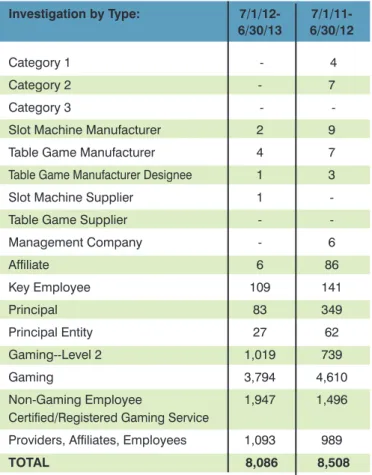
Since it was formed in 2006, BIE has conducted background investigations on over 55,000 individuals and 4,500 companies. Investigation by Type: 7/1/12- 7/1/11- 6/30/13 6/30/12 Category 1 - 4 Category 2 - 7 Category 3 - -
Slot Machine Manufacturer 2 9 Table Game Manufacturer 4 7 Table Game Manufacturer Designee 1 3 Slot Machine Supplier 1 - Table Game Supplier - -Management Company - 6 Affiliate 6 86 Key Employee 109 141 Principal 83 349 Principal Entity 27 62 Gaming--Level 2 1,019 739 Gaming 3,794 4,610 Non-Gaming Employee 1,947 1,496 Certified/Registered Gaming Service Providers, Affiliates, Employees 1,093 989
Office of Enforcement Counsel
Cyrus Pitre Chief Enforcement Counsel
The Office of Enforcement Counsel (OEC) serves as the prosecutor in all noncriminal matters relating to casino gaming in the Commonwealth. In its regulatory function, the OEC operates separately and independently of the Pennsylvania Gaming Control Board (Board).
Guided by the mandates of the Act, Board approved regulations, established legal precedence, and Commonwealth statutory law to fulfill the agency’s overall mission, the OEC’s responsibilities and duties include, but are not limited to: } providing legal advice to the Bureau of Investigations and
Enforcement (BIE) and making suitability recommenda-tions on applicants before the Board;
} ensuring regulatory compliance with the Act and Board-approved regulations;
} initiating proceedings for noncriminal violations of the Act or Board-approved regulations;
} seeking remedies which may include implementing com-pliance, civil fines and penalties, imposing conditions, and/or suspending or revoking licensing privileges of any person subject to the Board’s jurisdiction;
} providing recommendations and objections in matters before the Board;
} responding to all regulatory petitions subject to the Board’s jurisdiction; and,
} petitioning for the placement of individuals on the Board’s Involuntary Exclusion List.
The OEC maintains a presence in the PGCB’s main Harrisburg office, but also in regional offices in Conshohocken and Pittsburgh. Additionally, each OEC attorney is directly linked to Board staff on-site in each licensed facility and in each regional office allowing the OEC essential connectivity to review, assess, and act immediately and efficiently to matters that require its attention.
Matters handled by the OEC in fiscal year 2012-2013 included:
} prosecuting and/or making recommendations regarding the impact of refinancing and/or restructuring packages; } prosecuting and/or making recommendations regarding the access plan and financing package for Nemacolin’s Lady Luck Casino;
} providing regulatory oversight during the test periods and opening of Nemacolin’s Lady Luck Casino;
} prosecuting the public renewal hearing of Category 1 Licensee Mohegan Sun Pocono Downs;
} prosecuting the placement of dozens of individuals on the Board’s Involuntary Exclusion List;
} prosecuting the SugarHouse refinancing/expansion; } working with BIE on background investigations of the
Philadelphia Category 2 applicants.
The OEC expects the 2013-2014 fiscal year to include: } participating in suitability hearings regarding the
Philadel-phia Category 2 applicants;
} working with BIE on the background investigation of the Category 1 applicant for the last available license and participating in any subsequent suitability hearing; } monitoring the approved SugarHouse casino expansion
and
} various transactions regarding the expansion, corporate restructuring and/or debt refinancing of various licensees;
Office of Enforcement Counsel Statistical Data
Type July 1, 2012 - June 30, 2013
Enforcement Warning Letters 258
Enforcement Petitions and Complaints 177
Enforcement Compliance Conferences 12
Sworn Statements and Depositions 17
Regulatory Consent Agreements 46
Total Regulatory Fines & Penalties $530,590
Final Background Investigation Reports 1,322
Recommended License Denial Notices 59
Regulatory Hearings 86
Bureau of Financial Management & Administration
The Office of Financial Management (OFM) develops andmonitors the annual agency budget and assists the Board in preparing both analyses and recommendations regarding the itemized gaming budgets of the Department of Revenue, Attorney General’s Office, and Pennsylvania State Police to the legislative appropriations committees.
OFM also:
} provides gaming related revenue estimates to the Governor’s Budget Office;
} bills, collects, reports and monitors all agency generated revenue;
} administers the Local Law Enforcement Grant Program; and,
} posts on its Internet website, a list of all the itemized expenses of employees and members for each month that were reimbursed
The Office of Human Resources (HR):
} establishes, maintains and administers effective and comprehensive classification and compensation programs/ policies;
} coordinates a highly competitive benefits program; } ensures that all employees work in a safe and fair
environment.
HR staff support the board in achieving its goals and objectives by assisting managers in recruiting, retaining, and developing a talented and diverse workforce through the coordination of training and performance management programs. The Office of Human Resources also strives to maintain a cooperative working relationship with the American Federation of State, County and Municipal Employees (AFSCME) who represent all professional, clerical, administrative and first-line supervisory positions at the PGCB.
Office Services (OC) is responsible for the agency’s procurement needs, office space leasing and fleet operations and travel.
In Fiscal Year 2012-2013 OC continued its efforts to reduce costs wherever possible by:
eliminating all sole-source contracts;
} reducing costs for its Pittsburgh office by moving into a new office suite at lower rental rate;
} negotiated a new lease for the Office of Hearings and Appeals in Harrisburg that reduces monthly rent while providing permanent space for public meetings of the PGCB; and,
} reduced the overall cost and size of fleet operations.
Employees By Bureau
(as of June 30, 2013)
*Governor’s Annual Workforce Report
0 10 20 30 40 50 60 70 80 90 100 110 120
Commissioners Executive Offices Financial Mgt. & Admin. Investigations & Enforcement Casino Compliance Licensing GLO / OIT Office of Chief Counsel Hearings & Appeals Gaming Operations 7 15 12 114 29 22 11 5 15 83 Minority Representation (as of June 30, 2013) Gender Representation (as of June 30, 2013) 0 20 40 60 80 100 0 20 40 60 80 100 Caucasian Minority Caucasian Minority Male Female Male Female
Commonwealth Agencies* Commonwealth Agencies*
PGCB PGCB
85% 58%
15% 42%
86% 60%
Pennsylvania’s 12th Casino Opens: Lady Luck Casino Nemacolin
Throughout much of fiscal year 2012-2013, PGCB staff worked closely with staff at Lady
Luck Casino Nemacolin in Fayette County to prepare for the opening of Pennsylvania’s
second Category 3 Resort Casino, which occurred on July 1, 2013.
PGCB staff worked diligently for months on some keypre-opening requirements including:
} ensuring that the casino was conducting all required employee training;
} approving security and surveillance plans;
} testing surveillance cameras for proper positioning and use; and,
} making sure that all slot machines were properly func-tioning and communicating with the PA Department of Revenue’s Central Control Computer System.
Additionally, PGCB staff conducted over 850 investigations resulting in the licensing or certification of more than
700 individuals to work in the casino and more than 100 businesses that provide goods and services to the facility.
Prior to permitting Lady Luck Casino to open to the public, staff from the PGCB also approved internal controls, table
games submissions, table layouts, cards, dice and other devices, along with both problem gambling and diversity plans.
Finally, two test periods overseen by Gaming Control Board Commissioners Anthony Moscato, Annmarie Kaiser and John McNally III, were held on Thursday, June 27th and Saturday, June 29th. After a thorough evaluation of the test periods to insure that the casino was ready to receive the public, the Commissioners jointly gave authorization for the opening of the Lady Luck Casino Nemacolin on Monday, July 1st.
At a cost of approximately $60 million to construct on the grounds of the Nemacolin Woodlands Resort, Lady Luck Casino employed over 350 construction workers and, at its opening, employed over 500 individuals of which 90% are Pennsylvania residents.
PGCB Statement of Revenue and Expenditures
Fiscal Year 2012-13
Appropriation
Beginning Balance
Casino Operator Assessments $25,142,000
Restricted Revenue $10,956,000 Available $36,098,000 Expenditures Personnel Expenditures Salaries $18,842,512 Overtime $231,201 Benefits $9,138,868
Other Employee Paid Benefits $383 Leave Payouts/Military Stipend $71,465
Total Personnel Expenditures $28,284,429
Operating Expenditures Travel $347,814 Training $32,004 Utilities/Comm $440,934 Services $1,338,123 Rentals/Leases $1,804,805 Supplies $75,332 Equipment(NFA) $202,690 Inventory Expenses $76,532
Other Operating Expenses $1,045,243
Total Operating Expenditures $5,363,477
Fixed Assets
Hardware Servers $6,876
Software Licensing Recurring $205,822
$212,698
Total Expenditures $33,860,605
Revenues Over (Under) Expenditures $2,237,395
7/10/2012
See Agenda posted on Gaming Control Board Website under “Meet-ings”. Link to 7/11/2012.
7/11/2012
Quasi-judicial deliberation regarding Greenwood Gaming’s Petition for Modification of Gaming Floor: OP-21 and Category 2 discussion regarding application period
7/31/2012
See Agenda posted on Gaming Control Board Website under “Meet-ings”. Link to 8/1/2012.
8/21/2012
See Agenda posted on Gaming Control Board Website under “Meet-ings”. Link to 8/22/2012.
8/22/2012
Quasi-judicial deliberation regarding Mt. Airy #1, LLC License Renewal and Brigade Capital Management, LLC Petition regarding Institutional Investors
9/4/2012
Conference call regarding Brigade Capital Management, LLC Petition regarding Institutional Investors
9/11/2012
See Agenda posted on Gaming Control Board Website under “Meet-ings”. Link to 9/12/2012.
9/26/2012
Conference call regarding Personnel Matters
10/9/2012
See Agenda posted on Gaming Control Board Website under “Meet-ings”. Link to 10/10/2012.
11/7/2012
See Agenda posted on Gaming Control Board Website under “Meet-ings”. Link to 11/8/2012.
11/19/2012
See Agenda posted on Gaming Control Board Website under “Meet-ings”. Link to 11/20/2012.
11/20/2012
Quasi-judicial deliberation regarding Sands Bethworks Gaming, LLC - Petition Requesting Approval of the Reconfiguration of the Gaming Floor, Gaming Laboratories Inc. – Petition to Possess Slot Machines for Purposes of Operating a Permanent Gaming Testing and Certifi-cation Laboratory in the Commonwealth, and Valley Forge Casino – Petition for Approval of Revised Resort Membership Program.
12/11/2012
See Agenda posted on Gaming Control Board Website under “Meet-ings”. Link to 12/12/2012.
1/8/2013
See Agenda posted on Gaming Control Board Website under “Meet-ings”. Link to 1/9/2013.
1/28/2013
See Agenda posted on Gaming Control Board Website under “Meet-ings”. Link to 1/29/2013.
1/29/2013
Quasi-judicial deliberation regarding Mt. Airy#1 Petition for Approval of Casino Floor Reconfiguration and Presque Isle Downs Petition to Reduce the Number of Slot Machines and Table Games
2/19/2013
See Agenda posted on Gaming Control Board Website under “Meet-ings”. Link to 2/20/2013.
3/12/2013
See Agenda posted on Gaming Control Board Website under “Meet-ings”. Link to 3/13/2013.
4/2/2013
See Agenda posted on Gaming Control Board Website under “Meet-ings”. Link to 4/3/2013.
4/23/2013
See Agenda posted on Gaming Control Board Website under “Meet-ings”. Link to 4/24/2013.
4/24/2013
Quasi-judicial deliberation regarding Penn National Petition for Ap-proval of a Corporate Restructuring and Confidentiality Motion
5/14/2013
See Agenda posted on Gaming Control Board Website under “Meet-ings”. Link to 5/15/2013.
5/15/2013
Quasi-judicial deliberation regarding Sugarhouse HSP Gaming, L.P. – Petition for Approval to Modify Phase 1A Expansion and Woodlands Fayette, LLC – Petition for Reconsideration of the Board’s April 25, 2013 Order
6/4/2013
See Agenda posted on Gaming Control Board Website under “Meet-ings”. Link to 6/5/2013.
6/25/2013
See Agenda posted on Gaming Control Board Website under “Meet-ings”. Link to 6/26/2013.
Pennsylvania Gaming Control Board - Executive Session Log Fiscal Year 2012-2013
The Pennsylvania Gaming Control Board (Board) convenes public meetings monthly to conduct its business and render decisions on applications, petitions and reports and recommendations. In order to complete its work timely and
efficiently, the Board may convene more than one public meeting during a single month.
It is customary for the Board to conduct an executive session the day prior to a public meeting for the purpose of discussing matters confidential under the state’s Sunshine Law. An agenda is prepared for these executive sessions
and the agenda is posted to the Board’s website.
Additionally, the Board may consider matters that necessitate a hearing and these matters are conducted immediately prior to a scheduled public meeting. When the hearing is concluded, the Board’s Chairman may call for an executive session to engage in quasi-judicial deliberations regarding the matters which were the subject of the hearing.
A log of executive sessions held by the Board during Fiscal Year 2012/2013, including reference to the agenda posted on the Board’s website, is set forth below
Pennsylvania has 12 operating casinos. As of June 30, 2013 PA casinos employed 16,644 individuals and total tax revenue from slots machines and table games for FY 12/13 was $1,464,192,395
Local Share Distribution FY 2012-13 Statewide
Slots - $142,269,957 Tables - $14,263,193
Table Game Revenues FY 2012-13
Average Number of Table Games in June 2013 1,071
Gross Revenue $713,107,163
* Taxes and Fees $110,455,677
Non-Banking Tables 219 Gross Revenue $60,043,410 Banking Tables 827 Gross Revenue $647,966,671 Electronic Tables 0 Gross Revenue $72,711
Fully Automated Electronic Tables 25
Gross Revenue $5,024,371
Slot Revenues FY 2012-13
Average Number of Slot Machines in June 2013 26,045 Wagers $30,819,486,036 Payouts $27,778,710,113
Promotional Plays $681,162,132
Adjustments $91,360
Gross Terminal Revenue $2,428,887,430
** Taxes and Fees $1,353,736,717
Taxable Slot Wins Per Day
July 2012 $257.11 August 2012 $255.56 September 2012 $252.92 October 2012 $232.24 November 2012 $243.48 December 2012 $237.65 January 2013 $228.70 February 2013 $265.26 March 2013 $282.20 April 2013 $262.27 May 2013 $262.36 June 2013 $254.80
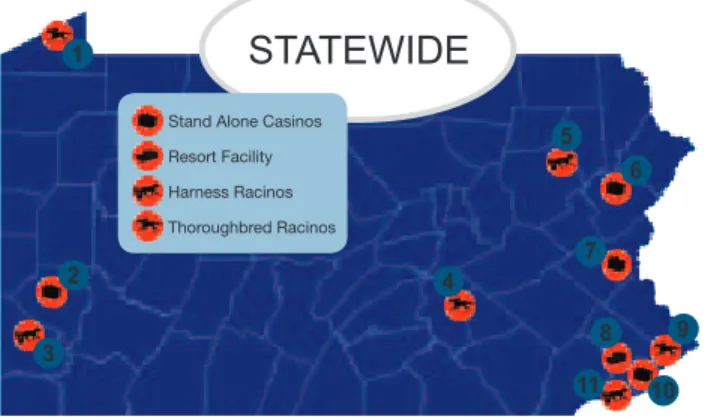
STATEWIDE
Stand Alone CasinosResort Facility Harness Racinos Thoroughbred Racinos 8 3 2 1 4 7 6 5 11 10 9
Presque Isle Downs & Casino opened on February 28, 2007 in Erie County, Summit Township and is a thoroughbred racetrack. As of June 30, 2013 the casino employed 916 individuals.
1
Table Game Revenues FY 2012-13
Average Number of Table Games in June 2013 46
Gross Revenue $14,956,139
Taxes and Fees $2,100,835
Non-Banking Tables 9 Gross Revenue $1,325,754 Banking Tables 37 Gross Revenue $13,630,385 Electronic Tables 0 Gross Revenue $0
Fully Automated Electronic Tables 0
Gross Revenue $0
Slot Revenues FY 2012-13
Average Number of Slot Machines in June 2013 1,705 Wagers $1,809,654,311 Payouts $1,625,792,027
Promotional Plays $45,420,609
Adjustments $21,460
Gross Terminal Revenue $138,463,135
Taxes and Fees $81,607,213
Taxable Slot Wins Per Day
July 2012 $215.53 August 2012 $212.25 September 2012 $209.42 October 2012 $174.46 November 2012 $171.24 December 2012 $158.01 January 2013 $146.67 February 2013 $188.88 March 2013 $237.92 April 2013 $230.07 May 2013 $227.37 June 2013 $230.06
Local Share Distribution FY 2012-13
Summit Township Slots - $1,308,354 Tables - $0 Erie County Slots - $11,204,908 Tables - $0
Erie Co. Redevelopment Auth. Slots - $0
Tables - $299,123 * Includes $7.5 million tables games certification fee and $1,417 test nights
taxes from Lady Luck Casino Nemacolin
** Include $5 million slots licensure fee and $25,189 slots tax from test nights at Lady Luck Casino Nemacolin. In addition there is $45,114,460 in Local Share Minimum amount included.
Meadows Racetrack & Casino opened on June 11, 2007 in Washington County, North Strabane Township and is a harness race-track. As of June 30, 2013 the casino employed 1,260 individuals.
3
Table Game Revenues FY 2012-13
Average Number of Table Games in June 2013 80
Gross Revenue $35,983,833
Taxes and Fees $5,056,543
Non-Banking Tables 20 Gross Revenue $2,988,397 Banking Tables 60 Gross Revenue $32,995,436 Electronic Tables 0 Gross Revenue $0
Fully Automated Electronic Tables 0
Gross Revenue $0
Slot Revenues FY 2012-13
Average Number of Slot Machines in June 2013 3,317 Wagers $3,048,194,865 Payouts $2,807,389,619
Promotional Plays $69,182,278
Adjustments $0
Gross Terminal Revenue $240,805,246
Taxes and Fees $134,816,973
Taxable Slot Wins Per Day
July 2012 $215.85 August 2012 $202.27 September 2012 $216.21 October 2012 $191.56 November 2012 $191.73 December 2012 $179.60 January 2013 $177.13 February 2013 $195.55 March 2013 $209.85 April 2013 $202.16 May 2013 $203.03 June 2013 $202.85
Local Share Distribution FY 2012-13
Washington Co. Townships Slots - $3,016,672 Tables - $189,362 Washington Co. - DCED
Slots - $9,254,142 Tables - $170,476 North Strabane Twp. Township Slots - $2,382,690 Tables - $359,838 Rivers Casino opened on August 9, 2009 in Allegheny County in the
City of Pittsburgh. As of June 30, 2013 the casino employed 1,782 individuals.
2
Table Game Revenues FY 2012-13
Average Number of Table Games in June 2013 114
Gross Revenue $69,280,996
Taxes and Fees $9,731,196
Non-Banking Tables 30 Gross Revenue $6,730,314 Banking Tables 84 Gross Revenue $62,550,683 Electronic Tables 0 Gross Revenue $0
Fully Automated Electronic Tables 0
Gross Revenue $0
Slot Revenues FY 2012-13
Average Number of Slot Machines in June 2013 2,939 Wagers $3,470,801,798 Payouts $3,120,115,261
Promotional Plays $67,353,664
Adjustments $0
Gross Terminal Revenue $283,332,873
Taxes and Fees $156,936,375
Taxable Slot Wins Per Day
July 2012 $254.48 August 2012 $260.89 September 2012 $265.07 October 2012 $252.82 November 2012 $280.19 December 2012 $261.82 January 2013 $248.40 February 2013 $300.67 March 2013 $301.27 April 2013 $277.55 May 2013 $268.17 June 2013 $260.32
Local Share Distribution FY 2012-13
Visitors Bureau of Monroeville Slots - $0 Tables - $103,921 Dept of Education Slots - $0 Tables - $1,281,699 Allegheny County Slots - $5,666,657 Tables - $0 Pittsburgh/ICA Slots - $10,024,151 Tables -$0
Table Game Revenues FY 2012-13
Average Number of Table Games in June 2013 84
Gross Revenue $42,923,506
Taxes and Fees $6,040,956
Non-Banking Tables 18 Gross Revenue $4,052,288 Banking Tables 66 Gross Revenue $38,871,218 Electronic Tables 0 Gross Revenue $0
Fully Automated Electronic Tables 0
Gross Revenue $0
Slot Revenues FY 2012-13
Average Number of Slot Machines in June 2013 2,332 Wagers $2,922,913,668 Payouts $2,625,131,660
Promotional Plays $73,525,763
Adjustments $69,900
Gross Terminal Revenue $224,326,145
Taxes and Fees $126,245,731
Taxable Slot Wins Per Day
July 2012 $282.90 August 2012 $277.07 September 2012 $268.26 October 2012 $245.19 November 2012 $257.91 December 2012 $244.42 January 2013 $238.33 February 2013 $266.07 March 2013 $282.54 April 2013 $265.87 May 2013 $270.93 June 2013 $263.65
Local Share Distribution FY 2012-13 Plains Township Slots - $2,414,944 Tables - $429,235 Luzerne County - CFA
Slots - $11,914,584 Tables - $429,235
Mohegan Sun at Pocono Downs opened on November 14, 2006 in Luzerne County, Plains Township and is a harness racetrack. As of June 30, 2013 the casino employed 1,732 individuals.
5
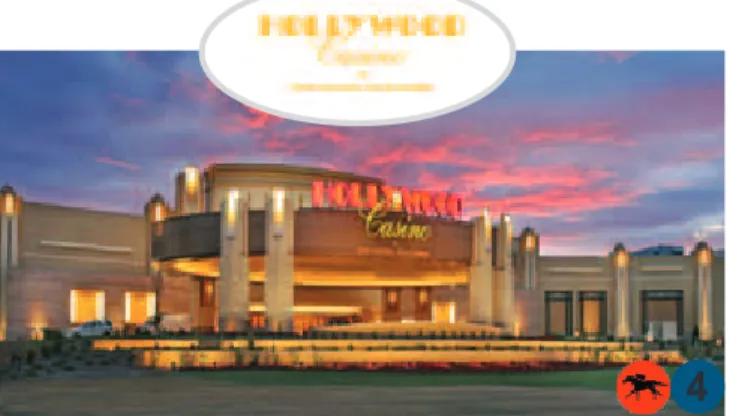
Hollywood Casino at Penn National Race Course opened on February 12,2008 in Dauphin County, East Hanover Township and is a thoroughbred racetrack. As of June 30, 2013 the casino employed 1,252 individuals.
4
Table Game Revenues FY 2012-13
Average Number of Table Games in June 2013 69
Gross Revenue $37,810,041
Taxes and Fees $5,317,982
Non-Banking Tables 16 Gross Revenue $4,320,908 Banking Tables 53 Gross Revenue $33,416,422 Electronic Tables 0 Gross Revenue $72,711
Fully Automated Electronic Tables 0
Gross Revenue $0
Slot Revenues FY 2012-13
Average Number of Slot Machines in June 2013 2,456 Wagers $2,469,039,520 Payouts $2,206,269,938
Promotional Plays $24,569,553
Adjustments $0
Gross Terminal Revenue $238,200,029
Taxes and Fees $133,492,125
Taxable Slot Wins Per Day
July 2012 $279.10 August 2012 $263.85 September 2012 $264.93 October 2012 $240.35 November 2012 $247.75 December 2012 $242.50 January 2013 $238.70 February 2013 $282.19 March 2013 $299.30 April 2013 $276.77 May 2013 $269.49 June 2013 $271.68
Local Share Distribution FY 2012-13
East Hanover Twp, Leb. Co Slots - $160,000
Tables - $116,152 Dauphin County
Slots - $13,459,236 Tables - $523,896
East Hanover Twp, Dauphin Co Slots - $1,028,330
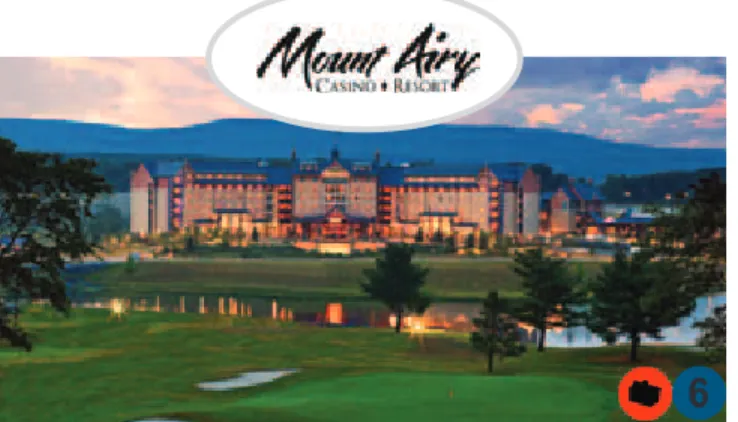
Mount Airy Casino Resort opened on October 22, 2007 in Monroe County, Paradise Township. As of June 30, 2013 the casino employed 1,320 individuals.
6
Table Game Revenues FY 2012-13
Average Number of Table Games in June 2013 72
Gross Revenue $39,224,667
Taxes and Fees $5,519,165
Non-Banking Tables 10 Gross Revenue $2,180,362 Banking Tables 62 Gross Revenue $37,044,304 Electronic Tables 0 Gross Revenue $0
Fully Automated Electronic Tables 0
Gross Revenue $0
Slot Revenues FY 2012-13
Average Number of Slot Machines in June 2013 1,874 Wagers $1,890,014,945 Payouts $1,709,283,691
Promotional Plays $34,136,445
Adjustments $0
Gross Terminal Revenue $146,594,808
Taxes and Fees $85,988,990
Taxable Slot Wins Per Day
July 2012 $220.00 August 2012 $219.57 September 2012 $212.02 October 2012 $186.71 November 2012 $176.86 December 2012 $170.03 January 2013 $169.47 February 2013 $182.49 March 2013 $205.56 April 2013 $209.80 May 2013 $213.45 June 2013 $211.09
Local Share Distribution FY 2012-13 Paradise Township Slots - $858,859 Tables - $392,706 PHEAA Slots - $0 Tables - $196,353 Monroe County - CFA
Slots - $9,720,702 Tables - $196,353 Monroe County Slots - $2,287,377 Tables - $0
Table Game Revenues FY 2012-13
Average Number of Table Games in June 2013 183
Gross Revenue $165,378,077
Taxes and Fees $23,283,344
Non-Banking Tables 36 Gross Revenue $11,328,162 Banking Tables 147 Gross Revenue $154,049,915 Electronic Tables 0 Gross Revenue $0
Fully Automated Electronic Tables 0
Gross Revenue $0
Slot Revenues FY 2012-13
Average Number of Slot Machines in June 2013 3,013 Wagers $4,204,816,551 Payouts $3,780,221,728
Promotional Plays $133,691,441
Adjustments $0
Gross Terminal Revenue $290,903,382
Taxes and Fees $160,784,470
Taxable Slot Wins Per Day
July 2012 $262.77 August 2012 $265.53 September 2012 $258.48 October 2012 $235.07 November 2012 $255.72 December 2012 $264.42 January 2013 $244.43 February 2013 $277.91 March 2013 $293.71 April 2013 $270.64 May 2013 $280.05 June 2013 $261.06 Allentown City Slots - $3,393,759 Tables - $330,756 Bethlehem City Slots - $8,687,860 Tables - $826,890 Easton City Slots - $0 Tables - $826,890 Lehigh County Slots - $930,891 Tables - $330,756 Northampton Co. Slots - $2,792,672 Tables - $992,268 Local Share Distribution FY 2012-13
Sands Casino Resort Bethlehem opened on May 22, 2009 in
Northampton County in the City of Bethlehem. As of June 30, 2013 the casino employed 2,117 individuals.
Valley Forge Casino Resort opened on March 31, 2012 in Montgomery County in Upper Merion Township and is a resort facility. As of June 30, 2013 the casino employed 1,180 individuals.
8
Table Game Revenues FY 2012-13
Average Number of Table Games in June 2013 50
Gross Revenue $31,583,280
Taxes and Fees $5,053,325
Non-Banking Tables 0 Gross Revenue $0 Banking Tables 50 Gross Revenue $31,583,280 Electronic Tables 0 Gross Revenue $0
Fully Automated Electronic Tables 0
Gross Revenue $0
Slot Revenues FY 2012-13
Average Number of Slot Machines in June 2013 600 Wagers $699,583,052 Payouts $627,786,301
Promotional Plays $15,851,821
Adjustments $0
Gross Terminal Revenue $55,944,930
Taxes and Fees $30,138,483
Taxable Slot Wins Per Day
July 2012 $188.68 August 2012 $213.60 September 2012 $239.36 October 2012 $222.01 November 2012 $237.85 December 2012 $239.19 January 2013 $253.62 February 2013 $297.75 March 2013 $304.37 April 2013 $299.73 May 2013 $290.64 June 2013 $284.02
Local Share Distribution FY 2012-13
Montgomery Co. - CFA Slots - $1,118,899 Tables - $315,833 Upper Merion Township
Slots - $1,118,899 Tables - $315,833 Bucks County Slots - $7,528,362 Tables - $1,103,145 Bensalem Township Slots - $9,837,039 Tables - $1,103,145 Local Share Distribution FY 2012-13 Table Game Revenues FY 2012-13
Average Number of Table Games in June 2013 166
Gross Revenue $110,307,984
Taxes and Fees $16,521,226
Non-Banking Tables 45 Gross Revenue $16,797,344 Banking Tables 102 Gross Revenue $90,560,552 Electronic Tables 0 Gross Revenue $0
Fully Automated Electronic Tables 19
Gross Revenue $2,950,088
Slot Revenues FY 2012-13
Average Number of Slot Machines in June 2013 3,361 Wagers $5,267,459,140 Payouts $4,773,949,504
Promotional Plays $117,091,550
Adjustments $0
Gross Terminal Revenue $376,418,086
Taxes and Fees $205,146,941
Taxable Slot Wins Per Day
July 2012 $295.28 August 2012 $301.55 September 2012 $296.96 October 2012 $280.10 November 2012 $296.40 December 2012 $297.38 January 2013 $289.11 February 2013 $323.13 March 2013 $348.83 April 2013 $313.21 May 2013 $317.15 June 2013 $307.87
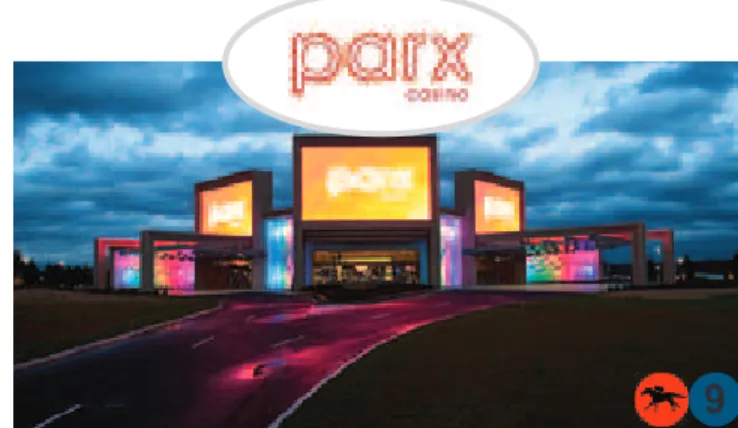
Parx Casino opened on December 19, 2006 in Bucks County, Bensalem Township and is a thoroughbred racetrack. As of June 30, 2013 the casino employed 1,825 individuals.
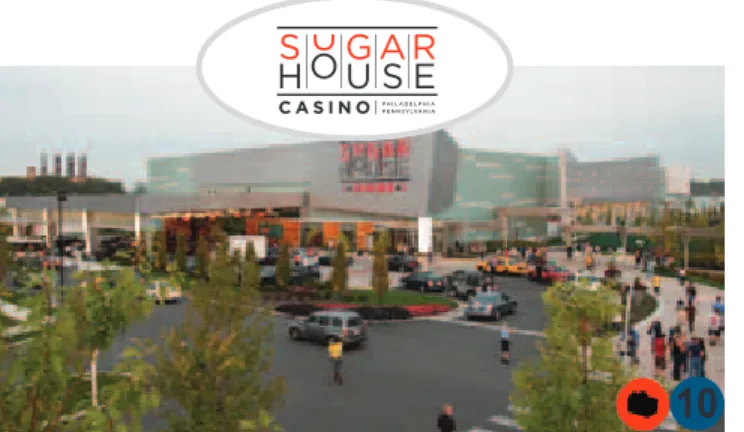
SugarHouse Casino opened on September 23, 2010 in the City of Philadelphia. As of June 30, 2013 the casino employed 1,085 individuals.
10
Table Game Revenues FY 2012-13
Average Number of Table Games in June 2013 58
Gross Revenue $85,318,943
Taxes and Fees $12,545,594
Non-Banking Tables 0 Gross Revenue $0 Banking Tables 56 Gross Revenue $84,613,035 Electronic Tables 0 Gross Revenue $0
Fully Automated Electronic Tables 2
Gross Revenue $705,908
Slot Revenues FY 2012-13
Average Number of Slot Machines in June 2013 1,604 Wagers $2,076,640,693 Payouts $1,857,019,867
Promotional Plays $35,337,619
Adjustments $0
Gross Terminal Revenue $184,283,208
Taxes and Fees $99,282,736
Taxable Slot Wins Per Day
July 2012 $310.81 August 2012 $318.79 September 2012 $295.06 October 2012 $285.17 November 2012 $304.60 December 2012 $309.63 January 2013 $296.47 February 2013 $367.08 March 2013 $358.12 April 2013 $321.66 May 2013 $312.48 June 2013 $298.02
Local Share Distribution FY 2012-13 Philadelphia City Slots - $3,456,329 Tables - $830,189 Phila. School District
Slots - $3,914,999 Tables - $876,190
Harrah’s Philadelphia Casino and Racetrack opened on January 23, 2007 in Delaware County in the City of Chester and is a harness race-track. As of June 30, 2013 the casino employed 1,672 individuals.
11
Table Game Revenues FY 2012-13
Average Number of Table Games in June 2013 121
Gross Revenue $80,330,840
Taxes and Fees $11,784,093
Non-Banking Tables 35 Gross Revenue $10,319,881 Banking Tables 82 Gross Revenue $68,642,584 Electronic Tables 0 Gross Revenue $0
Fully Automated Electronic Tables 4
Gross Revenue $1,368,375
Slot Revenues FY 2012-13
Average Number of Slot Machines in June 2013 2,803 Wagers $2,959,777,342 Payouts $2,645,207,196
Promotional Plays $65,001,333
Adjustments $0
Gross Terminal Revenue $249,568,812
Taxes and Fees $139,271,490
Taxable Slot Wins Per Day
July 2012 $255.89 August 2012 $252.61 September 2012 $242.42 October 2012 $222.21 November 2012 $243.58 December 2012 $237.23 January 2013 $221.80 February 2013 $259.86 March 2013 $275.29 April 2013 $245.72 May 2013 $247.44 June 2013 $234.31
Local Share Distribution FY 2012-13 Chester City Slots - $9,795,394 Tables - $803,308 Delaware County Slots - $4,991,376 Tables - $803,308
Delivering Information to the Public
Speakers Bureau
The PGCB is committed to making sure that citizens are well-informed of the oversight work of the Board and the impact of legalized casino gaming in Pennsylvania.
To facilitate that mission, the Board members and staff actively crisscross the state to speak to community groups as a result of requests through the PGCB Speakers Bureau. This face-to-face interaction permits Pennsylvanians to hear firsthand on the financial and workforce impact of the casinos statewide and within regions of the Commonwealth, and how issues such as problem gaming, smoking and crime are being handled. During Fiscal Year 2012-2013 staff of the PGCB performed over 60 speaking engagements throughout Pennsylvania, with that number expected to be even higher in the next fiscal year.
Professional, educational and service organizations can request a speaker from the PGCB for meetings and conferences. Additional
information and an online speaker request tool can be found by clicking this link or typing it into your browser: http://gamingcontrolboard. pa.gov/?p=111.
Web Site
The PGCB’s web site, www. gamingcontrolboard.pa.gov, provides an important link to the public in all Board matters related to both its regulatory efforts and Pennsylvania’s gaming industry. During the 2012-2013 fiscal year, as an example, the web site was a valuable resource to those who wished to become part of the public input process for the Philadelphia casino licensing. At the site, citizens, community groups and public officials could access key information about each of the casino applicants, and choose to register to speak at a public input hearing or submit written comments for the Board’s review.
At this website, visitors can also watch Board meetings live or view videos of past meetings, look up future meeting schedules and past meeting transcripts, download important presentations made to the Board related to the statewide or community impact of current or future casinos, obtain information on identifying a gambling problem and gaining assistance, discover employment opportunities, access an interactive map of casino locations, and much more.
Meeting Videos and Live Streams
The PGCB also continues its effort to help the public see its regulatory work and decisions via video. This capability was expanded during the 2012-2013 fiscal year when the PGCB began to stream off-site public meetings in addition to Harrisburg-based meetings. These included hearings on the Philadelphia casino licensing matter along with casino renewal hearings held within the community i