Imperial College London Department of Computing
Local Reasoning about Web
Programs
Gareth David Smith
June 2, 2011
Supervised by Philippa Gardner
Submitted in part fulfilment of the requirements for the degree of Doctor of Philosophy in Computing of Imperial College London
Declaration
I herewith certify that all material in this dissertation which is not my own work has been properly acknowledged.
Abstract
Since 1990, the world wide web has evolved from a static collection of refer-ence pages to a dynamic programming and application-hosting environment. At the core of this evolution is the programming language JavaScript and the XML update library “DOM”. Every modern web browser contains a DOM implementation which allows JavaScript programs to read and alter the web page that the user is currently viewing. JavaScript and DOM are extremely successful, and this success may be in part due to their highly dynamic and tightly integrated nature. However, this very nature hinders formal program analysis and tool development. Even the implementation independent specification that defines DOM is largely written in the English language, and not using any formal system.
While client-side web programming was once a simple discipline of form validation and interface trickery, it is fast becoming a far more serious business encompassing application development for the emerging ubiqui-tous “cloud”. As this evolution gains pace there is an increasing demand for client-side tool support of the sort commonly enjoyed by “enterprise” programmers, working in more easily analysed languages such as Java.
This thesis makes use of recent developments in program reasoning using context logic to provide the first formal, compositional specification for the Fundamental Interfaces of DOM Core Level 1. It presents both a big-step operational semantics for the necessary operations of the library and a context logic for reasoning about programs which use the library. Finally, it presents example programs that use the library and shows how context logic can be used to prove useful properties of those programs.
Acknowledgements
•
to my supervisor Philippa Gardner, who has guided
and encouraged me;
•
to my parents Dave and Dorothy, who taught me to
think and question, and my brother Chris, who always
helped me practice;
•
to my family, who are my closest friends;
Contents
1. Introduction 9
1.1. The Hacker’s Jungle . . . 9
1.2. Contributions and Thesis Outline . . . 14
1.3. Publications . . . 15
2. Technical Background 17 2.1. Hoare Reasoning . . . 17
2.2. Separation Logic . . . 19
2.2.1. The Heap . . . 20
2.2.2. The Assertion Language . . . 20
2.2.3. Program Reasoning . . . 20
2.3. Context Logic . . . 22
2.3.1. The Tree . . . 23
2.3.2. The Assertion Language . . . 24
2.3.3. Program Reasoning . . . 25
3. Featherweight DOM 27 3.1. Featherweight DOM Data Structures . . . 27
3.2. A Simple Imperative Language . . . 32
3.2.1. Program State . . . 33
3.2.2. Expressions . . . 33
3.2.3. Standard Imperative Commands . . . 34
3.2.4. Procedures . . . 37
3.3. Featherweight DOM Commands . . . 39
4. Context Logic for Featherweight DOM 45 4.1. Logical Variables . . . 46
4.2. Logical Expressions. . . 48
4.4. Formula Types . . . 52 4.5. Satisfaction . . . 55 4.6. Derived Notation . . . 56 4.7. Program Reasoning. . . 60 4.8. Soundness . . . 65 4.8.1. Defining Soundness. . . 65
4.8.2. An Existing Approach to Soundness for Local Reasoning 67 4.8.3. The Problem with the Existing Approach . . . 67
4.8.4. A New Approach . . . 69
4.8.5. Defining Locality . . . 69
4.8.6. Locality of the Featherweight DOM Commands . . . . 76
4.8.7. Soundness and Locality Propagation . . . 84
5. Featherweight DOM Examples 90 5.1. Additional Commands . . . 90 5.1.1. getPreviousSibling . . . 90 5.1.2. getFirstChild . . . 96 5.1.3. getDataLength . . . 97 5.1.4. getData . . . 99 5.2. Weakest Preconditions . . . 99 5.3. Compliance Testing . . . 103
5.4. Proving Schema Invariants. . . 106
6. DOM Core Level 1, The Fundamental Interfaces 112 6.1. Notation . . . 113 6.2. Data Structure . . . 113 6.2.1. Node Types . . . 117 6.2.2. The Grove. . . 118 6.2.3. Document Nodes . . . 118 6.2.4. Document Fragments . . . 119 6.2.5. Element Nodes . . . 119 6.2.6. Attributes . . . 120
6.2.7. Comments and Text Nodes . . . 122
6.2.8. Element Searches . . . 122
6.2.9. Strings and Characters. . . 125
6.2.11. Context Application . . . 127
6.3. The Language. . . 129
6.3.1. The Host Language . . . 130
6.3.2. DOM Library Commands . . . 135
7. Context Logic for DOM Core Level 1 164 7.1. Logical Variables . . . 164 7.2. Logical Expressions. . . 164 7.3. Logical Formulae . . . 165 7.3.1. Formula Types . . . 167 7.3.2. Satisfaction Relation . . . 167 7.4. Derived Formulae . . . 169 7.5. Program Reasoning. . . 172 7.6. Command Axioms . . . 173 7.6.1. Document . . . 173 7.6.2. Node. . . 175 7.6.3. NodeList . . . 186 7.6.4. Element . . . 190 7.6.5. Attr . . . 191 7.6.6. NamedNodeMap . . . 191 7.6.7. Character Data . . . 193 7.7. Inference Rules . . . 194 7.8. Example . . . 195
8. DOM in the Wild 200 8.1. Python minidom . . . 201
9. Conclusions and Future Work 204 A. Featherweight DOM 216 A.1. The Remaining Commands . . . 216
A.2. Weakest Preconditions . . . 223
A.2.1. appendChild . . . 224
A.2.2. removeChild . . . 225
A.2.3. getNodeName. . . 226
A.2.4. getParentNode . . . 227
A.2.6. createElement. . . 229 A.2.7. item . . . 229 A.2.8. substringData. . . 231 A.2.9. appendData. . . 233 A.2.10. deleteData . . . 234 A.2.11. createTextNode . . . 235 A.2.12. assignment . . . 235 A.2.13. skip . . . 236
B. DOM Core Level 1 237 B.1. The Remaining Commands . . . 237
B.2. Proving Schema Preservation of the graduateStudents Pro-cedure . . . 267
C. Implementation Behaviour 272 C.1. The normalize Command . . . 272
C.2. Default Attributes . . . 275
1. Introduction
In his 2000 paper “Intuitionistic Reasoning about Shared Mutable Data Structure” [57], John Reynolds described programming with pointers as “a no-man’s land inhabited by many useful and intuitively straight-forward programs that have been poorly served by both type systems and program-proving methodologies”. He claimed that this no-man’s land was “far more than a hacker’s jungle”, and proposed the methods which ultimately led to the development of separation logic and have since met with a great deal of success in that no-man’s land.
Today, there is a growing body of work on reasoning about pointer pro-gramming, including significant success with automated reasoning about complete industrial programs[69]. While the no-man’s lands of pointer pro-grams may have been claimed and tamed, there is now a new world of programs which have been poorly served by both type systems and program-proving methodologies. Dynamically typed “scripting languages” sacrifice the safety of type systems on the altar of flexibility and short release-cycles. They are extremely difficult to reason about, and have been very successful on the fast paced world wide web, which rewards first-movers, and makes it easy to instantly distribute bug-fixes to an entire user base. This thesis takes the latest developments in the methodologies that were used to con-quer the no-mans land of pointer programs, and applies them to forging a path through the new hacker’s jungle.
1.1. The Hacker’s Jungle
The origins of the world wide web lie in a proposal written in 1989 by Tim Berners-Lee[67] and re-written in 1990 with Robert Cailliau[68]. The proposal was to create “a large hypertext database with typed links”, the purpose of which was to allow high energy physicists to share data, news and documentation. The first web pages were “static”, meaning that any
two attempts to access the same page would return the same data, and that data would be composed of inert text and graphics.
In 1993 the Common Gateway Interface (CGI) was standardised[17], al-lowing web servers to serve not just static web pages, but also pages that were produced dynamically by a console program. This allowed for the creation of sites like search engines or other database query systems. This also opened the door for early versions of e-commerce sites such as Amazon. While this technology allowed a server to respond to each HTTP request with a unique, dynamically generated page; it did not introduce any dynam-icism into the client – the web browser. Each page was still composed of text and images which could not respond to user-interaction without loading a new page from the server.
Three key technologies have since emerged in client-side web program-ming. In 1995, Netscape included a JavaScript implementation in the 2.0 release of their browser Netscape Navigator[25]. In the same year, Sun released the first version of their Java programming language, which intro-duced Java “applets”. Hot on the heels of Netscape and Sun, Macromedia released “Flash” in 1996.
All three of these technologies aimed to enrich the user experience of browsing the web by allowing reactive code to run on the client machine. However, the specific goals of each technology differed slightly. JavaScript was initially most often used for simple form validation, while Java applets were used for “enterprise” client-server programming and Flash was mostly used for animation. These perceptions changed in 2004 and 2005 when Google unveiled Gmail and Google Maps. Both of these applications made use of JavaScript as their client-side programming language and are consid-ered by many to have been the first wide deployments of the web program-ming techniques now known as “Ajax”[2]. The term “Ajax” is shorthand for “Asynchronous JavaScript and XML”, and refers to the use of JavaScript running in a web browser and interacting in a timely fashion with the user while making asynchronous requests of the web server to ensure that any data the user requires is available in the client program when they require it. A good example of this technique is the scrolling map feature pioneered by Google Maps. The JavaScript program listens to the drag-events generated by the user’s mouse, and uses those events to scroll the map in real time. In the background, the program requests adjacent map tiles from the server,
so that whenever the user drags a previously unseen area of map into view, that map tile will have already been loaded into program memory and the user need not wait for a network request.
In 2010, Java applets are rare on the web while Ajax web-applications are flourishing. JavaScript has become an international standard called ECMAScript[26]. What was Macromedia Flash is now called Adobe Flash, and features a programming language based on ECMAScript, which is called “ActionScript”.
One of the keys to the success of Ajax is the tight integration of the JavaScript programming language with the user interface of the web browser. This integration is largely achieved through a library called DOM. DOM stands for “Document Object Model” and is a library for performing in-place XML update. Every modern web browser contains a DOM imple-mentation which is used by JavaScript programs to read and alter the web page that the user is currently viewing.
The origins of DOM lie in several competing and incompatible XML up-date libraries developed during the 1990s. Today however, DOM is defined by an implementation neutral specification, maintained by the World Wide Web Consortium (W3C)[22]. The W3C first published “DOM Level 1” in 1998, and have built subsequent layers on top of that first standard. The current release of the specification, called “DOM Level 3” was published in 2004.
It is thanks to the implementation neutrality of the DOM and ECMAScript specifications that it is now possible to run the same client-side web program in Chrome, Firefox, Internet Explorer or Safari. In addition to implemen-tations in web browsers, there are also DOM implemenimplemen-tations available for most high-level programming languages. This makes it possible to write server-side CGI programs which use the same programming techniques for managing their XML. DOM also provides a convenient means for writing other programs that manipulate XML, without necessarily having anything to do with the web. The Open Document Format is an example of a mod-ern XML-based format for storing word processor documents, spreadsheets, presentations, graphics and formulae. OpenOffice provides its own imple-mentation of DOM in order to manipulate these documents.
It is instructive to compare the current state of DOM and JavaScript to that of their 1995 competitor, Java. DOM is successful, mature and
implementation neutral, but it suffers from being written in the English language rather than in a more precise, mathematical fashion. There are some cases which are unclear or ambiguous, and this leads to inconsistency in implementations and bugs in client code. This thesis represents the first formal mathematical specification for DOM. An operational semantics for JavaScript was only recently produced by Maffeis, Mitchell and Taly [48]. JavaScript programmers have no type system or any other kind of auto-mated reasoning to support them. While many type systems have been devised for small subsets of the language[3,63,38], these subsets all ignore several key features of the language-proper. A recent survey by Richards, Lebresne, Burg and Vitek of JavaScript as it is used in the wild demon-strates that many of these features are in extremely wide use[59].This is in stark contrast with Java, which has been extensively studied from the point of view of precisely specified subsets of the language such as featherweight java[42], lightweight java[46], middlewight java[5] and ClassicJava[27]. Java has a powerful static type system which can be extended to support mech-anisms such as ownership types[18, 7] and session types[41]. Parkinson introduced separation logic for reasoning about Java in 2005[56], and this work is being automated in the jStar tool[21]. This work all results in tools which support Java programmers in writing large reliable programs.
In the past, JavaScript and DOM programs have tended to be small. Such programs need little in the way of tool support, but benefit greatly from flexibility and tight browser integration. This is changing. As web programming and Ajax become more and more ubiquitous and complex, the demand for tools, libraries and other innovative methods of ensuring the reliability of web programs is increasing. Unit testing frameworks and well-designed libraries such as jQuery[44] can and do take some of the strain. However, thoroughly testing large complex code is difficult, especially when the number of platforms which must be tested is constantly increasing as new web browsers designed for new form-factors such as web-phones and tablet PCs are introduced to the market. Libraries can help reduce the complexity of application programs, but only at the expense of increasing the complexity of libraries. Whether it is the application author or the library author who is writing the complex code, it is clear that if programs are to be written in JavaScript and DOM then more advanced tools-support of the sort enjoyed by java will be essential.
Another solution to the problem of the increasing complexity of JavaScript and DOM programs is to write code in another language entirely. Bet-ter supported languages include Java, Haskell or the purpose-designed lan-guages Flapjax or Milescript. In all these cases, the programmer can now write code in their language of choice and compile to JavaScript. This is not how Java was deployed on the web in 1995, but is how Google chose to deploy their new service“Wave”, which was written entirely in Java and deployed using the Google Web Toolkit[19] which compiles the client-side portion to JavaScript. It is clear that even if web programmers are tempted away from JavaScript when writing programs, they will continue to compile to JavaScript for the foreseeable future. If DOM and JavaScript are to be the assembly language of the web, then a formal understanding of DOM and JavaScript will surely play a crucial role in developing compilers that target it. Since JavaScript seems to be resistant to static type analysis, and since a formal understanding of DOM and JavaScript will be important in the future development of programmers tools, and web language compilers, it is desirable to find another means of reasoning about DOM/JavaScript code.
This thesis concentrates on reasoning about DOM, while keeping in mind that future work will involve reasoning about JavaScript.
From the point of view of a JavaScript programmer, DOM is a large global data structure, which may be accessed by any part of a JavaScript program regardless of scope. This is reminiscent of a C programmer’s heap, which is also a large global data structure which exists outside the normal rules of scope. Both structures play havoc with the modular design of programs, introduce problems of aliasing, and make formal reasoning difficult.
O’Hearn, Reynolds and others recently introduced separation logic which has met with a great deal of success in reasoning about C programs which make use of the heap [57, 55, 58]. That work has led to a number of automated tools which have been very successful in finding and eliminating bugs in environments where testing is difficult and there is little support from a type system[4,62,69,11].
Separation logic allows a mathematician or an automated tool to reason about the shape of a heap: to isolate only the small sub-heap that a partic-ular subroutine requires to run, to reason about the effects of the subroutine on that sub-heap, and finally to use this reasoning to draw conclusions about
the whole global heap.
This methodology seems to be a sensible approach to reasoning about the large global structure of web programs. However, while the C heap is a sim-ple bag of heap cells, the tree structure of DOM is more comsim-plex. Calcagno, Gardner and Zarfaty have shown[12] that separation logic is insufficient to reason about tree structures, and have introduced context logic to fill the gap. Context logic is inspired by ambient logic[16], and has been used to reason about programs that manipulate simple tree structures.
This thesis applies context logic to the task of reasoning about DOM programs.
1.2. Contributions and Thesis Outline
The key contributions of this thesis are a formal description of the Funda-mental Interfaces of DOM Core Level 1, and an application of Gardner and Zarfaty’s context logic for reasoning about DOM programs. DOM data is significantly more complex than the data models of previous context logic applications. The core conceptual difficulties presented by the DOM struc-ture are distilled in “Featherweight DOM” and dealt with in Chapters 3
and 4. This work on Featherweight DOM then serves as a road map for work on the Fundamental Interfaces of DOM Core Level 1, which is covered in Chapters 6 and 7. Using this formal description and context logic, it is possible to reason in an intuitive and modular fashion about the correctness of programmes that use DOM to manipulate XML data.
Here is the outline of this thesis:
• Chapter 2 provides background on program verification techniques, beginning with Hoare logic and tracing the development of separation logic and context logic. It defines much of the mathematical notation and explains many of the techniques that are used in later chapters.
• Chapter 3 follows the example of featherweight java and presents “Featherweight DOM”. Featherweight DOM concentrates on the Node interface of DOM Core Level One and demonstrates the conceptual core of our approach without getting lost in all the detail of the Fun-damental Interfaces of DOM Core Level One. This presentation con-sists of a big-step operational semantics of the necessary operations of
Featherweight DOM and an implementation of the remaining opera-tions in terms of those.
• Chapter4presents a context logic for Featherweight DOM, and shows soundness using a new notion of program locality.
• Chapter 5demonstrates context logic for Featherweight DOM by rea-soning about several example programs.
• Chapter6extends the work in Chapter3to cover all the Fundamental Interfaces of DOM Core Level One. The act of precisely specifying its behaviour uncovers a number of ambiguous or unclear descriptions in the W3C specification. As with Chapter 3, this chapter presents a core of operational semantics and implementations of remaining oper-ations. It concludes with some example programs which demonstrate the features of the Fundamental Interfaces of DOM Core Level One.
• Chapter 7 presents a context logic for the Fundamental Interfaces of DOM Core Level One. As with Chapter 4, this logic is then used to reason about the example programs given in the previous chapter.
• Chapter 8 briefly describes the real world behaviour of key features of several DOM implementations and discusses some of the possible reasons for some common deviations from the specification.
1.3. Publications
While much of the work in this thesis is unpublished, other parts have previously appeared in the following publications:
• Gardner, Smith, Wheelhouse and Zarfaty. DOM: Towards a Formal Specification. Plan-X – a POPL Workshop, 2008[30]
• Gardner, Smith, Wheelhouse and Zarfaty. Local Hoare reasoning about DOM. Proceedings of the Twenty-Seventh ACM SIGMOD-SIGACT-SIGART Symposium on Principles of Database Systems: PODS, 2008[33]
These papers introduced Featherweight DOM as it is presented here in Chapter3. This was the first attempt to use local reasoning with con-text logic to reason about web programs. The core concepts, including
the Featherweight DOM data structure were provided by Smith, while all authors contributed technical details and examples. In particular, Zarfaty provided valuable context logic expertise.
• Gardner, Smith, Wright. Local Reasoning about Mashups. Theory workshop paper at the 3rd International Conference on Verified Soft-ware: Theories, Tools and Experiments 2010[31]
This paper and the accompanying technical report used some of the techniques and specifications developed in this thesis, and applied them to the problem of reasoning about mashups. This paper began as Wright’s MSc project to extend Featherweight DOM to a broader setting. Smith provided DOM expertise, and all authors contributed technical details and examples.
2. Technical Background
This chapter describes the common notation and techniques used through-out the thesis. It introduces separation logic and context logic, which form the basis for the reasoning used for DOM.
The chapter starts with an introduction to program reasoning in Sec-tion 2.1. It begins with Hoare’s seminal 1969 paper “An Axiomatic Basis for Computer Programming”, and goes on to note several extensions made over the years by others. Section 2.2 introduces separation logic, which makes reasoning about pointer programs practical and has been success-fully adapted to reasoning about Java programs. Section 2.3 introduces context logic, which is a generalisation of separation logic that enables us to reason about tree-like structures such as DOM.
2.1. Hoare Reasoning
In his 1969 paper “An Axiomatic Basis for Computer Programming”[39], Hoare laid the logical foundations for reasoning about the properties of computer programs. This paper took Floyd’s treatment of flowcharts[28] and applied those notions to program texts, establishing the notation which has come to be known as the “Hoare Triple”, the notion of a command axiom, and the first rules of inference with which one may make deductions about a program. Over the years since, this system has been refined and extended by the research community. It still remains recognisable as the deductive system described in [39].
The central concept of this system is the Hoare Triple1 {P}C{Q}. In this expression,P andQare first-order logic predicates which describe the state of the program, andCis the program that the statement reasons about. The statement as a whole means “If the assertion P is true before initiation of
1In his 1969 paper, Hoare used the notationP{C}Q, but the above notation has become
a programC, then the assertion Q will be true on its completion”. It must be noted that the triple does not guarantee successful termination of C. It may fail to terminate either “due to infinite loop; or . . . due to violation of an implementation-defined limit”. The particular implementation-defined limit we will typically be interested in here is a memory fault, which is caused when a program attempts to dereference an unallocated memory cell.
The practicality of Hoare’s system in top-down program construction was demonstrated in papers such as his 1971 “Proof of a Program: FIND”[40]. In the years since, Hoare Reasoning has been re-used and extended in many ways. Here we are chiefly concerned with its use to reason about programs that destructively update data structures. In 1972 Burstall of-fered “Some techniques for proving correctness of programs which alter data structures”[9] which made use of what he called a “distinct nonrepeating tree system”. The key intuition of this paper was that the nonrepeating tree system, written as P1&. . .&Pn contained n assertions Pi which each described a distinct region of storage. Thus, a single location could change only onePi, and the complexity of reasoning about pointer programs could be managed.
In 1975, Dijkstra introduced the concept of “weakest preconditions”[20]. Dijkstra’s weakest preconditions were inspired directly by Hoare’s triples, with the chief difference that Dijkstra expected the programmer/logician to prove both the correctness of any result that the program might return, and also that the program would always terminate. He defined the weakest precondition wp(S, R), where S denotes some statement list (or program) and R denotes some condition on the state of the system, to be “the weakest precondition for the initial state of the system such that activation of S is guaranteed to lead to a properly terminating activity leaving the system in a final state satisfying the postcondition R”. Where Hoare would characterise a single commandCwith one or more axioms of the form{P}C{Q}, Dijkstra would characterise that command with its most general weakest precondi-tion. He would say “For any postcondition R, we have wp(C, R) = . . .”. When we speak of “the weakest precondition of a command” without speci-fying a particular postcondition, it is this most general weakest precondition to which we are referring. While Dijkstra was not chiefly concerned with reasoning about pointer programs and destructive data update, his weakest
preconditions have become a standard tool in the program verification belt. As we will see, this concept of a weakest precondition, and in particular the most general weakest precondition for an arbitrary postcondition, turns out to be crucial in proving the completeness of later systems of program reasoning for loop-free code.
2.2. Separation Logic
In 2000, Reynolds[57] identified limitations in Burstall’s techniques for prov-ing programs which alter data structures. For example, for any given as-sertion P1 &. . .& Pn, the only allowed sharing was from variables into data fragments described by distinct Pi, or from one fragment Pi to an-other Pj. This meant that a given assertion P1 &. . .& Pn could only describe structures with a fixed finite bound on the number of substruc-tures. To overcome this and other limitations, Reynolds drew inspiration from Kripke’s work[45] on intuitionistic logic and introduced “Intuitionistic Reasoning about Shared Mutable Data Structure”[57]. Similar intuitionis-tic semanintuitionis-tics were developed independently by Ishtiaq and O’Hearn using the logic of bunched implication[52]. Ishtiaq and O’Hearn also devised a classical version of the logic which is more expressive. In particular, it can express storage deallocation. Reynolds then extended this classical version, adding pointer arithmetic, while O’Hearn and Yang introduced the concept of “small axioms”. This early work by O’Hearn, Reynolds and Yang was distilled in what is now known as “separation logic”[55,58].
The key concept of separation logic is the notion of “local Hoare reason-ing”, whereby one reasons not about a program’s effect on the whole state of a machine, but rather only about its effect on the state that is essential to its running. This is achieved by the use of a separating conjunction ∗
which is used in a similar way to the & of Burstall, and by a new inference rule called “the Frame Rule” which allows a local proof to be generalised to one which describes data that a program leaves unchanged. As we will see, the ∗ of separation logic does not require the rigid structure of Burstall’s distinct nonrepeating tree system, and so can describe structures without a fixed finite bound on the number of substructures.
The remainder of this section briefly describes separation logic as it is applied to reasoning about a C-like language, with a shared heap.
2.2.1. The Heap
A key characteristic of any C-like language is a dynamically-allocated stor-age mechanism known as a “heap”. A heap is a finite collection of cells, which are indexed by the positive natural numbers. Each cell stores a single value which can be interpreted simply as an integer, or as a pointer which either refers to another cell in the heap, or is the special value 0 which is not associated with any cell. If the cell indexed byxstores the value y, we write x 7→ y. Cells which store multiple values can be emulated by using adjacent cells. The notation x7→ y, z is commonly used to refer to a heap in which x 7→ y and (x+ 1) 7→ z. The empty heap is referred to by the notationemp.
2.2.2. The Assertion Language
The assertion language of separation logic extends first-order logic with two new operators: separating conjunction “∗”, and separating implication “−∗”. Given our heap and C-like language, the assertion“P∗Q” states thatP
holds over one portion of the heap and thatQhold over a separate, disjoint portion of the heap. Using this operator we can, for example, cleanly specify a linked list:
list(x) , x= 0
list(x) ,∃h, t. x7→h, t∗list(t)
Furthermore, we can cleanly specify a pair of disjoint lists list(x)∗list(y). Note that this predicate holds for disjoint lists such as those depicted on the left below, but not for lists with sharing such as those on the right:
The assertion “P−∗Q”, is satisfied by any heap h0 such that for all heaps
h1 satisfying P,h0∗h1 satisfies Q. This is particularly useful in describing
the weakest preconditions of commands.
2.2.3. Program Reasoning
Traditional Hoare triples{P}C{Q}are interpreted “loosely” – meaning that they provide no guarantees about any state not explicitly mentioned in
either P or Q. By contrast, the local Hoare reasoning of separation logic interprets these triples “tightly”. This means that: the command C may only access state which is either described in P or explicitly allocated by
C itself. The triple guarantees that all the state not mentioned by the predicatesP and Qremains unchanged by the command C.
In order to reason about a program using tightly interpreted separa-tion logic triples, that program must be composed entirely of “local” com-mands, as described in [70]. A commandCis local if and only if it satisfies both the safety monotonicity property and the frame property. The safety-monotonicity property says that, if a heap contains all the cells necessary for safe execution of a command, then so does every larger heap. The frame property says that if a command can be executed safely on a small heap then execution on any larger heap can be traced back to the small state.
One advantage of local specifications is that they allow us to reason about a program in the same way as a programmer is likely to think informally about it. That is, by considering only that portion of the state that the program changes. To see how the specified program behaves in a larger state, we can apply the Frame Rule, as introduced in [55]:
{P}C{Q} {R∗P}C{R∗Q}
where Cmodifies no variables that are free inR
Using tightly interpreted Hoare triples, we can specify commands “lo-cally” – mentioning only the data that the command requires, and relying on the Frame Rule to scale the specification up to arbitrary states. Where Hoare provides command “Axioms”, we may now provide “Small Axioms”. This avoids the issues of aliasing which make non-local Hoare logic command axioms impractical to use with shared mutable data structures.
For example, we can use the “list” predicate from the previous section to specify a subroutine which disposes of a linked list:
{list(x)} disposeList(x) {emp}
The procedure “disposeList” acts only on the heap cells that form the linked list referred to in the precondition list(x). The postcondition states
that the heap is empty, which is to say that the list cells have been de-allocated. Using this specification and the Frame Rule given above, we can derive a description of how thedisposeListprocedure behaves when there are two lists present in the heap.
{list(x)∗list(y)} disposeList(x) {list(y)}
This example demonstrates two important points. Firstly, the use of ∗
in the Frame Rule (and hence in the derived local Hoare triple) precludes the possibility that the list beginning with cellx shares any elements with the list beginning with cell y. That is to say, there will be no unexpected behaviour due to aliasing between the two distinct portions of the heap. Secondly, neither of the lists in this example has a fixed finite bound on its number of substructures – the reasoning holds regardless of the length of the list.
While the examples given here have been low-level C-style examples, it is possible to use separation logic to reason about object systems such as the java object-heap [56,21]. In addition, separation logic has been used to rea-son about resources and concurrency[51,15], permission accounting[6] and information hiding[53]. It has also been married with other reasoning sys-tems such as rely/guarantee[64] and cyclic proof[8]. Finally, separation logic reasoning has been automated in a number of tools including Smallfoot[4], Space Invader[62], SLAyer[60] and jStar[21]. Of particular note here are the first automatic proofs of pointer usage in entire industrial programs: Microsoft and Linux device drivers of up to 10,000 lines of code[69] and new techniques which pave the way to automatically verifying programs of over a million lines of code[11].
2.3. Context Logic
In 2005, Calcagno, Gardner and Zarfaty drew inspiration from the ambient logic of Cardelli and Gordon[16] to produce a generalisation of separation logic which was capable of elegantly handling tree structures[12, 71]. A key motivation for this work was the discovery that neither separation logic nor ambient logic were sufficient for local reasoning about tree programs. This insufficiency is formally described in [13] which introduces the concept
of “parametric expressivity”. Previous results by Lozes had shown that for closed formulae, both the assertion languages of separation logic and of context logic were no more expressive than propositional logic. In [13], Calcagno et al. observed that in program reasoning it is often necessary to parameterise a formula. For example, when expressing the weakest precon-dition for the commanddisposeList, which is “P ∗list(x)”, theP stands for the arbitrary postcondition which we wish to satisfy after the execution of disposeList. [13] shows that when this kind of parametric formula is taken into account, context logic is indeed more expressive than previous systems.
Context logic can be applied to many kinds of structured data, as has been discussed in [14]. It is shown in [12] that if one applies context logic to a relatively simple data structure such as a heap the context logic collapses neatly into separation logic. Here, we are primarily interested in trees.
2.3.1. The Tree
In this thesis we will be using context logic to reason about complex tree-like structures which correspond to DOM data. This section illustrates context logic with the example of simple trees, defined as follows:
T ::=∅|a[T]|T⊗T
A tree is either empty, a node with a unique label and a subtree, or the collection of subtrees. The composition operator⊗ is associative and non-commutative with unit∅. The empty tree∅may be considered analogous
to the empty heap.
This tree may be manipulated by a program just as a C program manip-ulates the heap. For reasoning about these manipulations, it is helpful to consider the natural contexts of these trees:
C ::= |a[C]|C⊗T |T ⊗C
Notice that each context must contain precisely one hole . There is a simple context application function ap : C ×T * T which inserts a tree into the hole in a context, and returns the resulting tree.
K
P
Q
Q ≈ K◦P
Q
Q
K ≈
K
P
P ≈
−◦
− ◦
Figure 2.1.: Context Application and Adjoints
2.3.2. The Assertion Language
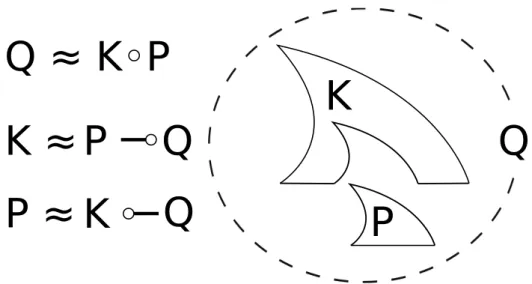
The assertion language of context logic follows separation logic in extending first-order logic with new operators. Where separation logic introduced separating conjunction “∗”, context logic introduces separating application “◦”. Separating application is not symmetric, so in place of separation logic’s “−∗”, context logic’s “◦” has two right-adjoints: “−◦” and “◦−”.
The formula K ◦P is satisfied by a tree if that tree can be split into a context satisfyingK and disjoint tree satisfying P.
The formulaP−◦Qis satisfied by a contextcif, whenever a tree satisfying
P is inserted into the hole inc, the resulting tree satisfies Q.
The formulaK◦−Qis satisfied by a treetif, whenever it is inserted into a context satisfyingK, the resulting tree satisfies Q.
The three formulae K ◦P, P −◦Q and K ◦−Q and the relationships between them are illustrated in Figure2.1.
Unlike separation logic, context formula may be partitioned into two types: tree formulae and context formulae. The treatment above is typ-ical in that it uses P and Q to refer to tree formulae, and K to refer to context formulae. Since there are two types of formulae, there are also two types of true: trueT is satisfied by any tree and trueC is satisfied by any
Using context logic, it is possible to specify complex ancestral relation-ships in a tree. For example, the formula:
(∅−◦(trueC◦x[trueT]))◦y[trueT]
This is a complex formula which demonstrates several features of the context logic assertion language, and also turns out to be a particularly useful shape for program reasoning in later chapters. It describes any tree which contains at least two nodes labeled x and y, in which y is not an ancestor ofx.
The formula describes a context (∅−◦(trueC◦x[trueT])) applied to a tree
containing onlyyand its children. To understand the context ∅−◦(trueC,
consider Figure2.1. The formula is a −◦formula which describes a context such that if some tree satisfying P were to be inserted, the resulting tree would satisfyQ. In this case, our formulaP is∅, which means that if the
hole in the context were to simply vanish, then the resulting tree would look likeQ. TheQin this case describes any tree which contains a node “x”.
The context formula therefore describes any context that contains a node
xsomewhere within it. Since a context may contain no nodes whose ances-tors are the context hole we can be sure that after the context application, the nodey is not an ancestor of x in the resulting tree.
2.3.3. Program Reasoning
As with separation logic, context logic may only be used to reason about programs which are local. The safety-monotonicity and frame properties are essentially the same as in separation logic, but re-stated in terms of contexts. Also as with separation logic we have the Frame Rule, re-stated to use separating application instead of separating conjunction:
{P}C{Q} {K◦P}C{K◦Q}
We can use context logic to specify a command “move y underx” which is similar to the DOM commandappendChild. This command takesyfrom wherever it is in the tree, and places it at the end of the list ofx’s children. Ifyis an ancestor of x, then this command should fail rather than attempt to create a structure with a loop, or an unreachable subtree. The axiom for
this command is as follows:
{(∅−◦(C◦x[T]))◦(y[T0])}
move y underx
{C◦x[T⊗y[T0]]}
The precondition is of the form discussed earlier in Section 2.3.2, which specifies thatyis not an ancestor ofx. We use variables such asCandT to specify that the parts of the tree around x and y which we have examined do not change during the execution of the command.
As with separation logic, we can apply the Frame Rule to see how this command behaves in the presence of additional disjoint data:
{z[w[trueT]⊗ ]◦((∅−◦(C◦x[T]))◦(y[T0]))}
move y underx
{z[w[trueT]⊗ ]◦(C◦x[T⊗y[T0]])}
It is these sorts of techniques which we will apply in future chapters to reasoning about DOM programs.
In this thesis, context logic is used to reason about trees and tree-like structures. However, it can be applied to a wide variety of data structures[14,
71]. There have been a number of developments in understanding context logic, including adjunct elimination[10], and completeness results[13]. There has been some success in using context logic in conjunction with separa-tion logic to relate high level specificasepara-tions to low level implementasepara-tions of those specifications[32, 29]. This thesis represents the first attempt to apply context logic in an industrial problem-space[33], and has provided the motivation for the most recent evolution of context logic: the intro-duction of segment structures which allow smaller specifications for move commands[34].
3. Featherweight DOM
This chapter describes “Featherweight DOM”, which is a small XML update language designed by the author to demonstrate the conceptual core of DOM.
The W3C DOM specification is divided into a number of levels, of which the Level 1 is the most fundamental. The Level 1 specification is itself sep-arated into two parts: Core, which “provides a low-level set of fundamental interfaces that can represent any structured document”; and HTML, which “provides additional, higher-level interfaces. . . to provide a more convenient view of an HTML document”. Furthermore, the DOM Core specification presents “two somewhat different sets of interfaces to an XML/HTML doc-ument; one presenting an ‘object-oriented’ approach with a hierarchy of inheritance, and a ‘simplified’ view that allows all manipulation to be done via the Node interface”.
Featherweight DOM captures the spirit of the Node interface of DOM Core Level 1 focusing on the tree structure and simple text nodes. Feather-weight DOM does not deal directly with more complex DOM structure, such as Attributes, DocumentFragments and so on. For a more comprehensive and rigorously compliant treatment of DOM Core Level 1, see Chapter6.
Featherweight DOM consists of two parts: The DOM library functionality of Featherweight DOM and the simple imperative language into which the DOM functionality is embedded. This chapter defines an abstract data structure, and presents the operational semantics for Featherweight DOM.
3.1. Featherweight DOM Data Structures
We introduce an abstract data structure to represent the XML-like data that Featherweight DOM programs manipulate. This data structure is given in Definition 2. Following the shape of this data structure, we also give the corresponding context structure in Definition 4. This is essential to
our reasoning and also helpful in describing the operational semantics for Featherweight DOM.
In the following structure, elementseleand text nodestxtrepresent their namesakes in [22]. The grove structureg may be regarded as analogous to the object heap, and forestsfrepresent the contents of the NodeList object that contains the children of a given Element1.
A DOM Element in turn corresponds to an XML element. A DOM text node is an artifact of the DOM choice to model all XML data in terms of nodes: XML documents may contain text at any point in their structure, and DOM models this by wrapping that text in a node which may be moved around and otherwise manipulated in the same way as, for example, an element node. A side effect of this choice is that the same XML document may have more than one DOM representation. For example, the XML
hpiThis is a paragraphh/picontains the text “This is a paragraph”. This text may be represented in DOM as a single text node containing the string “This is a paragraph”, or as two adjacent text nodes containing the strings “This i” and “s a paragraph”, or as three adjacent text nodes containing the strings “This i”, “”, “s a paragraph”.
Definition 1 (Strings). Given a finite set Charof text characters, with a
distinguished character ‘#’, stringss∈S are defined by: (with c∈Char)
strings ∈S s ::=∅S |<c>S |s⊗Ss
As a notational convenience, we will use the shorthand “abc” to refer to the string<‘a’>S⊗S<‘b’>S⊗S<‘c’>S.
1
We follow the DOM specification in that we write DOM type names in UpperCamel-Case – hence “Element”. When describing XML elements however, it is usual to use standard English capitalization.
Definition 2(Featherweight Data). Given an infinite setIDof node iden-tifiers and the strings S defined in Definition 1, groves g ∈ G, elements
ele ∈ ELE, forests f ∈ F, text nodes txt ∈ TXT are defined by: (with
id,fid∈ID)
groves ∈G g ::=∅G|<ele>G|<txt>G|g⊕g
elements ∈ELE ele ::=sid[f]fid where ‘#’6∈s
forests ∈F f ::=∅F|<ele>F |<txt>F|f⊗Ff
text nodes∈TXT txt ::= “#text”ids
For well-formedness, the identifiers id and fid must be unique across the whole data structure. For the remainder of this thesis, we consider only well-formed data structures, with unique identifiers. The set of possible data types {G,ELE,F,TXT,S} is written D. Given an arbitrary data type D ∈ D, d ∈ D denotes arbitrary data, and ids(d) is the set of all identifiersidand fidin the data structure d.
Definition 3(Congruence). The structural congruence≡is the least
equiv-alence relation onS D∈DD satisfying: Associativity of ⊕ g1⊕(g2⊕g3)≡(g1⊕g2)⊕g3 Commutativity of⊕ g1⊕g2≡g2⊕g1 Identity of ⊕ g≡g⊕∅G Associativity of ⊗F f1⊗F(f2⊗Ff3)≡(f1⊗Ff2)⊗Ff3 Identity of ⊗F f≡f⊗F∅F Associativity of ⊗S s1⊗S(s2⊗Ss3)≡(s1⊗Ss2)⊗Ss3 Identity of ⊗S s≡s⊗S∅S
Notice that text nodes txt use the string “#text” which contains the distinguished character ‘#’. Element nodes on the other hand may have an arbitrary string s, but that string must not contain the distinguished character ‘#’. This is as specified in the W3C specification[22].
The XML fragment mentioned earlier: hpiThis is a paragraphh/pican now be represented as the Featherweight DOM structure:
“p”id[<“#text”id0“This is a paragraph”>F]fid
DOM structure:
“p”id[<“#text”id0“This i”>F⊗F“#text”id00“s a paragraph”>F]fid
Each of these featherweight DOM structures corresponds to a DOM struc-ture allowed by [22]. These structures are not equivalent under≡, and they both accurately represent the XML fragment in question. The string as-sociated with a Featherweight DOM element structure corresponds to the nodeName attribute of the corresponding DOM Node, and hence to the tag of the corresponding XML element. The string associated with Feath-erweight DOM text structures corresponds to the nodeValue attribute of the corresponding DOM Node, and hence to a portion of the text in the corresponding XML document. The id and fid values do not correspond to any part the XML data. They may be regarded as object addresses for DOM nodes in an object heap. Their purpose is to uniquely identify Featherweight DOM structures so that Featherweight DOM programs can refer to, and update them. Theid corresponds to the heap-address of the Node object in question while the fid corresponds to the heap-address of the NodeList that contains the children of the Node object in question.
Definition 4 (Featherweight Contexts). Given an infinite setID of node
identifiers and the data structures defined in Definition2, grove contextscg∈
CG, element contexts cele ∈ CELE, forest contexts cf ∈ CF, text
con-textsctxt∈CTXT, and string contexts cs∈CSare defined by:
grove contexts cg ::=−G|<cele>G|<ctxt>G|cg⊕g
element contexts cele ::=−ELE|sid[cf]fid where ‘#’6∈s
forest contexts cf ::=−F|<cele>F|<ctxt>F|cf⊗Ff|f⊗Fcf
text contexts ctxt ::=−TXT |“#text”id“cs”
string contexts cs ::=−S|cs⊗Ss|s⊗Scs
As before, element names may not contain “#”, identifiersidandfidare unique across the whole data structure, and there is an analogous congru-ence ≡. The set of possible context types {CG,CELE,CF,CTXT,CS}
is writtenCD.
Given data types D1,D2 ∈ D and a context type CD2 ∈ CD which
ap(−G,g) ,g
ap(<cele>G,d1) ,<ap(cele,d1)>G
ap(<ctxt>G,d1) ,<ap(ctxt,d1)>G
ap(cg⊕g,d1) ,ap(cg,d1)⊕giff ids(g)∩ids(d1) =∅
ap(−ELE,ele) ,ele
ap(sid[cf]fid,d1) ,sid[ap(cf,d1)]fid ifid,fid∈/ ids(d1)
ap(−F,f) ,f
ap(<cele>F,d1) ,<ap(cele,d1)>F
ap(<ctxt>F,d1) ,<ap(ctxt,d1)>F
ap(cf⊗Ff,d1) ,ap(cf,d1)⊗Ffiff ids(f)∩ids(d1) =∅
ap(f⊗Fcf,d1) ,f⊗Fap(cf,d1) iff ids(f)∩ids(d1) =∅
ap(−TXT,txt) ,txt
ap(“#text”id“cs”,s),“#text”id“ ap(cs,s) ”
ap(−S,s) ,s
ap(cs⊗Ss0,s) ,ap(cs,s)⊗Ss0
ap(s0⊗Scs,s) ,s0⊗Sap(cs,s)
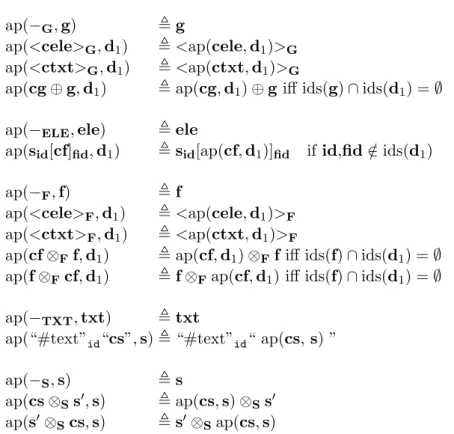
Notice that ap is a partial function, and is not defined in cases which would result in a structure with duplicateids.
contextcd∈CD2 with hole−D1. We callD1→D2the context type ofcd.
We define the partial application function ap : (D1D2)×D1 * D2,
which returns a result if there is no clash of identifiers between the arguments of the function.
Definition 5 (Context Application). Given data types D1,D2 ∈ D, the
partial application function ap : (D1D2)×D1 * D2 is defined by
in-duction on the structure of the first argument in Figure3.1(and undefined where not given). The notation ap(cd,d)↓ states that ap(cd,d) is defined.
Using the application function we can represent the XML fragment
hpiThis is a paragraphh/pias a pair of disjoint Featherweight DOM struc-tures:
ap(“p”id[−F]fid, <“#text”id0“This is a paragraph”>F)
Here the application function has been used to isolate a text node from its parent. As we shall see, this is particularly useful if we wish to define a command which operates in the same way on the text node regardless of its context.
3.2. A Simple Imperative Language
At the core of Featherweight DOM is the simple imperative programming language into which the DOM library is embedded. While future work will certainly involve reasoning about DOM in the context of JavaScript, in this thesis we content ourselves with a language which is as simple as possible. The language is dynamically typed and consists of sequential composition, assignment, conditional and loop commands and a simple procedure system with dynamic scope. This means that the reasoning about Featherweight DOM given in Chapter4cannot rely on language features which JavaScript doesn’t have, such as static types or properly lexically scoped variables. In this way, we keep the language simple, focus on reasoning about the Featherweight DOM library, and also support future development in the direction of JavaScript.
3.2.1. Program State
As normal for in-place update, our language depends on a variable stores. To distinguish program variables from expressions in our reasoning, program variable names will always be written in lower case.
Definition 6 (The Variable Store). Given the special value null and the
sets of identifiersID, stringsS, integersZand booleansB, a store is a finite
partial function from variables to values:
s:VarProg*({null} ∪ID∪S∪Z∪B)
Variable lookup of a variable var in a store s is written s(var). The notation [s|var v] describes an updated store, which differs from an existing storesonly in that the variablevarhas the valuev. If the existing store s contains a variable var, then that variable is overwritten in the new store. If the existing stores does not contain a variablevar, then the new store is extended with that variable. The notation [s\var] describes an updated store which differs from an existing storesonly in that the variable
varhas been removed.
The special value null may be thought of as a distinguished identifier value which refers to no data structure. As we shall see, there are a number of DOM commands which always return either an identifier in ID or the special valuenull.
3.2.2. Expressions
We introduce expressionsExpr∈Exp which do not alter the program state. Due to the dynamically typed nature of this language, the values of some syntactically correct expressions are undefined. If a program command at-tempts to evaluate such an expression, it will fault. To distinguish ex-pressions from variables in our reasoning, expression names will always be written in UpperCamelCase.
Definition 7(Expressions). Given the special valuenull, the empty string∅S,
vari-ablesvar∈VarProg, expressions Expr∈Exp are defined by:
Expr::= null|∅S |<c>S|n|true|false literal constants
|var variables
|Expr=Expr equality test
|Expr⊗SExpr string concatenation
|len(Expr) string and forest length
|Expr+Expr|Expr−Expr
|Expr×Expr|Expr÷Expr arithmetic operations |Expr∧Expr|Expr∨Expr| ¬Expr boolean operations In order to define our expression evaluation, we require the auxiliary function len.
Definition 8 (Forest Length). The length of a string or forest is defined
by:
len(∅D), 0
len(<d>D), 1
len(d1⊗Dd2), len(d1) + len(d2)
whereD∈ {F,S}, andd1,d2∈D, and d∈ELE∪TXT∪C
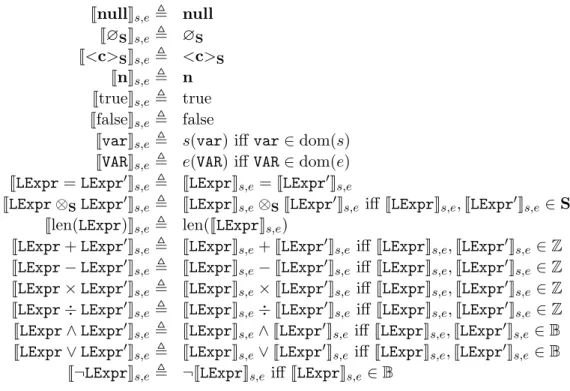
Definition 9 (Expression Evaluation). The evaluation of expression Expr
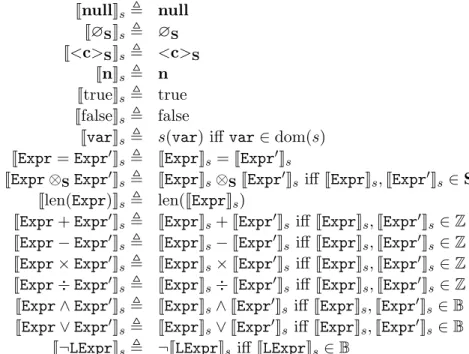
in storesis defined by the partial function given in Figure3.2.
Note that not all syntactically correct expressions can be successfully evaluated. Attempting to evaluate such an expression at runtime will result in a runtime fault.
3.2.3. Standard Imperative Commands
The core of the Featherweight DOM language is a set of imperative com-mands that the reader will be familiar with from many other languages.
JnullKs, null J∅SKs, ∅S J<c>SKs, <c>S JnKs, n JtrueKs, true JfalseKs, false
JvarKs, s(var) iffvar∈dom(s) JExpr=Expr 0 Ks, JExprKs=JExpr 0 Ks JExpr⊗SExpr 0 Ks, JExprKs⊗SJExpr 0
Ks iffJExprKs,JExpr
0
Ks∈S Jlen(Expr)Ks, len(JExprKs)
JExpr+Expr
0
Ks, JExprKs+JExpr
0
Ks iff JExprKs,JExpr
0 Ks∈Z JExpr−Expr 0 Ks, JExprKs−JExpr 0
Ks iff JExprKs,JExpr
0 Ks∈Z JExpr×Expr 0 Ks, JExprKs×JExpr 0
Ks iff JExprKs,JExpr
0 Ks∈Z JExpr÷Expr 0 Ks, JExprKs÷JExpr 0
Ks iff JExprKs,JExpr
0 Ks∈Z JExpr∧Expr 0 Ks, JExprKs∧JExpr 0
Ks iff JExprKs,JExpr
0 Ks∈B JExpr∨Expr 0 Ks, JExprKs∨JExpr 0
Ks iff JExprKs,JExpr
0
Ks∈B J¬LExprKs, ¬JLExprKs iff JLExprKs∈B
Note that this function is partial, and therefore that not all syntactically correct expressions can be evaluated. Attempting to evaluate such an ex-pression will result in a runtime fault.
JExprKs=val
s,g,var:=Expr [s|var←val],g
s,g,C1 s0,g0
s0,g0,C2 s00,g00
s,g,(C1;C2) s00,g00
JExprKs= true
s,g,C1 s0,g0
s,g,if Expr then C1 else C2 fi s0,g0
JExprKs= false
s,g,C2 s0,g0
s,g,if Expr then C1 else C2 fi s0,g0
s,g,if Expr then C;while Expr do C od else skip fi s0,g0
s,g,while Expr do C od s0,g0
val=s(var)
[s|var null],g,C s0,g0
s,g,local var:C endloc [s0|var val],g0 var6∈dom(s)
[s|var null],g,C s0,g0
s,g,local var:C endloc [s0\var],g0
s,g,skip s,g
Figure 3.3.: Imperative Commands
Featherweight DOM language are:
C::=var:=Expr assignment
|C;C sequential composition
|if Expr then C else C fi conditionals
|while Expr do C od loops
|local var:C endloc local variable declaration
|skip skip
|v:=procname(params),C procedure declaration
|v:=procname(vars) procedure call
|CDOM DOM commands (see Section 3.3)
We deal with procedures in Section 3.2.4 and the DOM commands in Section3.3. We give big-step operational semantics for the remaining com-mands here.
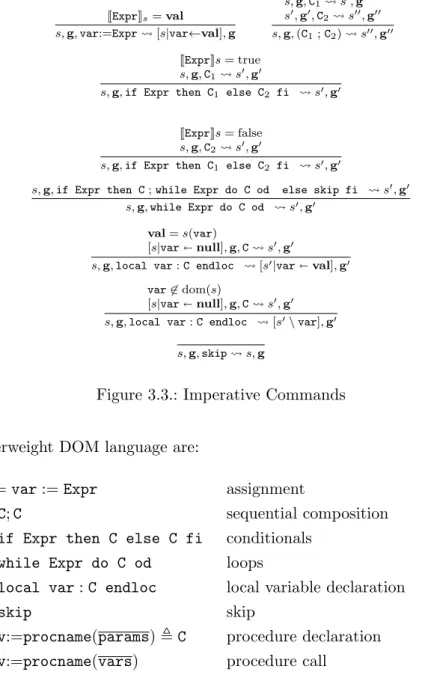
Definition 11(Imperative Commands). The operational semantics of
Feath-erweight DOM’s standard imperative commands are given in Figure 3.3
statess,g, and faults.
For convenience, we also have the following simple syntactic sugars. An else-less if:
if Expr then C fi ,if Expr then C else skip fi
We may also group local scope declarations:
local x,y,· · ·z: C endloc , local x: local y: · · · local z: C endloc endloc endloc 3.2.4. Procedures
We provide a primitive procedure system with dynamic scope. This means that if a procedure is defined within one local scope declaration, and called within another, it is the variables in the calling-scope that are modified by the procedure, not the variables in the lexical defining-scope. Procedures are defined statically for each program with the following syntax:
v:=procname(params),C
where procnameis the name of the procedure, vis a variable, paramsis a vector of variables andCis the body of the procedure.
Definition 12 (procs). Procedures are represented during program
exe-cution as a partial functionprocs which maps procedure names procname
to the tuple (v,params,C) which contains the return variable v, a vector of the procedure’s parameter variables params and the procedure’s bodyC.
Notice that since procedures (and theprocsmap that contains them) are both statically defined and dynamically scoped, it does not matter where in the program text a procedure is written. The following three programs are equivalent. All result in the variableytaking the value 5.
y:=0 ; local x: x:=4 ; y:=myproc(), y:=x endloc ; local x: x:=5 ; y:=myproc() endloc y:=0 ; local x: x:=4 endloc ; local x: x:=5 ; y:=myproc(), y:=x y:=myproc() endloc y:=myproc(), y:=x y:=0 ; local x: x:=4 endloc ; local x: x:=5 ; y:=myproc() endloc Procedure call
Given a partial function procstaking procedure names to procedures, the semantics of procedure call are given by the following rule:
procs(procname) = (v0,params,C)
|params|=|vars| params=p1. . .pn vars=v1. . .vn
s,g,C{v/v0,v1/p1, . . . ,vn/pn} s0,g0
s,g,v:=procname(vars) s0,g0
where vars is a vector of variables. Note that procedure call is only defined when the number of parameter expressions matches the number of parameter variables.
Ignoring Return Values and Void Procedures
Since there are circumstances in which one might wish to ignore the return value of a procedure, we define syntactic sugars and a special variable for doing so.
Definition 13(Thedevnullvariable). The distinguished variabledevnull
behaves exactly like any other variable, except that no user-defined program may mention it. It exists solely for use in the following syntactic sugars.
When we wish to ignore the return value of a procedure or DOM command “var:=command(vars)”, we may use the syntactic sugar:
command(vars) which expands to:
local devnull:
devnull:=command(vars)
endloc
Since thedevnullvariable is not mentioned in any user-defined program, the only effect of this syntactic sugar is to calculate the return value of the procedure as normal, and then to ignore it.
When we wish to define a procedure which returns no value, we may use the syntactic sugar:
procname(params),C
which expands to:
devnull:=procname(params),C
Since thedevnullvariable is not mentioned in any user-defined program (and in particular, is not mentioned inC), the effect of this syntactic sugar is to produce a procedure which has no effect on its return variable. The procedure is therefore most naturally called using the syntactic sugar for ignoring a return value.
3.3. Featherweight DOM Commands
The essential character of Featherweight DOM is found not in its simple imperative core, but in the DOM library Commands embedded in the sim-ple imperative language. The DOM library commands are defined in this section.
Recall that we are compiling the essence of the Node interface defined in [22]. That interface defines a number of commands of which we specify an essential subset. Since that interface makes extensive use of NodeList objects, we also specify commands from the NodeList interface. In
addi-tion to these, we also specify two commands from the Document interface:
createElementand createTextNode. We require these two commands in order to create new nodes in our data structure. Finally, in order to make it possible to write more interesting example programs, we specify some commands from the CharacterData interface. We then use the resulting language to implement the remaining Node interface commands.
Since we are embedding the Featherweight DOM Commands in a sim-ple imperative language rather than an object oriented language, we do not insist that all commands (for example, appendChild) return a value if this would result in them simply returning one of their arguments un-changed. This simplifies our Featherweight presentation without sacrificing functionality. For a more slavish adherence to the letter of the W3C DOM Specification, see Chapter6.
Recall the standard imperative commands C defined in Section 3.2.3. Here, we extend that language with DOM commands.
Definition 14 (DOM Library Commands). The DOM library commands
for Featherweight DOM are:
CDOM::=appendChild(parent,newChild)
|removeChild(parent,oldChild)
|name:=getNodeName(node)
|id:=getParentNode(node)
|fid:=getChildNodes(node)
|node:=createElement(Name)
|node:=createTextNode(Str)
|node:=item(list,Int)
|str:=substringData(node,Offset,Count)
|appendData(node,Arg)
|deleteData(node,Offset,Count)
In line with our procedure semantics, the arguments of most of these commands are restricted to being variables (written in lowerCamelCase) rather than expressions. Some commands however, are used in practice most frequently with literal expressions. These commands can therefore accept expressions (written inupperCamelCase) as arguments. The DOM commands have the following behaviour and requirements:
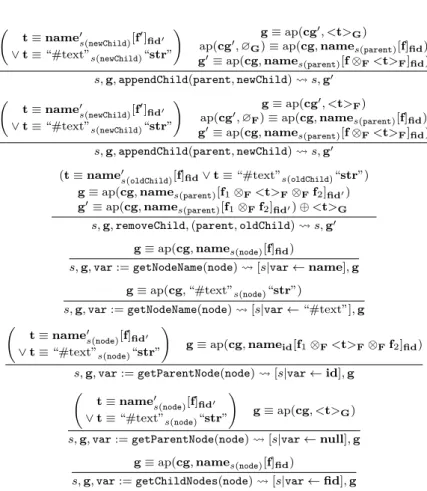
appendChild(parent, newChild) moves the tree newChild to the end of
parent’s child list. It requires that parentis an element node, and that newChildis an element and is not an ancestor of parent.
removeChild(parent,oldChild) removes the node oldChildand its sub-tree from parent’s child forest and re-inserts it at the root of the grove. It requires that parent is an element andoldChild is a child of parent.
name := getNodeName(node) assigns to the variable var the nodeName value of node. It requires thatnodeis either a text node or an element. If node is a text node, thenvar is set to “#text”.
var:= getParentNode(node) assigns to the variablevar the identifier of the parent of node, if it exists, and null otherwise. It requires that
node is either a text node or an element.
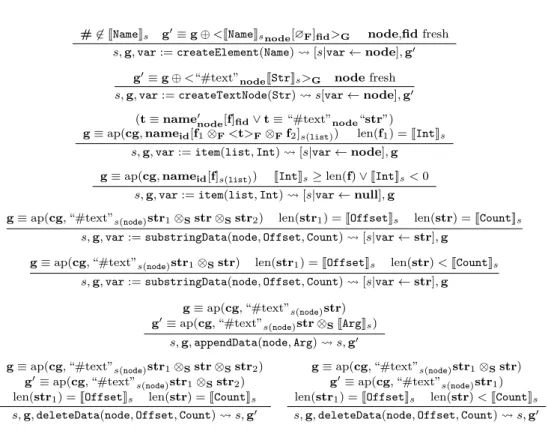
var:= getChildNodes(node) assigns to the variablevar the identifier of the child forest of the element node. It requires that node is an el-ement. We differ slightly from the letter of the W3C specification in that we do not require this command to return a reference to an empty NodeList when it is called on a text node. This simplifies our Featherweight presentation without sacrificing functionality. For a more rigid treatment of the W3C specification, see the definition of
getChildNodes in Chapter6.
var:= createElement (Name) creates a new element node at the root of the grove, with fresh id and fid and a name equal to Name. The identifieridof the new node is recorded in the variablevar. It requires that Name is a string and that #6∈JNameKs.
var:= createTextNode(Str) creates a new text node at the grove level, with freshidand the string contained within the text node set toStr. It records the new node’s identifier in the variable var and requires that Strevaluate to a string.
var:= item(list, Int) sets the variable var to the (Int+ 1)th node in the list pointed to by list, setting it to null if Int evaluates to an invalid index. It faults if list does not correspond to the fid of an existing structure or if Intis not an integer.
var:= substringData(node,Offset,Count) assigns to the variablevara substring of the string of the text nodenode. That substring will be of lengthCountand will start with (Offset+1)th character of the string of the text node. IfOffset+Countexceeds the string length, then all the characters to the string end are returned. This command requires that node is a text node, that Offset and Count be non-negative integers, and that Offsetbe at most the string length.
appendData(node, Arg) appends the string Arg to the end of the string contained in node. It requires that node exists and be a text node and that Argevaluate to a string.
deleteData(node, Offset, Count) deletes a substring of lengthCount start-ing with the (Offset+ 1)th character of the value of the text node referred to by node. Count. If Offset+Count exceeds the string length, then all the characters to the string end are deleted. This command requires that node is a text node, that Offset and Count
be non-negative integers, and thatOffsetbe at most the string length.
Definition 15 (Semantics of The DOM Library Commands). The
opera-tional semantics of these Featherweight DOM commands are given in Fig-ures 3.4 and 3.5 by an evaluation relation relating configuration triples
s,g,C, terminal statess,g, and faults.
Featherweight DOM is “minimal” in the sense that each specified DOM command cannot be implemented in terms of the remaining commands. Those Node interface commands which are not specified as part of Feath-erweight DOM can be implemented in terms of those which are. These implementations may be found in AppendixA.1.
t≡name0s(newChild)[f0]fid0 ∨t≡“#text”s(newChild)“str”
! g≡ap(cg0, <t>
G)
ap(cg0,
∅G)≡ap(cg,names(parent)[f]fid)
g0≡ap(cg,names(parent)[f⊗F<t>F]fid)
s,g,appendChild(parent,newChild) s,g0
t≡name0s(newChild)[f0]fid0 ∨t≡“#text”s(newChild)“str”
! g≡ap(cg0, <t>
F)
ap(cg0,∅F)≡ap(cg,names(parent)[f]fid)
g0≡ap(cg,names(parent)[f⊗F<t>F]fid)
s,g,appendChild(parent,newChild) s,g0 (t≡name0s(oldChild)[f]fid∨t≡“#text”s(oldChild)“str”)
g≡ap(cg,names(parent)[f1⊗F<t>F⊗Ff2]fid0)
g0≡ap(cg,name
s(parent)[f1⊗Ff2]fid0)⊕<t>G
s,g,removeChild,(parent,oldChild) s,g0
g≡ap(cg,names(node)[f]fid)
s,g,var:=getNodeName(node) [s|var←name],g g≡ap(cg,“#text”s(node)“str”)
s,g,var:=getNodeName(node) [s|var←“#text”],g t≡name0s(node)[f]fid0
∨t≡“#text”s(node)“str”
!
g≡ap(cg,nameid[f1⊗F<t>F⊗Ff2]fid)
s,g,var:=getParentNode(node) [s|var←id],g t≡name0
s(node)[f]fid0 ∨t≡“#text”s(node)“str”
!
g≡ap(cg, <t>G)
s,g,var:=getParentNode(node) [s|var←null],g g≡ap(cg,names(node)[f]fid)
s,g,var:=getChildNodes(node) [s|var←fid],g
#6∈JNameKs g
0≡g⊕<
JNameKsnode[∅F]fid>G node,fidfresh
s,g,var:=createElement(Name) [s|var←node],g0
g0≡g⊕<“#text”nodeJStrKs>G nodefresh
s,g,var:=createTextNode(Str) s[var←node],g0 (t≡name0node[f]fid∨t≡“#text”node“str”)
g≡ap(cg,nameid[f1⊗F<t>F⊗Ff2]s(list)) len(f1) =JIntKs
s,g,var:=item(list,Int) [s|var←node],g g≡ap(cg,nameid[f]s(list)) JIntKs≥len(f)∨JIntKs<0
s,g,var:=item(list,Int) [s|var←null],g
g≡ap(cg,“#text”s(node)str1⊗Sstr⊗Sstr2) len(str1) =JOffsetKs len(str) =JCountKs
s,g,var:=substringData(node,Offset,Count) [s|var←str],g g≡ap(cg,“#text”s(node)str1⊗Sstr) len(str1) =JOffsetKs len(str)<JCountKs
s,g,var:=substringData(node,Offset,Count) [s|var←str],g g≡ap(cg,“#text”s(node)str)
g0≡ap(cg,“#text”s(node)str⊗SJArgKs)
s,g,appendData(node,Arg) s,g0
g≡ap(cg,“#text”s(node)str1⊗Sstr⊗Sstr2)
g0≡ap(cg,“#text”
s(node)str1⊗Sstr2)
len(str1) =JOffsetKs len(str) =JCountKs
s,g,deleteData(node,Offset,Count) s,g0
g≡ap(cg,“#text”s(node)str1⊗Sstr)
g0≡ap(cg,“#text”
s(node)str1)
len(str1) =JOffsetKs len(str)<JCountKs
s,g,deleteData(node,Offset,Count) s,g0
4. Context Logic for
Featherweight DOM
This chapter presents Context Logic for Featherweight DOM.
We follow previous work on Context Logic for analysing simple trees [12]. Although the basic reasoning is the same, the transition was by no means easy due to the comparative complexity of the DOM structures.
Context Logic consists of standard formulae constructed from the connec-tives of first-order logic, variables, expression tests, and quantification over variables. In addition, it has generalstructural formulae andmodel-specific formulae which reflect the data structure being modeled. We adapt the structural formulae of Context Logic slightly, so as to be able to handle the multiple types of DOM data. The structural formulae consist of an applica-tionconnective for analysing context application, and its two corresponding right adjoints. For DOM data types D,D1,D2 ∈ D:
• the application formula P ◦D1 P1 describes data of e.g. type D2,
which can be split into a context of type D1→ D2 satisfying P, and
disjoint subdata of type D1 satisfying P1; the application connective