An Electronic Tool for Measuring Learning and
Teaching Performance of an Engineering Class
T.H. Nguyen, Ph.D., P.E.
Abstract— Creating an engineering course to meet the predefined learning objectives requires an appropriate and effective assessment tool being able to determine the level of achievement of the learning objectives. The basic tools that are usually used for assessing knowledge of students in a course include homework, quizzes, tests/exams, lab reports, oral presentations, and projects. These basic tools may help to verify what students are able to do after taking the course; however, they are hardly used to determine how well the course achievement addresses each of the selected learning objectives. The primary purpose of this research is to develop a computer tool for quantifying the learning and teaching performance of an engineering course with respect to the selected learning objectives as well as identifying necessary actions to be taken for improving the course quality. For this particular project, the ABET (Accreditation Board of Engineering and Technology) Engineering Criteria 2000 (also known as eleven ABET Engineering Outcomes 3A-K) were used as the learning objectives.
Index Terms— ABET Engineering Criteria, Engineering Education, Learning Assessment, Learning Performance, Teaching Performance.
I. INTRODUCTION
The ABET (Accreditation Board of Engineering and Technology) Engineering Criteria 2000 (also known as eleven ABET Engineering Outcomes 3A-K) were introduced in the middle 1990s and have been used to evaluate all American engineering programs since then [1]. Since the new ABET accreditation system was first introduced, researchers/educators have extensively discussed various methods to assess Outcomes 3a-3k, as shown in Table 1. Obviously, the potential of the new system to improve instruction depends strongly on how well engineering faculty understand it and achieve its specified outcomes. Usually, the faculty goes through three major activities, when developing a course to comply with the ABET engineering criteria, including: planning, instruction, and assessment/evaluation. Among these activities, assessment usually plays an important role in the success of the course; as it determines the level of achievement of the ABET outcomes, which in turn identifies
necessary actions to be taken for improving the course quality. The basic tools that are usually used for assessing knowledge of students in a course include homework, quizzes, tests/exams, lab reports, oral presentations, and projects. These basic tools may help to verify what students are able to do after taking the course; however, they are hardly used to determine how well the course achievement addresses each of the selected learning objectives. The primary purpose of this paper is to describe an electronic tool that was developed to measure the level of achievement of the ABET engineering outcomes of a civil engineering and construction course at California State University at Long Beach. The paper is organized as follows: (1) the overall assessment process for an engineering class is briefly described; (2) the basic concept of quality function deployment (QFD) is explained; and (3) the development of the proposed assessment tool using QFD method is presented. Findings and results are discussed, followed by conclusions.
Manuscript received July, 11, 2007.
T.H. Nguyen is with the California State University at Long Beach, Long Beach, CA 90840 USA (Telephone: 562-985-1661; fax: 562-985-2380; e-mail: thnguyen@ csulb.edu).
Table 1. ABET Criterion 3 Outcomes
A. an ability to apply the knowledge of mathematics, science, and engineering.
B. an ability to design and conduct experiments, as well as to analyze and interpret data.
C. an ability to design a system, component, or process to meet desired needs.
D. an ability to function on multi-disciplinary teams. E. an ability to identify, formulate, and solve
engineering problems.
F. an understanding of professional and ethical responsibility.
G. an ability to communicate effectively.
H. the broad education necessary to understand the impact of engineering solutions in a global and societal context.
I. a recognition of the need for, and an ability to engage in lifelong learning.
J. a demonstrated knowledge of contemporary issues. K. an ability to use the techniques, skills, and modern engineering tools necessary for engineering practice.
II. ASSESSMENT OF STUDENT LEARNING
The basic starting point for assessing student learning begins with asking two basic questions: 1.) what should students know and be able to do at the end of the semester?, and
2.) what evidence will indicate that they have reached these goals? The basic tools that are often used for assessing knowledge in a particular course are the student works such as homework, quizzes, tests/exams, and projects/labs reports. These basic tools may help to answer the two basic questions above, however, they are hardly used to determine how well the course achievement addresses each of the ABET Criterion 3 outcomes. In addition, the teaching performance of instructor usually impacts the success of a class and should be taken into consideration when assessing the class achievement. This leads to a need for a tool that is designed to assess both teaching and learning performance with respect to predefined learning objectives. The assessment tool will help the instructor to collect and analyze data containing information linking student expectations (i.e. learning objectives or ABET criteria) to a set of teaching performance metrics that the instructor can then measure and control. In this particular study, the student expectations or learning objectives include the eleven ABET Engineering Criteria 3A-K (see Table 1), whereas the teaching performance metrics represent the critical factors that most affect the instructor’s performance. The teaching performance factors, based upon results of previous research in [2], include the following factors:
1. Communication skill: The ability of the instructor to communicate effectively
2. Student focus: The degree of importance that an instructor places on student relationships and student satisfaction and the degree of knowledge about student needs or learning objectives. Examples: displaying a personal interest in students and their learning, inspiring students to set and achieve goals which really challenge them, and involving students in ‘hands-on’ projects such as research, case studies, or ‘real life’ activities.
3.Knowledge/Expertise: The instructor’s knowledge or expertise about the subject being taught. Examples: Capability of making it clear how each topic fit in the course, explaining course material clearly and concisely, and relating course material to real life situations
4. Attitude about enhancing student learning: The degree of encouragement by the instructor so as to maximize learning of all students with varying learning styles and abilities. Examples: finding ways to help students answer their own questions, forming teams or discussion groups to facilitate learning, encouraging students to use multiple resources (e.g. data banks, library holdings, outside experts) to improve understanding, and providing timely and frequent feedback on tests, reports, projects, etc. to help students improve.
5. Interaction with students: The degree of effectiveness of the instructor to interact with students in class or outside of class (office visits, phone calls, emails, etc.). Examples: Asking students to share ideas and experiences with others whose backgrounds and viewpoints differ from their own, introducing stimulating ideas about the subject, and stimulating students to intellectual effort beyond that required by most courses.
6. Teaching performance improvement: The attitude of the instructor about continuously improving teaching performance. Examples: identifying and evaluating student
satisfaction and class performance results to take appropriate actions for improving teaching performance.
These teaching performance factors greatly impact the level of achievement of the class with respect to the learning objectives (i.e. ABET outcomes). Additionally, one teaching performance factor may have a greater impact than others and the different degrees of impact among the factors, in this study, are referred to as strengths of relationship between the teaching performance factors and the learning objectives. These strengths of relationship should be taken into consideration as measuring the learning and teaching performance of an engineering class. An appropriate assessment method for such a measuring task was selected for this particular study, i.e. Quality Function Deployment (QFD), which is briefly presented in the following section.
III. QUALITY FUNCTION DEPLOYMENT (QFD)
QFD, also known as the House of Quality, is defined as a structured methodology and mathematical tool used to identify and quantify customers' requirements and translate them into key critical parameters that in turn help a company to prioritize actions to improve their product or service to meet customers' expectations [3]. In an education context, the ‘customers’ represent students, the ‘service’ refers to ‘teaching’ or ‘learning performance’, and the ‘company’ represents the instructor teaching the course. In a business context, QFD is used for translating the ‘voice of customer’ through the various phases of project or service planning, designing, and manufacturing into a final product. In this education study, the QFD can be used for translating the ‘voice of the student’ through the three stages of the course planning, teaching, and assessment/evaluation into the learning objectives. In a typical QFD application, a company or instructor creates and analyzes a data matrix linking customer or student needs (i.e. learning objectives) to a set of service or teaching metrics that the company or instructor can then measure and control. For further details of a QFD application, readers are referred to [4] and [5]. In this study, the basic QFD process has been extracted and modified to develop the process of measuring the level of learning performance of an engineering class. Basically, the assessment process include the following steps: first, the important weight of each learning objective as well as each teaching performance factor is determined; next, the actual level of achievement with respect to each learning objective and teaching performance factor is collected; then, the strength of relationships between the learning objectives and teaching performance factors are established; and finally, the learning performance index can be calculated. The learning performance index is defined as the ratio of the actual level of learning performance to the expected or maximum level of learning performance. In general, the process of evaluating the learning performance of a class involves five major steps as follows:
1. Collect data regarding important weights, the actual status, and strength of relationships of learning objectives and teaching performance factors.
2. Calculate point scores in actual condition for each teaching performance factor with respect to a particular ABET criterion or learning objective by using the following formula.
Where:
i = 1, 2, …, n (number of learning objectives)
j = 1, 2, …,m (number of teaching performance factors) Actual Sij = point scores in actual condition for the teaching performance factor j with respect to the ABET outcome i AWi = the actual status of ABET outcome i
AHj = the actual status of teaching performance factor j Wi = the normalized weight of importance of ABET outcome i Hj = the normalized weight of importance of teaching
performance factor j
IRij = the strength of the relationships between teaching performance factor j and learning objective or ABET outcome i.
Therefore, the actual level of learning performance of the class with respect to ABET outcome i is given by
Actual LPi =
Σ
Actual Sij for 1≤ j ≤ m Similarly, the actual level of learning performance of the class with respect to teaching performance factor j is computed as follows:Actual LPj =
Σ
Actual Sij for 1≤ i ≤ nThe actual level of learning/teaching performance (Actual LP) for the class is calculated as follows:
Actual LP =
Σ
Actual LPi =Σ
Actual LPj (1) 3. Calculate point scores in maximum (expected) condition for each teaching performance factor with respect to a particular ABET criterion or learning objective by using the following formula.Where:
i = 1, 2, …, n (number of learning objectives)
j = 1, 2, …,m (number of teaching performance factors)
Max Sij = point scores in maximum condition for the teaching performance factor j with respect to the ABET outcome i MWi = the max status of ABET outcome i
MHj = the max status of teaching performance factor j (Wi x AWi) + (Hj x AHj)
Wi = the normalized weight of importance of ABET outcome i Hj = the normalized weight of importance of teaching
performance factor j
IRij = the strength of the relationships between teaching performance factor j and learning objective or ABET outcome i.
Therefore, the maximum level of learning performance of the class with respect to ABET outcome i is given by
Max LPi =
Σ
Max Sij for 1≤ j ≤ m Similarly, the maximum level of learning performance of the class with respect to teaching performance factor j is computed as follows:Max LPj =
Σ
Max Sij for 1≤ i ≤ nThe maximum level of learning/teaching performance (Max LP) for the class is calculated as follows:
Max LP =
Σ
Max LPi =Σ
Max LPj (2) 4. Calculate the overall performance index (PIndex) of the class using equations (1) and (2) as follows:PIndex = (Actual LP/Max LP)x100% (3) In addition, the performance index for a particular learning objective i (PIndexi) or teaching performance factor j (PIndexj) can be computed as follows:
PIndexi = (Actual LPi/Max LPi)x100% for 1≤ i ≤ n (4) PIndexj = (Actual LPj/Max LPj)x100% for 1≤ j ≤ m (5) 5. Identify the learning objectives that have low performance indexes. It is obvious that the desirable learning performance index should be as close to 100% as possible. Consequently, the learning or teaching performance factors having lower performance indexes should be well taken care of for improvement.
IV. DEVELOPMENT OF THE PROPOSED ASSESSMENT TOOL
The proposed assessment tool was developed through three steps. First, based upon the QFD concept on how to determine Actual Sij = x (IRij)
2 m j =1 n i =1 m j =1 m n i =1 j =1 n i =1 m n j =1 i =1 (Wi x MWi) + (Hj x MHj)
Max Sij = x (IRij) 2
the service quality performance of an organization, the reasoning of logics (or algorithms) for calculating the learning performance index were established. Second, the data structure of the QFD model was used to develop the user interface for the proposed computer assessment tool. Basically, the user will be prompted to enter the information necessary for calculating the expected level and the actual level of learning/teaching performance with respect to the ABET criteria. Finally, the assessing algorithms and the user interface for the proposed assessment tool were implemented into a computer platform. Microsoft Visual Basic 6.0 was used for the research implementation since it is widely used software programs and the development of the prototype can be easily beta tested and demonstrated to users. The proposed assessment tool was designed to measure the overall performance index of an engineering class and was named PIndex (Performance Index). PIndex was used to evaluate learning/teaching performance of several classes at the Department of Civil Engineering and Construction Engineering Management at California State University, Long Beach (CSULB). Below is an example input and output of PIndex for an engineering class: CE 130 – Surveying and Mapping at CSULB. The assessment process in PIndex can be summarized as follows:
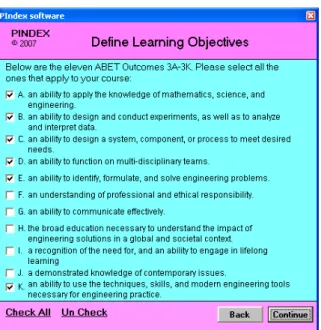
First, the instructor is prompted to define the learning objectives of the class. In this example, ABET Engineering Criteria A, B, C, D, E, and K were selected (see Figure 1).
Second, the data about the importance weights of the learning objectives as well as the teaching performance factors are input (see Figures 2 and 3). These importance weights were reported from students and senior professors. Also, the strengths of relationship between the teaching performance factors and the learning objectives which were given by senior professors are entered.
Third, the grades of student works (i.e. homework, quizzes, tests/exams, lab reports, projects) that were averaged as percentages are entered. Figure 4 shows an example of input data about the level of achievement of three student works with respect to the learning objectives A, B, C, D, E, and K, which is measured as percentages. The zero percentage for learning objective D indicates that the homework had no relevance with this learning objective.
Figure 2. Importance Weights of Learning Objectives
Figure 1. Define Learning Objectives
Figure 3. Importance Weights of Teaching Performance Factors
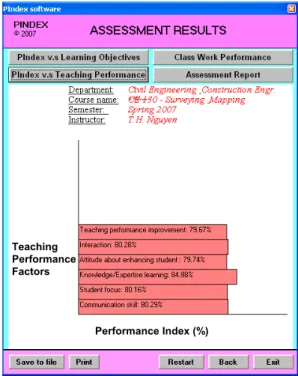
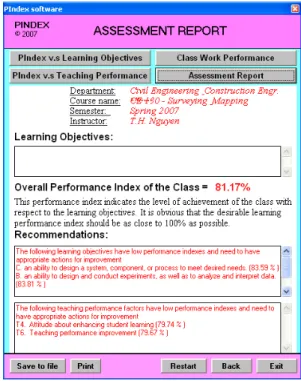
Finally, the overall learning performance index of the class can be determined using equations (1), (2), and (3) and is presented in the assessment report (Figure 9). In the final assessment report, the learning objectives or teaching performance factors that have low performance indexes are displayed so that the instructor is aware of the weakness and should take appropriate actions for improving quality of future classes. In addition, the performance index of the class with respect to each learning objectives (i.e. ABET criteria) as well as each teaching performance factor can also be computed by using the equations (4) and (5), respectively, as shown in Figures 6 and 7. Figure 8 shows the level of achievement of student works with respect to the learning objectives.
Teaching Performance Factors Performance Index (%)
Figure 6. PIndex v.s. Teaching Performance Factors
Figure 4. Input Data for Student Works
Figure 7. Class Work PIndex v.s. Learning Objectives
V. CONCLUSION
The assessment of an engineering course with respect to student expectations or learning objectives is a necessary activity for enhancing the course quality. While traditional assessment tools such as homework, quizzes, tests, exams, lab
reports, oral presentations, and projects may be used as evidences of the overall student achievements with respect to the learning objectives, they do not address the level of performance of each individual learning objective as well as the instructor’s teaching performance. This study made use of ABET Engineering 3A-K Outcomes as learning objectives of an engineering class to be measured. Also, the most critical factors that impact teaching performance of an instructor were evaluated together with the learning objectives. These factors include communication skill, student focus, knowledge/expertise, attitude about enhancing student learning, interaction with students, and teaching performance improvement. In this paper, an electronic assessment tool was developed in the computer platform of Microsoft Visual Basic 6.0.The tool can be used to measure the learning performance index as the level of the achievement with respect to the learning objectives of an engineering class, which indicate the strength as well as the weakness of the class so that appropriate actions will be taken for enhancing quality of future classes. The assessment method employs the concept of quality function deployment (QFD), a technique to measure the customer service quality of an organization, and applies it to academia by linking students expectations (i.e. learning objectives) and teaching performance of an instructor. The assessment method can be used as a template for developing similar tools to measure learning and teaching performance of any course other than engineering courses.
ACKNOWLEDGMENT
The author gratefully acknowledges the support of the
Scholarly and Creative Activity Committee program at California State University Long Beach for funding this project.
REFERENCES
[1] Felder, M. R. and Brent, R. (2003), “Designing and Teaching Courses to
Satisfy the ABET Engineering Criteria”. ASEE Journal of Engineering
Education, Vol. 92, No. 1, pp. 7-25.
[2] T.H. Nguyen, C. McIntyre, and M. Diab. (2005), “Measuring Learning Performance of an Engineering Capstone Course with respect to the
ABET Engineering Criteria” Proceedings of the 2005 ASEE North
Midwest Regional Conference, Brookings, SD, Oct. 13-14, 2005..
[3] Hoyle, D. (1998), “ISO 9000 Quality Systems Handbook”, 3rd Edition,
Butterworth-Heinemann Ltd., Boston, MA.
[4] Akao, Y. (1990), “Quality Function Deployment: Integrating Customer Requirements into Product Design”, Productivity Press, Cambridge, MA. [5] Akao, Y., Mizuno, S. and Ishihara, K. (1994), “QFD; the
Customer-Driven Approach to Quality Planning and Deployment”, Asian Productivity Organization, Tokyo.