3D Product authenticity model for online retail:
An invariance analysis
Raed Algharabat
Brunel Business School, Marketing Department, Brunel University Elliot Jaques Building, Uxbridge, Middlesex, UB8 3PH, United Kingdom Tel: +44 (0) 1895 266251
Email: [email protected] Charles Dennis
Brunel Business School, Marketing Department, Brunel University Elliot Jaques Building, Uxbridge, Middlesex, UB8 3PH, United Kingdom Tel: +44 (0) 1895 265242
Email: [email protected]
Abstract
This study investigates the effects of different levels of invariance analysis on three dimensional (3D) product authenticity model (3DPAM) constructs in the e- retailing context. A hypothetical retailer website presents a variety of laptops using 3D product visualisations. The proposed conceptual model achieves acceptable fit and the hypothesised paths are all valid. We empirically investigate the invariance across the subgroups to validate the results of our 3DPAM. We concluded that the 3D product authenticity model construct was invariant for our sample across different gender, level of education and study backgrounds. These findings suggested that all our subgroups conceptualised the 3DPAM similarly. Also the results show some non-invariance results for the structural and latent mean models. The gender group posits a non-invariance latent mean model. Study backgrounds group reveals a non-invariance result for the structural model. These findings allowed us to understand the 3DPAMs validity in the e-retail context. Managerial implications are explained.
Keywords: 3D product authenticity, control, animated colours, value, behavioural intention, invariance analyses
1 INTRODUCTION
Scholars (e.g., Li et al., 2001, 2002, 2003) classify experiences, based on the interaction between a product or an environment and an individual, into three types. First, direct experience permits consumers to interact (e.g., physically) directly with a product. Second, indirect experience often allows consumers to interact with second-hand source such as static visual pictures. Third, virtual experience allows consumers to interact with three dimensional (3D) virtual models. According to Steuer (1992, p.78) virtual reality (VR) is “a real or simulated environment in which a perceiver experiences telepresence”. In contrast, virtual experience (VE) derives from VR and can be defined as “psychological and emotional states that consumers undergo while interacting with a 3D environment” (Li et al., 2001, p. 14). A 3D presentation enables consumers to interact with products, enriches their learning processes, and creates a sense of being in a simulated real world. Furthermore, direct and virtual experiences combine within VR, such that the latter enhances and enriches the overall experience because consumers use almost all of their senses when interacting with a 3D product visualisation (Klein, 2003; Li et al., 2001, 2002, 2003). Despite widespread discussions and various definitions of VE, we notice that previous scholars, within the online retail context, consider the notions of 3D telepresence as virtual substitutes for actual experience with the products. However, the telepresence and presence constructs are not necessarily wholly appropriate concepts for marketers since they represent a process of being mentally transported into other areas or being immersed into an illusion environment. Such notions may not be particularly helpful for marketers and website designers who are concerned with 3D product visualisation of real products. Instead, we propose the 3D product authenticity construct, which refers to simulating a real product authentically online. We therefore first discuss the notions of telepresence or presence in the immersive virtual reality (IVR) environment then proceed to explain applications of non-immersive virtual realties (NIVR i.e., an online retailer context). We also offer a new definition and measurement scale for the construct of 3D authenticity. Furthermore, we introduce the 3D product authenticity model to replace the telepresence model in the virtual reality environment. To validate our findings of the 3D product authenticity model, we investigate the effects of different levels of invariance analysis, across gender, levels of education and study backgrounds subgroups.
2 THEORETICAL BACKGROUND
2.1. 3D Product Visualisation in the Immersive and Non-Immersive VR
VR terminologies enter the vocabulary with the emergence of IVR devices, such as head-mounted display, which allow users to interact with virtual environments and to visualise different objects (Suh and Lee, 2005). As a result, the notions of telepresence or presence emerge. Notwithstanding, previous literature in the IVR area has provided readers with different classifications and conceptualisations of VR experience. For example, Steuer's (1992, p. 76) definition of VR focuses on human experience, not technological hardware, and differentiates between two types of VE; presence and telepresence. Whereas presence refers to “the experience of one’s physical environment; it refers not to one’s surroundings as they exist in the physical world, but to the perception of those surroundings as mediated by both automatic and controlled mental processes”, telepresence is “the experience of presence in an environment by means of a communication medium”. In turn, Sheridan (1992) distinguishes between virtual presence and telepresence, such that presence relates to the sense of being in a computer-mediated environment, whereas telepresence indicates a sense of being in any real remote location. However, Biocca (1992) defines VE (based on the telepresence construct) as users’ ability to be, psychologically, transported into another area. To that end, Biocca and Delaney (1995) argue that the definition of virtual reality experience depends on technological hardware and software. The authors define VE as perceptual immersion.This type of VE depends on sensory immersion in virtual environments. To extend prior literature, Lombard and Ditton (1997) identify six taxonomies of VE: social richness, realism, transportation, immersion, social actor within medium and medium as social actor. Notwithstanding Lombard and Ditton’s (1997) classification, two types of presence are identified in the NIVR area, concerning users interaction with e-retailers’ websites and products using desktop or laptop computers (Suh and Lee, 2005). The first is telepresence, or the illusion of being in a place far from the physical body (Biocca, 1997; Heeter, 1992). This conceptualisation of telepresence relates to transporting a user, self, or place, to another place. The second form is telepresence in a social sense, such that other beings exist in the VR world with whom users can interact (e.g., avatars). Authors such as Heeter (1992) and Lombard and Ditton (1997) empirically test this concept, and McGoldrick and colleagues (2008) emphasise the avatar’s role in enhancing virtual personal shopper capabilities. Moreover, to identify the main determinants of VE within IVR, researchers follow
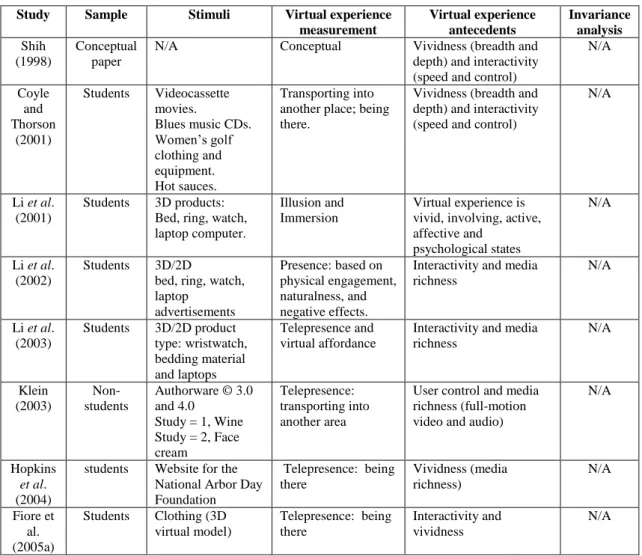
interactivity and vividness theories. For example, previous scholars (Biocca & Delany, 1995; Heeter, 1992; Lombard & Ditton, 1997; Sheridan, 1992; Steuer, 1992) assert that interactivity and vividness may represent the main antecedents of virtual reality experience. Interactivity appears particularly of interest since the appearance of new communication channels such as the World Wide Web, for which it represents a critical concept and primary advantage (Rafaeli & Sudweeks, 1997). Considerable research investigates and empirically tests the construct, but there is little agreement on the definition or operationalisation of the interactivity construct (e.g., Ariely, 2000; Klein, 2003; Liu & Shrum, 2002; McMillan & Hwang, 2002). For example, Steuer (1992) classifies it into three elements: speed, mapping and range. Rafaeli and Sudweeks (1997) argue interactivity relates to the communication process, and Ariely (2000) defines it on the basis of the control construct (the narrowest definition). Rowley (2008) focuses on information interactivity. Still other scholars (e.g., Lui & Shrum, 2002; McMillan & Hwang, 2002) argue that definitions of interactivity cannot be restricted to messages, human interactions or communications but rather should include multidimensional aspects. Thus speed, responsiveness and communications represent the main elements to define and measure interactivity construct. In contrast, vividness, according to Steuer (1992, p. 81) is “the way in which an environment presents information to the senses”. Steuer explains that vividness is stimulus driven and depends completely on the technical characteristics of a medium. In turn, it represents a product of two important variables: sensory breadth, and sensory depth. Most scholars use this definition of vividness. To that end, Lee (2004) revises all the previous definitions of telepresence or presence and argues that none of the previous definitions could be used to tap the concept of using virtual environment to reflect consumers’ virtual experience. The author posits two ways for an experience to become a virtual. First, using “Para-authentic objects” in which the users interact with objects in which they can find in real life aspects such as clothing. Secondly, using “Artificial objects”, which simulates objects that do not exists in real life. On that basis, we claim that using the notions of 3D telepresence or presence and their definitions to define VE neither help marketers and e-retailers to understand the effect of 3D product visualisation on consumers’ VE, nor suit the online retail context. Because (i) these notions represent a process of being mentally transported into other areas or being immersed into an illusion environment, such notions often reflect negative meanings such as immersion, delusion and transportation (Lee, 2004); (ii) presence and telepresence measurement scales, were originally built upon external devices, such as head-mounted display, which are not used in online retailers’ 3D virtual model; and (iii) the lack of agreement upon the antecedents of telepresence and presence (interactivity and vividness) often complicates measuring the 3D product visualisation VE, and (iv) these notions measure VE based on different technologies (see Table 1). For example, to measure VE, Shih (1998) proposes a conceptual framework. Coyle and Thorson (2001) focus on videocassette movies. Klein (2003) employs a simple technology such as Authorware © 3.0 and 4.0, and Hopkins et al. (2004) investigate websites VE. Moreover, we notice that only few of the previous studies focused on the use of 3D product visualisation to measure VE (see Table 1). For instance, Li et al. (2001, 2002, 2003) and Fiore et al. (2005a) measured VE using 3D product visualisation. Unfortunately, both studies measured it based on the telepresence construct. Based on the above gaps, we claim that a 3D virtual experience should be an authentic representation of the direct (offline) experience. The concept of 3D authenticity of the product visualisation implies that ability of the 3D to simulate the product experience in bricks-and-clicks contexts. We felt that it is important to measure how consumers, within the online retail context, could imagine that 3D presented products. Particularly, we introduced our new construct, namely, 3D product authenticity to reflect customers’ virtual experience, where customers can feel the authenticity of the 3D products.
Table 1: Previous research on online VR using 3D telepresence
3D Product Authenticity (3DPA) Construct
None of the previous definitions of telepresence or presence that use 3D virtual models realistically taps consumers’ virtual experiences. A 3D virtual experience should be an authentic representation of the direct (offline) experience. We therefore propose a new notion that relates to the simulation of online products and virtual experience, namely, the authenticity of the 3D product visualisation. Telepresence and presence are not particularly well suited to the online retail context, because they reflect illusion and transportation to other places. In contrast, the concept of 3D authenticity of the product visualisation implies the ability to simulate the product virtual experience in bricks-and-clicks contexts. We propose the following definition of perceived 3D product authenticity in a computer-mediated environment: 3D Product Authenticity (3DPA) is a psychological state in which virtual objects presented in 3D in a computer-mediated environment are perceived as actual objects in a sensory way. Furthermore, we identify users’ ability to control the content and form of the 3D flash (interactivity), animated colours (vividness) and 3D authenticity as the main elements of the 3D virtual experience. Moreover, we define control and animated colours as the main antecedences of 3D authenticity.
3 RESEARCH MODEL
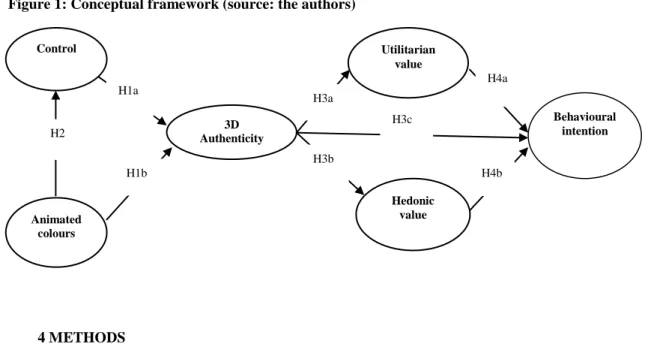
We demonstrate our research model in Figure 1. Our model is testing the relationships between control, animated colours, 3D product authenticity, hedonic and utilitarian value and behavioural intention. As the objective of our study is 3D product authenticity model’s measurement equivalence, the focus of our model is concentrated on whether gender, education levels and study backgrounds affect participants’ responses to our 3D product authenticity model.
Study Sample Stimuli Virtual experience measurement Virtual experience antecedents Invariance analysis Shih (1998) Conceptual paper
N/A Conceptual Vividness (breadth and
depth) and interactivity (speed and control)
N/A Coyle and Thorson (2001) Students Videocassette movies. Blues music CDs. Women’s golf clothing and equipment. Hot sauces. Transporting into another place; being there.
Vividness (breadth and depth) and interactivity (speed and control)
N/A
Li et al. (2001)
Students 3D products: Bed, ring, watch, laptop computer.
Illusion and Immersion
Virtual experience is vivid, involving, active, affective and psychological states N/A Li et al. (2002) Students 3D/2D bed, ring, watch, laptop advertisements Presence: based on physical engagement, naturalness, and negative effects.
Interactivity and media richness N/A Li et al. (2003) Students 3D/2D product type: wristwatch, bedding material and laptops Telepresence and virtual affordance
Interactivity and media richness N/A Klein (2003) Non-students Authorware © 3.0 and 4.0 Study = 1, Wine Study = 2, Face cream Telepresence: transporting into another area
User control and media richness (full-motion video and audio)
N/A
Hopkins
et al. (2004)
students Website for the National Arbor Day Foundation Telepresence: being there Vividness (media richness) N/A Fiore et al. (2005a) Students Clothing (3D virtual model) Telepresence: being there Interactivity and vividness N/A
3.1 3D Product Authenticity Antecedents and Definitions
We use the control construct to represent interactivity in an online retail context. Ariely’s (2000) definition of control refers to users’ abilities to customise and choose Web site contents to achieve their goals. We focus more on consumers’ ability to control and easily interact with the 3D virtual model. Therefore, we define control as users’ abilities to customise and choose the contents of the virtual model (i.e., 3D product visualisation), rotate, and zoom in or out on the product in the virtual model and the ability of the virtual model (3D) to respond to participants’ orders properly. In turn, we hypothesise:
H1a: A high level of control of 3D product visualization increases 3D authenticity.
Furthermore, 3D vividness should facilitate virtual experience by providing more sensory depth and breadth (Li et al., 2002, 2003). High-quality online animations enhance perceived reality of the 3D products (e.g., Fortin and Dholakia, 2005; Klein, 2003; Shih, 1998). Specifically, we consider vividness of the visual imagery, such that consumers can see online products with different colours (skins) just as they would see them in person. Media richness may lead to a real (authentic) experience, according to research on online shopping (Algharabat and Dennis, 2009a; Klein, 2003; Schlosser, 2003). Moreover, consumers’ ability to change the animation (colours) of the 3D product might help them sense control over the product. We therefore hypothesise:
H1b: A high level of 3D animated colours increases perceived 3D authenticity.
H2: A high level of 3D animated colours increases control.
3.2 Effects of 3D products Authenticity on Utilitarian and Hedonic Value
To identify the main consequences of using authentic 3D product visualisations, and to explain cognitive and emotional experiences that consumers might have from navigating an authentic 3D product visualisation, we follow the hedonic and utilitarian value theories (based on Babin et al., 1994; Fiore et al., 2005a). Scholars (e.g., Fiore and Jin, 2003; Fiore et al., 2005a; Kim et al., 2007; Klein, 2003; Li et al., 2001, 2002, 2003; Suh and Chang 2006) explain the importance of using 3D product visualisations in enhancing consumers’ understanding of product attributes, features and characteristics. 3D visualisation increases consumers’ involvement and encourages them to seek more information about the products (Fiore et al., 2005a). Suh and Lee (2005) posit a positive relationship between higher levels of 3D product visualisation and seeking more information about the products’ characteristics and features. Suh and Chang’s (2006) empirical research of the influence of 3D product visualisation and product knowledge reveals a positive relationship between 3D and perceived product knowledge. Using 3D product visualisation helps consumers to imagine how a product may look and it gives them more details about the products’ characteristics (Fortin and Dholakia, 2005; Klein, 2003; Shih, 1998). Therefore, we hypothesise:
H3a: 3D authenticity in a retailer website will positively affect website use for utilitarian value. Scholars (Fiore et al., 2005b; Kim and Forsythe, 2007; Lee et al., 2006; Schlosser, 2003) report the importance of 3D product visualisation in enhancing the experiential aspects of a virtual shopping. The above researchers find that the ability of 3D product visualisation to produce hedonic values for shoppers is greater than its ability to produce utilitarian values. Fiore et al. (2005b) assert that 3D virtual model produces hedonic value, which is highly correlated with consumers’ emotional pleasure and arousal variables. Fiore et al. (2005a) posit the importance of virtual models in boosting hedonic value (enjoyment). Fiore et al. (2005a) also report the importance of 3D virtual model technology in producing more hedonic value. Many scholars in the communication field (e.g., Heeter, 1992; Lombard and Ditton, 1997; Song et al., 2007) report the importance of enjoyment as a consequence of using 3D. Consumers use 3D product visualisation to have more fun, enjoyment and entertainment (Kim and Forsythe, 2007). Such sources of fun or enjoyment come from consumers’ ability to rotate, and zoom in or out on the product (Fiore et al., 2005a), seeing different animated coloured pictorial images that may enhance their mental pleasure when using 3D sites.
3.3 Effects of 3D Product Authenticity, Utilitarian and Hedonic Value on Behavioural Intention
The role of 3D product visualisation in enhancing behavioural intentions appears well supported; 3D utilitarian and hedonic values improve willingness to purchase from an online retailer (Fiore et al., 2005a, 2005b), intention to buy (Schlosser, 2003) and purchase intentions (Li et al., 2001; 2003). Moreover, 3D realism improves users’ beliefs and attitudes towards an online store (Klein, 2003). Therefore,
H3c: The relationship between 3D authenticity and behavioural intention is positive.
H4a: The relationship between utilitarian value and behavioural intention is positive.
H4b: The relationship between hedonic value and behavioural intention is positive.
Figure 1: Conceptual framework (source: the authors)
4 METHODS 4.1 Stimuli
A retailer’s website with one stimulus was custom-designed for this study. The stimulus was illustrated in 3D product visualisation sites in which participants can see, the focal product, laptops from different angles; they can rotate it and zoom it in or out. The 3D stimulus is designed to help consumers to imagine the product in appropriate and relevant ways and it enhances consumers’ virtual experiences (Li et al., 2001). Moreover, we decide to use the 3D stimulus which users can control (content and form) and see from different colours to bridge the gaps in measuring VE using the 3D product visualisation. Previous scholars measure VE based on movies, simple technology but not 3D product visualisation. Moreover, those who use the 3D product visualisation measure it based on the telepresence construct (see Table 1).
4.2 Interface Design
We designed one stimulus, a 3D flash (site), for testing the proposed hypotheses. The site allows participants to control the content and form of the 3D flash. For example, participants can zoom in or out on the product, rotate it and can see different parts of the product when clicking on it. The 3D flash permits participants to change the colour of the laptop and see it with animated colours. Also the flash allows participants to get actual and perceived information about the laptop features and attributes. Moreover, our site enhance participants’ fun and enjoyment values by enabling them to control (i.e., to zoom in or out on and rotate), to change the colour of the laptop and to see more information about the product (see Appendix A). In designing this interface, we consider a comprehensive site to visualise an electrical online retailer to surpass actual experience. Moreover, this study adds more features and cases to the ones that might be found in real sites. For example, none of the national sites that sell laptops (e.g., Sony and Dell, to the best of the authors’ knowledge) has a flash combining both 3D and information about laptops. The website we created for this study was not previously known to users, nor did users have any knowledge of the fictitious brands on the site. Thus, we eliminated any impact
Control Animated colours 3D Authenticity Utilitarian value Hedonic value Behavioural intention H1a H1b H3a H3b H4a H4b H3c H2
of previous experiences or attitudes (Fiore et al., 2005a). The site offers a wide variety of laptops, similar to those that many college-aged women and men currently buy and use. Therefore, site provides a suitable context for the present sample.
4.3 Participants
Student samples are well suited to online shopping research (e.g., Balabanis & Reynolds, 2001; Fiore et al., 2005a; Kim et al., 2007; Li et al., 2002, 2003), because they are computer literate and have few problems using new technology. Students also are likely consumers of electrical goods (Jahng et al., 2000). We employed a sample of 312 students to perform this study. The sample was gender balanced, consisting of 48% women and 52% men, and 90% of the sample ranged from 18 to 30 years of age. Approximately 90% reported having had prior online shopping experience.
4.4 Instrument
Participants were informed that this study pertained to consumers’ evaluations of an electrical retailer’s Web site. The questionnaire contained five-point Likert-type scales, anchored by “strongly disagree” and “strongly agree”.
To measure the control construct, we developed a five-item scale that centres on users’ ability to rotate and zoom in or out the virtual model based on Liu and Shrum’s (2002); McMillan and Hwang’s (2002) and Song and Zinkhan’s (2008) studies. To measure animated colours, we developed a four-item animated colour scale based on Fiore and colleagues (2005a), Klein’s (2003), Steuer’s (1992) studies. The items tap how closely the simulated sensory information reflects the real product. We could not find an existing scale to measure 3D product authenticity so we developed a new five-item scale. We submitted the items to evaluations by academics (lecturers in online retailing and Ph.D. students); these respondents considered the items relevant for measuring the authenticity construct. We followed Churchill’s (1979) procedures for developing a marketing construct scale and adopted Christodoulides and colleagues (2006) procedures for developing a scale for the online context. Each item began with “After surfing the 3D sites”, and then obtained responses to the following: “3D creates a product experience similar to the one I would have when shopping in a store”, “3D let me feel like if I am holding a real laptop and rotating it” (i.e. virtual affordance), “3D let me feel like I am dealing with a salesman who is responding to my orders”, “3D let me see the laptop as if it was a real one”, and “Being able to zoom in/out and rotate the laptop let me visualise how the laptop might look in an offline retailer”. To measure hedonic values, we adopted a modified version of Babin and colleagues (1994) scale. We based the study on 4 of the 11 items. To measure utilitarian values, we adopted a modified version of Fiore and colleagues (2005a) scale. To measure Behavioural intention, we used a modified version of Fiore and colleagues (2005a) scale. See Table 2 for the purified items.
5 RESULTS
5.1 Measurement Model for the 3D Product Authenticity Model
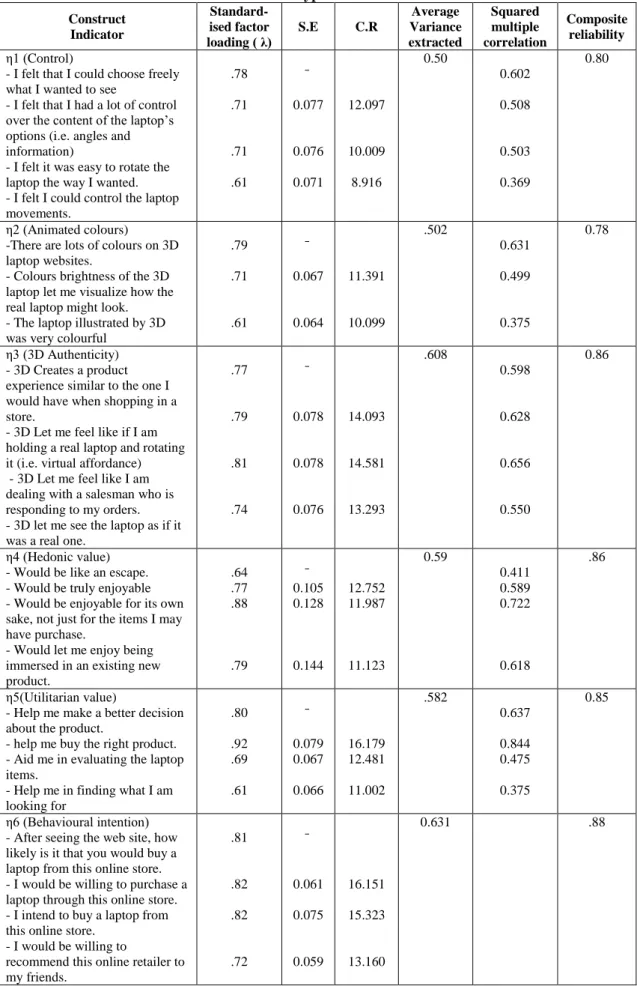
We evaluated the measurement and structural equation models using AMOS 16. The measurement model includes 23 indicators, and we provide its results in Table 2, including the standardised factor loading, standard error (S.E), critical ratios (C.R), composite reliability, squared multiple correlation and average variance extracted (AVE) for each construct. The standardised factor loadings (λ) are all greater than .61. The composite reliabilities for control (.80), animated colours, (.782), 3D authenticity (.86), utilitarian (.85), hedonic (.86) and behavioural intention (.88) are acceptable (Hair et al., 2006). Moreover, average variance extracted by each construct exceeds the minimum value recommended by Hair et al. (2006), (i.e., exceeds .5).
Table 2: Measurement model results for hypothetical 3DPAM. Construct Indicator Standard-ised factor loading ( λ) S.E C.R Average Variance extracted Squared multiple correlation Composite reliability η1 (Control)
- I felt that I could choose freely what I wanted to see
- I felt that I had a lot of control over the content of the laptop’s options (i.e. angles and information)
- I felt it was easy to rotate the laptop the way I wanted. - I felt I could control the laptop movements. .78 .71 .71 .61 ¯ 0.077 0.076 0.071 12.097 10.009 8.916 0.50 0.602 0.508 0.503 0.369 0.80 η2 (Animated colours)
-There are lots of colours on 3D laptop websites.
- Colours brightness of the 3D laptop let me visualize how the real laptop might look. - The laptop illustrated by 3D was very colourful
.79 .71 .61 ¯ 0.067 0.064 11.391 10.099 .502 0.631 0.499 0.375 0.78 η3 (3D Authenticity) - 3D Creates a product experience similar to the one I would have when shopping in a store.
- 3D Let me feel like if I am holding a real laptop and rotating it (i.e. virtual affordance) - 3D Let me feel like I am dealing with a salesman who is responding to my orders. - 3D let me see the laptop as if it was a real one.
.77 .79 .81 .74 ¯ 0.078 0.078 0.076 14.093 14.581 13.293 .608 0.598 0.628 0.656 0.550 0.86 η4 (Hedonic value) - Would be like an escape. - Would be truly enjoyable - Would be enjoyable for its own sake, not just for the items I may have purchase.
- Would let me enjoy being immersed in an existing new product. .64 .77 .88 .79 ¯ 0.105 0.128 0.144 12.752 11.987 11.123 0.59 0.411 0.589 0.722 0.618 .86 η5(Utilitarian value)
- Help me make a better decision about the product.
- help me buy the right product. - Aid me in evaluating the laptop items.
- Help me in finding what I am looking for .80 .92 .69 .61 ¯ 0.079 0.067 0.066 16.179 12.481 11.002 .582 0.637 0.844 0.475 0.375 0.85 η6 (Behavioural intention) - After seeing the web site, how likely is it that you would buy a laptop from this online store. - I would be willing to purchase a laptop through this online store. - I intend to buy a laptop from this online store.
- I would be willing to
recommend this online retailer to my friends. .81 .82 .82 .72 ¯ 0.061 0.075 0.059 16.151 15.323 13.160 0.631 .88
5.2 Structural Equation Model for the 3D Product Authenticity Model
The hypothesised model achieves a chi-square of 350.225 (df = 219), with a goodness-of-fit index (GFI) of .911, comparative fit index (CFI) of .965, root mean square residual (RMR) of .038 and root mean square error of approximation (RMSEA) of .044, normed fit index (NFI) of .912, relative fit index (RFI) of .9, incremental fit index (IFI) of .965, and
χ
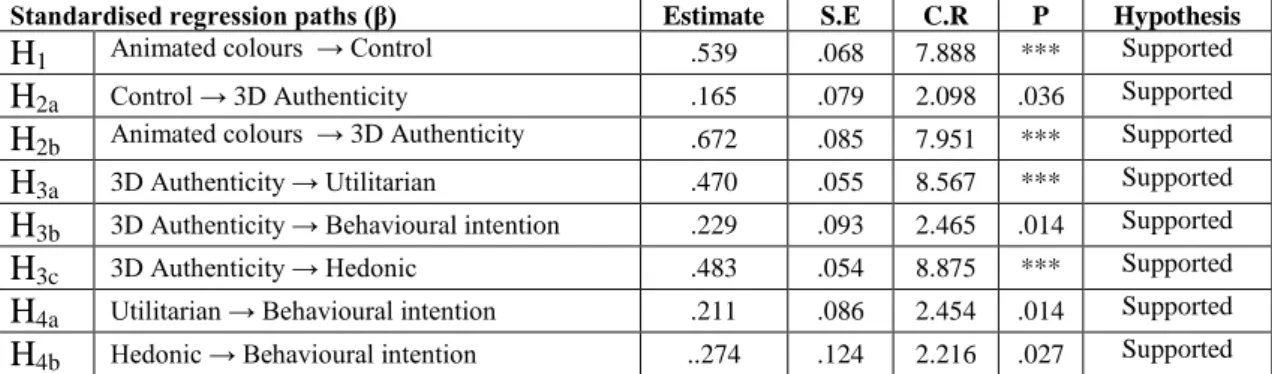
2/df = 1.599. These results indicate a good fit of the data to the model (Byrne, 2001; Hair et al., 2006). Furthermore, the structural equation model confirms that control and animated colours have significant positive effects on 3D authenticity (H1a t = 2.098; H1b t = 7.951). Moreover, animated colour exhibits a significant positive effect on control (H2 t = 7.888). Finally, as we hypothesized, 3D authenticity, hedonic and utilitarian values have positive effects on behavioural intention (H3c: 2.465, H4a: t = 2.216, H4b: t= 2.454). Table 3 reports estimates, standardised estimates, and critical ratio for each hypothesized path. All the hypothesized paths are supported (p < .05).Table 3: Summary of results of structural model estimation
Standardised regression paths (β) Estimate S.E C.R P Hypothesis
H
1 Animated colours → Control .539 .068 7.888 *** SupportedH
2a Control → 3D Authenticity .165 .079 2.098 .036 SupportedH
2b Animated colours → 3D Authenticity .672 .085 7.951 *** SupportedH
3a 3D Authenticity → Utilitarian .470 .055 8.567 *** SupportedH
3b 3D Authenticity → Behavioural intention .229 .093 2.465 .014 SupportedH
3c 3D Authenticity → Hedonic .483 .054 8.875 *** SupportedH
4a Utilitarian → Behavioural intention .211 .086 2.454 .014 SupportedH
4b Hedonic → Behavioural intention ..274 .124 2.216 .027 Supported6 INVARIANCE ANALYSIS
We use the invariance analyses to determine the effects of gender, education levels and study backgrounds and their relationships in our conceptual framework. We start with conducting a measurement invariance analysis (measurement weight) for gender, education levels and study backgrounds to determine whether, for example, the males and females groups would use the same pattern in measuring the observed items. If the result is invariant, then the data of each group is suitable for further analysis (i.e., structural invariance analysis). However, if the two groups understood the items in different ways (i.e., non-invariance), then, we identify the source of the non-invariance. To do so, we identify the observed item(s) that caused the non-invariance. If the result of the measurement model is invariance, then, we go to the next step. However, if the results still non-invariant, then, we stop the analysis.
Secondly, after having the insignificant results in the measurement model, we conduct the invariance structural model analysis to determine if gender, education levels and study background groups have invariance or non-invariance results in perceiving the relationships between the unobserved constructs. To conduct this analysis, we follow two steps; (i) if the members of any group (e.g., the males and females groups) perceive the relationships between the constructs similarly (i.e., invariance), then, we move to the third step (i.e., latent mean invariance analysis), (ii) however, if the members of any group perceive the relationships between the constructs differently (i.e., non-invariance), then we determine the source of the non-invariance. Moreover, if the structural model analyses are non-invariance, we calculate the un-standardised direct, indirect and total effects. Thirdly, we conduct the latent mean invariance analyses among latent constructs to determine if the groups have perceived each construct similarly (invariance) or differently (non-invariance). In all the three previous steps, we report ∆
χ
2 and ∆df and fit indices (TLI, CFI and RMSEA) models for the comparison purposes.6.1. Invariance Analysis Results
The invariance analyses provide a better understanding of our conceptual model and its constructs invariance validity. Following a series of invariance analyses, we could conclude that our conceptual framework was invariant of measurement loading, structural loading and latent mean across gender,
education level and study background. The following explains the invariance analysis and it reports the non-invariance models.
Gender
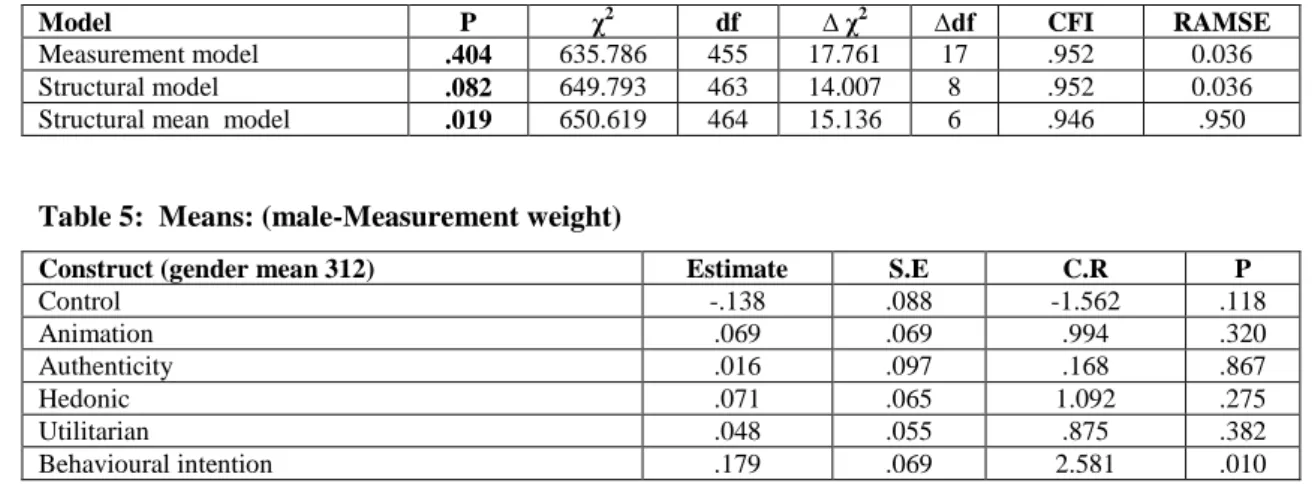
We classify the participants into two groups according to their gender (i.e., males or females). The measurement model results (Table 4) reveal insignificant differences between the males and females groups regarding the measurement and structural models. However, result shows a significant difference in the mean model. The females group is higher (.179) than the males group in perceiving the behavioural intention construct (Table 5).
Table 4: Results of factorial invariance analysis for gender: assuming model unconstrained to be correct.
Model P χ2 df ∆ χ2 ∆df CFI RAMSE
Measurement model .404 635.786 455 17.761 17 .952 0.036
Structural model .082 649.793 463 14.007 8 .952 0.036
Structural mean model .019 650.619 464 15.136 6 .946 .950
Table 5: Means: (male-Measurement weight)
Construct (gender mean 312) Estimate S.E C.R P
Control -.138 .088 -1.562 .118 Animation .069 .069 .994 .320 Authenticity .016 .097 .168 .867 Hedonic .071 .065 1.092 .275 Utilitarian .048 .055 .875 .382 Behavioural intention .179 .069 2.581 .010 Education Level
The second invariance analysis classifies participants into two groups according to the participants’ educational levels (undergraduates and postgraduates groups). The measurement model, structural model and latent mean model results reveal invariance differences (i.e., insignificant differences) between the undergraduates and postgraduates groups (Table 6).
Table 6: Results of factorial, structural and mean invariance analysis for education: assuming model unconstrained to be correct.
Model P χ2 df ∆ χ2 ∆df CFI RAMSE
Measurement model .562 649.828 455 15.466 17 .949 0.37
Structural model .240 660.190 463 10.363 8 .943 .948
Structural mean model .072 656.679 464 11.575 6 .945 .949
Participants’ Study Backgrounds
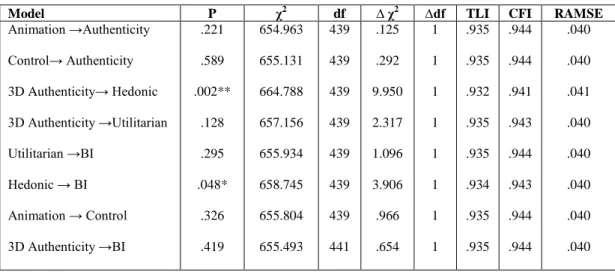
The third invariance analysis classifies the participants into two groups according to the participants’ study backgrounds (Business-Social and Maths-IT-Engineering groups). The measurement model and mean model results (Table 7) reveal insignificant differences between the Business-Social studies and the Maths-IT-Engineering studies backgrounds. However, structural model results reveal non-invariance (significant) differences between the Business-Social studies and the Maths-IT-Engineering studies groups in determining the relationships between the proposed constructs (Table 8). The relationships between 3D product authenticity→ hedonic, and hedonic → behavioural intention (BI) are the source of this non-invariance. In other words, both groups perceive the importance of the hedonic values differently.
Table 7: Results of factorial, structural and mean invariance analysis for background: assuming model unconstrained to be correct
Model P χ2 df ∆ χ2 ∆df CFI RAMSE
Measurement model .221 675.953 455 21.115 17 .943 0.040
Structural model .010 696.033 463 20.080 8 .934 .939
Table 8: Results of path coefficient invariance analysis for study background.
Model P χ2 df ∆ χ2 ∆df TLI CFI RAMSE
Animation →Authenticity Control→ Authenticity 3D Authenticity→ Hedonic 3D Authenticity →Utilitarian Utilitarian →BI Hedonic → BI Animation → Control 3D Authenticity →BI .221 .589 .002** .128 .295 .048* .326 .419 654.963 655.131 664.788 657.156 655.934 658.745 655.804 655.493 439 439 439 439 439 439 439 441 .125 .292 9.950 2.317 1.096 3.906 .966 .654 1 1 1 1 1 1 1 1 .935 .935 .932 .935 .935 .934 .935 .935 .944 .944 .941 .943 .944 .943 .944 .944 .040 .040 .041 .040 .040 .040 .040 .040 * p < 0.05; ** p <0.01.
Table 9 shows the results of un-standardised indirect, direct and total effects- estimates for the Maths-IT-Engineering studies background group and the Business-Social studies background group.
Table 9: Results of un-standardised indirect, direct and total effects- estimates
Predictor variables
Behavioural intention toward the online retailer Indirect effects Direct effects Total effects Animated colours .221 --- .221 Control 0.029 --- .029 3D Authenticity .075 .230 .306 Utilitarian value --- .169 .169 Hedonic value --- .029 .029 R2 .34 Predictor variables
Behavioural intention toward the online retailer Indirect effects Direct effects Total effects Animated colours .433 --- .433 Control 0.224 --- .224 3D Authenticity .156 .419 .574 Utilitarian value --- .069 .069 Hedonic value --- .225 .225 R2 .34
Un-standardised indirect, direct and total effects- estimates
6 DISCUSSION
This research aims to measure 3D product visualisation virtual experience, to provide a validated conceptual model that integrates different constructs and to clarify the theoretical problems of using different measurement of the 3D virtual experience. Moreover, this research provides invariance analysis to determine the main moderators within our model. Our survey validates the hypothesised model, and the model findings confirm that animated colours and control are the main determinants of 3D authenticity (VE). Moreover, we find that the authenticity of the 3D model, hedonic and utilitarian values are the main determinants of users’ behavioural intention. We follow a series of invariance analyses to confirm our results across gender, education levels and study background. Results show that our 3D product authenticity model is invariant in respect of measurement model. Furthermore, we find invariance results regarding the structural model across gender and education level. However, the non-invariance results appear well in the mean model (across gender) and the structural model (across study background). The difference (non-invariance) in the latent mean between males and females groups suggests that females tend to accept the idea of buying from our fictitious e-retailer more than the males group does. This result supports Tversky and Morrison’s (2002) findings regarding the ability of the animated graphics to increase females’ comprehension and learning. Moreover, the ability of the 3D flashes to enhance users’ understanding of the laptops’ features especially when using animations makes Females’ ability to make purchase decisions (based on non-verbal cues) easier (Dennis et al., 1999) than men.
The non-invariance (significant) differences between Business-Social group and Maths-IT- Engineering groups clearly come in the relationships between the proposed constructs (i.e., the structural model). The 3D authenticity→ hedonic and the hedonic→ behavioural intention relationships are the source of the coefficients non-invariance. In other words, both groups perceive the importance of the hedonic values and the behavioural intention differently. That is, Maths-IT- Engineering group tend to accept that the 3D authenticity and the novelty of the 3D flash increases the level of fun and entertainment. On the other hand, Maths-IT- Engineering group does not accept that the high level of entrainment may end with a positive behavioural intention towards the online retailer. In regards to the un-standardisedeffects, students with the Maths-IT- Engineering backgrounds perceive the total effects of the 3D authenticity construct on the behavioural intention (.574) more than the Business-Social backgrounds (.306) do. This could be justified due to the Maths-IT- Engineering group ability to understand and criticize the novelty of the 3D more than the Business-Social backgrounds. However, the Business-Social background group perceives the total effects of the utilitarian values (.169) on behavioural intention more than the IT- Engineering group does. On the other hand, the Maths-IT- Engineering group perceives the total effects of the hedonic values (.225) on behavioural intention more than the human-studies group (.029) does. In contrast to the Maths-IT- Engineering group who perceives the direct effect of the hedonic values (.225) on behavioural intention more than utilitarian values (.069), the Business-Social studies group perceives the direct effect of the utilitarian values on behavioural intention (.169) more than the hedonic values (.029). These results could be explained as follows. First, Raijas (2002) finds that the experienced people know what they are looking for. Moreover, these results support the findings of Dennis and King (2009) and Dholakia and Chiang (2003) regarding shopping styles. In other words, when shopping for technical and expensive products shoppers who are Empathisers turn to become Systemisers and vise verse. Second, in comparison to the Business-Social group, the Maths-IT- Engineering group bought on average more laptops online (M Maths-IT-Engineering = 1.33, M Business-Social = 1.3) than the Business-Social group did. The Business-Social group are more interested in a laptop features and characteristics than entertainment features. The animation construct had the strongest indirect effect (.221, 433 respectively) in both groups. However, the indirect effect of the control construct in the Maths-IT- Engineering group (.244) is greater than the indirect effect of control on the Business-Social studies group (.029). Finally, in both groups, the 3D authenticity construct has the strongest direct effect and total effects.
7 CONCLUSION AND CONTRIBUTION
From a theoretical standpoint, our results contribute to the existing literature in several ways. First, previous research on VE has focused on three elements to surpass the offline (direct) experience; interactivity, vividness and 3D telepresence. However, we claimed that the notion of 3D telepresence reflects negative meanings. Instead we propose the notion of 3D authenticity to reflect the 3D virtual experience. Second, to solve the lack of agreement regarding defining and measuring the interactivity and vividness constructs. We narrowed the operationalisations of 3D authenticity antecedents to control and animated colours to reflect a real authentic VE. In line with other online retail researchers who investigated the influence of using 3D product visualisation on VE (Li et al., 2001, 2002, 2003), we find that marketers should focus on specific aspects of interactivity and vividness (rather than on the abstract constructs) when defining 3D virtual experience. For example, when it comes to 3D virtual models, we prefer focusing on the narrowest, most relevant aspects of interactivity (i.e., control). Whereas Heeter (2000, p. 75) describes interactivity as “an overused and under defined concept”, we posit that control represents a useful construct for 3D models in the online retail context. Moreover, in support of previous research (Ariely, 2000; Coyle & Thorson, 2001) we narrow our conceptualisation of control to consumers’ ability to control the content and form of the 3D flashes. In other words, users’ ability to zoom in or out, rotate and get more information about the product enhances their perceptions of the authenticity of the 3D products. Furthermore, whereas prior research defines vividness according to sensory breadth and depth, we argue that research might benefit from a tighter focus on specific aspects of vividness through illustration, such as we have applied here. This result is in accordance with Pimentel and Teixeira’s (1994, p. 146) study that asserts that visual stimuli are the main sensory cues in producing virtual experiences.
Third, our use of invariance analyses gives this research a plus, since previous research has not examined them in the context of 3D virtual experience. The invariance analyses led to another contribution, which highlights the importance of this research’s conceptual framework applicability in the e-retailing area. Following a series of invariance analyses, it could be concluded that our conceptual framework is invariance of the measurement model, structural model and latent mean model across gender, education level, and study background. However, the effect of 3D authenticity on hedonic and the impact of hedonic on behavioural intention are moderated by study background. This result posits
that the study background is a significant moderator between the effect of 3D authenticity on hedonic values, and the effect of hedonic value and behavioural intention. Marketers and website developers should focus on this moderator when designing 3D product visualisation for the online retailer. Any 3D flash should reflect more innovation in designing and it should reflect a state of enjoyment for students with Maths-IT- Engineering backgrounds and Business-Social group. This conclusion posits that overall all the subgroups conceptualise the constructs and variables (animated colours, control, 3D authenticity, utilitarian, hedonic, and behavioural intention constructs) similarly. Also, this suggests that our results have no obvious bias of gender, education level, and study background (Lai and Li, 2005).
8 MANAGERIAL IMPLICATIONS
E-retailers should pay more attention to 3D product authenticity antecedents, i.e., control and animated colour when designing their 3D virtual models. Including real colours and flashes that consumers can control easily will lead to more authentic online experiences. The direct and indirect effects of animated colours and control constructs reveal the importance of these constructs within the 3D e-retail context. Any 3D flash should include the essential information that consumers seek rather than just a pretty picture. For example, consumers should be able to click on any part of the 3D flash to get access to information about it. Website developers should take advantage of technological advancements to develop and update online retailers’ 3D flashes. Pechtl (2003) asserts a positive relationship between perceived innovation attributes and online adoption behaviour. Algharabat and Dennis (2009a) posit the importance of authentic 3D product to enhance users’ hedonic and utilitarian values. Managers and Web sites designers should work together to ensure that the 3D product visualisation provides customers with the complete and accurate information they need. In addition, marketers should decide what information (or knowledge) to focus on before developing 3D flashes. It should be accepted that developing 3D flashes is not a money-free issue. Nevertheless, many companies have already claimed to have improved their sales as a result of designing and using 3D flashes. For example, J.C. Penny, eBags and Wal-Mart claimed that their online sales have increased 10% to 50% after using rich media such as 3D flashes (Demery, 2003). Moreover, Demery (2006) posits that the numbers of companies who are investing in 3D virtual models is increasing steadily because these companies are seeing the potential of the technology for selling more products. Nantel (2004) asserts that consumers shopping online for clothing are 26% more likely to purchase from the sites that have 3D virtual model than from sites that have not. Moreover, Fiore (2008) posits that media richness is an important way to differentiate retailers. Wagner (2000) asserts that online retailers with 3D product visualisations may reap benefits that extend beyond sales. For example, 3D increases site stickiness: users will spend more time on the online retailer, which leads to more opportunities to learn more about the products, interact with them, build trust and confidence. Finally, according to the Social Issues Research Centre (SIRC, as cited in Herrod, 2007) study it is expected that “by 2020 virtual commerce (v-commerce) will replace e-commerce” and the development of 3D virtual models (such as 3D virtual shopping malls) will be leading the whole industry by 2020.
9 LIMITATIONS AND FURTHER STUDIES
Although the generalisability of the results is limited by the student sample, and cannot be generalised to all online consumer groups, we argue that students represent the shoppers of tomorrow (Algharabat and Dennis, 2009b; Balabanis and Reynolds, 2001) and the research thus has prescient value. Second, since this study has focused only on laptops, which we consider to be products that are associated with more search or experience, it is unclear to what extent the results can be generalised and applied to other online products. On the bases of our results, we recommend that website developers should pay more attention to simulating 3D animation colours to reflect the real products more authentically. Moreover, they should work to create an environment in which consumers sense that they can feel the online products when they navigate the site. We recommend research efforts to extend the generalisability of our findings to other contexts (e.g., clothing) and to non-student samples. Further research may add and test other stimuli, for example by simulating real sounds to investigate how auditory vividness may influence 3DPAM.
APPENDIX A
REFERENCES
Algharabat, R. and Dennis, C. (2009a). Using authentic 3D product visualisation for an electrical online retailer. 12th International Conference on Retailing and Commercial Distribution Teaching and Research Issues, EAERCD, Surrey University, 15-17 July.
Algharabat, R. and Dennis, C. (2009b). Modelling 3D product visualisation on the online retailer. Academy of Marketing, Annual conference 2009, Putting Marketing in Its Place, Leeds Metropolitan University, 6-9 July.
Ariely, D. (2000). Controlling the information flow: Effects on consumers’ decision making and preferences. Journal of Consumer Research, Vol. 26 (September), pp. 233-248.
Babin, Barry J., William R. Darden, and Mitch Griffin. (1994). Work and/or Fun: Measuring Hedonic and Shopping Value, Journal of Consumer Research, Vol. 20 (March), pp. 644–56.
Balabanis, G., and Reynolds, N. (2001). Consumer attitudes towards multi-Channel retailers’ Web Sites: The role of involvement, brand attitude, internet knowledge and visit duration. Journal of Business Strategies, Vol. 18 (Fall), pp. 105-131.
Biocca, F. (1992). Will simulation sickness slow down the diffusion of virtual environment technology?, Presence, Vol. 1, No 3, pp. 334–343.
Biocca, F. (1997). The cyborg’s dilemma: progressive embodiment in virtual environments. Journal of Computer-Mediated Communication, Vol. 3, No 2. Available at:
http://www.ascusc.org/jcmc/vol3/issue2/biocca2.html, [Accessed 14th November 2007] Biocca, F., and Delaney, B. (1995). Immersive virtual reality technology”, In F.Biocca, and M. Levy
(Eds.). Communication in the age of virtual reality (pp.57-124). Hillsdale, NJ: Erlbaum.
Byrne, B. (2001).Structural Equation Modeling with AMOS. Lawrence Erlbaum Associate New Jersey, U.S.A.
Christodoulides, G., Leslie, C., Olivier, F., Eric, S., and Temi, A. (2006). Conceptualising and Measuring the Equity of Online Brands. Journal of Marketing Management, Vol. 22, pp. 799-825.
Churchill, G. (1979). A Paradigm for Developing Better Measures of Marketing Constructs. Journal of Marketing Research, Vol. XVI, pp. 64-73.
Coyle, James R., and Thorson, Esther. (2001). The effects of progressive levels of interactivity and vividness in web marketing site, Journal of Advertising, Vol. 30, No. 3, pp. 65-77.
Demery, P. (2003, October). The latest flash”, Internet Retailer. Available at
http://www.internetretailer.com/article.asp?id=10323 , [Accessed 15th May 2009]
Demery, P. (2006, January). As consumers flock to high bandwidth, e-retailers shake, rattle and roll. Internet Retailer, pp. 23-28
Dennis, A., Kinney, S., and Hung, Y. (1999). Gender Differences in the Effects of Richness. Small Group Research, Vol. 30, No.4, pp. 405-437.
Dennis, C. and King, T. (2009). Development of a cross-market scale for femininity and masculinity expressed in shopping styles’. 12th International Conference on Retailing and Commercial
Distribution Teaching and Research Issues, EAERCD, Surrey University, 15-17 July.
Dholakia R, R. and Chiang, K-P. (2003). Shoppers in cyberspace: are they from Venus or Mars and does it matter?. Journal of Consumer Psychology, 13 (1/2): 171-176.
Fiore, A. M., Kim, J. and Lee, H.H. (2005a). Effects of image interactivity technology on consumer responses toward the online retailing. Journal of Interactivity Marketing, Vol. 19, No. 3, pp. 39-53.
Fiore, A., Jin, H. and Kim, J. (2005b). For fun and profit: hedonic value from image interactivity and responses towards an online store. Psychology & Marketing, Vol. 22, No. 8, pp. 669-94. Fiore, A.M., & Jin, H.J. (2003). Influence of Image Interactivity on Approach Responses Towards an
Online Retailer. Internet Research: Electronic Networking Applications and Policy, Vol. 13, pp.38-48.
Fiore, Ann. (2008). The digital consumer: Valuable partner for product development and production. Clothing and Textiles Research Journal, Vol. (26), No. (2), pp. 177-190
Fortin, D., and Dholakia, R. (2005). Interactivity and vividness effects on social presence and involvement with a web-based advertisement. Journal of Business Research, Vol. 58, 387-396. Hair, J., Anderson, R., Tatham, R., and Black, W. (2006). Multivariate Data Analysis, Prentice-Hall,
Upper Saddle River, NJ.
Heeter, C. (1992). Being there: the subjective experience of presence. Presence: Teleoperators and Virtual Environments, Vol. 1, pp. 262-71.
Heeter, C. (2000). Interactivity in the context of designed experiences. Journal of Interactive Advertising, Vol. 1, No. 1, pp. 75-89.
Herrod, E. (2007, May). E-commerce to 2020. Internet Retailing. Available at
http://www.internetretailing.net/news/e-commerce-to 2020/?searchterm=3D [Accessed 15th May 2009]
Hopkins, C. D., Raymond, M, A., and Mitra, A. (2004). Consumer responses to perceived telepresence in the online advertising environment: the moderating role of involvement, Marketing Theory, Vol. 4, No. 137, pp. 137-63.
Jahng, J., Jain, H., and Ramamurthy, K. (2000). Effective design of electronic commerce environments: A proposed theory of congruence and an illustration, IEEE Transactions on Systems, Man, and Cybernetics: Part A, 30 (July), pp. 456–471.
Kim, J & Forsythe, S. (2007). Hedonic usage of product virtualisation technology in online apparel shopping. International Journal of Retail and Distribution Management, Vol. 35, No. 6, pp. 502-514
Kim, J., Fiore, A., and Lee, H. (2007). Influence of online store perception, shopping enjoyment, and shopping involvement on consumer patronage behaviour towards an online retailer. Journal of Retailing and Consumer Services, No.14, pp. 95-107.
Klein, L. (2003). Creating virtual product experiences: the role of telepresence. Journal of Interactive Marketing, Vol. 17, No. 1, pp. 41-55.
Lai, V., and Li, H. (2005). Technology acceptance model for internet banking: an invariance analysis. Information & Management, Vol. 42, pp. 373-386.
Lee, H.H., Fiore, A.M., Kim, J., (2006). The role of the technology acceptance model in explaining effects of image interactivity technology on consumer responses. International Journal of Retail & Distribution Management, Vol. 34, No. 8, pp. 621-644.
Li, H., Daugherty, T. and Biocca, F. (2001). Characteristics of virtual experience in electronic commerce: a protocol analysis. Journal of Interactive Marketing, Vol. 15, No. 3, pp. 13-30. Li, H., Daugherty, T. and Biocca, F. (2002). Impact of 3-D advertising on product knowledge, brand
attitude and purchase intention: the mediating role of presence. Journal of Advertising, Vol. 31, No. 3, pp. 43-57.
Li, H., Daugherty, T. and Biocca, F. (2003). The role of virtual experience in consumer learning. Journal of Consumer Psychology, Vol. 13, No. 4, pp. 395-407.
Liu, Y. and Shrum, L.J. (2002). What is interactivity and is it always such a good thing? Implications of definition, person, and situation for the influence of interactivity on advertising effectiveness. Journal of Advertising, Vol. 31. No. 4, pp. 53-64.
Lombard, M and Ditton, T. (1997). At the heart of it all: the concept of presence. Journal of Computer-Mediated Communication, Vol. 3, No. 2. Available at:
http://jcmc.indiana.edu/vol3/issue2/lombard.html.
McGoldrick, P., Keeling, K., and Beatty, S., (2008). A typology of roles for avatars in online retailing. Journal of Marketing Management, Vol. 24, No. 3-4, pp. 433-461.
McMillan, S.J. and Hwang, J.-S. (2002). Measures of perceived interactivity: an exploration of the role of direction of communication, user control, and time in shaping perceptions of interactivity. Journal of Advertising, Vol. 31, No. 3, pp. 29-42.
Nantel, J. (2004). My virtual model: Virtual reality comes into fashion. Journal of Interactive Marketing, Vol. 18, No. 3, 73-86.
Pimentel, K., and Teixeira, K. (1994) Virtual Reality: Through the New Looking Glass. 2nd edn. New York: Intel/MacGraw-hill
Pechtl, H. (2003). Adoption of online shopping by German grocery shoppers. The International Review of Retail, Distribution and Consumer Research, No. 13, Vol. 2, pp. 145-159.
Pimentel, K., and Teixeira, K. (1994). Virtual Reality: Through the New Looking Glass (2nd ed.), Intel/MacGraw-hill, New York.
Rafaeli, S. and Sudweeks, F. (1997). Networked interactivity, Journal of Computer Mediated Communication, Vol. 2, No. 4. Available at:
http://jcmc.indiana.edu/vol2/issue4/rafaeli.sudweeks.html, [Accessed 10th March 2008] Raijas, A. (2002). The Consumer Benefits and Problems in the Electronic Grocery Store. Journal of
Retailing and Consumer Services, Vol. 9, pp. 107-113.
Rowley, J. (2008). Understanding digital content marketing, Journal of Marketing Management, Vol. 24, No. 5-6, pp. 517-540.
Schlosser, A. (2003). Experiencing products in the virtual world: the role of goal and imagery in influencing attitudes versus purchase intentions. Journal of Consumer Research, Vol. 30, No. 2, pp. 184-198.
Sheridan, T.B. (1992). Musings on telepresence and virtual presence. Presence, Teleoperators and Virtual Environments, Vol. 1, No. 1, pp. 120-126.
Shih, C. (1998). Conceptualizing consumer experiences in cyberspace. European Journal of Marketing. Vol. 32, No. (7/8), pp. 655-663.
Song, J.H., and Zinkhan, G. M. (2008). Determinants of Perceived Web Site Interactivity. Journal of Marketing, Vol. 72(March), pp. 99-113.
Song, K., Fiore, A., and Park, J. (2007). Telepresence in online apparel shopping experience. Journal of Fashion Marketing and Management. Vol. 11, No. 4, pp. 553-570.
Steuer, J. (1992). Defining virtual reality: dimensions determining telepresence. Journal of Communication, Vol. 42, No. 4, pp. 73-93.
Suh, K., and Chang, S. (2006). User interface and consumer perceptions of online stores: the role of telepresence. Journal of Behaviour & Information Technology, Vol. 25, No. 2, pp. 99-113.
Suh, K., and Lee, Y. (2005). The effects of virtual reality on consumer learning: an empirical investigation. MIS Quarterly, Vol. 29. No. 4, pp. 673-697.
Tversky, B., and Morrison, J. (2002). Animation: Can it Facilitate?, International Journal Human-Computer Studies, 57, pp. 247-262
Wagner, M. (2000). Picture this: E-retailers aims to zoom, spin and model their way to higher sales. Internet Retailer”. Available at:
http://www.internetretailer.com/internet/marketing-conference/90763-picture-this-e-retailers-aim-zoom-spin-model-their-way-higher-sales.html, [Accessed 15th May 2009]