Postadress: 171 94 SOLNA Telefon: 0771-567 567
Epost: [email protected] www.skatteverket.se
Enforcement strategies
How enforcement can improve tax compliance
“Even if the open windows of science at first make us shiver after the cosy indoor warmth of traditional humanising myths,
in the end the fresh air brings vigour, and the great spaces have a splendour of their own.”
SUMMARY ... 3
1 INTRODUCTION... 5
2 WHAT DOES THE RESEARCH SAY? ... 6
2.1 STUDIES OF THE EFFECT OF ENFORCEMENT SHOW MIXED RESULTS ...6
2.2 THE SIGNIFICANCE OF SOCIAL AND PERSONAL NORMS ...8
2.3 CROWDING THEORY – THE DYNAMIC BETWEEN ENFORCEMENT AND NORMS ...9
2.4 THE SLIPPERY SLOPE MODEL – THE DIFFERENCE BETWEEN COERCIVE AND LEGITIMATE POWER ... 10
3 A POSSIBLE EXPLANATORY MODEL ... 13
3.1 MOTIVES MATTER ... 13
3.2 DOES THIS ALSO APPLY TO SERIOUS TAX EVASION AND BUSINESS TAXPAYERS? ... 15
3.3 COMPARISON WITH THE CLASSICAL THEORY IN COMPLIANCE RESEARCH ... 17
3.4 COMPARISON WITH THE SWEDISH TAX AGENCY’S DEVELOPMENT... 18
3.5 PERCEIVED RISK OF DETECTION AS A RESULT, NOT A CAUSE ... 19
4 THE IMPORTANCE OF THE ENVIRONMENT ... 21
4.1 CONTEXT AND PERCEPTIONS MATTER ... 21
4.2 HOW WE FRAME TAXES MATTER ... 23
5 DIFFERENT TYPES OF PREVENTIVE EFFECT... 24
5.1 DIFFERENT EFFECTS DEPENDING ON THE TYPE OF ERROR ... 24
5.2 THE GENERAL PREVENTION EFFECT IS MOST IMPORTANT ... 26
6 BETTER UNDERSTANDING BY USING A SYSTEM APPROACH ... 27
6.1 ENFORCEMENT AS PART OF A COMPLEX SYSTEM ... 27
6.2 COMPLEX ADAPTIVE SYSTEMS ARE NOT COMPLICATED ... 29
7 HOW TO IMPROVE THE EFFECT OF ENFORCEMENT ... 30
7.1 USE ENFORCEMENT TO STRENGTHEN SOCIAL NORMS ... 30
7.2 MAKE SURE THE ENFORCEMENT IS LEGITIMATE… ... 33
7.3 …AND TREAT PEOPLE WITH RESPECT ... 34
7.4 FOCUS ON WHAT PEOPLE DO, NOT ON HOW THEY ARE ... 35
7.5 SANCTION THE ACT, NOT THE PERSON ... 36
7.6 ALSO USE SYSTEM-LEVEL MEASURES ... 37
7.7 BE CREATIVE ... 39
7.8 DON’T LOOK AT ENFORCEMENT IN ISOLATION ... 41
7.9 ADD NEW TYPES OF SELECTION ... 42
Summary
This report describes new possibilities in enforcement strategies and how their application can lead to improved tax compliance.
Complex connections behind the effects of enforcement
Studies of the effects of enforcement indicate that they can vary and even be contradictory. Enforcement can lead to increased tax evasion, reduced tax evasion, or not affect behaviour at all. This doesn’t mean that some studies manage to obtain the ‘right’ answers, while others get it mostly wrong. The only reasonable approach is to assume that all studies have something to contribute in terms of knowledge and understanding.
The research also furnishes knowledge that can explain these seemingly conflicting effects. The effects of enforcement vary greatly depending on how and in what context it is carried out. Many different factors influence the effects of enforcement, and the context influences the effects just as enforcement influences the context. This means that different effects are to be expected, and that it is difficult to predict the effect of a specific enforcement activity.
Norm reinforcement or deterrence
Enforcement can either reinforce or weaken the will to do the right thing. This means that enforcement functions in different ways which are mutually exclusive. The choice here is between enforcement influencing norms in society and thereby the will to do the right thing, and enforcement being a deterrent by using threats to make people act in a certain way. In the latter case, the will to do the right thing is weakened. Still, the effect on behaviour can be the same: that people actually do the right thing. The question is thus whether we want taxpayers to want to do the right thing (and therefore also do it), or whether we want to coerce people into a specific behaviour, regardless of what they want. The Swedish Tax Agency has already made its choice, as implied by the vision of a society in which everyone is willing to do their fair share. People’s motives matter.
Focusing on the will to do the right thing and on preventive effects
It follows that enforcement should be managed with the purpose to influence the will to do the right thing. This in turn means that the main function of enforcement is to influence norms.
This also means that the preventive, norm reinforcing effect of enforcement is the most important and cost effective one. Prevention in this context should refer to the effect of enforcement on the system as a whole, i e the effect on the entire taxpaying collective over time. It remains important for enforcement to be directed towards areas with large and
serious errors, but the effect of enforcement is primarily at the system level rather than on the particular group to which enforcement is applied. Enforcement must be seen as a means for increasing the will to do the right thing, not as an end in itself. The effects of enforcement can better be understood if enforcement is seen as part of a complex system.
The qualitative aspects of enforcement are crucial to its result
The will to do the right thing will increase, and trust in the tax authority grow, if enforcement is perceived as legitimate, supportive and fair. This means that enforcement must not be perceived as toothless or insufficient; it must be capable of convincing people that others do the right thing. Neither, however, must enforcement be perceived as disproportionately harsh, invasive or comprehensive, as it will then lose its legitimacy. If enforcement is perceived as legitimate, qualitative aspects such as who is the subject of enforcement and how enforcement is carried out will be very significant for the outcome.
Enforcement is most effective in conjunction with other measures
Enforcement has considerable potential for positive effects, but this requires enforcement to be combined with other measures. Enforcement combined with system-level measures such as staff ledgers and certified cash registers are good examples of this. Good and carefully considered communication are other prerequisites for good effect outcomes of enforcement. Communication about enforcement measures can produce immediate effects, but it is of course a requirement that the measures are carried out.
Focusing on influencing circumstances and conditions
The aim of enforcement as a system-level measure is to influence taxpayers’ circumstances and conditions. Small changes to these circumstances and conditions can have considerable effects on behaviour. This is often a more effective approach than trying to change taxpayers directly. The view should not be that errors and tax evasion occur because there is something wrong with the taxpayers, but because conditions are less than optimal. It’s not the taxpayers who are the problem; instead they can be part of the solution by contributing to the development of conditions. In keeping with this, enforcement should not be directed at taxpayers on the basis of how they are, but only on the basis of what they do.
1
Introduction
As with all other activities, the Swedish Tax Agency’s enforcement needs development. And such development has been going on continuously, on selection, working methods, prioritisations as well as in planning. But a more systematic review based on research and reasoning has not really been carried out since 1998, when the ‘Errors and tax evasion’ report1 was presented. It made the following observation:
The mechanisms that create a preventive effect are complex and little known. A lot of resources are spent on enforcement, but there is hardly any research that looks at the preventive effect of enforcement.
The situation today is completely different. There is a considerable body of research about the effects of enforcement and about taxpayers’ behaviour. But this research indicates that effects vary. For example, enforcement can increase the will to do the right thing, but also reduce the will to do the right thing, and enforcement can similarly increase or reduce the perceived risk of detection. Thus enforcement can lead to reduced as well as to increased tax evasion. Enforcement does not produce simple, unequivocal and completely predictable effects. But the research has also provided a sufficient understanding of how enforcement works to allow it to explain these seemingly conflicting results.
In other words it’s not about determining that certain studies are ‘right’ while others are ‘wrong’. Instead the ambition must be to understand and interpret existing results in such a way that it becomes possible to explain the different results.
One of the things that the research indicates is a need to understand the interplay between norms (including the will to do the right thing) and enforcement, and the interplay between trust and enforcement. This also involves seeing the deterrent effect of enforcement as something other than its norm-reinforcing effect. Researchers such as Michael Wenzel, Bruno Frey and Erich Kirchler have, in different ways, contributed new knowledge that makes it possible to understand the functioning of enforcement. Research in areas such as behavioural economics also has valuable knowledge to contribute, that makes it easier to understand the functioning of enforcement. Taken together, this indicates that taxpayers’ behaviour is more readily understood if we regard enforcement as part of a complex system. An understanding of how enforcement functions and how its effects occur is crucial to establishing how enforcement should be developed; this knowledge will lead to new approaches, which may be sufficient in itself to bring about development.
In addition to this, it is important to consider the changed conditions resulting from the fact that tax administrations today work in partly new ways. Cooperation with taxpayers and their representatives is becoming increasingly common. At the same time, technical developments create new possibilities to make it easy to get it right and hard to get it wrong. These changes also influence enforcement.
This report will deal mainly with the effects of enforcement on intentional tax evasion. The term ‘evasion’ is used precisely to emphasise that the behaviour is intentional. A distinction is made between serious tax evasion and less serious tax evasion (designated ‘minor tax evasion’) – not on the basis of any specifications in terms of amounts, but rather on how it is perceived by the vast majority of people. Unintentional errors can also be affected by enforcement, but usually in the sense that enforcement is used as a means to educate the taxpayer. When the term ‘error’ is used in this report it refers to both intentional tax evasion and unintentional mistakes.
2
What does the research say?
Relevant research to examine is of course different studies on the effect on enforcement activities but also studies on how enforcement works and how it can influence attitudes and behaviour.
2.1 Studies of the effect of enforcement show mixed results
What influence does enforcement have on the degree of voluntary compliance? The research doesn’t provide an unequivocal answer. There are very many studies of different kinds and their results are varied. Sometimes they show that enforcement increases the degree of compliance, other times that it reduces it, and yet other times that it doesn’t make any difference. With regard to the deterrent effect of enforcement, the OECD2 laconically notes that ‘The relationship between deterrence and tax compliance is complex. Research on the effect of deterrence conducted by revenue bodies and academic research show different results.’
A study of enforcement in Germany shows that it isn’t always easy to understand its effects. A Danish research foundation, the Rockwool Foundation, and researchers Lars Feld and Claus Larsen carried out a study3 in 2005 to find out why the informal economy had contracted in Germany. In 2004 the informal economy in Germany shrank for the first time in three decades, from 4.1 per cent of GDP to 3.1 per cent. Along with a number of other measures, Germany had increased the frequency of enforcement and raised penalties. The question was whether increased enforcement was the main cause.
2 OECD, 2010, ‘Understanding and Influencing Taxpayers’ Compliance Behaviour’. FTA.
3 ‘Black Activities in Germany in 2001 and in 2004. A Comparison Based on Survey Data.’ News From The Rockwool Foundation
Surveys showed that taxpayers felt there was a greater risk of detection. On the basis of this data alone, it is tempting to draw the conclusion that increased enforcement has led to an increased risk of detection, which in turn has led to people doing less undeclared work. But Germany had also, in addition to increasing the frequency of enforcement and raising penalties, made changes to tax and labour market legislation. The researchers therefore decided to add a parameter to the study, which they called tax morals and social norms. The results indicated that an increased risk of detection and of penalties did not have any effect whatsoever on people’s tendency to participate in the informal economy. Social norms had a considerable effect on women’s tendency to participate in the informal economy, and a marginal effect on men’s tendency to do so.
The researchers concluded that social norms are what determine behaviour, and made the following remark in the closing section of their report: ‘How the relationship between the state and its citizens shapes tax compliance and black activities is much more complex than might appear at first sight, but so far the evidence does not point to increased deterrence as the factor behind the reduction of black activities.’
Another Danish study, from 2011, showed that enforcement had a significant effect on those who had been audited, in that they declared a higher income for the year following the audit. A British study from 2012 showed that auditing those who had made errors led to increased compliance afterwards, but that auditing those who had filed correctly led to reduced compliance afterwards.4
Earlier studies, based on random audits in the US during the early 1990s, showed that enforcement had no effect at all. Another study from the US tried to assess the preventive effect of audits and found that there was possibly a very slight effect. When the effect of auditing VAT reporting in Argentina and Chile was investigated in 2006, no effects could be demonstrated. In an American study, the threat of an audit showed a certain effect in that individual traders reported higher incomes. However, the opposite applied for high income earners – they began reporting lower incomes.5
There are thus no clear and consistent results from the research in respect of the effects of enforcement, but it is nevertheless possible to draw conclusions from the research. Simply the fact that different studies give different results is valuable information in itself. Instead of assuming that some studies must be right and others wrong, we can assume that all of them have something to contribute and that the task is to find an explanatory model in which most of the results appear reasonable.
4 TARC, Tax Administration Research Centre, ‘How Long Lasting are the Effects of Audits?’, Arun Advani, William Elming & Jonathan
Shaw, January 2015.
Below are some descriptions of ideas and conclusions from three theories of the effects of enforcement. Together they form a pattern that allows us to see the variation across different studies as completely comprehensible and logical.
2.2 The significance of social and personal norms
Social norms exist in two variants: ‘ought to’ norms (prescriptive or injunctive norms) tell us how we should act according to the general view, and ‘do’ norms (descriptive norm) tell us how other people act. Personal norms are your own values and attitudes about what is right and wrong.
Our behaviour is governed to a considerable extent by personal norms, but these personal norms are social norms that the individual has internalised. In other words we are strongly influenced by social norms. These can apply for society as a whole or for larger or smaller groups which have something in common (e g location, age, profession or interest).
An Australian researcher, Michael Wenzel, has studied how norms and enforcement function together by means of a survey with just over 2000 respondents.6 The survey included questions about respondents’ own tax evasion (which need not at all be the same thing as real tax evasion) and about views and attitudes. The following conclusions can be drawn from this study:
Strong personal norms for paying taxes makes the deterrent effect of enforcement marginal (since there was no intention to evade taxes anyway). People who want to pay taxes are thus not influenced by enforcement.
The deterrent effect of enforcement is greater if personal norms for paying taxes are weak. People who don’t want to pay taxes are thus influenced by enforcement. The effect of enforcement becomes even greater when there are social norms for paying taxes. This means that even if a person has not adopted the norm that you should pay tax, they will still be influenced by what others think and do. Formal sanctions have a greater effect if they are supported by informal sanctions in the form of social disapproval.
This means that the deterrent effect of enforcement can be expected to be small or non-existent when personal norms are strong (for paying tax), that the deterrent effect is greater when personal norms are weak, and even greater when personal norms are weak in combination with strong social norms.
In other words, the deterrent effects of enforcement are dependent to a great extent on the context, and on which taxpayers are subject to it. The deterrent effect of enforcement is
6 ‘The social side of sanctions: personal and social norms as moderators of deterrence’, Working paper no 34, Centre for Tax System
high when the will to do the right thing is low. The deterrent effect of enforcement is low when the will to do the right thing is high. Since the goal is that the will to do the right thing should be high, the conclusion is that it is positive if the deterrent effect of enforcement is perceived as small.
2.3 Crowding theory – the dynamic between enforcement and norms
Crowding theory is a view of the connection between enforcement and norms, presented by the researcher Bruno Frey.7
This thinking is founded on the notion that there is a difference between internal and external motivation or, expressed differently, a difference between personal norms (will) and incentives in the shape of formal or informal sanctions. The question, then, is whether a person does the right thing because s/he wants to, or whether it is due to some form of external pressure. Pressure is often a matter of sanctions, but can also refer to rewards for the desired behaviour.
Traditional thinking has it that the stronger the incentive (in the form of sanctions), the higher the degree of compliance. Crowding theory says that this is not always the case, and that external incentives can actually reduce the degree of compliance. External incentives can push the internal will out, in what is termed a crowding-out effect. But the opposite can also happen – external incentives can strengthen the internal will. In this case a crowding-in effects occurs. The effect of external incentives can thus vary, and result in anything between the strongly positive and the strongly negative. We cannot say that sanctions always have a certain effect – instead it depends on the context.
Which effect will dominate is determined by whether the individual perceives the external incentive as controlling or supportive. If the incentive is perceived as controlling, i e as coercion, the will to do what was intended becomes reduced. The internal conviction, or the personal norm, is substituted for the external pressure. If the individual’s will to do something is not recognised and appreciated, the value of this will is reduced. A person who is ordered or coerced to do something that s/he actually wants to do doesn’t get a chance to show his/her good will, thereby losing his/her motivation.
But if the incentive is perceived as supportive instead, the will to do what was intended can increase. Supportive incentives are not perceived as coercion – rather, the individual perceives a chance to make his/her own choice. As there is an incentive, this strengthens the individual’s own view of what is right. If the person wants to do the right thing, and also perceives incentives as supportive, this serves as confirmation that his/her will is right, thus strengthening it.
One example of a type of behaviour which is in line with crowding theory is people’s inclination to do volunteer work. People who receive remuneration are less inclined to do volunteer work. Remuneration is still important though; those who receive more in remuneration are willing to work more. But no remuneration at all leads to the greatest work input. The will to do something is a powerful motivation. An external incentive, such as money, can replace this motivation. But it can take very considerable remuneration to make the external motivation stronger.8
2.4 The slippery slope model – the difference between coercive and
legitimate power
In 2007 Erich Kirchler, an Austrian psychologist, presented (together with Erik Hoelzl and Ingrid Wahl) a model of compliance that distinguished between enforced compliance and voluntary compliance, which they called the ‘Slippery slope framework’.
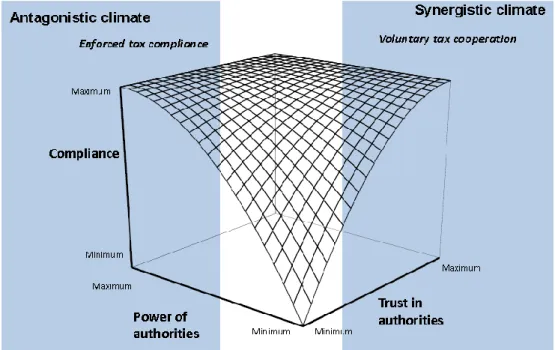
Figure 1. The Slippery Slope Model according to Erich Kirchler et al.
The model states that compliance can be achieved either through coercion and the exercise of power, or by building trust. This creates two different ‘compliance climates’, one antagonistic and one synergistic.
There is empirical support for the notion that power contributes to compliance, as well as for the notion that trust contributes to compliance. In that respect the model is accurate. What has been less clear is how power and trust function together. Empirical studies
indicate that power destroys trust. But there are also studies which show that compliance is highest when both power and trust are present to a considerable extent.
In other words, power can both reduce and increase trust in tax authorities. Kirchler’s new thinking deals with explaining this. His solution is to differentiate between types of power – in this case between coercive power and legitimate power. Kirchler also differentiates between rational trust and implicit trust. This complicates the model, but increases its explanatory power considerably.
Coercive power is about pressure based on sanctions (or rewards). A person who breaks the rules will suffer monetary, physical or psychological costs. Compliance is created by means of threats and deterrence.
Legitimate power is based on identifying with the wielder of power. Compliance is created when the wielder of power is seen as a legitimate, informed expert doing the right thing. Rational trust is about the citizen basing his/her trust on actual circumstances and conscious assessments. Trust arises when there are good reasons to take the authority at its word. Implicit trust is about an unconscious reaction. Trust arises in situations where all participants, both individual people and authorities, have the same social identity. Social norms imply that everyone within one and the same group that you can identify with can also be trusted.
Coercive power destroys trust, both the rational and the implicit kind. Legitimate power, by contrast, creates rational trust. There are three explanations for this: 1) legitimate power creates fairness by making it difficult for others to cheat, 2) legitimate power contributes to making procedures fair, and 3) legitimate power can show that many people are doing the right thing.
Legitimate power leads to rational trust. Conversely, a high level of trust leads to power being perceived as legitimate. They mutually reinforce each other, and both strengthen the will to do the right thing. Therefore this ought to be effective.
Coercive power, then, cannot be combined with trust. But legitimate power can create rational trust, and implicit trust is created completely without power. Kirchler describes these different states as three different compliance climates (instead of the two we had before): antagonistic, service-based and trust-based.
Antagonistic climate
Here coercive power dominates. Compliance is created by means of extensive enforcement and harsh sanctions. This leads to a vicious cycle in which mistrust grows, and this leads to
reduced compliance which in turn requires increased power, and so on. The attitude is that the tax administration and the taxpayers are opponents working against each other.
Service-based climate
‘Service’ has here a broad meaning. It involves legitimate power and rational trust in everything the authority does, including enforcement. Taxpayers expect a fair and supportive authority characterised by professional goodwill. Fairness in this context also refers to the authority ensuring that others do the right thing. Taxpayers who find the authority helpful and competent in all respects become trustful of it and want to do the right thing.
Trust-based climate
Implicit trust dominates. This means that taxpayers and authorities trust each other. The tax administration operates on the assumption that it is there to look after the taxpayers’ interests. Taxpayers act like responsible citizens, and make conscious choices to comply. Kirchler admits that a system entirely without enforcement and power is utopian, but maintains that a system with rational trust can develop towards increasing levels of implicit trust.
It is unrealistic to imagine a tax system entirely without enforcement. A reasonable conclusion to draw from the model, however, is that enforcement should primarily be seen as a tool for ensuring that ‘everyone else’ does the right thing – and less as a tool for intimidating people into obeying. The aim is to operate in a way that is perceived as fair and conducive to trust, and to build a will to do the right thing by using legitimate power which leads to rational trust. If this also creates implicit trust to some extent, that is of course welcome.
This means that a service-based climate (which can also extend into a trust-based climate) is the preferable one. The following correlations from Kirchler’s experiment show that this can lead to greater trust and higher levels of compliance.
Service, then, does not only suggest support given to taxpayers, but a climate based on legitimate power and rational trust. Enforcement is a part of this. The figure shows that this climate has a strong correlation with trust and a weaker, but still positive, correlation with compliance. The connection with compliance occurs both directly (the climate increases the will to do the right thing) and indirectly (the climate creates trust which in turn increases the will to do the right thing). Broadly speaking, there is no difference here between private individuals and businesses.
3
A possible explanatory model
3.1 Motives matter
To some extent, the three theories described above say the same thing. They say that enforcement can strengthen the will to do the right thing, and that coercion and threats cannot be combined with a will to do the right thing. Thus enforcement can be used either to strengthen the will to do the right thing or to threaten and coerce – but not both at the same time.
This is a critical conclusion, and one that implies a strategic choice. Every tax authority must choose whether they are interested in increasing the will to do the right thing or whether they are only interested in the actual behaviour, irrespective of what people want. In other words, the question has to be asked if people’s motives for doing the right thing are interesting, or if it is only the behaviour which is interesting.
The way enforcement works can be described by means of two extremes: enforcement can either force people to do the right thing or increase the will to do the right thing. Since both methods work for influencing behaviour, the question has to do with which method you judge to be best on the basis of e g cost effectiveness and/or ethical considerations.
Figure 3. Summarising image of the three theories.
It is likely that changes occur continuously in the above model, due to shifts of a minor or major nature. Legitimate enforcement contributes to increased trust, but occasionally enforcement will be perceived as non-legitimate, which reduces trust and thus alters the effects of enforcement.
Enforcement can thus produce different effects. These differences between the outcomes don’t necessarily depend on the extent of enforcement or the severity of sanctions (even if this can play a role) – instead it has to do more with how enforcement is carried out and how it is perceived. The question, then, is not about choosing between enforcement and no enforcement, but only about how enforcement is carried out, and its purpose. The Swedish Tax Agency has already made its choice, as described in its vision ‘A society where everyone is willing to do their fair share’. Increasing the will to do the right thing is the central ambition.
Given the above, the effects of enforcement will be completely different depending on who is subject to enforcement (different personal norms), the context (different social norms), how enforcement is carried out (the degree of procedural justice) and how enforcement is communicated (knowledge about enforcement and the extent of evasion). Taken together, these factors influence how enforcement is perceived. These factors are numerous and complex, and they influence each other as well. It isn’t possible, therefore, to say that enforcement will always produce a given effect X – instead the correct answer is that enforcement can produce a variety of different effects, often depending on many different factors that cannot always be known or influenced in the short term. Studies of the effects of enforcement can thus be expected to produce different results, which indeed they do.
There is also a time factor to consider. Direct deterrence can have an immediate effect on behaviour, which can be observed and linked to a specific measure. It can take time before norm reinforcing measures produce results in the form of changed behaviour (which requires that social norms are influenced and then become internalised as personal norms). In the latter case it isn’t possible to prove that a specific norm reinforcing measure has had a specific effect on the behaviour of a defined group. What is possible to prove, however, is that norm reinforcement generally influences behaviour generally, albeit with a certain time lag.
An additional complicating factor in the interpretation of studies of the effects of enforcement is that different strategies for how you choose to use enforcement tend to be self-fulfilling. If you use enforcement to coerce and threaten, people will react to threats and coercion and not want to do the right thing (but may do anyway), which can be used to justify the chosen strategy. Conversely, a strategy that aims to increase people’s will to do the right thing will lead to threats and coercion not working. In somewhat simplified terms you could say that if you treat people as greedy and scheming crooks, they will (to a greater extent) behave that way. If, instead, you try to create a more collaborative climate based on fairness and trust, people will (to a greater extent) behave accordingly.9
This is about the purpose of enforcement and about how enforcement is used. Enforcement should not, according to the Swedish Tax Agency’s choice, be used for purposes of deterrence, although the very existence of enforcement will probably make some taxpayers feel deterred all the same. This in turn is about the effect and experience of enforcement for the individual, and need not be a problem – on the contrary, it can have a positive effect. The point here is that the tax authority should not make threats or use enforcement for the purpose of deterrence. This does not necessarily affect the extent of enforcement, but it does affect how enforcement is carried out and communicated, and thereby its long term effect on taxpayers as a group. But different taxpayers will nevertheless have different experiences. There is a difference between deterring (not good) and being deterred (can be OK).
3.2 Does this also apply to serious tax evasion and business
taxpayers?
Can the norm reinforcing effect of enforcement be expected to work for serious tax evasion and professional criminals as well? Are there situations in which deterrence is the only solution? As described above, a tax authority has to choose whether it wants to strengthen the will to do the right thing, or to deter. As soon as you choose deterrence, the will to do the right thing will be reduced. It isn’t possible to increase and decrease the will to do the
9 Kirchler & Hoelzl, 2006, ‘Modelling taxpayers behavior as a function of interaction between tax authorities and taxpayers in Managing
right thing at the same time. This is thus a strategic choice – you have to choose one or the other. A possible objection to this would be that criminals who don’t want to do the right thing anyway will never be made to want to do the right thing, regardless of how the enforcement is carried out. This may be perfectly true, but still doesn’t justify the tax authority applying threats and deterrence for certain groups. A discussion of an example may serve to explain this.
If the purpose of enforcement is to strengthen social norms, it should be directed at tax evasion that the majority of taxpayers find objectionable – often serious tax evasion and criminality. As a taxpayer, you want to know that tax evasion doesn’t pay and that most people do the right thing. The purpose of enforcement, then, is to persuade the majority that this is precisely the case. The primary purpose of enforcement is not to try to change the behaviour of the criminals subject to enforcement, even if this may also be a desirable side effect of the norm reinforcing effect. If enforcement succeeds in influencing social norms, this will have an effect on criminality as well, but mainly by means of a long term process. When social norms for honest behaviour are strengthened, the social and moral costs of becoming a criminal increase, which reduces the recruitment of new criminals. On this view, then, enforcement is primarily about influencing those norms in society that influence people’s behaviour. It’s about an indirect effect on behaviour.
The deterrent effect, on the other hand, can be seen as a direct effect of enforcement. If the purpose of enforcement is to have a deterrent effect, it should be presented in as threatening a way as possible. It is probably the case that professional criminals as a group are the least easily intimidated, while more ordinary taxpayers are more easily intimidated into obedience. In other words, deterrence is probably not very effective against serious criminality. Deterrence will also influence the will to do the right thing not just among those who are subject to the direct threats, but among others too. This means that even if a tax authority only threatens certain specific groups of criminals, other taxpayers will also note these threats and perceive that this is how the tax authority operates: ‘do the right thing, or else...’. This risks intimidating people into obeying, which may produce desirable effects on behaviour – but the will to do the right thing will not increase.
Thus norm reinforcement has the advantage of eventually influencing the entire group of taxpayers; and the stronger the social norms, the greater the effect of enforcement as its legitimacy increases. Deterrence, for its part, has the disadvantages that it works least well for those most involved with evasion, and that it will eventually reduce the will to do the right thing among all taxpayers, which may lead to a need for constantly escalating levels of enforcement.
Working with norm reinforcement also means that the Swedish Tax Agency needs to draw attention to behaviours that the majority of taxpayers find objectionable despite their being
completely legal. This includes certain forms of tax planning or tax avoidance. In these cases it is not always a question of enforcement (since the actions can be legal), but may involve other measures, e g pointing the effects out to legislators, or influencing taxpayers’ behaviour in other ways. Businesses are not insensitive to social norms either – they are run by people, and personal as well as social norms influence how these people act within the business. Businesses additionally have commercial reasons to consider their reputation.
3.3 Comparison with the classical theory in compliance research
Research into ‘tax compliance’, or how you get people to pay tax, is often regarded as having begun with the publication of an article written by Michael Allingham and Agnar Sandmo in 197210. Their basis is also classical economic theory, primarily inspired by the economist Gary Becker. The idea is that people evade tax if this is more profitable than paying it. The decision about whether to evade tax or not becomes an economic calculation carried out by rational individuals. It follows from this that tax evasion decreases if the risk of detection increases or if punishments become more severe.
Given the low risk of detection in most countries and the absence of draconian punishments, taxpayers should, in accordance with this theory, evade tax more than they actually do. This has led various researchers to develop the theory further by adding other costs, such as feelings of guilt and shame, and the risk of social stigma.
It is reasonable to assume that tax evasion will decrease if the cost of evading tax increases. Incentives matter. With a strategy of this kind, the interest of the tax authority will be in maximising the cost of tax evasion. It will then make sense to highlight the risk of detection and the punishments that exist, including the risk of social stigma. That is one reason why countries that have chosen this strategy are inclined to introduce ‘naming and shaming’, i e publishing the names of tax criminals. This is about deterrence and threats. In English-speaking contexts, the term ‘deterrence’ is often used. This thinking has had such a large impact that many people see enforcement or audits as synonymous with deterrence.
Incentives in the form of deterrence can work, at least up to a certain level. There are studies which show that increasing punishment leads to increased compliance, but when the punishments become too severe, the opposite effect occurs.11 If punishments are perceived as unfair and unreasonable, there is a risk of provoking people into increased tax evasion. The idea that people choose a higher cost in order to uphold a principle is not in line with classical economic theory. As will be described below, research in behavioural economics indicates that we humans often act in ways that are contrary to classical economic theory.
10 Journal of Public Economics, 1 (1972) 323–338)
11 Paul Webley, 2002, Tax Compliance. Chapter from Economic Crime presented at Linköping International Conference on Economic
But this report does not argue that deterrence and negative incentives don’t work. Its argument is instead that a strategy based on norm reinforcement and on increasing the will to do the right thing is more cost effective (besides being more pleasant). Enforcement and sanctions thus remain decisive elements, but are used to a different end. The crucial point is that we have to choose what end we want to achieve. Deterrence reduces the will to do the right thing, while norm reinforcement increases the will to do the right thing. We cannot choose both.
3.4 Comparison with the Swedish Tax Agency’s development
The Swedish Tax Agency’s results have developed in a positive direction after 2006, as the following diagram shows.
Figure 4. Per cent share of respondents agreeing with the statements. Results from the Swedish Tax Agency’s questionnaire surveys. Figures shown are from the Citizen Survey of 2012, Swedish Tax Agency Report 2012:1.
In its annual report for 2013, the Swedish Tax Agency noted that ‘... the tax gap, as a percentage of the gross national product (GNP), narrowed between 2007 and 2012.’ The annual report for 2014 also emphasises that the tax gap has narrowed. Most indicators for desirable effects are thus moving in the right direction.
There are likely to be several reasons for them, but these positive developments coincide with the Swedish Tax Agency’s decision to adopt a completely new strategy. This new strategy put the focus on norm reinforcement and the importance of building trust. Even if the vision (A society where everyone is willing to do their fair share) has existed since 1998, it wasn’t until 2006 that a strategy was formulated for how the vision might be realised.
The new strategy can be seen as a complete shift in outlook and in the view of the purpose of enforcement. The enforcement policy drawn up in 1998 contains the following formulation about what is meant by preventive effect.
‘... the taxpayer’s assessment, before a contemplated tax evasion, of the risk of detection and the consequences of such detection, which makes the taxpayer desist from the contemplated action.’ 12
This shows that the purpose of enforcement then was deterrence in the traditional sense. The Swedish Tax Agency has since moved very clearly towards an outlook and a working method that have become less and less about deterrence and more and more about norm reinforcement (a leftward shift in figure 3 above). The realisation has grown that the vision is not compatible with traditional deterrence.
However, it appears as if this 180-degree turn wasn’t given very much attention, and that its significance was underestimated.
It is not possible to prove what significance this radical change of course has had. What is clear, however, is that over a period of several years the Swedish Tax Agency has gradually but increasingly adopted the ideas about norm reinforcement in place of traditional deterrence, and that this has coincided with a positive development of the will to do the right thing.
There are nevertheless reasons to clarify this choice of course further. Choosing norm reinforcement over direct deterrence is an important strategic, ethical and practical choice as it has wide-ranging consequences for how the Swedish Tax Agency reasons and operates.
3.5 Perceived risk of detection as a result, not a cause
As mentioned above, just about all the curves point in the right direction after 2006. The perceived risk of detection is also increasing, as the diagram below indicates. Correlation between the will to do the right thing (described here as the share of respondents who would not conceal their income from taxation) and trust is marked, even if this should be interpreted with caution as only two measuring points are included (2006 and 2012). It is not unusual, however, for studies to show that a reduced inclination to evade tax is correlated with a perceived risk of detection.
Figure 5. Per cent share of respondents agreeing with the statements. Results from the Swedish Tax Agency’s questionnaire surveys. Figures shown are from the Citizen Survey of 2012, Swedish Tax Agency Report 2012:1.
These types of figures are often used as an argument that the perceived risk of detection should increase, and that enforcement has a deterrent effect which works. However, this isn’t consistent with the earlier claim that the deterrent effect of enforcement is reduced when the will to do the right thing increases. How, then, can the will increase at the same time as the perceived risk of detection also increases?
If enforcement has a deterrent effect this leads to a reduced will to do the right thing, and we can also expect that the perceived risk of detection increases – and that the risk of detection is one reason why people don’t evade tax. This scenario is entirely plausible. But since the situation in Sweden 2006 – 2012 was that the will actually increased, this cannot be an explanation that applies here at the moment.
Instead there are two other possible explanations. One is that there is no causal link whatsoever between the will to do the right thing and the perceived risk of detection, but that there is a strong correlation nonetheless. The other possible explanation is that the causal links go the other way, i e that the will to do the right thing in itself leads to a perceived greater risk of detection. The perceived risk of detection is measured by means of surveys, and it is easy to imagine that survey answers tend to be reconstructions after the fact, or a rationalisation of the respondents’ actual behaviour. If you have evaded tax and not got caught, you perceive a low risk of detection; if you haven’t evaded tax you perceive a high risk of detection since you can’t imagine evading tax and would like to see that evading tax didn’t pay.
Anyone asking a criminal about to commit a crime if he thinks he’ll get caught will always get a negative answer, in principle. A person planning to commit a crime isn’t counting on getting caught, because then they wouldn’t commit the crime. This is partly about calculation and partly about rationalising your own behaviour.
The latter explanation is possibly supported by the circumstance that there is no correlation between actual risk of detection and perceived risk of detection. The people who perceive the highest risk of detection are older women13, and they are not the group most subject to enforcement.
It is entirely possible, in other words, for the will to do the right thing to increase at the same time as perceived risk increases, without this implying that the deterrent effect of enforcement has increased. In these cases, the perceived risk of detection is the result of the behaviour, not its cause. If that is so, it means that the perceived risk of detection is an excellent indicator of actual behaviour.
4
The importance of the environment
As described above, the effects of enforcement are greatly influenced by how the individual perceives enforcement and in what context enforcement is carried out. The circumstances and surrounding environment are significant.
4.1 Context and perceptions matter
People do not behave strictly rationally, as classical economic theory has it. People are influenced by situations and by how choices are presented or perceived. Behavioural economics points to several different peculiarities in humans. One of these is loss aversion, which implies that we humans dislike losses more than we like gains. Most of us are prepared to take considerable risks in order to avoid a loss, but are not equally prepared to take considerable risks in order to guarantee a gain.
A good example of this has to do with people who misrepresent deductions under ‘employment income’ on their tax returns. People whose preliminary tax assessment includes excess tax are less inclined to fiddle deductions (they don’t want to take any risks that could threaten their gain, i e the refund). People with tax arrears are therefore more inclined to fiddle deductions (they are prepared to take a risk to avoid the loss).14
Let’s assume that Karl and Per, who are twins, each run their own business. Karl’s business is profitable, and he has never evaded taxes. Suddenly and unforeseeably he loses several of
13 Skatteverkets medborgarundersökning 2012, Rapport 2012:1.
14 Per Engström, Katarina Nordblom, Henry Ohlson and Annika Persson,”Loss evasion and tax aversion”, Uppsala Center for Fiscal
his clients, and his business begins to go very badly. In order to try to rescue his and his family’s livelihood, he begins to evade taxes. Karl has gone from being disinclined to evade taxes to being inclined to do so. His brother Per has long had problems with his business and has also been evading taxes for a long time. Suddenly his business begins to do well, and in order not to risk his profits, he stops evading taxes. Per has gone from being inclined to evade taxes to being disinclined to do so. Have Per’s or Karl’s personalities or morals changed? Probably not – their changed behaviour can be explained by changed circumstances. The environment in which a person acts is very significant for his or her behaviour.
Karl’s and Per’s sister, Stina, also runs her own business. It has always done well, and makes big profits, but Stina has evaded taxes all along, and also tends to evade more taxes when profits increase. Why is that? Is she not affected by loss aversion? In fact she is affected by loss aversion, but her calculation is different. What constitutes a loss is determined on the basis of a reference point. If you are expecting a profit of 100, but it only reaches 50, that can be seen as a loss. The reference point is usually the present situation, but it can also be an expectation. Stina sees the entire profit as a gain, and she sees taxes as a reduction of that gain. This reduction is a loss, and she thus becomes inclined to take risks in order to avoid this loss. This has to do with mental accounting, which is another essential part of behavioural economics.
All people practice mental accounting, which means that you perceive different money in different ways. An unexpected income can be perceived as totally different to an expected income, and is therefore spent in a different way (perhaps on something unnecessary or futile). A person might divide their salary into different parts – net earnings and available balance after housing costs, for example. This can be done by keeping written accounts or by using different bank accounts, or it can be done only in your head.
The point is that if Stina had discounted tax from profits in her mental accounting, she would not perceive the tax as a loss. How you present things to yourself or others becomes significant for behaviour. This also makes it difficult to understand behaviour and to find typical behaviours.
Loss aversion also means that early enforcement probably works better than enforcement which is applied when tax evasion has been going on for a long time. A person who is evading taxes for the first time perceives the reduced tax as a gain, and is not willing to take big risks. Enforcement can then make the person change their mind. If tax evasion has been going on for a long time, the reference point will be evaded taxes, in which case stopping would be perceived as a loss. In that situation, a tax evader is prepared to take considerable risks in order to avoid the loss. Enforcement is then unlikely to change the person’s
behaviour, and could even make their tax evasion more serious in the future (as compensation for the tax that was the result of enforcement).
Enforcement can thus have different effects depending on when it is carried out. But once again there are no guarantees – instead it’s a matter of the likelihood of an individual prevention effect increasing when enforcement occurs early.
The above also points to the difficulties in trying to evaluate the risk profile of individuals. Different individuals may of course have different characteristics and moral values, but contexts and how those contexts are perceived are probably more significant. Even if we know an individual’s characteristics and attitudes, we cannot know how that person is going to perceive a given context. To try to make assessments of individual taxpayers seems rather meaningless – a better idea would be to make probability assessments based on external, actual circumstances.
4.2 How we frame taxes matter
Dan Ariely, a psychologist who has written several books about behavioural economics, points out that people behave very differently depending on how a situation is perceived or presented – what is called framing.
Ariely argues that people can make decisions based on social norms or on economic market norms. He illustrates this with the results of a study in which lawyers were asked if they were willing to take on a few cases involving people of small means, at a lower fee ($30 per hour). Most of them said no. The researchers then asked lawyers if they would be willing to take on a few cases involving people of small means free of charge. Now most of them said yes. When money was involved, the lawyers assessed the request on the basis of economic considerations, and then $30 was too low a fee. When money was not involved, they assessed the request on the basis of social considerations, where norms say that it is right to help others.
A decision to do (or not do) something can thus be made by applying two different yardsticks – one of social norms and the other of economic benefit. According to Ariely, it is enough just to mention money for the economic yardstick to be applied. His conclusion is that money is the most expensive way of motivating people to do something. Social norms are both cheaper and more effective.
Ariely does not refer to taxes specifically, but mentions that the social contract that exists between citizens and state could be endangered if it is valued exclusively in monetary terms.15
In other words there may be advantages to seeing taxes as a social transaction (even if taxes undoubtedly have to do with money). Without it having been expressly stated, or even fully realised, this is actually what the Swedish Tax Agency’s strategy is trying to do.
5
Different types of preventive effect
Enforcement can produce both individual prevention (effects on those subject to enforcement) and general prevention (effects on those not subject to enforcement). These effects are different and can be expected to occur in different ways.
5.1 Different effects depending on the type of error
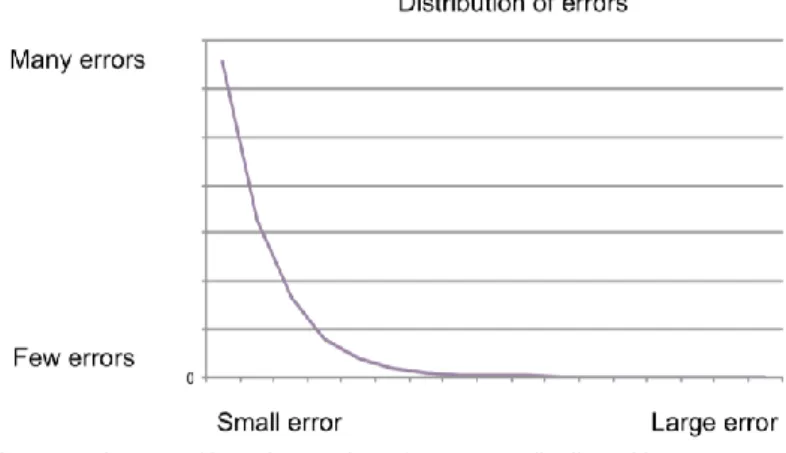
An increased understanding of how the preventive effects work can be gained by looking at a couple of diagrams. The one below shows how errors (both unintentional and intentional) are distributed between small and large errors.16
Figure 6. Diagram of how the number of errors are distributed between small and large errors.
There are, quite simply, many small errors and few large errors. This is entirely natural. A person handling large sums is probably more careful, meaning that fewer unintentional errors occur. There are probably more people who accept small errors. As for intentional tax evasion, it’s also natural that fewer people are prepared to fiddle large sums, partly because they aren’t prepared to take the increased risk and partly because fiddling large sums requires a large income to begin with.
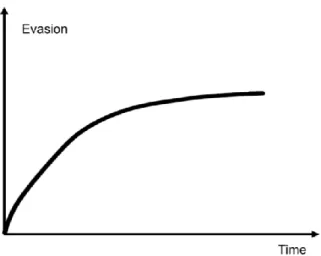
The report ‘Right from the start’17 also noted that the development of tax evasion for a given tax evading individual should look something like this:
16 This was studied e g by the Swedish National Audit Office in 1997, ’Skattekontrollen och pengarna’ (’Tax enforcement and money’),
Report 1997:7.
Figure 7. Development of tax evasion over time for an individual.
A person who begins to evade tax is likely to do so with a relatively small sum (which is seen as a gain, and therefore the person is risk averse). When tax evasion has gone on for some time, this sum will no longer be seen as a gain, since it’s being taken for granted (and not as something extra). This can lead the person to become prepared to take bigger risks and evade more tax, but only up to a certain limit. This limit is entirely individual, and depends on the person’s possibilities for evading tax and their willingness to take risks. In other words it is not the case that every person who starts evading tax ends up a big-time tax fiddler; instead, most people fiddle relatively small sums.
Early tax evasion thus tends to involve small amounts (which is not to say that all small sums fiddled are examples of early tax evasion). As noted earlier, the individual prevention effect may be expected to be bigger when enforcement targets early tax evasion.
It follows that the individual prevention effect is smaller when tax evasion has been going on for a long time. This longer term tax evasion also tends to involve larger sums, though this need not be the case.
It is reasonable to assume that the opposite applies for general prevention effects. They should be greater when enforcement targets serious and big errors. Enforcement should be perceived as more legitimate when it manages to deal with large scale and serious tax evasion instead of only dealing with minor tax evasion. In this context, ‘general prevention effect’ refers to the norm reinforcing effect and not to a generally deterrent effect.
The conclusion is that enforcement works best for early errors (often small and common errors) by means of a big individual prevention effect, and for serious tax evasion (often big and unusual errors) by means of big general prevention effect.
What this implies is that enforcement works badly for everything in between – for errors which are not early and which are not serious tax evasion either. This makes both the
individual prevention effect and the general prevention effect small. In other words there are few gains to be made from targeting minor tax evasion, through enforcement, which has been going on for a long time.
5.2 The general prevention effect is most important
Another conclusion that can be drawn from the reasoning above is that it’s difficult to maximise individual and general prevention effects at the same time. They require different things to be enforced. But the two types of effect are not necessarily mutually exclusive – they can be combined, but the more effort you put into increasing general prevention effects, the less room you leave for individual prevention effects, and vice versa. A functional strategy should choose one type of effect as the principal one and, given that choice, do as well as possible with the other type.
There is much to suggest that the general prevention effect, in the form of norm reinforcement, is the most important one. It affects all taxpayers in some way, and is thus cost effective. The individual prevention effect assumes a one-to-one relation, and is thus more costly. Successful general prevention makes it possible to achieve a high level of compliance with relatively few enforcement actions. The overall effect thus ought to be considerably greater than for individual prevention.
This should not mean, however, that the individual prevention effect should be ignored. When enforcement is carried out in order to achieve general prevention effects, efforts should be made at the same time to try to achieve the best possible individual prevention effect. It is furthermore likely that a smaller part of enforcement will need to be spent on actions aimed primarily at individual prevention effects in order to obtain good overall enforcement that is seen to be legitimate and credible in its entirety.
Still, focusing specifically on general prevention effects will have consequences for how enforcement is prioritised and how effects are evaluated. In other words, what should be regarded as most important are the effects on the whole (the overall ‘system’), while the effects on those actually subject to enforcement should be secondary (but not unimportant). Enforcement is often directed towards a specific type of error, occurrence, or group of taxpayers. This need not be wrong at all, but the interesting question is where the effect is expected to occur.
Studies in the US have shown that taxpayers who were given information via the media fiddled less than if they had received information from the people around them. The reason for this is thought to be that friends and acquaintances only tell you about enforcement when the authorities have failed to identify tax evasion, or when your acquaintance feels
unfairly treated. A person who has been subjected to enforcement and has been found guilty of tax evasion may well be disinclined to tell you about it.18
However, an enforcement action directed at a certain type of occurrence, e.g. unreported earnings, could potentially have some effect for that type of occurrence specifically. Enforcement directed at a specific industry could also have an effect on that particular industry. But that is based on enforcement being communicated (preferably in advance) – and then it is the information as such that has an effect. Of course, enforcement then has to happen in reality. But as long as an enforcement action takes place, it doesn’t matter how the tax authority defines the group subject to enforcement, e.g. as ‘unreported earnings’, ‘cash industries’, ‘taxi’ or anything else. The effect occurs as a result of enforcement and communication being combined.
Communication is what creates the direct effects. But communication is of course reliant on enforcement being carried out. Communication can occur both before and after enforcement has been carried out.
However, communication must not give the impression that tax evasion is widespread, because then tax evasion will increase. There are studies which show that reports about tax evasion generally reduce the will to comply, but if the reporting concerns specific and delimited tax evasion (a certain group or individual), the same negative effect does not occur.19
6
Better understanding by using a system approach
We have noted, then, that the effects of enforcement can vary due to a number of different factors, making it difficult to control and predict these effects. The effects of enforcement cannot be understood in terms of simple and linear causal links – it is not the case that enforcement X always leads to effect Y, and the more X you apply the more Y you get. Such lines of reasoning and assumptions are outright wrong. Instead it is a question of seeing the effects of enforcement as part of a complex system. The causal links are dynamic, i e non-linear and variable over time. Just because X leads to Y today, it need not do so tomorrow.
6.1 Enforcement as part of a complex system
18 Leandra Lederman, 2003, ”The Interplay Between Norms and Enforcement in Tax Compliance”. 19 Ibid.
One researcher who has tried to analyse the issue of the effect of enforcement on taxpayers’ behaviour is Jack Manhire, who previously worked at the American tax authority (IRS).20 21 He advocates a system approach in order to better understand the effects.
Manhire points out that studies of the effects of enforcement normally involve assessing the effect of variations in enforcement frequency and sanctions on individual taxpayers’ motivation and behaviour. As described above, these studies do not provide any unequivocal answers.
This is what may be expected of a complex system. If you apply a system approach, it is not possible to understand the effect on the whole (at the macro level) by studying behaviour at the micro level, regardless of how detailed and extensive the studies are, and regardless of how many factors you include in the assessments.
A traditionally reductionist approach in which you try to understand the whole by analysing the parts doesn’t work. But it is possible to understand the system as a whole. Complex systems can be governed by simple rules and still present an unexpected and unpredictable behaviour.
In order to test these ideas, Manhire builds a mathematical model with simple rules governing taxpayers’ and the tax administration’s behaviour. These rules are based on various research findings about taxpayers’ motivation. The model should not be seen as a description of reality, however, and doesn’t show how taxpayers actually behave. The purpose of the model is to examine whether simple rules for behaviour at the micro level can lead to unexpected or unpredictable effects at the macro level.
The results indicate that behaviour at the macro level is fairly stable, while behaviour at the micro level can be variable. When the share of the total population that is subject to enforcement is set at 0.88 per cent, the degree of compliance becomes 82 per cent, which closely matches actual conditions in the US. When the enforcement frequency is increased or reduced in the model, it has no effect whatsoever on the overall degree of compliance. By contrast, the behaviour of individual taxpayers is influenced by the enforcement frequency, but in different ways (some comply more and others less), and the net effect is low or none at all.
Behaviour at the macro level, however, is influenced by the perceived strength of the tax authority – which is distinct from the perceived risk of detection or enforcement frequency. The actual enforcement frequency may be connected with the perceived strength of the tax
20 J. T. Manhire, “There is no spoon: Reconsidering the tax compliance puzzle”, Treasury Executive Institute - U.S. Department of the
Treasury, 2014.
21 J. T. Manhire, “Do Audits Matter?: A Parallax Theory of the Relation between Tax Enforcement and Underreporting”, Treasury
authority, but need not be. Manhire’s view is that we should perhaps not attach so much importance to the perceived risk of detection when assessing the effects of enforcement on the system as a whole.
It is important to underline that this model doesn’t prove anything about how these things work in reality. What the model does is showing that it is possible that behaviour at the micro level cannot be aggregated to the macro level. Manhire points out that a factor which applies for the population as a whole, e g the perceived strength of the tax authority, can have a greater significance than factors related to individuals’ behaviour. He further points out that since it is a mathematical model, you can choose what label to apply to the factor which applies for the population as a whole (perceived strength of the tax authority). This factor could just as well be called ‘shared social norms’ or ‘shared sense of compliance as a moral duty’, or something else that can apply for the system as a whole. The lesson here is that system factors play a bigger role than individual-related factors.
Even if this is only a theoretical example, it shows that there can be advantages in trying to understand taxpayers’ behaviour and the effect of enforcement as a complex (adaptive) system. This means that it is possible to achieve some understanding of how the system as a whole works, but that it probably isn’t fruitful to try to elucidate detailed connections between a number of different factors.
6.2 Complex adaptive systems are not complicated
Complex adaptive systems have the following characteristics:
They consist of many independent integral units, e g a human community or the living cell.
The interaction leads to spontaneous self-organisation, e g birds adapting to other birds and thus creating a flock.
They are adaptive, trying to turn occurrences in their surroundings into advantages, e g a species that evolves towards a better adaptation to its surroundings or a company that learns from its experiences.
Such complex, self-organising and adaptive systems have a dynamic that distinguishes them from static objects, e g computers, which are merely complicated and not complex. Complex systems are more spontaneous, less ordered and more alive.
In order for a system to be considered a complex adaptive system, it should possess all or some of the following attributes:
The system has many parts and many connections between its parts.