When can bundling help adoption
of network technologies or services?
Steven Weber
Dept. of ECE, Drexel U.
[email protected]
Roch Gu ´erin
Dept. of CSE, WUSTL[email protected]
Jaudelice C. de Oliveira
Dept. of ECE, Drexel U.[email protected]
ABSTRACT
Network technologies (and services) often become more valu-able as more users adopt them,e.g.,Metcalfe’s law. The flip side of this phenomenon is that many potentially valuable network technologies never take off, as their cost exceeds their initial value (when few are using them). This is often blamed for the slow adoption of IPv6 and security extensions to popular protocols such as DNSSEC and BGP-SEC. De-veloping approaches to overcome those early adoption hur-dles is, therefore, of interest. Bundling technologies so as to appeal to a larger set of early adopters is a possible option, but it is hard to predict why and when it may succeed,i.e.,
help both technologies. Our goal is to develop principled insight and answers to this question, and in particular how it is affected by correlation in how users value each tech-nology. The paper outlines a possible modeling approach, and points to potential differences with how correlation has traditionally been found to impact bundling’s efficacy.
Categories and Subject Descriptors
500 [Networks]: Network economics; 300 [Networks]: Pub-lic Internet
Keywords
Internet services, adoption, user valuation, correlation
1.
INTRODUCTION
Many Internet technologies and services have value that increases with the size of their user base,i.e., they exhibit positive externalities or network effects (Metcalfe’s law is often mentioned as one of the first acknowledgments of this effect in modern communication networks [5, p.71]). Exter-nalities are well-known [4] to have dual effects on adoption patterns. Adoption rapidly accelerates after passing a criti-cal threshold (until the market starts saturating), but reach-ing this critical level of adoption is often slow and difficult. In practice, technologies that fail often fail during this early stage, as many potential adopters see a cost that exceeds the (low) initial value of the technology. This is commonly men-tioned as an explanation for the limited or stalled adoption of many Internet security protocols [11], and is also partly responsible for IPv6 slow adoption,e.g.,see [9] for a related discussion.
IAB ITAT2013 Cambridge, UK Copyright is held by author/owner(s).
A common approach (see again [11]) to overcome this ini-tial hurdle is to bundle technologies, in the hope that the bundle has broader appeal and is, therefore, able to over-come early adoption inertia. The main unknown is the ex-tent to which dependencies (as measured by a joint distribu-tion) orcorrelation in how users value the individual tech-nologies influences their adoption decision for the bundle.
We illustrate this next by way of two examples; one in-volving two distinct Internet technologies that offer access to very different functionalities, the other involving a com-mon family of services that are differentiated solely by how individual users value them.
1.1
Anonymous communications and secure
distributed storage
Anonymous communication systems have been available for some time,e.g.,see [7] for a recent survey, but in spite of a recent rise in profile [1], they remain relatively marginal,
i.e., have not yet attracted a large user-base. This can
affect their robustness and their ability to deliver strong anonymity guarantees (mixing traffic from more users and tapping into the resources contributed by those users can improve both anonymity and robustness, at least in P2P based implementations of such systems).
Overcoming the limited appeal (to users) of anonymous communications and increasing the number of users such a system can tap into, can be realized by bundling it with another service. Ideally, this other service should exhibit technical synergies with anonymous communications so as to facilitate a joint implementation. Secure distributed stor-age is a possible candidate. It enables the automatic and encrypted backup of local files over a distributed set of network peers (see BuddyBackup1 for an example), and
shares with anonymous communications a reliance on cryp-tographic primitives and protocols, as well as a value that grows with its number of adopters (more users likely means a more reliable system). The main question is whether com-bining those two services can increase adoption for both. The answer depends on the cost versus value of the bundle. The cost of the bundle consists of the communication (bandwidth), processing, and storage costs of the two ser-vices, with anonymous communications calling mostly for bandwidth and processing resources, and secure distributed storage requiring primarily storage resources and to a lesser extent processing and communication resources. Because the two services have mostly independent needs, those costs should be approximately additive. The value a user assigns
1
to the bundle depends on her level of use of anonymous com-munications and reliance on secure distributed storage as a means of preserving and accessing her personal data. This value will change as more users adopt the bundle (it im-proves the quality and reliability of both services), but the decisions of early adopters depends primarily on how they intrinsically value access to anonymous communication and secure distributed storage.
For illustration purposes, assume that within a given user population the stand-alone values of both services are uni-formly distributed. However, to reflect the fact that secure distributed storage should be attractive to most users while anonymous communications will likely have more limited appeal, we assume that the stand-alone values of the for-mer are in [a,1],0< a < 1,while they span the full [0,1] range for the latter. In other words, most users view secure distributed storage as useful (valued at > a), while fewer assign a similar value (in the range [a,1]) to anonymous communications. Under those assumptions, correlation in user valuations clearly affects the number of early adopters the service bundle will attract. For example, it is relatively easy to show that the cost threshold beyond which there are no early adopters for the bundle is 2 under perfect positive correlation, but onlya+1 under perfect negative correlation.
1.2
Online discussion forums
Consider next the case of an online discussion forum2 ded-icated to a particular topic. Participating in such a forum has some intrinsic value, e.g., from access to promotions and discounts on related products, but its core value often comes from the answers and advice it provides in response to users’ questions. To succeed, a forum must, therefore, accu-mulate a large enough “knowledge-base” and consequently achieve a critical mass of users. This can be challenging, as the added value from Q&A’s is essentially absent in the early stages, and promotions and discounts alone may be in-sufficient to attract enough early adopters. Combining the topics of multiple forums under a common umbrella is one way to address this challenge. The stand-alone value of such a “bundled” forum,e.g.,promotions and discounts that now extend across more products, may appeal to a broader user base, and allow it to succeed where individual forums would not have. The question we seek to answer is again when and why this may be the case?
As with anonymous communications and secure distributed storage, whether a bundled forum attracts more early adopters, and therefore improves its odds of success, depends on its initial cost-benefit ratio relative to that of individual forums. The “cost” of joining a bundled forum,e.g., the amount of time needed to extract useful information, is typically higher than that of more focused, single-topic forums. Its combined stand-alone value arguably depends on many factors, but a reasonable first approximation is again to assume that it is the sum of the stand-alone values of the individual fo-rums it combines. As in the previous example, whether this sum exceeds the cost of joining the forum, which determines the number of early adopters, depends to a large extent on
the joint distribution of user valuations for the individual
forums; an important measure of which is their correlation. For purpose of illustration, consider a scenario where we contemplate merging two discussion forums, whose
stand-2Similar arguments hold for other systems of a like
“crowd-sourcing” nature,e.g.,recommender systems.
alone values (value of product promotions and discounts) follow identical uniform distributions when measured across a population of users. Assume further that for a given user, the values she sees in the two forums are either perfectly positively or perfectly negatively correlated, i.e., equal or diametrically opposite. Under perfect positive correlation, the stand-alone value that any user derives from the bun-dled forum is then simplytwicethe value she sees in either of the individual forums. If we also assume that the cost of joining the bundled forum is also twice that of joining a single-topic forum, i.e., it takes twice as long to find rele-vant information, then it is easy to show that bundling has no impact on early adoption, and the bundled forum sees the same number of potential early adopters as either of the original forums. In contrast, when values are perfectly negatively correlated, all users now see the same (average) value from joining the bundled forum. In this case either no user or all users will be early adopters, depending on whether this average value is above or below the bundle’s cost. Hence, unlike the case of perfect positive correlation, bundling can now have a significant impact on the number of early adopters the bundled forum attracts.
As the above examples hopefully illustrated, correlation in how users value different services and/or technologies (and more generally their joint distribution) can have a significant effect on whether combining them in a bundle is beneficial. Exploring this issue in a systematic fashion is our main goal. In Section 3, we outline an arguably stylized initial model that captures fundamental aspects of the role correlation plays in determining when and why bundling technologies is beneficial or not. Many enhancements and extensions to this basic model are clearly possible, but in spite or maybe because of its simplicity, it helps illustrate how models can help build insight and offer a basis on which to develop a more principled understanding of when bundling network technologies can be beneficial.
Before introducing the basic model we rely on, we briefly review prior works in two areas most relevant to our inves-tigation, namely, product adoption models and characteri-zation of optimal (product) bundling strategies.
2.
RELATED WORK
The topic this paper discusses is at the intersection of two major lines of work; product and technology diffusion, and product and service bundling.
Modeling how products, technologies, and services dif-fuse through a population of potential users,i.e.,are being adopted by users, is a topic of longstanding interest in mar-keting research with [13] offering a recent review of available models and techniques. The models most relevant to our investigation are those based on the approach introduced in [4] and extended in many subsequent works, which ex-plore product diffusion in the presence of externalities using an adoption decision process that reflects the utility of in-dividual users. However, and except for a few recent works that we review below, the aspect of bundling had not been incorporated in those investigations.
There has obviously been a significant literature devoted to bundling as a stand-alone topic (see [16] for a recent review). The main goal of most of those works has typi-cally been the development of optimal bundling and pricing strategies, and pricing is a dimension that is largely absent from our investigation as technology adoption costs are
as-sumed given and exogenous3. Instead, our focus is mostly
on how the joint distribution in technology valuation across users (as measured throuhg their correlation coefficient), de-termines whether the adoption level of a technology bundle can exceed those of separate technology offerings. Correla-tion in how users value different technologies and the im-pact this has on bundling strategies is in itself a topic that several prior works have explicitly taken into account,e.g.,
[15, 10, 2]. In general, negative correlation in demand im-proves bundling’s benefits over separate offerings, although high marginal costs (compared to the average value of the bundle) can negate this effect. Conversely, a high positive correlation tends to yield the opposite outcome,i.e., favor separate (pure component) offerings. As we shall see, when promoting adoption is the goal, the outcome appears to be somewhat different with some level of positive correlation typically needed to produce favorable outcomes (see Sec-tion 4 for details). Furthermore, none of the early works on bundling incorporated externalities, which are likely also contributing to the different effect of correlation.
There are to-date only three works we are aware of [14, 12, 6] that have investigated the problem of bundling tech-nologies or services with externalities, and we briefly review how these papers differ from our focus. First and as has been the norm in the bundling literature, all three papers seek optimal pricing strategies, while we assume exogenous costs (prices), i.e., the cost of adopting a new technology is typically not easily controlled4. Second and more impor-tantly, the impact of value correlation is absent from those three prior works.
Specifically, [14] focuses on optimal pricing while
assum-ing independent valuations for two services. [12] explores
the joint offering of a product and a complementary service, where the latter exhibits positive externalities. As in [14], users’ valuations for the product and its complementary ser-vice are assumed independent, and there is no investigation of the impact of correlation. [6] is cast in the context of a two-sided market (the two market sides create externalities), where the platform provider seeks to decide how to bundle and price new content with the platform it offers, given the existence of an installed based of users that already own the platform and content developers that contribute to its pop-ularity through the content theydevelop. The focus is again on optimal pricing strategies and bundling decisions, and there is no correlation between the value of new content and older content.
3.
MODEL OVERVIEW
In this section, we provide a brief description of the type of models we rely on to explore when and why bundling network technologies may be beneficial when it comes to improving their adoption.
We consider a model for the adoption of multiple (two) technologies (or services) by a heterogeneous population of potential users. The perceived utilityVi(xi(t)) of
technol-ogy i ∈ {1,2} by a (random) user given that a fraction
3e.g., the time needed to deploy a new protocol, install a
new software, or more generally the resources required by a new service.
4
Note that this does not mean that there are no benefits to investigating adoption’s sensitivity to changes in cost. The models we propose can be readily used for such purpose.
xi(t)∈[0,1] of the population has already adopted the
tech-nology at timetincorporates three components:i) the user’s affinity for the technology (capturing users’ heterogeneity in how they value the technology), ii) the network external-ity tied to the adoption level of the technology, andiii) the technology adoption cost. Specifically:
Vi(xi(t)) =Ui+eixi(t)−ci, i∈ {1,2}, (1)
wherei)Ui≥0 is the user’s (random) affinity for technology
i;ii)ei≥0 is the strength of the externality contribution5
for technology i; and iii) ci ≥ 0 is the cost of adopting
technologyi.
Similarly, when the two services are bundled, the util-ityV(x(t)) that a random user perceives from adopting the bundle is of the form
V(x(t)) =V1(x(t)) +V2(x(t)) =U+ex(t)−c. (2) Here, x(t) is the (common) adoption level of the bundled technologies. Note that the assumption of additive values for the two technologies,i.e.,V(x(t)) =V1(x(t)) +V2(x(t)), implies that they are neither substitute nor complement. Under such an assumption, U =U1+U2 is the aggregate intrinsic value of the bundled technologies,e=e1+e2 is the aggregate force of the externality, andcis the aggregate cost, which for simplicity is also assumed to satisfyc=c1+c2. Extending the models to account for instances where the two technologies are partial complements (U ≥U1+U2 and/or
e≥e1+e2) or substitutes (U ≤U1+U2and/ore≤e1+e2), or for possible economies of scope in the cost of the bundle (c≤ c1+c2) is certainly of interest. Such extensions can be incorporated in the models, but at the cost of added complexity.
Users adopt a technology if they derive positive utility from doing so. In the presence of “independent technolo-gies,” i.e., that are neither complements nor substitutes, adoption decisions for the two technologies are decoupled. However, the value an individual user assigns to one tech-nology may be coupled to the value she assigns to the other technology, i.e., the pair of random variables (U1, U2) may be correlated. This will affect whether she adopts the tech-nologies when they are bundled. In particular, the number of users which derive positive utility from adopting the bun-dle depends on the joint distribution of U1 andU2, and in particular theircorrelation.
Our goal in developing models and their solutions is to inform an answer to the general question of“How do
adop-tion equilibria (x∗, x∗) under bundling compare with
adop-tion equilibria (x∗1, x∗2) when network technologies (or
ser-vices) are offered separately, and what parameters affect the outcome?”
An explicit answer for an arbitrary joint distribution ofU1
and U2 is difficult and furthermore relatively opaque, i.e.,
the expressions that can be derived offer little insight into the impact of individual parameters. However, it is possi-ble to investigate simple cases that can be explicitly solved, and which more importantly allow us to directly assess the impact of various parameters and in particular correlation in users’ valuations for the two technologies. We describe
5
The assumption of linear externality affords analytical tractability, and typically does not qualitatively affect the nature of the findings,i.e., they hold for distributions with CDFF(u), which share with the uniform distribution a non-decreasing hazard-rate functionF0(u)/(1−F(u)) [3, 8].
next a very simple configuration (some may even argue sim-plistic), which nevertheless incorporates some of the basic effects we want to capture,i.e., heterogeneity in how users value technologies, and the possibility of correlation in how an individual user values different technologies.
3.1
A basic model
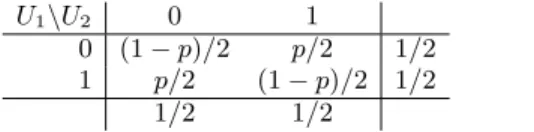
We consider a setting where users either like or don’t like a technology. In other words, a user’s affinities for the two technologies (the values it assigns to the technologies) can be modeled as a pair of Bernoulli random variables (U1, U2)∈ {0,1}2
with joint distribution parameterized byp∈[0,1] as follows: U1\U2 0 1 0 (1−p)/2 p/2 1/2 1 p/2 (1−p)/2 1/2 1/2 1/2 (3)
The user population then consists of four types: negative affinities for both technologies (0,0), positive affinities for both technologies (1,1), and mixed technology affinities (0,1) and (1,0). Note that exactly half of the population has a positive affinity for each technology, regardless of p. Fur-thermore, the correlationρin a user’s affinities for the two technologies, (U1, U2), can be expressed as a simple function ofp: ρ= E[pU1U2]−E[U1]E[U2] Var(U1)Var(U2) = 1−p 2 − 1 2× 1 2 q 1 4× 1 4 = 1−2p, (4)
which ranges fromρ=−1 forp= 1 (all users have mixed affinities) up to ρ = +1 for p= 0 (all affinities are either both positive or both negative).
It is possible under this simple model to characterize adop-tion equilibria, both when technologies are offered separately and when they are offered as a bundle. Possible adoption equilibria are 0,1/2, and 1 under separate offerings, and 0,1+ρ
4 ,
3−ρ
4 ,and 1 for a bundled offering. Fig. 1 illustrate
the different regions of the (ci, ei) and (c, e) planes (for
sepa-rate and bundled offerings, respectively) in which each equi-librium is realized, assuming that when the two technologies or the bundle are first offered, there are no adopters, i.e., xi(0) = 0, i∈ {1,2}andx(0) = 0. li 0 ri 1 1 2 li 0 1 ri1 2 li 0 1 1 ri 2 liri 0 1 1 2 li ri 0 1 1 2 li ri 0 1 1 2 liri 0 1 1 2 li ri 0 1 1 2 1 2 0 1 1 2 0 1 1 2 0 1 1 2 0 1 1 2 0 1 1 2 0 1 1 2 0 1 1 2 0 xi xi xi xi xi xi xi xi xi xi xi xi xi xi xi xi hi(xi) hi(xi) hi(xi) hi(xi) hi(xi) hi(xi) hi(xi) hi(xi) (a) (b) (c) (d) (e) (f) (g) (h) 1 ci ei 0 0 1 1 2 2 ci ei 0 0 1 1 2 2 1 0 ci ei 0 0 1 1 2 2 ci ei 0 0 1 1 2 2 1 0 1 2 1 2 ci =2 ci =2 ei= 2ci ei= 2ci ei= 2ci ei= 2(c i 1)
(a) Separate Equlibria
e= c c =2 0 1 2 3 4 5 0 1 2 3 4 5 ⇢= 0 c e e= 4c 3 ⇢ e= 4(c 1) 3 ⇢ e= 4(c 1) 1+ ⇢ e= 4(c 2) 1+ ⇢ c =2 0 1 2 0 1 2 c e 0 1 3 4 3 4 5 5 0 1 2 3 4 5 0 1 2 3 4 5 c e 0 1 2 3 4 5 0 1 2 3 4 5 c e e= 4(c 1) 1+ ⇢ 0 1 2 0 1 2 c e 3 4 3 4 5 5 c =2 0 1 2 3 4 5 0 1 2 3 4 5 c e 0 e= 4c 3 ⇢ e= 4(c 1) 3 ⇢ 1 e= c e= 4(c 2) 1+ ⇢ ⇢= 0 ⇢= 0 l m r 1 0 1/e 1/e x h(x) 1/2 3 ⇢ 4 1 +⇢ 4 1 +⇢ 4 1 +⇢ 4 1 ⇢ 2 1 +⇢ 4 3 ⇢ 4 3 ⇢ 4 1 +⇢ 4 e= 4c 3 ⇢ e= 4(c 1) 1+ ⇢ ⇢= 0 (b) Bundled Equilibria
Figure 1: Regions of realized adoption equilibria as a function of adoption cost and externality strength.
By comparing Fig. 1(a) and Fig. 1(b), it is possible to determine when bundling is beneficial or not,e.g., when it results in win-win (WW) or lose-lose (LL) outcomes, where
both technologies realize a higher, respectively lower, level of adoption than when offered alone. For a given ρ value, this essentially amounts to overlaying Fig. 1(a) and Fig. 1(b) to identify how the bundled and separate equilibria regions overlap. In particular, we readily see that the boundaries of the different equilibria regions in the (c, e) plane of Fig. 1(b) depend on the value ofρ. Hence, we can expectρto influence when WW (and LL) outcomes arise. In the next section, we review some initial insight that emerges from comparing regions in Fig. 1(a) and Fig. 1(b).
4.
INITIAL RESULTS AND INSIGHT
The traditional “wisdom” in developing bundling strate-gies, e.g., see [16], is that bundling is typically most effec-tive in the presence ofnegative correlationin user valuations (reservation prices). The intuition is that bundling reduces heterogeneity in users’ valuations, which facilitates the se-lection of a “price” for a bundled offering that results in an overall higher profit (see [16, Section 2.3]).
This is easily illustrated with a simple two products,X
and Y, and two customers, A and B, example. Assume thatAis willing to payp1 andp2 < p1 for productsX and
Y, respectively, while B’s willingness to pay for X and Y
isp2, p1, respectively. In other words,AandB’s valuations for the two products are perfectly negatively correlated. For the sake of illustration, assume p1 = 5 and p2 = 3. It is then easy to see that the optimal prices p∗1 and p
∗
2 when
the two products are offered separately are both equal to 3 for a total profit (assuming zero marginal costs) of 12. In contrast the bundle’s optimal price isp∗= 8 for a total profit of 16>12. In contrast, if the two users’ willingness to pay had been perfectly positively correlated, then bundling yields no benefit over separate offerings6.
There are obviously differences between the profit maxi-mization goal of traditional bundling strategies, and our goal of maximizing adoption given a fixed adoption cost (this cost will typically be different from the price that would op-timize profit). The other important difference between our formulation and that of traditional bundling strategies is the presence of externalities. Hence, we can expect both factors to contribute to possible differences in outcomes, with the latter (presence of externalities) likely to have a stronger influence.
In particular, it is relatively easy to see from Eqs. (1) and (2) that in the absence of externalities, assessing whether bundling benefits adoption is straightforward. Specifically, adoption levels when technologies are offered separately are equal to 1−F1(c1) and 1−F2(c2), whereFi(x) represents
the CDF of users’ valuation for technologyi. Conversely, the adoption level of the bundle is given by 1−F(c1+c2), where
F(x) is the CDF of the random variableU =U1+U2 that captures the cumulative valuation of the two technologies to a (random) user). Hence, in the absence of externalities, whether bundling is beneficial or not is solely a function of how the bundle’s cost compares to the cost of individual technologies.
On the other hand, more complex and interesting behav-iors emerge when externalities are present. In particular, our initial results indicate that bundling is effective in
im-6
In general it is possible for bundling to lower profit by preventing users who may have bought individual products from purchasing the bundle.
-1.0 -0.5 0.0 0.5 1.0Ρ 0.2 0.4 0.6 0.8 1.0x * -1.0 -0.5 0.0 0.5 1.0Ρ 0.2 0.4 0.6 0.8 1.0x * -1.0 -0.5 0.0 0.5 1.0Ρ 0.2 0.4 0.6 0.8 1.0x * -1.0 -0.5 0.0 0.5 1.0Ρ 0.2 0.4 0.6 0.8 1.0x * -1.0 -0.5 0.0 0.5 1.0Ρ 0.2 0.4 0.6 0.8 1.0x *
Figure 2: Impact of value correlation(ρ) on bundle adoption(x∗) for different technology combinations. Technology1: c1 = 1/3, e1= 1/3so that x∗1= 1/2.
Technology2: c2 = 4/3and (left to right) e2= 1,3/2,2,5/2,3, so thatx∗2 = 0.
proving network technology adoption, and in particular cre-ate win-win outcomes, when the technologies being bundled havepositively correlatedvaluations, although too strong a correlation will often mitigate this benefit.
The model reveals that win-win outcomes, i.e.,the bun-dled technologies realize a higher level of adoption than if offered alone, often arise when one technology has a high adoption cost compared to its intrinsic value together with a high externality factor, while the other technology enjoys middling costs, values, and externality factor.
In such cases, the first technology could be tremendously successful, if only it managed to acquire enough of a user base to unleash the substantial value its strong external-ity factor can deliver. Unfortunately, its high adoption cost and relatively low intrinsic value make this nearly impossi-ble. Hence, when offered alone, this technology never takes off. In contrast, the relatively low adoption cost of the other technology enables it to make rapid initial progress even when offered alone. Its initial adoption spurt, how-ever, quickly subsides as its externality contributions do not progress fast enough to keep attracting more users. This translates in neither technology experiencing meaningful suc-cess when offered alone. Bundling can, however, change this. When the two technologies are bundled, the second be-comes the engine that drives initial adoption until enough of a user-base has been built to allow the first technology to cross its critical adoption threshold. At that point, the roles reverse and the first technology becomes the main driver for continued adoption, as its strong externality contribution is now sufficient to attract more users. The bundle’s adoption then takes off, possibly reaching full penetration. In the pro-cess, the second technology also reaches a level of adoption it would never have realized on its own. In summary, external-ities play a major role in creating such a win-win outcome, although as we shall see next, correlation in valuations can have a significant influence on the outcome.
We use Fig. 2 to demonstrate the subtle role that correla-tion across technology valuacorrela-tions can play. Specifically, the figure plots the adoption levels of two bundled technologies; one that alone would only achieve average penetration (be-cause of a combination of low cost,c1 = 1/3,and marginal externality,e1= 1/3,so thatx∗1= 1/2), and the other which
by itself would never take off in spite of its strong potential (its high cost,c2= 4/3,prevents it from reaching the critical mass it needs for its high externality,e2 >3/2,to kick in, and its stand-alone adoption, therefore, remains atx∗2 = 0).
The figure shows the adoption equilibrium of the bundled technologies as a function of their (value) correlation coef-ficient ρ ∈ [−1,1]. The five plots in the figure show the bundled equilibrium as a function ofρ for different values of the externality factore2 of the second technology, which
varies (from left to right) from average (e2 = 1) to very high (e2 = 3). When the externality factor of the second technology is not high enough (e2 = 1) to compensate for its high cost (left-most plot), bundling the two technolo-gies is detrimental, independent of the value ofρ, i.e., the bundled equilibrium is below the adoption level (1/2) of the first technology offered alone. As the externality factor of the second technology increases (e2 ≥3/2 – four right-most plots), the value it can deliver as adoption increases becomes high enough that it can leverage the initial adoption spurt of the first technology, and bundling becomes beneficial to both technology (x∗>1/2).
This cross-over occurs once correlation exceeds a certain threshold. This is because early adopters of the bundle are driven primarily by the first technology, and under highly negative correlation in technology valuations, the second technology contributes added cost but little or no added value to those early adopters. Hence, adoption stops quickly at a level below that of the first technology offered alone. As correlation increases, the number of early adopters that experience a positive utility from adopting the bundle in-creases to a point that it can reach enough of a critical mass to allow the externality effect of the second technology to become effective and increase adoption beyond what tech-nology 1 would have realized if offered alone.
Note though that further increases in correlation do not yield additional improvements. As a matter of fact, increas-ingρbeyond the threshold can lower adoption (second and third plots from the left). This is because as correlation in-creases, the potential adoption “base” of the bundle narrows (both technologies appeal to an increasingly similar set of users). This effect persists until the externality factor of the second technology is strong enough to allow the bundle to reach full adoption (fourth plot from the left fore2 = 5/2). Once the externality factor of the second technology ex-ceeds that level, its strength is now sufficient to preserve full adoption as long asρremains within some range (see again fourth plot from the left). Further increasingρbeyond that range results in the adoption level of the bundle dropping again, unless the externality factor of the second technology is so strong that the range ofρvalues for which no decline in bundle’s adoption occurs extends all the way to ρ = 1. This is illustrated in the right-most plot of Fig. 2 fore2 = 3. The following bundlingguideline emerges from the above discussion.
Bundling guidelines: When selecting technology bundles to foster adoption, it is best to choose technologies that
1. Are heterogeneous in their cost-benefit structure,i.e.,
low cost & externality vs. high cost & externality; 2. Are sufficiently correlated in how users value them, but
The second guideline basically states that once the goal of creating a sufficient critical mass of early adopters has been reached (which requires a certain minimum level of correla-tion in how users value the bundled technologies), there is no benefit in selecting technologies that exhibit higher levels of correlation (and there could be disadvantages).
5.
CONCLUSION
The paper presents an initial investigation aimed at de-veloping a better understanding of when bundling network-ing technologies or services can be beneficial,i.e., result in higher adoption levels than when they are offered separately. The question is of relevance in many practical settings as networking technologies commonly face early adoption hurdles until they acquire a large enough user-base to start delivering sufficient value. Bundling technologies can offer an effective solution to overcome those early adoption chal-lenges, but it is often hard to predict whether it will succeed or not. Of particular importance in determining the out-come is correlation in how users value the individual tech-nologies being bundled. The paper proposes simple models that can help explore this question in a principled manner, and illustrates the type of insight they provide through a few simple examples.
There are obviously many extensions that are desirable to the basic models described in the paper and in their abil-ity to realistically capture how technologies interact, e.g.,
the extent to which they are complements or substitutes, or whether they exhibit economies of scope. The methodology outlined in the paper, however, offers a first step towards developing a fundamental understanding of the role that bundling can play in helping network technologies overcome initial adoption hurdles.
6.
REFERENCES
[1] C. Arthur. NSA scandal: what data is being monitored and how does it work? The Guardian, 2013. Available at
http://www.guardian.co.uk/world/2013/jun/07/nsa-prism-records-surveillance-questions.
[2] Y. Bakos and E. Brynjolfsson. Bundling information goods: Pricing, profits, and efficiency.Management
Science, 45(12), December 1999.
[3] H. K. Bhargava and V. Choudhary. Economics of an information intermediary with aggregation benefits.
Information Systems Research, 15(1):22–36, 2004.
[4] L. Cabral. On the adoption of innovation with network externalities.Mathematical Social Sciences, 19:299–308, 1990.
[5] M. Castells.The rise of the network society, volume I. Wiley-Blackwell, 2nd edition, 2010.
[6] Y. Chao and T. Derdenger. Mixed bundling in two-sided markets in the presence of installed base effects.Management Science, 57(3), March 2013. [7] L. Fern´andez Franco. A survey and comparison of
anonymous communication systems: Anonymity and security. Universitat Oberta de Catalunya
-Institutional Repository, June 2012. Available at http://hdl.handle.net/10609/14740.
[8] D. Fudenberg and J. Tirole.Game Theory. MIT Press., Cambridge, MA, 1991.
[9] R. Gu´erin and K. Hosanagar. Fostering IPv6
migration through network quality differentials.ACM
SIGCOMM Computer Communication Review,
40(3):18–25, July 2010.
[10] R. McAfee, J. McMillan, and M. Whinston. Multiproduct monopoly, commodity bundling, and correlation of values.The Quarterly Journal of
Economics, 104(2), May 1989.
[11] A. Ozment and S. Schechter. Bootstrapping the adoption of Internet security protocols. InProc. WEIS, 2006.
[12] M.-S. Pang and H. Etzion. Analyzing pricing strategies for online services with network effects.
Information Systems Research, 23(4), December 2012.
[13] R. Peres, E. Muller, and V. Mahajan. Innovation diffusion and new product growth models: A critical review and research directions.International Journal
of Research in Marketing, 27, 2010.
[14] A. Prasad, R. Venkatesh, and V. Mahajan. Optimal bundling of technological products with network externality.Management Science, 56(12), December 2010.
[15] R. Schmalensee. Gaussian demand and commodity bundling.Journal of Business, 57(1), 1984.
[16] R. Venkatesh and V. Mahajan. The design and pricing of product bundles: A review of normative guidelines and practical approaches. In V. Rao, editor, Handbook
of Pricing Research in Marketing, pages 232–257.