The Real Value of Joining a
Local Chamber of Commerce
Study Overview
Advocates of chambers of commerce have long believed that when a company is active in its local chamber, it is doing the right thing not only for the community but for its own success as well. While there is plenty of evidence to show the impact of chambers of commerce on their communities, it is much harder to find data that quantify the impact of belonging to a chamber. This study, commissioned by the American Chamber of Commerce Executives with support from Small Business Network, Inc., is designed to do just that: determine the real value to companies in terms of consumer outcomes of joining and being active in their local chamber of commerce. Do consumers really support businesses because they are chamber members?
Data for the study come from a scientific web-based survey of 2,000 adults nationwide1. What makes the
study unlike most, however, is that almost every question on it is part of one of several imbedded experiments. This means that respondents were randomly assigned to different groups at several points during the survey. Each group reads something slightly
different—like a description of a company that changes only a little for each group—but then everyone is asked the same questions thereafter, regardless of which company description they just read. Therefore, when there are statistically significant differences in how different groups answered the same
questions, we know exactly why it happened.
This approach yields powerful results because it bypasses the subjectivity of most opinion polls. A sampling of some of these results proves this to be the case.
• Most consumers (59%) think that being active in the local chamber of commerce is an effective business strategy overall. It is 29% more effective, however, for communicating to consumers that a company uses good business practices and 26% more effective for communicating that a business is reputable.
• If a company shows that it is highly involved in its local chamber (e.g., sits on the chamber board), consumers are 12% more likely to think that its products stack up better against its competition.
• When a consumer thinks that a company’s products stack up better against the competition because the company is highly involved in its local chamber of commerce, it is because he or she infers that the company is trustworthy, involved in the community, and is an industry leader.
• When consumers know that a restaurant franchise is a member of the chamber of commerce, they are 40% more likely to eat at the franchise in the next few months.
• When consumers know that an insurance company is a member of the chamber of commerce, they
are 43% more likely to consider buying insurance from it.
• When consumers know that a small business is a member of the chamber of commerce, they are 44% more likely to think favorably of it and 63% more likely to purchase goods or services from the company in the future.
1 Unlike for probability samples common in telephone and mail surveys, it is not possible to compute a margin of sampling error for web-based surveys that rely on panels of survey respondents. Nonetheless, the respondents to this web-based survey are demographically and geographically representative of the adult U.S. population.
Contents
Chamber Membership as a Business Strategy... 2
Chamber Impacts and their Causes... 3
Impact on Large Businesses ... 5
Impact on Small Businesses ... 6
About The Schapiro Group and Market Street Services... 8
Chamber Membership as a Business Strategy
The first imbedded experiment in the survey tests how effective an active membership in the local chamber of commerce is for making specific impressions on consumers. Joining the chamber is a good thing to do, but what exactly does an active chamber
membership say about your company? Does it tell consumers that your business is reputable, that it cares about its customers, that it is involved in the community, or that it uses good business practices?
The Results
The results show that being active in the local chamber of commerce is a good strategy for businesses to use in communicating each of the four specific company traits. Statistically, it is an effective way to convey to consumers that a company uses good business practices, is involved in the community, cares about customers, and is reputable—regardless of whatever they may or may not already think about the company.
The percentages in Table 1 show just how effective of a business strategy being active in a local chamber really is. For example, consumers
say that being active in the local chamber is 29% more effective for communicating that a company uses good business practices than it is for making a general statement about the company. The only other business strategy that so consistently communicates specific traits about a company is encouraging employees to volunteer their time.
Table 1: How Effectively Business Strategies Communicate Specific Traits about a Company Specific Company Traits
Uses good
business practices Reputable
Cares about customers
Community involvement Being active in the local
chamber of commerce
29% More
effective 26% More effective 13% More effective 12% More effective
Sponsoring events around the community
Equally
effective 10% More effective 20% More effective 24% More effective Encouraging employees
to volunteer
19% More
effective 14% More effective 13% More effective 15% More effective Giving out scholarships to
local students
Equally
effective effective Equally 28% More effective 36% More effective
Business Strategies
Encouraging employees to donate to a charity
Equally
effective effective Equally effective Equally effective Equally
The Test
To answer this question, we asked survey respondents to rate the effectiveness of five different business strategies, including being active in the local chamber. These business strategies represent the rows of Table 1.
We also divided up respondents into five groups at random. Each group was asked to define “effectiveness” differently. In one group, respondents were asked to rate how effective each business strategy would be for a company to show you that it uses good business practices. Other groups rated the strategies based on how effectively they communicated other company traits, which are represented by columns in Table 1.
The fifth group of respondents was asked to rate each strategy based on how effective it is for a business “to show you about itself.” This group, which was asked about no trait at all, is a baseline group. We compare the results from each of the four “trait” groups (the ones listed in the columns of the table) against the “no trait” group to determine whether any of the tested strategies are more effective, equally effective, or less effective at showing people that a company embodies each of these traits.
Figure 1: What a Local Chamber Membership Shows Consumers
Figure 1 is a snapshot of just how effectively chamber membership conveys to consumers each of the specific company traits, as well as the baseline measure of “showing people about your company.” The effectiveness percentages are collapsed for easy viewing, so the percentages do not match up directly to the statistical values in Table 1.
The graph shows that seven out of ten consumers believe that being actively involved in the chamber is an effective strategy for enhancing a business’ reputation and for demonstrating that it uses good business practices.
Chamber Impacts and their Causes
The next step in quantifying the real value of a local chamber membership is to assess its impact on various consumer outcomes such as how they think about a company’s goods and services. If such impacts exist, how exactly does chamber membership make
the consumer think differently about the company so as to explain the impacts? The Results
The results show that chamber involvement can enhance a company's reputation in a couple of ways:
• If a company shows that it is highly involved in its local chamber (e.g., sits on the chamber board), consumers are 12% more likely to think that its products stack up better against its competition.
• When consumers find out that a company is involved with its local chamber, they are 19% more likely to think favorably of that company. This effect is not dependent on the degree of chamber involvement; it holds true regardless of whether or not the
company is highly involved in the chamber.
59% 63% 64% 69% 70% 0% 25% 50% 75% 100% Show ing people about your com pany
Show ing that you are involved in the
com m unity
Show ing that you care
about custom ers
Show ing that you have a
good reputation
Show ing that you use good
business practices
The Test
This imbedded experiment involved creating a fictional business called the Wallace Products Company. It was important to use a fictional business so that respondents had no preconceptions about the company, its reputation, or its products.
Respondents were divided into several different groups at random, and each read a short description of the company and the products it makes for the home. There were only two ways in which these descriptions differed: some added that the Wallace Products Company was a longtime member of its local chamber of commerce, some added that the company is known for various traits (such as being involved in its local community or being trustworthy), and some included combinations of these. No matter which version of the company description
respondents read, they all answered the same questions afterward about the company, including how favorably they felt toward it and how well they thought its products stacked up against its major competitors. The differences in how the various groups answered these questions can be tied back directly to the different ways in which the fictional company was described to them.
Next we parsed out why involvement in the local chamber leads to these positive effects. In other words, what exactly does chamber membership say about a company that creates these positive impacts?
• When a consumer thinks that a company’s products stack up better against the competition because the company is highly involved in its local chamber of commerce, it is because he or she infers that the company is trustworthy, involved in the community, and is an industry leader.
• When a consumer thinks more favorably of a company because the company is a member of its local chamber of commerce, it is because he or she infers that the company is trustworthy, is involved in the community, cares about its customers, is successful, and is a leader in the business community.
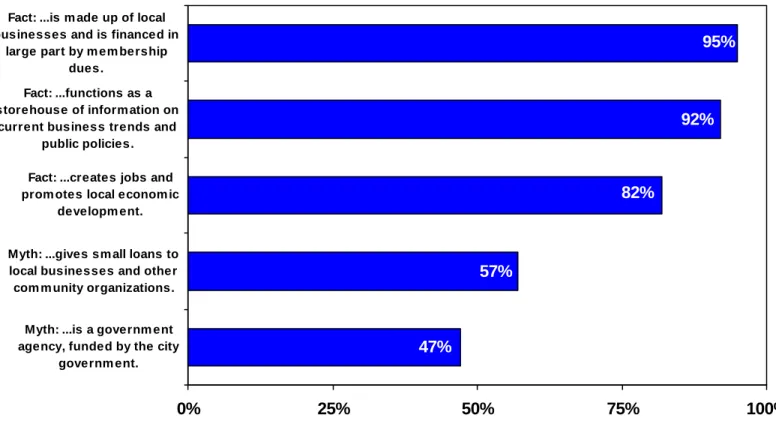
Figure 2 shows that most people know fairly well what local chambers do and do not do, but it is still important to assess the effect that this knowledge could have on the positive chamber membership impacts described above.
• The results show that consumers who believe the chamber is a government entity are less likely to think that chamber membership conveys a company’s trustworthiness, business leadership, and community involvement.
• On the other hand, those who believe the chamber is a storehouse for information on current business trends are more likely to think that chamber membership conveys that a company is successful.
Figure 2: Beliefs in Facts and Myths: The Chamber of Commerce…
95% 92% 82% 57% 47% 0% 25% 50% 75% 100%
Myth: ...is a governm ent agency, funded by the city
governm ent. Myth: ...gives sm all loans to local businesses and other com m unity organizations.
Fact: ...creates jobs and prom otes local econom ic
developm ent. Fact: ...functions as a storehouse of inform ation on
current business trends and public policies. Fact: ...is m ade up of local businesses and is financed in
large part by m em bership dues.
Impact on Large Businesses
The previous section of the report shows that chamber membership can have a big impact on a fictional company, but what about on actual companies? The next imbedded experiment in the study quantifies consumer outcomes for large, national corporations in the automobile manufacturing, insurance, and restaurant industries. Whereas before we used a fictional company in order to eliminate the possibility that a company’s reputation affects the potency of a local chamber membership, here we use differences in existing reputations to understand whether and how those reputations enhance or suppress the positive consumer impacts of joining the local chamber.
The Results
Chamber membership has a marked effect on consumer outcomes for large businesses, and a company’s existing reputation often changes the nature of the impact.
There is an important caveat, however: the positive outcomes only occur when consumers know that a business is a
chamber member (i.e., being involved in the
chamber is a known facet of the company's reputation). When consumers know that a large business is a member of the chamber, they are likely to patronize the company more often, to express favorable opinions about the company, to know more about the company, and to buy the company's products. The strength and nature of these effects differ by industry, as detailed below.
The Impact of Chamber Membership on Large Restaurant Chains
Patronage Frequency
• When consumers know that a restaurant franchise is a member of the chamber of commerce, they are 50% more likely to eat at the franchise more often.
Favorability
• When consumers know that a restaurant franchise is a member of the chamber of commerce, they are 25% more likely to think favorably of the franchise.
Purchase Intent
• When consumers know that a restaurant franchise is a member of the chamber of commerce, they are 40% more likely to eat at the franchise in the next few months.
• Among consumers who already know about a particular restaurant franchise, those who are aware that it is a member of the chamber are 38% more likely to eat at the franchise in the next few months. Among those who are less knowledgeable about the franchise, chamber
membership increases the likelihood by 76%.
The Test
This imbedded experiment involved selecting a handful—usually 3 or 4—real companies that compete against each other for individual consumers at the national level, like Ford, GM, Honda, and Toyota. Survey respondents were divided into four groups, one for each company, and were then asked a series of simple questions like, “how likely are you to buy a car from this company?”
Respondents were divided up one more time, however. Half of the respondents in each of these four groups were first asked, “Did you know that [company name] is a member of its local chamber of commerce?” This creates eight groups in total. Thus, we were able to determine whether “reminding” consumers about a company’s chamber membership has an impact on consumer outcomes. Perhaps more importantly, by analyzing how people who were not given the “reminder” think about these different companies’ reputations, we were able to determine whether and when the chamber membership impact hinges on a company’s existing reputation.
The Impact of Chamber Membership on Insurance Companies
Consumer Knowledge
• When consumers know that an insurance company is a member of the chamber of commerce,
they are 39% more likely to know a lot about the company.
Purchase Intent
• When consumers know that an insurance company is a member of the chamber of commerce,
they are 43% more likely to consider buying insurance from it. The Impact of Chamber Membership on Automobile Manufacturers
Consumer Knowledge
• Among consumers who have favorable opinions of an auto manufacturer, chamber membership
leads to a 10% increase in the likelihood that they report knowing a lot about the company.
• Among consumers who have ever considered buying a car from a particular auto manufacturer, chamber membership leads to a 10% increase in the likelihood that they report knowing a lot about the company.
Favorability
• Among those who have ever considered buying a car from a particular auto manufacturer, chamber membership leads to a 20% increase in consumers’ favorability reports.
Purchase Intent
• When consumers know that an auto manufacturer is a member of the chamber of commerce,
they are 9% more likely to consider purchasing their next car from that company.
Impact on Small Businesses
Small businesses represent the largest segment by number of most local chamber membership rolls, so it is important to quantify the impact that chamber
membership has on them too. This section of the report does just that using a similar analytical technique to the one for large businesses. The Results
The results indicate that the impact of a local chamber membership on small businesses is more consistent and more powerful than for large, national corporations. The caveat here is the same,
however: consumers need to be aware that the
small business is involved with its local
chamber in order for the benefits to emerge.
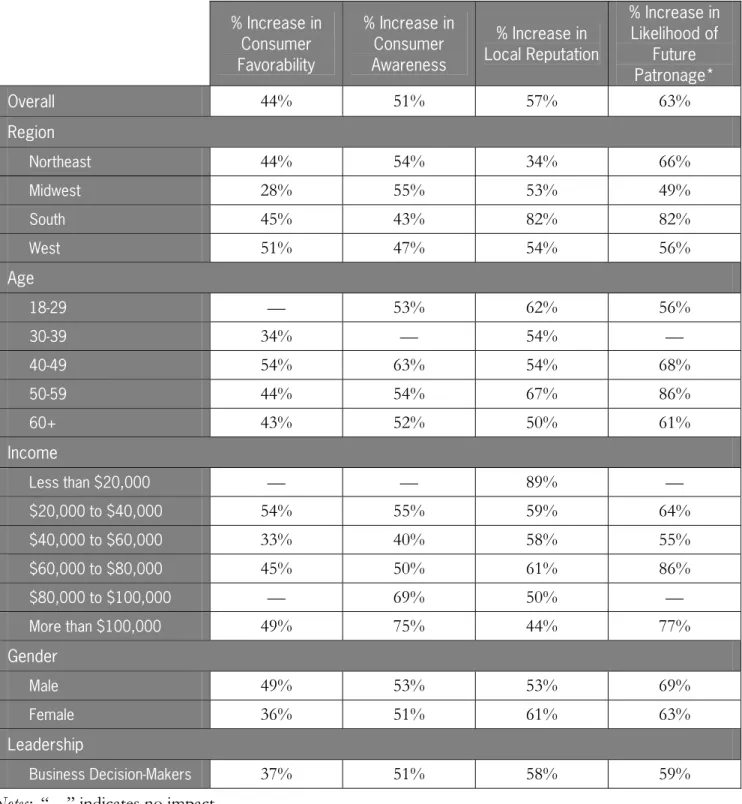
The results are detailed in the table below.
The Test
This imbedded experiment is much the same as the test for large businesses described on page 5. Since small businesses tend not to be nationally known, however, respondents answered questions about small businesses located in their area.
Half of respondents were first asked whether they knew that the small business was a member of its local chamber of commerce. The other half was not given this “reminder.” Thus, we were able to determine whether “reminding” consumers about a small business’ chamber membership has an impact on consumer outcomes, much like we did with large businesses.
For example, the table indicates that if respondents know that a small business is a member of its local chamber, the business enjoys a 44% increase in its consumer favorability rating, a 51% increase in consumer awareness, a 57% increase in its local reputation, and a 63% increase in the likelihood that consumers will patronize the business in the future. The table also shows the impacts among key demographic and geographic subgroups.
Table 2: The Impacts of Chamber Membership on Small Businesses % Increase in Consumer Favorability % Increase in Consumer Awareness % Increase in Local Reputation % Increase in Likelihood of Future Patronage* Overall 44% 51% 57% 63% Region Northeast 44% 54% 34% 66% Midwest 28% 55% 53% 49% South 45% 43% 82% 82% West 51% 47% 54% 56% Age 18-29 — 53% 62% 56% 30-39 34% — 54% — 40-49 54% 63% 54% 68% 50-59 44% 54% 67% 86% 60+ 43% 52% 50% 61% Income Less than $20,000 — — 89% — $20,000 to $40,000 54% 55% 59% 64% $40,000 to $60,000 33% 40% 58% 55% $60,000 to $80,000 45% 50% 61% 86% $80,000 to $100,000 — 69% 50% — More than $100,000 49% 75% 44% 77% Gender Male 49% 53% 53% 69% Female 36% 51% 61% 63% Leadership Business Decision-Makers 37% 51% 58% 59%
Notes: “—” indicates no impact
About The Schapiro Group
and Market Street Services
Since its inception in 1984, The Schapiro Group, Inc. has been known for its research prowess and strategic acumen. The Schapiro Group provides data-driven strategic consulting services for private sector, public sector, membership organization, and nonprofit clients. Every project undertaken by The Schapiro Group is customized to the unique needs of the client.
Over the past 20+ years, members of our research team have developed innovative strategic research for corporate, government, and non-profit clients at the local, state, and national levels. The Schapiro Group uses state-of-the-industry research design, statistical analysis, and social measurement to provide clients with the critical data they need to be competitive. We use methodologically sophisticated techniques that provide high quality information in an easy-to-understand format. Our research team is led by Beth Schapiro, President of The Schapiro Group and a nationally recognized expert on strategy development and public affairs with 30 years of experience in the field. She holds a Ph.D. in Political Science from Emory University. Senior Strategist Alex Trouteaud holds a Ph.D. in Applied Sociology from Baylor University.
In its ten-year history, Market Street Services has served some sixty chambers of commerce across the country. Founded in 1997 as an alternative to traditional community and economic development firms, Market Street brings original insights and clarity to the evaluation and
revitalization of the places where people live, work, and grow. Market Street is an independent firm that focuses solely on community and economic development issues. Through honest and informed
assessments, Market Street can equip you with the tools to create meaningful change. Our solutions successfully merge our experience and expertise with your economic and social realities.
From chamber organization and program analysis to complete economic and community development strategies, Market Street’s top staff, led by long-time CCE J. Mac Holladay, are ready to assist your chamber.