?
The 5 Red Flags
?
Five Causal and Defining Characteristics
of
PRODUCT-BASED PYRAMID SCHEMES
or
RECRUITING MLM’s*
Text from which summary was extracted for a white paper for the 2002 NW3C/CPEC
(National White Collar Crime Center/Coalition for the Prevention of Economic Crime)
Economic Crime Summit Conference in Arlington, Virginia)
Revised and updated March 20. 2004
By Jon M. Taylor, Ph.D., President, Consumer Awareness Institute
and Director, Pyramid Scheme Alert
?
Five causal and defining characteristics of product-based pyramid schemes, or
recruiting MLM’s – and how these five “red flags” were derived
?
How product-based pyramid schemes can be differentiated from legitimate direct
sales operations
?
Why product-based pyramid schemes, or recruiting MLM’s, cause far greater
losses than no-product pyramid schemes, but have generally escaped prosecution
as pyramid schemes
?
Recommendations for enforcement of laws and rules protecting consumers
against product-based pyramid schemes
*a.k.a. “Multi-level Marketing,” “Network Marketing,” “Consumer Direct Marketing,” etc.
“MLM” is a generic acronym for any type of multi-level product distribution program.
A “recruiting MLM” is one with a compensation plan that rewards recruiting so much more than direct
selling that there is little incentive to sell products. It is actually a product-based pyramid scheme.
2
TABLE OF CONTENTS
INTRODUCTION: The twin challenges of defining product-based pyramid schemes, or recruiting MLM’s – and recognizing consumer harm (also – why understanding the compensation plan is so important)
3 What is the difference between recruiting MLM’s and retail MLM’s? (also – how these characteristics were
derived)
4
The Five Characteristics, or Red Flags, of product-based pyramid schemes – causal, defining, and legally significant 4 THE FIVE RED FLAGS: Five causal and defining characteristicsof product-based pyramid schemes, or recruiting MLM’s
5 1. Each person recruited is empowered and given incentives to recruit other participants, who are empowered and
motivated to recruit still other participants, etc. – in an endless chain of empowered and motivated recruiters recruiting recruiters – without regard to market saturation. (also – MLM’s as Ponzi schemes, why the emphasis on recruiting over direct selling, and how unlimited recruiting dooms participants to failure)
5
2. Advancement in a hierarchy of multiple levels of “distributors” is achieved by recruitment, rather than by appointment. 6
3. “Pay to play” requirements are met by ongoing “incentivized purchases.” (also – how recruiting MLM’s kill their own retail market)
7
4. The company pays commissions and bonuses on more “distributor” levels than are functionally justified; i.e., more than five levels. (also – the legality of exploitive breakaway compensation plans)
8
5. Company payout per sale for each upline participant equals or exceeds that for the person selling the product – resulting in inadequate incentive to retail and excessive incentive to recruit. (also – why low commissions to front-line distributors is seldom offset by retailing products at marked up retail prices, and how this feature distinguishes recruiting MLM’s from retail MLM’s)
9
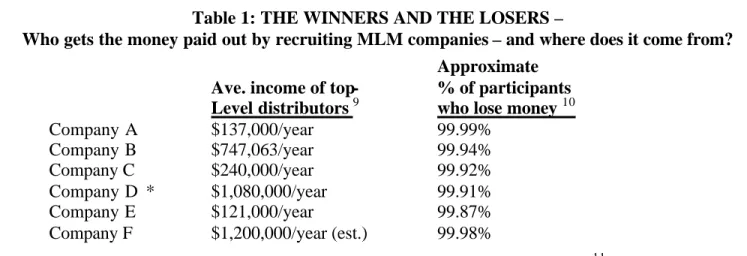
Table 1: The winners and the losers in recruiting MLM’s 10
TAX RETURNS—confirming evidence that the money goes to those at the top 10 The negative effects of recruiting MLM’s (high loss rates, misrepresentation, psychological & social harm) 11 How do recruiting MLM’s misrepresent earnings (three major tactics underlying the deceptions)? 13 What would a fair MLM program look like? 13
Table 2: Characteristics of product-base pyramid schemes and associated effects 13
Why are product-based pyramid schemes more harmful than no-product pyramid schemes? 14 The 8 R’S of MLM durability– resulting in greater damage than no-product schemes (ruse, repeated investments,
re-pyramiding, rationalization, etc.)
14 LAW ENFORCEM ENT CONSIDERATIONS (prosecution for misrepresentation, based on adequate disclosure by MLM’s, why so few complaints about MLM’s, default decisions, why consumers cannot be expected to “check it out carefully,” the key to cost-effective enforcement, DSA warning, the real villain in MLM fraud)
15 CONCLUSIONS (why promoters of recruiting MLM’s resort to such blatant misrepresentations) 18
ENDNOTES 19
Appendix A: Explanations of Compensation Plans 20 Appendix B: Definitions of Other Relevant Terms 21 Appendix C: Does MLM Qualify as a form of Direct Selling — a Six Point Checklist 23
3
INTRODUCTION: the twin challenges of
defining product-based pyramid schemes, or
recruiting MLM’s – and recognizing consumer
harm
In this paper I shall attempt to answer the following:
? When is a multi-level marketing (MLM) program merely an exploitive product-based pyramid scheme, or recruiting MLM?
? How can product-based pyramid schemes be distinguished from legitimate businesses?
? How can one determine which MLM
programs cause the greatest losses to participants, and which could be considered harmless?
Pyramid schemes, in which no products are offered, are fairly easy to identify, and they seldom last long without law enforcement shutting them down. But when products are offered, and when consumers are presented with an income “opportunity” with multiple levels of “distributors,” it is not easy to decide whether or not it is in fact an exploitive product-based pyramid scheme. It is well to remember that some programs are worse than others in terms of the percentage of participants who lose money and that some of the most damaging programs manage to escape legal action.
FTC rationale for considering pyramid schemes unlawful. Section 5(a)(1) of the Federal Trade Commission Act, 15 U.S.C. 45(a)(1), states that “Unfair methods of competition in or affecting commerce, and unfair or deceptive acts or practices in or affecting commerce, are hereby declared unlawful.”
While the Federal Trade Commission Act does not specifically address pyramid schemes, such schemes have been deemed unlawful under the Federal Trade Commission Act.1
The key to identifying the potential harm: Look for perverse elements in the compensation plan that create extremely high leverage for the top persons in the hierarchy of participants. MLM “leverage” refers to the concentration of payments (commissions, bonuses, etc.) from the company to top-level “distributors,” who profit hugely from the efforts and purchases of a multitude of “downline” participants recruited beneath them. In highly leveraged MLM programs, at least 99% of recruits lose both time and money. As a general rule, the greater the leverage for top participants in the distributor hierarchy, the higher the loss rate for their downline.
I refer to highly leveraged MLM’s, which recruit aggressively, as “recruiting MLM’s,” as opposed to “retail MLM’s,” which allow a person to earn a significant income from retailing products to end users.
Understanding the difference is key to identifying the programs which do the most harm.
Confusing comparisons: MLM is often compared with legitimate alternative business models, such as franchising, direct sales, insurance agencies, and small business operations, such as product distributorships. This adds confusion in the minds of consumers and law enforcement officials. However, my research suggests that clear differences can seen.
One common strategy for MLM companies to build credibility is to go to great lengths to be identified as a “direct sales” organization. But after rigorous comparisons of legitimate business models with features of highly leveraged MLM compensation plans, five clear distinctions can be made, as discussed below. Interestingly, the five features, which differentiate these programs from legitimate businesses, are the same features that cause an extremely high loss rate and other problems for participants. I call them “causal and defining characteristics of product-based pyramid schemes” because they both cause the problem and define themselves as pyramid schemes. Properly applied, they also identify programs that violate most federal and state laws against pyramid schemes.
Inadequate definitions: Most of the laws and statutes were crafted before the structure, dynamics, and effects of product-based pyramid schemes were understood, so the definitions within anti-pyramid statutes do not accurately reflect the root causes of the problems. However, there is enough validity in the present legal definitions of pyramid schemes that enforcement against such schemes can be effective if the principles in this paper are understood and applied. This is true regardless of how complex is the compensation plan of the MLM in question.
FTC guidelines and most state statutes include a key element in defining pyramid schemes – the payment of money by the company in return for the right to recruit other participants into the scheme. If the primary emphasis is compensation from recruiting, rather than from the sale of products to end users, it is considered a pyramid scheme. How such primary emphasis is to be determined has until now been a formidable challenge for investigators.
Why understanding the compensation plan is so important: Psychologists experimenting with both animals and people learned long ago that you get the behavior you reward. Since the compensation plan specifies how participants are rewarded, it reveals whether the primary emphasis is on recruiting or on retailing – and therefore, whether or not a given MLM is
4
a disguised pyramid scheme. (For terms used in describing MLM compensation plans, see Appendix A.)
MLM companies maneuver to divert authorities from examining how participants are rewarded. They speak of the validity of a company’s products, the integrity of its leaders, and the company’s solid financial condition. It seems that the one thing MLM leaders do not want regulators to understand – the compensation plan – is the one thing investigators must grasp in order to answer the question of where the emphasis is – on company payout resulting primarily from recruiting, or primarily from retailing to consumers outside of the MLM network of participants.
The problem of evaluating MLM compensation plans is further complicated by an endless array of
complex MLM payout formulas. The problem of
identifying emphasis on recruiting vs. retailing in a compensation plan, as well as consumer harm, can be greatly simplified by understanding the five characteristics discussed below – all of which are generic to exploitive product-based pyramid schemes.
WHAT IS THE DIFFERENCE BETWEEN
RECRUITING MLM’S AND RETAIL
MLM’s?
Companies with all five of the following characteristics of a product-based pyramid scheme can be classified as recruiting MLM’s, as differentiated from the rather rare retail MLM’s, which offers its primary rewards to those who retail products. Recruiting MLM’s are essentially closed systems, which sell products at retail primarily to program participants and cooperating family members. These product purchases could be considered disguised or laundered investments in a product-based pyramid scheme. Where this is the case, participants at the top (and the MLM company) are rewarded at the expense of a multitude of unwitting recruits. Almost all MLM’s are recruiting MLM’s.
How these defining characteristics were derived:
Nine years of research led to this edition of this paper, including a one-year experiential test, direct observations, hundreds of interviews with persons from a variety of MLM’s and with consumers as MLM prospects, consultations with top experts in the field, collection/processing of available data, and analysis of all types of compensation plans. These programs were compared with features of legitimate business models to which MLM is often compared, such as direct sales, franchises, distributorships, insurance agencies, etc.
The author was able to identify a list of characteristics that are common to MLM’s. These were
then compared to characteristics of no-product pyramid schemes. From this comparative analysis, a trained eye can see that when one focuses on the causes of the problems with more highly leveraged MLM’s, which are compensation plans with perverse reward features, certain characteristics, or “red flags,” become obvious.2
THE FIVE CHARACTERISTICS, OR RED
FLAGS, of product-based pyramid schemes
– causal, defining, and legally significant
The Five Red Flags. The set of five characteristics below – or red flags to watch for – were found to be exclusive to recruiting MLM’s (which are most MLM’s today). Based on careful analysis of available data, MLM programs with these characteristics have a shocking loss rate – approximately 99.9% of participants lose money! – not a legitimate business by any reasonable measure. In the light of these odds, typical promises made by MLM promoters of lucrative incomes are misleading, except for a few at the top of the pyramid who got in early.
Again, it is important to recognize that —
(1) These 5 characteristics are CAUSAL because they identify the cause of the harm or consumer losses.
(2) They are DEFINING because they clearly separate what I call “recruiting MLM’s” or product-based pyramid schemes from all other forms of commercial activity.
(3) And they are LEGALLY SIGNIFICANT
because they answer the question that law enforcement has not consistently answered in cases before; i.e., how the PRIMARY EMPHASIS ON INCOME FROM RECRUITING (as opposed to selling direct to consumers at retail prices) can be determined from the reward system (compensation plan) – rather than from complaints, which simply are too unreliable in this field of activity. It is interesting to note that most of the laws against MLM’s as pyramid schemes are based on one of the EFFECTS (and not the primary one; i.e., whether or not sales occurs to end users) and not any of the CAUSES of the problems2 (op cit). No wonder law enforcement has been so confused and inconsistent in this arena. Even so, using this analysis, law enforcement agencies can (and must) work within existing laws. Attempting to change the laws is risky, since the MLM lobby (Direct Selling Association) could then influence legislators to pass anti-pyramid laws favorable to MLM, as they have done in several states.
5
THE FIVE RED FLAGS: Five causal and
defining characteristics of product-based
pyramid schemes, or recruiting MLM’s:
1. Each person recruited is empowered and given
incentives to recruit other participants, who are
empowered and motivated to recruit still other
participants, etc. – in an endless chain of
empowered and motivated recruiters recruiting
recruiters – without regard to market saturation.
When analyzing a program, ask: Is unlimited recruiting allowed, and are those who are recruited empowered and spurred on by incentives (such as overrides from downline purchases, advancement, etc.) to recruit additional participants, etc. – so that the effect is unlimited recruiting of empowered and motivated recruiters in an endless chain?
All pyramid schemes, chain letters, and MLM programs have this multi-level chaining characteristic in common. Had all forms of endless chain marketing schemes been declared illegal (as happened in Wisconsin in 1970 – but unfortunately was not enforced 3), this confusion over definitions would be minimal. Aggregate losses totalling over $100 billion by tens of millions of unwitting participants would have been prevented, and MLM in its present form would not have existed. And you would not be reading this paper.
The ill-fated Amway decision. In 1979 the FTC ruled that Amway was not a pyramid scheme, subject to “retail rules” – which are generally ignored (in actual practice) by MLM companies. Consumers recruited into MLM’s will continue to pay heavy prices for this decision – until federal and state enforcement agencies more rigorously apply existing la ws as suggested in this paper. In spite of the confusion over definitions of what constitutes a pyramid scheme, much can still be accomplished within the present legal framework. This paper focuses on clarifying those definitions and on identifying the combination of features in the compensation plan that cause the greatest harm.
The fact that an MLM compensation plan limits the number of levels upon which any distributor can be paid overrides from the company does not negate the “endless chain” feature of the scheme. The mathematical impossibility of later recruits enjoying the same financial benefit as earlier participants is apparent.
Is saturation inevitable? In 1979, Amway successfully argued to the federal judge that market
saturation, theoretically associated with a pyramid scheme, had never happened and was not possible.4
However,with unlimited recruiting, new recruits find it increasingly difficult to recruit more participants into the program. While total saturation is never reached, when enough people are brought into the scheme that prospects perceive little remaining opportunity to sell or recruit, then it could be said that perceived or de facto saturation has taken place. De facto saturation would lead to collapse of the scheme, except that promoters typically expand to other geographical areas or set up new product divisions to survive and grow.
Why MLM’s explosive growth? The recruitment feature of an MLM or product-based pyramid scheme is what accounts for its explosive growth – until it collapses or is shut down by authorities. Unlike chain letters or Internet report chains, very intensive person-to-person recruiting drives MLM recruitment schemes. Recruiting MLM’s are like a fast-growing cancer.
Each person brought into the program has a personal stake in advancing the scheme so that he or she may profit from an expanding downline. New recruits are taught to “be a product of the products” and to set the example of model recruiting and purchasing in suggested amounts so that others will duplicate their recruiting efforts and purchases, carrying them to success on the backs of downline participants.
Since the upline’s income is dependent on the recruiting success of downline participants, the upline is motivated to train and encourage their recruiting success. Upline participants may apply pressure on their downline to increase their own gains. This pressure from above and below creates explosive growth in purchases by participants and sympathetic family members, which are more distributor-driven than market-driven.
Are they buyers or sellers? Unlimited recruiting in MLM’s also changes the marketing nature of the system from one of a network of “distributors” to a network of buyers. Any clear distinction between buyers and sellers evaporates. The sellers are the buyers, and the buyers are the sellers – to themselves and their families. Also, we see the fallacy of the claim of MLM promoters that they are removing the “middle man” in their marketing system. Actually, in an MLM, middlemen are often multiplied hundreds or thousands of times.
New recruits into a recruiting MLM buy products mainly to qualify for profits from recruiting others, rather than from any real need for the products or from any expectation of profit from retailing. And as people tire of being solicited, the perceived opportunity to find willing buyers eventually diminishes to a trickle. Since the retail market is a phantom one, in order to increase
6
the base of recruiting prospects who will pay retail to “play the game,” promoters must introduce new product divisions or open up new markets to recruit in other areas.
Recruiting MLM’s become Ponzi schemes. When MLM promoters expand into other areas to make it possible for earlier investing participants to be paid off from newer investors, the MLM can be said to be a pyramid scheme that has evolved into a Ponzi scheme5 – which is illegal in almost all jurisdictions. Ponzi schemes are programs in which new investors are repaid, not from the sales of products or fulfillment of servic es, but from the investments of new investors. Ultimate collapse is inevitable as new markets become less accessible, or when perceived saturation makes future prospects resistant to participation.
Some MLM proponents argue that continual dropouts justify replacement through ongoing recruitment, much as in other direct sales businesses. But this is a fallacy. Later recruits never have the same opportunity as earlier entrants due to facto saturation.
Why is recruiting emphasized over retailing?
Unlimited recruiting of recruiters, combined with the other factors explained here, creates enormous leverage. Rewards for recruiting a large downline are so much greater than for retailing products that participants see no point in spending time and effort retailing, except for token sales (often fake sales to cooperating relatives) to satisfy “retail rules.” Again, “you get the behavior you reward.” The “primary emphasis on income from recruiting” test of a pyramid scheme is thus satisfied.
Not only are participants promised huge rewards for recruiting large downlines, but also the compensation plan often penalizes them for not doing so. Participants might even be taunted for “leaving money on the table.” The reward system serves as a constant reminder that their income could be multiplied many times over by increasing the body count of recruits and by achieving volume triggers to move up through the various payout levels.
Does unlimited recruiting doom participants to failure? It is not the recruiting per se that creates the problems, as recruiting is essential in many businesses (e.g., sales and executive recruitment). But unlimited recruiting of participating recruiters, each of whom is empowered and given incentives to recruit other recruiters, who are empowered to recruit still other recruiters, etc., in an endless chain, inevitably dooms the majority of participants to failure and loss. This is not true of insurance agencies, direct sales, and other legitimate businesses – even recruiting businesses.
Any endless chain marketing scheme is an infinite recruiting program in a finite population of prospects – predetermined to failure and loss of investments, with the exception of a few at the top (or who got in at the beginning) of a pyramid of participants. Therefore, making promises of rewards comparable to earlier entrants is misleading and becomes a primary device for defrauding recruits.
Like territorial franchises, MLM companies could conceivably limit recruiting in a given area. But limiting the number of participants is uncharacteristic of MLM because it would dampen the illusion of the potential for huge incomes for new recruits. Such limitations would render any pyramid scheme impotent.
2. Advancement in a hierarchy of multiple levels
of “distributors” is achieved by recruitment,
rather than by appointment.
Ask: Does a participating “distributor” advance one’s position (and potential income) in a hierarchy of multiple levels of participants by recruiting other “distributors” under him/her, who in turn advance by recruiting distributors under them, etc.?
In MLM programs, the position in the hierarchy is determined by time of entrance into the program and by success at recruiting, rather than by appointment. When consumers are recruited into such a program and then given incentives to buy products, they are being “leveraged” for the profit of those above them. They may think they are advancing, when in fact they are often being manipulated into buying more products and recruiting more people to benefit those above them.
Are MLM “distributors” really distributors? When the pay plan rewards recruits more for recruiting others than for retailing products or services, and when sales are “incentivized,” or tied more to advancement in the scheme than to sales of products, it is a misnomer to refer to them as “distributors.” This is why in this paper the term is often placed in quotation marks. It is more correct to refer to them as “investing participants.” Correctly viewed, an accumulation of such incentivized purchases over a period of time constitute a substantial investment in a pyramid scheme. (See #3 below)
For most MLM programs, it has become evident on close examination that both advancement and income are dependent primarily on downline recruiting. However, if participants must recruit to be successful, or if the pay plan’s primary rewards are for building a downline, it should be considered a recruiting MLM, and hence an illegal pyramid scheme.
7
3. “Pay to play” requirements are met by
ongoing “incentivized purchases.”
Ask: Are “distributors” who are recruited presented with significant “pay to play” options; i.e., are they encouraged to make sizable investments in “incentivized purchases” in order to take advantage of the “business opportunity,” and later to continue qualifying for advancement in – or payout in overrides and bonuses from – the MLM company?
What are “incentivized purchases?” (or “pay-to play purchases”? I coined the term “incentivized purchases” to refer to the practice of tying purchases of products from an MLM company with requirements to enter the “business opportunity” option and to advance in the hierarchy of “distributors” – who are in effect merely participants making pyramid scheme investments disguised (or laundered) as purchases. They could also be called “pay to play” purchases. (See “Definitions of Other Relevant Terms” in Appendix B.)
How much is actually invested in the scheme?
MLM companies typically charge a nominal fee to be licensed as a distributor. This is usually less than $100 to avoid raising the eyebrows of enforcement officials – and to escape subjecting the MLM program to more strict guidelines as a security or “business opportunity.” However, it is typical that initial registration or license fees are merely the beginning of the total investment for MLM participation. One must add incentivized purchases, which may total thousands of dollars a year. They constitute a substantial portion of the cost of participating in the “business opportunity.” Whether they are used, sold, given away, or stored is irrelevant.
Escalating incentives to continue purchasing products to qualify for ever-higher levels in the hierarchy of participants often leads distributors” to hyper-consume products or to give away a lot of samples. Many fill their garages with products they don’t need. The argument that participants would have purchased the products from another source anyway, and that these purchases should not be considered an expense of doing business, simply does not hold water.
So when participants are expected to make product investments to get into a program – and then to keep on purchasing products, services, training, etc., in order to progress in the organization, they are paying pyramid investment fees to “play the game,” one of the earmarks of a product-based pyramid scheme.
If participants add the operating costs of recruiting to the cost of purchases from the company, total expenses generally exceed any payments from the MLM company.
The breakeven bar is raised and is rarely exceeded by revenues. In other words, almost all participants below those at the top of the pyramid lose money.
Why are incentivized MLM product purchases not recognized as pyramid investments? Some MLM compensation plans offer escalating incentives for recruiting an increasing number of “distributors,” so many participants recruit “dummy distributors” from friends and relatives and buy products in their names. They come to believe this will qualify them for “the really big bucks.” Few among them realize that they – and their dummy distributors – have in effect paid a very large fee for participation in a pyramid scheme. Through a variety of misrepresentations about the “opportunity,” money is extorted from them in the form of incentivized purchases. Such an amount paid at the start into a no-product pyramid scheme would immediately arouse suspicions of its constituting an illegal pyramid scheme. But since the money paid into an MLM program is paid for legitimate products and over a period of time, most participants and investigators fail to see it as an investment in a pyramid scheme. In reality, this means of investing in the form of incentivized and ongoing product purchases could be considered a device for disguising or laundering pyramid scheme investments.
Many MLM products are sold at a premium so commissions can be paid to many levels of distributors. If an MLM product were to be sold for $20 more than a comparable one sold through other outlets, (or if $20 were paid for products that would otherwise not have been purchased), this $20 premium could be considered the pyramid investment portion of the price, which would flow to the top of the hierarchy of participants in typical pyramid fashion.
Do MLM companies sell products at retail? MLM promoters have convinced many regulators and the public that MLM distributors sell a significant amount of products to consumers as end users of products not connected to participants in the scheme. In most MLM programs, this is patently false. We know from surveys conducted in areas where intense MLM activity is occurring that few sales are made directly to consumers who are not connected to the recruitment scheme. Only investors in the program can be induced into paying for overpriced “notions, potions, and lotions’ typically sold by MLM companies as a cover for pyramid investments.
For a list of criteria to clearly distinguish between MLM and direct selling, refer to Appendix C: “Does Multi-level Marketing* Qualify as a Form of Direct Selling? — a 7-Point Checklist”
8
How recruiting MLM’s kill their own retail market. In many MLM’s, purchases at inflated retail prices are primarily made by new recruits as a form of entry fee – after which they pay wholesale for products. Promoters who recruit at MLM opportunity meetings often kill their own retail market. Why would anyone pay full retail price when there are plenty of “distributors” who would gladly sell at wholesale prices to meet their “pay to play” quota of purchases?
Most ex-distributors of MLM’s I have intervie wed have said they cancelled automatic bank draft payments for monthly product shipments or sharply reduced purchases from the company following their leaving the program. This supports the conclusion that the retail market for the products is more contrived than real. “Pay to play” purchases practically cease upon termination.
What about the refund policy of MLM’s? Many MLM’s have a one-year return policy which guarantees a refund for unused and unopened merchandise, minus a small re-stocking fee. While this sounds acceptable to recruits and regulators, hundreds of interviews with ex-distibutors lead to the conclusion that this offers little actual protection to participant/victims of the schemes. It is extremely rare for a person to recognize the fraud in an MLM program without intensive de-programming by a knowledgeable consumer advocate. They have been conditioned to blame themselves – not the MLM program – for their “failure.” And many have opened their product packages to sample or share the contents.
4. The company pays commissions and bonuses
on more “distributor” levels than are
functionally justified; i.e., more than five levels.
Ask: Does the company pay overrides (commissions and bonuses) to distributors in a hierarchy of more levels than are functionally justified; i.e., more than five levels?”
For even the largest of conventional distributor arrangements, the entire U.S. can be covered by four supervisory levels in the distributor hierarchy; e.g., branch managers, district managers, regional managers, and national sales manager – plus an international manager if one is needed for foreign markets. More than that is superfluous and bloated, driving up product prices and making sales at a competitive retail markup unprofitable and unrealistic.
Why does more than five levels signal a recruiting MLM? There is seldom any functional justification for six or more levels in an MLM hierarchy of “distributors,” other than to encourage recruiting and the
illusion of very large potential incomes to more participants than is mathematically possible – a hallmark of many pyramid schemes. When combined with the other factors herein, only those “distributors” at the top of the pyramid realize any significant income, and the extra levels only enrich those at or near the top of the pyramid at the expense of those beneath them. In some states, this could be considered “unjust enrichment.”
So – with an upline of many levels, the top-level participants may be profiting to an extreme degree from the losses of those beneath them. Such exorbitant incomes result from the reaping of huge overrides from the combined product investments of as many as thousands of downline participants, which increase exponentially with each added level. (See Table 1.)
Important distinction. This characteristic is a key feature separating recruiting MLM’s from no-product pyramid schemes, which typically pay on only four or five levels before the person atop the pyramid collects and moves on to start a new pyramid. It also helps explain why the loss rate for recruiting MLM’s is much higher than for classic, no-product pyramid schemes.
How does extreme leverage result from excessive payout levels? MLM promoters refer to such residuals as “leverage” – large company payouts, disproportionate to effort expended, to top-level participants. The effects of leverage can be illustrated in a downline of six levels of participants. For example, assume that a “distributor” recruits five “active distributors,” each of whom recruits five more, and so on through six levels of distributors. The pyramid grows exponentially as shown below:
Level 1: 5 distributors
x $5 in commissions & bonuses = $25/month
Level 2: (5x5=) 25 + 5 = 30 total distributors
x $5 ” ” ” ” = $150/month
Level 3: (25x5=) 125 + 30 = 155 total distributors
x $5 ” ” ” ” = $775/month
Level 4: (125x5=) 625 + 155 = 780 total distributors
x$5 ” ” ” ” = $3,900/month
Level 5: (625x5=) 3,125 + 780 = 3,905 total distributors
x $5 ” ” ” ” = $19,525/month
Level 6: (3,905x5=) 15,625 + 3,905 = 19,530 total distributors x 5 “ “ “ “ = $97,650/month!
If each “distributor” were to buy enough products each month to yield an override of $5 in commissions and bonuses to the original upline distributor, then with a five-level downline, the upline distributor gets $19,525 per month, while with a six-level downline the same distributor can get $97,650 per month – five times as much as for five levels. The incentive to recruit to get to
9
the sixth level becomes enormous. Of course, it seldom works out that way, but these are the type of figures that are often presented to prospective new recruits at MLM opportunity meetings.
This illustrates why recruiting is emphasized, as opposed to selling products to persons outside the pyramid. An income of $97,650 is much more appealing to a Level 1 participant than $100 that might be earned by selling the products at the full retail price (assuming $20 markup on products sold to each of five customers). Compared to recruiting, selling products at full retail price becomes a waste of time in such a system. The incentive to recruit to move up a level becomes very great. Again, one can see that the legal requirement of “primary emphasis” on income from recruiting fees (in the form of downline purchases) is satisfied.
Exploitive breakaway compensation plans– legal or not? One category of compensation plans, the “breakaway” deserves mention, as it is so highly leveraged that the losses of participants are staggering.
In a breakaway system, the levels in the hierarchy are made up, not of individual participants, but of “breakaway organizations” (or pyramids) – groups of participants who have met requirements to “break away,” allowing a small commission override from all participants in the breakaway unit. So in a breakaway system, a hierarchy of six levels is actually six levels of groups of participants, which makes it a constellation of pyramids within a giant mega-pyramid – with most of the payout going to top participants.
The extreme loss rate results from each profitable top-level “distributor” being supported by a downline of many groups of participants (often totaling thousands), almost all of them victims who lose money – after subtracting purchases and other expenses. MLM’s with breakaway compensation plans – though common – are the most extreme and exploitive type of pyramid scheme and therefore should be illegal.
Other MLM compensation plans have their own unique problems, primarily centered around obfuscating the fact that the programs are designed to enrich those at the top of a pyramidal hierarchy of participants at the expense of a multitude of downline participants.
5. Company payout per sale for each upline
participant equals or exceeds that for the person
selling the product – resulting in inadequate
incentive to retail and excessive incentive to
recruit.
Ask: Would a “distributor” purchasing products for resale receive about the same total payout (in
commissions, bonuses, etc.) from the company as participants several levels above him or her who had nothing to do with the sale?
While the previous four features are fairly easy to identify, this one requires understanding of alternative distribution models and complex incentives in the MLM pay plan. Group bonuses and other incentives must be factored in to determine actual payout per sale. Sometimes the bonuses come in the form of larger discounts or higher commissions per sale at higher levels.
Why does this feature of recruiting MLM’s discourage retailing of products to end users?
Recruiting MLM’s offer small rewards to front line “distributors” for selling products, which are usually overpriced. So to achieve significant income one must recruit a large downline from which to draw commissions from their combined purchases. This factor, more than any other, determines whether a program is biased towards recruitment or towards retailing (direct selling to end users). It is also an important red flag signaling an illegal pyramid scheme.
What is the harm or main problem with recruiting MLM’s? Compensation plans of recruiting MLM’s lead to extreme inequality in payout (money paid by the company) to participants. There are a few “winners” who got there at the expense of a multitude of “losers.” Often these “losers” will invest considerable amounts of time and money and then quit, blaming themselves. But their “failure” is due not so much to their lack of effort, as to an exploitive system, which dooms approximately 99.9% to losses (after subtracting “pay to play” purchases and minimal operating expenses).
A failure rate in excess of 99% would not be so serious, except that in MLM opportunity meetings, the program is typically touted as the path to financial freedom, or time freedom, and the earnings of top distributors is posted – but without the abysmal odds of getting there.
In other sales settings, it is not unusual for a successful commissioned sales person to receive more income than their sales managers. This is because the person doing the selling makes more in commissions per sale (often 20-40%) than managers two or three management levels above him or her. But in recruiting MLM programs, upline distributors several layers removed from the actual sale receive about as much or more in total payments per sale (including commissions and bonuses) from the company as the person who actually sold the product. The latter may only get a sales commission of 5-15% from the company – not enough to make direct selling profitable, even if the products were priced competitively.
Since the total payout per sale is limited, when upline participants receive substantial income in
1 0
overrides from downline purchases, this limits the percentage of commissions to any participants actually selling products to end users. So the income of front line “distributors” is extremely limited, forcing him or her to recruit a large downline to realize a significant income from commissions on their purchases. Powerful incentives may then be at work to recruit a downline of hundreds – or even thousands – of participants.
Can’t low commissions to front-line distributors be offset by retailing products at marked up retail prices?
MLM promoters claim “distributors” who buy products at wholesale prices from the company can then sell them at a higher retail price, such as happens in conventional retail outlets, which allow for a substantial retail profit margin. MLM companies then go to great lengths to assure recruits and regulators that they are legitimate direct sales operations and that participants are making money from selling products at profitable retail profit margins.
The problem is that suggested retail prices for MLM products are generally too high to be competitive with other outlets. So MLM “distributors” wind up
purchasing large quantities for themselves and their families and/or selling products at wholesale prices to downline participants and others in order to meet volume requirements for bonus or discount levels. Again, the payment of full retail listed price generally occurs with new recruits who are “buying into” the system. This is how they “pay to play” [the game].
How does this feature distinguish recruiting MLM’s from retail MLM’s? Again, this characteristic, more than any other, is primarily what separates recruiting MLM’s from retailing MLM’s. The latter are MLM companies which (by making generous payments to front-line distributors) make it possible for participants to make money retailing products with only a small downline of participants. But out of hundreds of MLM programs with which I have become familiar, MLM companies programs that could be classified as retail MLM’s could be counted on the fingers of one hand. A careful overview, using this analysis, would suggest that the vast majority of MLM’s should be classified as recruiting MLM’s.
Table 1: THE WINNERS AND THE LOSERS –
Who gets the money paid out by recruiting MLM companies – and where does it come from?
Approximate
Ave. income of top-
% of participants
Level distributors
9who lose money
10Company A
$137,000/year
99.99%
Company B
$747,063/year
99.94%
Company C
$240,000/year
99.92%
Company D *
$1,080,000/year
99.91%
Company E
$121,000/year
99.87%
Company F
$1,200,000/year (est.)
99.98%
*RTTP = Renaissance–the Tax People (shut down as an illegal pyramid scheme
11)
The others are prominent MLM’s still operating.
TAX RETURNS—confirming evidence that
the money goes to those at the top
In a recent survey of 187 tax preparers in Utah 6, (plus a few calls to other states) a clear distinction could be seen between MLM participants who could be described as “top of the pyramid promoters” (TOPP’s) and downline participant-victims. In three counties where MLM recruiting had been active, but where no MLM companies were headquartered (and few if any TOPP’s reside), none of the 33 tax preparers contacted could recall any MLM participants ever reporting a
significant profit from MLM participation over an extended period of time. (Three had made a small profit, then quit within a year or two.) This was out of an aggregate total of over 300,000 tax returns prepared during the course of their careers.
In sharp contrast, in Utah County, Utah, with the highest concentration of MLM companies in the country, a completely different picture emerges. A large number of TOPP’s live in or near cities where their company headquarters are located, and they tend to have their tax returns prepared by CPA firms. With the same number of tax preparers surveyed (with an estimated 667,000
1 1
aggregate career total tax returns) as in the three counties with no MLM companies, approximately 185 tax returns had shown significant net profits from MLM (33 in 2002 alone) – from tens of thousands to almost $1 million a month!
So – as with no-product pyramid schemes, the compensation system rewards those at the top at the expense of participant-victims at the bottom. The other major beneficiaries of MLM fraud are founders and officials of the company, many of whom are paid huge salaries and profits or overrides from the same source.
It is also noteworthy that in a survey of Utah County households, though 56% of households sampled had been recruited by an MLM “distributor” in the past year, less than 5% had joined. Less than 7% had been approached to buy the products without mention of the “opportunity,” and only 1% had actually purchased the products. So there were five times as many distributors who were enrolled as there were customers who bought – evidence that very little direct selling was occurring.
These results confirm what has been said earlier. With recruiting MLM’s, direct sales to end use customers seldom occur. The rewards go to those at the top of a large downline of “distributors”—almost all of whom lose money. Also, Utah County households don’t join the program or buy the products in significant numbers, so participants and promoters must go elsewhere to recover their investment—making them Ponzi-like schemes as well as pyramid schemes.
NEGATIVE EFFECTS OF RECRUITING MLM’s
MLM compensation plans with all five charac-teristics inevitably lead to the following negative effects: 1. A strong emphasis on recruiting, instead of retailing of products, becomes essential to make any money, and since the market for new recruits is limited in any given area, most participants do not make enough commissions to meet expenses. Recruiting MLM promoters go to great lengths to make it appear that their revenues come from direct selling of products, which is simply not the case. This one effect is the basis of most statutes against pyramid schemes, though it is not the most damaging effect.
The following provide evidence that recruiting MLM’s do not engender any significant retail market:
? The compensations plan rewards recruiting so much more than direct sales that there is little incentive to sell directly to consumers at retail prices.
? Subtract all incentivized purchases by new
distributors and their families from total revenues from that area on the company’s financial report. If the volume left over is minimal, direct selling is not the major thrust of the company, in spite of what its promoters claim.
? Surveys of ex-distributors reveal that few continue buying the products after leaving the MLM. They also admit that little if any direct selling occurs outside of the network of distributors and their immediate families. (Surveys of ex-distributors are more valid than those of current distributors, who may have contracted to sell at retail to keep their distributor license.)
? Again, we know from surveys conducted in areas where intense MLM activity is occurring that few sales are made directly to consumers who are not connected to the recruitment scheme.
? Little if any direct selling continues in an area two or three years after an MLM finishes its recruitment blitz through the area.
? To counter dwindling sales due to a drop-off in recruiting, the MLM moves its recruiting efforts to other areas or to new product divisions in the company. Promoters can then sell to new recruits.
? Signs of reporting inconsistencies can reveal a lack of direct sales in contradiction to what MLM officials are telling law enforcement investigators. In the case of Nu Skin, sharp discrepancies appeared between U.S. revenues reported to the SEC and those reported to the FTC and to recruits in the amount of sales that were occurring at retail prices. This was blatant evidence of misrepresentation.7
? Direct observation can be revealing. In my test of Nu Skin’s program, I saw over 400 Nu Skin distributors over a one-year period, but I can recall only one who made a serious effort to sell Nu Skin’s expensive supplements directly to rich neighbors.
2. Loss rates are extremely high. This is the harm that is most objectionable. Because of the extreme leverage in the compensation plan., some founders, early entrants into the program, and a few top distributors get huge gains – who are held up as examples for all prospects to see. However, for the vast majority of MLM participants, actual profits are rare.
In my research I was able to gather data on top earnings and loss rates for six MLM’s, which could be classified as recruiting MLM’s, since all of them have compensation plans with the five characteristics of recruiting MLM’s, as identified in this paper. Five of them are leading MLM’s that are still operating. This led to the remarkable finding that the loss rate (percentage of participants who lost money after subtracting all expenses) in these recruiting MLM’s was approximately 99.9% (close to 100%) –with the remaining 1/10 of 1% positioned at the top. (See Table 1.)
As more data becomes available, more recruiting MLM’s will likely be found to follow the same pattern. However, it should be noted that a true picture of
1 2
success or loss rates can only be determined by removing the deceptions that seem to be common to typical reporting of distributor incomes and success rates by MLM companies. (See the section below: “How do recruiting MLM’s misrepresent earnings?”)
In contrast, the loss rate for recent no-product pyramid schemes ranges from 87.5% to 93.3% (averaging about 90% –depending on whether or not re-investment is assumed by those profiting from each completed cycle), which is far less than product-based pyramid schemes – with about a 99.9% loss rate. So a person would have about 100 times the chance of profiting in a classic no-product pyramid scheme as in a recruiting MLM. We can conclude that recruiting MLM’s, or product-based pyramid schemes, are truly scams – far more harmful than classic 1-2-4-8 pyramid schemes.
3. Misrepresentation is rampant, since deception is essential for the MLM company to survive and grow. If the truth were told about the odds of success, few would join the program. Some MLM promoters also find it advantageous to make unjustified product claims to draw in new recruits. It has been my observation that success in a recruiting MLM requires one first to be deceived, then to maintain a high level of self-deception, and finally to go about deceiving others.
Interesting fact. It has been calculated that the odds of profiting from a no-product pyramid scheme are 111 times as great as profiting as a distributor for one prominent recruiting MLM (after removing statistical misrepresentations from its reporting). The chance of profiting from a single spin of the roulette wheel at Caesar’s Palace in Las Vegas is 48 times as great8.
4. Recruiting MLM’s evolve into Ponzi schemes, with promoters moving from one location to another, as each area is increasingly perceived by the public to be saturated. What happens is that the MLM grows rapidly until it reaches de facto saturation in a given area. All later entrants are severely disadvantaged in their recruiting efforts and are usually found in a losing position. MLM companies try to get around this by starting new divisions, introducing new products, or entering new geographic regions to start new pyramids, a process I call “re-pyramiding.”
So investing participants recover their investments by recruiting in other areas – in Ponzi fashion – to get new participants to likewise invest. If they don’t do this, they can lose their income stream and the position they gained. Company officials cooperate – or the company may collapse, along with their jobs.
5. The distinction between seller and buyer becomes confused and blurred. The seller becomes
the buyer, and the buyer becomes the seller – to themselves and their families.
6. Stockpiling of products is common, if only in secret. Many participants wind up making excessive purchases in their own name or in the name of downline “distributors” in order to advance up the hierarchy of participants, so they can reap large residual incomes off the efforts of others – which seldom happens. Most participants are left with unsold products, broken promises, and unrealized dreams. Return privileges for refunds are not used as much as one would expect for the reasons mentioned above.
7. The regulatory process – essential in a democracy to protect consumers – is compromised when pyramid fraud is allowed by regulatory agencies, creating, in effect, a “license to steal.”
8. MLM observers have noticed psychological and social harm far outside of the norm for legitimate businesses. Some MLM programs adopt cultist patterns in recruitment and retention of members, becoming a rather closed society. Marriages are terminated, and other important relationships are often disrupted by single -minded recruitment efforts. Also, the evolution of “MLM junkies” have been observed, with traits of addiction similar to those for other addictions.
9. A perverse risk-reward relationship develops with recruiting MLM’s. In legitimate businesses, it can be said that the more time and money one invests (risks) in the business, the more likely it is that success will be achieved. But with recruiting MLM’s, with the exception of the first ones in and those at the top of the pyramid, the more one invests, the greater the losses. The most fortunate of the MLM participants are those who invested the least time and money. The luckiest are those who refuse to join at all.
10. Extreme leverage results, meaning the majority of company payout goes to participants at the top of the hierarchy or pyramid. Cases of huge gains of some distributors are rare, but are held up as examples for all prospective recruits to see. However, for the vast majority of MLM participants, actual profits are rare. (Table 1)
11. The program becomes a closed market system, in which products are sold primarily through a downline of participants (and sympathetic family members) and seldom to retail customers at retail prices. This alone should qualify it as an illegal pyramid scheme.
Some of the effects stemming from the five features of product-based pyramid schemes, both individually and in combination, can be seen in Table 2.
1 3
HOW DO RECRUITING MLM’S
MISREP-RESENT EARNINGS?
To make participation appear profitable, recruiting MLM’s typically use such tactics as these:
1. In figuring the odds of “success,” the total number of persons who enroll as distributors are not counted, only those who are “active” during a given time period. These are then compared against a cumulative number of top distributors who have achieved certain levels over a long period.
2. Costs – especially incentivized or “pay to play” purchases – are not subtracted in figuring net earnings.
3. Assumptions are made that products purchased are sold at inflated retail prices, which seldom happens.
For a detailed example of how the debunking of these deceptions leads to an awareness of the misrepresentations common to MLM income claims, see the author’s analysis of the report of “Actual Average Incomes” of distributors for Nu Skin Enterprises. 12
WHAT WOULD A FAIR AND LEGAL
MLM PROGRAM LOOK LIKE?
An MLM could reward selling of products more than recruiting by paying at least half of the total company payout to those actually selling products to end use consumers. So if a company’s total payout to distributors was 50%, the commission for frontline distributors would be at least 25%. And the number of levels in the payout structure should be capped at a maximum of four levels of individual participants.
In a mythical MLM program that is both legal and ethical, products would be sold at competitive prices, so that distributors could succeed from retailing the products, not just from selling to their downlines at inflated prices. “Pay to play” requirements would be minimal.
Breakaway compensation plans – essentially pyramids within mega-pyramids – would be banned, and other complex plans (matrix, binary, etc.), seldom used effectively by participants or fully understood by regulators, could be replaced with simpler unilevel plans. This would remove the obfuscation that hides misrepresentations and makes comparisons difficult.
Table 2: Characteristics of product-base pyramid schemes and associated effects
CHARACTERISTICS EFFECTS
1. Each person recruited is empowered & given incentives to recruit other participants, who are empowered and motivated to recruit still other participants, etc. – in an endless chain of empowered and motivated recruiters recruiting recruiters – without regard to market saturation.
Demonstrates primary income is from recruiting, especially with the features of unlimited recruitment and such powerful incentives to recruit – vs. meager profits from retailing over-priced products.
Hyper growth inevitably leads to perceived saturation, which often is followed by a Ponzi move to other markets to repay early investors. 2. Advancement in a hierarchy of multiple levels
of “distributors” is achieved by recruitment, rather than by appointment.
Demonstrates primary income is from recruiting, since that is the only way to advance in the scheme and to realize major profits. In recruiting MLM’s, most recruits are doomed to failure.
3. “Pay to play” requirements are met by “incentivized purchases”.
Raises breakeven bar, assuring losses for most participants.May place MLM in category of a security or business opportunity – or a de facto investment in a pyramid scheme. Encourages hyper-consumption of products.
4. The company pays commissions and bonuses on more “distributor” levels than are functionally justified.
Demonstrates primary income is from recruiting, not retailing. Enhances leverage for top participants who profit hugely, while assuring high loss rate for lower levels. Virtually eliminates retail option, due to high wholesale prices that make direct sales with retail markup difficult. Primary retail target is new recruits – which are making de facto pyramid investments.
5. Company payout per sale for each upline participant equals or exceeds that for the person selling the product
Same effects as for #4, but greatly magnified when #4 and #5 are taken together. Removes incentive to do direct selling, since recruiting is potentially many times more profitable.
1-5: Combining all five characteristics Results in high loss rates (close to 99.9%) – much higher than for no-product pyramid schemes (87.5% to 93.3%).
Strong emphasis on recruiting as the primary source of income, satisfying most statutory definitions of a pyramid scheme.
Demonstrates extreme leverage, necessitating fraud and misrepresentation in order to survive and grow.
1 4
WHY ARE PRODUCT-BASED PYRAMID
SCHEMES MORE HARMFUL THAN
NO-PRODUCT PYRAMID SCHEMES?
No-product pyramid schemes are fairly easy for both regulators and consumers to recognize. They seldom get very large and are not often concentrated in a single company, so the challenge is to stop them as quickly as possible by going after the perpetrators.
No-product pyramid schemes normally require a one-time investment, progress and pay on only four or five levels, and pay the money directly to a person at the top of the pyramid before maturing and splitting to form new pyramids. With product-based pyramid schemes, characteristics #1, #2, #3, and #5 (see pages 2-5) are usually the same as for no-product pyramid schemes, but the number of payout levels (#4) can be much larger.
MLM companies usually pay on six or more levels, creating enormous leverage and therefore a higher loss rate and greater aggregate losses than is the case for no-product pyramid schemes. For recruiting MLM’s, top participants are greatly enriched by this leverage.
Product-based pyramid schemes, or recruiting MLM’s, do far more harm than no-product schemes because they tend to victimize far more people, have a higher loss rate, cause more aggregate damage, and endure much longer than no-product pyramid schemes – because of the 8 R’s of MLM durability13:
THE 8 R’S OF MLM DURABILITY –
resulting in greater damage than no-product
schemes:
(1) Rewards. The profitability for the MLM company and the payout to top distributors is so great that they will routinely misrepresent and will go to great lengths to keep the scheme going, including finding new divisions or areas in which to continue recruiting after a given area has reached de facto saturation.
(2) Ruse. MLM’s have been enormously successful in positioning themselves as direct sales programs that are exempt from laws against pyramid schemes. Even many regulators, the Better Business Bureau, educators, and writers will be quick to condemn a no-product pyramid scheme, but will exonerate a far more extreme and exploitive product-based pyramid scheme (MLM).
As this paper demonstrates, a recruiting MLM company is actually an institutionalized pyramid scheme. Recruits in the hierarchy of “distributors become unwitting agents in collecting pyramid investments (in the form of “incentivized purchases) that fund the company and enrich top “distributors.”
Another ruse is the idea touted by MLM promoters
that their program “gets around the middleman.” In fact, the MLM guarantees that their program will create a whole network of unnecessary middlemen to be paid off. (3) Repeated investments (“pay to play”). Although the cost of signing up as an MLM distributor is usually less than $100, the cumulative investment, in required or strongly incentivized purchases to “stay in the game,” may amount to hundreds or even thousands of dollars over several months. Products are often sold on a subscription basis by automatic bank withdrawal to maintain cash flow and upline residuals. Often purchases are far beyond the needs of the buyers and are stockpiled or given away. Usually such purchases are discontinued when the person withdraws from the scheme.
(4) Replacement. MLM’s are conducted as “body shops,” so that those people who drop out on the bottom levels are constantly being replaced with new recruits who believe the promises of wealth and time freedom – or a little additional income for persons who are struggling to make ends meet (which almost always sets them further behind financially).
(5)Re-pyramiding. When MLM company officers see that the “pyramid” is about to collapse, they start a new division, introduce new products, or enter a new region, all within the same corporate umbrella. This makes possible a whole new “ground floor opportunity” to participate in the “hyper growth” of the company, or to “ride the wave of opportunity.” This Ponzi-like behavior is what Amway, NuSkin, and other long-lasting MLM companies have done.
(6) Rationalization and self-blame. Self-deception is common in MLM’s, making it the perfect con game. The very people who are being victimized are often its most ardent promoters – until they run out of resources and quit. They seldom complain to regulators, having been taught that any failure is their fault for not having tried hard enough, rather than the fault of the MLM. They may also fear retaliation from or to their upline, which may include close friends or relatives.
(7) Retail “rules.” The trick for a recruiting MLM to evade regulatory scrutiny is to create the illusion that retailing is being done by establishing “rules” for minimum retailing with which distributors must comply – which are satisfied cosmetically so as not to arouse the attention of regulators. Compliance with these rules is not independently audited, nor are they reinforced by corresponding incentives in the compensation plan. MLM rule -making is ineffective without correcting problems in the compensation plan itself.
(8) Recognition. The MLM company may go to great lengths to enhance its legitimacy and its credibility. They may donate heavily to influential politicians and parties, to the Olympics, and to worthy, highly visible
1 5
causes. Their support for these causes is given top billing at opportunity meetings and often given recognition by an unwitting press. Celebrities are hired to speak at MLM conventions. Top MLM officials and founders have been honored by university and civic groups.
LAW ENFORCEMENT CONSIDERATIONS
Most of the leading MLM programs display all five of the characteristics of product-based pyramid schemes. But in 1979 an FTC judge ruled that Amway was not a pyramid scheme. Despite the ruling, recent evidence suggests that MLM programs biased towards recruiting (with these five characteristics), are the most extreme (highly leveraged) forms of pyramid schemes, based on loss rates (of participants who lose money) – which approximates 99.9% for companies for which data has become available. (See Table 1.)
As this paper demonstrates, the vast majority of sales recorded by recruiting MLM’s are to new recruits and sympathetic family members and not to consumers as end users. Most purchases by these recruits are “pay to play” investments, made to qualify to participate and advance in the schemes. And since about 99.9% of participants lose money, then total sales revenues for a recruiting MLM are a close approximation of the amount of aggregate losses suffered by those involved.
Combining loss rates of close to 100% with estimated total sales volume for all recruiting MLM’s world-wide since the 1979 Amway decision, one could reasonably estimate that well over 25 million victims have suffered total aggregate losses in excess of $100 billion! This would place product-based pyramid schemes at or near the top of all consumer scams. It could be considered a major category of white collar crime, except that most of those doing the defrauding are not aware that it is a scam.
The 1979 Amway ruling was made on condition that certain “rules” would be adhered to that would separate Amway as a legitimate MLM from an illegal pyramid scheme:
–a “buy back rule” – Saleable unused merchandise can be returned for a refund - minus a restocking fee
–the “70% rule” – Distributors must derive at least 70% of their income from retail sales to non-distributors –“10 customer rule” – Each distributor must have ten retail customers).14
While it is beyond the scope of this paper to review the company’s compliance with the “Amway rules,” it is generally recognized by informed analysts that, with the exception of the buy back rule, these rules are at best given token recognition by Amway and by the MLM industry and are not enforced consistently by regulators.
Actual statistics have confirmed this. According to research done at the office of the Wisconsin Attorney General, Amway has blatantly ignored “the Amway rules” to avoid FTC action for conducting a pyramid scheme. An example is the “70% rule” – that at least 70% of distributor income must come from retail sales to non-distributors – when in fact it was found that such sales constituted no more than 19%! 15
The “buy back rule” seldom works, as few participants are able to sort out the reasons for their “failure” in the year’s time that is typically allowed. Without expert consultation, most blame themselves and accept their losses without demanding a refund.
The fallacy underlying these rules is the assumption that they will have corrective effects without fundamental changes in the compensation plan. Without making the distributor pay plan more fair by the company’s paying at least half of total payout to front-line distributors who retail products, pricing products competitively, restricting “pay to play” requirements and the number of payout levels (no more than five), thereby allowing those beneath top level participants to earn a profit, any number of “retail rules” will have negligible effects.
Needed – prosecution for misrepresentation, based on adequate disclosure demands on recruiting MLM’s. Even if regulators do not wish to act on the legality of product-based pyramid schemes, it would be extremely helpful to consumers and to law enforcement to have true information on the odds of success for all MLM’s that recruit participants into their schemes. Investigators and pr osecutors would do well to require MLM companies to release the following information:
1. Average company payout to all distributors at all levels, including those not considered “active”
2. The total number of participants recruited each year and the percentage of distributors who terminate or become inactive each year
3. The cost of participation (including all purchases from the company) at the various levels, including initial qualifications for commissions
4. The percentage of all participants who signed up as distributors who achieved the various levels in the hierarchy of distributors in a given time frame.
These figures would then need to be carefully analyzed and debunked for typical deceptions, as noted on pages 11-12 in this report. As accurate data is accumulated on more and more MLM’s, stronger and stronger evidence would be available to confirm that programs with the five characteristics discussed in this paper are characterized by misrepresentations – promising riches but delivering staggerin g loss rates.