MPRA
Munich Personal RePEc Archive
CEO turnover in a competitive
assignment framework
Eisfeldt, Andrea and Kuhnen, Camelia M.
Northwestern University – Kellogg School of Management
23. April 2010
Online at
http://mpra.ub.uni-muenchen.de/22367/
CEO Turnover in a Competitive
Assignment Framework
Andrea L. Eisfeldt
∗Camelia M. Kuhnen
†‡April 2010
Abstract
There is considerable and widespread concern about whether CEOs are appropri-ately punished for poor performance. The empirical literature on CEO turnover documents that CEOs are indeed more likely to be forced out if their performance is poor relative to the industry average. However, CEOs are also more likely to be replaced if the industry is doing badly. We show that these empirical patterns are natural and efficient outcomes of a competitive assignment model in which CEOs and firms form matches based on multiple characteristics, and where industry con-ditions affect the outside options of both managers and firms. Our model also has several new predictions about the type of replacement manager, and their pay and performance. We construct a dataset which describes all turnover events during the period 1992-2006 and show that these predictions are also born out empirically.
∗Department of Finance, Kellogg School of Management, Northwestern University, 2001 Sheridan
Rd., Evanston, IL 60208-2001, [email protected]
†Department of Finance, Kellogg School of Management, Northwestern University, 2001 Sheridan
Rd., Evanston, IL 60208-2001, [email protected].
‡We thank Maggie Tsai, Nicholas Stancu and Kathy Ptouchkina for providing excellent research
assistance. We thank Janice Eberly, Michael Fishman, Dirk Jenter, Arvind Krishnamurthy, Robert Mc-Donald, Tyler Muir, Kevin J. Murphy, Dimitris Papanikolaou, Jonathan Parker, and Adriano Rampini for helpful discussions, and Robert Parrino and seminar participants at the AFA 2009 Annual Meeting, the Kellogg Finance Lunch, and the USC Marshall School of Business for helpful comments. All remain-ing errors are ours. A preliminary and significantly different version of this paper previously circulated as “Aggregate Business Conditions and the CEO Labor Market”.
1
Introduction
There is considerable controversy about both CEO retention, and about CEO pay. In particular, there is concern about whether CEOs are appropriately punished for poor performance. The empirical literature on CEO turnover documents that CEOs are indeed more likely to be forced out of their job if their performance is poor relative to the industry average.1
However, the empirical evidence also shows that CEOs are less likely to be retained if overall industry performance is poor, even after accounting for the effect of relative performance.2
Conversely, they are more likely to be retained even conditional on poor relative performance if the industry is doing well. Jenter and Kanaan (2006) show that this result is puzzling from the perspective of the theoretical literature on relative performance evaluation. These models suggest that exogenous, industry, shocks should be filtered out of the termination decision.3
We propose an explanation for the effects of industry shocks on CEO turnover which is based on the simple idea that industry conditions affect the outside options of both the manager and the firm.4
CEO-firm matches are dissolved when match surplus is negative. Thus, if industry conditions affect outside options, such conditions naturally drive turnover events. In our model, firm specific skills can act as a fixed cost which deters turnover.5
As a result only the worst managers will be fired. Thus, our model generates turnover which is driven both by relative, and by absolute, performance, consistent with the empirical evidence. In the model the efficient amount of turnover occurs, even though the fixed cost of losing firm specific capital prevents some depreciated matches from dissolving. This implies that some managers with inappropriate skill sets, and thus potentially inappropriate strategies, will be efficiently retained. These firm specific skills also imply that it may be inefficient to fire poorly performing managers, especially if new general skills are not required.
Specifically, we develop a competitive assignment model in which CEOs and firms
1
See for example Barro and Barro (1990), Gibbons and Murphy (1990), and Warner, Watts, and Wruck (1988).
2
See Jenter and Kanaan (2006) and Kaplan and Minton (2006).
3
See Holmstrom (1982) and Gibbons and Murphy (1990) for the development of the theory of relative performance evaluation.
4
See Lazear and Oyer (2004) and Oyer (2004) for empirical evidence that firms set wages in accordance with the employees’ outside option.
5
See Murphy and Zabojnik (2004) and Murphy and Zabojnik (2007) for a model of the effect of firm specific skill on managerial turnover. See Frydman (2005) for evidence that turnover has increased over time because general skills have become more important.
form matches based on multiple characteristics. CEOs are viewed as hedonic goods with multidimensional skill bundles. Likewise, firms’ production functions have heterogeneous weights on CEO skills such as firm-specific knowledge, ability to grow sales, and ability to cut costs. Firm productivity is determined by the match between the firm’s skill demands and the supply of the skills of their particular manager. There exists a competitive market for CEOs, whose wages are determined analogously to the prices of the hedonic goods in Rosen (1974). We also extend the standard competitive assignment model to include two industries so that both CEOs’ and firms’ outside options are determined endogenously.
Industry shocks are modeled as shocks to firms’ skill demands. When such shocks arrive, the quality of firm-CEO matches in that industry deteriorates. As a result, indus-try level productivity declines. Moreover, the shock implies that firms demand managers with different skills and this drives managerial turnover. The new equilibrium allocation of managers across firms and industries is determined via competitive assignment, and this equilibrium also pins down the new wage and profit allocations.
Our model has new predictions about the type of replacement manager, and their pay and performance which we show are also born out empirically. We construct a dataset which describes all turnover events during the period 1992-2006. We document the type of turnover event (force outs, retirements, and potential quits), pay of the incumbent and replacement, and whether the replacement is an industry insider or outsider. Our model predicts that when an industry shock to firm skill weights arrives, industry output will decline and firms with the poorest performance will fire their managers. It also predicts that these managers will be replaced with industry outsiders, or managers with the industry’s new skill requirements and we document this in our data. These outsider replacements will be more highly paid both than the incumbent, and than industry insiders and this is also true empirically. Finally, in the model and in the data, firm performance improves under these highly paid outsider replacements.
Our paper is closely related to recent papers on CEO pay by Tervio (2008) and Gabaix and Landier (2008). These papers show that the observed high levels of CEO pay can be seen as natural outcomes of the joint distribution of talent and firm sizes in a competitive assignment framework.6
These papers constitute one response to the
6
For early contributions, see Lucas (1978), the competitive assignment model of the distribution of earnings in Sattinger (1979), the superstars model of Rosen (1981), and the review of the implications of competitive assignment models for earnings in Sattinger (1993). Dicks (2009) studies the implications of the assignment model of CEO pay for corporate governance. Kaplan and Rauh (2010) analyze the pay of top earners across several occupations (i.e., executives, lawyers and athletes) and find evidence
argument that the observed high level of CEO pay is a result of entrenched managers earning excessive rents (eg. Bebchuk and Fried (2004)). In this paper, we show how the competitive assignment model can also be used to understand the flip side of CEO pay, namely CEO turnover. We argue along related lines that the observed patterns of CEO turnover and the dynamics of CEO pay around replacement events are the result of efficient match formation and dissolution.
That decisions about CEO replacement can be driven by industry conditions and observable managerial characteristics can be seen clearly in current events. The future of the CEOs in the beleaguered US auto and financial services industries is being debated by the media and influenced by government interventions. However, not all CEOs face the same termination risk. For example, the US government forced GM’s Rick Wagoner out by threatening to withhold further bailout money, but allowed Chrysler’s Robert Nardelli to stay on. In an article about the replacement, the Wall Street Journal noted that, “Unlike Mr. Wagoner, who had been at the helm of GM since 2000, Mr. Nardelli is considered an auto-industry outsider.”7
Similarly, there has been speculation that CEOs in the financial services industry might also be ousted. Consider the cases of criticized CEOs Vikram Pandit of Citigroup and Ken Lewis of Bank of America. In September 2009 Ken Lewis announced that he will step down as the CEO of Bank of America after public and government pressure, however Pandit is still managing Citigroup after vast losses and government capital injections. We argue that it may be Pandit’s firm specific skill, and knowledge of the complex balance sheet of Citigroup that may make it efficient to retain him even though his general skill set may be better matched to an environment in which financial institutions are growing, and better able to bear risk. In general, given the intricate nature of financial institutions, firm-specific and industry specific knowledge may be critical to weathering the financial crisis and this may make outsider replacements untenable. Indeed, Bank of America replaced Ken Lewis with the head of their consumer banking division, Brian Moynihan.
Viewing managers as hedonic goods is useful for considering how industry shocks might drive CEO turnover since weights on particular skills are likely to be correlated within industries. For example, the natural life cycle of industries is one of sales growth followed by increasing competition and then necessary restructuring and cost cutting. In future work, it may also be interesting to use a hedonic pricing model to understand consistent with the superstar model.
7
which of the scarce skills general managers possess drives the high pay of talented CEOs. For example, Murphy and Zabojnik (2004), Murphy and Zabojnik (2007) and Frydman (2005) have used the hypothesis that general managerial skills have increased in im-portance relative to firm-specific skills to understand the rise in CEO pay over time. However, in this paper we focus mainly on turnover events, and study the dynamics of CEO pay only around turnover events.
Our empirical work contributes to the existing literature by studying a large dataset of CEO replacements we construct to describe turnover events which occur during the period 1992-2006. We collect information regarding both the reason for the incumbent CEO’s departure and the identity and background of the new CEO. To test our theoretical predictions, we study the effect of firm and industry conditions on the likelihood of turnovers classified as forced departures, potential quits or retirements. We similarly document the determinants of the choice of whether the replacement CEO will be a firm insider, industry insider, or firm and industry outsider. Empirically, a large fraction of turnover events cannot be unambiguously classified as either firings or quits. We refer to these events as potential quits, since they may include instances where the CEO chose to leave the firm for another job and was not necessarily forced out. Interestingly, in the context of a competitive assignment model where separations occur when total surplus becomes negative, this is also the case. Under most reasonable theoretical definitions of fires vs. quits, a large fraction of separations in data generated by the model would remain unclassified.
We first show that our dataset confirms earlier findings that poor industry stock re-turns and low firm stock performance relative to the industry increase the likelihood of forced turnover. Controlling for firm relative to industry stock returns, we find that low firm relative to industry return on assets (ROA) also increases the likelihood of forced turnovers. Thus, real variables contain additional information about CEO performance. Not surprisingly, retirements and potential quits appear to be much less affected by rela-tive firm performance than are forced turnovers. Poor firm performance still significantly increases the likelihood of these types of turnovers too, but the magnitude of the effect is less than a quarter of the effect of poor performance on the likelihood of forced turnovers. Further, as predicted by our theoretical framework, we show that the independent effects of industry conditions on turnover may be driven by the fact that industry shocks can change what type of manager is optimal. For example, industries which experience a decline in the long term trend of return on assets, have lower stock returns, or have
lower average ROA also experience more forced turnovers. Importantly, firms that force departures are more likely to choose a replacement CEO from outside the industry, consistent with the idea that the firm desires to match with a new manager with a different skill set than that of the incumbent.
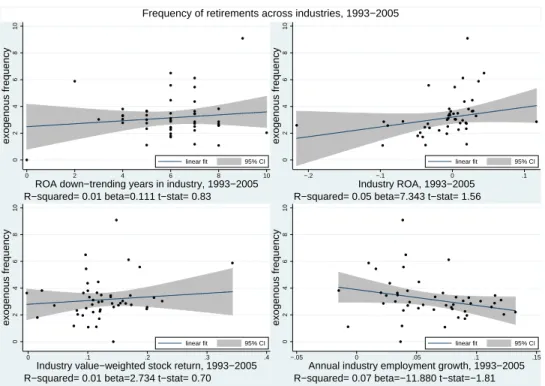
We also show that industry conditions affect the CEO’s decision to depart the firm voluntarily. Potential quits are more frequent in industries with down-trending ROA, and with lower average stock returns and ROA, suggesting that in those industries the outside option of the CEO of leisure or perhaps joining private firms is more valuable than the expected payments received by staying with the firm during the industry downturn. Retirements are less frequent in industries with higher employment growth, possibly indicating that part of the rent captured by active CEOs comes from empire building (e.g. managing organizations with many employees).
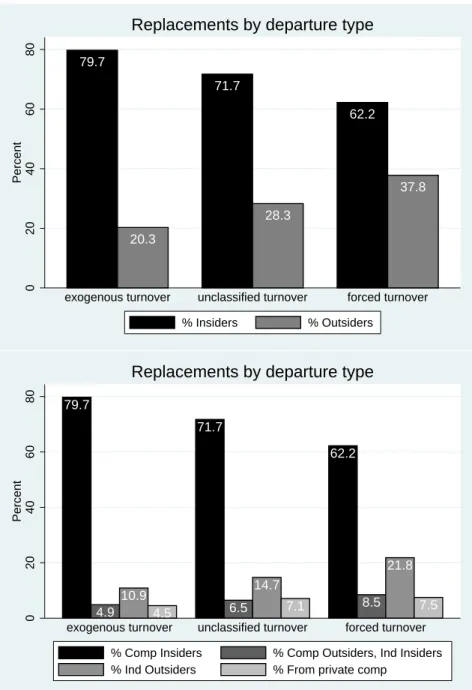
Replacement CEOs are significantly more likely to come from outside the firm and outside the industry when the firm does poorly in terms of stock returns and return on assets, or when the industry has low ROA, which are instances where typically the incumbent CEO is fired. Replacement CEOs are more likely to come from inside the firm if the turnover event was due to retirement or voluntary departure rather than forced turnover. The pay of replacement CEOs is highest in situations where the incumbent was fired and the new CEO is an outsider, as predicted by our competitive assignment model.
Our paper builds on the results of a large body of work8
on CEO turnover. One of the most documented facts is that relative performance evaluation (RPE) matters for CEO turnover: the probability of CEO turnover is negatively related to the performance of the firm relative to the industry (Barro and Barro (1990), Gibbons and Murphy (1990)) or to the market (Warner, Watts, and Wruck (1988)).
However, RPE does not seem to be the only driver of managerial changes. Jenter and Kanaan (2006) document that CEOs are more likely to be dismissed from their job after bad industry and bad market performance, and in light of these findings argue that RPE cannot be the sole determinant of CEO turnover. They suggest two hypotheses consistent with the empirical results. First, corporate boards may commit systematic attribution errors and credit or blame the CEO for performance caused by factors outside their control. Second, firm performance in bad times may be more revealing about CEO skill than performance in good times. In our model, the relevance of industry conditions
8
for whether or not a CEO is forced out comes from considering the firm and CEO as parties in a match whose actions depend on their respective outside options. The data support this idea since the type of turnover event helps to predict the type and pay of the replacement CEO chosen.
Several papers have focused on the relationship between corporate governance, com-pensation and CEO turnover. Huson, Parrino, and Starks (2001) find that the frequency of forced turnover and of outside succession increased over time during 1971 to 1994, and that board characteristics influence the likelihood of these events. Kaplan and Minton (2006) argue that the CEO turnover rate during 1992-2005 is higher than previously found for the prior two decades (11.8% versus 10%) and attribute this to boards becom-ing increasbecom-ingly more sensitive to the CEO’s performance. Peters and Wagner (2007) suggest that this recent increase in turnover has lead to a significant increase in CEO pay, as executives face a higher risk of losing their jobs.
The role of industry conditions on CEO turnover has not received much attention in the literature. This may be because historically, the literature on CEO turnover has focused on the role of boards as monitors of the firm and has attempted to ascer-tain their effectiveness in this role.9
Notable exceptions are Parrino (1997) and Eisfeldt and Rampini (2008). Parrino (1997) argues that intra-industry CEO appointments are less costly and performance measures are more precise in homogeneous industries, and, consistent with this argument, finds that the likelihood of forced turnover and of an intra-industry appointment increase with intra-industry homogeneity. Eisfeldt and Rampini (2008) show how aggregate business cycle conditions can drive CEO turnover and compensation in a principal agent environment where managers have private information about their skill. Their focus, however, is on external turnover due to mergers and acquisitions.
2
Model
Our model is similar to the competitive assignment models used to explain the rise in, and high levels of CEO compensation, except that in those models skill is one-dimensional and there is only one industry. In fact, we believe we are the first to develop a com-petitive assignment model with two industries, or markets, although the two market set up might be useful for modeling marriage markets, general labor markets, or real estate markets as well. Having two industries is useful for studying turnover, but it does add
9
complication since firm and manager outside options depend on conditions in both in-dustries. Similarly, one dimensional heterogeneity across managers and firms is a useful simplification which allows one to derive managers’ wage profiles as a function of talent in a straightforward manner. Considering that managerial skills are multidimensional is, however, more realistic and consistent with the evidence in Bertrand and Schoar (2003) which documents managerial fixed effects in management style, and Kaplan, Klebanov, and Sorensen (2008) who show that multiple personal characteristics matter for the suc-cess of a CEO candidate at getting the job. It is also natural to think that firms’ skill demands change over time, and are correlated within industries and we will utilize this idea.
Our modeling strategy is most closely related to Tervio (2008) who uses the model from Sattinger (1979) in which skills are one-dimensional, skill and size distributions are continuous, and firm size and CEO ability are complementary in production, to analyti-cally describe the relationship between CEO talent, firm size, and CEO pay. Gabaix and Landier (2008) employ extreme value theory to show quantitatively that such a model can explain the rise in and level of CEO pay. Finally, in a closely related model, Murphy and Zabojnik (2004) and Murphy and Zabojnik (2007) incorporate firm-specific vs. general skill by modeling firms as only being able to deploy a fraction of a new CEO’s ability. The remaining fraction represents firm-specific skill which can only be deployed by incumbent managers. Murphy and Zabojnik use their model to explain the rise in CEO pay by an increase in the importance of general managerial skills through comparative statics over this fraction. Our model and solution methods will closely follow Tervio (2008) adapted to our set up with multidimensional heterogeneity and more than one industry.
First, we will describe our general set up and illustrate how industry conditions might affect managerial and firm outside options. Since CEO-firm matches will dissolve when total match surplus becomes negative, such variation in outside options will naturally drive turnover events. In this general set up, we will allow for managers to retire, or to move to another job. Similarly, firms can choose to liquidate, or to find a new manager in the case that their match dissolves. In this framework, we can describe in general terms the effects of variation in industry conditions and outside options on turnover events. We also show how ambiguity in classifying turnover events as firings vs. quits is natural even in the model. This suggests that even with the best data of what goes on in board meetings one may not be able to classify turnover events with great precision.
simplify-ing assumptions. In section 2.2, we describe a two firm example. The example illustrates how our model generates relative and absolute performance effects on turnover. There is what appears to be relative performance evaluation even though there is no learning or asymmetric information in the model. The example also shows that when industry conditions deteriorate expensive outside replacements are brought in. These outside re-placements are expensive because in order for it to be optimal to replace the manager, the firm must acquire a manger with general skills which outweigh the loss of firm specific skills. General skills have positive market prices while firm specific skills have no value outside the firm. Thus, if it makes sense to replace the manager, the firm will need to pay the replacement more. In the two firm example, pay outside the one industry in which the two firms operate is exogenous. In section 2.3 we describe a more general economy, with two industries. In this economy, all allocations, wages, and profits are pinned down endogenously. We use the two industry economy to provide more detailed results. First, we show how the model generates both relative and absolute performance effects on turnover. In the model, CEOs of firms in the bottom of the poorly performing industry are fired whereas CEOs of firms in the top of the industry which fare better quit. We also describe the type, pay and performance of the replacement manager rela-tive to incumbent managers and retained managers at other firms. We show again that managers who are forced out in poorly performing industries are replaced with highly paid industry outsiders, and that performance improves under this replacement.
2.1
General Framework
There are two dates, zero and one. At each date, managers will be matched to firms via competitive assignment. To fix ideas, it is useful to first examine the decision problems of a single firm and manager at a single date. For this, we consider the decision problems of a manager and a firm who are currently matched in a competitive assignment economy. Neither the firm, nor the manager can commit to honoring long term contracts, so each must earn at least the value of their outside option in each period in order for the match to continue. The dynamics of optimal managerial compensation induced by agency problems when long term contracts are feasible is the focus of many recent theoretical papers.10
Although some of these papers do contain results about contract termination,
10
See for example, DeMarzo and Fishman (2007a), DeMarzo and Fishman (2007b), He (2007), DeMarzo, Fishman, He, and Wang (2009), He (2009), Sannikov (2008), and Lustig, Syverson, and Van Nieuwerburgh (2009). Sannikov (2008) considers the effects of variation in firm and managerial
their main focus is on compensation dynamics rather than CEO turnover. For the most part termination in these models is rare, and is largely used as a stick to provide incentives with rather than treated as an object of interest in and of itself. The limited focus on CEO turnover in the dynamic contracting literature is in contrast to the large empirical literature on turnover discussed above.
We consider a firm i which produces output using capital and the managerial input from manager j according to:
ai(mj)kα,
whereai(mj) is the productivity of capital when firmiemploys managerj, andα∈[0,1].
This productivity is given by (slightly abusing notation):
ai(mj) = S
X
s=1
θi,saj,s
where θi,s is a weight which describes the importance of skill s in determining the
pro-ductivity of capital deployed in firm i and aj,s is the level of ability of manager j in
skill s. Thus the productivity of manager j employed at firm i is the inner product of managerj’s skill levels and firmi’s skill weights. These weights vary over time and across firms. Moreover, these weights are likely to be correlated within industries, and subject to common shocks. For example, growing firms may have high weights on skills such as building and motivating a sales force, and firms in mature industries may place higher weights on cost cutting. Firms which can fund growth or operating leverage internally may not have a high weight on the ability to raise external finance, whereas firms needing to access capital markets might.11
Similarly, the importance of firm-specific vs. general skills may vary in the spirit of the evidence documented by Frydman (2005) for the time series of all firms. The abilities of managers may also vary over time. In particular, managers may gain firm-specific abilities through learning by doing during their tenure outside options on the agency costs of providing incentives. DeMarzo, Fishman, He, and Wang (2009) consider how exogenous variables affect the degree of agency costs and hence the dynamics of managerial compensation. Lustig, Syverson, and Van Nieuwerburgh (2009) study how managerial outside options affect the division of rents between managers and firm owners over time and study the induced distribu-tions of managerial compensation. He (2007) focuses on the effects of hidden savings on compensation dynamics. Edmans and Gabaix (2009) provide a survey of how these and other recent theories can explain “pay-for-luck”.
11
Firms may also value particular psychological characteristics or preferences of the CEO. For instance, Graham, Harvey, and Puri (2009) show that CEOs who are more risk tolerant tend to work for high growth firms.
with the firm. Although it is interesting to consider the decision by the manager to invest in accumulating different skills, for simplicity here we will assume that abilities are fixed and leave a study of that investment decision for future work.12
Bertrand and Schoar (2003) document managerial fixed effects in management style, consistent with abilities being somewhat rigid. For it to be optimal to replace a manager with a suboptimal skill set, we need to have that there are at least investment costs, adjustment costs, or time to build for managerial skills, which seems reasonable. The value or total surplus created by firmi when it is matched with manager j is
V ≡ai(mj)kα.
To keep things simple, there is no labor other than the managerial input in our model. Since we assume that there is no commitment on the part of the manager, the manager will always need to earn a value inside the match equal to the value of their outside option. The manager can quit, or they can retire. We assume that there is a market for managers in which the per period hedonic price of a manager is given by the market value of that manager’s ability bundle, which we denote by wj. This market is in the
spirit of that formalized in Rosen (1974) and Lancaster (1966). Rosen (1974) contains a description of the technical assumptions which determine the properties of the hedonic price function. If skill bundles are recombinable, and there is no arbitrage, this function will be linear but these assumptions seem strong for the CEO market and so we expect the price function to be nonlinear. Moreover, because bundles cannot be dismantled, the price of any particular skill will depend on the joint distributions of and demands for all skills. For this reason, when one is interested in the distribution of CEO pay it is convenient to assume that skills are one-dimensional, as in Sattinger (1979) and Tervio (2008). Here, we depart from this assumption but simplify our general model in order to solve for managerial wages. We illustrate ideas by solving a simple example in Subsection 2.2. Then, in Subsection 2.3 we solve a two industry version of our model with skill levels and weights carefully specified to allow us to solve the model for turnover and wages in a parsimonious way. We base our solution method on that in Tervio (2008) adapted to incorporate the additional heterogeneity and the existence of an alternative industry for managers.
12
In a recent paper Giannetti (2009) presents a model where compensation is designed to incentivize managers to invest in firm-specific skills.
If the manager can either stay at his current employer, quit for his next best employ-ment option, or retire, then the manager’s outside option is:
Vmj ≡max{w j, R}
where R is the value of retiring.
The firm’s owners will also need to be paid their outside option. The firm can fire the manager and hire a replacement, or it can liquidate. The firm’s outside option is given by: Vfi ≡max n max n {ai(mn)k α−(Vmn)}, L o .
The left hand argument is the value the firm receives with the optimal replacement manager, whereai(mn) andVmn are defined analogously to the productivity of manager j at firmi and the outside option of managerj defined above as a function of the market prices of manager n’s skills. The right hand argument, L, is the liquidation value of the firm.
The current match will dissolve if total surplus from the match is negative, in other words if the value created by the current match after payments to capital and labor, minus the manager’s outside option, minus the firm’s outside option, is negative, i.e. if:
(ai(mj)kα)−(max{wj, R})
− (max{maxn{ai(mn)kα−(Vmn)}, L})<0
or,
V −Vmj −Vfi <0.
This condition is analogous to what Murphy and Zabojnik (2004) describe as the “make or buy” tradeoff, except that skills are multidimensional.
Considering this general model, there are several channels through which changes in exogenous variables such as industry conditions might drive total surplus below zero and thereby drive CEO turnover. Throughout the description of this model we used simple notation and suppressed the dependence of skill weights, skill prices, the pool of replacement managers, the value of retirement and liquidation and the productivity of capital on industry conditions. However, we think that such conditions likely affect all of these variables. Consider first the potential effects of a deterioration in industry conditions on the outside option of the firm. As the industry declines, the optimal
managerial skill bundle may change, for instance to more heavily weigh cost cutting or the ability to access capital markets. We model this explicitly in sections 2.2 and 2.3. Firms may find it profitable to fire incumbent managers and hire managers with the newly more desirable bundle. Thus our model can generate more forced turnover or firings when industry conditions are poor under what seem to be reasonable assumptions about the relationship between the firm’s outside option and what is going on in the industry. Next, consider how industry conditions might change the outside option of the manager and lead to managers quitting for better jobs or retiring. Changes in industry conditions can change skill prices and lead the manager to leave for greener pastures. Finally, industry conditions can change the relative value of retirement through affecting the disutility of work and the value of retirement compensation packages.
Industry conditions affect turnover in the competitive assignment model and in the data. However, firm relative to industry performance is the most important predictor of observing an instance of forced turnover, both in our data and in that of previous studies. The finding that RPE apparently has such a large empirical contribution to turnover seems to suggest that there is quite a bit of private information and/or learning about CEO ability. However, note that even without private information one might observe what would appear to be RPE driven turnover in data generated by a model like the one described. In particular, if there are any fixed costs of managerial replacement (such as the loss of firm specific skills), such fixed costs will lead to a cutoff rule for performance below which managers will be fired.13
Thus, finding that RPE drives turnover does not show that boards are effectively dealing with a problem of asymmetric information. The empirical relationship between poor performance and turnover may simply be due to variation in the importance or level of firm or industry specific skills which may lead only the poorest performing firms to seek replacements. Alternatively, there may be other fixed costs of replacement which would also lead to performance thresholds for firing managers. On the other hand, the converse is also true. Even if the data did not find such strong support for RPE, one could still not conclude that boards were not using RPE to gauge talent and effort if other drivers for turnover also exist. We believe that both learning about unobservable managerial skills, and shocks to demands for observable talents, are potentially important contributors to CEO turnover.
13
In general, in a dynamic model, such fixed costs will also lead to real option like behavior in the decision to replace managers. For simplicity, we study a two period economy in section 2.3 in which such real option considerations have no role. It would be interesting to consider a longer horizon model with real option effects, but we leave this to future work.
Explicitly considering the outside options of both managers and firms in our com-petitive assignment framework illustrates another, perhaps surprising feature of such a model which is also consistent with the data. In the model, as in the data, it is actually quite difficult to label a separation as a “quit” or “fire”. Since empirically separations are typically labeled as quits or fires by utilizing news stories as we do here, one might think that the large fraction of turnovers which can neither be labeled as quits or fires are simply misclassified due to lack of information. One might think that if one had perfect data, that all separations should be able to be labeled one way or the other. However, even in data generated by the model, quite reasonable theoretical definitions of quits and firings would imply that for a large fraction of separations, the agent who initiated the separation is ambiguous. Separations occur when the total surplus from the current match is negative. As discussed, this can occur for many reasons on the part of the firm and the manager, both of whose outside options vary over time, or it can be that the total value of the match declines. Furthermore, the outside options of the firm and the manager, as well as the value created by the match depend on the same variables, namely, skill weights and prices.
We discuss this ambiguity in the context of one specific definition of “quits” vs. “fires” but note that the model permits others. We introduce time subscripts and suppress individual agent subscripts to define a separation as follows:
Definition 1 A separation occurs in the current period when a match satisfies the following two conditions:
Condition 1 Vt−Vtm−Vtf <0 and Condition 2 Vt −1−Vtm−1−V f t−1 >0.
Now, consider defining a separation as initiated by one agent (either the manager or the firm) if that agent would choose to remain in the match with the current match value and the current outside option of the other agent, but with their own lagged outside option. This separation must satisfy conditions 1 and 2 as well as either
Condition 3 (Q) Vt−Vtm−1−V
f t >0
Condition 4 (F) Vt−Vtm−V f t−1 >0
if the separation is a fire. Note that conditions 1 and Q together simply say that Vm t > Vm
t−1, while conditions 1 and F together simply say thatV
f t > V
f
t−1. These two inequalities
are not mutually exclusive, so clearly many separations would be unclassified under this definition. We can, however, refine this definition further.
Add to the definition above that the initiating agent would not want to remain in the match even given the current match value, that agent’s current outside option, and the other agent’s lagged outside option. If conditions Q and F are associated with quits and fires, these new conditions basically state that quits must also not be firings, and likewise firings must also not be quits. In other words, they require that the separation also satisfy
Condition 5 (¬F) Vt−Vtm−V f t−1 <0
if the separation is a quit, and Condition 6 (¬Q) Vt−Vtm−1−V
f t <0
if the separation is a fire.
Then, a quit can be defined as a separation which satisfies Q and ¬F. Combining these two conditions, and condition 1 with condition Q yields the following definition of a quit:
Definition 2 A separation is a quit if Vm
t > Vtm−1 and Vtm−Vtm−1 > V
f t −V
f t−1.
Similarly, a fire can be defined as a separation which satisfies F and ¬Q. Combining these two conditions, and condition 1 with condition F yields the following definition of a firing:
Definition 3 A separation is a fire if Vtf > Vtf−1 and Vtf −Vtf−1 > Vm
t −Vtm−1.
Even these very loose definitions permit separations that cannot be classified in cases in which the total value of the match drives the surplus negative and outside options remain unchanged. More strict definitions of quits and fires, such as the one given by conditions Q and F only, or requiring a quit to satisfyVtm > Vtm−1 andV
f t ≤V
f
t−1 and requiring a fire
to satisfy Vtf > Vtf−1 and Vtm ≤ Vtm−1, would lead to even more ambiguous separations.
However, note that in the model, as in the data, the type of replacement manager, and the compensation of that manager, would yield additional information about the type of separation observed.
2.2
Two Firm Example
We now consider CEO turnover and pay in a simple stylized equilibrium example of our model. There are two firms (A and B) in the industry, and four potential managers (w, x, y, and z), each with three skills, namely, industry or firm specific knowledge, sales growth ability, and cost cutting ability. There are two dates, 0 and 1. Production is linear (i.e., α= 1), the interest rate is zero, there is no labor, and capital k is fixed at 1 unit for each firm.14
Table 1 describes the firm skill weights and managerial skill levels. At date 0, Firm A has θ weights (3, 2, 0) on the 3 skills respectively. Firm B has θ
weights (0, 1, 0) on the 3 skills respectively. Thus, both firms weight sales growth ability, and firm A weighs industry specific skills more heavily (it produces a more complex good, for example). Firm A is more productive since all weights are at least as great as those for firm B. Manager w has skill levels (1, 1, 0), manager x has skill levels (0, 1, 0), manager y has skill levels (0, 0, 1), and manager z has skill levels (0, 0, 3), for the 3 skills respectively. Thus, manager w has industry specific skills and sales growth skills, manager x has sales growth skills, and managers y and z have cost cutting skills. Managers who do not get hired may deploy their non-industry specific skills in another industry which has weights equal to one on sales growth and cost cutting and capital equal to 1
2. Firms in this alternative industry face free entry and earn zero profits, thus,
managers’ who are not hired have outside options equal to 1 2
P
s=2:3as.
An equilibrium at date 0 is an allocation of managers to firms, wages paid to managers, and firm profits, such that no manager and no firm prefers an alternative allocation. One such equilibrium is as follows: Firm B hires manager x, produces 1 unit of output, pays the manager 1
2 +ǫ in order to make the manager prefer to work at firm B instead of in
the alternative industry, and has profits of 1
2 −ǫ. Firm A hires manager w, produces 5
units of output, pays the manager 1
2 + 2ǫ in order to make the manager prefer to work
at firm A instead of firm B, and has profits of 41
2−2ǫ. Table 2 describes the equilibrium
allocation at date 0.
At the beginning of time 1, a shock changes the weights on the skill bundles at firm A and B. The formerly young industry is now mature and firms A and B should cut costs instead of growing sales. At date 1, Firm A’s θ weights are shocked to (3, 0, 2) on the 3 skills respectively. Firm B’sθ weights are shocked to (0, 0, 1) on the 3 skills respectively. Due to the shock to the skill weights, output in the industry immediately falls from 6
14
One can incorporate variation in size if one considers theθ weights to be weights times capital. In other words, define ˜θj
units to 3 units. Firms may choose to terminate their managers and replace them. First, imagine that only managers (w, x, and y) are available. In this case, one equilibrium is as follows: Firm B hires manager y, produces 1 unit of output, pays the manager 1
2+ǫin
order to make the manager prefer to work at firm B instead of in the alternative industry, and has profits of 1
2 −ǫ. Firm A decides to retain its manager, w, produces 3 units of
output, pays the manager 1
2 +ǫ in order to make the manager prefer to work instead
of being employed in the alternative industry for 1
2, and makes profits of 2 1
2 −ǫ. Thus,
in this case, only the relatively poorly performing firm fires its manager. However, if manager z is available, a candidate equilibrium is: Firm B hires manager y, produces 1 unit of output, pays the manager 1
2 +ǫ in order to make the manager prefer to work
at firm B instead of in the alternative industry, and has profits of 1
2 −ǫ. Firm A hires
manager z, produces 6 units of output, pays the manager 21
2 + 2ǫ in order to make the
manager prefer to work at firm A instead of firm B and makes profits of 31
2 −2ǫ. Thus,
the industry shock may cause both firms to turn over their CEO’s. Table 3 describes the equilibrium allocation at date 1.
Firms will not want to pay for skills they do not find valuable, so when a shock changes skill weights they are likely to look outside the industry, where these new skills have been previously productively deployed, for their replacement. Notice also that if the outside option of deploying general skills in other industries is higher than that of deploying industry specific skills, the outsiders will tend to be more highly paid relative to their contribution to output. In the example, consider firm A’s choice of replacement. To dominate the existing manager, the outsider replacement needs to be able to generate considerably higher output since all of that output is generated by skills with positive market prices. As a result, the firm will require much higher output under the new manager in order to be able to pay the manager the higher required wage and still increase profits. Thus, when an outsider is hired, output increases significantly and so does CEO compensation. In our example, output in the industry first decreases from 6 to 3 and then increases to 7 after managerial reallocation. CEO pay increases from 1 + 3ǫ
in the time 0 equilibrium allocation to 3 + 3ǫ in the time 1 equilibrium allocation.
2.3
Two Industry Economy
In this section, we consider CEO turnover in a two industry version of our example economy. The model generates turnover which is consistent with relative performance
evaluation, however overall industry performance is also a key predictor of turnover. The model has distinct predictions for quits vs. firings, and also speaks to the type and pay of the replacement manager. For example, one key fact which emerges from our empirical exercise below is that turnovers which occur in industry downturns are more likely to be forced turnovers which result in replacements by industry outsiders at relatively high pay. Our model also generates this result and yields the intuition that this is because industry downturns may be due to the fit of the manager deteriorating, causing the firm to look elsewhere for the necessary skills. Because firms who fire their manager must give up output from cheap firm specific skills, to improve output and raise profits they will require high levels of expensive general skills in their choice of replacement manager and hence replacement manager pay will be relatively high.
We extend the standard competitive assignment model in two ways. First, we con-sider mangers with multidimensional skills and firms with multidimensional skill weights. Second, we consider the equilibrium in an economy where managers’ outside options may be outside their current industry, in a competing industry where matching is also deter-mined via competitive assignment. To our knowledge we are the first to consider a two market competitive assignment model, however the framework would be interesting for other markets as well, such as marriage markets, student markets, real estate markets, or general labor markets.
The basic assignment model of Sattinger (1979), Tervio (2008), and Gabaix and Landier (2008) is built upon the following three simplifying assumptions: First, skills and firm characteristics are one-dimensional (managers have talent and firms have a size), second, the distributions of talent and firm size are continuous, and third, firm size and talent are complements. Assuming skills have only one dimension significantly simplifies the analysis because wages do not depend on the joint distributions of managerial skills and firm skill weights. However, if one chooses the distributions carefully, and adopts the assumptions that skill distributions and firm skill weights are continuous and firm skill weights and managerial skill levels are complementary, then the analytical techniques used in Tervio (2008) can be applied to solve for equilibrium wage and profit profiles.
There are two dates, zero and one. There are two industries, A and B, and two types of managers, x and z. All firms have capital stocks equal to one.15
There are measure one of firms in each industry, and measure one of each type of manager. Thus, there will be
15
One can incorporate variation in size if one considers theθ weights to be weights times capital. In other words, define ˜θj
no unemployment. Similarly, to keep things manageable, we will not consider retirement or liquidation here although they would be interesting extensions.16
As in the example above, skill levels and weights have three components, namely, firm specific skills, sales growth skills, and cost cutting skills, respectively. The level of firm specific skill will depend on the industry the manager works in. In industry A, the more productive industry, managers will develop firm specific skill in proportion to their general skill and will have firm specific skill greater than zero if they work at their incumbent firm and zero otherwise. Industry B is the less productive industry, and is a generalist industry. Managers working in this industry do not accumulate firm specific skill. General skill levels are fixed characteristics of managers. Type x managers have sales growth skills distributed uniformly between zero and two, and have zero cost cutting skills. Type x managers have firm specific skills ax
0 = ax1 iff they work at their incumbent firm in
industry A.
The opportunity cost of losing firm specific skills acts like a fixed firing cost and leads to what appears to be relative performance evaluation since only the poorest performing managers will be fired. However, note that there is no asymmetric information, and no learning in our model. One implication of the effect of firm specific skills is that cutoff levels for firing should be lower in industries where managers have high levels of firm specific skill and this seems to make sense.17
For managers of type x, we have,
ax0 ∼U(1,3),
if type xmanagers are incumbents at their industry A firms,
ax1 ∼U(1,3),
and ax
2=0. Type z managers havea
z
0 equal to zero even if they work at their incumbent
firm in industry B since industry B is a generalist industry. Type z managers have cost cutting skills distributed uniformly between zero and two, and have zero sales growth
16
One could consider varying the outside options of the least productive operating firmπ0 and least
talented employed managerw0 in the single market equilibrium. 17
This is basically applying the intuition used in Frydman (2005) and Murphy and Zabojnik (2007) used to explain the time series of turnover events to the cross section.
skills. Thus, for type z managers we have,
az2 ∼U(0,2),
and az
1=0.
Again, firm level productivity will be given by the inner product of managerial skill levels and firm skill weights. Firm skill weights can change over time. In particular, we will consider the effects on turnover and managerial compensation of a date 1 shock to the skill weights in industry A. At time zero, firms in industry A have skill weights as follows: θ0A∼U(1,3), θ A 1 ∼U(1,3), and θ A 2 = 0.
We assume thatθ0Aand θ
A
1 are perfectly correlated so that the firm with the highest firm
specific skill weight also has the highest general skill weights. When ordered between zero and one, the oneth firm has the highest weights and is the most productive. Firms in industry B have constant skill weights as follows:
θB0 = 0, θ
B
1 ∼U(0,1), and θ
B
2 ∼U(0,1).
Notice that industry A is more productive than industry B. Industry B also values both general skills. It is a generalist industry, and one that employs a pool of potential replacements for the more productive industry A. Since in practice CEO to CEO job transitions are rarely observed, one might think of the industry B managers as division managers in large firms.
At date zero, managers are matched with firms via competitive assignment. Given our assumptions, at this date the economy reduces to two distinct competitive assignment markets, and the equilibrium assignment is given by the equilibrium assignments in each of the markets separately. All managers of type x will work in industry A, and all managers of type z will work in industry B. Industry A only values sales growth skills, which are possessed by type x managers. Since industry A is more productive and will pay more for these skills, type xmangers will choose to work there. We assume that the economy at date t = −1 is described by the same parameters as those at time zero, so that all managers in industry A have ax
0 > 0 since they will work for their incumbent
firms.
Our analysis closely follows that in Tervio (2008) and it may be useful for the reader to refer to Section I of that paper for additional details. As in Tervio (2008), it will be convenient to consider the inverse distribution functions for skill levels and skill weights. Managers and firms are ordered on the unit interval as described above so that for each manager type y ∈ {x, z} and each skill type n ∈ {0,1,2} ay
n[i] is the skill level of a
quantileitypeymanager and the derivative of the inverse distribution satisfiesay′
n[i]≥0
for each skill type, with strict inequality for general skills. For each manager and skill type, if Fy
an is the cumulative distribution ofan for type y, then the profile of an is given by
ayn[i] =ayn s.t. Fay
n(an) =i. Basically, ay
n[i] gives the ability level of the ith type y manager. The inverse
dis-tribution functions for firms’ skill weights are defined analogously for industries A and B.
In each industry, the equilibrium assignment must satisfy two types of constraints. First, the sorting constraints state that each firm must prefer hiring its manager at their equilibrium wage to hiring any alternative manager at that replacement manager’s equi-librium wage. Second, the participation constraints state that all firms and individuals must earn their outside option for opportunities outside of industries A and B. In our economy, we set these outside options to be equal to zero, and leave the study of vari-ation in liquidvari-ation and retirement options to future research. We have the following constraints where boldface type is used to denote vectors:
V(ax[i],θA[i])−wx[i] ≥ V(ax[j],θA[i])−wx[j] ∀i, j ∈[0,1] SC(i, j) (1) V(ax[i],θA[i])−wx[i] ≥ 0 ∀i, j ∈[0,1] P C θA[i] (2)
wx[i] ≥ 0 P C ax
[i] (3)
Analogous sorting constraints must hold across industries, but we ignore them at date 0 since they will not be binding. They will bind for some agents at date 1. Note also that the only binding sorting constraints within an industry are those which consider hiring the next best manager. Since firms in industry A at time zero haveθA
2 = 0, and managers
of typex have ax
2 = 0, to compute the efficient assignment in industry A one only needs
to consider the effects ofax
1 and θ
A
1. Moreover, because firm specific skills are not valued
outside the firm, wages in industry A will be determined solely by the distributions for
ax
studied in Tervio (2008). Analogous constraints must be satisfied in industry B which will employ type z managers. Since managers of typez only have cost cutting skills az
2,
to compute the efficient assignment in industry B one only needs to consider the effects of az2 and θ
B
2 . The participation constraints will bind for the lowest ability manager and
the lowest productivity firm.
We now solve for wages and profits at time zero. Regrouping the sorting constraints for types i and i−ǫ and dividing byǫ yields:
V(ax[i],θA [i])−V(ax[i−ǫ],θA [i]) ǫ ≥ wx[i]−wx[i−ǫ] ǫ .
Taking the limit as ǫ→0 we get the slope of the wage profile for type x managers:18
wx′[i] =V
a(a
x[i],θA
[i])·ax′[i].
Finally, integrating, and adding the binding participation constraint yields the wage profile: wx[i] =w0+ Z i 0 Va(a x [j],θA[j])·ax′[j]dj
Again, since firm specific skills are not valued outside the firm, and firms in industry A at time zero have θA
2 = 0, to compute wages one only needs to consider the effects of a
x
1
and θA
1. Note that the sorting constraints could have been written from the manager’s
perspective, and an analogous profile for profits can be obtained as follows:19
πA[i] =π0
+ Z i
0
Vθ(ax[j],θA[j])·θA′[j]dj.
Using the distributions for θA and ax, the definition V(ax[i],θA[i]) =ax[i]·θA[i]kα, 18
Note that because of the discontinuity in the value ofa0 as managers change firms one technically
can’t use this argument for firm specific skills. Firm specific skills are unpriced and have a wage of zero at date zero. One can think of taking the limit only over the part ofV which comes from general skills, and then adding the output and profits from general skills separately.
19
Here again, due to the discontinuity in ax
0 across firms, one can integrate over the general skills
and the fact that k = 1∀i, we have that output in industry A is given by:20
VA(i, i) = 1 + 6i+ 8i2
wages, or managerial outside options are given by,21
wx(i) = 2i+ 2i2
and firm profits are given by22
πA(i) = 2 + 6i+ 6i2.
When the retirement option has zero value, then w = Vm where Vm is as described in
Section 2. Similarly, when liquidating has zero value, then π=Vf.
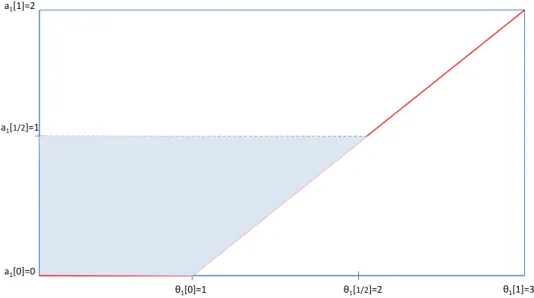
Figure 1 graphs output, wages, and profits in industry A. Take for example, firm 1 2
who is matched with manager 1
2. Output is 6. Of this, 1.5 is paid to the manager and
4.5 is retained by the firm. However, note that the manager receives the majority of the portion of output created from general skills, which is 2. These wages are graphed in figure 1 as the shaded area to the left of the matching function for the (1
2, 1
2) match.
Similarly, for industry B, which in equilibrium employs managers of typez, we have:23
VB(i, i) = 2i2
wages, or managerial outside options are given by,24
wz(i) = i2
and firm profits are given by25
πB(i) =i2. 20
To compute output, note that output equalsθ0(i)a0(i) +θ1(i)a1(i) +θ2(i)a2(i) and use the
distribu-tions for skills and skill weights to compute output as a function ofi. In particular, note thatθA
0 = 1+2i, ax
0 = 1 + 2i,θA1 = 1 + 2i,a1x= 2i,θ2A= 0, andax2 = 0. 21
For wages, note thatax
1[j] = 2j so thatax1′[j] = 2, andθA1(j) = 1 + 2j so Ri 0θ A 1(j)dj =i+i 2 . 22
For profits from general skills, note thatθA
1(j) = 1 + 2jsoθA1′(j) = 2 andax1(j) = 2jso Ri 0a x 1(j)dj= i2 . 23
To compute output, note thatθB
0 = 0,az0= 0,θB1 =i,a1z= 0,θA2 =i, andaz2= 2i. 24
For wages, note thataz
2[j] = 2j so thataz2′[j] = 2, andθB2(j) =j so Ri 0θ A 2(j)dj = 1 2i 2 . 25
For profits from general skills, note thatθA
2(j) =j soθ1B′(j) = 1 andaz2(j) = 2j so Ri 0a z 2(j)dj =i 2 .
a1[1]=2
a1[0]=0
a1[1/2]=1
θ1[0]=1 θ1[1/2]=2 θ1[1]=3
Figure 1: Industry A General Skill Output, Wages, and Profits.
We now consider a shock to firm skill weights in industry A, and the resulting effects on managerial assignment and turnover, and wages and profits in industries A and B. Imagine that industry A had been a growing industry but has now matured and firms thus need to focus on cost cutting instead of sales growth. This change in industry conditions induces a change in the skill weights in industry A. In particular, we examine the effects of a switch in which θA
1 and θ2A exchange values. Thus, θ1A becomes zero for
all firms, and θA
2 becomes positive and is distributed uniformly across firms between one
and three. Weights in industry B do not change.
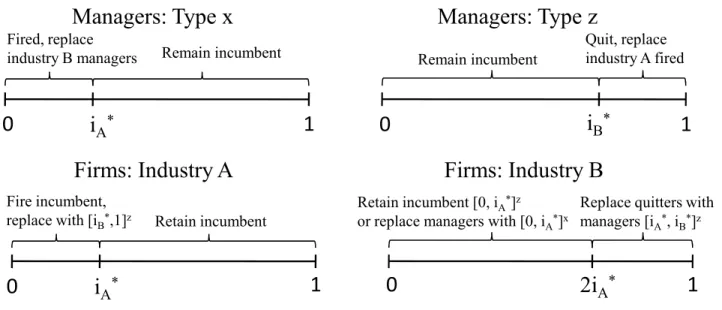
We show that the resulting reallocation of managers is as follows: The most talented managers in industry A remain with their firms. They are incumbents. There is a cutoff level of talent below which all managers in industry A are fired and reallocate to industry B. Call the index of this talent level i∗
A. Because industry A is more productive,
the managers at the top end of industry B will quit and reallocate to replace the fired managers at the bottom of industry A. Call the index of the talent level above which type z managers quit industry B to work in industry A i∗
B and note that i∗B = 1−i∗A.
The fired managers from industry A will go to work in industry B.
We solve for the competitive assignment equilibrium at date 1 as follows: First, we guess that there is a cutoff rule for managerial turnover as described above. Then, conditional on this rule, we compute equilibrium wages and output. We can then solve for the cutoff value, and verify that we have found an equilibrium. The equilibrium must
a2[1]=2
a2[0]=0
a2[1/2]=1
θ2[0]=0 θ2[1/2]=2 θ2[1]=3
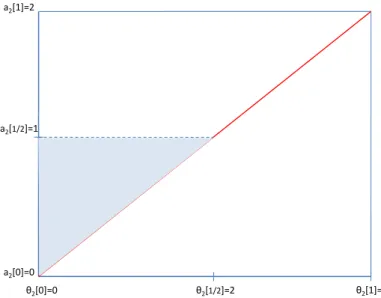
Figure 2: Industry B General Skill Output, Wages, and Profits.
satisfy the sorting constraints described for the date zero assignment. In addition, the date 1 skill weights imply that cross industry sorting constraints will bind for the firms and/or managers at the cutoffs i∗
A and i∗B. In particular, firm i∗A must be indifferent
between hiring their incumbent manager, and firing their manager and replacing them with the oneth manager from Industry B. This condition will pin down the cutoff value
i∗
A. Similarly, manager i∗B must be indifferent between quitting industry B to work at the
bottom of industry A, and staying in industry B. Figure 3 describes the turnover and reallocation of managers in industries A and B.26
To compute the equilibrium allocations, it is easiest to begin with industry B since managers there will not have outside options in industry A, whereas managers in industry A may have outside options in industry B. In industry B, the top managers quit and move to industry A. The firms whose managers quit can either hire the fired type x managers being reallocated from industry A, or they can hire the top end of the type z
managers which choose to remain in industry B. When i∗
A < i∗B, they prefer the higher
skilled type z managers. Now, consider the firms in the bottom of industry B, below the quitting threshold i∗
B. These firms will retain their managers, but also absorb the fired
managers from industry A. The measure of managers being reallocated from industry A is i∗
A. Since industry B firms value both sales growth and cost cutting skills, they are 26
This figure and the wage and profit calculations which follow are conditional on i∗
A < i∗B. If the
opposite is true, similar conditions will hold with mixing in industry B of managers of both types up to the managers with indexi∗
Managers: Type x
Managers: Type z
0
i
1
A*Firms: Industry A
Retain incumbent Fire incumbent, replace with [iB*,1]z0
i
1
A*Managers: Type x
Remain incumbent Fired, replace industry B managers0
2i
1
A*Firms: Industry B
Replace quitters with managers [iA*, i
B*]z Retain incumbent [0, iA*]z
or replace managers with [0, iA*]x
0
i
1
B*Managers: Type z
Quit, replace industry A fired Remain incumbentFigure 3: Turnover and Reallocation in Industries A and B.
indifferent between hiring type x and type z managers with the same index. Thus, the distribution at the bottom of industry B will be a mixture of the type x and type z
managers with indexes less than i∗
A and will have total mass 2i∗A. In this region, as one
considers firms with higher indexes, skill will not increase as quickly as in the top region of industry B in which there is no mixing. In particular, as one changes the firm index in this region we have that a′[i] = 1. For all output and wage calculations we use i to denote the firm index, which after reallocation may differ from the index of the manager. Thus output for firms in industry B withi <2i∗
A isi
2
. Wages at firms in industry B with
i < 2i∗
A are
1
2i
2
. With those payments in hand, one can compute the wages of firms at the top of industry B. Firms in industry B with indexes i > 2i∗
A produce output equal
to (i)(2i −2i∗
A). These firms pay wages equal to
1
2i∗A+i
2
− 2i∗2
A. Talented managers
quitting industry B and being replaced by lower ability managers from industry A leads to a decline in output in industry B after the departures. Both wages and profits also decline. Interestingly, profits fall by more than wages even though the average ability of managers in industry B declines and nothing about firm characteristics has changes. This is because the managers have better outside options than industry B firms do.
With the allocations and payments in industry B in hand we can compute allocations and payments in industry A. Firms at the top of industry A, with indexes i > i∗
A,
retain their managers. Firms at the bottom of industry A, with indexes i < i∗
A, fire
performance evaluation is consistent with the pattern of forced turnover in industry A even though there is no private information or learning about ability. Moreover, absolute performance also matters. Output immediately falls in industry A when the shock to the weights occurs due to the mismatch between firms’ skill needs and the supply of those skills by their assigned managers. Even after reassignment, total output and profits in industry A will be lower than before the shock. However, output at firms who fire their managers will be higher after reallocation than both prior to and after the shock, and for the most poorly performing firms the same is true for profits. This is consistent with the pattern we see in the data, as we discuss in section 4. Firms in industry A with indexes i > i∗
A retain their managers and produce output equal to (1 + 2i)(1 + 2i). All
output is generated by firm specific skills since there is zero value from sales growth skill in industry A after the shock. Firm specific skills lead to only the poorest performing firms in industry A firing their managers, since doing so entails losing the output and profits from these skills. Since firm specific skills are unpriced, they are cheaper. Even so, managers at these firms do not earn zero wages since they must prefer to stay in industry A rather than quit and go to the top of industry B. The cross industry sorting constraints thus lead to firm specific skills earning rents for the owning managers. Wages at these firms are thus 1
2i∗A+i
2
−i∗2
A, and are lower than before the shock. Firms in
industry A with indexes i < i∗
A fire their managers and replace them with managers
with indexes i ∈ [i∗
B,1]z from industry B. Output is (1 + 2i)(2i+ 2−2i∗A). Wages are
2i+ 2i2
−6i∗
B+ 2iB∗.
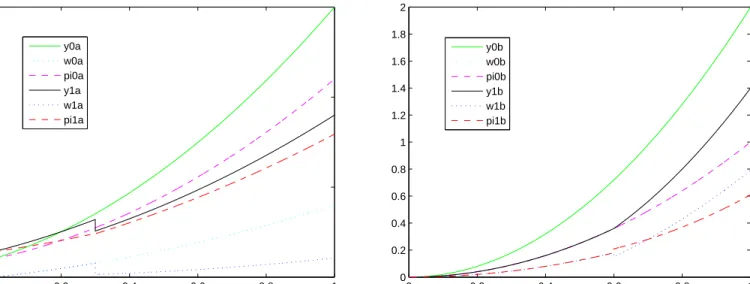
Figure 4 plots output, wages, and profits in industries A and B.
3
Data
We use four main sources of data: Execucomp for the name and compensation of the CEOs of 2779 publicly traded companies during 1992-2006, CRSP/Compustat for stock returns and accounting data for these firms, the industries they belong to, and for stock market returns, the Bureau of Economic Analysis for industry data referring to both public and private firms, and Factiva for news stories published in a three-year window around CEO departures. The information in Factiva allows us to determine the reason why a CEO left and where the replacement CEO came from.27
27
We are also grateful to Dirk Jenter for sharing the data from Jenter and Kanaan (2006) regarding whether or not a CEO was forced out or left the firm voluntarily (possibly by retiring). Because
0 0.2 0.4 0.6 0.8 1 0 5 10 15 y0a w0a pi0a y1a w1a pi1a 0 0.2 0.4 0.6 0.8 1 0 0.2 0.4 0.6 0.8 1 1.2 1.4 1.6 1.8 2 y0b w0b pi0b y1b w1b pi1b
Figure 4: Output, Wages, and Profits in Industries A and B.
We identify 2068 instances where a CEO was replaced, and for which we know both the reason for the incumbent’s departure, as well as where the new CEO came from. The replacement event is defined based on whether the same individual has the CEO title (ie., for this individual the Execucomp variableCEOAN N takes the value ”CEO”) during the current and subsequent year. If the name of the CEO in year tis different from the name of the CEO in yeart+1, we record this as a turnover event in yeart. Later in the analysis we will refer to the turnover yeartas time 0. Of all replacements events, 613 (29.7%) are the result of a planned retirement decision, announced at least six months prior to the actual departure date, or of a health-related reason. Another 323 (15.6%) replacements are instances where the incumbent CEO was forced out, according to newspaper stories related to the departure. The remaining 1132 (54.7%) cases are those that do not fit in any of these two categories – retirements or firings – and thus we will label them unclassified departures. These events include instances where the incumbent voluntarily left the firm, and therefore we also refer to them as potential quits. Since these unclassified departures are the residual category, one might expect them to behave like a weighted average of retirements and forced turnovers. This is true for some empirical relationships our sample is longer, our data set contains 50% more instances of turnover and we classify these as forced, unclassified (potential quits), and retirements. Note that we also collect data on the identity and background of the replacement CEO, and pay and performance subsequent to turnover events. For turnover events which we identified as forced turnover and which also occurred in the Jenter and Kanaan (2006) dataset, our classification schemes agreed for 75% of such events. We were also able to identify 16 cases of forced turnover (5% of observations) which we had previously categorized as unclassified by using the Jenter and Kanaan (2006) data.
(for example the relationship between relative firm performance and the likelihood of turnover), but unclassified departures have some distinct characteristics also. We discuss this more in section 4, but, for example, they have the strongest negative relationship of all turnover types with contemporaneous market returns.
Our definition of departure type is different from the algorithm described in Par-rino (1997) and followed by several other papers, in two significant ways. First, and most important, the extant literature on turnover identifies just two types of departures: forced and unforced (the latter including retirements). However, since an employment relationship is the result of a two-sided matching process that depends on conditions in the executive labor market, we allow for turnover to happen for three reasons: the firm chooses to terminate the match, the CEO chooses to terminate the match but is still active in the executive labor market, or the CEO leaves the executive labor market for exogenous reasons such as age and health. These three types of departure have different theoretical reasons, as the model suggests, and will be predicted by different variables in the empirical analysis.
Second, unlike Parrino (1997), we do not condition on the incumbent CEO’s age to define a departure as forced or not. Parrino (1997) classifies as forced departures all cases where the CEO is younger than 60, and (1) related news stories do not report the reason for departure as involving death, poor health or the acceptance of another job, or (2) the firm reports the departure as a retirement, but does so less than six months before succession. We believe that it is possible that in some of these instances managers voluntarily quit the job – they were not fired, nor did they choose to leave the executive labor market (i.e. retire.) Hence, while in papers using the Parrino (1997) algorithm the age of the departing CEO is a significant and negative predictor of forced turnover because of the way forced turnovers are defined, in our analysis this mechanical relationship does not exist.
4
Empirical Results
The three novel theoretical predictions that we will test empirically are as follows: (H1) When industry conditions deteriorate, forced turnover is more likely to occur. (H2) When industry conditions deteriorate, replacement CEOs are more likely to have skills different from those of departing CEOs.