Processes integration and coordination in collaborative models to supply chain
management
PhD student: Ing. VILLARREAL, Pablo David
RESEARCH AREA
Supply Chain Management, Agent-oriented Software Engineering, Workflow, DecisionFlow.
RESEARCH ABSTRACT
To face a global and extremely competitive market, the enterprises have changed the manner in which they executed their business processes to maximize the efficiency of supply chain management. This change was supported by the new technology (Hayes, 2000). Enterprises have moved from internal information integration to information exchange with other enterprises (cooperation) and actually to collaboration with the objective of mitigating the problems produced by the uncertainty parameters involved in the definition of the materials flow in the supply chain. Among them, we can mention the demand variability increases as one moves upstream in a supply chain (from customer to first supplier) with increasing amplitude called “bullwhip effect” (Lee et al., 1997).
The term collaboration implies that business processes are jointly derived, jointly affirmed, jointly executed and jointly measured. Collaborative relationships transform the way of sharing information and drive change to the underlying business process. The management of collaborative relationships implies the design of a collaborative model and the implementation of technological tools that support not only the information exchange but also the coordination and execution of business processes over Internet. Based on a collaborative model proposed by Caliusco and Villarreal (2001), some doctoral thesis are being currently developed. One of them, presented in this work, is focused on analyzing the management and coordination of business processes over the Internet.
Following, the main characteristics of collaborative models are discussed and then the specific research topics are presented.
Collaborative Models for Supply Chain Management
Some collaborative models were proposed, one of them that has been developed and successfully implemented by some enterprises like Wal-Mart and Procter & Gamble is the CPFR model. Chapman and Petersen (2000) presented a model for supply chain collaboration called DAMA (Demand Activated Manufacturing Architecture) model. The difference between their model and the CPFR model is that CPFR focuses on the manufacturer/distributor partnership and the DAMA model assumes a collaborative supply chain with multiple trading partners collaboratively working to meet consumer demand.
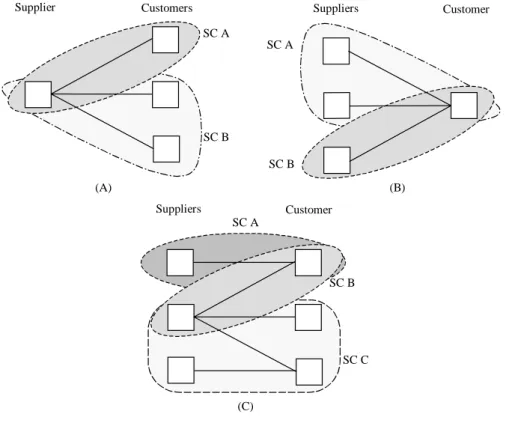
The DAMA model proposes a global coordination of all trading partners of the supply chain. This global supply chain management may consist of one to four global activities (defining products, forecasting and planing capacity commitments, scheduling products and product delivery, expediting production and delivery exceptions) to be collaboratively executed by all the trading partners. The DAMA model is appropriate for the supply chain collaborative management of some type of industry where each enterprise has a high participation level in the supply chain. However, a manufacturing enterprise usually participates in two or more supply chains. For example, an enterprise that produces tetra brick packages provides the milk industry, the juice industry, the wine industry, etc. Another case is that of the enterprises that produce corrugated cardboard, which also provide the mentioned industries. In these cases, the manufacturing enterprises have a relationship among them as the one represented in Figure 1 (a), where the supplying manufacturing enterprise provides several manufacturing enterprises belonging to different supply chains.
Other frequent type of relationship among manufacturing enterprises is the one represented in Figure 1 (b), where a manufacturing enterprise is provided by two or more manufacturing enterprises belonging to different supply chains. For example: a milk enterprise is provided by the corrugated cardboard manufacturer, the tetra brick manufacturer, the polystyrene manufacturer, etc.
By analyzing these examples, it can be seen that the relationship among these manufacturing enterprises is not a linear one as the textile industry modeled by DAMA, but a complex relationship as represented in Figure 1 (c).
achieve this relationship, collaboration must be supported by a peer-to-peer relationship model. This model was developed by Villarreal et al. (2001) and considers a decentralized relationship between two manufacturing enterprises.
B2B RELATIONSHIPS FOR COLLABORATIVE MANAGEMENT
Implementation and application of an inter-enterprise collaborative management model, which is technologically enabled by Internet, lead to the design and implementation of a Business-to-Business (B2B) relationship between two or more enterprises. There are different types of B2B models based on Internet that have been applied to various business contexts: electronic catalogs, electronic auctions, e-procurement, etc. Currently, these B2B models are being implemented through Marketplaces B2B models, which are also called e-Hubs, B2B Electronic Markets o e-Markets. B2B Marketplaces can function as Internet-based intermediaries that focus on specific industry verticals or specific business processes and use various market-making mechanisms to mediate any-to-any transactions among businesses (Dai and Kauffman, 2001).
The management of a collaborative relationship with one or more partners implies the creation of a set of processes that are particular to the organization (internal processes) and others that are to be carried out jointly by the enterprises (external processes). For that purpose, it is necessary to focus on B2B relationships, supporting not only the information exchange among enterprises but also the inter-enterprise management and execution of business processes over Internet. In this way, the supply chain integration is possible at a higher level than what is achieved by the information exchange. This higher integration level of the supply chain is achieved by integrating the business processes among enterprises. This leads to the need for systems that support the management and coordination of internal and jointly executed processes, based on a B2B relationship over Internet.
The Internet-Based B2B concept has evolved to a set of Inter-enterprise relationships that go far beyond transactions or information exchange for buying and selling goods or services via Internet. Recently, a new kind of B2B relationship has arisen, which has been called electronic collaborative commerce or c-commerce. C-commerce is an emerging business model that is based on Internet technology-enabled interactions inside an enterprise, between an enterprise and its business partners, and among participants of a trading community. A trading community might be constituted by an industry or part of an industry, or a supply chain (Bond, 2000).
SC A SC B Supplier Customers SC A SC B Suppliers Customer SC B SC C SC A Suppliers Customer (A) (B) (C)
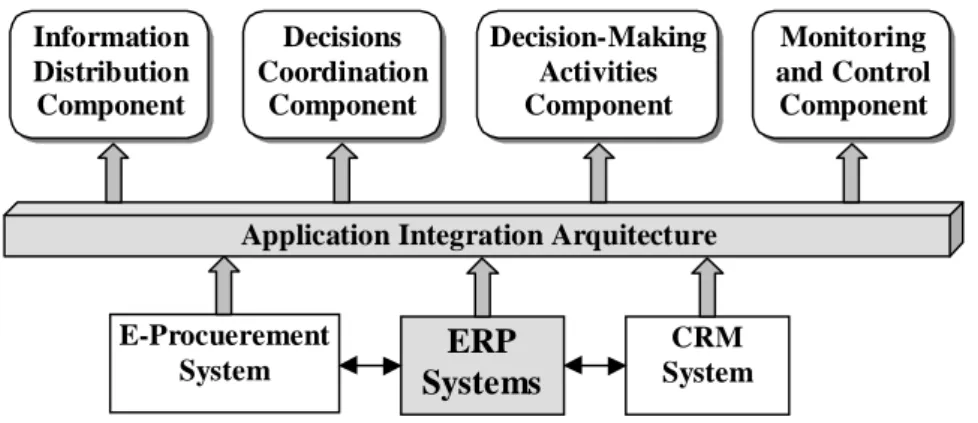
According to the previous characteristics to which a B2B relationship should tend for the implementation of an inter-enterprise collaborative model and with the aim of supporting it, Villarreal (2002) defined a high-level architecture to support the management of the collaborative processes of an enterprise and its partners, and the management of the internal processes of that enterprise. The architecture components are defined in a high abstraction level and they have a specific function. Each component represents a system, which is internally constituted by its respective software architecture to support and carry out their specific functions.
The defined architecture represents the systems and relationships among them, which are necessary for implementing an inter-enterprise collaborative management model. The architecture has four types of components: Information Distribution Component, Decisions Coordination Component, Monitoring and Control Component and Decision-Making Activities Component. The main function of the Information Distribution Component is to allow for information exchange. The Decisions Coordination Component has the function of coordinating and synchronizing the decision flow, the workflow and the information flow. The Monitoring and Control Component is the one in charge of capturing events and notifying when they can affect the already made decisions. Finally, the Decision-Making Activities Component supports each decision-making task being involved.
There is a set of business processes that constitute the enterprise operative processes, which are fundamental for the enterprise functioning and on which those processes that constitute the inter-enterprise collaborative management must be grounded. All this led to employing different operational systems, which support operative processes and are mainly focused on the enterprise transaction management. The systems constituted by a set of integrated applications that give support to internal operative processes are the so-called Enterprise Resource Planning (ERP) systems. The use of an ERP enables, among many other things, the integration of the enterprise operative processes through the different areas of the enterprise. This and other benefits have made the ERP systems become the fundamental management system on which the remaining systems involved in the e-business processes management operate (Kalakota, 1999). Therefore, any system oriented to support any B2B model must be integrated to the ERP system and/or to the enterprise legacy systems that support transactions. On the other hand, there are other systems that are also composed by integrated applications that manage transactions but they are focused on supporting transactions in a B2B relationship. E-procurement systems constitute one of them. Procurement is the process of obtaining material and services their inflow into the organization. Another types of transactions management systems are the ones focused on the Customer Relationship Management (CRM). Both CRM systems and e-procurement systems must be integrated to the ERP systems.
In order to manage inter-enterprise collaborative relationships focused on supply and demand planning processes, it is necessary to add an extra cluster. This cluster is constituted by the systems that enable the management of collaborative relationships between the enterprise and its partners. As a consequence, the proposed architecture components must be integrated to the remaining systems that manage and generate the information that constitutes the main source of information for the architecture components. Integration must be supported by applications integration architecture (Figure 2).
This thesis is focused on Decision Coordination Component. That is, the decentralized coordination of business and decision processes which are involved in a collaborative relationship between manufacturing enterprises.
ERP Systems
Application Integration Arquitecture
E-Procuerement System CRM System Information Distribution Component Monitoring and Control Component Decisions Coordination Component Decision-Making Activities Component
Decision Coordination Component
Managing parity collaborative relationships among enterprises in a B2B environment requires, besides information exchange, integration, coordination and management of business processes between enterprises and inside each enterprise via Internet.
In order to efficiently manage the supply chain functions and the activities composing the processes involved in the supply chain, enterprises should work in a highly coordinated way (Barbuceanu and Fox, 1996). But current market and enterprise dynamics make this coordination difficult: customers changing or canceling orders, material that does not arrive on time, failures in production resources, etc., cause deviations in planning. In parity B2B collaborative relationships between enterprises in which collaborative processes are being performed, coordination of decisions and activities in these processes is even more difficult. This is so because this coordination must be carried out in a decentralized way due to the lack of a superior authority to coordinate such processes. On the other hand, coordination of collaborative processes requires a coordination of enterprises internal processes. This leads to managing and coordination processes having certain characteristics: they are dynamic; it is not possible to make an a priori complete specification of activities and their order; they involve a combined set of decision-making and automated activities; the different decision points that carry out activities inside the enterprise are autonomous; creation, management and execution of collaborative processes must be jointly carried out by involved parties; different decision points must coordinate their decisions inside the enterprise so that they can coordinate the enterprise decisions with partners.
The search for a coordination strategy for these decision-making activities in collaborative and internal business processes leads to the need of relying on a system that incorporates workflow management capacities. A workflow is the automation of a whole business process or part of it, in which documents, information or tasks are passed on from a participant to another one in order to proceed according to a set of proceeding rules (WfMC, 2001). A workflow management system (WMS) is the software that automates coordination and control of tasks during the execution of a business process. The traditional approach for the business processes management has been the use of WMSs. In a workflow, all sequences of steps are known and predetermined beforehand, since proceeding rules that allow routing activities are defined in the process specifications before being instantiated. On the contrary, in business processes composed by decision-making activities that can be automated, the flow of activities of a decision process cannot be defined beforehand since possible decision alternatives depend on criteria belonging to one or more decision-makers. This leads to the need of coordinating the decisions flow. This is called Decisionflow, i.e. the coordination of decision-making activities involved in business processes, in which information or tasks are dynamically passed on from a participant to another one either by the decision maker or automatically. This is done according to the evaluation of information on solutions reached in each activity, keeping consistency among all solutions. In this way, according to the decisionflow the workflow is determined, and according to the latter the information flow is determined.
The Decision Coordination Component is in charge of managing the decisionflow and the workflow of inter-enterprise collaborative processes and of inter-enterprise internal processes. Traditional workflow systems are not suitable for the implementation of DCC since they do not fit a decentralized process management in a collaborative commerce environment on Internet. They are oriented to integration and synchronizing different business process activities in a particular enterprise. Although these activities can be executed in a distributed way, they are planned and coordinated by a centralized workflow engine. Furthermore, they do not support a decisionflow as previously described. When two enterprises jointly manage collaborative processes, it is not possible to use a decisionflow and workflow centralized management. The decisionflow and workflow management in collaborative processes must be carried out by each enterprise DCC in a decentralized way. In addition, the DCC must keep the autonomy and independence of each enterprise internal processes and of the activities involved in collaborative processes.
Besides, coordination of decisionflow and workflow must be managed in a different way with each partner according to the front-end agreement.
Finally, the objective of this thesis is focused on defining an information technology that allows a decentralized coordination between business processes and decision processes. To do that I will use methodologies based on Software Engineering, Knowledge Engineering, Supply Chain Management and Decision Support System Design.
The definition of decision processes involved in internal and collaborative processes of the supply chain will be based on the methodology proposed by Simon (1977).
Furthermore, the analysis and design of the system that will support the internal and collaborative processes management will based on agent-based software engineering methodology. (Jennings, 2001).
To design each software agents and other component it will use ABD (Arquitecture Based Design, CMU/SEI, 2000) method and ABASs (Attribute Based Arquitecture Style, CMU/SEI, 1999) method. Moreover, to design in detail all components it will use an object oriented methodologies.
REFERENCES
Barbuceanu, M. and Fox, M.S. Coordinating Multiple Agents in the Supply Chain. IEEE Computer Society Press, 1996, pp 134-142, (1996).
Bond, Bruce. Dial C for C-Commerce. GartnerGroup Executive Edge, Issue 06/2000, http://www.ee-online.com/jun2000.
Chapman, L. and Petersen, M. Demand Activated Manufacturing Architecture (DAMA). Model for Supply
Chain Collaboration. International Conference on Modeling and Analysis of Semiconductor Manufacturing,
(May 2000).
Collaborative Planning, Forecasting, and Replenishment VICS Subcommittee. “CPFR: Implementation Guidelines”, http://www.cpfr.org/, (1998).
Hayes, R.H. Challenges posed to Operations Management by the “New Economy”. Preedings of First World Confenrence on Production and Operations Management POM, Sevilla, (2000).
Jennings, N. (2001) An agent-based aproach for building complex software systems. Communications of the ACM. April 2001/Vol. 44, No. 4.
Kalakota, R. and Robinson, M. E-Business, Roadmap for Success. Addison Wesley (1999).
Klen, A.P., Spinosa, L.M., Rabelo R.J., and Ferreira, A.C. Integrated Logistics Management Support
System: An Advanced Coordination Functionality for the Virtual Environment. In proceedings of the 5th
International Workshop on Intelligent Manufacturing Systems, IMS'98, Gramado, Brasil, (November, 1998). Kramer, K.H., Minar, N. and Maes, P. Mobile Software Agents for Dynamic Routing. MIT Media Lab (March 1999).
Lee, H., Padmanabhan, P. And Whang, S. The bullwhip Effect in Supply Chains. Sloan Management
Review, 38, pp. 93-102, (1997).
Simon, H. (1997). The New Science of Managment Decisions, Rev. Ed. Englewood Cliffs, NJ: Prentice Hall.
Villarreal, Pablo ;Caliusco, María L. ;Salomone, EnriqueGalli, María R; Chiotti, Omar. Support for
Collaboration and Negotiation in SC Management. Proceeding of POM. Brasil. (2001).
Villarreal, Pablo ;Caliusco, María L. ;Salomone, EnriqueGalli, María R; Chiotti, Omar. Model and
Architecture to Manufacturing Inter-Enterprise Collaboration Management. Consider to be published on
Special Issue of Decision Science (2002).
Workflow Management Coalition (WfMC). Workflow: An introduction. WfMC General Publications,