The Pyramid of Teaching
Success in Sport: Lessons
from Applied Science and
Effective Coaches
Authors: Wade Gilberta; Swen Naterb; Mark Siwikb; Ronald Gallimorec
Affiliations: a California State University, Fresno, California,
USA
b BeLikeCoach, Cleveland, Ohio, USA c University of California, Los Angeles,
California, USA
DOI: 10.1080/21520704.2010.528172
Published in: Journal of Sport Psychology in Action, Volume 1, Issue 2 May 2010 , pages 86 - 94
Publication Frequency: 3 issues per year
Download PDF (~541 KB) View Related Articles
To cite this Article: Gilbert, Wade , Nater, Swen , Siwik, Mark and Gallimore, Ronald 'The Pyramid of Teaching Success in Sport: Lessons from Applied Science and Effective
Coaches', Journal of Sport Psychology in Action, 1:2, 86 - 94
Abstract
The purpose of this article is to offer a tool both for identifying the qualities of effective coaches and for facilitating the professional development of youth sport coaches. We have labeled this tool the Pyramid of Teaching Success in Sport (PofTSS) to reflect the widely held position that effective coaching is dependent upon teaching success. The PofTSS draws on multiple sources: (a) the authors' experiences across diverse careers in sport psychology, educational psychology, collegiate and professional sport, coaching, business performance and occupational stress, (b) four decades of coaching research, and (c) first-hand experience studying, playing for, and working with legendary sport coach John
Wooden. The PofTSS, which includes 15 blocks and 10 pieces of mortar, focuses coaches on improvement of their teaching skills. This emphasis on self-improvement rather than measuring oneself against the performances of others is consistent with current views on how best to develop human potential across domains.
Keywords: coach development; youth sport; coaching
Coaching effectiveness is a complex mix of art and science. This complexity is captured in hundreds of studies on sports coaching (Gilbert & Trudel, 2004), and countless media reports, biographies, and autobiographies. This literature suggests some degree of consensus regarding potential contributions to youth development. Effective sport coaching helps youth realize greater satisfaction, higher self-esteem and improved
relationships with coaches and teammates while lowering performance anxiety and overall dropout rates (Smith & Smoll, 2002, 2007). These positive youth development outcomes have recently been re-organized into the 4 C's of athlete development—competence, confidence, connection, and character (C t & Gilbert, 2009). Historically there has been less consensus on how to define effective sport coaching, particularly in youth sport settings. Many different labels have been used to describe quality coaching, including successful, model, elite, expert, winning, championship, and effective. A careful
examination of this diverse literature, literal definitions of coaching, and research definitions of effective coaching (C t & Gilbert, 2009; Horn, 2008) show a common theme—effective coaches are good teachers. It is from this perspective that we offer a tool both for identifying the qualities of effective coaches and for facilitating the professional development of youth sport coaches. We have labeled this tool the Pyramid of Teaching Success in Sport (PofTSS) to reflect the position that effective coaching is dependent upon teaching success. 'Teaching Success' is used instead of 'Coaching Success' also because we believe—like others before us—that all stakeholders in youth sport settings (e.g.,
officials, administrators, parents, peers) can and should play a role in teaching athlete developmental outcomes (Gould & Carson, 2008; Smoll & Smith, 2002). Our goal, then, is to provide a way for coaches—and those who work with coaches—to summarize
available evidence on effective coaching and represent that evidence in a form useful for professional development. Careful reflection on one's practice is critical to becoming an effective coach (C t & Gilbert, 2009; Nater & Gallimore, 2010). The PoTSS provides a tool to stimulate and direct coaches' reflection, thereby empowering them to take control of their ability to improve their teaching effectiveness.
A REPRESENTATION OF EFFECTIVE COACHING: THE
PYRAMID OF TEACHING SUCCESS IN SPORT
The Pyramid of Teaching Success in Sport (PofTSS) was partially inspired by Coach Wooden's Pyramid of Success and his lifelong dedication to improving the quality of teaching (Nater & Gallimore, 2010; The Official Site of Coach John Wooden, n.d.; Wooden, 2004). Coach Wooden's Pyramid of Success was originally created to help his high school English students have the peace of mind to feel successful if they made the effort to become the best they could be. Wooden's Pyramid consists of 15 blocks of desirable learning outcomes, each of which is a means and a precursor of subsequent athletic and academic development. Coach Wooden's timeless approach to teaching which is captured in the Pyramid continues to inform guidelines for developing a sound coaching
philosophy (Burton & Raedeke, 2009; Hammermeister, 2010; Vealey, 2005) and
scientific investigations of teaching and its improvement (Gallimore & Tharp, 2004; Nater & Gallimore, 2010).
Arguably, Wooden's Pyramid of Success reflects in a compelling graphic the four essential dimensions of athlete development: competence, confidence, connection, and character (C t & Gilbert, 2009). While Wooden's Pyramid expresses athlete developmental
outcomes, it neither defines for a coach how to improve teaching and learning nor identifies the building blocks of effective coaching. We have crafted the PofTSS as a potential tool for addressing this gap. In its current form the PofTSS is the result of several years of careful deliberation based on insights gleaned from multiple sources: (a) the authors' experiences across diverse careers in sport psychology, educational psychology, collegiate and professional sport, coaching, business performance and occupational stress, (b) four decades of coaching research now summarized in articles and an ever-growing list of books (e.g., Cassidy, Jones, & Potrac, 2009; Horn, 2008; Jowett &
Lavalle, 2007; Lyle & Cushion, 2010), and (c) first-hand experience studying, playing for, and working with legendary coach John Wooden.
In March 2010 at the annual convention of the American Alliance for Health, Physical Education, Recreation and Dance, the PofTSS was successfully introduced to a large audience of coaches, administrators and sport scientists. The response of this group to the PofTSS inspired us to write this article as a way to foster additional discussion about the elements of effective coaching, and solicit feedback from a wider audience.
THE PYRAMID OF TEACHING SUCCESS IN SPORT
(PofTSS)
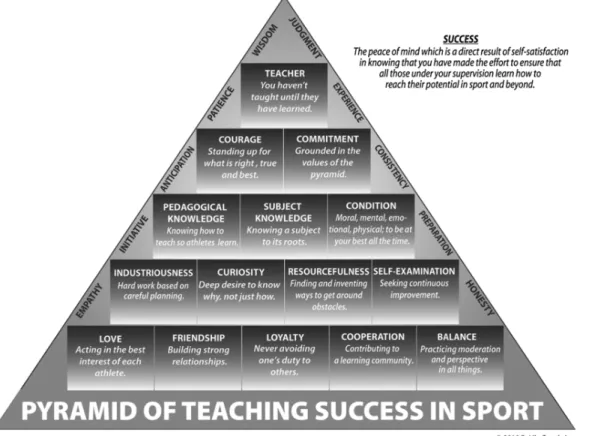
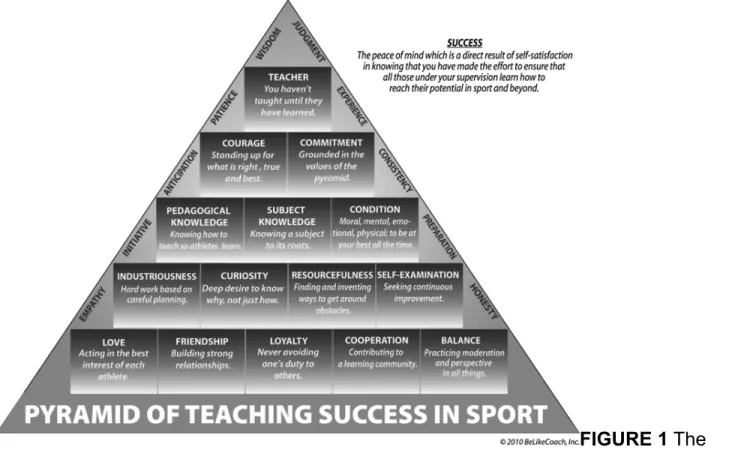
The Pyramid of Teaching Success in Sport (see Figure 1) is composed of five tiers. The rows of blocks and mortar are hierarchically arranged to represent qualities we have found to be indispensable to successful teaching in sport. Each row is foundational to the next. The first tier comprises qualities required in any human endeavor that seeks to nurture the development and performance of others—coaching, parenting, teaching, and leading to name a few. The second tier includes four qualities required to sustain continuous
improvement personally, and in a community of learning with others also committed to the development of capable, confident, connected and character-based youth. The third tier includes knowledge about teaching and the content and skills to be taught; and critically, the multiple forms of condition required of a teacher—moral, mental, emotional, and physical. We cannot teach what we do not know; we cannot teach what we know if we cannot make it comprehensible to learners; and we cannot teach effectively without the conditioning that strenuous demands of teaching require.
FIGURE 1 The Pyramid of Teaching Success in Sport.Note: The Pyramid of Teaching Success in Sport © (graphic and contents) is copyrighted and owned by BeLikeCoach, Inc. (BeLikeCoach.com) and is free for public use, copying, and distribution by individuals and organizations dedicated to improving learning, teaching, sport, and youth development. The fourth and fifth tiers include three qualities resting on the 3 levels and 12 personal qualities that support it in the Pyramid. Commitment to the values and principles represented in the Pyramid keep an effective coach grounded and clear about the
purposes of teaching. Commitment gives the coach the courage of conviction to adhere to those values when pressures build to relax standards and compromise principles. Finally, the apex (the fifth tier) of the Pyramid is the recognition that simply conducting a practice is not successful teaching in sport. We offer the following definition of teaching success in sport that we believe captures these qualities presented in the Pyramid:
Peace of mind which is a direct result of self-satisfaction in knowing that you have made the effort to ensure that all those under your supervision learn how to reach their potential in sport and beyond.
The First Tier—The Foundation of Teaching Success
The first tier of the PofTSS contains five blocks, two of which are cornerstones that
stabilize the structure. The cornerstones are two timeless and universal principles. Love in the context of teaching sport, we define as the selfless altruistic and unconditional
moderation and perspective in all things and maintaining an alignment between what the coach thinks, says, and does. Between the cornerstones are the blocks of Friendship, Loyalty, and Cooperation. Regular practice of friendship, loyalty and cooperation sets the stage for collaboration and the opportunity to learn from others. Depending on others for what one needs to learn requires building strong relationships, being loyal to the needs of others and sharing what you know.
The Second Tier—The Coach's Learning Community
Effective coaches understand that they cannot improve by themselves. Learning how to coach effectively is facilitated by participating in informal and formal communities of
learning with coaching peers (Gilbert, Gallimore, & Trudel, 2009). Collaborative coaches view competition as an opportunity to grow and improve in the common pursuit of athletic excellence and development of human potential. Just as a well-played game requires two well prepared teams, effective collaboration requires preparation and self-study. The elements of collaboration, individual preparation and inquiry, are expressed by the four blocks making up the second tier of the Pyramid: Industriousness, Curiosity,
Resourcefulness, and Self-examination. Industriousness is hard work based on careful planning. Curiosity is the deep desire to know why, not just how, and it is the pathway to deeper knowledge. Resourcefulness is needed to overcome challenges to ongoing
learning. Self-examination spurs future growth by eliminating weaker ideas and ineffective practices, setting new goals to pursue, and aligning everyday behavior with core values, especially love and balance.
The Third Tier—The Heart of the Pyramid
The third tier is the heart of the Pyramid because it focuses on the core elements of
effective teaching in sport: Pedagogical Knowledge, Subject Knowledge and Conditioning. Pedagogical Knowledge is knowing how to make content comprehensible and accessible to athletes, and how to structure activities that optimize the development and mastery of sport skills. It is knowing and understanding that effective instruction depends on the age and development of the athlete—what might work for teenagers will not necessarily work for younger children (C t & Gilbert, 2009). Knowing that players might learn more if first introduced to the whole concept and entire body of actions, than if they begin practicing small bits is a form of Pedagogical Knowledge.
Subject Knowledge is knowing the content to be taught, whether it is rules of the game or fielding at first base. Effective coaches continue to study and learn the sport they teach so they are better able to instruct in age-appropriate ways and to help athletes develop the same habits of self-study and continuous learning the coaches themselves practice. An athlete's intrinsic motivation to grow and excel are nurtured by coaches that set the example of working continuously to better understand the fundamentals of all four
Conditioning for the sport coach is no different than conditioning for the athlete—it takes physical, mental, emotional, social and moral endurance to be at your best for not just a single practice or game, but an entire season. We cannot teach effectively without the conditioning that the strenuous demands of teaching sport require. Ultimately, coaches are role models who teach more by their actions than their words. This concept is best
expressed through an anonymous poem that Coach Wooden used to express his belief about the role of conditioning for teachers in setting an example for their learners:
No written word, no spoken plea
Can teach our youth what they should be Nor all the books on all the shelves
It's what the teachers are themselves.
The Fourth Tier—Courage and Commitment
Throughout their careers, coaches and teachers confront pressure to relax standards and let students and players slide by. Every coach knows the challenges youth can present-settling for “good enough” instead of striving to improve, failing to meet responsibilities to self and teammates, and a myriad other situations which puts values and principles to the test. Value commitments provide the courage of convictions that every coach needs to defend principles and maintain standards. They know what they believe and that provides the courage to stand up to parents, program directors, and other authority figures who are prepared to honor expediency over welfare and development of youth. The two blocks of the fourth tier, Courage and Commitment, describe these coaches. They have the courage to fight for what they believe in and a loyal commitment to helping each athlete reach his or her full potential.
The Apex—Teacher
The ultimate measure of effective sport coaching is whether the athletes have learned what we have aspired to teach them (C t & Gilbert, 2009). If a coach can say that he or she has done everything possible to help an athlete learn, that coach will have reached the apex of the Pyramid which is Teacher. Like the Courage and Commitment blocks, Teacher is not something you work on but rather it is a perpetual state of becoming that flows from working on the 12 blocks in the first three tiers. Two of our favorite Wooden maxims are “when you are through learning, you're through” and that “it's what you learn after you know it all that counts” (Nater & Gallimore, 2010; Wooden, 2004). These maxims
recognize that there are constant gaps in ongoing learning and to fill these gaps, we have selected ten qualities expressed as mortar in the Pyramid.
Mortar
Much like mortar is used to bind construction blocks together to produce a hardier
structure, our mortar is intended to produce a stronger and more capable sport coach. Ten qualities expressed as mortar are proposed as reinforcements of the Pyramid. Connecting and binding the first tier (foundation of effective teaching) to the second tier (self-study and collaboration) are Empathy and Honesty. Empathy is the ability to recognize and consider the thoughts, feelings and emotions of others and Honesty is the ability to stay true to what is best in ourselves and others. Initiative and Preparation ensure that the sport coach will engage in self-study and seek out others to learn with and from and as such they bridge the gap between the coach's learning community and the three essential elements to effective teaching: communication skill, deep knowledge and conditioning. Anticipation of athlete needs and learning styles and Consistency in word and action help the sport coach develop the qualities of Courage and Commitment. These qualities, in turn, are sustained by the Patience in knowing that good things take time and Experience that comes from sustained thinking and problem-solving. At the apex of Teacher, we place Wisdom and Judgment. Ultimately, teachers and coaches are role models who teach more by their actions than their words (Gould, Collins, Lauer, & Chung, 2007).
SUMMARY
We present the PofTSS as a platform for stimulating further discussion and reflection about effective coaching in youth sport. The Pyramid identifies the personal qualities and values we have found to be important in helping others reach their potential through sport. Both our definition of teaching success and the qualities represented in the Pyramid emphasize self-improvement rather than measuring oneself against the performances of others. This is consistent with current views on how best to develop human potential. For example, in the achievement motivation literature this internal focus on personal development is referred to as a task- or mastery-orientation (Harwood, Spray, & Keegan, 2008). In the developmental psychology literature this orientation is sometimes labeled a growth mindset (Dweck, 2007). Lastly, this approach firmly situates coaching as a moral profession. Effective coaches understand that no matter how long one teaches and no matter how many courses and books are consumed, challenges arise for which knowledge and experience alone are insufficient preparation. In these moments, an ethical and moral grounding provides a platform to do what is right for the athlete (Gould et al., 2007). The Pyramid will surely evolve as we continue to share and test the ideas it represents. We look forward to hearing your thoughts about the Pyramid and how it fits with your
experiences coaching and working in youth sport settings.
ACKNOWLEDGEMENTS
Doug Saylor, Jerry Krause and Eva Dolan to the development of this article. Appreciation to Karen Becker for graphic design of the Pyramid of Teaching Success in Sport.
REFERENCES
1. Burton, D. and Raedeke, T. D. (2009) Sport psychology for coaches Human Kinetics , Champaign, IL
2. Cassidy, T. , Jones, R. L. and Potrac, P. (2009) Understanding sports coaching: The social, cultural and pedagogical foundations of coaching practice 2nd ed., Routledge , London, UK
3. C t , J. and Gilbert, W. D. (2009) An integrative definition of coaching
effectiveness and expertise. International Journal of Sports Science & Coaching 4 , pp. 307-323. [ crossref ]
4. Dweck, C. S. (2007) Mindset: The new psychology of success Ballantine , New York, NY
5. Gallimore, R. and Tharp, R. (2004) What a coach can teach a teacher, 1975-2004: Reflections and reanalysis of John Wooden's teaching practice. The Sport
Psychologist 18 , pp. 119-137.
6. Gilbert, W. , Gallimore, R. and Trudel, P. (2009) A learning community approach to coach development in youth sport. Journal of Coaching Education 2:2 , pp. 1-21. 7. Gilbert, W. D. and Trudel, P. (2004) Analysis of coaching science research
published from 1970-2001. Research Quarterly for Exercise and Sport 75 , pp. 388-399.
8. Gould, D. and Carson, S. (2008) Life skills development through sport: Current status and future directions. International Review of Sport and Exercise Psychology 1:1 , pp. 58-78. [informaworld]
9. Gould, D. , Collins, K. , Lauer, L. and Chung, Y. (2007) Coaching life skills through football: A study of award winning high school football coaches.
Journal of Applied Sport Psychology 19 , pp. 16-37. [informaworld]
10. Hammermeister, J. J. (2010) Cornerstones of coaching: The building blocks of success for sport coaches and teams Cooper , Traverse City, MO
11. Harwood, C. , Spray, C. M. and Keegan, R. Horn, T. S. (ed) (2008) Achievement goal theories in sport. Advances in sport psychology pp. 157-185. 3rd ed., Human Kinetics , Champaign, IL
12. Horn, T. (2008) Advances in sport psychology 3rd ed., Human Kinetics , Champaign, IL
13. Jowett, S. and Lavallee, D. (2007) Social psychology in sport Human Kinetics , Champaign, IL
14. Lyle, J. and Cushion, C. (2010) Sports coaching: Professionalisation and practice
Elsevier , Oxford, UK
15. Nater, S. and Gallimore, R. (2010) You haven't taught until they have learned: John Wooden's teaching principles and practices Fitness International Technology , Morgantown, WV
16. Smith, R. E. and Smoll, F. L. (2002) Way to go coach! 2nd ed., Warde , Portola Valley, CA
17. Smith, R. E. and Smoll, F. L. Jowett, S. and Lavallee, D. (eds) (2007) Social-cognitive approach to coaching behaviors. Social psychology in sport pp. 75-90. Human Kinetics , Champaign, IL
18. Smoll, F. L. and Smith, R. E. (2002) Children and youth in sport: A biopsychosocial perspective 2nd ed., Kendall/Hunt , Dubuque, IA 19. The Official Site of Coach John Wooden — Retrieved from http://www.coachwooden.com/
20. Vealey, R. (2005) Coaching for the inner edge Fitness Info Technology , Morgantown, WV
21. Wooden, J. R. (2004) My personal best: Life lessons from an All-American journey (with Steve Jamison) McGraw-Hill , New York, NY
List of Figures
FIGURE 1 The
Pyramid of Teaching Success in Sport.Note: The Pyramid of Teaching Success in Sport © (graphic and contents) is copyrighted and owned by BeLikeCoach, Inc.
(BeLikeCoach.com) and is free for public use, copying, and distribution by individuals and organizations dedicated to improving learning, teaching, sport, and youth development. Bookmark with:
CiteULike Del.icio.us BibSonomy Connotea