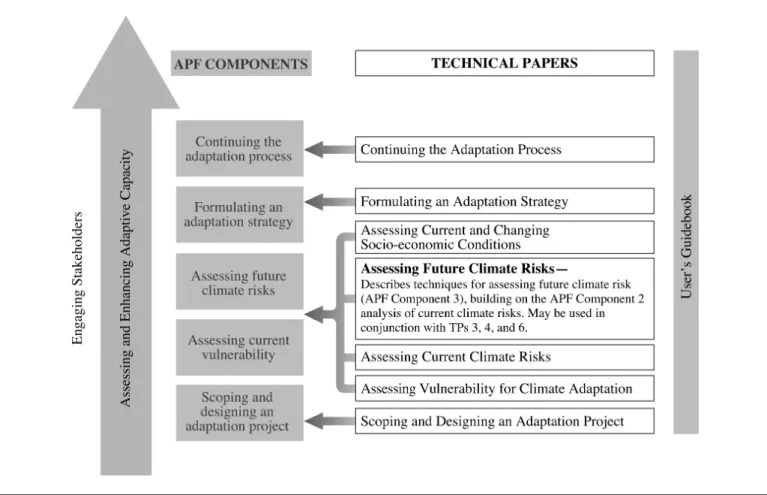
Assessing Future Climate Risks
5
ROGER JONES
1AND LINDA MEARNS
2Contributing Authors
Stephen Magezi
3and Rizaldi Boer
4Reviewers
Mozaharul Alam
5, Suruchi Bhawal
6, Henk Bosch
7, Mohamed El Raey
8, Ulka
Kelkar
6, Mohan Munasinghe
9, Stephen M. Mwakifwamba
10, Atiq Rahman
5, Samir
Safi
11, Barry Smit
12, Joel Smith
13, and Darren Swanson
141 Commonwealth Scientific & Industrial Research Organisation, Atmospheric Research, Aspendale, Australia 2 National Center for Atmospheric Research, Boulder, United States
3 Department of Meteorology, Kampala, Uganda 4 Bogor Agricultural University, Bogor, Indonesia
5 Bangladesh Centre for Advanced Studies, Dhaka, Bangladesh 6 The Energy and Resources Institute, New Delhi, India
7 Government Support Group for Energy and Environment, The Hague, The Netherlands 8 University of Alexandria, Alexandria, Egypt
9 Munasinghe Institute for Development, Colombo, Sri Lanka
10The Centre for Energy, Environment, Science & Technology, Dar Es Salaam, Tanzania 11 Lebanese University, Faculty of Sciences II, Beirut, Lebanon
12University of Guelph, Guelph, Canada 13Stratus Consulting, Boulder, United States
5.1. Introduction 121
5.2. Relationship with the Adaptation Policy
Framework as a whole 121
5.3. Key concepts 121
5.3.1. Uncertainty 122 5.3.2. Coping ranges 122 5.3.3. Risk quantification 123
5.4. Guidance on assessing future climate risks 124 5.4.1. Selecting an approach 124 5.4.2. Gathering information on future climate 125
5.4.2.1. IPCC Special Report on
Emission Scenarios 126 5.4.2.2. Projected climate changes 127 5.4.3. Conducting sensitivity experiments 127 5.4.4. Selecting planning and policy horizons 127
5.4.5. Constructing climate scenarios 128 5.4.5.1. Introduction to climate modelling 128 5.4.5.2. Uncertainties of future climate 129 5.4.5.3. Current climate data 131 5.4.5.4. Climate model output 131 5.4.5.5. Methods of constructing scenarios 131 5.4.5.6. Using and communicating
single-event and frequency-based probabilities 131 5.4.6. Conducting climate change risk assessments 135 5.4.7. Managing climate risks 137
5.5. Conclusions 138
References 138
Annex A.5.1. Climate change risk assessment
5.1. Introduction
This technical paper (TP) describes techniques for assessing future climate risk and therefore, adaptation needs, under a changing climate. In doing so, this TP outlines a process that is consistent with Adaptation Policy Framework (APF) Component 3,Assessing Future Climate Risks. The techniques described here utilise information about future climate in assessments that build on an understanding of current climate risks. Two pathways to assessing risk are described, the hazards-based approach and the vulnerability-based approach. The former begins with plausible changes in future climate, then projects biophysical and socio-economic conditions from those changes. The vulnerability-based approach sets criteria vulnerability-based on socio-economic or biophys-ical outcomes, then determines how likely these criteria are to be met or exceeded (this approach was introduced in TP3). The cli-mate risks that are described using either pathway can be man-aged through policy changes that reduce a population’s exposure to current and future climate hazards.
The material presented here builds on the concepts addressed in TP4 for assessing current risks by adding information on cli-mate change to assess future risks. Unless historically unprece-dented hazards are indicated by climate studies, criteria for risk management of future climate can be based on an understand-ing of current climate risks (TPs 3 and 4). If knowledge of those current risks is established, then assessments may com-mence by characterising how climate risks may change due to future climate and socio-economic changes (TP6).
The paper briefly describes the latest climate information and summarises methods on scenario development, directing the researcher towards source material on how to develop climate scenarios. It then outlines how climate scenario information can be used to extend our understanding of current climate–society relationships into the future, how to analyse risk relevant to dif-ferent planning horizons, and how to assess planned adaptations as a form of risk management.
5.2. Relationship with the Adaptation Policy Framework as a whole
With its focus on future climate risks, this paper contributes primarily to Component 3 of the APF. Yet it is closely linked to the other TPs, as outlined here.
TP2 – Engaging stakeholders in the adaptation process:
Engaged stakeholders can be a key element of modern risk assessments, and can contribute by extrapolating their current experience to possible future climate and identifying adapta-tions to address changing risks.
TP3 – Assessing vulnerability for climate adaptation:
Assessment of the consequences of climate change form a key part of climate risk assessment. TP3 describes the tools required to characterise vulnerability in preparation for assess-ing both current and future climate risks.
TP4 – Assessing current climate risks:Knowledge of current climate risks, and adaptation to those risks provide a sound basis for assessing future adaptation needs. TP4 describes how climate risk is a combination of the likelihood of a climate event (or a combination of events) and its consequences. This paper builds on the techniques described in TP4, describing methods for incorporating information about future climate into the risk assessment. TP4 is paired with the current paper within the APF.
TP6 – Assessing current and changing socio-economic condi-tions:A dynamic understanding of future risk requires knowl-edge of both biophysical and socio-economic change. Socio-economic analysis can be used to describe change in human systems that will affect a group’s ability to cope with future cli-mates, as outlined in TP6.
TP7 – Assessing and enhancing adaptive capacity:Adaptive capacity is the ability of a group to expand their coping range in response to an anticipated or experienced climate stress. Analysis of historical changes in the coping range can indicate the adaptive capacity of a particular group or activity.
TP8 – Formulating an adaptation strategy: The process of preparing an adaptation strategy involves making decisions on specific adaptation options – choices that respond to the risks recognised in this paper.
5.3. Key concepts
Climate risk arises from interactions between climate and society, and can be approached from its social aspect through vulnerabil-ity-based assessment, from its climatic aspect through natural hazards-based assessment, or through complementary approach-es that combine elements of both. The coping range, dapproach-escribed and illustrated in TP4, provides a framework that can accommo-date these approaches under climate change. As such, it can be used as an analytic tool or communication device in assessments.
When carrying out a risk assessment, the team needs to be aware of what type of information is needed to apply the results to planning or policy. In some cases, qualitative information may be all that is needed. For instance, in a region under water stress, an indication that drought risks are likely to increase in the future may be sufficient to warrant adaptation (Box 5-3, Section 5.5.5). In other cases, decisions about natural resource allocations based on climate change may be open to legal chal-lenge, requiring outcomes based on scientific assessments that can stand up in court (where scientific evidence will be assessed on the balance of probabilities). However, uncertainty also limits choice. Sometimes, although stakeholders want hard numbers, uncertainty may only allow qualitative responses. In this case, a compromise is to rely less on analytic techniques and modelling, and rely more on techniques from the social sciences, such as eliciting information from different stake-holders (TP2) on how they perceive climate risks, to provide semi-quantitative assessments.
5.3.1. Uncertainty
Climate change assessments are permeated by uncertainty, requiring the use of specialised methods such as climate sce-narios. This is a principle reason to recommend that adaptation assessments be anchored with an understanding of current cli-mate risk; it helps to provide a road map from known territory into uncertain futures. Risk assessment also utilises a for-malised set of techniques for managing uncertainty that can be used to expand the methods developed and utilised in Intergovernmental Panel on Climate Change (IPCC) assess-ments. For example, Moss and Schneider (2000) prepared a cross-cutting paper on uncertainty for the IPCC Third Assessment Report (TAR) that provides valuable guidance on framing and communicating uncertainty. Particularly valuable is the advice on providing guidance on the confidence used in terms such as likely,unlikely,possible and probable. Further guidance on managing uncertainty within assessments (both qualitative and statistical) is provided by Morgan and Henrion (1990) and, on communicating risk, in Morgan et al. (2001).
The major tool used to assess the impacts of future climate is the climate scenario. A scenario is a coherent, internally consistent and plausible description of a possible future state of the world. It is one of the main tools for assessing future developments in com-plex systems that may be unpredictable, are insufficiently
under-stood and have high scientific uncertainties (Carter and La Rovere, 2001). Scenarios can range from the simple to the complex, and from the qualitative to quantitative, encompassing narrative descriptions of possible futures to complex mathematical descrip-tions combining mean climate changes with climate extremes. Climate scenarios are not restricted to Global Climate Models (GCM) output – any information about future climate utilised in an assessment will suffice. Even when scenarios are constructed in narrative form, or are based on broad projections of climate change (e.g., Section 5.5.1.2), plausibility and consistency should be maintained as much as possible. Usually, a scenario has no like-lihood attached to it beyond being plausible. However, it is the basic building block of risk assessment approaches under climate change that use scenarios, ranges of uncertainty, probability distri-bution functions and Bayesian analysis. Section 5.5.4 contains examples of how to apply some of these techniques.
5.3.2. Coping ranges
The coping range was introduced in TP4 (Section 4.3.4) to show how current climate can be related to socially-related out-comes in order to carry out risk assessment. It can be used to assess how the ability to cope is affected by a perturbed climate (Figure 5-2) and to assess the changing ability to cope over time (TP4, Annex A.4.3).
The upper panel shows how a coping range may be breached under climate change if the ability to cope is held constant. If that range is represented in terms of temperature (or rainfall), the upper hot (or wet) baseline or reference threshold is exceeded more frequently, while the exceedance of the lower cold (or dry) baseline threshold reduces over time. Vulnerability will increase to extreme levels for the hot (wet) threshold over time. The lower panel represents the expansion of the coping range through adaptation and the consequent reduction of vulnerability. The amount of adaptation required depends on the planning horizon under assessment and the likelihood of exceeding given criteria over that planning horizon.
The coping range can also be used to explore how both climate and the ability to cope may interact over time. For example, an agricultural assessment could account for projected growth in technology, yield and income that broadens the coping range. An assessment could then determine whether these changes are ade-quate to cope with projected changes in climate. These assess-ments should be carried out on an appropriate planning horizon.
5.3.3. Risk quantification
Approaches for quantifying risk and the use of coping ranges under climate change are emerging areas and, as yet, there are limited assessments to draw from for guidance. Introductory
material is described in the IPCC Third Assessment Report: Mearns and Hulme (2001) for risk, and Smit and Pilifosova (2001) for coping ranges. This is developed further in Jones et al. (2003). An illustrative approach to using coping ranges is described by Yohe and Tol (2002). Methods for undertaking risk assessments utilising critical thresholds built around the conventional seven-step method of Carter et al. (1994) are described in Jones (2001). A guide for assessing risk (Willows and Connell, 2003), principally designed for decision-makers, contains participatory, qualitative and quantitative approaches.1 Further information on setting risk criteria and
thresholds can be found in TP4 (Section 4.4.4).
While the qualitative aspects of risk and coping ranges can be readily utilised in conceptual models (i.e., by stakeholders identifying the point where the level of harm exceeds tolerance levels), the more applied methods require a well-developed research capacity. The probability of exceeding a given level of vulnerability is an exceedingly useful concept to develop in methodological terms, and is discussed by Jones et al. (2003). While it would be useful, it is not always possible to have mod-els linking the entire process from climate change to socio-eco-nomic outcomes.
For example, if only biophysical models are available, or if vulnerability cannot be adequately quantified, stakeholders may decide to identify levels of vulnerability in biophysical Figure 5-2:Relationships between climate change, coping range, vulnerability thresholds and adaptation
terms where there is an agreed consensus about the degree of vulnerability:
• in terms of flooding, there may be a particular water level associated with widespread damage.
• if only rainfall data is available, researchers may quantify the rainfall amounts preceding similar levels of inundations. These amounts can then be used to construct a threshold providing the bounds of the cop-ing range for a community within a catchment. • for agriculture, rainfall may be used as a proxy for
loss of production or given levels of food security. In terms of sustainability, stakeholders may identify a level of crop production that they think is sustainable and assess how they may reach that target under cli-mate change.
Socio-economic scenarios may need to be developed to explore how coping ranges may evolve (TP6). More applied methods of exploring vulnerability are detailed in TP3.
The “learning by doing” aspect of the APF will help in this regard. Assessments that build capacities and tools that then become available for successive assessments will consequently build the capacity to develop new techniques. Meanwhile, pol-icy makers and stakeholders, once they have learned that firm forecasts of climate change are not forthcoming, are generally receptive to working with risk, especially if it is framed in terms of what they already know (i.e., couched in terms of their current exposure to climate risk). An example of a quantitative risk assessment for the water sector detailing the methods used and policy response is described in Annex A.5.1 (Jones and Page, 2001).
5.4. Guidance on assessing future climate risks
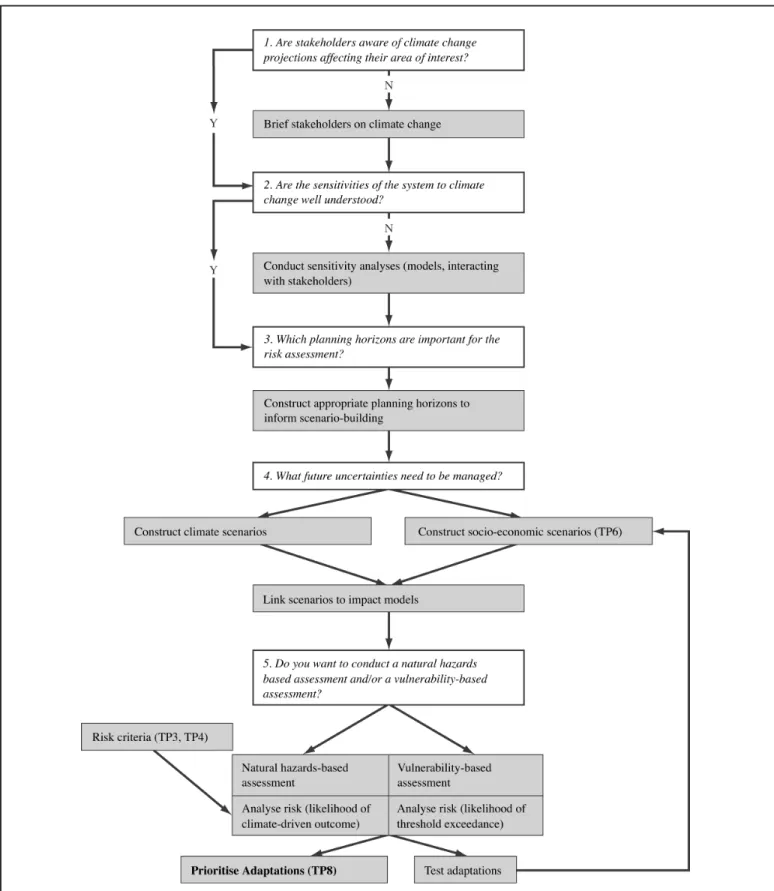
A broad structure for assessing future climate risks is provided in Figure 5-3. Included are some initial activities to carry out with stakeholders, such as exchanging information on what is already known. At this point in the process, some level of prior knowledge of climate change is assumed to exist in most coun-tries, including that generated by National Communications to the United Nations Convention on Climate Change (UNFC-CC). This flowchart is meant to provide guidance for con-structing a risk assessment – it is not meant to be followed step-by-step if the assessment, material and circumstances do not readily permit it.
There are several ways an assessment can be approached. It may build on an assessment of current climate risks as described in TP4, or may be based on pre-existing knowledge. It is also possible to integrate an assessment of current and future climate risks. One way to do this would be to take impor-tant elements from Figure 5-3 and Figure 4-2 in TP4, and order them to create a logical sequence relevant to a particular assess-ment. Elements from TPs 3 and 6 could be introduced in the same way. The decision of what elements need to be included
can be carried out jointly by researchers and stakeholders as part of conceptual model development.
5.4.1. Selecting an approach
The two major pathways through risk assessment are the natural hazards and the vulnerability-based approaches. (TP4, Section 4.4.) The natural hazards approach is a climate scenario-driven approach. It starts off with climate scenarios, applies them to impact models and determines possible changes in vulnerability. The vulnerability-based approach starts with possible future out-comes in the form of biophysical or socio-economic criteria that represent a given state of vulnerability. It then determines how likely those criteria are to be met/exceeded under different future climates, again by applying a range of climate scenarios. Outcomes used as criteria for risk assessment can be desirable (e.g., a future sustainable state) or undesirable (e.g., an important activity losing viability).
1. The natural hazards-based approach fixes a level of hazard (such as a peak wind speed of 10ms-1,
hurri-cane severity, or extreme temperature threshold of 35°C), and then assesses how changing that partic-ular hazard, according to one or more climate sce-narios, changes vulnerability. Limitations in cli-mate modelling often mean that changing hazards cannot be represented specifically but scenario-building methods are continually evolving. A broad formulation is Risk = Probability of climate hazard x Vulnerability.
2. The vulnerability-based approach sets criteria based on the level of harm in the system being assessed, then links that to a specific frequency, magnitude and/or combination of climate events. For example, loss of livelihood linked to severe drought, loss of property due to flooding, critical thresholds for management, or system viability. The level of vulnerability that provides this “trigger” can be decided jointly by researchers and stakeholders, chosen based on past experience, or defined according to policy guidelines. With this approach,Risk = Probability of exceeding one or more criteria of vulnerability.
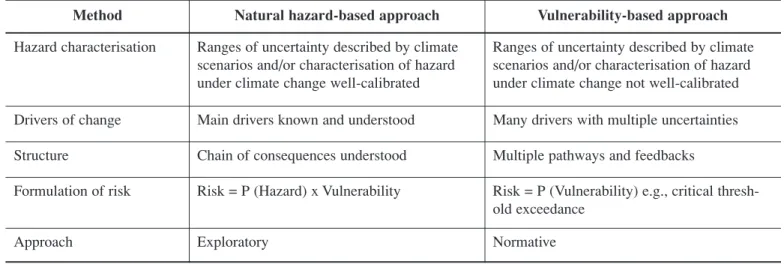
These methods are complementary and can be used separate-ly or together. Table 5-1 provides a quick checklist that may help to decide which technique may be most appropriate. If the ranges of uncertainty described by climate scenarios and/or characterisation of hazard under climate change are well-calibrated and if the drivers of change and the processes by which change can be represented are understood, then the natural hazard approach may be best suited. If the climate hazards cannot easily be characterised under climate change, there are many drivers of change and many pathways along which change can take place, then a vulnerability-based approach may be best suited. Another important distinction is that the natural hazard method is largely exploratory, i.e., given the underlying assumptions and conditions, a specific
outcome is predicted; and the vulnerability-based method is more normative, i.e., a future outcome is proposed (either positive or negative) and the risk of attaining or exceeding that outcome is assessed. Adaptation will aim to reduce the likelihood if that outcome is negative, or increase the likeli-hood if it is positive.
5.4.2. Gathering information on future climate
Information on what future climate may be like has increased substantially in the past decade. The most recent and complete information on the climate change science community’s assess-ment of this subject is found in the IPCC TARs (Houghton et
al., 2001; McCarthy et al., 2001; Metz et al., 2001; available at: http://www.ipcc.ch/), the main points of which are summarised hereafter.
Based on the most recent information, mainly from simula-tions of GCMs, it is believed that the average global tempera-ture of the earth will be between 1.4°C to 5.8°C warmer than present by the end of the 21st century. Moreover, there is increasing evidence that the warming of the earth over the past 50 years is attributable to increased greenhouse gases resulting from human activities.
5.4.2.1. IPCC Special Report on Emission Scenarios
The estimate of the range of temperature change at the end of the 21st century is based on results from climate models forced with scenarios of increasing greenhouse gases and aerosols, developed for the TAR (Nakicenovic and Swart, 2000). These
scenarios, in turn, were based on four “storylines” of what the future of the world might be from the point of view of demo-graphic, technological, political, social and economic develop-ments (Box 5-1). Forty different scenarios were developed from those storylines. In addition to producing very different outcomes in terms of climate, the range of possible develop-ments paths will also produce different adaptive capacities (TPs 6 and 7).
Across all Special Report on Emission Scenarios (SRES), the range of atmospheric CO2 would reach levels between 540 ppm to 970 ppm by the end of the present century. There are also significant ranges of change across the scenarios for the other greenhouse gases such as methane and nitrous oxide. The trajectory of sulphate aerosols also varies considerably across the scenarios with some steadily decreasing and others with an initial increase, but then decreasing by the second half of the century.
Table 5-1:Checklist to determine the efficacy of using the natural hazard- and vulnerability-based approaches in an assessment
Method Natural hazard-based approach Vulnerability-based approach Hazard characterisation Ranges of uncertainty described by climate
scenarios and/or characterisation of hazard under climate change well-calibrated
Ranges of uncertainty described by climate scenarios and/or characterisation of hazard under climate change not well-calibrated
Drivers of change Main drivers known and understood Many drivers with multiple uncertainties
Structure Chain of consequences understood Multiple pathways and feedbacks
Formulation of risk Risk = P (Hazard) x Vulnerability Risk = P (Vulnerability) e.g., critical thresh-old exceedance
Approach Exploratory Normative
Box 5-1. SRES scenario storylines
A1 Characterised by very rapid economic growth, global population peaking in mid-century, and then declining, and rapid introduction of new, efficient technologies. Three different subgroups in the A1 storyline are defined that pre-sent alternative changes in technology: fossil intensive (A1FI), non-fossil (A1T) and balanced across sources (A1B).
A2 Characterised by heterogeneity. Self-reliance and local identities are emphasised. Population increases continu-ously. Economic development is regionally oriented, and economic and technological growth is relatively slow compared to other storylines.
B1 A convergent world, having the population growth of the A1 storyline. Economic structures change rapidly toward a service and information economy, clean and resource-efficient technologies are introduced, with emphases on social and environmental sustainability.
B2 Local solutions to economic, social and environmental sustainability are emphasised. Global population grows continuously, but at rate lower than that of A2.
5.4.2.2. Projected climate changes
Based on atmosphere-ocean GCM (AOGCM) results, the IPCC determined that global annual average precipitation would increase from about 1.2% to 6.8% in the last 30 years of the 21st century, across the A2 and B2 scenarios. Global sea level is expected to increase by between 0.09 and 0.88 m by the end of the 21st century, based on the full range of the SRES sce-narios. Regional increases in sea level rise show large varia-tions between models.
Uncertainties in the responses of mean climate change, including variability, increase as one goes to finer levels of assessment (perception) than the global scale, especially for changes in regional precipitation. However, some specific regional changes are considered likely. It is believed that land temperatures will warm faster than the global average and oceans will warm more slowly. Polar regions are expect-ed to experience greater increases in temperature than will tropical regions, and will also experience increases in pre-cipitation in most seasons.
Based on a regional analysis of results of nine AOGCMs that used both the A2 and B2 emissions scenarios, more detailed common regional changes in temperature and precipitation were determined in the IPCC report (Giorgi and Hewitson, 2001). However, these results are more uncertain than those described in the previous paragraph. Large warming will occur during the winter in all high northern latitude regions, as well as in Tibet, whereas it is indicated to take place during the sum-mer in the Mediterranean basin, as well as in northern and cen-tral Asia. Increases in precipitation are anticipated over north-ern mid-latitudes and tropical African regions in the boreal winter. Increases in precipitation are also seen in the boreal summer in South Asia (e.g., India), East Asia (i.e., central China), and Tibet. Consistent decreases in winter precipitation are seen over Central America in the boreal winter (December–February) and over Australia and southern Africa in the austral winter (June–August). Changes in precipitation tend to be larger in the A2 scenario, compared to the B2. In other regions of the world and/or seasons, there was a lack of consistency in the changes in precipitation across the models and scenarios and no clear signal could be determined. More details on these results can be found in Giorgi and Hewitson (2001) and Giorgi et al. (2001).
The IPCC also assessed possible future changes in extreme events. These estimates are particularly important since vul-nerability to extreme events is usually high in human society, and our need to adapt to them is high. It is now believed that extreme high temperatures will increase, as will high-intensi-ty precipitation events. Low temperature extremes would decrease. Mid-continental areas will likely experience greater drought in the summer. Unfortunately, little is known regard-ing how intense hurricanes or mid-latitude storms will change. There is some evidence that, on average, more El Niño-like conditions would be seen (TP4, Annex A.4.2 pro-vides a summary).
5.4.3. Conducting sensitivity experiments
To obtain a first-order sense of how possible climate changes may affect different impacts and because of the degree of uncertainty in climate change, particularly at the regional scale, sensitivity exper-iments are a good means of exploring how impacts may respond to climate change. These make use of incremental changes in cli-mate, e.g., applying a 1°, 2°, and then 3°C increase in temperature; and/or 5%, 10%, 15% increase/decrease in precipitation, and so on. These can be constructed as quantitative data sets for use as input to quantitative impact models (e.g., crop and hydrologic models; Risbey, 1998; Mehrotra, 1999) or applied to mental mod-els (i.e., thought experiments) constructed with stakeholders.
Sensitivity experiments can produce important information on the basic sensitivity and vulnerability of the particular system and aid in the establishment of critical climate thresholds in the system (levels at which serious damage occurs). It is often recommended that such incremental changes be used early in a project so as to better understand the response of the system to climate shifts in a systematic way and to establish thresholds (e.g., Mearns and Hulme, 2001). The use of incremental changes should be limited to such explorations because they do not necessarily produce internally consistent and plausible scenarios of change. It is also possible to assess sensitivity to changes in climate variability, especially if it is difficult to develop scenarios for those changes from climate model data (e.g., assessing plausible but artificial changes in daily rainfall as part of flood modelling).
5.4.4. Selecting planning and policy horizons
Planning horizons will affect how far into the future a risk assess-ment may be projected. Planning horizons relate to the lifetime of decision-making associated with a particular activity – how far into the future is it planned? Is climate change likely to occur with this planning horizon? Do current planning decisions assume the continuation of historical conditions? How do we incorporate cli-mate change into long-term planning?
The same activity can be affected by several planning horizons used by different stakeholders (e.g., financial, urban planning and engineering horizons for infrastructure). For example, in a water resource or catchment-based assessment, the planning life of water storages may be 50+ years, but planning for sup-ply may only be 5–15 years (Figure 5-4). A risk assessment may then want to create scenarios based on two time horizons such as 2020 and 2050 to accommodate both water policy and infrastructure horizons respectively.
The policy horizon is related to the period of time over which a particular policy is planned to be implemented. This may not be on the same time scale as a planning horizon. For instance, the infrastructure affecting an activity will have an engineering life of many decades, but the policy horizon governing the operation of that infrastructure may be much shorter. Most nat-ural resource policy is implemented over periods of 5 to 15 years. Such policies may be reviewed or updated over time but
are often expected to manage resources over a much longer planning horizon. Risk assessment may be extended over the longer planning horizon, but adaptations developed to manage those risks are likely to be applied over shorter-term policy horizons (e.g., a long-term strategic outlook is often used to inform shorter-term adaptations). These longer-term outlooks are important, because to ignore strategic objectives in favour of exclusively short-term management may lead to incremental changes accumulating in unintended or irreversible outcomes. If the existing planning horizon does not extend beyond the policy horizon, assessment of the potential risks under climate change may be used to alert policy-makers to the value of tak-ing a longer-term view.
Planning and policy horizons influence the choice of climate scenario. Scenarios may represent a time slice in the future (e.g., 2020 or 2050), or project a pathway from the present into the future. The planning horizon may extend further than the policy horizon but knowledge of possible risks will influence the path taken, in policy terms, of reaching that planning hori-zon in good shape. If climate scenarios far into the future are chosen, but policy needs are much more immediate, several time-slices over the short to long-term may be used to bridge the distance between policy and planning horizons. A tension exists between the long-term needs of sustainable development and the short-term needs of economic and policy development. However, if adaptations can serve both shorter-term policy needs and long-term strategic objectives, the likelihood of achieving sustained benefits is maximised (as it is if both short-and long-term climate risks are managed). If adaptation is incremental, then policy horizons can be updated using adap-tive management, by reviewing shorter-term actions in the light of new information about longer-term outcomes. If irreversible changes with significant consequences are possible, or if retro-fitting infrastructure at some future time is likely to be too expensive, then adaptation may need to anticipate long-term changes almost immediately.
5.4.5. Constructing climate scenarios
The major methods for constructing climate scenarios utilise results from climate model simulations. While there are other means (Table 5-1; Carter et al., 1994; Mearns and Hulme, 2001), climate model results provide the user with internally consistent and plausible scenarios of the future that are sufficiently detailed for use with quantitative impacts models.
5.4.5.1. Introduction to climate modelling
Climate projections are produced by mathematical representa-tions of the earth’s climatic system using GCMs. These models are as physically representative as possible within the limita-tions of scientific knowledge, the ability to represent physical phenomena on an appropriate scale, and computer capacity. They link the atmosphere, ocean, land, and biosphere both vertically and horizontally in a series of three-dimensional grid boxes that partition the earth into layers and grids. The scale and thus the number of those boxes are limited by the computer power available to carry out the necessary computa-tions. GCMs have grid box resolutions in the order of 100 km to 500 km on a side, while Regional Climate Models (RCMs) have a resolution between 5 km and 100 km. Regional climate models have a limited domain of higher resolution allowing large-scale simulations to be run, and may be nested in a GCM or as a zone of high resolution of grid squares within a lower resolution GCM.
The current generation of GCM is the coupled GCM, or AOGCM, that links a three-dimensional representation of the ocean to the atmosphere. In these experiments, the enhanced greenhouse effect is simulated by gradually increasing the radiative forcing equivalent to historical increases in green-house gases and sulphate aerosols to 1990 or 2000, then simu-Figure 5-4:A representative section of planning horizons relevant to climate risk assessments. Few of these planning horizons are fixed. They cover a range of time and some (e.g., long-term biodiversity) will extend long beyond 2100.
lating the response to greenhouse gas and aerosol scenarios to 2100 or beyond. Although climate models are run on many time-steps per day usually, only daily and monthly data is saved. Monthly data is saved for many variables in the atmos-phere and ocean, whereas daily data is generally saved for sur-face variables important for the diagnosis of results and for impact studies. Due to the large amounts of data saved and stored, monthly data is usually preferred to the use of daily data.
5.4.5.2. Uncertainties of future climate
The uncertainties affecting climate change are biophysical and socio-economic. Biophysical uncertainties are those dealt with in climate models and include interactions between the oceans, atmosphere and biosphere. Socio-economic uncertainties include the economy, technology, population and society. These uncertainties interact, e.g., where greenhouse gas emis-sions alter the climate and biosphere, which then affect human systems. Accurately forecasting the rest of this century’s cli-mate is not possible because we cannot accurately predict the necessary socio-economic drivers in terms of greenhouse gas futures – we can only produce a large range of possible out-comes. The uncertainties in the climate models themselves also contribute to this inability.
While there are many uncertainties in climate change, this sec-tion reviews only some of the major ones that impacts researchers can most likely take account of in their work.
The uncertainties in technological, political and economic futures are integrated in the production of emissions scenarios. Hence, the different emissions scenarios can be said to sum-marize a range of those uncertainties. The major uncertainties in climate system responses are represented by the different cli-mate models that respond differently to the different emissions scenarios. These are the two summary types of uncertainty that are most available for consideration in impacts (and hence) adaptation research. Uncertainties also tend to propagate as one progresses through an assessment and as one moves from the global to local scale (Figure 5-5). Risk assessments need to account for these uncertainties as much as is practical. (A brief summary is in Box 5-2; IPCC-TGCIA, 1999; Carter and La Rovere, 2001; Mearns and Hulme, 2001).
Progress is rapidly being made in quantifying the uncertainties of climate change. These efforts have lead to recent papers quantifying the near future (i.e., next 20 years) using a combi-nation of climate observations and climate model results (Allen et al., 2000; Forest et al., 2002). Moreover, attempts to assign probabilities to longer-term future climate have also been made (e.g., Schneider, 2001; Wigley and Raper, 2001). More recently progress has been made in determining the reli-ability of climate model results (Giorgi and Mearns, 2001, and assigning probabilities to climate change on a regional scale Giorgi and Mearns, 2003; Tebaldi et al., 2003). However, these works should be viewed as providing subjective examples as opposed to objective probabilities of long-term future climate. Box 5-2 summarises how climate scenarios can be used to manage uncertainty.
Figure 5-5:The relationship between (upper diagram) ranges of uncertainty cascading through an assessment, and (lower dia-gram) individual scenarios, S1 to S4, and resultant ranges of uncertainty. These diagrams are sourced from Jones (2000) and Schneider and Kuntz-Duriseti (2002).
Box 5-2: Assessing likelihoods of climate change
Within the resources available to an assessment, the choice of how many and what kind of scenarios are needed has to bal-ance the concerns between precision and the ability to explore key uncertainties. For instbal-ance, daily rainfall data from cli-mate models is very imprecise and may need to be downscaled to obtain plausible values and distributions, but this task is resource intensive and may limit the number of scenarios that can be produced. The trade-off is between producing plausi-ble scenarios that properly represent the data needed to simulate impacts, and exploring the major uncertainties that will affect an assessment’s outcomes. This box outlines some strategies for assessing uncertainty and likelihoods. The IPCC Data Distribution Centre has both data and supporting material, as do a number of climate modelling centres. Even if only a limited number of climate scenarios are used, it would be valuable to scope the range of projected climate changes for the area in question before constructing those scenarios.
Single scenario
A single scenario can be used as a plausible outcome or to illustrate a storyline that tests various options in an environment of high uncertainty. It can be located within a range of uncertainty (e.g., low, median or high warming) or may be used to give a specific realisation to a generally accepted direction of change (e.g., increase in extreme rainfall). The downside is that a single scenario is often taken (erroneously) as a prediction.
Two scenarios
Two different scenarios will overcome the possibility of a single scenario being seen as a prediction. Strategies are to sam-ple a range of uncertainty by choosing extreme outliers, or just to illustrate two distinctly different possibilities (as in the U.S. National Assessment).
Several scenarios
Undertaken to explore one or more ranges of uncertainty (e.g., greenhouse gas emissions, climate sensitivity, regional cli-mate change). Three scenarios are sometimes discouraged to prevent users from gravitating towards the central esticli-mate.
Range of outcomes
Constructing a range of uncertainty bounded by high and low estimates of the outcomes (e.g., global warming as expressed by the IPCC). This limits the uncertainty by identifying outcomes that are not likely, but on the other hand, can identify large ranges in impacts that make it difficult to design adaptation policy. Figure 5-5 shows how scenarios are related to a well-calibrated range of uncertainty (e.g., global warming, regional temperature, rainfall or sea level rise).
Relating likelihood to global warming and sea-level rise
It is possible to quantify likely impacts and the consequences of those impacts for systems affected by variables that can be linked closely to global warming, such as mean temperature and sea-level rise. For example, low-lying land in any given region will be the first to be affected by sea level rise and elevated land will be the last. This allows relative likelihoods to be attributed across a range of coastal areas, where the lowest levels of coast are the most likely to be inundated, and the highest are the least likely. This distribution is conditional and depends on factors such as trend in land movement, region-al variability in mean sea-level rise, and changes in patterns of surge events. However, where mean sea-level rise is a sig-nificant driver of change, then the IPCC (2001) range of change will give a guide as to likelihood, and damage sea-level rise relationships will provide a guide as to consequences. Any section of coast proven vulnerable below the IPCC mini-mum projected sea-level rise will almost certainly be affected, the median part of the range is moderately likely to occur and the upper part of the range is unlikely to be reached. The same principle holds for systems strongly affected by tem-perature including coral reefs, tropical montane systems, permafrost regions and where biological thresholds are close to their upper temperature limits. Those impacts vulnerable to small levels of warming will be the first and most likely to be affected. If the direction of rainfall change is either overwhelmingly wetter or drier, then this principle can also apply to hydrological systems.
This principle is much more difficult to apply for variables that may either increase or decrease (e.g., rainfall in many regions), where systems are subject to complex interactions between variables, or where systems are driven largely by
5.4.5.3. Current climate data
Current climate data is generally necessary in developing cli-mate scenarios because errors in the reproduction of current climate by AOGCMs are still quite large. In general detailed climate data on a daily time scale are most easily acquired from the meteorological service of the relevant country. Monthly long-term datasets are available for the entire world on some web sites and institutes, such as the IPCC Data Distribution Centre, described in the next section. The way in which climate data is used to construct climate scenarios is described in later sections.
5.4.5.4. Climate model output
There are many sources of climate model output from future climate experiments. Different climate modelling centres pro-vide their data upon request, and many have web sites from which one can download climate data.
The most complete repository of climate model data is the IPCC Data Distribution Centre web site, which was created to provide up-to-date climate and related scenarios for impacts researchers. The DDC is the main product of the Task Group on Climate Impact Assessment of the IPCC. At this site, GCM results for nine different AOGCMS are available using two of the SRES emissions scenarios (A2 and B2). Additional climate model results will be made available in the near future. Data for the major climate variables of interest for impacts work (e.g., temperature, precipitation, solar radiation) on a monthly timescale are made available. There are also data on the socio-economic scenarios that were used in the formation of the emissions scenarios, as well as guidance material on how to develop scenarios and how to use them.
Observed climate data on a monthly timescale for the world is also available. Over time, results from many climate models for three additional SRES emissions scenarios will also become available. The web site is: http://ipcc-ddc.cru.uea.ac.uk/
5.4.5.5. Methods of constructing scenarios
There are various ways of constructing climate scenarios (reviews of methods in Carter et al., 1994, and Mearns and
Hulme, 2001). These include climate model-based approach-es, temporal and spatial analoguapproach-es, expert judgement and incremental scenarios for sensitivity studies as discussed above. Table 5-2 presents an overview of the methods with their main advantages and disadvantages. The most common means is by using results from AOGCM simulations in com-bination with climatological observations. The classic method entails determining the change in climate, and using this change to perturb observed climate data. In the case of results from transient runs of AOGCMs, this is accomplished by tak-ing the average of a series of simulated years of the current cli-mate (1961–1990) and the same for a series of simulated future years (2071–2100), taking the difference of the future minus the current simulations, and then appending these dif-ferences (generically referred to as “deltas”) to the observed data set. Quantitative impact models can be run using the actu-al observed data for present conditions and the “changed” observed data set to represent the future. In this manner, the errors in the climate model simulations do not directly affect the impact model results. In the case of presenting information on changes in climate to stakeholders, results from the simu-lations can also be discussed with them.
To account for uncertainties in future climate, it is recom-mended that results from multiple AOGCMs forced with mul-tiple emissions scenarios be used.
5.4.5.6. Using and communicating single-event and fre-quency-based probabilities
A project may want to quantify likelihoods, or levels of con-fidence in outcomes developed using climate scenarios and communicate these to stakeholders. If no guidance as to like-lihood of the outcomes of an assessment is provided to stake-holders, they may attach their own assumptions in an ad hoc manner, perhaps jumping to the wrong conclusions (Schneider, 2001). Therefore, we may want to qualify or even quantify the outcomes or to attach confidence levels to the conclusions as recommended by Moss and Schneider (2000). There are two aspects of probabilities that need to be considered before doing this:
1) What type of probabilities are you representing in your scenarios? They may be represented implicitly – so be mindful of such implicit assumptions.
changes to variability rather than by accompanying changes to means. This covers many biological, health and hydro-logical systems.
Combining ranges and probability distribution functions
Recent efforts are beginning to quantify risk in terms of applying prior distributions to input ranges of uncertainty. These methods are in their early stages of development but where they have been applied (in Australia), policy makers have responded positively.
Table 5-2:The role of various types of climate scenarios and an evaluation of their advantages and disadvantages according to the five criteria described in the table endnotes. Note that, in some applications, a combination of methods may be used (e.g., regional modelling and a weather generator). From Mearns and Hulme (2001).
Scenario type or tool Description/use Advantagesa Disadvantagesa
Incremental • Testing system sensitivity • Identifying key climate
threshold
• Easy to design and apply (5) • Allows impact response
surfaces to be created (3)
• Potential for creating unrealistic scenarios (1, 2) • Not directly related to
greenhouse gas forcing (1)
Analogue
Palaeoclimatic • Characterising warmer periods in past
• A physically plausible changed climate that really did occur in the past of a magnitude similar to that predicted for ~2100 (2)
• Variables may be poorly resolved in space and time (3, 5)
• Not related to greenhouse gas forcing (1)
Instrumental • Exploring vulnerabilities and some adaptive capacities
• Physically realistic changes (2) • Can contain a rich mixture
of well-resolved, internally consistent, variables (3) • Data readily available (5)
• Not necessarily related to greenhouse gas forcing (1) • Magnitude of the climate
change usually quite small (1) • No appropriate analogues
may be available (5)
Spatial • Extrapolating climate/ecosys-tem relationships
• Pedagogic
• May contain a rich mixture of well-resolved variables (3)
• Not related to greenhouse gas forcing (1, 4)
• Often physically implausible (2) • No appropriate analogues
may be available (5)
Climate model-based Direct AOGCM outputs
• Starting point for most climate scenarios • Large-scale response to
anthropogenic forcing
• Information derived from the most comprehensive, physically-based models (1, 2) • Long integrations (1)
• Data readily available (5) Many variables (potentially) available (3)
• Spatial information is poorly resolved (3)
• Daily characteristics may be unrealistic except for very large regions (3)
• Computationally expensive to derive multiple scenarios (4, 5) • Large control run biases may
be a concern for use in certain regions (2) High resolution/ stretched grid (AGCM) • Providing high-resolution information at global/ continental scales
• Provides highly resolved information (3)
• Information is derived from physically-based models (2) • Many variables available (3) • Globally consistent and
allows for feedbacks (1,2)
• Computationally expensive to derive multiple scenarios (4, 5) • Problems in maintaining
viable parameterisations across scales (1,2)
• High resolution is dependent on SSTs and sea ice margins from driving model
(AOGCM) (2)
• Dependent on (usually biased) inputs from driving
Scenario type or tool Description/Use Advantagesa Disadvantagesa
Regional models • Providing high spatial/ temporal resolution information
• Provides very highly resolved information (spatial and temporal) (3)
• Information is derived from physically-based models (2) • Many variables available (3) • Better representation of some
weather extremes than in GCMs (2, 4)
• Computationally expensive, and thus few multiple scenarios (4, 5)
• Lack of two-way nesting may raise concern regarding completeness (2)
• Dependent on (usually biased) inputs from driving AOGCM (2)
Statistical downscaling
• Providing point/high spatial resolution information
• Can generate information on high resolution grids, or non-uniform regions (3) • Potential for some techniques
to address a diverse range of variables (3)
• Variables are (probably) internally consistent (2) • Computationally (relatively)
inexpensive (5)
• Suitable for locations with limited computational resources (5)
• Rapid application to multiple GCMs (4)
• Assumes constancy of empirical relationships in the future (1, 2)
• Demands access to daily observational surface and/or upper air data that spans range of variability (5) • Not many variables produced
for some techniques (3, 5) • Dependent on (usually
biased) inputs from driving AOGCM (2) Climate scenario generators • Integrated assessments • Exploring uncertainties • Pedagogic
• May allow for sequential quantification of uncertainty (4) • Provides “integrated”
scenarios (1)
• Multiple scenarios easy to derive (4)
• Usually rely on linear pattern scaling methods (1)
• Poor representation of tempo-ral variability (3)
• Low spatial resolution (3)
Weather generators • Generating baseline climate time-series
• Altering higher order moments of climate • Statistical downscaling
• Generates long sequences of daily or sub-daily climate (2, 3) • Variables are usually internally
consistent (2)
• Can incorporate altered frequency/intensity of ENSO events (3)
• Poor representation of low frequency climate variability (2, 4)
• Limited representation of extremes (2, 3, 4)
• Requires access to long obser-vational weather series (5) • In the absence of
condition-ing, assumes constant statisti-cal characteristics (1, 2) Expert judgment • Exploring probability and
risk
• Integrating current thinking on changes in climate
• May allow for a “consensus” (4) • Has the potential to integrate
a very broad range of relevant information (1, 3, 4)
• Uncertainties can be readily represented (4)
• Subjectivity may introduce bias (2)
• A representative survey of experts may be difficult to implement (5)
Numbers in parentheses under advantages and disadvantages indicate that they are relevant to the criteria described. The five criteria are: (1)Consistencyat regional level with global projections; (2) Physical plausibility and realism, such that changes in different climatic variables are mutually consistent and credible, and spatial and temporal patterns of change are realistic; (3) Appropriatenessof information for impact assessments (i.e., resolution, time horizon, variables); (4) Representativenessof the potential range of future regional climate change; and (5) Accessibilityfor use in impact assessments.
2) How do your stakeholders understand likelihood and probability? This understanding may or may not be compatible with the management of climate uncer-tainties, so a common understanding may need to be developed as part of an assessment.
Regarding the first aspect; there are two major types of proba-bility that may be represented when dealing with climate risks. These can be divided into frequency-based and single-event uncertainties. Frequency-based uncertainties concern recurrent phenomena such as those that comprise climate variability and extremes (e.g., a flood, drought, or tropical cyclone). This type has a known or unknown statistical distribution that describes a series of events in terms of frequency and magnitude. The quantification of single-event uncertainties aims to determine the likelihood of a single event occurring within a given period (i.e., what is the likelihood of an El Niño event occurring next year or of global warming exceeding 3°C by 2100?).
Most climate hazards are described by frequency-based proba-bilities such as return periods or as a given frequency per unit time, including those contributing to the assessment of current climate risks, as described in TP4. These uncertainties are usual-ly assessed using historical data and statistical and dynamical relationships based on that data. People familiar with weather and climate are most used to this type of uncertainty. Even if they are not well-versed in statistics, people understand that the more extreme events generally occur less frequently and that the more extreme events have the larger consequence. Risk assessment requires weighing up these two factors of frequency and magni-tude. Return events such as the 1-in-100 year flood, likelihood of a specific extreme temperature, probability of a given severity of drought, cyclone frequency and magnitude are all examples (Table 4-1, TP4). Many criteria for assessing exceedance are also built on frequentist uncertainties (e.g., a given sequence of hot days >35ºC and both thresholds described in Annex A.5.1).
Part of the scenario-building task involves deciding how explic-itly these uncertainties need to be represented. If historical cli-mate variability is used as a basis and the mean changed, then the implicit assumption is that the variability around the mean remains unchanged. Changing mean climate as a response to global warming requires the management of single event uncertainties.
Single-event uncertainties represent an event that may or may not occur (e.g., collapse of the West Antarctic Ice-Sheet), or an event with a range of potential outcomes where only one out-come is possible, (e.g., global warming in °C by 2100). Questions such as “How much will the earth warm by 2050?” or “What is the direction and magnitude of rainfall change in my region under global warming?” are examples. Many single-event uncertainties associated with climate change are without precedent, and have no prior statistical history from which a probability distribution can be constructed.
The uncertainties surrounding variables such as mean global warming and regional changes in average temperature, rainfall
and other such factors are single-event uncertainties. That is, only one outcome is possible. This is why such uncertainties are generally expressed as scenarios and ranges of change instead of forecasts with central estimates. Care must be taken when communicating such ranges because a range of rainfall change constructed from several GCM of -15% to +15% does not mean that zero rainfall change is the most likely outcome. If most of the GCM analysed simulate some change in mean this may suggest that zero rainfall change is very unlikely.
Many scenarios will combine both frequency-based and single-event uncertainties. Care will need to be taken to track both implicit and explicit assumptions in scenarios and to ensure that stakeholders understand how different uncertainties are being applied. If stakeholders can see how their existing under-standing about climate and risk is incorporated into scenarios, then they will have a better chance of understanding how cli-mate change uncertainties have been managed.
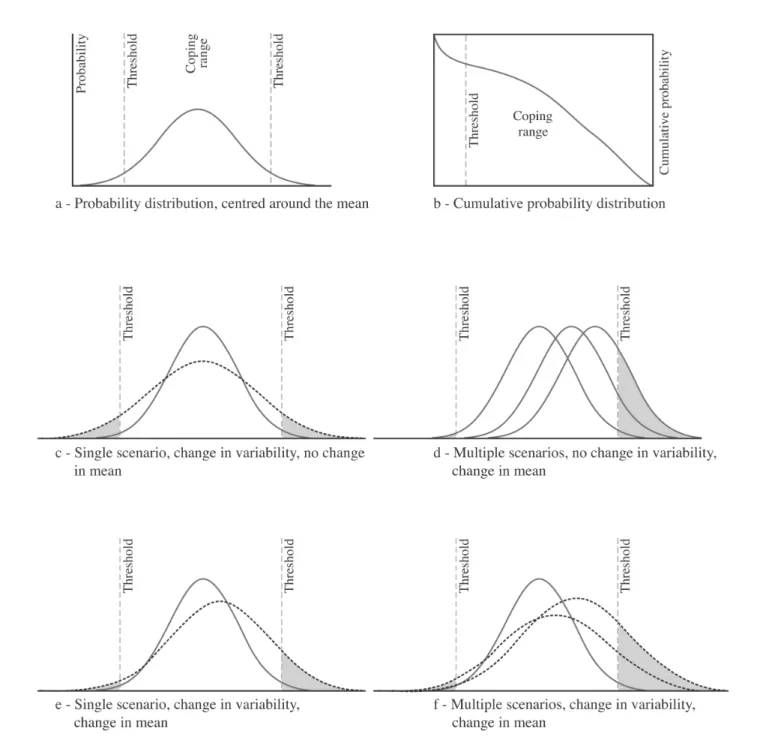
Figure 5-6 features different combinations of these two types of uncertainty in probabilistic terms:
• Graph “a” shows a normal distribution for a single variable shown as a distribution around the mean with nominal thresholds or risk criteria shown. This is a two-sided distribution.
• Graph “b” is a cumulative probability distribution that may be one sided, as for daily rainfall, or a cumulative representation of a probability distribution similar to the one on the left. These are typical of the types of frequency-based probabilities discussed in TP4. • Graph “c” represents a change in variance with no
change in mean.
• Graph “d” indicates multiple scenarios with changing means but fixed variance. This is the type of climate scenario where historical climate variability is scaled by a change in mean to estimate the impacts of differ-ent degrees of warming.
• Graph “e” exhibits a change in both mean and vari-ance for a single scenario.
• Graph “f” displays changes in both variance and mean and is the most complex to produce and interpret.
Assessments that are considering the types of analyses illus-trated in Figure 5-6 are encouraged to undertake a sensitivity analysis first, to quantify the impact for a given level of change. If changes in variance are likely to be dominated by changes to the mean (e.g., as in Figure 5-6, Graph d) then do not attempt producing scenarios for altered climate variability – use the his-torical variance. If changes in variance are important (e.g., where heavy rainfall is critical), then variability may be the most important factor.
By comparing scenarios to each other and situating them with-in broader ranges of uncertawith-inty, it is possible to build up a pic-ture of relative likelihoods. For example, if different climate models produce a consistent change in regional climate of warmer, wetter or drier conditions, then this change may seem
more likely. Critical thresholds linked to small magnitudes of global warming will be more likely to be exceeded than those that manifest under larger magnitudes of global warming. The same situation exists for sea level rise, low lying areas will be those most at risk from inundation and surge.
5.4.6. Conducting climate change risk assessments
The conventional seven-step method has been to apply cli-mate change scenarios, either to perturb a baseline clicli-mate, or directly to impact models, to see how much impacts may
change (Carter et al., 1994; Carter and Parry, 1998). Adapta-tion opAdapta-tions are then assessed to reduce those impacts. Types of assessments and their needs have multiplied since that method was first formulated (Carter et al., 1994) creating a demand for a variety of assessment techniques. For that rea-son, Figure 5-3 is a generic procedure that can be populated by many different analytic techniques, including those used in the seven-step method. These techniques can range from qualitative analysis (e.g., partitioning the outcomes into low, medium and high risk) to highly advanced numerical tech-niques (probabilities calculated using statistical and/or mod-elling techniques).
Figure 5-6:Constructions of different types of probabilities changing mean and variance, shown with thresholds/risk criteria to demonstrate how different representations of probability in scenario construction can be used to estimate change in risk.
Qualitative methods can use conceptual models incorporating elements of climate change (see TP4 for the development of conceptual models under current climate), informed by broad projections of global or regional climate change as being rep-resentative of “typical” climate scenarios. Narrative approach-es may develop several plausible storylinapproach-es of how climate may change, encouraging stakeholders to investigate how they would personally cope with such changes, suggesting adapta-tion opadapta-tions to manage potential risks. At the very least, this process will sensitise stakeholder groups to the issues sur-rounding adaptation to climate change. Hybrid approaches using existing quantitative models with qualitative assessments of future climate and socio-economic outlooks can also be instructive. The development of integrated scenarios, where consistent climate and socio-economic scenarios may also be addressed in a qualitative or semi-quantitative way, can also be used to promote a dialogue with stakeholders. See TP6 for issues relating to the alignment of SRES climate and green-house gas emission scenarios at a local or regional scale. Morgan et al. (2002) contains a rich assortment of techniques that can be used in risk communication. Willows and Connell (2003) also contains a range of useful methods.
Most risk assessments undertaken in developing countries are generally qualitative or semi-quantitative, but requests for quan-titative information by policy makers require an improved capac-ity to quantify outcomes. Many of the established methods will still be used but will increasingly be modified for particular styles of assessment. For methods on how to create and apply cli-mate scenarios, the IPCC-TGCIA guidelines (1999) and seven-step method of impact assessment (Carter et al., 1994; Carter and Parry 1998; UNEP, 1998) users are referred to existing guides.
Four assessments of current climate risk are featured in TP4. Of those, Box 4-2 has a future Component but is largely an assess-ment of current risk together with a brief assessassess-ment of possi-ble future changes to determine whether managing current risk would also reduce future risks. This next example is similar but opens up the question of how to follow up once short-term adaptations are put in place.
Box 5-3 details an example of a risk assessment investigating a natural hazard (drought). The analysis shows that current cli-mate risks are severe; clicli-mate variability, and therefore drought risk, is increasing. Projections from three GCM show that rain-fall is likely to decrease and temperature (and by extension evaporation) will increase. A vulnerability study shows that drought currently causes armed conflict. This risk has been communicated to the government and stakeholders who have negotiated a series of adaptations.
In this case, adaptation was badly needed to prevent recurring shocks that were causing famines, requiring years of recovery. Once basic protection against climate hazards is achieved, the emphasis can shift to adapting to increase productivity and pro-tection of the natural resource. This requires longer-term plan-ning horizons, gradually moving the emphasis of assessments from current risks towards future climate risks. Permanent water points create their own environmental stresses, population growth will continue and further drying is projected to increase climate risks. Risk assessments that explicitly formulate the like-lihood of continuing climate hazards, and those that investigate the vulnerability of local populations to climate will clearly be of value in ensuring a growing population can continue to reduce their exposure to environmental risks in a changing climate.
Box 5-3: Drought risk assessment in Uganda
Location:The Ugandan cattle corridor, running from the northeast to the southwest of the country, is a semi-arid area pop-ulated by over 41% and 60% of Uganda’s human and cattle population respectively. The Karamoja region in the northeast of the cattle corridor is a nomadic pastoralist region covering approximately 24,000 km2(10% of the country). It has an
average annual rainfall of 745 mm, ranging between 450 mm during severe drought years to 1000 mm during wet years.
Impacts:Droughts are increasing in frequency resulting in loss of water supply and pastures. Cattle keepers are forced to move livestock to other areas, resulting in cattle rustling, intertribal fighting and overall environmental insecurity. A recent study identified this area as one where environmental degradation, particularly drought, has caused armed conflict.
Traditional adaptation:Nomadism and migration are the major adaptive measures. Population growth is placing pressure on nomadic lifestyles while migration has been the catalyst for armed conflict and warfare. Warfare has moved from using bows and spears to automatic machineguns and rifles, threatening regional and national security.
Risk analysis:An initial vulnerability assessment under climate change using three GCM was carried out. It concluded that a doubling of CO2would increase the temperature by 2–4° C and decrease rainfall by 10–20% (>1 mm day-1). The annual
rainfall variability of the area has been increasing over the last 3 decades and is expected to increase further due to climate change.
Adaptation measures:Through a wide stakeholder consultation, the government has agreed to construct valley dams and tanks (surface water reservoirs) to supply stock during drought years. Eight reservoirs have been constructed of the 58 planned. The risk to drought impacts has decreased and the coping range increased, with available water for most drought years. However, land degradation is occurring near the reservoirs and water supply has periodically been contaminated. (Source: S. Magezi)
Although the APF stresses the need to assess current vulnerability and adaptation as part of planning for the future, current levels of adaptation need to be assessed for their adequacy in managing a changing climate. Box 5-4 shows an assessment that looks at possible changes to agricultural production in India. It uses an approach that accounts for current adaptations in agriculture, as expressed as farm-level net revenue aggregated to state and nation-al scnation-ale (Kumar and Parikh, 2001). This assessment suggests two things: 1) that developing countries face possible decreases in agri-cultural production compared to gains in developed countries using similar assessment techniques and 2) that current adaptations may be insufficient to manage losses under climate change.
The advantage of this approach is that it factors current adapta-tion into the assessment, and includes climate variability, albeit as it affects mean net revenue. The disadvantage is that the effects of CO2are not included as they would be in a more con-ventional crop modelling exercise. However, crop models gen-erally do not simulate adaptations all that well, although a new generation of models such as the Agricultural Production Systems sIMulator (APSIM) (Keating et al., 2003) are begin-ning to do so. Both the method in Box 5-4, and crop modelling approaches, have distinct advantages that can be used to illus-trate different aspects of risk. When different methods agree, some added confidence can be attached to the results.
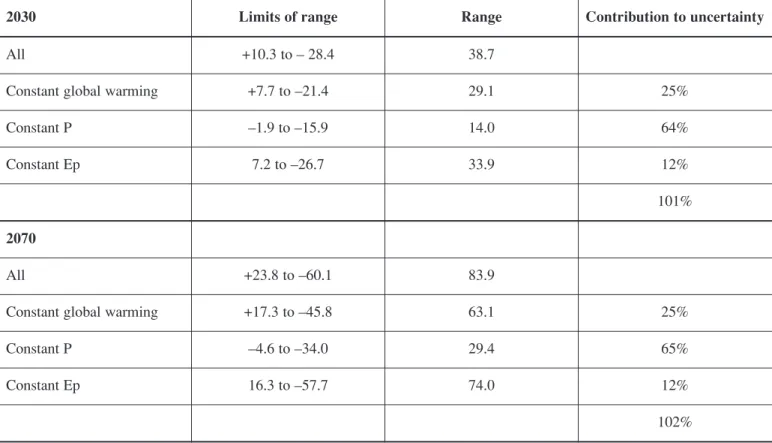
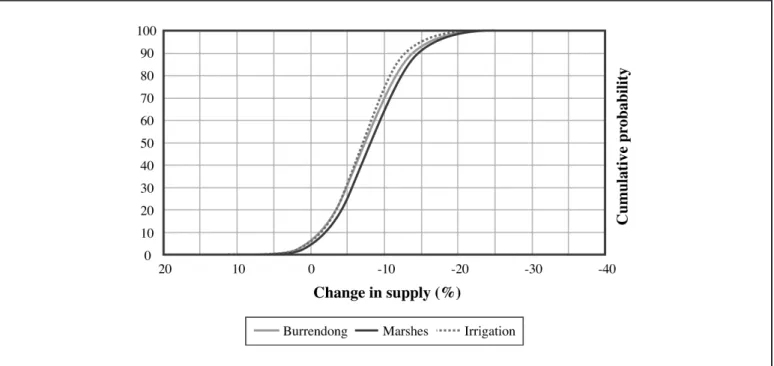
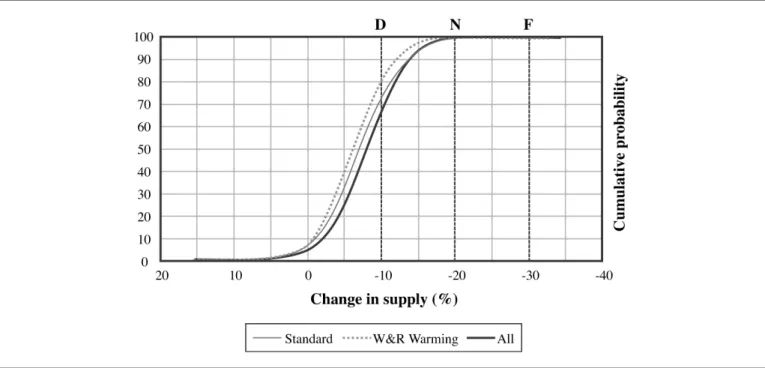
Annex A.5.1 summarises a risk assessment of water supply that uses both a natural hazards and vulnerability-based approach to assessing risk in a catchment in eastern Australia. This assess-ment applied multiple climate scenarios to an existing rainfall-runoff and river management model to determine changes in mean annual water supply, irrigation allocations and environ-mental flows. A relationship between changes in rainfall, poten-tial evaporation and water supply allowed conditional probabili-ty distributions of possible outcomes to be created. A natural hazards-based approach concluded that storage, irrigation and environmental flows would most likely change by 0% to -15% by 2030 from a total range of possibilities of +10% to -35%.
A complementary vulnerability-based assessment utilised two thresholds that represented a serious risk within the catchment. The first was a failure of irrigation supply to exceed 50% of the allocation levels five years running and the second that breed-ing of colonial water birds in a RAMSAR-gazetted wetland failed ten years running. It was found that the risk of exceeding this threshold depended on long-term rainfall variability in addition to climate change. If rainfall variability was “normal”, the probability of exceeding critical thresholds was negligible by 2030. However, if rainfall variability was in a drought-dom-inated phase, then the chance of exceeding the critical thresh-olds was about one in three. This catchment has been designat-ed as fully to over-allocatdesignat-ed in a recent audit (NLWRA, 2002), so adaptation to climate change is now seen as a necessary part of ongoing water reform, and investigations are ongoing.
Few risk assessments under climate change have so far utilised vulnerability-based approaches in a quantitative manner. However, a rich literature assessing qualitative approaches and vulnerability, to current climate suggests that significant develop-ment in this area is possible (TP3). Probabilistic approaches that apply a natural hazards approach in a “top down” manner, apply-ing climate change scenarios to impact models to determine vul-nerability are also being developed. Bottom-up approaches, where local criteria for risk denoting critical thresholds are constructed, then assessed for likelihood of exceedance are few, but this method has the potential to manage some (but not all) of the limi-tations of the natural hazards-based approach.
5.4.7. Managing climate risks
The main purpose of risk assessment is to determine the need for risk management (the reduction of risk). Adaptation to climate change reduces risk by altering human and environmental responses to climate hazards. (The hazards themselves are altered by the mitigation of greenhouse gases). Adaptation will increase the breadth of the coping range allowing successively
Box 5-4: Sensitivity of agricultural production in India to climate change
This study estimated the relationship between farm-level net revenue and climate variables in India using cross-sectional evidence (Kumar and Parikh, 2001). It used an economic approach expressed as farm-level net revenue. A number of vari-ables including temperature, rainfall, soil, technology, fertiliser and altitude were used to estimate a regression relationship with economic data from the yields of twenty crops across India. Temperature and rainfall of January, April, July and October are converted into anomalies, along with crop prices. Data for the 271 districts was from the decade 1970–1980; climate data was from the 1960–1980 time period. The response functions that explain the variation in price across districts therefore incorporate climate variability and adaptation to the mean climate and variability for the 10-year period that base-line climate data were available.
A “best-guess” climate change scenario was used to estimate possible changes due to climate. A rise of 2°C and an increase in rainfall of 7% was used as an illustrative scenario to determine how a mid-range or “best guess” climate change might affect Indian agriculture. The decrease in total economic yield was approximately 8%, being largest in the northern states. The eastern states registered increases. The impacts were larger than for those estimated in the United States using similar models, presumably due to India’s warmer temperatures and lower levels of technology.