Engine Serial Number:
The Hull Identification Number (HIN) is located on the starboard side of the transom. Be sure to record the HIN in the space provided above and always refer to the HIN for all correspondence or orders.© 2000 Bayliner Technical Publications. All rights reserved.
No part of this publication may be reproduced, stored in any retrieval system, or transmitted in any form by any means, electronic, mechanical, photocopying, recording or otherwise, without prior written permission of Bayliner. Printed in the United States of America.
Proprietary Rights
This document discloses subject matter in which Bayliner has proprietary rights. The information and design disclosed herein were originated by and are the property of Bayliner. Neither receipt nor possession thereof confers or transfers any right to reproduce, copy, alter or disclose the document or any part thereof, any information contained therein, or to construct boats or any item from it, except by written permission from or written agreement with Bayliner. This document is to be returned upon request to Bayliner.
General Notes
The material in this document is for information only and is subject to change without notice. While reasonable efforts have been made in the preparation of this document to assure its accuracy, Bay-liner assumes no liability resulting from errors or omissions in this document, or from the use of information contained herein.
TYPICAL HIN LOCATION
STARBOARD TRANSOM
Contents
Chapter 1: About This Manual
1 Dealer Service1 Boating Experience 1 Engine & Accessories
Guidelines 2 Safety Standards 2 Qualified Maintenance
2 Special Care For Moored Boats 3 Hazard Warning Symbols
Chapter 2: Product
Specifications
4 1600 (CF) 4 1750 (CH) 5 1800 (CJ) 5 1802 (CC) 6 1804 (PC) 6 1850 (BB) 7 1850 (CS) 7 1950 (CL) 8 1952 (CN) 8 1954 (CW) 9 2050 (CX) 9 2050 (CZ) 10 2052 (CK) 10 2150 (CT) 11 2152 (CY) 11 2350 (BC)Chapter 3: Components
& Systems
13 Electrical System (12-Volt DC) 14 Fuses and/or Circuit Breakers 15 Wiring Diagrams
15 Outboard Models 16 Outboard Fishing Models 17 Stern Drive Models 18 Stern Drive Fishing Models
19 Controls
19 Navigation and Interior Lights 19 Compass
20 Depth Finder
20 Bow Mount Trolling Motor 20 Anchoring
21 Ski Pylon
21 Hull Exterior Drains & Hardware 22 Fuel System
22 Fuel Fills and Vents 22 Fuel Filters
23 Bilge Blower 24 Live Well System 25 Bilge Pump
27 Fresh Water System
28 Marine Head With Pump Out 28 Portable Toilet
29 Alcohol Stove
30 Aft Jump Seat Conversion
30 1850BB, 1850CS, 2050CX
and 2052CK
31 1750CH, 1950CL,1952CN,
32 Fore-aft positions: 32 Lounge positions:
32 Pedestal Seats
33 Canvas Top Installation 34 Canvas Stowage
Appendix A: Limited Warranty
35 What Is Not Covered35 Other Limitations 35 Your Obligation
Chapter 1: About This Manual
This Owner’s Manual Supplement provides specific information about your boat that is not covered in the Owner’s Manual. Study the Owner’s Manual and this sup-plement carefully. Pay particular attention to, Appendix A: Limited Warranty in this supplement. Keep the Owner’s Manual and this supplement on your boat in a secure, yet readily available place.
Dealer Service
Make sure you receive a full explanation of all systems from the selling dealer before taking delivery of your boat. Your selling dealer is your key to service. If you experience any problems with your new boat, immediately contact the selling dealer. If for any reason your selling dealer is unable to help, you can call us direct on our customer service hotline: 360-435-8957 or send us a FAX: 360-403-4235.
Boating Experience
If this is your first boat or if you are changing to a type of boat you are not familiar with, for your own comfort and safety, you must obtain handling and operating experience before assuming command of the boat.
Take one of the boating safety classes offered by the U.S. Power Squadrons or the U.S. Coast Guard Auxiliary. For more course information, including dates and locations of upcoming classes, contact the organizations directly:
• U.S. Power Squadrons: 1-888-FOR-USPS (1-888-367-8777) or on the Internet at: http://www.usps.org
• U.S. Coast Guard Auxiliary: 1-800-368-5647 or on the Internet at: http://www.cgaux.org
Outside the United States, your selling dealer, national sailing federation or local yacht club can advise you of local sea schools or competent instructors.
Engine & Accessories Guidelines
Your boat’s engine and accessories were selected to provide optimum performance and service. Installing different engines or other accessories may cause unwanted handling characteristics. Should you choose to install a different engine or to add accessories that will affect the boat’s running trim, have an experienced marine
tech-CONTROL HAZARD! A qualified operator must be in control of the boat at all times. DO NOT operate your boat while under the influence of alcohol or drugs.
WA R N I N G !
The engine and accessories installed on your boat come with their own operation and maintenance manuals. Read and understand these manuals before operating the engines and accessories.
Safety Standards
Your boat’s mechanical and electrical systems were designed to meet safety stan-dards in effect at the time it was constructed. Some of these stanstan-dards were man-dated by law. All of them were designed to insure your safety, and the safety of other people, vessels and property.
In addition to this supplement, please read the Owner’s Manual, warning labels and all literature included in your owner’s packet for important safety standards and hazard information.
Qualified Maintenance
Failure to maintain your boat’s systems as designed could violate the laws in your jurisdiction and could expose you and other people to the danger of bodily injury or accidental death. Follow the instructions provided in the Owner’s Manual, this owner's manual supplement, the engine owner’s manual and all accessory instruc-tion sheets/manuals included in your boat’s owner’s packet.
N O T I C E
When storing your boat please refer to your engine’s operation and mainte-nance manuals.
DANGER
PERSONAL SAFETY HAZARD! DO NOT allow anyone to ride on parts of the boat not designated for such use.
Sitting on seat backs, lounging on the forward deck, bow riding, gunwale riding or occupying the transom platform or the aft sunlounge cushions while under-way is especially hazardous and WILL cause personal injury or death.
D A N G E R !
!
To maintain the integrity and safety of your boat, only qualified people should perform maintenance on, or in any way modify: The steering system, propul-sion system, engine control system, fuel system, environmental control system, or electrical system.
WA R N I N G !
hull bottom. This will detract from the boat’s beauty, greatly affect its performance and may damage the gelcoat. There are two methods of slowing marine growth: 1. Periodically haul the boat out of the water and scrub the hull bottom with a
bristle brush and a solution of soap and water.
2. The hull below the waterline was painted with anti-fouling paint by the factory. Occasionally you will need to re-paint it with a good grade of anti-fouling paint.
Hazard Warning Symbols
The hazard warning symbols shown below are used throughout this supplement to call attention to potentially dangerous situations that could lead to either personal injury or product damage. Read these warnings and follow all safety instructions.
N O T I C E
• To help seal the hull bottom and reduce the possibility of gelcoat blistering on moored boats, we recommend the application of an epoxy barrier coat-ing, such as INTERLUX, Interprotect 2000E/2001E. The barrier coating should be covered with several coats of anti-fouling paint.
• Many states regulate the chemical content of bottom paints in order to meet environmental standards. Check with your local dealer about recom-mended bottom paints, and about the laws in effect in your area.
EXPLOSION HAZARD! HOT
HAZARD! HAZARD!FIRE OPEN FLAMEHAZARD! ELECTRICALHAZARD! & FALLING HAZARD!PERSONAL INJURY PROPELLER HAZARD!ROTATING
DANGER
This message box alerts you to immediate hazards which WILL cause severe personal injury or death if the warning is ignored.
D A N G E R !
!
This message box alerts you to hazards or unsafe practices which COULD result in severe personal injury or death if the warning is ignored.
WA R N I N G !
!
C A U T I O N !
This message box alerts you to hazards or unsafe practices which COULD result in minor personal injury or cause product or property damage if the warning is ignored.
Chapter 2: Product Specifications
1600 (CF)
1750 (CH)
Overall Length Bridge Clearance Beam Maximum Draft Fuel Tank Capacity (gal) 16’ 1’’ 3’ 5’’ 7’ 2’ 8’’ 18 Overall Length Bridge Clearance Beam Maximum Draft Fuel Tank Capacity (gal.1800 (CJ)
1802 (CC)
Overall Length Bridge Clearance Beam Maximum Draft Fuel Tank Capacity (gal) 17’ 7’’ 3’ 10’’ 6’ 11’’ 2’ 8’’ 23 Overall Length Bridge Clearance Beam Maximum Draft Fuel Tank Capacity (gal) 17’ 7’’ 4’ 5’’ 6’ 11’’ 2’ 8’’ 231804 (PC)
1850 (BB)
Overall Length Bridge Clearance Beam Maximum Draft Fuel Tank Capacity (gal) 17’ 7’’ 3’ 10’’ 6’ 11’’ 2’ 8’’ 23 Overall Length Bridge Clearance Beam Maximum Draft Fuel Tank Capacity (gal) 18’ 4’’ 3’ 10’’ 7’ 5’’ 2’ 10’’ 301850 (CS)
1950 (CL)
Overall Length Bridge Clearance Beam Maximum Draft Fuel Tank Capacity (gal) 18’ 4’’ 3’ 10’’ 7’ 5’’ 2’ 10’’ 30 Overall Length Bridge Clearance Beam Maximum Draft Fuel Tank Capacity (gal) 18’ 8’’ 3’ 1’’ 7’ 6’’ 2’ 10’’ 231952 (CN)
1954 (CW)
Overall Length Bridge Clearance Beam Maximum Draft Fuel Tank Capacity (gal) 18’ 8’’ 3’ 8’’ 7’ 6’’ 2’ 10’’ 25 Overall Length Bridge Clearance Beam Maximum Draft Fuel Tank Capacity (gal) 18’ 8’’ 3’ 1’’ 7’ 6’’ 2’ 10’’ 252050 (CX)
2050 (CZ)
Overall Length Bridge Clearance Beam Maximum Draft Fuel Tank Capacity (gal) 20’ 6’’ 3’ 9’’ 7’ 8’’ 2’ 10’’ 37 Overall Length Bridge Clearance Beam Maximum Draft Fuel Tank Capacity (gal) 20’ 6’’ 3’ 9’’ 7’ 8’’ 2’ 10’’ 372052 (CK)
2150 (CT)
Overall Length Bridge Clearance Beam Maximum Draft Fuel Tank Capacity (gal) 20’ 6’’ 4’ 4’’ 7’ 8’’ 2’ 10’’ 37 Overall Length Bridge Clearance Beam Maximum Draft Fuel Tank Capacity (gal) 20’ 8’’ 3’ 10’’ 4’ 3’’ 2’ 11’’ 372152 (CY)
2350 (BC)
Overall Length Bridge Clearance Beam Maximum Draft Fuel Tank Capacity (gal) 20’ 8’’ 4’ 6’’ 7’ 11’’ 3’ 0’’ 37 Overall Length Bridge Clearance Beam Maximum Draft Fuel Tank Capacity (gal) 23’ 10’’ 5’ 2’’ 8’ 4’’ 3’ 1’’ 652350 (BD)
2352 (BF)
Overall Length Bridge Clearance Beam Maximum Draft Fuel Tank Capacity (gal) 23’ 9’’ 4’ 8’’ 8’ 6’’ 3’ 0’’ 65 Overall Length Bridge Clearance Beam Maximum Draft Fuel Tank Capacity (gal) Optional Water Tank Capacity (gal) 23’ 10’’ 5’ 2’’ 8’ 4’’ 3’ 1’’ 65 11Chapter 3: Components & Systems
Electrical System (12-Volt DC)
Thoroughly read and understand this section, the electrical sections of the Owner’s
Manual and all accessory manuals included in your boat’s owner’s packet. Wiring
schematics are provided in Chapter 4 of this supplement.
DANGER
EXTREME FIRE, ELECTRIC SHOCK and EXPLOSION HAZARD!To minimize the risks of fire, electric shock and explosion: • NEVER install knife switches or other arcing devices in the fuel
compartments.
• NEVER substitute automotive parts for marine parts. Electrical, ignition and fuel system parts were designed and manufactured to comply with rules and regulations that minimize risks of fire and explosion.
• Ensure all of the battery switches are in the OFF position before perform-ing any work in the engine spaces.
• DO NOT modify the electrical systems or relevant drawings.
• Only qualified personnel should install batteries and/or perform mainte-nance on the electrical system.
D A N G E R !
!
FIRE & EXPLOSION HAZARD!
• Fuel fumes are heavier than air and will collect in the bilge areas where they can be accidently ignited. Visually and by smell (sniff test), check the engine and fuel compartments for fumes or accumulation of fuel. Always operate the bilge blowers for at least four minutes prior to engine starting, electrical system maintenance or activation of electrical devices.
• Minimize the danger of fire and explosion by not exposing batteries to open flame or sparks. It is also important that no one smoke anywhere near the batteries.
WA R N I N G !
!
C A U T I O N !
SHOCK & ELECTRICAL SYSTEM DAMAGE HAZARD!
• NEVER disconnect the battery cables while the engine is running since
!
Fuses and/or Circuit Breakers
Please read the electrical section of the Owner’s Manual for important safeguards concerning your boat’s fuse block.
N O T I C E
Electrical connections are prone to corrosion. Electrical connections are prone to corrosion. To reduce corrosion caused electrical problems, keep all electrical connections clean and apply a spray-on protectant that is designed to protect connections from corrosion.
N O T I C E
VOLTAGES - All boats use either 110-volt AC/60 Hertz, 240-volt AC/60 Hertz or 220-volt AC/50 Hertz single phase systems, and 12-volt DC or 24-volt DC. Electrical distribution panels are labeled with 24-voltage and frequency of AC and DC.
DEPTH FINDER (OPTION), RED WIRE
BLANK (SPARE 10 amp)
BLOWER (I.O. BOATS ONLY), YELLOW WIRE
INSTRUMENTS, BLUE WIRE
BILGE PUMP, BROWN WIRE
12v POWER SUPPLY, RED WIRE
IGNITION SWITCH (I.O. BOATS ONLY), RED/PURPLE WIRE HORN, BROWN/ GREEN WIRE
NAVIGATION/ANCHOR LIGHTS, BLUE WIRE
STEREO, RED WIRE
10 amp 10 amp 5 amp 10 amp 5 amp 10 amp 15 amp 10 amp 10 amp 10 amp FUSE BLOCK (TYPICAL)
Wiring Diagrams
Outboard ModelsControls
Read and understand the Controls section of both the
Owner’s Manual and
engine manual, provided in the owner’s packet, for instructions and warranty information.
Navigation and Interior Lights
Read the navigation light section of the Owner’s Manual. The navigation and interior lights supplied with your boat are of top quality, but you should be aware that failure may periodically occur for a variety of reasons:
• There may be a blown fuse - replace the fuse in the switch panel. • The bulb may be burned out - carry spare bulbs for replacement. • A wire may be damaged or may have come loose - repair as required.
• The bulb base may be corroded - clean the base and coat it with non-conductive
electrical lubricant.
Compass
Your boat may come equipped with a compass. Carefully read and follow the man-ufacturer’s calibration and operating instructions provided in the owner’s packet.
SHIFTER CABLE THROTTLE CABLE
STEERING
SHIFT/ UNDER SIDE VIEW OF DECK
STARBOARD HELM SIDE PANEL THROTTLE (TYPICAL) CABLE
C A U T I O N !
• Conserve battery power. Prolonged operation of cabin interior lights (overnight) will result in a drained battery.
• Avoid the storage of gear where it would block navigation lights from view.
Depth Finder
Your boat may come equipped with a depth finder. It will provide you with measure-ments of water depth beneath the boat and in many cases it may help you locate schools of fish. The depth finder comes with its own Owner’s Manual. We suggest that you read it carefully before using the unit.
Bow Mount Trolling Motor
Your boat may be equipped with a foot operated trolling motor. Instructions can be found in the owner’s packet. Read these instructions before using the trolling motor.
Anchoring
Read and understand the Anchoring section of the Owner’s Manual.
WA R N I N G !
!
DO NOT use the depth finder as a navigational aid to prevent collision, ground-ing, boat damage or personal injury. When the boat is movground-ing, submerged objects will not be seen until they are already under the boat. Bottom depths may change too quickly to allow time for the boat operator to react. If you sus-pect shallow water or submerged objects, operate the boat at very slow speeds.
TROLLING TROLLING 12 VOLT TROLLING MOTOR RECEPTACLE DEPTH FINDER MOTOR VOLTAGE GAUGE BATTERY TEST LIVE WELL PUMP ENGINE TILT ACCY BRACKET MOTOR POWER PLUG FOOT CONTROL
WA R N I N G !
!
Ski Pylon
Your boat may feature a ski pylon. Read the manufac-turer’s operating instructions included in your owner’s packet before using the ski pylon. Carefully observe the following warnings:
Hull Exterior Drains & Hardware
It is critical that all pins are fully inserted through the pressure plates, base plates and tow bar tubes. Improper insertion may cause injury or death.
WA R N I N G !
!
When the tow bar is in use, all passengers must sit forward of the ski pylon and keep their hands well clear of the pylon and rope. Failure to do so may result in injury or death.
WA R N I N G !
!
TRANSOM LADDER SINK DRAIN BOW ON SOME MODELS COOLER DRAIN(ON PORT SIDE)
HATCH DRAIN
TYPICAL TRANSOM
BOW EYE LIVE WELL DRAIN ON SOME MODELS (PORT SIDE) (OPTION) TYPICAL BILGE PUMP DRAIN LOCATIONS
Fuel System
Fuel Fills and VentsFuel fills are located either on the aft deck or on the side decks adjacent to the aft cockpit. Fuel receptacle caps are marked “GAS”. Fuel vents are normally located in the hull or transom below and in the same general area as the fill. If you experience difficulty filling the fuel tank, check to see that the fuel fill and vent lines are free of obstructions and kinks.
Fuel Filters
Fuel filters should be replaced periodically to ensure that they remain clean and free of debris. A fine mesh screen filter is located on the fuel pickup tube. An additional filter, when supplied by the engine manufacturer, is installed on the engine. Consult your selling dealer or local marina concerning fuel additives that help to prevent fungus or buildup in your fuel tanks.
FUEL TANK
FUEL TANK DECK FITTING FUEL FILL TYPICAL FUEL SYSTEM
FUEL FEED HOSE
VENT FWD.
FIRE/EXPLOSION HAZARD
It is very important that the fuel system be inspected thoroughly the first time it is filled and then at each subsequent filling. For your safety and the safety of your passengers, the fueling instructions in the Owner’s Manual must be followed.
WA R N I N G !
!
C A U T I O N !
Bilge Blower
The bilge blower removes fumes from the engine compartment and draws fresh air into the compartment through the deck vents.
To ensure fresh air circulation, operate the bilge blower for at least four minutes before starting the engine, during starting, and while operating the boat below cruising speed.
TYPICAL BLOWER SYSTEM
FIRE/EXPLOSION HAZARD
Operation of the blower system is NOT A GUARANTEE that explosive fumes have been removed. If you smell any fuel, DO NOT start the engine.
If the engine is already running, immediately shut off the engine and all electri-cal accessories. Investigate immediately. DO NOT obstruct or modify the venti-lation system.
WA R N I N G !
Live Well System
Your boat may feature a live well. The live well aerator pump(s) are located aft, adja-cent to the bilge pump. The live well intakes are through-transom.
Switches for the live well are located on the forward elec-trical panel and on the main dash panel. These switches activate the aerator that pumps a continuous supply of fresh water into the live well. The overflow is automatically drained overboard.
Occasionally check the live well when it is operating to see that the aerator is
pump-ing adequate amounts of water. If there appears to be a problem, check the system, including the plastic screens over the transom intakes for weeds or other debris. The livewell is
drained by remov-ing the stand pipe (see photos to right) and allowing water to drain completely. TO FWD TRANSOM LIVE WELL TO AFT LIVE WELL LIVE WELL AERATOR PUMP (TYPICAL) PLASTIC SCREEN FILTER STAND PIPE LIVE WELL STAND PIPE DRAIN, ATTACHED AERATOR VALVE DRAIN, REMOVED DRAIN TO THRU-HULL
N O T I C E
Bilge Pump
This boat is equipped with one bilge pump, located at the low-est point of the bilge. The flow rate of the pump is 31.6 L (8.3 gal) per minute.
The electric bilge pump sup-plied with your boat is an impel-ler-type pump. It is controlled by a switch on the dash panel, which should be activated whenever water begins to accu-mulate in the bilge. Some mod-els will also have an automatic bilge pump switch (“autofloat switch”) mounted next to the pump. This is a float-type switch that will activate the bilge pump automatically when-ever the bilge water accumu-lates above a pre-set level. It is wired directly to the battery so it will normally function even when the boat is completely shut down and unattended, such as when the boat is moored at a marina.
Operation of the bilge pump should be checked often. To check the bilge pump, activate the dash-mounted switch and verify that water in the bilge is pumped over-board. If bilge water is present and the pump motor is running but not pumping, inspect the discharge hose for a kink or collapsed area. If no problems are found, check the bilge pump housing for clogging debris:
To remove the power cartridge:
1. Lift the tab while rotating the fins counter clockwise and lift out the power cartridge (Fig. 1).
2. Clear the housing of debris.
TRANS
OM
TYPICAL BILGE PUMP SYSTEM
FLOAT SWITCH BILGE PUMP THRU HULL TAB FIN
To reinstall the power cartridge:
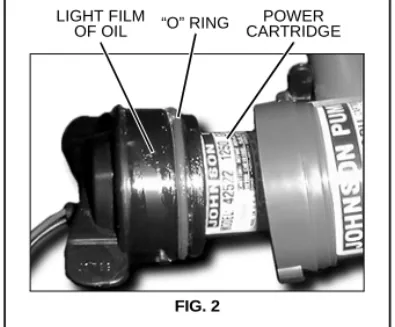
1. Make sure the “O” ring is properly located and coat the “O” ring with a light film of vegetable oil or min-eral oil (Fig. 2).
2. Align the two cams on either side of the power cartridge with the two slots on the outer housing. Press the power cartridge into the housing and twist clockwise. Ensure proper reinstallation by attempting to twist the fins counter clockwise without lifting the tab. The cartridge should stay in place.
If applicable, the autofloat switch should also be checked often for proper opera-tion. Lift the float by turning the plastic insert, where the wires enter the housing, 1/ 4 turn counter clockwise (Fig. 3).
As the float is lifted, the bilge pump should turn on. If lifting the float does not turn the pump on, check the inline fuse. If the fuse is good but the switch does not work, it may indicate a bad switch or possibly a low battery.
FIG. 2 OF OIL
LIGHT FILM “O” RING POWER CARTRIDGE
FLOAT
PLASTIC INSERT
DETAIL
OFF POSITION (DOWN)
FLOAT
ON POSITION (UP)
TYPICAL FLOAT SWITCH
FIG. 3
N O T I C E
Fresh Water System
Fresh water systems are available on some models. These pressure-type (demand) systems operate when the water pump switch (located near the sink in the cuddy cabin) is in the ON position. Turn the pump switch OFF when the boat is not in use and when the water tank is empty.
Stored water can become stagnant and distasteful. Pump the water tank dry before leaving your boat unattended for long periods of time. Occasionally you may want to disinfect your water system. Ask your selling dealer about available treatments and procedures.
Your boat may be equipped with a transom shower. Please read and follow the man-ufacturer’s operating instructions supplied in your owner’s packet.
PO RT AFT TO SINK FAUCET WATER TANK WATER PUMP SINK WATER DRAIN HOSE FAUCET PUMP SWITCH & LABEL
TYPICAL FRESH WATER SYSTEM COMPONENTS
TO TRANSOM SHOWER ON AFT DECK
Marine Head With Pump Out
If your boat features a marine head and pump out system, carefully read the manu-facturer’s owner’s manual supplied in your owner’s packet.
Portable Toilet
Your boat may feature a portable toilet. Read and follow the manufacturer’s operat-ing instructions supplied in your owner’s packet before using your portable toilet.
MARINE PUMP OUT WASTE TANK VENT HOSE HEAD HOSE WASTE PUMP WASTE TANK VENT FITTING OUT FITTING PORT DASH
PORTABLE TOILET STORAGE LOCATION (TYPICAL)
Alcohol Stove
If your boat features a single burner alcohol stove, carefully read and follow the manufacturer’s operating instructions supplied in your owner’s packet before using your stove for the first time.
Reduce the possibility of fire by removing all combustible materials away from the stove before/during use.
WA R N I N G !
!
SINK STBD FWD STOVE INSERTS HERE STOVE STORAGE STBD FWD TABLE CUDDY CABIN AREA*TYPICAL STOVE STORAGE AREA *TYPICAL STOVE OPERATING LOCATION
FIRE/EXPLOSION HAZARD
2352BF ONLY - FIRE HAZARD. The portable stove must be placed in
the designated operating location when in use (see photos). below)
.WA R N I N G !
!
CORRECT LOCATION OF THE STOVE DURING USE AND DURING USE
ALWAYS INSERT THE STOVE IN THE SLIDE OUT STOVE OPERATION BOARD BEFORE NEVER OPERATE THE
STOVE ON THIS COUNTER TOP. PROXIMITY TO THE OVERHEAD IS A FIRE HAZARD
Aft Jump Seat Conversion
1850BB, 1850CS, 2050CX and 2052CKThe following is the procedure for converting the jump seats into a sunlounge for the Capri 1850CS, 2050CX and 2052CK models:
1. Remove the port jump seat (Fig. 1). Rotate it 90° clock-wise and slide the lounge support insert into the
star-board side opening of the
motor box pad (Fig. 2). 2. Remove the starboard
(STBD) jump seat (Fig. 1). Rotate it 90° counterclock-wise and slide the lounge support insert into the (PORT) side opening of the motor box pad (Fig 3).
MOTOR BOX PAD STBD JUMP SEAT
FIG. 1 PORT JUMP SEAT SUNLOUNGE PAD) (CONVERTS TO PORT SUNLOUNGE PAD) (CONVERTS TO STBD PORT FIG. 3 MOTOR BOX PAD PORT STBD FIG. 2 LOUNGE SUPPORT INSERT MOTOR BOX PAD STBD
LOUNGE SUPPORT INSERT
DETAILED VIEW
STBD SUNLOUNGE PAD
(PORT JUMP SEAT) PORT SUNLOUNGE PAD(STBD JUMP SEAT)
MOTOR BOX PAD COMPLETED CONVERSION
1750CH, 1950CL,1952CN, 1954CW, 2150CT and 2152CY.
The following is the procedure for converting the jump seats into a sunlounge for the Capri 1750CH, 1950CL, 1952CN, 1954CW, 2150CT and 2152CY.
B
C
STEP - 2 A
Step - 2:
Slide the lounge support inserts (B) into the lounge support slots (C). STEP - 3 MOTOR BOX A STEP - 1 A C C Step - 1:
Remove the jump seats (A) by sliding them forward.
Step - 3:
Press down firmly on the inboard side of each jumpseat until they rest firmly on the motorbox ledge.
Sleeper Seat Adjustment
Your boat may be equipped with adjustable sleeper seats. These seats can be adjusted fore and aft in the upright position. The seat bottoms of these models also adjust into backrests while the seat is in the lounge position.
Fore-aft positions:
1. To slide the seat forward or backward, lift up on the front edge of the seat bottom (A).
2. Move the seat forward until the lock-ing mechanism engages in one of the three different positions
3. Lift the aft seat at point (B) and slide the aft seat towards the forward seat.
Lounge positions:
1. To put the seat into the lounge posi-tion, lift up on the front edge of the seat (A) and pull the seat all the way forward. Lift the aft seat at (B) and pull the aft seat away from the for-ward seat until the seat is laid out flat. 2. Lift up on the forward or aft seat
bot-tom at point (C) until the seat botbot-tom drops into the locked position.
3. To lower the seat bottom, lift the seat at points (C) and (D) at the same time. Drop the seat bottom flat while holding the seat up at point (D).
4. To return the seat to the operating position, lift the seat back at point (E) and push the seat bottom toward the center of the seat until it locks into place.
Pedestal Seats
Your boat may feature pedestal seating. Fore and aft pedestal seats should be removed and stowed in a safe and secure area while underway or when trailering your boat.
DANGER
PERSONAL SAFETY HAZARD! DO NOT allow anyone to ride on parts of the boat not designated for such use.
Sitting on seat backs, lounging on the forward deck, bow riding, gunwale riding or occupying the transom platform or the aft sunlounge cushions while under-way is especially hazardous and WILL cause personal injury or death.
D A N G E R !
Canvas Top Installation
1. Attach eye ends of main bow (See point A below) to deck hinges on the boat and remove boot if necessary.
2. Unfold canvas top and stretch the front edge of the top across the windshield frame and snap to frame (B). Use care to center the canvas on the windshield. Close the front zipper (C).
3. Pull back on the top (D), making sure the canvas lies evenly from side to side and hook the hold down straps (E) to the deck loops located near the rear of the windshield side wing. If the canvas top does not have a smooth, taut look, adjust by holding the rear of the top and tightening the straps by pulling on the strap buckle. When properly adjusted, both sides of the top will be even. 4. Align the secondary bow (F) with the center seam of the canvas by loosening
or tightening the top straps (G). No adjustments to the secondary bow jaw slide (H) should need to be made as they are preset during manufacturing. Before attempting to adjust the jawslide position, obtain the correct measurements from your selling dealer.
5. If additional canvas (i.e. side curtains, slant back cover, or camper cover) are to be installed, they should be snapped to the top canvas before final adjustment. The top can then be adjusted as in steps 3 and 4 to bring the lower row of snaps on the canvas in line with the row on the boat. Like the top, the additional can-vas pieces are in proper adjustment when they are smooth and taut.
A D E F H B G C C
Canvas Stowage
Your boat may feature venti-lated stowage space for the can-vas top under either the cancan-vas stowage cover or the aft
sun-lounge pad. CAN
VAS STOWAG
E COVER CANVAS TOP MOTOR BOX CANVAS STOWAGE (TYPICAL VIEW)
Appendix A: Limited Warranty
Bayliner warrants to the original purchasers of its 2000/2001 model boats, purchased from an authorized dealer, operated under normal, noncommercial use that the selling dealer will: (A) Repair any structural hull defect which occurs within five (5) years of the date of delivery; and (B) Repair or replace any parts found to be defective in factory material or workmanship within one (1) year of the date of delivery.
What Is Not Covered
This limited warranty does not apply to:
1. Engines, drive trains, controls, props, batteries, or other equipment or accessories carrying their own individual warranties;
2. Engines, parts or accessories not installed by Bayliner;
3. Plexiglass windscreen breakage; rainwater leakage on runabout models; rainwater leakage through convertible tops; minor gelcoat discoloration, cracks or crazing or air voids; 4. Hull blisters that form below the waterline;
5. Normal deterioration, i.e. wear, tear, or corrosion of hardware, vinyl, tops, vinyl and fabric uphol-stery, plastic, metal, wood, or trim tape;
6. Any Bayliner boat which has been overpowered according to the maximum horsepower specifi-cations on the capacity plate provided on each Bayliner outboard boat;
7. Any Bayliner boat used for commercial purposes;
8. Any defect caused by failure of the customer to provide reasonable care and maintenance.
Other Limitations
THERE ARE NO OTHER EXPRESS WARRANTIES ON THIS BOAT. TO THE EXTENT ALLOWED BY LAW:
1. ANY IMPLIED WARRANTY OF MERCHANTABILITY OR FITNESS FOR A PARTICULAR PURPOSE IS LIMITED TO THE DURATION OF ONE YEAR.
2. Neither Bayliner nor the selling dealer shall have any responsibility for loss of use of the boat, loss of time, inconvenience, commercial loss or consequential damages.
3. Some jurisdictions do not allow limitations on how long any implied warranty lasts, so the above limitation may not apply to you. Some jurisdictions do not allow the exclusion or limitation of incidental or consequential damages, so the above limitation or exclusion may not apply to you. This limited warranty gives you specific legal rights, and you may also have other rights which vary from state to state.
Your Obligation
In order to comply with regulations, it is essential that your limited warranty registration card be submitted within 30 days of delivery of your boat. Return of the limited warranty registration card is a condition pre-cedent to limited warranty coverage. Before any warranty work is performed, we require that you contact your dealer to request warranty assistance.
YOU MUST GIVE US WRITTEN NOTICE OF YOUR WARRANTY CLAIM PRIOR TO THE EXPI-RATION OF YOUR LIMITED WARRANTY AND ALLOW US AN OPPORTUNITY TO RESOLVE THE MATTER.
We require that you return your boat, at your expense, to your selling dealer or, if necessary, to the Bay-liner factory. You will be responsible for all transportation, haulouts and other expenses incurred in return-ing the boat for warranty service.
Bayliner Marine Corporation
PO Box 9029 Everett, WA 98206 Phone: 360-435-8957