DOCUMENT
DE TRAVAIL
N° 534
WHY FINANCIAL ADVICE CANNOT SUBSTITUTE
FOR FINANCIAL LITERACY?
Majdi Debbich
January 2015
DIRECTION GÉNÉRALE DES ÉTUDES ET DES RELATIONS INTERNATIONALES
WHY FINANCIAL ADVICE CANNOT SUBSTITUTE
FOR FINANCIAL LITERACY?
Majdi Debbich
January 2015
Les Documents de travail reflètent les idées personnelles de leurs auteurs et n'expriment pas nécessairement la position de la Banque de France. Ce document est disponible sur le site internet de la Banque de France «
www.banque-france.fr
».Working Papers reflect the opinions of the authors and do not necessarily express the views of the Banque de France. This document is available on the Banque de France Website “
www.banque-france.fr
”.Why Financial Advice Cannot Substitute for Financial Literacy ?
∗
Majdi
Debbich
†∗I would like to thank Luc Arrondel, Nicoletta Berardi, J. Michael Collins, Alexis Direr, Meglena Jeleva, Annamaria Lusardi,
Muriel Roger, Sébastien Roux, Frédérique Savignac, Ricardo Serrano-Padial and Gregory Verdugo for very helpful comments and fruitful discussions. I am also grateful to seminar participants at Banque de France, the Household Finance Scholar Seminar at the University of Wisconsin-Madison and the 2014 MASE Conference, Tunis.
†Banque de France and Paris School of Economics. E-mail: [email protected]. The views expressed in this paper are solely
Résumé
Cet article s’intéresse à la capacité des conseils fournis par des prestataires de services financiers à venir se substituer à l’éducation financière des consommateurs. Je construis un modèle théorique simplifié dans lequel un conseiller financier disposant d’une information parfaite communique avec un consommateur moins informé. Etant donnée l’existence d’un conflit d’intérêt pour le conseiller, le modèle prédit que seuls les consommateurs les plus éduqués financièrement reçoivent une information pertinente de la part du conseiller financier. Cette caractéristique incite les consommateurs dont le niveau d’éducation financière est le plus faible à ne pas demander de conseils financiers alors même qu’ils en ont le plus besoin. Globalement, le modèle prédit une relation monotone entre l’éducation financière des consommateurs et leur demande de conseils financiers. J’exploite ensuite les données d’un échantillon représentatif de ménages français (PATER 2011) pour tester les prédictions du modèle. Je trouve ainsi que l’éducation financière est fortement liée à la probabilité de demander des conseils financiers. En décomposant la mesure d’éducation financière utilisée, je montre que la relation est faiblement monotone, soutenant ainsi l’hypothèse que les conseils financiers ne peuvent venir se substituer à l’éducation financière des consommateurs. Ce résultat est robuste à différentes spécifications alternatives et aux régressions par variables instrumentales.
Mots-clés: Education financière, Conseils financiers, Finance des ménages
Codes JEL:D14, D82, G11
Abstract
This paper examines the ability of financial advice provided by sellers of financial services to substitute for financial literacy of customers. I set up a simple theoretical model in which an informed financial advisor communicates with a less informed customer of financial services. Given the existence of a conflict of interest from the advisor’s perspective, the model predicts that only well financially sophisticated customers receive relevant information from the advisor. This fact tends to prevent less financially sophisticated customers from asking advice although they are the most in need of financial guidance. Overall, the model predicts a monotonic relationship between financial literacy and the demand for financial advice. I then use a representative sample of French households (PATER 2011) to test the predictions of the model. I find that financial literacy is strongly associated to the probability to ask a financial advisor. Decomposing the measure of financial literacy, I show that the relationship is weakly monotonic which provides support to the fact that financial advice cannot substitute for financial literacy. This result is robust to alternative specifications and instrumental variables regressions.
Keywords: Financial Literacy, Financial Advice, Household Finance
Non-technical summary
Financial literacy has become an increasingly popular subject of investigation for researchers and policy makers, in particular following the aftermath of the 2008 financial crisis. The subprime crisis has revealed how devas-tating can be the consequences of individual financial behaviors for the global economy. The lack of financial knowledge and awareness is often pointed out as a source of financial mistakes for households. Indeed, financial illiteracy and its consequences on financial well-being have been widely documented in the economic literature. Less financially literate individuals tend to save than others, especially for retirement, they are also less prone to diversify their portfolios by holding stocks for instance, and they have a higher propensity to get overindebted. These results hold in most countries and in particular in France.
Yet financial illiteracy would not be an issue for individual financial decisions if more knowledgeable agents such as financial advisors could mitigate financial mistakes by providing sound financial guidance. In this paper, I challenge this assertion in the specific case of France where most financial advisors are transactional agents i.e. their compensation structure is interested and product-biased. To do so, I construct a very simple model of communication between a financial advisor which has perfect information regarding financial products and customer’s caracteristics, and a customer which is unaware of products’ caracteristics. I derive two important results from this model: (i) financial advisors tend to provide a relevant advice only to customers who already have a high level of financial literacy; (ii) given this fact, less financially literate customers do not ask for advice although they are the most in need of financial guidance. These results directly stem from the compensation structure of financial advisors.
Using a representative sample of French households (PATER 2011), I test the predictions of the model and in particular, I question the pattern of the relationship between the level of financial literacy and the demand for financial advice. Using different statistical methods to take into account other factors that could also influence the demand for financial advice such as wealth, income or financial experience, I show that financial literacy is positively associated to the demand for financial advice. In other words, individuals with a high level of financial literacy tend to ask for advice before making financial decisions while less financially sophisticated customers rather rely on their own judgement. These empirical results corroborate the predictions of the model and support a complementarity between financial literacy and financial advice rather than a substituability.
As suggested by the theoretical model, advisors’ compensation schemes can be at the heart of the empirical findings. Product-biased compensation structures lead financial advisors (i) to increase the informational gap between financially literate and illiterate customers and (ii) not to be useful for individuals who are the most in need of financial guidance. In this respect and given the importance of transactional agents in France, financial advice can hardly be relied upon to deal with widespread financial literacy. Rather, other levers such as financial education programs should be considered. While the efficiency of such programs regarding the quality of financial decisions is still debated, increasing financial knowledge and awareness in the population could help mitigate the bias of financial advisors.
1
Introduction
The issue of substituability between financial literacy and financial advice is gaining audience, as financial products become more complex and households exhibit low financial sophistication. Financial illiteracy has been shown to have important consequences for household’s financial well-being. Financially unsophisticated households tend to save less than others, especially for retirement (Lusardi and Mitchell 2007a; Banks et al. 2011; Arrondel et al. 2013). They are also less prone to hold stocks (van Rooij et al. 2011; Arrondel et al. 2014), to accumulate wealth (van Rooij et al. 2012) and tend to get over-indebted more often than other households (Lusardi and Tufano 2009; Gerardi et al. 2010). But financial illiteracy would not be an issue if households could seek for guidance from qualified sources such as bankers or independent financial advisors that can mitigate financial mistakes (Bluethgen and Gintschel 2008).
In France, most households lack command of basic economic and financial concepts (Arrondel et al. 2013) and tend to rely on financial advisors when they decide to make a financial decisions. About 49% of French households (PATER Survey 2011) declare to seek financial information mainly from their bank or from inde-pendent financial advisors (conseillers en investissements financiers). The compensation arrangements of these professionals differ but remain interested and product-biased in both cases. While bankers tend to charge a one-time commission upon selling a specific product, independent financial advisors act as intermediaries and receive trailing commissions. These compensation schemes can lead advisors to pursue goals that are not necessarily in the interest of customers and this way alter the capacity of financial advice to provide a consistent substitute for financial literacy. This paper examines this issue from both a theoretical and an empirical perspective. I develop a simple stylized model of communication between a customer and a financial advisor and then test the implications of the model on a representative sample of French households. The model predicts a mono-tonic relationship between financial literacy and the demand for financial advice: investors with a high level of financial sophistication tend to seek for advice while investors with a low level of financial sophistication do not ask for advice. Using an original household survey (PATER 2011), I investigate this issue from an empirical perspective and find that in the French population only sophisticated investors seek for advice.
A substantial body of the literature has questioned the capacity of experts (agents) to provide relevant advice to investors (principals) which decisions influence both outcomes in a context of hidden information and incomplete contracts. Several papers focus on the supply side of the financial advice industry either looking at the market structure or the internal organization of firm’s sales process. Bolton et al. (2007) consider a model of competition between two financial intermediaries offering advice to uninformed investors. They show that competition can lead intermediaries to provide relevant information to customers even when reputational costs from misselling are small. Inderst and Ottaviani (2009) look at the compensation scheme set up by a firm to incentivize its employees to find new customers. They show that the firm tolerance to misselling depends on its own sales process, agent’s costs of prospecting new clients and disclosure of commission structure which altogether make it difficult for policy makers to have a uniform set of regulation.
investor’s information or financial literacy acts as a substitute or a complement to resorting to financial advi-sors. No unique answer has been brought in the literature and the main reason for this is because the papers consider different definitions of what relying on a financial advisor means: delegating financial decisions, con-sulting/asking for advice or following recommendations. The paper by Aghion and Tirole (1997) provides a first insight though it cannot be presented as a model of advice because no communication is involved. The principal trades off delegating her decision to the agent and deciding alone. In the former case, the agent has more incentive to gather information but might also choose an option that does not fully match principal’s needs while in the latter case the principal decides based on her own information only. The authors show that for principals with higher costs to gather information, it might be optimal to delegate decisions to a more informed agent. In the context of financial decisions, this result works in favor of a substituability between information and delegation (asking the expert to take the right decision).
Another strand of the literature builds on the cheap-talk framework (Crawford and Sobel 1982) which refers to direct and costless communication to analyze the delegation process occuring between a biased expert and an uninformed decision maker. Ottaviani (2000) proposes a model in which principals differ in their degree of naivete and can choose between fully delegating their investment decision to a more informed agent or engaging in a cheap talk. Ottaviani shows that delegation gives higher expected payoff to principals because then all the information is used as compared to cheap-talk in which the agent provides only part of the information to the principal. This result is generalized by Dessein (2002) who shows that least informed principals tend to delegate their decisions rather than interact with the agent suggesting some complementarity between information and the demand for professional advice. Hackethal et al. (2012) study the question of delegation from an empirical perspective using German data and show that richer and experienced investors with potentially higher financial literacy tend to delegate more often to financial advisors. The explanation they provide for this is related to the higher opportunity cost of time of richer investors. Overall, there tend to be a theoretical consensus about the fact that least informed investors prefer delegating their decision rather than asking for advice but empirical evidence as in Hackethal et al. (2012) tend to show that this might not be always the case.
In Bucher-Koenen and Koenen (2011), the authors are interested in the determinants of financial advice seeking and in the determinants of following the advice given by the expert. They build an analytical model in which they posit that better informed customers induce advisors to provide better advice. Hence, customers have an incentive to ask for advice even if their level of information is high enough to invest autonomously. But the authors also show that financially sophisticated customers are less likely to follow professional advice. This conclusion is supported by an empirical analysis of the SAVE-panel survey in Germany. Georgarakos and Inderst (2011) build on a cheap-talk model to look also at how levels of information interact with following professional advice. They highlight the importance of trust in advisor for less financially sophisticated investors to follow or not the advice provided and show that well-informed investors tend to completely disregard advice. Evidence of these results are found in the Eurobarometer data in which trust matters only for less financially literate investors. These papers both show that in general financially sophisticated investors tend not to follow the advice given by financial experts.
In this paper, I am specifically interested in the demand for professional financial advice and its interaction with financial literacy. Therefore, I leave apart the questions of delegation and of following or not the advice given. Regarding the demand for advice, the rationale is that less informed and financially literate investors should have higher incentives to gather additional information from qualified sources when it comes to make financial decisions. However, several papers show that financially unsophisticated investors tend to turn more often to informal sources of information such as family, friends or acquaintances rather than professional experts when they seek financial guidance (van Rooij et al. 2011; Lusardi and Mitchell 2011a). Bucher-Koenen and Koenen (2011) using the SAVE-panel and Collins (2012) using the FINRA Financial Capability Survey report empricial evidence that the demand for financial advice is associated with higher financial literacy while Hung and Yoong (2010) show using experimental data from the RAND American Life Panel that financial advice tend to be chosen by least financially literate investors.
As opposed to the theoretical model of Bucher-Koenen and Koenen (2011) in which a complementarity is positedex-antebetween investor’s financial literacy and quality of advice, I let my simple communication model predict the pattern of the relationship. In this respect, the mechanic of my model is very similar to that in Calcagno and Monticone (2015). We both consider a situation in which an uninformed customer (principal) can decide to ask for advice to a better informed financial expert (agent) before investing. The communication game involved differ from the class of cheap-talk models because preferences of the principal and the agent are not always conflicting. As in Calcagno and Monticone (2015) I find that less financially literate customers tend not to ask for advice because they know they will not receive a relevant information from advisors.
However, the stylized model I present in this paper is original in several respects. As opposed to Calcagno and Monticone (2015) I do not assume that the asymmetry of information between the principal and the agent comes from a differential of knowledge regarding future financial markets returns. I do not believe that professional advisors are more knowledgeable than customers regarding future returns as portfolios managed or advised by experts do not necessarily perform better than self-managed accounts (Hackethal et al. 2012; Karabulut 2013). Hence, my analysis does not restrict to the case of investing on financial markets, rather I consider a situation that could apply to any financial product. The source of uncertainty for the customer in my model is on her type or alternatively the characteristics of the financial products. I assume that this uncertainty is decreasing with customer’s level of financial literacy. As in Bolton et al. (2007) and Inderst and Ottaviani (2009, 2012a), I assume that the customer does not perfectly observe her type and therefore cannot discriminate between any financial products the one that best suits her needs. As argued in Bolton et al. (2007), I assume thatcustomers may be unaware of important tax or liquidity advantages of one of the products or they may not be aware of
specific fine print contractual clauses.
The model also considers more complete beliefs for the customer. I assume that the customer has some beliefs regarding the alignment of her preferences with those of the advisor. In the baseline version of the model, this hypothesis does not play a significant part as the believed probability that preferences are aligned is assumed to be small. Thereby, as in Calcagno and Monticone (2015) the baseline model predicts that less financially literate customers do not ask for advice because they never get a relevant information from the advisor. In the
appendix, I present an extended version of the model in which financially unsophisticated customers may find it profitable to ask for advice even if they know the advice received will be biased towards advisor’s preferences. This happens when customers believe their preferences have a substantial probability to be aligned with those of the advisor so that the product advised corresponds to customer’s type. In that case, the model predicts a non-monotonic relationship between financial literacy and the demand for financial advice. Customers with lower and higher levels of financial literacy tend to ask for advice while customers with average levels of financial literacy do not ask for advice. In the empirical part of this paper, I test the conclusions of the model on a representative sample of the French population using the 2011 wave of the PATER survey. Financial literacy is measured with three questions on interest compounding, inflation and risk diversification following Lusardi and Mitchell (2011a). I find a positive and significant relationship between the level of financial literacy and the probability to ask for advice. To test for the non-monotonicity of the relationship between financial literacy and the demand for advice suggested by the extended version of the model, I use a set of dummy variables for each number of questions correctly answered. The pattern of the relationship is found to be monotonic thereby supporting the complementarity hypothesis predicted by the baseline model.
The rest of the paper is organized as follows. In section 2, I present the simple communication model and derive its equilibria. In section 3, I test the predictions of the model on the French PATER survey and provide robustness checks including instrumental variables regressions and alternative constructions of the index for financial literacy. Finally, I conclude in section 4 and explore other promising ways of dealing with widespread financial illiteracy.
2
Theoretical Background
2.1
Overview
The following stylized model considers a customerBwhich can invest her wealth in two different and mutually
exclusive financial products. I borrow from Bolton et al. (2007) and Inderst and Ottaviani (2009, 2012a) the fact that customer B (the principal) does not perfectly observe her type or alternatively does not perfectly
observe the characteristics of each financial product. Financial literacy is then understood here as a lack of information. I also borrow from Calcagno and Monticone (2015) the fact that customerB can ask for advice
to a more informed advisorA(the agent) and engage in an information revelation game which differs from the
class of cheap-talk games1.
Advisor A derives a different commission from each financial product and so may have an incentive not
to provide relevant information to the customer. But the advisor cares about reputation and then provides a biased advice only when the reputational cost of doing so does not exceed the benefits. CustomerBis assumed
to have beliefs regarding which product best suits her needs and preferences alignment. As a consequence, the customer trades off asking for advice or deciding alone which product to buy based on her beliefs and awareness
1The model differs from cheap-talk games (Crawford and Sobel 1982) because preferences of the agent and the principal do not always conflict.
of the advisor’s biasedness. I find that the customer may not ask for advice when she knows the advisor will not provide a relevant information i.e. when the reputational costs are too low.
The next subsections present the characteristics of both the customer (she) and the advisor (he) and the last subsection reports the equilibria of the communication game.
2.2
The Customer
I consider a rational customer B with preferences represented by a utility function u(.) with u0(.) > 0 and u00(.) < 0. This customer buys one unit of a financial product θ ∈ Θ with card{Θ} = 2 from a financial
intermediaryA. In other words, customerB has to choose between two financial products the oneθB∈Θthat
best suits her needs2 such that for anyθ∈Θ, 0≤u(θ)≤u(θ
B). But B does not know which product is best
suited for her needs. As in Bolton et al. (2007) and Inderst and Ottaviani (2009, 2012a) , I assume that the customer might not be aware of certain tax and liquidity advantages or may not be aware of specific contractual clauses.
This is equivalent to assuming that the customer has incomplete information about her true type. She only observes a signalγ∈Θtelling her which financial product is a best match. I assume the conditional probability
that the message is true given the financial product that best matches customer’s needsP(γ =θB/θB) to be
an increasing function of customer’s financial sophistication:
p(ϕ) =ϕ+1
2 (1)
with0≤ϕ≤1
2 being some measure of customer’s level of financial literacy.
For simplicity, I restrict the definition of financial literacy to a lack of information regarding customer’s true type. In the extreme case of a level of financial literacy close to zero, the customer is unable to discriminate between any financial product. The signal is not informative because the probability of each financial product to be a best match is exactly the same: p(0) = 12. On the contrary if customer’s financial literacy is close to
the upper bound, she perfectly knows which financial product best suits her needs andp(12) = 1.
I also assume that the customer can ask for advice to a commissioned financial intermediary when deciding on which product to invest3. But the customer and the advisor may not favor the same product leading to a
conflict of interests. CustomerB is assumed to have prior beliefs such that she believes preferences are aligned
with probabilityα=P(θA =θB)whereθA is the financial product that provides the advisor with the highest
commission.
2.3
The Advisor
The advisor earns a commission δ(θ)≥0 when selling financial product θ∈Θ. This commission differs from
one product to the other such that there is a product θA ∈ Θ which provides the advisor with the highest
2Conversely, I assume thatθ
−B corresponds to the product that does not match customer’s needs.
3In this simple version of the game, I make the assumption that the customer systematically follows the advice given by the advisor.
commission. Then for any θ ∈ Θ, it follows that 0 ≤δ(θ)≤ δ(θA). Let σ be the advice given by advisor A
to customerB. At this point, the advisor has always an incentive to sendσ=θA to the customer even when
θA6=θB.
But in practice, the advisor cares about reputation and therefore about the matching between customer’s needs and the financial product, at least to some extent. This can be represented by a reputational cost that the advisor incurs whenever the product advised does not suit customer’s needs (as in Bolton et al. 2007; Inderst and Ottaviani 2009, 2012a; Calcagno and Monticone 2015). I assume this reputational cost to be an increasing function of two arguments: customer’s degree of knowledge of her true typep(ϕ)and a measure of mismatching
between customer’s needs and product advised which can be represented by the difference between the highest possible utility and the actual utility: u(θB)−u(θ).
The reputational cost can then be written as the product of these two arguments:
p(ϕ).[u(θB)−u(θ)] (2)
The advisor always incurs a loss upon misselling but this loss can be dramatically reduced whenϕ→0that
is when the customer does not understand she has been swindled. Advisor’s payoff can finally be written as a profit-like function:
π(θ) =δ(θ)−p(ϕ).[u(θB)−u(θ)] (3) Assumption 1: In order to restrict the attention to cases in which a conflict of interest can arise in the communication between the advisor and the customer I make the following assumption:
δ(θA)−δ(θB)< u(θB)−u(θA)<2.[δ(θA)−δ(θB)] (4)
The first condition implies that the advisor does not always have an incentive to swindle the customer when her level of financial literacy is sufficiently high. The second condition implies that the advisor can have some incentives to provide misleading information when financial literacy is too low.
2.4
Resolution of the Model
The timing of the model is as follows:
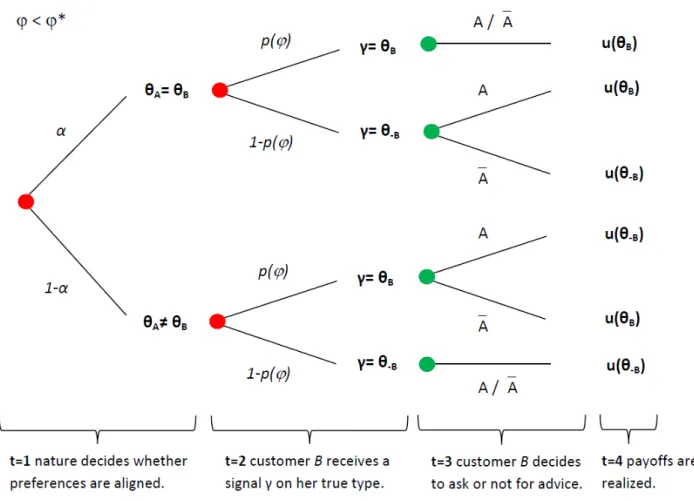
• At t= 1: nature decides whether customer and advisor’s preferences are aligned with some unobserved
probability. Advisor A always knows whether preferences are aligned but customerB does not, she has
beliefs regarding preferences alignment: α=P(θA=θB).
• At t = 2: customer B receives a private signal γ ∈ Θtelling her which product is a best match. This
signal is true with some probability: p(ϕ) =ϕ+12.
• At t = 3: customer B decides whether to invest autonomously based on her signal or to ask for advice
signal she received becausep(ϕ)≥1
2. Otherwise, if she decides to ask for further information to an expert
before investing, customer B engages in an information revelation game with advisorA and receives an
adviceσwhich she follows. The information sets are the following: the advisor perfectly observes whether
preferences are aligned, he also knows customer’s typeθB and level of financial literacy ϕ. The customer
has beliefs α regarding preferences alignment, she also knows her level of financial literacy ϕ and the
content of signalγ.
• Att= 4: payoffs are realized.
I start by analyzing the communication game that occurs att= 3when customerB decides to ask for advice.
2.4.1 Advisor’s strategies
Assuming customerB decides to ask for advice. Given that the advisor perfectly observes whether preferences
are aligned, then:
• if θA = θB, preferences are aligned and the advisor has no incentive to advise the customer to buy a
financial product that would not suit her needs. In that case advisor A advises customer B to buy
productθB i.e. σ=θB so as to get the highest possible payoff: π(θA/θA=θB) =δ(θA).
• ifθA 6=θB, the advisor may have an incentive to swindle the customer and advise her to buy a product
that does not necessarily suit her needs. But advisor Acares about reputation and therefore might not
systematically swindle the customer depending on the reputational cost which increases with customer’s financial literacyϕ. Given Assumption 1 there exists a level of financial literacyϕ∗∈]0;12[below which the
advisor swindles the customer and above which the advisor provides relevant information to the customer. In case of preferences misalignment, advisor Aadvises customerB to buy productθB only if:
π(θB/θA6=θB) ≥ π(θA/θA6=θB) ⇔ δ(θB) ≥ δ(θA)−p(ϕ).[u(θB)−u(θA)] ⇔ ϕ ≥ δ(θA)−δ(θB) u(θB)−u(θA) −1 2 (5) WhenθA6=θB, the financial literacy threshold below whichσ=θ−B and above whichσ=θB is then:
ϕ∗= δ(θA)−δ(θB) u(θB)−u(θA)
−1
2 (6)
2.4.2 Customer’s strategies
Customer B is assumed to perfectly observe the threshold ϕ∗ before deciding to consult or not the financial
advisor. The reliability of the information she gets from the advisor is linked to her level of financial literacy. Hence, customer’s decision to ask for advice then depends on whether she stands above or below the threshold.
• if ϕ ≥ ϕ∗, customer B knows that she will get a relevant information from advisor A regardless to
preferences alignment. In this case the customer has always an incentive to ask the advisor before investing. She then gets the highest possible utility u(θB).
• ifϕ < ϕ∗, customerB knows that the advice she will get from the advisor depends on the alignment of
preferences which she does not perfectly observe. Assuming αis small enough (α≤p(ϕ)), the customer
is better off investing on her own rather than asking for advice4. 2.4.3 Equilibria
The extensive form of this simple communication game can be represented as follows. [Figure 1 About Here]
CustomerBmoves first by deciding whether to ask or not for advice before investing. When investing alone,
customerB relies only on her signalγwhich is true with probabilityp(ϕ). She then getsu(θB)with probability
p(ϕ)and u(θ−B)with probability[1−p(ϕ)]. Otherwise if the customer decides to ask for advice, the advisor
gets the move and chooses whether to send a relevant information or to swindle the customer depending on his subsequent payoff. The advisor then chooses σ=θB either becauseθA =θB orϕ≥ϕ∗, he subsequently gets
δ(θB) and the customer getsu(θB). While the advisor chooses σ =θ−B only when θA 6=θB andϕ < ϕ∗, he
then getsδ(θA)−p(ϕ).[u(θB)−u(θA)]and the customer getsu(θ−B). Proposition 1:
In this game, a Nash equilibrium is a set of strategies for advisorAand customerB so that no player has a
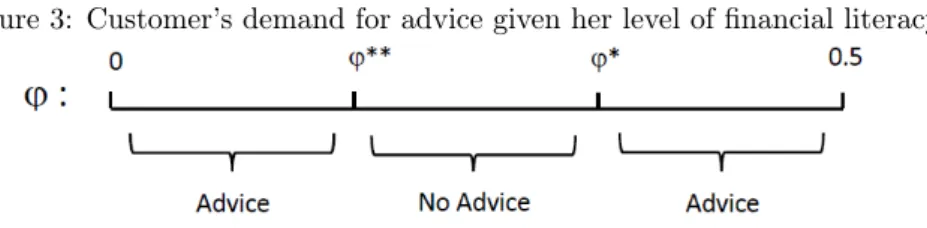
profitable deviation. Eventually the equilibria of the model depend on customer’s level of financial literacy • if ϕ ≥ ϕ∗: there is a unique fully revealing equilibrium in which advisor A advises θB (σ = θB) and
customerB asks for advice.
• ifϕ < ϕ∗: there is a unique pooling equilibrium in which advisorAadvises productθA(σ=θBifθA=θB
; σ=θ−B ifθA6=θB) and customerB does not ask for advice.
[Figure 2 About Here]
These equilibria suggest a complementarity between financial literacy and the demand for financial advice. As in Calcagno and Monticone (2015), the model predicts that financial advisors have a regressive effect in the sense they increase the information of financially literate customers and do not provide any relevant information to financially unsophisticated customers. This phenomenon leads financially literate customers to always ask for advice before investing. Unsophisticated customers are predicted not to ask for advice but rather to invest on their own. In the following section, I use a survey of French households (PATER 2011) to test the validity of these conclusions.
4In the appendix, I relax the restriction on parameterαand report the predictions of the extended model. Empirical evidence from PATER (2011) however support the baseline specification withα≤p(ϕ).
3
Empirical analysis
3.1
Data
3.1.1 The PATER survey
The PATER household survey is a representative survey of the French population. It was first conducted by the French National Statistics Institute (Institut national de la statistique et des études économiques, or INSEE) in 1998 and then repeated four times until 2011 upon the initiative of Luc Arrondel and André Masson at the Paris School of Economics in cooperation with Taylor-Nelson Sofres (TNS Sofres), a private survey company (Arrondel et al. 2013). The survey focuses on preferences (risk aversion, time preference, and altruism) and expectations (on income, stock prices and job insecurity), but it also covers a wide range of topics regarding households’ financial behaviors, financial literacy and sources of financial information in addition to wealth, income, socioeconomic, and demographic characteristics.
The module on financial literacy was introduced in the 2011 wave. The paper-based questionnaire and was sent out in November 2011 to a representative sample of 5,000 individuals. Respondents in this wave were sampled from the TNS Sofres metascope panel (30,000 households): two-thirds of the sample had been surveyed in the 2009 wave. Respondents had to fill in the questionnaire and return it by mail in exchange for a twenty euro shopping voucher. A total of 3,616 households sent back their questionnaire, representing a 72.3% response rate and weights were adjusted to preserve the representativity of the sample. Any member of the household could answer the questionnaire but more than 70% of respondents claimed to be in charge of the family finances.
3.1.2 Econometric sample
The full sample, which is representative of the French population is used to provide descriptive information on financial literacy and the demand for financial advice. However, due to non-responses to some questions, the analysis is restricted to a smaller sample. The issue of non-responses typically arises when the question is computationally demanding or when the wording requires more concentration. Some questions on income or wealth are also less answered. In our case, this issue mainly concerns the dependent variable on the demand for financial advice but also a question regarding self-confidence on financial issues. Excluding the observations with missing values leads to a subsample of 2,127 observations.
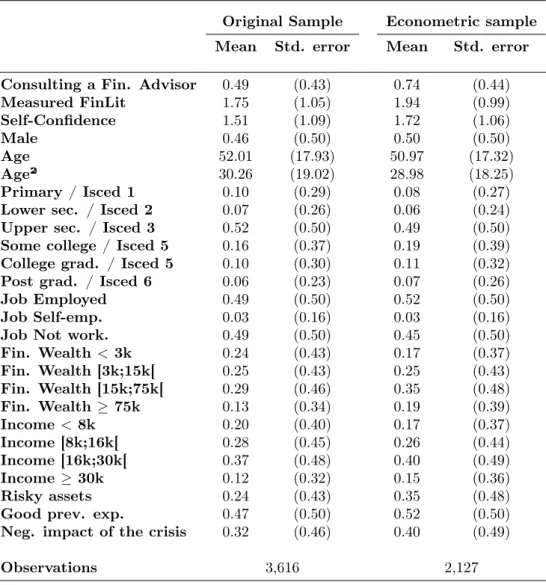
[Table 1 About Here]
Table 1 reports descriptive statistics for each variable used in the analysis for the original and the econometric sample. Both samples do not dramatically differ except for the demand for financial advice. Respondents in the econometric sample also tend to have slightly higher levels of financial literacy and self-confidence regarding financial issues. Those respondents are more educated and less likely to be unemployed or retired, they are also wealthier and have higher income. Finally, respondents in the econometric sample tend to have had more often a positive previous experience with a financial advisor and have been more often negatively impacted by the
crisis. Those differences are however small and I doubt they significantly alter the conclusions I draw from the analytical part.
3.2
Descriptive statistics
3.2.1 Financial literacy
The PATER survey encompasses a set of three questions on financial literacy that have become standard in the literature to assess the understanding of fundamental concepts for financial decision making. The set of questions on interest compounding, inflation and risk diversification was first designed by Lusardi and Mitchell (2011a) according to four principles: simplicity, relevance, brevity and capacity to differentiate. These questions have been included in many surveys across the world and have been shown to be related to several financial behaviors ranging from stock market participation to financial planning and indebtedness (see Lusardi and Mitchell (2014)). The wording of the question on inflation in the PATER survey corresponds exactly to the literature benchmark. The question on interest compounding is slightly harder to answer as it requires that the respondent grasp the difference between simple and compound interest. Another difference worth noting is on the risk diversification question. In the benchmark, respondents are simply asked to say whether a statement is true or false. In the PATER questionnaire, respondents are asked to rank four financial products according to their riskiness. Using this information, I construct a variable that only considers the relative ranking of stock versus share of a mutual fund regardless to other assets’ ranking. The exact wording of the questions in PATER 2011 is as follows (correct answers are in bold):
• Interest compounding: Suppose you had 1,000 euro in a savings account and the interest rate was 2% per year. After 5 years, how much do you think you would have in the account if you let the money to grow?
– Less than 1,100 euro
– Exactly 1,100 euro
– More than 1,100 euro – Do not know
– No answer
• Inflation: Imagine that the interest rate on your savings account was 1% per year and inflation was 2% per year. After 1 year, how much would you be able to buy with the money in this account?
– More than today
– Same as today
– Less than today – Do not know
– No answer
• Diversification: Rank these financial products from the less risky to the riskiest:
– Saving account, Stock, Bond, Stock of a mutual fund
– Do not know / No answer
For the risk diversification question, I consider the answer to be correct when “stock” is ranked as being riskier than “share of a mutual fund” and incorrect otherwise. “Do not know” refers to respondents having checked a box stating they do not know the answer while “no answer” refers to respondents who have completely skipped the question. The distinction between “do not know” and “no answer” can be made in the first two questions but not in the third.
[Table 2 About Here]
In the original sample, nearly 48% of the respondents correctly answer the question on interest compound-ing and this share rises to 53% in the econometric sample. As mentioned, the PATER question on interest compounding differs from the benchmark question of Lusardi and Mitchell (2011b) because it requires a broad understanding of interest computation as well as an understanding of the difference between simple and com-pound interest. This result can be compared to those of other countries such as Russia (Klapper et al. 2013) and Sweden (Almenberg and Säve-Söderbergh 2011) which have surveys with approximately the same wording. These countries have respectively 36% and 35% of respondents answering correctly the question on interest compounding. In other countries, a simpler wording was adopted for that question explaining part of the higher percentages of respondents answering correctly except for Italy: 65% in the United States (Lusardi and Mitchell 2011b), 82% in Germany (Bucher-Koenen and Lusardi 2011), 40% in Italy (Fornero and Monticone 2011), and 85% in the Netherlands (van Rooij et al. 2011). Therefore when trying to compare French results to other countries’ it is hard to disentangle the effect of the wording from the pure effect of a financial literacy differential. Eventually, the fact that half of French respondents fail to give a correct answer to the interest compounding question even when a list of answers is provided, points the lack of basic financial literacy in the French population.
Regarding the concept of inflation, 61% of the original sample display an understanding of the impact of inflation on purchasing power while more than 10% give an incorrect answer, and nearly a quarter does not know the answer or does not answer. As for the question on interest compounding, the percentage of correct answers is higher in the econometric sample with 68% of respondents answering correctly. These results put France in the international average with percentages of correct answers ranging from 59% in Sweden (Almenberg and Säve-Söderbergh 2011) to 78% in Germany (Bucher-Koenen and Lusardi 2011). Broadly speaking, households are more knowledgeable about inflation when their country has experienced it. Conversely, countries which experienced deflation have fewer respondents able to answer correctly the question on inflation (Lusardi and Mitchell 2011a).
Respondents appear to have less difficulty answering correctly the third question on risk diversification. However, the wording and structure of this question differ enough from the benchmark to call for caution when making international comparisons. About two-thirds of the original sample gets the question on risk diversification right while this share is 73% in the econometric sample. Using PATER 2011, Arrondel et al. (2013) show that these agregate figures hide large differences among population subgroups. Women, the youth and the elderly as well as the less educated tend to have a lower understanding of basic financial concepts. Thereby these population are the most in need of relevant financial advice when it comes to make financial decisions. The next section reports statistics on the demand for financial advice in France.
3.2.2 Sources of financial information
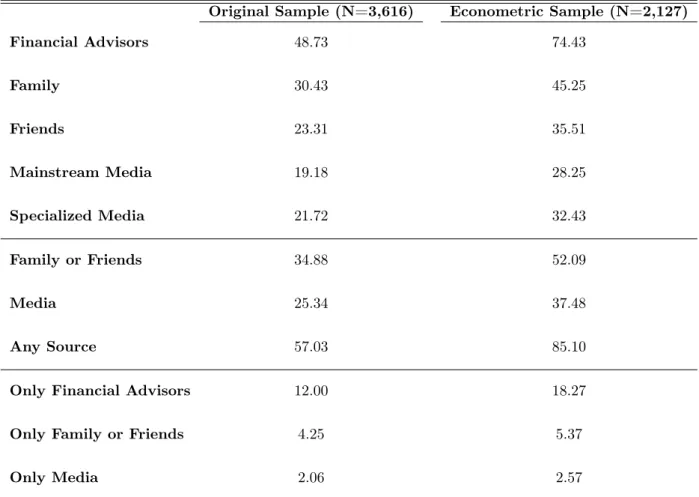
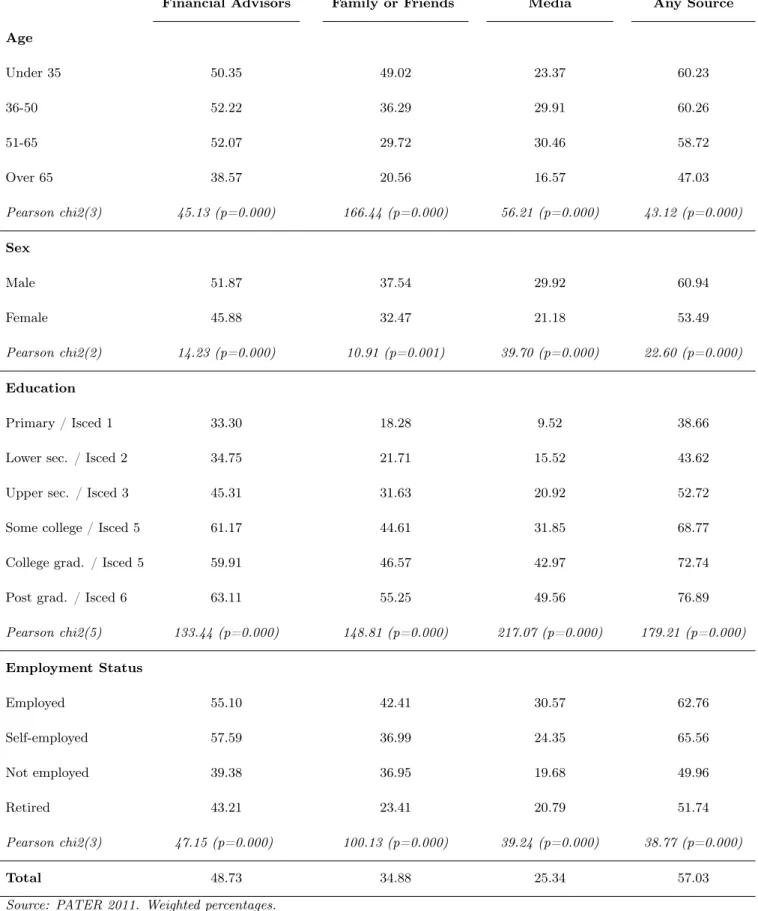
Respondents in the PATER survey were also questioned about their sources of financial information. Table 3 reports the results for both the original and the econometric samples. While respondents in the econometric sample tend to seek more often for financial advice regardless to the source, the patterns in both samples are alike. Broadly speaking, households tend to rely more often on professional financial advisors when it comes to gather financial information. Nearly half of the original sample and three quarters of the respondents in the econometric sample rely on experts. The second most important source of financial information is family followed by friends. Combining both sources, I find that more than a third of the original sample and more than a half of the econometric sample ask for advice to family or friends. Media either mainstream or specialized are relied upon by a quarter of the original sample and nearly fourty percent of the econometric sample. Overall, most households in both samples rely on one or several sources of financial information when it comes to making financial decisions. But financial advisors capture a substantial share of the demand for financial advice and remain the primary source of financial information. Even among households which gather financial information from a single source, financial advisors remain the most relied upon.
[Table 3 About Here]
Given the importance of professional advice, Table 3 shows how crucial it is to question the capacity of financial advisors to provide relevant information to customers. But those agregate figures hide heterogenous patterns of the demand for financial advice among population subgroups. Table 4 reports the shares of re-spondents consulting different sources of financial information by sociodemographic characteristics. Broadly speaking, respondents aged 65 or above tend to rely less often on financial advisors than the average respon-dent. This pattern is also true for other sources such as family or friends and media. Though the elderly could be the most in need of financial advice regarding pension management and budgeting as well as inheritance and gifts. The fact that the share of respondents relying on family or friends for financial advice decreases with age could come from some independence factor which would make individuals less willing to ask for advice to their family or friends when they age. Media either meainstream or specialized are more often relied on by middle-aged respondents. Regardless to the source of financial information, women are found to ask less often for financial advice. This pattern is all the more surprising given the fact that in PATER 2011 more than 58
percent of the respondents claiming to be in charge of the household’s finances were women. This actually comes from a composition effect which is controled for in the analytical section. Education appears positively related to asking for financial advice. The higher the level of education, the more often respondents ask either source for advice. Finally, employed and self-employed respondents ask for advice more often than unemployed and retired respondents. For the latter, this may come from the age effect discussed above. Overall, young working men with higher levels of education tend to ask more often for financial advice from either source but in particular from financial advisors.
[Table 4 About Here]
3.2.3 Financial literacy and the demand for professional financial advice
Several papers have shown that populations are not equally equiped to face financial decisions (Lusardi and Mitchell 2007c,b, 2008; Lusardi et al. 2010). In particular in France Arrondel et al. (2013) show using the PATER survey that women, young and old people as well as the less educated and the unemployed tend to have lower levels of financial literacy which can have severe consequences on their ability to plan for the future. It is also the case that these populations are less likely to seek for financial advice as described above despite the fact that they might be the most in need of financial guidance. Given the importance of the demand addressed to financial advisors, I concentrate my attention on this source of financial information to analyze the extent to which financial literacy can be related to the demand for financial advice. Table 5 reports the shares of respondents by number of correct answers to financial literacy questions for respondents consulting and not consulting a financial advisor. In both the original and the econometric samples, the number of questions answered correctly increases when respondents do actually consult a financial advisor. This positive correlation does not shed light on any potential causal relationship but it reflects the composition of the population in terms of financial literacy levels and demand for financial advice. Individuals who actually lack financial sophistication are also those who do not ask for advice.
[Table 5 About Here]
The theoretical part of this paper suggested a direction of the causality from financial literacy to the demand for financial advice: financially sophisticated customers ask for advice because they know the advice they will get will be relevant while financially illiterate customers do not ask for advice because they anticipate they will not receive a relevant information. In the following section, I attempt to confirm this relationship using the PATER survey and taking into account several determinants of the demand for financial advice.
3.3
Regressions
3.3.1 Specification
So as to characterize the pattern of the relationship between the level of financial literacy and the probability to ask for professional financial advice I perform several econometric regressions. The baseline specification is
the following:
yi=α+β1xF inancial Literacyi+β2xSocioeconomici+β3xFinancial Experiencei+εi
The dependent variable yi is a dichotomic variable equal to one when respondent i consults a financial
advisor and zero otherwise. The right-hand side of the equation includes a variable on financial literacy which corresponds to the number of financial literacy questions correctly answered by the respondent. This variable takes values between 0 and 3. Two vectors of explanatory variables are also added to the equation. The first one includes socioeconomic variables as gender, age, education, occupation, financial wealth and income. The second vector adds variables that are more specifically related to the financial experience of the respondent. This vector includes a self-assessed measure of financial culture which is considered to be a self-confidence variable regarding financial issues. It also includes a set of dummy variables indicating whether the respondent had previously a positive experience with a financial advisor, whether the respondent experienced a negative impact of the financial crisis and whether the respondent holds risky assets. Eventually, an idiosyncratic error term is added to account for unobserved heterogeneity. The PATER survey does not allow to control for characteristics of the advisor. However while advisor’s characteritics in particular gender and education, may have an influence on how much customers invest in risky assets (Direr and Visser 2013), I do not believe that these characteristics play a central role in the decision to ask or not for advice. The reason for this would be that customers do not observe the characteristics of the advisor unless they actually ask for advice.
In the next sections, regressions are performed using a linear probability model rather than a probit model given the tractability of ordinary least squares regressions and the possibility for a direct interpretation of coefficients. This choice does not alter the results nor does it the conclusions. I perform several regressions starting by including only the index of financial literacy and then including the other vectors so as to disentangle the effect of each set of variables. I then perform several robustness checks to control for the simultaneous decision to invest in risky assets and ask for advice but also instrumental variables (IV) regression to test the endogeneity of the financial literacy index. Indeed I am interested in the potential impact of financial literacy on the demand for financial advice. But there might be a reverse causality arising from the fact that consulting a financial advisor increases the level of financial literacy through some learning effect. It might also be the case that both financial literacy and the demand for financial advice are driven by a third variable that is omitted in the baseline specification. I therefore perform IV regressions with different sets of instruments to take into account any potential endogeneity bias. Finally, I report results of regressions which use alternative specifications of the financial literacy index.
3.3.2 Results
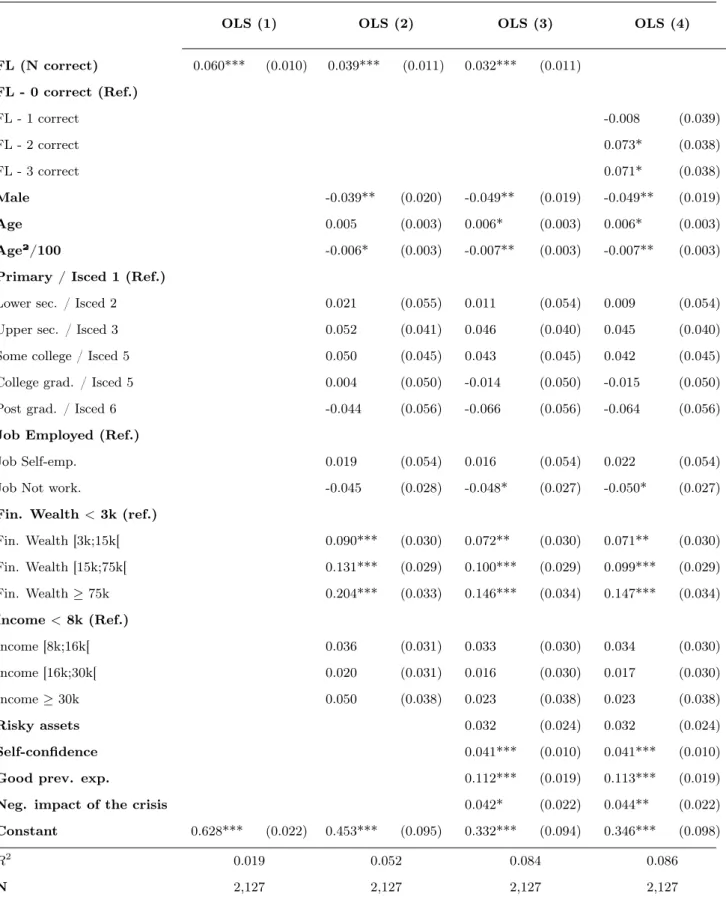
Table 6 reports results of ordinary least squares regressions of a dummy for asking for advice to a financial advisor on financial literacy and other explanatory variables. The first column includes only the index of financial literacy. Following the pattern in Table 5 of the descriptive section, the coefficient on financial literacy appears to be positive and significant at the 1% level. The second column adds the set of socioeconomic variables
to the regression. In contrast with what is observed in the descriptive part, the demand for financial advice appears to be negatively related to being a man. Some variables appear not to have any influence on the demand for financial advice such as age, education, and income. On the contrary the level of financial wealth is positively and significantly associated to asking for advice. The wealthier the respondent in terms of financial assets, the higher the probability to rely on professional advice. This does not necessarily come from a higher opportunity cost of time of richer households as argued in Hackethal et al. (2012) given that I do not find any significant influence of income. Rather, it might be that everything else equal richer households have access to a greater variety of financial products which makes them more prone to ask for advice. Eventually, this second regression shows that respondents who do not work either because they retired or because they are unemployed tend to ask less often for advice though the coefficient is weakly significant.
In the third regression, the vector of variables on respondent’s financial experience is added. This set of variables is expected to have a more direct influence on the demand for financial advice. Indeed, respondents who had a positive previous experience with a financial advisor as well as those who experienced a negative impact of the financial crisis are more likely to consult a financial advisor. Those facts increase in average the probability to ask for advice by respectively 11.2 and 4.2 percentage points. Self-confidence regarding financial issues is also positively and significantly associated to the demand for advice. Investing on financial markets by holding risky assets does not appear to have an influence on the demand for advice. Eventually, the introduction of the financial experience vector does not alter the significance of the variables previously discussed. Answering correctly an extra question of financial literacy increases the probability to ask for advice by 3.2 percentage points while being a man or not working decreases this probability by respectively 4.9 and 4.8 percentage points. Financial wealth is still positively and significantly associated to the demand for financial advice. Respondents with a financial portfolio worth more than 75k euro increase their probability to see a financial advisor by 14.6 percentage points everything else equal.
[Table 6 About Here]
The last column reports the results of the regression including dummies for each number of financial literacy questions answered correctly. I find no significant difference between not answering any question correctly and answering only one question correctly. But answering correctly two or three questions tends to have a significantly higher influence on the demand for financial advice as compared to not answering any question correctly. This supports the monotonicity of the relationship between financial literacy and the demand for financial advice. Overall, these regressions show that there is a positive and highly significant relationship between financial literacy and the demand for financial advice even when taking into account other factors that could influence the demand for advice. This supports a complementarity between the capacity of individuals to understand basic financial concepts and their willingness to seek advice from qualified sources. As argued in the theoretical part, this phenomenon could stem from the unability of financial advisors to disclose relevant information to less financially sophisticated customers. In the following section I test the robustness of these results by performing regressions with alternative indices of financial literacy. I also us an instrumental variables
approach to test for the endogeneity of financial literacy and account for the simultaneous decision to ask for advice and hold risky assets.
3.3.3 Robustness checks
Endogeneity of financial literacy
A problem of endogeneity can arise with the index of financial literacy in the regressions. This endogeneity could come from a reverse causality bias driven by a learning effect from consulting a financial advisor. It could also come from an omitted variable which would influence both the level of financial literacy and the demand for financial advice. To take into account this potential bias and test for the actual endogeneity of financial literacy in the regressions, I perform instrumental variables (IVs) regressions using the generalized method of moments (GMM). This method allows to take into account the heteroskedasticity of the error terms which stems from the linear probability model.
I use two sets of IVs to control for the endogeneity of financial literacy. These variables are related to financial literacy and unrelated to the demand for financial advice. The first set of IVs is made of a self-assessed measure of the level the respondent had in mathematics at school. Given the basic computational requirements needed to answer the financial literacy questions, this has a fair chance to be strongly correlated with financial literacy and unrelated to the demand for advice. The second IV used in this set is a dummy indicating whether respondent’s parents held risky assets in their portfolios. This variable acts as a proxy for respondent’s parents financial literacy which should be well correlated with respondent’s financial literacy. The second set of IVs I use is also made of the variable on respondent’s level in mathematics at school and a dummy indicating whether the respondent has no political opinion. This second variable is chosen as an IV given the results found in Arrondel et al. (2013). Using the PATER survey, the authors show that while there is no significant differences in terms of financial literacy between right-wing and left-wing affiliates, respondents with no political opinion tend to have a lower level of financial literacy than the average everything else equal. While there is more research to be done in this field to assert the source of the correlation, it is unlikely that having no political opinion influences the probability to ask for advice.
[Table 7 About Here]
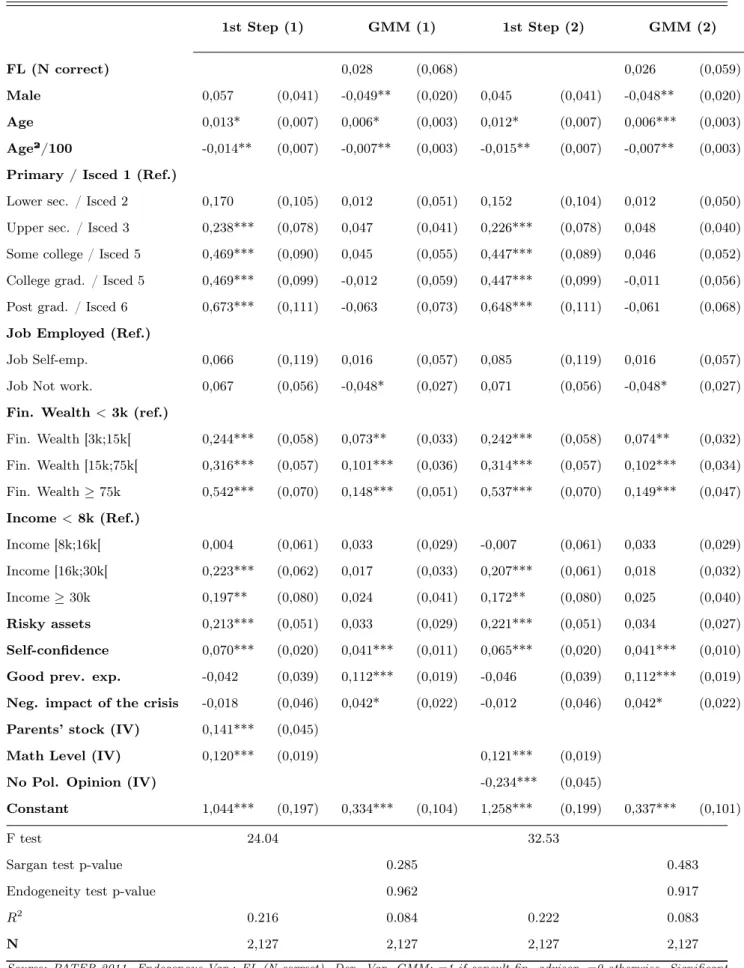
Table 7 reports the results of the two-step GMM estimations of the probability to ask for advice to a financial advisor. The first column reports the first-step of the regression with the first set of IVs. Financial literacy is found to be correlated with being a man, the level of education, the wealth and income of the respondent. It also appears that more financially literate respondents are also those who experienced a negative impact of the crisis. This result may however come from a reporting bias. More financially knowledgeable respondents may also be those who track the more often their finances and therefore those who are the more aware of the adverse effects the crisis had on their portfolios. More importantly, the IV on math level at school which is coded as a scale from 1 to 5 appears to be positively and significantly associated to financial literacy. Parents’ stockholding
appears to be positively correlated with financial literacy and the coefficient is significant at the 1% level. The F statistic of this regression (F=24.04) supports a strong joint significance of both IVs.
The second column reports the results of the second step of the first GMM estimation. The instrumented variable of financial literacy does not appear significant anymore while the coefficients of the other variables and their significance do not dramatically differ from those in the baseline regression without instrumentation (Table 6, OLS (3)). I perform two tests to challenge the quality of the instruments. The joint null hypothesis of the Sargan test is that the instruments are valid i.e. uncorrelated with error terms. With a p-value of 0.285 and an F-statistic of 24.04 in the first step I conclude that the instruments are relevant and valid. However, the endogeneity test with a p-value of 0.962 shows that the endogenous variable should actually be treated as exogenous. Thus, there does not seem to be an endogeneity bias in the baseline regression. The measure of financial literacy I use relies on computational skills and other cognitive abilities which are hard to enhance at adulthood (Christelis et al. 2010). This could explain the exogeneity of financial literacy at least regarding a potential reverse causality bias. Asking for advice and interacting with a financial advisor is unlikely to enhance the level of financial literacy of a customer.
The third and fourth columns report the first and second step of the GMM estimation using the set of IVs which includes the political opinion dummy. Having no political opinion is negatively associated to the level of financial literacy as found in Arrondel et al. (2013) and the coefficient is significant at the 1% level. Both the IVs in this regression appear to be relevant as they are significantly associated to the level of financial literacy with a strong joint significance (F=32.53). The results of the second step do not differ from those of the first GMM regression. The Sargan and endogeneity tests confirm that the instruments are valid but that the index of financial literacy should be treated as exogenous.
Simultaneity of asking for advice and holding risky assets
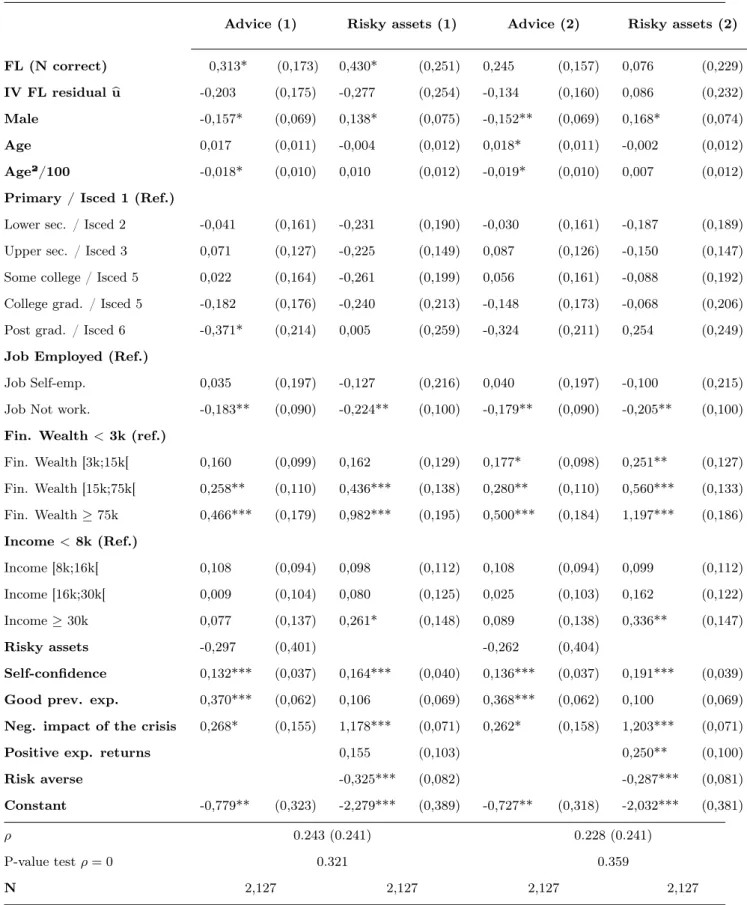
The baseline regression includes a dummy to take into account the fact that respondents hold or not risky assets. This variable was added because in some financial institutions, investing on risky assets could be bundled with some form of advice. Excluding this variable could therefore lead to spurious correlation and misinterpretation of the baseline regression results. The significance of the coefficient for financial literacy would in that case simply reflect the positive correlation between financial markets participation and financial literacy as documented in van Rooij et al. (2011) and Arrondel et al. (2014). But including a dummy for holding risky assets does not entirely solve the problem if advisors have a significant influence on customers’ participation to financial markets. In that case, the dummy for holding risky assets could be endogenous. To take this into account I perform several regressions using a bivariate probit approach. This approach allows to estimate simultaneously the coefficients of both equations of demand for financial advice and participation to financial markets. Table 8 reports the results of the bivariate probit using instrumental variables for holding risky assets: two dummies indicating whether the respondent expects positive market returns and whether she is risk averse.
The regressions reported in Table 8 include a test for the endogeneity of the financial literacy index. In the previous section I show that the index of financial literacy should be treated as exogenous in the demand for advice equation. However, it is also important to document the exogeneity of financial literacy in both equations of the bivariate probit. To do so, I rely on the Durbin-Wu-Hausman test by including the residuals of the first step regressions of Table 7. The coefficients of the residuals are not significant regardless to the set of instruments used for financial literacy. This result supports the exogeneity of the index of financial literacy. Table 9 reports the results of the bivariate probit without testing for the endogeneity of financial literacy.
[Table 9 About Here]
The correlation coefficient ρof the error terms of both equations is found not significant (p-value=0.403).
This result supports the baseline specification of the model in Table 6 and rules out any spurious correlation between the demand for financial advice and the level of financial literacy.
Alternative indices of financial literacy
The last robustness check I perform consists in replacing the baseline index of financial literacy (number of questions correctly answered) by a dummy variable equal to one when the questions are all correctly answered and a set of dummies for each question correctly answered. The first column of Table 10 reports the results of the regression with the dummy for all questions correctly answered. The coefficient on financial literacy is still positive and significant at the 5% level. Hence, answering correctly all the three questions of financial literacy increases the probability to see a financial advisor by 3.4 percentage points. The second estimation in Table 10 provides information on the influence of each question answered correctly on the probability to ask for advice. While the question on interest compounding does not play a significant part, the understanding of inflation and more importantly of risk diversification influences significantly the probability to ask for advice. In both these regressions, the other coefficients are not altered as compared to the baseline estimation.
[Table 10 About Here]
The results I find by performing GMM regressions, bivariate probit and replacing financial literacy by alternative indices provide support to the baseline specification and results (Table 6, OLS (3)). Financial literacy is positively related to the demand for financial advice. Theoretically, the model suggests that the direction of the relationship goes from financial literacy to the demand for financial advice given the unability of financial advisors to provide relevant advice to less financially literate customers. While it is empirically difficult to assert this causality, the results of the IV estimation support this direction of the causality. This has important consequences because financial advisors do not provide relevant information to those who are the most in need of guidance and tend to widen the informational gap between financially sophisticated and unsophisticated customers. Hence, considering product-biased compensation schemes, financial advice cannot provide a relevant substitute to financial literacy when it comes to making financial decisions.
4
Conclusion
This paper investigates the relationship between the level of financial literacy of a customer and her probability to interact with a financial advisor. This issue is important as several studies have shown that low levels of financial literacy are associated to portfolio underdiversification, poor financial planning and overindebtedness. In this context, I question the relationship between an informed financial advisor and an uninformed customer with a simple theoretical model. The baseline model predicts that only financially sophisticated customers receive relevant information from advisors and that this prevents less financially literate customers from asking advice.
Using the 2011 wave of the PATER survey I test this conclusion of the model and find that the higher the level of financial literacy of a customer, the higher her probability to ask for professional advice. The relationship I find is monotonic but only weakly. In light of the model, this suggests that financial literacy and the demand for financial advice are complements which stems from the compensation structure of financial advisor.
These compensation schemes tend to prevent financial advisors from providing relevant information to customers who are the most in need of financial guidance. As in Calcagno and Monticone (2015) I find that advisors have a regressive effect in the sense they increase the level of information of financially sophisticated customers and decrease that of less financially literate customers. These results therefore call for other promising ways to deal with widespread low levels of financial literacy and help households increase their financial well-being. While reforming financial advisors’ compensation schemes could be an interesting way such that advisors would be directly paid by customers in a lump sum manner, it is not sure that customers of financial services are willing to pay directly for financial advice (Inderst and Ottaviani 2012b).
Other levers include just-in-time education, rules of thumb or simplification of financial products but financial education programs have lately become the mostly used and debated manner to deal with low financial literacy. These programs are intended to increase customers’ level of financial literacy by giving them the tools to deal with basic financial decisions and cope with adverse financial shocks. The effectiveness of such financial education programs regarding financial outcomes is still debated (Miller et al. 2014). However, the simple model I propose shows that financial literacy is not only important for financial decision making but also for being able to receive relevant advice. Financial advisors in the theoretical model are found to provide relevant advice only to financially sophisticated customers. In that sense, even if financial education programs may not directly alter customer’s financial decisions, these programs are still paramount to allow customers to know their needs and empower them when facing biased financial advisors.
References
Aghion, P. and J. Tirole (1997). Formal and real authority in organizations.Journal of Political Economy 105(1), 1–29.
Almenberg, J. and J. Säve-Söderbergh (2011). Financial literacy and retirement planning in Sweden. Journal of Pension Economics and Finance 10(4), 585–598.
Arrondel, L., M. Debbich, and F. Savignac (2013). Financial literacy and financial planning in France. Numer-acy 6(2).
Arrondel, L., M. Debbich, and F. Savignac (2014). Financial literacy, information and stockholding. mimeo. Banks, J., C. O’Dea, and Z. Oldfield (2011). Cognitive function, numeracy and retirement saving trajectories.
The Economic Journal 120(548), F381–F410.
Bluethgen, R. and A. Gintschel (2008). Financial advice and individual investors’ portfolios. mimeo.
Bolton, P., X. Freixas, and J. Shapiro (2007). Conflicts of interest, information provision, and competition in the financial services industry. Journal of Financial Economics 85(2), 297–330.
Bucher-Koenen, T. and J. Koenen (2011). Do smarter consumers get better advice ? mimeo.
Bucher-Koenen, T. and A. Lusardi (2011). Financial literacy in Germany. Journal of Pension Economics and Finance 10(4), 565–584.
Calcagno, R. and C. Monticone (2015). Financial literacy and the demand for financial advice. Journal of Banking & Finance 50, 363–380.
Christelis, D., T. Jappelli, and M. Padula (2010). Cognitive abilities and portfolio choice. European Economic Review 54(1), 18–38.
Collins, J. M. (2012). Financial advice : a substitute for financial literacy ? Financial Services Review 21(4), 307–322.
Crawford, V. P. and J. Sobel (1982). Strategic information transmission. Econometrica 50(6), 1431–1451. Dessein, W. (2002). Authority and communication in organizations. Review of Economic Studies 69(4), 811–
838.
Direr, A. and M. Visser (2013). Portfolio choices and financial advice. Finance 34(2), 35–64.
Fornero, E. and C. Monticone (2011). Financial literacy in Italy. Journal of Pension Economics and Fi-nance 10(4), 547–564.
Georgarakos, D. and R. Inderst (2011). Financial advice and stock market participation. ECB Working paper series, 1296.
Gerardi, K. S., L. F. Goette, and S. Meier (2010). Financial literacy and subprime mortgage delinquency: evidence from a survey matched to administrative data. Federal Reserve Bank of Atlanta Working paper series 2010-10.
Hackethal, A., M. Haliassos, and T. Jappelli (2012). Financial advisors: a case of babysitters? Journal of Banking & Finance 36(2), 509–524.
Hung, A. A. and J. K. Yoong (2010). Asking for help: survey and experimental evidence on financial advice and behavior change. RAND Labor and Population Working paper series.
Inderst, R. and M. Ottaviani (2009). Misselling through agents. American Economic Review 99(3), 883–908. Inderst, R. and M. Ottaviani (2012a). Competition through commissions and kickbacks. American Economic
Review 102(2), 780–809.
Inderst, R. and M. Ottaviani (2012b). How (not) to pay for advice: a framework for consumer financial protection. Journal of Financial Economics 105(2), 393–411.
Karabulut, Y. (2013). Financial advice: an improvement for worse? mimeo.
Klapper, L. F., A. Lusardi, and G. A. Panos (2013). Financial literacy and the financial crisis. Journal of Banking & Finance 37(10), 3904–3923.
Lusardi, A. and O. S. Mitchell (2007a). Baby Boomer retirement security: the roles of planning, financial literacy, and housing wealth. Journal of Monetary Economics 54(1), 205–224.
Lusardi, A. and O. S. Mitchell (2007b). Baby boomer retirement security: the roles of planning, financial literacy, and housing wealth. Journal of Monetary Economics 54(1), 205–224.
Lusardi, A. and O. S. Mitchell (2007c). Financial literacy and retirement preparedness: evidence and implica-tions for financial education. Business Economics 42(1), 35–44.
Lusardi, A. and O. S. Mitchell (2008). Planning and financial literacy: how do women fare? American Economic Review 98(2), 413–417.
Lusardi, A. and O. S. Mitchell (2011a). Financial literacy and planning: implications for retirement wellbeing. In A. Lusardi and O. S. Mitchell (Eds.), Financial literacy: implications for retirement security and the financial marketplace. Oxford: Oxford University Press.
Lusardi, A. and O. S. Mitchell (2011b). Financial literacy around the world: an overview. Journal of Pension Economics and Finance 10(04), 497–508.
Lusardi, A. and O. S. Mitchell (2014). The economic importance of financial literacy: theory and evidence. Journal of Economic Literature 52(1), 5–44.