Sonderforschungsbereich/Transregio 15 · www.sfbtr15.de
Universität Mannheim · Freie Universität Berlin · Humboldt-Universität zu Berlin · Ludwig-Maximilians-Universität München Rheinische Friedrich-Wilhelms-Universität Bonn · Zentrum für Europäische Wirtschaftsforschung Mannheim
Speaker: Prof. Dr. Klaus M. Schmidt · Department of Economics · University of Munich · D-80539 Munich, Phone: +49(89)2180 2250 · Fax: +49(89)2180 3510
* Free University Berlin ** Free University Berlin
May 2013
Financial support from the Deutsche Forschungsgemeinschaft through SFB/TR 15 is gratefully acknowledged.
Discussion Paper No. 400
Signalling Rivalry and Quality
Uncertainty in a Duopoly
Helmut Bester* Juri Demuth**
S
IGNALLING
R
IVALRY AND
Q
UALITY
U
NCERTAINTY
IN A
D
UOPOLY
∗
Helmut Bester
†and Juri Demuth
‡October 2011, revised May 2013
Abstract
This paper considers price competition in a duopoly with quality uncertainty. The es-tablished firm (the ‘incumbent’) offers a quality that is publicly known; the other firm (the ‘entrant’) offers a new good whose quality is not known by some consumers. The in-cumbent is fully informed about the entrant’s quality. This leads to price signalling rivalry because the incumbent gains and the entrant loses if observed prices make the uninformed consumers more pessimistic about the entrant’s quality. When the uninformed consumers’ beliefs satisfy the ‘intuitive criterion’ and the ‘unprejudiced belief refinement’, prices sig-nal the entrant’s quality only in a two–sided separating equilibrium and are identical to the full information outcome.
Keywords: Quality uncertainty, Signalling, Oligopoly, Price competition
JEL Classification No.:D43, D82, L15
∗Support by the German Science Foundation (DFG) through SFB/TR 15 is gratefully acknowledged.
†Free University Berlin, Dept. of Economics, Boltzmannstr. 20, D-14195 Berlin (Germany); email:
‡Free University Berlin, Dept. of Economics, Boltzmannstr. 20, D-14195 Berlin (Germany); email:
1
Introduction
It is well established that in markets with asymmetric information firms may use prices, pos-sibly in conjunction with additional marketing devices, to signal quality information to un-informed market participants. In particular, if only some fraction of consumers is un-informed about quality, then firms may signal their qualities to the uninformed by setting prices higher than under perfect information. The idea is that high-quality firms suffer less from decreased sales to informed consumers due to price increases than low-quality firms. Therefore a high-quality firm can separate itself by setting a high price which is not profitable to imitate for the low-quality firm. Signalling thus leads to distorted pricing and an inefficient reduction in the supply of high-quality goods.
This paper studies an extension of the standard price signalling model to a durable goods duopoly. In this environment the informative signalling equilibrium is free of distortions and identical to the perfect information equilibrium. We obtain this conclusion for a horizon-tally and vertically differentiated duopoly market with price-setting competitors engaging in a game of signalling rivalry: An established firm (“incumbent"), whose quality is known by all market participants, faces a competitor (“entrant") who is either supplying the same quality as the incumbent or a superior quality acquired through some product innovation. Both firms and some fraction of consumers know the entrant’s quality. The uninformed consumers use prices set bybothfirms to infer quality information. An important feature of price competition is that the two firms have opposing interests in conveying information, because the incum-bent gains and the entrant loses when observed prices make the uninformed consumers more pessimistic about the entrant’s quality.
In our model consumers are confronted with two price signals concerning a single uncer-tain variable, the entrant’s quality. For the analysis of equilibrium, we apply two standard refinements for the uninformed consumers’ out-of-equilibrium beliefs. First, we use the ‘intu-itive criterion’ of Cho and Kreps (1987). Second, in situations where one of the firms’ pricing is informative we adopt the ‘unprejudiced belief criterion’ of Bagwell and Ramey (1991) to the pricing strategy of its competitor, because the intuitive criterion is no longer applicable. Under the unprejudiced belief criterion the consumers trust in the price signal of the non– deviating competitor whenever only one of the two firms selects an out-of-equilibrium price. This means that, given the other firm plays an equilibrium separating strategy, a deviating firm cannot influence beliefs by deviating to a non-equilibrium price and therefore always sets its best response price as under perfect information.
The unprejudiced belief criterion therefore excludes all separating equilibria with prices distorted from full-information prices. We show that these prices constitute the unique sep-arating equilibrium outcome in our model as long as the fraction of informed consumers is not too small. If only rather few consumers are informed, there is no informative equilibrium. The reason is that either the low-type entrant could gain by deviating to the high-type equi-librium price or the incumbent playing against the high-type would deviate to the low-type equilibrium price. Thus the firms’ price signals would become contradictory: The entrant
would signal that his quality is high and the incumbent that the entrant’s quality is low.
Related Literature
The standard prediction of the literature on price signalling is that quality uncertainty leads to distorted pricing for signalling purposes. The earliest contributions to this literature consider a market with a single seller. For example, Milgrom and Roberts (1986) show that a monopolist may use price and advertisement to convince consumers of the quality of a newly introduced product. In their model, which is based on repeat purchases of a non-durable good, prices can be distorted up– or downwards depending on expectations over future sales. Bagwell and Riordan (1991) consider a monopolist who produces a durable good whose quality may be high or low. The existence of informed consumers and cost differences between qualities allow the monopolist to signal high quality through an upward distorted price.1 Basically, our model extends Bagwell and Riordan (1991) to a horizontally differentiated duopoly in which one of the two firms offers a quality that is known to the competitor but not to all consumers. One strand of the literature extends the analysis of price signalling to oligopolistic mar-kets under the assumption that firms have private information only about their own quality. They are not informed about the other firms and, therefore, have the same prior about their competitors’ qualities as the uninformed consumers. Daughety and Reinganum (2007) and Daughety and Reinganum (2008) examine a horizontally and vertically differentiated duopoly andn–firm oligopoly, respectively. Price setting takes into account the ex-ante probabilities of rivals to be high– or low–quality types. Separating equilibria imply upward distorted prices, increasing in the ex-ante probability of firms being high–types. Similarly, Janssen and Roy (2010) show for a homogenous oligopoly that fully revealing mixed strategy equilibria exist in which high–types distort prices upward and low–types randomize prices over an interval, thereby generating sufficient rents to avoid mimicry of the high–types.
Closer related to the information structure in our model is the other strand of the liter-ature that assumes the oligopolists to be informed about their rivals’ qualities. Hertzendorf and Overgaard (2001a) analyze price setting and advertising in a duopoly. To keep the anal-ysis tractable, they assume that qualities are perfectly negatively correlated and consumers only know that one firm offers high quality and the other low quality. They apply two refine-ments that lead to a unique separating and a unique pooling equilibrium. In the separating equilibrium, a high degree of vertical differentiation leads to upwards distorted prices and a low degree to downward distorted prices. Yehezkel (2008) introduces some informed con-sumers into a similar model and examines how pricing and advertising strategies depend on the fraction of informed consumers.
In Fluet and Garella (2002) the ex ante distribution of the firm’s qualities is such that either both firms offer low quality or one firm offers low and the other high quality. The
1Linnemer (2002) shows that in the same setup it would be in some cases more profitable for the high-type
authors avoid the use of selection criteria and find multiple separating and pooling equilibria. For small quality differences separation can only be achieved with a combination of upward distorted prices and advertisement. This result is similar to a finding by Hertzendorf and Overgaard (2001b), who show that fully revealing separating equilibria satisfying the unprej-udiced belief condition do not exist.
These papers differ from our model in that they consider product differentiation only in the vertical dimension. This implies that the duopolists have a common interest in signalling
different qualities since they earn zero profits if consumers believe that they both offer the same expected quality. In our model of signalling rivalry such a common interest does not exist because consumer preferences are differentiated horizontally between the firms, and in the vertical dimension all consumers have identical preferences. As a consequence, the in-cumbent always prefers the consumers to believe that the entrant’s quality is identical to his own quality, whereas the entrant gains by convincing the consumers that he offers a supe-rior quality. Another feature that distinguishes our model from the above literature is that the duopolists are not in a symmetric position. Consumers are uninformed only about the en-trant’s and not about the incumbent’s quality. They interpret the prices of both firms as signals only about the entrant’s quality. In our analysis, we do not address expenditures on directly uninformative advertising as an additional signal. Since under our belief refinements only the full–information equilibrium without distortions survives, there is no role for dissipative advertising in equilibrium.
From a methodological perspective our analysis is closely related to Bagwell and Ramey (1991) and Schultz (1999). They study limit pricing by two incumbents to affect the entry decision of a third firm. The incumbents’ prices signal their information about an industry– wide parameter. The third firm enters the market only if it concludes that the probability of a favorable state is sufficiently high. In the paper by Bagwell and Ramey (1991) the competitors have a common interest, both want to signal an unfavorable state in order to prevent entry. Introducing the unprejudiced belief refinement, the authors find that only non–distorted separating equilibria exist. Further, under additional assumptions the intuitive criterion of Cho and Kreps (1987) eliminates all equilibria with pooling. By applying the same belief refinements to our context, we arrive at similar conclusions for the qualitative features of equilibrium. Schultz (1999) considers a variation of Bagwell and Ramey (1991) where the incumbents have conflicting interests, i.e. one incumbent prefers the entrant to stay out of the market, whereas its competitor profits from entry. Again, separating equilibrium prices are not distorted. But due to signalling rivalry these equilibria only exist if the effect of entry on the incumbent’s profits is relatively small. We obtain a related result in our model when the fraction of informed consumers is rather small.
This paper is organized as follows. In Section 2 we describe the model and, as a refer-ence point, we derive the equilibrium under full information. Section 3 defines the Perfect Bayesian Equilibrium and explains the belief refinements of our analysis. In Section 4 we show that under our refinements only the full information equilibrium prices can survive in an informative equilibrium and that such an equilibrium exists if the fraction of informed
consumers is not too small. Section 5 provides concluding remarks. The proofs of all formal results are relegated to an appendix in Section 6.
2
The Model
We employ the demand structure of the standard Hotelling (1929) duopoly with the modifi-cation that the two firms may offer different qualities. While one of the firms offers a quality that is publicly known by all market participants, the quality of the other firm is not known to some share of consumers. This environment may describe a market in which a new firm has entered to compete against an already established firm. In such a market it is reasonable to assume that consumers are informed about the established firm’s quality through their prior experience, but that some consumers are uncertain about the new firm’s product quality. In the terminology of Nelson (1970), the new good is anexperiencegood so that an uninformed consumer learns its true quality only after purchase. For convenience, in what follows we call the established firm the incumbent and the new firm the entrant. Our formal analysis focuses on post-entry price competition, but in the conclusions in Section 5 we indicate some implications for market entry decisions.
The incumbent firm is fully informed about the true quality of the entrant. The uninformed consumers use the firms’ prices to draw inferences about the entrant’s quality. Accordingly, the price setting behavior ofbothfirms takes into account that prices are quality signals.
There is a unit mass of consumers whose preference characteristic x is uniformly dis-tributed on the interval [0, 1]. Each consumer purchases at most one unit of the good from either the incumbent I or the entrant E. Given the incumbent’s quality qI and the entrant’s (expected) qualityqE, the valuation of a consumer with characteristic x∈[0, 1]is
vI(x) =qI−t x, vE(x) =qE−t(1−x) (1) for the incumbent’s and the entrant’s good. The parameter t reflects the degree of horizontal product differentiation. The two firms are also vertically differentiated if qI 6=qE. But the quality differential between the two firms affects the taste of all consumers in the same way, independently of their characteristic x. This aspect distinguishes our model from the price signalling models of Hertzendorf and Overgaard (2001a) and Fluet and Garella (2002) who similarly to Shaked and Sutton (1982) assume that consumers differ in their valuation of quality and that the goods are not horizontally differentiated. In what follows, we assume that the firms’ qualities are sufficiently high so that each consumer buys one unit of the good. All consumers observe the incumbent’s price pI and the entrant’s price pE. The critical consumer type ˜x, who is indifferent between purchasing from firm I and firm E, is then determined byvI(˜x)−pI=vE(x˜)−pE, and by (1) we have
˜ x(pI,pE,qE−qI) =max 0, min p E−pI−(qE−qI) +t 2t , 1 . (2)
All consumers withx<x˜optimally buy the incumbent’s good, whereas consumers withx>x˜ purchase from the entrant.
There are two possible qualities, qL and qH, with 0< qL < qH. The incumbent’s quality is commonly known to beqI =qL. There is uncertainty, however, about the entrant’s quality. Its quality is qE = qH with ex ante probability λ and qE = qL with probability 1−λ. One interpretation is that with probabilityλthe entrant has realized a product innovation which increases the ‘standard’ quality qL by the amount qH −qL. We normalize the unit cost of producing qualityqL to zero and assume that the unit cost of producing qualityqH isc>0.
By (2) only the quality differential between the two firms affects the consumers’ demand decisions. Therefore, we can simplify notation by defining
∆≡qH−qL. (3)
We assume that the high quality entrant has a competitive advantage becausec<∆.
Both firms observe the realization of qE before setting prices. In addition some fraction
γ ∈ (0, 1) of consumers becomes informed about the entrant’s true quality before making demand decisions. Each consumer type x is equally likely to be informed. This means that in each subset of the consumers’ characteristic set[0, 1] the fraction of informed consumers is identically equal toγ.
The uninformed consumers use the observed prices pI and pE to draw inferences about the entrant’s quality. We denote their posterior belief that the entrant’s quality is qE = qH
byµ∈[0, 1]. Thus the uninformed consumers anticipate that the entrant offers the expected
qualityµqH+(1−µ)qL=qL+µ∆. Since consumers are risk–neutral with respect to quality, for given prices pI and pE their demand decisions depend only on theexpectedquality difference between the two sellers.
In the uninformed consumers’ expectation the quality differenceqE−qI is always equal to
µ∆, independently of the entrant’s true quality. If the entrant’s quality isqE =qL, the informed consumers know thatqE−qI=0. Therefore, by (2) the incumbent’s and the entrant’s market shares,DI L and DE L, are given by
DI L(pI,pE,µ) = γx˜(pI,pE, 0) + (1−γ)x˜(pI,pE,µ∆), (4)
DE L(pI,pE,µ) = 1−DI L(pI,pE,µ).
IfqE =qH, the informed consumers know thatqE−qI= ∆. In this case, the two sellers’ market shares,DI H and DEH, are equal to
DI H(pI,pE,µ) = γ˜x(pI,pE,∆) + (1−γ)˜x(pI,pE,µ∆), (5)
DEH(pI,pE,µ) = 1−DI H(pI,pE,µ).
Therefore, if the entrant’s quality is qE = qL, the incumbent’s profit is ΠI L = pIDI L and the entrant’s profit ΠE L = pEDE L. If qE = qH, the duopolists’ profits are ΠI H = pIDI H and ΠEH = (pE−c)DEH.
Note that for allγ∈(0, 1)it is the case that ∂ΠE L ∂ µ ≥0, ∂ΠEH ∂ µ ≥0; ∂ΠI L ∂ µ ≤0, ∂ΠI H ∂ µ ≤0. (6)
Irrespective of the true quality, the entrant never loses and the incumbent never gains when the uninformed consumers raise their belief that the entrant offers high quality. Since these consumers interpret the firms’ prices as quality signals, price competition entails a signalling rivalry: The entrant has an incentive to choose a price that indicates high quality. This is in conflict with the incumbent’s interest to convince consumers that the entrant offers low quality.
Before analyzing how the duopolists’ signalling rivalry affects their price competition, we briefly describe the equilibrium under full information. The firms compete by simultaneously setting prices and their pricing strategies are contingent on the entrant’s quality. If qE =qL, we denote the incumbent’s and the entrant’s price by pI L and pE L, respectively; ifqE =qH the firms’ prices are denoted by pI H and pEH. When all consumers know the entrant’s quality, the firms’ profits can be calculated by settingµ≡0 for qE =qL andµ≡1 for qE =qH.2 The full information equilibrium prices ˆp= ((ˆpI L,ˆpE L),(ˆpI H,ˆpEH))are then defined by the conditions for profit maximization so that for allp≥0
ΠI L(ˆpI L,ˆpE L, 0)≥ΠI L(p,ˆpE L, 0), ΠE L(ˆpI L,ˆpE L, 0)≥ΠE L(ˆpI L,p, 0), (7) ΠI H(ˆpI H,ˆpEH, 1)≥ΠI H(p,ˆpI H, 1), ΠEH(ˆpI H,ˆpEH, 1)≥ΠEH(ˆpI H,p, 1).
From the corresponding first–order conditions one can easily derive the full information reac-tion funcreac-tions RI L(ˆpE L) = max ˆp E L+t 2 ,ˆpE L−t, 0 (8) RE L(ˆpI L) = max ˆp I L+t 2 ,ˆpI L−t, 0 (9) RI H(ˆpEH) = max ˆp EH+t−∆ 2 ,ˆpEH−t−∆, 0 (10) REH(ˆpI H) = max ˆp I H+t+ ∆ +c 2 ,ˆpI H−t+ ∆,c . (11)
The solution of (8)–(11) depends on the high quality entrant’s competitive advantage. If
∆−c <3t the innovation is non-drasticand the incumbent gets positive profits even when the entrant offers high quality. Otherwise, if∆−c≥3t, the innovation is drasticand implies that the incumbent’s market share is zero. The full information equilibrium prices in these two cases are
ˆpI L =t, ˆpE L=t, ˆpI H =t−(∆−c)/3, ˆpEH =t+ (∆ +2c)/3 if ∆−c<3t, (12)
ˆ
pI L =t, ˆpE L =t, ˆpI H =0, ˆpEH = ∆−t if ∆−c≥3t.
IfqE =qL, both firms charge the same price and have the same market shareDI L =DE L =1/2. If qE = qH, the incumbent is disadvantaged against the entrant and, even though he sets a lower price, his market share for non-drastic innovations DI H = (3t−∆ +c)/(6t)is smaller than the entrant’s share DEH = (3t+ ∆−c)/(6t). For drastic innovations we have DI H =0 and DEH =1.
3
Equilibrium and Belief Restrictions
We envisage the market to operate in three stages. First, both firms and a fraction γof con-sumers observe the realization of the entrant’s quality. Second, the firms compete by simul-taneously setting prices. Finally, in the third stage the uninformed consumers use observed prices to update their beliefs about the entrant’s quality, and all consumers decide whether to buy from the incumbent or the entrant.
In what follows we study pricing strategies of the firms and consumer beliefs that consti-tute a Perfect Bayesian Equilibrium of this game. The firms choose their prices contingent on their information about the entrant’s quality, and the uninformed consumers’ posterior prob-ability of facing the high quality entrant is a function of the firms’ prices. In equilibrium, each firm’s price maximizes its profit and the uninformed consumer’s posterior belief is consistent with Bayesian updating.3
More formally, (p∗,µ∗(·)) = ((p∗I L,p∗E L),(p∗I H,p∗EH),µ∗(·)) with µ∗: IR2
+ → [0, 1] is a Perfect Bayesian Equilibrium(PBE) if
(a) forQ=L,H p∗IQ = argmaxpΠIQ(p,p∗EQ,µ ∗(p,p∗ EQ)), (13) p∗EQ = argmaxpΠEQ(p∗IQ,p,µ∗(p∗IQ,p)), (14) and (b) µ∗(p∗ I L,p∗E L) =1−µ∗(p∗I H,p∗EH) =0, if p∗I L 6=p∗I H or p∗E L 6=p∗EH, (15) µ∗(p∗ I L,p ∗ E L) =µ ∗(p∗ I H,p ∗ EH) =λ, if p ∗ I L =p ∗ I H and p ∗ E L =p ∗ EH. (16)
Equilibrium conditions (13) and (14) state that, for each qualityqE ∈ {qL,qH}, the incum-bent and the entrant choose their prices to maximize profits, taking the competitor’s price and the uninformed consumers’ beliefs µ∗(·)as given. Equilibrium conditions (15) and (16) require that on the equilibrium path the buyers’ belief is consistent with Bayes’ rule. The buy-ers become fully informed about the entrant’s true quality not only in atwo–sided separating equilibrium, wherep∗i L 6=p∗iH for bothi∈ {I,E}, but also in aone–sided separating equilibrium, where p∗i L 6=p∗iH for some i∈ {I,E}and p∗j L=p∗jH for j6=i. Prices remain uninformative only
if p∗i L =p∗iH forboth i∈ {I,E}. In such apooling equilibriumthe posterior belief is equal to the a priori probabilityλ. Since we are interested in the existence and properties of informative equilibria, we ignore pooling in our subsequent analysis.
By (13) and (14), the uninformed consumers’ quality expectations affect the duopolists’ pricing decisions. But, conditions (15) and (16) impose restrictions on expectations only for prices that are actually chosen in equilibrium. Since out–of–equilibrium beliefs remain arbitrary, there are multiple equilibria, which are a typical feature of signalling games. This is so because the profit of a deviation from the equilibrium price depends on the uninformed consumers’ interpretation of this deviation. For example, the incumbent may be deterred from changing its price simply because consumers would interpret this as a signal that the entrant’s quality is high. Similarly, the entrant may be kept from changing its price if consumers view this as a signal of low quality. Without restrictions on consumer beliefs multiple equilibria with both upward and downward distorted prices can be found .
To avoid this problem, the literature usually applies refinements that impose restrictions on out–of–equilibrium beliefs. A prominent refinement is the ‘intuitive criterion’ of Cho and Kreps (1987), which has been used in a variety of price signalling games.4 Unfortunately, this criterion is not generally applicable in the present context because it is defined for sig-nalling games where each player has private information only about his own and not the other players’ characteristics. In our model, however, the duopolists have common private information and not only the entrant’s but also the incumbent’s price may signal the entrant’s quality. Therefore, the intuitive criterion cannot be used in our model if both firms’ prices are informative. Nonetheless, it remains applicable if one of the firms’ equilibrium prices are uninformative, i.e. if p∗i L =p∗iH for some i∈ {I,E}. In this case, the intuitive criterion can be used to refine beliefs for out–of–equilibrium prices of firm j6=i.
Consider the incumbent in a situation where the entrant charges p∗E L = p∗EH and the in-cumbent knows that the entrant’s quality is low. Suppose the inin-cumbent wishes to deviate to some price pI if the uninformed consumers interpret pI as a signal that indicates a low quality entrant. Then the idea of the intuitive criterion is that pI should indeed convince the consumers that the entrant offers low quality if the following is true: If the incumbent knew that the entrant’s quality is high, he would not gain from deviating to pI even if the consumers would respond favorably for the incumbent by believing that pI indicates a low quality entrant.
An analogous argument applies to the high quality entrant in a situation where the incum-bent’s pricingp∗I L=p∗I H reveals no information. In this case, the intuitive criterion requires the uninformed consumers to believe that a pricepEsignals high quality if for this belief deviating topE is profitable only for the high quality entrant and not for the low quality entrant.
More formally, the PBE (p∗,µ∗(·))satisfies the intuitive criterionif the following two
con-ditions (a) and (b) are satisfied:
4See, for example, Bagwell and Riordan (1991), Bagwell and Ramey (1991), Bester (1993), Bester and
(a) Ifp∗E L =p∗EH =p∗E, thenµ∗(pI,p∗E) =0 for all pI such that ΠI H(pI,p∗E, 0)≤ΠI H(p∗I H,p ∗ E,µ ∗(p∗ I H,p ∗ E)) (17) and ΠI L(pI,p∗E, 0)>ΠI L(p∗I L,p ∗ E,µ ∗(p∗ I L,p ∗ E)). (18)
(b) Ifp∗I L =p∗I H=p∗I, thenµ∗(p∗I,pE) =1 for allpE such that
ΠE L(p∗I,pE, 1)≤ΠE L(p∗I,p ∗ E L,µ ∗(p∗ I,p ∗ E L)) (19) and ΠEH(p∗I,pE, 1)>ΠEH(p∗I,p ∗ EH,µ ∗(p∗ I,p ∗ EH)). (20)
As a refinement for situations where firmi∈ {I,E}defects from the equilibrium and firm
j6=i uses a separating strategyp∗j L 6=p∗jH, we employ the ‘unprejudiced belief criterion’ intro-duced by Bagwell and Ramey (1991). The basic idea of this criterion is that upon observing an out–of–equilibrium price pair (pI,pE)the uninformed consumers rationalize their obser-vation with the fewest number of deviations from the equilibrium strategies. Therefore, if a price pair occurs where one of the prices is out–of–equilibrium while the other price belongs to the separating pricing strategy of the competitor, the consumers believe that the entrant’s quality is signaled by the competitor.
Actually, since there are only two types of the entrant, in our context it is sufficient to consider a simplified version of the unprejudiced belief criterion: If only the entrant chooses an out–of–equilibrium price pE and the incumbent’s equilibrium price p∗I H indicates a high quality entrant, then the uninformed consumers should conclude that the entrant offers high quality; there are no belief restrictions if the incumbent’s pricep∗I L signals low quality. Indeed, a high quality signal of the incumbent looks rather convincing since it is against his interest to admit that his competitor offers a superior good. An analogous reasoning applies when the uninformed consumers conjecture that the price pI constitutes a unilateral deviation by the incumbent. In this situation, they should infer from the entrant’s price p∗E L that his quality is low; there are no belief restrictions if the entrant’s price is p∗EH. Again, this seems plausible because expecting high quality makes little sense if the entrant acknowledges that his quality is low.
More formally, the PBE (p∗,µ∗(·))satisfies the (simplified) unprejudiced belief criterion if
the following two conditions (a) and (b) are satisfied: (a) Ifp∗I L6=p∗I H, thenµ∗(p∗I H,pE) =1 for all pE 6=p∗E L. (b) Ifp∗E L 6=p∗EH, thenµ∗(pI,p∗E L) =0 for all pI 6=p∗I H.
Notice that in a two–sided separating equilibrium the criterion does not impose belief re-strictions on the out–of–equilibrium price constellations(p∗I H,p∗E L)and(p∗I L,p∗EH), under which
the signals of the incumbent and the entrant appear contradictory. For these constellations it is not clear whether the incumbent or the entrant has deviated from his equilibrium strategy. In what follows, we call a PBE(p∗,µ∗(·))that satisfies the intuitive and the unprejudiced belief criterion asignalling equilibrium.5 In the following section, we investigate the existence and properties of equilibria where prices reveal the entrant’s quality.
4
Informative Equilibria
One–Sided Separating Equilibria
We start with the analysis of one–sided separating equilibria, in which one firm chooses a pooling and the other a separating pricing strategy. We will show that such equilibria typi-cally do not exist, except for special parameter constellations. First, consider the case where the incumbent’s price p∗I = p∗I L = p∗I H is independent of the entrant’s quality, whereas the entrant chooses quality contingent prices p∗E L and p∗EH with p∗E L 6= p∗EH. Because in equilib-rium the uninformed consumers infer the entrant’s quality from his price, their beliefs satisfy
µ∗(p∗
I,p∗E L) = 0 and µ∗(p∗I,p∗EH) = 1. The following lemma establishes necessary conditions
for this type of equilibrium.
Lemma 1 Suppose that the prices p, with pI = pI L = pI H,pE L 6= pEH, can be supported as a signalling equilibrium(p,µ(·))by some beliefsµ(·). Then p must satisfy
pE L =argmaxpΠE L(pI,p, 0), (21)
pI =argmaxpΠI H(p,pEH, 1) =argmaxpΠI L(p,pE L, 0), (22)
pEH maximizes ΠEH(pI,p, 1) subject to ΠE L(pI,p, 1)≤ΠE L(pI,pE L, 0). (23)
Condition (21) simply states that the low quality entrant’s price reaction against pI is not distorted by signalling considerations. Indeed, some pricepnot satisfying (21) can maximize the low quality seller’s profit only ifµ(pI,p)>0. But this is inconsistent with an equilibrium where prices reveal the true quality. The same argument underlies the first condition in (22) for the incumbent’s price when competing against the high quality entrant. The incumbent’s price reaction against pEH cannot be distorted because the consumers’ belief that the entrant has high quality is already the worst possible belief from the incumbent’s perspective.
The second condition for pI in (22) is implied by part (b) of the unprejudiced belief criterion. This criterion restricts the consumers’ belief toµ(p,pE L) =0 for all p6=pI. Further, Bayes’ rule in (15) requires thatµ(pI,pE L) =0. Thus, the incumbent’s pricing has no impact on consumer beliefs when facing the low quality entrant, and so in this situation there are also no signalling distortions.
Finally, the constraint in condition (23) has to be satisfied because otherwise the low quality entrant would gain by imitating the high quality entrant’s price. Further, the intuitive criterion implies that consumers infer high quality whenever the entrant gains by deviating to some price satisfying this constraint. Accordingly, the high quality entrant’s pricepEH must solve the constrained maximization problem in (23).
Lemma 1 allows us to show that a one–sided separating equilibrium with p∗E L 6=p∗EH exists at most for a single value of the parameterγ. Since there is no reason for why the fraction of informed consumers should be identical to this value, an equilibrium of this type generically fails to exist.
Proposition 1 For all γ 6= max{t/(t+ ∆),∆/(t+ ∆)} there exists no signalling equilibrium
(p∗,µ∗(·))such that p∗I L=p∗I H and p∗E L 6=p∗EH.
The nonexistence result stated in Proposition 1 is a straightforward implication of Lemma 1. The lemma shows that prices in a one–sided separating equilibrium have to satisfy four conditions. Yet, such an equilibrium determines only three prices. This means that not all conditions can hold simultaneously, unless the exogenous parameters accidentally make one of the conditions redundant. The following lemma shows that a similar observation applies to the other type of one–sided separating equilibria, in which the entrant adopts a pooling strategy p∗E = p∗E L = p∗EH and only the incumbent’s prices p∗I L and p∗EH reveal the entrant’s quality so thatµ∗(p∗E,p∗I L) =0 andµ∗(p∗E,p∗I H) =1.
Lemma 2 Suppose that the prices p, with pI L 6= pI H,pE = pE L = pEH, can be supported as a signalling equilibrium(p,µ(·))by some beliefsµ(·). Then p must satisfy
pI H=argmaxpΠI H(p,pE, 1), (24)
pE =argmaxpΠE L(pI L,p, 0) =argmaxpΠEH(pI H,p, 1), (25)
pI L maximizes ΠI L(p,pE, 0) subject to ΠI H(p,pE, 0)≤ΠI H(pI H,pE, 1). (26)
By our next proposition, the implications Lemmas 2 are similar to Lemma 1. In fact, Lemma 2 implies that a one–sided separating equilibrium with p∗I L 6= p∗I H typically fails to exist.
Proposition 2 For generic values ofγthere exists no signalling equilibrium(p∗,µ∗(·))such that p∗I L 6=p∗I H and p∗E L =p∗EH.
Our results so far show that in an informative equilibrium it cannot happen that one of the duopolists adopts a pooling strategy. Propositions 1 and 2 eliminate one–sided pooling by combining the intuitive and the unprejudiced belief criterion. This leaves a two–sided separating equilibrium as the remaining candidate for a signalling equilibrium.
Two–Sided Separating Equilibria
In a two–sided separating equilibrium the uninformed consumers’ equilibrium belief is
µ∗(p∗
I L,p∗E L) =0 and µ∗(p∗I H,p∗EH) = 1 as p∗I L 6=p∗I H and p∗E L 6= p∗EH. Since each firm’s price is
informative, the intuitive criterion is no longer applicable. Therefore, only the unprejudiced belief criterion plays a role in the following lemma which provides necessary and sufficient conditions for a two–sided separating equilibrium.
Lemma 3 The prices p, with pI L6=pI H,pE L 6=pEH, can be supported as a signalling equilibrium
(p,µ(·))by some beliefsµ(·)if and only if
(a) p is identical to the perfect information equilibrium ˆp, and (b) there exists someµ¯∈[0, 1]such that
ΠI H(pI H,pEH, 1)≥ΠI H(pI L,pEH, ¯µ), ΠE L(pI L,pE L, 0)≥ΠE L(pI L,pEH, ¯µ). (27)
By statement (a) of Lemma 3, in a two–sided separating equilibrium the firms’ prices are identical to the outcome of price competition under full information of all market participants about the entrant’s quality. Thus, even though prices act as signals, they are not distorted by incentive restrictions. This observation is a well–known implication of the unprejudiced belief refinement (see Bagwell and Ramey (1991)).6 The idea is simply that the high quality entrant can ignore signalling effects when already the incumbent’s price convinces the uninformed consumers of high quality. Similarly, the incumbent does not have to resort to distorted pric-ing to indicate a low quality entrant, because the entrant himself already reveals his quality through his price setting strategy. In a two–sided separating equilibrium, therefore, the firms’ prices are determined as mutually undistorted best responses against the competitor and are thus identical to the full information equilibrium.
While prices are not distorted by signalling effects, statement (b) of Lemma 3 shows that they have to satisfy an incentive compatibility restriction, which is related to the signalling rivalry between the duopolists. The uninformed consumers will be perplexed when they observe the out–of-equilibrium price pair (ˆpI L,ˆpEH). These prices are contradictory because the incumbent’s price signals a low quality entrant and the entrant’s price a high quality. Also, it is not clear which firm has deviated from its equilibrium strategy. The prices(ˆpI L,ˆpEH)could originate from the equilibrium pair(ˆpI H,ˆpEH)because the incumbent has deviated to ˆpI L; or they could originate from the equilibrium pair(ˆpI L,ˆpE L)because the entrant has deviated to
ˆ
pEH.
Condition (27) states that there must be some belief ¯µ = µ(ˆpI L,ˆpEH) that deters both kinds of deviations. On the one hand, by the first inequality in (27), ¯µ must be high enough so as to make it unattractive for the incumbent to deviate from ˆpI H to ˆpI L. On the other
6Yehezkel (2006) proposes a generalization of the unprejudiced belief criterion that eliminates all possible
¯
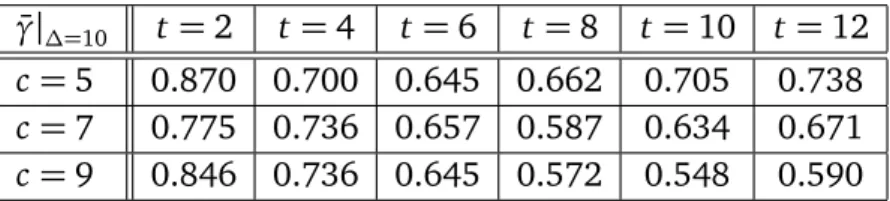
γ|∆=10 t =2 t =4 t =6 t =8 t=10 t=12
c=5 0.870 0.700 0.645 0.662 0.705 0.738
c=7 0.775 0.736 0.657 0.587 0.634 0.671
c=9 0.846 0.736 0.645 0.572 0.548 0.590
Table 1: Numerical values forγ¯.
hand, the second inequality in (27) requires that ¯µis small enough so that the entrant cannot gain by deviating from ˆpE L to ˆpEH. To examine whether both inequalities can be satisfied, we first consider the case of non-drastic innovations (∆−c <3t) and then drastic innovations (∆−c≥3t).
Non-drastic Innovations
Whether condition (b) of Lemma 3 is satisfied for p= ˆp, depends on how large the fraction
γof informed consumers is. As the proof of our next result shows, Lemma 3 implies that a two–sided separating equilibrium exists if and only ifγis not too small.
Proposition 3 Let ∆−c <3t. There exists a γ¯ = γ¯(t,∆,c) ∈ (0, 1) such that the following holds:
(a) Ifγ≥γ¯,then there exists a signalling equilibrium(p∗,µ∗(·))with p∗I L 6=p∗I H and p∗E L6=p∗EH.
The prices p∗in this equilibrium are identical to the perfect information equilibrium ˆp. (b) Ifγ <γ¯,there exists no signalling equilibrium(p∗,µ∗(·))such that p∗I L 6=p∗I H and p∗E L6=p∗EH.
In a two–sided separating equilibrium prices are not distorted by signalling. The incum-bent or the entrant can gain by a unilateral deviation only because this changes the unin-formed consumers’ beliefs. Therefore, a deviation is unprofitable as long as sufficiently many consumers are informed. This explains why(ˆp,µ∗(·))can constitute a signalling equilibrium forγ≥γ¯. If γ <γ¯, then the firms’ signalling rivalry is too intense to prevent profitable devi-ations: Either the incumbent will defect from the equilibrium if qE =qH, or the entrant will defect if qE =qL. As observed by Schultz (1999) in a different context, conflicting interests may thus rule out the existence of a two–sided separating equilibrium for some parameter constellations.
In Table 1 some numerical calculations illustrate how ¯γdepends oncandtif∆ =10. They reveal that ¯γ does not depend monotonically on the parameters of our model. In particular, if the measure t of horizontal differentiation increases, ¯γ first decreases and then increases. Our next result shows that this is true in general.
Proposition 4 (a) For t sufficiently large the critical value γ¯(t,∆,c), stated in Proposition 3, satisfies ∂γ¯(t,∆,c) ∂t >0, ∂γ¯(t,λ∆,λc) ∂ λ λ=1 <0. (28)
(b) For t sufficiently close to(∆−c)/3,7
∂γ¯(t,∆,c) ∂t <0, ∂γ¯(t,λ∆,λc) ∂ λ λ=1 >0. (29)
Prices can be used as credible signals because of their effect on the informed consumers’ demand. When the degree t of horizontal differentiation is sufficiently large, some of these consumers still purchase from the firm that has deviated to a higher price. In this situation, ¯γ is increasing in t because the price sensitivity of demand is negatively related to the product differentiation parameter t. Conversely, fewer informed consumers are required for the two– sided separating equilibrium if ∆−c is increased toλ∆−λc, withλ >1. Such an increase improves the competitiveness of the high quality entrant. It facilitates the requirements for an equilibrium because it raises the price differences|ˆpI H −ˆpI L|and |ˆpE L −ˆpEH|. Therefore, a deviation of the incumbent from ˆpI H to ˆpI L or of the entrant from ˆpE L to ˆpEH becomes less profitable, and a smaller fraction ¯γof informed consumers suffices for existence of a signalling equilibrium.
As part (b) of Proposition 4 shows, the comparative statics properties of ¯γ are reversed if t is relatively small. Then, by deviating from the full information price to a higher price, a firm loses the entire demand of the informed consumers. Therefore, the price sensitivity of the informed consumers’ demand plays no role. Instead, because equilibrium profits are increasing in t, the incentives for deviation become weaker if t increases. In particular, the incumbent is driven out of the market by the high quality entrant and receives zero profits in the limit as t→(∆−c)/3. Therefore, when t becomes small more informed consumers are required to prevent the incumbent from deviating to ˆpI L.
Drastic Innovations
Now we show that Proposition 3 holds also for drastic innovations: if the fraction γ of in-formed consumers is not too small, then the full information pricesˆpin (12) can be supported as a signalling equilibrium by some beliefsµ∗(·). We begin with the following lemma:
Lemma 4 Let∆−c>3t. If and only if µ¯≥(∆−t)/∆,then
ΠI H(ˆpI H,ˆpEH, 1)≥ΠI H(ˆpI L,ˆpEH, ¯µ), (30)
i.e. the incumbent does not gain from deviating toˆpI L if qE =qH.
Since the incumbent makes zero profit at the prices(ˆpI H,ˆpEH), he could gain by deviating to ˆpI L only if this attracts some uninformed consumers. Lemma 4 shows that this is not pos-sible as long as the uninformed consumers remain sufficiently optimistic about the entrant’s quality when observing the out–of–equilibrium prices(ˆpI L,ˆpEH).
Lemma 5 Let∆−c>3t and µ¯≥(∆−t)/∆. If and only ifγ≥(2∆−3t)/(2∆−2t), then
ΠE L(ˆpI L,ˆpE L, 0)≥ΠE L(ˆpI L,ˆpEH, ¯µ). (31)
i.e. the entrant does not gain from deviating to ˆpEH if qE =qL.
By deviating to ˆpEH the low quality entrant loses the demand from the informed con-sumers. But, by Lemma 4 he attracts all uninformed concon-sumers. A deviation is therefore not profitable only if the fraction of informed consumers is not too small.
Lemmas 3, 4 and 5 immediately imply the following extension of Proposition 3 to the case of drastic innovations:
Proposition 5 Let∆−c>3t and defineγ˜≡(2∆−3t)/(2∆−2t).
(a) Ifγ≥γ˜,there exists a signalling equilibrium(p∗,µ∗(·))with p∗I L6=p∗I H and p∗E L 6=p∗EH.The prices p∗in this equilibrium are identical to the perfect information equilibrium ˆp.
(b) Ifγ <γ˜,there exists no signalling equilibrium(p∗,µ∗(·))such that p∗I L 6=p∗I H and p∗E L6=p∗EH. Since∂γ/∂˜ t<0 and∂γ/∂˜ ∆>0, the comparative statics properties of ˜γare in line with part (b) of Proposition 4. Interestingly, in the limitt→0 we obtain ˜γ→1. This means that in a homogenous market a separating signalling equilibrium cannot exist with some uninformed consumers. The intuition is that the incumbent is driven out of the market by the high quality entrant, and for t → 0 also the low quality entrant’s profits become negligible at the full information prices. Therefore, if qE = qH the incumbent will deviate from p∗I H to p∗I L if this attracts some uninformed consumers. Should no uninformed consumer purchase from the incumbent, this means that all uninformed consumers turn to the entrant when observing the prices(p∗I L,p∗EH). But this implies that the low quality entrant will gain by deviating from p∗E L
top∗EH.
5
Conclusion
Our analysis shows that a firm may not have to resort to distorted pricing to signal its quality to the uninformed consumers. If its quality is known to a competitor, then the prices of both firms become quality signals and signalling competition may lead to non–distorted pricing in equilibrium. Indeed, under two belief refinements that have frequently been used in the
literature, we show that prices convey quality information only if the are identical to the equilibrium under full information.
This finding has obvious implications for other strategic choices. For example, consider the market entry decision of a firm whose quality is not publicly observable. As long as sufficiently many consumers are informed, our analysis indicates that entry decisions are not distorted when at least one of the incumbent firms learns the new firm’s quality after it has entered the market. A similar conclusion obtains forR&Dinvestments in product innovation when some consumers cannot observe whether the investment has been successful or not. If competing firms and a sufficient fraction of consumers become informed about the outcome, our results suggest that the incentives for product innovation are not distorted by the presence of uninformed consumers.
6
Appendix
Proof of Lemma 1: SincepE L 6=pEH impliesµ(pI,pE L) =0 and∂ΠE L/∂ µ >0, it follows from
equilibrium condition (14) that for all p≥0
ΠE L(pI,pE L, 0)≥ΠE L(pI,p,µ(pI,p))≥ΠE L(pI,p, 0). (32)
This proves that (21) must hold. Analogously,µ(pI,pEH) =1 and∂ΠI H/∂ µ <0 imply by (13) that for all p≥0
ΠI H(pI,pEH, 1)≥ΠI H(p,pEH,µ(p,pEH))≥ΠI H(p,pEH, 1). (33)
This proves that pI must satisfy the first condition in (22).
Suppose that pI does not satisfy the second condition in (22). Since part (b) of the un-prejudiced belief criterion implies µ(p,pE L) =0 for all p6= pI, then there exist some p such that
ΠI L(pI,pE L,µ(pI,pE L)) = ΠI L(pI,pE L, 0)<ΠI L(p,pE L, 0) = ΠI L(p,pE L,µ(p,pE L)). (34)
This is a contradiction to the condition that in equilibrium pI has to satisfy (13) forQ=L. Note that pEH must satisfy the constraint in (23) because equilibrium condition (14) im-plies that
ΠE L(pI,pE L, 0) = ΠE L(pI,pE L,µ(pI,pE L))≥ΠE L(pI,pEH,µ(pI,pEH)) = ΠE L(pI,pEH, 1). (35)
Suppose that pEH does not solve the maximization problem in (23). Then there exists some
pthat satisfies the constraint in (23) andΠEH(pI,p, 1)>ΠEH(pI,pEH, 1). Because part (b) of
the intuitive criterion then impliesµ(pI,p) =1, this yields
ΠEH(pI,p,µ(pI,p)) = ΠEH(pI,p, 1)>ΠEH(pI,pEH, 1) = ΠEH(pI,pEH,µ(pI,pEH)), (36)
a contradiction to equilibrium condition (14) forQ=H. Q.E.D. Proof of Proposition 1: Using the full-information best-response functions to solve the con-ditions for (21) and (22) in Lemma 1, we get the prices
p∗I =t,p∗E L =t,p∗EH =t+ ∆. (37) If the constraint in (23) is not binding, we obtain the high-quality entrant’s best-response
p∗EH =max
2t+ ∆ +c
2 ,∆
. (38)
This, however, is inconsistent with the last equation in (37) as ∆ > c and t > 0. If the constraint in (23) is binding, then ΠE L(p∗I,p∗EH, 1) = ΠE L(p∗I,p∗E L, 0). By (37) this equality is
equivalent to
(∆ +t)(t−γ∆)
2t = t
for∆≤t and
(∆ +t)(1−γ)
2 =
t
2 (40)
for∆>t. From these equations it follows that the conditions of Lemma 1 are satisfied only ifγ=t/(t+ ∆)if∆≤t andγ= ∆/(t+ ∆)if∆>t. Q.E.D. Proof of Lemma 2:The argument is analogous to the proof of Lemma 1. Q.E.D. Proof of Proposition 2: From the full-information best responses for (24) and (25) in Lemma 2, we obtain the solution
p∗I L= 3t+2∆ +4c 3 ,p ∗ I H = 3t−∆ +c 3 ,p ∗ E= 3t+ ∆ +2c 3 (41) for∆−c≤3t and p∗I L =2∆−3t,p∗I H=0, p∗E= ∆−t (42) for∆−c>3t.
If the constraint in (26) is not binding and∆−c≤3t, the full-information best-response of I L is given by p∗I L = max{(6t+ ∆ +2c)/6,(∆ +2c)/3}. This, however, is inconsistent with the first equation in (41). If the constraint in (26) is not binding and∆−c >3t, the full-information best-response of I L is given by p∗I L =max{∆/2,∆−2t}. This, however, is inconsistent with the first equation in (42).
For∆−c<3t, if the constraint in (26) is not binding, the full-information best-response of I L is given by p∗I L = max{(6t+ ∆ +2c)/6,(∆ +2c)/3}. This, however, is inconsistent with the first equation in (41). If the constraint in (26) is binding, then ΠI H(p∗I L,p∗E, 0) =
ΠI H(p∗I H,p
∗
E, 1). If∆−c<3t≤∆ +2c, this equality is by (41) equivalent to
0=(3t−∆ +c) 2
18t . (43)
If ∆ +2c < 3t ≤ 4∆ +2c, then the equality ΠI H(pI L∗ ,p∗E, 0) = ΠI H(p∗I H,p∗E, 1) by (41) is equivalent to
(1−γ)(3t+2∆ +4c)(3t−∆−2c)
18t =
(3t−∆ +c)2
18t . (44)
Finally, if 4∆ +2c ≤ 3t, then by (41) then the equality ΠI H(p∗I L,p∗E, 0) = ΠI H(p∗I H,p∗E, 1) is
equivalent to
(3t+2∆ +4c)(3t−3γ∆−∆−2c)
18t =
(3t−∆ +c)2
18t . (45)
As ∆−c <3t, the equations (43) – (45) have either no solution or a unique solution in γ Therefore, the conditions of Lemma 2 can hold at most for particular values ofγ. Q.E.D. Proof of Lemma 3: We first show that (a) and (b) must hold in a signalling equilibrium
(p,µ(·)). By (13)
for all p ≥0, where the second inequality follows from ∂ΠI H/∂ µ < 0. Similarly, (13) and
part (b) of the unprejudiced belief criterion imply
ΠI L(pI L,pE L, 0)≥ΠI L(p,pE L,µ(p,pE L)) = ΠI L(p,pE L, 0) (47)
for allp6=pI H. By continuity ofΠI L(·,pE L, 0), therefore also
ΠI L(pI L,pE L, 0)≥ΠI L(pI H,pE L, 0). (48)
By an analogous argument it follows from (13),∂ΠE L/∂ µ >0, and part (a) of the
unpreju-diced belief criterion that
ΠE L(pI L,pE L, 0)≥ΠE L(pI L,p, 0), ΠEH(pI H,pEH, 1)≥ΠEH(pI H,p, 1) (49)
for all p ≥0. By (46)–(49), p satisfies the conditions that define ˆp in (7). This proves that
(p,µ(·))must satisfy claim (a) that p= ˆp. Note that by (13) and (14)
ΠI H(pI H,pEH, 1) ≥ ΠI H(pI L,pEH,µ(pI L,pEH)), (50) ΠE L(pI L,pE L, 0) ≥ ΠE L(pI L,pEH,µ(pI L,pEH)).
This proves that statement (b) holds for ¯µ≡µ(pI L,pEH).
Next we show that(ˆp,µ(·))is a signalling equilibrium for someµ(·)only if (b) holds. Note that the intuitive criterion does not apply toˆpbecause ˆpI L6= ˆpI H and ˆpE L 6= ˆpEH. In line with the unprejudiced belief criterion, define
µ(ˆpI H,p)≡1 for allp= ˆ6 pE L, µ(p,ˆpE L)≡0 for allp6= ˆpI H, µ(ˆpI H,ˆpE L)≡λ. (51) Further, if (27) in part (b) of the lemma holds for p= ˆp we can set
µ(ˆpI L,p)≡0 for allp= ˆ6 pEH, µ(p,ˆpEH)≡1 for all p6= ˆpI L, µ(ˆpI L,ˆpEH)≡µ¯. (52) The beliefs for all other price pairs(pI,pE)play no role in the definition of a PBE and so they are arbitrary. Sinceµ(ˆpI L,ˆpE L) =0 andµ(ˆpI H,ˆpEH) =1 by (51) and (52), these beliefs satisfy Bayes rule (15) in part (b) of the definition of a PBE. Further since ˆp satisfies (7) and (50) holds forp= ˆp, it is easily verified that(ˆp,µ(·))satisfies also the conditions (13) and (14) for profit maximization in part (a) of the definition of a PBE. This proves that ˆp and the beliefs
µ(·)in (51) and (52) constitute a signalling equilibrium if (27) in part (b) of the lemma holds forp= ˆp. If the latter condition does not hold, then there is no beliefµ(pI L,pEH)that satisfies both conditions in (50) forp= ˆp. In this case, there exists no PBE(p,µ(·))withp= ˆpbecause at least one of the conditions (13) and (14) for profit maximization is violated. Q.E.D. Proof of Proposition 3:By Lemma 3 it is sufficient to show that for p= ˆp(27) has a solution
¯
µ∈[0, 1]if and only ifγ≥γ¯. Usingˆpin (12), we haveΠI H(ˆpI H,ˆpEH, 1) = (3t−∆ +c)2/(18t)
and ΠI H(ˆpI L,ˆpEH, ¯µ) = (1−γ)(∆(1−3 ¯µ) +2c+3t) 6 +min 0,γ(3t−2∆−2c) 6 , (53)
because ifqE=qH the incumbent’s demand from the informed consumers is zero at(ˆpI L,ˆpEH)
for 3t≤2(∆−c). Therefore, solving the the first inequality in (27) for ¯µyields
¯ µ≥µ¯I(γ)≡ 9t∆(1−γ)−(∆−c) 2 9t∆(1−γ) +max 0, γ 1−γ 2∆−2c−3t 3∆ . (54) By (12), we haveΠE L(ˆpI L,ˆpE L, 0) =t/2 and ΠE L(ˆpI L,ˆpEH, ¯µ) = (1−γ)(3t+2c+ ∆)(3t−2c+ ∆(3 ¯µ−1)) 18t (55) +min 0,γ[(3t) 2 −(∆ +2c)2] 18t ,
because ifqE=qLthe entrant’s demand from the informed consumers is zero at(ˆpI L,ˆpEH)for 3t≤∆ +2c. Therefore, solving the the second inequality in (27) for ¯µyields
¯ µ≤µ¯E(γ)≡ (∆ +2c) 2 3∆(1−γ)(3t+2c+ ∆)−max 0, γ 1−γ ∆ +2c−3t 3∆ . (56)
Thus, the two inequalities in (27) admit a solution ¯µ if and only if ¯µI(γ) ≤ µ¯E(γ). It is
easily verified that
0<µ¯E(0)<µ¯I(0)<1, limγ→1[µ¯I(γ)−µ¯E(γ)]<0, ¯µ0I(γ)<0, ¯µ
0
E(γ)>0. (57)
Therefore, by the intermediate value theorem there exist a (unique) ¯γ ∈ (0, 1) such that ¯
µI(γ¯) =µ¯E(γ¯)∈(0, 1)and ¯µI(γ)≤µ¯E(γ)if and only ifγ≥γ¯. Q.E.D.
Proof of Proposition 4: By the proof of Proposition 3, ¯γ is uniquely determined by the solution of ¯µI(γ¯|t,∆,c) = µ¯E(γ¯|t,∆,c), where ¯µI and ¯µE are defined in (54) and (56) and
satisfy (57). For 3t>max[2(∆−c),∆ +2c]one obtains
∂µ¯I(γ¯|t,∆,c)/∂t>0, ∂µ¯E(γ¯|t,∆,c)/∂t<0, (58) which immediately implies the first inequality in (28). Since ¯µI(γ¯|λt,λ∆,λc) =µ¯I(γ¯|t,∆,c)
and ¯µE(γ¯|λt,λ∆,λc) =µ¯E(γ¯|t,∆,c), the first inequality in (28) implies the second inequality
in (28). This proves part (a).
To prove part (b), let ∆−c <3t <min[2(∆−c),∆ +2c]. Then solving ¯µI(γ¯|t,∆,c) =
¯ µE(γ¯|t,∆,c)yields ¯ γ=∆(27t 2+3t∆−∆2) +12c t∆ +3c2(∆−5t)−2c3 18t2(3t+2c+ ∆) . (59) Since lim t→(∆−c)/3 ∂γ¯ ∂t =− 3(∆ +2c) 2(2∆ +c)2 <0, (60)
this proves the first inequality in (29). As ¯γin (59) is homogenous of degree zero in(t,∆,c)
the first inequality implies the second inequality in (29). Q.E.D. Proof of Lemma 4: Note that ΠI H(ˆpI H,pˆEH, 1) = 0 because ˆpI H = 0. Therefore (30) holds
if and only if no consumer purchases from the incumbent upon observing (ˆpI L,ˆpEH). The uninformed consumers’ demand is zero if and only if even the consumer with x =0 does not prefer to buy from the incumbent. This is the case if
qL−ˆpI L ≤µ¯qH+ (1−µ¯)qL−ˆpEH−t. (61) Since ˆpEH−ˆpI L = ∆−2t, this is identical to ¯µ≥(∆−t)/∆. Clearly, if even the uninformed consumers do not purchase from the incumbent, then at the prices(ˆpI L,ˆpEH)also the informed consumer do not buy from the incumbent because they know thatqE =qH. Q.E.D. Proof of Lemma 5:We first show that no informed consumer purchases from the low quality entrant if he deviates to p∗EH. This is the case if even the informed consumer with x =1 does not buy from the entrant, i.e. if
qL−ˆpI L−t≥qL−ˆpEH. (62)
Since ˆpEH−ˆpI L= ∆−2t, this is identical to∆≥3t and is satisfied as∆−c≥3t.
While a deviation to p∗EH leads to zero demand from the informed consumers, by the proof of Lemma 4 all uninformed consumers buy from the entrant at the prices (ˆpI L,ˆpEH). Therefore,
ΠE L(ˆpI L,ˆpEH, ¯µ) = (1−γ)ˆpEH = (1−γ)(∆−t). (63)
Since ΠE L(ˆpI L,ˆpE L, 0) = ΠE L(t,t, 0) = t/2, the inequality in (31) is equivalent toγ≥(2∆−
3t)/(2∆−2t). Q.E.D.
Proof of Proposition 4: Statements (a) and (b) follow immediately from Lemmas 3, 4 and