In
International Center for Public Policy
Working Paper 12-06
January 2012
Financing Social Expenditures in Developing
Countries: Payroll or Value Added Taxes?
Richard Bird
Michael Smart
INTERNATIONALCENTER FOR PUBLIC POLICY
International Center for Public Policy Andrew Young School of Policy Studies Georgia State University
Atlanta, Georgia 30303 United States of America
Phone: (404) 651-1144 Fax: (404) 651-4449 Email: [email protected]
Internet: http://aysps.gsu.edu/isp/index.html
Copyright 2006, the Andrew Young School of Policy Studies, Georgia State University. No part of the material protected by this copyright notice may be reproduced or utilized in any form or by any means without prior written permission from the copyright owner.
International Center for Public Policy
Working Paper 12-06
Financing Social Expenditures in Developing
Countries: Payroll or Value Added Taxes?
Richard Bird
Michael Smart
January 2012
International Center for Public Policy
Andrew Young School of Policy Studies
The Andrew Young School of Policy Studies was established at Georgia State University with the objective of promoting excellence in the design, implementation, and evaluation of public policy. In addition to two academic departments (economics and public administration), the Andrew Young School houses seven leading research centers and policy programs, including the International Center for Public Policy.
The mission of the International Center for Public Policy is to provide academic and professional training, applied research, and technical assistance in support of sound public policy and sustainable economic growth in developing and transitional economies.
The International Center for Public Policy at the Andrew Young School of Policy Studies is recognized worldwide for its efforts in support of economic and public policy reforms through technical assistance and training around the world. This reputation has been built serving a diverse client base, including the World Bank, the U.S. Agency for International Development (USAID), the United Nations Development Programme (UNDP), finance ministries, government organizations, legislative bodies and private sector institutions.
The success of the International Center for Public Policy reflects the breadth and depth of the in-house technical expertise that the International Center for Public Policy can draw upon. The Andrew Young School's faculty are leading experts in economics and public policy and have authored books, published in major academic and technical journals, and have extensive experience in designing and implementing technical assistance and training programs. Andrew Young School faculty have been active in policy reform in over 40 countries around the world. Our technical assistance strategy is not to merely provide technical prescriptions for policy reform, but to engage in a collaborative effort with the host government and donor agency to identify and analyze the issues at hand, arrive at policy solutions and implement reforms.
The International Center for Public Policy specializes in four broad policy areas:
Fiscal policy, including tax reforms, public expenditure reviews, tax administration reform
Fiscal decentralization, including fiscal decentralization reforms, design of intergovernmental transfer systems, urban government finance
Budgeting and fiscal management, including local government budgeting, performance-based budgeting, capital budgeting, multi-year budgeting
Economic analysis and revenue forecasting, including micro-simulation, time series forecasting,
For more information about our technical assistance activities and training programs, please visit our website at http://aysps.gsu.edu/isp/index.html or contact us by email at [email protected].
Financing Social Expenditures in Developing
Countries: Payroll or Value Added Taxes?
Richard Bird and Michael Smart
University of Toronto
Abstract
At present most social protection programs in Latin American countries are financed by payroll taxes levied on the formal sector. Increasingly, some countries are both extending some benefits similar to those received from these programs to non-contributors and financing such extensions as well as some benefits for contributors from general revenues, which at the margin in most countries means from the value added tax. In this paper we consider the efficiency of payroll taxes compared to value-added taxes as a way of financing expanded social programs in countries with large informal sectors. To do so, we construct a simple formal model that indicates, in general, that a revenue-neutral move from payroll to value-added taxes will reduce informality and increase wages, output and welfare. While the issue is not a simple one, and the specific conditions in each country need careful consideration, this analysis suggests that in countries with large informal sectors it is probably best to finance incremental expansions of social programs from broad-based taxes like VAT instead of payroll taxes.
Keywords: payroll tax; value-added tax; social programs; Latin America
Financing Social Expenditures in
Developing Countries: Payroll or Value
Added Taxes?
Richard Bird
University of Toronto
Michael Smart
University of Toronto
December 6, 2011
1
Introduction
At present social insurance (SI) systems in most Latin American countries are financed primarily through taxes on labour, including both payroll taxes that finance contributory SI regimes and other taxes on wages and labour income that finance a broader array of social programs. Payroll taxes that are explicitly linked to social insurance programs are levied at rates ranging from a low of about 8 percent in Mexico to a high of about 45 percent in Colombia. By definition, these taxes are applied only to the formal sector of the economy. Similarly, many of the benefits from the social programs financed by these taxes may be claimed only by those who are or have been employed in the formal sector and have therefore contributed to funding the programs, although there is often no tight connection between taxes paid and benefits received.1 Issues related both to contributory schemes (and the extent to which they are regarded by workers as benefit taxes)
1Details of country programs may be found in Social Security Administra-tion 2010 (available at http://www.ssa.gov/policy/docs/progdesc/ssptw/2008-2009/americas/index.html).
and to voluntary arrangements are discussed elsewhere. In the present pa-per, we focus primarily on the efficiency of payroll taxes (PRT) compared to value-added taxes (VAT) as a means of financing social programs in coun-tries with important informal sectors.
Increasingly, some countries (e.g. Colombia) are both providing some benefits from the social protection system on a more universal basis and are supplementing contributory finance to some extent from general rev-enues. This expansion of social protection regimes in Latin America raises closely linked questions with respect to the link between taxes paid and benefits received and the effects of the labour tax burden on employment and productivity. As social insurance expands beyond its original contribu-tory basis, a key question is whether it should continue to be financed pri-marily or exclusively through payroll and other taxes on labour, or whether efficiency and equity would be enhanced by shifting reliance to general revenues of government – and potentially to other tax bases, of which the value-added tax is the most obvious candidate. To answer such questions, it is important to compare the effects of such finance with the alternative of increasing either the rate or coverage (or both) of existing payroll taxes. To set the stage for such analysis, this paper begins with a brief overview of both the current SI financing arrangements and the general tax sys-tems in a number of major Latin American countries. In most countries, SI is financed to a considerable extent by dedicated payroll taxes, most of which are imposed on employers rather than on employees. Despite these dedicated revenues, most SI systems are far from self-financing and a substantial fraction of general revenues also ends up financing SI systems. Nonetheless, the very limited coverage of SI regimes has increasingly led countries to devote still more general revenue to expanded social protec-tion (SP) systems. In most countries the marginal source of general rev-enue is usually the VAT, which is often both the largest and one of the most elastic revenue sources available.
In considering possible alternative financing arrangements for SI, one important issue is to assess how the current system compares to such alter-natives in terms of such standard criteria as economic incidence, equity, and efficiency. In particular, in view of the marked and persistent importance of the informal sector in most Latin American countries, it is critical to un-derstand the likely effect of alternative SI financing on the relative growth of employment in the formal and informal sectors as well as the possible consequences of increasing (or reducing) informality on the pattern and
level of economic growth.2
Levy (2008) and others have argued that current SI payroll tax systems, together with non-contributory benefit programs available to workers in the informal sector, constitute a subsidy to the informal sector which sup-presses development of the formal sector and results in productivity losses. To remove this bias, Levy has proposed financing SI from the VAT instead of through contributory payroll taxes. These proposals have been contro-versial. Several authors, most notably Emran and Stiglitz (2005), have criticized VATs for encouraging tax evasion and the informal economy in developing countries.3 As such, the notion that increased reliance on VAT may be a solution to informality may appear surprising. Sorting out these differences is key to understanding the effect of SI financing on productiv-ity. These issues are explored to some extent with respect to VAT, for exam-ple, in such studies as de Paula and Scheinkman (2008, 2009) on Brazil, Pomeranz (2010) on Chile, and, with respect to both VAT and payroll taxes by Anton and Hernandez (2010) on Mexico. What is more, and of consid-erable concern to governments, if the two taxes have different bases that may grow at different rates and are subject to evasion to different degrees, alternative forms of SI financing may have important revenue implications. At first, the comparison between payroll and value-added taxation seems complex, since the legal and economic basis of the taxes is so different. Pay-roll taxes are levied on producers; while the legal incidence of VAT is also on producers, it is commonly viewed as a tax on consumption rather than production. As a tax on domestic production, the payroll tax is a tax on an origin basis, whereas almost all VATs are levied on a destination basis, zero-rating exports and fully taxing imports for domestic consumption. As such, the two taxes may in principle have different effects on the develop-ment of the tradable and non-tradable sectors and on the pattern and level of economic growth. Finally, the different base and the invoice-and-credit structure of the VAT mean that the incentives for tax evasion and distortions to formal sector production are potentially quite different than for payroll taxes. Some recent research (e.g. Antón and Henández, 2010) has made progress in elucidating certain aspects of this comparison, but some of the
2This has been the subject of considerable work by the World Bank – see, for instance, Perry et al. (2003) – as well as in country studies as Arias et al. (2010) and Hanson (2010).
3See Keen (2008) for an alternative approach stressing the extent to which VAT may actually tax rather than favour the informal sector.
fundamental economic issues may remain obscure.
For this reason, in Section 4 of the paper we construct a simple formal model of the effects of labour and value-added taxes, contrasting in partic-ular their incidence on wages, their implications for government revenue and for equity, and their effects on the informal economy.
The starting point of our model is a fundamental equivalence result: in a closed economy, and in the absence of informality, a consumption-based VAT is equivalent to a payroll tax plus a tax on the existing capital stock of firms and on other rents. In other words, in this idealized framework, the two taxes have identical effects on labour markets, but the VAT raises addi-tional revenues over a transition period from taxing quasi-rents to installed capital.
Thus far, the results of the model are standard: VAT is a more efficient tax than payroll taxation in the model because its base is broader than the payroll tax base. One implication is that VAT raises the same revenues at a lower tax rate than the payroll tax. However, the story becomes more complicated when we consider informality. In the model, we suppose that firms and workers may move between the formal sector (subject to VAT and payroll taxes) and the informal sector (not subject directly to either tax). The base of VAT is broader than payroll taxes to the extent that VAT taxes rents (and quasi-rents) of formal sector firms. Therefore, incentives to enter the informal sector are greater under VAT than under a payroll tax at the same statutory rate. In spite of this tradeoff between revenues and efficiency of the tax, we show that there exists a revenue-neutral reform from payroll taxation to VAT that increases national output and welfare in the model.
However, the analysis differs when various real world complications are considered. For example, under (destination-based) VATs, exports are zero-rated and imported goods are subject to taxation. This changes the efficiency effects of the two taxes, and may change the incentives for in-formality, to the extent that formal-sector firms are more or less involved in the export sector of the economy. Effects may also differ if, for exam-ple, markets are very imperfect and the infra-marginal rents taxed by VAT are relatively large, if capital is relatively more mobile than labour (or vice versa) between the formal and informal sectors and the elasticity of substi-tution for capital and labour is different in the two sectors, or if VAT is more regressive than the payroll tax and the existing income distribution is very unequal. However, although these factors may be important to differing
extents in different countries, on the whole the critical factors are (1) the size of the factor market distortions created by the tax wedges (e.g. the labour share in the VAT base) and (2) the relevant elasticities in the formal and informal markets.
2
Financing SI in Latin America
Over the last few years, issues related to social protection (SP)– a term encompassing both social insurance (SI) and social assistance (SA) – have come to the forefront of policy discussion in Latin America, with the UN, the World Bank, the Inter-American Development Bank, the IMF, the OECD, and many others contributing numerous reports and research papers to the growing pile of documentation related to this topic.4 Several different concerns underlie the marked recent expansion of policy discussion in this area.
2.1
Current Concerns
Many Latin American countries introduced traditional compulsory social insurance schemes financed by payroll taxes decades ago. As Mesa-Lago (2008) notes, some countries such as Argentina, Brazil and Chile intro-duced limited pension plans even before World War II; others including Colombia, Mexico, and Peru followed in the 1950s; late-comers, like most of the Central American countries, following in the 1960s and 1970s. The coverage and benefits of these schemes varies considerably from country to country (Social Security Administration 2010). In all cases, however, as Table 1 shows, the social insurance system is financed, to varying extents, through payroll taxes (“contributions”). On average, the level of these pay-roll tax rates is 23%, although with wide variation from country to country from a low of 8% in Mexico to a high of 45% in Colombia.
The literature offers several reasons for being concerned with the effi-cacy of the SI systems now existing in Latin America. One obvious reason is, as shown in Table 2, simply because almost none of the SI systems in Latin America are “self-financing”. On average, less than 40% of social security
4For a sampling, see e.g. Economic Commission on Latin America (2006), Mesa-Lago (2008), Riber, Robalino and Walker (2010), IMF (2010), and Da Costa et al. (2011).
outlays are financed by contributory finance, with the result that close to 20% of general tax revenues in effect finance SI spending. As shown in Ta-ble 2, there are of course wide differences from country to country, with the SI financing deficit being particularly large in Argentina and Brazil. These differences reflect both the differing scope and age of the SI systems in dif-ferent countries and the reforms undertaken in a number of countries in recent years, both in response to fiscal pressure and as part of the effort to expand coverage in the face of continuing high levels of both inequality and informality (see Table 3).5 Major reforms have taken place in Chile and Argentina – originally in the early 1990s and more recently in the last few years (Rofman, Fajnzlyber and Herrera 2010) as well as in Colombia (Clavijo 2009) and to some extent in Bolivia, Mexico and Peru (Kritzer, Kay and Sinha 2011).6
An additional reason for SI reform has been the desire to expand the present limited coverage of SI schemes in most countries of the region. A more important attack on the problem of the very limited access to such SI-linked services as pensions and health, however, has been the rapid ex-pansion in a number of countries of various forms of direct social assis-tance (SA), such as noncontributory SI schemes (“social pensions”) and conditional cash transfers (CCTs). In principle, SI and SA are quite differ-ent, with the former directed at consumption-smoothing and the latter at income redistribution but, as Ferreira and Robalino (2010) note, this dis-tinction is so often blurred in practice that it has become common in Latin America to lump SI and SA together under the label Social Protection (SP). We focus here on such non-contributory SI reforms as funding pensions, either universal or means-tested, out of general revenues and health in-surance schemes targeted to the poor (Holzmann, Robalino and Takayama 2009). Some recent studies (Ortiz and Cummins 2011) suggest that these schemes have already brought about noticeable improvements in terms of
5As Mesa-Lago (2008) notes, for example, Argentina, Brazil, Chile Costa Rica and Uruguay led the way in developing SI systems, while Paraguay, Nicaragua, Honduras, Guatemala, El Salvador and the Dominican Republic are late-comers.
6As Kritzer, Kay and Sinha (2011) discuss in detail, much of this reform activity has taken the form (to look only at pensions) of moving away to varying degrees from the traditional SI model of mandatory contributory financing through a central public agency of defined benefit pensions to models that, again to varying extents, introduce more vol-untary components in either the level or allocation of contributions and move to what is in effect a defined contribution pension system. We shall not discuss such schemes further here, however.
both poverty reduction and inequality in some countries in the region. While clearly motivated primarily by the basic distributional considera-tions suggested by the inequality and poverty measures shown in Table 3, these programs have also responded in part to the increasing perception that the basic SI system was deeply flawed, given its limited coverage of only the formal sector, the marked evasion even within that sector, and the fact that transfers are regressive in that they do not go to the poor. In short, as a detailed study of social transfers in eight countries concluded, the sys-tem is in general both “grossly inefficient and regressive” (Lindert, Skoufias and Shapiro 2006, p. 44).7
This result is not altered by the fact that to a considerable extent (see Table 2) such transfers were in fact funded not by SI contributions but by general revenues because in most countries the tax system is too limited and – largely owing to the very limited role of the personal income tax (Bird and Zolt 2005) – insufficiently progressive to effect any noticeable degree of redistribution (Goñi, Lopez and Seven 2008).8 Not only are tax burdens in the region relatively low but, unsurprisingly in light of the de-pendence of most economies on commodities, revenues have demonstrated high volatility in recent years (Fricke and Sussmith 2011).9
2.2
Economic aspects of payroll taxation
In short, there are macroeconomic and distributional problems with the design and financing of SP programs in Latin America. What is more, the recent expansion of such programs has accentuated concerns about the possibly undesirable economic effects on labour markets, productivity and growth of both sides of the SI equation – payroll tax (PRT) finance on one hand and subsidized transfers on the other – particularly in economies
7The same point is made by Goñi, López and Sevén (2008).
8Similar conclusions emerge from the various country studies presented in Barreix, Roca and Villela (2007) and the recent summary appraisal by Jimenez, Gomez Sabaini and Podesta (2010).
9As Fricke and Sussmith (2011) show, for the region as a whole, although with consid-erable variation from country to country, the long-run elasticity of income taxes is greater than for VAT. However, since much of the higher elasticity is associated with the CIT, the most important income tax in most countries, income tax revenues are also considerably more volatile than VAT revenues. On the other hand, in Argentina, Mexico and Peru, VAT is more elastic than social security contributions (PRT) while in Brazil the two are equally elastic; only in Chile and Ecuador is PRT more elastic than VAT.
with large informal sectors. Observations along such lines as the remark by Goñi, Lopez and Seven (2008, p. 23) that “payroll taxes . . . encourage informality and ultimately tend to detract from the revenue-raising ability of the overall tax system” are common in the literature.10 Indeed, such arguments are to a large extent simply an extension of the standard view of the disincentive effects of the “labour tax wedge.” This wedge is often defined to include “direct” taxes on labour, notably the personal income tax on labour income and payroll taxes. It is probably more appropriate to include consumption taxes also, since presumably workers respond to changes in net real wages (OECD 2007). However, few empirical studies do so. Levy (2008) took this long-standing argument about the disincentive effect of PRT on employees further by arguing (particularly with respect to Mexico) that not only did wage taxes imposed on formal sector workers encourage informality but that the recent expansion of the subsidized pro-vision of social services to informal sector workers reinforced the resulting disincentives to economic growth and productivity.11 His proposed solu-tion was essentially to replace payroll tax financing of social transfers by general revenue financing and in particular (at least in the case of Mexico) the VAT.
Of course, Levy (2008) was by no means the first to propose general revenue financing of SI or even the first to propose that the source of such finance should be the VAT. New Zealand, for example, has always financed all of its extensive social transfers from general revenues, as for the most part has Australia. Indeed, many countries finance first-pillar old-age pen-sions (usually income-tested) from general revenues even when they also have contributory financing of earnings-related pensions. Even countries with long-established PRT financed SI schemes have recently considered shifting some of the fiscal burden to general taxes, and in particular the VAT, both because of concerns about unemployment and for macroeco-nomic reasons. For example, a “social VAT” – that is, an additional VAT rate earmarked to finance social purposes – was seriously discussed in France recently (Besson 2007) and a somewhat similar proposal was made for the Czech Republic (Dalsgaard 2008).12
10See, for example, Perry et al. (2003).
11This theme was subsequently picked up to a considerable extent in studies by interna-tional agencies such as Pagés (2010) and Riber, Robalino and Walker (2010).
12For the most part, the analysis of the social VAT proposal in Besson (2007) as well as such other contributions as Maarek (2008) took the form of simulations (including some
Statutory incidence
As Table 1 shows, every country imposes part of the tax on employees and part on employers; however, with the exceptions of Chile and Venezuela, in most countries most payroll taxes (on average, 61%) are imposed on em-ployers. This split financing of SI contributions may not be economically significant in the sense that all taxes on wages are likely borne by workers in the long run, but some evidence suggests that it may be considered relevant in some respects by both employers and employees.13 More recently, there has also been some discussion in the US of the possibly beneficial effects on employment of reducing payroll taxes, although perhaps unsurprisingly in the present US context there appears to have been little or no consideration of making up the revenue loss through increases in other taxes. Interest-ingly, the Congressional Budget Office suggested that the most effective – in terms of increasing employment – way to cut SI taxes would be to reduce the employer’s portion.14 Presumably on somewhat similar reasoning, as part of its “Paying Tax” report on the investment climate in different coun-tries, World Bank (2011) separates out the so-called “Labour TTR” shown in Table 1, which is more or less the employer’s share of SI contribution as a share of commercial profits (for a hypothetical firm), as if only that part of the tax influenced business decisions. However, the arguments offered in support of this position are neither very explicit nor particularly strong.15
Payroll taxes as benefit taxes
Similarly, the argument sometimes found in the SP literature that social security “contributions” are not really taxes because they finance benefits
CGE analysis) that focused on the possible macroeconomic effects of this substitution on the balance of payments and inflation, although some attention was also paid to short-run effects on employment.
13Studies of payroll tax incidence in Latin American countries have yielded varying re-sults, but as a rule suggest some shifting: see e.g. Cruces, Galiani, and Kidyba (2010), Kugler and Kugler (2009), and Heckman and Pages (2004)
14For a summary of the recent US discussion, see Ainsworth (2011).
15Ainsworth (2011), though he presents no formal analysis, does a good job of criticiz-ing this reasoncriticiz-ing. Interestcriticiz-ingly, he also notes that cuttcriticiz-ing PRT is in many ways identical to cutting VAT and draws on some European experiments with VAT cuts to encourage em-ployment to argue that probably the most effective approach would be to target PRT cuts only to unemployed persons who enter employment.
received by the contributors is weak in general. In contrast, the exclusion of most informal workers from the scope of PRT means that, even with the ceilings imposed on the wage bases subject to such taxes, they are almost certainly progressive whether measured against income or consumption. The stuff now in parens might be put in a note at this point, to read: Social security contributions seem only rarely to be included in incidence analy-sis, perhaps in the belief – mistaken in most Latin American countries – that they are matched in some meaningful sense by SI benefits. The tendency in most countries to impose most SI taxes on employers rather than em-ployees (see Table 1) presumably reflects the view of politicians that voters are likely to be most aware of the direct impact of the latter on their net wages. Of course, while this may be largely true within the short-run hori-zon within which most political decisions are made, it is much less likely to be relevant in a long-run economic perspective. For these reasons, we assume in this paper, as in most of the economic literature, both that SI con-tributions can meaningfully be considered simply as a tax – the PRT â˘A¸S and that the incidence and effects of PRT are similar regardless of whether the tax is legally imposed on employer or employee.
In any case, the Levy (2008) proposal clearly touched a nerve not only in Mexico but in other countries in the region in part because it not only suggested a way to finance expanded SP – a distributionally desirable ob-jective – but it would also reduce the damaging effect on productivity and growth of the current PRT based SI financing structure. Such “double divi-dends” are always attractive to both analysts and politicians. In the present paper, however, we concentrate on the “cake” – the economic effect – rather than the “frosting” – the distributional effect, in part because the evidence in support of the former is much stronger and less country-specific.16
Informality
PRT has detrimental economic effects in Latin America not only because it constitutes a major component of the labour tax wedge as usually defined but in particular because it encourages informality, and informal firms are
16Even in the case of Mexico, Arias et al. (2010, p. 48) conclude that, while labor taxation has led to greater informality and informality has definitely reduced productivity growth in Mexico, there is ‘. . . little evidence that the introduction of social programs targeted towards informal workers has played a major role in promoting informality.”
not only in general small but also less productive than equally-sized formal firms (Pagés, 2010). As La Porta and Shleifer (2008) argue, on the whole the evidence appears to support this negative view of the economic effects of increasing informality. Informal firms to a considerable extent appear to self-select into the informal sector, with those at the lower end of the underlying distribution of firm productivity (entrepreneurial or managerial ability) joining the informal sector (de Paula and Scheinkman 2008). Once there, although they gain by being able to dodge taxes, they find it more costly and difficult to secure capital as Feltenstein and Shamloo (2011), de-veloping some aspects of the argument in Gordon and Li (2009), have re-cently argued. Informal sector firms are hence likely to do little investment in either physical or human capital, thus dragging aggregate productivity performance and the development of the economy’s growth potential down (Arias et al. 2010).17
3
The choice of tax base
3.1
Payroll taxes and VAT: The policy landscape
At the other end of the world from the US both economically and geo-graphically, some of the same arguments discussed in Ainsworth (2011) have come up in a recent proposal in New Caledonia to replace PRT financ-ing of social transfers by VAT – in effect, the French “social VAT” revived in the south Pacific. Although both the factual and analytical setting in a re-cent analysis of this proposal by Lagadec and Ris (2010) are very different to that prevailing in Latin America, notably in the omission of any discus-sion of the informal sector, in many ways this paper comes closer to dealing with the specific issues we analyze here than anything else in the literature, so one way to introduce the simple model set out in the next section may be simply to review the Lagadec and Ris (2010) analysis and raise some questions about it.
First, Lagadec and Ris (2010) consider, much as in the French case
17While the evidence on these links is still far from complete, utilizing a model of Hsieh and Klenow (2009), Camacho and Conover (2010), although not focusing on informality, find some evidence in Colombia that productivity was reduced by policy changes that raised the costs to employers of formal sector labor and increased by changes that reduced such costs.
mentioned earlier, two possible disadvantages of VAT substitution – the presumed greater regressivity of VAT and the possible inflationary effect. Neither of these arguments appears to be a major issue in the case of most Latin American countries. Although, as Smart and Bird (2009) and other studies have shown, VATs are indeed usually passed forward to consumers, there is little or no evidence, in either developed or developing countries of any significant effect on general price levels.18
On the other hand, assuming full forward-shifting, VATs in most Latin American countries are indeed mildly regressive in terms of income, al-though they are mildly progressive when measured against consumption (Barreix, Bes and Roca 2010). Moreover, the exclusion of most informal workers from the scope of PRT means that, even with the ceilings imposed on the wage bases subject to such taxes, they are almost certainly regres-sive whether measured against income or consumption (although social security contributions seem only rarely to be included in incidence anal-ysis, perhaps in the belief – mistaken in most Latin American countries – that they are matched in some meaningful sense by SI benefits. Although only a limited amount can be said about such issues in general analytical terms, empirical analysis of VAT-to-payroll tax substitution in the setting of any particular country should presumably pay close attention to these po-litically important distributional questions, while recognizing that the dis-tributional outcomes shown in such analyses, no matter how data-intensive or analytically sophisticated, often reflect as much or more the assumptions made as the reality being examined. 19
Lagadec and Ris (2010) go on to suggest that substituting VAT for PRT financing of SI will have three major advantages. First, it will expand the revenue base. Second, it will increase employment by lowering labour costs. And third, it will remove the trade distortion arising from the fact that PRT affects export but not import prices. However, no formal analysis supporting these arguments is offered; instead, the paper provides a simu-lation of the effects under a particular set of assumptions. We discuss these three advantages of VAT over PRT briefly below and more formally in the next section.
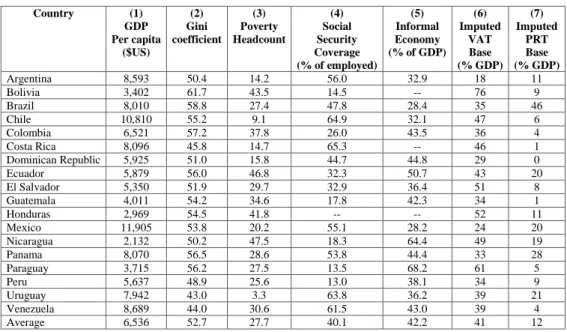
To begin with, as a glance at the two right-hand columns of Table 3 may
18For a Mexican study, see Pagan, Soydemir and Tijerino-Guajardo (2001).
19For a good example, see the recent incidence study by Barriex, Roca, and Villela (2007).
suggest, the first of these points – the expanded revenue base under VAT seems perhaps too obvious to be worth discussion. In fact, however, while the point is basically correct, the issue is considerably more subtle than such simple numerical manipulation suggests. For example, some evidence suggests, in line with conventional wisdom (Bird and Gendron 2007) that VAT is relatively easier to enforce effectively than “single point” taxes like PRT (e.g. de Paula and Scheinkman 2009; Pomeranz 2010). Some aspects of this differential enforcement in economies with informal sectors have re-cently been explored in both theoretical and empirical terms. For example, Boadway and Sato (2009) responding in part to a critique of VAT’s effects in an economy with an informal sector by Emran and Stiglitz (2005) and building on Keen (2008), show that since enforcement can affect the size of the informal sector, the case for relying on VAT, which is easier to enforce in the informal sector, is stronger. With respect to the specific case of Mex-ico, Leal (2010) argues that fully effective VAT enforcement would expand output by as much as 17% while Antón and Hernández (2010), using a different model, similarly suggest that an expanded tax base would be one likely outcome from a PRT-VAT substitution.
Finally, although this point does not so far seem to have received much consideration in the Latin American discussion, attention should also be paid to the “trade” effect of a VAT-PRT substitution, the third of the posi-tive effects postulated by Lagadec and Ris (2010). As Cardi and Restout (2010), like others, have noted, shifting all or some of the tax burden from labour to consumption in a neoclassical open economy model will produce heterogeneous sectoral responses operating largely through firm entry – re-sponses which may be amplified by the increased labour elasticity resulting from the tax shift. However, their model does not have an informal sector. The simple model presented in the next section builds a simple framework which – without delving too deeply into “the world of the second best” in which most developing countries exist – analyzes such a tax substitution in an open economy with an endogenously determined informal sector and differential tax enforcement.
3.2
A conceptual framework
To summarize the foregoing discussion, the proposals of Levy (2008) and the actual experience with policy reform in several countries suggest that a
key question is whether SI is better financed through (contributory or non-contributory) payroll taxes, or through a broader tax base like VAT. At first, the choice between labour taxes and VAT seems rather stark, since the legal base and structure of the taxes is so different. The previous economics literature has however posited simple general equilibrium models of the economy that elucidate the similarities and differences of the two taxes. In brief, the key issues are:
1. Value-added versus payroll base: In a pure consumption VAT, essen-tially all purchases are taxable, but taxable purchasers (businesses) receive credits for taxes paid on material inputs and capital goods pur-chased. The residual base of the value added tax is therefore labour costs of production (payroll) plus the returns to other primary factors of productionin excess of the normal return to capital employed in pro-duction. Of these, one may highlight in particular rents to land, quasi-rents to old capital, and supranormal profits. As such, the base of an ideal VAT is broader than that of the payroll tax. A revenue-neutral shift from payroll tax to VAT therefore typically permits a reduction in the statutory tax rate, and it may have different distributional im-plications.
2. Destination versus origin: Viewed in this way, both taxes are taxes on domestic production, rather than consumption. But most VATs apply zero-rating to exported commodities, and fully tax imports. As such, a VAT is typically a destination-based tax on domestic consumption, whereas a PRT is an origin-based tax on domestic production. This distinction is often held in policy circles to favour the VAT as an en-hancement to “international competitiveness”. But this difference is less important than it appears, since a switch from origin to destina-tion bases will in principle generally result in changes in exchange rates or domestic wage costs that render the two bases nearly equiv-alent (e.g., Lockwood, de Meza, and Myles, 1994).
3. Incentives for informality: Levy (2008) emphasized that existing SI systems entail a distortionary tax on formal sector employment that implicitly favour (less productive) informal sector firms. In contrast, Emran and Stiglitz (2005), and others, showed that VAT similarly favoured informality. Clearly, both taxes (or any taxes, for that mat-ter) create incentives for tax evasion, informality, and other economic
distortions, but the nature and magnitude of these incentives differ under VAT and PRT by virtue of their different legal and economic structures. Comparing the two taxes in this dimension requires more detailed analysis.
Despite the importance of the issue, there is yet little direct empirical evidence on the real world effects of VAT on informality in the de-veloping world. Keen and Lockwood (2010) study the effects of VAT adoption on the overall efficiency of the tax system, as measured by the ratio of tax revenues to GDP, and find that, while VAT reforms are generally revenue-neutral, adoption by low-income countries is asso-ciated with a small decline in revenue. As the authors recognize, this association may reflect other changes coincident with VAT adoption rather than the effects of induced informality; however, the result is suggestive. Desai and Hines (2005) examine the impact of the VAT on international trade in a cross-section of countries, finding that ex-istence of VAT is associated with lower openness to trade, particularly for low and middle income countries. In interesting recent work us-ing Brazilian business microdata, De Paula and Sheinkman find that informal businesses are more likely to have informal suppliers and customers, a result that is consistent with the VAT chain effect on tax evasion. Pomeranz (2010) examines field experiments in Chile that shows how VAT non-compliance behaviour cascades through the sup-ply chain. To date the differential effects of VAT and other tax bases on informality have not been explored in the data.
These considerations suggest that the differences between labour tax-ation and VAT are subtle. Sorting out the differences requires a formal economic model. In the next section, we analyze the effects of a switch from a payroll tax to VAT on real wages, productivity, trade, and the dis-tribution of income in a simple general equilibrium model of a small open economy. Our model includes a (simple) model of the incentives each tax creates for firms in the formal and informal sectors, and it leads to clear implications about the distributional and efficiency effects of a reform form payroll taxation to VAT.
4
A formal model
In a small open economy, a homogeneous consumption good is produced using labour as the sole productive input. There is a large population of potential entrepreneurs in the economy, each of whom chooses whether to enter the market or not and, if they enter, whether to operate in the formal or informal sector. Each firm is endowed with potential productivity
θ. The density of θ in the population of potential entrepreneurs is f(θ). The scale of firms is fixed, but it differs between the informal and formal sectors of the economy. If a firm operates in the formal sector, it hires1unit of labour and so produces θ units of output. If it operates in the informal sector, however, a firm hires only(1−s)unit of labour and producesθ(1−s)
units of output, where the scale advantage s may be regarded as reflecting the greater capital intensity typically observed among firms in the formal sector. Firms in the two sectors also differ in their ability to evade taxes, to which we return below.
The representative worker supplies labour and consumes output to max-imize utilityU(c,l)subject to the budget constraintqc=w l, where q is the consumer price of output and w the net wage received. Let
L(w/q)=arg maxU(l w/q,l)
be labour supply as a function of the net real wagew/q. Because of taxes, producer prices of the consumption good and of labour may differ from prices faced by the worker; let p denote the producer price of output, and
xthe net-of-tax price of labour. The consumption good can be imported as well as produced. The world (border) price is fixed at p∗.
We compare two tax systems: a payroll tax at rateτp and a value added
tax at rate τv. Under the payroll tax, labour used in domestic production
is taxed, so that the gross-of-tax wage paid by firms is x=(1+τp)w. Under
the value added tax, domestic production and imports of the consumption good are taxed, so that the domestic consumer price is q=(1+τv)p.
Gov-ernment revenues are used to finance purchase of a public good whose consumption enters additively into workers’ utility, and which is therefore suppressed from the model for simplicity. Profits of entrepreneurs, defined below, are likewise consumed through purchases of the consumption good. Because the economy is a small open economy, demands adjust to ensure a balance-of-trade equilibrium; that is, purchases of the consumption good
by workers, entrepreneurs, and government are equal to domestic produc-tion plus imports at any real wage in the model.
4.1
Tax incidence without informality
To set ideas, start with the case that all firms that operate will operate in the formal sector. Let the producer price of output be p. Profit of an entrepreneur of productivity typeθ is
π(θ)=θp−x
if the firm operates, and zero otherwise. Firms therefore operate ifπ(θ)≥0
or
θ≥θ∗= x
p
Let the proportion of firms with productivity above any threshold zbe
G(z)= Z ∞
z
f(θ)dθ
ThusG(θ∗)represents both the mass of firms that operates in the economy, and also the demand for labour, given the real wage paid by firms. Given the tax system (τp,τv), the wage paid in the domestic market adjusts to
clear the labour market, so that
G(x/p)=L(w/q)
The labour market clearing condition, together with the pricing equations
x=(1+τp)w q=(1+τv)p
characterize the equilibrium in the economy.
Equal tax rate comparisons
Our first results concern the incidence of VAT and payroll taxes at some common rate τp =τv =τ in the absence of an informal sector. Recall that
under the payroll tax the gross wage paid by firms is x=(1+τ)w. Since there is no tax on imports or on domestically produced consumption, q=
p=p∗: domestic consumer and producer prices of the consumption good equal the exogenous world price. The equilibrium wage with a payroll tax
¯ wp therefore solves G µ(1+τ) ¯w p p∗ ¶ =L µw¯ p p∗ ¶ (1) Under VAT at rateτ, there is no direct tax on wages so that x=w, but the tax raises the consumer price to q=(1+τ)p. Since VAT applies equally to domestic and imported consumption goods, p =p∗. The equilibrium wage under VAT w¯v therefore solves
G µ ¯ wv p∗ ¶ =L µ ¯ wv (1+τ)p∗ ¶ (2) It is immediately obvious from comparing these two expressions that w¯v=
(1+τ) ¯wp. Thus we have:
Result 1 In the absence of an informal sector, at equal tax rates τp =τv, a
switch from payroll taxation to value added taxation leaves the real wage paid by firms and received by workers unchanged. Consequently, the tax reform is neutral for labour supply, domestic production, and net imports.
Although the payroll tax is an origin-based tax on domestic production, whereas the value added tax is a destination-based tax on domestic con-sumption, a switch from payroll to value added taxation causes the real exchange rate to appreciate, leaving trade unaffected. In this model, such a tax reform is neutral for international trade, domestic production, and labour supply.
However, the two taxes are not equivalent in terms of government rev-enue. Revenue under the payroll tax is
Rp=τw¯p Z
θ∗ f(θ)dθ
whereas under the VAT it is
Rv=τp∗ Z
θ∗θf(θ)dθ
The difference in revenues is
Rv−Rp=τ Z
θ∗π(θ)f(θ)dθ
Result 2 At equal tax rates τp =τv, tax revenue is strictly higher under the
value added tax than under the payroll tax.
This highlights the fact that a value added tax is equivalent to a payroll tax plus a tax on excess profits of taxable firms. Since in this model profits are consumed by domestic entrepreneurs, the difference in the two tax bases may be regarded as either profits or entrepreneurial consumption – which are exempted under a payroll tax. Thus while the incidence of the two taxes on wages is the same in the absence of an informal sector, the value added tax is more progressive because it taxes entrepreneurial consumption. In this model, the two taxes have identical economic effects. But since the base of VAT is broader, an equal-revenue shift from payroll taxation to VAT would permit a reduction in the statutory tax rate, which in turn would induce a rise in the real wage, and in domestic production and consumption. In this sense, VAT is both more progressive and more productive than a payroll tax in a model without informality.
In a richer model, profits of firms may comprise both pure profits to entrepreneurial fixed factors of production and also quasi-rents to “old” capital installed at the time the value added tax is introduced. Under a consumption-VAT expenditures on capital goods are deductible from the tax base. While we abstract from capital for simplicity in this model, it should be recognized that revenues even from a strict consumption-VAT exceed that of a payroll tax over a (long) transition period, because the value-added base includes returns to old capital.
4.2
The informal sector
We now add the informal sector to the model. Given prices, each en-trepreneur of type θ now decides whether to produce in the formal sec-tor, in the informal secsec-tor, or to exit the market. All firms in the formal sector are fully taxable under both the payroll tax and the VAT. Whereas previously we define profitsπ(θ)at producer prices(p,x), it turns out to be more convenient to measure profits at after-tax prices (q,w). Accordingly, we define the value added tax rate on a tax-inclusive basis as
Tv= τv
so that the producer price under VAT is p∗=p=(1−Tv)q. Profits in the
formal sector are then
π(θ)=(1−Tv)qθ−(1+τp)w
If the firm operates in the informal sector, it suffers the scale penalty s, but it also evades taxes. We assume that an informal firm may evade all payroll and value added taxes, and therefore receive q for each unit of output sold while payingw for each unit of labour hired, in contrast to the corresponding prices(p,x)faced by formal sector firms. Accordingly, profits in the informal sector are
˜
π(θ)=(1−s)qθ−(1−s)w
Under these assumptions, the difference in profits in the formal and informal sectors is
π(θ)−π˜(θ)=(s−Tv)qθ−(s+τp)w (3)
Then an entrepreneur θ operates in the formal sector if π(θ)≥π˜(θ)≥0, and operates in the informal sector if π˜(θ)≥0>π(θ). Otherwise, the en-trepreneur chooses not to produce. Assume that
Tv<s
so that the scale disadvantage of informal sector firms exceeds the value added tax disadvantage of formal sector firms. Then the profit differential in (3) is increasing in productivityθ, and an entrepreneur of productivityθ
chooses:
the formal sector the informal sector no production if θ≥ss+−τTpvwq =θˆ ˜ θ=wq ≤θ<θˆ θ<θ˜ (4) Thus:
Result 3 The most productive firms operate in the formal sector. Some firms of intermediate productivity operate in the informal sector whenever the pay-roll tax or VAT rate is positive, while the least productive firms exit the market.
Our goal is to analyze how the two tax systems affect equilibrium real wages and production in the economy; i.e. the incidence and efficiency of taxes. To simplify notation, let
A(τp,Tv)= s+τp s−Tv
denote the effect of taxes on the threshold productivity level of formal sec-tor firms; thus θˆ= Aw/q. It follows from (4) that the equilibrium mass (number) of formal sector producers is
Nf =G( ˆθ)=G(Aw/q)
and of informal sector producers is
Ni=G( ˜θ)−G( ˆθ)=G(w/q)−G(Aw/q)
Given the real net wage w/q and the scale disadvantage s, the aggregate demand for labour by domestic producers is
Ld(w/q)=(1−s)[G(w/q)−G(Aw/q)]+G(Aw/q)=G(w/q)+sG(Aw/q)
Combining these expressions, we can solve for the equilibrium real net wage w¯/q that clears the labour market under any tax system(τp,Tv), i.e.
G( ¯w/q)+sG[A(τp,Tv)( ¯w/q)]=L( ¯w/q) (5)
This condition, together with the pricing conditionp=(1−Tv)q, fully
char-acterizes the equilibium real wage for any payroll or value-added tax sys-tem.
Comparing tax systems
We now turn to the comparison between a payroll tax at rateτp=τand a
VAT at the equivalent tax inclusive rate Tv =τ/(1+τ).
It is evident from (5) that the incidence of the two taxes on equilibrium wages depends only on the tax termA(τp,Tv), which determines the
thresh-old productivity at which firms operate in the formal or informal sectors of the economy – and thus determines the size of the economic distortion caused by the tax system. We define
Ap(τ)=A(τ, 0)= s+τ
as the tax distortion under the payroll tax, and
Av(τ)=A(0,τ/(1+τ))= s s−τ/(1+τ)
as the corresponding tax distortion under the value added tax. The labour market equilibrium conditions under the two taxes are then
G( ¯wp/qp)+sG[Ap(τ)( ¯wp/qp)]=L( ¯wp/qp) (6)
under the payroll tax, and
G( ¯wv/qv)+sG[Av(τ)( ¯wv/qv)]=L( ¯wv/qv) (7)
under the value added tax, where it is understood that the consumer price is qp=p∗ under the payroll tax, and qv=(1+τ)p∗ under the value added
tax.
It may be easily verified that
Ap(τ)<Av(τ) for allτ>0
Since G is decreasing in its argument and labour supply L is increasing in the real wage, it follows from (6)–(7) that
¯ wp qp > ¯ wv qv for allτ>0
Furthermore, since the residual supply of labour to the formal sector
Lr(w/q)=L(w/q)−(1−s)G(w/q)=s−1[L(w/q)−G(w/q)]
is increasing in the net real wage w/q, and the supply of and demand for labour in the formal sector must be equal in equilibrium, it follows that
Npf =G[Ap(τ)( ¯wp/qp)]>G[Av(τ)( ¯w/qv)]=Nvf
Collecting these results:
Result 4 Compared to a payroll tax at rate τ, in the presence of informality a value added tax at rateτresults in:
• a smaller formal sector and a larger informal production sector.
Aggregate domestic production may be either smaller or larger under the pay-roll tax, depending on the magnitude of the scale disadvantage of informal producers.
The result is illustrated in Figure 1, which depicts the residual labour supply function of the formal sector Lr and the labour demand functions of the formal sector under the two tax systems. Since Ap<Av, the formal
sector demand for labour under the payroll tax exceeds that of the equiva-lent value added tax at all real wage rates, implying that the real wage rate and the size of the formal sector is larger under the payroll tax. The reason is that the value added tax is imposed on entrepreneurial profit as well as on payroll, which creates an additional incentive for firms to move to the informal sector under the VAT compared to the payroll tax.
While the VAT is in this sense more distortionary than the payroll tax, the revenue comparisons of Result 2 still hold without change in the pres-ence of an informal sector, implying that the VAT raises more revenue than the payroll tax at the same tax rate. This highlights the tradeoff between the greater reach of the VAT and the associated greater incentives for infor-mality, consistent with the issues emphasized by Emran and Stiglitz (2005).
Is VAT more efficient than payroll taxation?
A more useful comparison is therefore between a payroll tax at rate τ and a value added tax at a tax-inclusive rateT∗ that yields the same economic effects. Observe from (6)–(7) that the market clearing real wage is the same under the two tax systems if and only if
s
s−T∗ =s+τs
or
T∗= sτ
s+τ (8)
When a payroll tax at rate τ is replaced by a VAT at tax-inclusive rate T∗, the real wage is unchanged, and so is the size of the formal sector Nf =
G(Aw/q)and of the informal sectorNi =G(w/q)−G(Aw/q). Revenue under the two tax systems is
Rv=T∗q Z
ˆ
and
Rp=τw Z
ˆ
θf(θ)dθ
The ratio of tax revenues is therefore
Rv Rp = T∗ τ q wE(θ|θ> ˆ θ) = s s+τ q wE(θ|θ> ˆ θ) =E(θ|θ> ˆ θ) ˆ θ
In the above derivation, the first equality shows that the comparison of tax revenues under equivalent payroll tax and VAT systems depends on the average profitability of labour in the formal sector. This is as expected, since the VAT is levied on value added in the formal sector, whereas the payroll tax is on wages in the formal sector. The second equality follows from the definition (8) of the equivalent VAT rate T∗, and the third from the definition (4) of the marginally profitable firm in the formal sector θˆ. Since E(θ|θ>θˆ)≥θˆ for any distribution of productivities, it follows that
Rv≥Rp, with strict inequality whenever the distribution has positive mass
above the thresholdθˆ. Thus we have:20
Result 5 For any payroll tax rate τ, there exists a value-added tax rate T∗ that results in:
• the same real wage paid to labour,
• the same level of production in the formal and informal sectors, but • higher tax revenues paid to government.
Our analysis highlights the tradeoff between higher revenues from tax-ing profit under the VAT, but correspondtax-ingly greater incentives for firms to switch to the informal sector. It turns out that this tradeoff is unambigu-ous. Beginning from a payroll tax at rateτ, there exists a lower value added tax rate T∗ at which the taxes paid by the marginal formal sector firm are unchanged from the payroll tax equilibrium, so that the size of the formal
and informal sectors is unchanged as well. Since the value added tax levies higher taxes on the pure profit of inframarginal formal sector firms than the payroll tax, aggregate tax revenue is unambiguously higher under the VAT than the payroll tax with equivalent economic effects.
The magnitude of the welfare gains from VAT finance depend on the dis-tribution of productivities in the population of formal sector firms, which drives the magntiude of inframarginal rents that are partially captured through VAT. To illustrate, suppose that productivity follows the Pareto dis-tribution with parameterk>0above a lower boundθ=1. Then the density function is
f(θ)=kθ−k−1 θ>1
The complement of the cumulative distribution function is
G(θ)=θ−k θ>θ0
The average productivity of formal sector firms is
E(θ|θ>θˆ)= k
ˆ
θ k−1
The ratio of tax revenues under VAT and payroll taxation is
Rv Rp
= k
k−1=Eθ
Thus, in the Pareto case, the revenue advantage of value added taxation is proportional to the average productivity in the population of firms in the economy.
4.3
Discussion
Our goal in this section has been to present a simple yet precise framework, of special relevance to economies where the potential for tax evasion may be high, in which the effects of labour and value added taxes may be com-pared. Our analysis of tax incidence shows that the differences between the two tax bases are smaller than they may first appear. While a payroll tax is an origin-based tax on production and the VAT a destination-based tax on consumption, this difference has no real effects in our model, because taxable commodities are traded internationally, and real wages adjust to
offset the effects of the two taxes on “competitiveness”. A more complete theory would incorporate taxes on non-tradable as well as tradable goods, which would admit some differences in the effect of the two taxes on ex-ternal trade, but previous research has shown these differences to be small in any case.
In our model, a more important difference is that the base of the VAT is broader, encompassing entrepreneurial profit and, over a long transition period, quasi-rents to “old” capital investments, as well as labour costs. The broader base of the VAT permits the same revenue to be raised at a lower statutory tax rate, implying a lower excess burden of taxation. It is also apt to be more equitable, in the sense that a shift from labour taxation to VAT shifts real income from entrepreneurs to workers.
These considerations become more complex when incentives for infor-mality are considered. At first blush, it seems clear that, despite its positive effect on revenues, a move from payroll taxation to VAT will also move pro-duction to the informal sector, because of the additional tax on profitable formal sector firms under VAT. In spite of this tradeoff between revenues and efficiency of the tax, we show that there exists a revenue-neutral re-form from payroll taxation to VAT that increases national output and wel-fare in the model. Since most entrepreneurial profits are inframarginal, adoption of a VAT permits a lower statutory tax rate to be levied than un-der payroll taxation, so that incentives for informality can be controlled, and higher tax revenues are generated in a less costly way.
Our model thus generates clear empirical predictions: in the model, a revenue-neutral move from payroll taxation to VAT generates less informal-ity, higher wages, and an improvement in the balance of trade. There is as yet no direct evidence on the real world effects of such reforms in the de-veloping world, but the results from cross-country studies are informative. Keen and Lockwood (2010) suggest that if VAT is more efficient than the taxes it replaces, then tax revenues should rise as as percentgae of GDP following introduction of VAT. In fact, there is generally no association be-tween VAT adoption and revenues, except in very low income countries, where there is a small decline. Desai and Hines (2005) examine the impact of the VAT on international trade in a cross-section of countries, finding that existence of VAT is associated with lower openness to trade, particu-larly for low and middle income countries. While this evidence is far from conclusive, it is not in consistent with the predictions of the model.
are being made. We have assumed that both VAT and payroll taxes may be fully evaded by firms in the informal sector. If there were differences in the ability of firms to evade the two taxes, our results would change in obvious ways. In particular, an often-cited advantage of VAT is that it is levied on a refundable basis on material inputs to production, which means that even tax-evading firms pay some tax, to the extent that it is embedded in their own input costs. This reduces the incentives for VAT evasion in a way that has no parallel for payroll taxes. We abstract from this issue. Second, we assume that there is no tax enforcement, so that the expected penalty for evasion is zero. Incorporating enforcement would not change our qualitative results, as long as the enforcement technology is the same for the two taxes. In principle, VAT has enforcement advantages over payroll taxation, because invoices may be checked. Although there is some evidence supporting this conclusion, the importance of this difference in practice is largely an open question.
A useful extension would be to consider the effects of VAT taxes on inter-mediate inputs. The conventional story is that incentives for tax evasion are weaker under an invoice-and-credit VAT than other taxes, because the “VAT chain effect” creates incentives for registered traders to do business with other registered traders. Consistent with this, De Paula and Sheinkman (2009) find that informal businesses are more likely to have informal sup-pliers and customers, a result that is consistent with the VAT chain effect on tax evasion.
5
Concluding Remarks
It is a long way from the simple model of section 4 to the complex world of tax-financed social insurance in Latin America described earlier in this paper. The issues emphasized in the model are nonetheless at the core of the debate over practical policy concerns, and they should inform the quantitative research over policy options for Latin America. On the whole, the results derived from the model provide some support for the concern Levy (2008) and others have expressed about extending payroll tax finance of social insurance, and of broader social protection programs, in coun-tries with significant informal sectors. The issue is far from a simple one, and close examination of the specific context is obviously required in every country. Nevertheless, our analysis highlights a number of key factors that
favour incremental financing of social insurance through a broad-based tax like VAT in Latin America in place of expansion of the payroll tax.
References
Ainsworth, Richard T. 2011. Will cutting the payroll tax increase jobs in the U.S.? Empirical evidence from the EU VAT, Tax Notes
International, February 21, pp. 581-590.
Antón, Antonio and Fausto Hernández. 2010. VAT collection and social security contributions under tax evasion: Is there a link? Documento de Trabajo 480, CIDE, Mexico, October.
Arias, Javier, Oliver Azuara, Pedro Bernal, James J. Heckman, and Cajeme Villarreal. 2010. Policies to promote growth and economic efficiency in Mexico. IZA DP No. 4740, February.
Barreix, Alberto, Jeronimo Roca and Luiz Villela. 2007. Fiscal policy and equity: estimation of the progressivity and redistributive capacity of taxes and social public expenditures in the Andean Countries, Working Paper 33, Inter-American Development Bank, Washington. Barreix, Alberto, Martin Bés, and Jerónimo Roca. 2010. El IVA
personalizado: aumentando la recaudación y compensando a los más pobres. Banco Interamericano de Desarrollo, Washington, Julio. Besson, Eric. 2007. TVA Sociale. Secrétariat d’État, Chargé de la
Prospective et de l’Évaluation des Politiques Publiques (Paris).
Bird, Richard M. and Pierre-Pascal Gendron. 2007. The VAT in developing and transitional countries. Cambridge: Cambridge University Press. Bird, Richard M. and Eric M. Zolt. 2005. Redistribution via taxation: The limits of the personal income tax in developing countries. UCLA Law Review, 52 (6): 1627-95.
Boadway, Robin and Motohiro Sato. 2009. Optimal tax design and enforcement with an informal sector. American Economic Journal: Economic Policy, 1: 1-27.
productivity in Colombia’s manufacturing industries. IDB Working Paper Series No. IDB-WP-123, February.
Cardi, Olivier and Romain Restout. 2010. Sectoral effects of tax reforms in an open economy, Discussion Paper 2010-45, Institute de Recherches Économiques et Sociales de l’Université catholique de Louvain. Clavijo, Sergio. 2009. Social security reforms in Colombia: Striking
demographic and fiscal balances. IMF Working Paper, WP/09/58. Cruces, Guillermo, Sebastian Galiani, and Susana Kidyba. 2010. Payroll
taxes, wages and employment: Identification through policy changes, Labour Economics, 17 (4): 743-749.
Da Costa, Rita, Juan Ramón de Laiglesia, Emmanuelle Martínez and Ánger Melguizo, The economy of the possible: pensions and informality in Latin America, Working Paper No. 295, OECD Development Centre, Paris, January.
Dalsgaard, Thomas. 2008. Tax and welfare reforms in the Czech Republic: Structural implications and challenges. IMF Working Paper,
WP/08/52.
de Paula, Áureo and José A. Scheinkman. 2008. The informal sector. Third version. PIER Working Paper 08-018.
de Paula, Áureo and José A. Scheinkman. 2009. Value added taxes, chain effects and informality. Second version. PIER Working Paper 09-041 Desai, M. A., and Hines, J. R. Jr. 2005. Value added taxes and
international trade: the evidence. University of Michigan working paper.
Economic Commission for Latin America and the Caribbean. 2006. Shaping the future of social protection: access, financing and solidarity. Santiago: United Nations.
Emran, M.Shah. and Joseph E. Stiglitz. 2005. On selective indirect tax reform in developing countries, Journal of Public Economics, 89 (4):
599-623.
Feltenstein, Andrew and Maral Shamloo. 2011. Tax reform, the informal economy, and bank financing of capital formation, Working Paper 11-25, Department of Economics International Studies Program, Andrew Young School of Policy Studies, Georgia State University, Atlanta.
Ferreira, Francisco H.G. and David Robalino. 2010. Social protection in Latin America: Achievements and limitations. Policy Research Working Paper 5305, World Bank, Washington.
Fricke, Hans, and Bernd Süssmuth. 2011. Growth and volatility of tax revenues in Latin America, CESifo Working Paper No. 3312, January. Goñi, Edwin, J. Humberto López, and Luis Sevén. 2008. Fiscal
redistribution and income inequality in Latin America, Policy Research Working Paper 4487, World Bank, January.
Gordon, Roger H. and Wei Li. 2009. Tax structures in development countries: Many puzzles and a possible explanation, Journal of Public Economics, 93: 855-866.
Hanson, Gordon H. 2010. Why isn’t Mexico rich? Journal of Economic Literature, 58 (4): 987-1004.
Heckman, James and Carmen Pages. 2004. Introduction. In Law and employment: Lessons from Latin America and the Caribbean, ed. James Heckman and Carmen Pages, 1-108. Chicago: University of Chicago Press/Natonal Bureau of Economic Research.
Holzmann, Robert, David Robalino, and Oriyuki Takayama, eds. 2009. Closing the coverage gap: The role of social pensions and other retirement income transfers. Washington: World Bank.
Hsieh, Chang-Tai and Peter J. Klenow. 2009. Misallocation and manufacturing TFP in China and India, Quarterly Journal of Economics, 124 (4): 1403-1448.
International Monetary Fund. 2010. Macro-Fiscal Implications of Health Care Reform in Advanced and Emerging Countries. Policy Paper, Fiscal Affairs Department, December.
Jimenez, Juan Pa