Insular neural system controls decision-making in
healthy and methamphetamine-treated rats
Hiroyuki Mizoguchia,1, Kentaro Katahirab,1, Ayumu Inutsukac,1, Kazuya Fukumotoa,b, Akihiro Nakamuraa, Tian Wangd, Taku Nagaid, Jun Satoa, Makoto Sawadae, Hideki Ohirab, Akihiro Yamanakac, and Kiyofumi Yamadad,2
aResearch Center for Next-Generation Drug Development, Research Institute of Environmental Medicine, Nagoya University, Nagoya 464-8601, Japan; bDepartment of Psychology, Graduate School of Environmental Studies, Nagoya University, Nagoya 464-8601, Japan;cDepartment of Neuroscience II,
Research Institute of Environmental Medicine, Nagoya University, Nagoya 464-8601, Japan;dDepartment of Neuropsychopharmacology and Hospital
Pharmacy, Nagoya University Graduate School of Medicine, Nagoya 466-8560, Japan; andeDepartment of Brain Functions, Division of Stress Adaptation
and Protection, Research Institute of Environmental Medicine, Nagoya University, Nagoya 464-8601, Japan
Edited by Anders Bjorklund, Lund University, Lund, Sweden, and approved June 8, 2015 (received for review September 18, 2014)
Patients suffering from neuropsychiatric disorders such as sub-stance-related and addictive disorders exhibit altered decision-making patterns, which may be associated with their behavioral abnormalities. However, the neuronal mechanisms underlying such impairments are largely unknown. Using a gambling test, we dem-onstrated that methamphetamine (METH)-treated rats chose a high-risk/high-reward option more frequently and assigned higher value to high returns than control rats, suggestive of changes in decision-making choice strategy. Immunohistochemical analysis following the gambling test revealed aberrant activation of the insular cortex (INS) and nucleus accumbens in METH-treated animals. Pharmaco-logical studies, together with in vivo microdialysis, showed that the insular neural system played a crucial role in decision-making. Moreover, manipulation of INS activation using designer receptor exclusively activated by designer drug technology resulted in alterations to decision-making. Our findings suggest that the INS is a critical region involved in decision-making and that insular neural dysfunction results in risk-taking behaviors associated with altered decision-making.
decision-making
|
methamphetamine|
insular cortex|
DREADD|
motivational valueD
ecision-making is a key activity of everyday life. Conse-quently, disturbances in the ability to make appropriate de-cisions or anticipate their possible consequences can result in massive social, medical, and financial problems. Decision-making depends on three temporally and partially functionally distinct sets of processes: (i) assessment and formation of preferences among possible options, (ii) selection and execution of an action, and (iii) experience or evaluation of the outcome (1). These pro-cesses are thought to require an extended neural network, mainly comprising glutamatergic, serotonergic, noradrenergic, and do-paminergic pathways in the frontostriatal and limbic loops, in-cluding the cingulate cortex, orbitofrontal cortex (OFC), insular cortex (INS), striatum (St), basal ganglia, and amygdala (2). Analysis of these processes helps to distinguish which aspects of decision-making are differentially affected in various neuropsy-chiatric disorders (1).Poor decision-making is a symptom of several neuropsychiatric diseases, such as depression, schizophrenia, Parkinson’s disease, and drug dependence (1, 3–5). Pathological decision-making in neuropsychiatric disorders is associated with an inability to make profitable long-term decisions that incorporate expectations of future outcomes (6). Thus, pathological decision-making is rec-ognized as a core problem in neuropsychiatric disorders, and a better understanding of the mechanisms underlying altered decision-making should provide insights that could lead to successful treat-ments for these diseases.
A hallmark of addiction is continuous use of substances de-spite negative consequences or the absence of positive conse-quences (7). Addicts are less able to flexibly adapt their behavior to changes in reward contingencies, and they have difficulties in
integrating reinforcers to guide future behavior (8). Several al-tered decision-making patterns have been observed in patients with drug dependence: in particular, they tend to preferentially select actions associated with larger short-term gains but long-term losses over actions associated with smaller short-long-term gains and overall long-term gains (1, 4). Moreover, brain imaging studies have demonstrated that cocaine-dependent patients exhibit reduced cortical thickness in the INS and dorsolateral prefrontal cortex in association with abnormal judgment and decision-making (9), and patients with methamphetamine (METH) dependence exhibit dysfunction in the OFC (1, 4) and activation in the INS (1, 10, 11). In animal studies, dopamine signaling in prefrontal cortex, including the INS and OFC, has been impli-cated in impulsive choice (12) and risky decision-making (13). However, the specific contributions of these regions to impaired decision-making remain unclear, and it is not known whether the dysfunctions in decision-making and the underlying neural substrates are preexisting conditions that contribute to the initiation of drug use or are instead a consequence of repeated use of drugs.
To address this issue, we tested the effect of chronic METH treatment on decision-making in rats, using a developed gam-bling test for rodents. Furthermore, we examined the effects of
Significance
Patients with addiction have a greater tendency to engage in risk-taking behavior. However, the neural substrates responsible for these deficits remain unknown. Here we demonstrated that chronic methamphetamine-treated rats preferred high-risk/ high-reward actions and assigned higher value to high returns, indicative of altered decision-making. Pharmacological studies revealed that the insular neural system controls decision-making in both healthy and methamphetamine-treated rats. We further confirmed the role of the insular cortex in decision-making using designer receptor exclusively activated by de-signer drug technology. Because decision-making is a cognitive process that influences many aspects of daily living and both mental and physical health, the findings of this study have broader implications.
Author contributions: H.M. and K.Y. designed research; H.M., K.K., A.I., and A.Y. contrib-uted new reagents/analytic tools; H.M., K.K., A.I., K.F., A.N., and T.W. analyzed data; H.M. designed, performed, and analyzed all experiments, collected and assembled the data, and drafted the manuscript; K.K. performed the reinforcement learning model-based analysis; A.I. performed the production and purification of viral vectors; T.N., J.S., M.S., H.O., and A.Y. gave advice about data analysis; and H.M., K.K., A.I., and K.Y. wrote the paper.
The authors declare no conflict of interest. This article is a PNAS Direct Submission.
1H.M., K.K., and A.I. contributed equally to this work.
2To whom correspondence should be addressed. Email: [email protected]. This article contains supporting information online atwww.pnas.org/lookup/suppl/doi:10. 1073/pnas.1418014112/-/DCSupplemental.
pharmacogenetic manipulations of neuronal activity in the INS on decision-making by using the designer receptor exclusively activated by designer drug (DREADD) technology.
Results
Rats Show Preference for Low-Risk/Low-Reward over High-Risk/High-Reward in a Gambling Test.Rats were subjected to a gambling test developed for rodents, in which they selected one of four arms (one low-risk/low-reward [L-L] arm, one high-risk/high-reward [H-H] arm, and two empty arms) in 16 trials per day for 14 d. Choice of the L-L arm resulted in a small reward (one food pellet) with high probability (14/16 trials, 87.5%) but sometimes resulted in a quinine-coated food pellet (2/16 trials, 12.5%). On the other hand, choice of the H-H arm resulted in a large reward (seven food pellets) with low probability (2/16 trials, 12.5%) but usually (14/16 trials, 87.5%) resulted in a quinine pellet (Fig. S1B).
When the reward probability of the H-H arm was set at 12.5%, rats also showed preference for the L-L arm over the H-H arm, as do healthy human subjects in the Iowa gambling task (6): H-H arm choice was 9.6±1.3% on day 14 (Fig. S2A). When the reward probability of the H-H arm was increased from 12.5% to 25.0% or 50% and the reward probability of the L-L arm was decreased from 87.5% to 75% or 50%, H-H arm preference increased as a function of reward probability (Fig. S2A). The number of entries into empty arms, considered to represent an index of learning and reference memory of the task rules, de-creased steeply during the first 5 d of testing and then stably maintained (Fig. S2B).
Next, to examine the effect of reward values of the H-H and L-L arms on decision-making behavior, the total reward values of the H-H and L-L arms were doubled (from 630 mg to 1,260 mg), but the reward probabilities remained the same as in the standard condition (12.5% and 87.5%, respectively). Under this double-reward condition, we observed apparent facilitation of development of risk avoidance behavior (i.e., reduction of H-H
arm choice) relative to that in the standard condition (Fig. S2C). On days 6, 8, and 10, the rate of H-H arm choice was significantly lower under the double-reward condition than under the stan-dard condition. The number of entries into empty arms tended to be lower in the double-reward condition than under standard conditions (Fig. S2D). These results suggest that risk avoidance behaviors in this gambling test are controlled by the probability of reward as well as the minimum reward values of the options. Chronic METH-Treated Rats Chose the H-H Arm More Frequently Than Control Animals. To determine the effect of chronic drug ad-ministration on decision-making, rats that had previously been treated with METH (4 mg/kg, once a day for 30 d) were sub-jected to the gambling test under the standard condition (Fig. 1A). As shown in Fig. 1B, vehicle-treated control rats gradually developed preference for the L-L arm (blue squares) over the H-H arm (blue circles), as did nontreated naïve rats; however, chronic METH-treated rats chose the H-H arm (red circles) more frequently and the L-L arm (red squares) less frequently than saline-treated control rats. The number of entries into empty arms did not differ between saline- and METH-treated animals (Fig. 1C). There was no difference in preference be-tween two empty arms in both saline- and METH-treated rats (saline group: 50.3±3.4% for one and 49.8±3.4% for the other;
METH group: 54.4 ± 5.8% for one and 45.6 ± 5.8% for
the other).
Next, to evaluate the effect of reward prediction error (RPE) on subsequent arm choice behaviors, we analyzed the choice data as a three-choice task including the empty arm. When an-imals received the large reward in the H-H arm (large positive RPE), the METH-treated rats chose the H-H arm (win–stay behavior) more frequently in the next trial than control rats did (Fig. 1D). There was no difference in H-H arm choice ratio between control and METH-treated animals after a quinine pellet was encountered in the H-H arm (negative RPE) (Fig. 1E). Alternatively, when METH-treated rats encountered a quinine
A
B
D
E
F
C
G
Fig. 1. (A) Experimental scheme. Rats were given METH at a dose of 4 mg/kg once a day for 30 d. The gambling test was initiated after 2 wk of withdrawal from METH. (B) Performance of METH-treated rats in the gambling test. A dotted line indicates the level of chance for arm choice. Values are means±SE (n= 5–6).†P<0.05. Repeated ANOVA for L-L arm revealed effects on treatment [F(1,9)=12.61,P<0.05], time [F(13,117)=33.57,P<0.05], and their interaction
[F(13,117)=0.90,P>0.05]. Repeated ANOVA for H-H arm revealed effects on treatment [F(1,9)=11.67,P<0.05], time [F(13,117)=8.74,P<0.05], and their
interaction [F(13,117)=1.98,P<0.05]. *P<0.05 vs. the H-H arm choice in saline-treated group on each day. (C) Number of entries into empty arms. Values are
means±SE (n=5–6). n.s., not significant. Repeated ANOVA revealed effects on treatment [F(1,9)=1.12,P>0.05], time [F(13,117)=34.00,P<0.05], and their
interaction [F(13,117)=2.50,P<0.05]. (D–G) Win–stay/lose–shift behavior of METH-treated rats in the gambling test. Values are means±SE (n=5–6). *P<0.05
vs. saline-treated group. Significant effects were observed inD(P<0.05 byutest) andG(P<0.05 byutest) but notE(P>0.05 byutest) orF(P>0.05 byutest). NEUR OSCIENCE PSYCHOLOGI CAL AND COGNITIVE SCIENC ES PNAS PLUS
chose the H-H arm in the next trial (lose–shift behavior) more frequently than control animals did (Fig. 1G). Again, there was no difference in H-H arm choice ratio between the two groups of rats after a normal food pellet was encountered in the L-L arm (small positive RPE) (Fig. 1F). Furthermore, there were no dif-ferences in empty arm choice ratio between saline- and METH-treated rats after receiving large reward (Fig. S3A), small reward (Fig. S3C), or quinine pellet (Fig. S3 Band D). These results suggest that METH-treated animals may suffer from impair-ments in the neural systems that control responses evoked by both large positive and negative RPEs, leading to impulsive choice behaviors.
Next, we analyzed the numbers of large rewards and quinine pellets acquired in the first (days 1–7) and second (days 8–14) halves of the gambling test. Our analysis revealed that the ele-vated H-H arm choice in METH-treated animals was not due to chance encounters of either large rewards following choice of the H-H arm during the initial phase of the gambling test (Fig. S4A–
C) or quinine pellets following choice of the L-L arm (Fig. S4D). Rather, over all trials of the gambling test, METH-treated rats encountered quinine pellets more frequently than saline-treated rats did (Fig. S4EandF). There was no difference in the total number of reward pellets between the two groups (Fig. S4Gand
H). In the food consumption test, there was no difference be-tween control and METH-treated groups with respect to ap-proach time (82.7 ± 42.1 s for control vs. 58.5 ± 41.5 s for METH), consumption time (151.6±39.7 s for control vs. 185.2± 6.5 s for METH), number of rewards eaten (26.4±4.9 pellets for control vs. 35.0 ± 2.4 pellets for METH), or the ratio of the number of rewards eaten to consumption time (0.18 ± 0.01 pellets per s for control vs. 0.19±0.01 pellets per s for METH). These results suggest that the altered arm choice behavior in METH-treated rats was not due to a change in their motiva-tion to obtain food. Moreover, the altered choice behavior in
treatment with METH but also of subsequent experience man-ifested under uncertain conditions in which RPEs were inserted into the test (Figs. S5andS6).
Finally, to examine the effect of the reward value of the H-H and L-L arms on the change in choice strategy in METH-treated rats, we subjected these animals to the gambling test under the double-reward value condition. Surprisingly, under these condi-tions, METH-treated animals did not exhibit a difference in arm choice behavior relative to saline-treated control animals, al-though they exhibited a significant difference in the rate of en-tries into empty arms. Furthermore, there were no differences in win–stay or lose–shift behavior between control and METH-treated animals (Fig. S7).
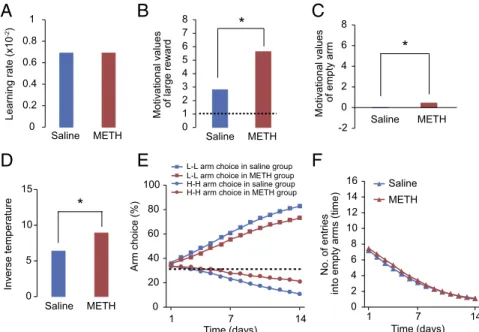
Chronic METH-Treated Rats Assign Higher Motivational Values to Large Rewards.There are several possible reasons why the METH-treated rats preferred the H-H arm to the L-L arm. Because the rate of H-H arm choice in the METH-treated group did not exceed 33% (the level of chance), two trivial explanations might apply: first, the METH treatment may have merely impaired or retarded the learning process, and second, METH treatment may simply have made the choice more random. A third, non-trivial explanation is that the METH treatment altered the rel-ative motivational values associated with small reward, large reward, and quinine. To determine which mechanism best ex-plains the data, we applied reinforcement learning models to the rats’ behavioral data and estimated the process underlying the trial-by-trial learning dynamics (14). If the first possibility is correct, the learning rateα, which determines the magnitude of the value update resulting from a single trial, would differ be-tween METH-treated and control rats. If the second possibility is correct, the inverse temperature parameterβ, which determines the randomness of choice, would differ between the two groups. On the other hand, if the third possibility is correct, the motivational
0 0.2 0.4 0.6 0.8 1 Saline METH Learning rate (x10 -2)
A
0 1 2 3 4 5 6 7 8 M o tiv a ti onal v a lues o f la rge re w a rdB
*
0 20 40 60 80 100 1 7 14 Arm choi ce (%)E
F
Time (days) 0 2 4 6 8 10 12 14 16 1 7 14 Time (days) No. of en tries into empty arms (time) -2 0 2 4 6 8 Saline METHC
M o tiv a ti onal v a lues of empty arm 0 5 10 15 Inv e rse temperatu re*
*
D
Saline METH Saline METHL-L arm choice in saline group L-L arm choice in METH group H-H arm choice in saline group
H-H arm choice in METH group Saline METH
Fig. 2. Reinforcement learning model-based analysis of rats’performance. (A–D) Estimated model parameters of the best model, selected based on the AIC. The selected model includes the learning rate that is shared with two groups (METH-treated rats and saline-treated control rats) (A) and the motivational value parameter for the large rewardκLR, which has different values between groups [χ2ð1Þ=12.54,P<0.001, likelihood ratio test]; the motivational value
for empty outcomeκE, which has different values between groups [χ2ð1Þ=7.96,P=0.0048]; the inverse temperature, which also has different values between
groups [χ2ð1Þ=6.97,P=0.0083]; and zero motivational value for the quinine pellet,κ
Q. A dotted line indicates one motivational value for small reward in
each group. (EandF) Model simulation results using the parameters of the best model. Fractions of arm choices on each day were averaged over 10,000 simulation runs. A dotted line indicates the level of chance for arm choice. This figure corresponds to Fig. 1B.
value parameters for the large rewardκBR (relative to quinine and small reward) should differ between groups.
Fig. 2 and Fig. S8show the estimated parameters for each group. Regarding the standard condition, we observed significant differences between groups in regard to the motivational value parameters for large reward and empty outcome, as well as the inverse temperature parameters. Among them, the differences in the motivational value for large rewards best explain the difference in the behavior of saline- and METH-treated rats. In addition, the inverse temperature was larger for METH-treated rats. Because larger inverse temperature value induces less random choice, the difference in the inverse temperature itself cannot account for the observation that the METH-treated rats chose the H-H arm more often than the control rats. For the double-reward condition, only the inverse temperature parame-ter yielded a significant difference between the two groups. These observations indicated that the METH-treated rats as-signed higher motivational values to large rewards than control rats under the standard condition but not under the double-reward condition. This result supports the third explanation offered above, i.e., that METH treatment alters the balance of motivational values, rather than merely impairing learning or choice behaviors.
Changes in c-Fos Expression Induced by the Gambling Test.Previous studies have suggested the involvement of the brain reward system, as well as the frontostriatal neuronal system, in decision-making (2, 13, 15). To identify the possible brain areas that could be involved in the altered decision-making of METH-treated rats, saline-treated control and METH-treated animals were
subjected to the gambling test under either the standard or double-reward condition for 14 d and then subjected to c-Fos immunohistochemistry. METH-treated animals that were sub-jected to the gambling test under the double-reward condi-tion were regarded as an alternative control group because they showed normal arm choice behavior under this condition (Figs. S7andS8).
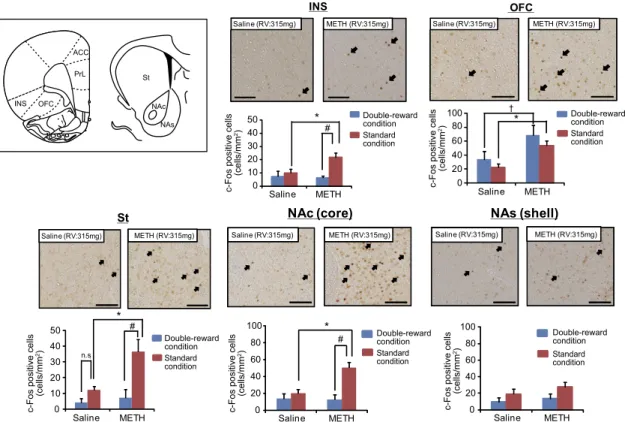
Quantitative analysis of c-Fos staining revealed significant differences between saline- and METH-treated animals in the numbers of c-Fos–positive cells in the INS, OFC, core of nucleus accumbens (NAc), and St but no differences in other brain areas such as anterior cingulated cortex (ACC), prelimbic cortex (PrL), and shell of nucleus accumbens (NAs) (Fig. 3 and Fig. S9). In particular, the numbers of c-Fos–positive cells in the INS, St, and NAc of METH-treated rats subjected to the gambling test under the standard condition were significantly higher than those in saline-treated control rats (Fig. 3; P< 0.05). This in-crease in c-Fos expression was specific to the standard condition of the gambling test and was not observed under the double-reward condition. Accordingly, neural activity in the INS, St, and NAc of METH-treated rats was associated with arm choice be-havior in the gambling test under both the standard (Fig. 1) and double-reward conditions (Fig. S7). By contrast, although c-Fos expression was elevated in the OFC of METH-treated rats, this change was not associated with these animals’ behavior in the gambling test. These results suggests that neural activation in the INS, NAc, and St is associated with altered decision-making in METH-treated rats regarding arm choice behavior in the gam-bling test but is not associated with previous drug treatment history. In subsequent experiments, we focused on the role of the
INS 0 10 20 30 40 50 Saline METH * # Saline (RV:315mg) METH (RV:315mg) OFC 0 20 40 60 Saline (RV:315mg) METH (RV:315mg) *
NAc (core) NAs (shell)
Saline (RV:315mg) METH (RV:315mg) Saline (RV:315mg) METH (RV:315mg)
0 20 40 60 80 100 0 20 40 60 80 100 St * Saline (RV:315mg) METH (RV:315mg) 0 10 20 30 40 50 # n.s. 100 # * Double-reward condition Standard condition INS OFC PrL ACC † 80 St NAc NAs
c-Fos positive cells
(cells/mm 2) Saline METH Double-reward condition Standard condition
c-Fos positive cells
(cells/mm
2)
Saline METH
c-Fos positive cells
(cells/mm 2) Double-reward condition Standard condition Double-reward condition Standard condition Double-reward condition Standard condition Saline METH
c-Fos positive cells
(cells/mm
2)
Saline METH
c-Fos positive cells
(cells/mm
2)
Fig. 3. Changes in c-Fos expression evoked by the gambling test under the standard or double-reward condition. c-Fos expression was analyzed immuno-histochemically in saline- and METH-treated rats 2 h after the gambling test. Photographs show typical examples of c-Fos expression in various brain areas of saline- or METH-treated rats, following the gambling test under the standard condition. Values are means±SE (n=3–4). *P<0.05 vs. saline-treated group (standard condition).†P<0.05 vs. saline-treated group (double-reward condition).#P<0.05 vs. METH-treated group (double-reward condition). n.s., not
significant. OFC, orbitofrontal cortex [F(3,9)=5.65,P<0.05]; INS, insular cortex [F(3,9)=4.93,P<0.05]; NAc, core of the nucleus accumbens [F(3,10)=11.3,P<
0.05]; NAs, shell of the nucleus accumbens [F(3,10)=1.74,P>0.05]; St, striatum [F(3,10)=8.25,P<0.05]. (Scale bar: 100μm.)
NEUR OSCIENCE PSYCHOLOGI CAL AND COGNITIVE SCIENC ES PNAS PLUS
the INS is involved in computing the level of risk associated with specific actions and plays a role in making decisions that require weighting of uncertain positive and negative conse-quences (16–19).
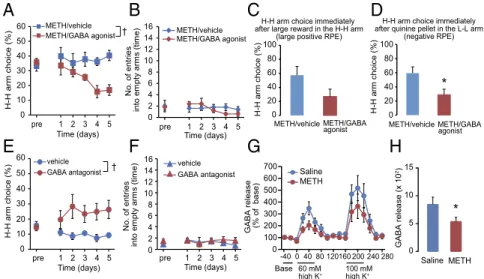
Manipulation of Insular Neural Activity Modifies Arm Choice Behavior in the Gambling Test.After being subjected to the gambling test under the standard condition for 14 d, METH-treated rats with higher H-H arm preference than saline-treated rats were divided into two groups: one group received bilateral microinjections of GABA receptor agonists to suppress INS neural activity, and the other received injections of vehicle. Microinjections of vehicle into the INS of METH-treated (METH/vehicle) rats had little effect on their arm choice behavior in the gambling test; thus, the METH/vehicle group exhibited a stable high level of H-H arm preference over 5 d (Fig. 4A). However, when INS neural activity was suppressed by GABA receptor agonists in METH-treated (METH/GABA agonist) rats, their elevated H-H arm choice ratio gradually decreased (Fig. 4A). In METH-treated rats, mi-croinjections of vehicle or GABA receptor agonist into the INS had little effect on the number of entries into empty arms (Fig. 4B). Following treatment with GABA receptor agonist, win–stay behavior in METH-treated rats did not significantly decrease (Fig. 4C), whereas lose–shift behavior was significantly reduced (Fig. 4D). When the METH/GABA agonist rats were subjected to the gambling test for an additional 3 d without pretreatment with GABA receptor agonist, their reduced H-H arm choice ratio returned to the previous level (control group: 41.8±5.2%; GABA receptor agonist-treated group: 28.6±1.9%).
GABAB receptor antagonists on arm choice behavior in the gambling test. When INS neural activity was disinhibited by GABA receptor antagonist in naïve rats that preferred the L-L arm to the H-H arm, these rats began to choose the H-H arm more frequently than vehicle-treated control rats did (Fig. 4E), although there was no change in the number of entries into empty arms (Fig. 4F). These findings suggest that the INS neural system plays a crucial role in arm choice behavior in the gambling test.
GABA Transmission Is Disrupted in the INS of METH-Treated Rats.To analyze activity-dependent GABA release in the INS of METH-treated rats, we measured depolarization-evoked GABA release in the INS by the in vivo microdialysis. In saline-treated control rats, high (60 mM) K+stimulation increased extracellular GABA levels of INS to 346.6±55.3% of basal levels at the peak, and higher (100 mM) K+stimulation increased the level to 517.4± 105.8% (Fig. 4G). In METH-treated rats, depolarization-evoked GABA release in the INS was reduced compared with that in control rats (Fig. 4G). In particular, the AUC of high (60 mM) K+-evoked GABA release for 60 min was significantly reduced in METH-treated rats compared with control rats (Fig. 4H). There was no significant difference in the basal level of extracellular GABA levels between control and METH-treated rats (2.37 ± 0.57 nM in saline group and 2.44±0.45 nM in METH group). These results suggest that METH-treated rats have impairments in activity-dependent GABA release in the INS and that dys-function in GABA neurotransmission in the INS may be asso-ciated with the altered decision-making of METH-treated rats.
A
B
C
E
F
D
60 mM high K+ *G
H
100 mM high K+ GA BA release (% of base) GAB A release (x 10 2) Saline METH 0 100 200 300 400 500 600 700 -40 0 40 80 120160 200 240 280 Base Saline METH 0 5 10 15 † 0 20 30 40 50 60 pre 1 2 3 4 5 METH/vehicle METH/GABA agonist H-H arm choice (%)10 Time (days) 0 2 4 6 8 10 12 14 16 pre 1 2 3 4 5 METH/vehicle METH/GABA agonist No. of entries into em pty arm s (tim e) Time (days) H-H arm choice (%) 0 20 40 60 80 100 METH/vehicle METH/GABA agonist * 0 20 40 60 80 100H-H arm choice immediately after quinine pellet in the L-L arm
(negative RPE) H-H arm choice immediately
after large reward in the H-H arm (large positive RPE)
H-H arm choice (%) vehicle GABA antagonist † 0 20 30 40 50 60 pre 1 2 3 4 5 H-H arm choice (%) 10 Time (days) 0 2 4 6 8 10 12 14 16 No. of entries into em pty arm s (tim e) vehicle GABA antagonist pre 1 2 3 4 5 Time (days) METH/vehicle METH/GABA agonist
Fig. 4. Dysfunction of the GABA system in the INS of METH-treated rats is involved in altered decision-making. (A) Effect of GABA receptor agonist (mixture of GABAAand GABABreceptor agonists) on the increase of H-H arm choice ratio in the gambling test in METH-treated rats. One group of animals received
bilateral microinjections of GABA receptor agonist into the INS, whereas the other group received vehicle as a control. They were subjected to the gambling test 15 min after the injection, and the experiment was repeated for consecutive 5 d. Values are means±SE (n=5).†P<0.05. Repeated ANOVA revealed significant effects on treatment [F(1,8)=9.74,P<0.05], time [F(4,32)=2.46,P>0.05], and their interaction [F(4,32)=2.38,P>0.05]. (B) Number of entries into
empty arms. Values are means±SE (n=5). There were no significant effects [treatment:F(1,8)=0.18,P>0.05; time:F(4,32)=1.84,P>0.05; interaction:F(4,32)=
1.95,P>0.05]. (C) Win–stay behavior. Values are means±SE (n=4–5). There were no significant effects (P>0.05 byutest). (D) Lose–shift behavior. Values are means±SE (n=5). *P<0.05 vs. METH/vehicle group. Significant effects were observed (P<0.05 byutest). (E) Effect of GABA receptor antagonist (mixture of GABAAand GABABreceptor antagonists) on H-H arm choice ratio in the gambling test in normal rats. GABA receptor antagonist was injected into the INS of
normal rats that had been previously subjected to the gambling test. These animals were again subjected to the gambling test 15 min after the injection; the experiment was repeated for 5 consecutive days. Values are means±SE (n=7).†P<0.05. Repeated ANOVA revealed significant effect on treatment [F(1,12)=
6.36,P<0.05] and not significant effect on time [F(4,48)=0.68,P>0.05] and their interaction [F(4, 48)=2.31,P>0.05]. (F) Number of entries into empty arms
[treatment:F(1,12)=0.29,P>0.05; time:F(4,48)=0.56,P>0.05; interaction:F(4, 48)=0.65,P>0.05]. Values are means±SE (n=7). (G) Depolarization-evoked
increase in the extracellular GABA levels in INS of METH-treated and saline-treated rats. Values are means±SE (n=9–11). Significant main effects were not observed [group:F(1,18)=2.38,P>0.05; time:F(16,288)=12.6,P<0.05; interaction:F(16, 288)=0.81,P>0.05]. The basal levels of GABA were not significantly
different between the two groups (P>0.05). (H) AUC of high (60 mM) K+-evoked GABA release for 60 min. Values are means±SE (n=9–11). *P<0.05 vs. saline-treated group.
Manipulation of Neural Activity in the INS Using the DREADD Technology Alters Arm Choice Behavior in Normal and METH-Treated Rats.Finally, we investigated whether manipulating the activity of the INS using the DREADD technology would affect arm choice be-havior in the gambling test. Specifically, to determine whether aberrant activation of the INS was necessary and sufficient to alter the choice strategy in METH-treated rats, we used a mu-tant human M4 muscarinic receptor (hM4Di) transgene to sup-press the aberrant neural activity in the INS of METH-treated rats, whereas we injected mutant human M3 muscarinic re-ceptor (hM3Dq) to activate INS neurons in normal rats.
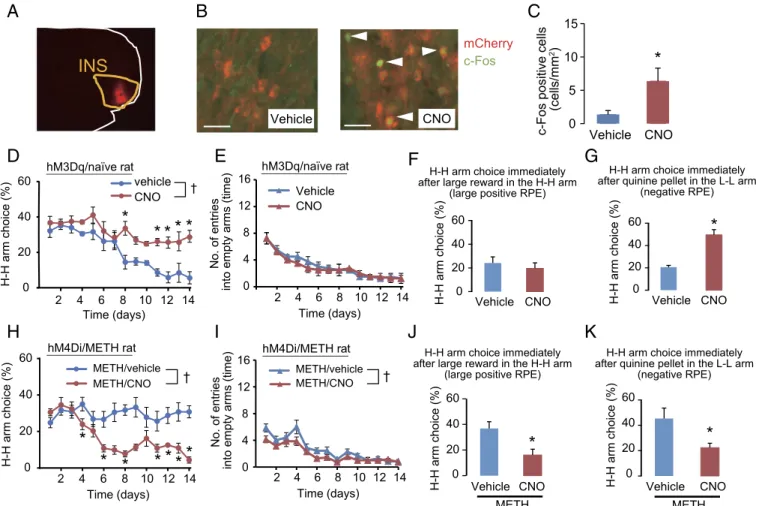
Normal rats overexpressing hM3Dq and METH-treated rats overexpressing hM4Di in the INS were subjected to the daily gambling test for 14 d; each test occurred 30 min after i.p. injection of either clozapine-N-oxide (CNO) or vehicle (control group). First, we confirmed that CNO treatment induced c-Fos
expres-sion in the INS of hM3Dq-overexpressing rats, indicating that CNO treatment activated the INS (Fig. 5A–C). In normal rats overexpressing hM3Dq in the INS, CNO injection resulted in an increase in H-H arm choice relative to vehicle-treated rats (Fig. 5D) but no difference in the number of entries into empty arms (Fig. 5E). There was no difference in win–stay behavior in CNO-treated rats relative to vehicle-CNO-treated rats (Fig. 5F), whereas lose–shift behavior was significantly elevated in response to CNO treatment (Fig. 5G).
By contrast, when hM4Di was overexpressed in the INS of rats that had been previously treated with METH for 30 d, CNO treatment resulted in a significant decrease in H-H arm choice ratio relative to vehicle treatment (Fig. 5H). As with the normal rats described above, the treatment had little effect on the number of entries into empty arms (Fig. 5I). The elevations in win–stay (Fig. 5J) and lose–shift behavior (Fig. 5K) in METH-treated rats
A
B
C
D
E
F
G
H
I
J
K
Fig. 5. Manipulation of neural activity in the INS using the DREADD technology resulted in alterations of arm choice behavior in the gambling test in normal and METH-treated rats. (A) Representative photograph of the expression of hM3Dq-mCherry in the INS. (B) Representative photograph of c-Fos expression induced by CNO treatment in the INS of hM3Dq-overexpressed rats. (Scale bar: 50μm.) (C) Quantitation of c-Fos expression induced by CNO treatment in the INS of hM3Dq-overexpressing rats. Rats were killed 1.5 h after CNO treatment. Values are means±SE (n=4–5). *P<0.05 vs. vehicle-treated group. (D) hM3Dq was overexpressed in the INS of naïve rats. The rats were given i.p. injections of CNO (0.5 mg/kg) or vehicle 30 min before each gambling test. Values are means±SE (n=4).†P<0.05. Repeated ANOVA revealed significant effects on treatment [F(1,6)=27.96,P<0.05], time [F(13,78)=9.76,P<0.05], and their
interaction [F(13,78)=2.09,P<0.05]. *P<0.05 vs. the vehicle-treated group on each day. (E) Effect on number of entries into empty arms. Values are means±
SE (n=4). There were no significant effects [treatment:F(1,6)=0.64,P>0.05; time:F(13,78)=17.35,P<0.05; interaction:F(13, 78)=0.28,P>0.05]. (F) Win–stay
behavior in hM3Dq-overexprssing rats. Values are means±SE (n=4). No significant effect was observed (P>0.05). (G) Lose–shift behavior in hM3Dq-overexpressing rats. Values are means±SE (n=4). *P<0.05 vs. vehicle-treated group. (H) hM4Di was overexpressed in the INS of METH-treated rats. The rats were given i.p. injections of CNO (0.5 mg/kg) or vehicle 30 min before each gambling test. Values are means±SE (n=7).†P<0.05. Repeated ANOVA revealed significant effects on treatment [F(1,12)=20.27,P<0.05], time [F(13,156)=5.38,P<0.05], and their interaction [F(13, 156)=5.41,P<0.05]. *P<0.05 vs. METH/
vehicle group on each day. (I) Effect on the number of entries into empty arms. Values are means±SE (n=7). Repeated ANOVA revealed significant effects [treatment:F(1,12)=6.09,P<0.05; time:F(13,156)=23.87,P<0.05; interaction:F(13, 156)=1.11,P>0.05].†P<0.05. (J) Win–stay behavior of
hM4Di-over-expressing rats. Values are means±SE (n=7). *P<0.05 vs. METH/vehicle-treated group. (K) Lose–shift behavior of hM4Di-overexpressing rats. Values are means±SE (n=7). *P<0.05 vs. METH/vehicle-treated group.
NEUR OSCIENCE PSYCHOLOGI CAL AND COGNITIVE SCIENC ES PNAS PLUS
behaviors suggest that the INS plays a critical role in arm choice in the gambling test used in this study.
Discussion
Computational and neurobiological studies of decision-making have provided much insight into the neural mechanisms that underlie suboptimal decision-making behaviors observed in pa-tients with various psychiatric and neurological disorders (15). However, because optimal decision-making according to the demands of specific tasks is likely to involve multiple algorithms and brain systems in various combinations, it is challenging to make generalizations about the nature of decision-making defi-cits in different disorders (15).
In this study, we developed a gambling test for rodents that follows rules similar to those of the human Iowa gambling test. Using this test, we demonstrated that METH-treated rats exhibited sustained/enduring alteration of decision-making or changes in choice strategy (increase in risky choice) even 1 mo after withdrawal.
Our behavioral results definitively showed that arm choice behavior was changed in METH-treated rats under the standard condition but not under the double-reward condition. In pros-pect theory, the shape of the value function is concave for gains and convex for losses, accounting for the empirical findings that humans are risk-averse for gains but risk-seeking for losses (3). METH-treated rats exhibited the same risk-averse behavior as control animals (Fig. 1B), but the value function of the small reward (one food pellet) in METH-treated rats under the stan-dard condition may have been lower than that in control rats. Under the double-reward condition, such a difference in value function of small reward (two food pellets) between the two groups of rats may have been concealed by differences in the slopes of concave reward value function curves, leading to the disap-pearance of the change in arm choice strategy in METH-treated rats under the double-reward condition. From the viewpoint of clinical treatment, our findings suggest that an enriched environ-ment may provide a means to ameliorate the altered decision-making in METH-dependent subjects.
It remains unclear whether this behavior in METH-treated rats reflects an impulse-like disorder rather than slower learn-ing. To provide a hypothetical explanation for the arm choice behavior in METH-treated rats, we applied a reinforcement-learning model and estimated the reinforcement-learning rate, randomness of arm choice, and motivational value of the large reward. This analysis indicated that the alteration of arm choice behavior in METH-treated rats is not merely due to impairment of the learning process or randomness of arm choice. Instead, the re-sults showed that METH-treated rats assigned a higher motiva-tional value to the large reward than control animals did. Yechiam et al. (20) applied a reinforcement learning model that distills performance in the Iowa gambling task of 10 populations, in-cluding chronic cocaine abusers, chronic cannabis abusers, young polydrug abusers, and young alcohol abusers, into three different underlying psychological components: the relative effect of re-wards and punishments on evaluations of options, the rate at which contingent payoffs are learned, and the consistency between learning and responding. Their analysis indicated that chronic cocaine abusers pay significantly higher attention to gains (21), and cannabis abusers show both significantly higher attention to gains and greater recency effects compared with control subjects. By contrast, young polydrug or alcohol abusers exhibited param-eter values very similar to those of their respective control groups. Thus, although all drug-abusing subjects share a common de-cision-making deficit, the psychological processes underlying this impairment may vary according to the type of drug abused, the duration of abuse, and the age of the subject.
gambling test, theoretical analysis of the results using a re-inforcement learning model, and the c-Fos expression studies suggest that dysfunction in the frontostriatal network may con-tribute to the observed change in arm choice strategy in METH-treated rats and that the outcome of processing and modification of option values in the decision-making process may be altered by chronic METH treatment. Both win–stay and lose–shift be-haviors were increased in the METH-treated group, suggesting that both positive and negative RPEs may contribute to an in-creased tendency toward risky choice in METH-treated rats. Accumulating evidence suggests that RPEs are represented by the activity of dopaminergic neurons in the ventral tegmental area and used in a reinforcement-learning process (22, 23). The dorsal striatum contributes directly to aspects of decision-mak-ing, especially action selection and initiation, through the in-tegration of sensorimotor, cognitive, and motivational/emotional information within specific corticostriatal circuits involving dis-crete regions of striatum (24). By contrast, the ventral striatal signal changes dynamically over time, dependent on the phase of the reward process and on learning status, and thereby acts as a motivational engine for the continuation of behavior (25, 26). Recent studies have suggested that ventral striatal dopamine D2 receptor expression is associated with risky decision-making (13, 27). Accordingly, further studies are warranted to clarify the contribution of dopaminergic neurons, as well as the striatal direct and indirect efferent pathways (28), to the altered arm choice strategy in METH-treated rats.
The INS is also critically involved in decision-making (16–19). INS activation is related to reward expectations in decision-making, as are the amygdala, basal ganglia, and OFC (2). The INS contributes to conscious drug urges and decision-making processes that precipitate relapse (29). Because the INS is con-nected to the amygdala (1) and striatum (30), the INS constructs the frontostriatal and limbic loops related to decision-making. Several neuroimaging studies have revealed dysfunctions of the prefrontal cortex in stimulant-dependent subjects (5, 29), and the close correlation between risky responses, harm avoidance, and activation of the INS suggests that this area plays a role in punishment (1, 31, 32). INS activation during decision-making tasks may alert the individual to expected aversive outcomes, and reduced activation in this area would be consistent with a di-minished ability to differentiate between choices that lead to good vs. poor outcomes, potentially a key factor in METH re-lapse (33). We detected elevated c-Fos expression in the INS, striatum, and NAc of METH-treated rats that exhibited alter-ation of decision-making in the gambling test, suggesting that aberrant activation in the frontostriatal loop may contribute to the change in choice strategy. Previous studies have demon-strated that chronic treatment of rats with psychostimulants such as amphetamine and cocaine increase the density of dendritic spines on medium spiny neurons in the frontostriatal loop in-cluding the nucleus accumbens, caudate-putamen, and prefrontal cortex (34, 35), which may underlie the aberrant activation of these brain areas by the gambling test.
Behavioral errors are associated with activation of the salience network, an intrinsic connectivity network characterized by spa-tially consistent functional connectivity of intrinsic brain activity (36), and the anterior right INS plays a central role in the sa-lience network response to errors (37). Based on our observation that the INS was aberrantly activated in METH-treated rats following the gambling test, we speculate that the salience net-work was responding to the positive and negative RPEs in the test and that this response is what caused the aberrant INS ac-tivity. Thus, aberrant activation of the INS following the gam-bling test in METH-treated rats may reflect the response of the salience network to positive and negative RPEs in the test. Be-cause signals related to value functions and reward prediction
errors are observed in many different areas (38), many other brain areas are likely to be involved in the process of updating action value functions; consequently, impaired functions of var-ious brain areas might contribute to more impulsive choices in METH-dependent individuals (39).
Previously, we demonstrated that baclofen acutely ameliorates the cognitive deficits in repeatedly METH-treated mice, an an-imal model for cognitive deficits in METH abuse and schizo-phrenia (40). In this study, we also demonstrated that GABA transmission in the INS plays roles in decision-making in control and METH-treated rats and that reduced activity-dependent GABA release in the INS is related to alteration of decision-making in METH-treated animals. Consistent with the findings reported here, a previous report demonstrated that GABA re-lease in the frontal cortex is reduced following METH treatment (41). Based on the analysis of win–stay and lose–shift behaviors in the gambling test, it is likely that METH-treated rats have a dysfunction in the neural system that controls response evoked by both positive and negative RPEs, leading to their impulsive choice behaviors. Conversely, GABAergic neurons in the INS, as part of the salience network system, may provide an inhibitory control of the emotional/impulsive choice behaviors evoked by RPE in normal animals. Consistent with this hypothesis, sup-pression of INS activity by local injection of GABA receptors agonists normalized the increased H-H arm choice ratio in METH-treated rats, whereas activation of INS by GABA receptors an-tagonists increased H-H arm choice ratio in normal rats. Thus, GABA in the INS may be implicated in the motivational values of rewards, as is dopamine in the reward system, serotonin in im-pulsivity and patience (42), and noradrenaline in attention and arousal (43).
Disinhibition of glutamatergic neurons, due to dysfunction of GABAergic interneurons in the INS, may play a role in altered decision-making in METH-treated rats. In other words, the exci-tation/inhibition balance in the INS may be important for appro-priate decision-making. In fact, when hM3Dq was overexpressed in the INS of naïve rats, the rats exhibited increased H-H arm choice following i.p. injection of CNO. In particular, lose–shift behavior was significantly increased after treatment with CNO, indicating that aberrant activation in the INS leads to altered decision-making and suggesting that the INS plays a critical role in the response to the negative outcome. On the other hand, when hM4Di was overexpressed in the INS of METH-treated rats, the increased tendency to choose the H-H arm was significantly re-duced by CNO treatment, indicating that inactivation of the INS can ameliorate the perturbation of choice strategy in METH-treated rats. Our findings obtained by this pharmacogenetic ap-proach are consistent with results obtained by the pharmacologic and neurochemical experiments, and support the hypothesis de-scribed above. This is the first report to our knowledge to dem-onstrate a causal role for the INS in decision-making, strongly supporting many fMRI studies that showed a correlation between INS activity and conscious urges in human studies of addiction (29). It remains to be determined whether glutamatergic afferent neurons in INS in which hM3Dq or hM4Di were overexpressed are activated or inhibited by CNO treatment, respectively.
One of the limitations of our study is that we used a passive drug exposure procedure at a fixed dose; however, the current standard for modeling human drug abuse uses a paradigm of self-administration, which has greater face validity (44). For ex-ample, Mitchell et al. (27) used a rat model of a risky decision-making task and cocaine self-administration to demonstrate that the relationship between elevated risk-taking and cocaine self-administration is bidirectional and that low striatal dopamine D2 receptor expression may predispose subjects to both mal-adaptive decision-making and cocaine use. We believe that our findings provide some insights into alterations of decision-making following overexposure to METH that have some relevance to
the related condition in humans who misuse METH. Neverthe-less, to justify experimenter-administered dosing, as opposed to letting the animals have extended access to the drug and esca-lating their intake on their own (45), we would need to perform additional experiments.
Methods
Animals.Male Wistar rats (7–8 wk old; weighing 220±5 g at the beginning of the experiments) were obtained from Japan SLC, Inc. The animals were housed in plastic cages and kept in a regulated environment (23±1 °C; 50± 5% humidity) with a 12-h light−dark cycle (lights on at 9:00 AM). Food (CE-2; CLEA Japan, Inc.) and tap water were available ad libitum. All experiments were performed in accordance with the Guidelines for Animal Experiments of Nagoya University, the Guiding Principles for the Care and Use of Labo-ratory Animals approved by the Japanese Pharmacological Society, and the United States National Institutes of Health Guide for the Care and Use of Laboratory Animals. All experimental procedures were approved by the In-stitutional Animal Care and Use Committee of the Research Institute of Environmental Medicine, Nagoya University.
Methamphetamine Treatment.METH (Dainippon Sumitomo Pharma Co.) was dissolved in saline. Rats were given METH s.c. at a dose of 4 mg/kg once a day for 30 d (Fig. 1); the dose course was designed according the previous studies, in which rats given amphetamine at a dose of 3–4 mg/kg at least 20 times exhibited persistent changes in the density of dendritic spines on neu-rons in the nucleus accumbens and prefrontal cortex (34, 35). In subsequent experiments, animals that exhibited stable high-risk/high-reward (H-H) arm choice behavior (12.9±2.5%) following repeated gambling tests (usually>14 times) were given METH (4 mg/kg, s.c.) once a day for 14 consecutive days (Fig. S5). The animals were then subjected to the gambling test during repeated METH treatment, as well as after the cessation of treatment.
Gambling Test for Rodents Using a Radial Arm Maze.The apparatus consisted of two start arms and four choice arms (two baited arms and two empty arms) on an elevated six-arm Plexiglas radial maze (BrainScience Idea Co., Ltd., Japan) located in a sound-attenuated testing room illuminated at 40 lx. The other two arms of the original eight-arm maze were removed from the apparatus. The central platform and arms were black in color. Each arm contained a plastic food cup (3 cm in diameter and 1.5 cm deep), glued onto the surfaces of the arms ∼1.5 cm from the end of each arm. The entrances from the start arms to the central platform could be blocked with black guillotine doors (30 cm in height and 11 cm in width). The central platform was 32 cm in diameter, and the arms were 48 cm long and 12 cm wide, with a 5-cm edge around the apparatus. The maze was elevated 45 cm from floor level (Fig. S1A).
Before the start of the decision-making task for rodents, rats were ha-bituated to the apparatus in a 10-min free exploration trial, conducted once per day for 10 d, during which 45-mg food pellets with banana flavor (Bioserve Inc.) were placed in the food cups of all four choice arms. The rats used in these trials were mildly food-restricted (about 1,300 mg solid feed per day). In the decision-making task, rewards were 45-mg banana-flavored food pellets, and negative outcomes (foods that were disappointing in comparison with the rewards) were quinine-coated 45-mg food pellets (Bioserve Inc.) that were unpalatable but not inedible. Rats could obtain either rewards or quinine pellets in the baited arms (see below), but no food pellets were placed in the empty arms. Rats were randomly placed in one of two start arms, and they learned to enter the central platform and then choose one of the four choice arms when the guillotine door was opened. When a rat obtained a food pellet during a trial, it was returned to either start arm by the ex-perimenter for the next trial. When a rat entered an empty arm, it was returned to the start arm, and the trial was continued until the animal en-tered a baited arm and received a reward or quinine pellet. Each session, held once per day, consisted of 16 trials with intertrial intervals of∼5 s, and the sessions were repeated for 14 consecutive days.
In the decision-making task, rats were trained to choose one of four choice arms [one low-risk/low-return (L-L) arm, one high-risk/high-return (H-H) arm, and two empty arms]. Under the standard condition (Fig. S1BandC), choice of the L-L arm resulted in frequent (14/16 trials; reward probability: 87.5%) small rewards (one banana-flavored food pellet; reward value: 45 mg) with infrequent (2/16 trials) negative outcomes (one quinine pellet). Choice of the H-H arm resulted in infrequent (2/16 trials, reward probability: 12.5%) large rewards (seven banana-flavored food pellets; reward value: 315 mg) with frequent (14/16 trials) negative outcomes (one quinine pellet). Spatial loca-tions of the L-L arm, the H-H arm, the two empty arms, and the two start arms were fixed among subjects throughout the experiments. A quinine
NEUR OSCIENCE PSYCHOLOGI CAL AND COGNITIVE SCIENC ES PNAS PLUS
domly at a rate of 2 out of 16 trials per day. Accordingly, there was no difference in the total reward value (630 mg) between the L-L and H-H arms. For three-choice task analysis, H-H arm or L-L arm choice (%) was expressed as follows: arm choice (%)=[((total number of either arm choice)/(16 trials+ total number of entries into empty arms))×100].
Win–Stay/Lose–Shift Behavior.We analyzed the choice data as a three-choice task, including empty arms (H-H arm, L-L arm, and empty arms). Win–stay behavior was measured in trials immediately after the animal encountered the large reward in the H-H arm, whereas lose–shift behavior was analyzed in trials immediately after the animal encountered the quinine pellet in the L-L arm (46). When a rat encountered the large reward in the H-H arm [large positive reward prediction error (RPE)], its subsequent choice was counted as a win– stay if it revisited the H-H arm in the next trial and otherwise as a win–shift. Alternatively, when a rat encountered the quinine pellet in the L-L arm, its subsequent choice was scored as lose–shift (negative RPE) if it switched to the H-H arm and otherwise as lose–stay. Win–stay or lose–shift behavior was expressed as follows: H-H arm choice (%) for win–stay behavior =[((total number of win–stay behaviors)/(total number of large rewards acquired))× 100], considering all win–stay behaviors during the 5- or 14-d training session, and H-H arm choice (%) for lose–shift behavior=[((total number of lose–shift behavior)/(total number of quinine pellets acquired in the L-L arm))×100], considering all lose–shift behaviors during the 5- or 14-d training session.
If a rat never encountered the large reward in the H-H arm or the quinine pellet in L-L arm, its behavior was omitted from the data. If a rat chose the empty arm between a current H-H arm choice and a previous baited arm choice, its behavior was omitted from the win–stay and lose–shift behaviors. As a control for the win–stay and lose–shift behaviors immediately after the positive and negative RPEs, respectively, we analyzed the behavioral pattern of arm choice in trials immediately after the animal encountered the quinine pellet in the H-H arm or the small reward in the L-L arm (negative RPE or small positive RPE, respectively).
Reinforcement Learning Model-Based Analysis in the Gambling Test.To esti-mate the underlying process governing the rats’behavior, we used re-inforcement learning model-based analysis (14). The standard rere-inforcement learning model represents the value of each action (e.g., selection of one arm); this value is called the“action value.”LetQi(t) denote the action value for choosing armi(i=H-H, L-L, or empty) in trialt, where the entry of empty arm was counted as a single trial. For the simplicity, we treated the two empty arms as a single option. The action values are updated according to the choice and the resulting outcome (small reward, large reward, or quinine pellet). Leta(t) denote the option the rat chooses in trialt. Ifa(t)=i, then the action value corresponding to the selected option is updated as follows:
Qiðt+1Þ=QiðtÞ+ α·δðtÞ,
δðtÞ=RðtÞ−QiðtÞ,
whereas the action value corresponding to the unselected option does not change. Hereα ð0≤α≤1Þis the learning rate that determines the magnitude of the update, andRðtÞis the motivational value for the outcome presented in trialt, which is specified below.δðtÞis called the“reward prediction error.”Given a set of action values, a choice is assumed to be made ac-cording to the probability of choosing option 1 [PðaðtÞ=HHÞ] given by the soft-max function:
P½aðtÞ=i=Xexp½β·θðmÞ·QiðtÞ kexp½β·θðmÞ·QkðtÞ
.
At the beginning of each day, rats tended to behave randomly, and they then gradually recovered their preferences based on previous experience. To model this random choice tendency at the beginning of each day and the gradual reinstatement of preferences, our model includedθðmÞ, with specific formθðmÞ=1− γm, wheremis the index of the trial in each day andγ
(0≤γ≤1) is a free parameter that determines the persistence of the random-choice tendency. The model set the motivational valueRðtÞas follows:
RðtÞ= 8 > > < > > : κE κQ 1 κLR
if the outcome was empty if the outcome was a quinine pellet if the outcome was small reward if the outcome was large reward
.
Because we were interested only in the relative motivational values of the four types of outcomes, rather than their absolute values [because the
(47)], we set eitherκEorκQto 0 and the value of the small reward to 1. We
treated the models withκE=0 and the models withκQ= 0 as different
models and selected the best model using a statistical model selection method described in Supporting Information. By estimating the motiva-tional value parameters from rats’choice data, we can estimate the balance of motivational values in the subjects (47, 48).
Microinjections of GABA Receptor Agonist and Antagonist in the INS.Rats were anesthetized with sodium pentobarbital and placed in a stereotaxic appa-ratus (49). According to the rat brain atlas (50), metal guide cannulae were inserted stereotaxically into the INS (AP+3.0, ML+4.0 from the bregma, DV−5.5 from the skull). A mixture of the GABAAreceptor agonist muscimol and the
GABABreceptor agonist baclofen (final concentration of each compound:
500 pmol/μL) or vehicle (PBS) was bilaterally microinjected at a rate of 1μL/min (total injection volume, 1μL). Alternatively, a mixture of the GABAAreceptor
antagonist picrotoxin and the GABABreceptor antagonist CGS54626 (final
concentrations: 25 ng and 1 ng/μL, respectively) or vehicle (PBS) was bilaterally microinjected at a rate of 1μL/min (total injection volume, 1μL). Fifteen mi-nutes after injection, rats were subjected to the gambling test.
In Vivo Microdialysis of GABA in the INS.Rats were anesthetized with sodium pentobarbital for stereotaxic implantation of a guide cannula into the INS, as described above. A dialysis probe (AI-6–1; 1 mm of membrane length; Eicom) was inserted through the guide cannula and perfused with brain dialysis medium (147 mM NaCl, 4 mM KCl, 2.3 mM CaCl2) at a flow rate of 1.0μL/min,
as described (51). Outflow fractions were collected every 20 min. After the collection of two baseline fractions, brain dialysis medium containing 60 or 100 mM KCl (for depolarization stimulation) was delivered through the di-alysis probe for 60 min. GABA levels in the dialysate samples were analyzed by HPLCy (HPLC) witho-phthaldialdehyde derivatization.
Surgery for AAV Injection and Viral Gene Transfer. The mCherry-tagged Dq-DREADD receptor [human M3 muscarinic receptor (hM3Dq)] and Di-DREADD receptor [human M4 muscarinic receptor (hM4Di)] transgenes were expressed under the control of the CMV promoter using adeno-associated virus (AAV) vectors. All AAV vectors were produced using the AAV Helper-Free System (Agilent Technologies) and purified according to a published method (52).
Rats were anesthetized with sodium pentobarbital for stereotaxic im-plantation of a capillary tube into the INS, as described above. Then, 1μL of hM3Dq-mCherry (3×10¹²particles/mL) or 3μL of hM4Di-mCherry (3×10¹²
particles/mL) was infused bilaterally with a glass micropipette at a flow rate of 0.5μL/min. The injector was left in place for an additional 15 min to min-imize diffusion up the injector tract. For all experiments, accuracy of injection coordinates was confirmed by visualization of mCherry in the injection needle tracks in 40-μm tissue sections.
Both hM3Dq and hM4Di can be activated only by clozapine-N-oxide (CNO), which is otherwise pharmacologically inert. CNO is able to silence or reduce the activity of neurons that express hM4Di, whereas the compound activates neurons that express hM3Dq (53). Two weeks after AAV injection, the gambling test was initiated. Rats were given CNO at a dose of 0.5 mg/kg (i.p.) 30 min before the gambling test (54). Vehicle (10% DMSO in saline)-treated rats that expressed hM3Dq or hM4Di in the INS were used as controls in these experiments.
c-Fos Immunohistochemistry and Quantitative Analysis.c-Fos immunostaining was performed as described previously (40). Selected areas were as follows: OFC, INS, anterior cingulated cortex (ACC), prelimbic cortex (PrL), core (NAc) and shell (NAs) of nucleus accumbens, and striatum. The methods can be found inSupporting Information.
Statistical Analyses.All data are expressed as means±SE. Statistical signifi-cance was determined using Student’sttest or the Mann–Whitneyutest for comparisons of two groups, one-way or two-way analysis of variance (ANOVA) for multigroup comparisons, or repeated-measures ANOVA. Fisher’s LSD test was used for post hoc comparison when theFvalue was signif-icant (P<0.05).
We used the maximum likelihood approach to estimate the reinforcement learning model parameter from rats’choice data, and the statistical analyses can be fully found inSupporting Information.
ACKNOWLEDGMENTS.This work was supported by the following funding sources: Grants-in-Aid for Scientific Research (24111518, 25116515, 25460094, 26120713, 26118506, and 26118507) from Ministry of Education, Culture,
Sports, Science and Technology (MEXT);“Integrated Research on Neuropsychi-atric Disorders”and“Bioinformatics for Brain Sciences,”carried out under the Strategic Research Program for Brain Sciences from MEXT; a Grant-in-Aid for Health Science Research from the Ministry of Health, Labour and Welfare of
Japan; a grant from the Smoking Research Foundation, Japan; a grant from the Uehara Memorial Foundation; a grant from the Takeda Science Foun-dation; and the Program for Promotion of Fundamental Studies in Health Sciences of the National Institute of Biomedical Innovation.
1. Ernst M, Paulus MP (2005) Neurobiology of decision making: A selective review from a neurocognitive and clinical perspective.Biol Psychiatry58(8):597–604.
2. Gleichgerrcht E, Ibáñez A, Roca M, Torralva T, Manes F (2010) Decision-making cog-nition in neurodegenerative diseases.Nat Rev Neurol6(11):611–623.
3. Lee D (2013) Decision making: from neuroscience to psychiatry.Neuron78(2):233–248. 4. Dom G, Sabbe B, Hulstijn W, van den Brink W (2005) Substance use disorders and the orbitofrontal cortex: Systematic review of behavioural decision-making and neuro-imaging studies.Br J Psychiatry187:209–220.
5. Tanabe J, et al. (2013) Reduced neural tracking of prediction error in substance-dependent individuals.Am J Psychiatry170(11):1356–1363.
6. Bechara A, Damasio AR, Damasio H, Anderson SW (1994) Insensitivity to future con-sequences following damage to human prefrontal cortex.Cognition50(1-3):7–15. 7. Kalivas PW, Volkow ND (2005) The neural basis of addiction: A pathology of
moti-vation and choice.Am J Psychiatry162(8):1403–1413.
8. Park SQ, et al. (2010) Prefrontal cortex fails to learn from reward prediction errors in alcohol dependence.J Neurosci30(22):7749–7753.
9. Makris N, et al. (2008) Cortical thickness abnormalities in cocaine addiction—A re-flection of both drug use and a pre-existing disposition to drug abuse?Neuron60(1): 174–188.
10. Paulus MP, Lovero KL, Wittmann M, Leland DS (2008) Reduced behavioral and neural activation in stimulant users to different error rates during decision making.Biol
Psychiatry63(11):1054–1060.
11. Paulus MP (2007) Decision-making dysfunctions in psychiatry—Altered homeostatic processing?Science318(5850):602–606.
12. Zeeb FD, Floresco SB, Winstanley CA (2010) Contributions of the orbitofrontal cortex to impulsive choice: Interactions with basal levels of impulsivity, dopamine signalling, and reward-related cues.Psychopharmacology (Berl)211(1):87–98.
13. Simon NW, et al. (2011) Dopaminergic modulation of risky decision-making.J Neurosci
31(48):17460–17470.
14. Daw ND (2009) Trial-by-trial data analysis using computational models.Decision
Making, Affect, and Learning: Attention and Performance XXIII(Oxford University
Press, Oxford), pp 1–26.
15. Sharp C, Monterosso J, Montague PR (2012) Neuroeconomics: A bridge for trans-lational research.Biol Psychiatry72(2):87–92.
16. Naqvi NH, Bechara A (2010) The insula and drug addiction: An interoceptive view of pleasure, urges, and decision-making.Brain Struct Funct214(5-6):435–450. 17. Ishii H, Ohara S, Tobler PN, Tsutsui K, Iijima T (2012) Inactivating anterior insular
cortex reduces risk taking.J Neurosci32(45):16031–16039.
18. Sanfey AG, Hastie R, Colvin MK, Grafman J (2003) Phineas gauged: Decision-making and the human prefrontal cortex.Neuropsychologia41(9):1218–1229.
19. Clark L, et al. (2008) Differential effects of insular and ventromedial prefrontal cortex lesions on risky decision-making.Brain131(Pt 5):1311–1322.
20. Yechiam E, Busemeyer JR, Stout JC, Bechara A (2005) Using cognitive models to map relations between neuropsychological disorders and human decision-making deficits.
Psychol Sci16(12):973–978.
21. Stout JC, Busemeyer JR, Lin A, Grant SJ, Bonson KR (2004) Cognitive modeling analysis of decision-making processes in cocaine abusers.Psychon Bull Rev11(4):742–747. 22. Hart AS, Rutledge RB, Glimcher PW, Phillips PE (2014) Phasic dopamine release in the
rat nucleus accumbens symmetrically encodes a reward prediction error term.
J Neurosci34(3):698–704.
23. Lak A, Stauffer WR, Schultz W (2014) Dopamine prediction error responses integrate subjective value from different reward dimensions.Proc Natl Acad Sci USA111(6): 2343–2348.
24. Balleine BW, Delgado MR, Hikosaka O (2007) The role of the dorsal striatum in reward and decision-making.J Neurosci27(31):8161–8165.
25. Howe MW, Tierney PL, Sandberg SG, Phillips PE, Graybiel AM (2013) Prolonged do-pamine signalling in striatum signals proximity and value of distant rewards.Nature
500(7464):575–579.
26. Heekeren HR, et al. (2007) Role of ventral striatum in reward-based decision making.
Neuroreport18(10):951–955.
27. Mitchell MR, et al. (2014) Adolescent risk taking, cocaine self-administration, and striatal dopamine signaling.Neuropsychopharmacology39(4):955–962.
28. Freeze BS, Kravitz AV, Hammack N, Berke JD, Kreitzer AC (2013) Control of basal ganglia output by direct and indirect pathway projection neurons.J Neurosci33(47): 18531–18539.
29. Naqvi NH, Bechara A (2009) The hidden island of addiction: The insula.Trends
Neu-rosci32(1):56–67.
30. Schilman EA, Uylings HB, Galis-de Graaf Y, Joel D, Groenewegen HJ (2008) The orbital cortex in rats topographically projects to central parts of the caudate-putamen complex.Neurosci Lett432(1):40–45.
31. Critchley HD, Mathias CJ, Dolan RJ (2001) Neural activity in the human brain relating to uncertainty and arousal during anticipation.Neuron29(2):537–545.
32. O’Doherty J, Critchley H, Deichmann R, Dolan RJ (2003) Dissociating valence of out-come from behavioral control in human orbital and ventral prefrontal cortices.
J Neurosci23(21):7931–7939.
33. Paulus MP, Tapert SF, Schuckit MA (2005) Neural activation patterns of metham-phetamine-dependent subjects during decision making predict relapse.Arch Gen
Psychiatry62(7):761–768.
34. Li Y, Kolb B, Robinson TE (2003) The location of persistent amphetamine-induced changes in the density of dendritic spines on medium spiny neurons in the nucleus accumbens and caudate-putamen.Neuropsychopharmacology28(6):1082–1085. 35. Robinson TE, Kolb B (1999) Alterations in the morphology of dendrites and dendritic
spines in the nucleus accumbens and prefrontal cortex following repeated treatment with amphetamine or cocaine.Eur J Neurosci11(5):1598–1604.
36. Holroyd CB, et al. (2004) Dorsal anterior cingulate cortex shows fMRI response to internal and external error signals.Nat Neurosci7(5):497–498.
37. Ham T, Leff A, de Boissezon X, Joffe A, Sharp DJ (2013) Cognitive control and the salience network: An investigation of error processing and effective connectivity.
J Neurosci33(16):7091–7098.
38. Lee D, Seo H, Jung MW (2012) Neural basis of reinforcement learning and decision making.Annu Rev Neurosci35:287–308.
39. Hoffman WF, et al. (2008) Cortical activation during delay discounting in abstinent methamphetamine dependent individuals.Psychopharmacology (Berl)201(2):183–193. 40. Arai S, et al. (2008) Involvement of pallidotegmental neurons in methamphetamine-and MK-801-induced impairment of prepulse inhibition of the acoustic startle reflex in mice: Reversal by GABAB receptor agonist baclofen.Neuropsychopharmacology
33(13):3164–3175.
41. Han W, et al. (2012) NMDA receptors in the medial prefrontal cortex and the dorsal hippocampus regulate methamphetamine-induced hyperactivity and extracellular amino acid release in mice.Behav Brain Res232(1):44–52.
42. Miyazaki K, Miyazaki KW, Doya K (2012) The role of serotonin in the regulation of patience and impulsivity.Mol Neurobiol45(2):213–224.
43. Takahashi H, et al. (2013) Norepinephrine in the brain is associated with aversion to financial loss.Mol Psychiatry18(1):3–4.
44. Kitamura O, Wee S, Specio SE, Koob GF, Pulvirenti L (2006) Escalation of metham-phetamine self-administration in rats: A dose-effect function.Psychopharmacology
(Berl)186(1):48–53.
45. Yan Y, Nitta A, Mizoguchi H, Yamada K, Nabeshima T (2006) Relapse of metham-phetamine-seeking behavior in C57BL/6J mice demonstrated by a reinstatement procedure involving intravenous self-administration.Behav Brain Res168(1):137–143. 46. van den Bos R, Jolles J, van der Knaap L, Baars A, de Visser L (2012) Male and female Wistar rats differ in decision-making performance in a rodent version of the Iowa Gambling Task.Behav Brain Res234(2):375–379.
47. Katahira K (2015) The relation between reinforcement learning parameters and the influence of reinforcement history on choice behavior.J Math Psychol66:59–69. 48. Katahira K, Fujimura T, Okanoya K, Okada M (2011) Decision-making based on
emotional images.Front Psychol2:311.
49. Mizoguchi H, et al. (2011) Matrix metalloproteinase-9 contributes to kindled seizure development in pentylenetetrazole-treated mice by converting pro-BDNF to mature BDNF in the hippocampus.J Neurosci31(36):12963–12971.
50. Paxinos G, Watson C (2007)The Rat Brain in Stereotaxic Coordinates(Academic, Amsterdam), 6th Ed.
51. Mizoguchi H, et al. (2007) Reduction of methamphetamine-induced sensitization and reward in matrix metalloproteinase-2 and -9-deficient mice.J Neurochem100(6): 1579–1588.
52. Lazarus M, et al. (2011) Arousal effect of caffeine depends on adenosine A2A re-ceptors in the shell of the nucleus accumbens.J Neurosci31(27):10067–10075. 53. Wess J, Nakajima K, Jain S (2013) Novel designer receptors to probe GPCR signaling
and physiology.Trends Pharmacol Sci34(7):385–392.
54. Garner AR, et al. (2012) Generation of a synthetic memory trace.Science335(6075): 1513–1516. NEUR OSCIENCE PSYCHOLOGI CAL AND COGNITIVE SCIENC ES PNAS PLUS