Do Remittances Increase Borrowing?
Christian Ambrosius
Alfredo Cuecuecha
School of Business & Economics
Discussion Paper
Economics
2014/19
1 August 2014
Christian Ambrosius Freie Universität Berlin Insitute for Latin American Studies School of Business and Economics
Rüdesheimer Str. 54-56 14197 Berlin, Germany
Alfredo Cuecuecha Colegio de Tlaxcala, A.C. Av. Melchor Ocampo No. 28, C. P.
90600, San Pablo Apetatitlán Tlaxcala, México
Abstract
While recent literature has pointed out that migrants’ remittances have a positive impact on savings with financial institutions, findings with respect to access to and the use of loans have been ambiguous. This paper investigates whether the reception of remittances facilitates taking up loans from formal or informal sources among Mexican households and finds positive and statistically significant effects of remittances on borrowing and on the existence of debts. We address methodological concerns of selection bias and reverse causality through household fixed effects and an instrumental strategy that exploits distance to train lines and labor market conditions in the US as exogenous determinants of remittances.
3
I. Introduction and related literature
Remittances - the money migrants send home, usually to their families staying behind - are today the second most important source of foreign finance for the group of
developing countries. Their continuous increase over the last two decades, interrupted only through a 5.8% decline of remittances to developing countries in 2009 following the global financial crisis (World Bank 2010), has raised interest on their impact on
economic development both in policy and academia. A large number of studies have addressed their impact on poverty and inequality (R. Adams and Page 2003; Jones 1998; Koechlin and León 2006; Acosta et al. 2008), spending behavior (R. Adams and
Cuecuecha 2010; Cox Edwards and Ureta 2003; Massey and Parrado 1998; Yang 2005; Woodruff and Zenteno 2007) and macroeconomic effects (Amuedo-Dorantes and Pozo 2004; Acosta, Fajnzylber, and Lopez 2007; Buch and Kuckulenz 2010; Sayan 2006). More recently, the effects of remittances on the access to and the use of financial services has gained attention and become a primary focus in development policy. It is usually argued that linking remittances with additional financial services has important benefits by providing households with additional tools of risk management and asset
accumulation and because the saving of remittances at financial institutions allows channeling savings from remittances towards the demand for credit elsewhere (see for example Orozco 2004; Terry and Wilson 2005; Orozco and Fedewa 2006). However, the effect of remittances on access to and use of financial services is not straightforward. The literature on remittances and financial access has put forward two views: One view claims that remittances function as a substitute for credit. Different behavior of spending
4 by remittances-receiving households is often explained within a theoretical framework of imperfect credit markets, where remittances help poor households overcome liquidity constraints that restrict investment in human or physical capital (Calero, Bedi, and Sparrow 2009, e.g.; Taylor and Wyatt, T.J. 1996). More explicitly, Woodruff and
Zenteno (2007) refer to the substitution between remittances and credit as an explanation for their empirical findings that credit-constrained Mexican microenterprises with
transnational ties invest more than micro entrepreneurs without such ties. Along a similar line of argument, Giuliano and Ruiz-Arranz (2009) find a larger impact on growth in countries with low levels of financial development because – as they argue –, remittances can substitute for the lack of access to credit and enable households and enterprises to increase their investment in human and physical capital in countries with larger credit constraints, which translates into higher growth. Ambrosius and Cuecuecha (2013) find that remittances respond to households’ demand for financing emergencies and make them less reliant on debt-financing when they suffer from health-related negative events.
A different line of research claims that remittances may function as a 'catalyst' for financial development. A number of empirical studies have found positive effects of remittances on savings indicators at the cross-country level (Aggarwal, Demirgüç-Kunt, and Martinez Peria 2010; Gupta, Pattillo, and Wagh 2009) and for case studies on Mexico (Ambrosius 2012; Demirgüç-Kunt et al. 2011) and El Salvador (Anzoategui, Demirgüç-Kunt, and Martínez Pería 2014). Several reasons are given for a positive impact of remittances on the amount of deposits: On the side of institutions, banks may have an interest in capturing remittances for the financial system and therefore target receivers specifically. On the side of receivers, the lumpiness of remittances may create a
5 demand for savings options. Also the knowledge of financial products could be higher in the case where migrants transmit 'financial knowledge' together with remittances. Others have argued that financial institutions might include remittances in the evaluation of creditworthiness of clients (Cuecuecha and Da Rocha 2011; Orozco and Fedewa 2006). In a randomized control trial among Salvadoran migrants, Ashraf et al. (2014) find that senders of remittances in general have a strong demand for savings accounts, and that this demand increases when the design of products allows migrants to retain control over the use of remittances. However, while empirical studies on remittances and financial development have found a robust impact on savings and deposits, the effect of remittances on credit from formal financial institutions is either weak (Aggarwal,
Demirgüç-Kunt, and Martinez Peria 2010; Ambrosius 2012; Demirgüç-Kunt et al. 2011) or has not been confirmed (Anzoategui, Demirgüç-Kunt, and Martínez Pería 2014).
The two perspectives on remittances and financial services are not contradictory: Research based on financial diaries has shown that poor households mix and combine different financial tools and instruments to cope with expected and unexpected financial gaps (Collins et al. 2009; Rutherford 2003). Since migration and financial services are both asset-building and risk-management tools, remittances and financial services may, in some cases, substitute for each other – for example, when family members in the US function as a source of capital from outside the regular household to cover emergency spending, or when remittances finance investment in human or physical capital in the context of absent or rudimentary financial markets in the countries of origin. In other cases, remittances and financial services may complement each other because the
6 reception of remittances may pave the way for additional financial services such as savings accounts or function as collateral for loans.
A better understanding of how households combine formal and informal strategies of risk management and asset building is important both from a theoretical and a practical standpoint of designing adequate policy instruments. Yet, although the relationship between remittances and financial services ranks high on the development policy agenda, there are still surprisingly few systematic studies on the topic. In particular, research so far failed to provide a clear picture on whether remittances have a positive impact on access to and the use of credit. In this paper, we test the hypothesis that remittances facilitate taking up loans using Mexican household data. A positive impact of remittances on loans may operate both through a demand-driven and a supply-driven channel. From the demand side, a more flexible budgetary constraint among remittances-receiving households might reduce their risk aversions and increase the propensity of potential borrowers to take up debt. From the lenders’ point of view, an additional and relatively stable source of income from outside the local economy enhances the creditworthiness of borrowers. In Mexico, 37% of the labor force was self employed in 2005 (INEGI, 2014a). Because the income of these households is not easily verifiable, they are perceived as high risk customers. On the other hand, 97% of all remittances are received through electronic transfers (Banxico, 2013) which makes them an easily trackable source of income. The fact that remittance markets on the Mexican side are dominated by banks (i.e. Banco Azteca, Banamex and BBV Bancomer) should provide formal lenders with an information advantage when working with remittance-receiving households. In principle, the same argument applies to informal lenders: The transfer of remittances is usually
7 accompanied by a printed receipt, which households could later use with informal lenders as proof of income. Everything else being equal, we therefore expect to find a positive impact of remittances on borrowing by households compared to a household with equal observable characteristics and no remittances. Because poor households have limited access to formal loans and usually rely on various formal and informal sources for taking up credit, we do not restrict this hypothesis to loans from formal financial institutions.
Putting forward this hypothesis does not exclude the possibility that remittances may also function as a substitute for credit, as argued elsewhere (Ambrosius and Cuecuecha 2013). Rather, we claim that household mix and combine different formal and informal financial instruments. Although remittances function as insurance that may protect households from over-indebtedness in the face of negative events (ibid.), we expect that remittances and loans may also be complementary. Hence, our hypothesis implies that the collateral effect of remittances is not crowded out by a substitution effect.
The rest of the paper proceeds as follows: In the following section II, we introduce the Mexican case and describe our data sources. Section III explains our empirical strategy. Studying the effect of migration and remittances on borrowing faces methodological challenges of selection bias (the observed and unobserved characteristics of remittance-receiving households differs from non-remittance-receiving households) reverse causalities (debt might itself be causal to migration, for example if migration is financed through debt or when migration is a strategy of escaping from debt, or remittances and debt may both respond to a third variable (e.g. health shocks, see Ambrosius and Cuecuecha 2013), and specification bias (the complexity of migration and remittance decisions make it difficult
8 to select a reduced form equation free of it). As explained in more detail in section three, we employ several strategies in order to address these concerns. First, the detailed household panel data of the Mexican Family Life Survey allows us to follow the same households over time and to control for time-constant household fixed effects additional to a large number of time-varying socioeconomic characteristics and the shock history of households. Second, we employ an instrumental variable strategy, where we combine two instruments. We use exogenous variation in the labor market conditions in the US as an exogenous determinant of remittances (used similarly by R. Adams and Cuecuecha 2010; Anzoategui, Demirgüç-Kunt, and Martínez Pería 2014; Yang 2008 and others). As a second instrument, we follow previous studies (Demirgüç-Kunt et al. 2011; López
Córdova 2005; Woodruff and Zenteno 2007) using distance to train lines as an instrument for migration and remittances between the US and Mexico. Access to transportation systems has been an important determinant of migration to the US during early migratory movements from Mexico to the US. Due to the persistence of network effects, still today the migration intensity across Mexican regions is highly correlated with distance to train lines (Woodruff 2007; cp. Demirgüç-Kunt et al. 2011, 230). In order to test the
robustness of our results, we also employ alternative dependent and independent variables. Section IV presents the results. We find a strong and significant effect of remittances on the existence of debt and on recent borrowing, but no effects of
transnational status. Findings for remittances are confirmed when we use an instrumental strategy. Section V highlights implications with respect to the design of adequate policy instruments and reconciles our study with general findings on the financial management
9 of migrant households, where several formal and informal strategies and instruments may exist next to each other.
II. The Mexican Context and Data Description
We test the hypothesis that remittances facilitate taking up loans using Mexican household data. Mexico provides an interesting case study for several reasons: First, Mexico is one of the most important emigration countries in the world with
approximately 10 million Mexican-born immigrants in the US, equaling 10% of Mexico’s total population. With an estimated 23.2 billion USD of remittances in 2012, Mexico was the third largest receiver of remittances in absolute terms after India and China (World Bank 2014a). At the same time, access to formal financial services is limited: In 2011, only an estimated 27% of Mexican adults uses formal financial services (World Bank 2014b). Mexican migrants predominantly originate from lower-income groups and from rural areas that are often excluded from access to formal finance due to information asymmetries, low competition of banks at local level and high transaction costs.1 In this context of a relatively limited access to finance, remittances play a
1 Several indicators signal that Mexico has problems with the competitivenes of the
financial sector. Recent data has shown that Mexico has lower credit to GDP ratio than comparable Latin American countries (CNBV, 2011). At the same time, Mexico has the bank with the largest ROA in Latin America (The Banker Database 2013). During 2013,
10 potentially important role in facilitating access to loans by formal or informal lenders. Finally, Mexico makes an ideal case study thanks to the availability of several data sources and a large variation of our key explanatory variables both at the household and regional level that we exploit in our empirical strategy. Our main household level observations come from the Mexican Family Life Survey (MxFLS), which is a prospective panel survey of individuals, households and families; it is nationally representative and multithematic. The first wave was conducted in 2002 and was representative of the population at that time. It was carried out jointly by the Centro de Investigación y Docencia Económica (Center for Research and Teaching in Economics, CIDE) and the Universidad Iberoamericana in Mexico City, and the second (2005-2006) and third (2009-2011) waves by Universidad Iberoamericana in Mexico City. As a multi-thematic database, the MxFLS combines information on household finance with migration histories and a large number of additional socioeconomic characteristics of households and individuals. The MxFLS is a nationally representative sample of households that were selected under criteria considering national, urban-rural, and regional representations on pre-established demographic and economic variables undertaken by the National Institute of Geography, Statistics, and Information (Instituto Nacional de Estadística, Geografía e Informática INEGI). The approximate sampling size is 8,440 households with approximately 35,000 individual interviews in 150
a financial reform has been launched in Mexico with the objective to increase the competitiveness of the sector.
11 communities throughout the Mexican Republic. Out of a total of four survey rounds that are planned through 2012, survey results for 2002 and 2005 are available at the time of writing. The same households in the MxFLS are followed over time so that changes across time can be observed for each household. We have data for both time periods for 7,572 households, coming from 149 municipalities.2
As our main dependent variable, we construct a binary indicator DBT whether
households reported to have outstanding debt at the moment of the survey. Debt may be with formal financial institutions as well as with semi-formal or informal institutions (financial cooperatives, credit unions, NGOs or money lenders) or through personal networks (friends, colleagues). We deliberately include the informal financial sector in the analysis in order to take account of the large institutional diversity in financial markets next to the traditional banking sector, to which lower income households and those living in rural households have only limited access. Alternatively, we ask whether at least one household member borrowed money during the twelve months previous to the survey (BOR). While the former indicator contains information about existing debt stocks, the latter indicator refers to relatively recent flows of debt.
Our main explanatory variable REM is a binary variable that takes the value '1' when at least one household member received remittances from abroad during the previous 12
2 For a detailed description of the MxFLS survey see Teruel, Rubalcava and Arenas
12 months. While households were not directly asked about receiving international
remittances, this information can be constructed indirectly by combining questions on whether households received monetary transfers during the last year (and from whom) and whether they have family members that live abroad. Households are classified as remittance-receiving households if at least one household member received monetary transfers from a family member living in the US during the last year. In 2002, our measure of remittance-receiving households indicates that 5.7% of all households received remittances, while that figure was 6.3% in 2005.3
3 In some cases, households could not be clearly classified into remittance-receiving
households. Respondents only replied if they received transfers from a sibling, an uncle/aunt, parents, etc. For example, if a respondent has two brothers, one living in the US and another living in a different household in Mexico, it is not possible to know from the survey data whether the respondent received the transfer from the brother living in Mexico, or a different brother living in the US. These households are classified as remittance-receiving households although there is some uncertainty in this classification and some of these transfers might actually be national remittances. Even so, this variable can be considered to be a good proxy for international remittances. The estimates for the share of remittance-receiving households based on this procedure are very similar to the estimates on remittances from other sources. According to Esquivel and Huerta-Pineda (2007), estimations based on ENIGH 2002 (Encuesta Nacional de Ingreso y Gasto de los
13 We include a number of time-varying control variables at the household level, such as total monthly household expenditure in log terms (EXPHH), the number of persons living in the household (SIZHH), the age of the head of household (AGEHH), whether family members speak a native language (ETHNIC) and a binary variable whether the head of household gained income from work or business (WRKHH). We also include variables whether household members suffered from different types of shocks during the previous five years: Loss of job or business (SHKEC), serious accidents or diseases that required hospital treatment (SHKSK) and loss of crop (SHKCR).4 We combine household level data from the MxFLS with data at the level of the 16 (out of 32) states and 149 municipalities from which households in the MxFLS were sampled and include information on rain fall (RAIN) and GDP at state level (GDPST). Data for state level GDP comes from INEGI (2014a) and data on rain at state level comes from CONAGUA (2014). We also include information about government expenditure at the municipality level (EXPMN) that comes from INEGI (2014b).
Hogares, a biannual household survey carried out by the Mexican Statistics Institute INEGI) indicate that 5.7 percent of Mexican households received remittances in 2002.
4 Two additional shock variables are available in MxFLS: loss of livestock (SHKLV) and
natural disasters (SHKDS). Tests were carried out to determine if they should stay in our regressions but they do not make a qualitative difference in our results.
14 In our instrumental variable strategy, we exploit regional variation of migration patterns in Mexico. We estimate remittances from two sources of exogenous variation that are correlated with remittances: 1) Distance to rail lines as a historical determinant of US-Mexican migration networks and 2) variation in job creation across US states over the last three years previous to the specific year of survey as an indicator of relatively recent US demand for Mexican migrants. TRAIN is obtained from Demirgüç-Kunt et al. (2011) and measures the distance of each municipality from the rail network as it existed in 1920 and then the distance from that point on the rail network to the US border (measuring distance along the railroad). Because the existence of rail lines could be correlated with economic conditions, we use as a control variable the distance of the head of the municipality to the nearest rail lines as they exist today. We construct TRAIN2 by crosschecking information from the MxFLS on the municipality in which households reside with information from railroad depots available from Mexlist (2014). We then use Google maps to calculate the distance from the head of municipality to the nearest railroad depot.
US employment data at the state level comes from the US Bureau of Labor Statistics 2012 (USBLS, 2014). We build an indicator on job creation by substracting the number of jobs in US state k in year (t-3) from the number of jobs in US state k in year (t). In order to generate variation per Mexican state, we multiply job creation in US states with the percentage of consular documents that were requested by individuals from Mexican state j who lived in US state k in 2008. This information is available from IME (2008). Note that the IME (2008) data is left intentionally without variation so that all time
15 variation in the created variable is due to the fluctuations in job creation. This variable will be called from now on DUSEMP.
Table 1 shows the definition of variables, data sources and descriptive statistics. In the next chapter, we explain our empirical strategy in more detail.
[HERE: TABLE 1: DATA DESCRIPTION]
III. The Empirical Strategy
Studying the effect of remittances on household debt and borrowing poses several methodological challenges. First, average socioeconomic conditions among migrant households differ from those of non-migrant households due to self-selection of migrants. Second, remittances and debt may both respond to a third variable, for example health shocks (Ambrosius and Cuecuecha 2013). Third, the causation between remittances (or migration) and debt could go in both directions: Migration could be a household coping strategy in response to high debts, or the high costs especially of informal migration could be financed through debt. In both cases, debt would precede migration rather than the other way round. Fourth, due to the complexity of the migration and remittance decisions it is hard to find a reduced form equation that will represent correctly the decisions of the household, which may lead to specification bias.
We employ several strategies in order to respond to these concerns. First, in order to address self-selection of migrants and omitted variable bias, we control for time-constant
16 unobservable differences (for example, different motivations or capacities that are
difficult to measure but are time-constant) through household fixed effects in addition to observable control variables at the household level that are related to the socioeconomic status of households and their shock histories. We also include indicators on the level of economic development of states where households live and levels of public expenditure at the municipal level, as well as an indicator of potential shocks due to rain variation at the state level. Second, we employ an instrumental variable strategy in order to address issues of reverse causality. To this end, we combine two instruments for remittances to Mexico previously used in the literature: First, distance to train lines as a factor that reduced the costs of migration and was therefore closely linked to the establishment of migrant networks. Second we use variations in labor market conditions in US states where Mexican migrants reside as exogenous determinant of remittances. Finally, we employ an alternative definition for our dependent variable: As an alternative to the existence of debt, we measure the effect of remittances on borrowing during the 12 months previous to the survey. We believe that concerns with respect to reverse causation are less justified in this case, because migration and the sending of remittances usually occur with delays. The incurring of debt in order to finance migration of a family member should take place before migrants become senders of remittances. Studies have found that remittance-sending often follows an inverted U-curve over time (Lucas and Stark 1985; Cai 2003; Liu and Reilly 2004; cp. Carling 2008, 593). According to these studies, the typical remitters would be those who have resided long enough to be well-established and have a stable income, but not so long that links with the home country have weakened. Within such a typical remittance cycle, it would be difficult to imagine how recent
17 borrowing would be causal to remittances in the same time period. Also, the use of alternative definitions for the dependent variable reduces concerns about potential specification bias, since confirming results on different specifications imply that our results are not simply a random result obtained due to ad hoc specifications.
In a first step, we estimate a conditional fixed effects logit model (Chamberlain 1984) of the following basic form:
,
where DBT is a binary variable whether households reported to have debt. Alternatively, we use borrowing (BOR) during the previous year as dependent variable in order to distinguish recent loans from existing debt stocks. REM is the main (binary) explanatory variable. X are control variables at the household and state level, as summarized in Table 1. is an unobserved household specific fixed effect, that enables us to control for all unobserved time-constant characteristics of households additional to the time-varying covariates X. is the usual error term.
While this strategy allows us to control for self-selection of migrants and omitted variable bias (e.g. variables that would have an effect both on remittances and on borrowing or debt), it does not provide an answer to the direction of causality between migration and remittances on the one hand, and access to and use of loans on the other hand. It could still be that correlations between remittances and debt are due to the financing of
18 migration or because remittance are sent in order to help households pay their debts. We therefore provide an additional strategy where we instrument for the likelihood that households receive remittances using exogenous variation from employment creation in the US states where Mexican migrants reside. US labor markets are a valid instrument because employment creation is a supply-side factor in explaining remittances to Mexico (instrument relevance): An improvement in labor market conditions in the US should have a positive influence on the capacity of Mexican migrants to send remittances, everything else being equal. At the same time, we expect that US labor market conditions do not have a (direct) effect on (changes in) debt levels among Mexican households, other than through the migration and remittances channel (instrument is exogenous, that is, US labor market conditions are uncorrelated with unobserved components in eq (1)). Adams and Cuecuecha (2010), Adams and Cuecuecha (2013), Anzoategui et al. (2014) and Yang (2008) have previously used economic conditions in the country of destination as instruments for remittances, among others. As explained above, US employment is measured via the change of employment levels in US states over the previous three years. We create regional variation of the instrument by multiplying the job creation rate in US state k with the information obtained from IME (2008), which varies by US state k and Mexican state j.5
5 We evaluated alternative indicators of US labor markets such as unemployment levels
19 We use distance to to the border by rail lines (TRAIN) as a second instrument for
remittances, following previous studies by Demirgüç-Kunt et al. (2011), López Córdova (2005) and Woodruff and Zenteno (2007). Mexican migration to the US has deep
historical roots that date back to US labor demand in the earlier parts of the 20th century, particularly during railway constructions in the 1920s. US recruiters used rail lines to attract Mexican migrants (Demirgüç-Kunt et al. 2011, 230) and early migration was facilitated by the proximity to railway networks that considerably reduced migration costs. Due to network effects, these historical migration patterns demonstrate a strong path dependency that persists until today, a fact that we exploit in our identification strategy. We then combine both instruments into one indicator by multiplying the time-varying state-level indicator on US job creation with TRAIN. This allows us to create a different value for each of the 149 municipalities at each period and to maintain household fixed effects in the instrumental regression. Tests of validity of instruments demonstrate that the combination of distance to trains and US labor market conditions into a single instrument generates best results in terms of weakness of instruments tests.
Our claim is that recent job creation in US states where Mexican migrants reside is exogenous to unobserved factors in the DBT or BOR equation (1). To make sure this claim is correct, we include as controls in all the regressions measures of rain at state level, the expenditure at the municipality level, and the GDP at the state level. Because
three years because it proved to be empirically strongest, while results are robust to alternative forms of constructing the instrument.
20 the distance to train lines might be correlated with economic conditions and therefore potentially violate the exogeneity assumption, we follow Demirgüç-Kunt et al. (2011) and control for distance to train lines as they exist today (TRAIN2). Multiplying TRAIN2
with the employment level in US states where migrants reside at time t (EMPUS)
provides time-variation to TRAIN2 and increases the strength of our instrument. Of equal importance in our empirical strategy is to maintain household fixed effects in the
regression and to control for all unobserved time-constant factors. Note that because the identifying information of the instrument comes from the variation of labor market conditions between US states, the exogeneity assumption should hold, even given a synchronization of the Mexican and the US business-cycles, conditional on a large number of control variables as listed above.
Because both the instrumented variable (REM) and the dependent variables (DBT, BOR) are binary, we face a problem of 'forbidden regression' (Wooldridge 2002, 236).
Therefore, we opt for using linear regression when including instruments. This comes at a price: Coefficients from the linear regression do not show the true size of the effect. We accept this limitation of our strategy, since the main interest of the instrumental approach lies in confirming the existence of an effect (its sign and significance) rather than its magnitude.
IV. Results
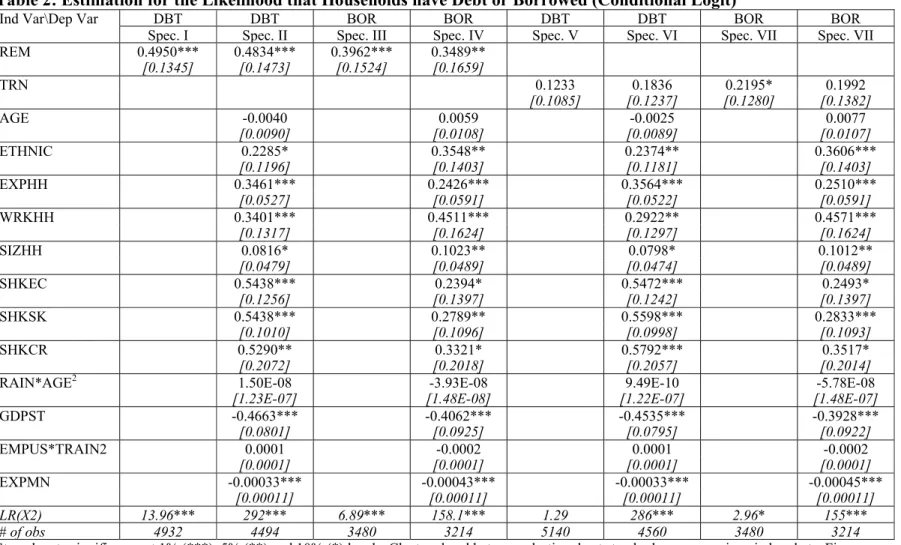
Table 2 provides results from a conditional logit model with household fixed effects on eight different specifications. In Specs. I and II, the dependent variable is the variable
21
DBT. In Specs. III and IV the dependent variable is the variable BOR. All specifications control for household fixed effects (unobservable time-constant differences). In addition, Specs. II and IV include controls for time-varying household characteristics, as well as state level time varying characteristics.6 In Specs. V to VIII, we repeat Specs. I to IV but use a binary indicator TRN for whether households have closes relatives (either a parent, a child or a spouse) in the US instead of REM. We find a strong and statistically
significant effect for remittances in all specifications (with and without controls, both for debt and for borrowing).7 Size and significance of the coefficients on REM change only slightly when introducing further controls, additional to the household fixed effects. For both the existence of debt and for recent borrowing the size of households (SIZHH), whether an indigenous language was spoken in the household (ETHNIC), whether the head of household earned income from work or business (WRKHH), the log of household
6 We include these control variables as a way to compare these results with our
instrumented regressions. While in the logit regressions the municipality and state level controls are not fundamental, they become very important in our instrumented
regressions as they insure that more observed shocks at the municipality and state level are controlled for.
7 All coefficients are in logit scale. Partial effects on the response probabilities cannot be
estimated from the conditional fixed effects logit model because of the unknown fixed effects parameter
22 expenditures (EXPHH) have positive and significant effects. State level GDP (GDPST) and the government expenditure at municipal level (EXPMN) have negative and
significant effects for both dependent variables. The level of employment in the US, multiplied by TRAIN2, is not statistically significant in any of the specifications. The age of the head of household (AGEHH) is not statistically significant. We also include indicators on the shock history of households. As expected, the occurrence of health-related shocks (SHKSK), loss of job or business failures (SHKEC), and the occurrence of total loss of crop (SHKCR) during the previous five years increases the probability of the existence of debt and of recent borrowing. For major covariate shocks like more rain at the state level (RAIN) we do not find an effect on debt or borrowing.8. Note that we do
not find significant effects on either borrowing or debt for the existence of close relatives in the US (TRN). This indicates that the observed effect operates through remittances and not through migration.
[HERE: TABLE 2 FIXED EFFECTS LOGIT]
8 As pointed out in the literature, local-level coping strategies such as informal lending
practices may break down in case of large covariate shocks that affect whole communities (cp. Dercon 2002)
23 In order to address remaining concerns with respect to reverse causality and other
methodological challenges related to the endogeneity of remittances, we present now results using instruments. Through the use of instruments, we may respond to three main concerns with respect to the validity of our results. First, high debts might itself be a motivation to migrate. Second, migration might be financed through debt. In both cases, debt (or borrowing) would precede migration and remittances, rather than the other way around. Although Specs. V to VII in Table 2 do not support such an effect, the
instrumental strategy provides additional empirical evidence against reverse causality. Finally, it is possible that both remittances and debts respond to a third omitted variable we are not able to control for (for example, a shock we do not observe).
As mentioned above, we combine distance to border by rail lines (TRAIN) and changes in labor market conditions in the US states where Mexican migrants reside (DUSEMP) into one instrument Z. Table 3 shows results for the first step fixed effects estimation where we predict remittances-receiving status of households from the instrument Z plus a set of exogenous control variables X. It is shown that a positive and statistically significant relation exists at the 1% level between the reception of remittances and job creation in US states where Mexican migrants reside. Table 3 also shows that households that have an older head of household (AGEHH), have higher household expenditures (EXPHH), speak an indigenous language (ETHNIC), suffered a total loss of crops (SHKCR) and suffered health shocks (SHKSK) receive more remittances on average.
24
[HERE: TABLE 4 WITH 2ND STEP RESULTS]
Table 4 shows the results of using an instrumental variable approach while maintaining the household fixed effects. The estimation confirms the positive effect of remittances on the existence of debt and on recent borrowing9. Households with more expenditure, households where the head participates in the labor market, households with economic shocks and households with health shocks have a higher probability of having debts or have recently borrowed. Households that live in more affluent states and where public expenditure at the municipality level is higher are less likely to have debts or to have borrowed recently. Households that speak a native language are more likely to have recently borrowed. Households with migrants in US states with higher level of
employment (EMPUS) are less likely to have borrowed recently. Stock and Yogo (2002) test statistics indicate that our instrument is very strong since our estimations are less than 10% above or below its true value (see Table 4).
Our results lead us to conclude from the various model specifications that there is strong evidence for an effect of remittances on the existence of debts and on borrowing. What
9 While the marginal effect of remittances seems to be large, we are not able to give a
precise estimate on the size of the coefficient, since we are using linear regressions on a binary outcome variable.
25 we observe is not driven by unobserved fixed effects or by reverse causality: We confirm a positive and statistically significant effect when controlling for observable and
unobservable differences across households; and when using instruments in order to control for the endogeneity of remittances.
V. Conclusion
All our specifications point to a positive and statistically significant effect of remittances on debts and on borrowing. Results are not driven by underlying differences between migrant households and non-migrant households or by the endogeneity of remittances: We addressed methodological concerns of selection bias, omitted variable bias and reverse causality through household fixed effects and the use of instrumental variables. By employing alternative definitions of the dependent variable, we also mitigated concerns of potential specification bias. There is strong evidence that the reception of remittances facilitates taking up loans, either through a demand-driven effect (receivers of remittances have a lower risk-aversion because they may rely on an additional source of income out of which to pay their debts) or through a supply-driven effect (lenders may accept remittances as collateral for loans or consider receivers of remittances to be more creditworthy because they have an additional and relatively stable source of income). A
26 specific test that would help decide whether our results are demand or supply driven is beyond the scope of this paper.10
The theoretical starting point of this paper was an understanding of remittances as part of a complex financial management of migrant households, in which several formal and informal instruments may exist next to each other. Because migration and financial services can both be understood as asset-building and risk-management tools, remittances and debt may, in some cases, substitute for each other – for example, when family
members in the US function as a source of insurance from outside the regular household to cover emergency spending, similar to “rainy” day credit or insurance from financial institutions. In these cases, receivers of remittances may have less need to rely on lending when they face liquidity shortages. In other cases, remittances and lending may
complement each other, because receivers of remittances may have unfulfilled lumpy investment options that cannot be financed by the regular remittance flow or because the same insurance function of remittances reduces lending constraints among risk-averse lenders and borrowers. However, the effect of remittances on lenders could operate even if they are risk neutral, as theory usually portrays banks, if remittances provide an
10 We can say that with our current results it is more likely that the link is coming from
the supply side, since the indicators observed by the researcher and most likely by the lenders (the reception of remittances) seem to be more important than the indicators observed by the borrower (whether there is a household member in the US). See the results reported in Table 2.
27 information advantage vis-à-vis an observationally equivalent household without
remittances. In this sense, the two opposing views that exist in the literature - namely that remittances function as a substitute for credit but that they may also have a positive impact on the access to and the use of financial services – are not necessarily contradictory.
Linking remittances with financial sector development has become an important topic on the policy agenda. We believe that our study can make an important contribution to this debate by showing that the financial decisions of remittance receiving households are rather complex since they can simultaneously use remittances and credit to finance their diverse credit needs, which ultimately reveals a demand for additional financial tools among migrant households. At the same time, much of this demand is not met by the formal financial sector and there is a need for institutions to address the particular demand for financial services by remittances-receiving households from rural and lower income groups. In our study, we do not differentiate between loans from formal and from informal sources. While the ability to take up loans may enhance risk management and asset building tools of households, the literature has also pointed towards the dangers of over indebtedness especially with respect to informal loans and moneylenders that charge high interest rates. Further research is needed to understand which institutions are best suited to provide financial services to remittances-receiving households, and whether linking remittances with additional financial services may generate social or economic change within or outside households.
28
VI. Literature
Acosta, Pablo, Cesar Calderón, Pablo Fajnzylber, and Humberto Lopez. 2008. “What Is the Impact of International Remittances on Poverty and Inequality in Latin America?” World Development 36 (1): 88–114.
Acosta, Pablo, Pablo Fajnzylber, and Humberto Lopez. 2007. “The Impact of Remittances on Poverty and Human Capital: Evidence from Latin American Household Surveys”. The World Bank.
Adams, Richard, and Alfredo Cuecuecha. 2010. “Remittances, Household Expenditure and Investment in Guatemala.” World Development 38 (11): 1626–41.
Adams, Richard H., and Alfredo Cuecuecha. 2013. “The Impact of Remittances on Investment and Poverty in Ghana.” World Development 50 (October): 24–40. doi:10.1016/j.worlddev.2013.04.009.
Adams, Richard, and John Page. 2003. International Migration, Remittances and Poverty in Developing Countries. The World Bank.
Aggarwal, Reena, Asli Demirgüç-Kunt, and Maria Soledad Martinez Peria. 2010. “Do Remittances Promote Financial Development?” Journal of Development Economics 96 (2): 255–64.
Ambrosius, Christian. 2012. Are Remittances a“ Catalyst” for Financial Access? Evidence from Mexican Household Data. School of Business & Economics, Discussion Paper: Economics.
29 Ambrosius, Christian, and Alfredo Cuecuecha. 2013. “Are Remittances a Substitute for
Credit? Carrying the Financial Burden of Health Shocks in National and Transnational Households.” World Development 46 (June): 143–52. doi:10.1016/j.worlddev.2013.01.032.
Amuedo-Dorantes, Catalina, and Susan Pozo. 2004. “Remittances and Insurance. Evidence from Mexican Migrants.” Journal of Population Economics 19 (2): 227–54.
Anzoategui, Diego, Asli Demirgüç-Kunt, and María Soledad Martínez Pería. 2014. “Remittances and Financial Inclusion: Evidence from El Salvador.” World Development 54 (February): 338–49. doi:10.1016/j.worlddev.2013.10.006. Ashraf, Nava, Diego Aycinena, Claudia Martínez, and Dean Yang. 2014. “Savings in
Transnational Households: A Field Experiment among Migrants from El Salvador.” Review of Economics and Statistics (forthcoming).
Banco de México (Banxico). 2013. “Estadísticas de Remesas Familiares. Available at: http://www.banxico.org.mx/estadisticas/index.html#SP.”
Buch, Claudia M., and Anja Kuckulenz. 2010. “Worker Remittances and Capital Flows to Developing Countries.” International Migration 48 (5): 89–117.
doi:10.1111/j.1468-2435.2009.00543.x.
Cai, Qian. 2003. “Migrant Remittances and Family Ties: A Case Study in China.”
International Journal of Population Geography 9 (6): 471–83. doi:10.1002/ijpg.305.
30 Calero, Carla, Arjun S. Bedi, and Robert Sparrow. 2009. “Remittances, Liquidity
Constraints and Human Capital Investments in Ecuador.” World Development 37 (June): 1143–54. doi:10.1016/j.worlddev.2008.10.006.
Carling, Jørgen. 2008. “The Determinants of Migrant Remittances.” Oxford Review of Economic Policy 24 (3): 581–98. doi:10.1093/oxrep/grn022.
Chamberlain, Gary. 1984. “Panel Data.” In Handbook of Econometrics, Z. Griliches and M. D. Intriligator, 2:1247–1348. Amsterdam: North Holland.
Collins, Daryl, Jonathan Morduch, Stuart Rutherford, and Orlanda Ruthven. 2009.
Portfolios of the Poor: How the World’s Poor Live on $2 a Day. Princeton: Princeton University Press.
Comisión Nacional Bancaria y de Valores (CNBV). 2011. Reporte de Inclusión FInanciera. Vicepresidencia de Política Regulatoria.
Comisión Nacional del Aguga (CONAGUA). 2014. Banco Nacional de Datos Climatológicos.
Cox Edwards, Alejandra, and Manuelita Ureta. 2003. “International Migration, Remittances, and Schooling: Evidence from El Salvador.” Journal of Development Economics 72: 429–61.
Cuecuecha, Alfredo, and José María Da Rocha. 2011. “El Acceso Al Crédito En Tiempos de Crisis, Las Remesas Y La Medición de La Pobreza.” In Reflexiones Sobre La Crisis Financiera, edited by Alfonso Mendoza, Karen Watkins, and Karen Watkins Fassler. Puebla, Pue.: UPAP, UNAM.
Demirgüç-Kunt, Aslı, Ernesto López Córdova, María Soledad Martinez Pería, and Christopher Woodruff. 2011. “Remittances and Banking Sector Breadth and
31 Depth. Evidence from Mexico.” Journal of Development Economics 95 (2): 229– 41.
Dercon, S. 2002. “Income Risk, Coping Strategies, and Safety Nets.” The World Bank Research Observer 17 (2): 141–66. doi:10.1093/wbro/17.2.141.
Esquivel, Gerardo, and Alejandra Huerta-Pineda. 2007. “Remittances and Poverty in Mexico: A Propensity Score Matching Approach.” Integration and Trade Journal, no. 27: 45–57.
Giuliano, Paola, and Marta Ruiz-Arranz. 2009. “Remittances, Financial Development, and Growth.” Journal of Development Economics 90: 144–52.
Gupta, Sanjeev, Catherine A. Pattillo, and Smita Wagh. 2009. “Effect of Remittances on Poverty and Financial Development in Sub-Saharan Africa.” World Development
37 (1): 104–15.
Instituto de los Mexicanos en el Exterior (IME). 2008. Matrículas Consulares de Alta Seguridad Expedidas Por Consulado Y Estado Mexicano de Procedencia. Instituto Nacional de Estadística y Geografía (INEGI). 2014a. Banco de Información
Económica. Producto Interno Bruto Por Entidad Federativa.
———. 2014b. Sistema Estatal Y Municipal de Bases de Datos (SIMBAD) Gasto Público Por Municipio.
Jones, Richard C. 1998. “Remittances and Inequality: A Question of Migration Stage and Geographic Scale.” Economic Geography 74 (1): 8–25.
Koechlin, Valerie, and Gianmarco León. 2006. “International Remittances and Income Inequality: An Empirical Investigation.” Journal of Economy Policy Reform 10 (3): 123–44.
32 Liu, Qiming, and Barry Reilly. 2004. “Income Transfers of Chinese Rural Migrants:
Some Empirical Evidence from Jinan.” Applied Economics 36 (12): 1295–1313. doi:10.1080/0003684042000191101.
López Córdova, Ernesto. 2005. “Globalization, Migration and Development: The Role of Mexican Migrant Remittances.” Economia, Journal of the Latin American and Caribbean Economic Association, Forthcoming.
Lucas, R.E.B., and O. Stark. 1985. “Motivations to Remit: Evidence from Botswana.”
The Journal of Political Economy, 901–18.
Massey, Douglas, and Emilio Parrado. 1998. “International Migration and Business Formation in Mexico.” Social Science Quarterly 79 (1): 1–20.
Mexlist. 2014. “Mexico Railroad Depots by State.” http://www.mexlist.com/estaciones/. Orozco, Manuel. 2004. “International Financial Flows and Worker Remittances: Best
Practices”. Report commissioned by the Population and Mortality divison of the United Nations.
Orozco, Manuel, and Rachel Fedewa. 2006. “Leveraging Efforts on Remittances and Financial Intermediation”. Inter-American Development Bank, INTAL-ITD. Rutherford, Stuart. 2003. “Money Talks: Conversations with Poor Households in
Bangladesh about Managing Money.” Journal of Microfinance/ESR Review 5 (2): 43–76.
Sayan, Serdar. 2006. “Business Cycles and Workers’ Remittances: How Do Migrant Workers Respond to Cyclical Movements of GDP at Home?” International Monetary Fund.
33 Stock, James H., and Motohiro Yogo. 2002. Testing for Weak Instruments in Linear IV
Regression. National Bureau of Economic Research Cambridge, Mass., USA. http://www.nber.org/papers/t0284.
Taylor, Edward J., and Wyatt, T.J. 1996. “The Shadow Value of Migrant Remittances, Income and Inequality in a Household-Farm Economy.” Journal of Development Studies 32 (6): 899–912.
Terry, Donald F., and Steven R. Wilson. 2005. Beyond Small Changes- Making Migrant Remittances. American Development Bank, Washington, DC:
Inter-American Development Bank.
Teruel, Gabriela, Luis Rubalcava, and E. Arenas. 2012. “Migration in the Familiy Life Survey.” In Migration and Remittances from Mexico, Cuecuecha, A. and Pederzini, C. Lanham, Md.: Lexington Books.
The Banker Database. 2013. Financial Information on Mexican Banks. U.S. Bureau of Labor Statistics (USBLS). 2014. “Online Data Base
(www.bls.gov/data/).”
Woodruff, Christopher. 2007. “Mexican Microenterprise Investment and Employment: The Role of Remittances.” INTAL-ITD, Working Paper 26.
http://www.microdinero.com/resource/download/nota_relacionada/5327-File-2744007045072486d49306.pdf.
Woodruff, Christopher, and Rene Zenteno. 2007. “Migration Networks and
Microenterprises in Mexico.” Journal of Development Economics 82 (2): 509–28. Wooldridge, Jeffrey M. 2002. Econometric Analysis of Cross Section and Panel Data.
34 World Bank. 2010. Migration and Remittances Factbook 2011. Washington, D.C.: World
Bank.
———. 2014a. “World Development Indicators Online Database.” ———. 2014b. Financial Inclusion Data. Mexico Dashboard.
Yang, Dean. 2005. International Migration, Human Capital, and Entrepreneurship: Evidence from Philippine Migrants’ Exchange Rate Shocks. World Bank Policy Research Working Paper Series 3578.
———. 2008. “International Migration, Remittances and Household Investment: Evidence from Philippine Migrants’ Exchange Rate Shocks.” The Economic Journal 118 (528): 591–630. doi:10.1111/j.1468-0297.2008.02134.x.
35
Table 1: Data Description
Variable Description 2002 2005
DBTa Binary variable that takes the value 1 for households that reported to have outstanding debt
0.31 0.25
(0.46) (0.43)
BORa Binary variable that takes the value 1 for households where at least one household member borrowed money from a formal or informal source during the previous 12 months
0.2 0.15
(0.4) (0.35)
REMa Binary variable that takes the value 1 for households that received remittances during the previous 12 months
0.06 0.06
(0.23) (0.24)
TRNa Binary variable that takes the value of 1 for households with a family member in the US
0.16 0.17
(0.36) (0.38)
AGEHHa Age of the head of household 43.85 46.58
(15.74) (15.53)
SIZHHa Number of household members 4.28 4.69
(2.06) (2.33)
EXPHHa Monthly per capita spending, in Mexican pesos, in log terms 7.87 7.97
(0.97) (1.09)
SHKECa Binary variable that takes the value 1 for unemployment or a business failure by any household member
0.08 0.06
(0.27) (0.24)
SHKSKa Binary variable that takes the value 1 for illness or serious accident that required
hospital treatment by any household member (0.34) 0.13 (0.31) 0.11 SHKCRa Binary variable that takes the value 1 for total loss of crop of households 0.06 0.03
(0.23) (0.16)
WRKHHa Binary variable that takes the value 1 for households where the household head earned income during the previous 12 months
0.8 0.76
(0.4) (0.43)
GDPSTb State level GDP in thousands of Mexican Pesos (current value) 14.55 15.13
(6.72) (6.74)
EXPMNc Per capita expenditures of the municipality government, in Mexican Pesos (current values)
1441.3 191.46
(689.1) (85.83)
RAINd Rain fall at state level 760.83 760.78
(318.99) (319.08 )
TRAINf Minimum of distance to the border along the 1920s railroad (distance to the railroad and from there to the border) and direct distance to the US border
701.8 701.7 (283.4) (283.5)
TRAIN2e Distance from the head of municipality to the nearest railroad depot, in kilometers 66.88 66.79
(122.45) (122.47 )
EMPUSg Indicator on the job level in US states where Mexican migrants reside. In order to generate variation per Mexican state, we generate an importance indicator based on the percentage of consular documents that were requested by individuals from Mexican state j who lived in US state k in 2008.
106 90.99
(80.29) (137.82 )
DUSEMPg Indicator on job creation in US states where Mexican migrants reside. Job creation is calculated as EMPUS(t)-EMPUS(t-3).
2.95 3.38
(2.17) (2.48)
Mean values and standard errors in brackets are given separately for 2002 and 2005 and for the 7,752 observations for which data was observed at both time periods. Sources: a) MxFLS, b) ( 2014a), c) INEGI (2014a), d) CONAGUA (2014) e) Demirgüç-Kunt et al. (2011) f) Mexlist (2014) and Google maps g) USBLS (2014) and IME (2008)
36
Table 2: Estimation for the Likelihood that Households have Debt or Borrowed (Conditional Logit)
Ind Var\Dep Var DBT DBT BOR BOR DBT DBT BOR BOR
Spec. I Spec. II Spec. III Spec. IV Spec. V Spec. VI Spec. VII Spec. VII
REM 0.4950*** 0.4834*** 0.3962*** 0.3489** [0.1345] [0.1473] [0.1524] [0.1659] TRN 0.1233 0.1836 0.2195* 0.1992 [0.1085] [0.1237] [0.1280] [0.1382] AGE -0.0040 0.0059 -0.0025 0.0077 [0.0090] [0.0108] [0.0089] [0.0107] ETHNIC 0.2285* 0.3548** 0.2374** 0.3606*** [0.1196] [0.1403] [0.1181] [0.1403] EXPHH 0.3461*** 0.2426*** 0.3564*** 0.2510*** [0.0527] [0.0591] [0.0522] [0.0591] WRKHH 0.3401*** 0.4511*** 0.2922** 0.4571*** [0.1317] [0.1624] [0.1297] [0.1624] SIZHH 0.0816* 0.1023** 0.0798* 0.1012** [0.0479] [0.0489] [0.0474] [0.0489] SHKEC 0.5438*** 0.2394* 0.5472*** 0.2493* [0.1256] [0.1397] [0.1242] [0.1397] SHKSK 0.5438*** 0.2789** 0.5598*** 0.2833*** [0.1010] [0.1096] [0.0998] [0.1093] SHKCR 0.5290** 0.3321* 0.5792*** 0.3517* [0.2072] [0.2018] [0.2057] [0.2014]
RAIN*AGE2 1.50E-08 -3.93E-08 9.49E-10 -5.78E-08
[1.23E-07] [1.48E-08] [1.22E-07] [1.48E-07]
GDPST -0.4663*** -0.4062*** -0.4535*** -0.3928*** [0.0801] [0.0925] [0.0795] [0.0922] EMPUS*TRAIN2 0.0001 -0.0002 0.0001 -0.0002 [0.0001] [0.0001] [0.0001] [0.0001] EXPMN -0.00033*** -0.00043*** -0.00033*** -0.00045*** [0.00011] [0.00011] [0.00011] [0.00011] LR(X2) 13.96*** 292*** 6.89*** 158.1*** 1.29 286*** 2.96* 155*** # of obs 4932 4494 3480 3214 5140 4560 3480 3214
Stars denote significance at 1% (***), 5% (**) and 10% (*) levels. Clustered and heteroscedastic robust standard errors are given in brackets. Figures in brackets are standard errors. Rain is interacted with age squared to generate variation per household on this variable.
37
Table 3: First Step Linear
Regression Instrumenting for the Likelihood that Households Received Remittances DUSEMP*TRAIN 0.0001*** [0.00001] AGEHH 0.0015* [0.0008] ETHNIC 0.0212** [0.0093] EXPHH 0.0141*** [0.0036] WRKHH -0.002 [0.0119] SIZHH -0.0021 [0.0051] SHKEC 0.0128 [0.0105] SHKSK 0.0184* [0.0099] SHKCR 0.0681*** [0.0205] RAIN*AGE2 -1.13E-08 [1.18E-08] GDPST -0.0004 [0.0071] EMPUS*TRAIN2 -6.02E-06 [4.25E-06] EXPMN -0.00001 [0.0001] CONS -0.159 [0.1046] # obs. 13740 F 12.38***
Fixed effects Yes
Stars denote significance at 1% (***), 5% (**) and 10% (*) levels. Robust standard errors are given in brackets. Rain is interacted with Age2 to generate variation per household in this variable.
38
Table 4: Second Step Linear Regression Instrumenting for the Likelihood that Households Received Remittances
Ind Var\Dep Var DBT BOR
Spec. I Spec. II REM 0.8822** 0.6048** [0.3668] [0.3160] AGE -0.0016 -0.0002 [0.0056] [0.0013] ETHNIC 0.0232 0.0369** [0.0218] [0.0190] EXPHH 0.0293*** 0.0130* [0.0099] [0.0076] WRKHH 0.0424** 0.0336** [0.0191] [0.0154] SIZHH 0.0119 0.0117 [0.0086] [0.0080] SHKEC 0.0961*** 0.0367* [0.0247] [0.0216] SHKSK 0.0883*** 0.0308* [0.0197] [0.0170] SHKCR 0.007 0.0115 [0.0381] [0.0341]
RAIN*AGE2 1.05E-08 2.31E-09
[1.98E-08] [1.62E-08]
GDPST -0.0820*** -0.0517***
[0.0139] [0.0121]
EMPUS *TRAIN2 -7.04E-06 -2.04E-05**
[1.05E-05] [8.05E-06] EXPMN -0.00005*** -0.00005*** [0.00002] [0.00002] F 18.98*** 10.94*** # of obs 13310 13016 Cragg-Donald F 31.19 31.71
Stock Yogo10% max IV size 16.38 16.38
Fixed effects Yes Yes
Stars denote significance at 1% (***), 5% (**) and 10% (*) levels. Clustered and heteroscedastic robust standard errors are given in brackets. RAIN is interacted with AGE2 to
2014 bereits erschienen:
2014/1 FOSSEN, Frank M.; Ronny FREIER und Thorsten MARTIN
Race to the debt trap? : Spatial econometric evidence on debt in German municipalities
Economics
2014/2 SCHREIBER, Sven
Anticipating business-cycle turning points in real time using density forescasts from a VAR
Economics
2014/3 FOSSEN, Frank M. und Daniela GLOCKER
Stated and revealed heterogeneous risk preferences in educational choice Economics
2014/4 KNABE, Andreas, Ronnie SCHÖB und Marcel THUM
Der flächendeckende Mindestlohn Economics
2014/5 QUINT, Dominic und Pau RABANAL
Monetary and Macroprudential Policy in an Estimated DSGE Model of the Euro Area Economics
2014/6 HUGHES HALLETT, Andrew; Ansgar RANNENBERG und Sven Schreiber
New Keynesian versus old Keynesian government spending multipliers: a comment
Economics
2014/7 DOBUSCH, Leonhard
Digitale Zivilgesellschaft in Deutschland : Stand und Perspektiven 2014 Management
2014/8 BEZNOSKA, Martin
Estimating a Consumer Demand System of Energy, Mobility and Leisure : a Microdata Approach for Germany
Economics
2014/9 GÖRLITZ, Katja und Sylvi RZEPKA
Does Regional Training Supply Determine Employees’ Training Participation? Economics
2014/10 BRANDSTETTER, Laura
Do Corporate Tax Cuts Reduce International Profit Shifting? FACTS
Economics
2014/12 HEIMSTÄDT, Maximilian; Frederic SAUNDERSON und Tom HEATH
Conceptualizing Open Data Ecosystems: a timeline analysis of Open Data development in the UK
Management
2014/13 QUINT, Dominic
Is it Really More Dispersed?: Measuring and Comparing the Stress from the Common Monetary Policy in the Euro Area
Economics
2014/14 SCHREYÖGG, Georg und Simone M. OSTERMANN
Managing uncertainty in Intensive Care Units: Exploring formal and informal coping practices in a university hospital
Management
2014/15 LÜTHEN, Holger
Rates of Return and Early Retirement Disincentives: Evidence from a German Pension Reform
Economics
2014/16 MEISSNER, Thomas und Davud ROSTAM-AFSCHAR
Do Tax Cuts Increase Consumption? An Experimental Test of Ricardian Equivalence Economics
2014/17 EICHFELDER, Sebastian und Mona LAU
Capital Gains Taces and Asset Prices: The Impact of Tax Awareness and Procrastination
FACTS
2014/18 BLAUFUS, Kay; Matthias BRAUNE; Jochen HUNDSDOERFER und Martin JACOB
Self-Serving Bias and Tax Morale FACTS