CloudAV: N-Version Antivirus in the Network Cloud
Jon Oberheide, Evan Cooke, Farnam Jahanian
Electrical Engineering and Computer Science Department
University of Michigan, Ann Arbor, MI 48109
{jonojono, emcooke, farnam}@umich.edu
Abstract
Antivirus software is one of the most widely used tools for detecting and stopping malicious and unwanted files. However, the long term effectiveness of traditional host-based antivirus is questionable. Antivirus software fails to detect many modern threats and its increasing com-plexity has resulted in vulnerabilities that are being ex-ploited by malware. This paper advocates a new model for malware detection on end hosts based on providing antivirus as an in-cloud network service. This model en-ables identification of malicious and unwanted software by multiple, heterogeneous detection engines in paral-lel, a technique we term ‘N-version protection’. This approach provides several important benefits including better detection of malicious software,enhanced foren-sics capabilities, retrospective detection, and improved deployability and management. To explore this idea we construct and deploy a production quality in-cloud an-tivirus system called CloudAV. CloudAV includes a lightweight, cross-platform host agent and a network ser-vice with ten antivirus engines and two behavioral detec-tion engines. We evaluate the performance, scalability, and efficacy of the system using data from a real-world deployment lasting more than six months and a database of 7220 malware samples covering a one year period. Using this dataset we find that CloudAV provides 35% better detection coverage against recent threats compared to a single antivirus engine and a 98% detection rate across the full dataset. We show that the average length of time to detect new threats by an antivirus engine is 48 days and that retrospective detection can greatly mini-mize the impact of this delay. Finally, we relate two case studies demonstrating how the forensics capabilities of CloudAV were used by operators during the deployment.
1
Introduction
Detecting malicious software is a complex problem. The vast, ever-increasing ecosystem of malicious software
and tools presents a daunting challenge for network op-erators and IT administrators. Antivirus software is one of the most widely used tools for detecting and stopping malicious and unwanted software. However, the elevat-ing sophistication of modern malicious software means that it is increasingly challenging for any single vendor to develop signatures for every new threat. Indeed, a recent Microsoft survey found more than 45,000 new variants of backdoors, trojans, and bots during the second half of 2006 [17].
Two important trends call into question the long term effectiveness of products from a single antivirus vendor. First, there is a significant vulnerability window between when a threat first appears and when antivirus vendors generate a signature. Moreover, a substantial percentage of malware is never detected by antivirus software. This means that end systems with the latest antivirus software and signatures can still be vulnerable for long periods of time. The second important trend is that the increasing complexity of antivirus software and services has indi-rectly resulted in vulnerabilities that can and are being exploited by malware. That is, malware is actually us-ing vulnerabilities in antivirus software itself as a means to infect systems. SANS has listed vulnerabilities in an-tivirus software as one of the top 20 threats of 2007 [27]. In this paper we suggest a new model for the detec-tion funcdetec-tionality currently performed by host-based an-tivirus software. This shift is characterized by two key changes.
1. Antivirus as a network service: First, the detec-tion capabilities currently provided by host-based antivirus software can be more efficiently and ef-fectively provided as an in-cloud network service. Instead of running complex analysis software on ev-ery end host, we suggest that each end host run a lightweight process to detect new files, send them to a network service for analysis, and then permit ac-cess or quarantine them based on a report returned
by the network service.
2. N-version protection:Second, the identification of malicious and unwanted software should be deter-mined by multiple, heterogeneous detection engines in parallel. Similar to the idea of N-version gramming, we propose the notion of N-version pro-tection and suggest that malware depro-tection systems should leverage the detection capabilities of multi-ple, heterogeneous detection engines to more effec-tively determine malicious and unwanted files. This new model provides several important benefits. (1)Better detection of malicious software: antivirus en-gines have complementary detection capabilities and a combination of many different engines can improve the overall identification of malicious and unwanted soft-ware. (2)Enhanced forensics capabilities: information about what hosts accessed what files provides an incred-ibly rich database of information for forensics and intru-sion analysis. Such information provides temporal rela-tionships between file access events on the same or dif-ferent hosts. (3) Retrospective detection: when a new threat is identified, historical information can be used to identify exactly which hosts or users open similar or identical files. For example, if a new botnet is detected, an in-cloud antivirus service can use the execution his-tory of hosts on a network to identify which hosts have been infected and notify administrators or even automat-ically quarantine infected hosts. (4)Improved deploya-bility and management: Moving detection off the host and into the network significantly simplifies host soft-ware enabling deployment on a wider range of platforms and enabling administrators to centrally control signa-tures and enforce file access policies.
To explore and validate this new antivirus model, we propose an in-cloud antivirus architecture that consists of three major components: a lightweighthost agentrun on end hosts like desktops, laptops, and mobiles devices that identifies new files and sends them into the network for analysis; anetwork service that receives files from hosts and identifies malicious or unwanted content; and anarchival and forensics servicethat stores information about analyzed files and provides a management inter-face for operators.
We construct, deploy, and evaluate a production qual-ity in-cloud antivirus system called CloudAV. CloudAV includes a lightweight, cross-platform host agent for Windows, Linux, and FreeBSD and a network service consisting of ten antivirus engines and two behavioral detection engines. We provide a detailed evaluation of the system using a dataset of 7220 malware samples col-lected in the wild over a period of a year [20] and a pro-duction deployment of our system on a campus network
in computer labs spanning multiple departments for a pe-riod of over 6 months.
Using the malware dataset, we show how the Clou-dAV N-version protection approach provides 35% better detection coverage against recent threats compared to a single antivirus engine and 98% detection coverage of the entire dataset compared to 83% with a single engine. In addition, we empirically find that the average length of time to detect new threats by a single engine is 48 days and show how retrospective detection can greatly mini-mize the impact of this delay.
Finally, we analyze the performance and scalability of the system using deployment results and show that while the total number of executables run by all the systems in a computing lab is quite large (an average of 20,500 per day), the number of unique executables run per day is two orders of magnitude smaller (an average of 217 per day). This means that the caching mechanisms employed in the network service achieves a hit rate of over 99.8%, reducing the load on the network and, in the rare case of a cache miss, we show that the average time required to analyze a file using CloudAV’s detection engines is approximately 1.3 seconds.
2
Limitations of Antivirus Software
Antivirus software is one of the most successful and widely used tools for detecting and stopping malicious and unwanted software. Antivirus software is deployed on most desktops and workstations in enterprises across the world. The market for antivirus and other security software is estimated to increase to over $10 billion dol-lars in 2008 [10].
The ubiquitous deployment of antivirus software is closely tied to the ever-expanding ecosystem of cious software and tools. As the construction of mali-cious software has shifted from the work of novices to a commercial and financially lucrative enterprise, antivirus vendors must expend more resources to keep up. The rise of botnets and targeted malware attacks for the pur-poses of spam, fraud, and identity theft present an evolv-ing challenge for antivirus companies. For example, the recent Storm worm demonstrated the use of encrypted peer-to-peer command and control, and the rapid deploy-ment of new variants to continually evade the signatures of antivirus software [4].
However, two important trends call into question the long term effectiveness of products from a single an-tivirus vendor. The first is that anan-tivirus software fails to detect a significant percentage of malware in the wild. Moreover, there is a significant vulnerability window be-tween when a threat first appears and when antivirus ven-dors generate a signature or modify their software to de-tect the threat. This means that end systems with the
AV Vendor Version 3 Months 1 Month 1 Week
Avast 4.7.1043 62.7% 45.8% 39.6%
AVG 7.5.503 83.8% 78.6% 72.2%
BitDefender 7.1.2559 83.9% 79.7% 78.5% ClamAV 0.91.2 57.5% 48.8% 46.8%
CWSandbox 2.0 N/A N/A N/A
F-Prot 6.0.8.0 70.4% 49.6% 46.0% F-Secure 8.00.101 80.9% 74.4% 60.3% Kaspersky 7.0.0.125 89.2% 84.0% 78.5% McAfee 8.5.0i 70.5% 56.7% 53.9%
Norman 1.8 N/A N/A N/A
Symantec 15.0.0.58 60.8% 38.8% 45.2% Trend Micro 16.00 79.4% 74.6% 75.3% (a) 1 Day d 1 Week 1 Month 3 Months 1 Year
Recency of Malware Sample 20 30 40 50 60 70 80 90 100 Percent Detected Avast AVG BitDefender ClamAV F-Prot F-Secure Kaspersky McAfee Symantec TrendMicro (b)
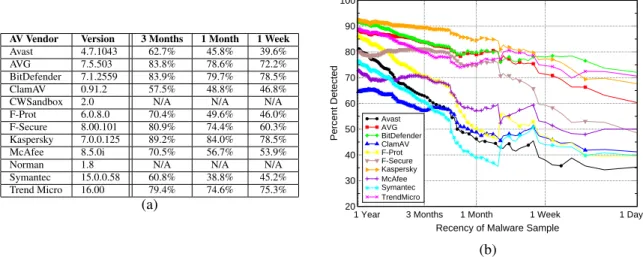
Figure 1: Detection rate for ten popular antivirus products as a function of the age of the malware samples.
latest antivirus software and signatures can still be vul-nerable for long periods of time. The second important trend is that the increasing complexity of antivirus soft-ware and services has indirectly resulted in vulnerabili-ties that can and are being exploited by malware. That is, malware is actually using vulnerabilities in antivirus software as means to infect systems.
2.1
Vulnerability Window
The sheer volume of new threats means that it is diffi-cult for any one antivirus vendor to create signatures for all new threats. The ability of any single vendor to cre-ate signatures is dependent on many factors such as de-tection algorithms, collection methodology of malware samples, and response time to 0-day malware. The end result is that there is a significant period of time between when a threat appears and when a signature is created by antivirus vendors (thevulnerability window).
To quantify the vulnerability window, we analyzed the detection rate of multiple antivirus engines across mal-ware samples collected over a one year period. The dataset included 7220 samples that were collected be-tween November 11th, 2006 to November 10th, 2007. The malware dataset is described in further detail in Sec-tion 6. The signatures used for the antivirus were updated the day after collection ended, November 11th, 2007, and stayed constant through the analysis.
In the first experiment, we analyzed the detection of recent malware. We created three groups of malware: one that included malware collected more recently than 3 months ago, one that included malware collected more recently than 1 month ago, and one that included mal-ware collected more recently than 1 week ago. The an-tivirus engine and signature versions along with their as-sociated detection rates for each time period are listed
in Figure 1(a). The table clearly shows that the detec-tion rate decreases as the malware becomes more recent. Specifically, the number of malware samples detected in the 1 week time period, arguably the most recent and im-portant threats, is quite low.
In the second experiment, we extended this analysis across all the days in the year over which the malware samples were collected. Figure 1(b) shows significant degradation of antivirus engine detection rates as the age, or recency, of the malware sample is varied. As can be seen in the figure, detection rates can drop over 45% when one day’s worth of malware is compared to a year’s worth. As the plot shows, antivirus engines tend to be ef-fective against malware that is a year old but much less useful in detecting more recent malware, which pose the greatest threat to end hosts.
2.2
Antivirus Software Vulnerabilities
A second major concern about the long term viability of host-based antivirus software is that the complexity of antivirus software has resulted in an increased risk of security vulnerabilities. Indeed, severe vulnerabil-ities have been discovered in the antivirus engines of nearly every vendor. While local exploits are more com-mon (ioctlvulnerabilities, overflows in decompression routines, etc), remote exploits in management interfaces have been observed in the wild [30]. Due to the inherent need for elevated privileges by antivirus software, many of these vulnerabilities result in a complete compromise of the affected end host.
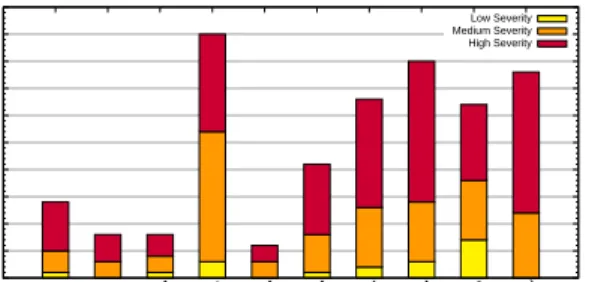
Figure 2 shows the number of vulnerabilities reported in the National Vulnerability Database [21] for ten popu-lar antivirus vendors between 2005 and November 2007. This large number of reported vulnerabilities demon-strates not only the risk involved in deploying antivirus
0 5 10 15 20 25 30 35 40 45 50
Avast AVG BitDefenderClamAV F-Prot F-Secure Kaspersky McAfee Symantec TrendMicro
Number of Vulnerabilities
AV Vendors
Severity of CVE/NVD Antivirus Vulnerabilities
Low Severity Medium Severity High Severity
Figure 2: Number of vulnerabilities reported in the Na-tional Vulnerability Database (NVD) for ten antivirus vendors between 2005 and November 2007
software, but also an evolution in tactics as attackers are now targeting vulnerabilities in antivirus software itself.
3
Approach
This paper advocates a new model for the detection functionality currently performed by antivirus software. First, the detection capabilities currently provided by host-based antivirus software can be more efficiently and effectively provided as an in-cloud network service. Sec-ond, the identification of malicious and unwanted soft-ware should be determined by multiple, heterogeneous detection engines in parallel.
3.1
Deployment Environment
Before getting into details of the approach, it is impor-tant to understand the environment in which such an ar-chitecture is most effective. First and foremost, we do not see the architecture replacing existing antivirus or in-trusion detection solutions. We base our approach on the same threat model as existing host-based antivirus solu-tions and assume an in-cloud antivirus service would run as an additional layer of protection to augment existing security systems such as those inside an organizational network like an enterprise. Some possible deployment environments include:
• Enterprise networks:Enterprise networks tend to be highly controlled environments in which IT ad-ministrators control both desktop and server soft-ware. In addition, enterprises typically have good network connectivity with low latencies and high bandwidth between workstations and back office systems.
• Government networks: Like enterprise networks, government networks tend to be highly controlled
with strictly enforced software and security prac-tices. In addition, policy enforcement, access con-trol, and forensic logging can be useful in tracking sensitive information.
• Mobile/Cellular networks: The rise of ubiqui-tous WiFi and mobile 2.5G and 3G data networks also provide an excellent platform for a provider-managed antivirus solution. As mobile devices be-come increasingly complex, there is an increasing need for mobile security software. Antivirus soft-ware has recently become available from multiple vendors for mobile phones [9, 13, 31].
Privacy implications: Shifting file analysis to a central location provides significant benefits but also has impor-tant privacy implications. It is critical that users of an in-cloud antivirus solution understand that their files may be transferred to another computer for analysis. There are may be situations where this might not be acceptable to users (e.g. many law firms and many consumer broad-band customers). However, in controlled environments with explicit network access policies, like many enter-prises, such issues are less of a concern. Moreover, the amount of information that is collected can be carefully controlled depending on the environment. As we will discuss later, information about each file analyzed and what files are cached can be controlled depending on the policies of the network.
3.2
In-Cloud Detection
The core of the proposed approach is moving the detec-tion of malicious and unwanted files from end hosts and into the network. This idea was originally introduced in [23] and we significantly extend and evaluate the concept in this paper.
There is currently a strong trend toward moving ser-vices from end host and monolithic servers into the net-work cloud. For example, in-cloud email [5, 7, 28] and HTTP [18, 25] filtering systems are already popular and are used to provide an additional layer of security for enterprise networks. In addition, there have been sev-eral attempts to provide network services as overlay net-works [29, 33].
Moving the detection of malicious and unwanted files into the network significantly lowers the complexity of host-based monitoring software. Clients no longer need to continually update their local signature database, re-ducing administrative cost. Simplifying the host soft-ware also decreases the chance that it could contain ex-ploitable vulnerabilities [15, 30]. Finally, a lightweight host agent allows the service to be extended to mobile and resource-limited devices that lack sufficient process-ing power but remain an enticprocess-ing target for malware.
3.3
N-Version Protection
The second core component of the proposed approach is a set of heterogeneous detection engines that are used to provide analysis results on a file, also known as version protection. This approach is very similar to N-version programming, a paradigm in which multiple im-plementations of critical software are written by inde-pendent parties to increase the reliability of software by reducing the probability of concurrent failures [2]. Tra-ditionally, N-version programming has been applied to systems requiring high availability such as distributed filesystems [26]. N-version programming has also been applied to security realm to detect implementation faults in web services that may be exploited by an attacker [19]. While N-version programming uses multiple implemen-tations to increase fault tolerance in complex software, the proposed approach uses multiple independent im-plementations of detection engines to increase coverage against a highly complex and ever-evolving ecosystem of malicious software.
A few online services have recently been constructed that implement N-version detection techniques. For ex-ample, there are online web services for malware sub-mission and analysis [6, 11, 22]. However, these services are designed for the occasional manual upload of a virus sample, rather than the automated and real-time protec-tion of end hosts.
4
Architecture
In order to move the detection of malicious and unwanted files from end hosts and into the network, several impor-tant challenges must be overcome: (1) unlike existing antivirus software, files must transported into the net-work for analysis; (2) an efficient analysis system must be constructed to handle the analysis of files from many different hosts using many different detection engines in parallel; and (3) the performance of the system must be similar or better than existing detection systems such as antivirus software.
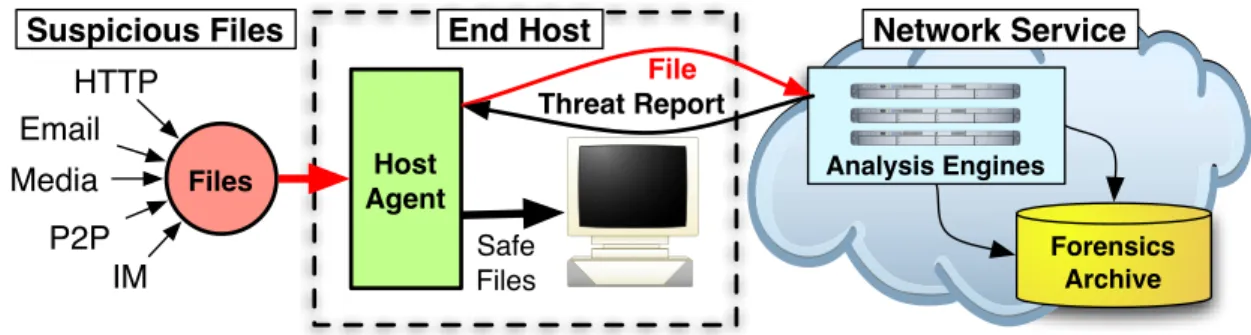
To address these problems we envision an architec-ture that includes three major components. The first is a lightweighthost agentrun on end systems like desktops, laptops, and mobiles devices that identifies new files and sends them into the network for analysis. The second is anetwork servicethat receives files from the host agent, identifies malicious and unwanted content, and instructs hosts whether access to the files is safe. The third com-ponent is anarchival and forensics servicethat stores in-formation about what files were analyzed and provides a query and alerting interface for operators. Figure 3 shows the high level architecture of the approach.
4.1
Client Software
Malicious and unwanted files can enter an organization from many sources. For example, mobile devices, USB drives, email attachments, downloads, and vulnerable network services are all common entry points. Due to the broad range of entry vectors, the proposed architec-ture uses a lightweight file acquisition agent run on each end system.
Just like existing antivirus software, the host agent runs on each end host and inspects each file on the sys-tem. Access to each file is trapped and diverted to a han-dling routine which begins by generating a unique identi-fier (UID) of the file and comparing that identiidenti-fier against a cache of previously analyzed files. If a file UID is not present in the cache then the file is sent to the in-cloud network service for analysis.
To make the analysis process more efficient, the archi-tecture provides a method for sending a file for analysis as soon as it is written on the end host’s filesystem (e.g., via file-copy, installation, or download). Doing so amor-tizes the transmission and analysis cost over the time elapsed between file creation and system or user-initiated access.
4.1.1 Threat Model
The threat model for the host agent is similar to that of existing software protection mechanisms such as an-tivirus, host-based firewalls, and host-based intrusion de-tection. As with these host-based systems, if an attacker has already achieved code execution privileges, it may be possible to evade or disable the host agent. As described in Section 2, antivirus software contains many vulnera-bilities that can be directly targeted by malware due to its complexity. By reducing the complexity of the host agent by moving detection into the network, it is possi-ble to reduce the vulnerability footprint of host software that may lead to elevated privileges or code execution.
4.1.2 File Unique Identifiers
One of the core components of the host agent is the file unique identifier (UID) generator. The goal of the UID generator is to provide a compact summary of a file. That summary is transmitted over the network to determine if an identical file has already been analyzed by the net-work service. One of the simplest methods of generat-ing such a UID is a cryptographic hash of a file, such as MD5 or SHA-1. Cryptographic hashes are fast and pro-vide excellent resistance to collision attacks. However, the same collision resistance also means that changing a single byte in a file results in completely different UID. To combat polymorphic threats, a more complex UID generator algorithm could be employed. For example,
Host Agent
P2P
IM
FilesHTTP
File Threat ReportEnd Host
Safe FilesSuspicious Files
Network Service
Media
Analysis EnginesForensics Archive
Figure 3: Architectural approach for in-cloud file analysis service.
a method such as locality-preserving hashing in multi-dimensional spaces [12] could be used track differences between two files in a compact manner.
4.1.3 User Interface
We envision three majors modes of operation that affect how users interact with the host agent that range from less to more interactive.
• Transparent mode: In this mode, the detection software is completely transparent to the end user. Files are sent into the cloud for analysis but the ex-ecution or loading of a file is never blocked or inter-rupted. In this mode end hosts can become infected by known malware but administrators can use de-tection alerts and detailed forensic information to aid in cleaning up infected systems.
• Warning mode: In this mode, access to a file is blocked until anaccess directivehas been returned to the host agent. If the file is classified as unsafe then a warning is presented to the user instructing them why the file is suspicious. The user is then allowed to make the decision of whether to proceed in accessing the file or not.
• Blocking mode: In this mode, access to a file is blocked until anaccess directivehas been returned to the host agent. If the file is classified as suspi-cious then access to the file is denied and the user is informed with an error dialog.
4.1.4 Other File Acquisition Methods
While the host agent is the primary method of acquiring candidate files and transmitting them to the network ser-vice for analysis, other methods can also be employed to increase the performance and visibility of the system. For example, a network sensor or tap monitoring the traf-fic of a network may pull files directly out of a network
stream using deep packet inspection (DPI) techniques. By identifying files and performing analysis before the file even reaches the destination host, the need to retrans-mit the file to the network service is alleviated and user-perceived latencies can be reduced. Clearly this approach cannot completely replace the host agent as network traf-fic can be encrypted, files may be encapsulated in un-known protocols, and the network is only one source of malicious content.
4.2
Network Service
The second major component of the architecture is the network service responsible for file analysis. The core task of the network service is to determine whether a file is malicious or unwanted. Unlike existing systems, each file is analyzed by a collection of detection engines. That is, each file is analyzed by multiple detection engines in parallel and a final determination of whether a file is ma-licious or unwanted is made by aggregating these indi-vidual results into a threat report.
4.2.1 Detection Engines
A cluster of servers can quickly analyze files using mul-tiple detection techniques. Additional detection engines can easily be integrated into a network service, allow-ing for considerable extensibility. Such comprehensive analysis can significantly increase the detection cover-age of malicious software. In addition, the use of en-gines from different vendors using different detection techniques means that the overall result does not rely too heavily on a single vendor or detection technology.
A wide range of both lightweight and heavyweight de-tection techniques can be used in the backend. For exam-ple, lightweight detection systems like existingantivirus enginescan be used to evaluate candidate files. In addi-tion, more heavyweight detectors likebehavioral analyz-erscan also be used. A behavioral system executes a sus-picious file in a sandboxed environment (e.g., Norman
Sandbox [22], CWSandbox [6]) or virtual machine and records host state changes and network activity. Such deep analysis is difficult or impossible to accomplish on resource-constrained devices like mobile phones but is possible when detection is moved to dedicated servers. In addition, instead of forcing signature updates to every host, detection engines can be kept up-to-date with the latest vendor signatures at a central source.
Finally, running multiple detection engines within the same service provides the ability to correlation informa-tion between engines. For example, if a detector finds that the behavior of an unknown file is similar to that of an file previously classified as malicious by antivirus en-gines, the unknown file can be marked as suspicious [23].
4.2.2 Result Aggregation
The results from the different detection engines must be combined to determine whether a file is safe to open, ac-cess, or execute. Several variables may impact this pro-cess.
First, results from the detection engines may reach the aggregator at different times – if a detector fails, it may never return any results. In order to prevent a slow or failed detector from holding up a host, the aggregator can use a subset of results to determine if a file is safe. Deter-mining the size of such a quorum depends on the deploy-ment scenario and variables like the number of detection engines, security policies, and latency requirements.
Second, the metadata returned by each detector may be different so the detection results are wrapped in a con-tainer object that describes how the data should be inter-preted. For example, behavioral analysis reports may not indicate whether a file is safe but can be attached to the final aggregation report to help users, operators, or exter-nal programs interpret the results.
Lastly, the threshold at which a candidate file is deemed unsafe or malicious may be defined by secu-rity policy of the network’s administrators. For example, some administrators may opt for a strict policy where a single engine is sufficient to deem a file malicious while less security-conscious administrators may require mul-tiple engines to agree to deem a file malicious. We dis-cuss the balance between coverage and confidence fur-ther in Section 7.
The result of the aggregation process is a threat report that is sent to the host agent and can be cached on the server. A threat report can contain a variety of metadata and analysis results about a file. The specific contents of the report depend on the deployment scenario. Some possible report sections include: (1) an operation direc-tive; a set of instructions indicating the action to be per-formed by the host agent, such as how the file should be accessed, opened, executed, or quarantined; (2)
fam-ily/variant labels; a list of malware famfam-ily/variant classi-fication labels assigned to the file by the different detec-tion engines; and (3) behavioral analysis; a list of host and network behaviors observed during simulation. This may include information about processes spawned, files and registry keys modified, network activity, or other state changes.
4.2.3 Caching
Once a threat report has been generated for a candidate file, it can be stored in both a local cache on the host agent and in a shared remote cache on the server. This means that once a file has been analyzed, subsequent ac-cesses to that file by the user can be determined locally without requiring network access. Moreover, once a sin-gle host in a network has accessed a file and sent it to the network service for analysis, any subsequent access of the same file by other hosts in the network can lever-age the existing threat report in the shared remote cache on the server. Cached reports stored in the network ser-vice may also periodically bepushedto the host agent to speed up future accesses and invalidated when deemed necessary.
4.3
Archival and Forensics Service
The third and final component of the architecture is a ser-vice that provides information on file usage across partic-ipating hosts which can assist in post-infection forensic analysis. While some forensics tracking systems [14, 8] provide fine-grained details tracing back to the exact vul-nerable processes and system objects involved in an in-fection, they are often accompanied by high storage re-quirements and performance degradation. Instead, we opt for a lightweight solution consisting of file access in-formation sent by the host agent and stored securely by the network service, in addition to the behavioral pro-files of malicious software generated by the behavioral detection engines. Depending on the privacy policy of organization, a tunable amount of forensics information can be logged and sent to the archival service. For exam-ple, a more security conscious organization could spec-ify that information about every executable launch be recorded and sent to the archival service. Another pol-icy might specify that only accesses to unsafe files be archived without any personally identifiable information. Archiving forensic and file usage information provides a rich information source for both security professionals and administrators. From a security perspective, tracking the system events leading up to an infection can assist in determining its cause, assessing the risk involved with the compromise, and aiding in any necessary disinfection and cleanup. In addition, threat reports from behavioral
engines provide a valuable source of forensic data as the exact operations performed by a piece of malicious soft-ware can be analyzed in detail. From a general adminis-tration perspective, knowledge of what applications and files are frequently in use can aid the placement of file caches, application servers, and even be used to deter-mine the optimal number of licenses needed for expen-sive applications.
Consider the outbreak of a zero-day exploit. An en-terprise might receive a notice of a new malware attack and wonder how many of their systems were infected. In the past, this might require performing an inventory of all systems, determining which were running vulnera-ble software, and then manually inspecting each system. Using the forensics archival interface in the proposed ar-chitecture, an operator could search for the UID of the malicious file over the past few months and instantly find out where, when, and who opened the file and what mali-cious actions the file performed. The impacted machines could then immediately be quarantined.
The forensics archive also enablesretrospective detec-tion. The complete archive of files that are transmitted to the network service may be re-scanned by available en-gines whenever a signature update occurs. Retrospective detection allows previously undetected malware that has infected a host to be identified and quarantined.
5
CloudAV Implementation
To explore and validate the proposed in-cloud antivirus architecture, we constructed a production quality imple-mentation called CloudAV. In this section we describe how CloudAV implements each of the three main com-ponents of the architecture.
5.1
Host Agent
We implement the host agent for a variety of platforms including Windows 2000/XP/Vista, Linux 2.4/2.6, and FreeBSD 6.0+. The implementation of the host agent is designed to acquire executable files for analysis by the in-cloud network service, as executables are a common source of malicious content. We discuss how the agent can be extended to acquire DLLs, documents, and other common malcode-bearing files types in Section 7.
While the exact APIs are platform dependent (Cre-ateProcess on Win32, execve syscall on Linux 2.4, LSM hooks on Linux 2.6, etc), the host agent hooks and in-terposes on system events. This interposition is im-plemented via the MadCodeHook [16] package on the Win32 platform and via the Dazuko [24] framework for the other platforms. Process creation events are inter-posed upon by the host agent to acquire and process can-didate executables before they are allowed to continue.
In addition, filesystem events are captured to identify new files entering a host and preemptively transfer them to the network service before execution to eliminate any user-perceived latencies.
As motivating factors of our work include the com-plexity and security risks involved in running host-based antivirus, the host agent was designed to be simple and lightweight, both in code size and resource requirements. The Win32 agent is approximately 1500 lines of code of which 60% is managed code, further reducing the vul-nerability profile of the agent. The agent for the other platforms is written in python and is under 300 lines of code.
While the host agent is primarily targeted at end hosts, our architecture is also effective in other deployment sce-narios such as mail servers. To demonstrate this, we also implemented a milter (mail filter) frontend for use with mail transfer agents (MTAs) such as Sendmail and Post-fix to scan all attachments on incoming emails. Using the pymilter API, the milter frontend weighs in at ap-proximately 100 lines of code.
5.2
Network Service
The network service acts as a dispatch manager between the host agent and the backend analysis engines. Incom-ing candidate files are received, analyzed, and a threat report is returned to the host agent dictating the appro-priate action to take. Communication between the host agent and the network service uses a HTTP wire protocol protected by mutually authenticated SSL/TLS. Between the components within the network service itself, com-munication is performed via a publish/subscribe bus to allow modularization and effective scalability.
The network service allows for various priorities to be assigned to analysis requests to aid latency-sensitive ap-plications and penalize misbehaving hosts. For example, application and mail scanning may take higher analysis priority than background analysis tasks such as retroac-tive detection (described in Section 7). This also enables the system to penalize or temporarily suspend misbehav-ing hosts than may try to submit many analysis requests or otherwise flood the system.
Each backend engine runs in a Xen virtualized con-tainer, which offers significant advantages in terms of isolation and scalability. Given the numerous vulnera-bilities in existing antivirus software discussed in Sec-tion 2, isolaSec-tion of the antivirus engines from the rest of the system is vital. If one of the antivirus engines in the backend is targeted and successfully exploited by a mali-cious candidate file, the virtualized container can simply be disposed of and immediately reverted to a clean snap-shot. As for scalability, virtualized containers allows the network service to spin up multiple instances of a
partic-(a) (b)
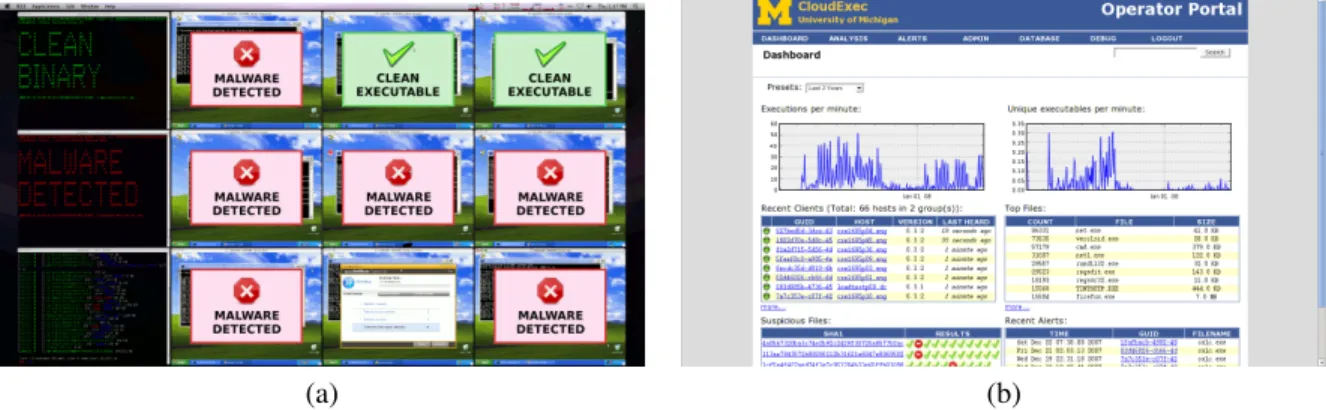
Figure 4: Screen captures of the detection engine VM monitoring interface (a) and the web management portal which provides access to forensic data and threat reports (b).
ular engine when demand for its services increase. Our current implementation employs 12 engines: 10 traditional antivirus engines (Avast, AVG, BitDefender, ClamAV, F-Prot, F-Secure, Kaspersky, McAfee, Syman-tec, and Trend Micro) and 2 behavioral engines (Nor-man Sandbox and CWSandbox). The exact version of each detection engine is listed in Figure 1(a). 9 of the backend engines run in a Windows XP environment us-ing Xen’s HVM capabilities while the other 3 run in a Gentoo Linux environment using Xen domU paravirtu-alization. Implementing each particular engine for the backend is a simple task and extending the backend with additional engines in the future is equally as simple. For reference, the amount of code required for each engine is 42 lines of python code on average with a median of 26 lines of code.
5.3
Management Interface
The third component is a management interface which provides access to the forensics archive, policy enforce-ment, alerting, and report generation. These inter-faces are exposed to network administrators via a web-based management interface. The web interface is im-plemented using Cherrypy, a python web development framework. A screen capture of the dashboard of the management interface is depicted in Figure 4.
The centralized management and network-based ar-chitecture allows for administrators to enforce network-wide policies and define alerts when those policies are violated. Alerts are defined through a flexible specifica-tion language consisting of attributes describing an ac-cess request from the host agent and boolean predicates similar to an SQL WHERE clause. The specification language allows for notification for triggered alerts (via email, syslog, SNMP) and enforcement of administrator-defined policies.
For example, network administrators may desire to block certain applications from being used on end hosts. While these unwanted applications may not be explic-itly malicious, they may have a negative effect on host or network performance or be against acceptable use poli-cies. We observed several classes of these potentially unwanted applications in our production deployment in-cluding P2P applications (uTorrent, Limewire, etc) and multi-player gaming (World of Warcraft, online poker, etc). Other policies can be defined to reinforce prudent security practices, such as blocking the user from execut-ing attachments from an email application.
6
Evaluation
In this section, we provide an evaluation of the proposed architecture through two distinct sources of data. The first source is a dataset of malicious software collected over a period of a year. Using this dataset, we evaluate the effectiveness of N-version protection and retrospec-tive detection. We also utilize this malware dataset to empirically quantify the size of vulnerability window.
The second data source is derived from a production deployment of the system on a campus network in com-puter labs spanning multiple departments for a period of over 6 months. We use the data collected from this de-ployment to explore the performance characteristics of CloudAV. For example, we analyze the number of files handled by the network service, the utility of the caching system, and the time it takes the detection engines to ana-lyze individual files. In addition, we use deployment data to demonstrate the forensics capabilities of the approach. We detail two real-world case studies from the deploy-ment, one involving an infection by malicious software and one involving a suspicious, yet legitimate executable.
Engines 3 Months 1 Month 1 Week 1 73.9% 63.1% 59.6% 2 87.7% 81.0% 77.6% 3 92.0% 87.8% 84.8% 4 93.8% 90.9% 88.4% 5 94.8% 92.4% 90.5% 6 95.4% 93.4% 91.8% 7 95.9% 94.0% 92.8% 8 96.2% 94.5% 93.5% 9 96.5% 94.8% 94.0% 10 96.7% 95.0% 94.4%
(a) 1 Year 3 MonthsRecency of Malware Sample1 Month 1 Week 1 Day d
50 60 70 80 90 100 Percent Detected 1 Engine 2 Engines 3 Engines 4 Engines 5 Engines 6 Engines 7 Engines 8 Engines 9 Engines 10 Engines (b)
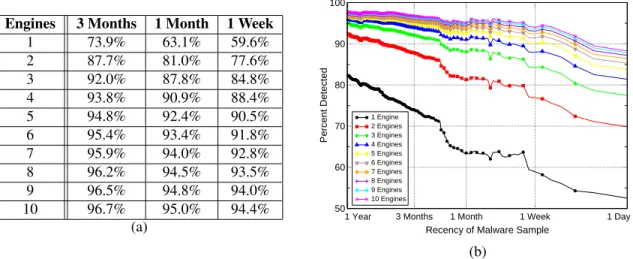
Figure 5: The average detection coverage for the various datasets (a) and the continuous coverage over time (b) when a given number of engines are used in parallel.
6.1
Malware Dataset Results
The first component of the evaluation is based on a mal-ware dataset obtained through Arbor Network’s Arbor Malware Library (AML) [20]. AML is composed of mal-ware collected using a variety of techniques such as dis-tributed darknet honeypots, spam traps, and honeyclient spidering. The use of a diverse set of collection tech-niques means that the malware samples are more rep-resentative of threats faced by end hosts than malware datasets collected using only a single collection method-ology such as Nepenthes [3]. The AML dataset used in this paper consists of 7220 unique malware samples col-lected over a period of one year (November 12th, 2006 to November 11th, 2007). An average of 20 samples were collected each day with a standard deviation of 19.6 sam-ples.
6.1.1 N-Version Protection
We used the AML malware dataset to assess the effec-tiveness of a set of heterogeneous detection engines. Fig-ure 5(a) and (b) show the overall detection rate across dif-ferent time ranges of malware samples as the number of detection engines is increased. The detection rates were determined by looking at the average performance across all combinations of N engines for a given N. For exam-ple, the average detection rate across all combinations of two detection engines over the most recent 3 months of malware was 87.7%.
Figure 5(a) demonstrates how the use of multiple het-erogeneous engines allows CloudAV to significantly im-prove the aggregate detection rate. Figure 5(b) shows the detection rate over malware samples ranging from one day old to one year old. The graph shows how using
ten engines can increase the detection rate for the entire year-long AML dataset as high as 98%.
The graph also reveals that CloudAV significantly im-proves the detection rate of more recent malware. When a single antivirus engine is used, the detection rate de-grades from 82% against a year old dataset to 52% against a day old dataset (a decrease of 30%). How-ever, using ten antivirus engines the detection coverage only goes from 98% down to 88% (a decrease of only 10%). These results show that not only do multiple en-gines complement each other to provide a higher detec-tion rate, but the combinadetec-tion has resistance to coverage degradation as the encountered threats become more re-cent. As the most recent threats are typically the most important, a detection rate of 88% versus 52% is a sig-nificant advantage.
Another noticeable feature of Figure 5 is the decrease in incremental coverage. Moving from 1 to 2 engines results in a large jump in detection rate, moving from 2 to 3 is smaller, moving from 3 to 4 is even smaller, and so on. The diminishing marginal utility of additional engines shows that a practical balance may be reached between detection coverage and licensing costs, which we discuss further in Section 7.
In addition to the averages presented in Figure 5, the minimum and maximum detection coverage for a given number of engines is of interest. For the one week time range, the maximum detection coverage when using only a single engine is 78.6% (Kaspersky) and the minimum is 39.7% (Avast). When using 3 engines in parallel, the maximum detection coverage is 93.6% (BitDefender, Kaspersky, and Trend Micro) and the minimum is 69.1% (ClamAV, F-Prot, and McAfee). However, the optimal combination of antivirus vendors to achieve the most comprehensive protection against malware may not be
a simple measure of total detection coverage. Rather, a number of complex factors may influence the best choice of detection engines, including the types of threats most commonly faced by the hosts being protected, the algo-rithms used for detection by a particular vendor, the ven-dor’s response time to 0-day malware, and the collection methodology and visibility employed by the vendor to collect new malware.
6.2
Retrospective Detection
We also used the AML malware dataset to understand the utility of retrospective detection. Recall that retrospec-tive detection is the ability to use historical information and archived files stored by CloudAV to retrospectively detect and identify hosts infected that with malware that has previously gone undetected. Retrospective detection is an especially important post-infection defense against 0-day threats and is independent of the number or vendor of antivirus engines employed. Imagine a polymorphic threat not detected by any antivirus or behavioral engine that infects a few hosts on a network. In the host-based antivirus paradigm, those hosts could become infected, have their antivirus software disabled, and continue to be infected indefinitely.
In the proposed system, the infected file would be sent to the network service for analysis, deemed clean, archived at the network service, and the host would be-come infected. Then, when any of the antivirus ven-dors update their signature databases to detect the threat, the previously undetected malware can be re-scanned in the network service’s archive and flagged as mali-cious. Instantly, armed with this new information, the network service can identify which hosts on the network have been infected in the past by this malware from its database of execution history and notify the administra-tors with detailed forensic information.
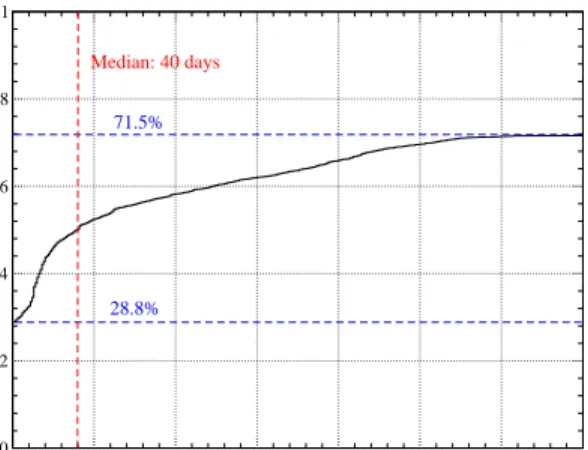
Retrospective detection is especially important as fre-quent signature updates from vendors continually add coverage for previously undetected malware. Using our AML dataset and an archive of a year’s worth of McAfee DAT signature files (with a one week granularity), we de-termined that approximately 100 new malware samples were detected each week on average (with a standard de-viation of 57) by the McAfee updates. More importantly, for those samples that were eventually detected by a sig-nature update (5147 out of 7220), the average time from when a piece of malware was observed to when it was detected (i.e. the vulnerability window) was approxi-mately 48 days. A cumulative distribution function of the days between observation and detection is depicted in Figure 6.
0 50 100 150 200 250 300 350
Days Between Observation and Detection 0 0.2 0.4 0.6 0.8 1
Fraction of Malware Samples
71.5%
28.8%
Median: 40 days
Figure 6: Cumulative distribution function depicting the number of days between when a malware sample is ob-served and when it is first detected by the McAfee an-tivirus engine.
6.3
Deployment Results
With the aid of network operations and security staff we deployed CloudAV across a large campus network. In this section, we discuss results based on the data col-lected as a part of this deployment.
6.3.1 Executable Events
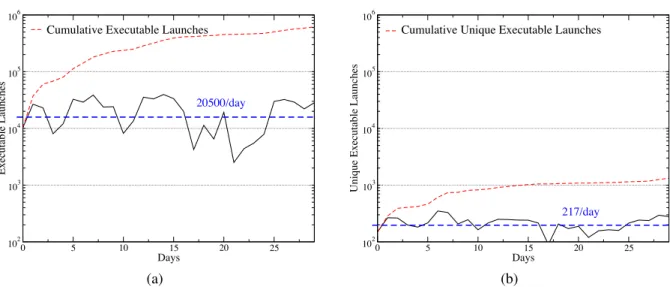
One of the core variables that impacts the resource re-quirements of the network service is the rate at which new files must be analyzed. If this rate is extremely high, extensive computing resources will be required to handle the analysis load. Figure 7 shows the number of total ex-ecution events and unique executables observed during a one month period in a university computing lab.
Figure 7 shows that while the total number of executa-bles run by all the systems in the lab is quite large (an average of 20,500 per day), the number of unique exe-cutables run per day is two orders of magnitude smaller (an average of 217 per day). Moreover, the number of unique executables is likely inflated due to the fact that these machines are frequently used by students to work on computer science class projects, resulting in a large number of distinct executables with each compile of a project. A more static, non-development environment would likely see even less unique executables.
We also investigated the origins of these executables based on the file path of 1000 unique executables stored in the forensics archive. Table 1 shows the break down of these sources. The majority of executables originate from the local hard drive but a significant portion were launched from various network sources. Executables from the temp directory often indicate that they were
0 5 10 15 20 25 Days 102 103 104 105 106 Executable Launches
Cumulative Executable Launches
20500/day 0 5 10 15 20 25 Days 102 103 104 105 106
Unique Executable Launches
Cumulative Unique Executable Launches
217/day
(a) (b)
Figure 7: Executable launches (a) and unique executable launches (b) per day over a one month period in a represen-tative sample of 50 machines in the deployment.
Program Files 22.3%
Local Drives Temp Directory 14.2%
52.4% Windows Directory 13.4%
Other 2.4%
Engineering Apps 23.6%
Network Drives User Desktop Shares 9.3% 43.3% User AFS Shares 8.3%
Other 2.1%
External Media USB Flash 2.4%
4.4% CDROM Drive 2.0%
Table 1: A distribution of the sources of 1000 executa-bles observed in during the deployment of our host agent over a six-month period.
downloaded via a web browser and executed, contribut-ing even more to networked origins. In addition, a non-trivial number of executables were introduced to the sys-tem directly from external media such as a CDROM drive and USB flash media. This diversity exemplifies the need for a host agent that is capable of acquiring files from a variety of sources.
6.3.2 Caching and Performance
A second important variable that determines the scalabil-ity and performance of the system is the cache hit rate. A hit in the local cache can prevent network requests, and a hit in the remote cache can prevent unnecessary files transfers to the network service. The hosts instrumented as a part of the deployment were heavily loaded
Win-dows XP workstations. The WinWin-dows Start Menu con-tained over 250 executable applications including a wide range of internet, multimedia, and engineering packages. Our results indicate that 10 processes were launched from when the host agent service loads to when the login screen appears and another 52 processes were launched before the user’s desktop loaded. As a measure of over-head, we measured the number of bytes transferred be-tween a specific client and network service under dif-ferent caching conditions. With a warm remote cache, the boot-up process took 8.7 KB and the login process took 46.2 KB. In the case of a cold remote cache, which would only ever occur a single time when the first host in the network loaded for the first time, the boot-up process took 406 KB and the login process took 12.5 MB. For comparison, the Active Directory service installed on the deployment machines took 171 KB and 270 KB on boot and login respectively.
It is also possible to evaluate the performance of the caching system by looking at Figure 7. We recorded al-most over 615,000 total execution events over one month yet only observed 1300 unique executables. As a remote cache miss only happens when a new executable is ob-served, the remote cache hit rate is approximately 99.8%. Even more significant, the local cache can be pre-seeded with known installed software during the host agent in-stallation process, improving the hit rate further. In the infrequent case when a miss occurs in both the local and remote cache, the candidate file must be transferred to the network service. Network latency, throughput, and analysis time all affect the user-perceived delay between when a file is acquired by the host agent and a threat report is returned by the network service. As local
net-works usually have low latencies and high bandwidth, the analysis time of files will often dominate the network latency and throughput delay. The average time for a detection engine to analyze a candidate file in the AML dataset was approximately 1.3 seconds with a standard deviation of 1.8 seconds.
6.3.3 Forensics Case Studies
We review two case studies from the deployment concerning two real-world events that demonstrate the utility of the forensics archive.
Malware Case Study: While running the host agent in transparent mode in the campus deployment, the Clou-dAV system alerted us to a candidate executable that had been marked as malicious by multiple antivirus engines. It is important to note that this malicious file success-fully evaded the local antivirus software (McAfee) that was installed along side our host agent. Immediately, we accessed the management interface to view the forensics information associated with the tracked execution event and runtime behavioral results provided the two behav-ioral engines employed in our network service.
The initial executable launched by the user was
warcraft3keygen.exe, an apparent serial number generator for the game Warcraft 3. This executable was just a bootstrap for them222.exeexecutable which was written to the Windows temp directory and subsequently launched via CreateProcess. m222.exe then copied itself toC:\Program Files\Intel\Intel, made itself hidden and read-only, and created a fraudulent Windows service via the Service Control Manager (SCM) called
Remote Procedure Call (RPC) MO to launch itself automatically at system startup. Additionally, the malware attempted to contact command and control infrastructure through DNS requests for several names including 50216.ipread.com, but the domains had already been blackholed.
Legitimate Case Study: In another instance, we were alerted to a candidate executable that was flagged as sus-picious by several engines. The executable in question was the PsExec utility from SysInternals which allows for remote control and command execution. Given that this utility can be used for both malicious and legitimate purposes, it was worthy of further investigation to deter-mine its origin.
Using the management interface, we were able to im-mediately drill down to the affected host, user, files, and environment of the suspected event. The PsExec service
psexesvc.exe was first launched from the parent pro-cessservices.exewhen an incoming remote execution request arrived from the PsExec client. The next
execu-tion event wasnet.exewith the command line argument
localgroup administrators, which results in the list-ing of all the users in the local administrators group.
Three factors led us to dismiss the event as legitimate. First, the operation performed by the net command was not overtly malicious. Second, the user performing this action was a known network administrator. Lastly, we were able to determine the net.exe executable was iden-tical to the one deployed across all the hosts in the net-work, ruling out the case where the net.exe program it-self may have been a trojaned version. While this event could be seen as a false positive, it is actually an impor-tant alert that needs to dealt with by a network adminis-trator. The forensic and historical information provided through the management interface allows these events to be dealt with remotely in an accurate and efficient man-ner.
7
Discussion and Limitations
Moving detection functionality into the network cloud has other technical and practical implications. In this section we attempt to highlight limitations of the pro-posed model and then describe a few resulting benefits.
7.1
User Context and Environment in
De-tection Engines
One important benefit of running detection engines on end systems is that local context such as user input, net-work input, operating system state, and the local filesys-tem are available to aid detection algorithms. For ex-ample, many antivirus vendors use behavioral detection routines that monitor running processes to identify mis-behaving or potentially malicious programs.
While it is difficult to replicate the entire state of end systems inside the network cloud, there are two general techniques an in-cloud antivirus system can use to pro-vide additional context to detection engines. First, de-tection engines can open or execute files inside a VM instance. For example, existing antivirus behavioral de-tection system can be leveraged by opening and running files inside a virtual antivirus detection instance. A sec-ond technique is to replicate more of the local end sys-tem state in the cloud. For example, when a file is sent to the network service, contextual metadata such as other running processes can be attached to the submission and used to aid detection. However, because complete local state can be quite large, there are many instances where deploying local detection agents may be required to com-pliment in-cloud detection.
7.2
Disconnected Operation
Another challenge with moving detection into the net-work is that netnet-work connectivity is needed to analyze files. An end host participating in the service may enter a disconnected state for many reasons including network outages, mobility constraints, misconfiguration, or denial of service attacks. In such a disconnected state, the host agent may not be able to reach the network service to check the remote cache or to submit new files for analy-sis. Therefore, in certain scenarios, the end host may be unable to complete its desired operations.
Addressing the issue of disconnected operation is pri-marily an issue of policy, although the architecture in-cludes technical components that aid in continued pro-tection in a disconnected state. For example, the local caching employed by our host agent effectively allows a disconnected user to access files that have previously been analyzed by the network service. However, for files that have not yet been analyzed, a policy decision is nec-essary. Security-conscious organizations may select a strict policy requiring that users have network connec-tivity before accessing new applications, while organiza-tions with less strict security policies may desire more flexibility. As our host agent works together with host-based antivirus, local antivirus software installed on the end host may provide adequate protection for these en-vironments with more liberal security policies until net-work access is restored.
7.3
Sources of Malicious Behavior
Malicious code or inputs that cause unwanted program behavior can be present in many places such as in the linking, loading, or running of the initial program in-structions, and the reading of input from memory, the filesystem, or the network. For example, some types of malware use external files such as DLLs loaded at run-time to store and later execute malicious code. In addi-tion, recent vulnerabilities in desktop software such as Adobe Acrobat [1] and Microsoft Word [32] have exem-plified the threat from documents, multimedia, and other non-executable malcode-bearing file types. Developing a host agent that handles all these different sources of malicious behavior is challenging.
The CloudAV implementation described in this paper focuses on executables, but the host agent can be ex-tended to identify other file types. To explore the chal-lenges of extending the system we modified the host agent to monitor the DLL dependencies for each exe-cutable acquired by the host agent. Each dependent DLL of an application is processed similar to the executable it-self: the local and remote cache is checked to determine if it has been previously analyzed, and if not, it is
trans-AV Vendor 3 Months 1 Month 1 Week
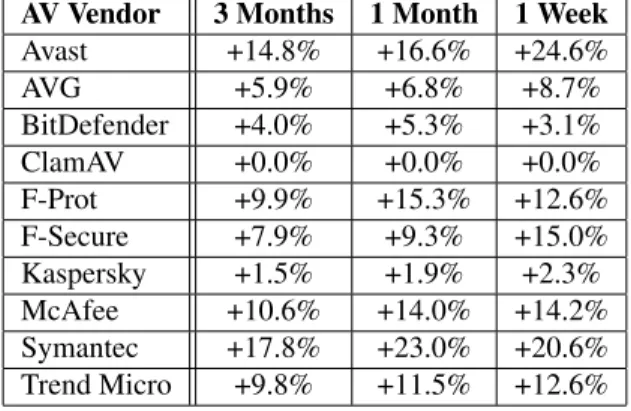
Avast +14.8% +16.6% +24.6% AVG +5.9% +6.8% +8.7% BitDefender +4.0% +5.3% +3.1% ClamAV +0.0% +0.0% +0.0% F-Prot +9.9% +15.3% +12.6% F-Secure +7.9% +9.3% +15.0% Kaspersky +1.5% +1.9% +2.3% McAfee +10.6% +14.0% +14.2% Symantec +17.8% +23.0% +20.6% Trend Micro +9.8% +11.5% +12.6% Table 2: The percentage increase in detection coverage obtained when ClamAV, a truly free engine, is added to a deployment with only a single engine.
mitted to the network service for analysis. Extending the host agent further to handle documents would be as sim-ple as instructing the host agent to listen for filesystem events for the desired file types. In fact, the types of files acquired by the host agent could be dynamically config-ured at a central location by an administrator to adapt to evolving threats.
7.4
Detection Engine Licensing
Most of the antivirus and behavioral engines employed in our architecture required paid licenses. Acquiring li-censes for all the engines may be infeasible for some or-ganizations. While we have chosen a large number of engines for evaluation and measurement purposes, the full amount may not be necessary to obtain effective pro-tection. As seen in Figure 5, ten engines may not be the most effective price/performance point as diminish-ing returns are observed as more engines are added.
We currently employ four free engines in our sys-tem for which paid licenses were not necessary: AVG, Avast, BitDefender, and ClamAV. Using only these four engines, we are still able to obtain 94.3%, 92.0%, and 88.0% detection coverage over periods of 3 months, 1 month, and 1 week respectively. These detection cover-age values for the combined free engines exceed every single vendor in each dataset period.
While the interpretation of the various antivirus li-censes is unclear in our architecture, especially with re-gards to virtualization, it is likely that site-wide licenses would be needed for the “free” engines for a commercial deployment. Even if only one licensed engine is used, our system still maintains the benefits such as forensics and management. As an experiment for this scenario, we measured how much detection coverage would be gained by adding the only truly free (GPL licensed) antivirus
product, ClamAV, to an existing system employing only a single engine. Although ClamAV is not an especially effective engine by itself, it can add a significant amount of detection coverage, up to a 25% increase when paired with another engine as seen in Table 2.
7.5
Managing False Positives
The use of parallel detection engines has important im-plications for the management of false positives. While multiple detection engines can increase detection cov-erage, the number of false positives encountered during normal operation may increase when compared to a sin-gle engine. While antivirus vendors try hard to reduce false positives, they can severely impair productivity and take weeks to be corrected by a vendor.
The proposed architecture provides the ability to ag-gregate results from different detection techniques which enables the unique ability to trade-off detection coverage for false positive resistance. If an administrator wanted maximal detection coverage they could set the aggrega-tion funcaggrega-tion to declare a candidate file unsafe ifany de-tector indicated the file malicious. However, a false pos-itive in any of the detector would cause the aggregator to declare the file unsafe.
In contrast, an administrator more concerned about false positives may set the aggregation function to de-clare a candidate file unsafe if at least half of the detec-tors deemed the file malicious. In this way multiple de-tection engines can be used to reduce the impact of false positives associated with any single engine.
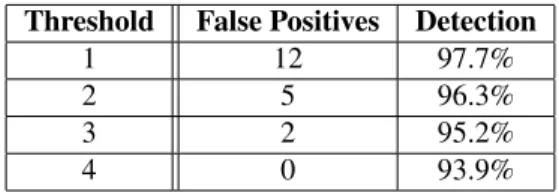
To explore this trade-off, we collected 12 real-world false positives that impact different detectors in Clou-dAV. These files range from printer drivers to password recovery utilities to self-extracting zip files. We defined a threshold, or confidence index, of the number of en-gines required to detect a file before deeming it unsafe. For each threshold value, we measured the number of remaining false positives and also the corresponding de-tection rate of true positives.
The results of this experiment are seen in Table 3. At a threshold of 4 engines, all of the false positives are elim-inated while only decreasing the overall detection cover-age by less than 4%. As this threshold can be adjusted at any time via the management interface, it can set by an administrator based on the perceived threat model of the network and the actual number of false positives encoun-tered during operation.
A second method of handling false positives is enabled by the centralized management of the network service. In the case of a standard host-based antivirus deployment, encountering a false positive may mean weeks of delay and loss of productivity while the antivirus vendor ana-lyzes the false positive and releases an updated signature
Threshold False Positives Detection
1 12 97.7%
2 5 96.3%
3 2 95.2%
4 0 93.9%
Table 3: The number of false positives observed at each engine threshold and the associated detection coverage over the full malware dataset.
set to all affected clients. In the network-based architec-ture, the false positive can be added to a network-wide whitelist through the management interface in a matter of minutes by a local administrator. This whitelist manage-ment allows administrators to alleviate the pain of false positives and empowers them to cut out the antivirus ven-dor middle-man and make more informed and rapid de-cisions about threats on their network.
7.6
Breaking Free of Vendor Lock-in
Finally, a serious issue associated with extensive deploy-ments of host-based antivirus in a large enterprise or or-ganizational network is vendor lock-in. Once a partic-ular vendor has been selected through an organization’s evaluation process and software is deployed to all depart-ments, it is often hard to switch to a new vendor at a later point due to technical, management, and bureaucratic is-sues. In reality, organizations may wish to switch an-tivirus vendors for a number of reasons such as increased detection coverage, decreased licensing costs, or integra-tion with network management devices.
The proposed antivirus architecture is innately vendor-neutral as it separates the acquisition of candidate files on the end host from the actual analysis and detection process performed in the network service. Therefore, even if only one detection engine is employed in the net-work service, a netnet-work administrator can easily replace it with another vendor’s offering if so desired, without an upheaval of existing infrastructure.
8
Conclusion
To address the ever-growing sophistication and threat of modern malicious software, we have proposed a new model for antivirus deployment by providing antivirus functionality as a network service using N-version pro-tection. This novel paradigm provides significant ad-vantages over traditional host-based antivirus including better detection of malicious software, enhanced foren-sics capabilities, retrospective detection, and improved deployability and management. Using a production im-plementation and real-world deployment of the CloudAV
platform, we evaluated the effectiveness of the proposed architecture and demonstrated how it provides signifi-cantly greater protection of end hosts against modern threats.
In the future, we plan to investigate the application of N-version protection to intrusion detection, phishing, and other realms of security that may benefit from het-erogeneity. We also plan to open our backend analysis infrastructure to security researchers to aid in the detec-tion and classificadetec-tion of collected malware samples.
Acknowledgments
This work was supported in part by the Department of Home-land Security (DHS) under contract number NBCHC060090 and by the National Science Foundation (NSF) under contract number CNS 0627445.
References
[1] Adobe Systems Incorporated. Apsb07-18: Adobe reader and acrobat vulnerability. http://www.adobe.com/support/ security/bulletins/apsb07-18.html, 2007.
[2] Algirdas Avizienis. The n-version approach to fault-tolerant soft-ware.IEEE Transactions on Software Engineering, 1985. [3] Paul Baecher, Markus Koetter, Thorsten Holz, Maximillian
Dorn-seif, and Felix Freiling. The nepenthes platform: An efficient ap-proach to collect malware. In9th International Symposium On Recent Advances In Intrusion Detection. Springer-Verlag, 2006. [4] Josh Ballard. An Eye on the Storm: Inside the Storm Epidemic.
41st Meeting of the North Americian Network Operators Group, October 2007.
[5] Barracuda Networks. Barracuda spam firewall. http://www. barracudanetworks.com, 2007.
[6] Carsten Willems and Thorsten Holz. Cwsandbox.http://www. cwsandbox.org/, 2007.
[7] Cloudmark. Cloudmark authority anti-virus. http://www. cloudmark.com, 2007.
[8] George W. Dunlap, Samuel T. King, Sukru Cinar, Murtaza Bas-rai, and Peter M. Chen. ReVirt: Enabling intrusion analysis through virtual-machine logging and replay. InProceedings of the 2002 Symposium on Operating Systems Design and Imple-mentaiton (OSDI), December 2002.
[9] F-Secure Corporation. F-secure mobile anti-virus. http:// mobile.f-secure.com/, 2007.
[10] Gartner, Inc. Forecast: Security software worldwide, 2006-2011, update. http://www.gartner.com/DisplayDocument? ref=g_search&id=510567&subref=advsearch, 2007. [11] Hispasec Sistemas. Virus total.http://virustotal.com, 2004. [12] Piotr Indyk, Rajeev Motwani, Prabhakar Raghavan, and San-tosh Vempala. Locality-preserving hashing in multidimensional spaces. InProceedings of the twenty-ninth annual ACM sympo-sium on Theory of computing (STOC 1997), May 1997. [13] Kaspersky Lab. Kaspersky mobile security. http://usa.
kaspersky.com/products_services/antivirus-mobile. php, 2007.
[14] Samuel T. King and Peter M. Chen. Backtracking intrusions. In
Proceedings of the 19th ACM Symposium on Operating Systems Principles (SOSP’03), Bolton Landing, NY, USA, 2003. [15] Abhishek Kumar, Vern Paxson, and Nicholas Weaver.
Exploit-ing underlyExploit-ing structure for detailed reconstruction of an internet-scale event.Proceedings of the USENIX/ACM Internet Measure-ment Conference, October 2005.
[16] Mathias Rauen. madcodehook.http://madshi.net/, 2008. [17] Microsoft. Microsoft security intelligence report:
July-december 2006. http://www.microsoft.com/technet/ security/default.mspx, May 2007.
[18] Alexander Moshchuk, Tanya Bragin, Damien Deville, Steven D. Gribble, and Henry M. Levy. Spyproxy: Execution-based de-tection of malicious web content. InProceedings of the 16th USENIX Security Symposium, August 2007.
[19] Lajos Nagy, Richard Ford, and William Allen. N-version pro-gramming for the detection of zero-day exploits. InIEEE Topi-cal Conference on Cybersecurity, Daytona Beach, Florida, USA, 2006.
[20] Arbor Networks. Arbor malware library (AML). http://www. arbornetworks.com, 2007.
[21] NIST/DHS/US-CERT. National vulnerability database. http: //nvd.nist.gov/, 2007.
[22] Norman Solutions. Norman sandbox whitepaper. http://download.norman.no/whitepapers/whitepaper_ Norman_SandBox.pdf, 2003.
[23] Jon Oberheide, Evan Cooke, and Farnam Jahanian. Rethink-ing antivirus: Executable analysis in the network cloud. In2nd USENIX Workshop on Hot Topics in Security (HotSec 2007), Au-gust 2007.
[24] John Ogness. Dazuko: An open solution to facilitate on-access scanning.Virus Bulletin, 2003.
[25] Niels Provos. Spybye. http://www.monkey.org/˜provos/ spybye, 2007.
[26] Rodrigo Rodrigues, Miguel Castro, and Barbara Liskov. Base: using abstraction to improve fault tolerance. InProceedings of the eighteenth ACM symposium on Operating systems principles, New York, NY, USA, 2001.
[27] SANS. Top-20 2007 security risks. http://www.sans.org/ top20/, 2007.
[28] S. Sidiroglou, J. Ioannidis, A.D. Keromytis, and S.J. Stolfo. An Email Worm Vaccine Architecture.Proceedings of the 1st Infor-mation Security Practice and Experience Conference (ISPEC), pages 97–108, 2005.
[29] Stelios Sidiroglou, Angelos Stavrou, and Angelos D. Keromytis. Mediated overlay services (moses): Network security as a com-posable service. InProceedings of the IEEE Sarnoff Symposium, Princeton, NJ, USA, 2007.
[30] Symantec Corporation. Symantec security advisory (sym06-010). http://www.symantec.com/avcenter/security/ Content/2006.05.25.html, 2006.
[31] Symantec Corporation. Symantec mobile antivirus for win-dows mobile.http://www.symantec.com/norton/products/ overview.jsp?pcid=pf&pvid=smavwm, 2007.
[32] Symantec Security Response Team. Ms word exploit creation tool. http://www.symantec.com/enterprise/security_ response/weblog/2007/04/ms_word_exploit_creation_ tool.html, 2007.
[33] Vinod Yegneswaran, Paul Barford, and Somesh Jha. Global intru-sion detection in the DOMINO overlay system. InProceedings of Network and Distributed System Security Symposium (NDSS ’04), San Diego, CA, February 2004.