Exploring Software Refactoring Decisions
in a Lean Startup
School of Science
Thesis submitted for examination for the degree of Master of Science in Technology.
Espoo 30.11.2015
Thesis supervisor:
Author: Ömer Furkan Tercan
Title: Exploring Software Refactoring Decisions in a Lean Startup
Date: 30.11.2015 Language: English Number of pages: 8+54 Department of Computer Science and Engineering
Professorship: Software Engineering Code: T-76 Supervisor and advisor: Assoc. Prof. Casper Lassenius
Software systems are continuously forced to evolve as they can not resist change. Quality typically degenerates as a software is subjected to change during the course of its lifetime. In this process, software quality must be audited, secured, and maintained, whereas maintaining such a system demands continuous refactoring.
Researchers have contributed widely in the area of software refacting. Fowler and Beck have introduced 22 problematic code smells considered as drivers for refactoring decisions, whereas Brown et al. have identified development anti-patterns known to make systems harder to maintain.
In spite of the wide contribution in the field, there is still little evidence to justify the usage of refactoring drivers. This study aims to contribute in this research gap by finding evidence on how software practitioners behave when making refactoring decisions.
To achieve its objective, this study initially conducts a literature review on the drivers for refactoring decisions, i.e., code smells and anti-patterns. Further, it examines relevant literature exploring the usage of these drivers.
Finally, we conduct a case study introducing new empirical evidence on how software practitioners make use of refactoring drivers. We further discuss the relation between our empirical findings and the examined literature.
Our key findings indicate that the code smells and anti-patterns found in the literature are not enough to be used as a basis for refactoring decisions. Drivers related to code documentation and style have been mostly neglected in the literature, whereas together they were the underlying reason for the 45% of all refactoring decision made in the case company.
Preface
This study was conducted while I work in a lean startup company to help improve their agile development process. I would like to thank all my colleagues for their kind support and valuable input when making this case study.
I would like to thank my supervisor Casper Lassenius for his guidance, encouragements and suggestions. His mentoring was very valuable in finishing this work.
Additionally, many thanks to all friends for just hanging in there.
Finally, I would like to express my deepest gratitude for being together with my dear wife, wonderful children and big-hearted parents.
Contents
Abstract ii
Preface iii
Contents iv
1 Introduction 1
1.1 Background and motivation . . . 1
1.2 Objective and research questions . . . 2
1.3 Structure and scope of the thesis . . . 3
2 Software refactoring 5 2.1 Drivers for refactoring decisions . . . 6
2.1.1 Code smells . . . 7
2.1.2 Development anti-patterns . . . 16
2.1.3 Summary . . . 21
2.2 Practitioner’s perception of refactoring drivers . . . 23
2.2.1 Know-how and the perceived usefulness of drivers . . . 23
2.2.2 Criticality of drivers . . . 25
2.2.3 Recurrence rate of drivers . . . 26
3 Research methodology 28 3.1 Case company . . . 29
3.2 Data collection and analysis . . . 31
4 Results and discussion 34 4.1 Refactoring ratio . . . 34
4.2 Identified refactoring drivers and driver groups . . . 34 4.2.1 Documentation . . . 36 4.2.2 Style . . . 38 4.2.3 Robustness . . . 39 4.2.4 Modifiability. . . 40 4.3 Discussion . . . 44
4.3.1 The literature’s view on refactoring decisions (RQ1) . . . 44
4.3.2 The practitioner’s view on refactoring decisions (RQ2) . . . . 46
5 Conclusions 50 5.1 Threads to Validity . . . 51
5.2 Future Work. . . 52
Glossary
IDE Integrated development environment. 8, 37, 39 LOC Lines of code. vii, 29, 30
List of Tables
1 Benefits of software refactoring . . . 6
2 Refactoring activities . . . 6
3 The blob anti-pattern view . . . 17
4 Lava flow anti-pattern view . . . 17
5 Functional decomposition anti-pattern view . . . 18
6 Poltergeists anti-pattern view . . . 18
7 Golden hammer anti-pattern view . . . 18
8 Spaghetti code anti-pattern view . . . 19
9 Cut and paste programming anti-pattern view . . . 20
10 A taxonomy of code smells . . . 21
11 Development Anti-patterns and their symptoms (code smells) . . . . 22
12 Quantitative studies on software refactoring drivers . . . 24
13 Study aspects and examined relevant literature . . . 25
14 Research questions and sub-questions . . . 28
15 Relation between the research questions and conducted work . . . 29
16 Server backend; number of files and LOC . . . 29
17 Android client; number of files and LOC . . . 30
18 Web client; number of files and LOC . . . 30
19 Refactoring driver groups and data codes . . . 33
20 The number of refactoring commits compared to the number of all commits . . . 34
List of Figures
1 Distribution of the used driver groups . . . 35
2 Distribution of the used drivers . . . 36
3 Name change driver distribution . . . 38
4 Code formatting driver distribution . . . 39
5 Object-oriented drivers and how they relate to the software components 41 6 Number of refactorings per driver . . . 47
1
Introduction
In this chapter, section 1.1 presents the study background and motivation. The following section 1.2introduces the objective and research questions. Finally, section
1.3 summarizes the structure and scope of this document.
1.1
Background and motivation
Software systems are continuously forced to evolve due to ongoing system require-ments. During this process, software quality must be audited, secured, and maintained. Otherwise, quality typically degenerates as software systems are constantly subjected to change.
Lehman’s laws of software evolution [1] state that, a functionality increment of a system always brings a corresponding decrease in the quality and an increase in the internal complexity. Therefore, in order to maintain software quality, each and every functionality increment of a system should be accompanied by a number of supplemental activities. Such maintenance activities imply continuous improvement on software code base, namely refactoring. For instance, in order to maintain and re-develop its products, Microsoft reserves 20% of its development effort for software refactoring [5].
Software refactoring is a process of change and improvement. It changes and improves the internal structure of a software system without altering its external behavior [6]. This activity improves code understandability, allows easier debugging and accelerates software development. Refactoring improves software quality. Typically, it achieves this by resolving quality defects such as code smells, development anti-patterns and other anomalies [21].
Refactoring naturally fits within the process of software reengineering [10], which aims to restructure legacy software. Therefore, refactoring as a concept was previously practiced as part of software restructuring. When object-oriented design emerged as a contemporary concept in the early nineties, the term refactoring became more prominent [6].
Researchers have contributed with a wide range of studies in the field of software refactoring. Fowler and Beck [6] have introduced 22 problematic code structures within the object-oriented context that points to refactoring needs. Mäntylä et al. [11] have outlined a classification for these 22 smells and further investigated the correlation among them by conducting an empirical study. Similarly, Brown et al. have listed 14 development anti-patterns in his book[4] and discusses design flaws that make systems harder to maintain.
and empirical studies to examine refactoring decisions. Siy and Votta [9] have studied data of 130 code inspection sessions and have introduced four groups of code maintenance drivers, namely documentation, style, portability, and safety. They have also presented empirical evidence on how software practitioners perceive these drivers. In their survey [23], Yamashita and Moonen have inspected code smells from the practitioner’s perspective and have presented a prioritized list of smells. In addition to these, there are empirical studies that introduce automated tool support for detecting code smells [7, 8, 13].
Even though there is significant amount of related work identifying software refactoring drivers, there is still little evidence to justify the usage of these drivers. In particular, the study of the human perception of what a code smell is and how to deal with it has been mostly neglected in the past. In order to understand the usage of these drivers, the software practitioner’s perception of refactoring drivers can be investigated. Having such focus on the human factor, further research on the drivers behind refactoring decisions can bring significant contribution to this research gap.
Motivated by the prior studies and the identified research gap, this thesis investigates the performed refactoring decisions in a lean startup software company. This is achieved through a case study. The results of the case study is analyzed, discussed and the most significant findings are compared with the existing scientific knowledge on refactoring decisions. This study also discusses relevant issues which can be investigated further in the future.
This study contains an overview of software refactoring in Chapter 2. This chapter presents refactoring drivers found in literature, namely code smells and development anti-patterns. It introduces a study of related surveys and empirical work which investigates refactoring decisions and practitioner perceptions.
1.2
Objective and research questions
According to the motivation stated in section 1.1, there is a need to investigate and reveal the correlation between how literature have conceptualized drivers for software refactoring decisions and how it is actually perceived by software practitioners. Accordingly, an empirical study can be conducted investigating refactoring decisions in a case company. The empirical findings can then be analyzed and compared with the scientific knowledge regarding software refactoring decision.
Objective
Study software refactoring decisions, particularly how it is conceptualized in the literature and comparably how it is perceived by software practitioners.
The following research questions were derived based on the main objective.
Research questions
RQ1: What does the literature say on how refactoring decision are made?
This research question attempts to investigate relevant literature to form a basis on refactoring decision making, In particular, it aims to identify the underlying drivers for refactoring decisions. This research question can be further investigated in two sub-questions:
• RQ1.1:What does the literature say about the terminology used in identifying drivers for refactoring decisions?
• RQ1.2: What quantitative findings does the literature reveal regarding these drivers?
RQ2: How does developers make refactoring decisions?
This research question is of exploratory nature and it aims to find new empirical evidence on the drivers for refactoring decisions. It takes into account that all software development activities are highly human dependent. Therefore, the developer’s perception is kept in the research foreground. This research question can be divided into two sub-questions:
• RQ2.1: What are the identified refactoring drivers from the viewpoint of software developers?
• RQ2.2: How does their viewpoints relate to the literature?
1.3
Structure and scope of the thesis
Chapter1presents the background and motivation of the thesis. This is accompanied by the main objective and research questions.
Following the introduction, Chapter2introduces an overview on software refactoring. It presents the refactoring drivers found in literature. This chapter concludes by
outlining the most relevant surveys and empirical studies that are investigating refactoring drivers and software practitioner perceptions.
Chapter 3 elaborates the main study objective and research questions. Furthermore, it presents the case study environment and the case study methodology.
Chapter 4 reports the case study results and discusses the findings. Collected and analyzed empirical data on refactoring decisions are presented. This is accompanied by a discussion on the comparison of the literature findings and case study findings.
Finally, Chapter 5 concludes the outcome of the thesis. It presents the potential validity threats and indicates future research areas.
2
Software refactoring
The term software refactoring was introduced for the first time by William F. Opdyke in his Ph.D. dissertation [3]. It became more practical and commonly used after the publication of the book Refactoring: Improve the Design of Existing Code, which was written by Martin Fowler in the year 1999 [6].
Refactoring is the process of making code level changes to improve its internal structure. The cumulative effect of these changes can radically improve software design [6]. Software refactoring is a form of code modification, used to improve the software structure in support of subsequent extension and long-term maintenance, in most cases having the goal to transform code without impacting correctness [4]. The basic principle in refactoring process is reorganizing classes, variables and methods across the class hierarchy to facilitate future adaptations and extensions, so that the source code can have better structure, readability and understandability [24].
Refactoring is important in order to maintain and improve code evolvability [15]. Particularly in agile development, refactoring is considered as a key practice and applied as a building block in order to compensate the lack of upfront design [15].
Refactoring is also performed to improve software readability. It improves code readability similarly to other quality attributes without introducing any observable behaviour change to the software. Any user, whether an end user or another developer, can not tell that things have changed [6].
Refactoring can improve code maintainability. It can assist the code in conforming to coding standards, help minimize redundancies, improve software security, and enable system portability [9].
An outline of the most significant benefits of software refactoring is presented in Table 1.
According to a survey on software refactoring [14], the refactoring process consists of a number of sequential activities presented in Table2.
This thesis mainly discusses the first two activities;identifying the areas for refactoring
(drivers) and determining which refactoring solutions should be applied. Accordingly, this section presents refactoring drivers addressed in the literature, namely code smells and development anti-patters. The Proposed refactoring solutions are also described under each refactoring driver.
Table 1: Benefits of software refactoring
Benefit Explanation
Removes duplicated code Programs having duplicated code are difficult to modify, as they need be modified in multiple ways for a single change
Improves the design The software design will decays unless develop-ers perform regular refactoring as they make code changes to realise short term goals
Makes the code easier to un-derstand
Even if codes are written to instruct computers, there is always someone who will try to read. Even the code owner might have problems understanding the logic after several months if code understand-ability is neglected.
Helps to program faster A good design is important to maintain speed in software development. Refactoring improves soft-ware quality, thus reduces commonly faced issues such as extendability and maintainability.
Table 2: Refactoring activities
Activity
1 Identify the areas for refactoring
2 Determine which refactoring solutions should be applied to the identified areas
3 Guarantee that the applied refactoring preserves behavior 4 Apply the refactoring
5 Assess the effect of the refactoring on quality characteristics of the software (e.g., complexity, understandability, maintainability) or the process (e.g.,
productivity, cost, effort)
6 Maintain the consistency between the refactored program code and other software artifacts (such as documentation, design documents, requirements specifications, tests, etc.)
2.1
Drivers for refactoring decisions
Identifying where to refactor in a software system can be difficult. Particularly, locating problematic parts known as code smells and anti-patterns can be quite
challenging. However once detected, these problematic parts can be used as drivers for refactoring decisions.
In this chapter we identify the mainly referred drivers for refactoring decisions in the literature. In Chapter4, we will then compare and discuss these findings together with our empirical results.Drivers for refactoring decisions are outlined in two categories; code smells [6] and development level anti-patterns [4].
2.1.1 Code smells
Code smells or bad smells are structures in code that suggest the possibility for software refactoring [6]. A Code smell does not indicate how to solve a problematic peace of code, but it narrows down the number of potential refactoring solutions that can be performed. Fowler provides a list of code smells and recommends possible refactoring solutions for each smell. In this manner, determining the drivers (code smells) and solutions would assist developers in making more intelligent refactoring decisions [6]
Fowler identifies code smells that primarily occur in object-oriented design. He recommends refactoring solutions based on object-oriented design patterns for smells occurring in cases of; interacting objects, information hiding, inheritance, interfaces, and polymorphism. Therefore, code smells can be derived based on poorly used, over-used, or misused object-oriented design principles.
As a supporting work, Mäntylä et al. classifies Fowler’s 22 smells to make the smells more understandable and to disclose the relationships among them [11]. According to their classification, code smells can be specified in seven categories; bloaters, object-orientation abusers, change preventers, dispensables, encapsulators, couplers, and others. Next, we introduce the smells using this classification.
Bloaters
Bloaters represent something in the code that has grown so large that it cannot be effectively handled [11]. This category include the code smells; long method, large class, primitive obsession, long parameter list, and data clumps.
Long method — the software that lives best and longest are those with short methods [6]. The longer a method body is, the more difficult it is to understand. It is usually more vulnerable to possible bugs due to having more corner cases to cover.
Formerly, programming languages and development environments have deterred people from writing small methods. Programming languages were introducing overhead in subroutine calls and development environments were unable to easily
switch context between routines and subroutines. However, modern languages and integrated development environments (IDE), have overcome these shortages. The observable effect is that developers can be more comfortably use decomposed methods to improve understandability, robustness and modularity.
Several solutions can be proposed to refactor long methods [6]:
• Replace comments with methods to reduce the semantic distance between what a method does and how it does it.
• Shorten methods by extracting code parts that seems to go nicely together into their own subroutines.
• To overcome method extraction issues when when there are lots of temp variables, conditionals and loops, decompose them into utility methods
• To overcome method extraction issues when a method has a long parameter list, introduce parameter objects.
• If a method still can not be decomposed easily, turn the method into its own object so that all the local variables become fields of it’s own and then decompose the method into other methods on the same object.
Large class — reveals to much responsibility. When a class is trying to do too much, it often shows up too many instance variables. This brings a lot of duplicated code into existence. A large class is also commonly exposed to changes for different reasons. This introduces extra complexity when software changes are required.
Two refactoring solutions are suggested for a class with too much code – a prime breeding ground for duplicated code, chaos, and death [6].
• Extract class and split the responsibility.
• Extract subclass for a subset of features. If a class has features that are used only in some instances, extract that subset into a subclass.
Primitive obsession —most programming languages have two data types – prim-itives and objects. Primitive type is a simple type holding a single value to represent a single data item. Objects on the other hand, allows to structure data items into meaningful groups. If a data item needs to be represented rather comprehensively, by using primitives one needs to extend the owning class with methods to satisfy the requirements. This can quickly result in code smells of duplication and feature envy.
In order to represent comprehensive data items without introducing code smells several refactoring solutions have introduced [6]:
• Replace data value with object. Turn the data item into an object once it requires additional data or behaviour.
• If the data value is a type code and does not affect class behaviour, replace it with class. By wrapping numeric type codes and enumerations into a class and providing static factory methods for handling them, readability of the code can be improved and potential bugs can be prevented.
• If the type code is affecting class behaviour, replace type code with subclass. Form an inheritance structure having a subclass for each type code. Following this, replace conditionals that depend on the type codes with polymorphism
Long parameter list — having method parameters is an alternative to having global variables. However, this is only true in our early programming days. However in an object-oriented context, instead of using a long parameter list or declaring global variables, a method can request data from other objects. Thus, instead of passing everything a method needs, it is enough to pass parameters so that the method can retrieve relevant data.
Refactoring solutions are introduced for long parameter lists [6] that reduces the likelihood of having methods that are inconsistent, difficult to use, understand, maintain and change:
• Replace parameter with method. If a method can get a value that is passed in as parameter by another means, it should [6]. If a method parameter is formed of an expression, the parameter can be removed by extracting the expression intro a subroutine and calling it directly from the method.
• Use preserve whole object. If several values of an object is passed as parameters into a method, instead, the whole object can be passed as a parameter or an appropriate method of the whole object can be invoked that returns required values.
• Introduce parameter objects based on group of data that naturally go to-gether.Data clumps which are typically passed together as parameters, can be replaced with objects that wraps them.
Data clumps —are one of the causes of long parameter lists, long methods, and large classes. Until they are extracted into a class, data items that naturally go together float within code and cause duplication, inconsistency, maintainability and readability issues.
This code smell can be resolved by using class extraction to split responsibility, previously explained on large class code smell. Data clumps can be further served as parameter objects or, preserved as whole objects. Both refactoring solution was elaborated on long parameter list code smell.
Object-orientation abusers
This category of smells is related to cases where the solution does not fully exploit the possibilities of object-oriented design [11]. Switch statements, temporary field, refused bequest, alternative classes with different interfaces, and parallel inheritance hierarchies are considered in the object-orientation abusers category.
Switch statements —result in duplicated code and a significant maintainability issue when code is subject to change. It causes duplication since the same statement typically exists in multiple places. In conjunction with duplication, it significantly prevents change. If a switch statement needs an additional clause, the change needs to be applied in all places where the statement is used.
The proposed refactoring solutions [6] indicate using the object-oriented notion of polymorphism.
• If a switch statement occur on a type code, similar to the refactoring solutions proposed on theprimitive obsession code smell, an inheritance structure can be formed having a subclass for each type code. Following this, switch statements can be replaced with polymorphism.
• If there are only few cases which makes using polymorphism an overkill, add an explicit method for each conditional case in the switch statement.
Temporary field — smell occurs in the case where a class variable is only set and used in certain cases. For instance, a temporary variable could be defined in the class scope, whereas it should only be defined a method scope. This type of smell make it difficult to understand the duty of the temporary variable.
In order to resolve this type of code smell, temporary fields and the methods that require them can be extracted into a new class [6]. The new method object can then be used by the original class.
Refused bequest — smell is a sign of an inappropriate inheritance hierarchy. Sub-classes get to inherit the methods and data of their parents [6]. This smell occurs when there is clash between what subclass expects to reuse and what it inherits from the parent class.
There are two refactoring solutions proposed to resolve the conflict on the inheritance hierarchy:
• Heading towards having an abstract superclass by pushing down fields and methods to subclasses.
• Removing the inheritance hierarchy and replacing inheritance with delegation. This solution can be used in the case where the subclass is refusing the superclass interface and causing the inheritance hierarchy to be useless. Instead, the superclass can be declared as a class variable and used appropriately.
Alternative classes with different interfaces — smell is a sign of not using inheritance properly on closely related classes. These classes contain similar features which can be considered as duplicate code and a preventer for change.
As a refactoring solution the commonalities can be extracted into a superclass. Consequently, the alternative classes can be incorporated in a inheritance hierarchy.
Parallel inheritance hierarchies — smell needs to be fixed by using a proper inheritance hierarchy. Tightly coupled classes result in tightly coupled inheritance hierarchies. This results as a special case of the shotgun surgery code smell having duplicated code[6].
The proposed refactoring solution to eliminate duplication is to make sure that instances of one hierarchy refer to instances of the other. This means decoupling classes that have a parallel inheritance hierarchy. Achieving this requires moving methods and fields from one class to the other and using only references. As a result the inheritance hierarchy on the referring class will disappear [6].
Change preventers
Change preventer code smells imply code structures that considerably hinder the modification if the software. [11]. Ideally according to [6], there is a one-to-one link between common changes and classes. This category contains divergent change and shotgun surgery code smells:
Divergent change —is one type of smell that causes difficult to modify code. It occurs when a class acts feature envy containing various responsibility, as a result being exposed to change in different ways for different reasons. Any change to handle a variation should change a single class, and all the typing in the new class should express the variation [6].
As a refactoring solution, one must identify all changing blocks for a particular cause and extract them into a new class.
Shotgun surgery — in the other code smell type that causes difficult to modify code. It occurs when a change has an effect on multiple locations. It is considerably difficult to modify certain part of a software, if it requires multiple changes in multiple classes.
access them via reference. Thus, code blocks affected by a particular change is put into a single class.
Dispensables
This type of code smells indicate existing unnecessary peaces in the code. This could be related to having lazy, redundant, or dead peaces in the code. Interestingly, Fowler [6] do not present a smell for dead code. Dead code is code that is left behind due to legacy reasons, evolved software, changed requirements, or refactoring. Dead code hinders code comprehension and makes current code structure less obvious [11].
Dispensable code smells include, lazy class, data class, duplicated code, and specula-tive generality.
Lazy class —is a class that is not doing enough work and suitable to be eliminated with a short effort.
There are two refactoring solutions proposed to eliminate a lazy class:
• Code in a nearly useless class can be moved to another class.
• In a inheritance hierarchy, if a subclass is not adding any value, the hierarchy can be collapsed. The methods and fields in the subclass can be pulled up to the parent class.
Data class —is a simple class that only have data fields and getter/setter methods for the fields. Similar to a lazy class, it does not have enough responsibility. Yet in this case, it is more suitable to embrace extended functionality.
There are several building blocks to extend the responsibility of a data class:
• First of all, encapsulation should be applied to its publicly available variables.
• Setter methods should be removed for variables that should not be modified.
• The behaviour of the outsider methods that invoke the getter and setter methods of the data class can be moved to the data class.
• Finally, encapsulation can be applied to its methods that are not used by other classes.
Duplicated code — smell indicates having the same code structure in multiple places. When a modification is required in such a code structure, the same change need to be applied in multiple locations.
The proposed refactoring solution recommends unifying recurring code in a method. This can be achieved in steps;
1. Extract duplicated code as a separate method. 2. Decide where the new method should belong.
3. Ensure that only this methods is called from all locations that seek the func-tionality.
4. Remove its duplicates.
Speculative generality —smell occurs when unnecessary ability is introduced to the code for the sake of speculative reasoning. This often results in a code with unused parts that is difficult to understand and maintain.
The refactoring solutions used to eliminate speculative generality include:
• If abstract classes are used that does not add any value, inheritance hierarchy can be collapsed.
• Unnecessary delegation can be resolved by moving the functionality indoors.
• Unused method parameters should be removed.
• Methods having difficult to understand abstract names should be renamed.
• Identify methods/classes that are only used in test cases. Remove them in case they are not supportive for test cases that exercise legitimate functionality.
Encapsulators
Encapsulation means hiding internal details from other classes. [6]. Code smells in this category reveal issues on the way objects, data, or operations are accessed. The smells in this category are message chains and middle man.
Message chain — smell usually indicates a coupling problem. When there is a chain of tightly coupled classes, modifying one requires changes on others.
Refactoring solution proposes hiding delegates using the following steps:
• Add a simple delegate method on the middle man.
• Remove direct access to the delegate object on the middle man.
.
Middle man — is a result of applying excessive amount of encapsulation and delegation. In this case, a class can become a middle man.
Different refactoring solutions can be applied in this case, depending on the condition of the class:
• If the class is nothing but a middle man, it can be removed, and the caller classes may start accessing its delegates directly
• If only a few method is used as delegates, move those methods to the caller class.
• If you have many simple delegations for the entire interface and if there is additional behaviour that stops your from removing the middle man, replace delegation with inheritance and make the delegating class (middle man) a subclass of the delegate. This will allow to extend delegate behaviour without any chaining.
Couplers
High coupling is against object-oriented design principles. It dramatically reduces the ability to modify and reuse software components. Code smells in this category are highly related to object-orientation abuser smells. This category includes, feature envy and inappropriate intimacy smells.
Feature envy — smell means a case where one method have a lot of responsibility and more interested in other classes than the owning class. This smell clearly indicates that such a method belongs elsewhere.
Depending on the method condition, several refactoring solutions can be applied:
• If it is obvious that the method belongs to a particular class, it can be moved. The method should go together with the data that it uses and the idea is to put things together that change together. This rule of thumb can be used in deciding a correct location for such a method.
• In case only one part of the method suffers from envy, that part can be extracted and moved as a new method to the relevant class.
Inappropriate intimacy — means that two classes are tightly coupled with each other [11]. In such a case, following refactoring solutions can serve several approaches:
• Moving over-intimately used methods or fields to the correct class and improve decoupling.
• Change bidirectional associations to unidirectional. Bidirectional associations introduce added complexity of maintaining the two-way links and ensuring that objects are properly created and removed [6]. Additionally, they are usually not perceived as natural by developers, so they often are a source of errors [6].
• Hide delegate to reduce intimacy and introduce a middle man class for accessing delegates.
• If inheritance is causing inappropriate intimacy, replace it with delegation. At the subclass, create a field for the parent class, adjust methods to delegate to the parent class, and remove the inheritance hierarchy.
Others
This category contains code smells that do not fit into any of the above categories. It covers incomplete library class and comments.
Incomplete library class — code smell occurs in case a library is in a bad form and impossible to modify. Under this circumstances, as a refactoring solution, one can introduce foreign methods or classes as a local extension. This way, they could be further refactored and modified according to needs.
Comments — in code can be an indication of a bad smell nearby. The best practice is to go through code comments, identify the bad smells nearby and refactor. Refactoring nearby code smell can transform code comments to be unnecessary.
Possible refactoring solutions include:
• If a block of code requires comment, extract that block into a new method and assign a descriptive name.
• If a method body is hard to understand and requires comment, rename the method to be more explanatory.
• if a block of code relies on an assumption, make that assumption explicit by introducing an assertion.
On the other hand, comments can be used as a refactoring solution themselves. It can be useful to add comments to describe why something was implemented in such a way, or how it can be improved.
Martin extended the work of Beck and Fowler with an elaboration on a set of design principles and new smells that were advocated by the Agile community [12].
2.1.2 Development anti-patterns
An anti-pattern is defined by Brown et al. [4] as a commonly occurring solution that will always generate negative consequences when it is applied to a recurring problem. In their book, Brown et al. describes anti-patterns in three levels including, development, architecture, and project management. This section only describes development level anti-patterns, since we are only interested in code level refactoring decisions,
Development anti-patters are conjectured in the literature to make systems harder to maintain. Moreover, code smells presented in the previous section can be seen as being symptoms of these anti-patterns. Even though they overlap, there are anti-patterns which are not referred in code smells.
The blob
The blob is found in designs where on class controls all the processing while others act like simple data classes. A blob is an outcome of a procedural design even though it may be represented using object notations and implemented in object-oriented languages. Therefore, as in procedural design, the blob contains the majority of processes while the other objects contain only data.
Some code smells can be symptoms of the blob anti-pattern. The large class smell may contain the blob anti-pattern if it controls all the processes. This will leave the rest of the classes to act as aData class or lazy class. This anti-pattern can also be a sign of a Large class having a lot of Feature envy methods, while other Data classes
havingInappropriate intimacy.
Divergent change code smell is another symptom of this anti-pattern. A blob class controlling most of the processes, is exposed most to different changes for different reasons.
The solution includes refactoring the design to distribute responsibilities more uni-formly and isolating the effect of changes. Detailed refactoring techniques can be found under related code smells.
Table 3: The blob anti-pattern view
Related smell groups Bloaters, Change preventers, Dispensables, Cou-plers
Related code smells Large class, Divergent change, Data class, Lazy class, Inappropriate intimacy
Refactoring solution Applying proper decomposition and distributing responsibilities more uniformly to other classes
Lava flow
Lava flow anti-pattern imply dead code and forgotten design information left as legacy in an evolving software. As a consequence, code that are redundant, commented out, or not understood by anyone is left behind in the software, Unless these symptoms are cleaned, the software is difficult to extend, maintain and understand.
Lava flow is clearly related to theDispensables code smell group. However, Fowler [6] does not mention dead code as a code smell.
The refactored solution includes a configuration management process that eliminates dead code and refactors software design toward increasing quality. This configuration management process can be strictly executed as part of the architectural configuration management, however, in agile development process it can be informal and tight to intensive face-to-face communication, pair reviews, and shared code ownership.
Table 4: Lava flow anti-pattern view
Related smell group Dispensables
Refactoring solutions In architecture-centric development processes, in-troducing a configuration management process to eliminate dead code and refactor software design in architecture-centric development processes. In agile development processes, relying on inten-sive face-to-face communication, pair reviews, and shared code ownership to eliminate redundancies
Functional decomposition
Functional decomposition is a direct match with theObject-orientation abusers code smell group. It refers to the misuse of object-orientation and resulting with code that resembles a structural language in class structure.
Table 5: Functional decomposition anti-pattern view
Related smell group Object-orientation abusers
Refactoring solutions Reengineering object-orientation
Poltergeists
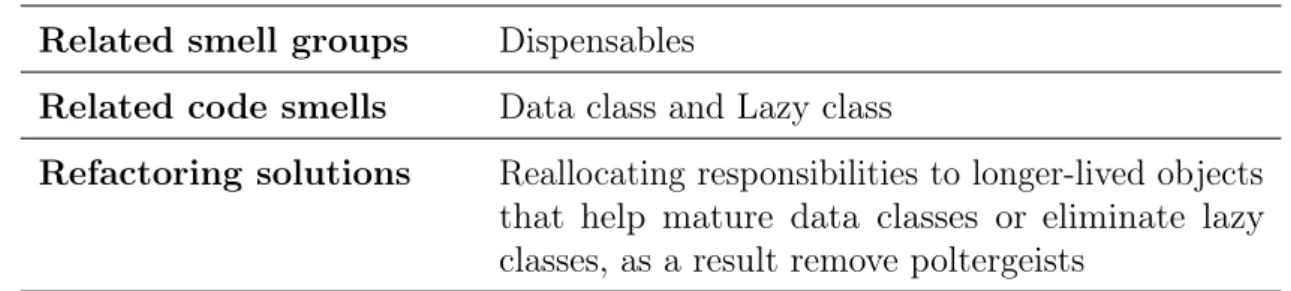
Poltergeists are classes with very limited roles and effective life cycles. This anti-pattern, depending on its condition, is a direct match to theData class orLazy class
code smell.
Table 6: Poltergeists anti-pattern view
Related smell groups Dispensables
Related code smells Data class and Lazy class
Refactoring solutions Reallocating responsibilities to longer-lived objects that help mature data classes or eliminate lazy classes, as a result remove poltergeists
Golden hammer
This anti-pattern appears as one particular programming solution is applied in a diverse range of problems, even though there might be better solutions. The reason could be taking less risk, or neglecting to learn new approaches. As a result, this anti-pattern may introduce inferior performance, scalability, and so on when compared to other available solutions.
None of Fowler’s code smells can be seen as a symptom of this anti-pattern.
Table 7: Golden hammer anti-pattern view
Refactoring solutions There are no direct code level refactoring solutions, however, process level improvements include, man-aging knowledge transfer, taking more risk and responsibility, and developing competences
Spaghetti code
Spaghetti code appears in a software which contains very less software structure. This anti-pattern is the most widely known design problem and, even though
nonobject-oriented languages are more susceptible, it is also seen in the object-nonobject-oriented context.
Spaghetti code may exist where there is a Large class, aLong method, or aDivergent change code smell. It may also intro tight coupling, therefore, Couplers, namely
Feature envy and Inappropriate intimacy smells may easily exist. Additionally, most of class methods may be utilizing class or global variables instead of having parameters, which will cause a lot of Temporary field smells.
The examples can be extended, however, in summary, spaghetti code can expose the software to several group of code smells including, Object-orientation abusers, Change preventers and couplers.
Table 8: Spaghetti code anti-pattern view
Related smell groups Object-orientation abusers, Change preventers, Couplers
Related code smells Large class, Long method, Divergent change, Fea-ture envy, Inappropriate intimacy, and Temporary field
Refactoring solutions This anti-pattern covers quite a lot of code smells and it is difficult to point specific refactoring sug-gestions. However, to discard spaghetti code, con-tinuous refactoring and code cleanup should be practiced
Cut and paste programming
Cut and paste programming is a clear blocker of software reuse and change. This anti-pattern is identified by the presence of duplicate segments of code spread through the software. Even though code duplication has a positive effect when to quickly make short-term modifications, in the long term it causes significant, reuseability and maintainability problems.
Cut and paste programming clearly matches with theDuplicated code code smell, as well as it is highly related to the change preventer code smell Shotgun surgery.
Back-box reuse enables reusing an external class or method without modifying it and without needing to know its implementation. It is an alternative to white-box reuse, where developers take a class or method from elsewhere and modify it (i.e., via extending) according to specific needs.
Table 9: Cut and paste programming anti-pattern view
Related smell groups Change preventers and Dispensables
Related code smells Duplicated code and Shotgun surgery
Refactoring solutions Unifying duplicated code, ideally taking advantage of black-box reuse
Other anti-patterns
In addition to the described development anti-patterns, Brown [4] explains several other "mini" anti-patterns including, Continuous obsolescence, Ambiguous viewpoint, Boat anchor, Dead end, Input Kludge, Walking through a minefield, and Mushroom management.
• Continuous obsolescence anti-pattern is somewhat related to the Incomplete library class code smell in which developers experience integration issues with external dependencies.
• Ambiguous viewpoint anti-pattern is related to the misuse of architectural patterns such as Model-View-Controller(MVC) and object-orientation.
• ABoat anchor is a direct match to theSpeculative generality code smell, which is a peace of software or hardware that serves no useful purpose.
• TheDead end anti-pattern appears when there is an external component used within the software and that is no longer maintained and supported by the supplier. In this "dead end" scenario, similar steps can be taken as in the
Incomplete library class code smell.
• Input kludge anti-pattern appears when ad hoc algorithms are employed for handling program’s user input, in which case indicates the lack of precaution for problems that may occur due to program input.
• Walking through a minefield anti-pattern indicates that, just because a software is released, it does not mean it is production ready. All software products contain defects and unless they are discovered through solid test coverage, bugs can appear on production and cause catastrophic problems.
• Mushroom management anti-pattern may appear due to the isolation between developers and end users. If short feedback cycles are not performed, end user expectations can be easily misunderstood.
2.1.3 Summary
Code level refactoring decisions can be made based on code smells. Code smells are design flaws in object-oriented designs that may lead to maintainability issues in the further evolution of the software system??. These smells particularly address problems to fulfill object-oriented design principles. In the object-oriented context, Fowler describes 22 code smells together with a set of recommended refactoring solutions.
Table10outlines the code smell classification of Mäntylä et al. [11]. This classification assists in fully understanding the code smells and how they relate to each other.
Table 10: A taxonomy of code smells
Taxonomy class Code smells
Bloaters Long method, Large class, Primitive obsession, Long parameter list, and Data clumps
Object-orientation abusers
Switch statements, Temporary field, Refused bequest, Alternative classes with different interfaces, and Parallel inheritance hierarchies
Change preventers Divergent change and Shotgun surgery
Dispensables Lazy class, Data class, Duplicated code, and Speculative generality.
Encapsulators Message chains and Middle man
Couplers Feature envy and Inappropriate intimacy Others Comments and Incomplete library class
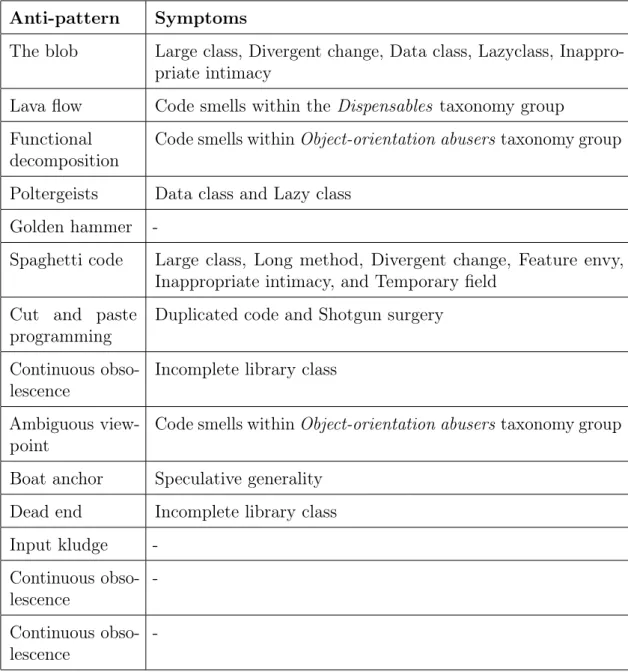
On the other hand, development anti-patterns tend to reveal problems in multiple levels including, code, architecture and development process. Anti-patterns overlap and extend code smells in many occasions. A considerable amount of code smells can be considered as symptoms of anti-patterns. Table 11 presents the relation between anti-patterns and code smells.
Some of the anti-patterns presented in Table11do not have any code smell symptoms. This is due to their architectural and process level dependencies. Refactoring such anti-patterns require architectural and process level changes in areas such as knowledge transfer, configuration management, requirements engineering, requirements change management, continuous integration, and continues deployment.
Table 11: Development Anti-patterns and their symptoms (code smells)
Anti-pattern Symptoms
The blob Large class, Divergent change, Data class, Lazyclass, Inappro-priate intimacy
Lava flow Code smells within the Dispensables taxonomy group Functional
decomposition
Code smells withinObject-orientation abusers taxonomy group
Poltergeists Data class and Lazy class Golden hammer
-Spaghetti code Large class, Long method, Divergent change, Feature envy, Inappropriate intimacy, and Temporary field
Cut and paste programming
Duplicated code and Shotgun surgery
Continuous obso-lescence
Incomplete library class
Ambiguous view-point
Code smells withinObject-orientation abusers taxonomy group
Boat anchor Speculative generality Dead end Incomplete library class Input kludge -Continuous obso-lescence -Continuous obso-lescence
-2.2
Practitioner’s perception of refactoring drivers
This section presents the literature’s view on how practitioners perceive and treat refactoring drivers, i.e code smells, anti-patterns and other design flaws. For this purpose, we have investigated relevant surveys and empirical studies, which provide developer insights on the perception and usage of these drivers.
The examined quantitative studies where selected based on their relevance to one of our research questions; RQ1.2: What quantitative findings does the literature reveal regarding refactoring drivers? Based on this research question, the inclusion and exclusion criteria were formed.
Inclusion criteria:
• Primarily, any field study that observes viewpoints and actions of practitioners regarding software refactoring decisions.
• Secondly, particular studies with findings on how practitioners perceive and treat refactoring drivers, i.e. code smells, anti-patterns and other quality flaws.
Exclusion criteria:
• Studies with no quantitative findings.
• Studies that do not evaluate refactoring drivers or solutions.
After defining the selection criteria, we have identified eight relevant studies. Three of which are surveys that present how practitioners perceive refactoring drivers. The remaining five are empirical studies that present evidence on to what extent these drivers are considered by practitioners. Table 12 outlines these quantitative studies. Note that the listed surveys and empirical studies are coded either with the prefix
SUR or EMP.
In order to understand how practitioners perceive and treat refactoring drivers, the identified studies were examined in three aspects. Table13, presents these aspects with corresponding studies. Now, we elaborate on these aspects.
2.2.1 Know-how and the perceived usefulness of drivers
We have examined a single survey presenting practitioner views related to how much they know about and how useful they see refactoring drivers, i.e. code smells and anti-patterns.
Table 12: Quantitative studies on software refactoring drivers
Code Study
SUR1 Do developers care about code smells? An exploratory survey [23]. Researchers have conducted a survey on 85 software professionals and have investigated the developer’s perception of refactoring drivers.
SUR2 A field study of refactoring challenges and benefits [22].
Kim et al. have conducted a survey with over three hundred profes-sional software engineers to revealed the symptoms of code that help developers initiate refactoring.
SUR3 Understanding the longevity of code smells: Preliminary Results of an Explanatory Survey [20].
An explanatory survey was conducted aiming at better understanding the longevity of code smells in software projects. Researchers have asked developers to rank 5 common refactorings in terms of frequency, difficulty and importance.
EMP1 Does the modern code inspection have value [9].
Researchers have investigated the importance of code inspections and have identified how developers treat soft maintenance issues as refac-toring drivers during code inspections to improve maintainability.
EMP2 The evolution and impact of code smells: A case study of two open source systems [18].
The effect of code smells on software change behaviour was investi-gated by analyzing the historical data of two open-source projects. Researchers have evaluated two of the Fowler’s smells [6]; large class and shotgun surgery.
EMP3 An exploratory study of the impact of code smells on software change-proneness [17]
Researchers have investigated the releations between 29 code smells and software change behaviour by statistically analyzing several releases of two open-source projects.
EMP4 Investigating the evolution of bad smells in object-oriented code [19]. The past versions of two open-source projects were inspected and the evolution of code smells in code were investigated. Three of Fowler’s smells [6] were evaluated; long method, feature envy and switch statements.
EMP5 Refactoring practice: How it is and how it should be supported-an eclipse case study [16].
A case study was conducted on the structural evolution of the Eclipse project. Several code releases were inspected and the fraction of code modifications related to structural refactorings were identified.
Table 13: Study aspects and examined relevant literature
Studies Know-how/usefulness Criticality Recurrence
SUR1 • • • SUR2 - • -SUR3 - - • EMP1 - - • EMP2 - • -EMP3 - • -EMP4 - • -EMP5 - •
-Legend: "•" indicates relevance in each aspect
In SUR1, researchers have asked 85 software professionals about their know-how regarding these drivers. Only 18% of the respondents stated that they had good understanding and have previously used them. Half of the respondents had some understanding but have never used code smells and anti-patterns, whereas 32% have never heard about any of the mentioned drivers. Likewise, half of the respondents saw them moderately to extremely useful and stated that they are most useful for code inspections and in error predictions.
2.2.2 Criticality of drivers
Six of the selected studies have addressed the criticality of smell existence in code.
SUR1 seeks to answer how concerned practitioners are about the existence of code smells, whereasSUR2 seeks to answer which quality attributes are mostly addressed and refactored by developers.
The results of SUR1 have indicated that almost all of the survey respondents were moderately to extremely concerned about code smells. Only 6% of the respondents were not concerned at all.
In the surveySUR2, 20% of the respondents stated that readability is the top driver for refactoring. Only 7-10% of the respondents considered refactoring drivers such as, duplication, reuse, maintainability, legacy code, testability, and performance. Finally, dependency, logical mismatch, and debugging were least considered as drivers for refactoring.
On the other hand, the empirical studiesEMP2 toEMP5 present findings on the criticality of certain code smells by inspecting the past versions of open-source projects.
EMP2 have evaluated two of the code smells, large class and shotgun surgery. The case study findings reveal that code smells are critical in terms of change behaviour. Large classes are exposed to bigger changes and require more maintenance. Similarly, classes infected with shotgun surgery show a higher change frequency during the development lifetime.
The results of EMP3 is similar to EMP2. In this exploratory study, researchers have evaluated 29 code smells during the lifetime of software development. They have indicated that classes with smells are more prone to change. In most cases the odds for classes with smells to change is 2 to 6 times higher than for classes without smells.
Researchers ofEMP4 have observed developer behaviours related to three code smells, namely long method, feature envy, switch statements. By inspecting the past versions of two open-source projects, this study have revealed that a large portion of code smells (57.7%) remain present throughout the development lifetime. This indicates that only a few number of code smells were alarming for developers. Within those few alarming cases, long methods were refactored the most by developers, whereas code fragments infected by feature envy and switch statements were considered quite less.
EMP5 presents that about 70% of structural changes may be due to refactorings. The performed refactorings involve a variety of restructuring activities, ranging from simple element renamings and moves to substantial reorganizations of containers and inheritance hierarchies.
2.2.3 Recurrence rate of drivers
Studies SUR1, SUR3 andEMP1 have evaluated the recurrence rate of refactoring drivers including, code smells, anti-patterns and soft maintanence issues.
In SUR1, researchers have asked software professionals to state the most recurring code smells and anti-patterns. As a result duplicated code was by far the most men-tioned smell, followed by code smells and anti-patterns related to size and complexity, namely long method, large class, and the anti-pattern accidental complexity.
The explanatory survey SUR3 conducts an online questionnaire with 33 developer answers and seeks to answer the occurrence frequency of software anomalies found in code. Developers were encouraged to rank 5 common refactoring drivers from a list of software anomalies found in code. According to developer responses the most recurring smells are duplicated code (26), long methods (23), inadequate naming for classes, methods and variables (23), long classes with too many responsibilities (14)
and classes that deeply depend on details of other classes (10).
The empirical studyEMP1 have evaluated code inspection results and have identified the refactored soft maintenance issues by developers in order to improve software maintainability. During code inspections developers have identified and refactored four main software maintenance issues:
• 47% of the refactorings where related to software documentation. These refactorings were related to clarification, correction and documenting future work.
• Style was the second most recurring refactoring having 46%. These refactoring category consists of, code clean-up, renaming, debugging and cosmetics.
• Portability was the third most recurring refactoring type with only 5%.
• Safety related maintenance issues were only identified and refactored in the 2% of the inspections.
3
Research methodology
The main objective of this study is to gain an understanding on how refactoring decisions are made. In particular how it is described in the literature versus how it is perceived by software developers.
The objective is targeted in terms of a) studying relevant literature to form a basis on refactoring, particularly on refactoring drivers, and b) finding new empirical evidence on how developers make refactoring decisions. The research questions and sub-questions are presented in Table14. Finding an answer to RQ1 requires a
Table 14: Research questions and sub-questions
RQ1 What does the literature say on how refactoring decision are made?
RQ1.1 What does the literature say about the terminology used in identi-fying drivers for refactoring decisions?
RQ1.2 What quantitative findings does the literature reveal regarding refactoring drivers?
RQ2 How does developers make refactoring decisions?
RQ2.1 What are the identified refactoring drivers from the viewpoint of software developers?
RQ2.2 How does developer behaviours in making refactoring decisions relate to the literature?
literature study in two aspects. First, we conduct a review on the terminology used by the literature to identify drivers for refactoring decisions. Second, we collect and synthesize quantitative studies that presents insight on software refactoring decision. By answering RQ1, we gain a fundamental understanding on refactoring decision, in particular its underlying drivers. Eventually, it is then possible to refer to this basis in the discussion chapter. Nevertheless, stud
Finding an answer to RQ2 through a real world investigation overlaps with Yin’s (2003) definition of a case study — an empirical method aimed at investigating contemporary phenomena in their context. Similarly, the findings will act as the second building block to identify how our empirical findings relate to the literature.
The relationship between conducted studies and these research questions are presented in Table 15.
Table 15: Relation between the research questions and conducted work
Research question Literature review Empirical study
RQ1.1 •
-RQ1.2 •
-RQ2.1 - •
RQ2.2 • •
Legend: "•" means a study has been conducted; "-" means inapplicable
3.1
Case company
The case study was conducted in a lean start-up ICT company based in Finland. The company is producing telecommunication application services enabling video calling from multiple endpoints, including web browsers, smart TV’s and mobile devices.
Software under study
The service platform consists of a server backend and multiple client endpoints. Within the scope of this study, we inspect three of the components, including the server backend, the Android client and the web client as they were actively developed during the period of this case study.
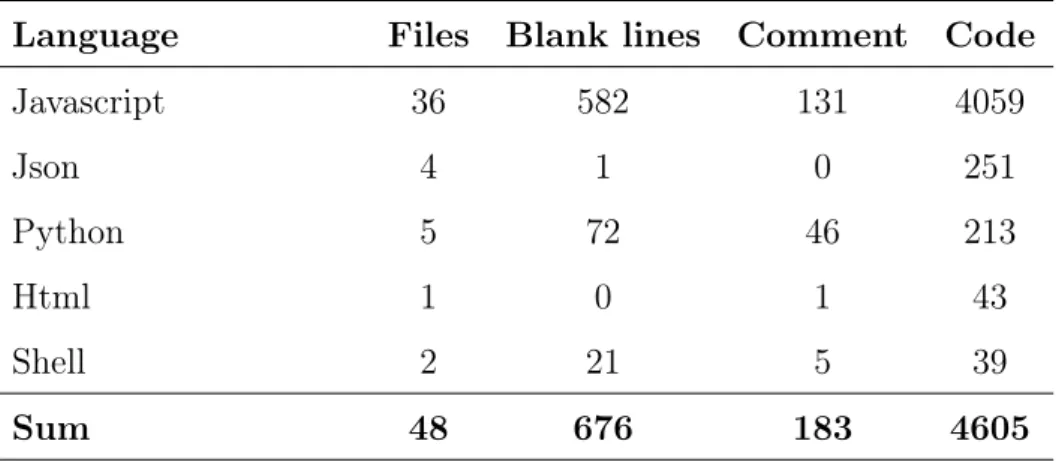
The server component was developed using Javascript and having NodeJS as the runtime environment. 16 presents the total amount of files and lines of code (LOC) in this component.
Table 16: Server backend; number of files and LOC
Language Files Blank lines Comment Code
Javascript 36 582 131 4059 Json 4 1 0 251 Python 5 72 46 213 Html 1 0 1 43 Shell 2 21 5 39 Sum 48 676 183 4605
The Android client component was developed using Java. The totam amount of files and LOC in this component is presented in Table 17.
Table 17: Android client; number of files and LOC
Language Files Blank lines Comment Code
Xml 707 2687 4921 25950
Java 143 2699 5873 15078
Shell 2 50 21 237
Sum 852 5436 10815 41265
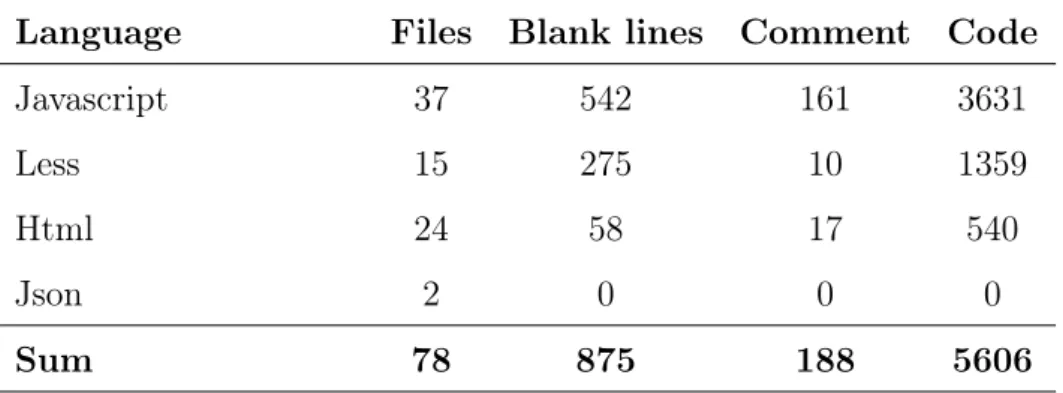
Table 18 presents the details of the web client component. The web client was developed using the AngularJS web application framework.
Table 18: Web client; number of files and LOC
Language Files Blank lines Comment Code
Javascript 37 542 161 3631 Less 15 275 10 1359 Html 24 58 17 540 Json 2 0 0 0 Sum 78 875 188 5606 Development process
The organization is a lean startup, following lean development principles and em-ploying most of the agile practices. Practices worth mentioning include; continuous integration and deployment, continuous improvement (process and software quality), efficient and face-to-face communication, peer reviews, one peace flow, pair program-ming, testing as an integral part of development, and collective code ownership.
As it is a key principle of lean development, in ensuring continuous integration and deployment, continuous software quality improvement takes place routinely but critically within the organization. In particular, software refactoring serves as the main approach in this context.
Continuous software quality improvement takes place routinely and critically within the organization. It is considered as a key principle in ensuring continuous integration
and deployment. Particularly, software refactoring serves as the main approach in this context
The empirical study was introduced to the developers during continuous process improvement meetings, namely retrospectives. As part of the case study, developers were asked to put addition attention when reporting/committing their daily progress in to the source-code revision control system RCS. Collective code ownership and peer reviews were routine practices at present. Therefore, developers were already used to report their daily commitments to theRCS.
Developers
All developers within the organization participated in the empirical study. The software development experience of the developers were varying between 3 to 10 years.
During the collection of the empirical data, 6 developers have marked their refactoring related daily commitments into the version control system.
3.2
Data collection and analysis
Data was gathered from a single source. The single source of information was stored in the version control system. Developers were asked to mark and commit their refactoring related tasks into the Git version control system. Developers were already used to this process since collective code ownership and peer reviews were routine practices.
Prior to the empirical data collection kick-off, one group discussion was conducted explaining developers the convention they are supposed to use in marking their refactoring related commits. In order to ease the data collection and analysis process, developers were informed to label relevant commits with the "refactor" keyword. This convention was used during the data collection period of 2 months.
Since Git was used as the version control system, developers marked refactoring tasks using git commit messages and git code line comments. Subsequently, a public API offered by a cloud-based git repository service was used to retrieve the commit messages, commit changes, and code line comments. The API offered Json as a response format. Therefore, it was trivial to collect, filter, and categorize refactoring tasks based on developer notes.
In the cases were developer notes lacked level of detail on the driver behind a refactoring decision, informal communication was used to resolve the ambiguity. Thanks to the use of a) peer reviews with short feedback cycles, b) efficient and
face-to-face communication, and c) technical reviews following each short development iterations, ambiguous developer notes were minimized.
The data were exported and filtered out from the version control system using a custom script developed by the researcher. This script was able to retrieve refactoring related code changes and their description from the version control system.
Once the empirical data were retrieved, they were coded for further analysis. As described by Miles and Huberman [2], data coding can be either pre-formed, e.i. codes are formed before the data is analyzed, or post-formed, e.i. codes are formed during the coding process. This study have utilized post-formed refactoring drivers as codes. However, prior to the data analysis, we have studied the literature and gathered an understanding on existing drivers. This pre-step have supported the post-formed coding process.
Having a coding process, the data analysis was performed based on the filtered data using. As described by Miles and Huberman [2], data coding can be either pre-formed, e.i., codes are formed before the data is analyzed, or post-formed, e.i., codes are formed during the coding process.
In this study, we used post-formed codes. However, prior to the data analysis, we studied the literature and gathered an understanding refactoring drivers. This pre-step supported the post-formed coding process.
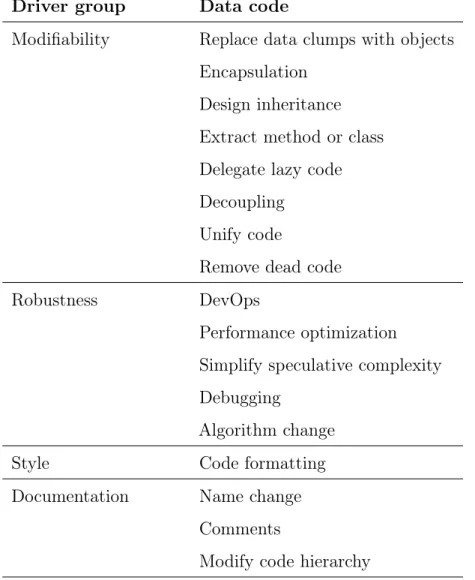
The retreived data were coded with 17 post-formed refactoring drivers. In the process of the analysis, these drivers were further grouped in the four categories. Table19
Table 19: Refactoring driver groups and data codes
Driver group Data code
Modifiability Replace data clumps with objects Encapsulation
Design inheritance Extract method or class Delegate lazy code Decoupling
Unify code
Remove dead code Robustness DevOps
Performance optimization Simplify speculative complexity Debugging
Algorithm change Style Code formatting Documentation Name change
Comments
4
Results and discussion
This section embodies the case study findings, accompanied by a discussion on how our findings relate to the literature.
4.1
Refactoring ratio
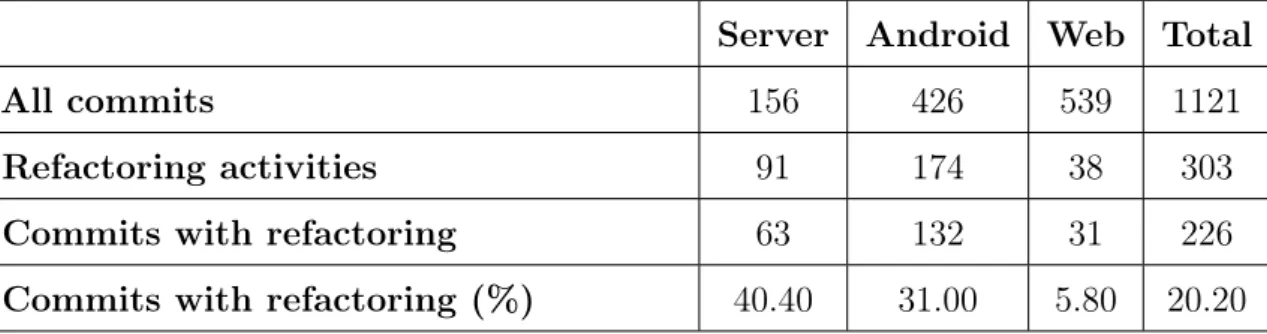
As discussed in the research methodology, developers were asked to label their commit messages using the keyword "refactor". As a result, we have collected data from the version control system for a period of 2 months. Table 20 presents the total amount of commits compared to the total amount of refactorings during the data collection period.
Table 20: The number of refactoring commits compared to the number of all commits
Server Android Web Total
All commits 156 426 539 1121
Refactoring activities 91 174 38 303
Commits with refactoring 63 132 31 226
Commits with refactoring (%) 40.40 31.00 5.80 20.20
During the data collection period, a total of 1121 changes were committed by the developers. This total commit number contains any kind of code change regarding functional or structural improvements. The findings indicate that 20% of the code change (commit) contains refactoring activities. In addition, the results imply that every individual commit may contain one to many refactoring activities.
Another interesting finding is that, even though more effort was spend on the Android client, the server code was proportionally exposed to more refactoring activities. This is due to the Android client and server having different natures in terms of programming language and development environment. The possible causes of this difference will is elaborated as we explain each identified refactoring driver.
4.2
Identified refactoring drivers and driver groups
As described in the data analysis, post-formed codes were identified during the coding process. As a result, refactoring activities were grouped under 17 post-formed refactoring drivers. We have then grouped these drivers in four categories; Documentation, style, robustness and modifiability.
Our semi-custom classification of refactoring drivers is tailored based on two sources; relevant frameworks found in the literature and the identified drivers of our empirical study.
Researchers have evaluated refactoring drivers having similar classifications. Siy and Votta [9] have divided soft maintenance issues into four categories; documentation, portability, safety and style. There is a perfect match between two studies among the driver groups documentation and styles. In respect to safety, our results only consists of few security related refactorings and are included in the robustness group. Likewise, our results included a limited number of refactoring drivers that could be considered related to portability or modifiability.
In another study, Mäntylä and Lassenius [15] have grouped refactoring drivers in a closely similar manner. They formed four classes; documentation, general, structure, and visual representation. Again, their documentation and visual representation
categories are covered in our documentation and style groups. Significant amount of the drivers they have grouped under structure can be found in our modifiability category, whereas drivers related to code complexity and poor algorithms fit in our robustness category.
Our custom classification of refactoring drivers are
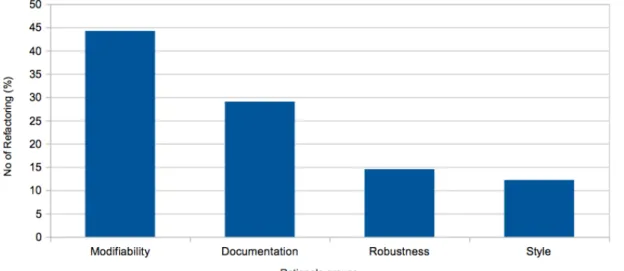
Figure1 presents the number and distribution of refactorings performed per driver group.
After going through all identified refactoring drivers and classifying them meaningfully, we categorized them in four groups, namely Documentation, Style, Robustness, and
Modifiability. Figure 1presents the number and distribution of refactoring activities per each driver group.
An overview of the driver groups, individual drivers, and the percentage of refactorings per each driver is presented in Figure 2.
Figure 2: Distribution of the used drivers
4.2.1 Documentation
Documentation related drivers include,Comments,Modify code hierarchy, and name change. This group of drivers highly effect the understanability and readability of