Hillier, David and Korczak, Adriana and Korczak, Piotr (2015) The impact
of personal attributes on corporate insider trading. Journal of Corporate
Finance, 30. pp. 150-167. ISSN 0929-1199 ,
http://dx.doi.org/10.1016/j.jcorpfin.2014.12.003
This version is available at http://strathprints.strath.ac.uk/50893/
Strathprints is designed to allow users to access the research output of the University of Strathclyde. Unless otherwise explicitly stated on the manuscript, Copyright © and Moral Rights for the papers on this site are retained by the individual authors and/or other copyright owners. Please check the manuscript for details of any other licences that may have been applied. You may not engage in further distribution of the material for any profitmaking activities or any commercial gain. You may freely distribute both the url (http://strathprints.strath.ac.uk/) and the content of this paper for research or private study, educational, or not-for-profit purposes without prior permission or charge.
Any correspondence concerning this service should be sent to Strathprints administrator: [email protected]
David Hillier, Adriana Korczak, Piotr Korczak PII: S0929-1199(14)00155-2
DOI: doi:10.1016/j.jcorpfin.2014.12.003
Reference: CORFIN 867
To appear in: Journal of Corporate Finance
Received date: 5 March 2014 Revised date: 10 December 2014 Accepted date: 11 December 2014
Please cite this article as: Hillier, David, Korczak, Adriana, Korczak, Piotr, The Impact of Personal Attributes on Corporate Insider Trading,Journal of Corporate Finance(2014), doi: 10.1016/j.jcorpfin.2014.12.003
This is a PDF file of an unedited manuscript that has been accepted for publication. As a service to our customers we are providing this early version of the manuscript. The manuscript will undergo copyediting, typesetting, and review of the resulting proof before it is published in its final form. Please note that during the production process errors may be discovered which could affect the content, and all legal disclaimers that apply to the journal pertain.
ACCEPTED MANUSCRIPT
The Impact of Personal Attributes on Corporate Insider Trading
David Hillier*, Adriana Korczak† and Piotr Korczak‡
This version: December 2014
ABSTRACT
We analyze the importance of personal attributes in explaining the performance of reported share transactions by corporate insiders. While prior literature has focused on observable firm and trade characteristics, little effort has been made to understand how individual attributes, such as skills, abilities, or personality, impact upon post-trade abnormal returns. We document that personal attributes explain up to a third of the variability in insider trading performance and dominate unobservable and observable firm and trade characteristics by a sizeable margin. Personal attributes are correlated with the insider’s year of birth, education and gender, and matter more in companies with greater information asymmetry and when outsiders are inattentive to public information. We shed also new light on the significance of executive hierarchy and regulations in explaining insider trading performance and highlight the importance of controlling for individual fixed effects in insider trading research to avoid omitted variable bias in estimated regression coefficients.
JEL classification: G12, G14
Keywords: Insider Trading; Abnormal Returns; Fixed Effects
*
Strathclyde Business School, University of Strathclyde, 100 Cathedral Street, Glasgow G4 0LN, UK, email: [email protected]
† School of Economics, Finance and Management, University of Bristol, 8 Woodland Road, Bristol BS8 1TN,
UK, email: [email protected]
‡ Corresponding author, School of Economics, Finance and Management, University of Bristol, 8 Woodland
ACCEPTED MANUSCRIPT
1
1. Introduction
Do corporate insider attributes have an impact on insider trading performance? Given that trading decisions are individually made by insiders, it is surprising we still know little about the extent to which insiders’ personal characteristics affect returns following their trades. Earlier studies focus predominantly on firm-level characteristics and it is now widely accepted that insider trading patterns and performance differ with the firm’s size and book-to-market ratio (e.g. Seyhun, 1986; Rozeff and Zaman, 1998; Lakonishok and Lee, 2001; Jenter, 2005). Extant literature also documents that insider trading profitability depends upon firm-level characteristics such as analyst coverage (Frankel and Li, 2004), ownership structure (Fidrmuc et al., 2006), antitakeover provisions (Ravina and Sapienza, 2010), the role of general counsel (Jagolinzer et al., 2011), the quality of internal control (Skaife et al., 2013), anti-shareholder mechanisms (Cziraki et al., 2013), advertising expenditures (Joseph and Wintoki, 2013), and concentrated sales relationships (Alldredge and Cicero, 2013). Unfortunately, the power of the proposed explanatory variables in capturing insider trading return variability is rather poor.1
We argue that insider trading decisions and their performance are to a large extent driven by insiders’ individual skills and abilities to acquire and process private and public information. This includes any biases such as overconfidence, optimism or limited attention, as well as attitudes to risk and willingness to trade on private information. Personal characteristics have two main features. First, behavioral economics, psychology and the genetics literature suggest that personality traits are fixed or slow-moving over time. Second, they are unobservable to the econometrician. Consequently, we propose to capture individual heterogeneity using insider fixed effects. In a set of tests we ascertain the extent to which variation in abnormal returns following insider trades is explained by individual fixed effects after controlling for known firm and transaction-level determinants of trading profitability. The approach builds on earlier studies in which individual fixed effects are used to identify managerial styles in a variety of contexts (e.g. Bertrand and Schoar, 2003; Coles and Li, 2011a, 2011b; Graham et al., 2012).
We show that individual managerial traits are significant determinants of insider trading performance. Factors that are usually considered in the insider trading literature (firm size, book-to-market ratio, transaction size) explain only a very small proportion of the variation in insider trading performance,
1
Although observable firm and transaction-level variables are statistically and economically significant, they explain only a small fraction of the variability of insider trading returns. For example, the adjusted R-square in Fidrmuc et al. (2006) is less than 5 percent. Cross-sectional regressions without firm fixed effects presented in Ravina and Sapienza (2010) have an R-square statistic of less than 1 percent.
ACCEPTED MANUSCRIPT
2 and adding insider fixed effects to the regressions substantially improves their explanatory power. Depending on the return horizon and transaction type (purchases or sales), insider fixed effects increase the adjusted R-square from less than 3 percent to between 19 and 39 percent, several percentage points more than firm fixed effects alone.
Since firms and insiders do not match randomly, their effects are likely to be correlated. To make sure that insider effects do not pick up firm-level fixed effects, we draw on the method proposed by Abowd et al. (1999), which allows for simultaneous identification of both insider and firm fixed effects. We find that insider fixed effects explain up to a third of the variability of post-trade abnormal returns and have up to three times more explanatory power than firm fixed effects. The effect of individual heterogeneity is also economically very large. The interquartile range of the estimated insider fixed effects is between 15 and 51 percentage points, depending on the model.
The fixed-effect approach sheds light on how much of the variability in insider trading performance is explained by individual characteristics but not on what those characteristics are. To address that point we test the link between estimated individual fixed effects and education, birth cohort and gender. Previous literature argues that those observed characteristics are related to or impact on skills, abilities, conservatism, risk aversion, overconfidence or attitude to social norms and hence overall lead to person-specific styles in financial decision making (Falato et al., 2014; Schoar and Zuo, 2011; Malmendier et al., 2011; Faccio et al., 2014). We show that individual fixed effects in our regression setup are related to the year in which the insider was born, with better trading performance by younger generations of insiders. We also find some evidence that insider trading performance is related to the insider’s gender and education.
In further tests we assess the nature of information on which individual insiders trade. We find that personal traits matter for trading on both public and private information as insider fixed effects explain a larger proportion of the post-trade return variability in firms with economically-linked customers (a proxy for a richer public information environment (Alldredge and Cicero (2013)) and in firms without analyst coverage (a proxy for information asymmetry between insiders and outsiders (Frankel and Li, 2004; Ellul and Panayides, 2012)). We also find that after the Sarbanes-Oxley Act was introduced in 2002, the role of differences across individuals in explaining insider buying performance increased, while the role of firm heterogeneity sharply declined. The results do not apply to insider sales, which are normally regarded as being driven by non-information factors. Individual trading behaviors thus seem to be deeply rooted in personalities, and do not appear to be affected by broad-brush regulation. Controlling for individual fixed effects also allows us to disentangle whether abnormal returns are related to the executive’s position in the firm or to the personal traits of the individual. It appears that, in general, the underperformance of CEOs is driven
ACCEPTED MANUSCRIPT
3 by a higher scrutiny associated with the position, while CFO outperformance is determined by individual attributes such as, for example, superior financial acumen.
The documented importance of individual effects rules out alternative views on what may determine insider trading performance. One such alternative view is that insider-specific characteristics play only a minor role in explaining variability in trading performance since individual behaviors are constrained by the effective public and private enforcement of insider trading regulations (Agrawal and Nasser, 2012; Cohen et al., 2012). Yet another alternative is that firm-level voluntary insider trading restrictions have an important role in shaping individual insider trading choices within a firm (Bettis et al., 2000; Lee et al., 2014). If firm-level insider trading rules are endogenously linked to the risk culture within a firm, then cross-sectional differences in insider trading performance can be captured by firm-specific fixed effects. We find that although firm-level effects are statistically important, they are dominated by person-specific effects.
The importance of individual heterogeneity for insider trading performance can be explained in a number of ways. One interpretation is that trading performance is closely aligned to the abilities and character of individual insiders, irrespective of corporate governance. Formal structures that enhance the independence of boards or improve reporting transparency or disclosure do little to constrain the opportunistic behavior of individuals who choose to exploit any misvaluation in the company’s stock price. Alternatively, and consistent with a signaling hypothesis, it may also be the case that corporate insiders with certain characteristics choose to personally signal that their firm’s stock price is abnormally high or low. The market thus responds proportionately to the degree to which the insider is respected in the market.
This study contributes to the literature in a number of ways. It adds to the insider trading literature by documenting the significance of personal traits in explaining insider trading performance. The paper also shows the impact of executive hierarchy on insider trading performance given mixed earlier evidence (e.g. Seyhun, 1986; Jeng et al., 2003; Fidrmuc et al., 2006; Ravina and Sapienza, 2010) and highlights the importance of controlling for insider fixed effects to avoid potential omitted-variable bias in estimated regression coefficients.
On a more general note, we build on and contribute to the literature on the investment performance of individuals and on the importance of innate characteristics in financial decision making. For example, Barnea et al. (2010) and Cesarini et al. (2010) find that genetic variation has explanatory power for stock market participation, asset allocation and individual portfolio risk. Barber and Odean (2001) report different rates of portfolio turnover and performance in men and women and attribute this to gender-specific levels of overconfidence. Similarly, Bharath et al. (2009) and Gregory et al. (2013)
ACCEPTED MANUSCRIPT
4 document different abnormal returns following trades by male and female insiders, and Jia at al. (2014) show a link between a measure of CEO masculinity and the extent of opportunistic insider trading. Grinblatt et al. (2012) find that stock trading decisions and performance are related to IQ score. Davidson et al. (2013) show that executives who reveal lower respect for rules and higher materialism are more likely to trade on profitable information, and, in a similar vein, Bhattacharya and Marshall (2012) argue that the decision to trade on inside information may be explained by unobservable psychological factors, such as hubris. Alldredge and Cicero (2013) provide evidence that insider trading performance is driven by insiders’ ability to pay attention to and correctly interpret public information about their customers. The documented importance of fixed person-specific effects for the performance of insider trades corroborates also the findings by Cohen et al. (2012) who split insiders into routine and opportunistic traders based on the pattern of initial trades and using that fixed classification over time show that opportunistic traders persistently outperform routine traders.
Finally, the paper has implications for the literature on managerial styles. Bertrand and Schoar (2003), Coles and Li (2011a, 2011b), Graham et al. (2012) and others show that there is an important unobserved managerial style component in a number of corporate finance choices, spanning the firm’s investment, capital structure, payout and compensation policies.2 Similarly, Bamber et al. (2010), Dyreng et al. (2010) and Ge et al. (2011) show the impact of executive-specific effects on firms’ accounting choices, including voluntary disclosure and tax avoidance. Moreover, it is documented that executives reveal consistent styles across firm and individual choices (e.g. Lee et al., 1992; Malmendier and Tate, 2005; Cronqvist et al., 2012; Kolasinski and Li, 2013; Bonaime and Ryngaert, 2013). This paper documents the impact of managerial styles on individual decisions related to own firm’s securities.
In the next section, we outline the empirical framework and in Section 3, we describe the data. Section 4 presents our empirical results and Section 5 concludes the paper.
2. Empirical Framework
The aim of the empirical tests in this paper is to determine the extent to which personal and individual attributes are important in explaining post-trade buy-and-hold insider abnormal returns. Our testing strategy is to first identify the explanatory power of observable firm, trade and insider characteristics,
2
In a recent study, Fee et al. (2013) use exogenous features of managerial turnover to provide a fuller picture of
the impact of managerial styles on firms’ investment and financial decisions. They reject the hypothesis that managerial styles are idiosyncratic and unanticipated by the board. In contrast, boards select CEOs with certain perceived styles that have a causal role in the selection of firm policies.
ACCEPTED MANUSCRIPT
5 taken from previous literature to determine the performance of insider trading. Then, we test the incremental explanatory power of time-invariant unobserved personal attributes captured by insider fixed effects, controlling for the observable characteristics. Because unobserved insider and firm characteristics can be correlated, we implement a series of tests to identify and disentangle the explanatory power of insider and firm fixed effects.
We start with separately estimating the following baseline model for sale and purchase transactions:
BHARijt = Xijt + ijt, (1)
where BHARijt is the buy-and-hold abnormal return following a trade by insider i in company j on day
t. Xijt is a vector of time-varying firm, trade and insider observable characteristics and year dummies.
The firm-level characteristics we include are firm size, book-to-market ratio and past stock return. Earlier studies show that insider trading profits are larger in small firms (e.g., Seyhun, 1986, Lakonishok and Lee, 2001), and the book-to-market ratio and past stock return control for contrarian trading by corporate insiders (e.g., Rozeff and Zaman, 1998; Jenter, 2005). The trade-level characteristic is transaction size, since larger trades have arguably greater information content and are associated with higher abnormal returns.3 The insider-level observable characteristics are two dummy variables (CEO and CFO) to capture the insider’s role in the company, their access to private information, and stronger regulatory scrutiny (Seyhun, 1986; Jeng et al., 2003; Fidrmuc et al., 2006; Ravina and Sapienza, 2010). All regressions include year dummies to control for possible time trends in insider trade performance. Note that the inclusion of year dummies does not add the standard time dimension in a panel setting since there can be more than one trade per firm and insider in a unit of time (year).
We next add insider fixed effects, i, to the baseline regressions and estimate model (2) below to
ascertain the change in adjusted R-square compared to the baseline model (1).
BHARijt = Xijt + i+ ijt (2)
BHARijt and Xijt are defined as before. Using insider fixed effects allows us to shed light on whether
the observed link between executive position and trading performance is driven by position per se, or whether it captures unobservable time-invariant insider characteristics correlated with an individual being in the role. Note that we are able to jointly identify the executive position dummies and insider fixed effects since an individual can trade in the same or another company before and after their current employment. The same principle applies if insiders with multiple board appointments concurrently trade in more than one of the firms in which they are employed.
3
ACCEPTED MANUSCRIPT
6 The change in adjusted R-square between models (1) and (2) provides direct evidence on the importance of unobserved, time-invariant insider characteristics in explaining post-trade abnormal returns. However, an important caveat is in order. Insiders and firms do not match randomly and individuals with specific characteristics are likely to seek employment in or to be sought by firms with particular profiles. In the context of our tests it means that estimated insider fixed effects can also capture unobserved firm characteristics. To explore this possibility we perform three tests. First, we re-estimate model (2) replacing insider fixed effects, i, with firm fixed effects, j:
BHARijt = Xijt + j+ ijt, (3)
where BHARijt and Xijt are defined as before. We compare the adjusted R-square of models (3) and
(2) to provide initial evidence on which of insider and firm fixed effects have a greater incremental explanatory power. Second, we estimate the baseline model (1) with fixed effects for every insider-firm combination, ij:
BHARijt = Xijt + ij+ ijt. (4)
The adjusted R-square of model (4) compared to models (2) and (3) indicates if jointly controlling for unobserved insider and firm heterogeneity increases the explanatory power of the regression. The drawback of the method is that it does not allow for the separation of insider and firm effects. We address this drawback in the third test, which aims to explain insider trading performance by disentangling the effects of time-invariant unobserved individual and firm effects in a ‘connectedness’ sample.
The concept of ‘connectedness’ was originally proposed by Abowd et al. (1999) and recently applied in a finance context by Coles and Li (2011a, 2011b) and Graham et al. (2012).4 Insider and firm fixed effects can be separately estimated for all trades linked by a single insider’s trading in multiple firms - that is, trading by an individual who moves between firms or who holds multiple board appointments.5 Specifically, insider and firm fixed effects can be separately estimated for transactions by all insiders who trade in firms with at least one multi-firm insider, no matter in how many firms they trade themselves. To illustrate, if an insider trades in firms A and B, her multi-firm transactions
4
See Appendix 2 in Graham et al. (2012) for a detailed methodological and econometric discussion of the estimation procedure.
5
Abowd et al. (1999), Coles and Li (2011a, 2011b) and Graham et al. (2012) call individuals with observations
in more than one company ‘movers’, and the related sample, the ‘mobility’ sample. In our study, mobility between firms is not a necessary condition as we can observe an individual’s trades in more than one firm even without the executive moving jobs. This is because individuals can hold multiple appointments at the same time.
ACCEPTED MANUSCRIPT
7 are a necessary and sufficient condition to identify insider and firm fixed effects for trades by all insiders in firms A and B.6
We therefore estimate the following model:
BHARijt = Xijt + i + j + ijt, (5)
with all notation as before. To understand the relative importance of unobserved fixed insider and firm characteristics in explaining the post-trade buy-and-hold returns, the R-square of the estimated models with insider and firm fixed effects is decomposed following the method proposed by Graham et al. (2012). The model R-square can be presented as
(6)
The standardized covariances measure the proportion of the model’s sum of squares attributable to individual observable characteristics, insider fixed effects and firm fixed effects, respectively. For example, cov
(
BHARijt,gˆi)
var
(
BHARijt)
can be interpreted as the importance of insider fixed effects in explaining the
variance of buy-and-hold abnormal returns.
We are also interested in the significance of observable characteristics, conditional on unobservable insider and firm characteristics. It is likely that unobservable effects are correlated with observable factors. For example, latent skills and abilities will be related to the probability of an individual being in a top executive position (such as CEO or CFO), and these characteristics are likely to influence insider trading performance. If unobservable insider and firm effects are correlated with observable characteristics, the coefficients of observable factors are estimated with bias if there is no control for the unobservable effects. Hence, our empirical approach allows us to reinterpret the impact of observable factors traditionally considered in the insider trading literature.
3. Data and Variable Definitions
The primary data source is Thomson Reuters Insider Filing Data Feed (IFDF). The database contains information on reported share transactions by corporate insiders, defined as officers, directors, and beneficial owners of more than 10 percent of shares outstanding. The information includes the type of
6
Because we analyze purchases and sales separately, the discussion only applies to same-type trades by an insider in more than one firm. That is, an insider’s purchase transaction in firm A and a sale in firm B does not allow for the estimation.
ACCEPTED MANUSCRIPT
8 transaction (buy/sell), transaction date, volume, price, security identifier, and data on the insider who traded. The sample contains all trades executed between January 1986 and December 2010. Since our focus is on individual insider characteristics, we exclude trades by beneficiary owners (mainly financial institutions) who are not officers or directors. We further limit our sample to open market or private purchases and sales (IFDF codes P and S) of common stock (CRSP share codes 10 and 11). Any trade where the reported volume is higher than the trading volume on the transaction day reported in CRSP or the transaction day closing price is lower than USD 2.00 is dropped from the sample. We also exclude trades in firms with a negative book-to-market ratio on the trading day.
Multiple transactions by a single insider on the same day in the same direction (buy or sell) are cumulated to give a single daily buy or sell trade. We do so for two reasons. First, same-day trades are likely to be executed on the basis of similar information. Second, treating multiple trades as separate observations could increase the correlation of post-transaction abnormal returns for a given insider and firm, and this would influence the statistical relationship between insider/firm fixed effects and abnormal returns we aim to establish.
Firm-level stock market and accounting data are sourced from CRSP/Compustat. Individual insider characteristics (age, gender, education) come from BoardEx. BoardEx spans a number of countries and contains detailed biographical information on officers and directors, together with compensation data (see, e.g. Fernandes et al., 2013). Individuals in the Thomson Reuters IFDF and BoardEx databases are manually matched on surname, given name, middle name, and the names of companies in which they serve. BoardEx database coverage begins in the late 1990s, and even though we focus on time-invariant insider characteristics, information on insiders in the earlier years of our sample period is likely to be incomplete.
Abnormal returns are estimated following Ravina and Sapienza (2010). For each transaction in our sample we estimate buy-and-hold abnormal returns (BHAR) over 30, 90, and 180 trading days following the transaction, with the CRSP value-weighted index used as a benchmark. Firm size is proxied by the natural logarithm of market capitalization (measured on the trade date as the number of shares outstanding multiplied by the closing price) and expressed in USD millions. Book-to-market ratio is calculated as book value of common equity at the end of most recent fiscal quarter divided by market capitalization on the trading day. Past stock return is defined as the buy-and-hold abnormal return over 90 trading days preceding the transaction date. Trade size is measured as shares traded divided by the number of shares outstanding. The CEO (CFO) dummy variable is equal to one if a trade is executed by the CEO (CFO), and zero otherwise. We rely on the IFDF database for the executive hierarchy (CEO/CFO) classification.
ACCEPTED MANUSCRIPT
9 Information on the sample, as well as descriptive statistics of the dependent and independent variables is presented in Table 1. Our final sample includes over 310,000 purchases and 823,000 sales. The average number of transactions per insider, important from the viewpoint of estimating insider fixed effects, is 4.3 and 7.9 in the purchase and sale samples, respectively.7 At the firm level, there are an average of 28.5 purchase transactions and 76.6 sales transactions per firm. Consistent with prior literature, we find that the mean abnormal return for purchases is larger in absolute value than for sales, suggesting that sales are more likely to be for liquidity and diversification reasons and less driven by private information.
Over the 180-day horizon, purchases are associated with average abnormal returns of 6.0%, whereas for sales the respective number is -0.2%. The distribution of returns is skewed and medians are below means for both purchases and sales, making the difference in average trading performance for purchases and sales difficult to interpret. Looking at the independent variables, our results again confirm trends observed in previous studies. Sales have higher monetary value and are executed in larger firms; insiders are contrarians and attempt to time the market by buying (selling) after stock price decreases (increases); and purchase transactions tend to be in firms with higher book-to-market ratios. For both purchases and sales, about 10% of trades are executed by CEOs and about 5% by CFOs.
4. Empirical results
4.1. Preliminary Evidence on The Role of Insider Attributes
In this section, we examine to what extent unobservable and fixed insider attributes explain insider trading performance. Table 2 presents coefficients from a variety of regression model specifications for both purchase (Panel A) and sale (Panel B) abnormal returns. We initially include only observable firm, trade and insider characteristics that are normally used in the empirical insider trading literature, together with year dummies. Then we measure the change in regression explanatory power when insider and firm fixed effects capture unobserved insider and firm heterogeneity, respectively.
Similar to earlier insider trading research (e.g. Fidrmuc et al., 2006; Ravina and Sapienza, 2010), our pooled-sample test results for both purchase and sale transactions reveal very low explanatory power when firm and individual fixed effects are omitted. The adjusted R-square is, depending on the return
7
Not to distort the picture of individual heterogeneity we preserve the number of insiders in our sample and do not impose restrictions of the minimum number of transactions per insider. In Section 4.6 we outline how this approach can influence our results and provide a robustness check for restricted samples based on the minimum number of trades required.
ACCEPTED MANUSCRIPT
10 horizon, no bigger than 3.3% for purchases (Table 2, Panel A, columns (1)-(3)) and 1.9% for sales (Table 2, Panel B, columns (1)-(3)). When we add only insider fixed effects to control for the unobserved individual insider characteristics the R-square substantially increases. The R-square for models that account for insider effects is between 25.3% and 39.1% for purchases (Table 2, Panel A, columns (4)-(6)), and between 19.1% and 34.2% for sales (Table 2, Panel B, columns (4)-(6)), depending on the return horizon. The results point to the very important role of latent insider characteristics in explaining abnormal trading performance.
When only firm fixed effects capture unobserved time-invariant firm attributes and characteristics, regression explanatory power is higher than in the baseline pooled specification. However, the increase is less than when insider fixed effects are used. The adjusted R-square of regressions with firm fixed effects alone is a few percentage points lower than for regressions with only insider fixed effects. For example, for BHAR(0,180) following purchase transactions, the adjusted R-square for the firm fixed effects regression is 32.8% compared to 39.1% for the insider fixed effects regression (Table 2, Panel A, columns (9) vs. (6)). However, both insider-level and firm-level fixed effects have incremental explanatory power as documented by results of regressions with insider-firm fixed effects, which are reported in columns (10)-(12) of Table 2, Panels A and B. Controlling for all insider-firm combinations shows a further increase in the adjusted R-square up to 49.5% in the longest return window of 180 days for purchases (Table 2, Panel A, column (12)) and up to 43.2% in the longest return window of 180 days for sales (Table 2, Panel B, column (12)).
Results reported in Table 2 allow us to better understand the potential bias in coefficients of observable characteristics when firm and insider fixed effects are not controlled for. The bias arises if the unobservable time-invariant firm and insider characteristics are correlated with observable factors. If the coefficients are biased, our empirical approach can help us re-interpret results presented in the earlier literature.
We focus on the significance and interpretation of CEO and CFO dummy variables, and we do so for two main reasons. First, CEO and CFO dummies are most likely to suffer from omitted variable bias. This is because latent skills, knowledge and personal characteristics are linked to top positions in the corporation, leading to correlation between unobserved insider heterogeneity, trading performance and executive position. Second, the literature investigating the role of position in the performance of insider trading presents mixed results and competing explanations. Our tests, which explicitly control for unobservable insider characteristics, can shed more light on what drives the trading performance of different insider groups.
ACCEPTED MANUSCRIPT
11 Seyhun (1986) and Ravina and Sapienza (2010) find that top executives outperform other groups of insiders in share trading, most likely due to their privileged position with respect to the corporate information set. Nevertheless, this information hierarchy hypothesis is not supported by Jeng et al. (2003), who fail to find any abnormal trading performance by top executives. They provide a competing explanation based on regulatory and adverse attention risks, and claim that top executives (especially CEOs), who are much more closely scrutinized by regulators and investors, avoid trading on valuable private information. In line with the risk arguments, Fidrmuc et al. (2006) document that purchase transactions by CEOs generate significantly lower abnormal returns than trades of any other insider group. More recently, Wang et al. (2012) find that share purchases by CFOs significantly outperform those by CEOs. They argue that any difference in performance can be explained by CFOs’ better insight into the financial standing of the firm and by lower regulatory scrutiny compared to CEOs. Knewtson and Nofsinger (2012) explore the two competing explanations and conclude that the regulatory scrutiny hypothesis appears to be most appropriate.
We compare the estimated coefficients of the CEO and CFO dummies in pooled OLS models without fixed effects and in models that control for insider fixed effects (columns (1)-(3) vs. columns (4)-(6) of Table 2, Panel A for purchases and Panel B for sales). Without individual fixed effects, the insider position dummies capture access to information and exposure to higher scrutiny on the one hand, and superior skills, and expertise, on the other. Inclusion of fixed effects captures the role of unobservable time-invariant skills and expertise, and leaves the position dummy to capture access to preferential information and regulatory scrutiny risk.
There is a remarkable change in the significance of the CEO and CFO dummy coefficients across model specifications. For purchases reported in Table 2, Panel A, the coefficient of the CEO dummy is positive but insignificant in the pooled-sample tests and this becomes significantly negative when we control for unobservable insider characteristics. The change indicates that executive seniority leads to less information-based trading and is not related to personal characteristics (e.g. risk aversion). The results are supportive of the regulatory scrutiny hypothesis (Jeng et al., 2003; Fidrmuc et al., 2006) and also indicate that the superior performance of top executives found in earlier studies may be driven by their unobserved personal traits.
When fixed effects are not included, the coefficient of the CFO dummy in our tests for purchases is positive and highly significant, in line with findings by Wang et al. (2011). The coefficient becomes insignificant when we account for unobserved insider heterogeneities. The result indicates that superior trading performance is not driven by executive position and associated access to financial information, but rather personal characteristics such as skills and expertise. We complement Knewtson and Nofsinger (2012) by providing direct evidence that the weaker performance of CEO
ACCEPTED MANUSCRIPT
12 insider trading is caused by higher scrutiny associated with the position, while CFOs’ abnormal trading performance is determined by their superior financial acumen.
For sale transactions reported in Table 2, Panel B, CFO trading performance does not differ significantly from the performance of other insiders, irrespective of our approach to controlling for unobserved heterogeneities. However, the results for CEOs are sensitive to the inclusion of fixed effects. For the horizon of 30 and 90 days, CEOs significantly outperform other insiders in pooled regressions where we find significantly lower (i.e. more negative) post-trade returns. However, the superior performance is driven by CEOs’ unobservable skills and abilities to process information, and not their superior access to information associated with the position. Once insider fixed effects are included, the coefficients of the CEO dummy become positive but insignificant. As for purchases, the finding suggests that CEOs respond to higher scrutiny risks by avoiding informed trading.
The changing signs, magnitudes and significance of the executive position dummies, together with changing coefficients of other observable characteristics (e.g. the effect of firm size and book-to-market ratio in regressions for sale transactions reported in Table 2, Panel B) highlight the potential omitted-variable problem in empirical tests when there are no controls for unobserved heterogeneity at the individual or firm level.
4.2. Separation of Individual and Firm Effects
The results discussed so far suggest that individual heterogeneity is more important than firm heterogeneity in explaining insider trading performance. However, far-reaching conclusions cannot be drawn at this stage since it is possible that both dimensions of fixed effects are overlapping. For example, individual fixed effects may reflect firm-level insider trading constraints, or firm effects could capture average insider characteristics within a firm. We now refine our analysis to separately identify insider and firm effects by decomposing their relative importance in cross-sectional abnormal return regressions.
As discussed in Section 2, the connectedness created by insiders who trade in multiple firms is a necessary condition to separately estimate insider and firm fixed effects. Table 3 presents information on the number of multi-firm insiders and the connectedness they create. Altogether, 14.6% of insiders in the purchase sample and 11.2% of insiders in the sell sample have trades in more than one firm, with the majority trading in two different firms. As can be seen from Table 3, the relatively small number of multiple-firm insiders still creates large connectedness among insiders. The connectedness sample includes around 85% of all insiders for both purchases and sales, and they execute 86.6% of
ACCEPTED MANUSCRIPT
13 all purchases and as many as 90.3% of all sale transactions. The percentage of all firms included in the connectedness sample is smaller, standing at 71.3% for purchases and 67.1% for sales.
Regression results for the connectedness sample are reported in Table 4, Panel A, and the relative importance of different factors is presented in Panel B of Table 4. As mentioned above, the connectedness requirement reduces the sample size, and the adjusted R-square in the connectedness sample is slightly lower compared to the R-square for insider-firm fixed effect regressions. We find that unobserved time-invariant insider attributes are up to 3 times more important in determining post-trade abnormal returns than unobserved firm characteristics. The only exception is BHAR(0,180) following sales where insider fixed effects are dominated by firm fixed effects. Overall, insider fixed effects explain about 32% of the variation of abnormal returns following purchase transactions and about 20% of return variation after sale trades. Scaling the contributions by total variability explained by all components (i.e. the model’s unadjusted R-square), we find that unobserved insider fixed characteristics contribute up to 68.1% of the model’s R-square.
There are inherent differences between insider purchases and sales (e.g., Lakonishok and Lee, 2001; Jeng et al., 2003). While it is recognized that insiders buy shares in their own firms based on undervaluation and favorable information about prospects, sales can be either based on information or pure liquidity and diversification reasons. This is especially the case when sales are associated with the exercise of executive options. Additionally, trading on information is linked to asymmetric litigation risk (Cheng and Lo, 2006). Insiders are more likely to face litigation when they sell on private information rather than when they buy. This is because outside investors suffer real losses when they buy from insiders ahead of negative developments, and only opportunity losses when they sell to informed buyers.
The varying nature of purchases and sales can have a complex impact on the role of individual heterogeneity in insider trading performance. On the one hand, more liquidity selling activity can lead to a lower importance of insider fixed effects in explaining post-trade abnormal returns, as liquidity trades are likely to be done at random times and hence not predictive for future stock returns. On the other hand, higher legal and regulatory risks associated with insider selling can lead to less frequent but more profitable trading by those who take the risk of trading on private information (see Bris, 2005). As a result, there is greater heterogeneity in individual behaviors which is likely to lead to a more important role of insider attributes. Our results of the greater significance of insider fixed effects in explaining post-trade return variability for purchases than for sales is in line with the explanation based on liquidity trading. This conjecture is also supported by the lower overall adjusted R-square for sale transactions and a larger number of sale trades compared to purchases.
ACCEPTED MANUSCRIPT
14 We restrict our discussion and inferences to an analysis of the variation in post-trade abnormal returns explained by fixed effects and do not formally test the joint significance of estimated fixed effects. As documented by Fee et al. (2013), the traditional F-test is highly problematic in settings like ours and there is no information content in the test in many cases.
Overall, our results indicate that a large fraction of post-trade return variability is explained by insiders’ unobservable traits that are not captured by observable characteristics commonly considered in insider trading research. Insider trading abnormal returns vary between individuals irrespective of the culture or corporate governance of the firm. It is possible that corporate insiders with certain characteristics choose to signal their views on share mispricing. In light of the importance of individual characteristics, it can be argued that formal regulatory initiatives to enhance firm-level corporate governance or transparency will have little impact on the behavior of individuals who choose to trade on private information.
4.3. Magnitude of Individual Effects
The evidence presented so far reveals that unobserved insider characteristics explain a large fraction of post-trade abnormal return variability. In this section we aim to understand the economic significance of unobserved insider characteristics by analyzing the distribution of insider fixed effects estimated from the connectedness sample. Since the mean and location of fixed effects depend on the benchmark relative to which they are estimated and are not meaningful in isolation, we focus instead on the dispersion of estimated fixed effects. A large dispersion indicates substantial variability in the person-specific component of trading performance. For clearer presentation, we normalize the insider fixed effects so that their mean is zero.
Following Abowd et al. (1999), the estimation method divides the connectedness sample into distinct groupings where firms within each group are connected by insiders trading in multiple firms, with no connection across groups. Firm and insider fixed effects are estimated within each group and are directly comparable within groups and not between groups. We present estimated insider fixed effects in only one, the largest group, which includes the vast majority of corporate insiders. In this group, there are 57,878 insiders with purchases and 85,605 insiders with sales, which is 96.4% and 96.2% of the total connectedness sample, respectively.
Descriptive statistics of the estimated fixed effects are presented in Table 5, where there is substantial variation in their magnitude. The 30-day investment horizon interquartile range is 18.8% for purchases and 14.8% for sales, widening to 51.1% for purchases and 43.1% for sales in the longest, 180-day, return window. The interquartile range provides an estimate of the difference in insider
ACCEPTED MANUSCRIPT
15 trading performance at the 25th and 75th distribution percentiles after controlling for the impact of unobserved firm characteristics, executive position and observable firm and trade characteristics. This strongly supports the argument that unobserved time-invariant individual characteristics have a significant impact on insider trading performance.
The next test ascertains whether estimated insider fixed effects are related to time-invariant observable personal characteristics. Previous research has shown that financial decision making styles are related to education (Falato et al., 2014), birth cohort (Schoar and Zuo, 2011; Malmendier et al., 2011) and gender (Faccio et al., 2014). It is argued that those characteristics are linked to or impact on skills, abilities, conservatism, risk aversion, overconfidence or attitude to social norms that lead to specific financial decisions. To the best of our knowledge, out of those three characteristics, only gender has been analyzed in the insider trading context, and with mixed results. Bharath et al. (2009) report that trades by male insiders are more profitable than those by female insiders and attribute the difference to a disadvantaged position of female executives in accessing private information. Gregory et al. (2013) find that the market underreacts to transactions by female insiders in the short run but longer-run abnormal returns generated by women exceed those generated by male insiders. They argue that there is no evidence of less information conveyed by transactions by female insiders and the initial underreaction may be due to gender stereotypes. In a related paper, Jia at al. (2014) find that male CEOs with a higher index of facial masculinity are more likely to engage in opportunistic insider trading.
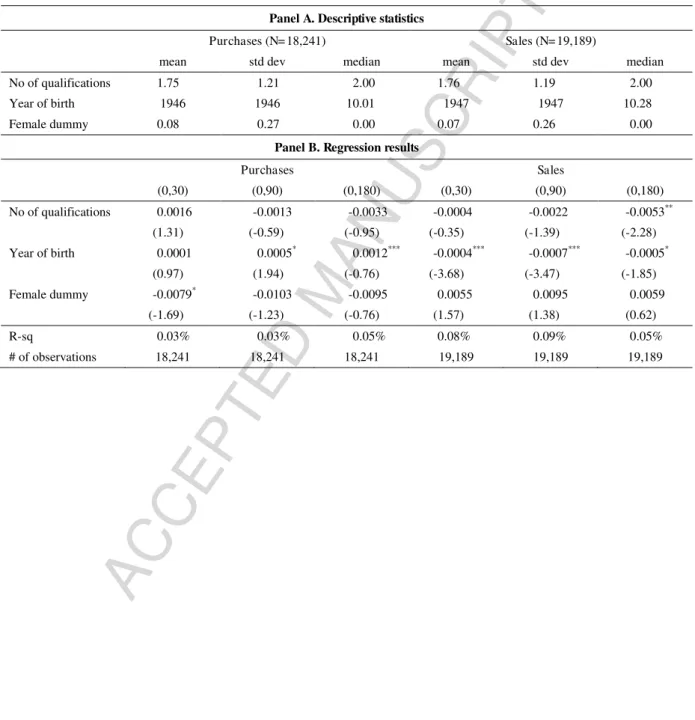
We run a set of regressions with estimated insider fixed effects as the dependent variable, and three independent variables sourced from the BoardEx database: number of qualifications (as a proxy for education), year of birth and a gender dummy. The biographical data is available for about 32% (22%) of insiders with purchase (sale) trades. From Table 6, younger generations of insiders outperform older generations. Insiders born a decade (10 years) later outperform older insiders by 1.2 percentage points over the 180-day window when they buy and by 0.5 percentage points when they sell shares.8 There is also weak evidence that female insiders underperform male insiders, consistent with the results in Bharath et al. (2009) and Jia at al. (2014), and that better educated insiders outperform other insiders when selling. Overall, the regression R-squares are very low indicating that time-invariant personal characteristics we analyze explain only a very small fraction of the variability of individual effects in insider trading performance.
8
Note that the significance of the year of birth does not reflect any time trends in insider trading performance as they are controlled for with year dummies in all baseline regressions.
ACCEPTED MANUSCRIPT
16 4.4. Trading on Private vs. Public Information
We next investigate whether individual insider attributes lead to trading on public and/or private information. Insiders profit from superior information and trade as contrarians (Piotroski and Roulstone, 2005). A traditional and very intuitive view is that despite security laws prohibiting trading on private information, insiders can still benefit from their advantageous position inside the firm (Jaffe, 1974). Recent evidence also suggests that insiders exploit inattentive outsiders and successfully profit from trading on relevant public information (Alldredge and Cicero, 2013).
We test whether individual fixed effects explain different portions of variability in trading performance across firm subsamples with different levels of public and private information. If insiders differ in their ability to collect and process public information, we should see a greater impact of insider fixed effects on insider trading performance in companies with a rich public information environment. Similarly, if insider traits are manifested in different abilities to process and trade on private information, insider fixed effects should matter more in companies with large information asymmetries where insiders have an information advantage over outsiders.
Drawing on Cohen and Frazzini (2008), we divide firms according to characteristics of the public information environment. A firm’s future cash flows, and hence valuation, depend on its operations within the buyer-supplier network, and the firm’s performance is linked to the financial standing of its customers and suppliers. If key customer or supplier identities are public information and information about their financial situation is also public, one can potentially infer about the firm’s prospects based on public information about its trading partners. Cohen and Frazzini (2008) show that because of investors’ attention constraints, stock prices do not promptly reflect publically available information about a firm’s principal customers. As a result, exploiting public information about stock prices and the financial performance of a firm’s economically-linked customers yields positive abnormal returns. Alldredge and Cicero (2013) show that insider trading is also more profitable in firms with economically-linked public customers. They argue that insiders are the most attentive group of investors, have innate abilities to collect and process public information and take advantage of the market inefficiency found by Cohen and Frazzini (2008).
We obtain information on customer-suppliers links from Andrea Frazzini’s website.9 The data set contains identifiers of all public firms and their principal customers that are covered by CRSP/Compustat. A principal customer accounts for at least 10 percent of a firm’s annual sales and firms are obliged to report their links with principal customers following Regulation SFAS No. 131.
9
ACCEPTED MANUSCRIPT
17 With this information we are able to identify firms in our insider trading sample that have economically-linked public customers. Similar to Alldredge and Cicero (2013), for each year, we classify firms with principal public customers as linked suppliers, and as non-linked suppliers otherwise. We then re-run our main tests for insider trades in linked and non-linked suppliers to identify the explanatory power of insider fixed effects. The customer-supplier data covers the period 1980-2004 so for this test we drop post-2004 insider transactions.
To divide firms according to information asymmetries and insiders’ private information advantage, we use the number of security analysts as a proxy for the number of informed traders (see Brennan et al., 1993). Holden and Subrahmanyam (1992) theoretically show that informed traders aggressively compete with each other, reducing the information advantage of any single trader and causing share prices to rapidly reflect private information. Informed outside traders compete for information with insiders (e.g. Fishman and Hagerty, 1992) and in the absence of informed outsiders (analysts), insiders have a monopoly over information. Consistent with this argument, Frankel and Li (2004) report lower insider trading performance in firms with a larger analyst following, and Ellul and Panayides (2012) document that termination of analyst coverage reduces firm liquidity and price efficiency while increasing the profitability of insider trades.
We source analyst coverage data from I/B/E/S. For all firms in our insider trading sample we collect information on the number of earnings estimates one month prior to the end of the fiscal year. If for the given year a company has no information on earnings estimates we set the number of analysts to zero. We then divide the full insider trading sample into two subsamples representing insider trades in firms with and without analyst earnings estimates.
Table 7 presents information on the relative importance of observable characteristics, insider fixed effects and firm fixed effects in explaining post-trade abnormal returns. The results are classified according to the public information environment (linked vs. non-linked suppliers, columns (1)-(4)) and the private information advantage (firms without vs. firms with analyst coverage, columns (5)-(8)). For brevity, the estimated regression coefficients are not tabulated, but available from the authors upon requests.
Considering different levels of public information, across all model specifications insider fixed effects explain a larger proportion of trading performance in firms with economically-linked customers (more public information). For example, for the (0,30) purchase window (Panel A, columns (1) and (2)), insider fixed effects explain 45.5% of the variation of post-trade abnormal returns in linked suppliers and only 31.0% of the return variation in non-linked suppliers. The results indicate that insider
ACCEPTED MANUSCRIPT
18 attributes matter more when trading performance depends upon the appropriate use of public information, and one of those attributes may be the degree of attentiveness.
The difference in the importance of insider fixed effects is generally more pronounced for purchase than for sale transactions. These findings extend the evidence in Alldredge and Cicero (2013) who document a difference in average insider selling but not buying performance across linked and non-linked suppliers. They interpret their finding by arguing that insider sales are less driven by private information due to asymmetric litigation risks (Cheng and Lo, 2006) and hence opportunities to profitably trade on public information matter. On the other hand, insiders are more likely to use private information when buying and hence public information is incrementally less useful. We document that individual traits matter in paying appropriate attention to on average less valuable information which nevertheless creates opportunities for profits when it is correctly used. In other words, personal attributes matter in selective use of information when it is relatively less important, which leads to larger person-specific heterogeneity in performance. Attributes matter less when, on average, the valuable public information is abundant, as argued by Alldredge and Cicero (2013).
Columns (5)-(8) of Table 7 present results for firms divided according to the insiders’ private information advantage. They show that insider attributes matter more for insider trading performance in firms without analyst coverage, that is in firms in which insiders have monopolistic possession of private information (Ellul and Panayides, 2012). The difference in the relative importance of insider fixed effects is as high as 9.3 percentage points (28.5% vs. 19.2%) for BHAR(0,90) following sale transactions (Panel B, columns (7) vs. (8)). The findings suggest that insiders systematically differ in the way they collect and analyze private information and are willing to trade on it given regulatory and reputational risks. In contrast to trading on public information, differences in the relative importance of insider fixed effects in explaining post-trade abnormal returns are greater for sales than for purchase transactions. Given the higher litigation risk when selling on private information (Cheng and Lo, 2006), our results indicate that there is a significant heterogeneity in the attitude to that risk across corporate insiders. Building on the argument in Alldredge and Cicero (2013), again we find that insiders differ less in trading on private information when the use of private information is likely to be more widespread, as in the case of purchases, but there is larger heterogeneity when the profitable opportunities are, on average, more limited, for example by regulatory risks, as in the case of sales.
Taken together, we find that insider traits matter for trading on both public and private information. The results indicate that individual insiders systematically differ in their ability to profit from public information and their willingness to trade on private information. The asymmetric results between purchases and sales suggest that the marginal importance of individual traits for trading performance
ACCEPTED MANUSCRIPT
19 is greater when, on average, specific opportunities to profit from information are less abundant. In other words, individual characteristics matter less when, on average, many insiders are able to make information-driven trading profits.
4.5. Regulations and Insider Trading
In this section we analyze the impact of regulations on insider trading. In particular, we test whether the Sarbanes-Oxley Act (SOX) had any influence on the role of unobservable individual and firm characteristics in explaining insider trading returns. The Sarbanes-Oxley Act of 2002 is a wide-reaching federal law with the key objective to improve corporate governance and enhance disclosure practices. SOX mandated stronger firm-level internal control mechanisms, but also enhanced individual responsibilities of top executives with increased penalties for white-collar crime. Another aspect of SOX was the requirement of more timely disclosure of insider trade activity. Brochet (2010) documents that after SOX the short-term stock price reaction to insider trading was stronger, indicating greater information content under the new reporting regime. He also reports that, after SOX, insiders were less likely to trade on negative private information, in line with the increased scrutiny of executive behavior introduced by regulation.
It is an open question how SOX might affect the relative role of insider and firm characteristics in explaining post-trade abnormal returns. On the one hand, enhanced scrutiny and tighter regulations in the post-SOX period may curb opportunistic insider behavior, which would consequently reduce the role of individual heterogeneity in explaining insider trading. A contrasting view would suggest that if SOX successfully strengthens firm-level internal control and oversight mechanisms, there would be greater homogeneity across firms and latent firm-level factors would have lower power in explaining insider returns.
To analyze the impact of SOX, we re-run regressions that include both insider and firm fixed effects in two sub-periods: 1991-2002 (‘pre-SOX’) and 2003-2010 (‘post-SOX’). In 1990 the Securities Enforcement Remedies and Penny Stock Reform Act (SERPSRA) changed SEC enforcement powers and increased penalties for insider trading (Lee et al., 2014). Hence we include only the post-1990 period in our analysis to limit the impact of other regulatory changes.
The results are presented in Table 8. For brevity we do not report estimated coefficients and focus only on the role of individual factors in explaining insider trading performance. For purchase transactions, we record a large increase in the role of insider fixed effects accompanied by a drop in the importance of firm fixed effects. For example, unobserved fixed insider characteristics explain 29.4% of the variability in BHAR(0,90) in the pre-SOX period and the explanatory power increases to
ACCEPTED MANUSCRIPT
20 46.6% after SOX (Table 8, Panel B, columns (1) and (2)). For sales, the effect is much more modest and the contributions from insider and firm fixed effects remain fairly stable around the enactment of SOX.
The increase in the importance of individual heterogeneity is consistent with the argument that personal attributes matter more when profitable trading opportunities are restricted by tougher regulations. It is possible that stricter rules discourage many insiders from trading on private information but create an opportunity of monopoly profits for the few who find a way to evade the law (Bris, 2005). As a result, individual heterogeneity is observed to have greater importance. The asymmetric effect on stock buying and selling behavior is somewhat puzzling though and may be driven by the confounding influence of firm-level and individual-level responses, if both firm-level and insider-level factors become more homogenous.
Table 8 provides convincing evidence that market wide regulations - in this case, SOX - homogenize the corporate landscape but have a limited impact on individual behavior once firm-level factors are included. Our results may indicate that individual trading behaviors are deeply rooted in personalities, and regulations do not alter individual heterogeneities, although they could influence average behavior, as found by Brochet (2010).
4.6. Subsample of Insiders with at Least Three Transactions
All tests presented so far do not impose any restriction on the minimum number of transactions per insider with an aim to preserve the cross-section of individuals. If the number of trades is correlated with unobservable personal traits – for example, insiders with poorer skills to analyze information can choose to trade less frequently, deleting insiders with a smaller number of transactions would distort the picture of individual heterogeneity and, consequently, bias our results. The drawbacks of our approach include a lower precision of estimated individual effects for insiders with few transactions, and the problem of overfitting if a group of one-trade insiders accounts for a large fraction of observations. If overfitting is a concern, then our estimates of the importance of unobserved individual characteristics for insider trading performance presented so far provide the upper bound estimate, and the estimate would fall sharply when insiders with a low number of trades are excluded.
In this section we provide a check if the key findings of this study hold when we impose a requirement of the minimum number of trades (separately for tests for sales and purchases) per individual. We follow Cohen et al. (2012) who use three trades to classify insiders and set the minimum requirement at three trades. This requirement should address the concern of a lack of precision in estimating the person-specific insider trading performance, overcome the problem of
ACCEPTED MANUSCRIPT
21 overfitting, and at the same time it takes into account the fact that individual insiders do not trade frequently, which is an inherent issue in insider trading research (e.g. Cohen et al., 2012).
Compared to the full sample reported in Table 1, imposing the requirement reduces the number of observations by 17.8% to 254,751 for purchases and by 7.0% to 766,130 for sales.10 In the restricted purchase sample there are 29,042 insiders, a reduction of 59.3%, and for sales the number of individuals is reduced by 40.7% to 61,589. Because, on average, insiders sell shares more frequently than buy, the reduction in the sample size is smaller for sales than for purchases.
Using that restricted sample we re-estimate model (5) to separate insider and firm fixed effects and to identify the relative importance of individual factors in explaining insider trading performance. Results reported in Table 9 show that the significance and magnitude of coefficients of observed characteristics remain similar to the ones estimated in the full sample and reported in Table 4. The importance of determinants of BHARs is presented in Panel B of the table. As predicted, we find a drop in the importance of insider fixed effects but they nevertheless retain the key explanatory power for post-trade abnormal returns. The lack of a sharp drop in the estimated importance of individual attributes across models shows that overfitting is not a primary concern. The drop is most pronounced for purchases over the shortest horizon of 30 days, where the relative importance of insider fixed effects is reduced from 32.0% to 21.5% (column (1) of Panel B, Table 4 vs. Table 9). It is more modest for the longest horizon of 180 days (a drop from 31.9% to 25.8%), and is overall smaller for sales where it drops by as little as 2.1 percentage points (from 20.5% to 18.4%) for the longest horizon (column (6) of Panel B, Table 4 vs. Table 9). Because the performance of trading is likely to be more precisely measured over the longer horizon, the results show that our initial estimate of the importance of individual heterogeneity is not largely influenced by insiders with fewer trades in the full sample.
Overall, we acknowledge the difficulty in precisely estimating the importance of personal attributes for insider trading performance. However, our results clearly indicate that insider fixed effects are a key factor explaining post-trade abnormal returns, and that they dominate other factors considered in the literature before. The analysis in the restricted sample addresses important estimation concerns but at the same time the results have to be interpreted with some caution as the restricted sample loses the breadth of the cross-section of individuals.
10
Note that the number of observations is further reduced in the estimation which imposes the requirement of connectedness to identify both insider and firm fixed effects.
ACCEPTED MANUSCRIPT
22 4.7. Subsample of Multiple-Firm Insiders
Our tests have all used the connectedness sample, which is the sample of insider trades connected by individuals who traded in multiple firms. The insiders included in the sample are not required to have trades in more than one firm as long as they trade in a firm that has at least one multiple-firm insider. In this section we introduce a stricter requirement and re-run the baseline tests in a sample of multiple-firm insiders only.
The connectedness sampling methodology relies on insiders trading in more than one firm, and when the number of multiple-firm insiders is relatively small, the idiosyncratic component of multiple-firm trading may have a large impact on the estimation (Graham et al., 2012). At the same time, the sample of multiple-firm insiders can suffer from selectivity bias. Insiders with trades in multiple firms are either individuals who have changed jobs and moved between firms, or who hold multiple board appointments. As such, they are likely to differ from the whole population of insiders with respect to expertise, skills and other personal attributes. Restricting the sample to those individuals is likely to remove a lot of individual heterogeneity in the sample and hence diminish the importance of individual unobservable characteristics in explaining trading performance. Moreover, as noted by Graham et al. (2012), increasing the percentage of multiple-firm insiders in a sample may raise the role of firm effects in explaining the dependent variable, since firm fixed effects contribute to between-firm and not within-firm variation in the dependent variable. Consequently, firm fixed effects play a more significant role in explaining trading performance for multiple-firm insiders rather than for single-firm insiders.
The results for trades by multi-firm insiders are presented in Table 10. The sample is by construction much smaller, with the number of observations equal to 32.5% and 23.8% of purchases and sales in the connectedness sample used in regressions reported in Table 4, respectively. The coefficients in Table 10 and their significance are similar to those in Table 4 but there are also systematic differences between the restricted sample and the full connectedness sample in the relative importance of BHAR determinants. Consistent with the prediction, we find a fall in the importance of insider fixed effects and an increase in the importance of firm fixed effects.
The importance of insider fixed effects in explaining the variation in BHARs is reduced by about half. For example, fixed effects for 30-day post-buy BHARs goes down from 32.0% (Table 4, Panel B, column (1)) to 15.4% (Table 10, Panel B, column (1)). The associated contribution of insider fixed effects to the model’s R-square decreases from 68.1% to 39.0%. Overall, in the sample of multiple-firm insiders we find that the multiple-firm effects dominate individual effects but still the importance of
ACCEPTED MANUSCRIPT
23 individual heterogeneities is not negligible and greatly exceeds the importance of observed characteristics (firm, insider and trade).
5. Summary and Conclusions
We analyze the impact of unobservable time-invariant individual attributes on the performance of insider trades. Our results strongly suggest that individual personality t