CSE Technical Report 334
Joan L. Herman Shari Golan
National Center for Research on Evaluation, Standards, and Student Testing (CRESST) UCLA Graduate School of Education
1The work reported herein was supported under the Educational Research and Development Center Program cooperative agreement R117G10027 and CFDA catalog number 84.117G as administered by the Office of
Educational Research and Improvement, U.S. Department of Education. The findings and opinions expressed in this report do not reflect the position or policies of the Office of Educational Research and Improvement or the U.S. Department of Education.
Effects of Standardized Testing on Teachers and Learning — Another Look
Joan L. Herman Shari Golan
National Center for Research on Evaluation, Standards and Student Testing (CRESST)
UCLA Graduate School of Education1
Standardized testing has assumed a prominent role in recent efforts to improve the quality of education. National, state, and district tests, combined with minimum competency, special program, and special diploma evaluations, have
resulted in a greatly expanded set of testing requirements for most schools. At a cost of millions, even billions, of dollars and at the expense of valuable student, teacher, and administrator time, testing advocates and many policymakers still view testing as a significant, positive, and cost-effective tool in educational improvement.
Testing advocates' support for testing as such a tool is based on a simple set of arguments. First, testing sets
meaningful standards to which school districts, schools, teachers, and students can aspire. Second, test data can be used as feedback to shape classroom instruction. Third,
testing makes school systems, schools, and teachers more accountable for student learning. Finally, testing, coupled with incentives and/or sanctions, can be used to promote fast and broad changes within schools and can stimulate major
educational reform.
While testing is thought by many to benefit education in a variety of ways, the validity and value of traditional
standardized tests are subjects of increasing debate. Recent studies raise questions about whether improvements in test score performance actually signal improvement in learning (Cannell, 1987; Linn, Grave, & Sanders, 1989; Shepard, 1990). Other studies point to standardized tests' narrowness of
content, their lack of match with curricula and instruction, their neglect of higher order thinking skills, and the
limited relevance and meaningfulness of their multiple choice formats (Baker, 1989; Herman, 1989; Shepard, 1990).
According to these and other researchers, rather than exert-ing a positive influence on student learnexert-ing, testexert-ing may trivialize the learning and instructional process, distort curricula, and usurp valuable instructional time (Bracey, 1989; Dorr-Bremme & Herman, 1986; Romberg, Zarinnia,
Williams, 1989; Smith, Edelsky, Draper, Rottenberg, &
Cherland, 1989; Stake, 1988). Schools serving disadvantaged students are thought to be particularly at risk for such adverse effects (Dorr-Bremme & Herman, 1986).
This current study brings additional empirical data to the debate about the actual effects of standardized testing
4
on teaching and learning. Specifically, this study poses a series of interrelated questions. First, what are the effects of standardized testing on (a) schools, and (b) the teaching and learning processes within them? Second, what do test scores mean? For instance, are increasing scores a reflec-tion of a school's test preparareflec-tion practices, its emphasis on basic skills, and/or its efforts toward instructional
renewal? Third, are there differences in how testing effects instruction and what test scores mean between schools serving lower socioeconomic status (SES) students and those serving more advantaged students?
This paper begins with a review of some past studies on the effects of standardized testing on schooling. (The find-ings of these studies helped focus our key research questions and suggested specific items for study instrumentation.)
Next, summaries of the study's methodology and its results are provided. Finally, the implications of the study's find-ings for educational policy and research are reported.
Literature Review
The following review examines research on a number of variables through which testing may influence schools. The variables are: accountability pressure, teacher attention to testing in instructional planning and delivery, time spent on test preparation, teachers' sense of professional pride, and general attitudes teachers hold about the fairness and util-ity of testing.
Accountability pressure. It is well documented that
standardized test scores are used by school administrators and the public to evaluate schools, teachers, and educational programs. Further, test scores are used in making a variety of decisions which have important consequences for teachers and students, that is, student promotion, teacher promotion, and program funding (Madaus, 1985, 1988, 1990; Tyler & White, 1979). The accountability pressure thus promoted has been examined in a number of studies. Some have investigated the factors which influence the amount of pressure experienced by teachers (Fish, 1988), while others have examined how
accountability pressures influence teachers and teaching behavior (Kelleghan & Madaus, 1985; Fish, 1989; Dorr-Bremme 1983).
Fish found that apparent pressure on teachers to improve their students' test scores was influenced by a number of factors including: the degree and nature of administrator involvement, teachers' professional self-concepts, and teach-ers' years of teaching experience (Fish, 1988). Thus, admin-istrator concern over test scores was positively related to accountability pressure reported by teachers. Both positive teacher self-concept and more years of teaching experience were negatively related to such pressure. One possible explanation for experienced teachers feeling less account-ability pressure comes from a study by Smith, et al. (1989). Smith and her colleagues found that veteran teachers more often believed that low test scores were due to factors
6
beyond their control, such as low student ability and discrepancies between the test and curriculum, than did novice teachers.
Madaus (1988) also studied factors that increase the accountability pressure on teachers to improve their
students' test scores. He coined the phrase "high stakes testing" to refer to testing which promotes pressure and behavior change by associating test results with important consequences. Also noting this phenomenon, Romberg et al. (1989) concluded "the greater the consequences attached to the test, the more likely it would be to have an impact [on teaching]" (p. 14). Similar to Madaus, Fish (1988) found that the amount of pressure felt by teachers increased with their belief that test results were to be used more for teacher evaluation than for student diagnosis and prescrip-tion.
The literature shows disagreement over whether account-ability pressure exerts positive, negative, or no effects on teaching and teaching behavior. Some, for example, have noted potential positive effects on teacher motivation. Madaus (1985) observed that when test score gains are tied to incen-tives, such as Distinguished School Awards, Cash for CAP, career ladder incentives, and celebrations; teachers feel motivated rather than pressured to increase scores. In addi-tion, Fish (1988) found that teachers were enthusiastic about efforts to raise test scores when their principals adopted a
collaborative rather than a dictatorial approach to test score improvement.
Other literature suggests that teachers respond nega-tively to pressure created by testing. Fish (1988) found that one factor reducing such negative impact was years of teaching experience. She observed that relatively inexperi-enced teachers felt greater anxiety and accountability pres-sure than experienced teachers. Fish also found that teach-ers reacted negatively to pressure created by public displays of classroom scores. Furthermore, when teacher-specific
and/or classroom-specific accountability existed, teachers reported instances of cheating—giving direct hints to
students or changing student responses on tests—and feelings of anxiety and low self-esteem. Dorr-Bremme, Burry,
Catterall, Cabello, and Daniels (1983) reported similar teacher testimonies about feelings of anxiety when scores were publicly posted. In addition, they found that anxiety increased when principals wanted to know why there had been a decline in scores.
Still other studies argue that testing and
accounta–bility pressure have little or no effect on
teaching. According to these studies, teachers discount the credibility of standardized tests and do not take action based on them. Salmon-Cox (1981) found that mandated
achievement tests were of little relevance to teachers, and that teachers viewed the results of such tests as relatively unreliable sources of information. Dorr-Bremme and Herman
8
(1983) as well as Ruddell (1985) found that teachers paid little attention to standardized tests for these same
reasons. Goslin (1967) similarly observed that teachers felt that standardized achievement tests were unfair and
inaccurate measures of student ability and therefore were not worth considering in their decision-making.
Influence of testing on teacher planning and
instruction. Several studies have investigated the ways in
which testing influences teacher planning and instruction. Herman and Dorr-Bremme (1983) found relatively little influ-ence of standardized tests on teacher decision-making; for instance, in grouping students, planning instruction, grad-ing, diagnosing/prescribing—compared to other sources of information available to teachers. In contrast, Salmon-Cox (1981) reported that teachers in Pittsburgh found the
California Achievement Test to be useful in sequencing instruction, planning instruction and grouping students. Mehrens (1984) found that achievement testing served to
broaden the curriculum; that is, testing encouraged teachers to add to, rather than replace existing instructional topics.
However, when test results are linked to rewards or sanctions, studies have found that "high stakes" testing leads to a narrowing of curricula and instruction. Madaus (1988) noted that teachers taught to the test when they believed important decisions, such as student promotion,
would be based on test scores. Smith et al. (1989) found that pressure to improve students' test scores caused some
teach-ers to "neglect material that the external test does not include...reading real books, writing in authentic context, solving higher-order problems, creative and divergent think-ing projects, longer-term integrative unit projects, [and] computer education..." (p. 268). She and her colleagues also found that teachers were using worksheets with the same ques-tion format as the mandated test. Corbett and Wilson (1988), in a study of Maryland schools, similarly found that schools redefined course objectives and resequenced course content in an attempt to improve test scores. Stodolsky (1988) further observed that accountability pressure discouraged teachers from using joint or team teaching approaches and from chang-ing their methods to facilitate serious student learnchang-ing.
Time spent on testing and test preparation. The
amount of instructional time teachers spend on test prepara-tion has been well documented. Smith and her colleagues
(1989) reported that teachers in two case study schools spent three to four weeks of school time on special test prepara-tion for standardized tests, and that time spent on test preparation increased with the approach of the test date. Similarly, Edelman (1981) found that even though teachers varied in the specific ways and extent to which they prepared students for mandated tests, 60% of the teachers stressed test content over a long period of time. Moreover, Fish
(1989) found that teachers, over the past five to six years, increased the amount of time they spent on practices which they believed would increase test scores.
10
Teachers' sense of professionalism and pride in work. Fish (1988), as previously mentioned, found that
teach-ers' professional self-images are negatively related to the pressure they feel to raise test scores. She noted that feelings of guilt, anger, and low professional esteem
increased when teachers engaged in questionable testing and test preparation activities. Corbett and Wilson (1988) also substantiated the high pressure and negative affect felt by teachers. A common reaction, according to Corbett and Wilson, was captured by this frustrated teacher's comments, "Teachers feel jerked around. The test dictates what I will do in the classroom. If you deviate from the objectives, you feel guilty...we were told 'here's how to get kids to pass the test fast'"(p. 36).
Teachers' general attitudes about the validity of testing. Teacher reactions to the validity of standardized
testing, according to the literature, range from concern to distrust. Findings from Dorr-Bremme et al. (1983) indicated that teachers were concerned about the utility of mandated tests, their appropriateness for some students, and the impact of testing on instructional time and student self-confidence. Similarly Smith et al. (1989) reported that teachers were pessimistic about what scores reveal. Less than one-fifth of the teachers interviewed felt that results from the mandated, standardized test used in their schools accurately reflected their students' learning for the year. Moreover, only 3% of the teachers from their study felt that
the test was appropriate for ethnic minorities or non-English speakers. Finally, Fish (1988) documented the general
teacher attitude that tests do not reflect classroom curricu-lum or student learning. Interestingly, however, Fish found that even teachers who viewed standardized tests as poor measures of student achievement still felt the need to spend a great deal of time on test preparation.
These findings raise questions concerning possible
discrepancies between teachers' beliefs about the utility and reliability of standardized testing and their classroom
instructional behavior in preparing their students for tests.
The meaning of test score gains. The meaningfulness
of standardized test scores as indicators of true student learning has recently come under serious question from other sources as well. Cannell (1987) discovered that all 50
states and most districts reported above-average performance on standardized, norm-referenced achievement test scores, an unnatural occurrence given the norm-referenced metric. Using greater technical rigor, Linn et al. (1989) replicated
Cannell's findings, but moved beyond them in identifying underlying causes for such seemingly spurious results, among them the age of norms. In a related interview study, Shepard (1990) identified additional issues which contribute to score inflation, among them the practice of using the same test forms year after year, the practice of having classroom
teachers administer the tests, questionable test preparation practices, and the pressure on teachers to raise test scores.
12
The combined results from these studies raise questions about whether test score gains signal improvement in broader student learning or whether they simply reflect teaching to the test, that is, unduly focusing the curriculum on narrow test content and/or having students practice items nearly identical to those appearing on the test, and/or, worse still, giving students practice with the actual items. A basic issue is: Do current accountability pressures drive schools to narrow their curriculum and engage in unsound
instructional practices at the cost of broader student learn-ing, school attitudes, and climate?
Key Research Questions
The current inquiry investigated a number of issues
raised separately by these previous studies, looking particu-larly at the interplay between the effects of testing on
teaching and learning processes in schools and the consequent meaning of test score gains. Specific research questions included:
1. What are the effects of testing on schools and on the teaching and learning processes within them?
a. How much and from where do teachers feel
pressure to improve their students' test scores?
b. How much and how does test preparation affect teachers' instructional planning, learning strate-gies, and curriculum content for tested subjects
and what impact does test preparation have on non-tested subjects?
c. How much time do school administrators spend on test preparation and how does that amount of time compare to the time they spend on instructional renewal?
d. What effect does testing have on teachers' sense of professionalism and pride in their work?
e. What general attitudes do teachers hold about the reasons test scores change, their fairness, and their usefulness?
2. What is the meaning of test score gains?
Specifical–ly, can we differentiate schools showing increasing scores from those showing stable or decreas-ing scores in terms of:
a. Emphasis on testing and test preparation?
b. Attention to school renewal?
3. Does testing have differential meaning in schools serving students from mostly economically disadvantaged backgrounds and those serving their more advantaged counterparts?
Our study used survey methodology to address these ques-tions, comparing the testing and educational practices of schools with increasing test scores to the practices of schools with stable or decreasing test scores. Responses
14
from schools serving higher and lower socioeconomic status students also were compared.
Methodology
Subjects (Table 1). The study results are based on
responses from upper elementary school teachers in matched pairs of schools from 11 medium-to-large school districts in nine states across the country. This sample was the result of a phased selection process. First, districts representing diverse geographical locales were identified and their will-ingness to participate in the study was secured. Directors of research and evaluation (or their counterparts) in
consenting districts were then asked to identify pairs of schools in their districts which were demographically simi-lar, for example, having the same socioeconomic standing. It was also requested that one school in the pair had shown a significant increase in standardized test scores over the previous three years (8 to 10 National Curve Equivalent points) and the other school had shown no such increase
Survey Sample
A. Schools By Test Score Trends
Increasing
Stable or
Decreasing Total
n = 2 4 n = 2 4 4 8
B. Mean Number of Teachers Per School
7 . 1 ( 3 . 5 2 )
C. Total Number of Teachers
TABLE 1 (Cont'd.)
D . School Level: Mean Years of Teaching Experience By Test Score Trends
Increasing Stable or Decreasing Overall 1 3 . 1 9 ( 5 . 1 5 ) 1 1 . 8 2 ( 4 . 0 5 ) 1 2 . 5 1 ( 4 . 6 3 )
E. School Level: Mean Years Teaching At Current School By Test Score Trends
Increasing Stable or Decreasing Overall 6 . 1 5 ( 2 . 9 7 ) 5 . 7 5 ( 2 . 6 0 ) 5 . 9 4 ( 2 . 7 7 )
F. Student Characteristics By Test Score Trends By School Percent of Chapter I Students
0 - 2 5 % 2 6 - 5 0 % 5 1 - 7 5 % 7 6 - 1 0 0 % _ _ X % Increasing n = 1 3 n = 6 n = 4 n = 1 2 6 . 4 2 (29.45) Stable or Decreasing n = 1 2 n = 3 n = 7 n = 2 3 4 . 6 7(32.49) Overall n = 2 5 n = 9 n = 1 1 n = 3 3 0 . 5 5 (30.96) Percent of Limited English Proficiency Students
0 - 2 5 % 2 6 - 5 0 % 5 1 - 7 5 % 7 6 - 1 0 0 % _ _ X % Increasing n = 2 1 n = 1 n = 1 n = 1 1 1 . 3 0 (22.98) Stable or Decreasing n = 2 0 n = 2 n = 2 n = 0 1 1 . 9 0 (21.76) Overall n = 4 1 n = 4 n = 2 n = 1 1 1 . 6 0 (22.13)
18
(having either remained stable or decreased over the same time period). The plan asked for two low SES pairs and one medium or high SES pair. The majority of directors, however, could not generate three such pairs. (In fact, a number of additional districts who were willing to participate in the study were unable to generate three pairs of schools with contrasting performance trends because they could not iden-tify any schools that had demonstrated clear upward score trends.)
Identified schools were then contacted, and all upper elementary school teachers within them asked to complete questionnaires. A modest honorarium was offered to each teacher returning a survey. All schools so contacted agreed to participate in this study. Data were subsequently
received from 341 third- through sixth-grade teachers from 24 matched pairs of schools, a total of 48 schools representing the West, the Southwest, the Midwest, the Southeast, and the East Coast regions of the country. Responses were received from approximately seven teachers at each school.
Based on the results of the survey, the schools in this study had highly experienced teaching staffs, with an average of 12.5 years of teaching experience. The teaching staffs at schools with increasing scores had a slightly higher average of 13.2 years teaching experience than staffs at schools with decreasing or stable scores who averaged 11.8 years of
showed similar longevity; both groups on average had taught at those schools for approximately six years.
The teachers in this study also provided data about the students they taught. Specifically, they estimated the
percentage of their students who were classified as Chapter One participants and/or Limited English Proficient. The aver-age percentaver-age of Chapter One students reported at the
schools with increasing scores is slightly lower (26.4%) than the number reported at schools with decreasing or stable
scores (34.7%). Both types of schools reported a similarly low percentage of Limited English Proficient students
(11.6%). Chapter One percentages were used subsequently to determine schools' socioeconomic status (SES) for study
purposes. Low SES schools were those reporting more than 50% Chapter One students, while high SES schools were those
reporting 20% or less Chapter One students (Table 2).
Measures. A teacher questionnaire containing 136 items
was specially developed for the study. The questionnaire asked about teacher and student background characteristics, perceived pressure to improve test scores, and influence of testing on teacher planning. The questionnaire also asked about amount and type of test preparation at the classroom and school level, impact of testing on non-tested subjects, impact of testing on teacher pride and sense of professional-ism, and general attitudes about reasons test scores change,
TABLE 2
Test Score Trends by Socioeconomic Status
Increasing Scores Decreasing Scores n=24 n=24 Low SES 29.2% n=7 37.5% n=9 High SES 50.0% n=13 41.7% n=10
their fairness, and their usefulness. The complete question-naire can be found in Appendix A.
Data collection procedures. As soon as permission
was received to conduct the study, testing directors called the principals of the paired schools to notify them of their selection. Next, study researchers contacted the principals both by phone and letter to communicate the purpose and the methodology of the study. Along with a set of teacher ques-tionnaires and return envelopes, principals were sent a
letter that gave a brief rationale of the study to share with their teachers, and a reminder to inform teachers that they would be paid a modest honorarium for their participation. Teachers were instructed to mail back their questionnaires directly to the researchers.
Data analysis procedures. Data were coded by school,
test score trend status, socioeconomic status and other iden-tifying information. Data were then aggregated at the school level for analysis; that is, the responses of individual teachers were averaged with those of other teachers from their school and then comparisons made between matched
responses from schools with increasing scores and those with stable or decreasing scores. School level estimates were based on at least three responses from a school, and only matched schools were included in the final data set. Thus, if there were no responses from one school within a matched pair, responses from the other school were eliminated from the analysis.
22
Comparisons also were made between high and low SES schools, both within and across schools with different test score trends. Because the research design was not fully crossed on these latter variables, these analyses are
intended only as exploratory. Finally, correlations were used to examine relationships between overall factors
believed to contribute to testing effects and test score gains.
Limitations of study. Beyond reliance on self-report
data, an important limitation of the study is related to the selection of suitable school pairs, especially in urban
districts with large numbers of disadvantaged students (our original target population). Our methodology relied on
research and evaluation directors' expert judgment in identi-fying demographically similar pairs of schools, where one school had demonstrated a clear improvement in test scores and one had not. As mentioned, a number of districts had difficulty in identifying schools with clear upward trends, skewing the sample; and it is possible that some directors who did identify schools for our sample may have used infor-mation in addition to test scores when defining whether or not a school was improving.
Results
Pressure to improve student test scores (Tables 3
and 4). Overall, teachers report feeling strong pressure from district administrators and the media to improve their students' test scores. Teachers also report feeling a moder-ate amount of such pressure from their principals, other
school administrators, other teachers, parents, and the com-munity. Interestingly, teachers in schools with increasing test scores report feeling more pressure from every source than teachers in schools with stable or decreasing scores. Further, when responses from high and low SES schools are compared, teachers in these schools feel the greatest pres-sure from different sources, with the exception of the media. Teachers in high SES schools report that parents, the commu-nity, and the media are the strongest sources of pressure, while teachers in low SES schools feel the most pressure from district administrators, principals, other school administra-tors, and the media. Finally, it is interesting to note that teachers in high SES schools with increasing test scores
report the most overall pressure, while the teachers in low SES schools with decreasing scores report the least amount of overall pressure.
Effects of test preparation on curriculum
content, teachers' instructional planning, and class-room activities for tested subjects (Tables 5-8). In
TABLE 3
Pressure on Teachers to Improve Test Scores By Test Score Trends
1=Almost No Pressure 3=Moderate Pressure
5=Great Pressure Increasing
Stable or Decreasing n=24 n=24 District administrators/ school boards 3.5939 (0.661) 3.5587 (0.672) Principal 3.1279 (0.821) 2.9847 (0.844)
Other school administrators 3.0823 (0.785) 2.9587 (0.676) Other teachers 2.3579 (0.556) 2.1201 (0.480) Parents 2.6561 (0.725) 2.2761 (0.518) Community 2.8422 (0.721) 2.4775 (0.563) Newspaper/Media 3.6256 (0.710) 3.5589 (0.594) Overall pressure 21.2198 (3.184) 19.5210 (2.706)
Pressure on Teachers to Improve Test Scores By Test Score Trends and Socioeconomic Status
Increasing Stable or Decreasing High SES n=12 Low SES n=7 High SES n=10 Low SES n=9 District administrators/ school boards 3.478 (.463) 3.800 (.866) 3.498 (.684) 3.697 (.508) Principal 2.77 (.527) 3.298 (1.09) 2.696 (.943) 3.166 (.684) Other school administrators 2.895 (.608) 3.128 (1.12) 2.868 (.613) 3.021 (.665) Other teachers 2.191 (.334) 2.315 (.763) 2.062 (.457) 2.166 (.533) Parents 3.00 (.635) 2.345 (.843) 2.590 (.418) 2.036 (.549) Community 3.20 (.44) 2.59 (.92) 2.822 (.569) 2.175 (.520) Newspaper/Media 3.77 (.39) 3.50 (1.13) 3.677 (.623) 3.442 (.559) Overall pressure 21.25 (2.210) 20.85 (4.810) 20.030 (3.130) 19.139 (2.207)
Table 5
Influence of Testing on Teachers' Instructional Planning by Test Score Trends
Increasing
Stable or Decreasing
n=24 n=24
Looks at old/current tests to make sure curriculum includes test content
3.130 (.991)
3.068 (.843)
Test objectives covered in instruction
3.7378 (0.975)
3.7069 (0.853) Adjusts plans according to last
year's test scores
2.6637 (0.708)
2.6726 (0.665) Adjusts plans according to
current year's test scores 3.3084 (0.818)
3.2352 (0.743) Adjusts curriculum sequence
according to test
2.8757 (0.816)
2.8873 (0.808)
Overall influence of testing on teachers' planning
19.0134 (4.389)
18.884 (4.128)
Influence of Testing on Teachers' Instructional Planning by Test Score Trends and Socioeconomic Status
Increasing Stable or Decreasing High SES n=12 Low SES n=7 High SES n=10 Low SES n=9
Looks at old/current tests to make sure curriculum includes test content 2.55 (.81) 3.62 (.98) 2.81 (.85) 3.51 (.47)
Test objectives covered in instruction 3.40 (.93) 3.91 (1.20) 3.58 (.97) 3.91 (.49) Adjusts plans according to last
year's test scores
2.51 (.60) 2.56 (.95) 2.51 (.54) 2.70 (.64) Adjusts plans according to
current year's test scores 3.06 (.59) 3.41 (1.21) 3.00 (.79) 3.39 (.53) Adjusts curriculum sequence
according to test 2.51 (.79) 3.02 (.82) 2.68 (.72) 3.39 (.53)
Overall influence of testing on teachers' planning 17.01 (4.16) 19.78 (4.60) 17.66 (4.04) 20.49 (2.64)
TABLE 7
Class Time Spent on Test Preparation by Test Score Trends
Increasing
Stable or Decreasing
n=24 n=24
Gives worksheets that review test content 4.0346 (1.305) 4.0621 (1.435) Practices on test item format 4.2615 (1.158) 4.3964 (1.185) Gives commercial practice tests 2.9079 (1.069) 3.1290 (1.310) Practices on old test forms 1.9482 (1.088) 2.1183 (1.201) Teaches test-taking strategies 4.4319 (1.013) 4.7551 (1.045)
Overall time spent on test preparation
17.3513 (4.753)
18.4202 (5.450)
1=None 2=At Most a Day 3=A few Days 4=A Week 5=Four Weeks 6=Regularly Throughout the Year
Class Time Spent on Test Preparation by Test Score Trends and Socioeconomic Status
Increasing Stable or Decreasing High SES n=12 Low SES n=7 High SES n=10 Low SES n=9 Gives worksheets that review test content 3.461 (1.409) 4.446 (1.03) 3.725 (1.600) 4.365 (.880) Practices on test item format 3.749 (1.315) 4.589 (.293) 4.084 (1.460) 4.722 (.852) Gives commercial practice tests 2.499 (1.122) 3.376 (.946) 2.735 (1.132) 3.807 (1.380) Practices on old test forms 1.574 (.670) 1.957 (.854) 2.073 (1.011) 2.175 (1.138) Teaches test-taking strategies 4.069 (.952) 4.411 (1.057) 4.503 (1.296) 5.001 (.676)
Overall time spent on test preparation 15.303 (5.042) 18.065 (3.741) 17.069 (6.100) 20.068 (3.989)
1=None 2=At Most a Day 3=A few Days 4=A Week 5=Four Weeks 6=Regularly Throughout the Year
30
substantially influences their instructional planning. Specifically, they report that in devising their plans for instruction they (a) look at prior tests to make sure that their curricula includes all or most of the test content, and (b) plan to assure that they cover test objectives. Further, they report that to some extent they adjust their instruc-tional plans based on the test performance of the class they had last year and more so on the most recent test performance of their current class. They also adjust the sequence of their curriculum based on what is included in the test.
There appear to be no differences between how testing influ-ences teachers' planning at schools with increasing scores and how testing influences teacher planning at schools with stable or decreasing scores. However, when teachers at high and low SES schools are compared, it is clear that the
instructional plans of teachers at low SES schools are more influenced by testing than those of teachers at high SES schools.
Beyond its effects on teacher planning and instructional delivery, testing also affects the teaching-learning process through instructional time devoted to direct test preparation activities. In general, teachers report spending from one to four weeks of class time on the following: having students complete worksheets that review expected test content, having students practice item formats expected on the test, and
instructing students in test-taking strategies. Teachers also report spending from one to several days administering
commercially produced practice tests and old forms of the test to their students. While no differences on these items were found between the reports of teachers at schools with increasing scores and those at schools with stable or
decreasing scores, teachers at low SES schools report spend-ing more of their classroom time on all test preparation activities than do teachers at high SES schools.
Impact of test preparation on non-tested
subjects (Tables 9 and 10). Even though teachers report
substantial pressure to improve test scores, spend substan-tial classroom time on test preparation activities, and give more than a moderate amount of their attention to drilling students in basic skills; they still report giving at least moderate classroom attention to non-tested subjects, such as fine arts, science, and higher order thinking skills. It is of interest to note, however, that while fine arts and non-tested subjects receive moderate attention, teachers indicate that drilling students in basic skills receives the most
emphasis. Furthermore, while most teachers report that
attention to all subjects has remained relatively stable over the last three years, teachers at high SES schools report an increase in attention to higher order thinking skills during this period. Teachers in low SES schools, furthermore,
report significantly more attention to test preparation than their higher SES counterparts.
TABLE 9
Subject Focus and Its Change Over the Last Three Years by Test Score Trends
Increasing Scores Stable or Decreasing Scores n=24 n=24 Drilling students in basic skills 2.60 (.42) same 2.51 (.34) same Fine Arts 1.87 (.46) same 1.88 (.32) same Science 2.33 (.38) same 2.34 (.24) same Subjects which are
not tested 1.96 (.44) same 1.97 (.24) same Higher order
think-ing/problem-solving 2.32 (.46) up 2.30 (.26) same Test preparation 2.26 (.49) same 2.21 (.49) same
Subject Focus and Its Change Over the Last Three Years by Test Score Trends and Socioeconomic Status
Increasing Stable or Decreasing High SES n=12 Low SES n=7 High SES n=10 Low SES n=9 Drilling students in basic skills 2.58 (.29) same 2.56 (.71) same 2.48 (.41) same 2.45 (.23) same Fine Arts 1.91 (.31) same 2.10 (.53) same 1.94 (.24) same 1.84 (.37) same Science 2.33 (.25) same 2.14 (.44) same 2.37 (.20) same 2.42 (.24) same Subjects which are
not tested 1.99 (.29) same 1.98 (.66) same 2.06 (.17) same 1.95 (.31) same Higher order
think-ing/problem-solving 2.40 (.28) up 2.30 (.63) same 2.31 (.18) up 2.31 (.37) same Test preparation 2.11 (.51) same 2.41 (.57) same 1.98 (.38) same 2.39 (.37) same 1=Litte 2=Moderate 3=A Lot
34
Time school administrations spend on test prepa-ration (Tables 11 and 12). School administrators pay
atten-tion to student performance, and they use a variety of
strategies to let their staff know that they care about test scores. The teachers in our sample report that a few times a year, school administrators engage in each of the following: staff meetings to review test scores, discussions with teach-ers on ways to improve test scores, discussions with teachteach-ers on ways to strengthen instruction in specific areas where test scores are weak, and providing teachers with materials to improve their students' test-taking skills. Teachers also report that their school administrators provide individual teachers with assistance in how to improve their students' test scores at least once a year, and likewise check whether teachers are emphasizing skills which showed weakness from past test results. In addition, teachers report that their school administrators sometimes publicly let teachers know how their students performed compared to other teachers' students, and on occasion, administrators consider test scores when evaluating teachers.
Results indicate that there are no significant differ-ences between the amount of (a) school attention to test scores reported by teachers from schools with increasing scores and, (b) school attention to test scores reported at schools with decreasing or stable scores. Teachers at low SES schools, however, do report more school attention to test
School Attention to Test Scores by Test Score Trends
Increasing
Stable or Decreasing
n=24 n=24
*Lets teachers know how students compared to others
3.0784 (0.951)
2.8164 (0.892)
*Considers test scores to evaluate teachers
2.0494 (0.617)
2.2310 (0.872)
Staff meetings to review test scores
2.6250 (0.620)
2.6411 (0.738)
Discusses ways to improve scores 2.7481
(0.692)
2.9085 (0.805)
Discusses ways to strengthen instruction where scores are low
2.7031 (0.599)
2.8538 (0.710)
Provides test-taking skills materials
2.5389 (0.756)
2.5507 (0.769)
Assists individual teachers to improve scores
1.8841 (0.641)
2.0250 (0.743)
Checks whether teachers emphasize weak skills
2.0452 (0.652)
2.3612 (0.677)
Overall school attention to test scores
20.0786 (4.027)
20.2698 (5.334)
* 1=Almost Never 3=Sometimes 5=Almost Always
TABLE 12
School Attention to Test Scores
by Test Score Trends and Socioeconomic Status
Increasing Stable or Decreasing High SES n=12 Low SES n=7 High SES n=10 Low SES n=9
*Lets teachers know how students compared to others 3.019 (.860) 3.248 (1.054) 2.719 (.731) 2.574 (.936)
*Considers test scores to evaluate teachers 1.816 (.630) 2.307 (.608) 2.079 (.669) 2.060 (.441)
Staff meetings to review test scores 2.375 (.473) 2.881 (.796) 2.407 (.634) 2.826 (.501)
Discusses ways to improve scores 2.553 (.515) 2.844 (1.023) 2.589 (.827) 3.199 (.483)
Discusses ways to strengthen instruction where scores are low
2.754 (.452) 2.546 (.910) 2.637 (.669) 3.117 (.483)
Provides test-taking skills materials 2.328 (.757) 2.429 (.783) 2.355 (.905) 2.674 (.650
Assists individual teachers to improve scores 1.680 (.626) 1.818 (.490) 1.816 (.715) 2.164 (.679)
Checks whether teachers emphasize weak skills
1.929 (.695) 2.157 (.786) 2.170 (.645) 2.507 (.554)
Overall school attention to test scores 18.59 (4.293) 21.564 (4.00) 18.662 (4.804) 20.926 (4.043)
* 1=Almost Never 3=Sometimes 5=Almost Always
scores than teachers at high SES schools. This is especially true when (a) test scores are used to compare and/or evaluate teachers, (b) staff meetings are held to review test scores, (c) discussions occur on ways to improve scores, and (d) individual teachers receive assistance on improving their students' performance.
School attention to instructional renewal (Tables
13-16). According to teacher responses, school attention to non-tested areas of instruction is similar to that devoted to test preparation. Teachers report that a few times a year school administrators discuss ways to improve students' atti-tudes and interest in learning, as well as introduce and
discuss important new instructional ideas. They also report that more than once a year their administrators discuss with teachers ways to improve instruction in higher-order thinking skills, on average a decidedly less frequent occurrence than test preparation discussions.
Nonetheless, the teachers in our sample generally report substantial school-wide instructional renewal. They see a somewhat strong presence in their schools of programmatic efforts to improve student learning, school climate, and students' attitudes and interest in school; and a moderately strong presence of innovative instructional strategies. Less strongly felt, but still reported was some school-wide or grade-level planning. It is of interest that teachers in low SES schools with stable or decreasing scores report the least
by Test Score Trends TABLE 13
School Attention to Other Planning Issues
Increasing Stable or Decreasing n=24 n=24 Discusses ways to improve higher order thinking skills 2.6049 (0.751) 2.7306 (0.526) Discusses ways to improve student attitude 2.9029 (0.642) 3.0618 (0.474) Introduces new instructional ideas 2.9600 (0.696) 3.1462 (0.486)
School Attention to Other Planning Issues by Test Score Trends and Socioeconomic Status
Increasing Stable or Decreasing High SES n=12 Low SES n=7 High SES n=10 Low SES n=9 Discusses ways to improve higher order thinking skills 2.71 (.66) 2.54 (1.14) 2.61 (.50) 2.77 (.54) Discusses ways to improve student attitude 3.05 (.49) 2.85 (.97) 3.02 (.40) 2.99 (.61) Introduces new instructional ideas 3.13 (.54) 2.95 (.99) 3.15 (.44) 3.11 (.54)
TABLE 15
Extent of Instructional Renewal and Its Change Over the Last Three Years by Test Score Trends
Increasing Scores Stable or Decreasing Scores n=24 n=24 Programmatic efforts to improve student learning 2.53 (.35) same 2.42 (.23) up Innovative instruc-tional strategies 2.40 (.46) same 2.36 (.33) same
Support for school-wide or grade level planning
2.30 (.60) down 2.37 (.41) down Efforts to improve school or class climate
2.50 (.42) same 2.54 (.39) same Efforts to improve student interest in learning 2.60 (.30) same 2.56 (.34) same
Opportunity for stu-dents to choose what they want to study
2.33 (.38) same 2.24 (.37) same Student's pride in school 2.53 (.35) same 2.48 (.37) same Overall instruc-tional renewal 17.149 (1.922) 16.934 (1.726)
Extent of Instructional Renewal and Its Change Over the Last Three Years by Test Score Trends and Socioeconomic Status
Increasing Scores Stable or Decreasing Scores High SES n=12 Low SES n=7 High SES n=10 Low SES n=9 Programmatic efforts to improve student learning 2.47 (.37) same 2.75 (.27) same 2.36 (.22) same 2.42 (.24) same Innovative instruc-tional strategies 2.46 (.35) same 2.34 (.50) same 2.44 (.22) same 2.24 (.39) same
Support for school-wide or grade level planning
2.42 (.45) down 2.27 (.65) same 2.36 (.40) down 2.19 (.42) down Efforts to improve school or class climate
2.57 (.34) up 2.51 (.39) same 2.61 (.25) same 2.31 (.50) same Efforts to improve student interest in learning 2.50 (.22) same 2.80 (.25) same 2.60 (.23) same 2.54 (.46) same
Opportunity for stu-dents to choose what they want to study
2.25 (.18) same 2.30 (.58) same 2.19 (.22) same 2.14 (.41) same Student's pride in school 2.62 (.24) same 2.36 (.55) up 2.60 (.15) same 2.37 (.45) same Overall instructional renewal 17.155 (1.713) 17.334 (1.858) 17.28 (1.157) 16.038 (1.781)
42
presence of instructional renewal in their schools, while low SES schools with increasing test scores report the greatest presence of instructional renewal.
Teachers' sense of their work environment (Tables
17 and 18). In general, the teachers in this sample report a moderate to strong and stable sense of job satisfaction over the last three years. Despite pressure from external
mandates, they see themselves (a) with control over their classroom programs, (b) at least moderately free both to use their professional judgment in instructional matters and to meet individual student needs, and (c) as somewhat influen-tial in school decision-making. In particular, teachers at schools with increasing scores report feeling significantly more influence over school decision-making than those at schools with stable or decreasing scores.
Further, while teachers report satisfaction with their work, their image as professionals, their efficacy, and their ability to deal in depth with specific topics, they also
report a moderate amount of pressure to cover all the required curriculum.
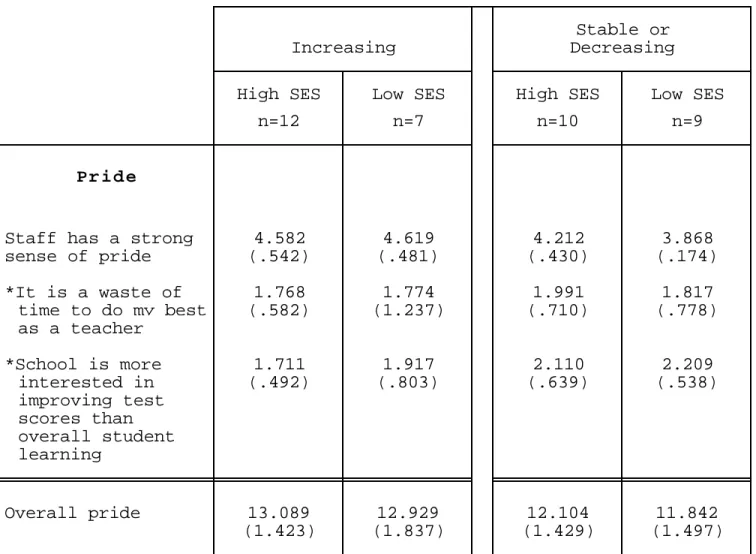
Teachers appear to have a strong sense of pride in their work, particularly in schools with increasing scores.
General attitudes teachers hold about the reasons test scores change, and the fairness and usefulness of testing (Tables 19-22). Overall, our sample reports that
Job Satisfaction and Its Change Over the Last Three Years by Test Score Trends
Increasing Scores Stable or Decreasing Scores n=24 n=24
Teacher control over classroom program 2.50 (.38) same 2.62 (.24) same Use of teachers' professional judgment 2.41 (.36) same 2.43 (.27) same
Ability to meet indi-vidual student needs
2.44 (.36) same 2.40 (.29) same Teacher's influence on school decision-making 2.24S (.41) same 2.00S (.36) same
Pressure to cover all required curriculum 2.23 (.56) same 2.34 (.31) same
Ability to cover one subject thoroughly 2.33 (.38) same 2.42 (.29) same Image of teacher as an efficient educator 2.39 (.44) same 2.28 (.35) same Satisfaction with my work 2.51 (.35) same 2.50 (.29) same Overall job satisfaction 20.60 (2.39) 20.22 (1.54)
1=Weak 2=Moderate 3=Strong
TABLE 18
Job Satisfaction and Its Change Over the Last
Three Years by Test Score Trends and Socioeconomic Status
Increasing Scores Stable or Decreasing Scores High SES n=12 Low SES n=7 High SES n=10 Low SES n=9
Teacher control over classroom program 2.44 (.33) same 2.49 (.55) same 2.58 (.26) same 2.70 (.22) same Use of teachers' professional judgment 2.43 (.29) same 2.61 (.27) same 2.41 (.24) same 2.48 (.32) same
Ability to meet indi-vidual student needs
2.41 (.34) same 2.45 (.39) same 2.35 (.20) same 2.30 (.35) same Teacher's influence on school decision-making 2.24 (.40) same 2.37 (.47) same 1.99 (.27) same 1.96 (.39) same
Pressure to cover all required curriculum 2.34 (.25) same 2.07 (.81) same 2.33 (.35) same 2.27 (.26) same
Ability to cover one subject thoroughly 2.22 (.39) same 2.58 (.36) same 2.40 (.19) same 2.46 (.41) same Image of teacher as an efficient educator 2.37 (.48) same 2.35 (.50) same 2.15 (.31) same 2.21 (.32) same Satisfaction with my work 2.45 (.36) same 2.59 (.36) same 2.43 (.16) same 2.51 (.29) same Overall job satisfaction 20.22 (2.16) 21.37 (2.89) 19.98 (1.15) 20.35 (1.94)
Perceived Causes of Changes in Test Scores by Test Score Trends
Increasing Scores Stable or Decreasing Scores n=23 n=24
Changes in student population 2.36S
(.66)
2.83S
(.63)
Alignment of instruction with test content 2.75 (.63) 2.75 (.66) Attention to test-taking skills 2.85 (.59) 2.87 (.66) Changes in instructional strategies 3.11 (.44) 3.04 (.52) Changes in textbooks 2.51 (.59) 2.63 (.73)
Changes in test admin-istration practices 1.98 (.53) 2.21 (.67) Changes in teaching effectiveness 3.06 (.49) 3.00 (.52)
Changes in school climate 2.50S
(.44)
2.98S
(.49)
Changes in the community 2.48S
(.56)
2.90S
(.68)
1=No Factor 2=Minor Factor 3=Moderate Factor 4=Major Factor
TABLE 20
Perceived Causes of Changes in Test Scores by Test Score Trends and Socioeconomic Status
Increasing Scores Stable or Decreasing Scores High SES n=12 Low SES n=6 High SES n=10 Low SES n=9
Changes in student population 2.38
(.63) 2.71 (.76) 3.02 (.43) 2.91 (.77)
Alignment of instruction with test content 2.40 (.56) 3.14 (.57) 2.55 (.60) 2.87 (.73) Attention to test-taking skills 2.60 (.66) 3.20 (.42) 2.54 (.53) 3.22 (.63) Changes in instructional strategies 2.96 (.39) 3.34 (.37) 2.90 (.39) 3.21 (.61) Changes in textbooks 2.49 (.42) 2.91 (.77) 2.60 (.75) 2.81 (.81)
Changes in test admin-istration practices 1.81 (.57) 2.20 (.53) 1.93 (.43) 2.31 (.83) Changes in teaching effectiveness 3.07 (.45) 3.05 (.45) 2.84 (.37) 3.01 (.68)
Changes in school climate 2.48
(.34) 2.74 (.42) 2.83 (.31) 3.11 (.70)
Changes in the community 2.51
(.62) 2.54 (.52) 3.14 (.31) 2.98 (.91)
Teachers' Attitudes About Testing by Test Score Trends Increasing Stable or Decreasing n=24 n=24 Expectations *Students not capable of learn-ing material 2.3884S (0.874) 2.8588S (0.621) Expects students to perform well 4.1335 (0.803) 4.0955 (0.414)
Teachers can influ-ence how well
students do 3.6247 (0.549) 3.6790 (0.469) Overall positive expectations 11.3912 (1.444) 10.8924 (1.049)
* Scales reversed in overall calculations
1=Definitely Disagree 3=Neutral 5=Definitely Agree
TABLE 22a
Teachers' Attitudes About Testing by Test Score Trends and Socioeconomic Status
Increasing Stable or Decreasing High SES n=12 Low SES n=7 High SES n=10 Low SES n=9 Expectations *Students not capable of learn-ing material 2.27 (.43) 2.53 (1.44) 2.61 (.35) 3.03 (.83) Expects students to perform well 4.28 (.40) 3.81 (1.29) 4.11 (.44) 3.96 (.38)
Teachers can influ-ence how well
students do 3.73 (.50) 3.33 (.69) 3.72 (.40) 3.59 (.56) Overall positive expectations 11.74 (.92) 10.67 (1.86) 11.22 (.87) 10.50 (1.28)
* Scales reversed in overall calculations
Increasing
Stable or Decreasing
n=24 n=24
P r i d e
Staff has a strong sense of pride 4.4472 (0.557) 4.0657 (0.464) *It is a waste of time to do my best as a teacher 1.752 (.769) 1.921 (.663) *School is more interested in improving test scores than overall student learning 1.8902 (0.600) 2.2345 (0.645) Overall pride 12.798S (1.462) 11.9075S (1.363)
* Scales reversed in overall calculations
1=Definitely Disagree 3=Neutral 5=Definitely Agree
TABLE 22b Teachers' Attitudes About Testing by Test Score Trends and Socioeconomic Status (Cont'd.)
Increasing Stable or Decreasing High SES n=12 Low SES n=7 High SES n=10 Low SES n=9 P r i d e
Staff has a strong sense of pride 4.582 (.542) 4.619 (.481) 4.212 (.430) 3.868 (.174) *It is a waste of time to do my best as a teacher 1.768 (.582) 1.774 (1.237) 1.991 (.710) 1.817 (.778) *School is more interested in improving test scores than overall student learning 1.711 (.492) 1.917 (.803) 2.110 (.639) 2.209 (.538) Overall pride 13.089 (1.423) 12.929 (1.837) 12.104 (1.429) 11.842 (1.497)
* Scales reversed in overall calculations
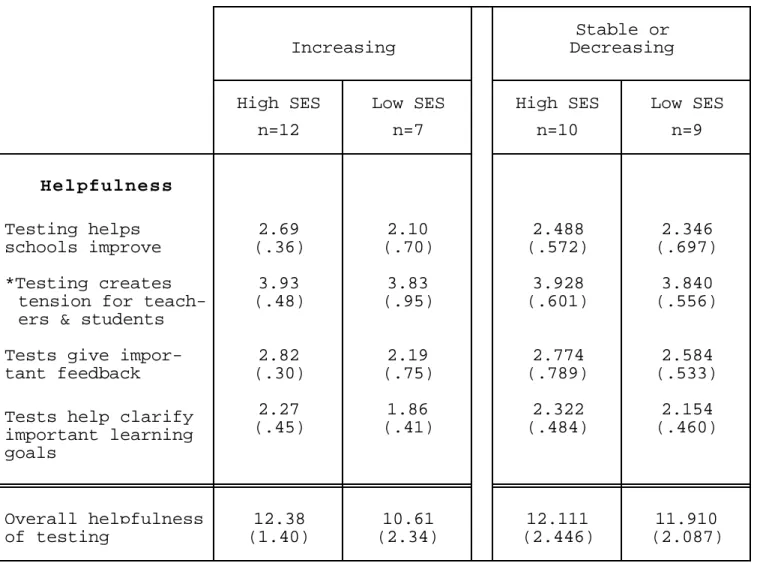
Increasing Stable or Decreasing n=24 n=24 Helpfulness Testing helps schools improve 2.5948 (0.588) 2.4470 (0.587) *Testing creates
tension for teach-ers & students
3.9071 (0.638)
3.9029 (0.541)
Tests give impor-tant feedback
2.6616) (0.569)
2.7324 (0.646) Tests help clarify
important learning goals 2.1980 (0.473) 2.3075 (0.470) Overall helpfulness of testing 12.1348 (1.947) 12.2017 (2.100)
* Scales reversed in overall calculations
TABLE 22c Teachers' Attitudes About Testing by Test Score Trends and Socioeconomic Status (Cont'd.)
Increasing Stable or Decreasing High SES n=12 Low SES n=7 High SES n=10 Low SES n=9 Helpfulness Testing helps schools improve 2.69 (.36) 2.10 (.70) 2.488 (.572) 2.346 (.697) *Testing creates
tension for teach-ers & students
3.93 (.48) 3.83 (.95) 3.928 (.601) 3.840 (.556)
Tests give impor-tant feedback 2.82 (.30) 2.19 (.75) 2.774 (.789) 2.584 (.533) Tests help clarify
important learning goals 2.27 (.45) 1.86 (.41) 2.322 (.484) 2.154 (.460) Overall helpfulness of testing 12.38 (1.40) 10.61 (2.34) 12.111 (2.446) 11.910 (2.087)
* Scales reversed in overall calculations
Increasing
Stable or Decreasing
n=24 n=24
Fairness
Teachers can influ-ence how well
students do 3.6247 (0.549) 3.6790 (0.469) *Discrepancy be-tween what should be taught & test emphasis 3.5889 (0.471) 3.5734 (0.539) Overall fairness of testing 6.0375 (0.752) 6.1121 (0.779)
* Scales reversed in overall calculations
TABLE 22d Teachers' Attitudes About Testing by Test Score Trends and Socioeconomic Status (Cont'd.)
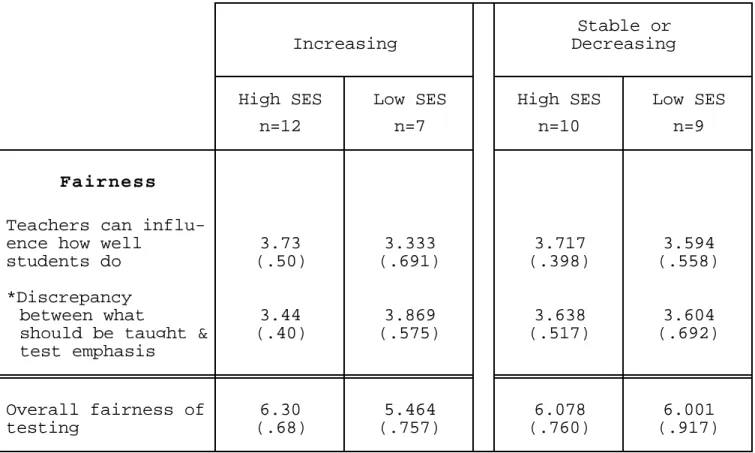
Increasing Stable or Decreasing High SES n=12 Low SES n=7 High SES n=10 Low SES n=9 Fairness
Teachers can influ-ence how well
students do 3.73 (.50) 3.333 (.691) 3.717 (.398) 3.594 (.558) *Discrepancy between what
should be taught & test emphasis 3.44 (.40) 3.869 (.575) 3.638 (.517) 3.604 (.692) Overall fairness of testing 6.30 (.68) 5.464 (.757) 6.078 (.760) 6.001 (.917)
* Scales reversed in overall calculations
schools with stable or decreasing scores. Similarly, teachers at high SES schools report higher expectations of their
students than those at low SES schools.
The teachers in our sample were less positive about the helpfulness of testing. Teachers disagreed that (a) testing is helping schools improve, (b) that tests give them impor-tant feedback about how well they are teaching in curricular areas, and (c) that tests help to clarify learning goals. In contrast, they believe that testing creates substantial
tension for teachers and students. Teachers at low SES schools held particularly negative views of testing.
Overall, teachers were fairly neutral about the fairness of testing. While they agreed that teachers can influence how well their students perform on standardized tests, they feel a discrepancy between what they think should be taught and what standardized tests actually emphasize. Similar to responses about the helpfulness of testing, teachers at low SES schools report feeling less able to influence student test scores. They also report greater discrepancy between what they think should be taught and what the test emphasizes than teachers at more advantaged schools.
Relationships between background, testing, and teaching variables (Tables 23 and Figure 1). Mirroring
differences in responses cited earlier, correlations show that socioeconomic status is significantly and negatively
TABLE 23
Correlations Among Student, Teacher, School, and Testing Variables
SES Pressure Influence Planning Time on Test Preparation School Attention to Tests Job Satis-faction Instruc-tional Renewal Press to Cover Material Pride SES _____ Overall pressure to increase test scores .1892 p=.099 _____ Overall influence of testing on instructional planning -.4084 p=.002 .1765 p=.115 _____ Overall time on test preparation -.3931 p=.003 -.0013 p=.496 .8164 p=.000 _____ Overall school attention to test scores -.2852 p=.026 .3902 p=.003 .7411 p=.000 .7010 p=.000 _____ Overall job satisfaction -.1208 p=.207 -.0179 p=.452 -.0819 p=.290 -.0341 p=.409 .0884 p=.277 _____ Overall Instruc-tional Renewal .2320 p=.060 .2513 p=.046 -.1869 p=.107 -.1493 p=.161 .2315 p=.061 .3650 p=.006 _____ Pressure to cover all required materials .1336 p=.183 .2168 p=.069 .2306 p=.057 .2593 p=.038 .4036 p=.002 -.5799 p=.000 -.0426 p=.389 _____ Overall pride in teaching .0528 p=.361 -.1715 p=.122 -.2897 p=.023 -.1606 p=.138 -.0110 p=.471 .5494 p=.000 .3567 p=.007 -.3302 p=.011 _____
. 7010 - . 2852 SES - . 4084 - . 3931 . 3650 . 3567 . 5811 - . 441 1 - . 4031 . 3902 . 7411 . 8164 . 2513 . 2593 . 4036 - . 3040 Pressure to cover all required material Pride in teachin g Teacher job satisfactio n Instructional renewal - . 5799 Influence of testing on instruc-tional planning Classtime spent on test preparation School attention to test scores Pressure to improve test scores
Relationships Between Testing, Teaching,
and Background Variables
58
related to the following: school attention to test scores, teachers' attention to testing in planning their instruction, and overall time devoted to test preparation activities.
Based on the direction of the relationship, testing is more influential and exerts stronger effects on teaching in
schools serving more disadvantaged students.
The cluster of variables assessing schools' and teach-ers' attention to testing and test scores also shows signifi-cant correlations in the expected direction. Where teachers report stronger school emphasis on testing they also indicate greater attention to testing in their instructional planning and report devoting more of their students' time to test preparation activities. Perceived pressure to improve test scores, however, appears significantly related only to the attention given testing by school administrators. School attention to test scores also is highly related to the pressure teachers feel to cover all required material.
Such pressure, however, is negatively related both to teachers' job satisfaction and to their pride in teaching. Pride in teaching is positively related to instructional renewal.
These patterns of correlations suggest possible models of the effects of testing on schools, the teaching and learn-ing within them, and on students' test performance. While intended only as exploratory, Figure 1 shows one such model.
Summary and Conclusions
Subject to the caveats of self-report data, survey results suggest that standardized testing has substantial effects on schools and the teaching and learning processes within them:
• Teachers feel strong pressure, especially from
district administrators and the media, to improve their students' test scores.
• School administrators encourage attention to
test scores by: holding staff meetings to review the scores, discussing with teachers how to
improve their students' tests scores, emphasiz-ing instructional changes in specific areas of test score weakness, and providing materials to support students' test-taking skills. On average such meetings and discussions are each held
several times a year.
• Testing substantially influences teachers'
classroom planning. Teachers make sure that their instructional programs cover test objec-tives and many look at prior tests to assure a good match. Adjustments are made in curricular scope and sequence based on test content and students' prior performance.
• Teachers devote substantial student time to test
60
that review test content, test-wiseness instruc-tion, and practice tests.
• Despite substantial reported pressure from
test-ing mandates, teachers indicate a moderate and relatively stable sense of both job satisfaction and professional efficacy.
Reaffirming findings from other studies, survey results also consistently indicate that schools serving economically disadvantaged students show more such effects than those serving students from higher socioeconomic communities. While teachers from higher SES schools report an increase over the last three years in instructional time devoted to higher level thinking skills, teachers in lower SES schools do not report such an increase. Further, low SES schools report giving substantially more instructional attention to test content through planning and delivery of instructional programs than higher SES schools.
Study results on the meaning of test score gains,
particularly on whether such gains signal school improvement or teaching to the test, are less clear cut. In comparing responses from schools with increasing scores to those from other schools, the study found no evidence to suggest that increasing scores are an artifact of "teaching to the test" practices. While teachers in schools with increasing scores do report feeling more pressure to produce, they indicate no more school attention to testing, no more attention to
test-ing in their own instructional planntest-ing, and no more instruc-tional time devoted to test preparation compared to those practices in other schools.
In fact, the significant relationships found in the study linking school test score trends with other variables, imply a broader meaning for test performance. Although the direction of the relationships and the potential halo effects are unknown, there is limited evidence to suggest that
schools where test scores are improving are better environ-ments for children. Compared to other schools, teachers from schools where tests scores are improving (a) report more
instructional innovation in their schools, (b) feel more involved in school decision-making, (c) hold higher expecta-tions for their students' performance, and (d) have more pride in their work. Teachers in schools with stable or decreasing schools are more likely to believe that their students are not capable of learning the materials on which they are tested and are more likely to believe that changes in test performance are due to changes in the school popula-tion and the community.
In the minds of teachers, however, test results are of uncertain meaning and of uncertain value in school improve-ment. Teachers do not believe that standardized testing is helping schools to improve. Neither do they believe that such testing helps clarify school goals, provides useful feed-back, or adequately assesses the most important learning goals for students.
62
In conclusion, testing does appear to influence the teaching and learning within schools. Substantial time and attention are devoted to assuring students are taught tested objectives and given practice in test content. Schools send out messages to their teachers about the importance of test-curriculum alignment and teachers design their instructional programs with such alignment in mind. Whether this is good news or bad news depends on whether or not one views the standards set by such tests as educationally valid and
significant. If test results do represent significant learn-ing outcomes, then testlearn-ing may contribute to the attainment of those outcomes. If test results do not represent such learning, then in current practice they are a misguided tool.
Whether the test results, under conditions of account-ability pressure, signal meaningful learning or even repre-sent broader learning beyond specific test content, remain critical issues for further investigation. Such meaningful-ness and generalizability issues are critical to the
productive use of assessment in stimulating educational
reform—and represent provocative challenges, whether the test instruments are traditional, multiple-choice measures or
References
Baker, E.L. (1989). Can we fairly measure the quality of education? (CSE Tech. Rep. No.290). Los Angeles, CA: University of California, Center for Research on
Evaluation, Standards, and Student Testing (Grant No. OERI-G-86-0003).
Bracey, G.W. (1989). The $150 million redundancy. Phi Delta Kappan , 70 (9), 698-702.
Cannell, J.J. (1987). Nationally normed elementary achieve-ment testing in America's public schools: How all 50 states are above the national average. Educational Measurement: Issues and Practice , 7 (4), 12-15.
Corbett, H.D., & Wilson, B. (1988). Raising the stakes in statewide mandatory minimum competency testing. In W. L. Boyd and C. T. Kerchner (Eds.), The politics of excel- lence and choice in education: The 1987 politics of education association yearbook (pp.27-39), New York: Falmer Press.
Dorr-Bremme, D., (1983). Assessing students: Teachers
routines, practices and reasoning. Evaluation Comment , 6
64
Dorr-Bremme, D., Burry, J., Catterall, J., Cabello, B., & Daniels, L. (1983). The costs of testing in American public schools (CSE Tech. Rep. No. 198). Los Angeles, CA: University of California, Center for the Study of Evaluation.
Dorr-Bremme, D. & Herman, J. (1983). Use of testing in schools: A national profile. In W. Hathaway (Ed.), Testing in the schools : New directions for testing and measurement (pp. 3-17), San Fransisco, CA: Jossey Bass.
Dorr-Bremme, D., & Herman, J. (1986). Assessing student achievement: A profile of classroom practices. CSE Monograph Series in Evaluation, 11. Los Angeles, CA: Center for the Study of Evaluation.
Edelman, J. (1981). The impact of mandated testing programs on classroom practices. Education , 102 (1), 56-59.
Fish, J. (1988). Responses to mandated standardized testing . Unpublished doctoral dissertation, University of
California, Los Angeles.
Goslin, D. (1967). Teachers and testing . New York: Russell Sage Foundation.
Herman, J.L. (1989). Priorities of educational testing and evaluation: The testimony of the CRESST national faculty (CSE Tech. Rep. No. 304). Los Angeles, CA: University of California, Center for the Study of Evaluation.
Linn, R.L., Graue, M.E., & Sanders, N.M. (1989). Comparing state and district test results to national norms:
Interpretations of scoring "above the national average " (Technical Report). Boulder, CO: University of
Colorado, Center for Research on Evaluation, Standards, and Student Testing (Grant No. OERI-G-86-0003).
Madaus, G. (1985). Test scores as administrative mechanisms in educational policy. Phi Delta Kappan , 66 (9), 611-17.
Madaus, G. (1988). The influence of testing on the curricu-lum. In L. Tanner (Ed.), The politics of reforming school administration . London: Farmer Press.
Madaus, G. (1990). The distortion of teaching and testing: High stakes testing and instruction. Peabody Journal of Education , 65 (3), 29-46.
Mehrens, W. A. (1984). National tests and local curriculum: Match or mismatch. Educational Measurement: Issues and Practices , 3 (3), 9-15.
Romberg, T.A., Zarinnia, A., & Williams, S.R. (1989). The influence of mandated testing on mathematics instruc- tion: Grade 8 teachers' perceptions (Monograph).
Madison, WI: University of Wisconsin, National Center for Research in Mathematical Science Education.
Ruddell, R.B. (1985). Knowledge and attitude toward testing: Field educators and legislators. The Reading Teacher , 389 , 538-543.
65
Salmon-Cox, L. (1981). Teachers and standardized achievement tests: what's really happening? Phi Delta Kappan ,
62 (10), 730-736.
Shepard, L.A. (1990). Inflated test score gains: Is it old norms or teaching the test? Educational Measurement: Issues and Practices , 9 (3), 15-22.
Smith, M.L., Edelsky, C., Draper, K., Rottenberg, C., &
Cherland, M. (1989). The role of testing in elementary schools (Monograph). Tempe, AZ: Arizona State
University, Center for Research on Evaluation,
Standards, and Student Testing (Grant No. OERI-G-86-0003).
Stake, R.E. (1988, September). The effect of reforms in assessment in the USA . Paper presented at the annual meeting of the British Educational Association at the University of East Anglia.
Stodolsky, S.S. (1988). The subject matters: Classroom activity in math and social studies . Chicago: University of Chicago Press.
Tyler, R.W., & White, S.H. (1979). Testing, teaching, and learning: Report of a conference on research on testing . Washington, DC: U.S. Department of Health, Education, and Welfare.