Júri:
Presidente: [Nome do presidente do júri]
Arguentes: [Nome do arguente 1] [Nome do arguente 2]
Vogal: Prof. Doutor Henrique João Domingos
Setembro, 2013
João Miguel Cardia Melro Rodrigues
Licenciado em Engenharia Informática
TSKY: A Dependable Middleware Solution for
Data Privacy using Public Storage Clouds
Dissertação para obtenção do Grau de Mestre em Engenharia Informática
Orientador: Doutor Henrique João Domingos, Prof. Auxiliar, Universidade Nova Lisboa
Júri:
Presidente: Doutor Nuno Manuel Robalo Correia
Arguente: Doutor Salvador Luís Bettencourt Pinto de Abreu Vogal: Doutor Henrique João Lopes Domingos
TSKY: A Dependable Middleware Solution for Data Privacy using Public Storage Clouds
Copyright © João Miguel Cardia Melro Rodrigues, Faculdade de Ciências e Tecnologia, Universidade Nova de Lisboa.
A Faculdade de Ciências e Tecnologia e a Universidade Nova de Lisboa têm o direito, perpétuo e sem limites geográficos, de arquivar e publicar esta disserta-ção através de exemplares impressos reproduzidos em papel ou de forma digi-tal, ou por qualquer outro meio conhecido ou que venha a ser inventado, e de a divulgar através de repositórios científicos e de admitir a sua cópia e distribui-ção com objectivos educacionais ou de investigadistribui-ção, não comerciais, desde que seja dado crédito ao autor e editor.
iii Agradecimentos
Desde já agradeço à Faculdade de Ciências e Tecnologia de Universidade Nova de Lisboa, mais especificamente ao Departamento de Informática e a todo o corpo docente, não docente e a todos os colegas pelo apoio prestado no decor-rer dos vários anos lectivos e em especial durante a fase de preparação e elabo-ração de dissertação período durante o qual me foi atribuída uma bolsa de in-vestigação. Ainda mais, agradeço ao meu orientador, Henrique João Lopes Domingos, pelo apoio prestado relativo não só á dissertação e ao projeto TSKY, como agradeço todo o apoio prestado ao nível académico.
Finalmente, e não menos importante, agradeço a todos os meus amigos, familiares e conhecidos pelo apoio prestado ao longo dos últimos anos, em que fui aluno da FCT.
v
Resumo
A presente dissertação visa tirar partido das virtudes oferecidas pelos sis-temas de armazenamento de dados em nuvem, disponibilizados por diferentes provedores na Internet. A solução proposta visa o incremento de garantias de segurança, disponibilidade e fiabilidade, através da utilização combinada de vários provedores, numa visão de armazenamento e computação em nuvem-de-nuvens. O sistema de middleware, designado por TSKY (Trusted Sky), preten-de constituir uma solução confiável, para intermediação entre aplicações finais e nuvens de armazenamento de vários provedores. Para isso o sistema combi-na, na sua arquitetura, componentes e serviços para indexação, distribuição e replicação de dados em múltiplas nuvens de armazenamento, tendo em vista assegurar condições de resiliência perante falhas ou ataques que podem ocorrer de forma independente ao nível do provedor. Para garantir as condições de se-gurança são utilizados vários mecanismos criptográficos para cifra e autentica-ção de dados, com base em esquema de partilha de segredos (secret sharing schemes) e assinaturas de limiar (threshold signatures). Para concretizar e avaliar o sistema TSKY, como sistema genérico, foi criado um repositório confiável de correio electrónico, designando por TSKY-TMS (Trusted Mail System). Este sis-tema constitui um protótipo que utiliza os serviços base do middleware TSKY para armazenamento de mensagens numa tipologia de nuvem-de-nuvens.Palavras-chave: Computação em Nuvem, Armazenamento em Nuvem, Esquemas e Algoritmos de Criptografia de Limiar, Esquemas de Encriptação Holomórfica, Privacidade, Fiabilidade e Disponibilidade dos Dados.
vii
Abstract
This dissertation aims to take advantage of the virtues offered by data storage cloud based systems on the Internet, proposing a solution that avoids security issues by combining different providers’ solutions in a vision of a cloud-of-clouds storage and computing. The solution, TSKY System (or Trusted Sky), is implemented as a middleware system, featuring a set of components designed to establish and to enhance conditions for security, privacy, reliability and availability of data, with these conditions being secured and verifiable by the end-user, independently of each provider. These components, implement cryptographic tools, including threshold and homomorphic cryptographic schemes, combined with encryption, replication, and dynamic indexing mecha-nisms. The solution allows data management and distribution functions over data kept in different storage clouds, not necessarily trusted, improving and ensuring resilience and security guarantees against Byzantine faults and at-tacks. The generic approach of the TSKY system model and its implemented services are evaluated in the context of a Trusted Email Repository System (TSKY-TMS System). The TSKY-TMS system is a prototype that uses the base TSKY middleware services to store mailboxes and email Messages in a cloud-of-clouds.Keywords: Cloud Computing, Cloud Storage Services, Threshold Crypto-graphic Schemes and Algorithms, Homomorphic Encryption Schemes, Data Privacy, Reliability and Availability
ix
Table of Contents
1. INTRODUCTION ... 1
1.1. CONTEXT AND MOTIVATION ... 1
1.2. CLOUD AS A SERVICE ... 2
1.3. SECURITY ISSUES OF DATA STORED IN PUBLIC CLOUDS ... 3
1.4. THESIS PROBLEM STATEMENT ... 6
1.5. OBJECTIVES ... 7
1.6. MAIN CONTRIBUTIONS ... 8
1.7. CONTRIBUTIONS AND ACHIEVED RESULTS ... 10
2. RELATED WORK ... 11
2.1. CRYPTOGRAPHIC MECHANISMS AND TOOLS ... 13
2.1.1 Secret Sharing Schemes ...13
2.1.2 Threshold Signatures ...22
2.1.3 Homomorphic encryption ...24
2.2. DATA MANAGEMENT ... 27
2.2.1 Dependable Data Storage Systems ...27
2.2.2 Cloud Oriented Dependable Solutions ...30
2.2.3 Final Discussion ...36
2.3. CLOUD STORAGE PLATFORMS AND SERVICES ... 37
2.3.1 Amazon S3...37
2.3.2 Google Cloud Storage ...38
2.3.3 Nirvanix Cloud Storage ...39
2.3.4 Rackspace Cloud Files ...40
2.3.5 Microsoft Azure...41
2.3.6 Dropbox ...42
x
2.3.8 Comparison ... 43
3. SYSTEM MODEL AND ARCHITECTURE ... 45
3.1. ATTACKER MODEL ... 45
3.2. SYSTEM REQUIREMENTS ... 46
3.3. SYSTEM ARCHITECTURE ... 47
3.4. DATA MODEL ... 50
3.5. SYSTEM MODEL GENERALIZATION ... 52
4. IMPLEMENTATION ... 55
4.1. STORAGE MODULE ... 56
4.2. FRONTEND AND ENDPOINTS ... 57
4.3. CORE MODULES ... 59
4.4. CLOUD STORAGE LAYER ... 62
4.5. ALGORITHMS ... 63
5. EVALUATION ... 67
5.1. THE TSKY FRAMEWORK ... 67
5.2. TEST EXECUTION ENVIRONMENT ... 68
5.3. CLOUD PROVIDER PERFORMANCE BENCHMARKS (PUT/GET) ... 69
5.4. THRESHOLD MODULE BENCHMARK ... 73
5.5. SECRET SHARING MODULE BENCHMARK ... 74
5.6. ENCRYPTION MODULE BENCHMARK ... 76
5.7. OVERALL SOLUTION BENCHMARK ... 78
5.8. CLOUD BASED PROXY SOLUTION BENCHMARK ... 82
xi
List of Figures
FIGURE 1:MAIN SYSTEM CONCERNS ... 11
FIGURE 2: INTERPOLATION PROBLEM, 4 POINTS, 3RD DEGREE FUNCTION ... 14
FIGURE 3: THREE 3-DIMENSIONAL PLANE INTERSECTION ... 17
FIGURE 4: IDATAGUARD DATA MODEL ... 32
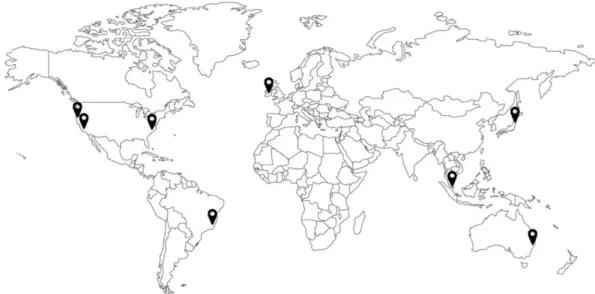
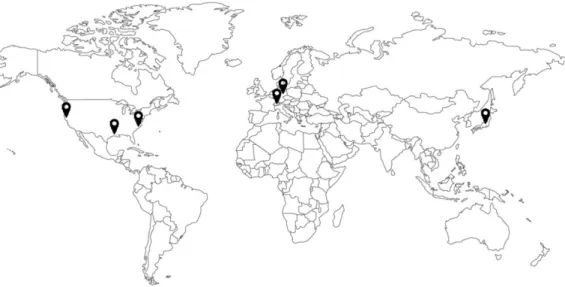
FIGURE 5: VARIOUS WORLDWIDE AMAZON DATA CENTER LOCATIONS ... 37
FIGURE 6: VARIOUS WORLDWIDE NIRVANIX DATA CENTER LOCATIONS ... 39
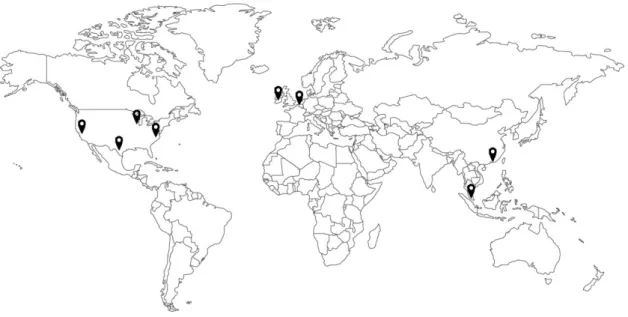
FIGURE 7: VARIOUS WORLDWIDE RACKSPACE DATA CENTER LOCATIONS ... 40
FIGURE 8: VARIOUS WORLDWIDE MICROSOFT AZURE DATA CENTER LOCATION ... 41
FIGURE 9: VARIOUS WORLDWIDE LUNA CLOUD DATA CENTER LOCATIONS ... 43
FIGURE 10: TSKY-TMS ARCHITECTURE ... 48
FIGURE 11: TSKY-TMS DATA MODEL ... 50
FIGURE 12: CLOUD BASED DEPLOYMENT ARCHITECTURE ... 52
FIGURE 13: MAILBOX LAYER CLASS DIAGRAM ... 57
FIGURE 14: CORE LAYER CLASS DIAGRAM ... 59
FIGURE 15: CLOUD STORAGE LAYER CLASS DIAGRAM ... 62
FIGURE 16: PERFORMANCE GRAPHIC OF PUT OPERATION (IN SECONDS AND MEGABYTES) ... 69
FIGURE 17: PERFORMANCE GRAPHIC OF GET OPERATION (IN SECONDS AND MEGABYTES) ... 70
FIGURE 18: PERFORMANCE OF THRESHOLD SIGNATURE MODULE IN DIFFERENT STAGES ... 73
FIGURE 19: PERFORMANCE OF SECRET SHARING MODULE USING MULTIPLE SCHEMES ... 75
FIGURE 20: PERFORMANCE OF ENCRYPTION MODULE USING AES256 IN SECONDS/MEGABYTES ... 77
FIGURE 21:MESSAGE SEND TIMES TO GMAIL SERVICE,TMS-MAC AND TMS-TS ... 80
FIGURE 22:MESSAGE RECEIVING TIMES TO GMAIL SERVICE,TMS-MAC AND TMS-TS ... 81
xiii
List of Tables
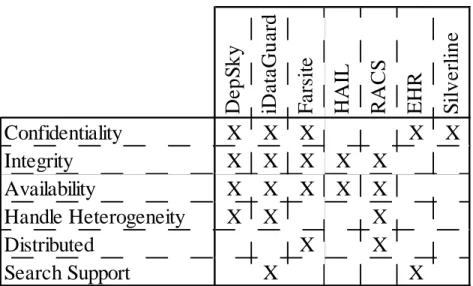
TABLE 1:COMPARISON TABLE BETWEEN MULTIPLE DEPENDABLE SYSTEMS ... 36
TABLE 2: PERFORMANCE TABLE OF PUT OPERATION (IN SECONDS AND MEGABYTES)... 69
TABLE 3: PERFORMANCE TABLE OF GET OPERATION (IN SECONDS AND MEGABYTES) ... 70
TABLE 4: ADDRESSES, PROBABLE LOCATION AND LATENCY OF CLOUD STORAGE PROVIDERS ... 71
TABLE 5: PERFORMANCE OF THRESHOLD SIGNATURE MODULE IN DIFFERENT STAGES ... 73
TABLE 6: PERFORMANCE OF SECRET SHARING MODULE IN SECONDS/BITS ... 75
TABLE 7: DETAILED PERFORMANCE OF SECRET SHARING MODULE IN MILLISECONDS/BITS ... 76
TABLE 8: PERFORMANCE OF ENCRYPTION MODULE USING AES256 IN SECONDS/MEGABYTES ... 77
TABLE 9: PERFORMANCE COMPARISON (IN SECONDS) SYMMETRIC ENCRYPTION ALGORITHMS ... 77
1
1.
Introduction
1.1.
Context and Motivation
In the current globalization context, it has become increasingly important to securely manage data regarding the internal operations of enterprises and their clients. Given the inevitable generation and exchange of new data, with an increasing tendency, and with the growing of the use of the Internet as a global business platform [1], the use of cloud based solutions has become even more appealing. This kind of solutions (cloud based solutions) offer multiple ad-vantages compared with traditional solutions based on localized data centers and infrastructures maintained by own companies [2]:
• Pay-per-use cost model, in which the clients pay just for the resources in use, reducing the infrastructure allocation and update costs as the need for more resources increase;
• Ubiquity, enabled by the public cloud access, end-user applications and middleware systems can access computational resources from any location without relying on resources real location. Furthermore the use of public cloud services enables the combination of different data centers (in different locations) from the same or from different providers in order to achieve bet-ter reliability and availability for the target solutions;
• Scalability and Elasticity, the on-demand resources provided in mul-titenant systems, allow the adaptation of resources like memory, available storage or computational power, accordingly to system loads or necessities;
2
• Maintenance costs, while providing maximum control, local infrastructures carry total ownership costs [3] associated the cost of building the infrastruc-ture itself along with maintenance costs. In multitenant public cloud solu-tions ownership and maintenance costs are omitted and the actual costs are easily managed as a pay-per-use cost model demands;
• Security, although not auditable cloud based solutions offer interesting reli-ability and availreli-ability conditions that could be explored by existing or new solutions.
1.2.
Cloud as a Service
Recently, the number of cloud services providers has substantially in-creased [4] which has promoted the competitiveness in those markets and con-sequently lowering the prices. These providers, offering different cost models to different targets (private or corporative customers), divide the provided ser-vices in three different standard categories:
• Infrastructures as a Service or IaaS – consisting in providing pure or virtu-alized computational resources without outbox features;
• Platform as a Service or PaaS – in which resources, as databases, key-value storage services or content delivery networks, are provided as a platform to new or existing systems and applications;
• Software as a Service or SaaS – in which the provided services consist in out-of-the-box server software (e.g. email, messaging, file storage, CMS).
The proposed solution is introduced as a Middleware as a Service in which a key-value storage API is provided as a middleware service offering data confidentiality, integrity and availability services. This API is then ex-plored by an email repository service used as validator to the proposed mid-dleware solution. The multiple categories of services including the MaaS, are leveraged by a set of advantages, as stated before:
• Elasticity – provided by public cloud services, the resources are dynamical-ly adjusted accordingdynamical-ly a set of well-defined needs (e.g. number of accesses per time period, data volume) or manually as customer demands;
• Scalability and resources Relocation – Normally application supported, scalability and relocation can be provided through data center virtualization
3 techniques. In the proposed solution this scalability can be provided through the use of multiple dynamic instances offering both scalability and relocation and consequently ubiquitous capabilities;
• Costs – The cost model, of the multiple cloud services are considered attrac-tive due to the lack of ownership costs associated to traditional infrastruc-tures that carry establishment and maintenance costs. Furthermore the use of private infrastructures carries constant energetic costs which can exceed the infrastructure effective profit.
In contrast to the proposed solution, the standard provided services are based on a set of non-auditable promises regarding durability, integrity, availa-bility and confidentiality, defined in Service Level Agreements describing the maximum time impact of future unpredicted events. Furthermore the presented solution is intended to run in a trusted environment, namely in a local trustable proxy or locally in the users’ computers.
1.3.
Security Issues of data stored in public clouds
As previously described, the use of cloud storage repositories on the In-ternet leverages a set of operational advantages, the analysis of such advantages raises an interest in the use of such services as storage platform to existing ap-plications, however the adoption of such providers reveals itself problematic when certain requirements are considered [19]. Requirements as maintenance and management with confidentiality and privacy guarantees or permanent user control and auditability are hard or even impossible to ensure. In fact, the use of such cloud based services as outsourced data management solutions are itself a still open problem [5]. These issues, widely discussed, are introduced by the following question: “How to keep public data secure?”, furthermore, various entities [20], [21] have analyzed these issues inspiring new research fields in computer systems security and cloud computing. For example in health field the adoption of cloud storage solutions requires a confidential and decentral-ized management of user’s persistent medical data [22]. Moreover, the medical data must be kept available and uncorrupted at any time and if deleted, in must be in a permanent way.
4 Beyond users control and auditability over security agreements, the use of outsourced solutions raises issues related with the prices unpredictability and data migration costs. These issues occur when large data volumes are stored in a provider premises and the service associated costs are substantially raised, which introduces a dilemma: keep the data in providers’ premises accepting the new cost model or do an expensive data migration to other provider. This sort of distress is called vendor lock-in.
Recent events have exposed multiple security vulnerabilities in cloud plat-forms, multiple reported cases [23], [24], [25], [26] shown that for multiple rea-sons the data stored on such platforms were disclosed, destroyed or corrupted accidentally or on purpose by identified or unidentified third parties exposing private data and so violating basic security properties as confidentiality, integri-ty and data availabiliintegri-ty leading to huge financial losses. These securiintegri-ty related issues become more pronounced when critical data and services are considered. Almost all society sectors rely on critical applications and services. E.g.:
• Applications that manage and handle users’ medical files and history in-volving patient-doctor confidentiality;
• Email messaging services, that handle critical messages from multiple users in corporative or personal contexts involving financial, legal, moral or even ethical matters;
• Applications that manage private banking data subject to strict terms and conditions in which the clients accounting data should not be dis-closed under any circumstances;
• Any application that handles user history and that for legal or ethical reasons should guaranty that the stored data will only be accessible by trusted and authenticated parties;
• Applications that support resource management to armed forces in na-tional security matters.
This thesis presents a middleware concept that act between final applications or services and the cloud storage providers offering reliability, availability integri-ty, confidentiality and indexing services to applications.
5 The above concerns have been extensively referred in the literature, as well as, in relevant reports published by different institutions [5] or results ad-dressed in relevant research projects [6], [7].
The combination of mechanisms and services to deal with security, relia-bility and availarelia-bility properties, conjugated in dependable and trusted solu-tions to manage outsourced data in public storage clouds, is a challenging re-search direction. The support for those properties with the addition of inde-pendent auditing control guarantees by the users is also a timely and innova-tive research contribution. Recently, the research community has been address-ing these challenges, discussaddress-ing the relevance and combination of different di-mensions of the problem. Some approaches are particularly concerned in im-proving dependability services as requirements of cloud computing infrastruc-tures and cloud data-centers [8], [9], [10]. Other approaches are more concerned in designing middleware services, implementing trust computer bases, to in-termediate the use of untrusted public clouds, as they are provided today, but adding dependability guarantees under the user control [11], [12], [13], [14].
The approach of the present dissertation follows the latter approaches, considering the adoption of well-known and well-established cloud storage so-lution providers, such as: Amazon [15], Google [16], Nirvanix [17] or Rackspace [18] and the way to explore such solutions in a secure, reliable and high-available way. The main focus is the design, implementation and validation of a middleware solution, used as a trusted computing base under the user control, to provide a set of security and reliability services, independently of native de-pendability mechanisms supported or not by the cloud-service providers in their data-centers.
Regardless of the dissertation focus, the combination of security and relia-bility mechanisms and services, complementarily addressed with other ap-proaches to improve native dependability services on cloud-based infrastruc-tures, will be certainly a way to provide an integrated and global solution for security, privacy, reliability and availability, to support dependable end-to-end arguments in cloud computing systems and applications design.
6
1.4.
Thesis problem statement
The dissertation problem is focused in finding possible answers and con-tributions to the following questions:
• Is it possible to build a middleware solution supporting a storage cloud-of-clouds approach to overcome the limitations of Internet public storage clouds in assuring reliability, availability and privacy guarantees for their users?
• How can we compose different mechanisms, in such middleware ap-proach, combining reliability, availability and privacy-enhanced services by the use of appropriate cryptographic tools and replication strategies that can benefit from a cloud-of-clouds implicit diversity and heteroge-neity?
• Is it possible to address this type of solutions, guaranteeing the secure deployment of critical applications while maintaining the user control and benefiting from the advantages of cloud-based outsourcing data management services?
• What kind of mechanisms and services are candidates to be conjugated in a generic middleware approach, to serve different types of applica-tions?
In order to give response to the above questions, this dissertation address-es a system that providaddress-es multiple servicaddress-es attained by a set of components, al-gorithms and techniques combined in a middleware approach. In our approach the data-storage clouds are considered primarily as simple storage services, without the capacity of executing middleware’s code. In the primarily approach (and in the addressed solution) we consider the clouds as not trusted, just being used to provide a data-integration support layer, accessed by their specific ac-cess interfaces or APIs, without modifications. The middleware itself was de-signed to execute as a local software library supporting applications in an end-user machine. However, the design concerns in the dissertation also address the possible evolution of the middleware abstraction, to run in remote trusted computing bases (as a proxy service implementing a transparent cloud-API ab-straction to the remote clients). With this concern in mind, the current middle-ware solution addresses some important issues namely the minimization of the
7 trusted computing base abstractions, in order to address, a future work vision, of possible support of some middleware components executing in a public computing cloud. From this generic problem statement, we identify the objec-tives and contributions introduced in the next sections.
1.5.
Objectives
To draw all the advantages provided by cloud based services and to ad-dress the problems associated to their use, the current thesis aims to conceive, implement, test and evaluate a trustable middleware system that takes ad-vantage of the benefits offered by multiple cloud storage providers in a cloud-of-clouds approach. The presented middleware can be explored in multiple ap-plication contexts by means of an API similar to the APIs offered by standard cloud storage provider solutions (used as key-value cloud storage services). The proposed middleware framework implements a TCB system that enables the composition of a set of components leveraging data privacy, reliability and availability properties while ensures auditability mechanisms under the user control.
The proposed middleware framework can be composed in a variety of ways, with multiple modules such as: fragmentation, encryption, replication and indexing modules. The solution indexes, authenticates, encrypts and repli-cates data on multiple storage clouds ensuring data integrity, data privacy and key-management in safety conditions. At the same time, the solution provides high-availability and fault-tolerance guarantees, supporting independent cloud-service failures than can occur in each storage cloud used.
By using threshold-based cryptographic techniques and tools the security support is mapped into a byzantine fault-tolerant replication model, using mul-tiple storage clouds as a data-storage backend. Furthermore, homomorphic techniques have been included in a way to enhance data privacy purposes, en-suring the protection of middleware-side indexing and searching operations over encrypted data. The implemented middleware framework, in a proof-of-concept prototype (named TSKY), supports an object storage solution provided as a key-value storage service. TSKY provides a generic object storage service and can be used as a backend storage system for different applications.
8 As proof of concept, and to test and evaluate the proposed solution, an email repository was designed and developed over the TSKY object storage sys-tem. This email repository system, named TSKY-TMS (Trusted Email System), was designed and implemented to support a set of standard protocols, namely POP3, SMTP and REST protocols. Through these endpoints any mail user agent application can send, store or retrieve electronic mail messages. Additionally, the TSKY-TMS system provides search operations over e-mail message headers (according to the RFC822 standard) and e-mail body contents (including some types of attachments). The TSKY-TMS repository service has enabled the vali-dation of different evaluation metrics, to test reliability and performance condi-tions regarding not only the TSKY-TMS integrated solution as regarding the base TSKY framework and the cloud providers’ storage services themselves.
1.6.
Main Contributions
As a solution to the described problem it was intended to design and de-velop a middleware solution that acts as a proxy between the client and the cloud storage providers in order to accomplish the proposed objectives. The proposed solution is composed by mechanisms based on a set of security ser-vices. The developed mechanisms integrated in the proposed framework com-bined with replication make up the following main contributions:
Controlled Data Management, by the use of the provided interface, appli-cations will be able to list, add, remove and search data in a permanent way. Furthermore since that, the data is stored encrypted in data storage providers and since the key cryptographic materials are locally stored, the data retrieva-bility and interpretation can only be made by the middleware, ensuring data privacy and giving total user control;
Data Confidentiality, delivered by the use of symmetric cryptography complemented with use of secret sharing schemes over encryption keys. Be-sides of minimizing the key management overhead, secret sharing schemes al-low data deployment in byzantine context, i.e., it is possible to successfully re-cover data with at least 3f+1 replicas, where f is the number of corrupted or un-available replicas. The presented middleware was tested using AES encryption
9 and three distinct secret sharing schemes: Shamir [27], Asmuth-Bloom [28] and Blackley [29] secret sharing scheme, detailed on related work section;
Data Integrity and Availability, delivered by the use of threshold signa-tures, providing unforgeable data integrity proofs that, as in other threshold schemes, threshold signatures can be mapped into a byzantine model, comple-mented with replication techniques, the use of threshold signatures guarantees corruption free data recoverability. Alternatively MACs were used as base to performance test comparisons;
Confidential Data Indexing and Searching provided by the application components the developed indexes with homomorphic properties, leverage the system security guarantees minimizing the middleware’s TCB while providing search operations over encrypted stored data at API level. The components providing such operations were designed using LSS and Paillier homomorphic schemes enabling ciphered keyword search and encrypted scoring updates re-spectively as defined in [30];
Cloud Storage Providers Individual Independence, the presented mid-dleware solution, as described before, explores a cloud-of-clouds topology in which the middleware itself can be considered a cloud exploring a set of other clouds. Each and all cloud providers are explored and supported by a set of heterogenic adapters. Furthermore, the presented solution assumes a fail model in which each cloud can fail independently without compromising data confi-dentiality, availability or integrity.
The validation of the proposed system, which comprises all the above con-tributions, includes not only the evaluation of each of the components individ-ually as include performance tests of the overall solution including over-cloud operations latencies. Furthermore, the above contributions included in the final solution and deployed using TSKY framework guarantee, in whole, the desired properties with main focus in data confidentiality, integrity, availability and system reliability. The overall solution desired properties are provided not only by the above contributions as are enforced by the cloud storage providers guar-antees and mechanisms, i.e., the system desired properties are enforced by availability and durability guarantees defined in each providers SLA.
10
1.7.
Contributions and achieved results
As a corollary of the current dissertation three main results were pro-duced:
• The TSKY-TMS system prototype. The prototype is available for use, for possible demonstration and validation purposes, downloadable from the TSKY project site (http://asc.di.fct.unl.pt/TSKY);
• The presentation and publication of two articles introducing and discuss-ing the TSKY-TMS design model and prototype implementation criteria, presenting also different assessment metrics for the system implementa-tion analysis and validaimplementa-tion:
o J. Rodrigues, B. Ferreira, H. Domingos, “A Secure Email
Reposito-ry Service using Public Untrusted Storage Clouds,” in INForum Informatics Symposium, 2013, pp. 395-406
o J. Rodrigues, B. Ferreira, H. Domingos, “TMS – A Trusted Mail
Repository Service using Public Storage Clouds,” in Eighth Work-shop on Middleware for Next Generation Internet Computing, 2013, article no. 2
11
2.
Related Work
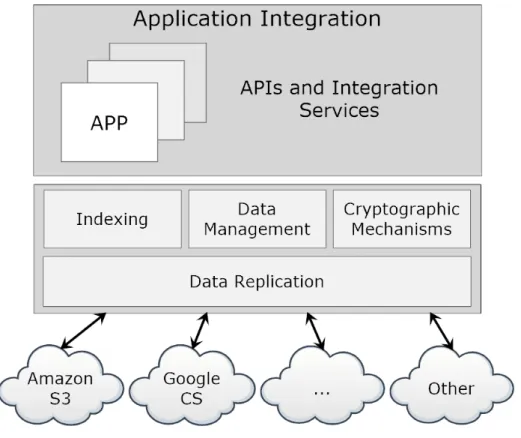
Figure 1: Main System Concerns
In Figure 1 we identify a set of important research directions related with components and services integrated in the architectural vision of the proposed system. The multiple components and the provided services motivate the study of relevant research work. Accordingly to Figure 1, in the next sections we will approach the studied related work references in the following areas:
12
Indexing – Although not as main focus, indexing techniques and services tend to be important to a set of applications we want to support. In the presence of large data sets indexing is key feature enabling the management of such data. One of the key issues, in this research direction, is how to extract actual infor-mation from large heterogeneous (different types/formats of data) datasets. Different techniques to address this issue, including multimedia information extraction, have been already addressed in [31]. In the context of development of this thesis, the indexing components are addressed using specific techniques for text-based information retrieval, namely simple linear searching schemes [32], [33] combined with ranking based indexing techniques, namely using the Okapi BM25 scoring scheme [34] for the purpose of validation of application scenario (email repository platform);
Data management services - In this direction, systems addressing the use of third party data-repositories not necessarily trustable for the applications us-ing them are particularly interestus-ing [13], [14]. More recently, approaches to de-pendable services in cloud-oriented middleware systems addressing security and reliability concerns, are important contributions inspiring the ideas for this thesis [11], [12].
Cryptographic Mechanisms and Tools – One of main issues addressed in this thesis regards data security, and so cryptographic mechanisms represent a big role in such objective. As research direction, we explored not only widely used encryption algorithms, as we explored some novel approaches using exist-ing mechanisms, namely secret sharexist-ing schemes [27], [28], [29], threshold signa-tures [35] and cryptographic homomorphic schemes [30]. The solution we in-tended to create uses these mechanisms integrated in other research directions, namely integrated in indexing, data management and cloud replication;
Data Replication – Finally and also as a research direction, the use of rep-lication mechanisms including Byzantine fault tolerant reprep-lication has been ex-tensively studied in multiple contexts as [36] or [37]. Although could be ad-dressed as future work, the use of fault tolerant replication algorithms is out of scope for the current thesis (and is addressed in the context of the TSKY project architecture in the context of other dissertations). Nevertheless, replication plays an important role in the designed solution regarding availability and
reli-13 ability issues assumed as objectives of the solution. Furthermore, the use of rep-lication using multiple clouds (in a cloud-of-cloud solution) enables new re-search directions concerning profiling and erasure codes techniques and also ubiquity and location awareness, all addressed as future work.
2.1.
Cryptographic Mechanisms and Tools
2.1.1
Secret Sharing Schemes
To easily understand the problem behind the existence of such schemes, Shamir (in [27]) has enunciated the following problem:
“Eleven scientists are working on a secret project. They wish to lock up the docu-ments in a cabinet so that the cabinet can be opened if and only if six or more of the sci-entists are present. What is the smallest number of locks needed? What is the smallest number of keys to the locks each scientist must carry?”
To solve such problem we could think in a combinatory solution where 252 keys per scientist and 462 locks are needed. This solution, not just is imprac-tical for the above problem as, it is impracimprac-tical and even infeasible in a compu-tational solution where some data need to be encrypted and keep secure on threshold basis. So, we need a secret sharing scheme to solve such problem in a practical way.
A secret sharing scheme, also called secret splitting or threshold(t,n) scheme, refers to a method for distributing a secret amongst a group of partici-pants, each whom is allocated a share of the secret. This secret can be any kind of numerical data, whereas any content can be converted to numerical data. The shared secret can be reconstructed only when a sufficient number, of possibly different types, of shares are combined together. This kind of schemes should held two essential properties:
• The knowledge of any 𝑡 or more 𝐷𝑖 pieces makes 𝐷 easily computable;
• And the knowledge of any 𝑡 −1 or fewer 𝐷𝑖 pieces leaves 𝐷 completely
undetermined (in the sense that all its possible values are equally likely). This kind of schemes held a huge advantage in the present dissertation, due to the replication (mapped into a Byzantine fault model) defined as an ob-jective and due to the confidentiality that must be held. Although useful this
14 kind of schemes are based on numerical operations and so are pretty heavy re-garding CPU processing. Some tests rere-garding the various scheme performanc-es were made and can be seen in evaluation section.
2.1.1.1.
Shamir Secret Sharing Scheme
Published in 1979, the Shamir Secret Scheme [27] is based on polynomial interpolation, this is, a set of planar points are generated in such way that the result of their interpolation is a function that held the secret. The Lagrange In-terpolation Theorem used to interpolate the points states that given 𝑛+ 1 data points (𝑥0,𝑦0), … , (𝑥𝑛,𝑦𝑛) in the plane, with xi ≠ 𝑥𝑗, for 𝑖 ≠ 𝑗, there is a unique
polynomial 𝑝 of degree at most 𝑛 that interpolates the given data, i.e.: such that
𝑝(𝑥𝑖) =𝑦𝑖 for 𝑖= 0, … ,𝑛.
In other words using a polynomial of degree 𝑡 −1 as the secret we share a set of 𝑛 points as a set of shares of that secret. In order to recover the secret we will need at least 𝑡 points to be able to recover the secret, i.e. we need 𝑡 points to be able to build the original 𝑡 −1 function that interpolates all the points.
Figure 2: Interpolation Problem, 4 points, 3rd degree function
As seen in Figure 2, through Lagrange interpolation definition we verify that a set of 4 point (n+1 points) determine uniquely the function of degree 5 (degree n) interpolating such points. This assumption is based on the existence of a solution and the uniqueness of such solution (found in [38]).
15
Algorithm
To share a secret D we start by randomly generate a polynomial of 𝑘 −1
degree:
𝑞(𝑥) =𝑎0+𝑎1𝑥+⋯+𝑎𝑘−1𝑥𝑘−1
Where:
𝑞(0) =𝑎0 =𝐷
We generate and distribute 𝑛 distinct points (𝑥1,𝑦1), … , (𝑥𝑛,𝑦𝑛) ∈ 𝑞
modu-lus 𝑝 such that 𝑝> 𝐷 and 𝑝> 𝑛. To recover the secret we need at least 𝑘 points from 𝑞. For each of the 𝑘 points we compute the Lagrange polynomials:
𝑙𝑗 = � 𝑥𝑥 − 𝑥𝑖
𝑗− 𝑥𝑖
𝑘
𝑖=1,𝑗≠𝑖
Finally we recover the secret computing:
𝑞(𝑥) =� 𝑙𝑗(𝑥)∙ 𝑦𝑖 𝑘
𝑗=1
16
Practical Example
We want to share the secret 𝐷 = 4321 amongst 6 people and we want at least 3 of them needed to recover the secret. We generate a function randomly with 𝑎0 =𝐷 :
𝑓(𝑥) = 4321 + 192𝑥+ 105𝑥2
Next we select 6 distinct points from 𝑓 modulus a prime 𝑝= 4327:
(1,291), (2,798), (3,1515), (4,2442), (5,3579), (6,599)
We distribute the shares among the players. To recover the secret we se-lect randomly at least 𝑘= 3 points (shares):
(2,798), (4,2442), (5,3579)
Next, we compute Lagrange polynomials for each of the selected points:
𝑙2 = 16𝑥2−32𝑥+103
𝑙4 = −12𝑥2+72𝑥 −5
𝑙5 =13𝑥2−2𝑥+83
Finally, to recover the secret, we compute:
𝑓(0) = 768∙103 + 2442∙(−5) + 3579∙83 mod 4327 = 4321
In this thesis the people correspond to a set of heterogenic clouds and the secret we pretend to share correspond to the seed used to generate a crypto-graphic key or a set of keys which in turn are used to encrypt the stored data. Although considered perfect and the most efficient method to share a secret this method present an error as defined in Lagrange Theorem. This error doesn’t occur frequently, even so, and to avoid secret corruption, the secret can be wrapped in some random data so the less significant data is discarded in the process.
17
2.1.1.2.
Blakley Secret Sharing Scheme
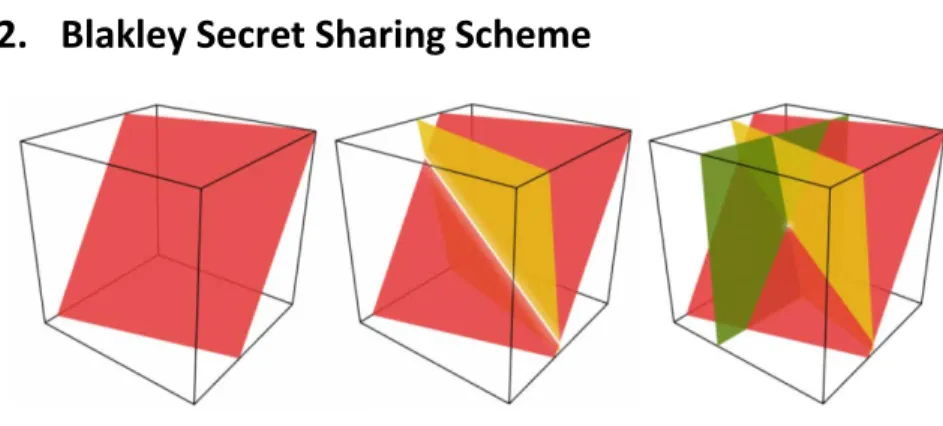
Figure 3: Three 3-Dimensional Plane Intersection
As with Shamir Scheme, this scheme was invented in 1979 but by George Blakley. The idea behind this scheme [29] is that we can create a hyperspace in such way that a subset t out of n planes can be intercepted in a point in that hy-perspace. This point is the secret we want to share. In other words, each share corresponds to a plane and the secret held in the point of intersection of at least t planes as illustrated in Figure 3.
Algorithm
First we select a prime 𝑝>𝐷 where 𝐷 is the secret we want to share. We generate a random point 𝑃= (𝑃1, … , 𝑃𝑘) where 𝑃1 = D.
Now we need to generate 𝑛 linearly independent (𝑑𝑒𝑡 ≠ 0) k-dimension planes: � 𝛼1,1 ⋯ 𝛼1,𝑘−1 ⋮ ⋱ ⋮ 𝛼𝑛,1 ⋯ 𝛼𝑛,𝑘−1 �:∀𝑖,𝑗𝛼𝑖𝑗 = rnd mod 𝑝
Finally we define the last monomial:
𝛼𝑖,𝑘 =𝑃𝑘− 𝛼𝑖1𝑃1− ⋯ − 𝑎𝑖𝑗𝑃𝑗(mod 𝑝), 𝑗 ∈[2,𝑘], 𝑖 ∈[1,𝑛]
Having at least 𝑘 planes we can precede to the secret recovery. To do so we must solve the following congruences’ system:
𝑆=� 𝛼1,1 ⋯ 𝛼1,𝑘−1 ⋮ ⋱ ⋮ 𝛼𝑘,1 ⋯ 𝛼𝑘,𝑘−1 (−1) ⋮ (−1)� � 𝛽1 ⋮ 𝛽𝑘 � ≡ − � 𝛼1,𝑘 ⋮ 𝛼𝑘,𝑘1 � (mod 𝑝) →(𝑃1, … ,𝑃𝑘) = (𝛽1, … ,𝛽𝑘)
Note that if the randomly generated planes aren’t linear independent they can null each other, this means that they doesn’t intercept each other.
18
Example
Again, we want to share the secret 𝐷 = 4321 amongst 6 people and we want at least 3 of them needed to recover the secret. Select a prime 𝑝= 7333.
Next we randomly generate a k-dimensional point 𝑃 = (4321,12,35) where the first coordinate is the secret we need to share. Generate random 𝑎 and 𝑏
values modulus 𝑝 to form a set of 𝑛 linearly independent planes:
𝐴 = (𝑎1, … ,𝑎𝑛) = (10,11,13,23,33,25)
𝐵 = (b1, … , bn) = (14,25,18,21,43,6)
Finally we compute the last monomial for each plane, completing our shares set:
𝑐𝑖 ≡ 𝑧0− 𝑎𝑖𝑥0 − 𝑏𝑖𝑦0 (𝑚𝑜𝑑𝑝) → 𝐶= (655,3535,2310,3062,3586,1933)
To recover our secret we start by selecting 𝑘 out of 𝑛 planes and build a congruences system matrix. Now we can solve the congruences matrix by ap-plying the Gaussian elimination process obtaining the secret:
�10 1411 25 −−11 13 18 −1� � 𝑥 𝑦 𝑧� ≡ � −655 −3535 −2310� (𝑚𝑜𝑑 7333) ⇔ (𝑥,𝑦,𝑧) = (4321,12,35)
As in the Shamir algorithm people correspond to a set of heterogenic clouds and the secret we pretend to share correspond to the seed used to gener-ate a key or a set of keys which in turn cipher the stored data. Unlike Shamir scheme, this scheme cannot be considered perfect because at each plane inter-section the solution space is reduced [39]. For instance in Figure 3 we can check that without any plane our point of intersection is localized in a 3-Dimensional space. By adding one plane we know that the secret is localized is a plane. By adding other plane we get a line of intersection corresponding to a reduced se-cret space. Since we are working in 𝑍𝑝 this scheme can be considered ideal.
19
2.1.1.3.
Asmuth-Bloom Secret Sharing Scheme
Invented by C. Asmuth and J. Bloom and published in 1983 the Asmuth-Bloom secret sharing algorithm [28] is based on the Chinese Remainder Theo-rem. The Chinese Remainder Theorem [40] states that a set of linear congruenc-es with distinct co-prime moduli has a unique solution in moduli multiplicato-ry. This is:
Let 𝑚1,𝑚2,𝑚3, … ,𝑚𝑛 be positive integers such that:
gcd�𝑚𝑖, 𝑚𝑗�= 1 for 𝑖 ≠ 𝑗
Then the simultaneous linear congruences:
𝑥 ≡ 𝑎1 (mod 𝑚1)
𝑥 ≡ 𝑎2 (mod 𝑚2)
⋮
𝑥 ≡ 𝑎𝑛 (mod 𝑚𝑛)
Has a unique solution modulo 𝑚1…𝑚𝑛 satisfying all these congruences.
Algorithm
The algorithm is divided in two phases. The first phase or dealing phase is described as follows. Let 𝐷 be the secret we pretend to share and let
𝑚0 <⋯ < 𝑚𝑛 be a set of co-prime values, ∀i,j gcd�𝑚𝑖,𝑚𝑗�= 1
𝑚0 ∙ � 𝑚𝑛−𝑖 <� 𝑚𝑖 𝑘 𝑖=1 𝑘−2 𝑖=0 with 𝑚0 > 𝑑
Let 𝑀= ∏𝑡𝑖=1𝑚𝑖 the dealer select a random 𝑎 for 𝑦 =𝐷+𝑎 ∙ 𝑚0 such that 0≤ 𝑦<𝑀. To each player a share of the secret (a congruence of the system) is delivered:
𝑦𝑖 ≡ 𝑦𝑚𝑜𝑑𝑚𝑖
The recovery phase consists in selection at least 𝑘 shares (𝑘 congruences)
𝑦 ≡ 𝑦𝑖 �𝑚𝑜𝑑𝑚𝑖� for any 𝑖 ∈ [1,𝑛], in turn, we apply the Chinese Remainder
20
Example
We want to share the secret 𝐷 = 4321 amongst 6 people and we want at least 3 of them needed to recover the secret. We select a 𝑚0 and 𝑛 co-prime
numbers accordingly to the previously described algorithm restrictions:
𝑚0 = 25561
(𝑚1, … ,𝑚𝑛) = (38219,38231,38237,38239,38261,38273)
Then we generate a random value 𝑎= 1104742420 and compute:
𝑦 = 4321 + 1104742420∙25561
Now we obtain a set of congruences (𝑎𝑖 = 𝑦 mod 𝑚𝑖):
𝑥 ≡10330 mod 38219 𝑥 ≡9405 mod 38231 𝑥 ≡12243 mod 38237 𝑥 ≡16349 mod 38239 𝑥 ≡4831 mod 38261 𝑥 ≡34276 mod 38273
To recover the secret we select a subset of congruences 𝑡 ≥3:
𝑥 ≡10330 mod 38219
𝑥 ≡12243 mod 38237
𝑥 ≡4831 mod 38261
Then applying the CRT algorithm we compute:
𝑀 =� 𝑚 𝑛 𝑖=1 = 55913856468683 (1462985857∙34023∙10330) + (1462297159∙34431∙12243) + (1461379903∙8009∙4831) = 28238321001941 mod 25561 = 4321
21 This scheme should be considered perfect due to the fact that the modulus value is unknown for the attacker so with just part of the congruences it is im-possible to know where de solution stands. As with others, this scheme is con-sidered ideal because are working in 𝑍𝑝. Though only Asmuth-Bloom has
ho-momorphic properties documented in [41], Shamir and Asmuth-Bloom can be used in such way through the point or plane translation respectively. Although interesting to maintain key freshness, this kind of properties will be addressed as future work.
22
2.1.2
Threshold Signatures
With the paper work being replaced by email and electronic documents the use of traditional signatures has been voided. The use of digital signatures offer not only data authenticity as provide a message integrity proof, this is, the signer cannot be impersonated and the authenticated messages can be verified against corruption or tampering. Signatures as RSA or DSA are widely used and leverage message integrity and authenticity verifiable by any party, pro-vided that a public key is available. The use of public/private key based signa-ture schemes confines the authenticity to a unique key and so to a unique entity that detains the key, which can be seen as an unique point of failure or simply very limited when a set of parties represent an unique entity. Multisignature and Threshold Signatures Schemes has been designed to solve such problems. As defined in [42] , there are two major differences between threshold signature schemes and multisignature schemes. Multisignature schemes, unlike with threshold schemes, do not restrict a minimum number of parties to generate a valid signature, i.e., do not define a threshold. Finally in multisignatures schemes each entity signs the message individually while in threshold signa-tures schemes a well-defined group of entities sign the message using a splitted key.
The existing threshold signature schemes are based on existing signature schemes as ElGammal (discrete logarithm problem), RSA (factorization prob-lem) or Elliptic Curve ElGammal (elliptic curve discrete logarithm probprob-lem). A threshold signature scheme is defined by two basic requirements [42]:
• At least t participants in the group can collaborate to generate a valid signature on behalf of the group signature;
• Anyone who plays the role of a verifier can use the group’s public key to verify the group signature without exposing the identities of the signers. Our solution approach, based on an algorithm defined at [35], explores a RSA approach mixed with Lagrange interpolation formula (as in Shamir secret sharing scheme) complemented by individual share verification process that enables fault detection avoiding process failure. The author describes the algo-rithm as unforgeable and robust in the random oracle model, this is, no attacker
23 should be able to generate a valid threshold signature and corrupt players pre-sent signature process should not be able to prevent fair players from generat-ing valid signatures. Furthermore it is assumed the hardness of the RSA prob-lem.
The article defines a set of players, a trusted dealer and an adversary as part of the system model. Additionally he defines t as the number of corrupted players and k the minimum number of signature shares needed to obtain the signature. Being l the total number of players, k and t are restricted by 𝑘 ≥ 𝑡+ 1
and 𝑙 − 𝑡 ≥ 𝑘. Finally, it’s defined a signature verification, share verification and share combining algorithms used in the various process phases. The algorithm defines a dealing phase in which the dealer generates a public key along with l private key shares and l verification keys. After the dealing phase each player including the corrupted ones signs a message of their choice (it is intended to be the same legit message) resulting in l signature shares. Once signed each player outputs their signature share. The use of a share verification algorithm before the combing phase allows the selection of valid signatures that are then used in the combining algorithm resulting in a signature.
As defined by the author the signature scheme assumes a “static corrup-tion model” in which the adversary can choose which players corrupt. In TSKY-TMS system the use of multiple storage clouds in a Byzantine fault tolerant model rise issues regarding the adversary attacks nature and location, for this purpose the use of threshold signatures is suitable in a way that middleware acts as dealer and players signing the same data and distributing the verifiable shares by the multiple storage clouds, in this way, an attack can occur in any storage node as long as the middleware is trustable and the number of affected nodes do not exceed the threshold value.
24
2.1.3
Homomorphic encryption
Due to cloud based platforms characteristics and costs, the migration of data has become increasingly interesting. To keep data safe we can apply a set of widely used techniques, namely symmetric/asymmetric crypto techniques along with replication. Though, the secure data must be managed by applica-tions running in controlled/trusted environments. Due to the hostile nature of cloud environments the migration of such applications can be considered a thread to data safety.
To allow the execution of operations over encrypted data, without expos-ing any critical information, homomorphic encryption techniques has emerged as techniques allowing such operations. In this way is possible to keep both ap-plications and data in public cloud storage without threatening data privacy. There are two groups of homomorphic schemes: the most common ones, called partial homomorphic cryptosystems allow specific operations to be executed over encrypted data (addictions or multiplications), for instance Paillier allow addition over encrypted data:
𝐸(𝑥1)∗ 𝐸(𝑥2) = (𝑔𝑥1𝑟1𝑚)(𝑔𝑥2𝑟2𝑚) =𝑔𝑥1+𝑥2(𝑟1𝑟2)𝑚 =𝐸(𝑥1 +𝑥2 mod 𝑚)
A homomorphic scheme supporting both addiction and multiplication is called a fully homomorphic scheme. Through the time, various authors have proposed these kind of schemes. Recently (in 2009) Gentry [43] proposed a fully homomorphic encryption scheme based using ideal lattices along with the for-malization of theorems and definitions that can be used to create other homo-morphic schemes. Subsequently, Dijk, Gentry, Halevi and Vaikuntanathan cre-ated a fully homomorphic scheme [44] based on modular operations over inte-gers which does not require ideal lattices.
Due to poor performance of fully homomorphic schemes different ap-proaches have been taken, namely the use of multiple partial homomorphisms in a context-aware approach, in which the used homomorphisms are chosen based on the target application and data.
25
2.1.3.1.
CryptDB
As the name suggests CryptDB [45] is a middleware system that provides practical and provable confidentiality in the face of data disclosure attacks over database systems. The base idea of the system is enabling the execution of SQL queries over encrypted data, to do so homomorphic properties are explored using aware encryption schemes. Since the encryption schemes are SQL-aware some primitive operators must be considered, namely equality or ine-quality checks, order comparisons, aggregations and joins. Furthermore CryptDB implements an adjustable query-based encryption in which encryp-tion schemes are adjusted accordingly to the runtime executed queries. The en-cryption schemes are arranged in onions. Each onion, define a set of layers and each layer allow the execution of a certain type of operation. The choice of such layers is dependent of the kind of operation and security level we want to guar-antee. For instance, layers go from Random, with maximum security offering in distinguishability under CPA to deterministic with weaker guarantees.
Finally CryptDB chains encryption keys to user passwords and so in order to access data user’s password is needed. If the target user is not logged and if the adversary has no access to the user’s password, the adversary cannot de-crypt the stored data even if DBMS and application server are completely com-promised. Through annotations over application’s SQL schema, the developer can define security and sharing policies, defining which users have access to each data item. The system architecture defines two parts, a database proxy and an unmodified DBMS. CryptDB defines two threat levels, one in which a curi-ous database administrator (DBA) try to learn data by snooping into DBMS server and a second threat in which the attacker takes control of the application and DBMS server. The first threat is defined as occurring in the DBMS server while the second thread also includes the database proxy containing users’ ac-tive sessions.
One of the key points of CryptDB system is the seamless integration with existing database backed up applications and so to evaluate such solution the authors have used real applications, namely they used phpBB revealing a 14.5% of throughput reduction. Although convincing the system presents some weak-nesses namely regarding data managed by users that are currently logged.
26
2.1.3.2.
Discussion
Due to the cloud nature of TSKY-TMS solution, the inclusion of homo-morphic schemes leverage the privacy of the overall solution by reducing the exposed data stored locally in the middleware. This is, since the middleware is running locally or in a computational proxy we can take advantage of homo-morphic schemes applied to a locally stored index, protecting the data from possible index disclosure attacks. It would be interesting to apply such homo-morphic operations to the stored data itself, but since the data stored in cloud storage repositories cannot be directly manipulated the use of homomorphic schemes is confined to the locally stored structures, namely the index.
27
2.2.
Data Management
2.2.1
Dependable Data Storage Systems
2.2.1.1.
Farsite
Farsite [46] is a distributed file system, secure and scalable that works like a centralized file server. The system is designed to execute on client machines, offering data availability, reliability, confidentiality and integrity over the stored files and directories. It explores a local cache system with slow update propagation in order to achieve a good performance. The system protects the data against corruption or unavailability through the use of symmetric encryp-tion and byzantine fault tolerant replicaencryp-tion. To manage the permissions differ-ent types of certificates were defined: namespace, user and physical machine certificates assuring the authenticity of all engaged entities.
Each system machine can take three distinct roles: it can be a client, a member of a directory group or a files host. The client machine interacts direct-ly with the user while a member of a directory group is a machine that manages the data using a fault tolerant byzantine protocol. Every member in the group stores a data replica and as new requests arrive the group handles them in a deterministic way, updating the replicas and sending confirmation to the client. Along with semantic verification in group accesses this mechanisms offers sys-tem reliability and data integrity.
By using cryptographic secure hashes over the content the directory groups can detect corruption in hosts stored data avoiding overall data tion, this is, detecting replica corruption the system avoids actual data corrup-tion. In order to achieve reliability and availability Farsite replicates the directo-ry metadata by multiple directodirecto-ry groups and the files data across multiple hosts. To redundantly store data erasure codes are used instead of simple repli-cation. If a machine stays unavailable for a substantial amount of time its func-tions are migrated into other machine using other data and metadata replicas in order to generate a new replica.
Data privacy is archived by the means of using symmetric encryption over files content and sensitive metadata. When the client creates a new file, a
ran-28 dom symmetric key file is generated then the client calculates the file’s hash and uses it as encryption key to the newly created file. Finally the created en-cryption file is used to encrypt the hashes instead of the data directly. This technique is called convergent encryption because a set of identical files con-verge into a single ciphered file independently of users key. Block level encryp-tion instead of file level encrypencryp-tion allows the execuencryp-tion of operaencryp-tions over a subset of blocks avoiding reading or writing the entire block. Furthermore the use of blocks allows read on demand operations, e.g., streaming applications.
Farsite system, as other distributed file systems, is very interesting con-cerning this thesis since it addresses confidentiality, integrity and availability issues over a file system which enables a comparison regarding de data stored in the multiple hosts. The use of certificates, addressed as future work in the current thesis, can be used to leverage the authenticity of the multiple instances of the middleware and probably for users and/or clients’ access control. Other fact that is considered interesting and that was explored in the presented mid-dleware solution was the use of hashes in order to detect file corruption. In the current solution the objects’ cloud identifiers are data hashes that allow integri-ty check on data retrieval. Although addressed as future work, the use of con-vergent encryption, as presented in Farsite system, could be used as means to reduce the storage costs which can be interesting regarding the cost model im-provement objectives.
2.2.1.2.
EHR
The system described in the article intend to ensure security and privacy of Electronic Health Records or EHRs [47], this is, it is required to guarantee that health records are kept confidential being only accessible by the health sys-tem personnel and their patients. To ensure such properties the syssys-tem makes use of an Attribute Based Encryption or ABE. An ABE system is a public key cryptographic system in which each user’s key is labeled with a set of attributes and the ciphered content is associated with an access policy. The user’s secret key can only decipher the content if the key associated attributes satisfy the content access policy.
29 The solution assumes the existence of a trustable authority or TA that gen-erates users’ keys and publishes the public values. The system assumes that cloud storage providers provide a reliable service and that data can be manipu-lated and analyzed by the same providers.
Each patient record consist in an encrypted file along with a metadata ta-ble describing the encrypted file including the encrypted file location, a plain access policy and a search index or SI for search operations over the ciphered content. To search over the ciphered data the system uses a Secure Channel Free Public-Key Encryption with Keyword search or PEKS. This mechanism gives the users private search abilities over ciphered data without revealing the search keywords or the partial matches with the server.
This system is interesting, regarding this thesis, due to the homomorphic search operations it offers. Furthermore, as in TSKY-TMS, EHR has main focus in protecting data privacy using symmetric keys but complemented with a poli-cy based public key system.
2.2.1.3.
Silverline
Silverline [48] is a system designed to improve the security of data stored in public clouds. Silverline is based on a simplified model in which the data is encrypted by the client before storing it to the cloud. Since Silverline is a system designed to be used as a middleware between applications and databases, and since some database operations cannot execute over ciphered data (eg. inequali-ty comparisons or field aggregations), a mechanism was required in order to determine whether the data could be encrypted or should be let plain. Once de-termined whether data should be encrypted it is necessary to assign symmetric key(s) to one or various data fields. One solution would consist in using one global key to all encrypted data. Although simple, this solution would raise many security issues regarding a single point of failure. On the other hand, a key per each data field could be used instead but although highly secure it in-troduces an overhead in key management and distribution. So the authors came with a hybrid solution in which are created data groups defining encryption domains with a single key per each group, this is, the loss or compromise of one key result in data loss or disclosure of only one of the groups data fields.
30 Silverline ensures a transparent user access, through the use of HTML5 based applications without the need of using modified browsers. Although not approaching integrity as an issue, this system presents an interesting hybrid solution regarding the use of multiple keys versus a single key. In TSKY-TMS, a multiple key scheme is used, where each object is encrypted with a different key. This approach can reconsidered towards latencies and costs optimization, and so a solution where multiple objects are merged into a single object creating larger encryption domains is desirable being addressed as future work.
Other interesting feature of Silverline is the reduced TCB model in which keys are stored in a client side browser using current technologies, and so the data security relies on client side stored crypto material. The current approach of TSKY-TMS has defined a REST API promoting the use of web based technol-ogies as interface to the evaluated system. A Webmail system with a browser based key management system would be highly desirable and will be also ad-dressed as future work.
2.2.1.4.
Discussion
Although in a different scope, Farsite file system, as in TSKY-TMS, assures some dependability attributes and so can be considered a dependable system. Data confidentiality is achieved by combining symmetric convergent encryp-tion combined with asymmetric keys that may be used in future as a means to archive data privacy while reducing storage costs.
The EHR system, unlike the other systems, presents a solution aimed at ensuring confidentiality using a policy based approach where user’s access to data depends on a key and an associated policy. Regarding the current thesis it would be interesting explore such solution as a mean to control multiple mid-dleware instances or multiple users. Since the current thesis do not addresses multiple users or multiple instances of TSKY-TMS this mechanism will be as-signed as future work.
2.2.2
Cloud Oriented Dependable Solutions
As with the current system there were examined a set of dependable sys-tems. The term dependability [49] is defined in three parts: the threads to the
31 system dependability, the means by which dependability is attained and a set of attributes. The described systems cover some of combination of dependabil-ity attributes, this is, cover availabildependabil-ity, reliabildependabil-ity, safety, confidentialdependabil-ity, integ-rity and/or maintainability. Beyond dependability these systems are also char-acterized by functionality, performance and costs discussed in the end of each subsection, thus creating a comparison with the presented system.
2.2.2.1.
Depsky
The DepSky system [11] is described by the authors as a cloud-of-clouds system that leverages availability, integrity and confidentiality of data stored in storage clouds and that deals with data integrity and availability through the use byzantine fault tolerant replication mechanisms.
DepSky cloud-of-cloud model mitigates vendor lock-in problem by the use of multiple storage providers disposing the dependency of single providers. Furthermore the use of multiple clouds combined with erasure code techniques assure not only data integrity and availability as allows the cost reduction of data storage costs up to 50%, as stated in DepSky storage evaluation. By explor-ing a set of storage clouds as simple storage nodes and by directexplor-ing all pro-cessing needs to a client or to a middleware server, along with encryption and secret sharing techniques the system attains a TCB (Trustable Computing Base) reduction to the client itself while offering confidentiality (in the DepSky-CA version). The DepSky-A version supports all dependability attributes support-ed by CA version other than confidentiality.
The system defines each data unit or DU by a unique identifier, a version number (in order to support versioning and updates), application specific metadata, integrity codes and the data itself. The system was designed consid-ering three entities, the writers, the readers and the cloud storage providers. The system assumes that both readers and writers can corrupt the stored data. As mean to solve corruption and as a concurrency control mechanism DepSky proposes a low contention locking mechanism that uses the storage clouds itself as lock platform. In this manner is possible to use authenticated locks, through the use of asymmetric cryptography, in order to assure authenticated concur-rency concerning multiple writers and readers.
32 The use of secret sharing techniques, erasure codes and multiple storage providers provides the system support to a byzantine fault tolerant model where 3f+1 clouds support at most f faults.
The described system (TSKY-TMS system) is very similar with DepSky system, as in TSKY-TMS, DepSky-CA explores a cloud-of-clouds model in or-der to provide data availability, confidentiality and integrity making DepSky the most similar dependable system analyzed. Although the concurrency con-trol is addressed as future work the TSKY-TMS supports integrity and authen-ticity through the use of signatures, more precisely threshold signatures that are suitable for the replication model that TSKY-TMS supports.
2.2.2.2.
iDataGuard
The authors describe iDataGuard [12] as a system to combat cloud diversi-ty and heterogeneidiversi-ty while enforcing data securidiversi-ty with search over encrypted data functionality.
Figure 4: iDataGuard Data Model
As shown in Figure 4, the iDataGuard architecture is defined in two main components, a client and middleware components that execute in a client ma-chine or alternatively in a secure proxy. The system provides two distinct inter-faces, one based on a file system and other based on abstract objects in which the file system interface is based on. The system execution is initiated by the
33 conversion of the outsourced data into the abstract data model though the data translator component or DT. The cryptographic module or Crypto Module uses a PBE scheme based on a master password in order to encrypt the contents. Fi-nally an index generator creates a cryptographic index for all text based files.
Each system object is represented by a unique identifier (generated by concatenation of full path and users’ password making it deterministic), a file name, content and metadata stored in a key-value approach. Since the identifier doesn’t provide any information it is kept plain while the metadata is stored encrypted using an object encryption key or OEK. This key is generated on-the-fly using a key derivation function or KDF of PBE PKCS#5 specification using as salt an random string preventing from key pre-calculation to the most com-mon passwords. The salt is stored in the plain section of objects metadata, in this way, iDataGuard can regenerate the key on demand. The data integrity is provided through the use of a Hash Based Message Authentication Code or HMAC applied to the identifier, name, content, metadata and version, which ensure the object most current version.
In a similar way, the proposed middleware system ensures confidentiality through the use of on-the-fly generated keys. As in iDataGuard, TSKY-TMS al-so faces cloud storage heterogeneity by the use of adapters that implement a standard cloud storage interface. Furthermore, the current TSKY-TMS architec-ture includes an index allowing search operations over encrypted data through the use of an index with homomorphic properties.
2.2.2.3.
HAIL
HAIL [13] or High-Availability and Integrity Layer for Cloud Storage is a system that assures availability and reliability using RAID similar mechanism where storage clouds are used as base storage rather than traditional hard disks. The HAIL defines assurances or proofs in two dimensions, the PDP or Proof of Data Possession that assures the presence of data and POR or Proof of Re-trievability in which is assured the existence of an effective data recovery pro-cess.
To assure a Byzantine fault tolerant model HAIL uses replication mecha-nisms that, i.e., f replicas out of 3f+1 can be corrupted without compromise data
34 retrievability. To do an integrity check HAIL randomly extracts a data block from each replica checking its equality. In case some discrepancy is found the system rebuilds a non-corrupt replica using the remaining replicas.
The PDP could be addressed in future implementation, complemented by threshold signatures, in order to detect possible corruptions while reducing da-ta transfer rates and consequently reducing the associated costs. However this technique would not be possible to implement taking into account the inexist-ent data correlation, i.e., in the currinexist-ent impleminexist-entation each stored replica dif-fers due to the use of different keys in different blocks.
2.2.2.4.
RACS
RACS [14] or Redundant Array of Cloud Storage is a system that splits da-ta in a similar manner to RAID systems, using as storage backend various age clouds. The system, as in TSKY-TMS, offers a transparent and reliable stor-age service providing data availability and integrity and avoiding vendor lock-in issues by the use of replication mechanisms. RACS, as other cloud storage providers provides retrieval, insertion, deletion and listing operations over data indexed by a unique key.
When a data insertion request arrives, the actual data is divided in m simi-lar size parts (1/m of the original size). Then RACS uses erasure codes in order to create n-m redundant parts totaling n parts, where redundant parts size is similar to th