Preface
The audience for the Yearbook consists of media and technology professionals in schools, higher education, and business contexts. Topics of interest to profession-als practicing in these areas are broad, as the Table of Contents demonstrates. The theme unifying each of the chapters in the book is the use of technology to enable or enhance education. Forms of technology represented in this volume vary from traditional tools such as the book to the latest advancements in digital technology, while areas of education encompass widely ranging situations involving learning and teaching, which are idea technologies.
As in prior volumes, the assumptions underlying the chapters presented here are as follows:
1. Technology represents tools that act as extensions of the educator. 2. Media serve as delivery systems for educational communications.
3. Technology is not restricted to machines and hardware, but includes techniques and procedures derived from scientific research about ways to promote change in human performance.
4. The fundamental tenet is that educational media and technology should be used to
a. achieve authentic learning objectives, b. situate learning tasks,
c. negotiate the complexities of guided learning, d. facilitate the construction of knowledge, e. aid in the assessment/documenting of learning,
f. support skill acquisition, and g. manage diversity.
The Educational Media and Technology Yearbook has become a standard ref-erence in many libraries and professional collections. Examined in relation to its companion volumes of the past, it provides a valuable historical record of cur-rent ideas and developments in the field. Part I, “Trends and Issues in Learning, Design, and Technology,” presents an array of chapters that develop some of the current themes listed above, in addition to others. Part II, “Trends and Issues in
vi Preface Library and Information Science,” concentrates on chapters of special relevance to K-12 education, library science education, school learning resources, and var-ious types of library and media centers – school, public, and academic among others. In Part III, “Leadership Profiles,” authors provide biographical sketches of the careers of instructional technology leaders. Part IV, “Organizations and Associations,” and Part V, “Graduate Programs,” are, respectively, directories of instructional technology-related organizations and institutions of higher learning offering degrees in related fields. Finally, Part VI, “Mediagraphy: Print and Nonprint Resources,” presents an annotated listing of selected current publications related to the field.
The editors of the Yearbook invite media and technology professionals to submit manuscripts for consideration for publication. Contact Michael Orey ([email protected]) for submission guidelines.
For a number of years, we have worked together as editors, and this is the sev-enth year with Dr. Michael Orey as the senior editor. Within each volume of the Educational Media and Technology Yearbook (EMTY), we try to list all the gradu-ate programs, journals, and organizations that are relgradu-ated to both Learning, Design, and Technology (LDT) and Information and Library Science (ILS). We also include a section on trends in LDT and trends in ILS, and we have a section profiling some of the leaders in the field. Beginning with the 2007 volume, we have attempted to generate a list of leading programs in the combined areas of LDT and ILS. Last year, we were able to compose an alphabetical list of 30 programs that people told us were among the best. However, this year we decided to be more systematic. Instead of following the US News and World Report model and have one top pro-gram list, we decided to use some of the same numbers that they use and generate a collection of top-20 lists, rather than attempt to generate a statistically significant rankings list. One thought was to rank programs according to the number of publica-tions that were produced; however, deciding which journals to include was an issue. We decided to use 2007 and 2008 as the years to count (since at the time of writing, it is still 2009 and so we do not have a complete year). Furthermore, we decided to only count actual research reports that appeared in one of two journals, Educational Technology Research and Development and the Journal of the Learning Sciences. These two journals were primarily selected based on the general sense that they are the leading journals in the area of LDT. Noticeably absent is the area of information and library science. So, while these numbers are pretty absolute, choosing to only count these journals is somewhat arbitrary.
The other top-20 lists are based on self-report data collected as part of the pro-gram information in the Educational Media and Technology Yearbook. Every year, we collect general information about programs in LDT and ILS and publish this information in the Yearbook. This year we opted to collect some additional data. We asked the representatives of each of the institutions to enter the US dollar amount of grants and contracts, the number of PhD graduates, the number of master’s grad-uates, and the number of other graduates from their programs. We also asked them for the number of full-time and part-time faculty. We then generated a top-20 list for some of these categories. The limitation in this case is that it is self-report data and
Preface vii there is no real way of verifying that the data is accurate. So, while the list of the 30 top programs last year lacked hard data, and the lists this year are based on numbers, those numbers may be just as unreliable. In the end, we have a collection of lists that we hope will be of use to our readers. Many of the universities that appeared in the top-30 list last year are here again, in addition to many others. More information about many of these universities can be found in Part V of this edition.
There are six top-20 lists in this preface. The first of these top-20 lists is based on a count of publications. We used every issue from the 2007 and 2008 volume years of the Educational Technology Research and Development journal and the Journal of the Learning Sciences. We eliminated all book reviews and letters to the editor and such others. We only used the primary academic articles of these journals. Each publication counted 1 point. If the article had two authors, then each author’s insti-tution received 0.5 points. If there were three authors, then 0.33 was spread across the institutions. Also, as an additional example, if there were three authors and two of them were from the same institution, then that institution received 0.66 points and the institution of the remaining author received 0.33. Finally, the unit receiving the points was the university. So, in the case of Indiana University where they have both a Learning Sciences and an Instructional Technology program, all of the points for IT and LS were aggregated into one variable called Indiana University. Table 1 shows our results. Nanyang Technological University came out as the top LDT pro-gram in the world. They were also in my list last year. Interestingly, the University of Wisconsin and the University of Colorado, numbers 3 and 4, were not even on last year’s list. The list this year is much more international with universities from all over the world. An interesting result is that since there is not enough variance, we have a 5-way tie for sixth and a 28-way tie for twentieth. We would love to hear your feedback on this approach for the future. Are there other journals that ought to be included? Is it unfair that there are more publications in ETRD than IJLS? What about recent graduates publishing with their new institution when the work was done at their previous institution? I am certain there are many other issues, and we welcome constructive feedback.
The two primary measures of research achievement are publications and grants. While choosing ETRD and IJLS was somewhat arbitrary, the numbers are verifiable. In Table 2, we present the top-20 programs according to the dollar amount of grants and contracts for that program over the academic year 2008–2009. While Table 1 was constrained to LDT, Table 2 has both LDT and ILS programs, which resulted in UNC being number 2 in the grants and contracts list, but not appearing at all in the publication list. Next year, we will count publications in the ILS area. University of Calgary comes out as the top program in terms of grant and contracts. They nearly doubled the amount of the number 2 institution. Texas Tech, who did not show up on my list last year, comes in a strong third in the area of grants and contracts.
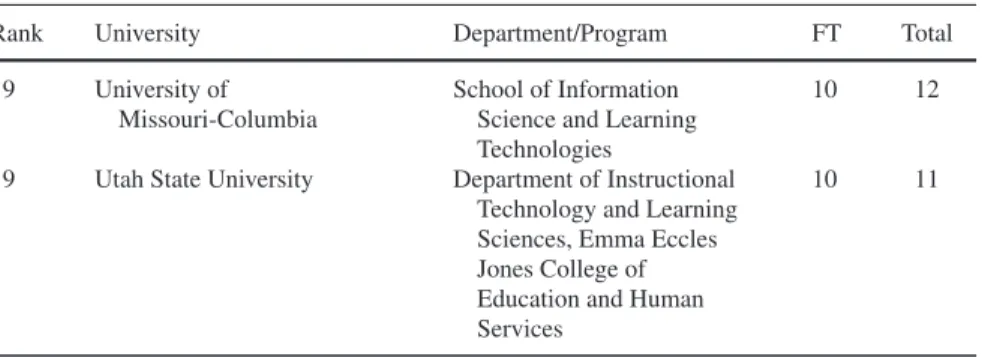
Tables 1 and 2 are measures of research productivity. The remaining four tables are more related to teaching than research. The first, Table 3, shows the top-20 pro-grams in terms of the number of full-time faculty. You will notice that the list is correct under the FT category, but number 4, Université de Poitiers, has more total faculty than number 3, the University of North Carolina. We decided that full-time
viii Preface
Table 1 Top-20 graduate programs in the area of Learning, Design, and Technology as
mea-sured by the number of publications in Educational Technology Research and Development and the Journal of the Learning Sciences
Rank University Pubs Rank University Pubs
1 Nanyang Technological University
4.33 20 Edith Cowan University 1 2 Arizona State University 3.66 20 Mandel Leadership Inst 1 3 University of Wisconsin 3.3 20 Miami University 1
4 University of Colorado 2.83 20 MIT 1
5 Indiana University 2.66 20 National Cheng Kung University
1 6 Sultan Qaboos University 2 20 Northern Illinois University,
De Kalb
1
6 SUNY-Buffalo 2 20 Oklahoma State University 1
6 University of Georgia 2 20 Open University of the Netherlands
1 6 University of Hong Kong 2 20 Queensland University of
Technology
1
6 University of New Mexico 2 20 Rutgers 1
11 UCLA 1.83 20 SUNY-Albany 1
12 Stanford 1.5 20 Tel-Aviv University 1
12 University of Illinois 1.5 20 University Central Florida 1 14 Purdue University 1.46 20 University of British
Columbia
1 15 Brigham Young University 1.33 20 University of Cambridge 1 15 Florida State University 1.33 20 University of Gothenburg 1 15 Lehigh University 1.33 20 University of KwaZulu-Natal 1 18 University of Memphis 1.2 20 University of
Mass-Dartmouth
1 19 Utrecht University 1.14 20 University of Michigan 1 20 University of Missouri 1 20 University of Nevada 1 20 University of Pittsburgh 1 20 University of Rochester 1 20 University of Sydney 1 20 University of Washington 1 20 UC-Santa Cruz 1 20 Universidad de La Sabana 1 20 Wayne State University 1
faculty was more important than part time as a measure and so only generated one list for number of faculty. We just thought it would be interesting to see the total number of faculty as well. For example, it is very interesting that the number 1 uni-versity for full-time faculty, Drexel Uniuni-versity, has a whopping total of 111 total faculty.
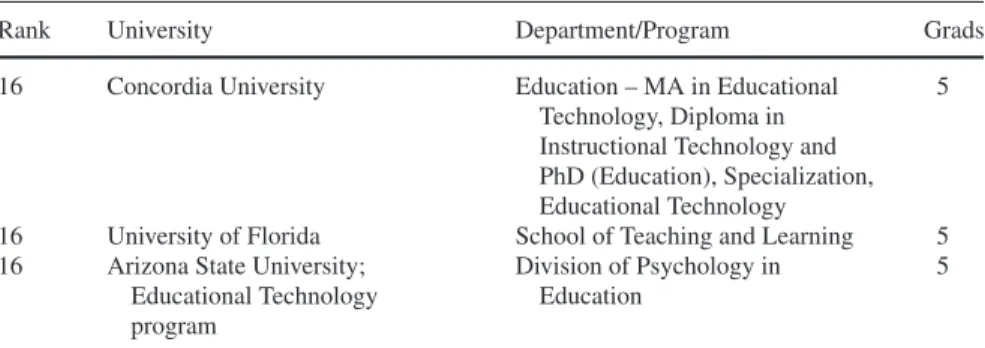
The next top-20 list is the number of PhD graduates. This list might be a good measure of research productivity as well as teaching productivity. It is interesting that Indiana University came out on top, yet I am unsure if this is the number of Instructional Technology or Learning Sciences or both? George Mason comes
Preface ix
Table 2 Top-20 LDT and ILS programs by the amount of grant and contract monies
Rank University Department/Program Total in US$
1 University of Calgary Graduate Division of Educational Research
$20,000,000 2 University of North Carolina,
Chapel Hill
School of Information and Library Science
$11,502,614 3 Texas Tech University Instructional Technology $6,000,000 4 Harvard University Graduate School of
Education
$3,000,000 5 George Mason University Instructional Technology
Programs
$2,500,000 6 University of Houston Curriculum and Instruction $2,000,000 6 Utrecht University Educational Sciences
Learning in Interaction
$2,000,000 6 Arizona State University;
Educational Technology program
Division of Psychology in Education
$2,000,000
6 Ewha Womans University Educational Technology Department
$2,000,000 6 University of Bridgeport Instructional Technology $2,000,000 6 Drexel University The iSchool at Drexel,
College of Information Science and Technology
$2,000,000
12 Indiana University School of Education $1,450,000 13 The Ohio State University Cultural Foundations,
Technology, and Qualitative Inquiry
$1,200,000
14 University of Hawaii-Manoa Department of Educational Technology
$1,097,246 15 University of
Wisconsin-Madison
Curriculum and Instruction, School of Education
$1,000,000 15 California State University
Monterey Bay (CSUMB)
Interdisciplinary Master in Instructional Science and Technology (MIST)
$1,000,000
15 University of Florida School of Teaching and Learning
$1,000,000 15 University of Massachusetts,
Amherst
Learning, Media and Technology Masters Program/Math Science and Learning Technology Doctoral Program
$1,000,000
15 Université de Poitiers Ingénierie des médias pour léducation
$1,000,000 20 University of
Missouri-Columbia
School of Information Science and Learning Technologies
$800,000
in second and Wayne state as number 3; some people I talked to last year men-tioned these two schools as more practitioner oriented than other programs. These numbers, as research numbers, would suggest that this is not correct. Another measure that might be interesting to count is the number of graduates who have taken academic positions as opposed to practitioner-oriented positions.
x Preface
Table 3 Top-20 LDT and ILS programs by the number of full-time faculty (also shown is the total
faculty, which includes both full- and part-time faculty)
Rank University Department/Program FT Total
1 Drexel University The iSchool at Drexel, College of Information Science and Technology
38 111
2 University of
Missouri-Kansas City
Curriculum and Instructional Leadership
30 45
3 University of North Carolina School of Information and Library Science
26 32
4 Université de Poitiers Ingénierie des médias pour léducation
25 50
5 Middle East Technical University
Computer Education and Instructional Technology
20 60
5 Valdosta State University Curriculum, Leadership, and Technology
20 30
7 Towson University College of Education 17 22
8 Regis University School of Education and Counseling
15 165
9 The University of Hong Kong
Faculty of Education 12 102 9 Valley City State University School of Education and
Graduate Studies
12 20
9 Utrecht University Educational Sciences Learning in Interaction
12 19
9 Fordham University MA Program in Public Communications in the Department of Communication and Media Studies
12 16
9 University of Georgia Department of Educational Psychology and Instructional Technology, College of Education
12 14
14 Athabasca University Centre for Distance Education
11 26
14 University of Bridgeport Instructional Technology 11 25
14 Indiana University School of Education 11 15
14 Louisiana State University School of Library and Information Science
11 11
14 The University of Oklahoma Instructional Psychology and Technology, Department of Educational Psychology
11 11
19 Penn State Great Valley School of Graduate Professional Studies Education Division/Instructional Systems Program 10 25
19 California State University Monterey Bay (CSUMB)
Interdisciplinary Master in Instructional Science and Technology (MIST)
10 22
19 University of West Georgia Department of Media and Instructional Technology
Preface xi
Table 3 (continued)
Rank University Department/Program FT Total
19 University of Missouri-Columbia
School of Information Science and Learning Technologies
10 12
19 Utah State University Department of Instructional Technology and Learning Sciences, Emma Eccles Jones College of Education and Human Services
10 11
Table 4 Top-20 LDT and ILS programs by the number of PhD graduates
Rank University Department/Program Grads
1 Indiana University School of Education 16
2 George Mason University Instructional Technology Programs 15 3 Wayne State University Instructional Technology 11 4 Middle East Technical University Computer Education and
Instructional Technology
10 4 Texas Tech University Instructional Technology 10 4 University of Houston Curriculum and Instruction 10 4 Pennsylvania State University Instructional Systems 10 4 University of Georgia Department of Educational
Psychology and Instructional Technology, College of Education
10
9 Drexel University The iSchool at Drexel, College of Information Science and Technology
9
9 Utah State University Department of Instructional Technology and Learning Sciences, Emma Eccles Jones College of Education and Human Services
9
11 University of Calgary Graduate Division of Educational Research
8 12 University of Bridgeport Instructional Technology 6 12 University of Missouri-Columbia School of Information Science and
Learning Technologies
6 12 Virginia Tech College of Liberal Arts and
Human Sciences
6 12 University of Balearic Islands Sciences of Education 6 16 Utrecht University Educational Sciences Learning in
Interaction
5 16 The Ohio State University Cultural Foundations, Technology,
and Qualitative Inquiry
5 16 University of Louisville College of Education and Human
Development
xii Preface
Table 4 (continued)
Rank University Department/Program Grads
16 Concordia University Education – MA in Educational Technology, Diploma in Instructional Technology and PhD (Education), Specialization, Educational Technology
5
16 University of Florida School of Teaching and Learning 5 16 Arizona State University;
Educational Technology program
Division of Psychology in Education
5
Table 5 Top-20 LDT and ILS programs by the number of master’s graduates
Rank University Department/Program Grads
1 Drexel University The iSchool at Drexel, College of Information Science and Technology
332
2 University of Bridgeport Instructional Technology 294 3 University of Calgary Graduate Division of Educational
Research
235 4 Regis University School of Education and Counseling 200
5 Towson University College of Education 157
6 George Mason University Instructional Technology Programs 130 7 University of North Carolina School of Information and Library
Science
115 8 Utrecht University Educational Sciences Learning in
Interaction
110 9 Nova Southeastern University –
Fischler Graduate School of Education and Human Services
Programs in Instructional Technology and Distance Education (ITDE)
100
10 Azusa Pacific University EDUCABS – Advanced Studies 90 11 Barry University Department of Educational
Computing and Technology, School of Education
75
11 University of Arizona School of Information Resources and Library Science
75 11 University of Maryland Baltimore
County (UMBC).
Department of Education 75 14 University of Missouri – Columbia School of Information Science and
Learning Technologies
72 15 The University of Rhode Island Graduate School of Library and
Information Studies
68 15 University of Colorado Denver School of Education and Human
Development
68 17 University of Central Florida College of Education – ERTL 65 18 University of Missouri-Kansas City Curriculum and Instructional
Leadership
60 18 Louisiana State University School of Library and Information
Science
Preface xiii
Table 5 (continued)
Rank University Department/Program Grads
18 University of South Florida Instructional Technology Program, Secondary Education Department, College of Education
60
18 Minot State University Graduate School 60
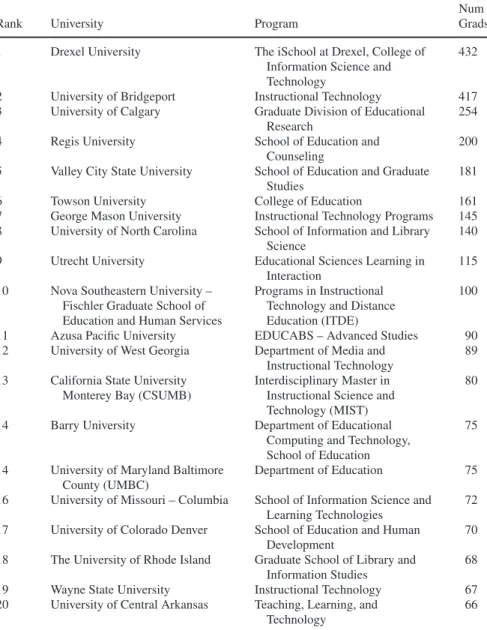
Table 6 Top-20 LDT and ILS programs by the overall total number of graduates
Rank University Program
Num Grads 1 Drexel University The iSchool at Drexel, College of
Information Science and Technology
432
2 University of Bridgeport Instructional Technology 417 3 University of Calgary Graduate Division of Educational
Research
254 4 Regis University School of Education and
Counseling
200 5 Valley City State University School of Education and Graduate
Studies
181
6 Towson University College of Education 161
7 George Mason University Instructional Technology Programs 145 8 University of North Carolina School of Information and Library
Science
140 9 Utrecht University Educational Sciences Learning in
Interaction
115 10 Nova Southeastern University –
Fischler Graduate School of Education and Human Services
Programs in Instructional Technology and Distance Education (ITDE)
100
11 Azusa Pacific University EDUCABS – Advanced Studies 90 12 University of West Georgia Department of Media and
Instructional Technology
89 13 California State University
Monterey Bay (CSUMB)
Interdisciplinary Master in Instructional Science and Technology (MIST)
80
14 Barry University Department of Educational Computing and Technology, School of Education
75
14 University of Maryland Baltimore County (UMBC)
Department of Education 75 16 University of Missouri – Columbia School of Information Science and
Learning Technologies
72 17 University of Colorado Denver School of Education and Human
Development
70 18 The University of Rhode Island Graduate School of Library and
Information Studies
68 19 Wayne State University Instructional Technology 67 20 University of Central Arkansas Teaching, Learning, and
Technology
xiv Preface Our next top-20 list is based on the number of master’s graduates. In our mind, we might consider this an indication of whether the program is more practitioner ori-ented than, say, the number of PhD graduates. Interestingly, George Mason comes in sixth here, whereas they were number 2 in PhD graduates. So, this differentiation may be meaningless. It is interesting to note that schools like Drexel University, University of Bridgeport, University of Calgary, and Regis University are produc-ing 200 or more graduates per year. In Georgia (United States), Walden University and the University of Phoenix are very active; however, neither of these two schools chose to complete the form. We are not implying that the large numbers are nec-essarily because these programs are online, but online degree programs certainly allow many more people to further their education.
The final top-20 list is the combined degree graduate list. It is very similar to the master’s list, but since the online form had entries only for PhD graduates, master’s graduates, and other graduates, I thought it might be most useful to just show the total number of graduates from each of the programs who chose to update their information in our database.
We acknowledge that any kind of rankings of programs is problematic. We hope you find our lists useful. If you have suggestions, please let us know and we will try to accommodate those changes in future publications of the Yearbook.
Michael Orey Athens, GA
Stephanie A. Jones Statesboro, GA
Robert Maribe Branch Athens, GA