NBER WORKING PAPER SERIES
GOING TO WAR AND GOING TO COLLEGE:
DID WORLD WAR II AND THE G.I.BILL
INCREASE EDUCATIONAL ATTAINMENT FOR RETURNING VETERANS? John Bound
Sarah Turner Working Paper 7452
http://www.nber.org/papers/w7452
NATIONAL BUREAU OF ECONOMIC RESEARCH 1050 Massachusetts Avenue
Cambridge, MA 02138 December 1999
We would like to thank participants at the NBER Seminar on the Economics of Higher Education for helpful comments. We are grateful to Tom Kane, Bill Johnson and John Pepper for reading an early draft of the paper and offering most helpful comments. The views expressed herein are those of the authors and not necessarily those of the National Bureau of Economic Research.
© 1999 by John Bound and Sarah Turner. All rights reserved. Short sections of text, not to exceed two paragraphs, may be quoted without explicit permission provided that full credit, including © notice, is given to the source.
Going to War and Going to College: Did World War II and the G.I. Bill
Increase Educational Attainment for Returning Veterans? John Bound and Sarah Turner
NBER Working Paper No. 7452 December 1999
JEL No. I2, J24
ABSTRACT
The end of World War II brought a flood of returning veterans to America's colleges and universities. Yet, despite widespread rhetoric about the ‘democratization’ of higher education that came with this large pool of students, there is little evidence about the question of whether military service, combined with the availability of post-war educational benefits, led these men to increase their investments in education - particularly at the college and university level. This paper uses the structure of the draft during the World War II period and the changing manpower requirements in the armed forces to address the effects of selection in comparisons of the educational attainment of veterans and nonveterans in this era. Using census data, our results indicate that the net effects of military service and the widely available funding for college through the G.I. Bill led to a moderate gain in the postsecondary educational attainment of World War II veterans.
John Bound Sarah E. Turner
Department of Economics Curry School of Education
University of Michigan University of Virginia
Ann Arbor, MI 48108 Charlottesville, VA 22902
and NBER [email protected]
The end of World War II brought a flood of returning veterans to America’s colleges and universities, with veterans accounting for about 70% of male enrollment in the years after V-J Day. Both contemporaneous assessments and the analyses of historians and economists point to the G.I. Bill as a policy instrument with dramatic effects on the level of educational attainment of returning veterans, as well as the overall landscape of American higher education. For example, Sidney Burrell concludes that the G.I. Bill led to “what may have been the most important educational and social transformation in American history.”1 The effects of the G.I. Bill on collegiate attainment are widely thought to have affected both the level and the distribution of education for men entering the labor force in the second half of the 20th Century. In this regard, the World War II G.I. Bill was seen by many to have
“democratizated” the collegiate population by making college a viable option for men from a range of sociodemographic backgrounds including minorities, children of immigrants, and children raised in low income households. In contemporary policy discussions, the legacy of the G.I. Bill has been invoked recently as evidence of the potential effectiveness of vouchers at the primary-secondary level
(Hauptman, 1998). Yet, there is little evidence on the question of whether military service, combined with the availability of post-war educational benefits, led World War II veterans to increase their investments in education - particularly at the college and university level.
Certainly, the presence on campus of returning veterans was hard to miss in the years
immediately after the conclusion of hostilities. Total enrollment jumped by more than 50 percent from the pre-war (1939) level of 1.3 million to over 2 million individuals in 1946, with further increases through 1949. Over 2.2 million veterans or approximately 1 in 8 of the returning servicemen attended
1
This is as referenced in Olson (1973) from Burrell (1967). Other examples include the sociologist James Coleman’s 1992 description of the G.I. Bill as an “extraordinarily successful post-secondary education voucher.”
college under the G.I. Bill (Olson, 1974). At issue is the extent to which this burst of collegiate
participation reflected ‘new demand’ or educational investments that had been postponed with the war effort.
The question at the heart of this paper is whether the combined forces of military service and the availability of sizable subsidies through the G.I. Bill increased educational attainment for World War II veterans. Since physical and mental fitness were prerequisites for military service, comparisons of the educational attainment of veterans and nonveterans from the same birth cohort are likely to overstate the causal effect of military service and the availability of postwar benefits. Differences between birth cohorts in the likelihood of military conscription generated by changing manpower requirements in the armed forces during the World War II period provide exogenous variation to measure the effect of veteran status on educational attainment. Our primary estimation strategy is to aggregate within birth cohorts and to use the between-cohort variation in veteran status to measure the effect of World War II and the availability of G.I. benefits on collegiate attainment.
Our strategy for understanding the impact of war service and the G.I. Bill on the educational attainment of veterans represents an application of what Campbell and Stanley (1963) refer to as a regression discontinuity design. If the G.I. Bill raised college enrollment rates above what they would otherwise have been, cohorts born too late to serve in World War II would have been expected to receive less post secondary school education than those born a few years earlier.
Other events in history, notably the Korean conflict, complicate the application of the
straightforward regression discontinuity design to this problem. Men from the youngest birth cohorts subject to the World War II draft faced a relatively high probability of service in the Korean conflict.
As such, understanding the magnitude of the effect of the Korean War and the associated benefits for these veterans on educational attainment is an important parameter in bounding the magnitude of the World War II effect. Recognizing this complication, our objective in this paper is to use the range of available information to narrow the range of plausible parameter estimates. Throughout the analysis, we focus on the relationship between changes in military manpower requirements and educational outcomes for white men.2
Our results indicate that the combined effect of military service and the widely available funding for college through the G.I. Bill led to higher postsecondary educational attainment among World War II veterans than among their nonveteran peers, with particularly large effects on college completion. These results suggest that the behavioral effect of military service and the associated benefits was about .23-.36 years of college attainment or an increase in college completion of 5 to 8 percentage points.
The first section of this paper sets the stage by describing the mechanism determining military conscription and the educational benefits available to World War II veterans. The second section examines the variation in military service by birth cohort among men eligible for service in World War II and presents information on the use of the G.I. Bill among eligible men. The third section sets forth the estimation strategy. The fourth section presents results of the between cohort estimation, as well as other evidence used to bound the potential effects of wartime service and the G.I. Bill on the collegiate attainment of men serving in World War II. The final section concludes and discusses the results in the context of other reconciles the context of other empirical work on post-secondary educational
attainment.
between 1940 and 1950.
2
We conducted similar analyses for black men, but due to smaller sample sizes, we are not able to estimate reliably the effect of service on educational attainment.
I. World War II Military Service and the G.I. Bill
With the outbreak of hostilities in Europe with the German invasion of Poland in 1939, the capacity to raise troops and military equipment became a serious question for U.S. policy makers. Voluntary enlistment was insufficient to fill the needs for military manpower and to protect U.S. interests in the face of escalating hostilities. Congress passed the Selective Service Act in 1940 and this
legislation provided for the registration and conscription of troops. Registration was the first step in the process that the military used to enumerate the pool of potential military manpower and identify men able to serve.
With the direct attack on Pearl Harbor in December of 1940, the United States became a full combatant in the war and military manpower needs grew rapidly. Initially, patriotism fueled many enlistments, but volunteers stopped far short of meeting the rapidly expanding military manpower needs. Combat in Europe, Africa and the Pacific generated sustained demand for additional military manpower through the Japanese surrender with the release of the atomic bomb on Hiroshima and Nagasaki in early August of 1945.
The first wave of registration under the Selective Service Act of 1940 required all men between the ages of 21 and 26 to make contact with local draft boards. Over the next two years, the second, third, and fourth registrations added youth who entered the draft-eligible age range during the next two years, while also adding older men to the registrant pool. The fifth and sixth registrations responded to the dwindling manpower pool by adding those in the age groups between 18 and 21. The final registration prohibited voluntary enlistment, presumably to reduce competition among the services for the most able recruits.
Following registration, men were classified by the local draft boards based on their ability to serve and their eligibility for deferments. Classification status was determined by the local draft board with the primary reasons for deferment (Classes II-IV) physical or mental disability (Class IV) or employment in war production or agriculture (Class II). For men eligible for World War II service, physical unfitness, the presence of dependents and employment in a sector of strategic importance to the war effort were the primary deferments or classifications that kept a man out of military service. Among the broad age range of men liable for service, those who turned 18 during the war were less likely to have deferments for occupational, agricultural production or dependency reasons that the broader range of service-eligible men.3
Moreover, as manpower pools dwindled, restrictions on deferments for war-related occupations and dependent family members were tightened appreciably, with some men reclassified as service-eligible.
By the middle of the war, the manpower pool was thin, particularly among young men and new registrants were in high demand and at significant risk of induction. Nearly a million men were drafted in 1941, followed by more than 3 million men in 1942 [Table 1]. Conscription continued to fill manpower needs in whole or in part through 1946, when more than 180,00 men were drafted in the last calls under the Selective Service Act of 1940. As the war progressed, chronological order of birth became the primary determinant of the probability of military service. During the later years of World War II, voluntary enlistment was generally prohibited and probability of induction was largely a function of date of birth. Since quotas were issued from the federal level to each state based on the stock of residents
3
Among men ages 19-25 who were in a deferred classification in August of 1945, 54% held deferments for physical or mental unfitness (IV-F) as compared to 43% who were deferred for occupational reasons (II) [Table 94, “Selective Service and Victory]. Among those IV-F, a relatively large fraction were deferred for reasons of mental deficiency (roughly 10%) or mental health conditions ( roughly 30%), with the remainder being deferred for a wide range of physical health limitations [Table 191, Selective Service and Victory, 1948].
already serving (including both enlistments and inductions), there was some variation across states at any point in time in the probability that an individual with a given birth day would receive a call. Men born in the early quarters of 1927 who served in World War II were likely to see some combat action, while those who served in the war effort from the later cohorts could expect to participate in the massive peace-keeping and rebuilding efforts in Europe and the Pacific.
The World War II era draft, particularly as it existed in the last years of the war, differed from the conscription mechanism employed in the Korean War largely in the nature of available deferments. Men at risk of induction during the period of the Korean War had the option of educational deferments, while occupational deferments, particularly in the area of agriculture, were decidedly less common than during World War II. The introduction of a general deferment (II-S) for college study in 1951provided a precursor to the doctrine of “channeling,” which changed the nature of selection into the military in the 1950s and 1960s by consciously directing those with high academic aptitude toward advanced
educational attainment.4
In short, the increased use of the college deferment during the Korean War was likely to have shifted the selection of the military from the upper tiers of the socio-economic distribution in the population to the middle belt. Moreover, among men who aspired to college, educational deferments were the best course of action for those who for whom financing was not a problem, while military service provided the promise of some financial aid for others.
Education benefits
Veterans of World War II were eligible to receive unprecedented federal support for
educational investments in the form of the G.I. Bill. Unlike previous federal expenditures in education,
4
By June of 1954, there were 157,200 registrants in class II-S deferred as college students. Of the more than 1 million male college students at this time, about 1 in 7 is II-S about 200,000 others were deferred in Class I-D as college ROTC students (1954 Annual Report of the Selective Service).
grants were awarded to individuals rather than institutions. Veterans serving more than 90 days
(through either conscription or voluntary enlistment) or those discharged early through service disability received benefits through the G.I. Bill. Those who served on active duty between September 1940 and July 1947 were eligible, with the stipulation that men choosing to use these benefits commenced schooling by July 1951. Educational benefits extended from a minimum of one year and up to four years, depending on length of service and age. Moreover, most men would have been eligible for the maximum benefits, with tours of service often exceeding three years. Benefits includedup to$500 in tuition and educational expenses paid to the institution and a stipend, which varied with family size and was adjusted upward over the course of the program. The stipend was a monthly cash allowance at the level of $65 per monthsingle veterans and $90 per monthfor married veterans, with an additional increase in the stipend level taking effect in April 1948; see Veterans’ Benefits Appendix for details. At the time, the subsidy for tuition and books was sufficient to cover the charges of traditionally expensive schools like Harvard University or Williams College. Moreover, the monthly stipends were about one half the opportunity cost of not working for a single veteran and about 70 percent of the opportunity cost for a married veteran, based on the monthly median income for the population in 1947 (U.S. Bureau of the Census, Series P-7). [Appendix A provides a fuller description of the World War II G.I. Bill and its cousins in later conflicts.] In short, the educational benefits available to returning World War II veterans presented an historically unparalleled federal subsidy for college enrollment, which was neither means-tested nor ability-tested.
The World War II G.I. Bill laid the foundation for G.I. Bills providing educational benefits for those serving in the Korean and Vietnam conflicts. For Korean War veterans, the structure of the
benefits was somewhat different (and potentially somewhat less generous). Under the law for Korean veterans, the $500 tuition payment was dropped in favor of higher subsistence payments, with students receiving between $110 and $160 per month, depending on the number of dependents. The effect of this change in program design was that for Korean veterans differences among colleges in tuition costs directly increased the net cost of attendance, while the tuition stipend available to World War II veterans created a long range over which differences in college tuition did not change the net cost. The maximum period of educational benefits was 36 months, rather than the 48 months granted to World War II veterans, and the computation of eligibility provided for a day and one half for each day served, rather than the minimum of one year provided to World War II veterans.
II. The Incidence of Military Service and G.I. Benefits
World War II stands above all other conflicts in both the share of men required to serve from any one birth cohort and the number of birth cohorts affected. The manpower demands of World War II brought together a total of 16 million military personnel between 1940 and 1945. The armed services relied on both voluntary enlistment and conscription through a draft mechanism. To put this in
perspective, World War I engaged 4.7 million individuals, 5.7 million took part in the Korean conflict and 8.7 million took part in the Vietnam conflict [U.S. Bureau of the Census, 1998, Table 585]. Across these conflicts, there has been considerable variation by year of birth in the likelihood of military
service. Figure 1 shows the share of white men serving in major conflicts from the turn of the century forward by year and quarter of birth.5
World War II drew sizable numbers of men born as early as 1900 and a dramatic upswing in the proportion serving occurred between the birth cohorts of 1914 and 1919. More than 75 percent of white men born in each quarter between 1920 and the middle of 1926 served in World War II. The proportion of men serving from each quarter of birth in this interval held nearly steady, with only modest movement between 75% and the peak of 81% in the fourth quarter of 1921. For men born after the middle of 1926, induction rates slid dramatically.
While the manpower demands of the Korean conflict were only one third of those in World War II, men of prime age for military service at the start of the conflict were quite likely to serve. Men who served in World War II were exempt from conscription in the Korean conflict, leaving a relatively narrow pool of age-eligible men to draw into service at the start of 1950. The manpower demands of the Korean conflict intersect with the right tail of World War II service. The service participation in the Korean War peaked at the 1931 birth cohort with about 60% of white men serving. The fraction of men serving in the military dropped after Korea but continued to be relatively high with the continued tensions of the Cold War sustaining military manpower demand. The Vietnam conflict drove manpower needs up again until the end of the draft July 1973, when service rates plummeted.
Table 2 provides some evidence on the extent to which returning veterans used the G.I. Bill to help finance college attendance. Among World War II veterans, those who turned 18 during the war were more likely to use benefits than those turning 18 before the start of the war, even though those
5
The data presented in Figure 1 is based on tabulations from the 1980 Decennial Census. The line labeled “Any Veteran Service” represents the share of men from each cohort serving in any conflict. Note that some men
turning 18 before the start of the war may have served somewhat longer tours of duty. While about 50 percent of veterans born between 1923 and 1928 used the G.I. benefits, the takeup rate was
appreciably less for those men born five years earlier, with this rate hovering between 27 and 40 percent. Similarly, while men turning 18 during the war used between 8 and 12 months of benefits on average, those born earlier used the G.I. Bill for appreciably fewer months of schooling. Such
substantial differences in the take up rates would seem to indicate that veterans who reached the age of 18 before the U.S. entry into the war were less likely to return to school after the war was over. This makes sense for an overlapping set of reasons. First, older veterans were less likely to have had their education disrupted. Second, those that had been working prior to entry into the military would often have had jobs to return to. Third, the age per se of the veteran is likely to have had an effect of the individual’s enthusiasm for educational investments.
Thus far, the analysis is framed in terms of measuring the effects of World War II service relative to a control group, which is assumed to be no military service and no G.I. benefits. If
researchers could rewind the clock or measure educational attainment at the start of 1950, this would certainly be true. However, the hostilities in Korea may have had a marked effect on the presumed “control group.” Men who did not serve in World War II were at greater risk of serving in the Korean conflict and Korean veterans were also eligible for educational benefits. However, we would not expect the program effects to be the same among men from the same birth cohorts serving in different conflicts. Not only were these Korean War veterans eligible for a somewhat different educational program, those Korean War veterans from cohorts at risk for World War II service would have been older at the time of military service and subsequent collegiate enrollment. As a result, they may have
completed their formal education or already established themselves professionally before the being called for service. Among Korean War veterans, the takeup rate on the educational benefits differs across cohorts, as well, with those born in 1932 and later more likely to use benefits and to use them for a longer term than their peers born earlier. To this point, the benefit utilization rate for men born
between 1932 and 1935 ranged from 47 to 57 percent (see Appendix Table 1).
III. Estimation Strategy
To estimate the causal effect of veteran service and the associated availability of educational benefits through the G.I. Bill on collegiate attainment, we focus on two measures of collegiate attainment: years of college completed (0-4) and receipt of baccalaureate degree measured by 16 years of
completed schooling. Let
(1) Edij = αj + βij Vij + εij
where Edij represents the educational attainment of individual iin cohort j, Vij is an indicator variable
equal to 1 if the individual served in World War II, and εijis an error term. Conceptually, αj represents
the mean educational attainment for randomly selected individuals from cohort j under the assumption that the individual did not serve in the military, while βij represents the effect of military service for
individual i in cohort j. Note that we are allowing the coefficient on Vij to vary across individuals – there
is no reason to believe that service during the war would effect all of those that served in the same way. Some individuals would have received a college education regardless of service, others would not have attended regardless of service. For both of these populations βij = 0. On the other hand, some who would not have otherwise attended college, may have been encouraged to attend college by the
generous benefits available. For this population, the effect is positive and βij > 0. Stated in this way it should be clear that βij represents the partial equilibrium effect of service of individual i -- βijrepresents
the impact on post secondary educational attainment of switching the ith individual’s veteran status, holding the veteran status of other individuals constant. To understand the (partial equilibrium) impact of the war on educational attainment we are interested in estimating β ≡ E(βij |Vij =1) – what in the program evaluation literature has been referred to as the effect of treatment on the treated.
One can imagine various strategies to estimate β. The simplest approach is to simply compare mean educational attainment between veterans and nonveterans for a cohort of individuals:
] 0 | [ ] 1 | [ = − = = ij ij ij ij c j Ed V Ed V
β , where the overlines are used to represent sample means. It is clear that:
(2) E(β$jc)=E(βij|Vij = +1) [ (E εij|Vij = −1) E(εij|Vij =0)]
The term in the square brackets represents the difference in the propensity to go to college of those that did and did not serve in the military. As long as selection into the military is nonrandom, this term is unlikely to be 0. In fact, given the nature of the exemptions from the draft that existed during World War II, we would expect that for the cohorts that served in World War II, the term in brackets would be positive. As a result, the simple comparison between those who did and did not serve will exaggerate the causal effect of service on educational attainment (E(β$jc)>β).6
6
The introduction of educational deferments during the Korean conflict, together with the much lower aggregate manpower demand, was likely to have significantly altered the nature of the selection into the military. Indeed, while simple within-cohort comparisons between veterans and non veterans show a strong positive association between veteran status and educational attainment for World War II era veterans, the same kind of comparisons show negative associations between veteran status and education attainment for cohorts born after the early 1930s. The most plausible interpretation of these patterns is not that the effect of being a veteran changed, but that the nature of selection into the military changed (Angrist and Kreuger, 1990).
The primary strategy we use to try to estimate β is to compare educational attainment across cohorts. To discuss the rational for such an approach we start by assuming a time homogenous environment – i.e. the α’s and the distribution of the β’s are constant across cohorts. Now imagine comparing cohorts across time. Define d Ed as Edij −Edij'. Then:
(3) ))] E( -) (E( + ) -[( + 1)] = V 1)Pr( = V | E( 1) = V 1)Pr( = V | [E( = ) Ed E(d ij ij j j ij ij ij ij ij ij ε ε α α β β ' ' ' ' '
Our assumptions imply that the term in the second set of square brackets is 0. However, without further conditions the term in the first set of square brackets will not have any simple interpretation. Suppose, however, that we compare educational attainment for cohorts with significant service during World War II to cohorts that were born too late to serve. Under this assumption, Pr(Vij' =1)=0and
V Ed d ij will
consistently estimate E(βij|Vij=1). Alternatively, suppose that Pr(Vij' = >1) 0 , but that anyone
who served in the later period would have served during the earlier period and that no one who did not serve in the earlier period would have served during the later period. Formally we are assuming that: (4) 0 0 1 1 ' ' = ⇒ = = ⇒ = ij ij ij ij V V V V
Given the close to universal service during World War II, this seems like a reasonable assumption. Under this assumption cross cohort changes in educational attainment divided by cross cohort changes in the fraction of the cohort serving identify the average effect of service for the population that would have served in one regime but not in the other – what Imbens and Angrist have referred to as the local average treatment effect (LATE).
population attending college was rising both before and after World War II, it seems natural to assume that the α’s rose over time. To account for such secular changes we include a linear time trend in the analysis. Thus, deviations from a trend identify the effect of veteran status on educational attainment. Beyond this, it is easy to imagine that the distribution of β’s might change over time. Thus, for example, individuals from cohorts that had, for the most part, started careers before being called to serve would probably be less likely to be induced to attend college than would individuals drawn from cohorts that were called up immediately out of high school. We deal with this issue by, when possible, focusing on comparisons between closely adjacent cohorts. In particular, we focus on cohorts that would have entered military service shortly after turning 18 (or shortly before, if they volunteered). We discuss these issues further in the context of specific estimates.
Our empirical strategy closely follows much recent discussion of the estimation of causal effects. It has long been understood that under suitable assumptions comparisons over time could be used to eliminate selection bias (Heckman and Robb, 1985). Effectively what we are doing is to use cohort dummies to form an instrument for veterans status. The connection between instrumental variables and time aggregation has been noted by various authors (e.g. Angrist (1991), Moffitt (1995)). Condition (4) is exactly analogous to the monotonicity conditiondiscussed by Imbens and Angrist (1994).7
IV. Empirical Results
7
It is now well understood that weak first stage results will jeopardize inferences based on the instrumental variables estimator. Not surprisingly, given the dramatic variation over cohorts in terms of the fraction of men who served in World War II, cohort dummies have considerable power predicting veteran status. The diagnostic statistics suggested by Bound, Jaeger and Baker (1995) and Staiger and Stock (1997) suggest no significant finite sample bias for any of the specifications we report.
Before turning to our between cohort estimates, it is worth examining within cohort comparisons in educational attainment between veterans and nonveterns. Table 3 compares the educational
attainment of World War II veterans to nonveterans. Using data from the 1970 Census representing 3% of the population, we present estimates of the relationship between service in World War II and educational attainment in Table 3.8 These measures of the within-year of birth differences in educational attainment between World War II veterans and men who did not serve in the military (neither World War II nor the Korean conflict) indicate substantial gaps in educational attainment, particularly at the collegiate level. For example, for men who turned 18 in the first complete birth cohort after Pearl Harbor (those born after 1923), those who served in World War II received about .4-.5 years more collegiate training than those who did not serve. Similarly, these World War II veterans were about 8 percentage points more likely to graduate from college than those who did not serve – a relative difference of more than 80 %. These striking differences in educational attainment are quite similar for the 1923-27 cohorts though appreciably lower for the 1928 cohort, with differences in educational attainment of about .27 years and a difference in college completion of about 4 percentage points.
Presumably, these simple differences in education exaggerate the causal effect of World War II service on collegiate attainment. World War II veterans were also 20 percentage points more likely to finish high school than non-veterans. Presumably, those rejected from the military for low mental capacity or illiteracy would have been high school drop outs. This suggests that most of the positive selection occurring during the war might have occurred among those with less than a high school degree
8
The file used in this analysis is the aggregation of the three publicly available 1% samples. We also compare similar files from 1960, 1970 and 1980 Decennial Census files. The more recent file has an advantage, representing 5% of the population, while the earlier data has the advantage of proximity to the completion of educational attainment and is therefore less susceptible to “grade inflation”, mortality and the return of adult students to the college classroom. While the 1960 sample is yet closer to the period of educational investment, 1%
and that within-cohort differences in educational attainment conditioned on high school completion might represent sensible comparisons to examine. Indeed, comparisons of post secondary educational attainment between veterans and non-veterans among the population graduating from high school may provide a reasonable estimate of the effect of military service on post secondary educational attainment.9
Conditional on high school graduation, the difference between World War II veterans and nonveterans in terms of average number of years of college completed is about .3, while the difference in college completion rates is roughly 6 percentage points. To use these numbers to estimate the impact of World War II on college going or completion, one needs to multiply by the fraction of veterans with a high school diploma (2/3). This transformation moves these simple comparisons down to .2 years of college and a 4 percentage point gain in college completion. Plainly, these differences are still
appreciable, but they suggest a smaller difference than is apparent in unconditional comparisons. Between cohort estimates provide a mechanism for reducing the potential upward bias
attributable to the greater selectivity of veterans relative to nonveterans and offer an alternative to within-cohort comparisons. Graphically, the thought experiment is to ask how collegiate attainment changes with changes in the manpower demand in military service. Figure 3 presents these trends over a fifty-year horizon of birth cohorts for white men, using data from the 1970 Census. We consider three measures of educational attainment: high school graduation, college completion, and years of college, with the last two measures capturing trends in the postsecondary sphere. Educational attainment is shown for men and women on the left axis, while the share of men who were veterans is superimposed
sample of the population is too small for detailed analysis of outcomes by quarter of birth. A full explanation of the sample restrictions is found in the Data Appendix.
9
For this to be the case, the restriction of the population to those completing high school must eliminate the difference between veterans and non-veterans in their capacity to complete college level work and military service must have no direct effect on the probability that a person would finish high school.
with the scale appearing on the right axis. If changes were purely secular – such as an increase or decrease in the demand for skilled workers – we might expect the trends for men and women to trend upwards in similar fashion. On the other hand, if the combination of military service and veteran benefits has sizable effects on educational attainment, we expect to see for men, but not for women, above trend levels of educational attainment for cohorts that would have most benefited from the G.I. Bill.
At the secondary level, which is shown in the first panel, the demands of the war had a deleterious effect on the prospects for finishing high school for men who turned 18 between 1940 and 1948. For the postsecondary attainment panels, what is most striking about these graphs is that for the three decades of birth cohorts between 1912 and 1942, the trends are quite smooth, moving upward at a steady pace, with the growth somewhat greater for men than for women. While dramatic changes in collegiate attainment mirroring changes in the manpower demands of the war are not visible, one can find patterns that are suggestive of a moderate effect of wartime service in educational attainment. Thus, for example, the growth across cohorts in the fraction of men completing college seems to have
accelerated a bit for the cohorts born in the early 1920s. These are the cohorts that were both very likely to see service during the war, but would have returned to civilian life at a young enough age that it would have been plausible for them to avail themselves of the educational benefits due them as veterans.
There is also some suggestion in these graphs that the growth in college completion rates slowed a bit for cohorts that would have reached college age in the immediate post war period, then
accelerated a bit for cohorts that would have turned 18 during the Korean conflict, and fell for cohorts that would have turned 18 after the conflict was over and then rose again for cohorts turning 18 during the 1960s. It is hard to know what to make of these long-term trends. The acceleration of college
completion rates for cohorts born during the early 1920s could have been partially due to improvements in the economy as the country came out of the depression. Much later, the rise in college completion rates for cohorts turning 18 during the 1960s could plausibly be attributed to the exceptionally strong market for college graduates that existed at the time. Plainly, changes over such an extended period of time in the nature of G.I. benefits and selection into the military limit the usefulness of between cohort estimates over such a long time horizon.
Focusing on men born between 1923 and 1928 (who turned 18 between 1941 and 1946), date of birth effectively determined when an individual was expected to register for the draft and individuals could not register (and were, therefore, not at risk of induction) before reaching the age of 18.
Examining the differences in outcomes among those turning 18 during the war mitigates the effect of potential differences in the response to the G.I. Bill among veterans reaching college age before and after the start of the war.Observationally similar individuals with earlier birthdates stood much higher probabilities of induction in World War II than those born later. The most dramatic differences appear in the comparisons of men born before and after 1927. It is this variation in service participation that identifies the effect of military service and benefits for World War II participants. Essentially, we are comparing the educational attainment of men born during the mid 1920s, who would have typically been inducted into the military after finishing high school in the early 1940s and would have returned to civilian life in the late 1940s, to men born in the late 1920s who would have finished high school at just about the same time.
Between cohort estimates for the educational outcomes of years of college and college completion are shown in Tables 4 and 5.10
These estimates are strikingly smaller than the estimates within birth cohorts. For men born between 1923-28, our estimates suggest that the effect of veteran service and the associated G.I. benefits on collegiate attainment are about .15 years, with college completion increasing by about 4 percentage points. While such measured effects are smaller in absolute magnitude than the within cohort estimates, they nonetheless represent relative increments of 16% in years of college and 23% in college completion. The college completion results are particularly striking because they are relatively larger than the outcomes of years of college and college enrollment, suggesting that the persistence of veterans in the educational pipeline was substantially greater than that observed for nonveterans.
In the tables, we report a range of specifications that present alternative ranges of birth cohorts, as well as the inclusion of quarter of birth effects. This range of estimates reflects several alternative specifications reported in the tables. In the first case, we consider the variation across birth cohorts from 1923-27. While this range of birth cohorts might be seen as constrained to those men entering the military under nearly identical conscription requirements, the short interval also reduces the precision of the point estimates. Comparison of the similar specifications with and without the inclusion of the 1928 data (compare (1) and (3)) yields slightly smaller point estimates in the latter case though an
appreciably narrower confidence interval, which includes the point estimate from the 1923-27 cohorts while ruling out a range of other values.
10
In addition, further specification tests did not reveal evidence of serial correlation. For this reason, our standard errors are calculated under the assumption of independent errors. Standard errors are also corrected for heteroskedasticity in accordance with estimate of the variance matrix suggested by Huber and White.
Using a dummy variable indicating birth after the third quarter of 1927 (these men would have turned 18 after V-J day) as an instrument for the fraction serving variable underscores the fact that the sharp break in military manpower demand occurring in the fall of 1945 identifies our results. The fact that the OLS (Panel A) and IV (Panel B) point estimates are virtually identical make it quite clear that what identifies these models is the comparison of outcomes for men who were likely to begin service before and after V-J day.
The inclusion of covariates for quarter of birth, shown in columns (2) and (4) and other even-numbered columns in this table, allow for cross-cohort differences in educational attainment by quarter of birth. The inclusion of such effects does not move the point estimate for the 1928 interval. Similarly, we have included a quadratic trend (in addition to the simple linear trend) and found that our results are not sensitive to this specification choice. Moreover, adding (or subtracting) an additional age cohort around the 1923 start point makes little difference in the estimated effects, as there is very little variation in the share serving and the educational outcomes among these men.
Estimates extending the period of analysis through the 1929, 1930, 1931 and 1932 are shown in columns (5)-(12). Particularly in the OLS estimates, there is a noticeable drop in the magnitude of the World War II effect with the addition of the 1929 birth cohort, as the effect on the years of college completed drops from .15 years to .11 years. Estimates that use the extended time horizon – effectively comparing outcomes in cohorts with a positive level of World War II participation with those with no participation – are conceptually closest to the desired treatment effects. However, the longer time series estimates also introduce an increased opportunity of specification error.
In attempting to measure the effects of World War II and the G.I. Bill on the educational attainment of returning veterans, it is important to specify the control group – and the expected
experiences of the control group -- carefully. To answer the question of the whether the combination of World War II service and the G.I. Bill increased educational attainment, we need to compare the veterans to the control of “no service, no benefits.” If participation in the Korean conflict had little effect on educational attainment for the cohorts born prior to 1930 that were at risk for service in World War II, the simple comparison of World War II veterans to non-World War II veterans will accomplish this objective. However, those not serving in World War II were at increased risk for participation in the Korean conflict and service in Korea brought both the hardship of the potential interruption of education and the benefit of the G.I. Bill for veterans of the Korean conflict. For men born in 1927 and 1928 and starting service in 1950 (when they were between ages 22-23), most would have finished their secondary education. We would expect the Korean War experience to have fewer adverse effects on educational attainment, particularly at the secondary level, than service in World War II. At the same time, these men were eligible for generous educational subsidies and many, did, in fact use them (see Appendix Table 1). Thus, it seems likely that the Korean War service had a positive effect on post secondary attainment for these cohorts.Beyond these direct effects of the Korean conflict on the educational attainment of the cohorts of men at risk of service during the conflict, the Korean conflict may have had “spillover effects” inducing some to obtain extra education as they used the availability of educational deferments to avoid service.
To attempt to control for the confounding effects of Korean Service on our estimates of the effect of World War II service on educational attainment, we add the fraction of a cohort serving during the Korean (but not World War II) to our time series regressions. Results are reported in Tables 6 and 7. Not surprisingly, estimates based on men born between 1923 and 1928 yield very imprecise estimates. Expansion of the time frame of analysis provides some leverage on estimating both effects
independently. This brings more of the variation in the manpower demands of the Korean conflict into play, diminishing the problems with identification of both effects seen in the estimates based on the six-year interval. The range through the 1932 birth cohort includes men who would have turned 18 before the start of the Korean conflict, while the longer range includes all men who would have been eligible for Korean service.
The specifications reported in columns (1)-(6) in Tables 6 and 7 report results based on the assumption that service during the Korean conflict had similar effects on educational attainment
regardless of birth cohort. Regardless of the cohorts used, we find that the magnitude of the effects of the Korean War and World War II service were quite similar in these specifications, on the order of between .3 and .4 years of college and a 7 to 10 percentage point advantage in college completion.
For all of the reasons enumerated on page 11, it seems more natural to assume that service had a larger effect for men born during the 1930s that it did for men during the 1920s. What is more, while it is possible that Korean War educational deferments, which were introduced in 1951, had a substantial effect on men born in the 1930s, men from the 1927-28 cohorts would have been among the first called up. To attempt to deal with the notion that the Korean conflict might have differentially affected cohorts born during the 1920s and 1930s, we include and interaction between the linear time trend and the variable indicating the fraction of each cohort serving during the Korean conflict. Results are reported in columns (7) and (8). In addition, because we expect the effect of the Korean War to rise and then level off for cohorts born after 1932 we also experimented with specifications that included a quadratic time trend interacted with the Korean War fraction. The results are reported in Column (9). While not very precisely estimated, the coefficients on these interaction terms are, in each case, of the expected sign. More to the point, the inclusion of the interaction term tends shifts the estimated effect of World War II
service somewhat towards 0. These point estimates of the effect of World War II service are between .26 and .36 for years of college completed and between 5 and 9 percentage points for college
completion. With the nonlinear specification of the Korean War trend, the effect of World War II service is .28 for years of college completed and 6 percentage points for college completion.11
The above discussion suggests that the specifications we should prefer are the ones represented by columns (7) and (9).
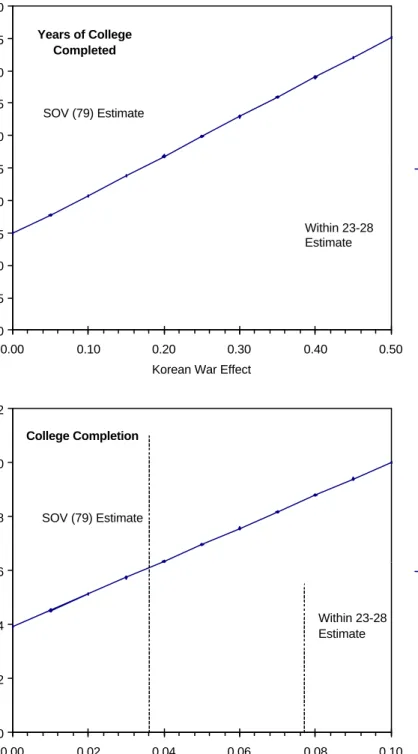
An alternative to the longer period panel with two endogenous variables is to restrict the estimate of the parameter associated with Korean War service to some plausible range of values using the data for 1923-28. Figure 3 graphically presents results from such a procedure where we have varied the Korean War service effect from 0 (replicating the results in column (1) of Tables 4 and 5) to 0.5 in the case of years of college completed to 0.1 in the case of college completion.12
The crux of the matter in narrowing these bounds of the veterans effect for those serving in World War II is determining how large the impact of the Korean War was on collegiate attainment. The vertical lines at the right of each panel represent the within cohort estimates of effect of service during the Korean War on the outcome in question -- 0.37in the case of years of college completed and 0.077 in the case of college completion – for the 1923-1928 cohorts.13
On the presumption that there continued to be positive selection among these cohorts and that there were no “spill over” effects, these within cohort estimates would seem to be plausible upper bounds on the effect of service during the Korean War educational attainment.
11
We have also estimated these relationships using a spline form with the break point at the 1932 year of birth and obtain similar results. The estimated effect of World War II on years of college completed is .28 (.11) years and the effect of World War II on completion is estimated at .06 (.026).
12
If Figure 3 were presented in the context of a longer time horizon (e.g., the 23-32 birth cohorts), the graph would have presented quite similar implied effects of World War II service.
The 1979 Survey of Veterans provides an alternative fix on the effect of service during the Korean conflict on educational attainment. For cohorts born between 1923 and 1928, Korean War veterans obtained, on average .19 (0.054) years of college after returning to civilian life while
approximately 3.6 (0.014) percent obtained a college degree, with the standard errors indicated in parentheses. Some of these men might have continued their education even with the G.I. Bill. Thus these figures would seem to represent upper bounds on the effect of service on educational attainment.14 (As Appendix Table 1 shows, later cohorts in the Korean conflict were more likely to use the G.I. Bill.)
Using these measures as our estimates of the effect of service during the Korean War, we see the implied estimate of the average effect of service during World War II on years of college completed to be 0.26 (.05)while for college completion the implied estimate is about 6.1 (1.3)percentage points, estimates that are roughly in the middle of the range of possible values represented in Figure 3.
IV. Discussion
Much of what we accomplish in this paper is to narrow appreciably the bounds of the effect of World War II service and the availability of G.I. benefits on educational attainment. A clear lower bound on the magnitude of the effects comes from the between cohort estimates for those born between 1923-28 without consideration of the effect of the Korean War experience and benefits on the control group. These estimates of about .15 years of collegiate attainment and a 4 percentage point increase in college completion are likely to be biased downward owing to the inclusion of Korean War veterans,
13
These estimates were obtained by running OLS regressions on a full set of quarter of birth specific cohort dummies, together with dummies for service during World War II, the Korean War or other conflicts.
14
Given the age of these men at the time of conscription and on their return from Korean War service, it seems unlikely that many of these men would have continued their education had the circumstances of their lives not changed. For this reason, we believe these numbers represent reasonable approximations to actual effect.
who had access to a parallel set of educational benefits, in the control group. At the other extreme, within cohort estimates placing the attainment effect at .42 years and the completion effect at 8 percentage points and are likely to form the extreme upper bound.
Narrowing the boundaries relies pivotally on the magnitude of the Korean War effect. Our preferred specifications (columns (7) and (9) of Tables 6 and 7) suggest the effect of World War II service on years of college completed to between 0.23 and 0.28, while they suggest the effect on college completion rates to be between 5 and 6 percentage points. Our estimates that employ the Survey of Veterans to measure the utilization G.I. benefits among Korean War veterans and suggest quite similar effects of service during World War II: on years of college completed , 0.26 years; on college completion 6.1 percentage points. In sum,our preferred estimates suggest a modestly smaller effect of World War II and the availability of benefits on years of educational attainment than would be obtained by simple within cohort comparisons between veterans and nonveterans, an outcome which is consistent with the selective nature of the wartime draft.
It is worth comparing our estimates to other points of reference in the literature. Stanley (1999) uses the break in benefit eligibility among men serving in the later years of the Korean War to estimate how the availability of benefits changed post-service attainment. He finds that educational benefits available to veterans of the Korean War increased years of collegiate attainment by about .25 years and increased college completion by about .05 percentage points.15
Ourestimates are also consistent with Lemieux and Card’s (1998) recent estimates of the effect of World War II service on educational attainment in Canada. Comparing educational attainment across cohorts in a manner similar to what we
15
Stanley’s empirical strategy, which is similar to Angrist (1993), examines outcomes among veterans with different military experiences or benefit eligibility.
have done, Lemieux and Card, estimate the effect of wartime service on post secondary school educational attainment that range from 0.27 to 0.46 years.16
Our estimates of the net effect of military service and the availability of subsidies for education on collegiate attainment among veterans of World War II speak to two long-standing questions: (1) what was the effect of World War II and the G.I. Bill on educational attainment and (2) how the
availability of direct subsidies for college costs are likely to affect investments in education. To be clear, our estimates -- even if we were to present a single point rather than a range -- do not resolve either issue entirely. Obviously, given the nature of our study, we can not estimate what the effect of World War II alone would have been, nor can we estimate the direct effect of the subsidies built into the G.I. Bill. Moreover, in terms of the effect of World War II on post secondary educational attainment, our estimates are partial equilibrium estimates. As such, they reflect the change in collegiate attainment associated with World War II military service and the availability of generous benefits through the G.I. Bill under the assumption that the return to college and the supply side of higher education also remained fixed. Conventional supply and demand logic suggests that the any expansion in the pool of college educated manpower would be accompanied by a fall in the relative wages for this type of labor. Similarly, subsidies for college tuition would be likely to drive up college costs, given anything but perfectly elastic supply among colleges and universities. Thus, the actual effect of World War II together with the G.I. Bill on educational attainment is likely to be smaller than the effect of service on a
16
The Lemieux/Card study has two advantages. First, relatively few French speaking Canadians served in World War II. Thus, Quebec provides a natural control group for the rest of Canada. Second, Canada did not participate in a major way in the Korean conflict. Thus, the before/after experiment is a cleaner one in Canada than it is in the U.S.
single individual.17
This reasoning only reinforces the impression obtained from Figure 2: while the G.I. Bill may very well have had a noticeable effect of post secondary educational attainment, the war was less of a watershed than it is sometimes depicted.
In terms of measuring the effect large scale subsidies on post secondary school educational attainment, we wish to stress that our measures reflect the effect of the disruption of the war and the availability of aid, not just the availability of aid (as would be the case in the traditional estimates of changes in the Pell grant on enrollment).18
Regardless, it is of interest to compare the net effect of military service and the G.I. Bill to more recent estimates of the behavioral response to changes in the cost of higher education. The G.I. Bill dramatically reduced the cost of attending college. Not only did the benefits effectively cover tuition, but the generous stipend dramatically reduced the opportunity costs associated with college attendance. Kane (1994) reports some of the most credible contemporary estimates of the effects of college costs on student enrollments. He uses the cross-state variation in the changes in tuition to identify the effect of college costs on enrollment rates. Kane’s estimates imply an overall cost elasticity of college enrollment of about 0.5 for the typical student. Our preferred estimates imply an elasticity of the effect of World War II of years of completed education for veterans of 0.4. In terms of college completion, the total cost elasticity is elasticity is 0.5.19
We regard the behavioral
17
In a different context, Heckman, Lochner, and Taber (1998) make a similar point about general equilibrium adjustments to a change in the subsidy for higher education. Unambiguously, the G.I. Bill represented transfers from cohorts too young or old to participate in the military during the war, to the cohorts that bore the brunt of military service.
18
The effect of the disruption of World War II on educational attainment is plausibly ambiguous in sign. On one hand, the war took many men away from the classroom for several years and may have broken academic trajectories for some, while other men who served would have gone to college in the absence of G.I. benefits. On the other hand, returning veterans – particularly those who did not have jobs to go back to -- might have worried about finding a job and found the G.I. benefits as a way to further their formal training while also postponing labor market re-entry. Moreover, the presence of a sizable cohort of returning veterans in their early 20s may have mitigated any perception that older students were “out of place” in college during the late 1940s.
19
In the computation of elasticities of college costs and total cost (including forgone earnings and college costs), we begin with the assumption that the G.I. Bill provided a subsidy sufficient to cover the full, direct cost of
effects of World War II on the educational choices of veterans to be quite similar to the contemporary response of students to changes in tuition costs.
For white men, the combination of World War II service and the availability of veteran’s benefits increased postsecondary educational attainment. To the extent that these positive effects can be attributed to the G.I. Bill, the behavioral responses to this program are largely consistent with estimates of the response of students to changes in tuition cost or the opportunity cost of college.20
How the G.I. Bill affected the distribution of collegiate participation among students from different socio-economic backgrounds and varying levels of precollegiate achievement remains an interesting question not resolved by this analysis. For racial and ethnic minorities, the availability of educational benefits through the G.I. Bill had the potential to reshape educational investments dramatically. However, the persistence of segregation – both in the military and in civilian life – may have also affected opportunities for educational advancement. Overall, our estimates suggest the G.I. Bill did benefit blacks. Small sample sizes for blacks limit our ability to make inferences about the
college. The average tuition cost of a public4-year collegein 1948 was $194 and the average cost of a 4-year private college was $368. (We recognize that the public tuition charged to in-state students is likely to be somewhat lower). We estimate the forgone earnings as equivalent to ¾ of the median income in 1948. These numbers result in an estimate of the reduction of total college costs of 64% for single individuals and about 87% for those married with one dependent and attending a public college. We also use the average of pre and post cost and educational attainment to calculate arc elasticities rather than point elasticities. The elasticity associated with the estimates of Kane (1994) is an average of the effect across income quartiles (from Table 5 of his paper) and uses the average earnings of male and female high school graduates in the 18-24 age group to derive the opportunity cost.
20
A recent evaluation of the effect of the Social Security Student Benefit Program by Susan Dynarski also suggests a quite large impact of grant aid on educational investments. Our calculations suggest that the behavioral effects of this program imply a total cost elasticity associated with a year of college at a public institutions of about .5. (This estimate is somewhat smaller than that reported in the Dynarski analysis).
Our estimates of the effects associated with the availability of G.I. benefits and World War II service are, nonetheless, appreciably larger than contemporary estimates of the effect of the Pell program on student enrollment. Briefly, assessments focusing on the enrollment response to changes in the availability of federal financial aid provided through the Pell grant program have rarely found sizable effects (Kane 1994; Kane 1995; Hansen 1983). One explanation for the difference in the results is that at the time of the G.I. Bill there were few individuals who could afford to fully finance a college education and only rarely were students able to find private scholarship funds to pay for college. A second type of explanation highlights the program design differences. G.I. benefit availability was widely known and easy for individuals to determine based on whether they served and for how long; in contrast, Pell
magnitude of the effect of World War II and the availability of the G.I. Bill on minority group
members.21 The continued segregation of the universities in the South and the capacity constraints of the historically blacks schools may have also placed some limits on the opportunities for minorities. Still, the likely presence of substantial liquidity constraints for many blacks may have magnified the relative effects of the G.I. Bill for this group of veterans.
Distinguishing the true social costs and benefits of the G.I. Bill requires substantial information on the general equilibrium consequences of the program and the supply side adjustments. Spillover effects of the G.I. Bill may have arisen in the tuition price or class size for colleges and universities. Beyond the effects on educational attainment, it may be that some of the most lasting impacts of the college enrollment of World War II veterans are not visible in educational attainment, but took the form of more subtle institutional changes that widened the pipeline to elite schools to include public school graduates and students from a wider range of ethnic, religious and geographic backgrounds.22
grant eligibility determination requires knowledge of income, assets, and some nonlinear formula parameters. As a result, the take up rate on the Pell grants may be much smaller as a result of information barriers.
21
Blacks served in the military during World War II in rough accordance with the “1 in 10” rule agreed to by Walter White and President Roosevelt at the start of the war. The military was not integrated until 1948, under an executive order from President Truman. Black men served in somewhat lower proportions than white men in World War II, with a peak participation rate closer to 55%. The difference in military participation rates by birth cohort narrowed appreciably in subsequent conflicts. Parallel tables for most of the presentations in the text are available from the authors and a further, limited, discussion of sample size issues appears in the Data Appendix.
22
Hoxby (1997) provides a test of the question of the extent to which the G.I. Bill contributed to the geographic integration of the market for higher education using a difference in difference specification of the probability of attending a college in state using the 1950 Census. Her results suggest that the G.I. Bill may explain up to a fourth of the increase in market integration between 1949 and 1963.
References
Angrist, J. D. (1990). Lifetime earnings and the Vietnam era draft lottery: Evidence from social security administrative records. The American Economic Review, 80 , (3), 313-336.
Angrist, J. D. (1991). Grouped-data estimation and testing in simple labor-supply models. Journal of Econometrics, 47, 243-266.
Angrist, J. D. (1993). The effect of veterans benefits on veterans' education and earnings. Industrial and Labor Relations Review, 46, (4), 637-652.
Angrist, J. D., & Krueger, A. B. (1994). Why do World War II veterans earn more than non veterans? Journal of Labor Economics,12, (1), 74-97.
Bound, J., Jaeger, D.A., & Baker, M. R. (1995). Problems with instrumental variables estimation when the correlation between the instruments and the endogenous explanatory variable is weak. Journal of the American Statistical Association, 90, (430), 443-50.
Burrell, S. (1967). The G.I. bill and the great American transformation. Boston UniversityGraduate Journal 15, Spring.
Cameron, S. & Heckman, J. (1999). “Can Tuition Policy Combat Rising Wage Inequality?” In M. Kosters (Ed.), Financing College Tuition. Washington, D.C.: AEI Press.
Campbell, D. T., & Stanley, J.C. (1963). Experimental and quasi-experimental designs for research on teaching. In N.L. Gage (Ed.), Handbook of Research on Teaching. Chicago: Rand-McNally.
Coleman, J. (1992) Some points on choice in education. Sociology of Education, 65, (4), 260-262. Dynarski, Susan. (1999) “Does Aid Matter? Measuring the Effect of Student Aid on College
Attendance and Completion,” mimeo (July).
Frederiksen, N., & Schrader, W.B. (1951). Adjustment to college: A study of 10,000 veteran and nonveteran students in sixteen American college. Princeton: Educational Testing Services.
Goldin, C., & Katz, L. (1998). The shaping of higher education: The formative years in the United States, 1890 to 1940. NBER Working Paper 6537.
Goldin, C., & Margo, R.A. (1992). The great compression: The wage structure in the United States at mid-century. The Quarterly Journal of Economics, 107, (1), 1-34.
Hansen, W. L. (1983). Impact of student financial aid on access. In Joseph Fromkin, (ed.), The Crisis in Higher Education. New York: Academy of Sciences.
Hansen, W. L. (1984). Economic growth and equal opportunity. In Edwin Dean, (ed.), Education and Economic Productivity. Cambridge: Ballinger Publishing Company.
Hauptman, A. (1998). The use of vouchers in higher education. In drafts from conference Vouchers and Related Delivery Mechanisms: Consumer Provision of Public Services.
Heckman, J., & Robb, R. (1985). Alternative methods for evaluating the impact of interventions. In Heckman & Singer (Eds.), Longitudinal Analysis of Labor Market Data. Cambridge: Cambridge University Press.
Heckman, J., L. Lochner, & C. Taber. (1998) “Explaining Rising Wage Inequality: Explorations with a Dynamic General Equilibrium Model of Earnings with Heterogeneous Agents.” Review of Economic Dynamics 1 (1): 1-54.
Hoxby, C. (1997). The changing market structure of higher education, NBER-Bunting mimeo. Imbens, G. & Angrist, J. (1994). Identification and estimation of local average treatment effects. Econometrica, 62, 467-75.
Kane, T. (1994). College entry by blacks since 1970: The role of college costs, family background and the returns to education. Journal of Political Economy, 102, (5), 878-911.
Karsten, P. (1984). The “New” American military history: A map of the territory, explored and unexplored. American Quarterly, 36, (3), 389-418.
Lemieux, T., & Card, D. (1998). Education, earnings, and the Canadian GI bill. NBER Working Paper 6718.
Mincer, J. (1974). Schooling, experience, and earnings. New York, National Bureau of Economic Research: Columbia University Press.
Moffit, R. (1995). Selection bias adjustments in a treatment-effect model as a method of aggregation. NBER Technical Working Paper 187.
Olson, K.W. (1973). The G.I. bill and higher education: Success and surprise. American Quarterly, 25, (5), 596-610.
Olson, K.W. (1974). The G.I. bill, the veterans, and the colleges. Lexington: The University of Kentucky Press.
Selective Service System. (1945). Selective service as the war turns: The third report of the director of selective service. Washington, D.C.: U.S. Government Printing Office.
Selective Service System. (1948). Selective Service and Victory.Washington, D.C.: U.S. Government Printing Office.
Selective Service System. (1948). Quotas, Calls and Inductions. Special Monograph, 12, Washington, D.C.: U.S. Government Printing Office.
Staiger, D., & Stock, J. (1997). Instrumental variables regression with weak instruments. Econometrica, 65, (3).
Stanley, M. (1999). College education and the mid-century G.I. bills: Effects on access and educational attainment, Mimeo, (March).
U.S. Bureau of the Census. 1998. Statistical Abstract of the United States: 1998, Washington, D.C. U.S. Department of Veterans’Affairs. (1999). “The G.I. Bill: From Roosevelt to Montgomery,” http://www.va.gov/education/GI_Bill.htm [August 22.]
Wolverton, C. (1944). Extension of remarks, Congressional record. Tuesday September 19, p. A4239.
Veterans’ Benefits Appendix
The initial World War II G.I. Bill was signed into law by President Roosevelt on June 22, 1944 [Serviceman’s Readjustment Act, Public Law 346]. The historical precedent in providing benefits to returning servicemen can be traced to benefits provided to those enlisting during World War II in Canada and the “Wisconsin Educational Bonus Law of 1919.”23 Although there was a long national history of providing educational and training benefits to disabled veterans, education benefits had not been provided on a national scale to able-bodied men in the U.S. in conflicts prior to World War II. As with previous conflicts, there was an explicit program to meet the needs of those veterans who became disabled in the war effort under the Vocational Rehabilitation Act Public, passed by Congress as Public Law 16 in March 1943. This program provided explicit counseling, supervision during training and employment placement services. The distinctive feature of the G.I. Bill was its availability to nearly all veterans, irregardless of prior academic achievement and disability status.
During the legislative process, one of the primary questions was whether the program would be administered by the Office of Education or the Veterans’ Administration. In the end, the program was set to be administered by the Veterans’ Administration and the only restriction on educational choice was that students enroll at an institution accredited by the state education agency. This latter provision helped to allay concerns that the G.I. Bill would lead to federal intervention in the content offerings of post-secondary institutions while also opening the door for a range of vocational, technical and apprenticeship programs.
The provisions of the G.I. Bill passed in 1944 provided for a monthly stipend of $50 for single veterans and $75 for married veterans, as well as the payment of tuition, books and supplies up to $500. All veterans serving 90 days with a record of honorable discharge were eligible for one year of educational benefits, with veterans receiving educational benefits matching years of service 1:1 up to a maximum of four years of benefit eligibility. Veterans over age 25 at the