Contents lists available at ScienceDirect
Computer
Methods
and
Programs
in
Biomedicine
journal homepage: www.elsevier.com/locate/cmpb
Paroxysmal
atrial
fibrillation
prediction
based
on
HRV
analysis
and
non-dominated
sorting
genetic
algorithm
III
K.H. Boon
∗, M. Khalil-Hani
, MB Malarvili
FacultyofElectricalEngineering,UniversitiTekonologiMalaysia,Skudai,Johor81310,Malaysia
a
r
t
i
c
l
e
i
n
f
o
Articlehistory: Received 17 February 2017 Revised 27 August 2017 Accepted 10 October 2017 Keywords:Heart rate variability Paroxysmal atrial fibrillation Arrhythmia prediction Multi-objective optimization
Non-dominated Sorting genetic algorithm III Feature selection
a
b
s
t
r
a
c
t
This paper presents a method that able to predict the paroxysmal atrial fibrillation (PAF). The method uses shorter heart rate variability (HRV) signals when compared to existing methods, and achieves good prediction accuracy. PAF is a common cardiac arrhythmia that increases the health risk of a patient, and the development of an accurate predictor of the onset of PAF is clinical important because it increases the possibility to electrically stabilize and prevent the onset of atrial arrhythmias with different pacing techniques. We propose a multi-objective optimization algorithm based on the non-dominated sorting genetic algorithm III for optimizing the baseline PAF prediction system, that consists of the stages of pre-processing, HRV feature extraction, and support vector machine (SVM) model. The pre-processing stage comprises of heart rate correction, interpolation, and signal detrending. After that, time-domain, frequency-domain, non-linear HRV features are extracted from the pre-processed data in feature extrac- tion stage. Then, these features are used as input to the SVM for predicting the PAF event. The proposed optimization algorithm is used to optimize the parameters and settings of various HRV feature extraction algorithms, select the best feature subsets, and tune the SVM parameters simultaneously for maximum prediction performance. The proposed method achieves an accuracy rate of 87.7%, which significantly outperforms most of the previous works. This accuracy rate is achieved even with the HRV signal length being reduced from the typical 30 min to just 5 min (a reduction of 83%). Furthermore, another signifi- cant result is the sensitivity rate, which is considered more important that other performance metrics in this paper, can be improved with the trade-off of lower specificity.
© 2017 Elsevier B.V. All rights reserved.
1. Introduction
Atrial Fibrillation (AF) is the common non-life-threatening car-
diac arrhythmia that can lead to stroke, heart failure, and other
heart related disease [1,2]. Patients often start with episodes of
paroxysmal atrial fibrillation (PAF), which last from seconds to
days but it is self-terminating. It also can be treated by medica- tion or electrical shock issued by the Implantable Defibrillator De-
vice (ICD) [3]. However, the PAF can slowly evolve to the chronic
AF that cannot return to normal sinus rhythm even with external treatment. Therefore, the development of an accurate predictor of
the onset of PAF is clinically important because it increases the
possibility to electrically stabilize and prevent the onset of atrial
arrhythmias with different pacing techniques [4]. This can lead to
decrease in symptoms, and possibly a decrease in atrial remodel- ing that causes increased susceptibility to future episodes of PAF
[3].
∗ Corresponding author.
E-mail addresses: [email protected] (K.H. Boon), [email protected] (M. Khalil-Hani), [email protected] (M. Malarvili).
Much research have been done for developing a method that
can predict the onset of PAF based on electrocardiogram (ECG)
signal. The works can be divided into premature atrial complexes
(PAC) detection [5–7] and heart rate variability (HRV) analysis [8–
13]. Tables 5 and 6 summarizes their methodology and predic- tion performance. Almost all existing methods, which achieved ac- ceptable prediction accuracies (around 80% and above), employed
30 min signal for feature extraction [8]. Some of them [5,9,10] even
could achieve same or above the level of 90%.
Previous works also attempted to use the HRV signal shorter
than 15 min for prediction. However, their accuracy rates were
lower when compared to the methods that used 30 min signal.
For example, Boon et al. [8] proposed a HRV analysis prediction
method based on HRV analysis, and they achieved accuracy rate of 79.3% and 68.9% for 15 min and 10 min respectively. Yang and Yin
[12] achieved lowest accuracy rate with 57% when they extracted features from 10 min HRV signal based on footprint analysis. With
spectral features, Hickey and Heneghan [6] achieved prediction ac-
curacies of 68%, 70%, and 66% for 5, 10 and 30 min of HRV signal respectively.
https://doi.org/10.1016/j.cmpb.2017.10.012 0169-2607/© 2017 Elsevier B.V. All rights reserved.
Fig.1. Block diagram of typical feature selection based on simple GA.
Therefore, this main objective of this paper is to propose a PAF onset prediction method that requires shorter time duration of the HRV signal during the feature extraction, while improving the pre- diction accuracy level.
2. Optimizationmethod
Multiple features are usually extracted during the HRV analysis. However, using all features does not always give the best classifi-
cation performance due to the curse of dimensionality [14]. There-
fore, feature selection algorithm is usually used to improve the per-
formance. The feature selection is an optimization problem that
involves selecting the best combination of features from the orig- inal extracted features without transforming them. It can enhance the performance, reduce the number of features, and help the re- searchers to understand which features are important to the clas- sification model.
Genetic algorithm (GA) is one of the popular methods for fea-
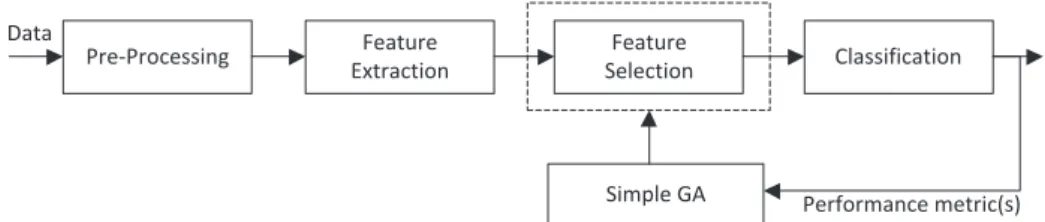
ture selection. Fig.1 shows the block diagram of the typical fea-
ture selection model based on simple GA for the existing research
based on HRV analysis [8,15–19]. After the features are extracted
from the pre-processed data, the simple GA is used to select the feature subset with high classification performance. Based on crit- ical review, there are a few shortcomings for the feature selection
model in Fig.1.
One of the shortcomings is the parameter values and settings in
both HRV pre-processing and feature extraction stages are not opti-
mized (tuned) for maximum classification performance. As shown
in Fig. 1, before the feature selector is applied, the HRV features
must be extracted based on certain pre-defined values and fixed setting of HRV feature extraction algorithms. According to Rashedi
et al. [20], to maximize the performance of extracted features,
these parameters should be tuned simultaneously with the feature selection process for different application and database. They pro- posed a heuristic search method called gravitational search algo-
rithm (GSA) to optimize the image recognition system. It simul-
taneously optimized both the parameters of feature extraction al- gorithms (wavelet transform and color histogram) and the feature subset, and this improved detection rate of their system. Inspired by their work, this paper intends to propose an optimization al- gorithm that can simultaneously optimizes the parameters in pre- processing and feature extraction stages, feature subset in feature selection process, and parameters of classification model. Such op-
timization model is shown in Fig.2.
Another shortcoming is that the trade-off between the classifi- cation sensitivity and specificity rate is not considered. Improving certain amount of sensitivity may need to sacrifice certain degree
of specificity, or vice versa [21]. Some medical applications require
high sensitivity while other need high specificity [21]. For example,
Xie and Minn [22] and Koley and Dey [23] developed the algorithm
for detecting the sleep apnea based on ECG signal. They were in- terested in high sensitivity rate because it reduced the risk of over- looking the apnea events that could pose threats to the patients. In this paper, we are more interested in improving the sensitivity at the expense of acceptable reduction in specificity rate when pre-
Heart Rate Correction
Interpolation
SVM
HRV Feature Extraction Supervised Prediction
Detrending Time Domain Analysis Frequency Domain Analysis Non-linear Analysis Detrended HRV
HRV Features Predicted Event HRV Data
HRV Pre-processing
Corrected HRV
Proposed optimization algorithm based on NSGA-III
Baseline prediction system based on HRV
Optimizing
Fig.2. Overview of the proposed method.
dicting the PAF onset. Therefore, the trade-off between different
prediction performance metrics is considered when developing the optimization algorithm.
In this paper, optimizing the PAF onset prediction model is
a multiple-objective problem. When GA is used for this class of
problems, there are two common approaches: weighted sum, and
Pareto dominance concept [24]. The former case is used in sim-
ple GA, in which multiple objective fitness functions are linearly
combined with different weight coefficients into a single composite
function. It was employed in previous works [8,18,19] to combine
different performance metrics (i.e., sensitivity, specificity, accuracy rate and feature count). There are several drawbacks with this ap-
proach [24]. One of them is that the trial and error is required for
tuning the weights values in order to obtain a solution with de- sired performance. Moreover, the simple GA only can return sin- gle solution per optimization run. As a result, the GA needs to be run multiple times for obtaining multiple solutions before trade- off among the solutions can be analyzed, which is not convenience for designer. It should be noted that, although the fitness functions
in previous works [8,18,19] had multiple metrics, they did not per-
form the trade-off analysis because their interest was obtaining a single solution with highest accuracy. The drawbacks in the simple GA can be tackled by using the Pareto dominance concept based GA. In this paper, the state-of-the-art Pareto dominance based GA,
which is called non-dominated sorting genetic algorithm III (NSGA-
III) [25,26], is adopted for optimization.
Finally, the GA based feature selectors in HRV based previous
works [8,15–19] are belong to the type of wrapper method [27] be-
cause only the machine learning classifier is used to evaluate the
fitness of the chromosome. Wrapper method has a well-known
shortcoming: the risk of selecting a subset that is overfitting to
the trained supervised classifier [8,27]. In the non-HRV research,
the hybrid feature selection based on simple GA [28–30] has been
proposed to mitigate this issue to certain degree. The hybrid GA uses the filter method (i.e., statistical test or correlation measure) to evaluate the feature, and only selects the feature that can pass certain evaluation criterion during the formation of feature subset.
the filter method called Mann-Whitney U test with the simple GA based feature selector. Before the GA was applied, they filtered out the HRV features that could not pass the U test at 20% significance
level. Therefore, in this paper, the filter method is used as part
of the proposed optimization algorithm for evaluating the features before they are selected to form feature subset.
In this paper, a multi-objective optimization algorithm based on NSGA-III is proposed to optimize the PAF onset prediction system while considering the above-mentioned shortcomings. The layout
of the paper is as follows. Section3 presents the database and pro-
posed method. Results and discussion are presented in Section4.
Finally, conclusion and future works are given in the Section5.
3. Proposedmethod
Fig. 2 shows overview of the proposed prediction method. It
comprises of the stages of pre-processing, HRV feature extraction, and support vector machine (SVM) model, which are simultane- ously optimized by the proposed optimization algorithm based on NSGA-III. Initially, 5 min HRV data that immediately precedes the PAF event is fed to the pre-processing stage for heart rate correc-
tion, interpolation and signal detrending. They are two types of
pre-processed output: corrected HRV and detrended HRV. It should
be noted that the detrended HRV is also corrected and interpo-
lated. Then, 6 time-domain and 4 non-linear features are extracted based on the corrected HRV, while 43 frequency-domain features are extracted based on the detrended HRV. Finally, these features are used as input to the SVM model for predicting the PAF event.
The SVM is implemented by using the C ++ library called LIBSVM
[31].
3.1. Experimentaldata
Based on the previous works [6–13], 106 data from 53 pairs of
ECG recordings (each pair is recorded from different PAF patients) are obtained from the standard database called Atrial Fibrillation
Prediction Database (AFPDB) [32]. Each pair of data contains one
30 min ECG segment that ends just prior to the onset of PAF event and another 30 min ECG segment at least 45 min distant from any onset of PAF. Each ECG segment contains two-channel traces from Holter recording with sampling rate of 128 Hz and 12-bit resolu- tion.
In this paper, the 5 min HRV segment that at least 45 min dis-
tant from the PAF event is assigned a class label of “NORMAL”,
while the HRV segment that immediately precedes the PAF event is given a class label of “ABNORMAL”.
3.2. Preprocessing
In the preprocessing stage, the RR intervals (intervals between successive R peaks) are derived from the ECG signal by using the
Hamilton and Tompkins algorithm [33]. Then, the HRV data is com-
puted as the reciprocal of RR intervals. After that, the HRV data
segment sequentially goes through the heart rate correction, in-
terpolation and signal detrending. The heart rate correction and
signal detrending are performed based on the McNames algorithm
[34] and the high pass filter proposed by Tarvainen et al. [35] re- spectively. As for the interpolation process, either linear or cubic
spline method is used to resample the HRV data to certain fre-
quency (4 Hz or 7 Hz) [36]. The methodology and reason for op-
timizing these 3 pre-processing steps with the proposed algorithm
are discussed in Section3.5.2.
3.3. HRVfeatureextraction
Fifty-three well-established HRV features are extracted using
time-domain, frequency domain and non-linear analysis [37]. Their
abbreviations are listed in TableA.1 and explained in the follow-
ing sub-sections. It should be noted that, they are one or more in- put parameters for the feature extraction algorithms that belong to frequency domain and non-linear analysis. In this paper, these parameters are optimized by the proposed optimization algorithm,
that is discussed in Section3.5.2. However, the recommended val-
ues for the parameters are also presented because they are used
during the result analysis in Section4.
3.3.1. Timedomainfeatures
Six time-domain HRV features are computed by using statisti- cal analysis. They are the mean of HRV (Mean), standard deviation of HRV (SDRR), root mean square of successive difference intervals (RMSSD), number of adjacent RR intervals differing by more than 50 ms (NN50), and sum of NN50 divided by the total number of
all RR intervals (pNN50). RR triangular index (RRTri) [37] is also
extracted as a geometric feature. It is defined as total number NN intervals divided by number of RR intervals that fall to modal bin. 3.3.2. Spectralfeatures
The total spectral power in low frequency (LF) band (0.04–0.15) and high frequency (HF) band (0.15–0.4 Hz) of the power spectral density (PSD) can be related to the sympathetic and parasympa-
thetic activities of the autonomic nervous system respectively [14].
In this paper , both auto-regressive (AR) model [10] and fast Fourier
transforms (FFT) [11] are used to estimate the PSD. Three features
are computed from each estimation method. They are total spectral
power in LF band, HF band, and ratio of LF to HF.
The coefficients of AR model are estimated with burg method, and it has one input parameter: order of the model. The order is
set to 16 based on the recommendation in [38]. As for the FFT,
the HRV data segment is multiplied with the temporal smoothing window function before the PSD is estimated. The default window function is rectangular window. Furthermore, each estimated PSD is normalized before the HRV features are extracted.
3.3.3. Bispectrumfeatures
Higher order spectral (HOS) analysis has been used to estimate
the bispectrum in the recent HRV analysis based research [8,10,19].
In this paper, HOS up to third-order cumulant is employed to es- timate the bispectrum from HRV data. The estimation is based on
the direct method described in [39]. The HRV data is divided into
several segments with each segment contains 512 data points with 50% overlapping. After that, each segment is smoothed by rectan- gular window, and zeroes are padded at the end the segment if the segment data length is not power of 2. Then, FFT is applied to each segment for computation of the bispectrum.
Bispectrum of HRV signal can be divided into 3 subband re-
gions inside region of interest (ROI) according to Yu and Lee [19].
They are LF–LF (LL), LF–HF (LH), and HF–HF (HH) regions which
cover different ranges of frequencies. Formulas in [19,40] are em-
ployed to compute bispectrum features from each subband region
and ROI. These features include mean magnitude ( Mave), mean of
sum of squared magnitude (Pave), normalized bispectral entropy
(P1), normalized bispectral squared entropy (P2), sum of logarith- mic amplitudes of the bispectrum (H1), sum of logarithmic ampli- tudes of diagonal elements in bispectrum (H2), first-order spectral moment of the amplitudes of diagonal elements in the bipsectrum (H3), Second-order spectral moment of the amplitudes of diagonal elements in the bispectrum (H4), weighted center of the bipsec-
trum, WCOB ( f1m, f2m). For LH region, H2, H3 and H4 are not com-
puted because the diagonal elements are not existed. 3.3.4. Nonlineardynamicsfeatures
Poincare plot and sample entropy are used to extract non-linear features from HRV data. Poincare plot is drawn by plotting each
Algorithm1 Proposed optimization algorithm. 1: Input: pc, pm, N, M, d1, d2, GENMAX 2: Output: F1whent=GENMAX 3: t=0 4: Zr= Initialize-reference −point ( M, d1, d2) 5: Pt= Initialize-population() 6: repeat 7: St=∅, i=1 8: Qt= Generatic-operation ( Pt,pc,pm) 9: ift=0 then 10: Vt=Pt∪Qt 11: else 12: Vt=Qt 13: endif 14: //———————————————————————————————
15: //Proposed Fitness Evaluation Stage 16: HRV-feature-extraction ( Vt) 17: Statistical-performance-evaluation ( Vt) 18: Local-search-operation ( Vt) 19: Duplication-handling ( Vt) 20: Prediction-performance-evaluation ( Vt) 21: Feature-count-evaluation( Vt) 22: //———————————————————————————————- 23: ift= 0 then 24: Rt=Vt 25: else 26: Rt=Vt∪Pt 27: endif
28: Fronts: ( F1, F2, . . .) = NDS( Rt) / ∗Non-dominated sorting ∗/ 29: repeat
30: St=St∪Fiand i=i=1 31: until| St| ≥N
32: Last front to be included: Fl=Fi 33: If| St| =Nthen
34: Pt+1=St, break 35: else
36: Pt+1= ∪lj−1=1Fj
37: Number of individuals to be chosen from Fl:K=N−| Pt+1|
38: Normalize ( St,fn)
39: [ π( s), d( s)] = Associate ( St,Zr) / ∗Associate each s∈Stwith a reference point ∗/ / ∗π( s): closest reference point ∗/
/ ∗d( s): distance between s and π( s) ∗/
40: ρj=
s∈St/Fl (π(s)=j?1 : 0 ) / ∗Compute niche count of reference point j∈Zr∗/
41: Niching ( K, ρj, π( s), d( s), Zr,Fl,P(t+1)) / ∗Choose K members one at a time from Flto construct Pt+1) ∗/
42: endif 43: t=t+1 44: untilt=GENMAX
45: Fronts: ( F1, F2, . . .) = NDS-without −statistic −fitness( Pt)
RR interval against next RR interval. Three features are computed
from the Poincare plot. They are denoted by SD1, SD2 and the ratio
SD1/ SD2 [37]. Sample entropy (SampEn) is a statistic measure that
quantifies the regularity of times series data. The method proposed in [31] is used to compute the SampEn of the HRV signal. Based on
the recommendation in [41], the input parameters are set as fol-
lows: embedding dimension, m=2 and tolerance distance, r=0.2.
3.4.Classification:supportvectormachine(SVM)
The support vector machine (SVM) algorithm based on the
statistical learning theory was proposed by Chang and Lin [31].
SVM maps the training samples from the input space to higher- dimensional features space via a kernel function. Product between vectors of training sample is used to generate a hyper-plane that can separate two classes. Optimization process of SVM classifier is aimed to find the optimal hyper-plane that maximizes the distance between training samples of two classes. The largest distance to the support vectors (training samples that is closest to the hyper- plane) is so-called functional margin. Larger functional margin in- dicates the generalization error of the classifier is lower.
In this paper, SVM is used as supervised classifier to classify the HRV segments to either “NORMAL” (segment that at least 45 min
distant from the PAF event) or “ABNORMAL” (segment that imme- diately precede the PAF event). Input of the SVM is the HRV fea- tures that are extracted during the feature extraction stage. The ra-
dial basis function (RBF) is used as the kernel function for SVM. Pa-
rameters of kernel function–kernel width
γ
and penalty constantC–are optimized by NSGA-III to achieve the best result.
3.5. Proposedoptimizationalgorithm
Algorithm 1 shows the proposed optimization method that is developed based on the non-dominated sorting genetic algorithm
III (NSGA-III) [25]. The optimization procedure is similar to the
original NSGA-III except the chromosome design, fitness evaluation stage, genetic operators and other some minor modifications.
There are 7 input parameters for the proposed optimization al-
gorithm: (1) M that specifies number of fitness functions, (2) d1
and d2that specify number of divisions for boundary layer and in-
side layer respectively during the two-layer reference point gener-
ation process, (3) population size N that specifies the size of the
populations denoted by Ptand Qt, (4) crossover rate pc and muta-
tion rate pm that control the probability of genetic operation, and
(5) maximum generation GENMAX that limits the maximum num-
Algorithm2Normalization ( St,fn). 1: Input:s∈St / ∗chromosome s∗/ 2: Output:fn / ∗Normalized vector ∗/
3: forj=1 toMdo 4: Compute ideal point: zmin
j =mins∈Stfj(s) 5: Compute the maximum point: zmax
j =maxs∈Stfj(s) 6: Translate objectives: fn j(s)= fj(s)−zminj zmax j −zminj ∀
s∈St/ ∗fnj is a normalized jth objective value of a chromosome s∗/
endfor
Fig.3. Chromosome design.
proposed optimization algorithm is the chromosomes (Pareto opti-
mal solutions) that are belong to the front F1 of population Pt at
the end of the optimization.
Like in the original NSGA-III, two-layer reference points denoted
by the Zrare generated according to the Das and Dennis approach
[42]. The initialization function takes the input parameters M, d1
and d2. The parent population P
t=0with population size N are also
randomly initialized. Then, two-point crossover and bit-flip muta-
tion operators [29] are applied to Pt for producing the offspring
population Qtwith same population size N. The crossover and mu-
tation rates are determined by pcand pmrespectively.
After that, both population Pt and Qt are combined to formed
the population set Vt if generation t = 0. Otherwise, Vt only con-
sists of offspring population Qt. The population Vtsequentially goes
through the different stages of fitness evaluation: HRV feature ex- traction, statistical performance evaluation, local search operation (LSO), duplication handling, prediction performance evaluation and
feature count evaluation. After the fitness evaluation stage, Rt is
assigned Vt if generation t= 0. Otherwise, it consists of both Vt
and Pt. Then, all chromosomes in the population Rtare sorted into
different non-domination levels called fronts ( F1, F2,…) using the
dominance principle [25]. A new population St is constructed by
selecting individuals from different fronts ( F1, F2,…) until the size
of St is equal to N or greater than N for the first time. The last
front ( Fi), which is assigned to St, is denoted by front Fl.
After that, Pt+1 is assigned St if the number of individuals in
St is exactly equal to N. Otherwise, Pt+1 is formed by the chro-
mosomes from front F1 up to Fl−1. In this case, they are still K
chromosomes need to be chosen from front Fl to fill the Pt+1 un-
til | Pt+1| =N. The K chromosomes are chosen based on a series of
operations, which are adaptive normalization, association and nich-
ing. Except the normalization process in line 38, the procedures of
Algorithm1 from line 36 to 41 are same as the original NSGA-III
[25]. The mix-max normalization proposed by Yuan et al. [43] is
adopted to normalize the fitness vector of every chromosome that
belong to set St. This process is summarized in Algorithm 2. The
procedure above is repeated until GENMAX. After that, the function
NDS-without-statistic-fitness is applied to Ptin order to obtain the
solutions that belong to front F1.
3.5.2. Chromosomedesign
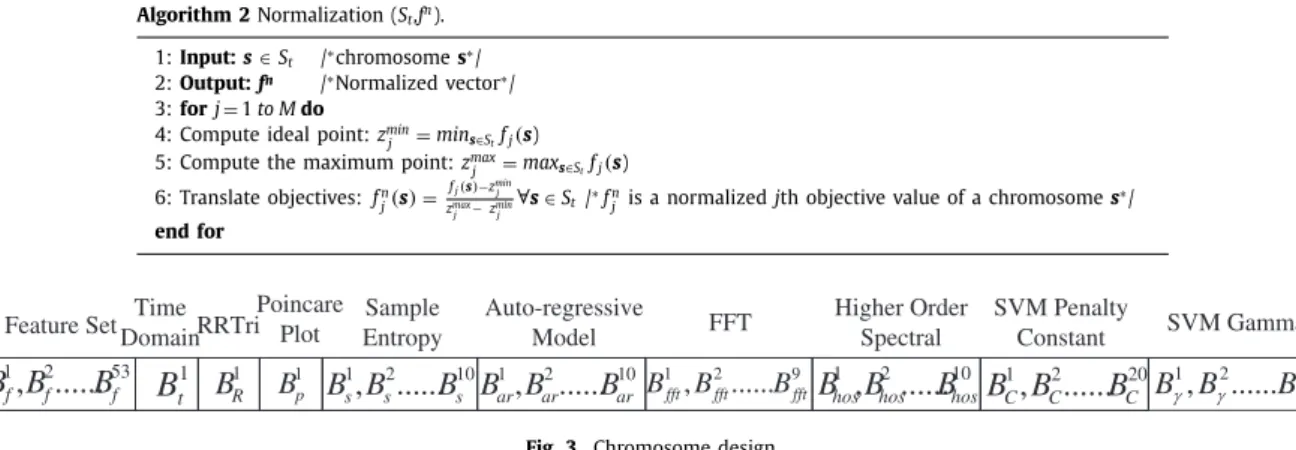
The structure of the proposed chromosome design is shown in
Fig. 3. The parameters and settings of the HRV based arrhythmia
prediction system are encoded into binary digits in the chromo- some for optimization. The chromosome contains 135 bits that can be divided into 10 different segments.
The feature set segment is a 53-bit binary string that represents the selected HRV feature subset for a chromosome. Each bit in the
segment represents the feature selection status of one HRV feature. The bit “1” indicates selection while “0” represents the deletion of the specific feature from the feature set.
The last 2 segments are two 20-bit binary strings that represent
the encoded value of the parameters C and
γ
respectively for theSVM model. The remaining seven segments, which are in the mid-
dle of a chromosome, represent various parameters and settings
for 7 different HRV feature extraction algorithms. Each of them is
explained in Table1.
Firstly, some of the binary digits in the Table1 are used to con-
trol the behavior of the heart rate correction, interpolation and sig- nal detrending in the pre-processing stage of the baseline predic-
tion system (refer to Fig.2). Two separate bits are used to decide
whether the heart rate correction and detrending are performed on the HRV data respectively. As for the interpolation process, 2 different bits are used to control its behavior. One of them is used to determine either linear or cubic spline method is chosen to re- sample (interpolate) the HRV data. Another one is used to select the resampling frequency (either 4 Hz or 7 Hz).
The heart rate correction enabling status is important because the abnormal heart rate may contain the required information to
predict the arrhythmia event. In previous works [5–7], authors
counted the number of the occurrence of premature atrial contrac- tions (PACs) (a type of arrhythmia) in the ECG signal. The counted number was used to predict the PAF onset. The occurrences of the arrhythmia cause the abnormal heart rates in the time series HRV data. Therefore, the abnormal heart rate prior to the PAF onset may be useful for the PAF onset prediction. These abnormal heart rates are eliminated when the heart rate correction algorithm is applied. As for the interpolation and detrending, they can influence the en- ergy value of the power spectrum estimated by frequency domain algorithms.
For sample entropy analysis, the parameter values of the em- bedding dimension and tolerance distance are tuned by the pro- posed algorithm. Their values are set to integer range of 1–4 and floating point range of 0.1–0.5 respectively according to Lake et al.
[44]. Furthermore, the order of the auto-regressive (AR) model is
also set to integer range of 6–32 based on the investigation in
Anita et al. [38]. In both fast Fourier transform (FFT) and higher or-
der spectral (HOS) analysis, one type of temporal smoothing win- dow function is selected among 8 different types of window func- tion when the spectral analysis is performed. They are Rectangu- lar, Parzen, Hanning, Hamming, Blackman, Blackman Harris, Welch, and Barlette window. Furthermore, one bit denoted by “FFT seg-
mentation” in theTable1 is used to decide whether regular FFT or
Welch based FFT is chosen for performing the Fourier transform. Besides that, there is one extra bit that controls whether the PSD estimated by the AR and FFT are normalized to between 0 and 1 before the related HRV features are computed. Finally, the segmen-
Table1
Definition of the chromosome representation. Feature extraction
algorithm
Algorithm parameters Bit
length
Representation
1 Time domain • Heart rate correction enabling 1 bit • ‘0’ represents disabling while ‘1’ represents enabling of the ectopic beat correction.
2 RR Triangular Index • Heart rate correction enabling 1 bit • ‘0’ represents disabling while ‘1’ represents enabling of the ectopic beat correction.
3 Poincare plot • Heart rate correction enabling 1 bit • ‘0’ represents disabling while ‘1’ represents enabling of the ectopic beat correction.
4 Sample entropy • Heart rate correction enabling 1 bit • ‘0’ represents disabling while ‘1’ represents enabling of the ectopic beat correction.
• Embedding dimension 2 bit •Represent an integer value within the range of 1–4.
• Tolerance Distance 7 bit • Represent a floating value within the range of 0.1–0.5. 5 Auto Regressive (AR)
analysis
• Heart rate correction enabling 1 bit • ‘0’ represents disabling while ‘1’ represents enabling of the ectopic beat correction.
• Heart rate detrending
enabling 1 bit • ‘0’ represents disabling while ‘1’ represents enabling of the detrending.
• Interpolation method 1 bit • ‘0’ represents linear interpolation while ‘1’ represents cubic spline interpolation.
• Resampling frequency 1 bit • ‘0’ represents 4 Hz while ‘1’ represents 7 Hz.
• Order of model 5 bits • Represent an integer value within the range of 6–32.
• Normalization of AR spectrum 1 bit • ‘0’ represents no normalization while ‘1’ represents the spectrum is normalized by the maximum value of AR spectrum.
6 Fast Fourier Transform (FFT)
• Heart rate correction enabling 1 bit • ‘0’ represents disabling while ‘1’ represents enabling of the ectopic beat correction.
• Heart rate detrending enabling
1 bit • ‘0’ represents disabling while ‘1’ represents enabling of the detrending.
• Interpolation method 1 bit • ‘0’ represents linear interpolation while ‘1’ represents cubic spline interpolation.
• Resampling frequency 1 bit • ‘0’ represents 4 Hz while ‘1’ represents 7 Hz.
• Temporal smoothing window function
3 Bit • Represents 8 types of symmetric smoothing window function.
• They are Rectangular, Parzen, Hanning, Hamming, Blackman, Blackman Harris, Welch and Barlette.
• FFT segmentation 1 Bit • ‘0’ represents normal FFT while ‘1’ represents welch based FFT with 50% data segment overlap.
• Normalization of FFT spectrum
1 bit • ‘0’ represents no normalization while ‘1’ represents the spectrum is normalized by the maximum value of FFT spectrum.
7 Higher Order Spectral (HOS) analysis
• Heart rate correction enabling 1 bit • ‘0’ represents disabling while ‘1’ represents enabling of the ectopic beat correction.
• Heart rate detrending enabling
1 bit • ‘0’ represents disabling while ‘1’ represents enabling of the detrending.
• Interpolation method 1 bit • ‘0’ represents linear interpolation while ‘1’ represents cubic spline interpolation.
• Resampling frequency 1 bit • ‘0’ represents 4 Hz while ‘1’ represents 7 Hz
• Temporal smoothing window function
3 bit • Represents 8 types of symmetric smoothing window function.
• They are Rectangular, Parzen, Hanning, Hamming, Blackman, Blackman Harris, Welch and Barlette.
• Segmentation size 1 bit • ‘0’ represents 256 samples per segment while ‘1’ represents 512 samples per segment.
• Zero-padding size for the segmented data.
1 bit • ‘0’ represents the padding size is equal to segmentation size while ‘1’ represents twice of the segmentation size.
• Overlapping of the segmented data
1 bit • ‘0’ represents no overlapping in the segmented data while ‘1’ represents 50% overlap of the segmented data.
tation size, zero-padding size and overlapping of the segmented
data are also determined for the HOS analysis.
In the proposed chromosome design, the real number R of a
parameter that is encoded into binary string p (that has more than
1 bit) can be computed as:
R=minp+maxp−minp
2l−1 ×d (1)
where d is decimal value of binary string p, max p is maximum
value of parameter, min pis minimum value of parameter, l is
length of binary string p. The max p and min p for each real num-
ber parameter shown in Table1 are different. They are set accord-
ing to their minimum and maximum value of the specified integer
or floating point range. As for the SVM parameters C and
γ
, theirminimum and maximum value are set to 0.1 and 10 0 0 respectively.
3.5.3. Fitnessevaluationstage
The proposed fitness evaluation stage consists of HRV feature extraction, statistical performance evaluation, local search opera- tion, duplication handling, prediction performance evaluation and
feature count evaluation. Before entering the fitness evaluation
stage, the duplicate chromosomes from population Qt are identi-
fied by comparing them to all chromosomes from Pt and Qt. The
fitness evaluation of these duplicate chromosomes are skipped and
reserved until they are modified by duplicate handling process
(line 19 of Algorithm 1). The detail of the duplicate chromosome
is explained in Section3.5.3.4 of this section.
3.5.3.1. HRVfeature extraction. During the HRV feature extraction
stage, for every chromosome that belong to the set Vt (referring to
Algorithm1), 53 HRV features in TableA.1 are extracted based on the decoded parameter values and settings. These parameter values
the feature extraction process, all HRV features are fed to statistical performance evaluation stage.
3.5.3.2. Statistical performance evaluation. The Mann–Whitney U
test is a non-parametric method used to test whether two in-
dependent samples of observations are drawn from the same or
identical distributions. Perez et al. [45] proposed a feature selec-
tion method called uFilter method, which is based on the Mann- Whitney U test, for single-objective optimization: feature selection. It is a standalone algorithm that evaluates the quality of a feature.
In their work, the statistic value denoted by wi was computed for
each feature. Then, top 20 features (with highest statistic values
wi in descending order) were selected to form a feature set. This
feature set was fed to the classification models for training and
testing.
In this paper, the uFilter method is used to evaluate the HRV features of each chromosome for two optimization objectives: (1) to optimize the parameters and settings that belong to HRV fea- ture extraction algorithms, and (2) to be used as an evaluation cri- terion in the local search operation (LSO). In the former objective, the optimization is achieved by minimizing the sum of the statistic values of all HRV features. It is computed as:
Sumofstatisticvalue=−
53
i=1
wi (2)
where wi is the absolute value of numerical difference between
ZNORMALand ZABNORMALfor ith feature (one of the 53 HRV features).
The algorithm that computes the wi,ZNORMAL and ZABNORMALcan be
found in [45]. The ZNORMALis the Z-indicator of feature values that
are extracted from HRV segments with the class label of “NOR-
MAL”, while the ZABNORMALis the Z-indicator of feature values ex-
tracted from HRV segments with the class label of “ABNORMAL”.
These two class labels are explained in Section3.1.
3.5.3.3. Localsearch operation(LSO). In this paper, the local search operation (LSO) is developed based on the hybrid feature selection
process of the simple GA proposed by Huang and Rong [30]. The
objectives of proposed LSO are: (1) to remove the non-significant features from the feature subset in the chromosome so that only the good features are retained. (2) to maintain the minimum num-
ber of selected significant features in the chromosome after the
removal process. The “significant feature” is the feature that can pass the evaluation criterion: two tailed Mann-Whitney U test at 20% significance level. Otherwise, it is referred as “non-significant feature”.
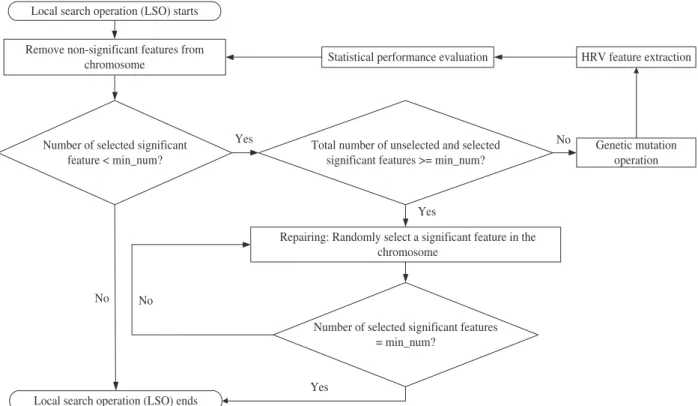
Fig. 4 shows the flow chart of the proposed LSO. Initially, the
HRV features, which are selected within the feature subset seg-
ment of the chromosome, are examined. The non-significant fea- tures are removed from the feature subset. This approach was used in [8] for manually removing the features that could not pass the U test before the simple GA was applied for feature selection.
After the above removal process, the chromosome is updated to reflect the changes. Then, the minimum number of selected signif- icant features is evaluated. If the number equal or more than the
integer number of 3 (denoted by “min_num” in the Fig.4), the LSO
is ended. Otherwise, the handling process is started to increase the feature count to 3. In the handling process, the first step is to ex- amine whether there is enough number of significant features for the selection. If it is enough, then one additional unselected signif- icant feature is randomly selected and added to the feature sub- set. Otherwise, the chromosome goes through the mutation oper- ation (genetic operation), HRV feature extraction stage and statis- tical evaluation stage again. Finally, the LSO is applied to this new chromosome. The handling process is repeated until the chromo- some has same or more than the minimum number of significant features.
3.5.3.4. Duplication handling. Duplicate chromosome is the cre- ation of the same chromosome that has been evaluated before the current generation during the GA optimization process. It causes the computation wastage due to the redundant evaluation of du-
plicate chromosomes [46].
In this paper, the duplicate handling process is proposed to
handle (remove and replace) the duplicate chromosome. It is de-
veloped based on the method proposed by Saroj and Devraj [46].
They modified the duplicate chromosomes when there was a same chromosome exists in the one previous and the most current gen- erations of the simple GA. Their results showed that the optimiza- tion performance of the simple GA was improved. Therefore, the
same concept is applied to the proposed optimization algorithm
in this paper because by default, the NSGA-III stores the previous population (population P) and current population (population Q) in one generation.
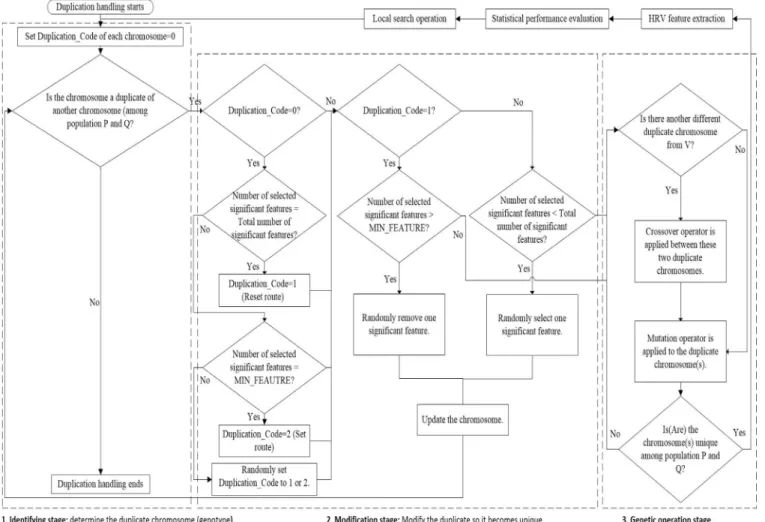
Fig. A.1 shows the flow chart of the proposed duplicate han-
dling process. The algorithm can be divided into 3 main parts:
identifying stage, modification stage, and genetic operation stage. In the identifying stage, the binary digit pattern of a chromosome
is compared against all the chromosomes in population Ptand Qt.
If its binary digit pattern is unique, the duplication handling pro- cess is ended. Otherwise, the chromosome is fed to the modifica- tion stage.
In the modification stage, the content of the duplicate chromo- some is modified so that it become unique among the population. When a chromosome enters this stage for the first time, its status represented by Duplication_Code is set to “0". Then, if the num- ber of selected significant features in the feature subset is equal to total number of significant features (sum of both selected and un- selected features in a chromosome), the duplicate chromosome is fed to reset route (by setting Duplication_Code to (1). If the num- ber of selected significant features is equal to minimum number of features denoted by “min_num”, it will go to set route (by set-
ting Duplication_Code to (2). If neither of the conditions is met,
then it is randomly fed to either set route or reset route. In the reset route, if the number of selected significant features greater than min_num, then one of the significant features in the feature subset of the chromosome is removed. Otherwise, the chromosome is fed to genetic operation stage. In the set route, if the number of selected significant features is less than total number of signifi-
cant features, then one of the unselected significant features is ran-
domly selected and added to the feature subset.
In the genetic operation stage, the first step is to find whether
there is another new but different duplicate chromosome exists.
If it exists, both crossover and mutation operators are applied to the modify both duplicate chromosomes. Otherwise, only mutation operator is applied to the current duplicate chromosome. The pro- cess in the genetic operation stage is repeated until the chromo- some(s) becomes unique. Then, they are fed to HRV feature extrac- tion stage, statistical performance evaluation, and local search op- eration. Finally, the duplicate handling process is repeated if nec- essary.
Several considerations are taken into account when developing the duplicate handling process. Firstly, the duplicate handling pro-
cess is placed after the LSO because the duplicate chromosomes
can be formed not only due to the genetic operation, but also due to the LSO. Secondly, HRV feature extraction process is avoided as
much as possible during the handling process because it is the
most computation intensive part of the algorithm. Therefore, the
modification stage only alters the feature subset segment of the
duplicate chromosome. The parameters and settings of HRV fea-
ture extraction algorithms are only modified in genetic operation stage.
Remove non-significant features from chromosome
Number of selected significant feature < min_num?
Total number of unselected and selected significant features >= min_num? Yes
Repairing: Randomly select a significant feature in the chromosome
Number of selected significant features = min_num? No Yes Genetic mutation operation HRV feature extraction Statistical performance evaluation
No
No Local search operation (LSO) starts
Local search operation (LSO) ends
Yes
Fig.4. Flow chart of the local search operation (LSO).
3.5.3.5. Prediction performance evaluation. The prediction perfor- mance of each chromosome is evaluated. Initially, the chromosome is decoded in order to determine the selected feature subset, and
the values of SVM parameters (penalty constant C and gamma
γ
).After that, the selected HRV features are taken from the training
dataset to train SVM model by using the decoded SVM parame-
ter values. The trained classifier is then evaluated with the testing dataset. Sensitivity (SEN), specificity (SPE), and accuracy (ACC) are used to measure the prediction performance. They are defined as follows: SEN= TP TP+FN (3) SPE=TNTN +FP (4) ACC= TP+TN TP+TN+FP+FN (5)
where TP is number of abnormal event (arrhythmia is occurred) that is correctly predicted, TN is number of normal event (No ar- rhythmia is occurred) that is correctly predicted, FN is number of arrhythmia event that is incorrectly predicted as normal event, FP is number of normal event that is incorrectly predicted as arrhyth- mia event.
10-fold cross validation is applied to evaluate the proposed
method. 10 ECG recordings (5 distant and 5 prior to onset of PAF event) are selected as testing set to measure the performance of classifier while remaining recordings (96 recordings) are used to train the classifier. This procedure is repeated over 10 times in or- der to cover entire database. In the 10th evaluation of 10-fold cross validation, training set contains 90 ECG recordings and testing set contains 16 ECG recordings. Then, average SEN, SPE and ACC are calculated as the measures for classification performance. Training set and testing set are subject independent (belong to different pa- tient). Since it is well known that GA suffers from local optima is- sue, the optimization is repeated 5 times and the best results are selected for performance analysis.
3.5.3.6. Featurecount. In the proposed optimization algorithm, the feature count is defined as the number of HRV features that are se- lected in a feature subset. The feature count is optimized by mini- mizing the fitness value given by:
Feature count=
N
i=1
Fi (6)
where Fiis ‘1’ if ith feature is selected and ‘0’ if not selected, and
N is the total number of features (regardless the feature is selected
or not) in the feature set segment of the chromosome. The N is set
to 53 for this paper.
3.5.3.7. Non-dominated sorting (NDS). During the non-dominated
sorting (NDS) (line 28 of the Algorithm 1), the chromosomes
are divided and assigned to different sets (represented F1, F2,…)
[25] starting from F1. Each set Ficontains a group of solutions that
are not dominated to each other. The dominance operator denoted
by “≺” is the standard symbol for representing the dominance rela-
tionship between two chromosomes. Assume that there is a min-
imization problem, the p≺q represents that the chromosome p is
said to strictly dominate another chromosome q, if and only if the
zi( p) ≤zi( q) for i=1, ..., M and zi( p) <zi( q) for at least one fitness
function indexed by i, where M is total number of fitness functions,
and zi( p) represents ith fitness value of the chromosome p.
In this paper, five fitness functions are proposed for the opti-
mization process. They are sum of statistic value ( Eq.(2)), predic-
tion sensitivity ( Eq.(3)), prediction specificity ( Eq.(4)), prediction
accuracy ( Eq.(5)), and feature count ( Eq.(6)). To fit into the above-
described dominance operator ≺, some maximization fitness func-
tions are turned into minimization fitness function by multiplying
each of them with a −1.0. These functions are sensitivity, speci-
ficity, and accuracy rate. The remaining fitness functions are mini- mization functions by default.
The procedure of the NDS-without-statistic-fitness (line 45 of the Algorithm1) is same as the process in NDS. However, there is one minor difference between them: the operation in dominance
Table2
Performance comparison between typical feature selection method and the proposed optimization method for PAF onset prediction.
Method Performance
SEN SPE ACC NF
Typical Method 88.7 66.0 77.4 4 Proposed Method 86.8 88.7 87.7 7
operator “≺”. The solutions in fronts Fi, which are produced by the
NDS-without-statistic-fitness(), are non-dominated to each other
with respect to all proposed fitness functions except the Eq.(2). In
contrast, the solutions produced by the NDS() are non-dominated to each other with respect to all fitness functions. It is because this paper is interested in analyzing the prediction performance of the solutions.
4. Resultsanddiscussion
4.1. Performancecomparisonbetweenthetypicalmethodandthe proposedoptimizationalgorithm
In this section, the performance difference between the PAF on- set prediction systems (solutions), which are optimized by the pro-
posed algorithm and the typical GA based feature selection method
respectively, is investigated.
The detail of the proposed optimization algorithm is described
by the Algorithm 1. The input parameters of the algorithm are
set as follows: N=212, pc=0.7, pm=0.1, M=5, d1=6, d2=0,
GENMAX=10 0 0. As for the typical GA based feature selection
(shown in Fig.1), the optimization methodology from [8] is em-
ployed for selecting the optimal feature subset and tuning the SVM parameters. The procedure of this method can be summarized as follows: Firstly, the same 53 HRV features are extracted based on the pre-defined HRV parameter values and settings (which are ex-
plained in the Section3.2 and 3.3). After that, each HRV feature is
evaluated with two tailed Mann-Whitney U test. Only the features that can pass the U test at 20% significance level are selected and used to form a significant feature set. Finally, the simple GA fea- ture selector is applied to this significant feature set for selecting
best feature subset. It should be noted that, unlike the proposed al-
gorithm in this paper, the HRV parameters and settings in typical method are not tuned. Therefore, the HRV feature extraction pro- cess is performed one time only since the parameter values and settings are same for every chromosome.
Each method is repeated 5 times with different initial popula- tions. After that, the best solution represented by a chromosome
is selected from each method for performance analysis. Table 2
compares the prediction performance between the prediction sys- tems that are optimized by typical feature selection method and
the proposed optimization algorithm respectively. With typical
method, the PAF onset prediction system achieves accuracy rate of 77.4%. The accuracy rate of the prediction system is improved by 10.3% when it is optimized by proposed algorithm. The prediction performance improvement is achieved because the proposed algo- rithm simultaneously optimizes all stages of the arrhythmia pre- diction system, while the typical method only optimizes the fea- ture subset and SVM classifier parameters.
The higher prediction performance can also be attributed to
more number of HRV features can pass the Mann–Whitney U test.
Table 3 shows the HRV features that able to pass the two tailed U test at 5%, 10% and 20% significance levels for typical method and proposed method. In typical method, only 10 HRV features can pass the U test up to 20% significance level. In contrast, the num- ber is improved to 32 when the proposed optimization algorithm
is used, and majority of them pass the 5% significance level. The improvement is achieved because the proposed optimization algo- rithm explicitly tunes the HRV parameter values and settings for improving the statistic value of each HRV feature by minimizing
the fitness value of Eq.(2). Furthermore, in Table3, it is observed
that all significant features from the typical method also re-appear as the significant features from the proposed method, except the
HH-WCOB( f2m). Finally, TableA.2 shows the difference between the
pre-defined and optimized values for the parameters and settings of HRV feature extraction algorithms.
When the number of features that pass the U test increases,
the NSGA-III has opportunity to explore and evaluate more combi-
nation of HRV features [8]. This leads to higher possibility in ob-
taining the optimal feature set with higher accuracy. However, only 10 HRV features are available for typical method while 32 HRV fea- tures are available for the proposed optimization algorithm.
In addition to the prediction performance, Table 2 shows that
although the optimal subset selected by typical method has lower
(better) feature count than proposed method, but at the expense of
significant lower accuracy rate. The typical method selects 4 fea- tures (out of 10 HRV features) to form the feature subset, which reduces the feature count by 60%. The selected features are AR-LF, LL-H2, LL-H3, ROI-H2. In contrast, the proposed method selects 7 features (out of 32 HRV features), which reduces the feature count by 78%. The selected features are NN50, pNN50, SampEn, SD2, AR-
LF, LL-H1, ROI-WCOB ( f2m), and all of them can pass the U test at
5% significance level.
4.2.Trade-off betweenperformancemetrics
In the typical feature selection method based on the simple GA (with weighted sum approach), each GA run returns a single so-
lution. Therefore, the typical method in Section 4.1 only gives a
solution that has highest accuracy rate. In contrast, with the pro-
posed NSGA-III based optimization algorithm, multiple solutions
that have different degree of trade-off between the performance metrics can be obtained in a single optimization run.
Table 4 shows the prediction sensitivity, specificity, accuracy rate and feature count of the Pareto optimal solutions. These solu- tions are obtained from the same optimization run that gives the
best solution in Table2. It should be noted that these solutions are
only a portion of the Pareto optimal solutions given by the output of Algorithm 1. These solutions are selected for analysis because they have highest prediction sensitivity at certain specificity rate, or vice versa.
Table4 shows that the sensitivity of the solutions can be im- proved, but at the expense of lower specificity rate. For example, from solution 1 to 10, the sensitivity rate increases from 43.4 to 100%, while the specificity rate decreases from 96.2% to 26.4%. On the other hand, the accuracy rate increases from solution 1, peaks at 5, and then decreases until solution 10. Unlike sensitivity and specificity, the changes in accuracy rate does not show either in- creasing or decreasing trend. It is because the increment (or decre-
ment) in sensitivity rate may outpace the decrement (or incre-
ment) in specificity rate.
The solution 5, which has the highest accuracy rate among the
Pareto optimal solutions, is used for comparison in Table 2 and
benchmarking in Table5. Furthermore, the accuracy rate of solu-
tion 1, 2 and 10, which have the best sensitivity or specificity rate, are significant lower than 80% (that is achieved by other solutions in Table4). It shows that even the sensitivity can be improved over certain threshold value, a significant trade-off is needed in speci- ficity, or vice versa.
Table3
HRV features that able to pass the two tailed U test up to 20% significance level for PAF onset. Significance Level HRV feature
typical method Proposed method
5% AR-LF, FFT-LF, LL-H2, LL-H3, LL-H4, HH-WCOB( f1m), HH-WCOB( f2m)
SDRR, RMSSD, NN50, pNN50, SampEn, SD1, SD2, AR-LF, AR-HF, FFT-LF, FFT-HF, LL- Mave, LL- Pave, LL-H1, LL-H2, LL-H3, LL-H4, LH-P1, LH- Mave, LH- Pave, LL-H1, ROI-P1, ROI-P2, ROI- Mave, ROI- Pave, ROI-WCOB( f2m), ROI-H1
10% – LL-P1, LH-P2
20% FFT-HF, LL- Mave, ROI-H2 HH-H1, ROI-WCOB( f1m), ROI-H2
Table4
Trade-off between sensitivity, specificity, accuracy rate and fea- ture count.
Solution SEN (%) SPE (%) ACC (%) Feature count
1 43.4 96.2 69.8 4 2 45.3 94.3 69.8 4 3 75.5 92.5 84.0 7 4 83.0 90.6 86.8 6 5 86.8 88.7 87.7 7 6 90.6 81.1 85.9 5 7 92.5 79.3 85.9 5 8 94.3 71.7 83.0 3 9 98.1 60.4 79.3 5 10 100.0 26.4 63.2 5
Fig.5. Average number of the duplicate chromosomes for 5 optimization runs without handling at generation t.
4.3.Duplicatechromosomes
The results in this section show that high number of dupli-
cates chromosomes are formed when NSGA-III is adapted for opti- mization in this paper. It wastes the computation resource and in- creases the optimization time when these duplicate chromosomes
are re-evaluated. Fig. 5 shows the average number of duplicates
for successive NSGA-III generations when they are not handled by
the duplicate chromosome handling process. The average number is computed by summing and averaging the number of duplicates in each generation of 5 different optimization runs.
First of all, the line denoted by “Duplicate 1" is the number of duplicate chromosomes found by comparing each chromosome to
other chromosomes within the population Pt only. For example, if
they are 4 chromosomes that have same binary pattern within the
population Pt, the count is increased by 3 (4 −1). Fig.5 shows that
the average number increases from 0 to around 60 within 50 gen- erations, and then remains around that number (within range of
±10) in the following generations. It represents approximately 28%
of the chromosomes in population Pt that has total size of 212.
Another line denoted by “Duplicate 2" is the number of duplicate
chromosomes found by comparing each chromosome in population
Qtto all the chromosomes in population Pt after the LSO in fitness
evaluation stage. The count is increased by 1 if there are two same
chromosomes between two populations in a generation. Fig.5 also
shows that this number also increases rapidly within 100 genera- tions.
With the proposed duplicate handling process, the number de-
noted by “Duplicate 1" becomes zero for all generations (zero
duplicate), which means all the chromosomes in population Pt
and Pt+1 are unique. Although the number denoted by “Dupli-
cate 2" remains same, the related duplicates are not re-evaluated.
It is because they are formed during the normal genetic opera-
tion (line 8 of Algorithm 1), and they are identified before en-
tering the fitness evaluation stage. Their fitness re-evaluations are skipped until modified by the duplicate handling process (line 19 of Algorithm1).
4.4. Benchmarking
Table 5 shows the benchmarking results of our proposed method against the previous works that use less than 15 min of HRV signal for prediction. Our proposed method achieves predic- tion accuracy rate of 87.7% by using the shortest HRV signal length
among all previous works: 5 min only. Furthermore, this accu-
racy rate outperforms all previous works that in Table 5. Boon
et al. [8] achieved accuracy rate of 79.3% but used longest sig-
nal length with 15 min. Their accuracy rate was reduced to 68.9%
when 10 min signal is used. Yang and Yin [12] employed 10 min
signal and it achieved the lowest accuracy rate among previous
works with 57%. Finally, Hickey and Heneghan [6] only achieved
accuracy rate of 68% and 70% for 5 min and 10 min respectively. Table5
Benchmarking of proposed method against previous works using less than 15 min of signal length.
Previous Work Signal length (Min) Feature extraction method Performance evaluation method SEN (%) SPE (%) ACC (%)
Boon et al. 2016 [8] 15 HRV Features 10-fold CV 77.4 81.1 79.3
10 HRV Features 10-fold CV 58.5 81.1 68.9
Yang and Yin, 2001 [12] 10 HRV based Footprint Analysis Single Hold – – 57.0
Hickey and Heneghan, 2002 [6] 10 Spectral based HRV features 5-fold CV 53.0 80.0 70.0
5 Spectral based HRV features 5-fold CV 51.0 79.0 68.0
Proposed Method 5 HRV Features 10-fold CV 86.8 88.7 87.7
Table6
Prediction performance of previous works that used 30 min signal for prediction.
Previous Work Feature extraction method Performance evaluation
method
SEN (%) SPE (%) ACC (%)
Zong et al. [7] Number and timing of PACs Single Hold – – 80.0
Hickey and Heneghan [6] PACs detection and Spectral based HRV features 5-fold CV 79.0 72.0 75.0
Thong et al., [5] PACs Analysis Single Hold 89.00 91.00 90.0
Costin et al. [9] HRV features and Morphological Variability of QRS complexes of ECG
Single Hold 89.3 89.4 89.4
Mohebbi and Ghassemian [10] HRV features Single Hold 96.2 93.1 94.5
Cheskonov [11] HRV based spectral features Single Hold 72.7 88.2 80.0
Lynn and Chiang [13] HRV based Return Map and Poincare Plot features Single Hold – – 64.0
In Table6 , the prediction performances of the previous works using 30 min data (either ECG or HRV signal depending on feature extraction method) are summarized. When compared to these pre- vious works, our proposed method outperforms all of them except
[5,9,10]. Our method is 1.7% lower than Costin et al. [9], 2.3% lower
than Trans et al. [5], 6.8% lower than the highest accuracy achieved
by Mohebbi and Ghassemian [10]. Finally, the feature count of the
proposed method is improved. The proposed method only uses
7 HRV features, which is significantly lower than 12 HRV features
in best previous work [10].
Although our proposed method does not outperform them
[5,9,10], they are several factors that need to be taken into con- sideration during the comparison. Firstly, their methods required longer duration of HRV signal for prediction. In contrast, the sig-
nal length is reduced by 83.33% (from 30 minto 5 min) in our
method. Furthermore, they only employed single hold out valida- tion method – it is well known that separating samples to single training and testing set can bias the performance of classifier. In this paper, 10-fold cross validation method, which is better method than single hold-out, is employed to estimate prediction accuracy
of proposed work. The K-fold method is considered better than
hold-out method because K-fold method can reduce the overfit-
ting problem of trained classifier model [31], and more suitable to
evaluate algorithm with small sample size of dataset [47]. Further-
more, Tran et al. [5] did not use HRV analysis for prediction, and
they also needed to specify both recordings belong to same sub- jects before classifying the data. The proposed method does not require this extra step of specifying both recordings. Costin et al.
[9] also used non-HRV analysis based features called morpholog- ical variability features that are extracted from QRS complexes in ECG signal. In contrast, the proposed method employs HRV analy- sis based features only.
5. Conclusion
In this paper, a paroxysmal atrial fibrillation (PAF) prediction
method based on HRV analysis and NSGA-III is proposed. The pro- posed PAF onset prediction method achieves accuracy with 87.7% that outperforms all previous works that use less than 30 min sig- nal for prediction. It is achieved even with HRV signal length being reduced from typical 30 min to 5 min (a reduction of 83%).
The improvements are achieved by proposing the NSGA-
III based multi-objective optimization algorithm that can
simultaneously optimizes all stages of the PAF onset prediction
system. Furthermore, the trade-off between prediction sensitivity
and specificity is analyzed, in which the results show that the
sensitivity can be improved at the expense of lower specificity.
Mann–Whitney U test is also used as the filter method to examine
the statistical significance of the features before they can be
selected to form the feature subset. Finally, a duplicate handling process is proposed to reduce the computation wastage due to the duplicate chromosomes.
As for limitation of this work, the proposed method still needs
improvement in order to achieve same or higher accuracy rate than
best work [10]. The proposed prediction method is also limited by
a small sample size of real data from patients. Therefore, our re- sult may not represent the true characteristic of the general PAF population. Furthermore, due to small sample size, the proposed algorithm is not evaluated with the testing data not included in the cross-validation process. As a result, evaluation with such test- ing set will be performed after we acquire larger sample size in future. Finally, the optimization process takes hours on single per- sonal computer because multiple fitness evaluation processes are performed on each NSGA-III solution. However, it is not an issue in practice since the proposed optimization process is run single time only to find the best prediction model before real-world de- ployment.
Hence, the following future works are planned to improve our
method. Firstly, more types of HRV feature extraction algorithm
that are reviewed in [37] can be used for prediction. Furthermore,
different filter methods such as analysis of variance, t-test and mu-
tual information can be used to evaluate the features. The impact of different methods on the optimization performance can be an- alyzed and compared to U test in this paper. Finally, the duplica- tion handling process can be improved so that it records all the chromosomes that have been evaluated in all previous generations.
Then, the history record is used to determine the duplication status
of a chromosome in the most recent generation. Such approach is
employed in the simple GA [48] to completely eliminate the dupli-
cate chromosome, but at the expense of higher memory and com- putation resource. Another future work is extending and applying the proposed optimization algorithm to other HRV research prob- lems such as prediction of ventricular tachyarrhythmia onset and detection sleep apnea. It is applicable as long as the classification
model is similar to baseline model in Fig.2, with some changes in