The Problem-Based Learning Classrooms in the Natural Sciences:
A Mechanism for Learning
Wilfredo T. Lacambra, Ph.D.
College of Engineering, AMA International University Bahrain Abstract
This study sought to analyze the level of effectiveness of the problem-based learning as an instructional approach to some selected courses in the natural sciences. This study was conducted to 100 students enrolled in any Physics, Chemistry, Biology and Environmental Science courses during the Second Trimester of the Academic Year 2014 – 2015. The primary goal of science education is to identify potential and obstacles to student learning, and then to address these obstacles in a way that leads to more effective learning. These obstacles include factors that originate during instruction - such as PBL as an instructional method as well as those that relate to students’ academic performance. Science courses are always part of the curriculum, and these need complete concentration, time and patience of the students. As teachers always remember the principle, which is, individual differences among the students. They are unique in abilities, interest, needs and experiences. Students should be treated according to their needs and interests, they must be assisted into developing proper attitudes towards these courses and they must be grouped according to their ability and develop each group up to the optimum. There is a high degree of correlation using the Pearson Product Moment of Correlation which means that there is a significant relationship between the GPA in Science courses and the effectiveness of PBL classrooms. This means that the Problem-Based Learning Method adopted in the science classes (Physics, Chemistry, Biology and Environmental Science|) are good predictors of the academic performance of students as shown in their GPA. Further, students who had PBL lecture and laboratory sections had very satisfactory grades in the science courses. Students with PBL classroom exposures had substantially higher learning gains on the scientific concepts – independent of their initial scientific knowledge of those concepts when compared to students in the traditional teaching-learning classroom environment.
Keywords: Problem-Based Learning, Natural Science Courses, Grade Point Average 1. Introduction
Education today is shifting from the traditional teaching-learning method to inquiry based approach in order to involve students in the teaching-learning process. The student-centered classes help students learn best in a classroom when they are involved in the learning process and discover for themselves the essence of teaching and learning process [1]. Problem-Based Learning (PBL) classrooms give students the avenue to discover knowledge in a more meaningful and practical way.
This study will look closely at PBL in the natural science classrooms as regards the intended learning outcomes and skills that are going to be demonstrated by the learners in their chosen fields in the future. PBL as a teaching-learning process gives focus on the importance of technology in the classroom environment.
Innovation is a watchword in almost all areas of endeavor. In the field of higher education, the school administrators and teachers are concerned with ways and means of improving student achievement and performance, physical facilities, curricula, and learning in general. Innovations in these areas need to be designed and applied to meet the demands upon these schools making education more responsive to the needs of a fast growing society.
Schools or universities are considered one of the most delicate enterprises because they are tasked with the development of human beings. The primary goal of education is to produce excellent outputs. Programs and projects have been created as means to improve the quality of education.
In this regard, it is important to make sure that the students enjoy the teaching-learning sessions and ascertain whether they are able to develop conceptual understanding and problem solving skills about difficult topics in science and mathematics courses. There has been different kinds of instructional approaches and mechanisms that need to be established in the classrooms in order to maximize student learning, hence, this study.
1.1 Statement of the Problem
This study is sought to analyze the level of effectiveness of the problem-based learning as an instructional approach to some selected courses in the natural sciences.
Specifically, this study seeks to answer the following questions:
1. Is the problem-based learning an effective instructional approach for learning in the following courses? 1.1 Physics
1.3 Biology
1.4 Environmental Science
2. Is there a significant difference in the level of performance of the students in the problem-based learning classrooms in the natural science courses?
3. What are the implications of the problem-based learning as an instructional approach to students’ learning as perceived by the science teachers?
4. What are the barriers encountered by the students which affect their performance in the natural science courses?
Hypothesis
There is no significant difference in the level of performance of the students in the problem-based learning classrooms in the natural sciences.
1.2 Significance of the Study
The result may serve as a baseline data in facilitating learning. Aptly, this will add bases for further investigation to Research and Development (R & D) researchers for dynamic classroom mechanisms. Thus, this study will prove beneficial to the following:
The Higher Education Institutions of Bahrain. The results of this study will prove beneficial to the higher education institutions in effecting curricular instructional innovations to improve teaching-learning.
The Department of Mathematics and Science Curriculum Committee. Those in charge of curriculum revisions in the different colleges could make use of the results of this study in effecting curricular instructional innovations to improve teaching-learning.
The School Administrators, Policy Makers. The school administrators and policy makers like the Head of Academics, College Deans could utilize the results of this research in planning future mechanisms for the improvement of outputs in education in general, and students’ performance.
The Science and Mathematics Teachers. Similarly, knowing the skills, abilities and performance of students, could be of vital importance to the teachers so that the subjects can be enhanced and improved using the PBL approach.
The Students in Science and Mathematics Subjects. Knowing the learning outcomes and the different skills: knowledge and understanding, subject-specific, thinking and general transferable skills, all these will challenge the students who come from different cultural and language backgrounds and eventually develop their abilities and performance in the classroom.
Other Future Researchers. Findings of this study could be a source off-shoot studies in the conduct of future researches in the various disciplines
1.3 Scope and Limitation
The scope of the study is related to the problem-based learning in the student-centered classrooms in the natural sciences courses of AMAIUB. The timeframe to conduct the study will be for the academic year 2015.
1.4Conceptual Framework / Theoretical Framework
Many researches and studies revealed that varying problems concerning the teaching and learning process confront the science teachers specially the different skill components expected from the course. In some cases, students were not equipped with the basic skills in problem-based learning work [1].
Figure 1 illustrates the research paradigm of the study. The input variable illustrates the courses/subjects along physics, chemistry, biology, environmental science/management. The PBL instructional approach is used to ascertain improvement/enhancement of students’ performance in these courses.
Theoretical Framework
Chapter 2
2. Literature Review
As far as the researcher is concerned, there has been no previous work done dealing with problem-based learning classes in natural sciences as an instructional learning mechanism based on the content areas and on Course Intended Learning Outcomes (CILO). The results may suggest a level of instructional approach appropriate for college students knowing the CILO evaluation in the natural sciences.
One of the goals of science education is the identification of potential and actual obstacles to student learning, and how to address these obstacles in a way that leads to more effective learning. These obstacles include factors that originate during instruction such as instructional methods and approaches as well as those that relate to language and diverse cultural settings [2].
A Student-Centered Science Classroom
Where students are involved and are at the core in the learning process, the classroom is considered student-centered. The three salient features characterize an effective learning classroom process (Combs 1996):
1. The classroom should facilitate the exploratory method. Students must feel secure and accepted. They need to understand the pros and cons of acquiring new knowledge and understanding. Classroom must provide for involvement, interaction, and socialization among the students.
2. Students must be given ample opportunities to acquire new information and t o gain experiences in the classroom. These opportunities are to be provided to allow students to do more in the acquisition of information. Students must be allowed to relate using their own past experiences as compared to the present information given by the teacher.
3. Self-discovery methods is encouraged and adapted by the learner's own style and pace for learning.
In a PBL environment, students veer away from getting instructions and information from a teacher to discovering information on their own pace. Students take the responsibility to communicate among the members of the team or group for their own learning rather than just mere listening and reacting to lessons presented. P B L is focused on understanding the processes not only on knowledge terms and content-wise for lifelong learning among the learners [2]. The role of the teacher is to facilitate, moderate and orchestrate to allow the learners to discover for themselves the knowledge in the learning process.
Problem – Based Learning
Problem based learning (PBL) was originally introduced in the Medical School at Mc-Master University in Canada in the late 1960s and is now a common curriculum component in health science schools around the world [3]. Distinguishing characteristics of PBL are:the inclusion of a problem or ‘trigger’, which small group of learners aims to ‘solve’; its learner-centeredness; and its reliance on collaborative learning [4]. The rationale for the PBL approach in health sciences is that its emphasis on real world problem solving develops students’ capacity for reasoning [5]. PBL has also another dimension where students learn to explore the social as well as the scientific aspects that are relevant to the problem. The role of the teacher is one of facilitator or coach rather than content expert [6]. For students, the student centeredness of PBL is viewed as considerably motivating [6].
In the 1980's the University of New Mexico, with support from McMaster, established a PBL project that conducted with the existing traditional instructional program. Comparatively, it showed that the PBL learners learned more of the course topics than the traditional learners, thus easing some initial discomfort with coverage issues. Studies proved useful in the PBL instruction for lifelong learners.
While it true that PBL was proven effective in the field of medicine, teachers believe that in the field of education, learners would progress to apply knowledge learned in the classrooms as future teachers, engineers, accountants, programmers, and health service providers.
This is the role of teachers to challenge the learners to apply the knowledge and understanding skills on a meaningful perspective. Learners should apply all the needed course intended learning outcomes and to use the necessary skills and apply developed concepts, theories and principles in solving problems of day-to-day living. Greeenberg (1990) cites four criteria for problem-solving scenarios.
1. Learners establish valid assumptions.
2. Learners’ use of readily available local materials.
3. Learners generate simple to complex solution to problems at hand. 4. The process of problem-solving is improved further by focused group discussion technique.
Students learn various topics and course content and processes through lecture discussion, direct instruction, and discovery approach, and then the application of the knowledge to find solutions and conclusive statements to a given problem. Torp and Sage (2002) describe the three features of PBL:
1. Students are aware of the current problem at hand.
2. Students are able to link the problem in a logical and inter-connections.
understanding skills in the classroom.
When learners are getting used to the PBL teaching-learning strategy, students are more likely to develop critical thinking skill, teamwork skill, as well as intellectual skills. Inasmuch as PBL is self-directed in nature and as gleaned on real-life situations, learners acquire self confidence in solving problems of everyday life. Solving problems in the classroom would also lead to self confidence in problem-solving in their homes and work stations. Realizing the link between academic work and the world in which students live, PBL would prove to learners the direct bearing between classroom work and real-world problems.
PBL helps in the development of learners’ analytical skills such as critical thinking, problem identification, situational analysis and problem solving that are at the core of PBL. Learners utilize the needed skills by inspecting at probable solutions to a given problem. Students begin to develop skills such as research activities, data gathering and analysis and communication skills among the team member as they go through these thinking skills, thus, help students become life- long learners.
Through group work or team work, students become more responsible to other members of the group especially in the laboratory classrooms. The learners are ready to set long and short term problem objectives in relation to the given problems. Learners are more likely to communicate effectively with other group members, and learn the relevance of effective communication skills. These skills are necessary institutional tools that students are supposed to be equipped of when entering the actual workplace.
PBL is a technique that permits students to be actively involved in the teaching-learning process, and do active role in a meaningful classroom environment. PBL initiates by way of giving the learners the needed skills to become life-long learners, the skills developed outside the box or of a text book, but by being one of the component part of the teaching-learning process.
Therefore, PBL is central to student learning and helps learners acquire the necessary knowledge and skills in the classroom, and apply it in a practical way to solve problems that are likely to happen in real-life situations.
Teaching - Learning in Science Courses
The reason why there is a higher imaginative level [in modern science] is not because there is a finer imagination, but because there are better instruments [7]. The role of experimental technologies for student cognition and learning in laboratory is a neglected aspect in science education research. Laboratory-learning activities is commonly described as “direct experience with physical phenomena” [7] and in a similar vein the National Research Councils’ America’s Lab Report as “opportunities for students to interact directly with the material world.” Laboratory equipment is seen as something that is just “manipulated” [8] and observation in the laboratory is seen as unproblematic requiring only low level of cognition. This is in line with the “traditional belief” that instruments and experimental devices per se has no cognitive value” [9].
A consequence of this is that emphasis in research is placed mainly on instructions, concepts, and ideas or on organization of laboratories and the role of instrumental technologies for student learning in laboratories are rarely studied and their role is usually either neglected or taken-for-granted [10].
Improving Student Learning in Science Classes
An essential component of all natural science courses is the laboratory program. Laboratories enable students develop many of the practical and theoretical skills required to be successful scientists, as well as providing the basis for a deeper understanding of the scientific method. Students learn to link theory to practice, problem-solve, control parameters, take measurements, understand and calculate experimental uncertainties, graph and interpret data, work in teams, and communicate by writing cohesive reports and papers [10].
The Goals of Science - Mathematics Teaching
The objectives of any course at all levels of learning are and should be based on the country’s national goals. These objectives give direction to activities for the learners’ growth. Being contributory to the growth of the individual and the development of his potentials for effective living, the natural sciences program aims to produce scientifically literate citizens. It must help the individual see his physical and biological world to make him appreciate and understand the basic laws on which life revolves. Thus, it has a large share in the responsibility of the schools to mould citizens who can help solve the problems intelligently. The young generation, for whom the curriculum has to be revised from time to time must understand their place in the world and either interactions in and with it [9].
National development requires citizens of the middle skills as well as men and women of the high-level professions for the leadership of the nation and in general, knowledgeable citizens who can help improve the quality of human life through research. Science-math curriculum seems to accomplish this goal as well [11].
The goals of science teaching are, therefore, clear. Even if students master facts, discoveries and principles, all these would be far from attaining the goals. Knowledge should be functional. Students should master the products of thinking and equally important if not more so, the processes of science as well [8].
Instructional objectives, in order to be meaningful and clearly understood by both the teacher and the learner, describe expected learning outcomes instead of content and therefore are stated in behavioral or
performance terms. These identify and describe what the learner will be doing to manifest that he has accomplished a particular skill [9].
3. Research Methodology Research Design
The study utilized the descriptive-correlation type of research which made use of relevant data from the teachers and student respondents of natural science courses in AMAIUB.
Descriptive study as characterized by incorporating the accumulation of fact, data, and figures for the purpose of their organization, analysis, tabulation and cause-effect relationship [12]. The interpretative and explanatory style of the technique was used to process raw data into a comprehensive collection of information that could then be evaluated from the positions occupied by the study’s general and specific aims.
This study was conducted during the First Trimester of the Academic Year 2015 – 2016. The questionnaires were distributed to students enrolled in any Science course.
Respondents of the Study
The respondents of the study are selected from the natural science courses in the CGE-AMAIUB. The respondents are the teachers handling natural science courses as well as the students who are registered in the natural science courses.
Respondents Faculty Students
Physics 2 25 Chemistry 2 25 Biology 1 25 Environmental Science 1 25 Total 6 100 Research Instruments
The research used in this study is a questionnaire that is arranged into side components. Each component contains questions that assess each of the variables. The choices are expressed using the descriptions using the Likert scale [12].
Data Gathering Procedure
The data gathering stage is carried out after the approval and validation of the research instrument, the questionnaire by the Research Committee.The proponent sought the approval and permission from the Research Head of AMAIUB to conduct the study. The researcher prepared a letter to the respondents in the distribution of the questionnaires. Explanations to the respondents are provided in order to get significant and reliable responses from them. Copies of the questionnaires were distributed among the group of targeted respondents.
Data Processing and Statistical Data
Responses to the questions are tallied by the researcher after the collection. The completed questionnaires are collected and the responses are organized, coded and processed. The weights assigned to the qualitative scale are considered. The weighted mean of each item in the questionnaires are determined based on the respondent’s average perceptions on the different variables that are investigated as well as the respondent’s overall perceptions. The standard deviation, was also used to find out the homogeneity or heterogeneity of the responses of respondents.
Upon retrieval of the accomplished instruments, the data were processed, analyzed and interpreted according to the requirements of the problems and hypothesis. The data gathered for the study were processed for some statistical analysis using descriptive statistics. The Pearson r - correlation test is used to determine the significant difference on the responses of the two groups of respondents. The results of inferential analysis were interpreted using .05 level of significance.
4. Results and Discussion
Table1. Effectiveness of PBL in Science Classes as Perceived by the Students 5–Strongly Agree; 4–Agree; 3–Moderately Agree; 2 – Disagree; 1 – Strongly Disagree
Statements Mean Interpretation
1. In PBL…, I develop problem-solving skills 3.79 Agree
2. The teacher motivates me do my work 4.14 Agree
3. It sharpens my analytical skills 3.91 Agree
4. I do well in this course if I have good memory 3.23 Moderately Agree
5. Teacher gives comments on my work 4.10 Agree
6. I develop confidence tackling unfamiliar problems 2.96 Moderately Agree 7. Improves my written communication skills 3.85 Agree
8. Improves my oral communication skills 2.64 Moderately Agree
9. Improves my technology usage 3.98 Agree
10. It is a great deal for me of what I am going to learn 3.17 Moderately Agree 11. I develop the value & sense of team work 4.74 Strongly Agree 12. The teacher is extremely good at explaining things 4.11 Agree
13. The teacher helps if I have difficulties in class 3.83 Agree
14. The teacher gives helpful feedback 3.80 Agree
15. Aims and objectives of the course are made clear 3.96 Agree 16. I develop ability to plan my own work 3.65 Agree
17. Feedback is provided in my marks and grades 4.67 Strongly Agree 18. The teacher discuss how I learn in this course 3.78 Agree
19. I get through this course by working hard 2.79 Moderately Agree 20. I explore the issues related to the problem 3.08 Moderately Agree
Overall weighted mean = 3.72 (Agree)
Table 1 shows the effectiveness of PBL as perceived by the students. Items 1, 2, 3, 5, 7, 9, 12, 13, 14, 15, 16 and 18 are rated “agree”. The students in science classes are agreeable of the statements as shown in their responses.
Among the items that are rated “moderately agree” are items 4, 6, 8, 10, 19 and 20. On the item “develop value and sense of team work”, it is rated “strongly agree” with a mean of 4.74, while the item on “feedback is provided by the teacher” which is rated “strongly agree” has a mean of 4.67.
The table shows the overall weighted mean of 3.72 with an adjectival description of “agree”. This means that the use of PBL as a teaching-learning technique in science classrooms is effective as perceived the student-respondents.
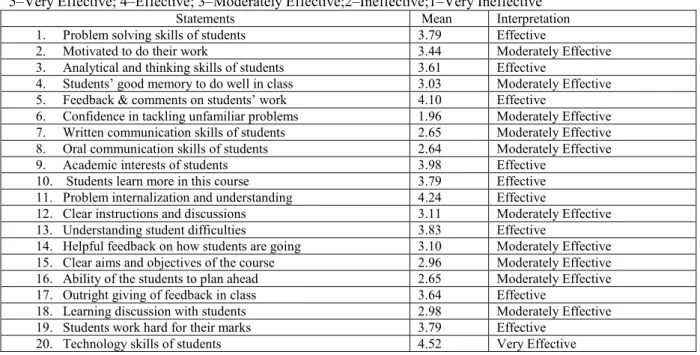
Table 2. Effectiveness of PBL as Perceived by Science Teachers
5–Very Effective; 4–Effective; 3–Moderately Effective;2–Ineffective;1–Very Ineffective
Statements Mean Interpretation
1. Problem solving skills of students 3.79 Effective
2. Motivated to do their work 3.44 Moderately Effective
3. Analytical and thinking skills of students 3.61 Effective
4. Students’ good memory to do well in class 3.03 Moderately Effective
5. Feedback & comments on students’ work 4.10 Effective
6. Confidence in tackling unfamiliar problems 1.96 Moderately Effective
7. Written communication skills of students 2.65 Moderately Effective
8. Oral communication skills of students 2.64 Moderately Effective
9. Academic interests of students 3.98 Effective
10. Students learn more in this course 3.79 Effective
11. Problem internalization and understanding 4.24 Effective
12. Clear instructions and discussions 3.11 Moderately Effective
13. Understanding student difficulties 3.83 Effective
14. Helpful feedback on how students are going 3.10 Moderately Effective
15. Clear aims and objectives of the course 2.96 Moderately Effective
16. Ability of the students to plan ahead 2.65 Moderately Effective
17. Outright giving of feedback in class 3.64 Effective
18. Learning discussion with students 2.98 Moderately Effective
19. Students work hard for their marks 3.79 Effective
20. Technology skills of students 4.52 Very Effective
Overall weighted mean = 3.97 (Effective)
the science teachers. Items 2, 4, 6, 7, 8, 12, 14, 15, 16, and 18 are rated “moderately effective”. The teachers handling science classes find PBL as an instructional method effective as shown in their responses.
Among the items that are rated “effective” are items 1, 3, 5, 9, 10, 11, 13, 17 and 19. On the item “technology skills of students”, it is rated “very effective” with a mean of 4.52.
The table shows the overall weighted mean of 3.97 with an adjectival description of “effective”. This means that the use of PBL as a teaching-learning method in science classrooms is effective as perceived the teacher-respondents.
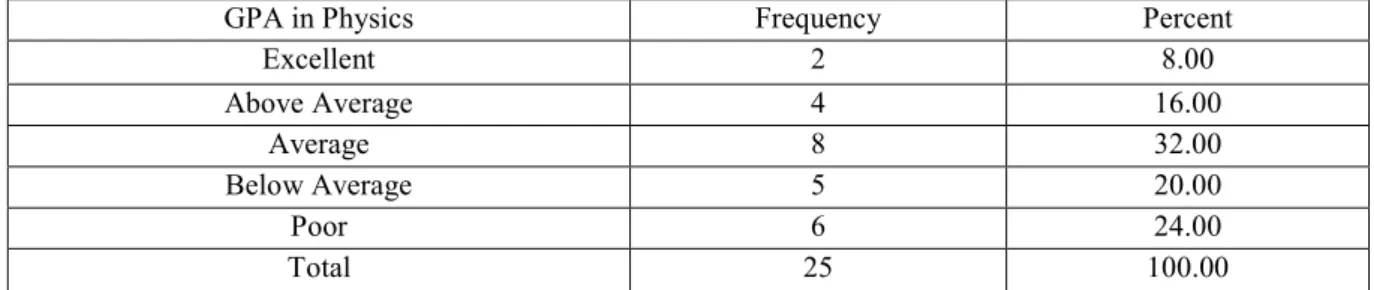
Table 3. Frequency & Percentage Distribution of GPA of Students in Physics
GPA in Physics Frequency Percent
Excellent 2 8.00 Above Average 4 16.00 Average 8 32.00 Below Average 5 20.00 Poor 6 24.00 Total 25 100.00
Table 3 presents the frequency and percentage distribution of the GPA of students in Physics. The table clearly shows that 8.00 per cent or two (2) of the respondents performed “excellent” in Physics, 16.00 per cent or four (4) of them are “above average”. Eight students or 32.00 per cent got marks in the “average” level while five (5) or 20.00 per cent are in the “below average” level while six (6) or 24.00 per cent performed “poor” GPA in Physics. The mean GPA of the students in the course is 82.63. This means that the students in the PBL class in lecture and laboratory sessions could be contributory in the acquisition of Physics high marks.
Table 4. Frequency and Percentage Distribution of GPA of Students in Chemistry
GPA in Chemistry Frequency Percent
Excellent 3 12.00 Above Average 6 24.00 Average 8 32.00 Below Average 6 24.00 Poor 2 8.00 Total 25 100.00
Table 4 presents the frequency and percentage distribution of the GPA of students in Chemistry. As clearly shown from the table, 12.00 per cent or three (3) of the respondents performed “excellent” in Chemistry, 24.00 per cent or six (6) of them are “above average”. Eight students or 32.00 per cent performed in the “average” level while six (6) or 24.00 per cent are in the “below average” level while two (2) or 8.00 per cent achieved ”poor” GPA in Chemistry. The mean GPA of the students in the course is 83.16. This means that the students’ PBL performance in both lecture and laboratory sessions are contributory in Chemistry high marks. Table 5. Frequency and Percentage Distribution of GPA of Students in Biology
GPA in Biology Frequency Percent
Excellent 2 8.00 Above Average 3 12.00 Average 7 28.00 Below Average 6 24.00 Poor 7 28.00 Total 25 100.00
Table 5 presents the frequency and percentage distribution of the GPA of students in Biology. The table clearly shows that 8.00 per cent or two (2) of the respondents performed “excellent” in Biology, 12.00 per cent or three (3) of them are “above average”. Seven students or 28.00 per cent have GPA marks in the “average” level while six (6) or 24.00 per cent are in the “below average” GPA level while seven (7) or 28.00 per cent performed “poor” GPA in Biology. The mean GPA of the students in the course is 78.26. This means that the students’ PBL performance in lecture and laboratory sessions could be contributory in getting GPA marks in Biology.
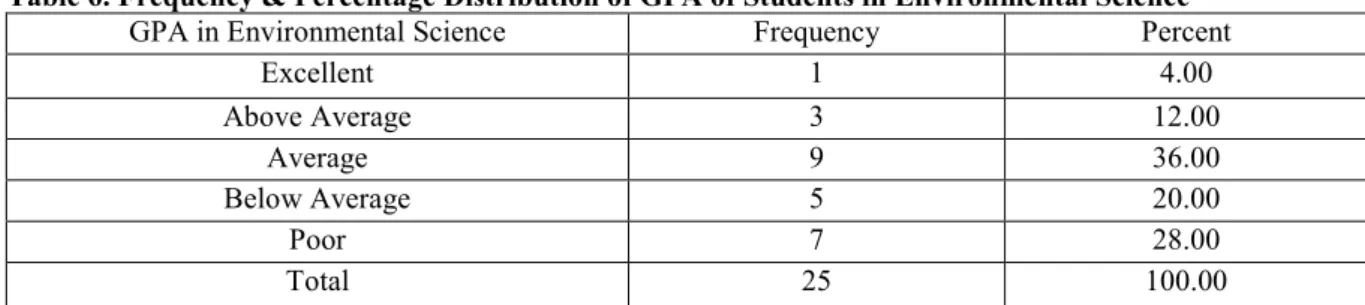
Table 6. Frequency & Percentage Distribution of GPA of Students in Environmental Science
GPA in Environmental Science Frequency Percent
Excellent 1 4.00 Above Average 3 12.00 Average 9 36.00 Below Average 5 20.00 Poor 7 28.00 Total 25 100.00
Table 6 presents the frequency and percentage distribution of the GPA of students in Environmental Science. As gleaned from the table, it clearly shows that 4.00 per cent or only one (1) of the respondents got “excellent” GPA in Environmental Science, 12.00 per cent or three (3) got “above average” GPAs. Nine students or 36.00 per cent performed in the “average” level while five (5) or 20.00 per cent are in the “below average” level while seven (7) or 28.00 per cent achieved “poor” GPA in Environmental Science. The mean GPA of the students in the course is 72.13. This means that the PBL strategy in class could be contributory in the acquisition of high marks in the course.
Table 7. Perceived Barriers in PBL Science Classes
5 – Always; 4 – Frequently; 3 – Occasionally; 2 – Seldom; 1 – Never
Perceived Barriers Mean Interpretation
1. Solving Problem Skill 2.39 Seldom
2. Communicating Skill 3.44 Occasionally
3. Using Technology/Apparatus Skill 2.11 Seldom
4. Working on Teams/Groups Skill 2.43 Seldom
5. Making Connections of Past Learning 3.15 Occasionally
Overall weighted mean = 2.70 (Occasionally)
Table 7 shows the perceived barriers encountered which were rated “occasionally”: item 2 on communicating skill (3.44) and item 5 on making connections of past learning (3.15). Items 1, 3, and 4 are rated “seldom”: problem – solving skills (2.39); using technology apparatus skill (2.11); and working on teams or groups (2.43).
The table shows the overall weighted mean of 2.70 with an adjectival description of “occasionally”. This means that the occurrence of the perceived barriers encountered by the students in PBL classes would not in any way affect the students’ performance in the PBL science courses.
Table 8. Correlation Between GPA and Effectiveness of PBL Classes GPA in Science Courses PBL Effectiveness Decision Interpretation Physics Pearson Correlation 0.702 Significant High degree of correlation Sig. (2-tailed) .000* N 25 Chemistry Pearson Correlation 0.648 Significant High degree of correlation Sig. (2-tailed) .000* N 25 Biology Pearson Correlation 0.601 Significant High degree of correlation Sig. (2-tailed) .000* N 25 Environmental Science Pearson Correlation 0.582 Significant Moderate degree of correlation Sig. (2-tailed) .000* N 25
Table 8 presents the significant relationship between students’ GPA in science courses and the effectiveness of PBL science classes. As shown from the table, there is a high degree of correlation using the Pearson Product Moment of Correlation (r = +0.702), which means that there is a significant relationship at 0.05 level (2-tailed) between the GPA in Physics and the effectiveness of PBL Physics class. Hence, the null hypothesis is rejected.
There is a high degree of correlation using the Pearson Product Moment of Correlation (r = +0.648), which means that there is a significant relationship at 0.05 level (2-tailed) between the GPA in Chemistry and the effectiveness of PBL Chemistry class. Hence, the null hypothesis is rejected.
From the table, there is a high degree of correlation using the Pearson Product Moment of Correlation (r = +0.601), which means that there is a significant relationship at 0.05 level (2-tailed) between the GPA in
Biology and the effectiveness of PBL Biology class. Hence, the null hypothesis is rejected.
As gleaned from table 8, there is a moderate degree of correlation using the Pearson Product Moment of Correlation (r = +0.582), which means that there is a significant relationship at 0.05 level (2-tailed) between the GPA in Environmental Science and the effectiveness of PBL Environmental Science class. Hence, the null hypothesis is rejected.
This means that the Problem-Based Learning Method adopted in the science classes (Physics, Chemistry, Biology and Environmental Science|) are good predictors of the academic performance of students as shown in their GPA. Further, students who had PBL lecture and laboratory sections had very satisfactory grades in the science courses. It can be implied, that students with PBL classroom exposures had substantially higher learning gains on the scientific concepts – independent of their initial scientific knowledge of those concepts when compared to students in the traditional teaching-learning classroom environment.
Conclusions and Recommendations
Based on the findings, the following conclusions are drawn:
1. The problem-based learning in the science classrooms maximize the learner's involvement in the teaching-learning process. With the PBL strategy in the science classrooms, students are able to apply the necessary knowledge and skills in solving practical and meaningful problems.
2 . Students’ acquired knowledge and skills help them solve problems in life, thereby giving them an opportunity to maximize learning and transforming them into life-long learners. As schools try to adopt this new technique in teaching, teachers will recognize the importance of PBL in science classrooms.
3. Teachers take new roles in the classroom as they need to become a component part of the teaching-learning process, acting as a facilitators and moderators for the students in the classrooms. Once a teacher learns to interface in the teaching-learning process, and students are knowledgeable of the problem at hand, students learn to apply the knowledge and necessary skills into practical, meaningful and productive ways.
4. There were problems encountered by the student-respondents that had affected their performance in the Physics achievement test. Students had problems in recalling important concepts, principles and theories, and giving of many assessment works, assignments, projects, and the students’ regularity in attending classes.
Recommendations
On the basis of the findings and conclusions, the following are the recommendations:
1. Science courses are always part of the engineering and computer science programs, and these need complete concentration, time and patience of the students. Students should adopt the PBL as a teaching-learning technique both in the lecture and laboratory science classroom so that they maximize learning through the acquisition of knowledge and skills to transform them for life-long learning with the guidance and assistance of the teachers in developing their abilities.
2. PBL technique should be undertaken in all science classrooms to help students overcome their difficulties especially in the application of science laws, theories, concepts and principles through problem solving. Also, students enrolled science classes should embrace PBL technique to develop the abilities and skills needed in the CILOs.
3. Science classroom instructions should be related to regular PBL activities of students to help them develop the proper attitude and attainment of skills towards the discipline. Formative assessments must be strengthened by PBL in the lecture and laboratory classrooms to maximize experiential learning and to develop life-long learning requirements and skills among students.
4. Teachers must provide more guided lecture and laboratory problems, visual aids and other classroom equipment to benefit the students more power of understanding the problems and to make teaching and learning more challenging and meaningful. The PBL tool must address all the course intended learning outcomes (CILOs) to increase achievement or performance level.
5. Similar studies should be conducted to other allied courses or disciplines in the university because the researcher strongly believes that this type of study would enhance and improve teaching and learning activities.
References
[1] Bloom, Benjamin S., 1994. Taxonomy of Educational Objectives: Cognitive Domain. New York: David McKay Company Incorporated.
[2] Clanchy, John. 2001. “Teaching Students From Overseas”. A Brief Guide for Lecturers and Supervisors. Melbourne: Longman Cheshire.
[3] Ballard, Brigid. 1995. “Some Issues in Teaching International Students”. In Reaching More Students: Griffith University.
[4] Dixon, Anthony. 1997. “Hongkong Students Cope With Small-Group Problem Based Learning”. In Research and Development in Problem Based Learning. Australian Problem Based Learning Network, Vol. 4. [5] Stokes, Stephanie. 1997. “Students’ Experiences of PBL: Journal and Questionnaire Analysis”. The Australian Journal for Higher Education Vol.1, pp161-179.
[6] Blue, Amy., et. al. 1998. “Students’ Communication Apprehension and Its Effect on PBL Performance”. Medical Teacher, Vol. 20, no.3, pp. 217-221.
[7] Bernstein, Basil. 1999. Class, Codes, and Control, Vol. 4, “The Structuring of Pedagogic Discourse”. London: Routledge.
[8] Hmelo-Silver, Cindy. 2002. “Collaborative Ways of Knowing: Issues in Facilitation”. Proceedings of Computer Supported Collaborative Ways of Learning. New Jersey: Erlbaum.
[9] Charlin, Bernard., et. al. 1998. “The Many Faces of Problem Based Learning: A Framework for Understanding and Comparison”. Medical Teacher, Vol. 20, pp. 323-330.
[10] Kelson, A., 2000. “Groups in Problem-based learning: Essential elements in theory and practice”. In Problem–based learning: A research perspective on learning interactions. London: Laurence Erlbaum.
[11] Woodward, Kron, et. al. 2007. “Classroom Discourse in PBL Classrooms in the Health Sciences”. Australian Review of Applied Linguistics. PBL Articles. pp. 9.1-9.18.
[12] Edwards, Allen L., 2002. Statistical Analysis for Students in Psychology and Education. New York: Rinehart and Co., Inc.