University of Missouri, St. Louis
IRL @ UMSL
Dissertations UMSL Graduate Works
4-14-2017
Exploring the Use of Technology to Support
Literacy of Sixth Grade Students with Reading
Disabilities
Jaime R. Inman
Jaime Renee Ball-Inman, [email protected]
Follow this and additional works at:https://irl.umsl.edu/dissertation
Part of theEducational Methods Commons,Instructional Media Design Commons, and the Special Education and Teaching Commons
This Dissertation is brought to you for free and open access by the UMSL Graduate Works at IRL @ UMSL. It has been accepted for inclusion in Dissertations by an authorized administrator of IRL @ UMSL. For more information, please [email protected].
Recommended Citation
Inman, Jaime R., "Exploring the Use of Technology to Support Literacy of Sixth Grade Students with Reading Disabilities" (2017).
Dissertations. 645.
Exploring the Use of Technology to Support Literacy of Sixth Grade Students with Reading Disabilities
by
Jaime Renee Ball-Inman
MAT, Educational Technology, Webster University, 2007 B.S. Business Administration, Maryville University, 2001
A Dissertation in Practice Submitted to the Graduate School of the University of Missouri-St. Louis in Partial Fulfillment of the Requirements for the Degree
Doctor of Education in Educational Practice
May 2017
Advisory Committee Dr. Gayle Wilkinson, Ed.D Chairperson Dr. Charles Granger, Ph.D Dr. Keith Miller, Ph.D
Dr. Kim Song, Ed.D
1
University of Missouri-St. Louis College of Education
Ed.D. Learning Community of Practice Curriculum and Instruction
Exploring the Use of Technology to Support Literacy of Sixth Grade Students with Reading Disabilities
Jaime R. Ball-Inman Abstract
The degree to which the utilization of technology supports the academic achievement of sixth grade students with reading disabilities was examined using a quantitative research design. The data analysis involved the results from the Educational Technology Assessment Program to measure achievement. The Standardized Test for the Assessment of Reading (STAR) provided 2015-2016 scores regarding academic accomplishment of middle school students with reading disabilities. The central research question was developed based on the current literature on the impact technology can have on student academic achievement (Grinager, 2006). Using a specially designed survey, the researcher examined the teachers’ understanding of educational technology and what technology was used to support learning in students with reading disabilities was determined. Along with the technology used by teachers, student reading scores, as well parent and student perception of technology use surveys were used to answer the research questions. In comparing data sources (STAR assessment and surveys), the degree to which technology supports student academic achievement was described.
2 Dedication
I dedicate this dissertation to my beautiful girls, Chloe and Brianna Inman and my amazing husband, Thomas Inman. Without the three of you, I never could have achieved this personal goal of mine. Chloe and Brianna, please remember that no one can take away your education, and I know you two can conquer the world with your continuous hard work and determination. Reach for the stars and dream big, girls. Regardless how hard a task might seem, you can do it. Tom, you have made me into such a strong, independent, confident, woman and continue to support me throughout my educational journeys. I truly could not have done this without you. I also want to dedicate this dissertation to my parents, Sgt. Jerry W. Ball, Sr. and Patricia A. Ball. Without your love, support, and prayers, I could not have made this journey. Thanks for showing me what hard work can do for a person. I am truly grateful to have two great role models in my life. My editor and friend, Pia Reinhold, I could not have done this without such an amazing editor, thank you for all your time. Finally, I want to thank my committee team, Dr. Wilkinson, Dr. Granger, Dr. Song, and Dr. Miller. What an amazing team. Each of you brought something really special to my doctoral journal, I will be forever grateful for your support and I only hope I make you proud in the future.
3 TABLE OF CONTENTS Abstract………...1 Dedication……….2 Table of Contents………...3 Chapter 1………...5 Introduction………5 Background………5 Statement of Problem……….9 Purpose of Statement………...13 Research Question………...15 Significance of Study………15 Limitations of Study………..16 Delimitations……….16
Theoretical Perspectives and Conceptual Framework………..17
Chapter Conclusion..……….18
Definition of Terms………...18
Chapter 2………...21
Review of Literature ………..21
Academic Benefits of Technology………...21
How Technology Improves Learning………...24
Role of the Teacher in the Use of Technology………...26
Effects of Computer-Based Technologies………..28
Assistive Technology………...30 Chapter Conclusion………....37 Chapter 3………..38 Methodology……….38 Introduction………...38 Research Design………....38 Description of Sample……..………...39 Sample………...39 Sampling Procedure………...40 Instrumentation………..41
Data Collection Procedures………...42
Data Analysis……….44
Validating and Findings……….44
Chapter Conclusion………45
Chapter 4………...46
Introduction ………..46
Results………...46
Technology Available at Middle School………...47
Findings………...47
Descriptive Analysis……….48
Reading Test Results……….62
Chapter Conclusion………...64
4
Findings and Conclusion…...………...66
Discussion……….………...69 Recommendations………72 Implications………...72 Chapter Conclusion………...73 Personal Reflection………...73 References:………...75 Appendix A………...82 Appendix B………...83 Appendix C………...85 Appendix D………...87 Appendix E………88 Appendix F………94 Appendix G………..102 Appendix H………..105
5
CHAPTER ONE: INTRODUCTION Background
Technology is everywhere in today’s society. It is available in every aspect of our lives, from communicating via cell phones and social media, to banking and mobile apps, even in healthcare and education. The list gets longer and longer as new technology advances appear in our lives. Most would say that technology has improved our lives, it has placed information at our fingertips such as directions on Google maps, finding a restaurant or a doctor and even paying bills through mobile apps. Most importantly, how does technology improve or support the education system? Does it support the needs of students with learning or reading disabilities? The purpose of this research is to describe the use of technology in helping students with reading disabilities. In this research, the researcher will be looking at the technology used by teachers and parents to help their students learn, such as multimedia, educational apps, tablets and Google Education.
Multimedia is a form of technology used in the classroom, using or involving several forms of communication or expression. Google Education offers Google Apps that are free to school districts and educators and uses completely online or cloud-based applications. According to Techopedia website, Google Apps is a brand of cloud computing, productivity and collaboration tools, software and products that were developed by Google. Cloud application is an application program that functions on the cloud (online), not on a user’s device (Rouse, 2016). According to Google Education website, it offers a core suite of productivity applications that Google makes available to schools and educational institutions. These communication and collaboration apps include
6
Gmail, Calendar, Drive, Docs and classroom sites. Google Apps for Education account unlocks access to dozens of other collaborative tools supported by Google.
Technology has enhanced the lives of students in many ways, such as how they communicate, learn, work and relate to one another. As society changes, so do learning styles and as they evolve, education changes as well. Developing advanced technology in schools continues to take place in the 21st century classrooms, (Gagnon, Hughes, Maccini, 2002). But does technology support student learning? And how does the use of technology support higher achievement of middle school students with reading disabilities? According to research, there are new approaches to enhance students’ reading skills through the use of technology-based practices. For example, computer or video-based multimedia program, technology-based assessments or audio texts, enhance students’ reading skills (Gagnon, Hughes, Maccini, 2002). Guthrie and Davis (2003), have noticed a relationship between technology, curriculum and learning by using real world experiences and personal interaction to connect students to technology and reading. Students have the ability to link to online museums, digital databases, take a virtual tour all through the use of the Internet, making the connection through the use of technology. Technology in education provides students the opportunities for technology literacy, information literacy, the capacity for lifelong learning and prepares students for 21st century skills, (Gagnon, Hughes, Maccini, 2002). While there are numerous ways to define 21st century skills, for this study, the researcher will use the definition from the Partnership for 21st Century Skills framework (P21), focusing on the information, media, and technology portion. Figure below is an illustration of 21st century skills:
7
Figure 1: Partnership for 21st century skills
Partnership for 21st Century Skills (2007) was designed with recommendations from teachers, education experts and business leaders to create a support system to ensure students are prepared for their future in work, life and citizenship. This study will focus more on the information, media and technology skills when the researcher refers to 21st Century Skills. The P21 Framework focuses on four key subjects that are described as 21st Century Skills:
Life and Career Skills:
Flexibility and Adaptability
Initiative and Self-Direction
Social and Cross-Cultural Skills
Productivity and Accountability
8 Information, Media and Technology Skills:
Information Literacy
Media Literacy
ICT (Information, Communication and Technology) Literacy Learning and Innovation Skills:
Creating and Innovation
Critical Thinking and Problem Solving
Communication
Collaboration (P21 Partnership for 2st Century Learning Framework, 2007, p.1-2). As Goon (2012) explains, John Dewey proposed a significant relationship between student achievement and the process of life skills (Dewey, 1916). According to Goon (2012), “John Dewey describes it’s the teacher’s obligation to mix the ingredients of studies and relevant life skills to make a significant contribution to the value of a student’s life,” (p. 1). John Dewey presented the theory of progressive education. Progressive education includes an emphasis on learning by incorporating hands-on projects, expeditionary learning, experiential learning, and collaborative and cooperative learning projects. Teachers can use these learning opportunities and relate them to technology projects, such as grouping students together in a research project on the Internet and assign the students a PowerPoint presentation.
Dewey conveys it's important to incorporate relevant life skills into the classroom. Students need educational experiences to help them feel empowered. Teachers can help students feel valued, equal and responsible members of the society, these are all critical life skills. Dewey’s idea is still relevant in today’s 21st Century Skills and educational technology, as teachers struggle to find ways to use educational technology to impact student academic achievement, (Goon, 2012).
Educational technology has logical connections with several theorists, such as Jean Piaget’s Constructivist Learning Theory. This theory focuses on knowledge and learning
9
(Fosent, 1996). “Piaget advocated that knowledge is a construction and not a reality, but an understanding, which is continuously being revised and reconstructed as a new experience” (Goon, 2012, p. 22). The Constructivist approach to learning engages learners. Like incorporating technology into the curriculum, students are exploring and personalizing the material during the learning process. Learning transforms into a more project-based instruction allowing learners to experience the world by doing things, rather than just receiving information by listening, according to Goon, (2012). Similar to Piaget’s work, students are using technology to build their academic understanding, using problem-solving skills and gaining 21st century technology skills.
Statement of the Problem
The purpose of this mixed methods research was to find out how the use of technology such as assistive technology, multimedia, educational apps, tablets and Google Education can impact student learning. Since advanced technology is part of our lives, most every student is quite engaged with technology, such as reading online books, Internet resources, using iPhones, iPads, tablets and playing digital games. Instructors progress into the 21st century, with the success of the technology that is brought into the classroom, with the hopes to increase student engagement in the classroom. Using technology as a tool for differentiation can also help engage students at a higher level of thinking. As with any change, there are challenges and practical questions that will develop, such as which technology will influence student’s achievement. As educators, we ask ourselves questions and possibly start to question our lessons, “Is this lesson more meaningful with the addition of technology?” Through this study, the researcher will investigate the use of technology
10
for students with reading disabilities and how learning with technology affects those students with reading disabilities.
Instructional technology is important in all grade levels of education. Technology is more than just hardware. The Association for Educational Communications and Technology (AECT) provides a 2008 definition of technology as “the study and ethical practice of facilitating learning and improving performance by creating, using and managing appropriate technological processes and recourses” (AECT, 2008, p.1). According to Grinager (2006), educational technology includes the use of hardware, software and other digital technologies to higher level learning. In a K-12 and postsecondary education setting, the following types of technologies can be found in a classroom setting:
● Computers-Laptops, desktops, iPads, handheld devices ● Software-Instructional and digital software
● Online Content-Providing engaging interaction ● Interactive Whiteboards
● LCD Projectors
● Sound Enhancement-Speakers and microphones ● Televisions- Enhance Distance Learning
● Digital Cameras (Grinager, 2006, p.1). Reading Disability
Learning to read can be taught at a young age, especially in grades 1-3. Teaching reading includes a developmental process involving letter and word recognition, decoding, comprehension and fluency. According to the Online Encyclopedia of Mental Disorders, a
11
reading disability is a learning disorder that involves significant impairment of reading accuracy, speed, or comprehension to the extent that the impairment interferes with academic achievement or activities of daily life. Students with reading disorder perform reading tasks well below the level one would expect on the basis of their general intelligence, educational opportunities, and physical health. “A common reading disorder is dyslexia. Dyslexia, however, usually includes deficits in spelling and writing as well as reading” (Online Encyclopedia of Mental Disorders, “Description,” para. 2). What happens when students fail to read? Educators begin to search for additional resources to include different instructional teaching methods or materials. It’s important for teachers to remember the shift to technology skills in today's changing society of learners as a part of of 21st century skills. Incorporating technology into a struggling reader’s curriculum may increase their academic achievement. Through the advancement of technology for students with learning needs, support from technology is becoming more common in our country's schools. Technology can be an efficient instrument that advances a student's contribution in the learning process and helps students with accessing and arranging information, (Maccini, Gagnon, Hughes, 2002).
Moats and Tolman (2009) found that students who are reading impaired might be the individuals who score underneath the 30th percentile in reading skills. Among every one of those poor readers, around 70-80 percent experience difficulty with word acknowledgment and comprehension. Another 10-15 percent of poor readers have all the earmarks of reading correctly, but are too slow in word recognition and text reading to score well on tests. Reading-disabled students have a particular weakness with the rate of word acknowledgment and responding to programmed review of word spellings, but may
12
do well on tests on phoneme awareness and other phonological aptitudes. These types of students’ experience difficulty creating automatic acknowledgment of words by sight and tend to spell phonetically, yet not precisely. According to Moats & Tolman (2009), “They also have found that another 10-15 percent of battling readers seem to translate words better than they can comprehend the meanings of passages. These struggling readers are also recognized as dyslexic readers since they can read words accurately and rapidly and they can spell,” (para 3). Students with dyslexia have reading issues that could be brought about by the different number of thinking, theoretical verbal thought or language comprehensions required for successful reading.
There are three types of reading disabilities that can overlap but can also be separate and distinct, such as phonological deficit, processing speed/orthographic processing deficit and comprehension deficit. Moats and Tolman (2009) defined “phonological deficit as implicating a core problem in the phonological processing system of oral language. Processing speed/orthographic handling deficiency influences speed and exactness of printed word acknowledgment and is known as a naming pace issue or familiarity issue” (para 3). However, comprehension deficit can be found in young students with social-phonetic inabilities, vocabulary weaknesses, dialect learning disarranges, learning challenges that influence conceptual thinking and logical thinking (Moats and Tolman, 2009).
According to LD Online (2016), students with reading disabilities may experience one or more of the following reading characteristics along with low comprehension:
● Reads slowly and deliberately ● Rereads lines in oral reading
13
● May substitute, omit, or transpose letters, words, syllables, and phrases ● Has trouble using basic phonics to sound out words
● Has decoding problems (difficulty with sound-symbol relationships and distinguishing between sounds and between certain letters)
● Loses place on page or skips lines, words and numbers ● Has poor comprehension of written materials
● Reads with an overdependence on guessing and compromises comprehension ● Does not like to read (Ruedel, Silver-Pacuilla, 2004, p. 5-6).
Purpose of Study
Computer technologies may improve reading skills for reading-disabled students. For this research, technology used in the classroom was explored, along with student’s involvement with technology used as a tool for student achievement. This study examined students in sixth grade with reading disabilities and assessed the school's technologies that are incorporated to help support students with reading disabilities.
A common type of technology used for students with reading disabilities is assistive technology tools. Assistive technology tools are technology equipment or product software used to improve or modify the material for students with reading disabilities such as:
Audiobooks (Books that can be electronically read to a student)
Paper-Based computer pen (This technology records and links audio to what a person writes using the pen and special paper.)
Computer software
14
Speech synthesizers/screen readers (Stanberry, 2015).
According to Futuresource Consulting Ltd, half of K-12 students will have access to 1-to-1 ration of computers to students for the school 2015-2016 school year (Molnar 2015). In the year 2006, just a decade ago, the classroom ratio of PCs to students was assessed at 1-to-4 (Wells and Lewis, 2006). Now in 2016, schools are finding ways to be a 1-to-1 ratio in the classroom. What this information indicates, is PC innovation can be utilized to give students extra practice in specialized skill areas (Clarifield & Stoner, 2005). A way to utilize Computer-Assisted Instruction (CAI) can be to differentiate and expand traditional face-to-face literacy instruction (Regan, Berkeley, Hughes, Kirby, 2014). As suggested, “a computer-assisted instruction can be used in several ways such as, instruct the difficult to teach at an individual pace, provide immediate feedback, provide instructive and consistent corrections, allow for extensive rehearsal or repetition, and be highly motivating” (Hall, Hughes & Filbert, 2000, p.175).
An example of computer-assisted instruction that can be used is Lexia SOS learning systems. “A reading program called Lexia Learning Systems Incorporated, created three reading software programs: Early Reading, Phonics Based Reading and SOS” (Reagan, Berkley, Hughes, & Regan, 2014, p.107). All three programs utilize the same pedagogical standards, yet they shift in ability and visual representation to coordinate the development of the learner. The program activities are highly interactive and organized in a grouping of skills going from phonological awareness (refers to an individual’s awareness of the phonological structure, or sound structure of words) to the control of morphological awareness (the recognition, understanding, and use of word parts that carry significance). A student's progress is tracked that allows students to advance once their targeted skills are mastered.
15
Research Question
Based on the current literature review on the impact technology can have on student academic achievements, the study was motivated by the following research questions:
1. In what way does the use of technology support the academic achievement of sixth grade students with reading disabilities?
2. What educational technology do teachers use in the classroom?
3. What educational technology support do students have at home to help overcome their reading disabilities?
Significance of the Study
In this study a mixed methods approach with a descriptive research design was used. The data analysis took place using the most recent reading test data from the school district’s Educational Technology Assessment. The data provided a collection of current data surrounding academic achievement for sixth grade students with reading disabilities. A survey was given to classroom teachers, parents and students about specific technology they use in the classroom and at home. This study will be significant to education specialists, because it looked at three key components of educational technology: a teacher’s comfort level with the use of technology, the teacher’s beliefs about the effectiveness of educational technology on teaching and learning, and the relationship to student’s academic achievements.
16
Limitations of the Study
This research study took place in a suburban school district K-12 public schools, specifically focusing on one middle school within the district. A survey instrument was created by the researcher. The researcher surveyed teachers, parents and students for this study. The researcher examined data regarding the district’s educational technology data for academic achievement of students with reading disabilities. The limitations that this study encountered was getting enough parents and students participate in the surveys. The researcher limited the surveys to one middle school of the six total middle schools in the district. If the researcher expanded the surveys to other middle schools within the district, it is possible more parents would have participated in the survey. The researcher selected this middle school in particular because it is a 1-to-1 Chromebook environment.
Delimitations
This research took place at one middle school within St. Louis County, from September 2016 through November 2016 at the school district. The examination focused on the utilization of technology supporting student academic achievement with sixth grade students who have reading disabilities. This mix methods study used three surveys that were taken by teachers, students and parents. The researcher also reviewed student’s reading scores and used a descriptive analysis to describe what technology is used in this school to help support student’s learning needs. The researcher observed one sixth grade lower-level language arts class, which allowed the researcher to see what technology is used in this building. Students with reading disabilities were asked to participate in the study. The criteria of the students are described further in Chapter three.
17
Theoretical Perspectives and Conceptual Framework
According to Gee (2000), literacy can be defined as a set of skills obtained through a combination of learning, social interactions, and meaningful acquisition in natural settings. Joann Larson and Jackie Marsh’s book, Making Literacy Real, theories and practices for learning and teaching, reflects on theoretical models of literacy with less emphasis on individuals. Instead, Larson and Marsh focus on literacy as a social practice and knowledge on how literacy is socially constructed (Larson and Marsh, 2005). Students are learning literacy everyday by communicating with family members, teachers and peers, as a social practice. Besides building confidence in students, literacy can include writing, reading and comprehension. Technology can be used in many ways one way is to incorporate social interaction. Lev Vygotsky (1962), a Russian teacher and psychologist, first stated that students learn through interaction and through communication with others. Vygotsky examined how our social environments might influence our learning process (Kozulin, 2003). Education has shifted from a traditional direct instruction approach to a more modern approach through the use of technology (Schenk, 2010). Students have become a group of socially active learners, engaging with a variety of technology tools and apps in order to enhance their learning skills (Schenk, 2010).
Educational technology has logical connections with several theorists, such as Jean Piaget’s Constructivist Learning Theory. The Constructivist Learning Theory of Jean Piaget is a theory of knowledge and learning (Fosnet, 1996). The Constructivist approach to learning engages learners, just as incorporating technology into the curriculum, where students are exploring and personalizing the material during the learning process. Learning transforms into project-based instruction to allow learners to experience the world by doing
18
things, rather than just receiving information by listening according to Goon, (2012). Just like the work of Piaget, students are using technology to build their academic understanding, using problem-solving skills and gaining 21st Century technology skills.
Summary
This dissertation is organized into five chapters. Chapter one introduces the problem that was investigated and the background for this study followed by the statement of the problem, purpose of the study, research questions, importance of the study, limitations of study, delimitations and definitions of terms used for this study. The purpose of this quantitative research was to find out if the use of technology can support higher-level learning. Chapter two contains a literature review related to the research on educational technology as a tool to support student’s academic achievement. Education technology should not focus on how many computers are in the classroom, but rather how all technologies are used in the classroom. Chapter three includes the methodology, reason for the quantitative study gathering of data, instruments used and discussion about validity and reliability of the data collected. Chapter four reports the data gathered and analysis of the findings. Finally, Chapter five summarizes the data and findings, with a conclusion of the study and recommendations for future research.
Definitions of Terms
This section contains definitions of terms used within the dissertation to create understanding of this study.
The 21st century skills: are a set of abilities that students need to develop in order to succeed in the information age.
19
Assistive technology: devices can include a piece of equipment or product system used to improve or modify students reading.
Dyslexia: includes deficits in spelling and writing as well as reading.
Comprehension deficit: often coinciding with the first two types of problems, but specifically found in children with social-linguistic disabilities, vocabulary weakness, language learning disorders, and learning difficulties that affect reasoning and logical thinking.
Computer-assisted instruction: an interactive instructional technique whereby a computer is used to present the instructional material and monitor the learning that takes place.
Constructivist Learning Theory: the knowledge is constructed and not a reality, but an understanding of which is continuously being revised and reconstructed as a new experience.
Digital learning: any instructional practice that effectively uses technology to strengthen a student’s learning experience.
Educational technology: refers to the use of incorporating hardware, software and other digital technologies into higher-level learning.
Instructional Technology: a field concerned with improving the efficiency and effectiveness of instruction involving: designing instruction (including all the phases of activity from assessment to evaluation) and applying learning theory to instructional design.
20
Morphological awareness: the recognition, understanding, and use of word parts that carry significance.
Reading disabilities: a learning disorder that involves significant impairment of reading accuracy, speed, or comprehension to the extent that the impairment interferes with academic achievement or activities in daily life.
Phonological deficit: implicating a core problem in phonological processing system of oral language.
Phonological awareness: refers to an individual’s awareness of the phonological structure, or sound structure of words.
Processing speed/orthographic processing deficit: affecting speed and accuracy of printed word recognition (also called naming speed problem or fluency problem).
Web 2.0: the current state of online technology as it compares to the early days of the Web, characterized by greater interactivity and collaboration, more pervasive network connectivity and enhanced communication channels.
21
CHAPTER TWO: LITERATURE REVIEW Academic Benefits of Technology
This research was conducted to identify the technology and multimedia applications that will help support middle school students with reading disabilities. According to Glatthorn, Boschee F., Whitehead, Boschee B. (2012) there is growing evidence showing that when implemented correctly, technology can have a significant impact on student achievement. “Research finds several beneficial outcomes that have been noticed when a relationship is established between technology, curriculum and learning” (Glatthorn et al., 2012, pp. 445). There are some academic benefits that technology, enhanced problem-solving skills, writing processes, content, and higher-order thinking skills can bring. Technology can help increase teamwork and collaborative inquiry and performance in basic learning skills. Technology can widen the scope of instructional opportunities (Glatthorn et al., 2012).
The question becomes does the use of technology improve student’s achievement? We live in a world where technology is all around us, in the classrooms, doctor’s offices, in newer cars, and the home. Teachers struggle to find instruction that will motivate students and set high goals for student achievement. Educators bring successful technology into the classroom, but still question if what they do is effective. According to Glatthorn et al. (2012), technology cannot only improve student achievements, but also create an enriched technological society that the student needs in order to impact students learning. Gulek and Hakan (2005) found that the use of technology increased student writing skills. Many educators have found that students are producing three times the amount of written documents as they did before word processors. Students are using keyboards more than a
22
pen or pencil to write, as they prepare for a 21st century future. Researchers show that students are writing more often because of greater ease when using technology. Gulek and Hakan (2005), who investigated the effects of computers on student writing, conducted a meta-analysis study that examined the impact students’ writing skills using a computer had on their achievement. They found that students who used computers while learning to write were more engaged and motivated in their writings. Students at the secondary level produced more work that was greater in length and higher in quality. The hope for this research is to describe what contributes to learning in order for students with reading disabilities to be successful in literacy. The following is a list of outcomes for the use of technology that can be helpful for students with reading disabilities:
● “Motivates students to learn
● Allow students to learn at their own pace
● Provides additional resources for students
● Prepares students for the future,” (Kurzweil Education, 2015, pg. 1). The trend of higher student achievement is more likely to increase with the advent of voice-recognition programs or other technological applications that will assist students with learning disabilities. Co-Writer is a software program designed to help students write complete sentences with correct spelling with just a few keystrokes. As a student begins to type, Co-Writer predicts the word and also suggests words for the student to select from. This technology can provide higher levels of achievement for student’s writing skills because it can increase student vocabulary and provide more complex ideas and options. A growing body of evidence demonstrates that technology is a useful resource for educational needs. Laptop use with special education students has created classroom
23
instruction opportunities and improved research skills. Students with learning disabilities who use computers, improved their writing skills (Gulek and Hakan, 2005).
In today’s 21st century learning environment, technology is built into powerful programs that allow students to check grammar, spelling and revise work. Grinager (2006) found that students who used a computer to take a test performed higher than those who took paper pencil test. Technology and curriculum are designed to meet educational needs in all areas of education for both the educator and the student. Methods such as cooperative learning, integration of curriculum, and greater application of learning styles have increased teacher communication and parent communication for an improved learner (Grinager, 2006).
The availability of digital technologies in the classroom allows teachers to take advantage of the interest and willingness of students to use technology. Several schools that are using networked computers in the classrooms, are finding this format can enhance and support cooperative learning opportunities. According to Glatthorn et al. (2012), when using computers in the classroom as learning centers, many teachers find it easier to have students engaged in a collaborative setting. As technology becomes an increasingly important part of students’ lives, it is important for educators to determine the role technology should play in classroom instruction.
It is vital to systematically examine how classes operate and how students learn. Instructional technology combined with effective teaching methods can have a substantial impact on student’s achievement. The key is how teachers use the technology, how they integrate it into their curriculum, and how they adapt their teaching methods to take advantage of the technology. By offering educators some assistance with adopting
inquiry-24
based and student-centered techniques, students will create higher-order thinking abilities, (Glatthorn et al., 2012).
How Technology Improves Learning
Technology can meet the instructional needs of students in different ways. Teachers can incorporate technology by conducting research, corresponding with others, creating or using graphics, movies, or using as a visual display. They can develop and present multimedia presentations, create art, music, movies or websites, and design and produce a product. Technology is designed to meet individual educational needs of students, and web-based applications allows students to access real-world research in a variety of fields. According to Glatthorn et al. (2012), during the year 2008, the overall ratio of students to instructional computers was 4-to-1. For some schools to justify the expense of installing and maintaining sophisticated technology, there needs to be hard evidence that technology enhances learning and increases achievement. Instructional technology is especially important in education. It creates a mobile classroom, prepares students for the future and allows students to communicate or connect anywhere in the world (Glatthorn et al., 2012). Researchers showed that technology is supportive and enhances student achievement. Gulek and Hakan (2005), indicates that students from a middle school with a laptop program have obtained higher GPA results than students in a non-laptop school. The summary below shows this data.
Table 1: GPA Results of Students Use of Laptop vs Non-Laptop Program Enrollment:
Grade Laptop Non-Laptop
6 3.50 3.13
7 3.28 2.94
8 3.23 3.07
Table 1 Adapted from The Journal of Technology, Learning, and Assessment, p. 13, by James Cengiz Gulek & Hakan Demirtas, 2005.
25
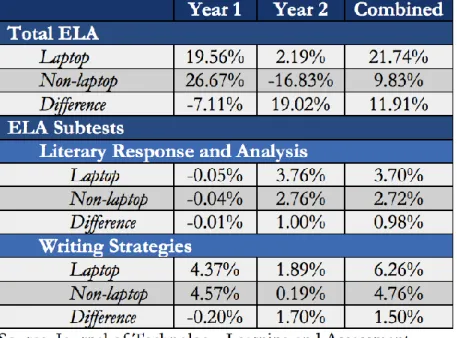
Research from Hanover Research Council from 2010, looked at the impact of 1-to-1 laptop initiatives on student achievement, particularly focusing on reading and writing areas and discovered significant progress in the students’ English Language Arts (ELA) scores. Figure 2 below shows greater improvement with students’ ELA scores for laptop students than non-laptop students.
Figure 2: Changes in ELA Scores: Laptop and Non-Laptop Groups
Figure 2: Adapted from the Journal of Technology, Learning and Assessment, p. 16, by Hanover Research Council, 2010.
Figure 2 shows during year one of the program, both laptop and non-laptop groups made improvements to their ELA scores. While in year two, the non-laptop group dropped by 17% and the laptop students increased only by 2%.
26
Role of the Teacher in the Use of Technology
Often teachers are not able to use technology for instruction much of the time because of other duties they have during instructional time. Individuals who are not in education may not realize there are numerous tasks a teacher must perform. According to Hooper and Rieber (1999), educators must include planning and implementing instruction, as well managing a group of people, meeting student psychological and social needs and motivating all students to put forth their best efforts. Teaching is an unreasonable, demanding and almost impossible job to do, without adding the demands of incorporating technology into instruction.
Teachers recognize the need for ongoing evaluations of student learning to refine and enhance the use of technology in the classroom. The technology consists of the designs and environments that engage learners. If used to engage students in meaningful learning, technology has the potential to transform education. To make technology a valuable tool, educators must make two things happen. First, the classroom must become a learning center and second, students and teachers work together in collaboration with technology for the purpose of creating a learning community (Hooper and Rieber, 1999).
Educators can attribute a significant increase in student achievement through the use of technology. Technology is more than hardware. It consists of creative lesson designs and environments that engage learners. If used to engage students in meaningful learning, the Internet has the potential to transform education. In the past, the teacher’s primary responsibility and activity has been directly instructing students, teachers as purveyors of knowledge and students, the recipients. The teachers taught what they knew and how they interpreted the world according to textbooks and other resources. Teachers are hired and
27
rewarded for their content expertise. Students would take notes on what teachers told them and tried to comprehend the world as their teachers described. Today, students should construct their own knowledge and meaning of the world. The teacher’s role is shifting from dispensing knowledge, to helping students create more viable conceptions of the world (Glatthorn et al., (2012).
Teachers must learn how to use technology themselves. They must gain skills and fluency with technology. Often, teachers will learn along with the students. Most teachers find these technology implications challenging. Just as teachers assume new roles in education, learning with technology requires students also assume new roles. For technology to be effective in the classroom, educators need to begin from the earliest starting point. Administrators can take a look at the school’s focus and teachers’ goals to evaluate technology needs in their classrooms. Benefits of technology in the classroom can assist educators with assessments, data-driven instruction, defined standards and a very powerful instructional management tool (Glatthorn et al., (2012).
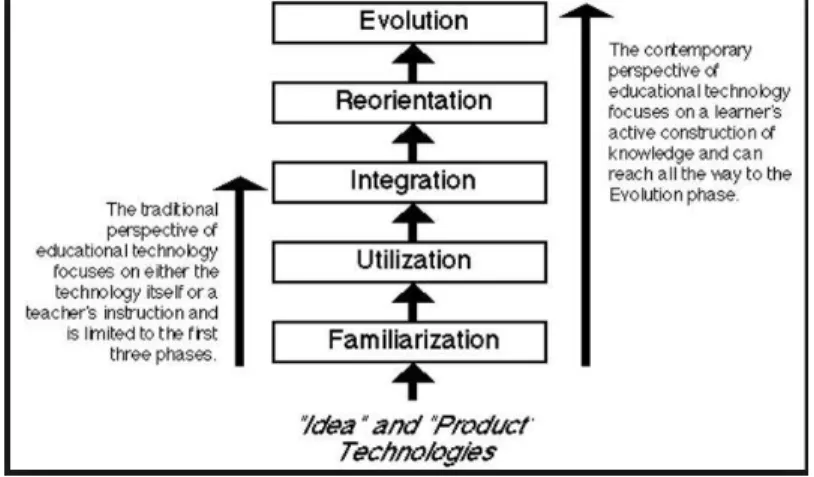
A model for adopting technology was designed for teachers to increase their use of technology in the classroom. Hooper and Rieber (1999) created the following model presented in Figure 3, as a resource for teachers to consider. The phases include Familiarization, Utilization and Evaluation. Phase one is Familiarization and it focuses on initial exposure to technology. The second phase is the Utilization Phase which is when a teacher tries out the technology in the classroom. The third phase, Evaluation Phase, serves as a reminder that the educational system must continue to adapt and evolve. Phase four focuses on the Integration Phase, the phase of adoption. Phase five is Reorientation and requires educators to find the purpose and function of the classroom. The final phase is
28
Evolution phase, which is the reminder of the educational system (Hooper and Rieber, 1995).
Figure 3: A model of adoption of both “idea” and “product” technologies in education.
Figure 3 Adapted from Teaching with Technology, pp. 154-170, by S. Hooper & L.P. Rieber, 1995.
Once educators have decided to take the next step to use technology in their instruction, they must decide what role technology will have in their classrooms. There are two main types of technology roles in education: product technologies and idea technologies. Hooper and Rieber (1995), explain that product technologies include hardware and machine-oriented technology such as audio-visual equipment, laptops, projectors, computer software, etc. Idea technologies include represented or product technology, such as giving the students experiences with the technology, taking a group project and using Google Documents to work to collaborate online. Other factors to consider for technology in education are the educational goals and outcomes that will be achieved with technology in the classroom and how technology can facilitate a more meaningful learning process (Hooper and Rieber, 1999).
Once a teacher decides on the role of technology in his or her classroom, some districts have found it appropriate to measure the teacher’s level of technology knowledge.
29
Some suggestions include planning staff development meetings to help faculty learn share ways to incorporate technology into the classroom and to see their knowledge of technology. By combining professional development that is targeted toward ways to help staff, participants can make connections between technology and the willingness to initiate the changes in their practices. According to Moersch (1998), creating a conceptual framework that measures the level of technology implementation in order for school districts to assist in achieving teacher skills in processed-based instruction, uses of technology and assessment.
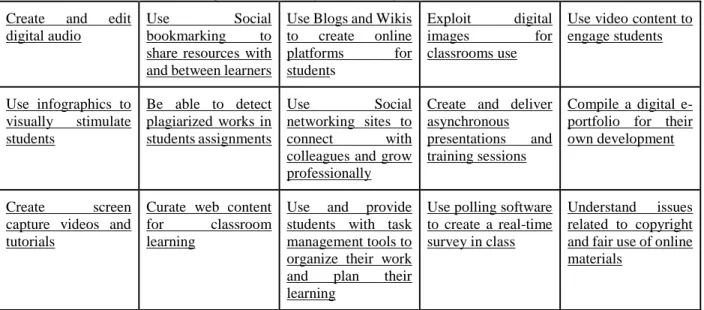
As computers and technology use in classrooms have grown over the years, there is an active interest in which technologies are employed in the classroom. Technology can motivate a wired generation of students and support educational needs of students in many ways. Teachers can incorporate technology by conducting online research, online videos, Podcasts, PowerPoint, interactive games, blogs, wikis, websites and infographics. The following skills have been established through technology as a resource on web tools in
Table 2: 20 Digital Skills Every 21st century Teacher Should Have
(Table 2) 20 Digital Skills Every 21st century Teacher Should Have
Create and edit digital audio
Use Social bookmarking to share resources with and between learners
Use Blogs and Wikis to create online platforms for students Exploit digital images for classrooms use
Use video content to engage students Use infographics to visually stimulate students Be able to detect plagiarized works in students assignments Use Social networking sites to connect with colleagues and grow professionally
Create and deliver asynchronous presentations and training sessions
Compile a digital e-portfolio for their own development
Create screen capture videos and tutorials
Curate web content for classroom learning
Use and provide students with task management tools to organize their work and plan their learning
Use polling software to create a real-time survey in class
Understand issues related to copyright and fair use of online materials
30
Use digital assessment tools to create quizzes
Find and evaluate authentic web based content
Use digital tools for time management purposes
Use note taking tools to share interesting content with your students
Use of online sticky notes to capture interesting ideas
http://www.educatorstechnology.com/2012/06/33-digital-skills-every-21st-century.html
According to Schacter (1999), who used a Meta-Analytic (a statistical approach to combine results from multiple studies) from results of more than 500 individual studies to draw the conclusion that there are positive and negative findings on student achievements:
Positive Findings:
● On average, students who used computer-based instruction scored at the 64 % on test performance compared to students in the control conditions without computers who scored at the 50 %
● Students learn more in less time when they receive computer-based instruction
● Students like their classes more and develop more positive attitudes when their classes include computer-based instruction
● Students in technology-rich environments showed increased achievement in preschool through higher education for both regular and special needs children
● Students’ attitudes toward learning and their self-concept improved consistently when computers used for instruction (Schacter, 1999, p. 4).
Negative Findings:
● Computers did not have positive effects in every area in which they studied
● The level of effectiveness of educational technology influenced by the particular student population, the software design, the educator’s role, and the degree of student access to the technology (Schacter, 1999, p.4).
Assistive Technology
According to Keengwe (2007), there has been a remarkable improvement in access and adoption of technology in preparing teachers to use assistive technology. But several reports have indicated that faculty members are not integrating technology into their instruction. In order to help faculty members, make decisions on student learning, there needs to be current knowledge of faculty integration practices. Keengwe (2007) examined
31
the relationship between faculty integration of technology into their classroom instruction and students understanding of the effects of technology to improve their learning. Faculty and students were surveyed to measure technology usage. Based on Keengwe’s (2007) survey, students needed direct instruction to learn how to use computer technology applications in the classroom. Faculty members need more professional development opportunities to infuse technology into instruction, such as webinars or in-services that focuses on technology programs that improve reading disabilities.
According to Bridges to Reading (2000), assistive technology is defined as any item, piece of equipment or system that helps people bypass, work around or compensate for learning disabilities. Assistive technology can be divided into two primary groups: hardware, which refers to equipment and software, which refers to programs that run on computers. The motivation behind assistive technology is to work around particular deficiencies, and support them. Assistive technology helps students with reading disabilities achieve their full potential and live enriching lives. According to Higgins and Raskind (2000), some examples of assistive technology can include reading machines that read books out loud and speech recognition systems. Assistive technology can help students work around their disabilities by focusing on their strengths rather than their weaknesses. Unfortunately reading disabilities are not cured and cannot be outgrown but with hard work and helpful tools such as technology, students with learning disabilities can learn how to compensate for them (Higgins and Raskind, 2000).
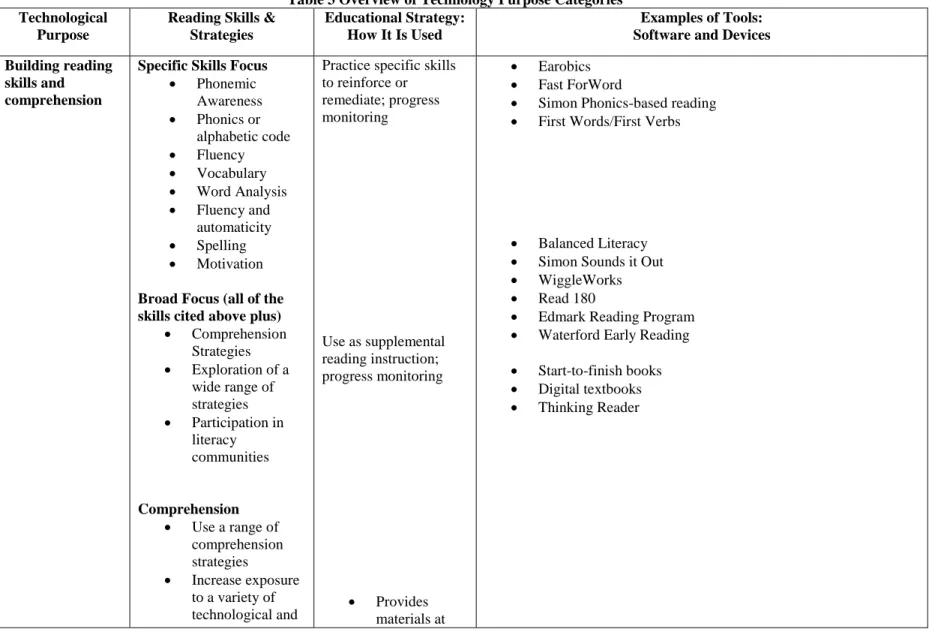
The National Center for Technology Innovation (2004) conducted a review of technology based approaches for Reading Instruction Tools, and identified six categories of technology uses that support students with reading disabilities (Silver-Pacuilla, Ruedel,
32
& Mistrett, 2004). The following table gives a general overview of the categories, the reading skills being exercised, educational strategies and products related to each category (Silver-Pacuilla, Ruedel, & Mistrett, 2004, p.16-17).
33
Table 3 Overview of Technology Purpose Categories Technological
Purpose
Reading Skills & Strategies
Educational Strategy: How It Is Used
Examples of Tools: Software and Devices Building reading
skills and comprehension
Specific Skills Focus Phonemic Awareness Phonics or alphabetic code Fluency Vocabulary Word Analysis Fluency and automaticity Spelling Motivation
Broad Focus (all of the skills cited above plus)
Comprehension Strategies Exploration of a wide range of strategies Participation in literacy communities Comprehension Use a range of comprehension strategies Increase exposure to a variety of technological and
Practice specific skills to reinforce or remediate; progress monitoring Use as supplemental reading instruction; progress monitoring Provides materials at Earobics Fast ForWord
Simon Phonics-based reading
First Words/First Verbs
Balanced Literacy
Simon Sounds it Out
WiggleWorks
Read 180
Edmark Reading Program
Waterford Early Reading
Start-to-finish books
Digital textbooks
34 informational resources Participate in literacy communities Engage in research different reading levels Embeds hyperlinks to additional information Probes, questions, elicits prediction and analysis Converting text to speech (TTS) Phonemic awareness Phonics or alphabetic code Fluency and automaticity Comprehension Exploration of a wide range of texts Engagement in research Increasing exposure to a variety of technological and informational resources Using language to accomplish their own purposes Read aloud any amount of text Highlight text as it is read aloud to support tracking Read and navigate the Internet Customize text presentation as it is read aloud
Simple Text (Apple)
Text Readers (ReadPlease, ScreenReader)
Talking word processors
Scan to Read programs (Kurzweil, WYNN, Read & Write Gold) Providing text in alternate formats Phonemic awareness Phonics or alphabetic code Fluency and automaticity Vocabulary Increase engagement with talking storybooks Combine text with symbols and pictures Living Books
Rebus Programs (Clicker4, News to You; Writing with Symbols)
Audio Supplements to Text (Read 180, Start to Finish)
Scan to Read programs
(Kurzweil, WYNN, Read & Write Gold)
35 Word analysis Comprehension Increasing exposure to a variety of technological and informational resources Participation in literacy communities Exploration of a wide range of texts Using a wide range of strategies Application of knowledge of language to create and critique text
Motivation (rebus software) Provide access todigital books and texts Convert print to speech
Text to Audio (CoolSpeech, Audible.com, Visual Thesaurus)
Providing electronic resources Phonics and alphabetic code Vocabulary Word analysis Comprehension Increasing exposure to a variety of technological and informational resources Motivation Immediate access to dictionary for pronunciation and meaning Online tools Portable reference tools Reading Pen Franklin devices On-Line resources
(libraryspot.com, Visual Thesaurus)
Organizing ideas Comprehension
Application of a wide range of strategies Arrange and easily rearrange ideas
Outline view in many word processors
Kidspiration/Inspiration
Viso
36
Application of knowledge of language to create and critique text
Increasing exposure to a variety of technological and informational resources Motivation Represent conceptual relationships Switch from diagram view to outline view Integrating literacy supports in a single application
Potentially all the skills and strategies cited above
E-Reading environment that converts TTS, manages e-books, including talking word processors and spell checkers with a range of embedded, at the ready supports
Kurzweil
WYNN
Read + Write Gold
eReader
37 Summary
Educational technology should not focus on how many computers are in the classroom, but rather on how they are used. A 21st century learning environment can better facilitate the integration of technology into a curriculum in order to have a positive effect on learning. The traditional classroom needs to be changed to an environment more conducive to engaged learning. Findings support that technology can be a vital resource that enhances student learning, if used appropriately. As with any new instructional methodology, questions arise on how to use it correctly, and teachers need to be trained in order to use it. Teachers also must generate quality lessons for technology to be successful. Training for teachers should be a priority before implementing technology into the classroom. The steps for implementation would suggest teachers use a device for themselves, to explore how to use the technology, and then be trained on using it in the classroom. Teachers then could take classes or professional development to meet their needs. Classes could be offered throughout the year for iPads, Chromebooks or other technology-driven hardware.
38
CHAPTER THREE: METHODOLOGY Introduction
The objective is to measure, examine and identify how the use of technology can support the academic achievement of middle school students with reading disabilities. As a mixed methods study; teachers, parents and students were surveyed on what technologies are being utilized in the classroom and at home as a support for student achievement. Analysis of the School District’s Educational Assessment data was used to measure achievement. The Standardized Test for the Assessment of Reading (STAR) assessment provided 2015-2016 scores regarding academic accomplishment of sixth grade students with reading disabilities. The technology that the school incorporated to help support students with reading disabilities was identified. The central research questions were developed based on the current literature review on the impact of technology on student academic achievements (Grinager, 2006). How does the use of technology enhance the academic achievement of middle school students with reading disabilities? What educational technology do reading teachers use in the classroom? What educational technology support do students have at home for their reading disabilities? Chapter three presents a detailed overview of the purpose, describes the research methods used and includes the research questions, population and sample, instrumentation, procedures and the data analysis.
Research Design
A mixed methods approach was selected to explore the use of technology as an enhancement for students with reading disabilities. Quantitative methodology was selected based on surveys to explore what technology was being used at school and home to support
39
students. This allowed a qualitative descriptive analysis. Three survey instruments were given to teachers, students and parents at the middle school level. The specific data collection instruments were created to support the research questions and purpose of the study. The qualitative data are coded by categories, such as beliefs on technology, comfort level with technology and use of technology. An observation matrix (Appendix H) was used to observe one sixth grade lower-level Language Arts class in order to determine what technology was available to teachers and students.
Description of Sample
The study examined institutional data from a suburban school district in St. Louis County, Missouri, regional area. This premier school district includes high student achievement, outstanding teachers and staff and a great community. The district’s mission is stated as doing whatever it takes to ensure all students realize their potential. According to the 2016 U.S. News the district’s high school is ranked number five in the state of Missouri. The study was conducted with students with sixth grade students, who have reading disabilities and their reading achievement scores during the 2016 academic year, from September through November.
Sample
The data set included reading achievement data for middle school students enrolled in the academic year 2015 to 2016. One middle school with enrollment of 740 students 232 sixth grade students, 237 seventh grade students and 253 8th grade students was chosen. The demographics of this school includes 9.7% Asian, 9.5% Black, 2.4% Hispanic and 76.6 % White. The average daily attendance rate was 95.9%, with 17.2 % students eligible for free, or reduced price meals. The ratio of students to regular classroom teachers was
40
14-to-1. The average years of teacher experience was 13.4 years, with 100% of certified teachers, 70% of the teachers hold advanced degrees. The district has 19 elementary schools, six middle schools, four high schools, two early childhood locations and a gifted program. The population studied was 50 students with reading disabilities in one middle school. Parents of the students and 30 teachers participated in the research. The criteria for selection was that the students were in grade six with a reading disability.
Sampling Procedure
The number of subjects including teachers, parents, and students participated in the survey, for a total of 75-100 participants. A total of 50 students, 30 teachers and 15 parents participated in the surveys. The 30 teachers that participated consisted of language arts, science, social studies, math, elective teachers and special school district teachers. The study was conducted during the months of September of 2016 through November of 2016. All the student participants were from a single language arts teacher who worked with lower-level reading students. The language arts teacher emailed the parents and students the surveys that took 10 minutes to complete online. The school principal emailed the teacher surveys to 30, teachers who completed a 20-minute survey online. There were no anticipated risks to the subjects associated with this research. Subject of participation was voluntary. All of the survey data will be kept confidential to protect the identity of the participants. The data that were collected from this study was stored in a file with the researcher and was destroyed after the study. No personal information of the participants was obtained.
41
Instrumentation
The precise data for analysis was the Educational Technology Assessment data from 2016-2017 school year. The instruments used included a review of all the technology used in the classroom, student reading scores (STAR), observation of the sixth-grade classroom technology usage and Likert scale surveys. All the tools were made with the purpose of addressing any issues of reliability and validity. Three different types of surveys, including a consent form, associated with the use of technology and student’s academic achievement was developed. There were a number of interesting questions that were created for the teachers, parents and student surveys. Questions from the survey were sorted into categories: teacher background information, student technology use, teacher technology use, technology leadership, technology beliefs, digital learning and web 2.0 and technology support.
Three instruments were used to measure possible effects of the use of technology: Instrument 1: Teacher Survey (22 questions) Appendix F,
Instrument 2: Parent Survey (24 questions) Appendix E, and Instrument 3: Student Survey (11 questions) Appendix G.
The first was a survey for teachers who work with reading impaired students, and two additional questionnaires one for parents and one for learners who are affected by a reading disability. The surveys were administered to teachers, parents and students during the school year of 2016-2017. Google Forms was used for creating the survey instrument. The web-based survey tool incorporated questions that related to all three surveys. The Likert scale surveys provided data from the teachers, parents, and students. The teacher’s 22- open ended question survey included categories such as teacher demographics, student technology use, technology leadership, technology beliefs, digital learning, web 2.0 and
42
technology support. The parent’s 24-question survey included the following categories demographics, technology use in home, student technology use, and reading tools. The students 11-question survey included background, technology in the home, student technology use, and technology as reading tools.
Data Collection Procedures
Before beginning data collection, the project was approved by the University of Missouri-St. Louis graduate school and Innovative Solutions for Compliance and Research Management (IRB) committee. The participants and the school used were assured that their participation was voluntary and confidential. The data collection began during the months of September 2016 through December 2016.
The surveys were released electronically to respondents in September 2016 and were due by November 2016. The middle school's principal, selected a language arts teacher to distribute the surveys electronically to the students with low reading scores. The language arts teacher worked in a classroom within a classroom, in sixth grade. Each class that this teacher worked with consisted of sixth grade level students and has four sections at each grade level. The language arts teacher holds a certification in language arts and is additionally certified as a reading specialist. The language arts teacher works particularly with students who have below average reading and writing skills. Within the classroom, there is another teacher assigned to work as a team with the language arts teacher, helping the students improve their reading and writing levels. This second teacher is certified in special education and who works with students with special needs or disabilities. Every student in this classroom setting has an Individualized Educational Plan (IEP) specifically due to low reading scores or writing skills. A typical class can involve the same grade
43
level students, all at the same reading levels, in a small classroom environment, with only 12-15 students per class working with two teachers. The two teachers continue to work with the students during the year to improve their reading and writing levels.
To ensure diminutive burden on the respondents, the survey lasted 20 minutes per contributor using a Likert scale instrumentation. The reported data was compiled and made available to the district and the middle school. The students’ reading scores from the school year 2015-2016 was used to determine the students to participate in the survey.
The recruitment and informed consent process began in August-October 2016 with the teachers and parents. During this time frame, participants took the online survey at home for parents and at school for teachers and students. After the consent forms were signed and collected by the principal, he then emailed the teachers their survey. A total of 30 teachers volunteered to take the survey, which included language arts, science, social studies, math and special school district teachers. Once the surveys were taken, the results were sent to the researcher via a web tool. The language arts teacher emailed the consent forms and collected the forms from the parents and students who participated in the surveys and returned the signed consent forms to the researcher. The results from the parents and students who participated were instantly sent to the researcher via the web tool that was used for the surveys.
Once the consent forms were signed by both the parents and students, the language arts teacher distributed the surveys via email. A total of 50 sixth grade students participated in the survey. Parent participation was lower than expected. The students took the surveys starting in September of 2016 in a classroom setting at the school. The principal selected the students who are identified as struggling readers based on the presence of an IEP. The