DOCUMENTOS DE TRABAJO
BILTOKI
Facultad de Ciencias Econ ´omicas. Avda. Lehendakari Aguirre, 83
48015 BILBAO.
D.T. 2005.01
A two-stage stochastic integer programming approach .
Documento de Trabajo BILTOKI DT2005.01
Editado por el Departamento de Econom´ıa Aplicada III (Econometr´ıa y Estad´ıstica)
de la Universidad del Pa´ıs Vasco.
Dep´osito Legal No.: BI-292-05
ISSN: 1134-8984
A two-stage stochastic integer programming approach
as a mixture of Branch-and-Fix Coordination and
Benders Decomposition schemes
L.F. Escudero1, A. Gar´ın∗2, M. Merino∗3 and G. P´erez∗4
1Centro de Investigaci´on Operativa
Universidad Miguel Hern´andez, Elche (Alicante), Spain e-mail: [email protected]
2Dpto. de Econom´ıa Aplicada III
Universidad del Pa´ıs Vasco, Bilbao (Vizcaya), Spain e-mail: [email protected]
3Dpto. de Matem´atica Aplicada, Estad´ıstica e Investigaci´on Operativa
Universidad del Pa´ıs Vasco, Bilbao (Vizcaya), Spain e-mail: [email protected]
4Dpto. de Matem´atica Aplicada, Estad´ıstica e Investigaci´on Operativa
Universidad del Pa´ıs Vasco, Leioa (Vizcaya), Spain e-mail: [email protected]
Abstract
We present an algorithmic approach for solving two-stage stochastic mixed 0-1 prob-lems. The first stage constraints of the Deterministic Equivalent Model have 0–1 vari-ables and continuous varivari-ables. The approach uses theTwin Node Family(TNF) concept within the algorithmic framework so-called Branch-and-Fix Coordination for satisfying thenonanticipativityconstraints, jointly with a Benders Decomposition scheme for solv-ing a given LP model at each TNFinteger set. As an illustrative case, the structuring of a portfolio of Mortgage-Backed Securities under uncertainty in the interest rate path along a given time horizon is used. Some computational experience is reported.
Keywords: Two-stage integer programming, Benders decomposition, nonanticipativ-ity constraints, splitting variables, twin node family, branch-and-fix coordination, MBS portfolio structuring.
* This research has been partially support by the grant Grupo consolidado de alto rendimiento 9/UPV 00038.321-13631/2001 from UPV, the project MEC2001-0636 from the DGCIT, the Researchers’ Education grant program 2000 from Gobierno Vasco, and the grant GRUPOS79/04 from the Generalitat Valenciana, Spain.
Introduction
Very frequently, mainly in problems with a given time horizon to exploit, some coefficients in the objective function and the right–hand–side (rhs, for short) vector and in, a lesser extend, the constraint matrix are not known with certainty when the decisions are to be made, but some information is available. This circumstance allows to use Stochastic Integer Programming (SIP) for solving (mixed) 0–1 programs under uncertainty. It has a broad application field, mainly, in production planning (Mirhassani et al. (2000), Klein Haneveld & van der Vlerk (2001), Ahmed et al. (2003), Alonso-Ayuso et al. (2003b,c, 2004, 2005) and Lulli & Sen (2004)), energy generation planning (Takriti & Birge (2000), Gr¨owe-Kuska et al. (2001), Hemmecke & Schultz (2001), Klein Haneveld & van der Vlerk (2001), Nowak et al. (2002), N¨urnberg & R¨omisch (2002) and Triki et al. (2005)) and finance (Cohen & Thore (1970), Crane (1971), Mulvey & Vladimirou (1992), Zenios (1995a), Cari˜no & Ziemba (1998), Ziemba & Mulvey (1998), Fleten et al. (2002), Kusy & Ziemba (2002)), among others (Uryasev & Pardalos (2001), Laporte & Louveaux (2002), Maatan et al. (2002) and Wallace & Ziemba (2005)) and, specially, see the books Jarrow et al. (1995), Zenios (1995b), Ziemba & Mulvey (1998) and Scherer (2003) devoted to financial management. See also Schultz (2003). The main focus and contribution of the paper is on the design and computational as-sessment of a Branch-and-Fix Coordination (BFC) scheme for obtaining the optimal mixed 0–1 solution to the two-stage stochastic program, where the parameters’ uncertainty is rep-resented by a set of scenarios. An important feature of our approach with respect to some other approaches for two-stage SIPis that it addresses the problemwhere 0–1 variables and continuous variables have nonzero elements in the first stage constraints. The difficulty in the algorithmic approach is very much increased by having the continuous variables in the first stage constraints. The special structure of the Deterministic Equivalent Model (DEM) is exploited. The relaxation of thenonanticipativity constraints of the first stage variables allows for the independent solution of the so–called scenario cluster-related problems. The constraints related to the 0–1 variables are satisfied by using a scheme that is based on the Twin Node Family(TNF) concept introduced in Alonso-Ayuso et al. (2003a,c). The scheme is specifically designed for coordinating the node branching selection and pruning and the 0–1 variable branching selection and fixing at each Branch-and-Fix(BF) tree.
Additionally, the proposed approach considers thecompactrepresentation of theDEMat eachTNFinteger set. By fixing those variables to the nodes’ values, theDEMhas only con-tinuous variables. By exploiting the remaining model’s structure, a Benders Decomposition allows thenonanticipativity constraints on the first stage continuous variables to be satisfied and, so, obtaining theLPoptimal solution for the givenTNFinteger set. The conditions for pruning aTNFare stated.
Given a time horizon, a set of available securities and an available budget for investment, theMortgage-Backed Securities Portfolio Structuring Problem(MBSPSP) is concerned with determining the subset of securities that will be included in the portfolio as well as determining the fraction of the face value to consider for each security, under uncertainty in the interest rate path along the time horizon. The problem of concern can be viewed as the problem considered in Escudero (1995), see also Zenios (1993), but forcing an upper bound on the number of securities to include in the portfolio and requiring a conditional minimum on the face value for each security, among other types of constraints for structuring the portfolio.
The problem can be treated as a two-stage stochastic mixed 0–1 model. The first stage constraints in the problemhave the 0–1 variables for determining the securities to include in the portfolio, and the continuous variables for determining the fraction of the related face value to consider. The second stage constraints have only continuous variables under each scenario, for determining the net available cash at the so-called dedicated time periods and for representing certain types of mismatchings related to durations and present values. So, theMBSPSP can be considered as an illustrative case for the computational assessment of our approach for two-stage SIPproblem solving. Some computational experience is reported to compare the quality of the solution obtained by our approach and the optimization of the average scenario problem. A comparison is also performed with solving the DEMby a plain use of a state-of-the-art optimization engine.
The remainder of the paper is organized as follows. Section 1 states theMBSPSP. Section 2 presents the m ixed 0-1 DEM. Section 3 presents the TNF based BFC algorithmic frame-work for problemsolving. Section 4 presents an illustrative case. Section 5 reports on the computational results. Section 6 concludes.
1
Problem statement
Let a security be defined as an asset that entitles the holder to a return along a time horizon. In our case, the asset is a financial right included by a principal and a yield backed by a mortgage (so, it is calledMortgage-Backed Security, for shortMBS), whose principal can be prepaid and even delayed. So, each security (e.g., a loan) to consider for being included in the portfolio should have the following features: principal’s amortization structure up to its maturity period; (usually adjustable) yield to be paid over time; partial or full potential prepayment, such that the prepayment of a security will affect its duration and the cashflow to generate; potential delay of the principal’s amortization; and type of risk measured by the interest rate weighting factor, the so-calledOption Adjusted Spread (OAS).
The OAS is used to weight the discount rate for obtaining the present value of a given security. It can be interpreted as the implied risk penalty for a particular security, see Hayre & Lauterbach (1991) and Ben-Dov et al. (1992), among others. Note: The value 0 (resp., 1) means a neutral factor for anadditive (resp.,multiplicative) scheme, see below.
TheMBSsecuritization consists of structuring a portfolio froma set of available securities. The problemof concern consists of the MBS securitization under the uncertainty in the interest rate path along a given time horizon, which implies uncertainty in the securities’ yield, prepayment and payment delay. As we said above, the uncertainty is represented by a set of scenarios. One characteristic of our problemis the need to resort to an integer formulation (rather than using only continuous variables). That need is motivated by the problem’s requirements related to the maximum number of securities to include in the portfolio, the MBS face value conditional minimum, the exclusivity and implicative constraints in the portfolio, etc.
There are three important issues that have not been considered in the paper, namely, the recursive contingent claimoption (Dunn & McConnell (1981) and Schwartz & Torous (1989)), the transaction costs on exercising the options, (Stanton (1995) and Longstaff (2004)) and the heterogeneity among mortgage borrowers for determining theMBSs(Deng et al. (2000)).
Although important issues, they are not crucial for assessing the performance of the proposed algorithmic approach for optimizing two-stage SIPproblems.
A feasible structuring of a portfolio requires two types of constraints to be satisfied, namely: (a) first stage constraints that force some types of relationships among the securities, e.g., upper bound on the number of securities to be included in the portfolio, investment budget for the securities’ total face value, equilibriumin the total face value of the different types of securities, exclusivity and implicative relationships among those types, etc.; and (b) second stage constraints for basically analyzing the performance of the securities’ portfolio along the time horizon over the scenarios. Typical constraints are the portfolio’s cashflow balance equation including the cash inflow and outflow due to the liabilities’ satisfaction for each dedicated time period under any scenario, the lower and upper bounds for the net available cash in those periods under any scenario, the requirement that the present value of the portfolio is not smaller than the present value of the liabilities under any scenario, the requirement that the absolute mismatchings of the unit durations and the present values of theMBS in the portfolio and the set of securities where it is taken fromare not greater than given thresholds, etc.
There are different types of goals. Thescenario trackingthrough the minimization of the expected difference between the MBS portfolio’s and liabilities’ duration mismatching and the optimal related mismatching under any scenario is treated in Escudero (1995). However, we consider the minimization of the expected absolute mismatching of the durations of the MBS portfolio and the liabilities over the scenarios. It is another approach for hedging the investment’s return against small changes in the interest rate along the time horizon, for given portfolio management fees and others.
The notation to be used through the paper is as follows. Sets:
I, set of available securities.
T, set of time periods.
Ω, set of scenarios to represent the uncertainty. Deterministic parameters:
b1, maximum number of securities that are allowed in theMBS portfolio to structure. b2, right-hand-side vector for the subsystemof constraints for the 0-1 variablesδi,i∈ I. A2, constraint matrix for the subsystem of constraints for the 0-1 variablesδi,i∈ I. b3, available investment’s budget at time period 0 to create theMBS portfolio.
h, investment’s net unit return (including management fees) from the investmentb3 as a target to reach for each so-called dedicated time period.
αt, investment’s amortization considered for time periodt, for t∈ T, such that b3 =
t∈T
ϕt, liability to be satisfied at (the end of) dedicated time periodt, for t∈ T. It can be expressed as
ϕt=αt+h
τ∈T:τ≥t
ατ. (2)
, latest dedicated time period where the cash inflow from the portfolio is committed to satisfy the liabilities, for ∈ T.
σ, σ, unit lower and upper bounds of the investment’s face value that is allowed to be kept in cash at any dedicated time period, respectively.
st, st, lower and upper bounds of available cash at dedicated time periodt, respectively, fort= 1, . . . , , such that
st=σ τ∈T:τ >t ατ (3) st=σ τ∈T:τ >t ατ. (4)
fi, principal (face) value of security i, fori∈ I.
xi, xi, conditional lower and upper bounds of the principal (face) value out of fi for security ito be included in theMBS portfolio, respectively, fori∈ I.
ti, maturity period for securityi(i.e., last period where any payment has been planned). Note: ti ∈ T,∀i∈ I.
ait, unit principal’s amortization of security i at (the end of) time period t, for t = 1, . . . , ti, i∈ I.
Ait, cumulated unit principal’s amortization of security i at time period t, for t = 1, . . . , ti, i∈ I, such that
Ait=
τ=1,...,t
aiτ, (5)
so that Ait= 1 for t=ti.
cξi, extra interest rate to charge for each time period with payment delay in securityi, fori∈ I.
oi, OASassigned to securityi, for 0≤oi, i∈ I.
τ, maximum number of time periods where a principal’s amortization payment can be delayed for any security. Note: τ ≤ |T | −ti, i∈ I.
Uncertain and scenario related parameters:
wω, weight factor assigned to scenarioω, for ω∈Ω, such that
ω∈Ωwω = 1.
rωt, interest rate at time periodtunder scenarioω, for t∈ T, ω∈Ω. The scenarios for the interest rate path along the time horizon can be generated from the binomial lattice approach given in Black et al. (1990) as it is done in Zenios (1993). See other schemes in Frauendorfer & Sch¨urle (1998) and Mulvey & Thorlacius (1998). An application of the so-called contamination technique (Dupacova (1986)) is presented in Dupacova et al. (1998) for the analysis of the influence of additional scenarios to a given sample in
bond portfolio management. The stochastic decomposition method for dealing with two-stage stochastic programs via sampling is described in Higle & Sen (1996). See in Kleywegt et al. (2001) and Ahmed & Shapiro (2002) some approaches for approximating the underlying two-stage stochastic program with integer recourse via sampling, among other approaches for dealing with the size of the scenario set. See in Dupacova et al. (2003) an approach for scenario reduction.
cωit, unit yield of security i at (the end of) time period t under scenario ω. It is a function of the interest rate rωt and the own security under scenarioω, fort= 1, . . . , ti, i∈ I, ω∈Ω. Notice thatrω1 =r1, where r1 is the interest rate at timet= 1.
βω
it, (partial or full) prepayment of the cumulated unit principal’s amortization of
secu-rity i at time periodtunder scenarioω, fort= 1, . . . , ti, i∈ I, ω∈Ω. It is a function of the security, the age of the security, the month of the year and the interest rate at the given period. The function is usually obtained by statistical means. However, see in Kang & Zenios (1992) some complete prepayment models.
κωitτ, unit payment delay in τ time periods of the principal’s amortization of security i that is due at time period t under scenario ω, for τ=1,...,τ κωitτ ≤ ait, t= 1, . . . , ti, τ = 1, . . . , τ , i∈ I, ω ∈Ω. It is a function of the security, the month of the year, the number of delay periods and the interest rate at the given time period.
eωit, net unit principal amortization of securityiat time periodtplus interest payments due to principal delays. It can be expressed as
eωit = ait[1− t−1 j=1 βijω −(1 +cωit) τ τ=1 κωitτ] + τ:1≤t−τ≤τ
aiτ[1 + (t−τ)(cωiτ +cξi)]κωiτ(t−τ)
(6)
γitω, unit return fromsecurityiat time periodt under scenario ω, fort= 1, . . . , ti+τ , i∈ I, ω∈Ω. Under mild assumptions, it can be expressed as
γitω =eωit+βitωAit+1+cωitAit 1− t−1 j=1 βijω . (7)
Γωi, unit return’s present value of security iunder scenarioω, for i∈ I, ω∈Ω. It can be expressed as Γωi = t=1,...,ti γitω τ=1,...,t (1 +oi·rωτ)−1. (8) Note that oi has been used as a multiplicative factor of rωτ and, then, the zero-value is not allowed. However, it is allowed when the OAS is used as an additive factor, see Zenios (1991). Notice that the greater the risk penalty OASoi is, the smaller the present value Γi is,∀i∈ I.
dω
i, change in the unit present value of the return of security i due to a small change
in the interest rate along the time horizon under scenario ω, for i∈ I, ω∈ Ω. It can be expressed as dωi =−(1/Γωi) t=1,...,ti t·γitω·oi τ=1,...,t (1 +oi·rωτ)−1. (9)
Note: |dωi| is the so-called modified Macaulay duration for a flat interest rate along a time horizon.
Φω, present value of the liabilities under scenario ω, forω ∈Ω. It can be expressed as Φω=
t∈T
ϕt
τ=1,...,t
(1 +rωτ)−1. (10)
dω, change in the unit present value of the liabilities due to a small change in the interest rate along the time horizon under scenario ω, for ω ∈Ω. It can be expressed as dω =−(1/Φω) t∈T t·ϕt τ=1,...,t (1 +rτω)−1. (11)
Additional deterministic parameters:
z, upper bound on the absolute difference between the unit duration of theMBS port-folio to structure and the unit duration of the available set of securities I.
v, upper bound on the absolute difference between the unit present value of the MBS portfolio to structure and the unit present value of the available set of securities I. Note. The parameters z and v allow some slackness in the representation of the MBS portfolio with respect to the available set of securities.
Structuring variables. They are 0–1 variables, such that δi =
1, if securityiis selected for the MBSportfolio to structure
0, otherwise. ∀i∈ I
Face value variables. They are continuous variables, such that
xi, principal (face) value out of fi for security ithat is included in the MBS portfolio, where xi ≤xi ≤xi forδi = 1 and, otherwise, it is zero, fori∈ I.
Performance variables. They are continuous variables, such that
sωt, cash availability at (the end of) dedicated time period t under scenario ω, for t= 1, . . . , , ω ∈Ω.
yω, free variable to take the (positive or negative) difference of the MBS portfolio’s
duration and the liabilities’ duration under scenario ω, for ω∈Ω.
zω, free variable to take the (positive or negative) difference of the unit durations of the MBSportfolio and the set of available securities I under scenarioω, for ω∈Ω. vω, free variable to take the (positive or negative) difference of the unit present values of the MBS portfolio and the set of available securities I under scenario ω, for ω∈Ω.
2
Mixed 0-1 Deterministic Equivalent Model (
DEM
)
The goal is to structure the MBS portfolio (i.e., obtaining xi, i ∈ I) to dedicate cash availability to satisfy the liabilities for the given set of dedicated time periods, and to protect the investment (liabilities) present value, such that a set of constraints should be satisfied by the portfolio.
The following is acompactrepresentation of the mixed 0–1DEMfor the two-stage stochas-tic MBSPSPwith complete recourse.
Objective: Minimizing the expected duration mismatching of the MBS portfolio and the liabilities over the scenarios, subject to the constraints (13)–(25).
ZIP = m in ω∈Ω wω|yω| (12) Constraints: i∈I δi ≤b1 (13) A2δ =b2 (14) δi ∈ {0,1} ∀i∈ I (15) xiδi ≤xi ≤xiδi ∀i∈ I (16) i∈I xi =b3 (17) i∈I Γωixi ≥Φω ∀ω∈Ω (18) (1 +rtω)sωt−1+ i∈I γitωxi =ϕt+sωt ∀t= 1, . . . , , ω∈Ω (19) st≤sωt ≤st ∀t= 1, . . . , , ω∈Ω (20) i∈I dωixi−dωΦω=yω ∀ω∈Ω (21) i∈I dωixi /b3− i∈I dωi fi / i∈I fi=zω ∀ω∈Ω (22) |zω| ≤z ∀ω∈Ω (23) i∈I Γωixi/b3− i∈I Γωifi/ i∈I fi=vω ∀ω∈Ω (24) |vω| ≤v ∀ω∈Ω. (25) The constraint system(13)-(25) has three different subsystems. The subsystem(13)-(17) is included by the first stage constraints, for structuring the MBS portfolio by considering all the scenarios via the other subsystems but without being subordinated to any of them in particular. The subsystem (18)-(20) basically protects the investment and forces some constraints for each dedicated time period under each scenario. The subsystem (22)-(25) forces the representativeness of the portfolio under each scenario.
Constraint (13) bounds above the number of securities in theMBS portfolio to structure. The system (14) imposes exclusivity and implicative constraints in theMBSportfolio for the 0–1 variablesδi,fori∈ I.
Constraints (16) define the semi-continuous character of the x–variables, such that no investment in any security can have a greater weight in the portfolio than a given value, and no security can have a face value smaller than a given bound, if any.
Constraint (17) forces the total investment in the portfolio to a given budget.
Constraint (18) protects the investment in the sense that the present value of the MBS portfolio cannot be smaller than the liabilities’ present value under any scenario.
Constraints (19)-(20) give the balance equations for the cashflow at the dedicated time periods, such that the return of the investment’s amortization and yield as well as the man-agement fees are guaranteed under any scenario. It is assumed that the available cash is short-time invested in a risk free environment and, in any case, it is bounded below and above by given values.
Constraint (21) gives the duration balance equations of theMBS portfolio and the liabil-ities under each scenario. The goal is precisely the minimization of the expected difference in the durations.
The constraint system(22)-(25) forces the representativeness of the MBS portfolio with respect to the set of available securities I, as measured by the unit duration and the unit present value under any scenario. It allows some upper bounds in the related differences.
Consider thecompact representation of the mixed 0–1DEM (12)-(25). ZIP = m in ω∈Ω wω|yω| s.t. e δ ≤ b1 A2 δ = b2 δ∈ {0,1}n −Ixδ +Ixx ≤ 0 −Ixδ +Ixx ≥ 0 e x = b3 aω4 x ≥ bω4 ∀ω∈Ω A5ωx +Bωsω = b5 ∀ω∈Ω s≤ Issω ≤ s ∀ω∈Ω aω6x +yω = bω6 ∀ω∈Ω aω7x +zω = bω7 ∀ω∈Ω |zω| ≤ z ∀ω∈Ω aω8x +vω = bω8 ∀ω∈Ω |vω| ≤ v ∀ω ∈Ω, (26)
where the additional notation is as follows: n=|I|,bω4,bω6,bω7 and bω8 are the right-hand-side (for short, rhs) parameters for the second stage constraints under scenario ω;b5 is the rhs vector of the parameters for the cashflow balance equations; e is the unit row vector; Ix andIx are the diagonal matrices whose diagonal vectors are the conditional lower and upper bounds of the x–variables, respectively; Ix and Is are the unit diagonal matrices for thex–
andsω–variables, respectively,aω4,a6ω,aω7 andaω8 are the constraint row vectors related to the x–variables for the second stage constraints; Aω5 and Bω are the constraint matrices related to thex– andsω–variables for the second stage constraints under scenarioω, respectively, for ω∈Ω; and the pair (s,s) gives the vectors of the lower and upper bounds for thesω–variables. Thecompactrepresentation (26) can be transformed in asplitting variablerepresentation, such that the variablesδi andxi are replaced withδiω andxωi, respectively,∀ω∈Ω, i∈ I.So, there is a model for each scenarioω∈Ω, but they are linked by the so-callednonanticipativity constraints
δωi −δωi = 0 (27)
xωi −xωi = 0, (28)
∀i∈ I, ω, ω ∈Ω :ω=ω.Then, the splitting variablerepresentation is as follows,
ZIP = m in ω∈Ω wω|yω| s.t. e δω ≤ b1 ∀ω∈Ω A2 δω = b2 ∀ω∈Ω δω ∈ {0,1}n ∀ω∈Ω −Ixδω +Ixxω ≤ 0 ∀ω∈Ω −Ixδω +Ixxω ≥ 0 ∀ω∈Ω e xω = b3 ∀ω∈Ω aω4 xω ≥ bω4 ∀ω∈Ω A5ωxω +Bωsω = b5 ∀ω∈Ω s≤ Is sω ≤ s ∀ω∈Ω aω6xω +yω = bω6 ∀ω∈Ω aω7xω +zω = bω7 ∀ω∈Ω |zω| ≤ z ∀ω∈Ω aω8xω +vω = bω8 ∀ω∈Ω |vω| ≤ v ∀ω∈Ω δω−δω = 0 ∀ω, ω ∈Ω :ω=ω xω−xω = 0 ∀ω, ω∈Ω :ω =ω. (29)
Notice that the dualization (or, for the matter, the relaxation) of the constraints (27) and (28) fromthe model (29) results in|Ω|independent mixed 0–1 models. For solving the original model (29), we propose to execute a so-called Branch-and-Fix Coordination (BFC) schem e for each of the scenario-related models to ensure the integrality condition on theδ–variables, such that the nonanticipativity constraints (27) are satisfied while selecting the branching nodes and the branching variables. For this purpose the so-called Twin Node Family (TNF) concept introduced in Alonso-Ayuso et al. (2003a,c) is used. Additionally, the proposed approach optimizes the LPmodel that results from the model (26) at each TNFinteger set, so that the nonanticipativity constraints (28) are also satisfied, see below.
3
Branch-and-Fix Coordination algorithmic framework
3.1 BFC methodology
The scenario-related model for ω ∈ Ω that results fromthe relaxation of the nonantici-pativityconstraints (27) and (28) in model (29) can be expressed as follows,
ZIPω = m in|yω| s.t. e δω ≤ b1 A2 δω = b2 δω ∈ {0,1}n −Ixδω +Ixxω ≤ 0 −Ixδω +Ixxω ≥ 0 e xω = b3 aω4 xω ≥ bω4 A5ωxω +Bωsω = b5 s≤ Issω ≤ s aω6xω +yω = bω6 aω7xω +zω = bω7 |zω| ≤ z aω 8xω +vω = bω8 |vω| ≤ v. (30)
Instead of obtaining independently the optimal solution of the programs (30), we propose a specialization of the BFC approach, see Alonso-Ayuso et al. (2003a,c). It is specially designed to coordinate the selection of the branching node and branching variable for each scenario-relatedBranch-and-Fix(BF) tree, such that the relaxed constraints (27) are satisfied when fixing the appropriate variables to either one or zero. The approach also coordinates and reinforces the scenario-relatedBFnode pruning, the variable fixing and the objective function bounding of the subproblems attached to the nodes. See similar decomposition approaches in Carøe & Schultz (1999), Hemmecke & Schultz (2001), Klein Haneveld & van der Vlerk (2001), R¨omisch & Schultz (2001), and Nowak et al. (2002), among others. However, those approaches focus more on using a Lagrangian relaxation of the constraints (27) to obtain good lower bounds, and less on branching and variable fixing. In any case, Lagrangian relaxation schemes can be added on top. See also Schultz (2003).
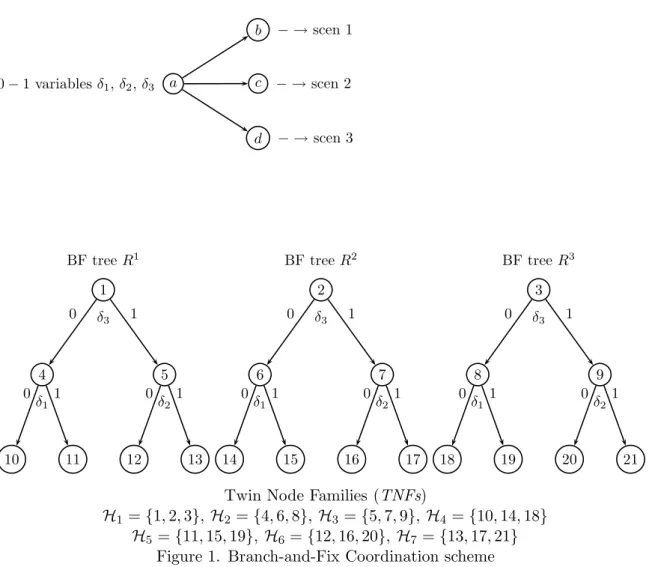
For the specialization of the BFC approach to solving problem(29), let Rω denote the BF tree associated with scenario ω, and Gω the set of active nodes in Rω, ω ∈Ω. Any two active nodes, say, g ∈ Gω and g ∈ Gω are said to betwin nodes if either they are the root nodes or the paths fromtheroot nodes to each of themin their own BF trees Rω and Rω, respectively, have branched on or fixed to the same 0–1 values for the same variablesδiω and δωi,for ω, ω ∈ Ω, i∈ I. A Twin Node Family (TNF), say, Hf is a set of nodes, such that any one is atwin node to all the other members of the family, for f ∈ F, whereF is the set
0−1 variablesδ1,δ2,δ3 a b − →scen 1 c − →scen 2 d − →scen 3 1 δ3 BF tree R1 4 δ1 0 10 0 11 1 5 δ2 1 12 0 13 1 2 δ3 BF treeR2 6 δ1 0 14 0 15 1 7 δ2 1 16 0 17 1 3 δ3 BF treeR3 8 δ1 0 18 0 19 1 9 δ2 1 20 0 21 1
Twin Node Families (TNFs)
H1 ={1,2,3},H2 ={4,6,8},H3 ={5,7,9},H4 ={10,14,18}
H5={11,15,19},H6 ={12,16,20}, H7={13,17,21}
Figure 1. Branch-and-Fix Coordination scheme
of TNFs. Note that g, g ∈ Hf for any family f ∈ F implies that ω = ω for g ∈ Gω and g ∈ Gω, ω, ω ∈ Ω. A TNF integer set is a a set of integer BF nodes, one per each tree, where thenonanticipativity constraints (27) of the 0–1 variables are satisfied.
Let us consider the scenario tree and the BFtrees shown in Figure 1, where δi gives the generic notation for the variables δiω, ∀ω ∈Ω. Notice that the first TNFto be used is H1. Based on the LP optimal solution of the models (30) attached to the nodes in H1, let us assume that the selected branching variable isδ3 and, so, the nodes 4 and 5,6 and 7,and 8 and 9 are created. The newTNFs areH2= (4,6,8) andH3 = (5,7,9), and so forth.
It is clear that the relaxation of the nonanticipativity constraints (27) is not required for all pairs of scenarios in order to obtain computational efficiency. So, the number of scenarios to consider in a given model basically depends on the dimensions of the scenario related model (30) (i.e, the parameters |I| and ti,∀i∈ I). The criterion for scenario clustering in the sets, say, Ω1, . . . ,Ωq, whereq is the number ofclustersto consider, could be alternatively based on the smallest internal deviation of the uncertain parameter (i.e., the interest rate rωt, ∀t ∈ T), the greatest deviation, etc. The determination of the most efficient criterion
is instance dependent. In any case, notice that Ωp∩Ωp = ∅, p, p = 1, . . . , q : p = p and Ω = ∪qp=1Ωp. The specific measure for quantifying the deviation of the interest rate path for any two scenarios is also another instance dependent element. In any case, by slightly abusing the previous notation, the problemto consider for the scenario cluster p= 1, . . . , q can be expressed as follows,
ZIPp = m in ω∈Ωp wω|yω| s.t. e δp ≤ b1 A2 δp = b2 δp ∈ {0,1}n −Ixδp +Ixxp ≤ 0 −Ixδp +I xxp ≥ 0 e xp = b3 aω4 xp ≥ bω4 ∀ω∈Ωp A5ωxp +Bωsω = bω 5 ∀ω∈Ωp s≤ Is sω ≤ s ∀ω∈Ωp aω6xp +yω = bω6 ∀ω∈Ωp aω7xp +zω = bω7 ∀ω∈Ωp |zω| ≤ z ∀ω∈Ω p aω8xp +vω = bω8 ∀ω∈Ωp |vω| ≤ v ∀ω∈Ωp. (31)
Theq problems (31) are linked by the nonanticipativity constraints
δpi −δpi = 0 (32)
xpi −xpi = 0, (33)
∀i∈ I, p, p = 1, . . . , q:p=p.
3.2 All x–variables alone. Benders Decomposition scheme
By slightly abusing the notation, let the following represent theLP model after fixing in model (26) theδ–variables to the 0–1 values related to a given TNFinteger set. In the new model,x1 will denote the vector of thex–variables whose relatedδ–variables have taken the value 1, and the pair (x1, x1) gives the related lower and upper bounds.
ZLPT N F = m in
ω∈Ω
s.t. e x1 = b3 aω4 x1 ≥ bω4 ∀ω∈Ω x1≤ x1 ≤ x1 A5ωx1 +Bωsω = b5 ∀ω∈Ω s≤ Is sω ≤ s ∀ω∈Ω aω6x1 +yω = bω6 ∀ω∈Ω aω7x1 +zω = bω7 ∀ω∈Ω |zω| ≤ z ∀ω∈Ω aω8x1 +vω = bω8 ∀ω∈Ω |vω| ≤ v ∀ω ∈Ω. (34)
By assuming that the x1–variables are the complicatingones and replacing the free vari-ables yω, zω and vω with y1ω− yω2, zω1− z2ω and vω1− v2ω, respectively, for yω1, y2ω, z1ω, z2ω v1ω, v2ω≥0, the original program(34) can be expressed
min x Fx s.t. e x1 = b3 aω4x1 ≥ bω4 ∀ω∈Ω x1 ≤ x1 ≤ x1, (35) where Fx = ω∈Ω wωFxω (36) and Fxω= m in y1ω+yω2 s.t. Bωsω = b5−Aω5x1 yω1 −yω2 = bω6 −aω6x1 z1ω−zω2 = bω7 −aω7x1 zω 1 +zω2 ≤ z vω1 −v2ω = bω8 −aω8x1 vω1 +v2ω ≤ v s≤ Issω ≤ s y1ω, yω2, z1ω, zω2, v1ω, vω2 ≥ 0. (37)
The dual of the primalLP problem(37) can be expressed Fxω = m ax (b5−Aω5x1)Tµω5 + (bω6 −a6ωx1)µω6 + (bω7 −aω7x1)µω7 −zλω+ (bω8 −aω8x1)µω8 −vβω+sTαω1 −sTαω2 s.t. BωTµω5 +Isαω1 −Isαω2 ≤ 0 −1≤ µω 6 ≤ 1 µω7 −λω ≤ 0 µω7 +λω ≥ 0 µω8 −βω ≤ 0 µω8 +βω ≥ 0 αω1, αω2, λω, βω ≥0 µω5, µω7, µω8 unrestricted. (38)
Given the structure of the constraint matrix that defines the feasible region in problem (38), it can be decomposed into a series of independent subproblems, such that
Fxω=Fxω(µω5, αω1, αω2) +Fxω(µ6ω) +Fxω(µω7, λω) +Fxω(µω8, βω) ∀ω∈Ω, (39) where Fxω(µω5, α1ω, αω2) = m ax (b5−A5ωx1)Tµω5 +sTαω1 −sTαω2 s.t. BωTµω5 +Isαω1 −Isαω2 ≤0 αω1, αω2 ≥0 µω5 unrestricted, (40) Fxω(µω6) = m ax (bω6 −aω6x1)µω6 s.t. −1≤µω6 ≤1, (41) Fxω(µω7, λω) = m ax (bω7 −aω7x1)µω7 −zλω s.t µω7 −λω ≤0 µω7 +λω ≥0 λω≥0 µω 7 unrestricted, (42) and Fω x(µω8, βω) = m ax (bω8 −aω8x1)µω8 −vβω s.t µω8 −βω≤0 µω8 +βω≥0 βω ≥0 µω8 unrestricted. (43)
The assumption of feasibility in the original model (34) requires the feasibility of the primal problems (37)∀ω∈Ω for all feasible values of the vectorx1 in the model (34). So, by the Duality Theorem,Fxω in the model (38) and, then, Fx (36) have also finite values.
Let Jp and Jr denote the sets of the extreme points and extreme rays of the feasible region in each problem(38), respectively. And, let an extreme point fromJp and an extreme ray fromJr be denoted as follows,
νjω≡(µω5, µω6, µω7, µω8, αω1, αω2, λω, βω)j ω∈Ω, j ∈ Jp∪ Jr. (44) The problem(38) for ω∈Ω is finite if and only if
−cjωx1+kjω ≤0 j∈ Jr, (45) where kjω = [µω5]tjb5+st[αω1]j−st[αω2]j+bω6[µω6]j+bω7[µω7]j−z[λω]j+bω8[µω8]j −v[βω]j c ω j = [µω5]tjAω5 + [µω6]jaω6 + [µω7]jaω7 + [µω8]jaω8. (46)
We can outer linearize the infimal value function in (38), such that it can be expressed as max
j∈Jp
ω∈Ω
wω(−cjωx1+kjω). (47)
By expressing the infimal value function by the outer linearized dual functions (38) and lettingZ denote the smallest upper bound, the original problem (34) for the givenTwin Node Family(TNF) can be represented as follows,
ZLPT N F = m inZ (48) s.t. e x1 =b3 (49) aω4x1≥bω4,∀ω ∈Ω (50) x1 ≤x1 ≤x1 (51) Z ≥ ω∈Ω wω(−cjωx1+kjω), ∀j∈ Jp (52) −cjωx1+kωj ≤0 ∀ω∈Ω, j ∈ Jr. (53) The problem(48)-(53) is known as the BendersMaster Program, see Benders (1962). It is not efficient to compute all its extreme points and rays (if any) (44) and, on the other hand, very few induced cuts (52)-(53) are frequently active at its optimal solution. A necessary condition for the implementation of this procedure is that the feasible region defined by (49)-(51) be finite. So, the solution can be iteratively obtained by identifying extreme points and rays based–cuts fromthe optimization of the so-called Auxiliary Program (AP), and appending themto the so-called Relaxed Master Program (RMP) for its optimization. The RMP can be expressed as
Z = m inZ s.t. e x1 =b3 aω4x1≥bω4 ∀ω∈Ω x1 ≤x1 ≤x1 (54) Z ≥ ω∈Ω wω(−cjωx1+kjω) ∀j∈ Jp −cjωx1+kjω ≤0 ∀ω∈Ω, j∈ Jr,
whereJp ⊆ Jp andJr⊆ Jrare the subsets of the extreme points and extreme rays already identified, respectively.
At the first iteration,RMPis only included by the submodel (48)-(51). TheAP is given by the model (38), whose value (39) is obtained by solving independently the models (40)-(43) for a given value, say,xˆ1 of the vector of thex1–variables. This value is the optimal solution in theRMPthat has been solved in the previous iteration, its solution value beingZ.
Notice that the primal infeasibility (i.e., dual unboundness) of the model (37) is detected for the vectorxˆ1 if there is a scenario whose model (40)-(43) is unbounded for that vector. In this case, by the Farkas’ lemma, there exists an extreme rayνjω (44) such that νjωW ≤0 and −cωjx1+kωj >0, whereW is the matrix of the feasible region for the dual problem (38). Then, one feasible cutfromthe set (55) should be appended to theRMP, at least.
−cωjx1+kjω ≤0 ∀ω ∈Ω0, (55) where Ω0 gives the set of scenarios fromΩ whose related models (40)-(43) are unbounded, and (44) gives the corresponding extreme ray.
On the other hand, if all dual models (40)-(43), ∀ω ∈Ω are bounded for the vector xˆ1, letZ=Fxˆ denote the optimal value of the objective function (39) and (56) be theoptimality cutto be appended to theRMPifZ (39)> Z (54).
Z ≥
ω∈Ω
wω(−cωjx1+kωj), (56)
where (44) gives the corresponding extreme point as the AP optimal solution for the point xˆ1.
Notice that ifZ =Z thenxˆ1 is the optimal solution of the model (34), beingZLPT N F =Z.
3.3 All x–variables with fractional δ–variables. Benders Decomposition
scheme
By abusing again the notation let δf denote the vector of the δ–variables to be allowed to take fractional values,δ1 the vector of theδ–variables that have been fixed to one,x1f the
vector of thex–variables whose relatedδ–variables do not take the value zero in model (34), and ef and Af2 (res.,e1 and A12) the unit row vector and constraint matrix for the variables’
vectorδf (res., δ1). The model can be expressed as follows, ZLPf = m in ω∈Ω wω|yω| s.t. e δf ≤ b1−e1δ1 A2 δf = b2−A12δ1 δf ∈[0,1]n −Ixδf +Ixx1f ≤ 0 −Ixδf +Ixx1f ≥ 0 e x1f = b3 aω4 x1f ≥ bω4 ∀ω∈Ω A5ωx1f +Bωsω = b5 ∀ω∈Ω s≤ Is sω ≤ s ∀ω∈Ω aω 6x1f +yω = bω6 ∀ω∈Ω aω7x1f +zω = bω7 ∀ω∈Ω |zω| ≤ z ∀ω∈Ω aω8x1f +vω = bω8 ∀ω∈Ω |vω| ≤ v ∀ω∈Ω. (57)
By assuming that the δf– andx1f–variables are the complicating ones and replacing the free variablesyω, zω andvω withy1ω−y2ω, zω1−z2ω andv1ω−v2ω,respectively, fory1ω, y2ω, z1ω, z2ω v1ω, v2ω≥0 as above, the program(57) can be expressed as
min x Fx s.t. e δf ≤ b1−e1δ1 A2 δf = b2−A1 2δ1 δf ∈[0,1]n −Ixδf +Ixx1f ≤ 0 −Ixδf +Ixx1f ≥ 0 e x1f = b3 aω4x1f ≥ bω4 ∀ω ∈Ω, (58) where Fx = ω∈Ω wωFxω (59)
andFxω can be expressed following the same rationale as in (37)–(47), but replacingx1 with x1f. Fromwhere it results that ZLPf can be expressed as
s.t. e δf ≤ b1−e1δ1 A2 δf = b2−A12δ1 δf ∈[0,1]n −Ixδf +Ixx1f ≤ 0 −Ixδf +Ixx1f ≥ 0 e x1f = b3 aω 4x1f ≥ bω4 ∀ω∈Ω Z ≥ ω∈Ωwω(−cjωx1f +kωj) ∀j∈ Jp −cjωx1f +kjω ≤ 0 ∀ω∈Ω, j ∈ Jr. (60)
The problem(60) is the BendersMaster Program. TheRelaxed Master Program (RMP) can be expressed as Z = m inZ s.t. e δf ≤ b1−e1δ1 A2 δf = b2−A12δ1 δf ∈[0,1]n −Ixδf +Ixx1f ≤ 0 −Ixδf +Ixx1f ≥ 0 e x1f = b3 aω4x1f ≥ bω4 ∀ω∈Ω Z ≥ ω∈Ωwω(−cω j x1f +kωj) ∀j∈ J p −cjωx1f +kjω ≤ 0 ∀ω∈Ω, j ∈ Jr, (61)
where Jp ⊆ Jp and Jr ⊆ Jr are the subsets of the extreme points and extreme rays,
respectively. Again, the feasible region of the initial relaxed master program must be finite. The Auxiliary Problem(AP) is given by the model (38) whose value (39) is obtained by solving independently the models (40)-(43) but, now, replacing the vectorxˆ1 with the vector xˆ1f.
Thefeasibilityand theoptimality cuts fromAPto be appended toRMPare given by the constraints (55) and (56), respectively, where againxˆ1 is replaced withxˆ1f.
3.4 BFC implementation
Different BFCimplementations can be considered. We present the version that has been implemented for performing the computational experimentation reported in Section 5.
Notice that theδ– andx–variables have zero coefficients in the objective function (12). In fact the y–variables are the unique variables in the objective function. These variables give the residual values of the duration balance equation (21) of theMBS portfolio and liabilities under each scenario. So, there is not a clear criterion for assigning branching priorities to the δ–variables. We have chosen the model’s input order (i.e., a random order) as the branching priority.
Based on the same reason, the objective function value could not be a good indication for the node branching selection. So, we have chosen the depth first strategy for the TNF branching selection, having first “branching on the zeros” and after “branching on the ones” for the chosenδ–variable to satisfy thenonanticipativityconstraints (32) for the selectedTNF to branch.
Notice that aTNFcan be pruned due to any of the following reasons: (a) theLPrelaxation of the scenario-cluster model (31) attached to a given node member is infeasible, (b) there is not a guarantee that a better solution than theincumbent one can be obtained fromthe best descendantTNFinteger set (in our current implementation, it is based on its objective function value, also called solution value), (c) theLPmodel (34) attached to theTNFinteger set is infeasible or its solution value is not better than the solution value of theincumbent solution, in case that all δ–variables have already been branched on or fixed for the family, and (d) see below when there is someδ–variable in theTNFinteger set that has not yet been branched on, nor fixed.
Once aTNFhas been pruned, the same branching criterion allows one to perform either a “branching on the ones” (in case it has already been “branched on the zeros”) or abacktracking to the previous branchedTNF.
The solution to be obtained by solving the LP model (34) attached to a TNF integer set could be the incumbent solution. However, it does not necessarily mean that it should be pruned, except if all δ–variables have been branched on or fixed for the family, as it is said above. Otherwise, a better solution can still be obtained by branching on the non-yet branched on, nor fixed δ–variables. Let ZLPT N F be the solution value in (34) that satisfies thenonanticipativity constraints (28) by fixing theδ–variables to their 0–1 values (where the constraints (27) are already satisfied). The family can be pruned if ZLPT N F = ZLPf , where ZLPf is the solution value of model (57), where both constraint types are satisfied, but the non-yet branched on, nor fixedδ–variables are allowed to take fractional values. Notice that the solution space defined by model (34) is included in the space defined by model (57). In this case, there is no better solution than ZT N F
LP to be obtained fromthe descendantTNF
integer sets.
For presenting theBFCalgorithmto solve model (29), let the following additional notation be adopted:
Rp, BFtree for the scenario cluster p, for p= 1, . . . , q.
LPp, LPrelaxation of the scenariocluster-related model (31) attached to a given node
member from the BFtree Rp in the given TNF, forp= 1, . . . , q.
ZLPp , solution value of the LP model LPp, forp= 1, . . . , q. By convention, let Zp LP =
+∞ in case of infeasibility. Note: ZLPp is the expected duration mismatching of the MBS portfolio and the liabilities over the scenarios incluster p, for theLP relaxation case.
ZIP, lower bound of the solution value of the original model (29) to be obtained from the best descendant TNFinteger set for a given family. It will be computed asZIP =
p=1,...,qZLPp for any family, but the one included by the root nodes of the BF trees.
For the latter family, ZIP is given by the LP relaxation of the original problem(26); the value is reported as ZLP in the computational experience shown in section 5 when
computed in Step 1 below, and it is obtained by solving the problem (57), via Benders Decomposition, without fixing a priori any δ–variable.
By convention, ZLPT N F = +∞, for the infeasible problem(34) related to a given TNF integer set, andZLPf = +∞, for the infeasible problems (57).
BFC Algorithm
Step 0: Initialize ZIP := +∞.
Step 1: Solve theLPrelaxation of the original problem(26) and computeZIP.If there is anyδ–variable that takes a fractional value then goto Step 2. Otherwise, the optimal solution to the original problemhas been found and, so, ZIP := ZIP and stop.
Step 2: Initialize i:= 1 and goto Step 4.
Step 3: Reset i:=i+ 1.Ifi=|I|+ 1 then goto Step 8. Step 4: Branch δip:= 0 and, so, fix xpi := 0,∀p= 1, . . . , q.
Step 5: Solve the linear problems LPp,∀p= 1, . . . , q and computeZIP.
If ZIP ≥ZIP then goto Step 7. If there is any δ–variable that either takes fractional values or takes different values for some of the q scenario clustersthen goto Step 3. If all the x–variables take the same value for all scenario clusters p = 1, . . . , q then updateZIP := ZIP and goto Step 7.
Step 6: Solve theLP model (34) to satisfy the constraints (33) for thex1–variables in the given TNFinteger set. Notice that the solution value is denoted by ZLPT N F.
Update ZIP := min{ZLPT N F, ZIP}. Ifi=|I| then goto Step 7.
Solve theLPmodel (57), where the fractionalδ–variables are the non-yet branched on, nor fixed in the current TNF. Notice that the solution value is denoted by ZLPf . If ZLPT N F =ZLPf then goto Step 7, otherwise goto Step 3.
Step 7: Prune the branch.
If δpi = 0,∀p= 1, . . . , q then goto Step 10. Step 8: Reset i:=i−1.
If i= 0 then stop, since the optimal solution ZIP has been found. Step 9: If δpi = 1, ∀p= 1, . . . , qthen goto Step 8.
Step 10: Branchδpi := 1 and, so,xi ≤xpi ≤ xi,∀p= 1, . . . , q. Goto Step 5.
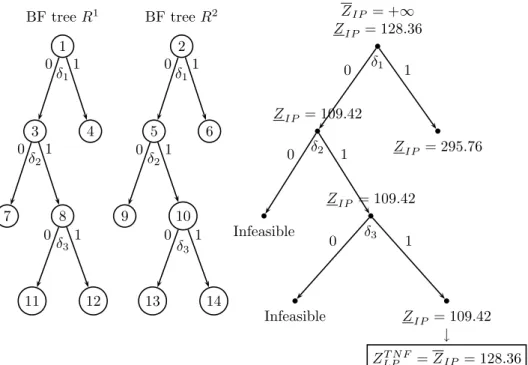
4
Illustrative case
In this section we present an illustrative case, where we have |Ω|= 2 scenarios, |I|= 3 securities, |T | = 4 tim e periods, = 3 dedicated time periods and a maximum of b1 = 2 securities in the portfolio. In spite of the small toy instance, the model (12)-(25) has 26 constraints, 24 variables (3 are 0–1 ones) and 90 nonzero elements in the constraint matrix. The interest rate path along the time horizon is as follows, in percentage: r11 = r12 = 6.3, r12 = 6.5,r22 = 6.1, r31= 7.5,r23 = 7.9,r41= 8.0, andr24 = 8.1. Objective function: ZIP = m in 0.5y+1+ 0.5 y−1+ 0.5 y+2+ 0.5 y−2 Constraints: δ1+δ2+δ3 ≤2 700δ1−x1 ≤0 400δ2−x2 ≤0 1000δ3−x3 ≤0 −1300 δ1+x1 ≤0 −1700 δ2+x2 ≤0 −2700 δ3+x3 ≤0 x1+x2+x3 = 3000 0.936641 x1+ 0.938030 x2+ 0.937013x3≥2788.769287 0.936293 x1+ 0.937609 x2+ 0.937256x3≥2792.632813 −s11+ 0.252000 x1+ 0.158500 x2+ 0.336150 x3 = 894 −s21+ 0.248800 x1+ 0.154900 x2+ 0.333310 x3 = 894 1.065 s11−s12+ 0.420750 x1+ 0.252500 x2+ 0.340000 x3 = 846 1.061 s21−s22+ 0.422390 x1+ 0.255300 x2+ 0.341600 x3 = 846 1.075 s12−s13+ 0.410000 x1+ 0.330800 x2+ 0.400000 x3 = 798 1.079 s22−s23+ 0.410000 x1+ 0.330400 x2+ 0.400000 x3 = 798 2.102381 x1+ 2.767783 x2+ 2.009360x3−y+1+y−1= 6511.689941 2.105035 x1+ 2.771116 x2+ 2.011282x3−y+2+y−2= 6516.945800 2.102381x1+ 2.767783 x2+ 2.009360 x3−3000 z+1+ 3000z−1= 6800.824707 2.105035x1+ 2.771116 x2+ 2.011282 x3−3000 z+2+ 3000z−2= 6808.942871 z+1+z−1 ≤0.566735 z+2+z−2 ≤0.566735 0.936641 x1+ 0.938030 x2+ 0.937013x3−3000 v+1+ 3000v−1= 2811.262939 0.936293 x1+ 0.937609 x2+ 0.937256x3−3000 v+2+ 3000v−2= 2810.480957 v+1+v−1 ≤0.234272 v+2+v−2 ≤0.234272 δ1, δ2, δ3∈ {0,1} 22.5≤s11, s21 ≤2250 15≤s12, s22 ≤1500 7.5≤s13, s23 ≤750 y+ω, y−ω, z+ω, z−ω, v+ω, v−ω ≥0,∀ω= 1,2 (62)