Transactional Concurrency Control
for Resource Constrained Applications
Kamal Solaiman
A thesis submitted for the degree of Doctor of Philosophy
School of Computing Science, Newcastle University
Declaration
I certify that no parts of the material included in this thesis have previously been submitted by me for a degree at Newcastle University or any other university. Parts of the work presented in this thesis have been published in the following:
1. K Solaiman, M. Brook, G Ushaw, G. Morgan, ‘ Optimistic Concurrency Control for Energy Efficiency in the Wireless Environment’, in the 13th International Conference on Algorithms and Architectures for Parallel Processing (ICA3PP), pp. 115-128, Springer International Publishing, 2013. (Best paper award)
2. K Solaiman, M. Brook, G. Ushaw, G. Morgan, ‘A Read-Write-Validation Approach to Optimistic Concurrency Control for Energy Efficiency of Resource-Constrained Systems’, in the 9th International Wireless Communication and Mobile Computing Conference (IWCMC), IEEE, pp. 1424-1429, 2013.
3. K. Solaiman and G. Morgan, ‘Later Validation/Earlier Write: Concurrency control for Resource-Constrained Systems with Real-Time Properties’, in 30th Symposium on Reliable Distributed Systems Workshops (SRDS), IEEE, PP. 9-12, Oct. 2011.
4. K. Solaiman and G. Morgan, ‘Later Validation/Earlier Write: Concurrency Control for Resource-Constrained Systems with Real-Time Properties’, Poster Session at Computing Department, Newcastle University, 2012.
Dedication
I dedicate this thesis to my beloved daughter (Hdel); she was my infinite resource of love during my PhD study.
A
CKNOWLEDGEMENTSI would like to thank my supervisor, Dr Graham Morgan for his advice and comments throughout the work on this thesis and for his support and encouragement during the difficult times I faced in previous years.
I would like to thank my colleagues and friends in the School of Computing Science at Newcastle University for their positive discussions and comments, especially Dr. Gary Ushaw, Matthew Brook and Ayad Keshlaf.
Certainly, I would like to thank my beloved father and mother for their continuous support throughout my study. Finally, I would like to thank my devoted wife for her support and patience during my research.
Abstract
Transactions have long been used as a mechanism for ensuring the consistency of databases. Databases, and associated transactional approaches, have always been an active area of research as different application domains and computing architectures have placed ever more elaborate requirements on shared data access. As transactions typically provide consistency at the expense of timeliness (abort/retry) and resource (duplicate shared data and locking), there has been substantial efforts to limit these two aspects of transactions while still satisfying application requirements. In environments where clients are geographically distant from a database the consistency/performance trade-off becomes acute as any retrieval of data over a network is not only expensive, but relatively slow compared to co-located client/database systems. Furthermore, for battery powered clients the increased overhead of transactions can also be viewed as a significant power overhead. However, for all their drawbacks transactions do provide the data consistency that is a requirement for many application types. In this Thesis we explore the solution space related to timely transactional systems for remote clients and centralised databases with a focus on providing a solution, that, when compared to other's work in this domain: (a) maintains consistency; (b) lowers latency; (c) improves throughput. To achieve this we revisit a technique first developed to decrease disk access times via local caching of state (for aborted transactions) to tackle the problems prevalent in real-time databases. We demonstrate that such a technique (rerun) allows a significant change in the typical structure of a transaction (one never before considered, even in rerun systems). Such a change itself brings significant performance success not only in the traditional rerun local database solution space, but also in the distributed solution space. A byproduct of our improvements also, one can argue, brings about a "greener" solution as less time coupled with improved throughput affords improved battery life for mobile devices.
v
Contents
List of Tables ………..……….. ix
List of Figures ………. x
List of Algorithms ………. xiii
Glossary ………. xiv
1 Introduction 1
1.1 Introduction ………. 1
1.2 The Concept of Transaction ……….. 1
1.3 Concurrency Control Approaches ………..……….. 2
1.3.1 Pessimistic Concurrency Control ……….………. 2
1.3.2 Optimistic Concurrency Control (OCC) ……… 3
1.3.3 Pessimistic vs Optimistic ………... 4
1.4 Cost of Aborted Transactions ………... 4
1.5 Research Contributions...………... 5
1.6 Publications ………... 7
1.7 Thesis Structure ………...……… 8
2 Background and Related Work 9 2.1 Database Consistency ……….……...………. 9 2.1.1 Serial Schedule ………….….……… 12 2.1.2 Serializable Schedule ….………..…..………... 12 2.1.3 non-serializable schedule ……… 13 2.2 Database Architecture ……..……….……… 13 2.2.1 Centralized Database ………..………... 13 2.2.2 Distributed Database ………..……….. 14 2.2.3 Mobile Database ………... 15
vi
2.3 Real-time Database ………..….……….… 16
2.3.1 Timelines Requirements .………... 17
2.3.2 Handling Late Transactions ………... 18
2.4 General Enhancement ……….………... 18
2.4.1 Caching ………... 18
2.4.2 Virtual Execution ………... 21
2.5 Related Work 22 2.5.1 Optimistic Concurrency Control Techniques ……... 22
2.5.2 Aspects of Optimistic Concurrency Control …..……….. 26
2.5.3 Data Delivery Choice ………...………… 38
2.5.4 Broadcast Datacycle Approach ……….…..…... 40
2.5.5 Indexing on the Air ………... 41
2.5.6 Broadcast Disks ……….... 43
2.5.7 Fault-tolerant in Broadcast Disks ……….………. 45
2.5.8 Forward and Backward OCC (FBOCC) ………...……… 46
2.5.9 Discussion ………. 49
2.6 Summary ………..……….…. 51
3 The Read-Write-Validate 52 3.1 Introduction ………...……… 52
3.2 Read-Write-Validate Approach ……… 54
3.3 Justifying Read-Write-Validate Approach ……….…….. 55
3.4 Advantages of Read-Write-Validate Approach ………... 55
3.4.1 Transaction Lifespan Minimized ………... 56
3.4.2 Blocking of Concurrent Transactions Eliminated ….………. 57
3.4.3 Newly Starting Transactions Never Blocked ………... 59
vii
3.5 Disadvantages of Read-Write-Validate Approach ……….……….. 64
3.5.1 Longer Wasted Execution ……….………. 64
3.5.2 Critical Section Constraint ……… 66
3.6 Read-Write-Validation Enhancement ……….……….. 66
3.6.1 Energy Efficiency Improvement ……….……….. 66
3.6.2 Reduction of Conflict Risk ……….……… 67
3.6.3 Wasted Execution Elimination ………..……. 67
3.7 Coping with System Failures ……….. 68
3.8 Read-Write-Validate Protocol ………. 68
3.8.1 Protocol Description ……… 69
3.8.2 Pseudo-code ………. 70
3.9 Distributed Read-Write-Validate Protocol ……….………. 71
3.9.1 Validation Stage at Client ……….……..……… 72
3.9.2 Validation Stage at the Server ………..…………... 73
3.10 Summary ………..……...……. 76
4 Evaluation 77
4.1 Read-Write-Validate Protocol ………..………….. 77
4.1.1 Simulation Tool ………..…………. 77
4.1.2 Simulation Model and Setting ………..……… 78
4.1.3 Simulation Results ……….………….. 80
4.2 Distributed Read-Write-Validation Protocol ……….………….... 85
4.2.1 Simulation Model and Setting ……….………. 85
viii
4.3 Summary ……….……….. 92
5 Conclusion and Future Work 93
5.1 Introduction ……… 93 5.2 Contributions of the Thesis ……… 94 5.2.1 Advantages Gained by the present research …………..…….. 94 5.3 Future Work ……….……….... 96
ix
List of Tables
1 Simulation Parameters of Read-Write-Validation Protocol ... 80
x
List of Figures
1.1 OCC algorithms phases ….….………... 4
2.1 Lost update anomaly ……….. 10
2.2 Inconsistent retrievals ……...……… 11
2.3 Model of centralized database architecture in a network ……….…. 14
2.4 Model of distributed database architecture ……….... 15
2.5 (a) First run in virtual executions environments ………. 22
2.5(b) Rerun in virtual execution environments ………... 22
2.6 Illustrates serious and non-serious conflicts …..………. 28
2.7 (a) Frequently rolled back scenario ……..………... 30
2.7 (b) Transactions backed off scenario …….……….. 30
2.8 Transactions management under an OCC broadcast commit scheme ...…. 34
2.9 Schedule with an undeveloped possible conflict ...……… 34
2.10 Schedule with a developed conflict ……… 35
2.11 Pull-based delivery...……… 39
2.12 Push-based delivery ………..………. 39
2.13 Broadcast datacycle with no indexing ………. 41
2.14 Broadcast datacycle in tune_opt strategy ………... 42
2.15 Broadcast datacycle in (1,m) strategy ………... 43
2.16 Flat broadcast approach ………. 44
2.17 Three different broadcast programs ………... 44
2.18 Broadcast program generation ……….. 45
2.19 Transaction execution schedule ……… 49
3.1 Read-Write-Validate approach phases ………..……….. 55
3.2 Transaction lifespan in conventional OCC ……… 57
xii
3.4 The occurrence of blocking in the conventional OCC approach...……… 59
3.5 Blocking eliminated in Read-Write-Validate approach …..………. 60
3.6 Blocking in newly starting transactions in the conventional OCC approach ……… 62
3.7 New transactions are never blocked in Read-Write-Validate approach … 63 3.8 Late visible updates in the conventional OCC approach ………..… 64
3.9 Earlier visible updates in the Read-Write-Validate approach ………... 65
3.10 Short period of wasted execution in the OCC conventional approach …. 66 3.11 Longer period of wasted execution in the Read-Write-Validate approach 66 3.12 Wasted executions no longer exist in the virtual execution environment. 69 4.1 Throughput with 50% of updates transactions ……….……. 83
4.2 Average response times with 50% of update transactions ………... 83
4.3 Late transactions with 50% of update transactions ……….….. 83
4.4 Throughput with 75% of updates transactions ……….. 85
4.5 Average response times with 75% of update transactions ……….... 85
4.6 Late transactions with 75% of update transactions ……….….. 85
4.7 Throughput at the server ……….…... 89
4.8 Response time at the server ………... 89
4.9 Miss Rate at the server ………... 89
4.10 Throughput of update transactions at clients ………. 91
4.11 Late update transactions at clients ……….… 91
4.12 Throughput of read only transactions at clients ………... 92
xiii
List of Algorithms
1 Backward oriented optimistic concurrency control ……… 23
2 Forward oriented optimistic concurrency control ……….. 24
3 Partial backward validation (FBOCC) ……… 46
4 Forward validation (FBOCC) ……….. 47
5 Final validation (FBOCC) ……… 48
6 Validation phase (Read-Write-Validate) ….………. 72
7 Partial backward validation (distributed Read-Write-Validate) ……….... 74
8 Final backward validation (distributed Read-Write-Validate) ………….... 75
xiv
Glossary
Transaction A sequence of operations (reads and writes) executed to perform a single logical task.
ACID Properties of transaction, including Atomicity, Consistency, Isolation and Durability.
Database A database is an organized collection of data items; each could be in the form of a record, page, data structure, picture, text, etc.
Real-Time database A database which maintains traditional database requirements (logical consistency); and also satisfies time-constraints (temporal consistency).
Ubiquitous Database A small database existing in mobile devices.
Distributed Database A database physically stored across multiple computers in multiple locations which are connected to each other via a network, yet operate logically as a single database.
DBMS Database Management System - a special application designed to interact with users.
Serializability A well-known correctness criteria which means that there is at least one serial schedule which leads to the same final state of the database.
CC Concurrency Control, a mechanism for coordinating Simultaneous access to shared data.
xv
OCC Optimistic Concurrency Control, provide a mechanism whereby simultaneously executing transactions validate with one another to determine whether a conflict has occurred, It is a well-known method due to the properties of non-blocking and deadlock-free execution.
FOCC Forward Optimistic Concurrency Control, OCC based on checking the intersection between the write set of a validating transaction and the read sets of currently executing transactions.
BOCC Backward Optimistic Concurrency Control, OCC based on checking the intersection between the read set of a validating transaction and the write sets of currently executing transactions.
FBOCC Forward and Backward Optimistic Concurrency Control, an OCC algorithm suitable for mobile transactions in wireless broadcast environments. It consists of two validation stages, one involving backward validation at the client, and the other forward validation at the server.
2PL Two-phase locking protocol, CC technique based on locks, which are divided into growing and shrinking phases in each transaction. In the growing phase, a transaction can request locks, but in the shrinking phase a transaction should unlock all locks that have been made in the first phase.
1
Chapter 1
Introduction
1.1 Introduction
This thesis is concerned with improving performance in shared client access to database systems. In particular, a measure of performance is quantified in terms of client request throughput. If client requests simultaneously update the same data, then erroneous behaviour in the overall system may result. The basic method to overcome this would be via the use of transactions. Therefore, the transactional style of access is used as the basic construct for modelling client requests.
1.2 The Concept of the Transaction
Transactions are a sequence of read and write operations executed in performing a single logical task. Transactions have four properties: atomicity, consistency, isolation and durability (ACID) [1][2]. These properties are described below.
1. Atomicity: this means that all operations involved in a transaction should be seen as one single operation. If one action belonging to a transaction fails, then the entire transaction fails.
2. Consistency: this is a general term used to signify that data must meet all of the validation rules that applications expect.
3. Isolation: this means that any concurrently running transactions do not affect each other at the time of execution. As an example, if T1, T2 and T3 are transactions running concurrently, they should have some equivalent serial order.
4. Durability: this refers to a guarantee that, if a transaction completes, then its effects persist in the database and it is never lost, even if the system crashes. Nevertheless, durability does not imply a permanent state of the database; other transactions may overwrite changes made in current transactions without undermining durability.
2
Executing transactions in the presence of concurrency requires a concurrency control mechanism to coordinate access to shared data. In such a setting, the main goal of a concurrency control algorithm is the creation of an ordering of read/write access that ensures database consistency.
1.3 Concurrency Control Approaches
Concurrency control has been extensively studied in the literature, resulting in various ways of implementing transactions to maintain database consistency. The two main categories are pessimistic and optimistic approaches [2][3].
1.3.1 Pessimistic Concurrency Control
A straightforward solution to coordinate access to shared data is to simply lock data while it is being accessed by one client, preventing any possible conflict from other clients occurring [4]. Locks are controlled by the concurrency control manager in order to ensure that:
1. Every transaction cannot read or write any element unless it previously requested a lock on that element and has not yet released it.
2. If a transaction locks an element then it must release it later.
3. No more than one transaction can lock the same element at any time.
A two-phase locking protocol (2PL) is a pessimistic approach proposed by Eswaran et al. [5]. In 2PL, locks are divided into growing and shrinking phases in each transaction. In the growing phase, a transaction can request locks, but in the shrinking phase a transaction should unlock all locks that have been made in the first phase. Therefore, for each transaction, all lock requests must precede all unlock requests. Although the 2PL protocol grants serializability, it is considered to be too constrained. The general weaknesses of locking approaches can be summarised as following [6][7][8].
1. It is required to always use locking to ensure consistency, even if most of the transactions do not overlap. However, locking is only actually needed in certain cases.
3
2. Lock maintenance adds an unnecessary overhead to read-only transactions even though these do not affect the consistency of the database and constitute the majority of system transactions [23].
3. When a large part of a database resides in a secondary storage, locking frequently accessed data items significantly decreases concurrency due to the waiting time needed for secondary storage access.
4. Keeping locks in place until the end of the execution of transactions in order to avoid cascading aborts causes a further decline in concurrency.
5. Deadlock problems make 2PL inappropriate in distributed database systems, since current deadlock detection techniques for distributed systems are complex and ineffective.
6. The significantly increased numbers of transactions occurring in distributed database systems increases locks’ overhead and the probability of lock conflict. Furthermore, communication delays lead to a worsening of the situation due to increasing lock-hold duration, which makes the probability of lock conflicts even higher. This results in a substantial decline in performance in distributed database systems.
1.3.2 Optimistic Concurrency Control (OCC)
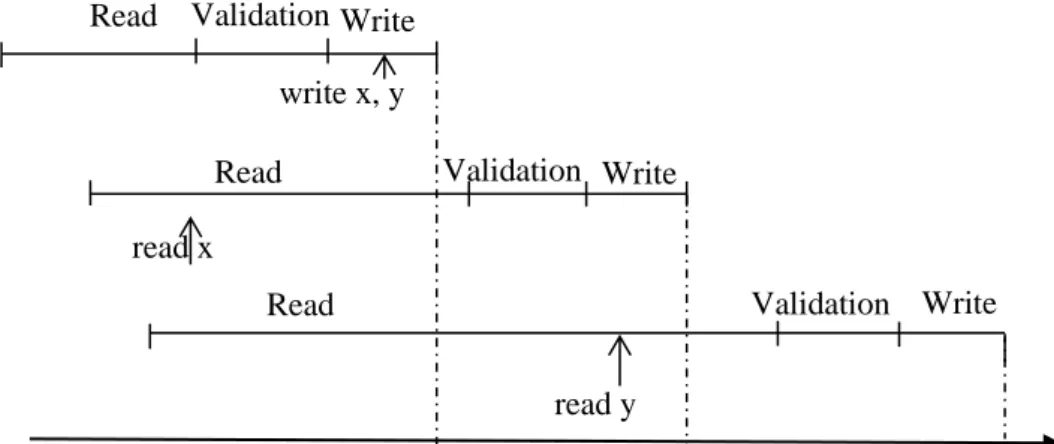
Kung and Robinson proposed the use of optimistic approach methods via the execution of transactions in three phases as shown in Figure 1.1 in order to avoid the problems pointed out in the previous section [8]. During the read phase, transactions access data without restrictions and make their own private copies of such data. All computation carried out by a transaction occurs on a private copy. When a write is requested, it is enacted on the private copy. During the validation phase, resolution policy is enacted where, in principle, other executing transactions are considered to determine whether or not the write requests can be satisfied without invalidating the correctness of the overall read/write schedule. If the writes are valid, the write phase is enacted which commits the changes to persistent storage. Alternatively, the transaction may abort if a valid schedule is not possible, and a renewed attempt is made later. If a transaction has no write operation, then the write phase is not required, with commitment being enacted to bring the transaction to a logical end.
4
Figure 1.1 OCC phases.
The optimistic approach can overcomes the weaknesses of pessimistic approaches, and works well in low contention environments especially when read operations outnumber writes. However, rollback is a considerable drawback in optimistic approaches when conflict rates are high.
1.3.3 Pessimistic vs Optimistic
In conventional databases, a pessimistic approach is better than an optimistic approach in high contention environments, particularly when physical resources are limited. In such environments, an optimistic approach results in considerable numbers of transactional aborts, which leads to substantial waste of resources. However, the optimistic approach is more convenient in low contention environments, particularly when the amounts of wasted resources involved are tolerable, and the optimistic approach provides a higher degree of concurrent executions [2][9][10]. In contrast, the optimistic approach works better than the pessimistic approach in real-time databases even given high data contention over a wide range of resource availability levels. This is because, in the optimistic approach, conflict resolution is delayed until the times at which transactions commit, which helps in making better conflict decisions. So, optimistic algorithms ensure that no transactions which are likely to miss their deadlines prevent other transacting execution in the system [2][11][12][13][14].
1.4 Cost of Aborted Transactions
Aborted transactions run again, and this requires them to retrieve data again from the database. The state of the database may by then have changed, and so it is necessary to request data again to prevent transactions from using inconsistent data. Accessing storage devices is expensive and aborted transactions that run again are, in essence, duplicating information retrieval. However, sometimes only a small proportion of the re-retrieved data has changed. Retrieving data that has not changed is, therefore, a waste
Read phase Write
phase Validation
5
of disk access. This is more serious in distributed databases when the data to be retrieved does not exist in the same machine, and is therefore more expensive in terms of incurring communication costs.
To improve performance, technique has been developed to only retrieve those items of data that have changed. Such a technique is called virtual execution, which allows an aborted transaction to continue reading the data it requires, and that data is cached locally so that upon rerun it does not need to waste resources reading the data again. Using this ”pre-fetched” data can lead to significant performance improvements, as there should be no disk I/O overhead involved in rerunning a read transaction where the data is already cached. However, there is now an issue with consistency when considering a transaction that is rerunning with pre-fetched data. Clearly some of the pre-fetched data may have been modified at the server since it was read to the local cache, which would result in the transaction running with inconsistent data. Concurrency control techniques must be applied to overcome this problem [15].
1.5 Research Contributions
This thesis introduces a novel Read-Write-Validate transactional phase sequence combined with virtual execution to render the conventional OCC approach appropriate for mobile device environments. The proposed approach presented in two contexts:
Firstly, it is show that implementing the proposed approach on the mobile devices themselves can improve contention issues with shared resources on that device, such as the solid-state disk. [16][17].
Secondly, it is further shown that the implementation of the proposed approach in client-server model based on a broadcast datacycle approach for wireless environment is efficient [18].
The results show that, with the proposed approach, overall system performance is improved, and the number of transactions that miss their deadlines due to concurrency issues is reduced. The number of transactions requiring a restart is reduced, and so less energy is used in re-accessing a resource or in retransmitting data a second time [17][18].
6
The benefits gained by the contribution made in this thesis are summarised below. 1. Transaction Lifespan Minimization
The lifespan of a transaction is the time between the start of a transaction and when it commits or the end of the write phases. The validation phase adds a non-deterministic timing period to the lifespan of the transaction. Therefore, the reordering of phases in the proposed approach removes from the transaction’s lifespan the non-deterministic timing of the validation phase.
2. The Blocking of Concurrent Transactions is Eliminated
In the conventional OCC approach, non-conflicted transactions executing in the read phase will eventually be blocked after having been validated while the validating transaction executes in the validation and write phases. This temporary blocking is essential to prevent non-conflicted transactions from entering a conflict state. Using the proposed approach, none-conflicted transactions no longer have to be blocked from progressing and yet database consistency is still maintained.
3. Newly Starting Transactions are Never Blocked
Newly starting transactions are those which may start execution while another transaction is executing in the validation or write phase. In the conventional OOC approach, such transactions will be temporally blocked until the validating transaction commits, in order to prevent them from entering a conflict state. In the proposed approach, newly starting transactions no longer have to be blocked from progressing and yet database consistency is still maintained.
4. Earlier Visible Updates
In the proposed approach, write operations become visible to concurrent transactions earlier, affording more likelihood of reading up-to-date data and thus reducing the opportunity for conflict to occur. This is because the reordering of the validation and write phases guarantees that all new updates have already been made before the validation phase starts.
7
Virtual execution allows those transactions that have been aborted to re-execute using in-memory values as opposed to reading directly from the persistent storage. This improves the proposed approach, because accessing a conventional hard disk drive is expensive in terms of power usage given that the disk must attain read speed and the appropriate data sector mist be found. Even solid-state drives are significantly more expensive to access compared to local memory. So, the reduction made in disk access leads to a reduction in energy consumption. The energy savings will be even greater if the transaction reads from a remote server over a wireless connection.
6. Reduction of Risk of Conflict
Rerunning transactions is quicker than those in their initial run since there is no persistent storage access which in turn increases the chance of transaction commitment. This is because transactions in rerun become ready to enter the critical section for write and validation phases in a shorter time. The shorter read phase in a rerun reduces the risk of conflict with other transactions occurring.
1.6 Publications
The contributions made in this thesis have been published in two conference papers, one workshop paper and one poster. One of the conference papers won the (best paper award) at The 13th International Conference on Algorithms and Architectures for Parallel Processing (ICA3PP), 2013. In addition, a journal paper is produced and invited to be submitted to Information Sciences journal, and a survey paper is in preparation. Details of the poster and the published papers are given below:
1. K. Solaiman, M. Brook, G. Ushaw, and G. Morgan, “Optimistic Concurrency Control for Energy Efficiency in the Wireless Environment” in the 13th International Conference on Algorithms and Architectures for Parallel Processing (ICA3PP), pp. 115-128. Springer International Publishing, 2013.
2. K. Solaiman, M. Brook, G. Ushaw, and G. Morgan, “A Read-Write-Validation Approach to Optimistic Concurrency Control for Energy Efficiency of Resource-Constrained Systems”, in the 9th International Wireless Communication and Mobile Computing Conference (IWCMC), IEEE, pp. 1424-1429, 2013.
8
3. K. Solaiman and G. Morgan, “Later Validation/Earlier Write: Concurrency Control for Resource-Constrained Systems with Real-Time Properties,” in 30th Symposium on Reliable Distributed Systems Workshops (SRDS), IEEE, pp. 9-12, Oct. 2011.
4. K. Solaiman and G. Morgan, “Later Validation/Earlier Write: Concurrency Control for Resource-Constrained Systems with Real-Time Properties”, Poster Session at Computing Department, Newcastle University, 2012.
1.7 Thesis Structure
The rest of this thesis is organised as follows:
Chapter 2 covers the background to the proposed approach. It starts with a description of concurrency control problems, and the concept of database consistency, and introduces centralized, distributed, mobile and real-time database types. Then previous research related to the proposed approaches is discussed, focussing on optimistic concurrency control techniques and aspects. Finally, an introduction to mobile computing, including caching and broadcast datacycle, is provided.
Chapter 3 describes the proposed approach in detail and extensively discusses its advantages and disadvantages. Then the Read-Write-Validation protocol and its pseudo code algorithm are presented to describe how the protocol works. The Read-Write-Validation protocol deals with concurrently running transactions accessing shared data at a single mobile device. Then the Distributed Read-Write-Validation protocol is presented including pseudo code algorithms, to describe how the proposed protocol works. The Distributed Read-Write-Validation protocol is designed to control numerous mobile transactions accessing a centralised database at the server.
Chapter 4 provides a description of the implemented simulations used to evaluate the performance of both proposed protocols, the Read-Write-Validation protocol and the Distributed Read-Write-Read-Write-Validation protocol. In addition, the results collected from the simulation experiments are provided.
9
Chapter 2
Background and Related Work
This chapter introduces the background and concepts necessary to understand the contribution of the thesis. The present study is primarily concerned with improving performance via the concurrency control mechanisms employed to govern the read/write ordering of concurrent transactions. The research covers both local and geographically dispersed clients, and so the architectures and the techniques employed within them to achieve improved transactional performance are described. Since performance impacts more acutely on those databases that have time requirements (real-time), one section is devoted to these approaches. This chapter starts with an introduction to database consistency, and then presents information concerning centralized, distributed, mobile and real-time databases. After that, caching and rerun policy enhancements are explained. This is followed by a discussion of the previous research relevant to the proposed approach. A description of optimistic concurrency control techniques is followed by a discussion of the trade-off of optimistic concurrency control aspects considered in the literature. Finally, mobile computing and broadcast wireless environments are introduced.
2.1 Database Consistency
A database is an organized collection of data items; each item could be in the form of a record, page, data structure, picture, or text (the general term data item is used throughout this thesis). Each single data item has a unique identifier, and the database is managed by a database management system (DBMS), which is a special application designed to interact with the users. In order to improve performance, applications in real life are allowed to run concurrently which may lead to multiple accesses to shared data simultaneously. Such multiple accesses are not secure and may lead to unexpected results. Two examples of these database anomalies are explained below:
10
Examples of Database Anomalies
This section illustrates two examples of database anomalies described in the literature [19][6]. Both examples explain the process of accessing one bank account for deposit and withdrawal operations by multiple users.
Example 1: Lost Updates
Consider that two customers - C1 and C2 - deposit money in the same bank account at approximately the same time. The deposit method works as follows:
Deposit (amount, account_number) { temp = read(accounts[account_number]; temp= temp+ amount;
write(accounts[account_number],temp); }
As illustrated in Figure 2.1, C1 reads the balance of the account (£200) and then adds £ 150 to the local copy of the balance (temp) to make it £350. C2 read the balance as well, which was still £200, and adds £50 to C2’s local copy, making it £250. Then, C1’s update of £350 was written back to the original database. Subsequently, C2’s update of £250 was also written back to the original database (the same account). At this point, an incorrect state has resulted and £150 has been lost: the correct balance should be £400.
Figure 2.1 Lost update anomaly [6] C1 Execution READ balance ADD £ 150 Write result back to database C2 Execution READ balance ADD £ 50 Write result back to database 200.0 350.0 250.0 200.0 250.0 200.0 350.0 Database
11
Example 2: Inconsistent Retrievals
Suppose that the two customers C1 and C2 simultaneously execute the following transactions T1 and T2 respectively:
1. T1 transfers £1000 from a checking account to the same person’s saving account.
2. T2 prints the total balance of the both accounts (checking and savings).
As illustrated in Figure 2.2, T1 reads the balance of £1200 from the checking account and subtracts £1000 from it; the result is that £200 will be written back to the database. Then, at approximately the same time, T2 reads the balances of both accounts and then prints the total. T1 continues and reads the balance of the savings transaction and adds the £1000 to the previous balance. The new balance of the savings account will be £1500, which will be updated to the original database. This time, the final result placed in the database is correct, but the execution is incorrect because the total balance printed by T2 is £700, whereas the real total balance is £1700.
Figure 2.2 Inconsistent retrievals [6] Database T1 Execution READ Checking balance SUBTRACT £1000
Write result back to database
READ
Savings balance ADD £1000 Write result back to database T2 Execution READ Checking balance READ Savings balance PRINT Sum C 1200.0 S 500.0 C 200.0 S 500.0 1200.0 200.0 500.0 1500.0 C 200.0 S 500.0 C 200.0 S 1500.0 Sum = £ 700.0
12
When all operations of a transaction are executed before or after all other transaction operations, the execution is called serial and database consistency is maintained. However, if the operations of more than one transaction are interleaved, their execution may lead to a state of inconsistency. Interleaved operations of one or more transactions are called schedules.
2.1.1 Serial Schedule
A schedule is serial if its operations consist of all the operations of one transaction, then all the operations of another transaction, and so on. Interleaved operations from different transactions are not allowed. In other words, if a schedule consists of a number of transactions T1, T2, T3,…Tm, then, for every i=1 to m-1, the transaction Ti is completed before the next transaction Ti+1 starts.
Consider the following example: T1 and T2 are two concurrent transactions. T1 = {R1 (a), R1 (b)}
T2 = {W2 (a), W2 (b)}. Histories:
H1 = {R1 (a), R1 (b), W2 (a), W2 (b)} H2 = {W2 (a), W2 (b), R1 (a), R1 (b)}
H1 and H2 indicate the order of the execution of operations in transactions T1and T2. Both H1 and H2 are serial because in both histories no operations were interleaved and the effect of the schedule on the database will be equivalent to schedule T1, T2 in the case of H1 and T2, T1 in the case of H2. However, in the following history:
H3= {R1 (a), W2 (a), W2 (b), R1 (b)}
H3 is not serial because here, operation R1 (a) precedes operation W2 (a) through the data item a, which means that T1 precedes T2. On the other hand, operation W2 (b) precedes operation R1 (b) through the data item b, which means that T2 precedes T1. Therefore, H3 is not serial.
2.1.2 Serializable Schedule
A schedule is serializable if it has the same effect on the database as other serial schedule of the same transactions. Therefore, if the serial schedule maintains database consistency, then the serializable schedule also maintains database consistency.
13
Consider again the following histories from the previous example: H4= {R1 (a), W2 (a), R1 (b), W2 (b)}
H5= {W2 (a), R1 (a), W2 (b), R1 (b)}
In H4, operation R1 (a) precedes W2 (a) through data item a, which means that T1 precedes T2; and R1 (b) precedes W2 (b) through data item b, which means that T1 precedes T2. Therefore, the effect of the execution of H4 is equivalent to the effect of the serial execution H1. Thus, H4 is serializable.
In H5, operation W2 (a) precedes R1 (a) through data item a, which means that T2 precedes T1; and W2 (b) precedes R1 (b) through data item b, which means that T2 precedes T1. Therefore, the effect of the execution of H5 is equivalent to the effect of the serial execution H2. Therefore, H5 is serializable as well.
2.1.3 non-serializable schedule
H3 in the previous section is an example of non-serializable history: H3= {R1 (a), W2 (a), W2 (b), R1 (b)}
As stated in the previous section, T1 precedes T2 because of the operation R1 (a) precedes operation W2 (a) through the data item a, and T2 precedes T1 because of operation W2 (b) precedes operation R1 (b) through the data item b. Therefore, the effect of the execution of H3 is not equivalent to the effect of any serial execution, thus, H3 is non-serializable.
The concept of serializability is a popular correctness criterion that has been used in concurrency control field. Serializability means that the effect of certain schedules on the database state is equivalent to at least one serial schedule of the same transactions [20][19][6].
2.2 Database Architecture
A database is an organized collection of data. Depending on the method use to stor such data, databases can be classified into three categories: centralized, distributed, and mobile databases.
14
2.2.1 Centralized Database
A centralized database is a database located and maintained in one location, where access may be performed via a communications network. Banking systems are an example of centralized databases, in which processing is performed in a mainframe, and clients use online banking for their transactions. Reservation systems could be another example of centralized databases, due to its advantage of preventing the double booking problem [166]. Such systems become more complicated in distributed database environments due to double booking issues.
Centralised Database Architecture
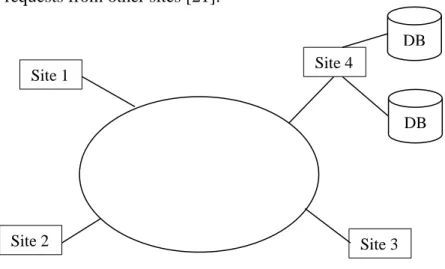
Figure 2.3 illustrates a model of a centralised database architecture, which consists of four sites connected via a network, and the database resides at only one site (site 4 in this example). Therefore, site 4 will be responsible for database management and processing requests from other sites [21].
Figure 2.3 Model of centralized database architecture in a network
2.2.2 Distributed Database
A distributed database is a database physically stored across multiple computers connected to each other via a network, and these computers may be located in the same physical location or dispersed in multiple locations. In both cases, the distributed database will operate logically as a single database. Distributed databases may be managed by several database management systems (DDBMSs), where one coordinates each remote site. Therefore, each site of the distributed database system is designated to be capable of administering its local database if connections with other sites have failed, and this is known as local autonomy. On the other hand, when distributed database sites
Site 3 Site 4 DB Site 1 Site 2 DB
15
are successfully connected to each other, the system must provide location transparency, which means that users can retrieve or update data from any site without prior knowledge of its location, so that all data in the distributed database should appear to be one logical database existing at one site.
Distributed Database Architecture
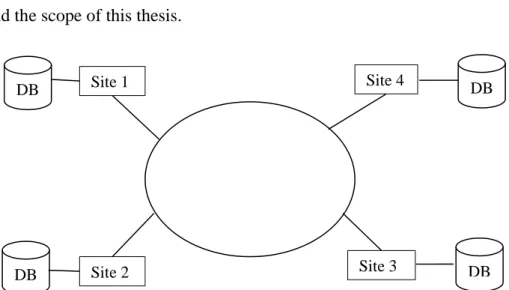
Figure 2.4 illustrates a model of a distributed database architecture, which consists of four sites connected via a network and the database is distributed between these sites. Local applications are executed at one site using data stored in the same site, not requiring data from other sites. Global applications however require data stored in other sites. Sites may have identical software, in which case the system is known as a homogeneous DDBMS, or different software in a heterogeneous DDBMS [21][22]. The client-server model is a popular modern type of architecture, providing service to clients via a communications network. Clients request a server’s content or service functions and wait for the server’s response. Other types of distributed models, such peer-to-peer, are beyond the scope of this thesis.
Figure 2.4 Model of distributed database architecture
2.2.3 Mobile Database
Developments in wireless networks, and mobile computing devices such as smartphones, tablets and PDAs have made mobile applications achievable and practical for use as stand-alone applications or in accessing remote applications. This has led to the necessity for mobile or ubiquitous databases. A mobile database is a small database residing on a mobile computing device, giving the ability to handle local queries without connectivity [23][24][25]. Due to the limited storage capacity of mobile devices, the entire database
Site 3 Site 4 DB Site 1 Site 2 DB DB DB
16
is stored in the server. The mobile devices downloading requires data in its local storage, so that locally existing desired data will add great benefits to applications running on a mobile device. This is especially important in the case of disconnection events, either by undesired interference or in an effort to save battery energy. Meanwhile, if some local data has been updated by mobile applications, new updates have to be transmitted back to the server in order to maintain consistency [26]. Nowadays, the primary type of storage used in mobile devices is flash memory, which is non-volatile and has several benefits compared to a conventional disk. The rapid increase in capacity at affordable prices has made flash memory widely used in mobile devices and even in modern notebooks [27].
However, mobile environments involve substantial constraints in comparison with non-mobile environments. Energy consumption is one important issue in modern powerful portable devices; as a general rule, the more advances are made in mobile hardware and the applications that need to be executed on it, the more energy consumption is required. Communication disconnection is another serious challenge in mobile computing, where for example, a wireless signal can suffer interference, for instance from electronic noise or tall buildings. In addition, the restricted bandwidth of wireless networks and limited resources in portable computing devices, add further constraints to mobile environments [28][29].
2.3 Real-time Database
Real-time database systems (RTDBSs) have become very important over the past two decades due to their significance use in a wide range of operations. Increases in computer speed and capacity have led them to be integrated into our society and to employ many different applications, for example in stock markets, banking, reservation systems, multi-media, telephone switching systems and military command and control management. In many of these examples, real-time databases manage time-constrained data and time-constrained transactions. For example, in stock market programs, current prices have to always be current, and must be no more than a few seconds old to be considered valid. In addition, transactions operated using these data have time-constraints in terms of reading and analysing information in the database. Therefore, the goal in real-time database use not only depends on logical computation carried out as in conventional databases, but also requiring the timing constraints of data and transactions [30][31][32][33].
17
By contrast, in conventional database, timeline constraints are not taken into account, and correctness depends on logical computation only. The main performance criteria in conventional databases are to achieve reasonable throughput or to minimize average response time. Meanwhile the scheduling of transactions is achieved by either fairness or resource consumption criteria, such as giving priority to transactions which have made the most progress toward their end [32][34].
2.3.1 Timeline Requirements
In real-time databases all traditional database requirements are maintained, which preserve the logical consistency of data and transactions, for example in granting the serializability of transactions and operations on data items. They can also require the temporal consistency of transactions and data. These requirements are summarised below [30].
Logical Consistency of Transactions
This controls the values produced by transactions. For example, serializability, as discussed in section 2.1.2, is correctness criteria for the logical consistency of transactions and has been widely used in traditional database systems.
Logical Consistency of Data
A range of data constraints require to be maintained in most traditional database systems, in order to ensure the logical consistency of data. For instance, database items should not have negative values.
Temporal Consistency of Transactions
The temporal consistency of transactions is controlled by timing constraints such as start time, period of execution and deadline. These timing constraints can be divided into three categories: hard, firm and soft. Failure to satisfy timing constraints is considered to be a violation of consistency and an appropriate recovery procedure has to be performed by the database management system.
Temporal Consistency of Data
Data temporal consistency concerns the age of data, and whether it is still considered to be valid, reflecting the current state of the data, or out of date it
18
might where have changed. In the previous example, prices in stock market programs have to be always current, for example, no more than a few seconds old, to be considered valid.
2.3.2 Handling Late Transactions
As previously mentioned, a primary performance measure in real-time databases is timeline level and not throughput or response time as in conventional databases. Therefore, transaction management becomes a scheduling issue, in which priority is considered and attention given to those transactions struggling to meet their deadlines, in order to minimize the number of late transactions. Earliest deadline scheduling policy is used to give priority to transactions that are closest to expiration [35], which leads to noticeable improvements in real-time environments. In addition, several deadline-cognizant methods have been introduced in the literature in order to achieve optimal performance, such as always sacrifice, OPT-wait and no sacrifice policies [36][13][37][38][39][6].
2.4 General Enhancements
Each access to a conventional hard disk is expensive in terms of both power usage and time, as the disk is spun up to speed and the relevant data sector located. Solid-state drives are also significantly more costly to access compared to local memory. Furthermore, with a soled-state drive, it is not possible to overwritten data straightaway, out of place update mechanism is applied. So, to update an data item, the whole block where such an item is located must be erased (‘Bulk erase’) and then the whole block rewritten with the new updated item [40]. Such access costs further increase when communication costs are incurred in network environments, such as when clients access remote data at the server. Therefore, reducing the number of times that a disk is accessed will improve performance and reduce the energy consumed. Caching and rerun policy are general enhancement methods used for such purposes[15][41].
2.4.1 Caching
Caching is an important technique that is used in many areas of computer science, such as in the CPU cache, disk cache or web cache. Data is simply stored in a local memory for future use. Cached data is usually a replica of the original data located elsewhere (EX. server), or it might be values that have been computed earlier. If new data
19
requested exists in the cache, then it will be read from the cache more quickly and cheaply. If new data is requested that does not exist in the cache, then it will need to be obtained from the original source or recomputed, which again incurs extra time and cost [41][42].
1 Cache Replacement Strategy
Due to cache size limitations on the client’s side, space could be exhausted quickly. A replacement strategy is used to clear some space in the cache for new requested data. The decision about which data should be removed from the cache could be influenced by several factors including the following [43][44]:
Recency: period of time since the last reference to the data item.
Frequency: number of times that data item has been referenced.
Cost of fetching: cost of obtaining data item from the original place.
Size: size of data item.
Expiration time: period of time before the data becomes out of date.
Modification time: period of time since the last modification to the data item. (Least recently used) LRU and (least frequently used) LFU are two well-known replacement strategies [43][42][45]. LRU looks backward to the history of data stored on the cache and removes an item that has not been used for the longest period of time. LFU again looks backward to the history of data stored on the cache and removes the item that has been least frequently referenced.
2 Client-Server Caching
Caching data in a client-server architecture is very important for improving performance. It can be implemented by two methods: intra-transaction caching and inter-transaction caching: In the former, data is stored within a single transaction boundary and discarded after the transaction commits. This is a simple method and cache management is performed by the clients themselves. In inter-transaction caching, data is stored across transaction boundaries, which requires more sophisticated techniques to be used in order to maintain the consistency of the cached data [46][47][45]. Even though caching incurs extra overheads for maintaining the consistency of cached data, it involves many benefits to the system, including the following [48][49][43]:
20
Reduced reliance on the server, a decrease in network traffic and message processing time and cost overheads, which consequently leads to a reduction in system latency and response time.
Allows better utilization of resources presented to clients.
The server can manage a larger number of clients in the system.
3 Transactional Cache Consistency
Caching introduces multiple copies of the same data items, and is similar to replication. Therefore, consistency between these redundant copies has to be maintained. The following are some techniques that have been introduced to ensure the consistency of cached data.
Avoidance versus Detection
In avoidance-based approaches, stale or out-of-date data is not allowed to exist in a client’s cache. Therefore, transactions never have a chance to read stale data. Avoidance-based approaches uses a read one/write all (ROWA) technique to make sure that all replicas of updated data items are the same when updated transactions commit. Based on the ROWA technique, transactions are read from the local copy in the client’s cache and all copies updated in the system. In contrast, in detection-based approaches, stale data is allowed to exist temporarily in the client’s cache. Therefore, checking the validity of cached data is mandatory and is performed by each transaction before it is allowed to commit In comparison with the ROWA technique, the detection-based approach is simple, because a consistency action only includes the server and a single client [45][50].
Invalidation versus Propagation
Two kinds of techniques to maintain cache consistency can be used in a client’s cache when a notification update arrives from the server: invalidation and propagation.
Invalidation is a technique of removing the stale copy from the client cache when the original copy at the server is updated. Therefore, invalidated data will be inaccessible for any subsequent transaction. Subsequent transactions interested in accessing invalidated data have to obtain an up-to-date copy from the server. Information needed for cache invalidation is broadcast from the server via invalidation messages, and this requires that the commitment of updated transactions is delayed until all client caches have been invalidated. This is considered to be a scalability weakness.
21
Propagation is a technique of sending new updates to clients when updated transactions commit at the server; this consequently replaces stale copies with new updated copies. Therefore, cached client data will be accessible for any subsequent transaction.[50][45]
2.4.2 Virtual Execution
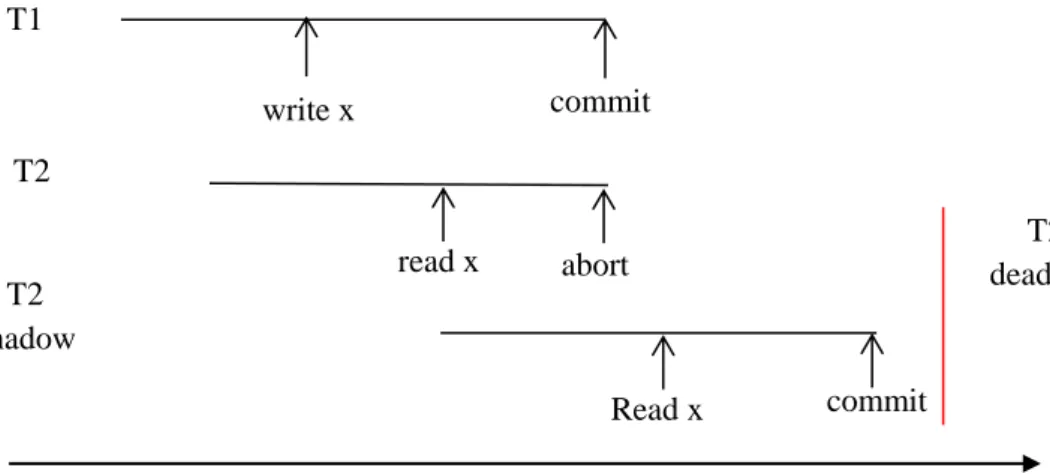
Virtual execution is a concurrency control technique that allows conflicting concurrently running transactions to continue execution virtually, in order to prefetch all required data in its private workspace in memory (first run), which is illustrated by the figure 2.5 a. When a transaction has finished the virtual execution, it aborts and reruns using the pre-fetched data stored in the memory from when it first read (rerun), which is illustrated by the figure 2.5 b. Then, if transactions enter a state of conflict within the rerun, it immediately aborts and reruns again [51] [52][15].
a) First run in virtual execution environments
b) Rerun in virtual execution environments Figure 2.5 transactional phases in virtual execution environments
Analysis has shown that virtual execution techniques that utilize OCC perform better if transactions are allowed to reach the end of their read phase before being aborted [53][54]. This is intuitively logical, since as transactions that have been aborted early would not have retrieved all the required data to be ready locally for the rerun phase. Cached values from the write sets of committed transactions together with read sets from
Read phase Write
phase Validation
phase
Time T
Long read phase because read set is prefetched from disk
Read phase Write phase Validation phase Time T
Short read phase because read set exists in the memory.
22
currently executing transactions populate a local buffer to the transaction management system. This can improve performance if overheads associated with persistent store access are significant. Therefore, distributed data stores [55] and real-time databases [15] have made use of such techniques. There is typically no disk I/O overheads required for the transaction during rerun, as the data has already been pre-fetched. Therefore, considerable battery power savings can be gained by deploying such a technique on mobile devices [16][17]. The following two important issues need to be considered in a virtual execution environment.
1. An access invariant property has to be guaranteed when using this approach, which means that any two executions of the same transaction must always access the same data items, even if these executions are separated by other conflicted transactions [15][51].
2. An issue of consistency arises for a transaction that operates using pre-fetched data. It may be that some of the pre-fetched data has since been modified. This will result in the rerun transaction operating with inconsistent data. A further concurrency control technique is clearly required to overcome this problem. [15][51]
It is important also to mention that, in conventional optimistic concurrency control methods, conflict resolution can be classified into two approaches: kill-based or die-based.
1. Kill-based approaches resolve conflicts between the validating transaction and conflicted concurrently running transactions by aborting conflicted concurrently running transactions and preceding the validating transactions to commit.
2. Die-based approaches, in contrast, resolves conflict by aborting the validating transaction and continuing the execution of conflicted concurrently running transactions.
When a virtual execution environment is deployed with a kill-based approach, it becomes logically equivalent to a die-based approach [51]. That is because the validating transaction continues execution towards the write phase as seen in the kill based approach, yet at the same time concurrently conflicted running transactions continue executions as described in the die-based approach.
23
2.5 Related Work
This section presents a survey of previous studies in the areas of optimistic concurrency control and broadcast datacycle approaches.
2.5.1 Optimistic Concurrency Control (OCC) Techniques
OCC techniques are classified into three categories: forward and backward oriented validation, serialization graph and timestamp. These techniques are described below:
1. Forward and Backward Oriented Validation
Härder [56] proposed two schemes for the validation phase: backward oriented optimistic concurrency control (BOCC) and forward oriented optimistic concurrency control (FOCC):
Backward Oriented Optimistic Concurrency Control. This operates by comparing the read set of a validating transaction with the write sets of all currently executed transactions that have finished the read phase before the validating transaction. If conflict is identified then the only way to resolve it is restarting the validating transaction in its entirety. Tv is the validating transaction
and Ti is the currently running transactions that have finished the read phase before Tv.
It is important to note that the WSs of the overlapping commit transaction have to be saved until their last current transaction has completed.
F o r w a r d O r
Algorithm 1 Backward Oriented Optimistic Concurrency Control 1: valid = TRUE;
2: for each Ti (i=1,2,…,n)
3: If RS(Tv) ∩ WS(Ti) ≠ {} then
4: Valid = FALSE; 5: Endif;
6: Endfor;
7: If valid then commit; 8: Else abort;
9: Endif;
24
iented Optimistic Concurrency Control. This based on comparing the write set of a validating transaction with the read sets of all currently runing transactions that have yet to finish the read phase. When a conflict is found, FOCC provides a degree of flexibility in that a number of resolution policies are possible. These may:
1. Delay the validating transaction and restart the validation phase at a later time.
2. Abort all conflicting transactions and allow the validating transaction to commit.
3. Abort the validating transaction.
It is this flexibility in resolution policies which has made FOCC the focus of further research [57][58][59][60][61][62][63].
Tv is the validating transaction and Ti is the active transactions.
However, aborting the validating transaction is expensive because such transactions have used resources and completed execution. The never abort validating (NAV) transaction strategy ensures that these resources will not be wasted by guaranteeing that the validating transaction commits [33]. However, a major drawback of FOCC is that concurrent transactions have to be blocked in their read phase while the validating transaction is executing in the validation and write phases. This blocking significantly degrades the performance of the system.
Algorithm 2 Forward Oriented Optimistic Concurrency Control 1: valid = TRUE;
2: for each Ti (i=1,2,…,n)
3: If WS(Tv) ∩ RS(Ti) ≠ {} then
4: Valid = FALSE; 5: Endif;
6: Endfor;
5: If valid then commit; 6: Else resolve the conflict; RS – read set and WS – write set.
25
2. Timestamp Technique
Timestamp (TS) is a unique number associated with each transaction at the beginning of its execution. TSs do not necessarily reflect the actual times of the generation of transactions but are important in that they reflect their order. Therefore, they must be issued in ascending order. Two methods could be used to generate TSs. The first method is taking the system clock as the TS. This is reasonable, but with this method the scheduling should not be quicker than the system clock in ordere to prevent the possibility of generating the same TS to two different transactions. The second method is to use the counter as the TS generator. Therefore, each new transaction receives the previous TS but increased by 1. The rule here is: for each transaction T, if Ti starts after
Tj then the TS of Ti must be higher than the TS of Tj.
In addition to the data, three pieces of information need to be associated with each data item: two TSs (RT and WT) and one additional bit (C) [34]:
1. RT (a), read time of data item a; this timestamp refers to the highest timestamp of the transaction that has read a.
2. WT (a), write time of data item a; this timestamp refers to the highest timestamp of the transaction that has written a.
3. C (a), commit bit of data item a, which is set to true if the most recent transactions that wrote object a have already committed. This information is used to eliminate the reading of dirty data [34].
The timestamp approach has been widely studied in the literature [16-18][19-22]. It shows a high degree of concurrency, guarantees a deadlock-free property, and provides a relatively smaller number of unnecessary rollback overheads. In contrast, the major disadvantage of the timestamp approach is the large overheads associated with timestamp management, especially when database is geographically distant from the client, communication between clients and the server is needed for every read operation to keep track of both read and write timestamp; which further increase timestamp overhead [64][21][18].
3. Serialization Graph Testing (SGT) Technique
The SGT scheduler maintains a serialization graph of the history representing the execution it controls. During the execution, the scheduler maintains the SG by adding edges between concurrent transaction nodes corresponding to all read and write
26
operations requested, without consideration of SG being acyclic. When a transaction T finishes execution and the scheduler receives a request to commit T, then it checks if T lies on a cyclic SG. If so, then this indicates that there has been a conflict operation inserted into the schedule, and some resolution policy needs to be applied to resolve this conflict. If not, then the schedule is still serializable and T can commit safely. The SGT scheduler theoretically maintains the serializability of the schedule. However, in practice, it is very expensive to maintain SG overheads; and yet, checking for cycles adds extra cost to this technique [19][65][66].
2.5.2 Aspects of Optimistic Concurrency Control
Optimistic approaches have the potential to provide greater performance than pessimistic approaches, particularly, in real-time databases even given high data contention over a wide range of resource availability levels. This is because, in the optimistic approach, conflict resolution is delayed until the times at which transactions commit, which helps in making better conflict decisions. Therefore, optimistic algorithms ensure that no transactions which are likely to miss their deadlines prevent other transactions execution in the system. Therefore, this section devoted to explored fifteen aspects of OCC studied in the literature. These include correctness criteria, conflict detection and resolution, unnecessary rollback, transaction length and starvation problems, back-off policy, partial rollback, read-only transaction considerations, transaction arrival rate, database granularity, static/dynamic data access schemes, silent/broadcast commit, speculative CC, deadline-cognizance and virtual execution.
1. Correctness Criteria
Serializability is the fundamental approach of correctness criteria to concurrency control. The serializability of a schedule means that its outcome, the transformation of a database state, is equivalent to at least one serial schedule [19]. Although serializability has been widely adopted in concurrency control [19][5][20][6], it is considered to be strong correctness criteria in certain circumstances, for instance in some commercial applications. Alternative weaker correctness criteria have been proposed in order to increase system performance [67][68][69][70][71][72][73][74]. For example, if a list of products is retrieved according to price, but which is just about to be updated with a new product, the new product may not appear in the list. However, it will appear in the list later.
![Figure 2.1 Lost update anomaly [6]](https://thumb-us.123doks.com/thumbv2/123dok_us/533650.2562926/25.892.319.669.783.1097/figure-lost-update-anomaly.webp)
![Figure 2.2 Inconsistent retrievals [6]](https://thumb-us.123doks.com/thumbv2/123dok_us/533650.2562926/26.892.319.663.624.1113/figure-inconsistent-retrievals.webp)
![Figure 2.18 Broadcast disks generation program [119]](https://thumb-us.123doks.com/thumbv2/123dok_us/533650.2562926/60.892.172.776.119.548/figure-broadcast-disks-generation-program.webp)
![Figure 2.19 Transaction execution schedule [147]](https://thumb-us.123doks.com/thumbv2/123dok_us/533650.2562926/64.892.250.733.132.422/figure-transaction-execution-schedule.webp)