Working Memory Functioning In Children With
Predominantly Inattentive Attention Deficit/Hyperactivity
Disorder (ADHD) Versus Children With Predominantly
Hyperactive ADHD
Karen Margaret Allsopp
(0607797/M)
________________________________________________________________________
A Research Report submitted to the Faculty of Humanities, University of the
Witwatersrand, Johannesburg, in partial fulfillment of the requirements for
the degree of Masters of Education in Educational Psychology by
Coursework and Research Report.
Johannesburg, April, 2008
Declaration
I hereby declare that this research report is my own, unaided work, and has not been presented for any other degree at any other academic institution, or published in any form.
It is submitted in partial fulfillment of the requirement for the degree of Masters of Education in Educational Psychology by Coursework and Research Report at the University of the Witwatersrand, Johannesburg.
____________________________ ______________
Karen Allsopp April 2008
Abstract
Working memory has been identified as an area in which children diagnosed with ADHD experience difficulty (Carnoldi, Marzocchi, Belotti, Caroli, De Meo & Braga, 2001). However, there are conflicting findings regarding the nature of working memory deficits in children diagnosed with ADHD and some researchers believe that working memory deficits may differ between the two ADHD subtypes (Diamond, 2005; Douglas, 2005; Knouse 2007; Milich , Balentine & Lynam, 2001). In addition, it is also thought that working memory may be one of the main contributing factors of this disorder (Rapport, Chung, Shore & Isaacs, 2001). Thus, there is clearly a need for additional and more detailed investigation into the way individuals with ADHD test with regard to their working memory functioning. This study attempted to examine the working memory functioning in children diagnosed with ADHD, in particular, the Predominantly Inattentive subtype and Predominantly
Hyperactive/impulsive subtype in comparison to a control group.
A sample of seventy-two participants was tested using the Ravens Progressive Coloured Matrices (RPCM) and the Automated Working Memory Assessment (AMWA) to assess their nonverbal intelligence and working memory. The primary motivating factor for the choice of participants was that they had to have been diagnosed by a professional as having ADHD (either subtype) and they had to be in Grades one or two. None of the children in the control group met the DSM-IV-TR (APA, 2000) criteria for ADHD.
Repeated measures of Mann-Whitney and post-hoc analysis revealed that there were significant differences in the verbal short term memory, verbal working memory and visuospatial working memory between the three groups. Test results revealed no significant differences between the test scores of the Inattentive group and the control group in these areas. However, scores obtained by the Hyperactive/impulsive group differed significantly from those of the control and Inattentive groups. Score differences related specifically to verbal short term memory, verbal working memory and visuospatial working memory. This implies that children diagnosed with ADHD, (the Hyperactive/impulsive subtype) may need specific strategies in the classroom to enable them to encode, access and retrieve information
to ensure optimal performance. The implications of these findings are discussed further in the thesis.
“Ode on Working Memory
There once was a box called short term store Whose function was storage and nothing more. But along came Alan Baddeley
Whose subjects dual-tasked madly
And working memory replaced short term store forevermore. For those who’ve been living in caves
Working memory is a system with slaves. They are independent buffers
So that neither one suffers
When doing verbal memory with visual maze. While storage is the job of each little slave The central executive says how we behave. From up in the prefrontal lobes
It activates and controls all nodes
Through a dopamine system acting as gates.
The unanswered questions on working memory abound Despite numerous studies whose findings are sound. What’s needed right now
Is for us to see how
We can put all these data on common ground (Janice Keenan, quoted in Models of Working Memory Mechanisms of Active Maintenance and Executive Control, 2007, p. xviii).”
Acknowledgements
I would like to thank the following people:
• Prof Kate Cockcroft, for her patience, understanding and the thorough way in which she directed and supervised me.
• Natasha , Grizelda, Kerry, Pascale and Carol for their assistance with data collection.
• The children and staff at Delta Park, Lantern, Bella Vista, Cross Roads,
Emmarentia Primary and Greenside Primary schools, for their participation in the study.
• My children Natasha, Sean and Samantha for their patience and understanding.
• My mom and dad for their support and motivation.
• Margaret, Nancy and Mariesa for their interest and encouragement.
• Jacques for his support and belief in me.
• Sharon for planting the seed.
• Shayne for beginning and accompanying me throughout this long journey.
• And last but not least, I would like to extend my gratitude to my husband, Roger, who always encouraged, supported me and took over many things to give me the opportunity to complete this research.
Table of Contents
Page
Declaration 2
Abstract 3
Ode on Working Memory 5
Acknowledgements 6
Table of Contents 7
List of Appendixes 8
List of Tables 9
List of Figures 10
Chapter 1: Introduction and Literature Review 11
1.1 Introduction 11
1.2 The theoretical and empirical underpinnings of this study 11 1.3 The structure and functioning of working memory 13 1.3.1 Working memory, a distinct memory system 13 1.3.2 Characteristics and structure of working memory 14
1.3.3 The phonological loop 18
1.3.4 The visuospatial sketchpad 18
1.3.5 The central executive 19
1.3.6 The episodic buffer 21
1.4 The development of working memory 21
1.5 Deficits in working memory and attention 24
1.6 Attention Deficit /Hyperactivity Disorder 27
1.7 The role of impaired executive function in ADHD 35
1.8 Rationale for the Current Study 43
Chapter 2: Method 45 2.1 Aim 45 2.2 Research Questions 45 2.3 Research Design 46 2.4 Sampling 46 2.5 Participant characteristics 47 2.5.1 ADHD 47 2.5.2 Social-cultural background 48 2.5.3 Age 48 2.6 Data Collection 49 2.7 Instruments 50
2.7.1 The Raven’s Coloured Progressive Matrices (RCPM) 50 2.7.2 The Automated Working Memory Assessment (AWMA) 50
2.8 Procedure 53
2.9 Threats to Validity 53
2.10 Data Analysis 54
2.10.2 Kruskal-Wallis Test 54 2.10.3 Mann-Whitney U Test 54 2.11 Conclusion 55 Chapter 3: Results 56 3.1 Introduction 56 3.2 Normality of Data 56 3.3 Descriptive Statistics 57
3.4 Analysis of the Ravens Coloured Progressive Matrices 57
3.5 Conclusion 68 Chapter 4: Discussion 69 4.1 Introduction 69 4.2 Discussion of Results 69 4.3 Limitations 76 4.4 Contribution to Knowledge 77
4.5 Directions for Future Research 78
4.6 Conclusion 78
Reference List 80
List of Appendixes
APPENDIX A: Permission letter from Gauteng Department of Education
APPENDIX B: Letter to the School Principal
APPENDIX C: Letter to the Parents
APPENDIX D: Parents Consent Form
APPENDIX E: Biographical Questionnaire
APPENDIX F: Child’s Assent Letter
APPENDIX G: Withdrawal Form
List of Tables
Page Table: 1 DSM-IV-TR Diagnostic Criteria for Attention-Deficit/Hyperactivity Disorder 29 Table: 2 A Comparison of the Characteristics of ADHD Hyperactive/impulsive
and Inattentive Subtypes 32
Table: 3 Results of Kolmogorov- Smirnov Test of Normality 56 Table: 4 Descriptive Statistics for the RPCM by Group 57 Table: 5 The Kruskal-Wallis Test: RCPM: Hyperactive/impulsive, Inattentive
and Control Groups 57
Table: 6 Mann-Whitney Test: RCPM, Inattentive and Hyperactive/impulsive
Groups 58
Table: 7 Mann-Whitney Test: RCPM, Inattentive and Control Groups 58 Table: 8 Mann-Whitney Test: RCPM, Hyperactive/impulsive and Control Groups 58 Table: 9 Means and Standard Deviation of the Inattentive, Hyperactive/impulsive
and Control Groups 60
Table: 10 Means and Standard Deviation of the Inattentive, Hyperactive/impulsive
and Control Groups after adjustment 61
Table: 11 Kruskall-Wallis Test : Verbal Short Term Memory 62 Table: 12 Post-Hoc Test between Inattentive and Hyperactive/impulsive Groups in terms
of Verbal Short Term Memory 62
Table: 13 Post-Hoc Test between Inattentive and Control Groups in terms of Verbal
Short Term Memory 63
Table: 14 Post-Hoc Test between Hyperactive/impulsive and Control Groups in terms of
Verbal Short Term Memory 63
Table: 15 Kruskall-Wallis Test: Verbal Working Memory 64 Table: 16 Post-Hoc Test between Inattentive and Hyperactive/impulsive Groups in terms
of Verbal Working Memory 64
Table: 17 Post-Hoc Test between Inattentive and Control Groups in terms of
Verbal Working Memory 65
Table: 18 Post-Hoc Test between Hyperactive/impulsive and Control Groups in terms of Verbal Working Memory
Table: 19 Kruskall-Wallis: Visuospatial Short Term Memory 66 Table: 20 Kruskall Wallis: Visuospatial Working Memory 66 Table: 21 Post-Hoc Test between Inattentive and Hyperactive/impulsive Groups in terms
of Visuospatial Working Memory 67
Table: 22 Post-Hoc Test between Inattentive and Control Groups in terms of Visuospatial
Working Memory 67
Table: 23 Post-Hoc Test between Hyperactive/impulsive and Control Groups in terms of
List of Figures
Page Figure 1: Baddeley’s Multi-Component Model of Working Memory 17 Figure 2: Barkely’s (1997) integrative Model of ADHD Hyperactive/impulsive
subtype 37
Chapter 1
Introduction and Literature Review
1.1 Introduction
The present study is positioned within the Baddeley and Hitch (1974) multi-component model of working memory. Since Baddeley and Hitch (1974) first published their seminal paper on working memory, many theories regarding this construct have been proposed and researched (Colflesh & Conway, 2007). This multi-component approach to working memory aims to understand ways in which knowledge is provisionally stored and maintained in the performance of complex cognitive tasks. Working memory has been identified as one of the areas in which children with Attention Deficit/Hyperactivity Disorder (ADHD) may
experience difficulty (Henry, 2001; Rapport, Chung, Shore & Isaacs, 2001). Consequently, a wealth of literature has been published in this regard and this study sought to contribute to the understanding of the nature of working memory with regard to ADHD. The following provides an overview of the empirical research in both of these fields. First, it is necessary to briefly describe memory and its functioning.
1.2 The theoretical and empirical underpinnings of this study
Memory can be defined as the ability to store and retrieve information (Cockcroft, 2002).
“If any one faculty of our nature may be called more wonderful than the rest, I do think it is memory. There seems something more speakingly
incomprehensible in the powers, the failures, the inequalities of memory, than in any other of our intelligences. The memory is sometimes so retentive, so serviceable, so obedient – and at others so bewildered and so weak – and at others again, so tyrannical, so beyond control!” (Austen, 1992 p.xvi)
Throughout history the intricate process of memory has been under speculation and
investigation. This “wonderful faculty of nature” is the key to successful development and growth. Memory is a “faculty” that is continually in use, an indispensable and vital part of development and learning (Levin, 2002). Over the years there has been important progress in cognitive neuropsychology in terms of the understanding of the neurology and functioning of memory systems (Vallar, Di Betta & Silveri, 2006), resulting in the reconceptualisation of memory as being a system that comprised of at least two main components as opposed to one single unitary system, namely short term memory and long term memory. This was first proposed by Hebb in 1949 based on temporary electrical activation and neuronal growth, and by the late 1960s, many new models of memory had emerged around the concept of short term memory (Baddeley, 2003).
The majority of research concerning human memory has been conducted within the information processing framework. This framework conceptualizes memory as a series of intricate, interrelated processes that encode, store and retrieve information. In this
framework, sensory information is assimilated and changed into memory, via encoding. This information is then symbolized or stored in the brain, and subsequently retrieved and made available to the individual. A deficit during encoding, storage or retrieval may result in a failure to remember (Cockcroft, 2002). According to the early information processing framework, for example Atkinson and Shiffrin (1968), information is assimilated through a series of temporary sensory registers into a restricted capacity short-term store and
subsequently fed into and out of long term memory. However, this early understanding of memory was incompatible with well established theories regarding learning. Furthermore, early information processing theory was largely incompatible with data concerning the impact of neuropsychological damage to the short term store. According to this framework, patients with short term store impairments should have shown a limited capacity for long term learning or every day cognitive activities (Baddely, 2003). However, these patients showed very few cognitive problems aside from severely impaired short term memory. In order to understand this phenomenon, Baddeley and Hitch (1974) used secondary tasks to deplete the availability of short term memory in participants performing reasoning or learning tasks, on the assumption that the latter were reliant on working memory. Baddeley
and Hitch (1974) found clear, but not severe, impairment in the patients’ short term memory and based on these findings, they proposed a three component model of working memory, a model that comprised of separable, interacting components to replace the unitary system (Baddeley, 2003).
1.3 The structure and functioning of working memory
1.3.1 Working memory, a distinct memory system
Baddeley and Hitch (1974) propose that, while working memory shares commonalities with short term memory structures and processes, the two are nevertheless distinct memory systems. Whilst there are short term memory components to working memory models, the concept of short term memory is separate from these hypothetical concepts. Short term memory refers to information that is maintained at a surface level that does not depend on permanent knowledge structures in order to operate (Engle, Cantor & Carullo, 1992; Isak & Plante, 1997). Gathercole and Alloway (2006) consider short term memory to be a
component of working memory, concerned with straightforward storage, whereas other researchers (e.g. Engle, Cantor & Carullo, 1992) argue that short term memory and working memory are separate from one another (Gathercole & Alloway, 2006). Both sets of theorists agree that important theoretical distinctions should be made between the passive short term memory system and a more dynamic working memory system. The short term memory system specializes in the temporary storage of material within particular information domains i.e., visual spatial or verbal (Gathercole & Alloway, 2006). Short term capacity is determined by practiced skills and strategies, such as rehearsal and chunking, which have traditionally been measured by digit span and word recall tasks (Daneman & Carpenter, 1980).
It is worth noting that the capacity of short term memory is linked to the speed of speech (Cockcroft, 2002). Thus, the faster an individual speaks, the more information s/he is able to rehearse. By the age of 8 years, it can be expected that many children will use articulatory rehearsal to support at least some memory tasks (Hutton & Towse, 2001). Visuospatial short term memory tasks and verbal short term memory tasks capture less underlying
cognitive skills than verbal working memory tasks and visuospatial working memory tasks (Kane, Hambrick, Tuholski, Wilhelm, Payne & Engle, 2004). Thus, studies reveal that when short term memory and working memory tests are conducted on children and adults, there are several differences between the data from short term memory and working memory tests. Working memory scores are often lower than their short term memory equivalent (generally half the value) and importantly, working memory tasks are often better predictors of complex cognitive skills, such as reading comprehension (Hutton & Towse, 2001; Savage, Cornish, Manly & Hollis, 2006).
As is clear from the description above, the relationship between short term memory and working memory is differently described by various theorists, however, it appears that most theorists agree that working memory and short term memory share a close relationship in that they both refer to temporary memory and both play an important role in learning during childhood (Gathercole & Alloway, 2006).
1.3.2 Characteristics and structure of working memory
There are numerous questions regarding working memory that remain unresolved and are the subject of continual ongoing research. These include the mechanisms for information coding and retrieval, as well as the representation format for different types of information (e.g. verbal or visuospatial) and the control, regulation, function and structure of working memory (Miyake & Shah, 2007). Fortunately, the characteristics of working memory are not
completely unknown. It is recognized that this component of memory is utilized to
momentarily hold in mind the different aspects of what individuals do daily. Humans utilize working memory to understand and represent their immediate environment and hold on to information about their immediate past experiences (Baddeley & Logie, 2007). It is also recognized that working memory has limited capacity, and is capable of only partial retention of past experience, with the degree of retention being dependent on the demands of the task and length of the task being performed (Logie, 1995). Working memory plays a vital role in the acquisition of original knowledge and problem solving. It is also vital for creating, linking and acting on current goals (Baddeley, 1986). In addition, research has consistently
demonstrated significant relationships between working memory and a wide range of
cognitive abilities such as language comprehension, mental arithmetic, reasoning and general intelligence (Abu-Rabia, 2003;Hutton & Towse, 2001; Savage et al., 2006). All cognitive activities require the moment-to-moment monitoring, processing and maintenance of task-relevant information which are supported by different components of working memory (Baddeley & Logie, 2007). Working memory capacity therefore has important consequences for higher cognitive functioning (Alloway, Gathercole & Pickering, 2006).
In an attempt to elaborate on the working memory process, recent neurological research revealed that the posterior cortex may be more important than the frontal cortex for the storage of information in working memory. This implies that the information entering working memory from the external visual world is processed by structures in the parietal and temporal lobes which are specialized for perceptual processing. These neuro-anatomical structures remain active when the stimulus is removed for a brief time. In the same way, information entering working memory from long term memory is also stored via the
structures that mediate its perception (Jonides, Lacey & Nee, 2005). The activation in these structures will fade with time and interference unless there is repeated rehearsal of them and this is controlled by the circuitry that also controls modulation or rehearsal of incoming information. i.e. the selective attention mechanism. The circuitry that controls rehearsal makes use of perceptual-motor processes in the parietal and frontal cortex, including the same mechanism that controls external speech. However, this hypothesis still needs to be tested thoroughly (Jonides et al., 2005).
Various theoretical frameworks have been proposed to account for the structure of working memory. Some researchers conceptualise working memory as a single controlled capacity system which competes for a limited resource pool, whilst others conceptualize working memory as a multi-component system comprising specialized subsystems that together emphasise combined processing and storage used in activities of daily living (Logie & Pearson, 1997), i.e. domain specific storage, domain general storage or specific executive functioning (Engle, Cantor & Carullo,1992; Kyllonen & Christal, 1990; Miyake & Shah, 2007). The Baddley and Hitch (1974) multi-component model, which is the most extensively
researched and most frequently used model of working memory (Miyake & Shah, 2007), forms the theoretical basis for this study. According to this model, working memory is comprised of several specialized components, including the central executive and two slave systems. Neuropsychological and neuroimaging studies support this model of working memory, which has subsequently been modified to include an episodic buffer (Baddeley, 2000). Evidence supporting the separability of the three-sub components of working
memory is abundant, ranging from the selective interference effects found in normal adults in dual-task paradigms, through to the pattern of selective sparing and impairments in brain-damaged patients, to the differential rates of developmental changes observed in children (Baddeley, 1996; Baddeley & Hitch, 2007; Bayliss, Jarrold, Baddeley, Gunn & Leigh, 2005; Smith & Jonides, 1999).
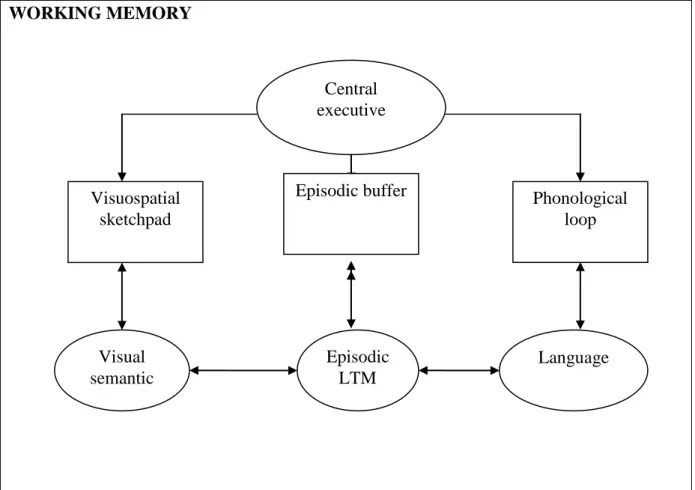
The structure of Baddeley and Hitch’s (1974, revised 1986) multi-component model is described in detail in Figure 1 (p.17). This figure shows the most recent multi-component model of working memory.
WORKING MEMORY
Figure 1: Baddeley’s Multi-Component Model of Working Memory adapted from The multi-component model of working memory: Explorations in experimental cognitive psychology (p. 4), by G. RepovŠ and A. Baddeley, 2006, Neuroscience,139 (1) 5-21.
As Figure 1 shows, this model of working memory comprises a limited capacity attentional controller, the central executive aided by two subsystems, one concerned with acoustic and verbal information, namely the phonological loop and the other performing a similar function for visual and spatial information, namely the visuospatial sketchpad. This working memory model is better able to explain performance in concurrent immediate memory tasks than theories that assume a single processing and storage system or a limited capacity attentional system coupled with activated memory traces (Cocchini, Logie, Sala, MacPherson &
Baddeley, 2002). Each of the subsystems making up Baddeley and Hitch’s (1986) model of working memory is described below.
Visuospatial sketchpad Central executive Visual semantic Language Episodic LTM
Episodic buffer Phonological
1.3.3 The phonological loop
The phonological loop is speech-based and responsible for the temporary storage of all information that is able to be verbalized, such as spoken words, printed words, and
identifiable objects (Gathercole & Alloway, 2006). It is comprised of two parts, namely the phonological store, and an articulatory rehearsal mechanism (Baddeley, 1996). The
articulatory rehearsal mechanism acts as an inner ear by maintaining information in its
auditory form for 1-2 seconds, where it is circulated in a similar manner to a tape loop. In this way, an individual is able to remember a telephone number just heard, provided that s/he keeps rehearsing it (Baddeley, 1996). Spoken words enter the phonological store directly, whereas written words or visual material needs to be converted into an articulatory code by the articulatory rehearsal mechanism befor being able to enter the phonological store (Baddeley, 1996). Baddeley and Hitch (1996) assume that individual differences in the phonological loop reflect the amount of memory activation obtainable. For example, patients with impaired verbal short term memory appear to be able to encode verbal material
normally, in so far as perceiving words and sentences, but the trace of such perceptual processing does not continue, demonstrating a lack of either adequate activation or maintenance (Miyake & Shah, 2007). Tasks that make use of the phonological loop are learning to read, language comprehension and vocabulary acquisition, and it is thought that a deficit in the phonological loops system may result in a difficulty in learning to read.
However, this hypothesis is still under investigation (Baddeley, 1986).
1.3.4 The visuospatial sketchpad
The visuospatial sketchpad is a specialized, temporary memory system responsible for the storage of visuospatial information over a short period of time (Gathercole & Pickering, 2000). Evidence for the visuospatial working memory has been obtained from research on memory for spatial movement and for visual patterns. In order to prove that there were separate subcomponents within the visuospatial sketchpad, Logie and Pearson (1997) conducted a study investigating visuospatial working memory in children aged 5, 8 and 11. These children’s memory spans for recognition and recall of square matrix patterns and
movements to a series of targets (the Corsi block test) were tested. Test results showed that, within each age group, the span measures for patterns correlated poorly with span for
movements. Performance on both types of tasks improved with age, and span for patterns improved much faster across age than span for movement sequences (Logie & Pearson, 1997). This developmental fractionation indicated that the capacity of these subsystems developed at different rates, providing support for the existence of separate components within the visuospatial sketchpad (Logie & Pearson, 1997). These components were named the visual cache and the inner scribe (Logie, 1995). The visual cache holds information about the spatial location of objects, and represents a record of visual processing that includes the object as well as spatial information in an integrated manner (Logie, 1995). The inner scribe maintains sequences of movement that are not solely dependant on visual perceptual input. The relative physical location of objects can be determined by hearing, by touch, or by arm movement as well as vision. In this way the blind have been found to also store spatial representation in the inner scribe (Logie, 1995). “Pure” measures of visuospatial working memory are difficult to develop, since many types of visuospatial images, such as pictures of familiar objects, can be coded in working memory using phonological or semantic
representations (Pickering, 2001).
1.3.5 The central executive
The central executive is the component of working memory responsible for controlling resources and monitoring information processing across informational domains (Alloway et al., 2006). Although the central executive is not yet fully understood, it is a vital component according to the Baddeley and Hitch (1974) model of working memory. Recent theories regarding the central executive conceptualise this structure as a supervisory or attentional control system (Roodenrys, Koloski & Grainger, 2001). Baddeley (2000) understood the central executive‘s role to be that of coordinating the subsidiary memory systems (i.e. the phonological loop and visuospatial sketchpad). The central executive is hypothesized to work together with, and regulate, the two storage systems used for the temporary storage of
different types of information, that is the verbal or auditory, and the visual and spatial (Henry, 2001). It is suggested that the central executive is responsible for attention and
inhibition of irrelevant information from entering the working memory (Pickering, 2001). Thus, its function is to control encoding and retrieval strategies, switch attention, and mentally direct material held in the slave systems (Baddeley, 2000). The central executive can be measured by a random generation task. The ability to generate numbers is a ‘basic’ function of the human mind, even if those numbers are not mathematically ‘random’. Relevant literature suggests that humans consciously generate random numbers as well as distractions that reduce that effort, such as concurrent tasks that take up memory or powers of concentration reduce the randomness of the numbers (Baddeley, 1986). When participants are asked to produce random sequences at speed they tend to produce series according to the conventional sequence – 1234, 7654 etc., as if the mind has exhausted its ability to screen the numbers fast enough, relying on simpler default orders to deliver a number in time.
Baddeley (1986) suggests that during random generation, the central executive acts as a filtering device, screening out automatically generated (and therefore nonrandom) responses. Several studies have suggested that random generation can be used to load the central
executive selectively within the working memory system (Swanson, Howard & Saez, 2006). It is thought that the efficiency of the central executive may be related to the process of updating. Updating requires the initial monitoring and coding of incoming information for relevance to the task at hand, and then appropriately revising the items held in working memory by replacing old, no longer relevant information for newer, more relevant
information (Swanson et al., 2006). It is assumed that the updating function goes further than the simple maintenance of task-relevant information given that updating requires an active manipulation of relevant information in working memory. Inadequate updating may impair the efficiency of the central executive system. Another possible source of difficulty that may impair the efficient operation of the central executive is speed of processing. Several
researchers have argued that processing speed accounts for the relationship between working memory and cognitive performance on a variety of tasks. Processing speed is assumed to determine capacity given that processing (i.e. encoding, transforming, retrieving) is time related. A faster rate of processing allows for more information to be processed, thus enabling a more functional working memory capacity (Swanson, et al., 2006).
1.3.6 The episodic buffer
The latest addition to the multi-component model, the episodic buffer, is responsible for the assimilation of information from different components of working memory and long term memory into multi-dimensional representation. Individuals’ verbal working memory and visuospatial working memory vary greatly, and act separately from one another, but their functioning may be integrated by the episodic buffer (Baddeley, 2000). One possibility is that developments in the episodic buffer facilitate the recoding of visual material into a verbal form.
The theoretical framework discussed above, together with relevant research, has outlined the multi-component approach to working memory, which is able to provide a understanding of the way in which information is temporarily stored and maintained in the performance of complex cognitive processing and provides a useful basis for the systematic accumulation of knowledge about important cognitive activities (Baddeley & Hitch, 2007). However, even though psychologists understand a great deal about the basic features and structure of working memory, there is currently little agreement about the way in which information is processed (Jonides et al., 2005). This highlights the need for future focused research investigating the processing of information in the working memory system.
1.4 The development of working memory
Given that this study focuses on children, it is necessary to take into account the development of working memory across childhood. In a completely developed working memory system, visual and phonological coding exist together on a continuum, under the control of
attentional and inhibitory mechanisms (Pickering, 2001). Changes in knowledge, processing strategies, processing speed, attentional, processing capacity, passive memory loss and storage capacity, are to be expected to influence performance on working memory tasks (Pickering, 2001). Many studies have researched age-related growth in children’s working memory. This research has indicated that their working memory spans increase
Studies indicate that children’s verbal working memory improves across the course of childhood, (Cowan, 1997, 2000; Gathercole & Baddeley, 1993) and studies involving digit span measures indicate a positive correlation with age (Ferguson, Bowey & Tilley, 2002) with span increasing from approximately two digits for 2-year-old to five digits for 7-year- olds and seven digits for adolescence (Dempster, 1981). The results obtained from research using tasks that require both storage and processing, such as backward digit span or
operations span, support the proposal of fixed growth; however, spans are typically poorer than studies involving purely digit span measures by roughly two units (Pascual-Leone, 2000). The processes and mechanisms that bring about these improvements are still being investigated. This is also true for age-related changes in processes such as sub-vocal rehearsal and articulation rate, which have been investigated in children and show a steady improvement in the speed of verbal rehearsal, thus allowing more items to be stored. As articulation rate increases and children are able to rehearse faster (vocally or sub-vocally), span increases and word length effects become more prominent. The word length effect has been found in children as young as 4 years old suggesting that articulation rate is important at a young age (Gathercole & Baddeley, 1993). Over the course of development, children increasingly rely more on more sophisticated forms of rehearsal instead of faster repetition. Overall empirical studies support claims that verbal working memory improves during
childhood and suggest that increases are due to more sophisticated and efficient processing of verbal information. There appears to be an increase in the capacity of the visual working memory which parallels improvements in the phonological loop (Pickering, 2001).
Visual working memory increases between the ages of 5 and 11 years (Pickering, 2001). By the age of 4 or 5, children can remember two to three item sequences of pictures (Gathercole & Baddeley, 1993). However, younger children find it more difficult when the pictures of items on a list bear a resemblance to one another than when they are visually distinct. This is found as early as preschool age, whereas, older children have more trouble with recall when the verbal labels for the images have similar sounding names. Thus, visual similarity effects decrease with age, whereas phonological similarity effects increase with age. This may be attributed to the fact that young children use their visual system for rehearsal of visual
information, but some time between 6 and 8 years of age, children begin using their verbal system for rehearsal.
During the early stages of development, the basic perceptual and sensory motor functions of working memory are enhanced, in the later stages the neurological networks develop in order to integrate complex processes associated with working memory function (Pickering, 2001). This may explain why children are better able to assemble information in a working memory task in a meaningful way as they get older, due to the increased content and development of their long term memory. This process is often referred to as “chunking” or grouping the information in a meaningful way. Research has proven that chunking increases the
performance on phonological working memory tasks, because memory items are grouped on the basis of information held in long term memory, which results in a reduced quantity of information being held in working memory (Pickering, 2001). It appears that older children and adults’ working memory operation is conditional on the efficient allocation of
phonological and visuospatial slave system resources by the central executive (Pickering, 2001). Visuospatial working memory tasks rely heavily on executive functioning which does not fully develop until adolescence. Consequently, the contribution of attention processes to visuospatial working memory tasks is unlikely to be at its most powerful until this stage of development (Pickering 2001). Much has been written about the differences between verbal and visuospatially based memories. This is particularly relevant in a
developmental context as children’s reliance on these codes appears to be different (Hutton & Towse, 2001). This needs to be taken into consideration in any study on working memory in children and will be discussed along with the findings in the final chapter of this report. Relatively little is known about the development of the central executive over childhood. However, it has been suggested that this component of working memory is particularly important to visuospatial memory tasks, due to the significant attentional requirements of these tasks (Pickering, 2001). It is probable that younger children draw more on executive resources to perform short term memory tasks, due to the fact that the brain areas related to higher level cognition are still developing. Therefore, older children have greater cognitive
resources and younger children do not have the benefit of these additional support systems (Alloway et al., 2006).
It is thought that changes in integrative ability within the episodic buffer take place over the course of childhood. Mounoud (1996) considered that a general change in cognition is driven by neurological maturation and supported by the environment. However, no studies have directly examined development within the episodic buffer, though research on the development of the phonological loop and development of the visuospatial sketchpad supply evidence about changes that may be expected. Research indicates that visual-verbal
integration may go through significant changes during middle childhood and elementary school years. Pickering (2001) particularly suggests that the change from visual to verbal processing occurs around 8 years of age. Gathercole, Pickering, Ambridge and Wearing (2004) propose that the change in processing occurs around 7 years of age.
1.5 Deficits in working memory and attention
Although the model of working memory outlined above conceptualizes working memory as a distinct memory system, the model does not imply that working memory functions as a discrete separate entity. In fact, it appears that at times, the terms working memory and attention are so intertwined that these constructs are sometimes used interchangeably and Baddeley (1993) once remarked that working memory may be better construed as working attention. The inter-connectedness between attention and working memory has been empirically established. For example, researchers have suggested that working memory capacity is limited by controlled attention, which is the ability to allocate attentional resources despite distraction or interference (Alloway et al., 2006). Children with high working memory capacity have also demonstrated greater available attentional resources available to them than individuals with low capacity (Baddeley, 1993). Further studies support the view that many children who have been diagnosed with attention difficulties, particularly ADHD, have cognitive deficits with regard to working memory, that is, they have difficulty holding information that directs behaviour (Sinha, 2005). An inter-connection between attention and working memory has also been demonstrated with adults. In a series of
three experiments conducted on adults (mean age 28), increased working memory load was demonstrated to reduce the executive control of attention measures via task-switching and inhibitory management paradigms (Alloway et al., 2006). The task was a serial stream of single colour words in congruent fonts, with the word presented for 900 ms followed by a 600 ms inter-stimulus interval. Participants were trained to respond to each of the words with a single ‘Go trial’ button press and to withhold this response when either of two different circumstances arose. The first was if the same word was presented on two consecutive trials (Repeat No-go), and the second was if the word and font of the word did not match (Stroop No-go). By having competing types of response inhibition rules, they aimed to vary the strength of stimulus–response relationships, whereby representations of rules competitively suppress one another such that the more prominent rule would suppress the weaker rule and so produce a significant number of errors, a small proportion of which may go unnoticed due to focusing mainly on the dominant rule.
In particular, they aimed to benefit from the over learned human behaviour of reading the word rather than the colour of the letters (the Stroop effect) and in so doing predispose participants to monitor for the repeat rather than the Stroop No-gos. Participants were trained to press a different ‘error awareness’ button on the trial following any commission errors and were not required to make the standard Go response. This research supported the attentional control theory that active maintenance of competing task goals is vital for executive
functioning and working memory capacity (Hester & Garavan, 2005). In addition, the findings of this research also suggest that, when information currently maintained in working memory is re-encountered, it is harder to exert executive control over it (Hester & Garavan, 2005). Based on these and similar findings, there is a growing emphasis on the closer
examination of tasks and processes that can be used to tap the central executive as a means of clarifying the nature of deficits in this system (Miyake & Shah, 2007; Roodenrys et al. 2001). In practical terms, current research suggests that working memory deficits may manifest as inattention and contribute to poor academic performance. As working memory is primarily located in the prefrontal cortex of the brain, deficits in working memory occur in several disorders where the prefrontal cortex is affected, such as ADHD (Klingberg, Fernell, Olesen, Johnson, Gustafsson, Dahlstrom, Gilberg, Forssberg & Weterberg, 2005). Children
diagnosed with ADHD and children who have working memory deficits share many of the same characteristics in the classroom, such as forgetting instructions, place-keeping errors in complex tasks and failure to meet simultaneous processing and storage demands (Gathercole & Alloway, 2006). Children diagnosed with ADHD also need to be “managed” in classroom situations. Deficits in working memory are often experienced by educators as inattention problems, like difficulty focusing on reading a text, or memory problems, such as forgetting what to do while walking from one room to another. In children the problem is often
remembering what to do next and this affects their planning ability (Douglas, 2005). Thus, it is not surprising that impairment in executive functioning such as response inhibition,
vigilance, working memory and planning have been identified as an area of deficit in children with ADHD and neuropsychological studies have supported these findings (Carnoldi,
Marzocchi, Belotti, Caroli, De Meo & Braga, 2001).
Most studies investigating the relationship between working memory and ADHD have focused on the ADHD Combined type or a mixed group of ADHD participants (Milich et al., 2001). Results from these studies have indicated that children with ADHD have visuospatial working memory and verbal working memory impairment in comparison to a normal control group of children (Roodenrys et al., 2001). Due to the high reliance on verbal instruction in the classroom, and reliance on visuospatial working memory and verbal working memory to perform basic skills such as reading, writing and mental arithmetic, deficits in this area may directly influence all classroom based activities and learning (Henry, 2001).
In sum, the literature outlined thus far suggests that working memory and attention are closely linked. There appear to be working memory deficits in children diagnosed with ADHD, however it is uncertain where these differences lie as children’s reliance on verbal and visuospatial based memories appear to differ. Most probable is that there may be a deficit in the functioning of the central executive, whose main function is attention and monitoring. The following section will provide a broad overview of relevant literature focusing on the history of ADHD, from its earlier classification to the current,
multi-dimensional conceptualization of ADHD. This section will also outline central points of the current debate concerning the general characteristics of ADHD and its different subtypes.
Additional literature concerning the link between working memory, attention and ADHD will be explored.
1.6 Attention Deficit/Hyperactivity Disorder
The history of the classification of ADHD is fraught with controversy. The identification of the most significant symptoms of ADHD is a debate that still continues. Some researchers propose an inadequate inhibitory process and others adhere to the earlier emphasis of attention problems as the core difficulty. Recently, it has been proposed that working memory may be the core deficit of this disorder (Rapport et al., 2001). Over the years these classification controversies have undergone continual research (Milich et al., 2001). The concept of ADHD has evolved over the last 30 years. This recurrently encountered neurobiological disorder in childhood has been the focus of significant research (Brown & Perrin, 2007). In order for a child to be diagnosed with this disorder they have to meet the DSM-IV-TR criteria for ADHD (Sprafkin & Gadow, 2007). At first, ADHD was classified as a hyperkinetic reaction of childhood. It first appeared as a diagnostic category in the DSM-II (American Psychiatric Association [APA], 1968), at which time it was
conceptualised as having a core dysfunction of excess motor activity. In the DSM-III (APA, 1980), it was later labeled as Attention Deficit Disorder (ADD). Virginia Douglas’s research on ADHD was an influential motivation for the above reconceptualisation (Flory, Milich, Lorch, Hayden, Stronge & Welsh, 2006). Her research incorporated a number of
components, including disinhibition and dysregulation difficulties, thus, moving the focus away from hyperactivity towards the problems in sustaining attention in tasks, hence the label of Attention Deficit Disorder (ADD ) (Martinussen, 2005). At this time, ADHD was subdivided into sub-types, distinguishing between individuals with and those without
hyperactivity. Thus, the role of hyperactivity in ADHD shifted from being a core component of the disorder to being an unessential concomitant symptom.
Following the publication of the DSM-III-R (APA, 1987), evidence supporting the validity of a multi-dimensional approach to ADHD began accumulating. Various factor analysis
studies found that symptoms of ADHD could be grouped into two factors, these being inattention and hyperactivity/impulsivity. This resulted in ADHD being reconceptualised as a disorder having two distinct areas of dysfunction (Milich, Balentine & Lynam, 2001). The criterion for ADHD presented in the DSM-IV (APA, 1994) reflects a multi-dimensional conceptualization of the disorder. This is supported by Barkley’s (1997) model of ADHD, which specifies problems in disinhibition as the core component. (Barkley, 1997).
Currently, as reflected in the DSM-IV-TR, ADHD is subdivided into three categories (Milich et al., 2001). The DSM-IV-TR criteria are shown in Table 1 (p. 29).
Table 1: DSM-IV-TR Diagnostic Criteria for Attention-Deficit/Hyperactivity Disorder
DSM-IV-TR Diagnostic Criteria For Attention-Deficit/Hyperactivity Disorder
adapted from Kaplan & Sadock’s Synopsis of Psychiatry Behavioral Sciences/Clinical Psychiatry. (9th ed.)(p. 1225),by B. J. Sadock & V.A. Sadock, 2002, New York: Lippincott Williams & Wilkins.
Either (1) or (2)
(1) Inattention: Six (or more) of the following symptoms of inattention have persisted for at least 6 months to a degree that is maladaptive and inconsistent with developmental level:
Inattention
• Often fails to give close attention to details or makes careless mistakes in schoolwork, work or other activities
• Often has difficulty sustaining attention in tasks or play activities
• Often does not seem to listen when spoken to directly
• Often does not follow through on instructions and fails to finish schoolwork, chores, or duties in the workplace(not due to oppositional behaviour or failure to understand instructions)
• Often has difficulty organizing tasks and activities (e.g. toys, school assignments, pencils, books or tools)
• Is often distracted by extraneous stimuli
• Is often forgetful in daily activities
(2) Hyperactivity-Impulsivity: Six (or more) of the following symptoms of
hyperactivity-impulsivity have persisted for at least 6 months to a degree that is maladaptive and inconsistent with developmental level.
Hyperactivity
• Often fidgets with hands and feet or squirms in seat
• Often leaves seat in classroom or in other situations in which remaining seated is expected
inappropriate (in adolescents and adults, may be limited to subjective feelings of restlessness)
• Often has difficulty playing or engaging in leisure activities quietly
• Is often “on the go” or often acts as if “driven by a motor”
• Often talks excessively
Impulsivity
• Often blurts out answers to questions before the questions have been completed
• Often has difficulty awaiting turn
• Often interrupts or intrudes on others (e.g. butts into conversations or games) A. Some hyperactive-impulsive or inattentive symptoms that caused impairment were
present before 7 years
B. Some impairment from the symptoms is present in two or more settings (e.g., at school or work and at home).
Code based on type:
Attention-Deficit/Hyperactivity Disorder, Combined Type: If both Criteria A1 and A2 are met for the past 6 months.
Attention-Deficit/Hyperactivity Disorder, Predominantly Inattentive Type: If Criterion A1 is met but Criterion A2 is not met for the past 6 months
Attention-Deficit/Hyperactivity Disorder, Predominantly Hyperactive-Impulsive Type: If Criterion A2 is met but Criterion A1 is not met for the past 6 months
As reflected in Table 1, ADHD is currently divided into three subtypes. The first subtype being Predominantly Inattentive subtype (Inattentive subtype), which, as the name implies, involves inattention and results in the impaired investment, organization and maintenance of attention in children. The Inattentive subtype is characterised by a sluggish cognitive tempo, drowsiness, lethargy and hypo-activity. Children diagnosed with the Inattentive subtype, rather than being distractible, may experience problems with under-arousal and motivation rather than inhibitory control (Diamond, 2005), as seen in Table 2 (p. 32). In addition, inattentive symptoms in early childhood tend be developmentally stable and are a predictor
of subsequent cognitive and academic impairments. This is in contrast to the disruptive hyperactive-impulsive symptoms which decrease with age and are associated with aggression and oppositional behaviour, but not necessarily cognitive dysfunction (Martinussen, 2005). The second ADHD subtype is the Predominantly Hyperactive-Impulsive subtype
(Hyperactive/impulsive subtype), which, as the name implies, involves hyperactivity and impulsivity and results in the child fidgeting, squirming, being unable to sit still in a classroom, running about or climbing, experiencing difficulty in participating in leisure activities quietly, and excessive talking. The third subtype is the Combined subtype, which is a combination of both Inattentive and Hyperactive/impulsive subtype characteristics (Holz & Lessing, 2002).
The changing DSM classifications have emphasized different primary symptoms underlying ADHD, starting with hyperactivity in the DSM-II, followed by attention problems in the DSM-III, and at present emphasizing both attention problems and hyperactive/impulsive behaviour in the DSM-IV-TR. Some researchers adhere to the identification of the primary deficit of children diagnosed with ADHD as being inhibitory processes, such as Barkley (1997), others adhere to the earlier emphasis on attentional problems, such as Brown and Perrin (2007) and more recently, some proposing working memory as a core deficit of the disorder (Rapport et al., 2001). As this study examined the working memory functioning of the two subtypes of ADHD, it is necessary to explore the distinctions between each subtype in greater detail. The characteristics of the Hyperactive/impulsive subtype and Inattentive subtype are summarised in Table 2 (p. 32).
Table 2: A Comparison of the Characteristics of ADHD Hyperactive/impulsive and Inattentive Subtypes
Hyperactive/impulsive subtype
adapted from Attention-deficit disorder (attention-deficit/hyperactivity disorder without hyperactivity): A neurobiologically and behaviorally distinct disorder from attention-deficit/hyperactivity disorder (with hyperactivity). Development and
Psychopathology 17 (p. 810), by A. Diamond.
Inattentive subtype
Hyperactive, always on the go, impulsive. Hypo-active and sluggish and have slow response speeds.
Primary deficit in response inhibition. Primary deficit in working memory,
especially prominent in auditory processing because of the demands it places on working memory.
Often insufficiently self-conscious. Tends to be overly self-conscious. Social problems due to impulsivity and over
assertiveness, butts in, takes things belonging to others, fail to wait their turn, and act without first considering the feelings of other.
Social problems because to passive, shy, or withdrawn.
Tend to be extroverted. More likely to be introverted. Externalizing behaviours, such as conduct
disorder, aggressivity, disruptive behaviour and even oppositional defiant disorder are more commonly comorbid with the Hyperactive/impulsive subtype.
Internalized disorders, such as anxiety or depression, are more common in children diagnosed with the Inattentive subtype. Tend to be socially isolated or withdrawn.
Reading and language deficits and problems with mental mathematical calculations are
more commonly comorbid with the Inattentive subtype.
Respond positively to methylphenidate. Those who are helped with methylphenidate often do best at low doses.
Most respond positively to methylphenidate in moderate to high doses.
Many children diagnosed with the Inattentive subtype are helped by amphetamines rather than methylphenidate.
More likely to smoke than the Inattentive subtype as there are marked similarities in the neurobiological and psychological effects of nicotine and methylphenidate.
More easily bored than distracted. Problem lies more in motivation than in inhibition. Challenge or risk may be key to keeping their attention and eliciting optimum performance. May involve in risk-taking and thrill-seeking activities as ways to experience a level of engagement.
One diagnostic debate that has persisted for the past 20 years, concerns the validity of the ADHD Inattentive subtype. Before the introduction of this disorder (DSM- III, 1980), it had not yet been conceptualised that children may have significant attentional problems, without the associated over activity and impulsivity. When the Inattentive subtype was first
introduced, various studies investigated the validity of this subtype of ADHD. These studies attempted to identify commonalities and differences between the two major subtypes of ADHD, i.e., those with concomitant hyperactivity and impulsivity and those with attention problems alone. As the literature addressing this issue grew, a number of reviews have appeared disputing the validity of the Inattentive subtype (Carlson, 1986; Carlson, Booth, Shin & Carnu, 1999 ; Carlson & Mann, 2000; Goodyear & Hynd, 1992; Wheeler & Carlson, 1994) and currently, the subtypes of ADHD are often regarded as part of one combined group and are not differentiated within studies.
However, there is a great deal of empirical evidence suggesting distinct differences between the two subtypes, to the extent that some researchers, like Diamond (2005), argue that the Inattentive subtype and Hyperactive/impulsive subtype are not two different types of ADHD, but two different disorders with different cognitive and behavioral profiles. Others argue that is possible that the Inattentive subtype may be better conceptualised as a form of Learning Disorder (Milich et al., 2001). For example, Gathercole and Alloway (2006) recently found that there is no strong case for claiming that impairments of working memory are a general characteristic of children with attentional disorders as their study indicated that children diagnosed with the Hyperactive/impulsive subtype did not have an unexpectedly poor memory function. Gathercole and Alloway (2006) propose that the Hyperactive/impulsive subtype may have the ability to hold information in memory, but may not take the time to actively manipulate information in the mind and consequently may perform poorly on tasks requiring the use of working memory capacity.
An additional study by Nigg, Baskey, Huang-Pollock and Rappley (2002) also examined this issue. The authors compared children diagnosed with ADHD (the Combined subtype) to a normal control group on a stop signal task, an empirically validated measure of behaviour inhibition. Results of this study revealed deficits in behavioural inhibition for the Combined subtype, with no such deficit found for the control group. Furthermore, when subtype
differences are investigated, children diagnosed with the Inattentive subtype have been found to perform more poorly on achievement measures than children diagnosed with ADHD Combined subtype, particularly with maths achievement.
These findings indicate that the processing deficits in the Combined and Inattentive subtype may be qualitatively different. There is also preliminary evidence to support the hypothesis that working memory deficits are more strongly associated with symptoms of inattention than with symptoms of hyperactivity-impulsivity in children (Martinussen, 2005).
Frank and Ben-Nun (1988) studied differences between boys diagnosed with the
Hyperactive/impulsive subtype and boys diagnosed with the Inattentive subtype using a neuropsychological battery. Children with the Hyperactive/impulsive subtype were more
likely to have a history of perinatal or neonatal abnormality. In addition, they were likely to have abnormal results on neurological examinations of motor skills. The
Hyperactive/impulsive group performed significantly below the Inattentive group on tests of visual perception, visual sequential memory and writing performance.
1.7 The role of impaired executive functioning in ADHD
For a number of years, ADHD has been associated with deficits in frontal lobe functioning (Barkley, Grodzinsky & DuPaul, 1992). Neuropsychological testing and advanced
neuroimaging procedures have also directed theoretical attention towards conceptualizing ADHD as a deficit in executive functioning (Barkley, 1998; Nigg, 2001), with evidence emerging that children with ADHD consistently exhibit deficits in executive functioning (Flory et al., 2006; Oorsterlaan, Scheres & Sergeant, 2004). Researchers refer to executive functioning as a collection of cognitive control processes that operate on lower-level
processes. Children with impaired executive functioning often exhibit many of the problems associated with ADHD, including inattention, disinhibition, poor planning and a deficient working memory (Barkley, 1997). Interest in executive functioning in children with ADHD developed from research demonstrating that prefrontal damage is associated with particular kinds of cognitive deficits, and from brain imaging studies demonstrating abnormalities in frontal-striatal-cerebellar networks in children diagnosed with ADHD. Prefrontal areas also play an important role in the cognitive and motor deficits of children diagnosed with ADHD (Douglas, 2005). Attempts to characterize the cognitive deficits of children diagnosed with ADHD have focused on several key processes, including attention, inhibition, state
regulation, delay aversion and executive functioning (Douglas, 2005). The question of whether attention problems are differentially related to distinct executive functions remains unresolved.
Barkley’s (1997) model places behaviour inhibition as the core executive function deficit in children diagnosed with ADHD, resulting in secondary deficits in other control processes, such as working memory and attention. According to this model of ADHD, hyperactivity, a “core” inhibitory deficit, impairs the development of several executive functions, including
working memory. Barkley (1997) views ADHD as a difficulty in sustaining effort over time, related to motivation, rather than to skill. The foundation of Barkley’s (1997) model is behaviour inhibition, or the delay of motor response, a delay which allows for the development of executive functions. Barkley (1997) conceptualizes the four executive functions as working memory, self – regulation of affect/ motivation, internalized speech, and reconstitution (refer to Figure 2). Self–regulation of affect involves both the ability to moderate the expression of feelings so they do not get out of control, and the ability to increase motivation as needed (for example, when performing a monotonous task). Internal speech facilitates the use of rules as guides to socially acceptable behaviour and the use of strategies in problem solving. Reconstitution is the ability to reconstitute (change the form) of past events and anticipate future ones. This involves the analysis and synthesis of
behaviour, verbal fluency, behavioural fluency, goal-directed behavioral creativity, behavioural simulations and syntax of behaviour and involves high-level thinking,
particularly analysis, synthesis and creativity (Wenar & Kerig, 2000). The final outcome of these executive functions is motor control, along with goal-directed behaviour that becomes increasingly lengthy, complex and adaptive. Each of the four mechanisms has its own
developmental course, for example, those that involve speech develop later than those that do not (Wenar & Kerig, 2000).
Figure 2: Barkely’s (1997) integrative Model of ADHD Hyperactivity/impulsive subtype adapted from Developmental Psychology from Infancy through Adolescence (4th ed.), (p.172), by C.Wenar & P.Kerig, 2000, Singapore: McGraw-Hill.
Barkley (1997) maintains that the primary deficit in the Hyperactive/impulsive subtype is the weakened ability to inhibit behaviour, and that all other deviations characteristic of ADHD are secondary to this reduced capacity, given that the four executive functions can only develop within a period of motor inhibition. It is important to note that delay or inhibition
allows executive functions to develop, as opposed to causing them to develop. For example, internalized speech develops as a result of its own set of causal factors, such as changes in knowledge, processing strategies, processing speed, passive memory loss and storage capacity not because of motor inhibition per se (Wenar & Kerig, 2000). Thus, children diagnosed with the Hyperactive/impulsive subtype are more likely to show impairment in working memory relative to the inattentive sub-type, where poor inhibition of behaviour is not the primary diagnostic focus.
Barkley (1997) explicitly states that his behavioural inhibition model of ADHD refers only to the Combined and Hyperactive/impulsive subtypes. This is because he assumes the primary impairment of the Inattentive subtype to be inattention. Thus, his theory is not appropriate in
Behaviour Inhibition Working Memory Self regulation of affect/ motivation/ arousal Internal speech Reconstitution Motor Control Fluency/Syntax
attempting to account for the problems of children with the Inattentive subtype. It appears that currently, no main theoretical model exists that provides a framework for understanding the Inattentive subtype (Milich et al., 2001).
In contrast to Barkley’s (1997) model, Rapport et al.,(2001) propose that working memory is the core executive function deficit in children diagnosed with ADHD. In recent research, three commonly discussed executive functions, namely inhibiting, updating working memory, and shifting between tasks or mental sets were only moderately correlated and separable, supporting the hypothesis that attention problems may be differentially related to distinct executive functions (Friedman, Haberstick, Willcutt, Miyake, Young, Corley & Hewitt, 2007; Miyake, Friedman, Emerson, Witzki, Howerter & Wager, 2000). However, researchers found that children diagnosed with ADHD show a great deal of variability with regard to their basic cognitive ability and executive functioning (Gathercole & Alloway, 2006; Loe & Feldman, 2007).
With respect to research examining differences in executive functioning between the
different ADHD subtypes, several studies have examined whether these deficits also extend to the Inattentive subtype. Barkley et al. (1992) compared 12 boys diagnosed with the Inattentive subtype to 12 boys diagnosed with the Hyperactive/ impulsive subtype on various neuropsychological measures of frontal lobe functioning (i.e., pegboard performance, the trailmaking test, Poreus Mazes, the Stroop, and the Wisconsin Card Sorting Test). There were no group differences on any of these measures. However, despite these findings of equivalent performance there may still be executive functioning differences between the ADHD subtypes given that this study did not utilize a control group for comparison.
In contradiction to the null result for measures of executive functioning mentioned above, Klorman, Hazel-Fernandez, Shaywitz, Fletcher, Marchione, Holahan, Stuebing and Shaywitz (1999) compared 102 children diagnosed with the Inattentive subtype and 207 children
diagnosed with the Combined subtype on two measures of executive functioning, namely the Tower of Hanoi and the Wisconsin Card Sorting Test. The Combined group exhibited deficits in executive functioning on both tasks. In comparison to the Inattentive group, the
Combined group made more non-perseverative errors on the Wisconsin Card Sorting Test, solved fewer puzzles and broke more rules on the Tower of Hanoi, than the Inattentive subtype. A study by Nigg (2000), found that the Inattentive subtype exhibited a deficit in set shifting on the Trail Making Test. Thus, there is a great deal of empirically based evidence supporting Barkley’s (1997) hypothesis that sustaining attention over time may be the core deficit of children diagnosed with the Inattentive subtype, as opposed to the delayed motor response of children diagnosed with the Hyperactive/impulsive subtype.
In an attempt to establish the similarities between the different subtypes of ADHD and to delineate the essential features of the core deficits of ADHD, recent discussion has centered around the attention deficit hypothesis, as well as the more recently formulated attentional control argument (Roodenrys et al., 2001). This debate has arisen from the development of the view that attention is a multifaceted concept, and that different attention tasks tap different attentional processes in addition to other non-attentional processes (Roodenrys et al., 2001). The main premise of the attentional control argument is that individuals with greater working memory capacity are better able to control or focus their attention than are individuals with lesser capacity (Colflesh & Conway, 2007). In other words, as the capacity of working memory increases, so does the ability to control the focus of attention, and individuals with high working memory capacity are able to flexibly adjust attentional focus (Colflesh & Conway, 2007). In support of this argument, children diagnosed with ADHD (all subtypes), demonstrate diminished performance on tasks involving the use of self-regulation, planning, organization and executive processing and the allocation of attention. These tasks fall under the general rubric of executive processing and place demands upon the
management or allocation of attentional control (Roodenrys et al., 2001).
Although theories and empirical studies have identified working memory deficits in children with ADHD, results and conclusions have been inconsistent across studies. This may be a consequence of differences in the definition of working memory that researchers have used participants with both subtypes of ADHD in a single group. Previous results have indicated that children with both subtypes of ADHD performed similarly on the memory tasks, but showed deficits in their ability to perform dual tasks. This suggests that ADHD may be