Developing the foundations for dialogic feedback in order to
better understand the ‘learning gap’ from a pupil’s perspective
Ruth Dann*Manchester Metropolitan University
This paper details a pilot study with 9–10-year olds who are not adequately progressing in their learning. The study explores pupils’ own understandings and articulation of their ‘learning gap’ (the gap between learning now and next) through discussions centred on their feedback and targets from teachers in both numeracy and literacy. A one-to-one dialogic approach is developed that reveals that pupils have very different articulations of their future learning than their teachers in literacy (predominantly writing) and very little notion of any future learning in numeracy. By further understanding ways in which pupils understand their ‘learning gap’ this study points to ways in which teachers and pupils may use dialogic approaches to more successfully align their differing perceptions to more effectively promote learning.
Keywords: learning gap; feedback; dialogic; communicative-action; interpretation Context
Feedback is considered an effective tool that lies at the interface of teaching and learning. It is
highlighted by Hattie (2009), and in the Sutton Trust Toolkit (2014) as having high ‘effect size’, offering up to eight months’ gain in children’s attainment. Such evidence offers confidence that feedback is worth teachers’ time. Yet, despite such confidence, there is considerable research
that alludes to the complexity of feedback processes. Black and Wiliam (1998) highlight both
its benefits and its potential to have little or even a negative impact. In exploring formative assessment, Sadler recognizes that feedback has ‘much that is unresolved and problematic’ (1998:
78). He is particularly concerned with the role of pupils in the process and the ways in which
feedback is interpreted. In recognizing that ‘the learner is, however, a person, a sentient being, situated in a context largely constructed by others’ (1998: 78), the particular dilemmas and tensions, which this paper is centred around, become significant. Although previous research
seeking to explore the nature of effective feedback is not ignored in this paper, it can offer only a portion of the necessary information about how feedback might be useful.
One of the key facets of feedback is its concern with identifying and closing a learning gap. A learning gap can be described as the gap between what a child knows and what is planned for
the next step of learning. Sadler (1989) gives the clear indication that feedback can be evident only when an identified gap is altered. Recognition of a learning gap has become prominent
in contemporary consideration of feedback. Practical strategies have been advanced to help articulate effective feedback strategies intended to increase the effectiveness of ‘closing the gap’. The use of tightly focused marking processes has come to be accepted as common practice in classrooms in England (e.g. Clarke, 2000). This seems to be closely linked to the current school
inspection framework in England (Ofsted, 2014: paragraph 56), which indicates the importance of
* Corresponding author – email: [email protected]
©Copyright 2015 Dann. This is an Open Access article distributed under the terms of the Creative Commons Attribution Licence, which permits unrestricted use, distribution, and reproduction in any medium, provided the original author and source are credited.
the scrutiny of pupil work (in books and folders) in the inspection process. Interpretation of this
requirement has resulted in the increased expectation that teachers should be marking work
and offering written feedback, visible to inspectors, as part of the evidence that will determine
the outcomes of inspections. In recognizing that feedback seems to be tightly focused in English classrooms and used to define and alter learning in pre-constructed ways a number of issues
and tensions are raised. Firstly, consideration needs to be given to the extent to which pupils
understand the feedback they receive in order to regulate their own learning gap. Secondly, the
extent to which pupils bring their own experiences and priorities to the learning process as part
of constructing their own assessment literacy requires exploration. Thirdly, further understanding is required of how the power dynamics within feedback processes are presented. These are
conventionally teacher-controlled, and may offer little more than a one-way monologue that fails to engage many pupils. This paper also develops the notion that not all pupils are ‘intentional learners’ (Black et al., 2006), actively looking for all the advice and directions they can find to improve their learning. Data (DfE, 2014) reveal a significant number of pupils whose progress
is below the expected levels. This relates to their absolute progress (attainment) as measured through tests and their achievements as indicated through their rate of progress. Thus, this paper seeks to explore some of the foundations of feedback by directly engaging with these pupils through one-to-one dialogic sessions focused on seeking to establish their understandings of their learning and their learning gap (in numeracy and literacy) and ways in which they become literate for learning.
Theoretical foundations
This study is rooted in particular theoretical frameworks but also seeks to make new
theoretical connections that promote specific understandings of assessment literacy through exploring dialogic feedback practices. It offers a justification for ways of articulating and framing
assessment literacy as well as offering possibilities for reshaping it. Broadly, the paper is located within the framework of Assessment for Learning (AfL) (Black and Wiliam, 1998) and the Assessment Reform Group (2002). Particularly, it concerns future learning, and is therefore
‘futures-orientated’. In Carless’s (2007) terms it is pre-emptive. However, more specifically it is contextualized alongside the notion of Assessment as Learning (AaL) in the sense that the
feedback strategies being explored and promoted are not just techniques and tools conveying assessment judgements in order to influence next steps for learning, but become part of
the pupils’ learning processes (Dann, 2002; Dann, 2014). The shift from assessment being a judgement to transforming a future learning event is complex. Feedback potentially offers a good example of a process that positively impacts on future learning. Yet the focus of this article
is on children for whom this does not seem significantly apparent. Implicit in the recognition
that feedback does not work well for all pupils is the importance of pupils’ understanding of this communicative tool. Without assessment literacy to interpret the feedback offered and align it with their own thinking, its function to alter their learning gap seems negligible.
The two key strands to the conceptual framework in this paper relate firstly to the power
dynamics between teachers and pupils and secondly to the nature and use of language in feedback processes.
Power dynamics in feedback processes
The power dynamics are clearly significant in the feedback process. Teachers might give feedback
divergent or convergent (Torrance and Pryor, 1998). Yet, in all these cases, the teacher is giving
the feedback. Such teacher-driven processes typically illustrate the transmission model of
feedback (Nicol and Macfarlane-Dick, 2006.) Although feedback is individually focused for the
specific needs of pupils, there is a lack of time and perhaps skill for more interactive forms of
feedback for all pupils, particularly from less experienced teachers (Carless, 2007). There is an implicit assumption within most feedback processes that pupils will want to be enabled by the feedback that is given to them and that they are willingly playing the same ‘game’ by the same
rules as their teachers, the prize and ultimate goal of schooling being the highest possible result
for each pupil in the high-stakes assessment systems at every stage along the pupil’s learning journey. Certainly some pupils have a ‘feel for the learning game’ expected in schools (Bourdieu, 1990) and demonstrate their capacity as ‘intentional learners’ (Black et al., 2006). Many pupils
are thus willing to be subservient in relation to their ‘knowledge worlds’ and recognize that the expertise of their teachers’ school-knowledge (Bernstein, 1971) will be beneficial to them.
Feedback is just one of the mechanisms that facilitates teachers in conveying and re-explaining
school-knowledge in a personalized way that responds to the progress of individual pupils. For
some children, however, school-knowledge may not sit well with their common sense or non-
school-knowledge. Seeing the need to engage with school-knowledge and desiring to achieve
as highly as teachers desire may not be seen as a priority. The power relationship here may not be perceived as being hierarchical. If teachers’ knowledge is not considered to be of value then the power basis may be fairly irrelevant from the pupils’ perspective. If feedback from teachers relates to a knowledge base about which a pupil is not interested, there may be little point in the feedback being offered.
The relationships between the feedback (process), the teacher–pupil (power and relationships) dynamic, and the content (knowledge) are thus all-important. Suggestions that non-school-knowledge should be given greater legitimization have been hotly debated through
the ‘new sociology of education’ in the 1970s and beyond (e.g. Young, 1971). There is certainly some need to acknowledge that pupils bring with them other forms of knowledge. Working
with these rather than ignoring them requires serious consideration. Habermas’s emphasis
on acknowledging ‘lifeworld’ offers a useful basis for understanding a rationale for the dialogic approaches to feedback being explored and developed in this paper. For Habermas ‘the structures
of the lifeworld lay down the forms of intersubjectivity of possible understanding’ (1987: 126).
Habermas’s attempt to bring together the knowledge world with the perspectives of individuals
situated in specific contexts is not simplistic. The importance of holding in tension the need
for an objective measureable set of outcomes alongside personal priorities and preferences is
justified by Habermas through promoting the role of reasoned argument:
A communicatively achieved agreement has a rational basis; it cannot be imposed by either party, whether instrumentally through intervention in the situation or strategically through influencing the decisions of opponents.
(Habermas, 1984: 287) This view lays the foundation for including, in the feedback encounter, the opportunity for reasoned
arguments by both teacher and pupil. This has specific implications for the power dynamic identified between the teacher (adult) and pupil in the feedback processes. The intersubjectivity
advanced through Habermas’s notion of ‘communicative action’ assumes that there is a sharing
of perspectives: ‘Actors [in this case pupils and teachers] seek to reach understanding about the action situation [learning] and their plans for action in order to coordinate actions by way of agreement’ (Habermas, 1984: 86). This impacts on the distribution of power in the feedback
processes, and shifts the location of power away from the teacher as the sole agent who
knowledge-structured world (framed by national objectives and standards) that needs to be part of discussion, argument, and negotiation. A more detailed and nuanced discussion of the potential for exploring feedback within Habermas’s framework of communicative action (1984; 1987) is offered by Dann (2015). In the context of this study the power focus shifts so that pupils’ understanding of their learning and their next steps for learning are central to how feedback is interpreted, and points to the possibilities for greater alignment between pupil and teacher aspirations for progress. Communicative action also highlights how the communicative processes may be enhanced; in this paper it is usefully applied to the possibilities for developing dialogic feedback strategies.
Feedback as communication – understanding and interpretation
Modes of feedback tend to be written and related to written pieces of schoolwork. In England these are almost always tightly related to lesson objectives and success criteria (Murtagh, 2014; Clarke, 2000). As the school system becomes more tied to the demonstration of national
standards and benchmarks, so the type of learning required seems to become more focused. Increasingly, feedback strategies seek to make explicit and visible the types of learning required to meet the standards, so that the pupils come to understand the learning that school requires
them to demonstrate. Dialogic approaches feature as part of these communication processes,
yet their use, and more specifically their potential use, within feedback may be underexplored.
Alexander suggests that dialogic assessment strategies help to inform the pupil and teacher
‘precisely’ (2008: 33) what needs to be done to progress learning. Mercer (2000) gives clear
insight into how dialogic approaches might be used by teachers to articulate building future learning, based on pupils’ past learning. He advocates language strategies such as recap, elicitations,
repetitions, reformations, and exhortations (Mercer, 2000: 52–5). These could all feature as
essential components of dialogic feedback. However, although dialogic practices are not new in the feedback processes, they often tend to be outcome-oriented and instigated by the teacher for a fairly limited and constrained pupil response.
The need to engage pupils more directly in understanding their own learning in order for it
to advance is not new (Dann, 2002; Dann, 2014; Klenowski and Wyatt-Smith, 2014; Sadler, 1989). Furthermore, the specific role of the pupil in having agency to be actively engaged in the learning processes is certainly recognized in socio-constructivist views of learning. Within this view,
dialogic teaching forms an important aspect of the interrelationship between teachers and pupils
in the learning process (Alexander, 2008). More specifically, the use of language in teaching is an
important component of understanding the co-construction of knowledge (Edwards and Mercer,
1987). Differences in understanding and interpretation must be recognized. Klenowski and Wyatt-Smith state that ‘the meaning of standards cannot be taken as identical in the minds and practices of teachers and among students in a classroom’ (2014: 108). Furthermore, Mercer contends that
‘just because shared past experience exists it does not mean that our communication partners
will necessarily know which parts of it are relevant for making sense of what is read’ (2000: 46). In advancing the notion of the ‘intermental development zone’ Mercer and Littleton offer some
insight into the importance of seeking to establish a ‘shared consciousness’ in which teacher
and pupil become and remain attuned (2007: 21). Establishing this within the process of dialogic teaching is certainly an idea they promote, yet not to develop this more specifically in relation to
the use of feedback seems a missed opportunity.
Developing these thoughts further, Biesta (2004) distinguishes communicative relationships,
which relate to qualification, based on the separate identities of those involved. Here teacher and pupil identities are recognized as distinct. This is compared to a more pragmatic communication
process, which recognizes the differences in the relationships and therefore in the meaning of the practices for the individuals involved. Such communication becomes characterized by
varied interpretations and use of language, and these variations are acknowledged. This research
takes this latter view, recognizing that what may be considered to be a shared encounter when feedback is given and acted on may well be characterized by very different interpretations. This
is a focus for exploration in this study.
There seems to be a proliferation of researchers in the field of assessment who recognize
the importance of pupils’ own understanding and interpretations in processes of assessment for learning (see, for example, Black et al., 2006; Dann, 2002; Dann, 2014; Hargreaves, 2013;
Hattie and Timperley, 2007; Jones, 2001; Nuthall, 2007). However, ways of successfully supporting pupils in understanding and interpreting teacher feedback in order to maximize pupil learning
remain complex. Even the processes of self-regulation of learning, traditionally considered to be the mechanism through which learners direct and control their learning, are often narrowly constructed in ways that try to force predetermined educational ends on to pupils’ agency, autonomy, and responsibility (Thoutenhoofd and Pirrie, 2015). Underpinning the approach in this study is the notion of open focused dialogue with pupils based on their school work in literacy and numeracy. It focuses on pupils’ perceptions of what teachers say and write, through feedback and target setting, and on what pupils think and say. Furthermore, this research rises to the
challenge, promoted by Torrance (2012: 333), that there needs to be further attempts to ‘explore
and exploit’ the learning gap, and by Dann, who asserts that ‘we need to better understand the space in which children learn, the space in which teaching, learning and assessment (feedback)
come together for the learner’ (2014: 155).
School contexts
This study was carried out in two schools in two different local authorities (each school with over
40 per cent of children on free school meals) with ten pupils aged 9 to10, who were identified by
teachers as not making the expected level of progress in literacy and numeracy. Both schools had
focused targeted feedback/marking strategies, which identified the good aspects of the pupils’ work and areas for development. In school one (S1), good aspects of the pupils’ work were highlighted in exercise books on the text in pink ink and areas that were not quite right or that
needed to be developed were highlighted in green ink. There was usually a sticker on each piece of work containing a ‘checklist for success’, making visible the learning that the piece of work was
intended to promote. Feedback comments were summarized by a ‘star’ comment followed by a
‘wish’ comment written in blue ink. In both numeracy and literacy, each child had printed card(s) stapled in their exercise books with descriptors for the particular national curriculum level(s) that they were working towards. The shaded targets were the ones currently in focus. As soon as three dates were inserted beside a target the pupil could consider that it had been achieved.
In school two (S2), pink written comments were written on the text for aspects of the work
that needed to be developed. A summary at the end, to which the pupil needed to respond, was written in pink (‘pink thinking’). Green comments were also written on the text and a summary green comment written at the end highlighting some successful points about the work.
Research design
This study was intended to be exploratory, as it sought to determine possibilities for a more structured study with a larger sample of schools and pupils in the future. The National Children’s
central guiding principles for this study. Ethical approval was granted by the author’s university.
Ten pupils (aged 9–10) in Year 5 (five in each school: six boys and four girls) were involved in
the study. The pupils were all selected by the class teachers and represented ‘pupils who have
not made expected progress in numeracy and literacy and who do not have a categorization of
special educational needs’. The focus on pupils whose achievements are lower than expected
reflects the ideas that the processes involved in this study are time and resource intensive and are thus, in this initial stage of inquiry, focused on a small number of pupils who may benefit most
from such intensive strategies.
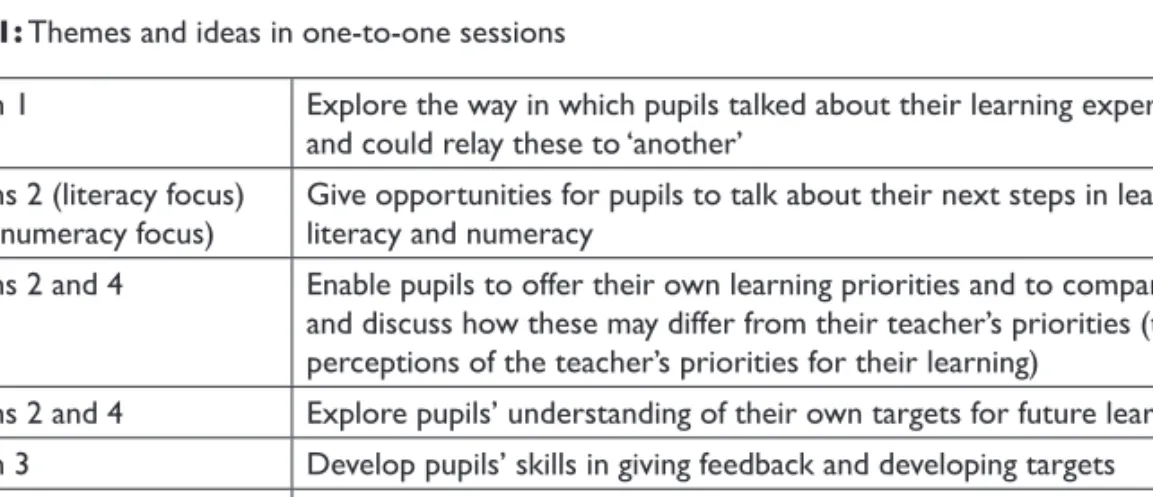
Pupils’ parents/carers were offered an opt-out form for consent for their child to participate in the study. Furthermore, each individual pupil was given an outline of why they were involved in the project using a laminated picture card, and offered the option to leave and return to their class at any time by raising their hand, without explanation, during each of the one-to-one dialogic sessions. Five one-to-one sessions of approximately 15 minutes each were offered with each pupil, focused on the themes and ideas set out in Table 1.
Table 1: Themes and ideas in one-to-one sessions
Session 1 Explore the way in which pupils talked about their learning experiences and could relay these to ‘another’
Sessions 2 (literacy focus)
and 4 (numeracy focus) Give opportunities for pupils to talk about their next steps in learning in literacy and numeracy Sessions 2 and 4 Enable pupils to offer their own learning priorities and to compare
and discuss how these may differ from their teacher’s priorities (their perceptions of the teacher’s priorities for their learning)
Sessions 2 and 4 Explore pupils’ understanding of their own targets for future learning Session 3 Develop pupils’ skills in giving feedback and developing targets Sessions 1, 2, and 4 Explore how pupils perceived what school could offer them in relation
to their own aspirations
Session 5 Examine the ways in which they could take on the views of others (multiple perspectives) in issues of tension and conflict
This paper will consider some of the findings related to sessions 1, 2, and 4 only.
Discussion of working with the pupils
The sessions drew on both real and imagined contexts. There was a deliberate attempt to structure an imagined context, which for the Year 5 pupils included a picture of a spaceship with imagined families on board. It was explained to the pupils that the spaceship families wanted to
find a school to attend and would like to know what the children thought about their school.
This scenario deliberately introduced ‘other’ to the children so that they could talk about their school experiences for an external audience rather than for the researcher.
What is it like to be in your school?
An important starting point was to try to establish pupils’ thoughts about being in school and what this meant to them. Children were asked, ‘What is it like to be in your school?’ From the Year 5 responses (10), eight of the children were positive, mainly using the words ‘fun’ (4), ‘good’ (2), and ‘fabulous’ (1). Three of the children (all from one school) indicated that it was ‘hard’,
Sometimes the work is hard and sometimes it is easy. (S2: 2) Good, ’cos you need to learn ... it’s hard sometimes. (S2: 3) Fun, sometimes it’s quite hard. (S2: 4)
In conveying what school was about, the element of challenge was important for them. Yet the majority of the pupils talked about challenge in a positive way. These Year 5 children, although
not progressing adequately, seemed to accept learning as being a challenge. Following their own articulation of what it was like to be in their school, the session specifically probed their
perceptions of what they found easy and hard in order to ascertain the challenges and successes that they perceived for themselves.
What’s hard and what’s easy? (Transcript 1)
S1: 2 (female). Maths is like a bit hard and like a challenge to me. Literacy is really easy. (Researcher) R. What else is hard?
S1: 2. Nothing. [Silence]
R. It is just the maths … How does your teacher help you?
S1: 2. Sometimes she is helpful, but sometimes I am scared to put up my hand in case she says ‘No’. R. You are worried to put your hand up? So what do you do instead?
S1: 2. We have cards like red ... green and you put them out. R. So do you put yours on to red if you are stuck?
S1: 2. No.
R. So even if you are stuck you do not turn your red one over? S1: 2. No.
What’s hard and what’s easy? (Transcript 2) R. What is really easy?
S2: 1 (male). Maths. The others are mainly easy [pause] mainly hard. R. What is hard?
S2: 1. Literacy. Science is a bit hard. R. What makes literacy hard? S2: 1. Too much writing.
R. Is it the actual picking up the pen and writing that is the problem? S2: 1. No, the thinking. I can’t think of the stuff to write.
Both these extracts illustrate how difficult the children found it to talk about what they found
challenging and what they could do to help themselves. The extracts were full of contradictions
and difficulties expressing what their challenges were. Only one of the ten children claimed that
learning was or how she made progress. All the other children were trying to make sense of their learning and the challenges it presented for them. They all had aspects of their work that
they felt that they could do, and specific challenges, which they began to articulate. They found it very difficult to think about how they might move forwards and how what they already knew
might help them to tackle what was more of a challenge. However, they were all very focused on ‘school-knowledge’.
Pupil perceptions of their learning in numeracy and literacy
The areas of numeracy and literacy were further explored with the pupils in session 2 (literacy) and session 4 (numeracy) in order to tease out how they perceived these aspects of their learning. There were considerable differences in how the children perceived their progress and ideas of future learning. The children were asked to select smiley-face cards to indicate the extent to which they liked literacy and how easy they found it (in session 2), then similarly for numeracy (in session 4). This involved much more focused consideration, through a forced-choice approach
related to their thinking about these subjects, than had been explored in the first session.
Their crude articulations were the starting point for further discussions about their targets
for the next steps in their learning in each area. There were significant differences between the
two curriculum areas. Children were more positive about their liking for maths compared with literacy, and slightly more positive about their abilities to succeed in numeracy. Given that all
these children were not making adequate progress in each subject (as determined by the teacher in relation to national curriculum levels), there was only one child in this group (S1: 2) who was negative towards maths. She had previously discussed her feelings that she could not ask for help.
The difference between attitudes to maths and literacy in these sessions increased as the pupils were asked about their next steps in learning.
These two sessions followed a similar structure (except for the difference in the curriculum focus). Pupils were asked to identify their targets in literacy (session 2) and in numeracy (session 4) and how they understood their next steps in learning. In literacy they were asked ‘what next steps to being a better writer do you think your teacher would like you to make?’ In numeracy they were asked ‘what does your teacher want you to learn next in maths and what are your teacher’s targets for you in maths?’ They were then asked ‘what are your targets and next steps to be better at numeracy/literacy?’ They were not given access to their exercise books at this
stage. As the children talked, each of the targets they identified was recorded by the researcher
on a sticky Post-it note. Two different colour notes were used, one colour for the targets they
identified as being from the teacher and another colour for their own targets. These were then
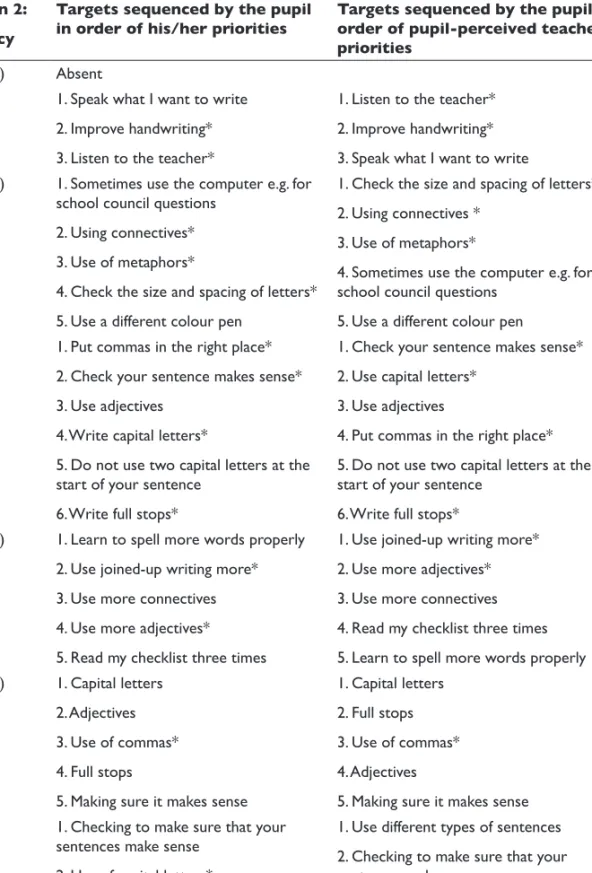
laid out in front of each pupil, who was asked to arrange the Post-it notes, one under the other, in order of the priority to them for their learning, with the most important at the top. When this had been completed, the rank order was noted on the top left of each Post-it note. The notes were then disassembled. The pupils were then asked to imagine that they were their teacher and to re-order the Post-it notes in the way they thought their teacher would list them, with the teacher’s own priorities to improve their numeracy or literacy. The responses from the pupils for literacy revealed that all the pupils were able to identify both their own targets and different targets, which they felt their teachers held for them. Also, each pupil (one absent) ordered these targets differently according to whether they were presenting their own priorities or the ones
that they perceived their teacher held. The results are shown in Table 2 (pp. 14–15).
In session 4 there was a completely different picture for numeracy. None of the ten pupils were able to offer more than one target that they thought the teacher would hold for them, and half the pupils could offer no teacher targets at all. For their own targets, four pupils could not
offer a target for their own numeracy learning at all, and only two pupils could offer three or four targets. Only two pupils were able to engage with the session in a way that resulted in them being able to order and reorder the targets.
Thus the data derived from these two sessions yielded a range of contrasting insights into the sense pupils made of their current and future learning and hence their learning gap, and how they saw themselves as progressing in their learning. Of particular interest was the way in which they articulated their own targets for literacy. After these had been recorded, they were asked if the teachers had targets for them. The pupils then articulated additional and different targets, which
they identified as ‘teacher targets’. The targets that they stated for themselves were conformist
and linked to the priorities in the national assessment frameworks for the national curriculum in England. Only two pupils mentioned slightly more individual and personal targets within literacy
– S1: 2, ‘speak what I want to write’ and S1: 3, ‘Sometimes use the computer e.g. for school council questions’ and ‘use a different colour pen’. However, for all but one of the pupils (S2: 4)
the targets that they stated were at a low level (around the level expected of a 7-year old in
England – Level 2). They were not challenging and future-orientated targets in any sense that was leading learning forward, and not specifically related to the type of learning or teacher feedback
comments evidenced in their exercise books. Their focus was on rethinking and practising what they thought were the fundamentals of their writing, the familiar, which occurred in each piece of writing. Even the way in which they constructed the teachers’ targets was related to improving
the basic skills of writing, rather than some of the specific strategies that they were being taught
in their recent lessons. The children were happy to talk about targets and they all willingly
articulated steps forward and easily identified themselves as developing writers with areas that
needed improvement and development. No one indicated that developing their writing was pointless or that they were not interested or prepared to progress, even though some found it
difficult to generate ideas for writing.
The task of prioritizing the targets that they had identified was designed to see the extent to
which they felt that they could have agency in owning their learning progress. After the children listed all their chosen targets in the order of their priorities, they were asked ‘imagine you were
[name of teacher], would s/he put these in the same order as you?’ Everyone said ‘No’. The
Post-it notes were muddled up and each pupil was asked to ‘put your targets in the order you
think [name of teacher] would put them’. Each pupil rearranged them, sometimes only slightly (e.g. S2: 4). Five of the children (mainly from School 1) had one of the teacher targets as the top priority in their list of teachers’ priorities (S1: 2, S1: 3, S1: 5, S1:4, and S2: 3). Three of these pupils switched one of their own targets out of first place to do this (S1: 2, S1: 3, and S1: 5). Four of the children (all in School 2) kept their own targets in the number one priority spot for the ‘teacher version’ of prioritizing their targets. Three of these four kept their own target unchanged in the first priority position (S2: 1, S2: 4, and S2: 5).
What was revealed in this aspect of the study was the sense in which the pupils had a view of their learning in literacy that they were keen to explain was different from that of
their teachers. Although they all focused almost entirely on school-knowledge, they identified
different targets for themselves than the ones that they thought that the teachers would hold,
and wanted to prioritize them differently. In almost all cases, the targets that they identified for themselves and those they identified as being the teachers’ were at a lower level than they were actually working. The way that they had internalized their thinking about their learning and their
next steps followed some of the classroom conventions and expectations but were very much focused on a basic view of learning that involved few challenges. This gave some insights into the
way they viewed their learning gap – the gap between what they know now and what they think
Table 2: Learning targets for literacy Session 2:
Literacy
Targets sequenced by the pupil in order of his/her priorities
Targets sequenced by the pupil in order of pupil-perceived teacher priorities
S1: 1 (m) Absent
S1: 2 (f) 1. Speak what I want to write 2. Improve handwriting* 3. Listen to the teacher*
1. Listen to the teacher* 2. Improve handwriting* 3. Speak what I want to write S1: 3 (m) 1. Sometimes use the computer e.g. for
school council questions 2. Using connectives* 3. Use of metaphors*
4. Check the size and spacing of letters* 5. Use a different colour pen
1. Check the size and spacing of letters* 2. Using connectives *
3. Use of metaphors*
4. Sometimes use the computer e.g. for school council questions
5. Use a different colour pen S1: 4 (f) 1. Put commas in the right place*
2. Check your sentence makes sense* 3. Use adjectives
4. Write capital letters*
5. Do not use two capital letters at the start of your sentence
6. Write full stops*
1. Check your sentence makes sense* 2. Use capital letters*
3. Use adjectives
4. Put commas in the right place* 5. Do not use two capital letters at the start of your sentence
6. Write full stops* S1: 5 (m) 1. Learn to spell more words properly
2. Use joined-up writing more* 3. Use more connectives 4. Use more adjectives* 5. Read my checklist three times
1. Use joined-up writing more* 2. Use more adjectives* 3. Use more connectives 4. Read my checklist three times 5. Learn to spell more words properly S2: 1 (m) 1. Capital letters
2. Adjectives 3. Use of commas* 4. Full stops
5. Making sure it makes sense
1. Capital letters 2. Full stops 3. Use of commas* 4. Adjectives
5. Making sure it makes sense S2: 2 (f) 1. Checking to make sure that your
sentences make sense 2. Use of capital letters*
3. Use different types of sentences 4. Remember spellings with double letters*
5. Get better ideas*
1. Use different types of sentences 2. Checking to make sure that your sentences make sense
3. Use of capital letters*
4. Remember spellings with double letters* 5. Get better ideas*
S2: 3 (m) 1. Read it* 2. Finger spaces* 3. Cursive writing*
4. Capital letters and full stops*
1. Cursive writing* 2. Read it*
3. Capital letters and full stops* 4. Finger spaces*
S2: 4 (m) 1. Use more sentence types 2. Use more adjective
3. Use more 2A [adjectives] sentences* 4. Some other sentences like ‘more soldiers are brave, some are lazy’* 5.More DD sentences [descriptive detail]*
6. More rhetorical sentences*
1. Use more sentence types
2. Use more 2A [adjectives] sentences* 3. Use more adjectives
4. Some other sentences like ‘more soldiers are brave, some are lazy’*
5. More DD sentences [descriptive detail]* 6. More rhetorical sentences*
S2: 5 (f) 1. Listen to instructions 2. Concentrate 3. Think hard 4. More adjectives* 5. Check your sentences*
1. Listen to instructions 2. More adjectives* 3. Concentrate
4. Check your sentences* 5. Think hard
Perceived as teacher targets*, (f)=female, (m)=male
The discussions related to numeracy in session 4 contrasted with those for literacy in terms of the pupils’ abilities to articulate or imagine their future learning. Although the pupils were more
positive about maths and the extent to which they could do it, they found it difficult, or in some
cases almost impossible, to identify next steps for learning or to articulate the purpose of their mathematics learning. When the children were asked what the teacher wanted them to learn and what their priorities were for their maths progress, most of the children were completely stumped and were not able to articulate what they thought the teacher’s maths teaching was
intending to achieve. This was in significant contrast to their responses in literacy. They found it very difficult to identify maths targets for themselves and even more difficult to imagine targets
that the teachers held for them. They did not express priorities or differences in priorities as they did for literacy.
Engagement with written feedback in literacy
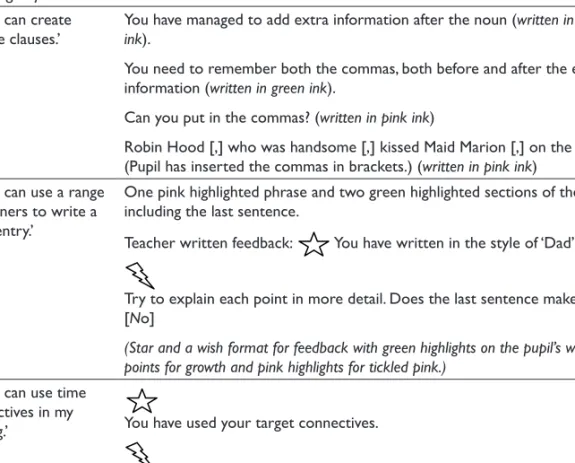
At the end of session 2, after this task had been completed, the pupils each had their writing book with them and they were asked to show the researcher some of their work and to talk about feedback and targets that the teacher had written on their work.
Table 3: Examples of written teacher feedback Learning objective Teacher feedback S2: 5: ‘I can create
relative clauses.’ You have managed to add extra information after the noun (written in green ink). You need to remember both the commas, both before and after the extra information (written in green ink).
Can you put in the commas? (written in pink ink)
Robin Hood [,] who was handsome [,] kissed Maid Marion [,] on the hand. (Pupil has inserted the commas in brackets.) (written in pink ink)
S1: 4: ‘I can use a range of openers to write a diary entry.’
One pink highlighted phrase and two green highlighted sections of the work including the last sentence.
Teacher written feedback: You have written in the style of ‘Dad’. Try to explain each point in more detail. Does the last sentence make sense? [No]
(Star and a wish format for feedback with green highlights on the pupil’s work for points for growth and pink highlights for tickled pink.)
S1: 5: ‘I can use time connectives in my
writing.’ You have used your target connectives.
Can you try to use one of your own connectives as an opener?
(‘but’, ‘due to the fact’, and ‘so’ highlighted in pink on the work as connectives pupil used in three different sentences.)
In most of the feedback the comments from teachers were closely focused on the specific
learning objectives of the lesson. There seemed to be a difference between the type of feedback
written daily in books for the pupils and their internalization of their next steps, both in terms
of the level of focus on the learning and the level of challenge.
As pupils went through their literacy books talking about the feedback and reading their teacher’s feedback comments they seemed to regard them as points from the past, and almost irrelevant to what they were doing now. The pupils were asked to look at a feedback comment (selected by the researcher as we were looking through the books) in the form of a development
point in green (School 2) or ‘wish’ (School 1), to see if they could indicate whether or not they had subsequently achieved the development point in another piece of work in their workbooks. The children found this request extremely difficult. They started to leaf through their books
looking at the feedback comments to see if they could see a similar one. They were not able to
consider the specific point of learning and think about where else it might be relevant. It was not part of their internalized understanding of what they were doing. It seemed a very ‘external’ type
of activity, looking for a visual clue of where this learning might be on the pages of their books,
rather than in their heads. There was one exception, S1: 3, who started to talk about where he
developed his skills before he found the example in his book.
They were each able to talk about the written feedback in a very focused and particular way, which was directly related to the activity carried out and particularly linked to the theme
for the future. There seemed to be little difference in the level of the pupils’ thinking about their
targets and future learning between the two schools, bearing in mind that School 1 offered the
pupils cards with levelled targets (at the level at which they were working) stuck in the back of
their books. Thus, the impact of these target cards did not seem to be significant for the children.
Exploring the learning gap as a fundamental starting point for developing dialogic feedback
The children were open to talking about their learning with the researcher. The extent to which the children would have a similar dialogue with their class teacher or teaching assistant
would need specific exploration. What the study revealed was that pupils (who in this case
were achieving below expected levels) were able to articulate a view of their learning and their future learning in literacy and that they unproblematically held their own priorities alongside what they considered to be their teachers’ different priorities. To a large extent such differences in perception were not shared or acknowledged, and the teachers continued to promote a curriculum that was governed by a one-sided set of views and priorities. The children clearly had constructed a notion of their learning gap that they explained in varying terms depending on whose view they were asked to take. However, the research also revealed that the learning gap that the pupils understood for themselves was unambitious and at a low level that was
mainly about reinforcing and confirming existing knowledge rather than seeking to extend and
be challenged with the newer teaching that they were experiencing. It revealed that the language
of the teacher and ‘school-knowledge’ was known by the children but not prioritized in the same
ways. Furthermore, the children were engaged with their learning, so in some sense might be considered ‘intentional learners’ (Black et al., 2006), yet were not understanding the ‘game’ that
the education system was requiring them to play.
In numeracy the research revealed that the pupils had very little notion of next steps. Their understanding of their learning gap was minimal as they struggled to articulate future learning aspirations. The research revealed that the children in this study (who were not progressing well) had particular views of their learning, and a limited concept of a learning gap in numeracy. The
feedback they received, although focused and developmental was concentrated on specific tasks
and the children failed to see its relevance in relation to a more general sense of their learning progress.
The data clearly showed that pupils were handling two different strands of their learning (their own priorities and those of their teachers) in literacy, and although they were taking on teachers’ comments and feedback they were assimilating these in sophisticated ways alongside their own priorities. These ‘dual dialogues’ (teacher-to-pupil and pupils’ internal dialogue with themselves in terms of their self-regulation of learning) were hidden in the classroom, with
the teachers recognizing only one version of events. The pupils were clearly adding their own
meanings and deciding which aspects of their learning they wished to take forward. Here there is a strong resonance with Habermas’s notion that there needs to be an ‘intersubjectivity of possible
understandings’ (1987: 126) between the pupil and the teacher. It highlights the fact that dialogue
around feedback might add an important arena for extending Mercer and Littleton’s (2007) notion of the importance of the shared consciousness within the ‘intermental development
zone’. The opportunities to engage in dialogue around feedback had provided a forum for pupil
views to be articulated in ways that had not become evident in existing classroom learning exchanges. These children were engaged in learning but had not grasped the level at which they needed to learn. The messages from the teacher, through written targets and feedback, were not being translated by the pupils in the ways that teachers had intended. In literacy they
were interpreted at a much lower level, and in numeracy the pupils showed little evidence of
internalizing their own learning progress at all.
The strategies used in this study, which helped the pupils to talk about their targets, to
prioritize, and to interpret what they thought the teacher wanted them to learn, provide a
starting point for a more meaningful understanding of how children see their learning gaps. It revealed that even though the power relations in the overt systems of feedback, marking, and target setting were teacher-led, the pupils were clearly making sense of these in their own ways.
It reinforces Klenowski and Wyatt-Smith’s (2014) notion that the meaning of standards cannot
be taken as identical in the minds and practices of teachers and students. The communicative relationships that dominated were ones to which the pupils were supposed to respond in particular ways, and in this respect they were conformist, yet it was clear that they were engaging
in their own ways and at their own levels, recognizing the formal systems and requirements that
ran alongside their own.
It is perhaps significant that the learning gaps that teaching and feedback seem to be
addressing did not fully match the ones that the pupils perceived for themselves and that the
progress of learning for these children had not advanced at the rate required by teachers, schools, and national targets. A more dialogic approach, which specifically seeks to understand the pupils’
starting points, understandings, and perceived next steps for learning demonstrated in this study, may offer a useful approach for supporting future learning. It may be particularly useful for
children who struggle to achieve in the way required by the school system and who, as this study reveals, fail to internalize the criteria and targets given by the teacher. By encouraging pupils to
explain and articulate their understandings of their learning there may be greater possibilities for synergy between teacher and pupil perspectives, as well as the processes of articulation, helping the pupil to revisit and rethink their own learning. Clearly there are some assumptions inherent in such an intention, yet these have been foregrounded in this study through consideration of theoretical foundations for the role of dialogue in communicative processes (Alexander, 2008; Habermas, 1984; Mercer, 2000; Mercer and Littleton, 2007).
The ideas developed here are preliminary and form the foundation for a larger-scale study that has as its starting point the importance of exploring pupils’ own understanding of their learning and the gap between what they know and what they think they need to know in both numeracy and literacy. Building on the work in this study, two distinctive areas for further research emerge. In literacy, dialogues between classroom adults and pupils who do not achieve may be vital for helping to understand and realign (co-align) next steps of learning so that there is explicit shared
understanding of learning aspiration. This would require more nuanced and detailed discussion
with the children around their written targets and their written feedback, which actively seeks to dialogically draw together the views of both pupils and teachers. The process of communicative
action (Habermas, 1984; Habermas, 1987), which is more specifically articulated by Dann (2015), together with this study, offers some further foundation for synthesizing both the need for such
an approach as well as a theoretical grounding for it.
In numeracy, this study suggests that future dialogue with pupils needs to be at a more fundamental level and might usefully relate to shaping and framing future steps in learning, in order to give pupils a greater sense of what might be ‘next’ in mathematics and why. What was clear from this study was that both written feedback and written targets in numeracy were not
sufficient for these children to help them to understand what they might need to learn next.
Further work with a larger sample of children who struggle to achieve would be an important
next step, together with some simple attempts specifically to discuss ‘what’s next’, so that pupils
Developing such dialogic strategies with pupils in such a focused way is clearly time intensive. Whether to help them to construct a learning gap for themselves in an initial stage in numeracy
or to co-align their learning gap more fully with the teachers’ targets in literacy, finding the
time is the essence in this endeavour to promote learning through reciprocal dialogic feedback processes.
Notes on the contributor
Ruth Dann is currently Principal Lecturer at Manchester Metropolitan University. She has previously lectured at Keele University and taught in a primary school in Hampshire. She has a particular research interest in pupil assessment. Other research interests include primary education, raising pupil achievement, and supporting the education of looked after children.
Funding for this research was provided by Manchester Metropolitan University. References
Alexander, R. (2008) Towards Dialogic Teaching. London: Dialogos.
Assessment Reform Group (2002) Assessment for Learning: 10 principles. Research-based principles to guide classroom practice. London: Assessment Reform Group.
BERA (2011) Ethical Guidelines for Educational Research. London: BERA.
Bernstein, B. (1971) ‘On the classification and framing of educational knowledge’. In Young, M.F.D. (ed.) Knowledge and Control: New directions in the sociology of education. West Drayton: Macmillan, 47–69. Biesta, G.J.J. (2004) ‘“Mind the gap!”: Communication and the educational relation’. In Bingham, C.W., and
Sidorkin, A.M. (eds) No Education Without Relation. New York: Peter Lang, 11–22.
Black, P., McCormick, R., James, M., and Peddar, D. (2006) ‘Learning how to learn and assessment for learning: A theoretical inquiry’. Research Papers in Education, 21, 119–32.
Black, P., and Wiliam, D. (1998) ‘Assessment and classroom learning’. Assessment in Education: Principles, Policy and Practice, 5 (1), 7–74.
Bourdieu, P. (1990) The Logic of Practice. Cambridge: Polity.
Carless, D. (2007) ‘Conceptualizing pre-emptive formative assessment’. Assessment in Education: Principles, Policy and Practice, 14 (2), 171–84.
Clarke, S. (2000) ‘Getting it right: Distance marking as accessible and effective feedback in the primary classroom’. In Askew, S. (ed.) Feedback for Learning. London: RoutledgeFalmer, 32–45.
Dann, R. (2002) Promoting Assessment as Learning: Improving the learning process. London RoutledgeFalmer. –– (2014) ‘Assessment as learning: Blurring the boundaries of assessment and learning for theory policy and
practice’. Assessment in Education: Principles, Policy and Practice, 21 (2), 149–66.
–– (2015) ‘Developing understanding of pupil feedback using Habermas’ notion of communicative action’. Assessment in Education: Principles, Policy and Practice. Online. www.tandfonline.com/doi/full/10.1080/096 9594X.2015.1056083 (requires subscription; accessed 14 September 2015).
Department for Education (2014) ‘School and college performance tables’. Online. www.education.gov.uk/ schools/performance/ (accessed 2 June 2015).
Edwards, D., and Mercer, N. (1987) Common Knowledge: The development of understanding in the classroom. London: Methuen.
Fisher, H. (2011) ‘Inside the primary classroom: Examples of dissatisfaction behind a veil of compliance’. British Journal of Educational Studies, 59 (2), 121–41.
Habermas, J. (1984) Reason and the Rationalization of Society. Trans. McCarthy, T. Cambridge: Polity. Vol. 1 of The Theory of Communicative Action.
–– (1987) Lifeworld and System: A critique of functionalist reason. Trans. McCarthy, T. Cambridge: Polity. Vol. 2 of The Theory of Communicative Action.
Hargreaves, E. (2013) ‘Inquiring into children’s experiences of teacher feedback: Reconceptualising assessment for learning’. Oxford Review of Education, 39 (2), 229–46.
Hattie, J., and Timperley, H. (2007) ‘The power of feedback’. Review of Educational Research, 77 (1), 81–112. Jones, D. (2001) ‘Bridging the Gap: Towards a model of children’s self-assessment’. Education 3–13, 29 (3),
61–8.
Klenowski, V., and Wyatt-Smith, C.M. (2014) Assessment for Education: Standards, judgement and moderation. London: Sage.
Mercer, N. (2000) Words and Minds: How we use language to think together. London: Routledge.
Mercer, N., and Littleton, K. (2007) Dialogue and the Development of Children’s Thinking: A sociocultural approach. London: Routledge.
Murtagh, L. (2014) ‘The motivational paradox of feedback: Teacher and student perceptions’. The Curriculum Journal, 25 (4), 516–41.
Nicol, D.J., and Macfarlane-Dick, D. (2006) ‘Formative assessment and self-regulated learning: A model and seven principles of good feedback practice’. Studies in Higher Education, 31 (2), 199–218.
Nuthall, G. (2007) The Hidden Lives of Learners. Wellington: NZCER Press.
Ofsted (2014) The Framework for School Inspection. Online. www.gov.uk/government/uploads/system/ uploads/attachment_data/file/457194/The_framework_for_school_inspection-.pdf (accessed 31 August 2015).
Sadler, D.R. (1989) ‘Formative assessment and the design of instructional systems’. Instructional Science, 18 (2), 119–44.
–– (1998) ‘Formative Assessment: Revisiting the territory’. Assessment in Education: Principles, Policy and Practice, 5 (1), 77–84.
Shaw, C., Brady, L-M., and Davey, C. (2011) Guidelines for Research with Children and Young People. London: National Children’s Bureau.
Sutton Trust and Education Endowment Foundation Teaching and Learning Toolkit (2014) Online. http:// educationendowmentfoundation.org.uk/uploads/toolkit/EEF_Teaching_and_learning_toolkit_ Feb_2014.pdf (accessed 27 March 2015).
Thoutenhoofd, E.D., and Pirrie, A. (2015) ‘From self-regulation to learning to learn: Observations on the construction of self and learning’. British Educational Research Journal, 41 (1), 72–84.
Torrance, H. (2012) ‘Formative assessment at the crossroads: Conformative, deformative and transformative assessment’. Oxford Review of Education, 38, 323–42.
Torrance, H., and Pryor, J. (1998) Investigating Formative Assessment. Buckingham: Open University Press. Tunstall, P., and Gipps, C. (1996) ‘How does your teacher help you make your work better? Children’s
understanding of formative assessment’. The Curriculum Journal, 7 (2), 185–203.
Young, M.F.D. (ed.) (1971) Knowledge and Control: New directions for the sociology of education. London: Collier-Macmillan.