Nursing Theses and Capstone Projects Hunt School of Nursing
2013
A Structured Orientation Development System for
Nursing Faculty
Dana R. Mangum Gardner-Webb University
Follow this and additional works at:http://digitalcommons.gardner-webb.edu/nursing_etd Part of theHigher Education Commons,Medical Education Commons, and theOccupational and Environmental Health Nursing Commons
This Capstone is brought to you for free and open access by the Hunt School of Nursing at Digital Commons @ Gardner-Webb University. It has been accepted for inclusion in Nursing Theses and Capstone Projects by an authorized administrator of Digital Commons @ Gardner-Webb University. For more information, please [email protected].
Recommended Citation
Mangum, Dana R., "A Structured Orientation Development System for Nursing Faculty" (2013).Nursing Theses and Capstone Projects.
by
Dana R. Mangum
A capstone project submitted to the faculty of Gardner-Webb University School of Nursing
in partial fulfillment of the requirements for the degree of Doctorate of Nursing Practice
Boiling Springs 2013
Submitted by: Approved by:
__________________________ _________________________ Dana R.Mangum Dr. Mary Griffin
__________________________ _________________________
All rights reserved
INFORMATION TO ALL USERS
The quality of this reproduction is dependent upon the quality of the copy submitted. In the unlikely event that the author did not send a complete manuscript
and there are missing pages, these will be noted. Also, if material had to be removed, a note will indicate the deletion.
Microform Edition © ProQuest LLC. All rights reserved. This work is protected against unauthorized copying under Title 17, United States Code
ProQuest LLC.
789 East Eisenhower Parkway P.O. Box 1346
Ann Arbor, MI 48106 - 1346 UMI 3589087
ii
Faculty of The Graduate School at Gardner-Webb Univeristy.
Approved by:
_________________________________ ___________________________________ Rebecca Beck-Little, PhD, RN Date
Committee Member
_________________________________ ____________________________________ Cindy Miller, PhD, RN Date
Committee Member
_________________________________ ___________________________________ Vickie Walker, DNP, RN Date
iii
to retire in record numbers. Healthcare technology is continually evolving and the topography of nursing education is changing. In order to aquire, develop, and retain excellent nursing faculty to meet the ever changing demands, nursing faculty need to be streamlined into the world of academia. A Structured Orientation Development System (SODS) was developed to aid nursing faculty into the transition from expert bedside nurse to expert nursing faculty. A literature review found no evidence of a structured type nursing faculty orientation system. The purpose of this project was to develop a systematic structured nurse educator orientation system. The orientation system incorporated the National League for Nursing (NLN) Core Competencies of Nurse Educators and Patrica Benner‘s From Novice to Expert theory into a survey for nursing faculty members. The survey results were used to determine the nursing faculty
member’s self perception of their teaching competency level. Individual goals were developed based on teaching competency levels, and a plan was devised to evaluate the nurse faculty member‘s teaching competency level at six months and one year. The program allowed the nursing faculty participants to evaluate their teaching competency level utilizing the NLN Core Competencies of Nurse Educators as a guide, and develop goals to improve their teaching competency level.
iv
understanding. In all thy ways acknowledge him, and he shall direct thy paths. God’s words have guided me through my nursing career from day one.
I want to thank my husband, Robert Mangum. He has supported me without hesitation in every adventure that I have attempted, he is my soul mate. My children; Amanda, Jake, and Travis have also been a constant support and encouragement.
I also want to say thank you to my parents, countless friends, and co-workers with all of their words of encouragement and support. Three co-workers who need to be recognized individually are Jane Binetti, Nancy Watkins, and Janice Terrell who have taken their time to listen, read and re-read my project, and provide endless words of encouragement.
A special thank you needs to be expressed to Dr. Mary Griffin, whose encouragement, support, and belief in me helped me to bring this idea to fruition.
And last but not least by any means I want to say thank you to the Thirteen Blue Bouquet’s, my friends from Gardner-Webb’s second Doctorate of Nursing Practice co-hort. You are all awesome and I am proud to have ventured this journey with each one of you. Knowing all of you has truly made me a better person, nurse, and teacher.
v
© Dana R. Mangum 2013 All Rights Reserved
vi INTRODUCTION ...1 Background ...2 Problem Statement ...4 Justification of Project ...5 Purpose ...7
Structured Orientation Development System (SODS) ...8
Project Question ...9
Definition of Terms...9
Summary ...11
CHAPTER II RESEARCH BASED EVIDENCE...12
Review of Literature ...13
Mentoring Methods ...13
Transition Methods ...17
Self Guided Methods ...18
Gaps in Literature ...22
Strengths and Limitations of Literature ...22
Theoretical Framework ...23
Summary ...30
CHAPTER III PROJECT DESCRIPTION ...31
vii
Sample...32
Project Design ...33
Protection of Human Subjects ...34
Instruments ...35
SODS Nursing Faculty Self-Assessment Survey ...35
Demographic Form ...36
SODS Nursing Faculty Core Competency Workshop ...37
SODS Teaching Continuum ...37
Data Collection ...38
Data Analysis ...38
Timeline ...39
Budget ...41
Bias and Assumptions ...43
Limitations ...43 Evaluation Plan ...44 Summary ...45 CHAPTER IV RESULTS ...46 Sample Characteristics ...46 Demographic Data ...48 Major Findings ...51
viii
SODS Post Self-Assessment Data ...57
SODS Teaching Continuum ...60
Summary ...60
CHAPTER V DISCUSSION ...62
Implication of Findings ...62
Application to Conceptual Framework ...69
Limitations ...70
Implications for Nursing ...71
Recommendations ...71
Conclusion ...72
REFERENCES ...73
APPENDICES A: National League for Nursing; Core Competencies of Nurse Educators ...79
B: Patricia Benner’s From Novice to Expert Theory ...84
C: National League for Nursing Permission Letter ...85
D: Patricia Benner‘s Permission Letter...86
E: SODS Pre Self-Assessment Survey ...87
F: SODS Post Self-Assessment Survey ...101
ix
Material ...136 J: SODS Teaching Continuum Example 1...142 K: SODS Teaching Continuum Example 2 ...151
x
Table 2: Patricia Benner; Seven Domains of Nursing Practice ...25
Table 3: Patricia Benner; From Novice to Expert Model ...28
Table 4: SODS Teaching Competency Levels ...36
Table 5: Data Collection Timeline ...41
Table 6: SODS Project Participation ...47
Table 7: SODS Nursing Faculty Pre Self-Assessment Survey; Demographic Data ...48
Table 8: SODS Nursing Faculty Pre Self-Assessment Survey; Initial Degree and Highest Degree...49
Table 9: SODS Nursing Faculty Pre Self-Assessment Survey; Teaching Experience ...50
Table 10: SODS Nursing Faculty Pre Self-Assessment Survey; How to teach ...50
Table 11: SODS Nursing Faculty Pre Self-Assessment Survey; NLN CNE, Mentors ...51
Table 12: SODS Nursing Faculty Pre Self-Assessment Survey; Core Competency Results fo Each Competency ...52
Table 13: SODS Nursing Faculty Pre Self-Assessment Survey; Individual Core Competency Ranking ...53
Table 14: SODS Nursing Faculty Pre Self-Assessment Survey; Core Competencies ...54
Table 15: SODS Nursing Faculty Pre and Post Self-Assessment Survey; Individual Core Competency Scores ...57
Table 16: SODS Nursing Faculty Pre and Post Self-Assessment Survey; Post Survey Scores ...59
xii
CHAPTER I INTRODUCTION
How novice nursing faculty are oriented and transitioned into the nursing faculty role is critical for the future success of nursing. Nursing organizations predict the shortage of nursing faculty will be more profound with the impending nursing shortage (National League for Nursing (NLN), 2010). The use of experienced nursing mentors to orient novice nursing faculty is currently an essential component in the orientation process. Effective mentor relationships should continue to support nursing faculty as they progress throughout their career. However, nursing mentor relationships are often unstructured, unpredictable, and generate varied results (Penn, Wilson, & Rosseter, 2008). The development of a systematic, predictable method of transitioning the bedside nurse to the nurse faculty role has the potential to increase nursing faculty retention and ensure adequate numbers of nursing faculty for the future. The foundation of an effective transitional system begins with knowledge and should be based on evidence. The
purpose of this evidence based project is to develop a systematic, predictable orientation system. The Structured Orientation Development System (SODS) should provide a systematic approach that can be used to orient and develop nursing faculty. The SODS could provide a solid foundation for the nurse faculty member to make a smooth,
predictable transition into nursing education and develop to their full potential as a nurse educator.
Background
The United States population is aging. The term “Baby Boomers” refers to those individuals born between 1946 and 1964; this segment of the population is defined by the record number of births following World War II. This distinct group is scheduled to retire in record numbers over the next decade. As the Baby Boomer population begins to retire, the demand for health services predictably will increase. A variety of industries have begun to endure the ramifications of so many workers retiring at once. One such industry is healthcare, with nursing care being one of the greatest areas of concern. The notable shift in demographics has raised concerns that the healthcare workforce,
especially nursing, will be insufficient to adequately serve older adults.
The U. S. Department of Health and Human Services (HHS) (2011), reported the average age of the registered nurse was 46.8 years, with only 26.6% of all nurses younger than 40. Reflecting the aging population, the average nursing faculty member’s age in the United States is 55 years (NLN, 2010).
The American Association of Colleges of Nursing (AACN), (2011), predicts mature nursing faculty members are anticipated to retire in record numbers, with the largest shortfall expected by 2015. This predicted shortage of nursing faculty may have a significant impact on the potential for admitting and graduating sufficient numbers of nursing students to address the shortage of prepared nurses (Siela, Twibell, & Keller, 2009). A variety of factors have contributed to the nursing faculty shortage, including higher compensation for the bedside nurse in clinical areas and private sector settings, which may lure current and potential nurse educators away from teaching. Additional
contributing factors include the decreased number of nursing students in master and doctoral level programs in nursing. Decreased enrollment in graduate schools could ultimately result in a decrease of potential nurse educators to meet the current and predicted demands for prepared nurse educators (Thrall, 2005).
Nursing stakeholders have offered suggestions on how to address the nursing faculty shortage, including government funding for master and doctoral education, redesigning the delivery of nursing education, developing retention strategies for current nursing faculty, and recruitment of more bedside nurses into nursing education.
The national shortage of nursing faculty has limited nursing student capacity at a time when the need for nurses continues to grow. In an attempt to minimize the impact of the nursing faculty shortage on the nation's nursing shortage, the AACN has leveraged resources to secure federal funding for nursing faculty development programs. The AACN (2011) continues to collect data on nursing faculty vacancy rates across the country, and is attempting to identify effective strategies to address the shortage as well as utilizing media to focus attention on the issue.
Traditionally, established nursing faculty members have oriented novice nursing faculty to the academic arena through mentoring relationships. Mentor relationships can often be unstructured resulting in varied experience outcomes based primarily on the relationship between the mentor and mentee. Inconsistencies in the mentor relationship often leave novice nursing faculty members with feelings of uncertainty, isolation, and anxiety about the teaching role (Penn et al., 2008). The context of the educational environment is often difficult to decipher and may be an unintended barrier for novice
nursing faculty success. Research has documented that novice nursing faculty members are typically unfamiliar with the language, culture, and practices of their institution, and the academic environment is, to a vast extent, different then they had anticipated
(McArthur-Rouse, 2008).
Improved retention of novice nursing faculty requires implementation of a more efficient system of orientation and development. The ideal orientation and development system would consistently, effectively, and predictably transition the bedside nurse into the role of expert nursing faculty within two to five years, given the degree of prior teaching experience the nurse faculty member possesses. A timely efficient system of transition could allow the novice nursing faculty to adjust to the new academic
environment and educator role with minimal difficulty. The most commonly
implemented method today to prepare novice nursing faculty for the teaching role is mentoring with a senior nursing faculty member (Smith & Zsohar, 2005). The utilization of mentoring raises questions of consistency and effectiveness with the mentoring
process as the sole means of transition for the novice nursing faculty member. Variations in the mentor and mentee experiences can be extreme. Some nursing faculty question what credentials should be necessary to qualify as an expert nursing faculty mentor.
Problem Statement
One identified barrier to nursing faculty recruitment and retention is often the unstructured process schools of nursing utilize to transition the expert bedside nurse into an expert nurse educator. Therefore, to recruit and retain nursing faculty, the
The ideal orientation development system would involve consistently, effectively, and predictably transitioning the expert bedside nurse into the role of expert nursing faculty within two to five years. A timely efficient system of transition can allow a novice nursing faculty member to adjust to their new academic environment and teaching role with less difficulty. By allowing the nursing faculty member an easier transition, more nurses could be encouraged to attempt the role of nurse educator; subsequently resulting in an increase in nursing student enrollment.
Justification of the Project
Nursing is approaching the crest of a true nursing shortage across the country. Research conducted by Cangelosi (2004) predicted the nursing faculty shortage to be more than 1,000 nurse faculty nationwide over the next decade, reflecting a national vacancy rate of 11 %. In 2005, the NLN appointed a Task Group to examine the role of a nurse educator. The Task Group released the Core Competencies of Nurse Educators (Appendix A), with Task Statements. The task group identified eight core competencies of a nurse educator in a step by step outline (Table 1). The core competencies focused on three functions of the nurse educator; knowledge level, skills mastered, and attitude.
Table 1
National League for Nursing Core Competencies of Nurse Educators
Core Competency Facilitate learning
Facilitate learner development and socialization Use assessment and evaluation strategies
Participate in curriculum design and evaluation of program outcomes
Function as a change agent and leader
Pursue continuous quality improvement in the nurse educator ole
Engage in scholarship
Function within the educational environment
The Robert Wood Johnson Foundation (RWJF), (2006), reported that the nursing shortage had improved somewhat since 2002. Initiatives such as loan forgiveness programs emerged for new graduates and nurses seeking to advance their education. Additional initiatives were developed to create better work conditions in many areas throughout the country. The RWJF (2006) initiatives increased public interest in nursing as a career, however most academic nursing institutions were inadequately staffed and insufficiently prepared for the influx of potential nursing student applications (AACN, 2005).
In 2009, more than 42,000 qualified nursing student applicants could not enter nursing programs because of the perpetual deficiency of available nursing faculty (AACN, 2011). This nursing shortage is expected to continue through 2025 (Buerhaus,
Staiger & Auerbach, 2008) and is expected to reduce the number of available nurses to transition into the role of a nurse educator.
The process of mentoring raises the question of consistency and effectiveness of the mentoring process as the sole means of transition to the new nursing faculty role. However, the current system of orientation encourages additional unanswered questions, such as what makes a nursing faculty member competent to be a mentor, how long does the process take to transition the novice nursing faculty member to a confident level of practice, and what tools exist to measure the outcomes of transitional training?
Stokowski (2011) noted that there must be a process utilized to educate and prepare the newest members of a profession or organization.
Purpose
The purpose of this evidence based project was to develop a systematic
orientation system, the Structured Orientation Development System (SODS), to transition the bedside nurse to the nurse faculty role. This orientation system is based on the
National League for Nursing (NLN) Core Competencies of Nurse Educators (2005) that establishes the basis for continuing orientation of nursing faculty, and Patricia Benner’s From Novice to Expert theory (1984) (Appendix B) that provides a guide for progression for the nurse from new graduate to expert in the field.
The SODS is a six step process that culminates in a plan for continued growth as a nursing faculty member, and evaluation of goals. A quantitative pre and post survey design was utilized to evaluate the SODS Nursing Faculty Self-Assessment Survey and determine the nursing faculty’s self-perception of their teaching competency level.
During an extensive literature search no relevant evaluation tool was identified for the purpose of orienting nursing faculty to the role of nurse educator. The SODS Nursing Faculty Self-Assessment Survey was developed by this Project Administrator by combining the NLN’s Core Competencies of Nurses Educators (2005) and Patricia Benner’s From Novice to Expert theory (1984). The Nursing Faculty Self-Assessment Survey was reviewed and written approval for use was granted by the NLN and Patricia Benner (Appendix C and D). The SODS Nursing Faculty Self-Assessment Survey is the initial step in the Structured Orientation Development System (SODS).
Structured Orientation Development System (SODS)
The SODS is an innovative system for the orientation and development of novice nursing faculty as well the continuous evaluation of established nursing faculty. The SODS can provide a guide that will allow nursing faculty to assess their teaching competency level and develop a plan to progress on the continuum from a novice educator to an expert educator. This evidence based project consists of six steps; (1) the SODS Nursing Faculty Pre Self-Assessment Survey (Appendix E), (2) a three hour SODS Nursing Faculty Core Competency Workshop, (3) the SODS Nursing Faculty Post Assessment Survey (Appendix F), (4) review the SODS Nursing Faculty Post Self-Assessment Survey results and the plotting of survey results on the SODS Teaching Continuum (Appendix G), (5) the nursing faculty will work with their manager or mentor to develop goals to progress their current teaching competency level to the next teaching competency level, and (6) to evaluate the achievement of goals developed in step five, reassess and develop new goals as necessary.
The SODS is designed to allow the nursing faculty member to complete the SODS alone or with the assistance of their mentor or manager to complete the following steps: (3) the self-assessment survey, (4) plot results from the survey, (5) develop goals, and (6) evaluate achievement of goals.
The SODS Teaching Continuum (step 4) represents the skills and knowledge level of a nursing faculty member from novice to expert, detailing competency along the teaching continuum. The SODS pre and post survey results can provide a guide on the SODS Teaching Continuum that can allow both new and experienced nursing faculty to assess their teaching competency level and develop a plan to progress on the teaching continuum from a novice nurse educator to an expert nurse educator. The SODS can be utilized by schools of nursing to improve nursing faculty job satisfaction, increase retention, and encourage more nurses to consider becoming a nurse educator by making the transition process from bedside nurse to educator seamless, ultimately allowing nursing programs to enroll more nursing students into adequately staffed nursing schools.
Project Question
Is the Structured Orientation Development System (SODS) a valid, alternate method for the orientation and development of nursing faculty?
Definition of Terms
The following operational definitions will be used in this project:
Nursing faculty member: a nurse who functions in the role of academic nurse educator.
Transitioning: moving, evolving from one area or level of understanding to another.
Mentor: individual(s) assisting in continued growth of another. Novice to Expert: individual growth in general/specific areas from a
novice (beginning) level to expert level (novice, advance beginner, competent, proficient, and expert) on a progressive continuum as identified by Benner (1984).
The Structured Orientation Development System (SODS): a formal systematic orientation system intended to direct the nursing faculty member through the various functions of the nursing faculty role from novice to expert.
The SODS Pre and Post Nursing Faculty Self-Assessment Survey: a 66 item survey that will be electronically emailed to the nursing faculty participants of this project. The survey hyperlink will be accessible for seven days for each of the two surveys to a secure website. Survey questions are derived from the NLN
Core Competencies of Nurse Educators (2005).
The SODS Teaching Continuum: a systematic scale that represents five teaching competency levels from novice to expert. The Teaching Continuum can provide a visual guide for the nursing faculty member to plot their teaching competency level and develop goals for later
Summary
The expanding aging population has created many challenges for different industries. The healthcare industry has been especially challenged with how to respond to the care needs of this aging demographic. Two identified contributing factors include the aging nursing faculty workforce and the lower than anticipated number of nursing students graduating each year. The SODS could aid the transition, orientation, and development of the expert bedside nurse to the expert nurse faculty role. The SODS Nursing Faculty Self-Assessment Survey could allow nursing faculty members to self-assess their teaching competency level. The ability of the nursing faculty member to recognize on a continuum where his or her teaching competency level ranks can serve as a visual indicator for the nursing faculty to recognize what goals are essential to progress their teaching competency to a higher level. Utilizing the SODS Teaching Continuum can allow the nurse faculty members, their immediate supervisors, and his or her mentors to more efficiently work toward the attainment of the expert nursing faculty role. Nurses who transition to the nurse faculty role with little difficulty are more likely to remain in the academic setting and therefore graduate more nursing students.
CHAPTER II Research Based Evidence
A review of the current literature for nursing faculty orientation development programs and nurse educator orientation development programs was sparse. The literature readily identified seminal works on mentoring the experienced nurse from clinical practice to the role of nursing faculty in the academic setting. Literature on mentoring as a tool to orient and transition the clinical practitioner to the nurse educator role was consistently noted to be positive in perception, although no consistent
methodology or evaluation results were evident. The literature search focused on the implementation of a formal, systematic, structured transitional program for the faculty nurse educator. In current empirical nursing literature the term ‘transition’ focused more often on health status or the developmental stages of disease. Additional search results for transition focused on the nursing student to graduate nurse experience. Evidence based nursing has become the standard for best practice in nursing requiring nurse
educators to maintain a current knowledge base. The current and predicted future nursing faculty shortage could inevitably alter future nursing student’s educational experience. Over the next decade, nursing faculty are expected to retire and leave academia in record numbers, therefore creating insufficient numbers of nursing faculty to be available to teach and develop an already deficient pool of new graduate nurses needed to provide care for the aging Baby Boomers (NLN, 2010).
Data collected were limited to the publication years of 2005-2011. Medical, Health, and Nursing data bases were utilized for the initial search. Three data bases were
selected: The Academic Search Premier, the Cumulative Index for Nursing and Allied Health Literature Plus, and PubMed. Search terms were limited to: faculty, new faculty, new nursing faculty, nursing faculty, and novice nurse educator. Boolean logic using the operator “and” was used to narrow each initial search term (s). Search terms used with the “and” operator included, development, mentorship, orientation, and programs. Research material obtained from the literature review was categorized by similar styles: mentoring methods, transitioning methods, and self-guided methods.
Review of Literature Mentoring Methods
Smith and Zsohar (2005) identified that a successful mentoring relationship guides the neophyte educator into a successful teaching career through better adjustment and professional academic advancement. Based on their research they identified essential elements needed to produce an effective mentoring program; a collegial relationship with the mentor, improved job satisfaction in a faculty role, improved quality of nursing education, and retention in the nursing education profession were among the positive outcomes of successful mentoring programs. Smith and Zsohar’s research noted that caring, connecting, and communicating are integral components of a successful
mentoring relationship. The research study noted that not all senior faculty members have the desire or skill to serve as mentors to new faculty.
In 2006, the NLN published a position statement, “Mentoring of Nursing
Faculty”. The position statement promotes the deliberate use of mentoring as a means to fostering the career development of faculty. The position statement also examined how
mentoring could be made operational throughout the career continuum and recommended the development of a Tool Kit on mentoring (NLN, 2008). The Tool Kit contains
questions intended to guide mentoring related concepts, mentoring practices at specific points throughout a faculty member’s career continuum, and mentoring related outcomes. The Tool Kit also contains informational resources useful to mentees.
Alteen, Didham, and Stratton (2009) research study examined the effects of a major transition for nursing faculty undergoing a school of nursing program change from teaching in a diploma nursing program to teaching in a baccalaureate nursing program. The investigations and analyses culminated into a 10 year retrospective model for nursing faculty development. The key points to the model include self-reflection, support,
mentorship, and dialogue. During the time of the program transition a large number of nursing faculty turnover occurred. The large number of nursing faculty turnover was perceived as an alignment with the national trend in the professoriate of nursing faculty retiring at a much higher rate than the inflow of adequately prepared nursing faculty at the master and doctoral levels. The nursing program’s mentorship process evolved into a formalized process to help new nursing faculty with professional growth and
development. The objectives of the mentorship program included, facilitating the establishment of relationships among experienced and novice nursing faculty, assisting novice nursing faculty in the transition to a nursing education role, providing advice, consultation, and expertise to nursing faculty as needed, and providing a nurturing learning environment for professional and personal development.
White, Brannan, and Wilson (2010) conducted a qualitative research study to explore the experience of protégés participating in a mentorship program for novice nursing faculty. An interpretive phenomenological research study was conducted. The one year long research study examined the experiences of the protégés participating in mentorship programs. The research study revealed three main themes: creating a meaningful mentor-protégé relationship, transitioning as a new nurse educator, and the mentor-protégé program. Three years prior to the research study the school of nursing hired 16 novice nurse educators in anticipation of the nursing faculty shortage. The necessity to maintain the nursing programs quality became a driving force for a formal mentor-protégé program. Methodological rigor was achieved using the trustworthiness criteria of credibility, dependability, confirmability, and transferability as described by Guba and Lincoln (1989). Two subthemes emerged from the process of transitioning for the new nurse educator, one of frustration and one of putting actions into practice. Frustration was expressed as concern regarding the lack of preparation to teach in a nursing program, a limited understanding of the required functions of their role as a nurse faculty member, and inconsistencies among nursing faculty. Three overall conclusions were reached from the research, developing reciprocal relationships that foster open communication is essential for successful mentoring, novice nurse educators require support and guidance to navigate through the challenges in their new role as a nurse educator, and the deliberate planned activities over time in a formal program enhance the development of novice nursing faculty. After five years, 14 of the 16 originally hired nursing faculty members remained in their positions.
Young, Pearsall, Stiles, and Horton-Deutsch (2011) conducted a qualitative research study that explored the experiences of becoming a nurse faculty leader. The hermeneutic analysis of the experience of becoming a nurse faculty leader involved interviewing 23 leaders from diverse backgrounds, roles, and situations. Research questions focused on the nurse leaders’ experience of becoming a nurse leader in any dimension of leadership including work in the classroom, among nursing faculty peers, and at the institutional level or beyond. The data analysis approach to the research study was reflective, reflexive, and circular. Three themes were identified; being thrust into leadership, taking on something new, and succeeding; taking risks, trying something new with students; and facing challenges, building consensus. Nurse faculty leaders
commonly describe themselves as being unprepared for a leadership position. Young et al. (2011) concluded that mentors more than ever need to be carefully chosen based on their knowledge about leadership development and enactment of best practices.
Race and Skees (2010) research study stated “learning the art of mentoring is an essential tool at any level of nursing if new staff is to be successful (p. 173)”. The research study examined mentoring on all nursing levels, focusing on the different types of mentorships: formal, informal, assessed by administration, voluntary participation, and positive and negative relationships. Overbearing, and mismatched personalities were among the negative experiences expressed by some mentees. Race and Skees research study emphasized the importance for each new mentee to have a learning need
assessment performed. Once an assessment is completed, a tailored program to assist the novice nurse educator can be designed.
Transitioning Methods
McDonald (2008) combines personal experience with a literature review to assist the clinical practice nurse transition into a nursing faculty position. McDonald focused on the knowledge deficit and learning curve experienced in academic organizations and environments. The research study identified that a written format that provided
information on the new academic culture and support, social norms, and expectations may not always be available. Support from senior nursing faculty for new nursing faculty may not be available in formal and informal situations, as many new nursing faculty members commented on the lack of help, and the unforeseen amount of autonomy expected of the new educator.
Penn et al. (2008) provided advice on how to find teaching opportunities in higher education and how to successfully make the role transition from bedside nurse to nurse educator. The types of nursing faculty positions available were explored. What educational qualifications are needed for teaching and how the academic work environment is different than the hospital teaching environment? The research study explored what faculty development opportunities may be available to new nursing faculty. The researcher’s findings identified the role transition from nurse as a practitioner to nurse as an educator can cause feelings of uncertainty, isolation, and anxiety. Those nurses new to the academic environment should seek out nursing faculty mentors and professional development opportunities to learn about the work environment in which they are teaching and to enhance their teaching abilities.
Janzen (2010) describes how the understanding of self and student can assist in actualizing the role of clinical nurse educator. The metaphor of Alice [Alice in
Wonderland & through the looking glass, (Carroll, 1832)] stepping through the looking glass was used to present three dimensions that expert practitioners pass through in their journey to clinical nurse educator. Janzen theorized that the transition from expert nurse practitioner to expert nurse educator is a multidimensional process; novice nurse
educators can expect to pass back and forth between a figurative gradient before their role becomes actualized, and ultimately, the process of actualization changes individuals in their role as nurse educators and as humans.
Self-Guided Methods
Hessler and Ritchie (2005) discussed the future of nursing education and the impending nursing faculty shortage. The research study provided 10 suggestions for schools of nursing to consider in order to recruit and retain new nursing faculty: provide guidance, foster socialization, encourage flexibility, conduct orientation, provide support, facilitate collaboration, allow for mistakes, coordinate teaching assignments, grow your own nursing faculty, and offer rewards. Generations are changing, and it is important that schools of nursing are aware that recruitment and retention strategies that may have been successful in the past may now be obsolete. The research study identified that at the time of publication no literature was available to support the concept of a self-guided program for new nursing faculty. The research finding further identified that at a minimum, support for a formal or informal self-guided program will help retain and recruit individuals into nursing education. A self-guided program will help ease the
transition from bedside nursing to nursing education, and helping new nursing faculty achieve balance in their careers will help decrease some of the anxiety many experience in their first year of academia.
In 2005, the NLN Task Group released the Core Competencies of Nurse Educators, With Task Statements. The Task Group conducted an extensive literature search to identify the core competencies of nurse educators. Eight competencies provide a step by step outline of the requirements necessary for nurse educators to be successful in their role. The competencies include: facilitate learning, facilitate learner development and socialization, use assessment and evaluation strategies, participate in curriculum design and evaluation of program outcomes, function as a change agent and leader, pursue continuous quality improvement in the nurse educator role, engage in scholarship, and function within the educational environment. The core competencies embody the knowledge; skills and attitudes required of nurse educators and reflect the complexity of the practice.
Culleiton and Shellenbarger (2007) research examined career opportunities in nursing education, identifying the nurse educator’s role, responsibilities, and work requirements. The research provided steps the novice nurse educator could take before planning and assuming a career as a nurse educator. A step by step process is also provided for the novice nurse educators to use for successful planning, implementation, and evaluation in a medical-surgical nursing course. The researcher’s explore
employment options and educational requirements, preparation for the nurse educator teaching position with curriculum vitae, and potential interview questions. Within the
planning for teaching section of the study, the use of mentors or course facilitators was offered as a tool to guide new nursing faculty to the nurse educator role. Orientation time should be planned to allow the new nurse educator to become familiar with the clinical nursing faculty and the clinical expectations. The use of mentor colleagues can identify successful strategies from the past as well as potential pitfalls to avoid. The study concludes with teaching strategies and how to conduct student evaluations.
Suplee and Gardner (2009) research examined the orientation process at one academic institution. The primary focus was on meeting the needs of inexperienced nursing faculty, orientation to address new nursing faculty needs, orientation evaluation process, continued professional development, administrative support, and partnering opportunities. The research study noted that orientation programs set the stage for novice nursing faculty members’ professional career journeys. The research study concluded that a comprehensive orientation program that begins prior to the academic year and then followed up monthly with one hour discussion sessions produced positive outcomes of retention for the new nursing faculty. Discussion session topics were developed based on a needs assessment conducted during orientation. Feedback from novice nursing faculty revealed a feeling of being overwhelmed in the early stages of the nursing faculty
members first year. The use of mentors was supported by the nursing program and was reported by nursing faculty to help ease the transition.
Danna, Schaubhut, and Jones (2010) recount the experiences of three nurse leaders transitioning from bedside practice careers into academic nursing faculty careers. The nurses discussed the effects the nursing faculty shortage played in their transitions,
how different the culture in academia was from the hospital environment, and the nurse educator competencies needed to become an effective nurse educator. The process of orientation and faculty development could be achieved with the help of mentors however, an organized and comprehensive orientation plan is an essential first step in providing the necessary information and basic tools to guide novice nursing faculty.
Baker’s (2010) research study examined a community college nursing faculty orientation program that includes goals, pre and post assessment, a group-determined instructional plan, support, mentoring, and outcomes evaluation. Research findings noted positive relationships that occur between co-workers and management also provide power and meaning to the workplace. High levels of empowerment and low levels of burnout were significant predictors of work satisfaction, with empowerment being the stronger predictor. One strategy that meets educators’ needs for preparation for the nurse academic role, professional growth, and the development of a social network is the implementation of a new nursing faculty orientation program. Eleven novice nurse educators where hired over a two year period. The call for a structured orientation program was needed to ensure the novice nurse educators assumed their new roles more easily, and to aid in their retention. The researcher acknowledged the college’s previous orientation program relied on the seasoned nurse educators being assigned to assist the new nurse educators, and functioning as both a preceptor and a mentor. The new nurse educators reported mixed results largely depending on how committed the preceptor mentor was to the assigned role. The importance of a more formalized orientation program immediately emerged for program evaluation reports. Self-assessment surveys
were included as a key component of the new nurse faculty orientation program. New nurse mentors were assigned based on their enthusiasm and professionalism as much as their expertise in nursing education. New evaluations revealed that novice nursing faculty felt supported and valued.
Gaps in Literature
The literature search focused on the identification of a formal systematic process to orient and develop the bedside nurse to the role of the nurse educator. While a limited number of studies referred to the use of a structured orientation program no definitive, formal, or systematic orientation process was identified. A current trend in nursing education is to recruit, orient, and transition the novice nurse educators in a consistent, cohesive best practice program that can be evaluated in a timely manner. The efficiency and effectiveness of the SODS could help ensure retention and ultimately produce expert nurse educators.
Strengths and Limitations of Literature
The NURSE Scale evidence rating system was utilized to evaluate the literature composed for this project. The NURSE Scale (an acronym for Nursing’s Unique Rating Scale of Evidence) uses a hierarchal five point system to assign strength to various forms of evidence. Components of the scale include: terminology consistent with nursing science, inclusion of both quantitative and qualitative evidence, addition of
non-interventional research, and inclusion of non-research evidence. The NURSE Scale ranks research findings according to methodological rigor. The use of the NURSE Scale
demonstrated a weak evidence base. The greater part of the literature search revealed opinions of authorities and experts; a small number of single descriptive or qualitative studies were identified. The notable deficiencies in evidence based literature validated the gap in the literature.
Theoretical Framework
Patricia Benner’s mid-range theory (1984) “From Novice to Expert” was selected as a foundational guide for developing and evaluating a structured nursing faculty
orientation development system for the novice nurse educator to develop into an expert nurse educator. In 1982, Benner was the research study director for a federally funded grant entitled, Achieving Methods of Intraprofessional Consensus, Assessment and Evaluation Research study (the AMICAE Research study) (Altmann, 2007). The research study focus was to discover and describe knowledge embedded in nursing practice, and led to the publication of Benner’s first book in 1984, From Novice to Expert: Excellence and Power in Clinical Nursing Practice. Benner further developed and distinguished the Dreyfus Model of Skill Acquisition and Skill Development (1980) into five levels of nursing practice: (1) novice, (2) advanced beginner, (3) competent, (4) proficient, and (5) expert (Figure 1). Benner focused on different levels of skill
performance that nurses demonstrate as they progress from novice to expert (Benner, 2011). The novice nurse moves from reliance on learned principles to the use of personal experiences to assist in guiding actions. The novice nurse’s view of situations changes from individual components to a more holistic view. A novice nurse advances from a
detached observer to an involved participant. Each experience the nurse encounters builds on and expands his or her level of expertise.
Figure 1. Patricia Benner’s From Novice to Exert Model
Patricia Benner’s From Novice to Expert: Excellence and Power in Clinical Nursing Practice Model Flow chart of how a learner moves through the developmental stages of novice to expert as they gain experience. From Novice to Expert: Excellence and Power
in Clinical Nursing, Practice, Addison Wesley, Menlo Park, CA.
Benner’s concept of moving from a novice to expert on a continuum can be applied to the SODS, allowing nursing faculty members to advance through levels of teaching competencies, identifying and achieving competency with each level as they progress through the system. Identification of each stage of progress can provide the novice nursing faculty member with measurable milestones allowing him or her to focus on areas of deficiency to improve and progress to the next level of teaching competency. Ultimately, novice nursing faculty members should be able to self-assess, identify their teaching competency level, and reach their maximum potential in the nursing faculty role. Benner further defines the From Novice to Expert theory by identifying the expert
competencies into seven domains of nursing practice (1984). Expertise in an area of practice is gained and maintained experientially as the nurse engages in context rich practice (Table 2).
Table 2
Benner’s Novice to Expert, Seven Domains of Nursing Practice.
Seven Domains of Nursing Practice The helping role
The teaching-coaching function
The diagnostic and patient-monitoring function Effective management of rapidly changing situations
Administering and monitoring therapeutic interventions and regimens Monitoring and ensuring the quality of healthcare practices
Organizational and work-role competencies
The traditional role of a mentor as the sole means of transition to aid the nursing faculty members will be reassigned. The mentor’s new role will be that of a resource to aid and guide the nursing faculty member as he or she progress through the levels of the SODS and progress from novice to expert.
Benner’s From Novice to Expert theory is appealing from a nurse educator perspective for a number of reasons, but primarily as it relates to the clearly defined levels of proficiency and the ability to progress from one level to another as the nursing faculty member gains skill and knowledge. The ability of the novice nursing faculty member to understand what is required for each level of progression is valuable in setting goals to obtain the next level of proficiency and achieve success.
Benner’s work has found its place in a multitude of settings in particular, the From Novice to Expert theory is frequently used in the development of nursing
Benner’s theory to develop career ladders and guide practice in field settings (Marble, 2009). Nursing education has integrated Benner’s work into curriculum development, faculty evaluations, faculty mentorship, clinical decision making, and advanced practice nursing (APN) preparation (Hawkins & Fontenot, 2009). Latham and Fahey (2006) developed a self-assessment guide for APN students. During the APN students last semester the students use journals to reflect on their activities as an APN student. The APN student faculty used the students’ baseline as a guide to help the students map a plan for growth from novice to expert.
Benner’s theory has application with patient teaching and health promotion. A newly diagnosed diabetic patient would be considered a novice with regard to his condition and the care required to maintain optimal health. The nurse’s responsibility is to assess the patient with newly diagnosed diabetes, develop a plan of care, implement the plan, and evaluate the effectiveness of the plan of care. Teaching for the patient needs to occur in small, manageable increments so that the patient can retain the information. The degree of complexity of the information increases as the patient’s knowledge level increases, exemplifying Benner’s From Novice to Expert theory. The patient’s level of knowledge will increase and evolve from novice to expert with the aid of the nurse as the educator. Benner’s theory also has application in nursing education. Nursing students often have difficulty with prioritizing multiple patients. Novice
students often look to the task that must be performed as a gauge for the amount of work that will be required of him or her. The expert nursing student can discern quickly patient acuity and begin to look at the whole picture of each patient and evaluate subtle
changes in the patient’s condition rather than be overwhelmed with tasks. Clearly defined levels of progress allow students, novice nurses, or novice nursing faculty to self-evaluate their ability to master the didactic and skills component of each level of
Table 3
Patricia Benner’s “From Novice to Expert” Model. Stage Description
Novice The novice is a beginner with no experience with the given situation. Without experience rules that were taught to the novice are often applied without specific intent. The rule governed novice performer is often inflexible and limited in behavior. The novice performer operates under the conditions of: tell me what to do, and I’ll do it.
Advanced Beginner
The advanced beginner has some experience (lived or mentored), identifies meaningful components in situations, begins formation of guiding principles, based on experience. Competent The competent performer has increased experience in practice,
sees long-term effects of actions, plans consciously and deliberately, demonstrates improved efficiency and
organization. The competent performer has a sense of mastery and coping ability, moves slowly and without flexibility, often lacks the ability to effectively prioritize.
Proficient The proficient performer anticipates needs based on past
experiences, perceives situations as a whole rather than aspects. The proficient performer has learned from experience what to expect in a given situation. The proficient performer
demonstrates the ability to modify plans in response to changing events.
Expert The expert performer has built a vast background of experience. The expert performer demonstrates appropriate understanding and action steps to a variety of situations. The expert performer demonstrates intuition and focus of problems providing
poignant solutions. The expert performer functions from a deep comprehension of the total situation.
Many nursing programs have integrated Benner’s theory into their curriculum. River Valley Community College (2010) in Claremont, New Hampshire, is an associate
degree nursing program that openly threads Benner’s theory throughout their curriculum. Each course description posted on the college website notes that the curriculum is based on Patricia Benner’s From Novice to Expert nursing model of skill attainment. Benner’s concept of the student progressing from the novice to the expert can easily be
incorporated into any curriculum. Benner’s concept can be applied globally in a nursing program or explicitly in an individual course.
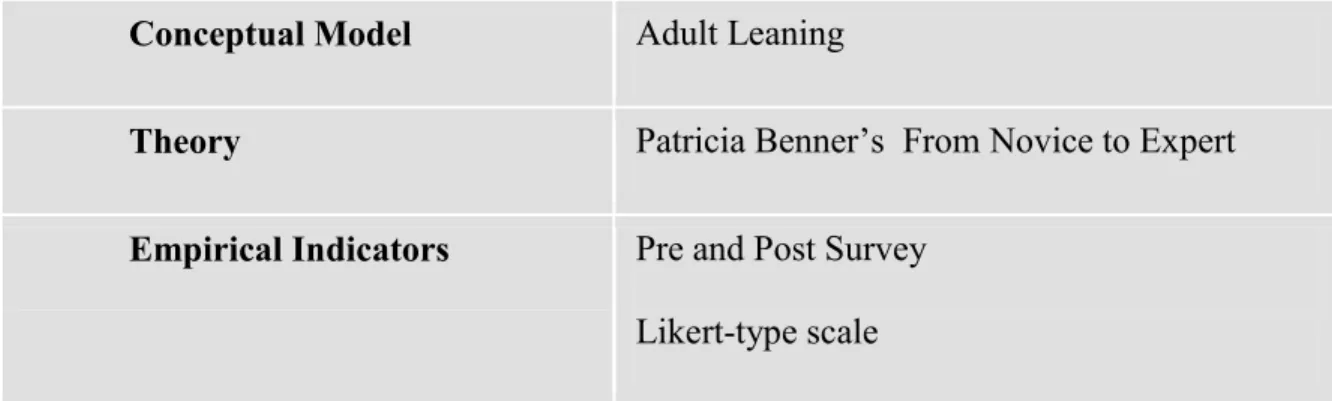
The conceptual-theoretical-empirical structure for this project included the Adult Learning theory as a conceptual model, Patricia Benner’s From Novice to Expert theory, and pre and post surveys that utilize a Likert-type scale (Figure 2). The linkage of
conceptual models of nursing, theories, and empirical indicators in a CTE system provide the translation of the components of nursing knowledge into realistic practice.
Conceptual Model Adult Leaning
Theory Patricia Benner’s From Novice to Expert
Empirical Indicators Pre and Post Survey Likert-type scale
Figure 2. Conceptual – Theoretical – Empirical System C T E
Fawcett, J., &Garity, J. (2009).Evaluation of conceptual theoretical-empirical linkages. Evaluating research for evidence based nursing practice (pp. 57-71). Philadelphia, PA: F.A. Davis
Summary
At a time when academia is experiencing a serious shortage of nursing faculty, it is imperative that steps be taken to recruit and retain nurse educators (NLN, 2006). Historically, schools of nursing have utilized mentoring as a primary tool of orientation for novice nursing faculty. It is important that schools of nursing are aware that
recruitment and retention strategies of the past may be obsolete in the future (Hessler & Ritchie, 2005). The role of the nurse educator must adapt to the new changes the future will bring. Work satisfaction has a positive correlation with successful retention of new nurse educators. Preparation for the academic role, and professional growth both have been targeted as strategies to obtain work satisfaction (Baker, 2010). The necessity for a structured nurse educator orientation development system is evident from the current literature (Hessler & Ritchie, 2005; McDonald, 2008; Suplee & Gardner, 2009; Baker, 2010; Race & Skees, 2010). Current literature does not explore the utilization of a formal structured orientation development system for novice nursing faculty to transition into the nurse educator role, although the need for such a program has been suggested and
recommended in the literature for many years. The omission of a systematic predictable orientation method in the literature provides a gap in knowledge. A SODS project could close the knowledge gap for nursing educator orientation and development, and provide a solution for the long term need in nursing education.
CHAPTER III Project Description
The purpose of this evidence based project was to examine the implementation of the Structured Orientation Development System (SODS) as an alternate method of orientation and development for nursing faculty in the role of a nurse educator.
Traditionally the methods used to orient, transition, and develop the expert bedside nurse to the role of the nurse educator have occurred through the process of mentorships with senior nursing faculty members. The mentor mentee experience has often been random and unstructured, resulting in a less than consistent method of orientation. The SODS could provide a systematic, predictable method of transitioning the bedside nurse to the nurse faculty role. The SODS is a six step process that could allow the novice nurse educator to self-assess their teaching competency level, plot survey results on the teaching continuum, develop goals to increase their teaching competency level, and evaluate their accomplishment.
Project Implementation
This evidence based project applied the SODS six step orientation process to the nursing faculty from a school of nursing college. All full time nursing faculty members of the school of nursing college were invited to participate. Participants were informed of the project and process during the spring 2012 academic semester and again at the beginning of the fall 2012 semester. The Project Preceptor emailed each eligible nursing faculty member a survey link to participate in the SODS Pre and Post Self-Assessment Survey. The nursing faculty who completed the SODS Pre Self-Assessment Survey were
invited to attend a three hour SODS Nursing Faculty Core Competency Workshop. Participants in the workshop received a handout of the NLN Core Competencies of Nurse Educators. The participants who completed the SODS Pre Self-Assessment Survey and attended the SODS Nursing Faculty Core Competency Workshop were invited to take the SODS Post Assessment Survey. The participant’s scores from the SODS Pre Self-Assessment Survey were tabulated and plotted on the SODS Teaching Continuum.
Setting
This evidence based project took place in the natural setting of a private university’s school of nursing program located in a major metropolitan area in central North Carolina. The school of nursing program was established circa 1980, and is currently accredited by the National League of Nurses and the Southern Association of Colleges and Schools. The school of nursing offers associate, bachelor, and masters of nursing degrees. The University was established circa 1850 as a liberal arts and
professional studies campus. The University serves approximately 2,600 undergraduate and graduate students.
Sample
The School of Nursing is comprised of 25 nursing faculty members. The nursing faculty represents a variety of clinical and teaching experiences. The school of nursing has experienced a variety of changes over the past year, including the resignation of the Associate Dean and Dean of the program, a newly appointed Dean of Health Services, the non-renewal of nine faculty contracts, and the hiring of four new nursing faculty positions. The concentration of the SODS project focused on the four newly hired
nursing faculty members and the completion of steps 4-6 of the SODS process. The associate degree school of nursing program is undergoing a curriculum revision while addressing a probation status from the National League for Nurses Accrediting
Commission (NLNAC) regarding NCLEX (National Council Licensure Examination) first time pass scores. The School of Nursing Director (Project Preceptor) has identified a nursing faculty need for the SODS and is supportive of the implementation of the system.
Project Design
A pre and post test method design approach was used for this evidence based project. A pre and post survey method was utilized for the same group of nursing faculty with the SODS Nursing Faculty Pre and Post Self-Assessment Survey being administered at two different times during the fall 2012 semester. A quantitative collection through an online survey of data from participants was followed by a three hour SODS Nursing Faculty Core Competency Workshop held in October, 2012, and was followed by a second quantitative collection of data through an online survey. Each SODS Nursing Faculty Self-Assessment Survey included a consent to participate disclaimer on page one of each survey. The participant’s voluntary log on and completion of the SODS Nursing Faculty Self-Assessment Survey served as consent to the survey. All participants were instructed to create a unique identification number; all collected data used the unique numbers created by the participants.
The SODS Nursing Faculty Pre Self-Assessment Survey data was evaluated by the Project Administrator and a master in nursing graduate student. The four newly hired
nursing faculty members were identified from the SODS Nursing Faculty Pre Self-Assessment Survey demographic question regarding length of employment with current employer. The four newly hired nursing faculty member’s pre self-assessment surveys scores were plotted on the SODS Teaching Continuum. Individual core competency tasks were identified that will assist the nursing faculty to achieve the next teaching competency level. Goals will be reviewed for progression after six months and reviewed again for achievement at one year.
Protection of Human Subjects
This evidence based project was granted permission from the Institutional Review Board (IRB) at Gardner-Webb University. Additional IRB permission was granted by the project setting’s University. The Project Administrator and a nursing graduate student have both completed all respective Collaborative Institutional Training Initiative (CITI) training. All participants were fully informed regarding the purpose of the evidence project and expectations of participation during the September nursing faculty meeting. All nursing faculty were emailed a link to the SODS Nursing Faculty Pre and Post Self-Assessment Surveys. The introduction page for each survey contained a statement of confidentiality and anonymity rights, the right to withdrawal from the project without penalty, and consent to participate. Completed electronic surveys were maintained by Rational Survey website and were pass word protected; access was only available to the Project Administrator and the nursing graduate student. Confidentiality was maintained on all data collection by using a unique number to identify participants instead of names, or any other personal identifiers. The SODS Nursing Faculty Pre
Self-Assessment Survey asked each nursing faculty member to create a unique six digit number. Prior to the SODS Nursing Faculty Pre Self-Assessment Survey the nursing faculty were given a blank envelope, an index card, and written instructions on how to create a unique number. The written instructions asked the participant to write their unique number on the index card, seal the envelope, and write their name across the sealed flap. The nursing faculty members were further instructed to bring the sealed envelope to the SODS Nursing Faculty Core Competency Workshop. The sealed envelopes were collected and stored unopened. The envelopes were returned by the Project Administrator to the Project Preceptor to distribute to each nursing faculty member three days before the SODS Nursing Faculty Post Self-Assessment Survey.
Instruments SODS Nursing Faculty Self-Assessment Survey
The survey tool utilized in this evidence based project was developed by the Project Administrator. The SODS Nursing Faculty Self-Assessment Survey incorporates the NLN’s Core Competencies of Nurse Educators (2005) and Patricia Benner’s From Novice to Expert Theory (1984). To establish validity for the SODS Nursing Faculty Self-Assessment Survey, the Project Administrator sent a personal email to Patricia Benner and Linda Christensen (Chief Administration Officer of the NLN). Each email contained an attachment of the SODS Nursing Faculty Self-Assessment Survey with a request for each party to review and provide permission for their work to be used in the development of the SODS Nursing Faculty Self-Assessment Survey. Patricia Benner and Linda Christensen replied to the Project Administrator via email with full approval to use
their material. Demographics data was collected utilizing the Nursing Faculty Pre Self-Assessment Survey. The survey contained 66 item questions from eight categories; a five point Likert-type scale was used to evaluate the nursing faculty’s perception of their teaching competency level. The Likert-type scale structure was developed from Benner’s (1984) From Novice to Expert Theory. Each question of the survey was scored as
novice, advanced beginner, competent, proficient, or expert. Each teaching competency level was assigned a numerical value based on the minimum and maximum possible points obtained (Table 4). The point value distribution was based on the minimum score possible for each competency level and up to 51% of the next level of competency.
Table 4
SODS Teaching Competency Levels
Teaching Competency Level
Teaching Competency score range
Novice 66– 99 Advanced Beginner 100 – 165 Competent 166 – 231 Proficient 232 – 307 Expert 308 – 330 Demographic Form
A demographic data collection form was included in the SODS Nursing Faculty Pre Self-Assessment Survey. The demographic form included 18 questions related to ethnicity, gender, age, nursing experience, nursing education experience, and educational level obtained.
SODS Nursing Faculty Core Competency Workshop
One week following the SODS Nursing Faculty Pre Self-Assessment Survey, the nursing faculty members were invited to attend the SODS Nursing Faculty Core
Competency Workshop. The three hour workshop date and time were allocated by the Project Preceptor. The Project Administrator presented the NLN’s Core Competencies of Nurse Educators through a power point presentation (Appendix H), group discussion, interactive group activities, and participant handout material (Appendix I). The nursing faculty members were asked to participate in group discussions, small group work, interactive activities, and verbal and visual demonstration of applied concepts. The workshop took place on the campus of the school of nursing during normal working hours. Attendance to the workshop was voluntary and limited to those participants who completed the SODS Nursing Faculty Pre Self-Assessment Survey. Verification of the SODS Nursing Faculty Pre Self-Assessment Survey was from the completion certificate available at the end of the online survey. Nursing faculty who participated in the SODS Nursing Faculty Pre Self-Assessment Survey were provided instructions with the online survey; to print the survey completion certificate, sign their name on the certificate, and bring it to the SODS Nursing Faculty Core Competency Workshop for a fifty dollar VISA gift card drawing. Participants were instructed that the winner of the drawing must be present to win; if the winner was not present a new name would be drawn.
SODS Teaching Continuum
The SODS Teaching Continuum (Appendix J and K) is a guide for the nursing faculty member to plot their SODS Nursing Faculty Pre Self-Assessment Survey score
results on the teaching continuum. The SODS Teaching Continuum consists of five teaching competency levels that progress from a novice nurse educator to an expert nurse educator. The five teaching competency levels are based on Benner’s From Novice to Expert Theory (1984), novice, advanced beginner, competent, proficient, and expert. Each teaching competency level is defined in content by the NLN’s Core Competency of Nurse Educators (2005). The 66 sub-competencies identified by the NLN’s Core
Competency of Nurse Educators have been distributed to one of the five teaching competency levels based on the complexity of the competency. The SODS Nursing Faculty Pre Self-Assessment Survey results formulated a numerical score that is transposed into one of the five teaching competency levels.
Data Collection
A quantitative method was selected because specific narrow questions were used to collect quantifiable data from participants. A convenience sampling design was utilized. Data collection occurred in an unbiased, objective manner through an internet survey website. The internet survey website was password protected and access was limited to the Project Administrator and the masters in nursing graduate student. Pre-assigned value for each answer selection was analyzed using statistics. A pre and post survey method was utilized for the nursing faculty who pre survey, attend the workshop and then post survey.
Data Analysis
The quantitative data collection was entered into the International Business Machines’ (IBM): Statistical Package for the Social Sciences (SPSS) version 18 for
software analysis. Demographic data collected was described for gender, ethnicity, age, number of years in nursing profession, number of years with current employer, and number of years as a nursing faculty member. The SPSS software was utilized to obtain data for each answer selected on the SODS Nursing Faculty Pre Self-Assessment Survey distributed at the beginning of the fall 2012 academic semester. The second
administration of the SODS Nursing Faculty Post Self-Assessment Survey utilized a paired-sample t-test to determine if a statistically significant mean difference was found for the frequency at the end of the project. Cohen's (1960) kappa coefficient is a
statistical measure of inter-rater agreement for quantitative (categorical) items. Cohen’s kappa coefficient was used for simple agreement on a coding to category .61 to .80 is considered as a substantial percentage. Cohen’s kappa coefficient will limit bias from the Project Administrator and promote credibility and dependability of the quantitative data.
Timeline
The timeline began in the fall of 2011 and ended in the spring of 2013. The first project objective was to find a nursing program that was just beginning or relatively new; this would provide participants that were in need of orientation to the nurse faculty role or new to the nursing program. After several interviews with a variety of nursing programs, the current setting was selected primarily due to the large number of nursing faculty in the program. Multiple meetings were arranged with the Project Preceptor (current Director of the nursing program). The Project Preceptor expressed an interest in the SODS project to expose the nursing faculty to the NLN’s Core Competencies of Nurse Educators. The Project Preceptor expressed her desire that all of the nursing