www.elsevier.com/locate/disc
Note on the 3-graph counting lemma
Brendan Nagle
a,∗,1, Vojtˇech Rödl
b,2, Mathias Schacht
c,3aDepartment of Mathematics and Statistics, University of South Florida, Tampa, FL 33620, USA bDepartment of Mathematics and Computer Science, Emory University, Atlanta, GA 30032, USA cInstitut für Informatik, Humboldt-Universität zu Berlin, Unter den Linden 6, D-10099 Berlin, Germany
Received 29 April 2004; received in revised form 10 August 2007; accepted 13 August 2007 Available online 15 October 2007
Dedicated to Professor Miklós Simonovits on the occasion of his 60th birthday
Abstract
Szemerédi’sregularity lemmaproved to be a powerful tool in extremal graph theory. Many of its applications are based on the so-calledcounting lemma: ifGis ak-partite graph withk-partitionV1∪ · · · ∪Vk,|V1| = · · · = |Vk| =n, where all induced bipartite graphsG[Vi, Vj]are(d,)-regular, then the number ofk-cliquesKkinGisd
k 2
nk(1±o(1)). Frankl and Rödl extended Szemerédi’s regularity lemma to 3-graphs and Nagle and Rödl established an accompanying 3-graph counting lemmaanalogous to the graph counting lemma above. In this paper, we provide a new proof of the 3-graph counting lemma.
© 2007 Elsevier B.V. All rights reserved.
MSC:primary 05C65; secondary 05C35; 05D05
Keywords:Szemerédi’s regularity lemma; Hypergraph regularity lemma; Counting lemma
1. Introduction
Szemerédi’s regularity lemma[20]is a powerful tool in combinatorics with many applications inextremal graph theory,combinatorial number theory, andtheoretical computer science(see, e.g., the excellent surveys[8,9]for some of these applications). The lemma asserts that all large graphs can be decomposed into constantly many edge-disjoint, bipartite subgraphs, almost all of which behave “random-like” (see Theorem 1 below).
The broad applicability of Szemerédi’s lemma to graph problems suggests that a regularity lemma for hypergraphs
might render many applications. Frankl and Rödl[1]established such an extension, hereafter called theFR-Lemma,
of the regularity lemma to 3-graphs or 3-uniform hypergraphs. (A 3-uniform hypergraphHon the vertex setV is a
family of 3-element subsets ofV, i.e.,H⊆
V
3
. Note that we identify hypergraphs with their edge set and we write
V (H)for the vertex set.) The FR-lemma guarantees that any large 3-graph admits a decomposition into constantly
∗Corresponding author.
E-mail addresses:[email protected](B. Nagle),[email protected](V. Rödl),[email protected](M. Schacht). 1Partially supported by NSF Grant DMS 0639839.
2Partially supported by NSF Grant DMS 0300529. 3Supported by DFG Grant SCHA 1263/1-1.
0012-365X/$ - see front matter © 2007 Elsevier B.V. All rights reserved. doi:10.1016/j.disc.2007.08.054
many edge-disjoint, tripartite subsystems, almost all of which behave “random-like.” Applications of the FR-lemma to 3-graphs can be found in[1,4–6,10,11,15,16,18,19].
Most of the applications of the 3-graph regularity lemma are based on a structural counterpart, the so-called 3-graph counting lemma, which was first obtained by the first two authors [12]. As a cogent example, the counting lemma, working within the framework of the FR-lemma, gives a new proof of Szemerédi’s theorem for arithmetic progressions of length four (see[1]) and its multidimensional version restricted to four points (see[19]). In this note we give an alternative proof of the 3-graph counting lemma, Theorem 5. This result was originally obtained by the first two authors
[12]and follows also from the work of Peng, Skokan and the second author[14]. (In this latter reference, the authors show that hypergraph “regularity”, defined precisely in Definition 3, is suitably preserved on complete underlying subgraphs, which then implies the counting lemma.) The proof presented here is substantially different. It is based on Szemerédi’s regularity lemma and is somewhat simpler than the earlier proofs. The statement of Theorem 5 requires some notation and we begin by stating Szemerédi’s regularity lemma precisely.
1.1. Szemerédi’s regularity lemma
In this paper we writex=y ±for realsxandyand some positive>0 for the inequalitiesy−xy+.
Szemerédi’s lemma pivots on the concept of an-regular pair. Let bipartite graphBbe given with bipartitionX∪Y. We say the pair(X, Y )is(d,)-regularif for allX ⊆ XandY ⊆ Y where|X|>|X|and|Y|>|Y|, we have
dB(X, Y)=d±wheredB(X, Y)= |E(B[X, Y])||X|−1|Y|−1is thedensityof the bipartite subgraphB[X, Y]
of B induced onX ∪Y. We say the pair(X, Y ) is -regularif it is(d,)-regular for some d. In this paper, we
use a well-known variant of Szemerédi’s regularity lemma fork-partite graphsG, and therefore present Szemerédi’s
lemma in this context. Letk-partite graphGbe given withk-partitionV =V (G)=V1∪ · · · ∪Vk.We say a refining
partitionW1i ∪ · · · ∪Wti =Vi, 1ik, ist-equitableif|W1i|· · ·|Wti||W1i| +1. We say at-equitable partition
W1i∪ · · · ∪Wti=Vi, 1ik, is-regularif for all 1i < jk, all butt2pairs(Wai, Wbj), 1a, bt, are-regular.
Szemerédi’s regularity lemma (fork-partite graphs) can then be stated4 as follows.
Theorem 1(Szemerédi’s regularity lemma). Let integerk1and>0be given.There exist positive integersN0=
N0(k,)andT0=T0(k,)such that anyk-partite graphGon the vertex setV=V1∪ · · · ∪Vkwith|V1|, . . . ,|Vk|N0,
admits an-regular andt-equitable partitionW1i ∪ · · · ∪Wti=Vi for1ik,wheretT0.
Central to many applications of Szemerédi’s regularity lemma is the assertion that any subgraphFof constant size
may be embedded into an appropriately given collection of “dense and regular” pairs from an-regular andt-equitable
partition. This observation is due to the counting lemma for graphs. For a graphG, we denote byK(s2)(G)the set of alls-tuples fromV (G)spanning cliquesKs(2)inG.
Fact 2(Counting lemma). For every integers2and constantsd >0and>0there exists>0so that whenever Gis an s-partite graph with vertex partition V1∪ · · · ∪Vs satisfying that all induced bipartite graphsG[Vi, Vj],
1i < js,are(d,)-regular and|V1| = · · · = |Vs| =nfor sufficiently largen,then|K(s2)(G)| =d(
s
2)ns(1±).
1.2. The counting lemma for 3-graphs
In this section we introduce the notion of regular 3-graphs and state the 3-graph counting lemma. We omit a formulation of the FR-Lemma since it is somewhat technical and, in fact, is not needed to state the corresponding counting lemma. The following definition generalizes the notion of regular graphs to regular 3-graphs.
Definition 3((, r)-regularity). Let a positive integerr1 and constantsd0 and>0 be given along with a 3-graph Hand a 3-partite graphP =P12∪P13∪P23. We say thatHis(d,, r)-regular with respect to Pif for any family
4There are other
k-partite formulations of Szemerédi’s regularity lemma. A possibly more common formulation would definet-equitable partitions asW0i∪W1i∪ · · · ∪Wti=Vi, 1it, where|W0i|< tand|W1i| = · · · = |Wti|(W0i, 1it, is often referred to as a “garbage” class). Then
-regular,t-equitable partitions would be defined otherwise the same as we did for Theorem 1; for each 1i < jk, all butt2pairs(Wai, Wbj), 1a, bt, are-regular. These two notions oft-equitable-regular partitions are the equivalent, however, up to a slight change in.
Q= {Q1, . . . , Qr}ofrsubgraphs ofP with r i=1 K(2) 3 (Qi) >|K( 2) 3 (P )| we have|dH(Q)−d|<, where dH(Q)= ⎧ ⎪ ⎨ ⎪ ⎩ |H∩r i=1K( 2) 3 (Qi)| |r i=1K( 2) 3 (Qi)| if|ri=1K( 2) 3 (Qi)|>0, 0 otherwise.
is thedensityofHonQ. We sayHis(, r)-regular with respect to Pif it is(d,, r)-regular with respect toP for somed0.
In most contexts whereHis(d,, r)-regular w.r.t.P, we actually haveH⊆K(32)(P ). This assumption, however, is not needed to state Definition 3. Moreover, we note that Definition 3 allows some membersQiofQto be empty.
While Szemerédi’s regularity lemma decomposes the vertex set of a graph, the 3-graph regularity lemma partitions not only the vertex set, but also partitions the set of all pairs between any two such vertex classes into edge-disjoint bipartite graphs. In that environment, the concept corresponding to an-regular pair is that of Definition 3, where the three bipartite graphsP12,P13, andP23are also regular (in the sense of Szemerédi). Consequently, a corresponding generalization of Fact 2 takes place in the following environment.
Setup 4. Let positive integersk,randnand positive constantsd3,3,d2and2be given.Suppose (1) V =V1∪ · · · ∪Vk,|V1| = · · · = |Vk| =n,is a partition of vertex setV.
(2) P =1i<jkPij is ak-partite graph,with vertex setV andk-partition above,where allPij =P[Vi, Vj], 1i < jk,are(d2,2)-regular.
(3) H=1h<i<jkHhij ⊆ K3(P )is ak-partite3-graph,with vertex setV andk-partition above,where all
Hhij=H[V
h, Vi, Vj], 1h < i < jk,are(d3,3, r)-regular with respect toPhi∪Pij∪Phj.
The counting lemma estimates the number of hypercliques, i.e., complete 3-graphs,Kk(3) inH. We denote by
K(3)
k (H)the set of allk-tuples fromV (H)spanning hypercliquesK( 3) k inH.
Theorem 5(Counting lemma, Nagle and Rödl[12]). Letk3be an integer.For every>0andd3>0there exists
3>0so that for alld2>0there exist integerrand2>0andnsufficiently large so that with these constants,ifH
andP are as in Setup4,then
|K(3) k (H)| =d k 3 3 d k 2 2 nk(1±).
Proving Theorem 5 is the content of this paper. The first proof of Theorem 5 appeared in[12]and another proof by
Peng, Skokan, and one of the authors was given in[14]. The proof we present here is shorter than the previous ones
and we believe it is also simpler. We present our proof in Section 2 and conclude this introduction with the following remarks.
The main problem of proving Theorem 5 is working with the given quantification of constants: ∀, d3,∃3 :
∀d2,∃2,∃r. This quantification, consistent with the output of the 3-graph regularity lemma, allows for the graph
P to be relatively “sparse” compared to3, the measure of regularity of the 3-graphH. If the quantification of
con-stants were allowed as∀, d3, d2,∃3=2, then such a “dense” version of Theorem 5 is simpler to prove and was
proved in[7]. In the present paper, we use Szemerédi’s regularity lemma, Theorem 1, to overcome those difficulties
arising from the quantification of constants in Theorem 5. Recently Gowers[2,3]developed a regularity lemma and a
corresponding counting lemma for-graphs for general3. The approach in[2,3]is different and, for e.g.,=3 the
notion of 3-graph regularity there differs from that in Definition 3. A regularity lemma for-graphs (3) extending the
-graph counting lemma for that regularity lemma. The proof of the general counting lemma in[13]was inspired by the main idea presented here, i.e., it uses the regularity lemma for-graphs to overcome difficulties, which are similar to those indicated in the previous remark.
2. Proof of the 3-graph counting lemma
It was shown in[12]that the full statement of Theorem 5 can be deduced from just the lower bound. Hence it suffices
to prove the lower bound of Theorem 5 only.
Our proof of Theorem 5 proceeds by induction onk3. The base case k=3 is trivial. Indeed, by Definition 3,
H=H123
has (relative) densityd3±3with respect to P =P12∪P23∪P13. Fact 2 implies that (with2>)
|K(2)
3 (P )| =d 3 2n
3
(1±/2)and the lower bound of Theorem 5 fork=3 then follows from3>.
To proceed to the induction step, we assume that Theorem 5 holds fork−1. Recalling the quantification of Theorem
5, which is∀, d3,∃d3: ∀d2,∃2,∃r, we may assume that
1 k, 2, d3?3min{3, d2}?2, 1 r? 1 n (1)
holds. Then for a given graphP and a 3-graphHas in Setup 4, we show|Kk(3)(H)|d k 3 3 d k 2 2 nk(1−).
We now refine the hierarchy in (1) and introduce some further auxiliary constants. Let0>0 and integerr>0 be chosen so that both0,1/r>min{d2,3}. LetT0=T0(k−1,0)be the constant guaranteed by Szemerédi’s regularity lemma, Theorem 1. We choose2>0 so small and integersrandnso large (which complies with the quantification of Theorem 5) that the hierarchy (1) extends to
1 k,, d3?3min{3, d2}?0, 1 r, 1 T0?2, 1 r? 1 n. (2)
Before going into the precise details of the induction step, we first give an informal description of the proof. 2.1. Outline of the induction step
The so-called link graphs ofHplay a central rôle in our proof of the induction step. In the context of Setup 4, consider a vertexv∈V1and fix 2i < jk. The(i, j )-link graphLijv is defined5 asLijv = {{vi, vj} ∈Pij:{v, vi, vj} ∈H}
and thelink graphLvofvis then set asLv=
2i<jkLijv.(Note thatLvis a(k−1)-partite graph.)
A natural place to consider applying the induction hypothesis on the counting lemma is to enumerate cliquesKk(3−)1 in the(k−1)-partite hypergraphH∩K(32)(Lv)(with the(k−1)-partite graphLv), wherev ∈ V1is a “typical” vertex. (Indeed, a cliqueKk(3−)1inH∩K(
2)
3 (Lv)corresponds to a cliqueKk(3)inHcontaining the vertexv). For this,
one would need to check that the hypothesis of the counting lemma is met (for(k−1)) byH∩K3(2)(Lv)andLv
(replacingHandP, as in Setup 4). Unfortunately, this would not often be the case. Indeed, one may show that while
the density of the bipartite graphsLijv (for mostv∈V1), 1i < jk, is aboutd2d3, the regularity ofLijv depends on
3. As we see in (2),3?d3d2, and to apply the induction hypothesis, we would need it the other way around.
The main idea of our proof is to apply the Szemerédi regularity lemma, Theorem 1, to the link graphsLv, i.e., we
‘regularize’ the links. With0>d2d3(cf. (2)), we will regularize eachLvto obtain0-regular partitionPvgiven by
Vi =W1v,i ∪ · · · ∪Wtv,iv , 2ik, wheretvT0for the constantT0appearing in (2). We will then show that for each 2i < jk, for mostv∈V1, most of the pairsWav,i, Wbv,j, 1a, btv, will have density inLijv close tod2d3(see part (i) of Claim 7). (Of course, most of these pairsWav,i, Wbv,jare0-regular where0>d2d3). Showing this will involve using the(d3,3, r)-regularity ofH1ij w.r.t.P1i∪P1j ∪Pij and the choicer?T0. We will then show that for all 2h < i < jk, for mostv ∈V1, most triplesWav,h, Wbv,i, Wcv,j, 1a, b, ctv, will satisfy thatHhij ∩K(32)(Lv)
5Note thatLij
v has vertex setNP1i(v)∪NP1j(v)where, for example,NP1i(v)is theP1i-neighborhood of the vertexv. Note thatLijv is a subgraph ofPvij, wherePvij=Pij[NP1i(v), NP1j(v)]is the subgraph ofPijinduced on the neighborhoodsNP1i(v)andNP1j(v).
is(d3,13/20, r)-regular w.r.t.Lv[Wav,h, Wbv,i, Wcv,j](see part (ii) of Claim 7). Showing this will involve using the (d3,3, r)-regularity ofHhij w.r.t.Phi∪Phj∪Pij and the choicer?max{r, T0}.
From the two observations above, we then infer that for mostv∈V1, most(k−1)-partite graphsLv[Wav,22, . . . , W v,k ak ],
1a2, . . . , aktv, and corresponding 3-graphsH∩K3(2)(Lv[Wav,22, . . . , W v,k
ak ])satisfy the hypothesis (for(k−1))
of the counting lemma. (That is, after the adjustment of regularizing the links, we are in a position of using the induction hypothesis (within the pieces)). We then use the induction hypothesis to count the cliquesKk(3−)1 inH∩
K(2)
3 (Lv[Wv, 2 a2 , . . . , W
v,k
ak ]). We then add over all suitable choices of indices 1a2, . . . , aktvand then add over all
suitable choices of verticesv∈V1.
We now formalize the details sketched above. 2.2. Transversals and their properties
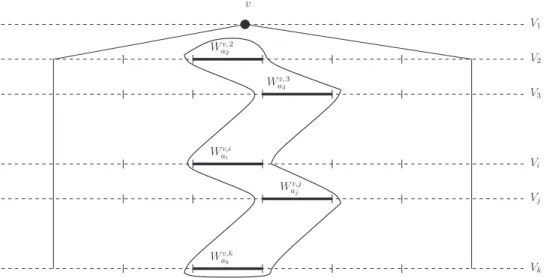
Let the constants be fixed as in (2) and ak-partite graphP and a 3-graphH be given as in Setup 4. We first regularize the link graphs. For every vertexv∈V1, we apply Szemerédi’s regularity lemma, Theorem 1 with0, to the (k−1)-partite link graphLvto obtain an0-regular andtv-equitable partitionPvofV (Lv), wheretvT0(see (2)). In other words,Pvrefines the partitionNP12(v)∪ · · · ∪NP1k(v)=V (Lv), i.e., we obtainW1v,i∪ · · · ∪Wtv,iv =NP1i(v)for
i=2, . . . , k, where for all pairs 2i < jkall but at most0tv2pairs(a, b)∈ [tv] × [tv]satisfy thatLijv[Wav,i, Wbv,j] is0-regular.
For a fixedv ∈V1and a fixed(k−1)-vectorav=(a2, . . . , ak)∈ [tv] × · · · × [tv] = [tv]k−1we denote byLv(av) the subgraph ofLvinduced on the setsWav,22, . . . , W
v,k ak , i.e., Lv(av)= 2i<jk Lijv[Wav,ii , Wav,jj ] =Lv[W v,2 a2 , . . . , W v,k ak ]. (3)
Similarly, we define for all 2h < i < jkand(ah, ai, aj)∈ [tv]3 Lhijv [ah, ai, aj] =Lhiv [Wav,hh , W v,i ai ] ∪L ij v[Wav,ii , W v,j aj ] ∪Lhjv [Wav,hh , W v,j aj ]. (4)
Moreover, we setH(av)to be equal to the 3-graphHinduced on the triangles ofLv(av), i.e., H(av)=H∩K3(2)(Lv(av))=
2h<i<jk
Hhij(a
v), (5)
whereHhij(av)=Hhij∩K3(2)(Lhijv [ah, ai, aj]).
We refer to the objectsH(av)andLv(av)astransversalsof the partitionPv(seeFig. 1).
Note that asLvwas regularized, we infer that all but0k2tvk−1vectorsav=(a2, . . . , ak)∈ [tv]k−1satisfy that all
k−1 2
bipartite graphsLijv[Wav,ii , W
v,j
aj ], 2i < jk, are0-regular. It follows directly from the definitions in (3) and (5) that
|K(3) k (H)| = v∈V1 av∈[tv]k−1 |K(3) k−1(H(av))|. (6)
In our proof of the induction step we will use the following well-known fact about the size of typical neighborhoods in2-regular graphs (see, e.g.,[8, Fact 1]).
Fact 6. For all but2k2nverticesv∈V1,we have|NP1i(v)| =(d2±2)n,for all2ik. For future reference, we set
V1= {v∈V1: |NP1i(v)| =(d2±2)n, for all 2ik}, (7)
so that Fact 6 implies|V1|(1−2k2)n. The following claim is the key observation for the proof of Theorem 5. While technical looking, part (i) of Claim 7 follows from standard arguments, which we present in Section 4. The proof of part (ii) is given in Section 5.
Fig. 1. A transversal of the partitionPv.
Claim 7. For all but13/4nverticesv ∈ V1(see(7)),all but 1/20
3 k3tvk−1vectorsav=(a2, . . . , ak) ∈ [tv]k−1yield transversalsLv(av)andH(av)satisfying that
(i) for all2i < jkthe bipartite graphsLijv[Wav,ii , W v,j
aj ]have densityd2d3(1±
1/4
3 )and(due to regularization) are0-regular,
(ii) for all 2h < i < jk the 3-partite 3-graph Hhij(av) is(d3,13/20, r)-regular with respect to the3-partite graphsLhijv [ah, ai, aj],whereris given in(2) (recall the notation in(4)).
LetV1typdenote the set of “typical” verticesv∈V1to which Fact 6 and Claim 7 refer. For eachv∈V typ
1 , let[tv]k− 1 typ denote the set of “typical” vectorsav∈ [tv]k−1to which Claim 7 refers.
2.3. The induction step
We conclude from Fact 6 and Claim 7 above that for any vertexv ∈ V1typand anyav ∈ [tv]ktyp−1, the transversals
H(av)andLv(av), satisfy the hypothesis of Setup 4 with the constantsk−1,d3,13/20,d2d3,0,randd2n/tv. Indeed, as in Setup 4, observe thatH(av)replacesH,Lv(av)replacesP,k−1 replacesk,d3remainsd3,13/20replaces3, d2d3replacesd2,0replaces2andd2n/tvreplacesn. (We will take/2 to replace)
Due to the hierarchy of the constants in (2), we may assume that 1 k−1, 2, d3? 1/20 3 min{ 1/20 3 , d2d3}?0, 1 r? tv d2n. (8)
As such, for fixedv∈V1typandav=(a2, . . . , ak)∈ [tv]k− 1
typ , we may apply the induction hypothesis to the transversals
H(av)andLv(av)and infer
|K(3) k−1(H(av))|d k−1 3 3 (d2d3) k−1 2 d2n tv k−1 1− 2 =d k 3 3 d k 2 2 nk−1 tvk−1 1− 2 . (9)
Consequently, by (6) we have |K(3) k (H)| = v∈V1 av∈[tv]k−1 |K(3) k−1(H(av))| (9) d k 3 3 d k 2 2 nk− 11− 2 v∈V1typ |[tv]ktyp−1| tvk−1 .
By Fact 6 and Claim 7,|V1typ|(1−13/4−2k2)n > (1−231/4)nand|[tv]typk−1|(1−k3 1/20 3 )tk− 1 v for everyv ∈V typ 1 . Hence we conclude (due to the hierarchy in (8)) that
|K(3) k H)|d k 3 3 d k 2 2 nk 1− 2 (1−213/4)(1−k313/20)d k 3 3 d k 2 2 nk(1−). This concludes our proof of Theorem 5.
3. Proof of Claim 7
In this section, we outline our strategies for proving parts (i) and (ii) of Claim 7. To begin, we find the following notation helpful to discuss Claim 7 and use it in the remainder of this paper.
Definition 8. Fixv∈V1. For fixed 2i < jkand 2h < i, set
Lijgood(v)= {(a, b)∈ [tv]2:Lijv[Wav,i, Wbv,j]is(d,0)-regular ford=d2d3(1± 1/4 3 )}, Lhijgood(v)= {(a, b, c)∈ [tv]3:(a, b)∈Lgood(v), (b, c)hi ∈Lijgood(v), (a, c)∈L
hj good(v)}, Hhijgood(v)= {(a, b, c)∈ [tv]3:Hhij is(d3,13/20, r)-regular w.r.tLhijv [a, b, c]}, whereLhijv [a, b, c]was defined in (4). Finally, set
Lgood(v)= {av∈ [tv]k−1:(ai, aj)∈Lijgood(v)for all 2i < jk},
Hgood(v)= {av∈ [tv]k−1:(ah, ai, aj)∈Hgoodhij (v)for all 2h < i < jk}. We also define corresponding “bad” sets and fix
Lijbad(v)= [tv]2\Lgoodij (v), Lhijbad(v)= [tv]3\Lhijgood(v), Hhijbad(v)= [tv]3\Hhijgood(v), Lbad(v)= [tv]k−1\Lgood(v) and Hbad(v)= [tv]k−1\Hgood(v).
In the notation above, Claim 7 asserts that all but13/4nverticesv ∈V1(see (7)) satisfy
|Lbad(v)| + |Hbad(v)|31/20tvk−1.
We consider the sum on the left hand side of the inequality above. Observe that
|Lbad(v)| + |Hbad(v)| = |Lbad(v)| + |Hbad(v)∩Lgood(v)| + |Hbad(v)∩Lbad(v)|
2|Lbad(v)| + |Hbad(v)∩Lgood(v)|. Moreover, observe that
|Lbad(v)|tvk−3 2i<jk
and
|Hbad(v)∩Lgood(v)|tvk−4 2h<i<jk
|Hhijbad(v)∩Lhijgood(v)|
hold for allv∈V1. We may therefore give reformulations of parts (i) and (ii) from Claim 7 in the following form. Proposition 9(Claim 7 part (i)). LetP andHsatisfy Setup4with constants as in(2).Then all but2k213/2nvertices v∈V1(see(7))satisfy that|L
ij bad(v)|3 1/4 3 t 2 v for all2i < jk.
Proposition 10(Claim 7 part (ii)). LetP andHsatisfy Setup4with constants as in(2).Then all butk312/4nvertices v∈V1(see(7))satisfy that|Lgoodhij (v)∩Hhijbad(v)|<213/20tv3for all2h < i < jk.
Propositions 9 and 10 together imply that all but 2k213/2n+k321/4n31/4nverticesv∈V1satisfy 2|Lbad(v)| + |Hbad(v)∩Lgood(v)|
2tvk−3 2i<jk
|Lijbad(v)| +tvk−4 2h<i<jk
|Hbadhij(v)∩Lhijgood(v)|
613/4 k 2 tvk−1+213/20 k 3 tvk−113/20k 3 tvk−1, as promised by Claim 7.
We give the proofs of Propositions 9 and 10 in Sections 4 and 5, respectively. 4. Proof of Proposition 9
Let P and H be given as in Setup 4 where the constants satisfy (2). Moreover, let {Pv}v∈V1 be the family of
0-regular, tv-equitable partitions obtained in Section 2.2. We prove that all but 2k231/2nvertices v ∈ V1 (see (7)) satisfy|Lijbad(v)|313/4tv2for all 2i < jk. Let us clarify this goal. Fix 2i < jk. Since Pvis 0-regular for everyv∈V1, at most0tv213/4tv2pairs(Wav,i, Wbv,j), 1a, btv, can be irregular. Hence we only have to verify the density assertion of Proposition 9, namely, for all but 213/2nverticesv∈V1,
dLij v(W v,i a , Wbv,j)=d2d3(1± 1/4 3 ),
holds for all but 313/4tv2pairs(Wav,i, Wbv,j). We begin with the following definition.
Definition 11. LetL⊆P be bipartite graphs with bipartitionU1∪U2and letd,>0 and integerrbe given. We say Lis(d,, r)-regular with respect toP if every familyB= {B1, . . . , Br}ofr inducedsubgraphsBi ⊆P satisfying
|r s=1Bs|>|P|also satisfies|L∩ r s=1Bs| =(d±)| r s=1Bs|.
The following fact appeared (in slightly different language) in[1, Claim A](see also[12]). It asserts that forHand
P as in Setup 4, most verticesv∈V1satisfy that their linksLvij, 2ijk, are regular in the sense of Definition 11.
Fact 12(most links are(d3,231/2, r)-regular). Letk,d3,3,d2andrbe given as in(2).Then forHandP are as in
Setup4,all but2k213/2nverticesv ∈V1(see(7))satisfy that for all2i < jk,Lijv is(d3,213/2, r)-regular with
respect toPvij=P[NP1i(v), NP1j(v)].
Fact 12 is essentially the same as Claim A from[1]. For completeness, we sketch a proof of Fact 12 at the end of
As in Fact 12, we say that a vertexv∈V1is agood vertexif for all 2i < jk,Lijv is(d3,213/2, r)-regular with respect toPvij. LetV
good
1 =V
good
1 (k, d3,3, d2,2, r)be the set of all good verticesv∈V1.
Proof of Proposition 9. Fact 12 ensures us that almost every vertexv∈ V1is a good vertex. Now, fix 2i < jk. The key observation is that everygood vertexv ∈ V1goodsatisfies that all but 2
1/4 3 t
2
v pairsWav,i,Wbv,j, 1a, btv, have densityd2d3(1±13/4).
Indeed, letv ∈ V1good but suppose{(Wav,i, Wbv,j)}(a,b)∈I is a collection of pairs, each with density, say, smaller thand2d3(1−13/4), such that|I|13/4tv2. We claim the familyB= {Pvij[Wav,i, Wbv,j]:(a, b)∈ I}contradicts the (d3,213/2, r)-regularity ofLijv with respect toPvij.
Note that (2) gives thatrT02t 2
v|I| = |B|. The setBis therefore a family ofr induced subgraphs ofPvij = P[NP1i(v), NP1j(v)]. We claimBis a family ofrinduced subgraphs ofPvij satisfying
(a,b)∈IPvij[Wav,i, Wbv,j] >213/2|Pvij| (10) and Lijv ∩ (a,b)∈I Pvij[Wav,i, Wbv,j] < (d3−213/2) (a,b)∈IPvij[Wav,i, Wbv,j] . (11)
Once (10) and (11) are established, we see thatBcontradicts the(d3,231/2, r)-regularity ofLijv with respect toPvij. This will prove Proposition 9.
We first verify (10). Observe that (a,b)∈IPvij[Wav,i, Wbv,j] =(a,b)∈I|Pvij[Wav,i, Wbv,j]|. (12)
Fix(a, b)∈I. Recall that2>1/T01/tvin (2) and sincev∈V1
|Wav,i| =|NP1i(v)| tv ±
1=(d2±22)n tv ,
(recall (7)). Consequently, the(d2,2)-regularity ofPij implies that
|Pvij[Wav,i, Wbv,j]| =(d2±2)|Wav,i||Wbv,j| =(d2±2) (d2±22)n tv 2 =(d2±22)3n 2 t2 v . (13)
The(d2,2)-regularity ofPijalso implies (recallingv∈V1(cf. (7))
|Pvij| =(d2±2)((d2±2)n)2=(d2±2)3n2. (14)
Consequently, with|I|13/4tv2, (12), (13) and (14) establish (10). Observe that (11) is equivalent to
(a,b)∈I
|Lijv[Wav,i, Wbv,j]|< (d3−213/2) (a,b)∈I
|Pvij[Wav,i, Wbv,j]|. (15)
Fix(a, b)∈I. Our assumption is that
which, with (13), implies |Lijv[Wav,i, Wbv,j]|< d3 (1− 1/4 3 ) (1−2d2−1) |Pvij[Wav,i, Wbv,j]| < (d3−213/2)|Pvij[Wav,i, Wbv,j]| (16) where the last inequality follows from2>d2,3in (2). As (16) holds for each(a, b)∈I, (15) follows. Proof of Fact 12. It suffices to consider just the casek=3, for which we prove all but 231/2nverticesv ∈V1(see (7)) satisfy thatL23v is(d3,213/2, r)-regular w.r.t.Pv23. We note that while the constantsd3,3, d2,2andrsatisfy the hierarchy in (2) (due to the quantification of the counting lemma), all that is required to enable the present sketch is that 0<2=2(d2)>d2is sufficiently small.
For each fixed vertex v ∈ V1 (see (7)) for which L23v is not (d3,213/2, r)-regular w.r.t. Pv23, fix a family Bv=
{Bv1, . . . , Bvr}ofrinduced subgraphsBvs ⊆Pv23, 1sr, for which r s=1 Bvs >2 1/2 3 |P 23 v | (17)
but for which either L23v ∩ r s=1 Bvs < (d3−2 1/2 3 ) r s=1 Bvs or L23v ∩ r s=1 Bvs > (d3+2 1/2 3 ) r s=1 Bvs .
LetV1−be the set of such verticesv∈V1for which the first condition holds and letV1+be the set of such verticesv∈V1 for which the second condition holds. We claim|V1−|<
1/2
3 nand|V1+|< 1/2
3 n. The proofs of these two inequalities are symmetric, so w.l.o.g., we prove only the first.
Assume, on the contrary, that|V1−|31/2n. We showV1−leads to a contradiction with the(d3,3, r)-regularity of
H123w.r.t.P12∪P13∪P23. In particular, we show the setV−
1 implies the existence of a familyQ=QV1−={Q1, . . . , Qr}
satisfying r s=1 K(2) 3 (Qs) >3K(32)(P12∪P13∪P23) and dH123(Q) < d3−3. (18)
Indeed, fixv ∈ V1− and fix 1sr. Define Q 12
vs ⊆ P12 (respectivelyQ13vs ⊆ P13) as the set of all edges of P12(resp.P13) containing vertexvand defineQ23vs=Bvs. SetQvs =Q12vs∪Q13vs ∪Q23vs andQs =
v∈V1−Qvs. Set Q= {Q1, . . . , Qr}. Note that r s=1 K(2) 3 (Qs) = v∈V1− r s=1 Bvs (19) and H123∩ r s=1 K(2) 3 (Qs) = v∈V1− L23v ∩ r s=1 Bvs . (20)
Note that the second inequality of (18) is trivial. Indeed, using both equalities in (19) and (20) and the definition of V1−, we have v∈V1− L23v ∩ r s=1 Bvs < (d3−2 1/2 3 ) v∈V1− r s=1 Bvs =(d3−2 1/2 3 ) r s=1 K(2) 3 (Qs) , so thatdH123(Q) < d−213/2< d3−3follows.
To see the first inequality of (18), we use (17) to see v∈V1− r s=1 Bvs > v∈V1− 213/2|Pv23|>231/2(d2−2)((d2−2)n)2|V1−|,
where the last inequality follows fromv∈V1(as in (14) cf. (7)). Then our assumption aboutV1−implies 213/2(d2−2)3n2|V1−|>23(d2−2)3n3.
Since2>d2, Fact 2 implies|K(32)(P12∪P13∪P23)|(3/2)d23n3, and so the first inequality of (18) follows from (19) and from2d2−1>d2in (2).
5. Proof of Proposition 10
We show that all butk312/4nverticesv∈V1(see (7)) satisfy|L hij good(v)∩H hij bad(v)|<2 1/20 3 tv3for all 2h < i < jk. In the remainder of this paper, we fix 2h < i < jk. It suffices to prove that all but21/4nverticesv ∈ V1satisfy
|Lhijgood(v)∩Hhijbad(v)|<213/20tv3for the fixed indices 2h < i < jk.
Remark 13. In the remainder of this paper, the indices 2h < i < jkarefixed. Assume, on the contrary, there exists a setAhij ⊆V
1of size
|Ahij|>12/4n (21)
consisting of vertices for which
|Lgoodhij (v)∩Hhijbad(v)|213/20tv3. (22)
We show that (21) leads to a contradiction to our hypothesis of Setup 4 that the triadHhij is(d3,3, r)-regular with respect toPhi∪Pij ∪Phj. We outline our approach in the following remark.
Remark 14. Fixv∈Ahijand fix(a, b, c)∈Lhijgood(v)∩Hhijbad(v). Since(a, b, c)∈Hhijbad(v), we appeal to Definitions 3 and 8 to infer that there exists a familyQhijvabc= {Qhijvabc(p):1pr},Qhijvabc(p)⊆Lhijv [a, b, c](see (4)), satisfying
r p=1 K(2) 3 (Q hij vabc(p)) >13/20|K( 2) 3 (Lhijv [a, b, c])|, (23) but |dH(Qhijvabc)−d3|13/20. (24)
In (32), we collect a witnessQhijvabcfor each(a, b, c)∈Lhijgood(v)∩Hhijbad(v)andv∈Ahij to create a “big witness”Qhij
that will contradict the(d3,3, r)-regularity ofHhij with respect toPhi∪Pij ∪Phj.
In the process of collecting the witnessesQhijvabcover(a, b, c)∈Lhijgood(v)∩Hhijbad(v)andv∈Ahij, we do not need the entire setAhij, and in fact, we need only a small subset thereof. Over two steps, we refine the setAhij into two nested subsetsChij ⊆Bhij ⊆Ahij where the final subsetChij produces the big witnessQhij promised.
5.1. Refining the setAhij
We obtain the intermediate subsetBhij ⊆Ahij using Fact 15 below. This fact states that fromAhij we may find a subset of verticesBhij, every pair from which has the “right” sharedP1q-neighborhood,q ∈ {h, i, j}.
Fact 15. Set f=128
2/5 3
d33d23. (25)
Assuming(21),there exists a setBhij ⊆Ahij of size|Bhij| =2f such that for eachq ∈ {h, i, j}and for every distinct verticesu,v∈Bhij ,
|NP1q(u)∩NP1q(v)| =(d2±2)2n. (26)
Fact 15 is not difficult to prove and was shown, in a slightly different context, in[1, page 155]. For completeness, we prove Fact 15 in Section 5.5.
To identify the subsetChij ⊆Bhij, we use the following considerations. Fixv∈Bhij and set
LH−(v)= {(a, b, c)∈Lhijgood(v)∩Hhijbad(v):dH(Qhijvabc) < d3−13/20}, (27) LH+(v)= {(a, b, c)∈Lhijgood(v)∩Hhijbad(v):dH(Qhijvabc) > d3+13/20}. (28) Moreover, we define
B−hij= {v∈Bhij:|LH−(v)|12|Lhijgood(v)∩Hhijbad(v)|}, B+hij= {v∈Bhij:|LH+(v)|12|L
hij
good(v)∩H hij bad(v)|}.
Clearly, one of|B−hij|12|Bhij| =f or|B+hij|12|Bhij| =f holds. In our proof, it does not matter which holds as the cases are symmetric. We assume, without loss of generality, that the former holds and we fix some set
Chij ⊂B−hij ⊆Bhij such that|Chij| =f. (29) We construct the witnessQhij fromChij. Before doing so, however, we state the following fact for future reference.
Fact 16. Letv ∈Chij.From(22)and the definition ofT0(see(2)),we infer
1/20 3 t
3 v12|L
hij
bad(v)∩Hhijbad(v)||LH−(v)|t 3
vT03. (30)
For each(a, b, c)∈LH−(v),we recall from(24)thatdH(Qhijvabc) < d3−13/20,and so, Hhij∩ r p=1 K(2) 3 (Q hij vabc(p)) < (d3−13/20) r p=1 K(2) 3 (Q hij vabc(p)) . (31)
5.2. Constructing the witness
With the setChij above, we proceed to construct the promised witnessQhij. Define
Qhij = {Qhijvabc(p):v∈Chij, (a, b, c)∈LH−(v), andp=1, . . . , r}. (32) We assertQhijis the promised family witnessing the(d3,3, r)-irregularity ofHhijwith respect toPhi∪Pij∪Phj.
We first claim thatQhij has at mostrmembers. Indeed, we have
|Qhij|(32=)r v∈Chij |LH−(v)|( 30) rf T30 (25=) 128rT03 2/5 3 d33d 3 2 (2) >r, as desired.
Now, asQhij has at mostr members consisting of subgraphs fromPhi ∪Pij ∪Phj, the following observation, Claim 17 and 18, provide a direct contradiction to the(d3,3, r)-regularity ofHhij with respect toPhi∪Pij∪Phj. For that set
K(2)
3 (Qhij)=
{K(2)
3 (Qhijvabc(p)):v∈Chij, (a, b, c)∈LH−(v), p=1, . . . , r}. Claim 17. |K(32)(Qhij)|>3|K(32)(Phi∪Pij∪Phj)|.
Claim 18. |Hhij ∩K(32)(Qhij)|< (d3−3)|K(32)(Qhij)|.
Since Claims 17 and 18 provide a contradiction to the(d3,3, r)-regularity ofHhijwith respect toPhi∪Pij∪Phj, our proof of Proposition 10 will be complete upon proving these two claims.
5.3. Proof of Claim 17 Inclusion–exclusion gives |K(2) 3 (Qhij)| v∈Chij {K(2)
3 (Qhijvabc(p)):(a, b, c)∈LH−(v), p=1, . . . , r}
− v=v∈Chij {K(2) 3 (Q hij vabc(p))∩K( 2) 3 (Q hij vabc(p))} , (33)
where the last union runs over all(a, b, c)∈LH−(v),(a, b, c)∈LH−(v), andp,p=1, . . . , r. We bound the two terms on the right hand side of (33) in the following two facts.6
Fact 19. For everyv∈Chij {K(2) 3 (Q hij vabc(p)):(a, b, c)∈LH−(v), p=1, . . . , r} 1/10 3 128 d 3 3d26n3. Fact 20. For all distinct verticesv,v∈Chij
{K(2) 3 (Qhijvabc(p))∩K( 2) 3 (Qhijvabc(p)):(a, b, c)∈LH−(v), (a, b, c)∈LH−(v), andp, p=1, . . . , r}16d29n 3 . Facts 19 and 20 conclude the proof of Claim 17.
Proof of Claim 17. Applying Facts 19 and 20 to (33), we obtain the lower bound
|K(2) 3 (Qhij)|f 1/10 3 128 d 3 3d26n3−16 f 2 d29n3d23n3 f d33d2313/10 128 −8f 2 d26 . Inserting the valuef =12823/5/(d33d
3
2)from (25), we infer the further lower bound
|K(2) 3 (Qhij)|d 3 2n3 1/2 3 − 217 d36 4/5 3 =1/2 3 d 3 2n3 1−2 17 d36 3/10 3 1 2 1/2 3 d 3 2n 3 , (34)
where the last inequality follows from the fact that3>d3from (2). On the other hand, since2>d2in (2), we conclude from Fact 2, the counting lemma for graphs, that
|K(2)
3 (Phi∪Pij∪Phj)|2d 3 2n3.
Comparing this inequality against (34) proves Claim 17. Thus, it remains to verify Facts 19 and 20.
Proof of Fact 19. Fix a vertexv∈Chij. Observe from (32) that
{K(2) 3 (Q
hij
vabc(p)):(a, b, c)∈LH−(v)andp=1, . . . , r} = (a,b,c)∈LH−(v) r p=1 K(2) 3 (Q hij vabc(p)) (23) (a,b,c)∈LH−(v) 1/20 3 |K( 2) 3 (Lhijv [a, b, c])|. (35)
We further estimate (35) by appealing to Fact 2.
Fix(a, b, c) ∈ LH−(v) ⊆ Lhijgood(v) (see (27)). By the definition of Lhijgood(v), each of the three bipartite graphs Lhiv [Wav,h, Wbv,i],Lijv[Wbv,i, Wcv,j], andLhjv [Wav,h, Wcv,j], is0-regular with densityd3d2(1±
1/4
3 ), where0>d2d3 from (2). Applying Fact 2 toLhijv [a, b, c], we therefore conclude
|K(2) 3 (Lhijv [a, b, c])| 1 2(d3d2(1− 1/4 3 )) 3| Wav,h||Wbv,i||Wcv,j| (d3d2)3 16 |W v,h a ||Wbv,i||Wcv,j| d33d 6 2 128 n3 t3 v , (36)
where the last inequality follows from the fact thatv∈V1(see (7)). Applying (36) to (35), we conclude
{K(2)
3 (Qhijvabc(p)):(a, b, c)∈LH−(v)andp=1, . . . , r}
1/20 3 128 d33d26 t3 v n3|LH−(v)|( 30) 1/10 3 128 d 3 3d 6 2n 3 , as claimed.
Proof of Fact 20. Let two distinct verticesvandv∈Chijbe fixed. We use the notationPvvhi for the subgraph ofPhi
induced onNP1h(v, v)∪NP1i(v, v)where, for example,NP1h(v, v)=NP1h(v)∩NP1h(v). DefinePvvij andPvvhj
similarly. Then, {K(2) 3 (Q hij vabc(p))∩K (2) 3 (Q hij vabc(p)):(a, b, c)∈LH−(v), (a, b, c)∈LH−(v), andp, p=1, . . . , r}|K3(2)(Pvvhi∪P ij vv∪P hj vv)|. (37)
To bound the right hand side of (37), we apply Fact 2 to the graphPvvhi∪Pvvij∪Pvvhj, but first check that it is appropriate
to do so.
To see that Fact 2 applies to the graphPvvhi∪Pvvij∪Pvvhj, we claim that each ofPvvhi,PvvijandPvvhjis(d2,12/2)-regular, and check this assertion forPvvhi. Recall from (26) that each of|NP1h(v, v)|,|NP1i(v, v)| =(d2±2)2n?2n. Since
Phiis(d2,2)-regular, and sincePvvhiis the subgraph ofPhiinduced onNP1h(v, v)∪NP1i(v, v), we have thatPvvhi
inherits7 (d2,12/2)-regularity fromPhi.
Returning to (37), we apply Fact 2 (with12/2>d2) to obtain |K(2) 3 (Pvvhi∪Pvvij∪P hj vv)|2d 3 2|NP1h(v, v)||NP1i(v, v)||NP1j(v, v)|,
from which it follows (via (26)) that
|K(2) 3 (Pvvhi∪Pvvij∪P hj vv)|16d 9 2n 3 . (38)
Combining (37) and (38) proves Fact 20. 5.4. Proof of Claim 18
The proof of Claim 18 follows largely from work of the proof of Claim 17. First, observe that
|Hhij∩K(2) 3 (Qhij)| v∈Chij (a,b,c)∈LH−(v) Hhij ∩ r p=1 K(2) 3 (Qhijvabc(p)) (31) < (d3−13/20) v∈Chij (a,b,c)∈LH−(v) r p=1 K(2) 3 (Q hij vabc(p)) =(d3−13/20) v∈Chij (a,b,c)∈LH−(v) r p=1 {K(2) 3 (Q hij vabc(p))} .
Recall that we saw the right-most sum above in our inclusion–exclusion of (33). In particular, we may use (33) and Fact 20 to obtain the further upper bound
|Hhij∩K(2) 3 (Qhij)|< (d3− 1/20 3 ) |K(2) 3 (Qhij)| +16 f 2 d29n 3 . As such, we use Fact 19 and the definition ofQhij in (32) to infer
dH(Qhij) < (d3−13/20) ⎛ ⎝1+ 16 f 2 d29n3 f13/10d33d26n3/128 ⎞ ⎠(d3−1/20 3 ) 1+2 10f d3 2 1/10 3 d 3 3 .
Using the valuef =12823/5/(d33d 3
2)(see (25)), we obtain further upper bound dH(Qhij) < (d3−13/20) 1+2 173/10 3 d36 < d3−3,
where the last inequality follows from3>d3in (2). This proves Claim 18. 5.5. Proof of Fact 15
The proof depends only on the hypotheses that the bipartite graphsP1h,P1i, andP1jare each(d2,2)-regular and that|Ahij|>12/4n(as we assumed in (21)). In particular, the hypothesis in (22) will play no rôle in what follows.
7As one may show, in fact,
We shall apply Turán’s theorem[21]to the auxiliary graph=(V (), E())whose vertices are given byV ()= Ahij ⊆V1and whose edges are given by
E()= {v, v} ∈ Ahij 2 : |NP1q(v, v)| =(d2±2)2n, q∈ {h, i, j}
(where, for verticesv, vand indexq∈ {h, i, j},NP1q(v, v)=NP1q(v)∩NP1q(v)). Indeed, withf=12832/5/(d33d23)
given in (25), note that we may take the desired setBhij ⊂Ahij as the vertex set of any cliqueK2f in. Suppose, on the contrary, thatcontains no cliquesK2f. Then Turán’s theorem ensures
|E()| 1− 1 2f −1+o(1) |Ahij| 2 ,
whereo(1)→0 as|Ahij| → ∞. Since|Ahij|>12/4n, where (2) ensuresnmay be taken as large as we need, we infer
|E()| 1− 1 2(2f −1) |Ahij| 2 1− 1 8f |Ahij| 2 . (39)
We now show that (39) leads to a contradiction with our choice of constants in (2).
Indeed, for an indexq ∈ {h, i, j}, the(d2,2)-regularity of the graphP1qimplies that all but 42n2pairs of vertices
{v, v} ∈ V1 2 satisfy|NP1q(v, v)| =(d2±2)2n. As such, |E()| |Ahij| 2 −122n2 1−242n 2 |Ahij|2 |Ahij| 2 (21) (1−2412/2) |Ahij| 2 . (40)
Now, comparing (39) and (40) and usingf =12832/5/(d33d23)from (25) yields d33d 3 2 2102/5 3 = 1 8f 24 1/2 2 contradicting (2). Acknowledgments
The authors would like to thank the anonymous referees for their helpful suggestions. References
[1]P. Frankl, V. Rödl, Extremal problems on set systems, Random Structures Algorithms 20 (2) (2002) 131–164.
[2]W.T. Gowers, Hypergraph regularity and the multidimensional Szemerédi theorem, preprint.
[3]W.T. Gowers, Quasirandomness, counting and regularity for 3-uniform hypergraphs, Combin. Probab. Comput. 15 (1–2) (2006) 143–184.
[4]P.E. Haxell, B. Nagle, V. Rödl, Integer and fractional packings in dense 3-uniform hypergraphs, Random Structures Algorithms 22 (3) (2003) 248–310.
[5]Y. Kohayakawa, B. Nagle, V. Rödl, Efficient testing of hypergraphs (extended abstract), Automata, languages and programming, Lecture Notes in Computer Science, vol. 2380, Springer, Berlin, 2002, pp. 1017–1028.
[6]Y. Kohayakawa, B. Nagle, V. Rödl, Hereditary properties of triple systems, Combin. Probab. Comput. 12 (2) (2003) 155–189.
[7]Y. Kohayakawa, V. Rödl, J. Skokan, Hypergraphs, quasi-randomness, and conditions for regularity, J. Combin. Theory Ser. A 97 (2) (2002) 307–352.
[8]J. Komlós, A. Shokoufandeh, M. Simonovits, E. Szemerédi, The regularity lemma and its applications in graph theory, Theoretical aspects of computer science (Tehran, 2000), Lecture Notes in Computer Science, vol. 2292, Springer, Berlin, 2002, pp. 84–112.
[9]J. Komlós, M. Simonovits, Szemerédi’s regularity lemma and its applications in graph theory, Combinatorics, Paul Erd˝os is eighty, vol. 2 (Keszthely, 1993), Bolyai Society Mathematical Studies, vol. 2, János Bolyai Mathematical Society, Budapest, 1996, pp. 295–352.
[10]D. Kühn, D. Osthus, Loose Hamilton cycles in 3-uniform hypergraphs of large minimum degree, J. Combin. Theory Ser. B 96 (6) (2006) 767–821.
[11]B. Nagle, V. Rödl, The asymptotic number of triple systems not containing a fixed one, Discrete Math. 235 (1–3) (2001) 271–290 Combinatorics (Prague, 1998).
[12]B. Nagle, V. Rödl, Regularity properties for triple systems, Random Structures Algorithms 23 (3) (2003) 264–332.
[13]B. Nagle, V. Rödl, M. Schacht, The counting lemma for regulark-uniform hypergraphs, Random Structures Algorithms 28 (2) (2006) 113–179.
[14]Y. Peng, V. Rödl, J. Skokan, Counting small cliques in 3-uniform hypergraphs, Combin. Probab. Comput. 14 (3) (2005) 371–413.
[15]V. Rödl, A. Ruci´nski, Ramsey properties of random hypergraphs, J. Combin. Theory Ser. A 81 (1) (1998) 1–33.
[16]V. Rödl, A. Ruci´nski, E. Szemerédi, Dirac’s theorem for 3-uniform hypergraphs, Combin. Probab. Comput. 15 (1–2) (2006) 229–251.
[17]V. Rödl, J. Skokan, Regularity lemma fork-uniform hypergraphs, Random Structures Algorithms 25 (1) (2004) 1–42.
[18]G.N. Sárközy, S. Selkow, On a Turán-type hypergraph problem of Brown, Erd˝os and T. Sós, Discrete Math. 297 (1–3) (2005) 190–195.
[19]J. Solymosi, A note on a question of Erd˝os and Graham, Combin. Probab. Comput. 13 (2) (2004) 263–267.
[20]E. Szemerédi, Regular partitions of graphs, Problèmes combinatoires et théorie des graphes (Colloques Internationaux CNRS, University of Orsay, Orsay, 1976), Colloques Internationaux CNRS, vol. 260, CNRS, Paris, 1978, pp. 399–401.