FEATURE
ARTICLE
Teaching
Human
Genetics
in
Biochemistry
by
Computer
Literature Searching
_HUMAN
Q
~GENETICS
EVirginia K.
Proud,*
FrancisJ.Schmidtt
EDUCATIONE. Diane
Johnson,§
andJoyce
A.Mitchell*,t
-*Department of Child Health, Universityof Missouri Hospital andClinics, Columbia; tDepartmentofBiochemistryand $InformationScience
Group, Universityof Missouri School ofMedicine, Columbia;and §J. Otto Lottes HealthSciences Library, UniversityofMissouri,Columbia
Summary
We describe anew user-intense-learning experience that incorporates the teaching of clinical and research applications of human genetics inbiochemistry while training first-year medical students to develop skills in computer access to the literature. Human genetics was incorporated into the biochemistry curriculum by
providing each student with experience in on-line literature searching in MEDLINE, using Grateful
Med,
in order to write an abstract about a specific inherited biochemical disorder. We stressed the need for the students to obtain current information in order to understand and interpret the rapidly changing field of human genetics. We taught the students that the most efficient method of obtaining such information was by searching the medical literature via computer.
Introduction
Human genetics isnationally recognized as essential inthe practiceof medicine and yet is neglectedinmany medical education programs (Childs 1987). Informa-tion-seeking skills and literature retrieval are also in-adequately taught (AAMC 1986).Neitherresidentsnor attending physiciansroutinelyaccesstheliterature for information to make patient care decisions (DaRosa et al. 1983; Northrup et al. 1983).
Inordertobegintoaddress thedeficienciesin teach-ingmedical genetics and computeraccessskills,we con-ductedapilotproject whichrequiredfirst-yearmedical studentstosearchMEDLINE forcurrentinformation ongenetics topicsinbiochemistry(Proudetal. 1988). This exercise wasdeveloped from experience ofoneof theauthors (V.K.P.) ina similareducational exercise,
Received November 16,1988.
Address forcorrespondence:VirginiaK.Proud,M.D.,Division of Medical Genetics, Department of ChildHealth, Universityof Mis-souriHospital andClinics, Columbia,MO65212.
i 1989byThe AmericanSociety ofHumanGenetics.Allrightsreserved. 0002-9297/89/4404-0023$02.00
"updatingMcKusick" (Bocurtha et al. 1986, 1987), which required manual literaturesearching. The pur-poseof"updating McKusick"was to increasestudent awarenessand use of the vastmedical literature avail-abletothem, whileexpanding the teaching of the prin-ciples of human genetics within the cell biology course. Oneof the problems was the amount of time the stu-dents needed tocomplete the exercise; greater than 50 percentof the students spent 11-20 h on the exercise. Inourproject, thestudents were assigned a specific
biochemicaltopicand were taughtto usethe Grateful MedsoftwaretosearchMEDLINE toobtain
informa-tionnecessarytoprepareabriefabstractabout infor-mation reportedinthe recent literature. We hypothe-sizedthatteaching computer access would expedite the mechanics ofsearching and allow the students to focus on critically reviewing the pertinent articles.
This project taught human genetics and computer accesstothe medical literature, while stressing the need for thestudentsandfacultytoobtainup-to-date infor-mation in orderto understand genetic disorders. We
taughtthat themostefficientmethodofobtainingsuch information was by computer access to MEDLINE. Specific goals of the project included the following:
1. to teach medical students computer access to MED-LINEas partof the basic science curriculum in bio-chemistry
2. to increase the exposure to and awareness of human geneticsby integration into the required curriculum 3. toanalyze the students' search behavior to determine the conditionsunder which they used computer ac-cess, and to determine how they applied the skills learned to other subject areas.
The GPEP report (AAMC 1984) recommended that programs in medical education focus on skills for inde-pendent learningto the sameextent that they focus on acquisitionof knowledge. Our project had the dual pur-pose of teaching computer-data-base access skills for independent learning, while focusing on content in the rapidly expanding field of human genetics.
Material and Methods
Human genetics is taught throughout our medical school curriculumby lectures, laboratories,andsmall group discussions when topics apply to a variety of courses. Thisexercise wasintegratedintothefirst-year biochemistry course in order to reinforce concepts stressedinthe lectures. Time wasderivedby substitut-ing this exercisefor two 1-h discussion sessions about
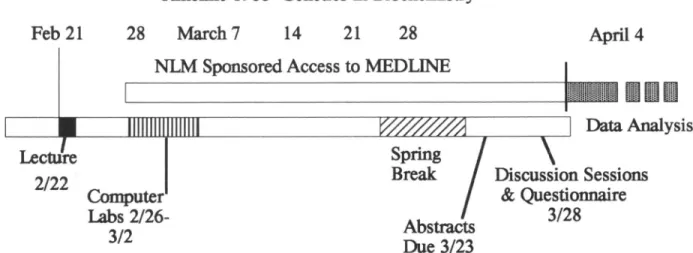
assigned recent journal articles. Thetime linefor the exercise is shown in figure 1.
Onehundred fifteenfirst-yearmedical studentswere each givenatopicaboutaspecificgeneticbiochemical disorder selected from MendelianInheritance in Man
(McKusick 1986). After a 2-h introductory lecture in theuseof Grateful Medto accessMEDLINE,theywere encouraged, but not required, to attend a small group computer-lab training session. The computer lab con-sisted of three instructors (a geneticist, an information scientist, and a library search analyst), 12 students, and six IBM PC's with modems. Because of the research protocol, the National Library of Medicine (NLM) provided complimentary access time for the S wk of the project. The students were encouraged to use Grate-ful Med to search MEDLINE for other topics, and, with signed release, thetraffic files of their searches were reviewed. After completing the literature search, each student was required to critically review pertinent jour-nal articlesand prepare a one-page abstract of new in-formation about the disorder. The students were ex-pectedtoknow themetabolicreactionsinvolvedinthe specific disorder and were directed to concentrate on genetic aspectsof thenewinformation,including chro-mosome mapping, linkage analysis, carrier testing, prenatal diagnosis, and new therapies. Abstracts were presented at2-hdiscussion sessionsof15students each, led by a geneticist and a biochemist. Topics in each dis-cussion session weregrouped by category of disorder (e.g.,neurologicdisorders,aminoaciddisorders,or stor-agedisorders). The latest references from the Online Mendelian Inheritance in Man (OMIM; McKusick 1988), which is partially sponsored by the Howard Hughes Medical Institute, wereprovided to the instruc-torsandwereusefulindefiningthe scope ofrecent pub-lications.
The project was evaluated by analysis ofdata
col-Timeline 1988-
Genetics
in
Biochemistry
Feb21
28
*March7
14
21
28
NLM Sponsored Access
to
MEDLINE
I _ IIIIIIIIIIIIIIIIE
rrZZZZZZZrz4
L |||c 111111iluuuumnnuuLecture
2/22 C
uter
Labs
2126-3/2
Data
Analysis
SpnngBreak
Discussion
Sessions
/ &QuestioaAbsftwts
3/28Due
3/23
Figure I Time line ofeducational exercise: teachinggenetics inbiochemistry bycomputer literaturesearching
April
4
I
I.Es a L---- ---, 0 i I 11 III Cr77rJFlOlorljFldFAq I Ilected from the following threesources: (1) question-naires,completedatthe end oftheexercise,which asked about the students'experiencewithcomputers, litera-ture searching, genetics, and biochemistry, as wellas theiropinionsaboutthe exercise; (2) NLM traffic files ofstudent searches;and (3)evaluation of the abstracts by both a geneticist and biochemist. For satisfactory completion of theassignment, the studentsweregiven creditfortwobiochemistryquizzes,whichweredeleted. Results
A. Student Questionnaires
The studentquestionnaires completedatthe endof
the discussion session containeddescriptive informa-tion about the students'perceptionsof the exercise,as well asbackground information about their expertise ingeneticsandcomputeruse.Ninety-two(80%)of 115 students completed thequestionnaires. Asummaryof
questionnaireresultsisgivenintable1.Eighty-four per-cent (77/92) of the students had an undergraduate courseingeneticsand27% (25/92)hadsome knowl-edge about their specifictopic beforebeginning their literaturesearch.Eighty-sixpercent(79/92)had used a computer before, but only 33% (30/92) had used the computerfor literature searching. An overwhelm-ing majority (98%) of the students thought that this was a"satisfactory"or"excellent" method forlearning
computeraccesstothe literature. Most of the students
(69%forgeneticsand75%forbiochemistry)thought that thiswasa"satisfactory"or"excellent"waytolearn
principlesofgeneticsorbiochemistry. Seventy-eight
per-cent(72/92)of thestudents desired continued access
to the literature throughout medical school.
Ninety-sixpercent (88/92) spent lessthan 6 h in thelibrary
completing the project, but 67% (62/92) reported spending 3-4 h in additional independent computer
searching.
Table I
SummaryofResults of Analyses of Student Questionnaries and of Data from National Library of Medicine Traffic Files
A. Questionnaires (92students)
Prior coursein
genetics.
...Experience usingcomputer forlibrarysearch ...
Spent<6 hrsearching...
Spent1-5 h independentcomputersearching ...
Describedvalueofexperienceassatisfactory/excellent waytolearn:
Biochemistry ...
Genetics...
Computeraccess ...
Recommended repeatingthe exercise in othercourses...
Desiredcontinuedfree accesstothemedical literature ...
77(84%) 30(33%) 88(96%) 70(85%) 69(75%) 63(69%) 90(98%) 40 (43%) 72 (78%) B. Independent Search Experiencea
No. of students ... 91 No. of searches ... 829
(mean9.1 searches/student)
(range 1-31 searches/student)
Averagetime/search ... 3.1 minutes (min. 12s; max. 38min) Searches<5 min ... 82% Averageno. of articlesretrieved/search ... ... 84
Averageno. ofarticlesprinted/search ... 5
Topic No.of Searches No. ofStudents
Assigned ... 262 (31.6%) 50
Other genetic ... 39 (4.7%) 10
Other medical 5... 28 (63.9%) 78
Searches by
Date
mu
Training
Non-Genetics
* Genetics
C-4 y __qt__-_ N.04NN -N
FEBRUARY MARCH APRIL
tComputerJ_ A-Spring Break--+d LDiscussion Sessions
Training Abstract Due
Figure2 Distribution of number of MEDLINE literaturesearches, usingGratefulMed, duringthetraininglabs andindependent search time.
B. MEDLINE Traffic Files
Ninety-one students performed 829 independent searchesduringthe 5 wk ofcomplimentarycomputer
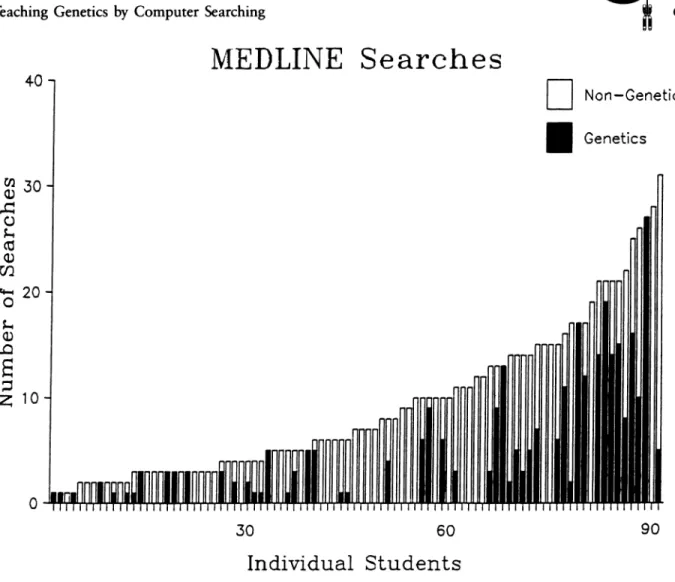
accesstime,inadditiontothe 375 searches whichwere performed duringthetraininglabs(see fig. 2).A sum-maryof dataanalysis ofMEDLINEtrafficfilesisgiven intable 1. Thefrequency distribution of the indepen-dent searches is illustrated in figure 3. There were an average ofninesearchesper student, with a range of 1-31. Twenty-four (21%) ofthe students did not do
anyindependentsearches outside thetraininglabs. Four of these students reported having hadnoprior
com-puter experience. Sixty-five students completed the searchesonthegeneticsexerciseduringthetraininglab. Theindependentsearchesweresortedaccordingto
cat-egories: genetics topics,other students'genetics topics, andother medical topics. Two hundred sixty-two(31.6%)
of the 829independentsearcheswere ontheassigned genetics topics.Asmallproportion(39 searches, 4.7%) were ongenetic topics other thanthatassignedtothe
searcher,but themajority(528 searches, 63.9%)were onother medicaltopics.Several students used the
com-puteraccesstoundertake searchesoncurrent
indepen-dentlaboratory-research projectsortoreview the
bib-liographies of faculty members for whom they were considering workinginsummerresearch projects. The students quickly learned efficient, appropriate search strategies.Eightypercentof the searcheswereperformed withno errorinsearchstrategyor format. Ofthe 86 searches that contained anerror,themajority (43%)
of theerrors were aresult ofsimple misunderstanding of the AND/OR structureof the Grateful Med-form
screen.Eachsearch retrievedanaverageof 84citations
withabstracts; however,ontheaverage,onlyfive
refer-150 an U) o 100 S) 0 a)
Sm50
-z
040 -30 -20 -10 0 30
MEDLINE Searches
DONon
-Genetics * Geneticsnf
60 90Individual Students
Figure 3 Frequency distributionof8i> independent searches done by91students,showingproportionof searches relatedtogenetics
topicscomparedwith other medicaltopics. The studentsreadily applied the skills ofcomputer accesstosearch topics in othercourses.
ences weredownloaded.Onlyonestudentwasunable
tofindanypertinentrecentarticles cited in MEDLINE.
The78 students who did searches on the 528 other medical topics generally structured more complex searches.
Although theNLMprovided bothtraining and in-dividual codes forcomplimentaryaccess for the5wk of thisproject, ifchargedatfullrates,actualcost
break-down fromthe NLM would be$2,598.Sincestudents areusually chargedatapproximately50%offullrate,
estimatedcostwould beabout $1,300 for thisproject. Since the NLM wouldprovide complimentarytraining codes for other institutions, a final cost for 5 wk of
independent searching for 115 students would be ap-proximately $900 forcomputeraccesstimewhenusing Grateful Med.
C. Correlations between Questionnaires, Traffic Mile Data, and Grades onAbstracts
Correlations,crosstabulations,andregression anal-yseswereperformedonallpossible pairwise combina-tionsof datafrom thefollowingtwogroupsof items: 1. previouscourseworkingenetics,previouscomputer
experience,numberofyearsowingapersonal
com-puter,number of hoursspentontheexercise, num-ber of referencesread,number of hours ofreported
computeruse,gradeinbiochemistry,and class rank
in biochemistry
2. total number ofsearches, total number of search ses-sions, and total on-line time.
Theseanalysisweredone for thetwosubsets of data
(geneticandnongenetic)inadditiontothe total data.
c)
0
co
Q)
MEDLINE Searches
40 n 30 C) U)Sw
1420 0:z
10.z
Class
Rank
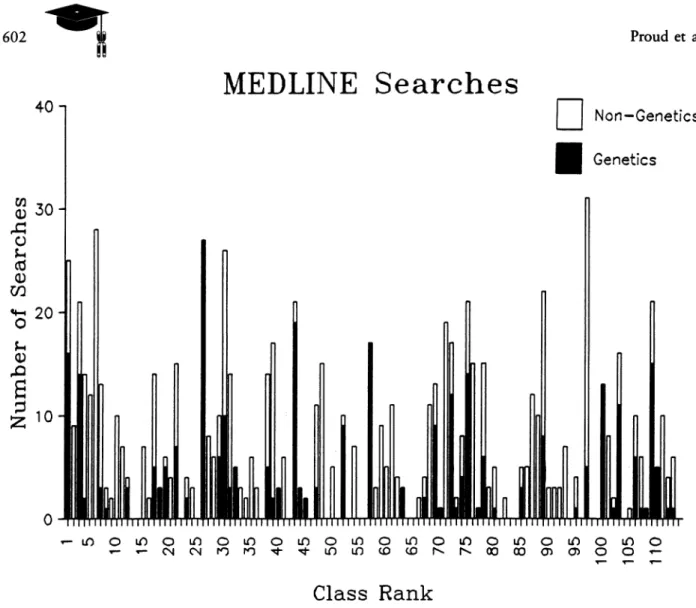
Figure4 Frequencydistributionof 829independentsearches as afunctionof class rank inbiochemistry.Thisgraph demonstrates
the lackof correlation between the two variables. Our interpretation is that Grateful Med is easy to use for students of all abilities andbackgrounds.
There were no significant correlations foundbetween
anyofthesedataitems, suggesting to usthatlearning Grateful Med did notrequire anyparticularexpertise and that all studentsreadily applied the search tech-niques. We were unable to identify subpopulationsof
students, such as(a) those who mighthave had more computer experience and who therefore might have done agreaternumber ofindependentsearches or(b)
those whomight have had minimal computerexperience
and whothereforerequiredalargenumberofsearches in order to complete the task. The search frequency
as a function ofclass rank in biochemistry is shown
infigure4. Clearly, there was nocorrelation between
student rankinbiochemistryclass and thenumber of
independent searches performed.
Discussion
We have described a new experience for first-year
medicalstudents which consolidatestheteaching of
clin-icaland research applications of humangenetics and
biochemistry
withtraining and skills necessaryfor com-puter access to the literature. Thiswasdonebyverti-callyinserting the exerciseintothestandard biochem-istry curriculum. The project required cooperation
betweenthefaculties of the divisionof medicalgenetics,
department ofchildhealth, department of
biochemis-try,informationsciencegroup,
andJ.
Otto LottesHealthSciences
Library,
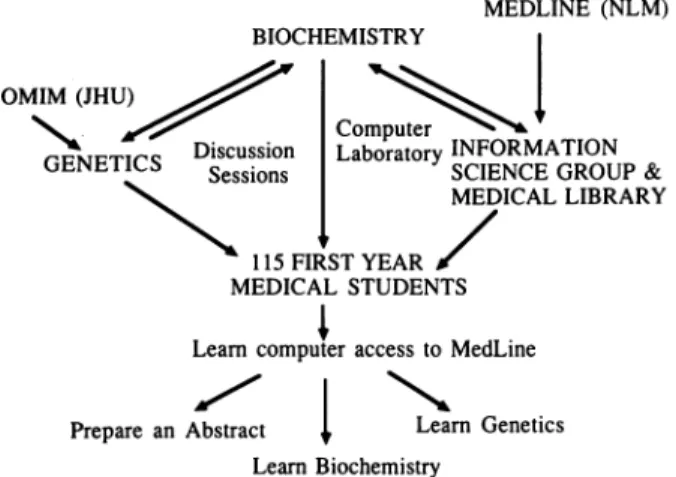
all interacting with on-line medicalliteraturedata bases (i.e., the OMIM) atJohns Hop-kins University andthe NLM in Bethesda,MD (see
- 0 0 0 0 Ln 0 LO 0 LO 0 0 0 0 0 U') 0 0 0 0 0 0 0
T- %- N N n n * 110- 0 0 w w rl-_ rl-l m m m 0) 0 0
I--MEDLINE (NLM) BIOCHEMISTRY
OMIM (JHU) t
GENETIC Discussion Laboratory INFORMATION Sessions SCIENCEGROUP &
MEDICAL LIBRARY
115 FIRSTYEAR MEDICAL STUDENTS Learncomputer access toMedLine Prepare anAbstract At Learn Genetics
LearnBiochemistry
Figure 5 Dynamic interaction and communication, within the medical center, facilitated by this exercise.
fig. 5). Response wasenthusiastic from both students
andfaculty. Themedicalstudentsquickly learned the readily transferrable skills of computer access to the
literature. Theygained experience in preparing an ab-stract and in discussing the abstract with their peers, whiledeveloping an appreciation of the basic princi-ples of human genetics and an understanding of a specific inherited biochemical disorder. The exercise
en-couraged communication between geneticists,
bio-chemists,medicallibrarians,and informationscientists, all of whomdevelopedapersonal appreciation of com-puter literature searching while exchanging informa-tionaboutnewdevelopmentsintheir respectivefields. Medical students need to become aware, early in their medical school career, of the vast literature available to them, and they must be required to use that infor-mation in arelevant manner in order to gain expertise inliteraturesearching. We have demonstrated that stu-dents of all abilities and backgrounds can easily be
taughtto search the literatureeffectively by computer to complete an exercise ingenetics and biochemistry.
DatafromBodurtha et al. (1986) showed that 27% of the studentsspent >20 h in thelibraryportion of the assignment, whereas 92% of our studentscompleted the exercise in less than <5 h in the library. The use ofGratefulMed to search the literature aboutgenetic disorders is an efficient use oftimefor busy medical
students. This exercise was inserted into the curricu-lum withoutneedingtoadd additional hours of lecture time to an already crowded curriculum. In addition,
wedemonstrated that the skills learned were quickly appliedto othercourses,as78students went on to
per-form528additionalsearches on other medicaltopics.
We are notthefirstgroup toteach medical students to docomputer searching by MEDLINE or to study end-user search behavior (e.g., see Kirby and Miller 1986;Woodetal. 1986). Westronglybelieve that com-puterliterature searchingshould beintegrated within the curriculum and that students should be required toperform such searches routinely. The implementa-tion of this program at other institutions could take different forms to access MEDLINE files. Access to MEDLINEfiles locally throughmini-MEDLINE or on CD-ROM, or remotely via BRS-Colleague or Paper Chase, could be used to modify theexercise, to meet the needs and facilities available.
Byfocusing thecontentof literature searchingon hu-man genomes, we areexpandingexposure tothe prin-ciples of humangeneticsand intend that medical stu-dents willbegintoapply their knowledge to both the basicsciencesand clinical rotations. Integrating exer-cises in
genetics-literature searching
into the curricu-lum could be implementedin a varietyofcourses in thebasicsciences or inclinicalclerkships. Wehave re-cently completedafollow-upexercisebythesestudents in a second-year pathology course.We developed an efficient exercise to teach human geneticsandcomputerliterature searching. Wewould liketo go beyond this to answerthe more important questionof whethertrainingincomputerized literature retrieval andfurther educationin humangenetics can affectthepracticeof medicine. Wewould likeour stu-dentstodepend onthecomputer for literature access inorder toprovide thebestpossible care, through in-formation, for their patients.
A 10-minvideotape discussing the mechanicsof the exercise is available on loan fromJoyce A. Mitchell, Ph.D., Director, Information Science Group, Univer-sityofMissouri School ofMedicine, 605 LewisHall, Columbia, MO 65211.
Acknowledgments
This workwassupportedinpartbyagrantfromthe
Miz-zouAlumni Association, withcomputer timedonatedbythe NationalLibrary of Medicine. The authors wishto acknowl-edge the contribution, in data entry and analysis, by Ken
Proud,James H. CuttsIII,and Margie Ross, and the secretarial
supportofDorothy Longnecker.
References
AAMC. 1984. Physicians forthe twenty-first century: the
GPEP report. AssociationofAmerican.MedicalColleges, Washington, DC.
. 1986. Evaluation of medical informationscience in
medical education. J. Med. Educ. 61:488-543. Bodurtha, J. N., J. I. Townsend, V. K. Proud, and W. E. Nance.
1986.UpdatingMcKusick:aneducational exercise for med-ical students. Am. J. Med. Genet. 24:505-511.
Bodurtha,J. N., S. Verbin, K. K. Papp, and W. E. Nance. 1987. Recentinnovations inhumangeneticseducation.Am. J. Hum. Genet. 41:304-305.
Childs, B. 1987. Genetics for medical students. Am. J.Hum. Genet. 41:296-303.
DaRosa, D. A., T. A.Mast. B.Dawson-Saunders,J. Mazur, D. E. Ramsey, and J. R. Folse. 1983. A study of the
information-seeking skills of medical students and
physi-cian faculty. J. Med. Educ. 58:45-50.
Kirby,M.,andN.Miller.1986. MEDLINEsearchingon
Col-league:reasonsforfailureor successofuntrained andusers.
Med. Ref. Serv. Q. 5:17-39.
McKusick, V. A. 1986.Mendelianinheritance in man: cata-logs of autosomal dominant, autosomal recessive and X-linked phenotypes. 7th ed. The Johns Hopkins Univer-sity Press, Baltimore.
.1988.Online Mendelian inheritancein man(OMIM).
The JohnsHopkinsUniversityand Howard Hughes Med-ical Institute, Baltimore.
Northrup,D. E., M. Moore-West, B.Skipper,andS. R.Teaf. 1983.Characteristics of clinicalinformation-searching: in-vestigation usingcritical incidenttechnique.J. Med. Educ. 58:873-881.
Proud, V. K., F. Schmidt, E. D. Johnson, R. Hillman, and
J.A.Mitchell. 1988.Teachinggenetics inbiochemistry by
computerliterature searching. Am. J. Hum. Genet. 43:A66.
Wood,M. S., E. B.Horak,andS. Snow. 1986.Enduser search-ing inthe health sciences. Haworth,New York.