Calhoun: The NPS Institutional Archive
Theses and Dissertations Thesis Collection
2014-12
Assessment of Aberdeen Proving
þÿGround Army Contracting Command,
contract management processes
Petree, Christopher D.
Monterey, California: Naval Postgraduate School
NAVAL
POSTGRADUATE
SCHOOL
MONTEREY, CALIFORNIA
MBA PROFESSIONAL REPORT
ASSESSMENT OF ABERDEEN PROVING GROUND–
ARMY CONTRACTING COMMAND, CONTRACT
MANAGEMENT PROCESSES
December 2014
By:
Christopher D. Petree
Courtney J. Gary
Advisors: Rene G. Rendon Luis Morales
REPORT DOCUMENTATION PAGE Form Approved OMB No. 0704–0188
Public reporting burden for this collection of information is estimated to average 1 hour per response, including the time for reviewing instruction, searching existing data sources, gathering and maintaining the data needed, and completing and reviewing the collection of information. Send comments regarding this burden estimate or any other aspect of this collection of information, including suggestions for reducing this burden, to Washington headquarters Services, Directorate for Information Operations and Reports, 1215 Jefferson Davis Highway, Suite 1204, Arlington, VA 22202–4302, and to the Office of Management and Budget, Paperwork Reduction Project (0704–0188) Washington DC 20503.
1. AGENCY USE ONLY (Leave blank) 2. REPORT DATE December 2014
3. REPORT TYPE AND DATES COVERED
Master’s Thesis
4. TITLE AND SUBTITLE
ASSESSMENT OF ABERDEEN PROVING GROUND–ARMY
CONTRACTING COMMAND, CONTRACT MANAGEMENT PROCESSES
5. FUNDING NUMBERS 6. AUTHOR(S) Christopher D. Petree, Courtney M. Gary
7. PERFORMING ORGANIZATION NAME(S) AND ADDRESS(ES)
Naval Postgraduate School Monterey, CA 93943–5000
8. PERFORMING ORGANIZATION REPORT NUMBER
9. SPONSORING /MONITORING AGENCY NAME(S) AND ADDRESS(ES)
N/A
10. SPONSORING/MONITORING AGENCY REPORT NUMBER 11. SUPPLEMENTARY NOTES The views expressed in this thesis are those of the author and do not reflect the official policy or position of the Department of Defense or the U.S. Government. IRB Protocol number 2010–0071-AM05-EP7-A.
12a. DISTRIBUTION / AVAILABILITY STATEMENT Approved for public release; distribution is unlimited
12b. DISTRIBUTION CODE 13. ABSTRACT (maximum 200 words)
The DOD has had longstanding, and documented, problems in contracting, which include ethical issues, workforce competencies, lack of manpower, and fraud. DOD current remedies include rightsizing the workforce, training, incentivizing performance, reaffirming ethical standards, but these are incremental solutions. What is called for is a review of contract management process capability from a broader perspective, using the Contract Management Maturity Model (CMMM). This research will focus on contract management as an aspect to improve process capability.
The purpose of this research project will be to assess the contract management processes at Aberdeen Proving Ground–Army Contracting Command (APG-ACC). Using the CMMM, the research will analyze APG-ACC’s process capability, focusing on the areas of Procurement Planning, Solicitation Planning, Solicitation, Source Selection, Contract Administration, and Contract Closeout. Using analytical data gained from surveys completed by level II and III Defense Acquisition Workforce Improvement Act (DAWIA) personnel at APG-ACC, the data will gauge the maturity of APG-ACC’s contract management processes. Results captured from data will allow the assessment of APG-ACC contracting capability and will help in the formulation of meaningful recommendations to the command.
14. SUBJECT TERMS Contract Management Maturity Model, Performance Measurement, Performance Evaluation, Process Maturity
15. NUMBER OF PAGES 77 16. PRICE CODE 17. SECURITY CLASSIFICATION OF REPORT Unclassified 18. SECURITY CLASSIFICATION OF THIS PAGE Unclassified 19. SECURITY CLASSIFICATION OF ABSTRACT Unclassified 20. LIMITATION OF ABSTRACT UU
NSN 7540–01–280–5500 Standard Form 298 (Rev. 2–89)
Approved for public release; distribution is unlimited
ASSESSMENT OF ABERDEEN PROVING GROUND–ARMY CONTRACTING COMMAND, CONTRACT MANAGEMENT PROCESSES
Christopher D. Petree, Major, United States Army Courtney J. Gary, Major, United States Army
Submitted in partial fulfillment of the requirements for the degree of
MASTER OF BUSINESS ADMINISTRATION from the
NAVAL POSTGRADUATE SCHOOL December 2014
Authors: Christopher D. Petree Courtney J. Gary
Approved by: Dr. Rene G. Rendon Thesis Advisor
Luis Morales Second Reader
Dr. William R. Gates
ASSESSMENT OF ABERDEEN PROVING GROUND–ARMY
CONTRACTING COMMAND, CONTRACT MANAGEMENT
PROCESSES
ABSTRACT
The DOD has had longstanding, and documented, problems in contracting, which include ethical issues, workforce competencies, lack of manpower, and fraud. DOD current remedies include rightsizing the workforce, training, incentivizing performance, reaffirming ethical standards, but these are incremental solutions. What is called for is a review of contract management process capability from a broader perspective, using the Contract Management Maturity Model (CMMM). This research will focus on contract management as an aspect to improve process capability.
The purpose of this research project will be to assess the contract management processes at Aberdeen Proving Ground–Army Contracting Command (APG-ACC). Using the CMMM, the research will analyze APG-ACC’s process capability, focusing on the areas of Procurement Planning, Solicitation Planning, Solicitation, Source Selection, Contract Administration, and Contract Closeout. Using analytical data gained from surveys completed by level II and III Defense Acquisition Workforce Improvement Act (DAWIA) personnel at APG-ACC, the data will gauge the maturity of APG-ACC’s contract management processes. Results captured from data will allow the assessment of APG-ACC contracting capability and will help in the formulation of meaningful recommendations to the command.
TABLE OF CONTENTS
I. INTRODUCTION ... 1 A. BACKGROUND ... 1 B. PURPOSE ... 3 C. RESEARCH QUESTIONS ... 4 D. ORGANIZATION OF REPORT ... 4 E. METHODOLOGY ... 5 F. BENEFITS OF RESEARCH ... 5 G. LIMITATIONS TO RESEARCH... 6 H. SUMMARY ... 7II. LITERATURE REVIEW ... 9
A. INTRODUCTION ... 9
B. PUBLIC PROCUREMENT PERFORMANCE MEASUREMENT AND EVALUATION ... 9
1. Why Should We Measure? ... 9
2. What Should We Measure? ... 10
3. How Should We Measure? ... 11
C. CONTRACT MANAGEMENT MATURITY MODEL ... 14
2. Levels of Maturity ... 17
3. Process Enablers ... 19
D. PREVIOUS APPLICATIONS OF CMMM WITH ARMY ORGANIZATIONS ... 20
E. SUMMARY ... 21
III. ABERDEEN PROVING GROUND–ARMY CONTRACTING COMMAND (ABERDEEN, MARYLAND) ... 23 A. INTRODUCTION ... 23 B. ORGANIZATION ... 23 C. SERVICES PROVIDED ... 25 1. SERVICE CONTRACTS ... 25 2. SUPPLY CONTRACTS ... 26 3. CONSTRUCTION CONTRACTS ... 27
D. CURRENT PERFORMANCE MANAGEMENT METRICS ... 27
E. SUMMARY ... 28
IV. ASSESSMENT RESULTS AND PROCESS IMPROVEMENT RECOMMENDATIONS ... 29
A. INTRODUCTION ... 29
B. SELECTION OF STUDY PARTICIPANTS ... 29
C. ADMINISTRATION OF CMMM SURVEY ... 30
D. SURVEY RESULTS ... 30
1. APG-ACC Contract Management Process Maturity ... 33
b. Solicitation Planning and Source Selection ... 35
2. APG-ACC Process Enablers ... 35
3. Process Strengths ... 35 4. Process Results ... 36 5. Management Support ... 37 6. Process Integration ... 37 7. Process Measurement ... 38 E. COMPLIANCE ANALYSIS ... 39
F. RECOMMENDATIONS FOR CONTRACT MANAGEMENT PROCESS IMPROVEMENTS AT APG-ACC ... 40
1. Procurement Planning ... 40 2. Solicitation Planning ... 41 3. Solicitation ... 41 4. Source Selection ... 42 5. Contract Administration ... 42 6. Contract Closeout ... 43 G. SUMMARY ... 43
V. SUMMARY, CONCLUSIONS, AND AREAS FOR FURTHER RESEARCH 45 A. INTRODUCTION ... 45
B. SUMMARY ... 45
C. CONCLUSION ... 45
1. What is the Contract Management Process Maturity Level for APG-ACC in Each of the Six Process Areas of the CMMM? ... 45
2. What Process Improvement Opportunities Are Available for APG-ACC, Based on the CMMM Assessment at APG? ... 46
3. What Metrics does APG Currently Use to Assess Contract Management Performance? ... 46
4. How Do Compliance Reports of APG-ACC Compare to the CMMM Results? ... 46
D. AREAS FOR FURTHER RESEARCH ... 46
LIST OF FIGURES
Figure 1. Army Contract Spending, 1990–2010 (from DD350 and FPDS;
CSIS analysis (2011) ... 3
Figure 2. Aberdeen Proving Ground-Army Contracting Command Organization Chart. This chart provides a visual representation of how the organization is structured from a top down approach (from APG-ACC, 2014) ... 24
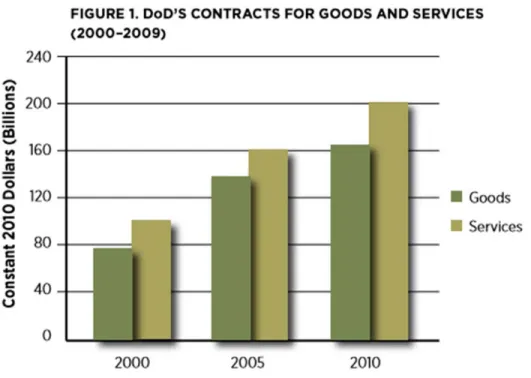
Figure 3. Graphic representation of DOD dollars spent for goods and services from 2000 to 2010. This graph shows the progression of dollars spent for goods and services. (From Rendon, Apte & Apte, 2011, p. 5). ... 26
Figure 4. Contract Management Maturity Model Assessment Results for APG-ACC ... 34
Figure 5. Process Strength ... 36
Figure 6. APG-ACC Process Results ... 36
Figure 7. APG-ACC Management Support ... 37
Figure 8. APG-ACC Process Integration ... 38
LIST OF TABLES
Table 1. APG-ACC Performance Metrics cross-referenced with the contract phases ... 28
Table 2. APG-ACC RESPONSE DEMOGRAPHICS ... 30
Table 3. APG-ACC Survey Item Responses for Procurement Planning and Solicitation Planning ... 31
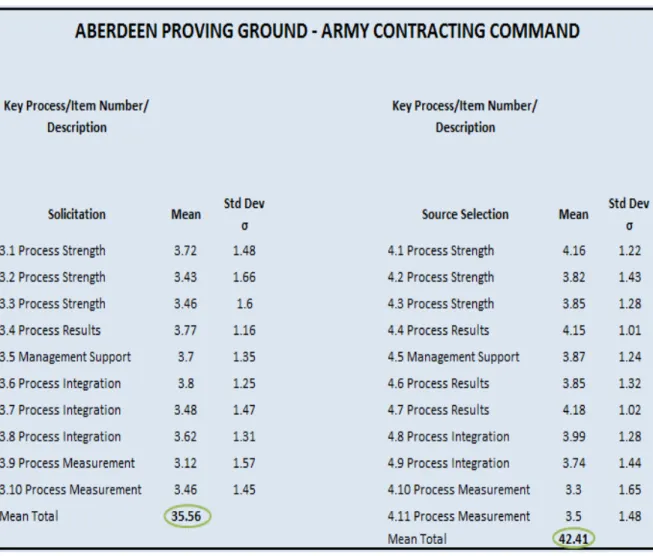
Table 4. APG-ACC Survey Item Responses for Solicitation and Source Selection ... 32
Table 5. APG-ACC Survey Item Responses for Contract Administration and Contract Closeout ... 33
LIST OF ACRONYMS AND ABBREVIATIONS
ACC Army Contracting Command
APG Aberdeen Proving Ground
ARP Acquisition Research Program
C3T Command, Control, Communications and Tactical CECOM Communications Electronic Command
CMMM Contract Management Maturity Model
C4ISR Command, Control, Communications, Computers, Intelligence, Surveillance and Reconnaissance DAWIA Defense Acquisition Workforce Improvement Act DFARS Defense Federal Acquisition Regulation Supplement
DOD Department of Defense
FAR Federal Acquisition Regulation FMS Foreign Military Sales
FY Fiscal Year
GAO Government Accountability Office
IG Inspector General
MILDEP Military Deputy
NPS Naval Postgraduate School
OCO Overseas Contingency Operations
PARC Principle Assistant Responsible for Contracting PEO Program Executive Officer
RDECOM Research, Developments, and Engineering Command SES Senior Executive Service
ACKNOWLEDGMENTS
We would like to collectively thank every individual who helped bring this research project to fruition. However, we would like to personally recognize a few individuals who were influential in seeing this project through.
Dr. Rendon, thank you for taking this project on and advising us throughout the process. Your support, guidance, mentorship, and contracting expertise were instrumental in the successful completion of this report. Additionally, we would like to thank our Second Reader, Luis Morales, for the advice, counsel and outstanding support.
We would also like to recognize COL Michael Roger, APG-ACC, Chief of Staff, Ms. Tanya Peel, and the entire Aberdeen Proving Ground-Army Contracting Command. This report would not have been possible without the time, effort and support you provided to us. We hope this project provides value to the organization as you look to refine the organization’s contract management processes.
MAJ PETREE: I would like to especially recognize and thank my wife Amber, and my four children, Hailey, Hannah, Hayden, and Christopher Jr., for the love, support, and believing in me. Completing this research project has been an incredibly long journey; however, when I needed that extra push they were always there encouraging me to keep achieving. I would like for my family to know that they motivate me every day to be a better me.
MAJ GARY: I would be remiss if I did not personally thank my family, Craig, Julien, my mother and my sisters, for their unwavering support. I know I could not have made it without the periodic sanity checks I was able to receive in my “counseling sessions” with them throughout the course of this program.
I. INTRODUCTION
This chapter will help set the stage for the purpose of this research and subsequently serve as a guide for what to expect in the succeeding chapters. As the Army contracting workforce has increased over the last decade, during a time of war, there has been an abundance of contact mismanagement, fraud, and unethical behavior from the acquisition contracting workforce, which has cost billions of dollars in lost capital. Current remedies include, rightsizing the contracting workforce, additional training, incentivizing performance, and reaffirming ethical standards, but these initiatives are incremental solutions and only focus on individual competence. What is called for is a review of contract management process capability. This research will show that by assessing contract management process capability using the Contract Management Maturity Model (CMMM), an organization can view their contract management processes, identify shortcomings, and take corrective actions to improve the organizations contract management process capability. We will look at Aberdeen Proving Ground–Army Contracting Command (APG-ACC) contract management processes, using the CMMM.
A. BACKGROUND
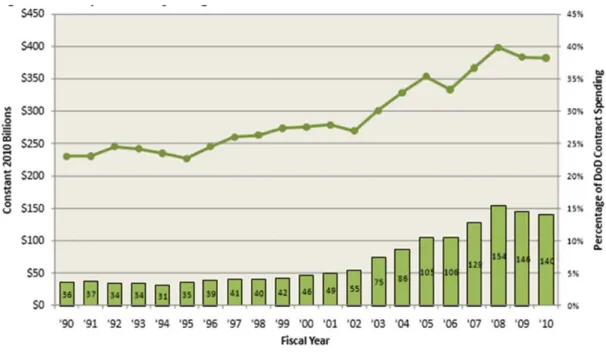
The Army’s mission has changed significantly since the drawdown of forces at the end of the Cold War. The Army saw a large exodus of its military personnel in the 1990s due to a drawdown in forces; however there was an increase in contracted support to augment the force. In addition to an increase in contracted support the Army also increased its contract spending (Figure 1). After September 11, 2001, the environment transformed yet again from a post Cold War government workforce, to an expeditionary workforce focused on the deployed Warfighter, DOD civilian, and contractor support. It was then realized that the government contracting force was ill prepared to provide quality contracting support to deployed forces. According to the Gansler Report “The
Institutional Army has not adjusted to the challenges of providing timely, efficient, and effective contracting support to the force in Operation Iraqi Freedom, more than half of which is contractor personnel” (Gansler Report, 2007).
Although the Army’s operational environment and mission have evolved, what did not evolve were the competencies of the government contracting workforce. The Army’s undeveloped contracting workforce found itself responsible for procuring services and supplies in austere environments and managing enormous budgets while doing so. As noted by Congress, DOD contracting has been plagued with issues of accountability, poor oversight of contractor performance, fraud, theft, and ethical violations, (United States Congress Senate Committee on Appropriations, 2008).
In 2007, the Secretary of the Army established a commission to look at Army Acquisition and Program Management support to expeditionary operations, so that shortcomings could be addressed to provide better contracting support. Corrective actions that were recommended were the following: 1. Increase the military workforce and include General Officer (GO) billets; 2. Restructure/right size the organization; 3. Provide training and tools for success; 4. Obtain legislative, regulatory, and policy assistance (Commission on Army Acquisition and Program Management in Expeditionary Operations (2007). Seven years after the release of the Gansler Report and implementation of recommend actions; contract mismanagement is an issue that continues to plague the military services (GAO, 2013).
Figure 1. Army Contract Spending, 1990–2010 (from DD350 and FPDS; CSIS analysis (2011)
B. PURPOSE
The purpose of this research is to assess the contract management processes at Aberdeen Proving Ground–Army Contracting Command (APG-ACC) by surveying its subordinate contracting centers using the Contract Management Maturity Model (CMMM). Through in-depth analysis, the research will assess APG-ACC contract management process capability by analyzing the integration of best practices throughout the contracting process. We will also cross-reference the prescribed government compliance metrics with the CMMM assessment results. We will survey each subordinate contracting center, analyze the data received, and then provide an overall rating to the APG-ACC contracting management command. The results from the research will help APG-ACC identify strengths and weakness in its contract management processes.
C. RESEARCH QUESTIONS
To better understand the contract management process capability at APG-ACC we will answer the following questions:
1. What is the contract management process maturity level for APG-ACC in each of the six process areas of the CMMM?
2. What process improvement opportunities are available for APG-ACC, based on the CMMM assessment at APG?
3. What metrics does APG currently use to assess contract management performance?
4. How do compliance reports of APG-ACC compare to the CMMM results?
D. ORGANIZATION OF REPORT
This report is comprised of the following five chapters: Chapter I describes the purpose of the research; introduces the research questions; and discusses the significance and implications of the study. Lastly, in Chapter I we will discuss limitations to this research project and the benefits gained from conducting the study.
Chapter II is a review of the literature. In the literature review we discuss why organizations should measure performance; compliance to public policy and agency regulations; how should we measure; and what should we measure.
process areas. Additionally, we will cross-reference APG-ACC CMMM results with DOD Inspector General (IG) and Government Accountability Office reports to see if there are consistencies between the reports and the assessment.
Chapter V will summarize the report and provide recommendations for areas of further research.
E. METHODOLOGY
We will conduct a literature review on why organizations should measure performance, what should be measured, and how performance should be measured. We will also cover the CMMM and its previous applications with other Army organizations in our literature review.
We deployed a 62-question survey to assess the contract management process maturity at APG-ACC. We analyzed the data from the survey and assigned a contract management maturity level to each of the six phases of the contract management process.
The target populations for our research were APG-ACC 1102 series workers and military equivalents who are DAWIA level II and level III certified in contracting. We selected this population because level II and level III certified individuals were more familiar with the contracting processes at APG-ACC due to longevity in the organization and the contracting community. Level I certified personnel are normally the entry-level workers of a contracting organization, and lack the experience and knowledge of that the level II and III contracting personnel possess.
To assess APG’s current contract management performance we will gather the metrics they currently use. We will also explore any compliance reports for additional consistencies with the CMMM assessment results.
F. BENEFITS OF RESEARCH
assessment tool outside of metrics they currently use collect. APG-ACC can compare our assessment from the CMMM to their organizational performance metrics to see if there are consistencies between the two methods used to assess the organization. Also, using this report APG-ACC can structure their contract management initiatives to improve contract management process areas having lower levels of process maturity, and implement practices to sustain areas that have been identified as having higher levels of process maturity.
As a final point, the results from this research can be used as a baseline for additional research being conducted within the APG-ACC. The CMMM is the only contract management process model used by DOD and industry. If the organization should use another assessment approach to gauge the overall contract management process capability they can make comparisons between the two assessment findings as a means for identifying consistencies. Additionally, this research can be used by other Army contracting command organizations and other DOD contracting agencies as an example of assessing contract management process capability.
G. LIMITATIONS TO RESEARCH
There are several limitations that we identified during the planning and implementation of this research. The first limitation identified was the CMMM survey was sent to the entire workforce within the divisions identified as performing contracting duties. We asked that only level II and level III, DAWIA certified contracting officers and specialists take the survey. There may have
limitation to this research. A final limitation is that although we encouraged full participation in the survey we received a response rate of 17.04%.
H. SUMMARY
In this chapter, we introduced the research topic; provided background information; the purpose of the research; the questions we set out to answer; the organization of the report; methodology; benefits of the research; and limitations of the research. The next chapter is a review of the literature. In the literature review we discuss why organizations should measure performance; compliance to public policy and agency regulations; how organizations should measure performance; and what should be measured. Furthermore, we will discuss the CMMM, its key process areas, and maturity level descriptions.
II. LITERATURE
REVIEW
A. INTRODUCTION
Organizations should measure performance to fully subscribe to establishing efficiency and effectiveness within their organization. This chapter looks to provide a literature review of public purchasing performance evaluation and its significance. We further reviewed various evaluation frameworks available to include using performance metrics, evaluating compliance and best practice models.
B. PUBLIC PROCUREMENT PERFORMANCE MEASUREMENT AND EVALUATION
1. Why Should We Measure?
Procurement equates to nearly one-third of all government outlays, making it particularly sensitive to accountability and transparency within public administration (Schapper et al., 2006). “Value for money is the core principle governing public procurement and is supported by the underpinning principles of efficiency and effectiveness, competition, accountability, transparency, ethics and industry development” (Raymond, 2008, p.782). In turn, public entities should strive to achieve the “value for money” for the public through use of elements to include customer satisfaction and the public interest (Raymond, 2008). By law, federal agencies are required to conduct performance measures to show the strategy for achieving value for money and providing the highest quality services and products to the customer (Cavanagh et al., 1999).
Weele (2010) conducted a survey of purchasing managers and their views regarding what benefits an organization could realize in evaluating purchasing performance. The responses provided proposed better decision making, improved communication between departments, accountability and professional development as advantages to evaluating purchasing performance (Weele, 2010). Weele further concludes that there are two primary reasons to
assess performance: to rate the individual buyer for individual performance assessment and to allow the individual buyer to assess how their efforts are contributing to the organizations goals and objectives (2010).
Purchasing can have a pivotal role in overall organizational function depending on how it is viewed by management. The organizational leadership’s view of how purchasing fits into the agency structure influences the way performance measurements are determined. Weele (2010) discusses that there are four functional perceptions that the leadership can hold regarding purchasing: operational or administrative, commercial, integrated logistics management and as a strategic business function. These perceptions further translate into where purchasing ranks within the organization.
The lowest tier view is derived from the operational administrative function and results in measurements reflecting the clerical aspects of purchasing. With the commercial function, Weele (2010) suggests that purchasing is a direct report to management and expands metrics to an organization’s goals as they relate to savings, return on investment and price reductions. The next perspective weaves purchasing into other material functions within the organization resulting in measurements that involve delivery reliability and lead-time reduction. The final perspective includes purchasing in top tier management and propels the measurements to more proactive elements such as early supplier involvement and “should-cost” analysis.
collect information such as certification level, years of experience, and dollars appropriated or budgeted for requirements as valuable inputs.
Process measurement addresses the way the work is being conducted and helps an organization in determining quality of production relative to efficiency (Cohen & Emieke 2008). It is this type of measurement that connects organizational improvement and learning by taking into account activities such as production rates, error rates, and number steps or tasks required to complete work (Cohen & Emieke 2008). Federal contracting agencies use Procurement Administrative Lead Time also known as PALT to measure the duration a requirement takes to be procured.
The output measurement provides information on the quantity of work being performed as it relates to the inputs and resources available. Output data, when utilized with multiple indicators, informs an organization on several facets of performance and a more detailed analysis of outputs (Cohen & Emieke 2008). Indicators such as dollars obligated, contracts closed out or completed could be used by a contracting organization to capture outputs.
The final performance measurements are outcomes, also identified as impacts. These performance indicators seek to identify effectiveness by tying inputs and outputs to the organization’s goals. Outcomes are the hardest factors to measure, as it takes longer to realize the impact of an action and require the customer’s perspective, however provides the most valuable information to the organization (Cohen & Emieke 2008). Purchasing organizations can tie in socio-economic and small business goals to measureable outcomes linked to their higher mission to support customers and public interest.
3. How Should We Measure?
Before measuring purchasing performance, Weele (2010) advises that performance must be classified using two elements: effectiveness and efficiency. Purchasing effectiveness relates to “the extent which, by choosing a certain
2010, p. 303). This outcome answers whether the purchasing activities are meeting the set end-state. Purchasing efficiency is “the relationship between planned and actual sacrifices made in order to realize a goal previously agreed upon,” (Weele, 2010, p. 305). Efficiency is the relationship between actual costs and planned costs. Together, efficiency and effectiveness equal performance (Weele, 2010).
Weele (2010) further categorizes performance measurement into four key areas: purchasing material costs/ prices, product quality, purchase logistics and purchasing functions. The first three are subsets of purchasing effectiveness and the last a subset of purchasing efficiency that are further narrowed down to actions that should be evaluated.
Regulatory compliance is a method for evaluating performance and is noted as a traditional framework in public procurement; however, management can only expect to maintain status quo with regard to performance using this method alone (Schapper et al., 2006). Policy compliance can examine “processes and outcomes of procurement in relation to other policy objectives and expectations of the public sector” (Schapper et al, 2006, p.5). DOD assesses compliance through agencies such as the Inspector General and Congress who maintains oversight of policy compliance through the Government Accountability Office.
Benchmarking is a form of performance evaluation that can be described as a method that attempts to “visualize best practices through normalizing
benchmarking revealed increase public procurement performance. Brandmeier and Rupp’s (2010) research expanded the area by focusing on specific practices that increased performance by evaluating companies already known for achieving high levels of performance. They concluded certain benchmarking success factors were particularly salient to the procurement process that included: cross functional teams, high placement in the organizational structure, cooperation with other functions, supplier integration into training and development of procurement workforce and reoccurring evaluation. In a case study analysis of how benchmarking could be conducted within the procurement process, Raymond found that organizations should include measures to address accountability, transparency, value for money, workforce professionalism and ethics in order to enact improvement to public procurement systems (2008).
The Balance Scorecard approach is presented by Niven as “a carefully selected set of quantifiable measures derived from the organizations strategy” (2003, p. 14) that resulted in the public sector desire to improve measures of organizational performance. The framework analyzes four areas of emphasis: the customer, internal processes, learning and growth and financial (Niven, 2003). Both public and private entities recognize the need to connect performance measurement into management of the organization in order to obtain the competitive advantage in their respective industries. In 1993, the Procurement Executives Association (PEA) developed a Procurement Measurement Assessment Team that utilized the balance score card methodology to assess the federal acquisition system, determine best practices in measuring performance and identify strategies and recommendations to improve the state of acquisition agencies (Cavanagh et al., 1999). The team determined that federal performance management systems needed the following qualities to achieve the measurement into management connection: 1. Agency vision translated into measureable outcomes that have been socialized with the rest of the agency, stakeholders and customers; 2. An appropriate assessment tool that incorporates management and improvements; 3. Shift from compliance and audit-based
oversight to “forward-looking strategic partnerships” (Cavanagh et al., 1999, p.14); 4. Incorporate multiple measurements from customer service to quality and cost; 5. Adopt a consistent approach to performance management (Cavanagh et al., 1999).
The contract score card developed by Cullen looks further past the balance scorecard approach by assessing an organization’s contracted functions (2009). She argues that the balance scorecard only accurately informs an organization of its internal functions, where the contract scorecard measures the external arrangements of an agency (Cullen, 2009).
Maturity Models are methods of process measurement that capture an organization’s development over time and assess that development through four factors: “The development of a single entity is simplified and described with a limited number of maturity levels (usually four to six). The maturity levels are characterized by certain requirements which the entity has to achieve on that level. Levels are sequentially ordered, from an initial level up to an ending level (the latter is the level of perfection). During development the entity is progressing forwards from one level to the next one. No levels can be left out” (Weerdmeester et al., 2003, p. 5).
Various sectors of industry have developed maturity models to measure organizational progression. These models include Project Management Maturity, Earned Value Management Maturity, Software Management Maturity, Capability Maturity, Knowledge Management Maturity, and Contract Management Maturity,
between the process capabilities of an organization and its ability to produce successful results between buyers and sellers (Rendon, 2008).
1. Key Process Areas
Garrett and Rendon proposed that “in order to award and successfully manage effective contracts, organizations must have disciplined, capable, and mature contract management processes in place” (2005, p. 48). To further analyze maturity, the CMMM examines the phases of contract management as key process areas to evaluate. Appendix A references the contract phases with the corresponding activities and applicable Federal Acquisition Regulation Parts. Past studies using the CMMM indicate that low maturity in any contract management process area contributes to the detriment of effectiveness and efficiency within an organization. The CMMM includes six phases of the contract management process which are discussed next.
Procurement Planning is the internal identification of which services or products to procure, how to procure them, when to procure them and at what cost. This contracting phase includes the following activities (Rendon, 2011):
(1) Conducting requirements analysis
(2) Determining required sources of supply and services (3) Conducting Acquisition Planning
(4) Conducting Market research
(5) Determining competition environment
Solicitation Planning is the process of identifying project or program requirements, documentation and potential vendors that can provide the requirement. In this phase the following key activities are conducted (Rendon, 2011):
1. Documenting competition environment 2. Determining the procurement method
3. Determining evaluation strategy 4. Developing solicitation documents 5. Determining contract type/ incentive 6. Determining terms and conditions
Solicitation is the process of obtaining bids or proposals from potential suppliers that will meet internal organizational needs. The phase contains the following activities (Rendon, 2011):
1. Advertising the procurement
2. Conducting conferences (pre-solicitation, pre-proposal) 3. Amending solicitation documents as required
Source Selection is evaluating the potential bids against established criteria to select a vendor. The key activities for this phase are as follows (Rendon, 2011):
1. Evaluating proposals 2. Applying evaluation criteria
3. Negotiating contract terms and conditions 4. Determining contactor responsibility standards 5. Selecting contractor
4. Managing government furnished property
5. Monitoring and measure contractor’s performance 6. Managing transportation issues
7. Managing value engineering issues 8. Managing contractor payment process 9. Managing contractor payment process 10. Managing protests, disputes and appeals 11. Complying with terms and conditions
Finally, Contract Closeout is the settlement of the contract and resolving of any outstanding administrative actions. The activities that occur in this phase are as follows (Rendon, 2011):
1. Verifying contract completion 2. Verifying contractor compliance
3. Ensuring contract completion documentation 4. Making final payment
5. Documenting lessons learned/ best practices 6. Processing contract terminations
7. Disposing of buyer-furnished property and equipment 8. Processing contract closeout procedures
In addition to the six phases of contract management, the CMMM also identifies five levels of process maturity and these levels are discussed next.
2. Levels of Maturity
There are five process maturity levels: Ad Hoc, Basic, Structured, Integrated and Optimized.
Ad Hoc: Represents the initial level of contract management processes that are informally practiced and applied. The leadership understands the benefits of the contract management process but, organization-wide practices are not established. There may be some processes present in the organization, however no consistency to when they are applied. Lastly, there is a lack of accountability held to leadership and contract management personnel for failure to comply with basic procurement management standards (Rendon, 2011).
Basic: The level at which rudimentary contract processes and standards are established but only required on selected contracts that meet certain criteria. Some documentation has been set for processes however, these developments are not considered institutionalized. Finally, organizational policy and standards established are not required to be consistently applied for any contracts that have not met certain criteria (Rendon, 2011).
Structured: The maturity level where contract management processes are institutionalized and formal documentation is established for processes and standards. Documentation is present for formal standards and possibly automated. There is flexibility in application of processes and documents to fit various types of contract situations since contract process use is mandated. With this maturity level, the organizational leadership is well versed in providing guidance and direction for strategy development and issues related to contract management (Rendon, 2011).
process” (Rendon, 2011, p.15). Best practices and lessons learned are fully integrated into organizational operations (Rendon, 2011). The results of the CMMM can be further analyzed to help an organization focus its continuous improvement efforts by identifying key process enablers which will be discussed next.
3. Process Enablers
The process enablers are classified into five areas: Process Strength, Process Results, Management Support, Process Integration, and Process Measurement (Rendon, 2011).
Process Strength is measured by the first three survey items in each key process area. Process Strength assesses how established contract management processes are and the level at which they are standardized and documented.
Process Results are measured by the fourth survey item in each key process area as well as the sixth and seventh items in the area of source selection. Process Results assess the success of outcomes in each area, such as structuring solicitations to facilitate complete and accurate proposals, using appropriate evaluation criteria, and evaluating past performance and technical capability in contractor proposal evaluation.
Management Support is measure by the fifth survey item in each key process area. Management Support assesses concerns such as senior-management involvement in providing input and approval of key planning decisions and documents.
Process Integration is measured by the sixth, seventh, and eighth survey items in the area of Procurement Planning, Solicitation Planning, and Solicitation. Process Integration is measure by the eighth and ninth survey items in the area of Source Selection, the sixth through the ninth survey items in the area of Contract Administration, and the seventh survey item in the area of Contract
Closeout. Process Integration assesses how processes are integrated across each of the key process areas.
Process Measurement is measured by the final two survey items in each key process area as well as the eighth survey item in the area of Contract Closeout. Process Measurement assesses concerns such as the efficiency and effectiveness of metrics in process evaluation and improvement (Chang, Levine & Philaphandeth, 2012).
D. PREVIOUS APPLICATIONS OF CMMM WITH ARMY ORGANIZATIONS The CMMM has been applied to other contracting organizations within the Army. In September of 2009, Kevin Puma and Beth Scherr conducted a joint-applied project Assessing Combat Management Maturity: U.S. Army Joint Munitions and Lethality Contracting Center, Army Contracting Command, Pictanny Aresenal. Their study of six contracting organizations found that all of the sub-centers operated at the Integrated or Structured maturity level for all phases of contract management, less Contract Closeout. The Contract Closeout phase was recorded at the Basic level and the researchers recommended the organizational leadership focus on key process areas and continually monitor the reform efforts (Puma & Scherr, 2009).
Dina Jeffers (2009) conducted research on Contract Specialist Turnover Rate and Contract Management Maturity in the National Capital Region Contracting Center: An Analysis. Jeffers (2009) found that the National Capital Region Contracting Center rated low in contract process maturity but, found no
Command (JM&L) and the National Capital Region (NCR) and the 2011
Assessment of Army Contracting Command’s Contract Management Processes (TACOM and RDECOM). The results of these studies determined that the agencies surveyed rated low maturity levels for post award functions, specifically Contract Administration and Contract Closeout (Rendon, 2010; 2011).
E. SUMMARY
In this chapter, we presented a literature review on methods of public procurement performance measurement and evaluation. We addressed why organizations should conduct measurement, what should be measured and how to measure. We also reviewed the Contract Management Maturity Model that we used to conduct our study and its previous applications with other Army organizations. In the next chapter, we will provide information on APG-ACC which was the organization that participated in the study.
III.
ABERDEEN PROVING GROUND–ARMY CONTRACTING
COMMAND (ABERDEEN, MARYLAND)
A. INTRODUCTION
In this chapter, we provide a discussion on the case setting for this research. In this chapter we will present an overview of the Aberdeen Proving Ground–Army Contracting Command. We will discuss the organizational structure. We will also discuss the types of contracts managed by APG-ACC, which includes service contracts, supply contracts, and construction contracts. Finally, we will discuss organizational metrics that APG-ACC uses.
B. ORGANIZATION
APG-ACC is a Senior Executive Service (SES) led organization that provides contracting support to a wide customer base throughout the United States. The organization is a subordinate unit of the U.S. Army Contracting Command. APG-ACC is located in northern Maryland along the Chesapeake Bay in Aberdeen, Maryland. The organization consist of the Office of the Executive Director, Office of the Deputy Director, Chief of Staff G3, and 16 Divisions of which 13 perform contracting duties (Figure 2). APG-ACC is not confined to Aberdeen, MD, as there are several contracting Divisions within the organization that are in locations such as: Adelphi, MD; Denver, CO; Ft. Belvoir, VA; Ft. Huachuca, AZ; Frederick, MD; Natick, MA; Orlando, FL; Research Triangle Park, NC; and Tobyhanna Army Depot, PA.
Aberdeen Proving Ground-Army Contracting Command’s mission is to “Provide responsive, efficient, cost-effective and compliant contracts and business solutions to assist our customers with mission objectives in support of National Defense” (www.acc.army.mil, 2014). The organization achieves its mission by delivering contracting support to their customer base, and garnering longstanding support, in the following areas: Research and Development; Command, Control, Communications, Computer, Intelligence, Surveillance and
Reconnaissance (C4ISR); Cyber Security; Test and Evaluation; Chemical and Biological Defense; and Medical Research. In addition to procuring services and supplies, the organization is knowledgeable in the areas of installation and base operations, foreign military sales (FMS), and other transactions.
Command and control of the organization is provided by the Director, who is a SES, Department of the Army (DA) civilian. The current Director provides leadership and guidance to over 500 DA civilians and military Soldiers; many who are level II or III DAWIA certified. The organization executes on average more than 21,000 contracting actions in excess of $6.5 billion per year; providing seamless support to Program Executive Offices (PEO), Soldiers, and established Army customers.
C. SERVICES PROVIDED
APG-ACC provides contacting support through the purchasing of services, supplies, and construction from various industry, small business, and commercial partners. APG-ACC’s primary customers are CECOM, PEO-C3T, RDECOM, and Garrison. As explained previously, APG-ACC’s three major customer requirements are procurement of services, supplies and military construction. We will explain what each category of procurement requirements are and an example of each.
1. SERVICE CONTRACTS
APG-ACC like many other contracting commands procures large amounts of services for their customer base. According to the Federal Acquisition Regulation (FAR) a service contract is “a contract that directly engages the time and effort of a contractor whose primary purpose is to perform an identifiable task rather than to furnish an end item of supply” (FAR 37.101). Rendon, Apte and Apte pointed out that over the last decade DOD has continued to see an increase in the amount of services it procures (2012). For example, as seen in Figure 3, the procurement of services in the DOD has continued to increase in scope and dollars in the past decade. This is a significant fact as the contract management process of these billions of dollars in contracts are important to DOD and APG-ACC. The services procured by APG-ACC include installation level support, facilities management, grounds management, and custodial.
Figure 3. Graphic representation of DOD dollars spent for goods and services from 2000 to 2010. This graph shows the progression of dollars spent for goods and services. (From Rendon, Apte & Apte, 2011, p. 5).
2. SUPPLY CONTRACTS
In addition to procuring services, APG-ACC also procures large sums of goods and materials. The FAR defines supplies as, “all property except land or interest in land. It includes (but is not limited to) public works, buildings and facilities; ships, floating equipment, and vessels of every character, type, and
eligible, non-multi-year contract for the production of the Mid-Tier Networking Vehicular Radio (MNVR) (U.S. Department of Defense, 2014).
3. CONSTRUCTION CONTRACTS
Although construction projects are normally handled by the Army Corps of Engineers, Army Contracting Commands such as APG-ACC also procure construction and demolition services from industry. Normally the magnitude of construction will most likely dictate which agency will procure the facilities, i.e., design, design-bid-build, and design-build. Army Contracting Commands will normally purchase minor construction services. In the management of these contracts, APG-ACC uses performance management metrics which will be discussed next.
D. CURRENT PERFORMANCE MANAGEMENT METRICS
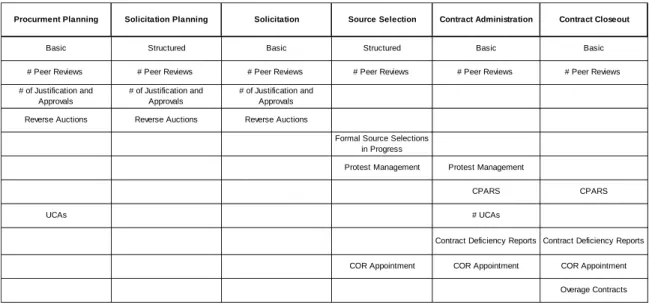
APG-ACC has personnel within the Office of the Principle Assistant Responsible for Contract (PARC) Division, whose duties include tracking organizational performance metrics and strategic initiatives. APG-ACC collects and monitors over 70 organizational performance metrics comprised of the inputs, processes, outputs and outcomes model, previously discussed in Chapter II, on a quarterly basis categorized into the following: Human Capital; Training and Certification; Operations and Budget, Pre-Award, Competition and Socioeconomic; Post-Award and Compliance. Refer to Appendix B for a summary of APG-ACC’s metrics. The metrics from the Pre-Award and Post-Award categories were re-categorized to align with the contract management
phases utilized with the CMMM shown in Table 1.
Table 1. APG-ACC Performance Metrics cross-referenced with the contract phases
E. SUMMARY
This chapter provided an overview of APG-ACC’s organizational make-up, to include the organizations leadership and geographic locale. Additionally, we covered the contracting services APG-ACC provides its customers, and current contract management metrics used by the organization. The next chapter will consist of the CMMM assessment results and process improvement recommendations.
Procurment Planning Solicitation Planning Solicitation Source Selection Contract Administration Contract Closeout
Basic Structured Basic Structured Basic Basic
# Peer Reviews # Peer Reviews # Peer Reviews # Peer Reviews # Peer Reviews # Peer Reviews
# of Justification and Approvals # of Justification and Approvals # of Justification and Approvals
Reverse Auctions Reverse Auctions Reverse Auctions
Formal Source Selections in Progress
Protest Management Protest Management
CPARS CPARS
UCAs # UCAs
Contract Deficiency Reports Contract Deficiency Reports
COR Appointment COR Appointment COR Appointment
IV. ASSESSMENT
RESULTS
AND PROCESS IMPROVEMENT
RECOMMENDATIONS
A. INTRODUCTION
This chapter provides the results of the Contract Management Maturity Model (CMMM) assessment conducted at Aberdeen Proving Ground–Army Contracting Command (APG-ACC). We also provide an in-depth analysis of each contract management process area in relation to the organization. Using the analysis gained from the surveys, we will assign a maturity level to determine the command’s contract management process maturity level. We will provide our analysis of APG-ACC compliance reports and discuss any relationship to the CMMM assessment findings. Furthermore, in this chapter we will provide recommendations to APG-ACC to help improve the contracting process capability.
B. SELECTION OF STUDY PARTICIPANTS
The group targeted for this research was Defense Acquisition Workforce Improvement Act (DAWIA) level II and level III certified 1102s and military equivalents who were directly involved in the procurement process i.e., procurement analysts and contract specialists. Using the CMMM as a tool to measure contract management process capability for the organization provides a benchmark of process maturity for the organization, of which the workforce can build upon to create a more capable contract management process capability.
We strategically targeted DAWIA level II and level III contracting personnel to provide a clearer picture of the organizations contract management process capability, as this group tends to be the brain trust for government contracting. DAWIA level II and III personnel have demonstrated through course completion and experience that they possess the requisite contracting competency needed to successfully manage contracts from Procurement Planning to Contract Closeout.
C. ADMINISTRATION OF CMMM SURVEY
The CMMM survey was deployed August 2014 electronically and remained open for 48 days. The respondents were asked to voluntarily answer a 62 question survey using a Likert Scale to ascertain the contract management process capability of APG-ACC. At the end of the survey period, we analyzed responses and calculated the maturity level for each contract management process area.
D. SURVEY RESULTS
There were 534 eligible participants to take the survey; however we received responses from 91 respondents. This gave us a response rate of 17.04%. Table 2 reflects demographic data such as, warranted and non-warranted, years of experience, and DAWIA certification level. Additionally, the survey responses for the contract management process areas will be presented along with the corresponding results for the organization contract management assessment.
Table 2. APG-ACC RESPONSE DEMOGRAPHICS
Table 3. APG-ACC Survey Item Responses for Procurement Planning and Solicitation Planning
Table 4. APG-ACC Survey Item Responses for Solicitation and Source Selection
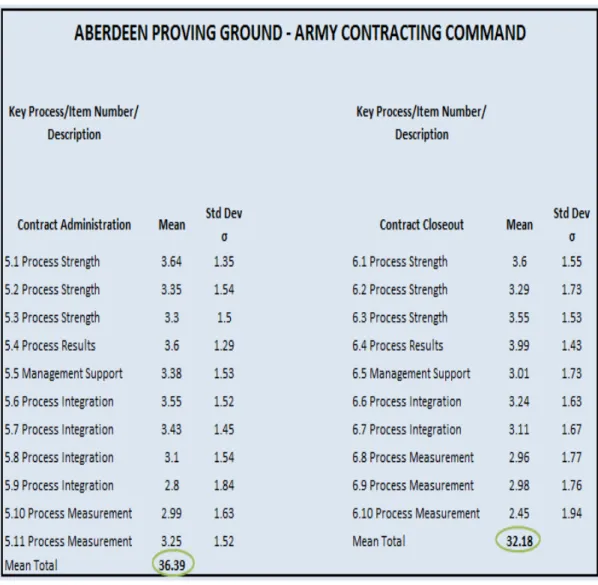
Table 5. APG-ACC Survey Item Responses for Contract Administration and Contract Closeout
1. APG-ACC Contract Management Process Maturity
Figure 4 reflects the APG-ACC contract management process maturity levels. As can be seen in Figure 4, the majority of contract management processes are at the Basic maturity level; while the remaining processes are at the Structured level. The following will provide more in-depth discussion of these CMMM assessment results.
Figure 4. Contract Management Maturity Model Assessment Results for APG-ACC
a. Procurement Planning, Solicitation, Contract Administration
and Contract Closeout
APG-ACC’s Procurement Planning, Solicitation, Contract Administration and Contract Closeout process areas were assessed at the Basic process
and standards established are not required to be consistently applied for any contracts that have not met certain criteria (Rendon, 2011).
b. Solicitation Planning and Source Selection
The organization’s Solicitation Planning and Source Selection process areas were assessed at the Structured process maturity level. This means for these process areas and related activities i.e., determining the procurement method, evaluation strategy, and negotiating contract terms and conditions, these processes are institutionalized and formal documentation is established for processes and standards. Documentation is present for formal standards and possibly automated. There is flexibility in application of processes and documents to fit various types of contract situations since contract process use is mandated. With this maturity level, the organizational leadership is well versed in providing guidance and direction for strategy development and issues related to contract management (Rendon, 2011).
2. APG-ACC Process Enablers
As previously discussed, each CMMM survey item is associated with a specific process enabler (Process Strength, Process Results, Management Support, Process Integration, and Process Measurement). Using the CMMM assessment results we analyze APG-ACC process capability in terms of these process enablers. Using the data in Figures 5–9, an analysis of survey item means can be interpreted to reflect the implementation of those process enablers.
3. Process Strengths
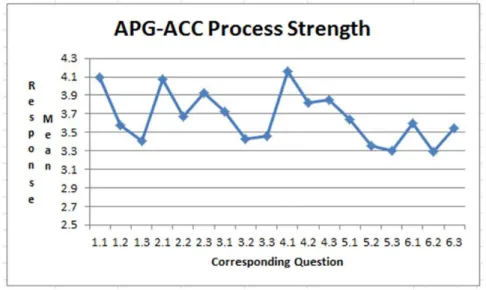
Figure 5 is a graphic representation of the organization’s Process Strengths. Of note, questions 1.1, 2.1, and 4.1 mean scores were significantly higher than the remaining questions for Process Strength. This analysis suggests the organization’s Process Strength enablers are strongest in Procurement Planning, Solicitation Planning, and Source Selection. Additionally, the analysis
suggests that APG-ACC Process Strength enablers are the weakest in Contract Administration and Contract Closeout.
Figure 5. Process Strength 4. Process Results
Figure 6 represents the organization’s Process Results. Questions 2.4, 4.4, and 4.7 mean scores were higher than the remaining questions posed for Process Results. This analysis suggests the organization’s Process Results enablers are strongest in Solicitation Planning and Source Selection. Additionally, the analysis suggests that APG-ACC Process Results enablers are the weakest in Procurement Planning, and Contract Administration.
5. Management Support
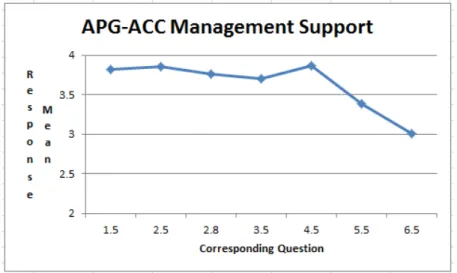
Figure 7 is a representation of the organization’s Management Support in the six areas of contract management processes. Question 4.5 mean score was significantly higher than the remaining questions for Management Support. This analysis suggests the organization’s Management Support enablers are strongest in Source Selection. Additionally, the analysis suggests that APG-ACC Management Support enablers are the weakest in Contract Administration and Contract Closeout.
Figure 7. APG-ACC Management Support
6. Process Integration
Figure 8 is a representation of the organization’s Process Integration. Question 4.8 was significantly higher than the remaining questions for Process Integration. This analysis suggests the organization’s Process Integration enablers are strongest in Source Selection. Additionally, the analysis suggests that APG-ACC Process Integration enablers are the weakest in Contract Administration and Contract Closeout.
Figure 8. APG-ACC Process Integration 7. Process Measurement
Figure 9 is a representation of the organization’s Process Measurement. Questions 2.10, 3.10, and 4.11 were significantly higher than the remaining questions for Process Measurement. This analysis suggests the organization’s Process Measurement enablers are strongest in Solicitation Planning, Solicitation, and Source Selection. Additionally, the analysis suggests that APG-ACC Process Measurement enablers are the weakest in Contract Administration and Contract Closeout.
E. COMPLIANCE ANALYSIS
In our literature review, we discussed other methods to evaluate organizational performance and management processes. These methods include evaluating compliance to regulations and policy. We collected audit report information from the DOD Inspector General (IG) for APG-ACC to determine if there were any consistencies with the CMMM findings. We noted that in a report for 2014, the DOD IG found that APG-ACC’s sub-centers could improve contract administration practices and oversight, specifically citing that contract officials lacked or failed to have “adequate documentation to support incremental funding; properly authorize contract oversight or update quality assurance surveillance plans; or evaluate contractor performance with standards that were compliant with the Army Federal Acquisition Supplement” (DOD IG, 2014). This IG finding seems consistent with the CMMM assessment findings. The Basic maturity level and the enabler of Process Strength was APG-ACC’s lowest mean score.
In a 2013 report, the DOD IG reviewed 30 sole source/ non-competitive contracts from APG-ACC and found 28 of the contracts to be adequately supported. APG-ACC was reported to have conducted and documented appropriately market research that was completed as well as properly documented when market research was not done. They also complied with Justification and Approval requirements and applied the sole source policy properly and consistently (DOD IG, 2013). These findings appear consistent with our maturity rating of “Structured” for APG-ACC and a high mean score in solicitation documentation.
The DOD’s IG published a consolidated report covering all the audits conducted for acquisition management from Fiscal Year (FY) 2003 to 2008 (2009). The issues were categorized into the following areas: Acquisition and Contract Award Decisions, Contract types and Pricing and Contract Administration and Funding. APG-ACCs CMMM results appeared to be inconsistent with the IG DOD-wide findings with regard to the various issues
areas cited by the IG as DOD wide issues that APG-ACC’s ratings of Structured maturity contradict. We might conclude that APG-ACC and other organizations performing well in the IG’s issue areas, adopt the sharing of best practices with the rest of the DOD.
In a 2012 GAO report, it was cited that there is a DOD-wide issue with regard to over-aged contract closeout. The report found a gross mismatch in data being provided by Army Headquarters, its’ commands and contracting centers with regard to the number of over-aged contracts requiring closeout. It was further stated that inadequate implementation plans linked to performance metrics that compared “actual performance against planned results” was contributing to DOD’s inability to reduce the backlog (GAO, 2012). This seems to be reflected in our assessment results because not only was Contract Closeout assessed at the Basic maturity level, but also Process Strength, Management Support and Process Measurement found to be the lowest process enabler means for Contract Closeout.
F. RECOMMENDATIONS FOR CONTRACT MANAGEMENT PROCESS IMPROVEMENTS AT APG-ACC
This section will focus on recommendations to the organization to improve the contract management processes at APG-ACC. The recommendations are based on the contract management maturity model assessment results and what improvements that can be made to increase the maturity levels in each of the six process areas.
established within the organization and APG-ACC should ensure processes are institutionalized, and mandated throughout the entire organization. Finally, senior organizational management should be involved in providing guidance, direction, and even approval of key contracting strategy, and decision related to contract terms and conditions (Rendon, 2011).
2. Solicitation Planning
Solicitation Planning was assessed at the Structured maturity level. Solicitation Planning mean scores were consistent in all process enabler categories. We provide the following recommendations for improving APG-ACC’s process maturity to the Integrated level. For Solicitation Planning process activities such as determining the procurement method, determining the contract type, developing the solicitation document, and structuring contract terms and conditions, APG-ACC should ensure management processes are fully integrated with other organizational core processes such as financial management, schedule management, and performance management. The customer is also integrated into the purchasing team and leadership utilizes performance metrics to evaluate the contract management process and make decisions (Rendon, 2011).
3. Solicitation
Solicitation was assessed at the Basic maturity level. In addition, the process enablers of Process Strength, Process Results, and Process Integration were relatively lower than other process enablers. We provide the following recommendations for improving APG-ACC’s process maturity to the Structured level. For Solicitation process activities such as conducting advertising of the procurement opportunity, conducting a pre-proposal conference, and developing and maintaining a qualified bidder’s list should be fully established within the organization and APG-ACC should ensure processes are institutionalized, and mandated throughout the entire organization. Finally, senior organizational
approval of key contracting strategy, and decision related to contract terms and conditions (Rendon, 2011).
4. Source Selection
Source Selection was assessed at the Structured maturity level. Mean scores for Source Selection were consistent in all process enabler categories. We provide the following recommendations for improving APG-ACC’s process maturity to the Integrated level. For Source Selection process activities such as applying evaluation criteria to the management, cost, and technical proposals, negotiating with suppliers, and executing the contract award strategies, APG-ACC should ensure management processes are fully integrated with other organizational core processes such as financial management, schedule management, and performance management. The customer is also integrated into the purchasing team and leadership utilizes performance metrics to evaluate the contract management process and make decisions (Rendon, 2011).
5. Contract Administration
Contract Administration was assessed at the Basic maturity level. In addition, Contract Administration scored lower in all process enabler areas except Process Results. We provide the following recommendations for improving APG-ACC’s process maturity to the Structured level. For Contract Administration process activities such as conducting a pre-performance conference, monitoring the contractors work results; managing the contract
6. Contract Closeout
Contract Closeout was assessed at the Basic maturity level. In addition, Contract Closeout scored lower in all process enabler areas. We provide the following recommendations for improving APG-ACC’s process maturity to the Structured level. For Contract Closeout process activities such as processing of government property dispositions, final acceptance of products and services, and documentation of the contractor’s final past-performance report, should be fully established within the organization and APG-ACC should ensure processes are institutionalized, and mandated throughout the entire organization. Finally, senior organizational management should be involved in providing guidance, direction, and even approval of key contracting strategy, and decision related to contract terms and conditions (Rendon, 2011).
G. SUMMARY
In this chapter, we provided the results from the CMMM assessment. We determined the APG-ACC contract management process maturity level for each of the CMMM process areas. We also analyzed APG-ACC process enablers as they relate to the maturity levels. We also compared the CMMM assessment results with recent GAO and DOD IG compliance inspections. Lastly, we provided APG-ACC recommendations for improving contract management process capability. In the next chapter we will summarize this report, answer the research questions, provide our conclusions, and recommendations for further research.
V.
SUMMARY, CONCLUSIONS, AND AREAS FOR FURTHER
RESEARCH
A. INTRODUCTION
In this chapter, we summarize the background and purpose of our research. We then conclude our research by presenting our findings to our research questions. Finally, based on our findings, we recommend areas for further research.
B. SUMMARY
The Acquisition workforce has undergone significant changes due to U.S. participation in conflicts across the globe. The increased requirement for contracted services and the shortage of federal contracting workforce has resulted in issues of accountability, transparency and value for money, which are important to the public’s interest. The federal response to these issues over the years has been to increase training of the contracting workforce to improve individual competency however, the issues still prevail. What is needed is an emphasis on organizational contract management process capability. The purpose of our research was to assess the contract management process capability using the CMMM and provide recommendations to where APG-ACC can improve contract management processes.
C. CONCLUSION
1. What is the Contract Management Process Maturity Level for APG-ACC in Each of the Six Process Areas of the CMMM?
The results of the CMMM assessment indicated that APG-ACC is operating at the Basic maturity level for Procurement Planning, Solicitation, Contract Administration and Contract Closeout. The organization is performing at the Structure maturity level in Solicitation Planning and Source Selection.