ABAC Journal Vol.39 No.2 (April-June, 2019 pp 45-63) 45 Khalid Abdul Wahid1,*, Ahmad Suffian Mohd Zahari2,
Shahsuzan Zakaraia3, and Hatinah Abu Bakar4
Abstract
Customer knowledge is a vital external factor which can affect organizational performance and survival. Customer knowledge consists of knowledge for customers (KfC), knowledge about customers (KaC) and knowledge from customers (KfrC). Many researchers regard customer knowledge as a strategic resource for companies to improve innovation, to facilitate the detection of new market opportunities, and to support long-term relationships with customers. However, there is still a lack of understanding of the role of knowledge sharing in improving organizational performance. This study aimed to investigate the impact of customer knowledge, and innovative customer knowledge sharing, on organizational performance. A second aim was to study the mediating effect of innovative customer knowledge sharing. The findings showed that customer knowledge positively influences customer knowledge sharing (CKS) except regarding the factor of knowledge about customers (KAC). Organizational performance (OP) was positively impacted by customer knowledge sharing (CKS). The findings also showed that customer knowledge sharing (CKS) has a mediating effect between customer knowledge (CK) and organizational performance (OP).
Keywords: Customer knowledge, Knowledge sharing, Organizational performance, Partial Least Square (PLS)
1,*Dr. Khalid Abdul Wahid obtains a Ph.D. in Business Administration specialising in Knowledge Creation from Kasetsart University, Bangkok, Thailand. Currently he is working as a senior lecturer and a research scholar in the Department of Information Management, Universiti Teknologi MARA (UiTM), Kelantan branch, Malaysia. Email: [email protected]
2Dr. Ahmad Suffian Mohd Zahari obtains a Ph.D. in Business Management from Universiti Teknologi MARA (UiTM), Malaysia. Currently he is working as a senior lecturer in the Department of Business and Management at Universiti Teknologi MARA (UiTM), Terengganu branch, Malaysia.
3Dr. Shahsuzan Zakaria obtains a Ph.D. in Financial Risk Management, Victoria University, Melbourne, Australia. Currently he is working as a senior lecturer in the Department of Business and Management, Universiti Teknologi MARA (UiTM), Kelantan branch, Malaysia.
4Dr. Hatinah Abu Bakar obtains a Ph.D. in Human Resources from Universiti Utara Malaysia (UUM), Malaysia. Currently she is working as a senior lecturer in the Department of Business and Management, Universiti Teknologi MARA (UiTM), Kelantan branch, Malaysia.
46
1. INTRODUCTION
In the new millennium, the concern of the Malaysian government in developing the nation as a knowledge-based economy, has become more apparent. As such, the government must focus on the development and manage-ment of human capital (Laili & Khairul, 2012). Therefore, the government and other organizations are urged to develop into a more knowledgeable organization, especially in terms of managing resources and providing services to the public (Syed Omar & Rowland, 2004). This knowledge is valuable since it leads to the effective and timely development of products based on the in-depth knowledge of customer needs (Slater, Olson, & Sorensen, 2012). The collective value of knowledge assets increases with the sharing of knowledge (Davenport & Prusak, 1998).
Knowledge has become a key asset and competitive advantage for many organizations operating in increasingly complex and competitive environments. Businesses in the era of the knowledge economy have realized that efficiently capturing the knowledge embedded in their organizations, and deploying it into operations and services, can create an edge over their competitors. In today’s competitive environment, a company needs sustainable assets in order to become more competitive to address its participation in business. The main objective of any business is to gain a competitive advantage in the market-place.
To date, most companies have focused on collecting massive amounts of customer data, but they do not know how
to cope with it (Davenport, Harris & Kohli, 2001). Thus, without the use of customer knowledge throughout the entire organization, the organization loses its competitive advantage and its ability to provide the products and services which will meet customers’ needs. Currently, most companies are focusing on the implementation of knowledge manage-ment (KM). However, this is not enough, due to its general application. In today’s competitive business environment, the implementation of knowledge manage-ment should be expanded to the concept of Customer Knowledge Management (CKM). According to Feng and Tian (2005), CKM has become an important branch of knowledge management, due to the fact that, in CKM there is a commercial relationship between the organization and the customer. They further argued that CKM is a customer-oriented management concept which takes customer knowledge as an important element to allocate resources.
Insurance companies have learned to develop their knowledge assets in their effort to improve the insurance industry in Malaysia. The emerging fluctuation of the Malaysian insurance and investment market has also directly incorporated the idea of using knowledge and information as sources of differentiation strategy. According to Huang and Lai (2010), in insurance businesses, the term ‘knowledge’ refers to the familiarity and professional capability in new policy designs, underwriting, claims, and customer service.
According to Garcia-Murillo and Annabi (2002), customer knowledge has received little attention in the knowledge management literature. Therefore, the
47 implementation of knowledge
manage-ment should be expanded to the concept of CKM, in order for companies to stay competitive in today’s business environ-ment. CKM has become an important branch of knowledge management even though it is a recent concept (Feng & Tian, 2005). CKM is recognized as a key strategic resource in any company’s success (Rollins & Halinen, 2005). Therefore, CKM and knowledge manage-ment must be closely connected. According to Rollins and Halinen (2005), CKM is an area of management where knowledge management instruments and procedures are applied to support the exchange of customer knowledge within an organization, and between an organiza-tion and its customers. They further added that CKM is thus used to manage customer relationships, improving customer relationship management processes, such as customer service, customer retention and relationship profitability (Rollins & Halinen, 2005). As a result, organizational performance can be further improved.
Based on previous studies, research on CKM is still lacking. According to Peng, Lawrence and Koo (2009), current CKM research is dominated by Western cases and theories. The little available research conducted in this particular field, mainly focuses on understanding the concept, and manifestation of knowledge management. The lack of study on CKM has been pointed out by Alhawari, Talet, Mansour, Alryalat & Hadi (2008), in which they stressed the fact that customer knowledge expansion must be a key concept to organizations if they want to maintain a competitive advantage and to achieve successful relationships with their
customers. Very little literature has yet been found to discuss this concept, even though many organizations have predicted its potentially great impact. Based on the above research gap, this study aims to investigate the impact of customer knowledge and innovative customer knowledge sharing on organizational performance. A second aim is to study the mediating effect of innovative customer knowledge sharing on organizational performance.
2. LITERATURE REVIEW
The importance of knowledge is marked by the increase in information and knowledge. In order to effectively handle the overabundance of incoming informa-tion and outgoing knowledge, many organizations are trying to manage their knowledge effectively in the process of obtaining or developing new know-ledge (Kiessling, Richey, Meng & Dabic, 2009). The importance of existing knowl-edge has been given much attention with the introduction of the knowledge-based view (KBV) theory. As discussed in the knowledge-based view, according to Halawi, Aronson & McCarthy (2005), knowledge is seen as a strategic asset with the potential to be a source of sustainable competitive advantage.
2.1 Knowledge-Based View (KBV) The knowledge-based view (KBV), comes from the concept of a resource-based view, and focuses on the value of intangible assets, suggesting knowledge as critical to a firm’s long-term success (Kiessling et al., 2009). Therefore, with the implementation of a knowledge-based
48
view, managers can enhance a firm’s capacity to produce and efficiently update knowledge (Mbhalati, 2012).
In the knowledge-based view, a firm develops new knowledge for its compe-titive advantage from the unique combi-nation of existing knowledge (Fleming, 2001; Mbhalati, 2012). Furthermore, the knowledge-based view focuses on flexibi-lity in the new dynamic marketplace, using knowledge transfer and integration (Kiessling et al., 2009). The knowledge-based view suggests that management should create a firm’s value through knowledge management (Kiessling et al., 2009). According to the study conducted by Wahid, Numprasertchai, Sudharatna & Laohavichien (2016) market knowledge, which consists of customer knowledge, competitor knowledge and supplier knowledge, becomes an important factor for organizational competitiveness. The research found that customer knowledge becomes the most influential factor of an organization’s competitive advantage.
It can be contended that the knowledge-based view explains how an organization and its customers cooperate in order to develop effective relationships and to successfully manage resources as discussed by each theory. The emphasis of coordinated processes to create inte-grated resources between an organization and its customers through a knowledge-based view provides the underlying theoretical rationale to support the concept of customer knowledge management.
2.2 Customer Knowledge
According to Paquette (2006), there are three types of customer knowledge,
which are knowledge for customers, knowledge about customers and knowledge from customers. Knowledge for customers is knowledge regarding products, markets and suppliers (Gebert, Gelb, Kolbe & Brenner, 2002). It is required in customer relationship man-agement processes to satisfy the knowl-edge needs of customers. According to Feng and Tian (2005), knowledge for customers occurs in a single direction, that is from the organization to the customers, wherein the organization provides customers with necessary knowledge, allowing them to better understand the product which is being offered by the organization. This knowledge is concerned in improving the user experience with products and services, which is critical for retaining customers (Desouza & Awazu, 2004). It is required in the customer knowledge management process to meet the needs of customer knowledge. This is the know-ledge that the firm should have, and which can be used to assist the customer in making a purchase decision (Garcia-Murillo & Annabi, 2002). For example, the organization will provide customers with knowledge about its products and their applications (Davenport & Prusak, 1998; Li, He & Chun-li, 2011), as well as knowledge about the market and suppliers (Hongqi & Ruoyu, 2008). According to Davenport and Prusak (1998), knowledge about products and services is often created in product design and engineering organizations. The information from a customer database can be used to identify the needs of different groups of customers (Dennis, Marsland & Cockett, 2001). In other words, this knowledge is produced from organizations to customers and
49 suppliers.
Knowledge about customersis about customer segments, histories, connections, requirements, expectations and purchas-ing activity (Gebert et al., 2002). It is accumulated to understand the motivation of customers and to address them in personalized ways. According to Alotaibi and Rigas (2008), knowledge about customers can be discovered through the powerful analytical system. It can be captured through various forms of codified knowledge such as emails, customer databases, written documents (Merilainen & Halinen, 2009), customer surveys, service management and customer complaints. Knowledge about customers also includes processed demographic, psychographic and behavioral demographic information (Desouza & Awazu, 2004), customer history, contacts, needs, expectations and buying patterns. Feng and Tian (2005) further argued that knowledge about customers can be obtained by collecting statistical information, historical purchasing data, and any other kind of feedback information from other channels.
Knowledge from customers is the knowledge captured from a customer database, which can be defined as insights, ideas, thoughts and information regarding current products and services, customer trends and future needs, and ideas for product innovation (Gebert et al., 2002; Desouza & Awazu, 2004). Alotaibi and Rigas (2008), and Rollins and Halinen (2005) added that knowledge from customers can be gathered via feedback mechanisms, which are provided by customers for peer customers and were introduced by web-based retailing systems such as Amazon.com. Customers
build their own expertise while using the product or service and at the same time improve their experience with the firm. 2.3 Organizational Performance
Measuring the performance of an organization is very important as an indicator for achieving effectiveness in the organization. The literature on organizational performance shows that there is no single universal measure or common framework that can be used to assess overall organizational performance (Alkalha, Al-Zu’bi, Al-Dmour, Alshurideh & Masa’deh, 2012). Similarly, Alkalha et al. (2012) mentioned that it is difficult to measure organizational performance, especially due to the fact that there are continual changes regarding which features should be measured.
Antony and Bhattachatyya (2010) proposed a construct for organizational performance that can be used to evaluate and assess the success of an organization, in order to create and deliver values to its external and internal stakeholders. As the literature goes, many scholars and practitioners agree that organizational performance can be used as an indicator, to evaluate how well an organization achieves its objectives, and to assess the efficiency and effectiveness of goal achievement (Ho, 2011; Al-Dhaafri, Yusoff & Al-Swidi, 2013). Venkatraman and Ramunajan (1986) argued that organizational performance is an indicator, which can measure how well an enterprise achieves its own objectives. This indicator is comprised of sales growth, company return on investment (ROI), company return on assets (ROA), market share, new product introduction
50
and product quality. This study has adapted the measurement of organizational performance developed by Venkatrman and Ramunajan (1986). 2.4 Customer Knowledge Sharing
Nowadays, the formation and use of new knowledge is necessary to the survival of businesses. Customer knowledge that has been gathered in an organization is of no use unless it is shared with people who need to know. According to Okyere-Kwakye and Khalil (2011), knowledge sharing has been labelled as the key element within organizations in the 21st century. Therefore, knowledge sharing has been given great attention by both academi-cians and practitioners (Wangpipatwong, 2009). They further argued that sharing of knowledge is not easy to implement due to the nature of knowledge. Therefore, employees should have the ability to share, to collaborate with others to solve problems, to develop new ideas and to implement policies or procedures pertaining to the sharing of knowledge.
To create a knowledge sharing culture, organizations must encourage employees to work together more effectively, to collaborate and to share organizational knowledge more effectively, in order to better perform their jobs (Xiong & Deng, 2008). According to Huang and Huang (2012), effective knowledge sharing among members has become a competitive requirement for organizations. Therefore, the implement-tation of knowledge sharing among employees can improve an organization as a whole in meeting its business objectives.
According to Kang, Kim and Chang (2008), knowledge sharing is defined as the transmission or distribution of individual knowledge in an organization. Furthermore, individual members of an organization, with different ideas, jobs, and experiences, will create new knowledge by communicating and sharing their individual knowledge (Kang et al., 2008). In relation to this, Haas and Hansen (2007) mentioned that there are two distinct ways of transferring knowledge across organizations, which are transferring knowledge between individuals, and transferring knowledge through written documents.
Knowledge sharing is thought to be influenced by various factors, both at the individual, and at the organizational level (Hong, Suh, & Koo, 2011). In addition, past research has identified both individual and organizational factors as the antecedents of knowledge sharing. The antecedents of knowledge sharing can be identified by factors such as, motivation to share, rewards, opportu-nities to share, culture and work environment (Ahmadi, Daraei & Kalam, 2012), motivation (Llopis-Corcoles, 2011), communication (Bratianu & Orzea, 2010), and trust between individuals (Ahmadi et al., 2012; Hansen, Rasmussen & Bosse, 2013). However, research by Ahmadi et al. (2012) in an Iranian bank found that trust, reward and information technology have a significant relationship, whereby the organizational culture failed to support the influence of knowledge sharing to the Iranian bank.
The above discussion shows that there is a relationship between customer knowledge, knowledge sharing and organizational performance. Hence, the
51 hypotheses for this study are identified as
follows:
H1: Knowledge for customers (KfC) has a positive impact on customer knowledge sharing (CKS).
H2: Knowledge about customers (KaC) has a positive impact on customer knowledge sharing (CKS).
H3: Knowledge from customers (KfrC) has a positive impact on customer knowledge sharing (CKS)
H4: Customer knowledge sharing (CKS) positively influences organizational performance (OP).
H5: Customer knowledge sharing (CKS) mediates between customer knowledge and organizational performance (OP).
3. RESEARCH METHODOLOGY This study utilized survey research. Questionnaires, deploying a 5-point Likert scale (1 for “Strongly Disagree”; 2 for “Disagree”; 3 for “Neither Agree nor Disagree”; 4 for “Agree” and 5 for “Strongly Agree”) were used to collect data. Prior to pilot testing and main data collection, the questionnaires were pre-tested with several experts in the field, and also several insurance companies who could become the prospective respondents. The questionnaires were pilot tested with 30 insurance companies. The responses of these 30 companies were analyzed using SmartPLS to determine the reliability of the measurements. The recorded Cronbach Alpha for all variables employing multi-items was estimated in the range of 0.65 – 0.88 indicating that the questionnaires were reliable (Kline, 2011).
Organizational Performance H1
H3 H2 Knowledge forCustomer
Knowledge aboutCustomer
Knowledge from Customer
Customer Knowledge Sharing H4
H5
Customer Knowledge
52
The population of the study included 500 Malaysian insurance companies listed in the Bank Negara database; 182 companies responded. However, only 180 questionnaires were considered valid for the data analysis. These were analyzed using a Partial Least Square (SmartPLS version 3). The measurement model was first developed and assessed, followed by development and assessment of the structural model.
Previous studies have indicated a sample threshold of as little as 100 samples for PLS-SEM (Reinartz, Haenlein, and Henseler 2009). Alternatively, one can revert to the more restrictive minimum sample size recommended based on statistical power (Hair, Hult, Ringle & Sarstedt, 2014). G*Power was used to calculate the sample size based on statistical power (Faul, Erdfelder, Buchner and Lang. 2009), suggesting that a sample size of 129 was required for a statistical power of 0.95 for model testing. Since, the sample size exceeded 129, the power value also exceeded 0.95. Moreover, the minimum power required in social and behavioural science research is typically 0.8. Therefore, in both cases, it can be concluded that the sample size was acceptable for the purposes of the study. 4. RESULTS
The respondents of the study consisted of 180 Malaysian insurance companies, the categories of company included, 45 life insurance companies (25 %), 92 general insurance companies (51.11%), 33 life takaful cooperatives (18.33%), 9 general takaful cooperatives (5%) and 1 other (0.56%). In terms of
company size, most respondents have less than 25 employees (88 companies, 48.89%), with a few companies in each of the other size categories, 26-50 employees (15 companies, 8.33%), 51-75 employees (6 companies, 3.33%), 76-100 (13 companies, 7.22%), or more than 100 (58 companies, 32.23%). Regarding annual revenue, 145 insurance companies had annual revenue of more than USD 12.23 million, while 16 companies earned between USD 5 and 10 million, and 19 companies had an annual revenue less than USD 5 million.
4.1 Common Method Variance (CMV) Due to the self-reported nature of the data, there was potential for common method variance (CMV). The Harman one-factor test was therefore conducted to determine the extent of this. According to Podsakoff and Organ (1986), common method bias is problematic if a single latent factor would account for the majority of the explained variance. The un-rotated factor analysis showed that the first factor accounted for only 26.40% of the total 75.21% variance, and thus the common method bias was not a serious threat in this study.
4.2 Assessment of Measurement Model To examine the research model, a Partial Least Square (PLS) analysis technique was employed using the SmartPLS 3 software version 3.2.8 (Ringle, Wende & Becker, 2015). In an effort to refine all structural equation models, a two stage analytical procedure was employed, whereby researchers tested the measurement model and
53 structural model as recommended by
Hair, Sarstedt, Hopkins & Kuppelwieser (2014). Prior to structural modelling, the study should assess the measurement model of latent construct for dimensiona-lity, validity, and reliability. Cronbach’s (α) and composite reliability were also employed as recommended by Henseler, Ringle & Sarstedt (2015).
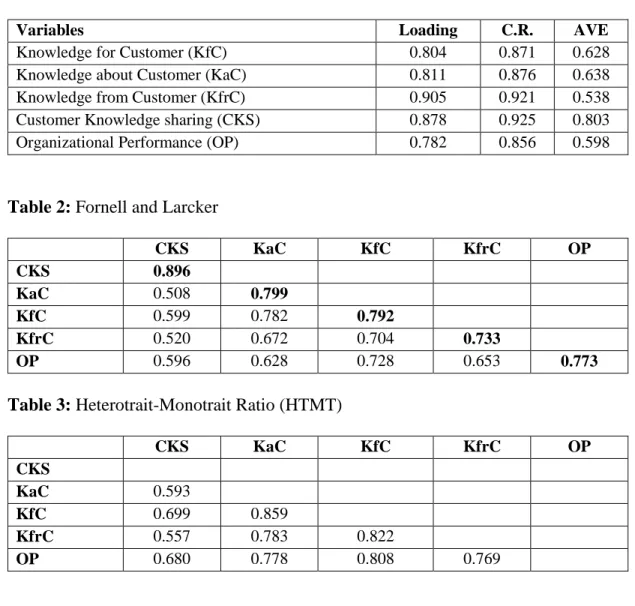
The measurement model used in this study included five constructs: knowledge for customers (KfC), knowledge about customers (KaC), knowledge from customers (KfrC), customer knowledge sharing (CKS) and organizational performance (OP). In assessing a model’s reliability, the loading of each indicator on its associated latent variable must be calculated and compared to a threshold. Generally, the loading should be higher than 0.7 for indicator reliability to be considered acceptable (Hair, Ringle, and Sarstedt, 2014). A loading lower than 0.4 indicates that an item should be considered for removal, while items with a loading of 0.4–0.7 should be considered for removal if they increase the composite reliability (CR) and Average Variance Extracted (AVE) above the threshold (Hair, Ringle, and Sarstedt, 2014). The majority of the indicator loadings on their corresponding latent variables for the respondents were higher than 0.7, as shown in Table 1.
4.3 Validity Assessment
Validity was assessed in terms of convergent validity and discriminant validity. Convergent validity is the extent to which the scale correlates positively with other measures of the same constructs (Malhotra, 2002). Convergent
validity of the measurement model is usually ascertained by examining the factor loading, average variance extracted (AVE) and compost reliability (CR) (Hair, Black, Babin, Anderson & Tatham, 2010). All values were found to be above 0.6, showing acceptable convergent validity of the model. Convergent validity can be evaluated by examining the loading (≥ 0.6), AVE ≥ 0.5, and CR ≥ 0.7 (Kim, 2010). The coefficients for the effect of each item on their respective underlying constructs were observed. A test of each item’s coefficient was used to assess convergent validity. All values fulfil the required standard, indicating high convergence validity. Table 1 shows the results of factor loadings, showing that all lie above the threshold level of 0.7 as recommended by Chin (2010) and Hair et al. (2010).
Besides assessing the convergent validity, the study also evaluated the discriminant validity. Discriminant validity can be evaluated by examining the Fornell-Larcker Criterion (Fornell & Larcker, 1981) and Heterotrait-Monotrait Ratio (HTMT) (Henseler, Ringle & Sarstedt, 2015). Fornell and Larcker (1981) have suggested examining whether the square root of the AVE for each construct is greater than the correlation between the constructs. There are two ways of using HTMT to assess discriminant validity: (1) as a criterion or (2) as a statistical test. First, using HTMT as a criterion involves comparing it to a predefined threshold. If the value of HTMT is higher than this threshold, one can conclude that there is a lack of discriminant validity. Some authors suggest a threshold of 0.85 (Kline, 2011), whereas others propose a value of 0.90
54
(Gold, Malhotra & Segars, 2011). Tables 2 and 3 show the results of the discrimi-nant validity assessment of the measure-ment model using the Fornell–Larcker criterion and HTMTratio, both of which indicate that the models possess accept-able discriminant validity.
4.4 Assessment of Structural Model The study performed bootstraping involving 5000 samples whislt the actual sample stood at 180. The SEM results are
presented in Table 4 and Table 5. It can be observed that the R2 value for CKS is 0.379, suggesting that 37.9% of the variance in CKS is explained by the knowledge for customers (KfC), knowledge about customers (KaC) and knowledge from customers (KfrC). The CKS construct in turn contributes to 35.6.7% of the variance in organizational performance (OP) based on the R2 value of 0.356. Table 4 shows that all beta path coefficients were positive and in the expected direction and were statistically Table 1: Factor loading, C.R. and AVE
Variables Loading C.R. AVE
Knowledge for Customer (KfC) 0.804 0.871 0.628
Knowledge about Customer (KaC) 0.811 0.876 0.638
Knowledge from Customer (KfrC) 0.905 0.921 0.538
Customer Knowledge sharing (CKS) 0.878 0.925 0.803
Organizational Performance (OP) 0.782 0.856 0.598
Table 2: Fornell and Larcker
CKS KaC KfC KfrC OP CKS 0.896 KaC 0.508 0.799 KfC 0.599 0.782 0.792 KfrC 0.520 0.672 0.704 0.733 OP 0.596 0.628 0.728 0.653 0.773
Table 3: Heterotrait-Monotrait Ratio (HTMT)
CKS KaC KfC KfrC OP CKS KaC 0.593 KfC 0.699 0.859 KfrC 0.557 0.783 0.822 OP 0.680 0.778 0.808 0.769
55 coefficient between knowledge about
customer (KaC) and customer knowledge sharing (CKS) whose t value is less than 1.645. To elaborate on the significance of the effect, the values were found to be β = 0.434 (p < 0.05) for knowledge for customers (KfC) and β = 0.184 (p < 0.05) for knowledge from customers (KfrC) on CKS. Thus H1 and H3 are supported by the analysis but H2 is not supported. Similarly, CKS shows a significant relationship with organizational perform-ance (OP) (β = 0.596, p < 0.05). This means H4 is supported. The result also reveals that both knowledge for customers (KfC) and knowledge from customers (kfrC) are equally important
compared to knowledge about customers (KaC).
To test indirect effects, the study employed Preacher and Hayes (2008) bootstrapping method. First the indirect effect of KfC on OP was tested. The bootstrapping analysis revealed the indirect effect (β=0.259) with a t value of 2.842 (Table 5). The study also confirmed that there is mediation, given that the indirect effect of KfrC on OP is 0.110 with a t value of 1.694. Based on the above results, it can be concluded that the mediation effect of CKS on the relationship between KfC, KfrC and OP is statistically significant, therefore H5 is supported as shown in Table 5.
Table 4: Path coefficient and hypotheses testing Hypotheses
β S.E. t value Decision R2 VIF Q2 H1 KfC -> CKS 0.434 0.136 3.184 Supported
0.379
3.025
0.267
H2 KaC-> CKS 0.045 0.149 0.302 Not Supported 2.779
H3 KfrC -> CKS 0.184 0.219 1.777 Supported 2.145
H4 CKS -> OP 0.596 0.063 9.499 Supported 0.356 1.000 0.184
Note: *p < 0.05; **p < 0.01; KfC=Knowledge for customer; KaC=Knowledge about customerr; KfrC=Knowledge from customerr; CKS=Customer knowledge sharing; OP=Organizational performance.
Table 5: Indirect effects
Hypotheses β S.E. t value Decision
H5 KfC -> OP 0.259 0.091 2.842 Supported
KfrC -> OP 0.110 0.065 1.694 Supported
Note: *p < 0.05; **p < 0.01; KfC=Knowledge for customer; KaC=Knowledge about customerr; KfrC=Knowledge from customerr; CKS=Customer knowledge sharing; OP=Organizational performance.
56
Multicollinearity among the variables in our model was evaluated, with no cause for concern found using the criteria of variance inflation factor (VIF), as shown in Table 4; all variables were found to be below the suggested value of 5.00 (Hair et al., 2014). Finally, the predictive relevance of the model was also assessed through the blindfolding procedure as suggested by Hair et al. (2014), and shown in Table 4. The Q2 value for customer knowledge sharing (CKS) was found to be Q2 = 0.267, while
organiza-tional performance (OP) was Q2 = 0.184; both are > 0, suggesting that the model has sufficient predictive relevance.
5. DISCUSSION AND RECOMMENDATIONS
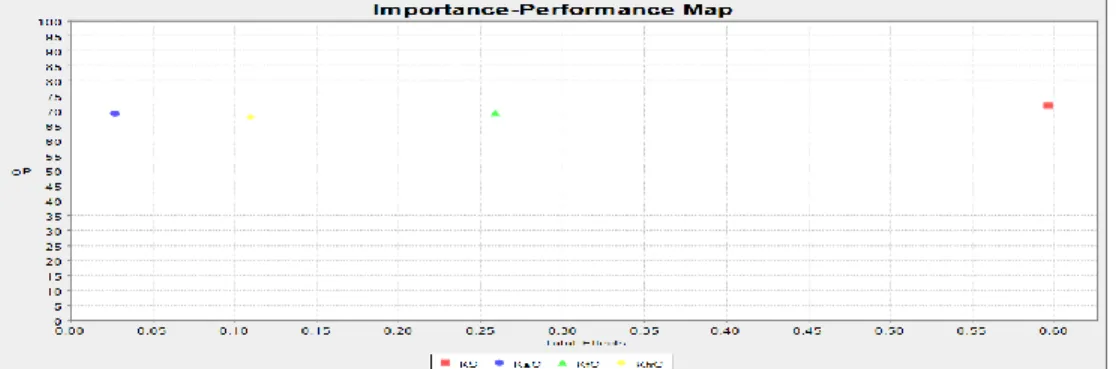
An Importance and Performance Matrix Analysis (IPMA) is useful in discussing the findings for managerial implications. IPMA contrasts the structural model total effects (importance) and the average values of the latent variable scores (performance) of a specific endogenous construct, highlight-ing significant areas for improvement through management activities (Hair et al., 2014).
The results suggest that managers should be aware of customer knowledge sharing as it plays a significant role in organizational performance. Managers can prioritize their managerial actions based on the results of IPMA. IPMA addresses the important areas for the improvement of management activities. Knowledge for customers, knowledge from customers, and customer knowledge sharing have the highest importance regarding the organizational performance construct. In other words, managers should note that one point increase in knowledge for customers, knowledge from customers and customer knowledge sharing is expected to increase the organizational performance by the value of the total effect. Customer knowledge sharing has the highest performance regarding its influence in organizational performance construct. Empirical studies on customer knowledge factors and organizational performance in the context of insurance companies are scarce and factors influencing them need to be studied with scrutiny. Future research should investigate the impact of other market knowledge factors such as competitor knowledge and supplier knowledge (Wahid et al., 2016) on organizational performance.
57 Since knowledge sharing is a
challenging task, it is likely that the significant relationship emerges because insurance companies provide and encourage their employees to work as a team in providing and implementing customers’ knowledge. For example, if an organization applies teamwork, knowledge sharing is likely to be more effective. Teamwork can create a better working environment wherein individuals in the organization are able to interact together, collaborate regarding skills, and to share information and knowledge pertaining to their customers.
Knowledge sharing is a possible reason that an insurance company may create a community of practice. A community of practice refers to a group of people who share some knowledge or expertise; they learn from each other, developing skills and practices of collaborative knowledge exchange. Company initiated group forming has promoted learning and sharing in the insurance companies. For example, when insurance companies create a community of practices, it is more possible to share organizational customer knowledge among its employees. Employees can discuss various situations regarding customer feedback, customer needs, and customer wants, through their experiences dealing with customers. In return they can develop action oriented and suitable formula in managing CKM dimensions. Besides this, employees in insurance companies can generate new knowledge in response to specific problems and issues. This study shows that it is important to create a platform for mutual information communication. All questions are worth discussing, on all
levels. A dynamic way to look at customer knowledge management is important as it creates awareness.
The insurance companies seem to apply a suitable method among their employees such as encouraging personal relationships. Employees can share their experiences dealing with customers, as it pertains to various issues brought up by customers. For example, whenever possible, insurance representatives interact directly with their current and possible customers through face to face, web sites, blogs and social networking. The method of marketing products or services involves word of mouth marketing to current and possible customers so that they can be informed about new products or services. As a result, the customers become well informed about the current products, and agents have greater knowledge regarding customer complaints and feedback. They can then share this knowledge about the current needs of customers among their colleagues.
Successful teamwork relies on cooperation among all team members, in order to build strategies which can enhance customer knowledge, thus achieving the common company goals. Willingness to share information is also an element needed for creating a dynamic organization built on internal trust. In recent years, with increasing demands of market competition, many organizations acknowledge that the sharing of knowledge among employees can enhance organizational performance, and thus bring huge economic advantage to the company. However, employees must be willing to share knowledge in the first place, in order to ensure that the benefits
58
from this practice can be realized. Therefore, developing a successful knowledge-sharing strategy is crucial for customer knowledge to be a valuable resource for the organization. In addition, it is important for managers to conceive and implement a culture of knowledge sharing so that employees can understand the importance of knowledge sharing in the organization and take necessary actions to ensure its effective implementation. However, a successful knowledge sharing environment depends upon the individual characteristics of the employees of the organization, as well as on the working environment of the organization. Thus, employees should be motivated and confident to engage in knowledge sharing.
Since the culture of the organization serves as a critical factor to the organization's ability to create value through leveraging knowledge assets, it is strictly recommended that organizations should put special emphasis on the sharing of knowledge to improve organizational performance. Although knowledge sharing implementation in an organization is not an easy task, the benefits of knowledge sharing can have a real impact on organizational performance. By actively involving employees in sharing organizational knowledge, an organization can improve and build a new source of knowledge that can enhance the reputation of the business. Establishing the right strategy of knowledge sharing can create a competitive advantage through the introduction of new products and services that can better meet the needs of customers. Finally, to create a knowledge sharing culture in an organization, top
management must encourage employees to work together more effectively, to collaborate and to share knowledge to enrich the organizational knowledge, and thus to improve organizational performance. The level of sharing regarding the information and knowledge acquired and gathered from customers, suppliers and third parties, is very important for an organization to be ahead of its competitors and involved in innovation.
Some limitations in this study have been identified. Firstly, the study used a cross sectional research design rather than a longitudinal study. Thus, it is not able to examine the organizational behavior over a period of time. The longitudinal study can cope with the long-term nature of customer knowledge sharing and organizational performance. Second, this research concerns the sample drawn from insurance companies in Malaysia. Since CKS may be influenced by the differences of implementation between insurance companies and other industries, the research model should be tested further in future studies, using samples from other industries, such as hotels, banks, other health services, retailing and manufacturing sectors to compare and further generalize the results of this study. New insights and findings could be achieved if the study focuses on multiple service industries.
6. CONCLUSION
Customer knowledge is an important element for organizational performance. Furthermore, customer knowledge sharing is the most important factor for selecting and managing crucial resources
59 to implement the desired strategy to
achieve performance. Managers should be aware that unique and relevant knowledge is usually linked to employees and customers. Organizations may achieve higher performance and profits not because they possess better resources, but because their knowledge sharing implementation will allow them to make better use of their resources. The study shows that customer knowledge significantly influences organizational performance. This result is consistent with the previous study conducted by Wahid et al. (2016). CKS becomes an important element in creating new knowledge regarding customers. This newly created customer knowledge then becomes an important asset for an organization to generate a competitive advantage. Insurance companies have a tendency of sharing customer knowledge in terms of knowledge for customers and knowledge from customers, but not knowledge about customers.
According to the research results from Malaysian insurance companies, it can be concluded that customer knowledge sharing affects organizational performance. Organizations are capable of creating new knowledge in the form of customer portfolios. This knowledge is created and will be passed on to other employees to identify customers’ needs and will form the basis for building a strategy of relations with key company customers. In turn, this close cooperation with key customers leads to the increase of new products and services within the company. It can be concluded that current contacts with customers leads to the creation of new knowledge regarding the customers’ needs and preferences. As a
result of knowledge sharing within an organization, new solutions are created based on the defined customer needs and preferences, which leads to the generation of new ideas. The use of a customer needs database should be implemented in order to increase the number of new products or services that can be generated. It follows that the more information is gathered about the needs of customers with regard to company products and services, the more employees can create further ideas for new products. Knowledge about the customers’ needs can be the basis for creating new products and service concepts in insurance companies. The research results confirm the hypotheses. Sharing useful knowledge within an organization with assistance from the CRM system can increase organizational performance in Malaysian insurance companies.
REFERENCES
Ahmadi, S. A. A., Daraei, M. R., & Kalam, R. F. (2012), Analysis of knowledge sharing in banking industry. Interdisciplinary Journal of
Contemporary Research in
Business, 4(7), 815-826.
Dhaafri, H. S., Yusoff, R. Z., & Al-Swidi, A. K. (2013), The effect of total quality management, enterprise resource planning and the entrepre-neurial orientation on the organiza-tional performance: The mediating role of the organizational excellence: A proposed research framework.
International Journal of Business Administration, 4(1), 66-85.
Alhawari, S., Talet, A. N., Mansour, E., Alryalat, H., & Hadi, W. M. (2008),
60
The effects of knowledge process for customer on the achievement of customer knowledge retention.
Communications of the IBIMA,
6(27), 174-180.
Alkalha, Z., Al-Zu'bi, Al-Dmour, H., Alshurideh, M., & Masa'deh, R. (2012), Investigating the effect of human resource policies on organi-zational performance: An empirical study on commercial bank operating in Jordan. European Journal of
Economics, Finance and
Administrative Sciences, 1(51), 94- 102.
Alotaibi, M., & Rigas, D. (2008), Interactive customer knowledge management systems: A compara-tive evaluation of users’ perception of trust and level of knowledge.
Proceedings of the 7th WSEAS International Conference on E-Activities, Cairo, Egypt, 54-59. Antony, J. P., & Bhattacharyya, S. (2010),
Measuring organizational perform-ance and organizational excellence of SMEs: An empirical study on SMEs in India. Measuring Business Excellence, 14(3), 42-52.
Bratianu, C. & Orzea, I. (2010), Organizational knowledge creation.
Management, Marketing Challenges for Knowledge Society, 5(3), 41-62. Chin, W. (2010), How to write up and
report PLS analyses. In:
EspositoVinzi V, Chin W.W, Henseler J, Wang H (eds) Handbook of partial least squares: concepts, methods and applications. Springer Heidelberg, 655-690.
Davenport, T. H., Harris, J. G., & Kohli, A. K. (2001), How do they know
their customers so well?” Sloan Management Review, Winter, 63-73. Davenport, T. H., & Prusak, L. (1998), Working knowledge: how organisations manage what they know. Ubiquity: An ACM IT
Magazine and Forum, 1-15.
Retrieved February, 17, 2019, from http://www.acm.org/ubiquity/book/t _davenport_1.html
Dennis, C., Marsland, D., & Cockett, T. (2001), Data mining for shopping centres customer knowledge-management framework. Journal of Knowledge Management, 5(4), 368-374.
Desouza, K. C., & Awazu, Y. (2004), Gaining a competitive edge from your customers: Exploring the three dimensions of customer knowledge.
Knowledge Management Review,
7(3), 12-15.
Faul, F., Erdfelder, E., Buchner, A. and Lang, A.G. (2009), Statistical power analyses using G*Power 3.1: Tests for correlation and regression analyses. Behavior Research Methods. 41(4), 1149–1160.
Feng, T. X., & Tian, J. X. (2005), CKM and condition analysis of successful CKM implementation. Proceedings of the 4th International Conference on Machine Learning and Cyber-netics, Guangzhou, 2239-2244. Fleming, L. (2001), Recombinant
uncertainty in technological search.
ManagementScience, 47, 117-132. Fornell, C. & Larcker, D. F. (1981),
Evaluating Structural Equation Models with unobservable variables and measurement error. Journal of Marketing Research, 8(1), 39-50.
61 Garcia-Murillo, M., & Annabi, H. (2002),
Customer knowledge management.
Journal ofthe Operational Research Society, 53(8), 875-884.
Gebert, H., Gelb, M., Kolbe, L., & Brenner, W. (2002), Knowledge-enabled customer relationship management: Integrating customer relationship management and knowledge management concepts.
Journal of Knowledge Management, 7(5), 107- 123.
Gold, A.H., Malhotra, A. & Segars, A.H. (2001), Knowledge management: An organizational capabilities perspec-tive. Journal of Management Information Systems, 18(1), 185– 214.
Halawi, L., Aronson, J., & McCarthy, R. (2005), Resource-based view of knowledge management for competitive advantage. The Electronic Journal of Knowledge Management, 3(2), 75-86.
Haas, M., & Hansen, M. T. (2007), Different knowledge, different benefits: Toward a productivity perspective on knowledge sharing in organizations. Strategic Man-agement Journal, 28, 1133-1153. Hair, J. F., Black, W. C., Babin, B. J.,
Anderson, R. E. & Tatham, R. (2010), Multivariate Data Analysis
7, London, Pearson.
Hair, J. F., Hult, G.T.M., Ringle, C. & Sarstedt, M. (2014), A Primer on Partial Least Squares Structural
Equation Modeling (PLS-SEM). Los
Angeles, CA, Sage.
Hair, J. F, Sarstedt, J., Hopkins, M. & Kuppelwieser, V. (2014), Partial Least Squares Structural Equation Modeling (PLS-SEM) an emerging
tool in business research. European Business Review, 26, 106-121. Henseler, J., Ringle, C.M. & Sarstedt, M.
(2015), A new criterion for assessing discriminant validity in variance-based structural equation modelling.
Journal of the Academy of Marketing Science, 43, 115-135
Hansen, U. K., Rasmussen, M. A., & Bosse, M. (2013), Expectations as a key element in trusting. Paper presented at 5th Seminar of the
Nordic Research Network on
Trust, Skordsborg, Denmark, 14-15 May, 2013.
Ho, L. A. (2011), Meditation, learning, organizational innovation and performance. Industrial Manage-ment & Data Systems, 111(1), 113-131.
Hong, D., Suh, E., & Koo, C. (2011), Developing strategies for over-coming barriers to knowledge sharing based on conversational knowledge management: A case study of a financial company. Expert systems with Applications, 38 (12), 14417- 14427.
Hongqi, Z., & Ruoyu, L. (2008), A model for the relationship between customer knowledge management and service innovation capability.
Proceedings of the
International Conference on Service Systems and Service Management,
Melbourne, 1-5.
Huang, E. Y., & Huang, T. K. (2012), Investigating the antecedents of users’ knowledge sharing intention.
Journal of Computer Information System, 53(2), 93-102.
Huang, L. S., & Lai, C. P. (2010), Applying knowledge management in
62
the life insurance industry: Evidence from Taiwan. International Research Journal of Finance and Economics, 48, 115-127.
Kang, Y., Kim, S., & Chang, G. (2008), The impact of knowledge sharing on work performance: An empirical analysis of the public employees' perceptions in South Korea.
International Journal of Public Administration, 31(14), 1548-1568. Kline, R. B. (2011), Principles and
Practices of Structural Equation Modelling (2nd ed.). New York, NY: Guilford.
Kiessling, T. S., Richey, R. G., Meng, J. & Dabic, M. (2009), Exploring knowledge management to organiza-tional performance outcomes in a transitional economy. Journal of World Business, 44(4), 421-433. Kim, D. Y. (2010), The Impacts of Quality
Management Practices on
Innovation (Doctoral dissertation). Retrieved from ProQuest Dissertation & Thesis Global. (Accession No. 816192017).
Laili Hashim & Khairul Mizan Taib. (2012), Training and development for knowledge workers – Malaysia scene. International Journal of Business, Humanities and Techno-logy, 2(2), 139-147.
Li, X., He, Q. Y., & Chun-li, J. (2011), Creating competitive advantage through customer knowledge management in customer relation-ship management. Proceeding of the International Conference on
E-Business and E-Government,
Shanghai, China, 1-4.
Llopis-Corcoles, O. (2011), Under-standing knowledge sharing in
organizations: multilevel research through a social cognitive per-spective. Proceedings of the
DimeDruid ACADEMY Winter
Conference, Denmark.
Malhotra, N.K. (2002), Basic Marketing Research: Applications to Contem-porary, New Jersey, Prentice Hall International.
Mbhalati, O. J. (2012), The genesis of the knowledge-based view. Journal of Knowledge Management Practice,
13(2).
Merilaiinen, K., & Halinen, A. (2009), Customer knowledge creation in strategic business networks towards an analytical framework.
Proceedings of the 25th IMP Conference, Marseille, 1-14.
Okyere-Kwakye, E., & Khalil Md Nor. (2011), Individual factors and knowledge sharing. American Journal of Economics and Business Administration, 3(1), 66-72.
Paquette, S. (2006), Customer knowledge management, Encyclopedia of
Knowledge Management: Idea
Group Inc. Retrieved February 19,
2019 from,
http://www.fis.utoronto.ca/phd/paqu ette/Documents/Paquette%20%20C ustomer%20Knowledge%20Manage ment.pdf.
Peng, J., Lawrence, A., & Koo, T. (2009), Customer knowledge management in international project: A case study.
Journal of Technology Management in China, 4(2), 145-157.
Podsakoff, P. M. & Organ, D.W. (1986), Self-reports in organizational research: Problems and prospects. J Manag. 1(4), 531–544.
63 Preacher, K. J. & Hayes, A. F. (2008),
Asymptotic and resampling strategies for assessing and comparing indirect effects in multiple mediator models. Behavior Research Methods, 40, 879-891. Reinartz, W., Haenlein, M. & Henseler, J.
(2009), An empirical comparison of the efficacy of covariance-based and variance-based SEM. International Journal of Research in Marketing, 26(4), 332–344.
Ringle, C.M., Wende, S. & Becker, J.M. (2015), SmartPLS 3, Boenningstedt, Smart PLS GmbH.
Rollins, M., & Halinen, A. (2005), Customer knowledge management competence: towards a theoretical framework. Proceedings of the 38th Hawaii InternationalConference on System Sciences, 1-10.
Slater, S. F., Olson, E. M., & Sorensen, H. E. (2012), Creating and exploiting market knowledge assets. Journal of Business Strategy, 33(4), 18-27. Syed Omar Sharifuddin & Rowland, F.
(2004), Benchmarking knowledge management in a public organization in Malaysia benchmarking. An International Journal, 11(3), 238-266.
Wahid, K. A., Numprasertchai, H., Sudharatna, Y., & Laohavichien, T. (2016), Assessing perceived knowledge creation: The role of organizational knowledge and market environment. International Journal of Management, Knowledge and Learning, 5(1), 57-79.
Wangpipatwong, S. (2009), Factors influencing knowledge sharing among university students.
Proceedings of the 17th International
Conference on Computers in
Education, Asia-Pacific Society for Computers in Education, Hong Kong, 800-807.
Xiong, S., & Deng, H. (2008), Critical success factors for effective knowledge sharing in Chinese joint ventures. Proceedings of the 19thAustralasian Conference on Information Systems, Christchurch, New Zealand, 1089-1098.
Venkatraman, N., & Ramanujam, V. (1986), Measurement of business performance in strategy research: A comparison of approaches. Academy of Management Review, 11, 801-814.