Cross-database evaluation of audio-based spoofing detection systems
Pavel Korshunov and S´ebastien Marcel
Biometrics group, Idiap Research Institute,
Martigny, Switzerland
[email protected], [email protected]
Abstract
Since automatic speaker verification (ASV) systems are highly vulnerable to spoofing attacks, it is important to develop mech-anisms that can detect such attacks. To be practical, however, a spoofing attack detection approach should have (i) high ac-curacy, (ii) be well-generalized for practical attacks, and (iii) be simple and efficient. Several audio-based spoofing detection methods have been proposed recently but their evaluation is lim-ited to less realistic databases containing homogeneous data. In this paper, we consider eight existing presentation attack de-tection (PAD) methods and evaluate their performance using two major publicly available speaker databases with spoofing attacks: AVspoof1 and ASVspoof2. We first show that
realis-tic presentation attacks (speech is replayed to PAD system) are significantly more challenging for the considered PAD meth-ods compared to the so called ‘logical access’ attacks (speech is presented to PAD system directly). Then, via a cross-database evaluation, we demonstrate that the existing methods generalize poorly when different databases or different types of attacks are used for training and testing. The results question the efficiency and practicality of the existing PAD systems, as well as, call for creation of databases with larger variety of realistic speech presentation attacks.
Index Terms: speaker anti-spoofing, presentation attacks,
cross-database testing, open source
1. Introduction
Recent years have shown an increase in both the accuracy of biometric systems and their practical use. The application of biometrics is becoming widespread with fingerprint sensors in smartphones, automatic face recognition in social networks and video-based applications, and speaker recognition in phone banking and other phone-based services. The popularization of the biometric systems, however, exposed their major flaw — high vulnerability to spoofing attacks [1]. A fingerprint sensor can be easily tricked with a simple glue-made mold, a face recognition system can be accessed using a printed photo, and a speaker recognition can be spoofed with a replay of pre-recorded voice. The ease with which a biometric system can be spoofed demonstrates the importance of developing efficient anti-spoofing systems that can detect both known (conceivable now) and unknown (possible in the future) spoofing attacks.
In this paper, we focus on the spoofing attack detection or presentation attack detection (PAD) systems in the context of voice biometrics. Although the research in this area is far from being matured, several approaches have been proposed re-cently, mostly focusing on feature extraction component of
anti-1https://www.idiap.ch/dataset/avspoof 2http://datashare.is.ed.ac.uk/handle/10283/853
spoofing systems. A survey by Wuet al.[2] provides a compre-hensive overview of the spoofing attacks and the currently avail-able anti-spoofing methods. These methods use features mostly based on the audio spectrogram, such as spectral- and cepstral-based features [3], phase-cepstral-based features [4], the combination of amplitude and phase features [5], and audio quality based fea-tures [6]. Also, a higher computational layer can be added, for instance, Alegreet al.[7] proposed to use histograms of local binary patterns (LBP), which can be computed directly from a set of pre-selected spectral, phase-based, or other features. Most of these features are used successfully in speaker verifica-tion systems already, so, naturally, they are first to be proposed for anti-spoofing systems as well. However, to demonstrate that the anti-spoofing methods work, they need to be evaluated on a dataset with a set of comprehensive spoofing attacks that pose a real threat to the state of the art speaker verification systems [8]. Although, the number of speech databases with spoofing at-tacks is significantly limited, two major databases were created recently: ASVspoof1[9], as part of the 2015 Interspeech
anti-spoofing challenge, and AVspoof2[10]. Most of the available work on speaker anti-spoofing, essentially, focuses on detect-ing synthetic speech, such as voice conversion, speech synthe-sis, and artificial signals [2]. The synthetically generated at-tacks are assumed to be fed into a verification system directly bypassing its microphone, hence, they are coined as ‘logical access’ attacks [9]. This type of attacks constitute ASVspoof database. The most practicalreplay attacks, which are formally defined aspresentation attacksby ISO standardization commit-tee [11], received considerably less attention, since, until now, there was no public dataset with such attacks. That is why AVspoof database [10] is of great interest, since it is the first database that contains several types of replay attacks.
To overcome the lack of evaluations of the currently avail-able spoofing attack detection methods on presentation attacks and to find out how well these methods generalize across dif-ferent types of attacks, we need an extensive cross-database evaluations of the state-of the art. By taking the recent work of Sahidullah et al. [12], which benchmarked several anti-spoofing systems, as a starting point, we have selected several well-performing methods and developed their open source im-plementation3 based on a well-known Bob framework [13]4.
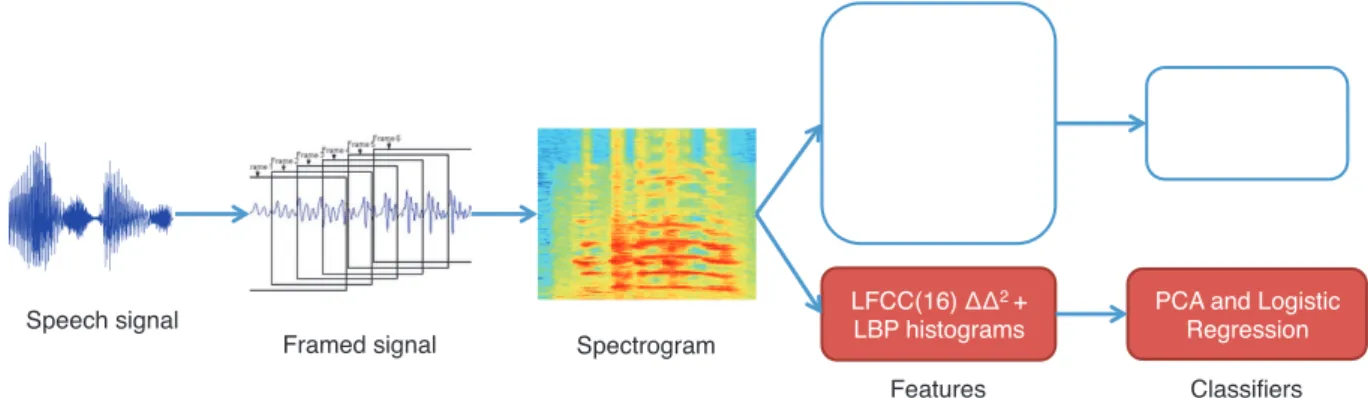
Hence, we have implemented: GMM-based classifier us-ing cepstral-based features with rectangular (RFCC), mel-scaled triangular (MFCC) [14], inverted mel-mel-scaled triangular (IMFCC), and linear triangular (LFCC) filters [15], spectral flux-based features (SSFC) [16], subband centroid frequency (SCFC) [17], and subband centroid magnitude (SCMC) [17] features, as well as, features of LBP histograms computed
us-3Source code: https://pypi.python.org/pypi/bob.paper.interspeech 2016 4http://idiap.github.io/bob/
Speech signal
Framed signal Spectrogram
SCFC(20) ΔΔ2 RFCC(20) ΔΔ2 LFCC(20) ΔΔ2 MFCC(20) ΔΔ2 IMFCC(20) ΔΔ2 SSFC(20) ΔΔ2 SCMC(20) ΔΔ2 LFCC(16) ΔΔ2 + LBP histograms GMM 512
PCA and Logistic Regression
Features Classifiers
Figure 1: Processing flow of considered PAD systems.
ing LFCC [7] with a PCA-based dimensionality reduction and logistic regression classifier. Figure 1 illustrates the processing flow of the implemented PAD systems.
We demonstrate the effect of presentation (or replay) at-tacks on the selected anti-spoofing systems compared to syn-thetically generated attacks. And to understand how well these systems generalize across different databases and different types of data, we conducted an extensive cross-database evalu-ation by (i) training the systems on data from one database and testing them on data from another database, and (ii) training them on one type of data (‘logical access’ or presentation at-tacks) and testing them on another type of data.
Therefore, the main contributions of this paper include (i) open source implementation of eight state of the art speaker spoofing detection systems, (ii) evaluation of these systems on presentation attacks from AVspoof database, and (iii) compara-tive performance and cross-database testing using AVspoof and ASVspoof databases.
2. Spoofing detection methods
We have selected several state of the art methods for spoofing attacks detection in speech (please see Figure 1 for an illustra-tion), which were recently evaluated by Sahidullahet al.[12] on ASVspoof database. Taking already benchmarked approaches allow us to compare and cross-validate our open source imple-mentations3with the results presented in [12].
By following [12], we adopted GMM-based classifier (two models for real and attacks), since it led to a better performance compared to SVM. We selected four cepstral-based features with rectangular (RFCC), mel-scale triangular (MFCC) [14], inverted mel-scale triangular (IMFCC), and linear triangular (LFCC) filters [15]. These features are computed from a power spectrum (power of magnitude of 512-sized FFT) by apply-ing one of the above filters of a given size (we use size20as per [12]). We also implemented spectral flux-based features (SSFC) [16], which are Euclidean distances between power spectrums (normalized by the maximum value) of two consecu-tive frames, subband centroid frequency (SCFC) [17], and sub-band centroid magnitude (SCMC) [17] features. A discrete co-sine transform (DCT-II) is applied to all above features, except for SCFC, and first20coefficients are taken.
For the comparison with the above systems, we also imple-mented features using histograms of uniform local binary pat-terns (uLBP(8,1)) [7] computed from LFCCs (16coefficients, deltas, and double-deltas [18]), which is one of the first
meth-ods proposed for anti-spoofing detection in speech. However, instead of using a histogram intersection for classification be-tween real data and attacks, to increase the accuracy of detec-tion closer to practical values, we used logistic regression with prior PCA-based dimensionality reduction.
Before computing selected features, a given audio sample is first split into overlapping20ms-long speech frames with10ms overlap. The frames are pre-emphasized with0.97coefficient and pre-processed by applying Hamming window. Then, for all features, except for LBP-based features [7], we compute deltas and double-deltas [18] and keep only these features (40in to-tal) for the classifier. We kept only deltas and double-deltas, because [12] reported that static features degraded performance of PAD systems.
3. Spoofing databases
For our cross-database benchmarking of selected anti-spoofing methods, we have selected two recent and the most comprehen-sive to date publicly available databases with speech spoofing attacks: ASVspoof and AVspoof.
3.1. ASVspoof
ASVspoof1 database was created for a 2015 Interspeech
anti-spoofing challenge [9]. It contains genuine speech data from 106speakers (45male and61female), while spoofed speech was generated using speech synthesis and voice conversion al-gorithms. In total, database has10 spoofing attacks, five of which are considered ‘unknown’, since they appear in the evalu-ation set only and their nature was not known to the participants at the time of the evaluation. However, it is important to note that ASVspoof database was built with an assumption that the attackers have a direct access (or what the authors called ‘logical access’) to a verification system. It means that the database does not contain more realistic presentation attacks [11] and hence, basically, is a database of synthetic speech. For more details on ASVspoof database, please refer to [9].
3.2. AVspoof
To our knowledge, the largest publicly available database con-taining speech presentation attacks is AVspoof [10]2.
AVspoof database contains real (genuine) speech samples from44participants (31males and13females) recorded over the period of two months in four sessions, each scheduled sev-eral days apart in different setups and environmental conditions
Table 1: Performance of PAD systems on ASVspoof [9] and AVspoof [10] with results in[12] EER (%)column copied from [12].
PAD system ASVspoof (Eval) AVspoof (Eval)
[12] EER (%) Bob3EER (%) Bob3HTER (%) Bob3HTER (%)
Known Unknown Known Unknown LA PA
SCFC(20)∆∆2, GMM512 0.07 8.84 0.10 5.17 0.00 5.15 RFCC(20)∆∆2, GMM512 0.12 1.92 0.12 1.32 0.03 2.70 LFCC(20)∆∆2, GMM512 0.11 1.67 0.13 1.20 0.00 5.00 MFCC(20)∆∆2, GMM512 0.39 3.84 0.46 2.93 0.00 5.34 IMFCC(20)∆∆2, GMM512 0.15 1.86 0.20 1.57 0.01 3.76 SSFC(20)∆∆2, GMM512 0.30 1.96 0.23 1.60 0.70 4.17 SCMC(20)∆∆2, GMM512 0.17 1.71 0.18 1.37 0.01 3.24 uLBP(8,1), PCA and LR N/A N/A 9.95 21.30 0.65 5.89
Table 2: Cross database testing on ASVspoof [9] and AVspoof [10] databases of PAD systems (open source implementations3).
PAD system HTER (%)
ASVspoof (Train/Dev) AVspoof-LA (Train/Dev) AVspoof-LA (Eval) AVspoof-PA (Eval) ASVspoof (Eval) AVspoof-PA (Eval)
SCFC(20)∆∆2, GMM512 1.43 6.48 19.99 7.56 RFCC(20)∆∆2, GMM512 34.93 38.54 25.58 13.20 LFCC(20)∆∆2, GMM512 0.71 10.58 18.44 8.40 MFCC(20)∆∆2, GMM512 1.87 9.82 10.13 5.15 IMFCC(20)∆∆2, GMM512 2.28 46.49 21.80 49.57 SSFC(20)∆∆2, GMM512 34.64 41.68 43.50 36.26 SCMC(20)∆∆2, GMM512 1.23 12.16 22.99 7.97
uLBP(8,1), PCA and LR 58.38 53.00 44.34 49.10
such as background noises. The first session was recorded in the most controlled conditions. Speech samples were recorded using three devices: laptop using microphone AT2020USB+, Samsung Galaxy S4 phone, and iPhone 3GS.
From the recorded genuine data, two major types of tacks were created for AVspoof database: ‘logical access’ at-tacks, similar to those in ASVspoof database [9], and presen-tation attacks, as they are defined by ISO standardization com-mittee [11]. ‘Logical access’ attacks are generated using (i) a statistical parametric-based speech synthesis algorithm [19] and (ii) a voice conversion algorithm from Festvox5.
When generating presentation attacks, the assumption is that a verification system is installed on a laptop (with an inter-nal built-in microphone) and an attacker is trying to gain access to this system by playing back to it a pre-recorded genuine data or an automatically generated synthetic data using some play-back device. In AVspoof database, presentation attacks consist of (i) direct replay attacks when a genuine data is played back using a laptop with internal speakers, a laptop with external high quality speakers, Samsung Galaxy S4 phone, and iPhone 3G, (ii) synthesized speech replayed with a laptop, and (iii) con-verted voice attacks replayed with a laptop. For more details on AVspoof database, please refer to [10].
4. Evaluation results
Open source implementations3 of the selected spoofing detec-tion methods (see Secdetec-tion 2 for details) are evaluated by com-puting a half total error rate (HTER) on the evaluation set of a database, which is a mean of false acceptance rate (FAR) and false reject rate (FRR) computed using a threshold found from the development set (see [8] for more details).
5http://festvox.org/
4.1. Comparative evaluation ASVspoof vs. AVspoof
The results of evaluating the selected methods on different types of attacks from ASVspoof and AVspoof databases are presented in Table 1. These results are obtained by training each anti-spoofing method (i.e., a PAD system) on a training (Train) set of a given database, then tuned on development (Dev) set and tested on evaluation (Eval) set of the same database.
In Table 1, the results for ‘known’ and ‘unknown’ attacks (see columns titled asBob EER (%)to indicate our Bob-based open source implementation) ofEvalset of ASVspoof are pre-sented separately. Thus, our results can be compared with results reported in Table 4 of [12] (Matlab implementation), which we also included in Table 1 for convenience (columns ti-tled as[12] EER (%)). Also, equal error rates (EER) are shown for these sets to keep the results comparable with [12]. We can observe that both implementations lead to similar results for ‘known’ attacks, while our Bob-based system shows smaller error rates for ‘unknown’ attacks.
For AVspoof database, only the results for our Bob-based implementation are shown in Table 1, since AVspoof database was not used in [12]. Since AVspoof contains both ‘logical ac-cess’ (LA for short) and presentation attacks (PA), the results for these two types of attacks are presented separately, to allow comparing the performance on ASVspoof database (it has ‘log-ical access’ attacks only) with an AVspoof-LA attacks. From these results, we can note that (i) LA set of AVspoof is less challenging compared to ASVspoof for all methods, except for SSFC-based, and (ii) presentation attacks are significantly more challenging compared to LA attacks. The increase in HTER for almost all PAD systems in more than100times for PA com-pared to LA attacks of AVspoof means that presentation attacks, besides emulating a more realistic spoofing scenario, pose a se-rious threat to the state of the art systems and need to be con-sidered in all future evaluations of anti-spoofing systems.
0.1 0.2 0.5 1 2 5 10 20 40 60 80 90 95 98 99 FAR (%) 0.1 0.2 0.51 2 5 10 20 40 60 80 90 95 98 99 FRR (%) HTER = 1.87% HTER = 9.82% HTER = 2.27% MFCC,AVspoof-LA(Eval) MFCC,AVspoof-PA(Eval) MFCC,ASVspoof(Eval)
(a)TrainandDevsets of ASVspoof
0.1 0.2 0.5 1 2 5 10 20 40 60 80 90 95 98 99 FAR (%) 0.1 0.2 0.51 2 5 10 20 40 60 80 90 95 98 99 FRR (%) HTER = 0.00% HTER = 5.15% HTER = 10.13% MFCC,AVspoof-LA(Eval) MFCC,AVspoof-PA(Eval) MFCC,ASVspoof(Eval)
(b)TrainandDevsets of AVspoof-LA
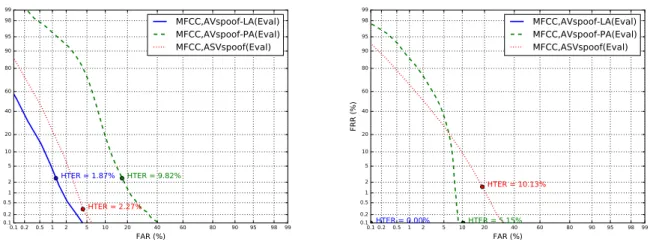
Figure 2: DET curves forMFCC(20)∆∆2, GMM512PAD system when it is trained on one database and evaluated on another.
Table 3: Per attack results for RFFC and MFCC-based systems. Attacks ASVspoof (Train) AVspoof-LA (Train)
MFCC RFCC MFCC RFCC AVSpoof-LA SS 1.45 34.78 0.00 1.07 (Eval) VC 1.88 34.93 0.00 0.00 AVSpoof-PA SS 3.51 35.14 24.91 40.09 (Eval) SS-HQ 22.93 39.11 11.52 36.79 VC 6.21 35.65 0.90 9.40 VC-HQ 6.30 35.40 1.12 10.32 RE 48.25 72.20 49.98 49.99 4.2. Cross-database evaluation
Table 2 presents the cross-database results when a given PAD system is trained and tuned using training and development sets from one database but is tested using evaluation set from an-other database. For instance, results in the second column of the table are obtained by using training and development sets from ASVspoof database but evaluation set from AVspoof-LA. Also, we evaluated the effect of using one type of attacks (e.g., ‘log-ical access’ from AVspoof-LA) for training and another type (e.g., presentation attacks of AVspoof-PA) for testing (the re-sults are in the last column of the table).
From the results in Table 2, we can note that all methods generalize poorly across different datasets with HTER reaching 50%. It is also interesting to note that even similar methods, for instance, RFCC and MFCC-based, have very different accuracy in cross-database testing, even though they showed less drastic difference in single-database evaluations (see Table 1). To un-derstand the cause for such drastic difference in performances, we split the results for RFCC and MFCC-based methods for each attack of AVspoof database separately, as shown in Ta-ble 3. The rows of the taTa-ble indicate the attacks, including ‘log-ical access’ speech synthesis (SS) and voice conversion (VC) in AVspoof-LA, and replay or presentation attacks of speech syn-thesis (SS), speech synthesis replayed with high quality speak-ers (SS-HQ), voice conversion (VC), voice conversion replayed with high quality speakers (VC-HQ), and replay attacks with
laptop and phones (RE). We can note that the main difference between RFCC and MFCC-based methods is in SS and VC at-tacks, while both methods perform almost equally poorly on RE attacks. It means MFCC-based system is more sensitive to synthetic attacks and, since such synthetic attacks constitute the majority of the overall attacks, it led to the overall low HTER for MFCC-based system. But none of the systems work well on REattacks.
To provide more details on how MFCC-based PAD sys-tem performs on different databases, we plot its detection er-ror tradeoff (DET) curves in Figure 2. Figure 2a shows DET curves when the method is trained on ASVspoof database and Figure 2b shows when it is trained on AVspoof-LA. In both plots, we can notice that the PAD system is misbalanced: a small decrease in false acceptance rate of spoofing attacks has a cost of having large increase in false rejection rate. This is especially true when the system is evaluated using attacks from AVspoof-PA, which again emphasizes the challenge that pre-sentation attacks pose to the current PAD systems.
5. Conclusion
In this paper, we conducted a cross-database evaluation of sev-eral state of the art speech spoofing attacks detection methods implemented as open source. We used two recent comprehen-sive databases with speech spoofing attacks: ASVspoof (‘logi-cal access’ attacks only) and AVspoof (‘logi(‘logi-cal access’ and pre-sentation attacks). The evaluation results demonstrated that all methods generalize poorly, especially, when they are trained on ‘logical access’ attacks and tested on more realistic presenta-tion attacks, which means a new and more practically applica-ble anti-spoofing methods need to be developed. Databases with larger variety of attacks in both training and testing sets are also needed.
6. Acknowledgements
This work was partially funded by Google Inc., EU BEAT project (#284989), and Norwegian SWAN project. The authors would also like to thank Sahid Sahidullah for providing imple-mentation details of the features from [12] paper.
7. References
[1] S. Marcel, M. S. Nixon, and S. Z. Li,Handbook of Biometric Anti-Spoofing: Trusted Biometrics Under Spoofing Attacks. Springer-Verlag London, 2014.
[2] Z. Wu, N. Evans, T. Kinnunen, J. Yamagishi, F. Alegre, and H. Li, “Spoofing and countermeasures for speaker verification: A sur-vey,”Speech Communication, vol. 66, pp. 130–153, Feb. 2015. [3] S. Shiota, F. Villavicencio, J. Yamagishi, N. Ono, I. Echizen,
and T. Matsui, “Voice liveness detection algorithms based on pop noise caused by human breath for automatic speaker verification,” inINTERSPEECH, Dresden, Germany, Sep. 2015, pp. 239–243. [4] P. L. De Leon, M. Pucher, J. Yamagishi, I. Hernaez, and I.
Saratx-aga, “Evaluation of speaker verification security and detection of HMM-based synthetic speech,”IEEE Transactions on Audio, Speech, and Language Processing, vol. 20, no. 8, pp. 2280–2290, Oct. 2012.
[5] T. B. Patel and H. A. Patil, “Combining evidences from mel cep-stral, cochlear filter cepstral and instantaneous frequency features for detection of natural vs. spoofed speech,” inINTERSPEECH, Dresden, Germany, Sep. 2015, pp. 2062–2066.
[6] A. Janicki, “Spoofing countermeasure based on analysis of lin-ear prediction error,” inINTERSPEECH, Dresden, Germany, Sep. 2015, pp. 2077–2081.
[7] F. Alegre, A. Amehraye, and N. Evans, “A one-class classifica-tion approach to generalised speaker verificaclassifica-tion spoofing coun-termeasures using local binary patterns,” inIEEE Sixth Interna-tional Conference on Biometrics: Theory, Applications and Sys-tems (BTAS), Arlington, VA, Sep. 2013, pp. 1–8.
[8] I. Chingovska, A. Anjos, and S. Marcel, “Biometrics evalua-tion under spoofing attacks,”IEEE Transactions on Information Forensics and Security, vol. 9, no. 12, pp. 2264–2276, Dec. 2014. [9] Z. Wu, T. Kinnunen, N. Evans, J. Yamagishi, C. Hanilc¸i, M. Sahidullah, and A. Sizov, “ASVspoof 2015: the first automatic speaker verification spoofing and countermeasures challenge,” pp. 2037–2041, Sep. 2015.
[10] S. Kucur Ergunay, E. Khoury, A. Lazaridis, and S. Marcel, “On the vulnerability of speaker verification to realistic voice spoof-ing,” inIEEE International Conference on Biometrics: Theory, Applications and Systems, Sep. 2015.
[11] ISO/IEC JTC 1/SC 37 Biometrics, “DIS 30107-1, information technology – biometrics presentation attack detection,” American National Standards Institute, Jan. 2016.
[12] M. Sahidullah, T. Kinnunen, and C. Hanilc¸i, “A comparison of features for synthetic speech detection,” inINTERSPEECH, Dres-den, Germany, Sep. 2015, pp. 2087–2091.
[13] A. Anjos, L. E. Shafey, R. Wallace, M. G¨unther, C. McCool, and S. Marcel, “Bob: a free signal processing and machine learn-ing toolbox for researchers,” inACM international conference on Multimedia (ACMMM), Oct. 2012.
[14] S. Davis and P. Mermelstein, “Comparison of parametric repre-sentations for monosyllabic word recognition in continuously spo-ken sentences,”IEEE Transactions on Acoustics, Speech, and Sig-nal Processing, vol. 28, no. 4, pp. 357–366, Aug. 1980. [15] S. Furui, “Cepstral analysis technique for automatic speaker
ver-ification,”IEEE Transactions on Acoustics, Speech, and Signal Processing, vol. 29, no. 2, pp. 254–272, Apr. 1981.
[16] E. Scheirer and M. Slaney, “Construction and evaluation of a ro-bust multifeature speech/music discriminator,” inIEEE Interna-tional Conference on Acoustics, Speech, and Signal Processing (ICASSP), vol. 2, Apr. 1997, pp. 1331–1334.
[17] P. N. Le, E. Ambikairajah, J. Epps, V. Sethu, and E. Choi, “Inves-tigation of spectral centroid features for cognitive load classifica-tion,”Speech Commun., vol. 53, no. 4, pp. 540–551, Apr. 2011. [18] F. K. Soong and A. E. Rosenberg, “On the use of
instanta-neous and transitional spectral information in speaker recogni-tion,”IEEE Transactions on Acoustics, Speech, and Signal Pro-cessing, vol. 36, no. 6, pp. 871–879, Jun. 1988.
[19] H. Zen, K. Tokuda, and A. W. Black, “Review: Statistical para-metric speech synthesis,”Speech Commun., vol. 51, no. 11, pp. 1039–1064, Nov. 2009.
![Table 2: Cross database testing on ASVspoof [9] and AVspoof [10] databases of PAD systems (open source implementations 3 ).](https://thumb-us.123doks.com/thumbv2/123dok_us/1455834.2694783/3.892.142.752.359.518/table-database-testing-asvspoof-avspoof-databases-systems-implementations.webp)