i
Title Page
AVAILABILITY AND UTILISATIONOFINFORMATION RESOURCES BY ACADEMIC LIBRARIANS FOR JOB PERFORMANCE ENHANCEMENT IN SELECTED UNIVERSITY
LIBRARIES IN NORTH-CENTRAL NIGERIA.
Kutu, Jacob Oloruntoba
BLIS, MLIS (University of Ibadan Nigeria) Student Number: 216021160
Thesis submitted in fulfilment of the requirements for the degree of Doctor of Philosophy (Information Studies) in the School of Social Sciences, College of Humanities, University of KwaZulu-Natal, Pietermaritzburg, South Africa.
Supervisor: Dr. Francis Garaba
………. Submitted: August 2020
ii
DECLARATION
I, KUTU Jacob Oloruntoba, declare that:
(i) The research reported in this dissertation/thesis, except where otherwise indicated, is my original work;
(ii) This dissertation/thesis has not been submitted for any degree or examination at any other university;
(iii) This dissertation/thesis does not contain other persons ‘data, pictures, graphs or other information, unless specifically acknowledged as being sourced from other persons; (iv) This dissertation/thesis does not contain other persons ‘writing, unless specifically
acknowledged as being sourced from other researchers. Where other written sources have been quoted, then:
i their words have been re-written, but the general information attributed to them has been referenced;
ii where their exact words have been used, their writing has been placed inside quotations marks, and referenced;
(v) Where I have reproduced a publication of which I am an author, co-author or editor, I have indicated in detail which part of the publication was actually written by myself alone and have fully referenced such publications;
(vi) This dissertation/thesis does not contain text, graphics or tables copied and pasted from the Internet, unless specifically acknowledged, and the source being detailed in the dissertation and in the reference’s sections.
KUTU Jacob Oloruntoba Date: August 2020
Dr. Francis Garaba Date: August 2020
Supervisor
iii
ABSTRACT
The study examinedavailability and utilisation of information resources by academic librarians for job performance enhancement in selected university libraries in North-Central Nigeria. Five research questions and four hypotheses were tested at 0.05 level of significance. Maslow’s Hierarchy of Needs and Task-Technology Fit were the theoretical frameworks underpinning the study. Research questions were matched to the theories while post-positivism research paradigm with survey research design was employed. The extant literature reviewed showed that job performance of academic librarians in African university libraries, particularly Nigerian university libraries was low, when compared with that of their counterparts from the developed parts of the world. The literature also revealed that little or no attention has been paid to examine the importance of information resources use in achieving academic librarians' job performance. The study used explanatory design as a choice of mixed method research. Both qualitative and quantitative data were gathered from the academic librarians from seven selected universities in the north-central geopolitical zone of Nigeria.
The data arising from the study were analysed with the aid of Statistical Package for the Social Sciences (SPSS version 24.0). For the research questions, descriptive statistics (frequency counts, percentages, mean and standard deviation) were employed to describe the variables and their occurrences among the respondents. Inferential statistics were used to test the hypotheses. The qualitative data were analysed using thematic analysis. The results of the evaluation contributed immensely to enhancing the researcher’s confidence in the reliability of the instruments and the data emanating from such procedures. The ethical aspect of this study was achieved by adhering to the ethical protocol of the University of KwaZulu-Natal.
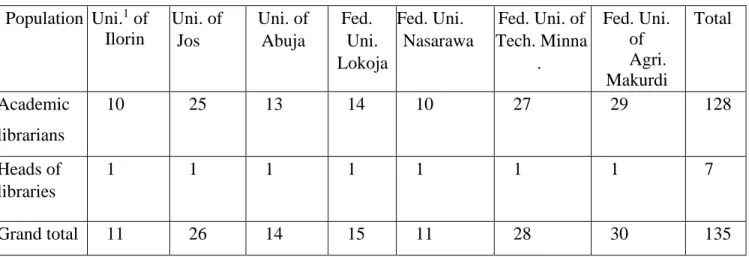
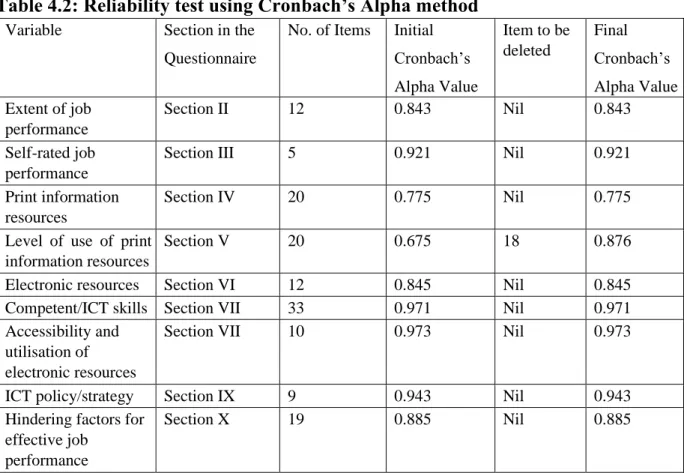
The reliability coefficient of the instrument was computed using Cronbach’s alpha (α) through a pre-test reliability method. A Cronbach’s alpha (α) value of r = 0.876 was obtained. The total enumeration technique was thereafter used to select academic librarians in the seven selected federal universities in the north-central region of Nigeria. One hundred and twenty-eight (128)
iv
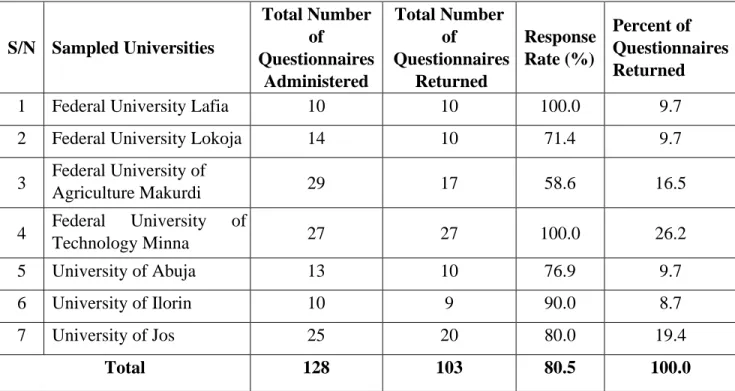
copies of a questionnaire were administered across the seven university libraries. Out of this total, 103 copies were duly completed and returned for quantitative analysis, giving a response rate of 81%. However, a response rate of 100% was achieved for the qualitative data. In addition, the census method was used, in line with Israel (1992). Copies of the survey questionnaire were used mainly to collect quantitative data from the academic librarians, while interviews were used to collect qualitative data from university librarians (heads of library).
The findings indicated that 90% of the respondents noted that there is high availability of information resources for their job performance. A relationship between level of information resources utilisation and academic librarians job performance was established in the selected university libraries at (β= 0.591; p<0.05). The hypotheses tested revealed that job performance was significantly related to information accessibility and information utilisation. Though, information availability was found to be positively related to job performance, the relationship was not statistically significant (β= 0.081; p>0.05). Theoretically, the study contributed to validating Maslow’s Hierarchy of Needs and Task-Technology Fit.
The need for university libraries to sustain awareness among library staff on the importance of engaging in the use of cataloguing services for effective job performance, maintenance of acquisition policy on selection of print and non-print information resources, provision of regular electricity supply, improved Internet connectivity, attendance of periodic ICT-based training and improved library budgetary allocation were recommended as strategies for effective job performance among the academic librarians in the selected university libraries in North-central, Nigeria.
v
DEDICATION
This thesis is dedicated to the Almighty God; my amiable wife, Bolanle Olubunmi Kutu; my beloved son, King-David Akorede Kutu; my mother; and my late father, Chief Obamorin Odugbe Owoleke.
vi
ACKNOWLEDGEMENTS
I give God the glory and honour. I am indebted to my supervisor Dr. Francis Garaba, for his admirable devotion to my studies, close supervision and technical advice in overcoming obstacles faced during the writing of my thesis. He is a great scholar.
My gratitude goes to my employer, University of Ibadan, Ibadan, for granting me study leave to undertake this PhD programme. I appreciate the chairman of Academic Staff Union of Nigerian Universities (ASUU) (University of Ibadan Chapter), Prof. Deji Omole and the Director of Academic Planning Unit, Prof. Victor Okoruwa for their effort in helping me in accessing the NEEDS ASSESSMENT fund. My gratitude also goes to ASUU National for the award of N250,000 PhD research grant. I extend my sincere thanks to the seven selected university libraries in North-Central Nigeria for granting me permission to undertake this research. I am equally grateful to the seven university librarians and their staff for their immense contributions in providing the data and information required during my research.
My special thanks go to my wife and beloved son Bolanle Kutu and King-David Akorede Kutu, for their unwavering and unconditional physical, emotional and spiritual support throughout my study. My sincere and heartfelt appreciation goes to my brother, Prof. Funso Raphael Kutu, for introducing me to the world of education and sacrificing every bit of his comfort to see me through. I am grateful to his lovely wife (who is more than a wife to me), Dr. Mrs Mercy Kutu, for supporting and standing by my family while I was away. I acknowledge the larger family, brothers and sisters for their continuous prayers, support and encouragement –Segun Kutu, Bosede Clement, Dr. Adebayo Augustine Kutu and his lovely wife, FebiShola Kutu, Lanre Kutu, Tai Kutu, Kehinde Kutu, and Obaloluwa Kutu. I wish to also acknowledge Dr. Hamzat for his assistance during my research; he ensured that the work is readable. Also acknowledged are my in-laws (Mr and Mrs Olorunfemi). I am also grateful to my uncle, friends and colleagues: Mr and Mrs Ogundele Oluseye, their children (they are my pillar in Ibadan), Dumebi Otulugbu, Adekunjo Olalekan, Mamudu Philomina, Ganiyu Quadril, Sarafa, Dr. Adegbore, Dr. Simon Adekunle (my analyst), Hon. and Dr. Mrs Agoro, Dr. Oladele (who granted the permission for the programme), Ojo Jacob, Simon Abogunde, the Oke family in Ibadan. I appreciate their enormous support. May God bless all of them.
vii TABLE OF CONTENTS Contents Title Page ... i DECLARATION ... ii ABSTRACT ... iii DEDICATION ... v ACKNOWLEDGEMENTS ... vi
TABLE OF CONTENTS ... vii
LIST OF TABLES ... xiii
LIST OF FIGURES ... xv
LIST OF ABBREVIATIONS AND ACRONYMS ... xvi
CHAPTER ONE: Introduction ... 1
1.1 Introduction ... 1
1.2 Background to the study ... 1
1.3 Brief historical development of the Nigerian educational system ... 5
1.4 The study site ... 6
1.5 Statement of the problem ... 10
1.6 Aim and objectives of the study... 12
1.7 Research questions ... 12
1.8 Research hypotheses ... 13
1.9 Significance of the study ... 13
1.10 Originality of the study ... 14
1.11 Overview of theoretical framework ... 15
1.12 Overview of literature review ... 16
viii
1.14 Ethical considerations ... 17
1.15 Delimitations of the study ... 18
1.16 Definition of key terms ... 18
1.17 Structure of thesis ... 19
1.18 Summary ... 20
CHAPTER TWO: Theoretical Framework ... 21
2.1 Introduction ... 21
2.2 The role of a theoretical framework in research ... 23
2.3 Theoretical framework in quantitative and qualitative studies ... 23
2.4 The theoretical perspective adopted for this study ... 24
2.4.1 Maslow’s Hierarchy of Need theory ... 24
2.4.2. Task-Technology Fit Theory ... 30
2.5 Summary ... 40
CHAPTER THREE: Literature Review ... 42
3.1 Introduction ... 42
3.2 Information resources/sources ... 43
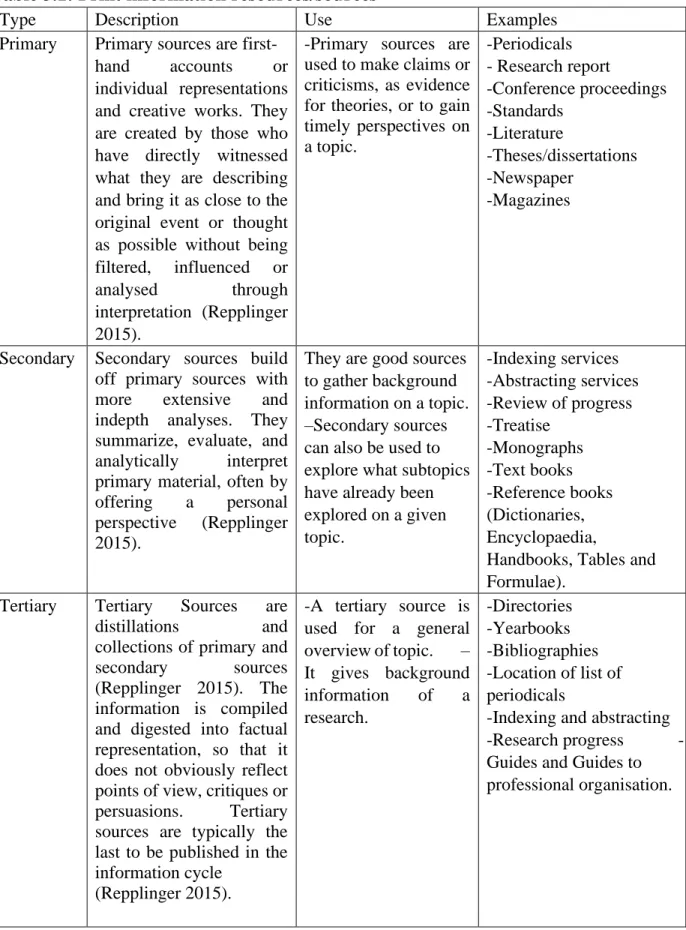
3.2.2 Secondary sources of information ... 50
3.2.3 Tertiary sources of information ... 52
3.2.4 Electronic Information Resources (EIRS) ... 53
3.3 Information resources availability ... 61
3.4 Information resources accessibility... 63
3.5 Information utilisation ... 66
3.6 Job performance of academic librarians ... 68
3.7 Factors inhibiting effective job performance of academic librarians in university libraries 71 3.8 Summary ... 76
ix
CHAPTER FOUR: Research Methodology ... 77
4.1 Introduction ... 77
4.2 Research paradigm ... 79
4.3 Research design ... 83
4.4. Location and population of the study area ... 84
4.5. Sampling procedure ... 86
4.6 Data collection methods ... 87
4.7 Data collection instruments... 88
4.7.1 Survey questionnaire ... 88
4.7.2 Interview questions ... 90
4.7.3 Mixed methods research ... 90
4.8 Reliability and validity of the instruments ... 94
4.10 Limitations of the study ... 97
4.11 Data analysis ... 97
4.12 Ethical issues ... 98
4.13 Evaluation of the research methodology... 99
4.14 Summary ... 101
CHAPTER FIVE: Data Analysis and Presentation ... 102
5.1 Introduction ... 102
5.2 Response rate ... 103
5.3 Biographical information of respondents... 105
5.4 Data presentation based on research question ... 108
5.4.1 Job performance of academic librarians in North-Central Nigeria ... 108
5.4.2 Level of availability and utilisation of information resources ... 111
x
5.4.4 Information resources availability, accessibility, utilisation and job performance among
academic librarians ... 118
5.4.5 Factors inhibiting academic librarians from fully utilising information resources for job ... enhancement. ... 123
5.5 Hypotheses testing ... 126
5.6 Results from structured interviews ... 129
5.6.1 How available and accessible are the following information resources in your university libraries? ... 130
5.6.2 How often do you access and use these resources to improve your job performance? ... 131
5.6.3 Heads of libraries’ rated job performance ... 131
5.6.4 What is the effect and constraints of information resources utilisation on academic ... 138
5.7. Summary ... 138
CHAPTER SIX: Interpretation and Discussion of Findings ... 140
6.1 Introduction ... 140
6.2 Socio-demographic characteristics of the respondents ... 141
6.2.1 Gender ... 141 6.2.2 Age ... 142 6.2.3 Academic qualification ... 142 6.2.4 Professional rank ... 143 6.2.5 Working experience ... 143 6.2.6 Salary structure ... 144
6.3 Job Performance of academic librarians in North-Central Nigeria ... 144
6.4 Level of availability and utilisation of information resources ... 146
6.5 Level of accessibility and utilisation of information resources ... 150
6.6 Relationship between information resources availability, accessibility, utilisation and job performance among academic librarians ... 151
xi
6.6.1 Discussion of the hypotheses ... 153
6.8 Factors inhibiting effective job performance of academic librarians ... 154
6.9 Summary ... 156
CHAPTER SEVEN: Summary of Findings, Conclusion and Recommendations ... 158
7.1 Introduction ... 158
7.2 Summary of the chapters ... 159
7.3 Summary of findings... 160
7.3.3 Level of accessibility and utilisation of print and electronic information resources ... 162
7.3.5 Obstacles to the use of information resources for effective job performance ... 164
7.4 Conclusion ... 164
7.5 Recommendations ... 165
7.5.1 Extent of job performance of academic librarians in North-Central Nigeria ... 165
7.5.4 Relationship between information resources availability, accessibility, utilisation and job performance ... 166
7.5.5 Obstacles to the use of information resources for effective job performance ... 167
7.6 Originality and implication of the study ... 168
7.6.1 Implication of the study ... 168
7.6.1.1 Theoretical implications ... 168
7.6.1.2 Practical implications ... 169
7.6.1.3 Policy implications... 169
7.6.1.4 Methodological implications ... 170
7.7 Limitations and suggestions for further studies ... 170
7.8 Summary ... 170
REFERENCES ... 172
xii
LIST OF APPENDICES
Appendix 1: Letter of Informed Consent ... 213
Appendix II: Questionnaire... 215
Appendix III: Interview Schedule ... 222
Appendix IV: Letter of Introduction (Federal University Lafia) ... 224
Appendix V: Gate keeper letter ... 225
Appendix VI: Letter of Introduction (Federal University Lokoja) ... 226
Appendix VII: Gate keeper letter ... 227
Appendix VIII: Letter of Introduction (Federal University of Agriculture Makurdi) ... 228
Appendix IX: Gate keeper letter (Federal University of Agriculture Makurdi) ... 229
Appendix X: Letter of Introduction (Federal University of Technology Minna) ... 230
Appendix XI: Gate Keeper Letter ... 231
Appendix XII: Letter of Introduction (University of Abuja) ... 232
Appendix XIII: Gate Keeper Letter ... 233
Appendix XIV: Letter of Introduction (Univeristy of Ilorin) ... 234
Appendix XV: (Gate Keeper Letter) ... 235
Appendix XVI: Letter of Introduction (University of Jos) ... 236
Appendix XVII (Gate Keeper Letter) ... 237
Appendix XVIII: (Ethical Clearance) ... 238
xiii
LIST OF TABLES
Table1.1: Mapping research questions to theoretical theories ... 16
Table 2.1: Illustration of workplace motivation theories ... 29
Table 3.1: Print information resources/sources ... 46
Table 4.2: Reliability test using Cronbach’s Alpha method ... 95
Table 5.1: Response rate from survey {Number of observation (n)=103} ... 104
Table 5.2: Background information of respondents {(n)=103} ... 106
Table 5.3: Job performance of academic librarians in North-Central Nigeria {(n)=103} ... 109
Table 5.4: Self-rated job performance of academic librarians {(n)=103} ... 110
Table 5.5: Availability of print information resources {(n)=103} ... 112
Table 5.6: Level of use of print information resources by academic librarians{(n)=103} ... 114
Table 5.7: Accessibility of print information resources {(n)=103} ... 116
Table 5.8: Accessibility and utilisation of electronic resources {(n)=103} ... 117
Table 5.9: Electronic resources {(n)=103} ... 119
Table 5.10: Task-Technology Fit (TTF) reference{(n)=103} ... 121
Table 5.11: Obstacles to the use of information resources for effective job performance {(n)=103} ... 124
Table 5.12: Model summaryb ... 126
Table 5.13: ANOVAa ... 126
Table 5.14: Coefficients ... 127
Table 5.15: Mean, Standard Deviation ANOVA Results of Information Availability, Accessibility and Utilization ... 129
Table 5.6.16: Summary of interview responses on information resources ... 130
Table 5.6.17: Summary of interviews on accessibility and utilisation of both electronic and non-electronic resources ... 131
xiv
Table 5.6.18a: How competent does the group under your supervision perform their job? ... 133
Table 5.6.18b: How effective does the individual get work done? ... 134
Table 5.6.18c: Overall quality of individual grouping work ... 135
Table 5.6.18d: Overall perceived competencies of individual grouping ... 136
Table 5.6.18e Overall quantity of individual work. ... 137
Table 5.6.19: Effect and constraints of information resources utilisation on academic librarians’ job performance ... 138
xv
LIST OF FIGURES
Figure 1.1: Map of Nigeria, showing the six regions and the location. ... 10
Figure 2.1: Maslow’s Hierarchy of Needs Theory ... 28
Figure 2.2 Task-Technology Fit ... 35
Figure 2.3 Technology-to-Performance Chain………..…………39
xvi
LIST OF ABBREVIATIONS AND ACRONYMS AAAE: American Association for Agricultural Education AAU: Association of African Universities
ACM: Association for Computing Machinery
AGORA: Access to Global Online Research on Agriculture Program ANOVA: Analysis of Variance
ARCOM: Association of Researchers in Construction Management ASUU: Academic Staff Union of Universities
CAZRI: Central Arid Zone Research Institute
CD: Compact Disk
CD-ROM: Compact Disk- Read Only Memory
CIA: Central Intelligence Agency
COREVIP: Conference of Rectors, Vice Chancellors and Presidents of African Universities
CVI: Content Validity Index
DAI: Dissertation Abstracts International DPM: Data Protection Manager
DVD: Digital Versatile Disc E-book: Electronic Book
EBSCOhost: Elton B. Stephens Company EIRs: Electronic Information Resources E-journal: Electronic Journal
FCT: Federal Capital Territory
FUT: Federal University of Technology
HINARI: Health Internetwork Access to Research Initiative
IBB: Ibrahim Badamosi Babangida
ICT: Information Communication Technology IDT: Innovation Diffusion Theory
xvii
IEEE: Institute of Electrical and Electronics Engineers IFAS: Institute of Food and Agricultural Sciences
IFLA: International Federation of Library Associations and Institutions IIC: Integrated Information Centre
IRS: Internal Revenue Services
IT: Information Technology
JSTOR: Journal Storage
LIS: Library and Information Science MDG: Millennium Development Goal MIS:
MMR:
Management Information Systems Mixed Method Research
MoA: Memorandum of Action
MPCU: Model of Personal Computer Utilization
N.D: No Date
NLAOF: Nigerian Library Association Online Forum NUC: National Universities Commission
OARE: Online Access to Research in the Environment
OPAC : Online Public Access Catalogue
PCs : Personal Computer
PDF : Portable Document File
PNLA: The Pacific Northwest Library Association RFID: Radio Frequency Identification
SD: Standard Deviation
SDI: Selective Dissemination of Information SPSS: Statistical Package for the Social Sciences
SRELS: Sarada Ranganathan Endowment for Library Science TAM: Technology Acceptance Model
TEEAL: The Essential Electronic Agricultural Library TPC: Technology-to-Perform Chain
xviii
TTF: Task-Technology Fit
UENR: University of Energy and Natural Resources UHAS: University of Health and Allied Sciences UKZN: University of KwaZulu-Natal
UN: United Nations
UNESCO: United Nations Educational, Scientific and Cultural Organization UNDP: United Nations Development Programme
USA: United States of America
UTAUT: Unified Theory of Acceptance and Use of Technology VIF: Variance Inflation Factor
1
CHAPTER ONE: Introduction
INTRODUCTION 1.1 Introduction
Today’s academic libraries are multifaceted institutions with different roles and a host of related operations and services developed over a long period of time. Nevertheless, the main purpose of the academic library is to provide access to all sources of information for varying needs. Academic libraries and other types of libraries stood unchallenged throughout the world especially in the developing countries as the primary providers of historical record. When librarians needed reliable information for their job performance, most especially within the framework of tertiary institution, they often turned to academic libraries. This study intends to investigate availability and utilisation of information resources by academic librarians for job performance enhancement in selected university libraries in North-Central Nigeria. The chapter presents the background to the study, brief historical development of Nigerian educational system, the study site, definitions of key terms, statement of the problem, objectives of the study, research questions, research hypothesis, significance of the study and originality of the study. The theoretical framework and preliminary literature review used in the study are also provided. In this study, the research methodology employed for data collection and population determinant are explained. Lastly, ethical considerations, delimitation of the study and a short discussion of the structure of the study, are discussed. The next section reviews the background to the study.
1.2 Background to the study
Availability and utilisation of information resources are variables that determine job performance of academic librarians. Adomi (2012:17) noted that information resources are media from which an individual or a group of people receive concepts, messages and direction that enable them to accomplish a given task such as taking a vital decision, as well as solving a problem. Performance is concerned with the alignment of the objectives of an organisation vis a vis the employees' agreed measures, competence, skills, development plans and results delivery. According to Campbell (1990), job performance is a means to reach a goal or set of goals within a job or organisation but not the real consequences of the acts performed within the job. Employee job performance, therefore, encapsulates the behaviour individuals engage themselves in or produce in the
2
workplace which are in line with and contribute to an organisation’s goal (Ikyanyon and Ucho 2013).
Similarly, job performance can by and large mean the efforts put forth at work by the employees towards achieving an organisational goal (Motowidlo, Borman and Schmidt 1997). Despite the relevance of job performance as an outcome measure in empirical studies, it has been adequately investigated by researchers that self-rated and supervisor-rated measurement scales are best methods of determining individual job performance (Heilman, Block and Lucas 1992). Self-rated measurement scale is an approach that allows individual participants to rate themselves on job performance, while supervisor-rated is an approach that allows only supervisor to rate his subordinate. Campbell (1990:704) linked the content and structure of performance to ''a virtual desert''. The author further described performance as an occupation that is carefully conducted with combination of different elements for the purpose of achieving result from a specific activity.
In elaboration, authors agree that when conceptualising performance, one has to differentiate between actions, that is, behavioural and outcome features of performance (Campbell 1990; Kanfer 1990; Campbell et al. 1993; Rose 1999). According to Campbell et al. (1993), performance must be distinguished from effectiveness and productivity or efficiency. Effectiveness refers to the evaluation of results of performance, while productivity refers to the ratio of effectiveness to the cost of attaining the outcome. Similarly, availability of information resources should also be distinguished from utilisation. Availability of information resources means their presence in libraries for immediate use (Aguolu and Agaolu 2002). Information resources might be available, that is, the library might have acquired them, but they may be inaccessible to those who need them for whatever reason (uncatalogued, mis-catalogued, mis-shelved or lost).
The word information has become famous since the 1950s. The era of globalisation has forced universities and other organisations to search for the best forms of information to face the challenges of their future engagement. Nations across the globe have reacted differently to the dynamic nature of the information environment that influences their lives as information has changed from traditional to modern. It is the knowledge of information that contributes to the economic, cultural, social and political well-being of society (Cogburn 1998). In any academic
3
institution, a library is established as a critical component of institutional infrastructure that supports teaching and learning activities through the provision of necessary information resources to users. Mason (2010) views the mission of the academic library as having to build and maintain a collection that will support the growth of information and job performance of both academic librarians and other library users.
Inadequate modern information resources have been the main reasons why some university libraries in Africa are not measured up to their contemporaries in the western world on job performance. In other words, they do not place much value on information (Abrahams, Burke and Mouton 2009/2010). Since most institutions acquire resources to support teaching and learning from the library, it is expected of librarians to ensure they have the commensurate information skills required to be productive. Effective job performance is said to be impeded because of the inability of some African university libraries to provide modern information resources through internet connectivity. The provision of timely information in university libraries as a result of modern Information Communication Technology (ICT) infrastructure has led to increases in job performance in advanced countries (Benat, Soumitra and Bruno 2013). This poses a challenge as to whether equal information availability and utilisation opportunity can lead to a comparative increase in job performance in African university libraries (Frankor and Akussah 2012:34). If academic librarians in African university libraries have easy access to modern information resources and technologies, it is most likely that the quality of their job performance will increase and this will have a consistent positive impact on their job performance and output compared to that of developed countries (Foster et al. 2008 and Frankor and Akussah 2012).
From the global viewpoint, it is availability of information resources that makes utilisation possible, while it is utilisation that makes performance achievable. Thus, the combination of availability of information resources and information technology may improve job performance of academic librarians. However, there is need for all developed and developing countries of the world to take information as tools that assist the enhancement of job performance of academic librarians through the use of modern information resources (Rosenberg 2005; Chuene 2000; Lancaster and Sandore 1997; Rada 1994). This can be possible if academic librarians realise the enormous role information resources play in improving efficient services. In Canada, for instance,
4
information resource utilisation and its effect on job performance of academic librarians have been adopted. Librarians are leaders in using technology to improve traditional library resources and services to meet the challenges of the 21st-century. In Africa, a committee was set up by the government and mandated to design an information technology/information resources plan for the country and ensure all libraries are ICT compliant for the betterment of the country (Olise 2010). The foregoing reiterates government’s commitment to improving library services and performance.
It is observed that Nigerian university scholars are not measured up compared to their contemporaries in advanced countries in terms of job performance (Ani et al. 2016; Madukoma and Opeke 2013; Madukoma and Popoola 2012; Frankor and Akussah 2012; Adams, King and Hook 2010; Foster et al. 2008 and Aguolu 1996). Part of the problem has been traced to inadequate modern information resources and poor electricity supply in most of the university libraries resulting in low level of availability and utilisation of information. Therefore, for the purpose of this study, the working definition of information will be within the realm of science and technology; information as knowledge which is transferable and information as a basic resource that links a variety of activities involving individuals, institutions and society (Adewole 2001 cited in Aderanti and Adedotun 2015: 1346).
In the same vein, the present study views information resources as a collection of library information materials significant to users’ needs which should be managed by librarians. These resources consist of journal collections, students’ research projects, newspapers/magazines, books/monographs, conference proceedings, computers, databases, abstracts and indexes, government documents, conference proceedings, theses and dissertations, internet, online information resources and ICT tools. These are essential resources needed by academic librarians to improve job performance. Academic librarians are professionally trained persons who have earned a minimum of master’s degree in Library Studies or cognate fields and are engaged in library services (Robert 2014).
Discussed in the next section is the historical development of Nigerian educational system.
5
1.3 Brief historical development of the Nigerian educational system
Nigeria had a population of 186,053,386 million people in 2016 and a projected population of 392 million in 2050 (CIA World Fact Book 2017). Nigeria is geographically situated on the north of the Gulf of Guinea in West Africa. It has a space of about 923,768km2 and is bordered to the east by Chad and Cameroun, to the north by the Niger Republic, to the West by the Republic of Benin and to the south by the Gulf of Guinea (Encyclopaedia Britannica 2002). There are 36 states and 774 local government areas. Each state is governed by the governor while the local government area is under the leadership of the Chairman/Chairperson (Nigeria Country Profile 2008: 17-18). Lately, the 36 states of Nigeria were structured into six geo-political zones, in particular: South-South, South-East, South-West, North-East, North-West and North-Central (Okorie, Ademowo, Saka, Davies, Okoronkwo, Bockarie, Molyneux and Kelly-Hope 2013: 3). Although these zones are not contained in the Nigerian constitution, they structure the reason for some changes that occur in political circles, particularly in zones of political arrangement, situating of government ventures and different types of bureaucratic character consistency. In each of these states, there is federal university, while each state government also has a state-owned university.
Before the arrival of British colonialists in the early 19th Century, there were two types of education systems. In the northern part of the country the instruction was carefully a strict issue which included the educating of Qur'an and the Arabic letter set (Baba 2011). Then again, the indigenous framework was the second kind of education before the arrival of British colonialists. Students were taught the practical skills needed to function successfully in traditional society. In the 1840s, Western education was presented by British evangelists. The Anglican Church Missionary Society floated a few schools in the mid-1800s in which the British frontier government gave the congregation financial support and by the mid-twentieth century, the administration started structure erection with optional schools. At that point, the British merged the northern and southern areas into one state in the year 1914. At that time, a total of 11 optional schools were functioning, except the ones under the control of missionaries. During that period, Western training gradually entered the northern district. By 1947, only 66,000 students were enrolled in grade school in the north and after ten years, the rate of enrolment during this period increased to 206,000 students; while in the western area at this period, number of students selected increased from 240,000 to 983,000. The eastern area encountered the most dramatic changes in
6
essential enrolment during this period, springing from 320,000 to 1,209,000 students. The number of secondary school students in the whole nation developed significantly, expanding from 10,000 out of 1947 to 36, 000 of every 1957. A large portion of this development (90%) was altogether in the south (Zurlo 2017).
In the 1950s, Nigeria adopted Form Six, a British system of education that structured secondary education into six years - three junior secondary years, two senior secondary years and a year university preliminary programme. Any candidate that scores very high at the end of Form Six examination at the end of Form Six were usually admitted into universities. As of Nigeria’s independence in 1960, with about 6,000 students, there were only six higher educational institutions in Nigeria out of which three were established in the west, two in the south and one in the north (Zurlo 2017).
This takes us to the study site which shall be discussed in the next section.
1.4 The study site
The study will be limited to some of the universities in Northern part of Nigeria. These seven federal universities include Federal University Lokoja, Federal University Lafia, University of Ilorin, University of Jos, Federal University of Technology Minna, Federal University of Agriculture Makurdi and University of Abuja all in North–Central region of the country. The northern part of Nigeria consists of three regions, namely the North-East, the North-West and the North-Central. The North-Central region which is blessed in natural resources is made up of seven states situated in the middle belt region of Nigeria. The Nigeria’s system of government allows for division of power between federal, state and local governments. With the total number of 36 states in Nigeria, these states are divided into six geo-political regions. The North-Central has the highest number of states which are Niger, Kogi, Benue, Plateau, Nasarawa, Kwara and Federal Capital Territory (FCT) Abuja. It is important to have an in-depth understanding of these seven federal universities in the North-Central region of Nigeria.
University of Abuja was established January 1, 1988 (under Decree No. 110 of 1992 as amended) with mandate to run a distance learning and conventional programmes simultaneously as the first university in Nigeria to assume such a dual mandate (Becky 2009). The university is committed to
7
and seeks academic excellence in ensuring equal education for all. University of Abuja library was established the same year the university was founded. The university took off from the temporary site in Gwagwalada, tagged as the 'mini- campus'. Presently this university is operating from both the main and the mini campuses (University of Abuja: n. d). The mini campus library with a seating capacity of 420 readers ceased to be the main library in August 2014 as a result of the completion of the Central Library at the main campus. The total number of staff in the college library is as of now sixty-two (62) with 13 professional librarians, 11 non-professional administrators and other senior supporting staff, and 38 junior staff. The library is headed by a University Librarian with other staff. The newly constructed Central Library is located along airport road Abuja with a seating capacity of 3000 readers at a time (University of Abuja: n.d.). The library began the integration of information resources into hybrid services in 2005 and the process is still in progress. Although all these hybrid services are provided to assist teaching and learning, they also improve job performance of all the academic librarians (Seidu 2012: 6).
The Federal University of Technology also known as FUT Minna is a federal government-owned university situated in North-Central region of Nigeria. It was established on 1 February 1983 with the objective of providing the nation with much needed reliance in Sciences, Technology and Engineering (STEM). It is a specialised university of technology. The university library otherwise known as Ibrahim Babangida (IBB) library was established in 1988 at the inception of the university. The library has an annex at Bosso campus. In all, the libraries has a seating capacity of 2,200. The library has attempted to integrate its services, particularly the serials collections in the last six years. As a result of this, some of its journal collections have been converted into digital form.
University of Ilorin was another federal government-owned university established in 1975. The university was situated in Ilorin, Kwara State capital in North-Central, Nigeria. The university was established in order to execute one of the educational visions of the country's third National Development Plan. The aim is to provide Nigerians opportunities to acquire higher education and to generate high level of human resources that are vital for the rapid economic development. University of Ilorin library was established in 1976 with a seating capacity of 2,400. The library
8
has various information resources that assist members of the university community to improve their job performance. The university provided different electronic resources such as CD-ROMs, databases, e-journal and OPAC (University of Ilorin 2011).
In October 1975, the military government established seven additional universities, including University of Jos, which was established with a vision of being an innovative university with great interaction between town and gown. Today, the institution carries a high responsibility of preparing students for the future. The institution’s library is committed to providing education that is globally competitive to the needs of employers and the developing of students to face the challenges of Nigeria and beyond. The university library was established in 1975; it is as old as the university itself. It has a seating capacity of 2,350 for readers. The library has been providing information resources services to its users for effective and efficient service delivery (University of Jos: n.d).
The Federal university Lokoja, also known as Fulokoja, is one of the eight federal universities created under the administration of the immediate past president (Goodluck Ebele Jonathan) of the Federal Republic of Nigeria. The university was established on 16 February 2011 and situated in the confluence city of Lokoja, the capital of Kogi State, North-Central Nigeria. As part of the requirements of the National Universities Commission (NUC), the university was established with the state-of-the-art library to provide information resources to support the teaching, learning and research activities of the parent institution. The university library was later devolved into faculties with intention of accommodating the teeming population of students and staff of the university. The library has a seating capacity of 635 readers at a time with electronic library facilities. The library is also enjoying the subscription of full-text databases.
Federal University of Agriculture, Makurdi is located in the capital city of Benue State of Nigeria. It occupies a land area of 8,048 hectares, thus making it the largest holder of agricultural land mass among universities of its kind (Seidu 2012: 8). The university serves 19 states in the Northern part of the country and Federal Capital Territory. It has a modest seating capacity of 1550 readers at a time. The establishment of universities of agriculture came into effect on l January 1988 following a demerger process that resulted in simultaneous coming on stream of the two universities of
9
agriculture located in Makurdi in Benue State, and Abeokuta in Ogun State (University of Agriculture Makurdi: n.d.). The university library is named Francis Idachaba library, which was established in 1988, the same time the university was established. The essence of establishing the library is to provide resources that will enhance the academic activities of lecturers, students and other community of users. The library is the heart-beat of the institution which serves as the educational life-wire of every serious clientele Barman (2011) describes library as change agent that requires constant positive changes to go along with the changing personality of its users - a development that has necessitated the University of Agriculture, Makurdi to expand the library collection (both print and electronic). The library is also enjoying the subscription of full-text databases such as EBSCOHOST, AGORA, HINARI and OARE and intranet materials (E-silo, LanTEEAL). These resources are downloadable at user’s convenience (Ugah 2017).
The Federal University Lafia was established in 2011 along with nine other universities by former President of Federal Republic of Nigeria, President Goodluck Jonathan. The university was established to increase access to, and improve the quality of education, particularly in a state that had no federal university present. The university is located in Lafia, the capital city of Nasarawa State, part of North-Central Nigeria. Academic activity started in September 2012 with just 247 students in 11 programmes and just three faculties (Admin 2015).
For further clarity of the geographical spread in Nigeria, a map showing various states of Nigeria is presented in Figure 1.1. Nigeria has 36 states with Abuja as the federal capital.
10
Figure 1.1: Map of Nigeria, showing the six regions and the location (shown in green) of the present study (Source: SkyscraperCity.com 2011).
In the next section, the statement of the problem is identified and presented.
1.5 Statement of the problem
University libraries are often established primarily to provide both staff and students of the parent institution with unhindered access to information resources. Academic librarians are expected to make use of these resources for the enhancement of their job performance. However, a sizeable number of studies in the literature reported poor use of library resources by academic librarians (Olasore and Adekunmisi, 2015; Ani 2013; Madukoma and Opeke, 2013; Madukoma and Popoola 2012). This is attributed to factors ranging from obsolete equipment in the libraries, poor internet connectivity and stringent working conditions. This submission is however against the findings of Heilman, Block and Lucas’s (1992) which reported that the use of self-rated scale brought about bias on job performance rating rather than the use of both self-rated and supervisor-rated scale measurement to determine librarians’ job performance. These divergent views (self-rated and
11
supervisor-rated) as noted by Madukoma and Opeke (2013) and Heilman, Block and Lucas (1992) created a gap that needed to be investigated.
This study, therefore, examined the availability and utilisation of information resources in some selected Nigerian university libraries vis-a-vis job performance enhancement of academic librarians. In another development, Ani’s (2013) study is only limited to utilisation of electronic information resources without considering the non-electronic resources. Further findings from Ani (2013) view accessibility and utilisation as a single construct to determine job performance of academic librarians. Therefore, this study considers both electronic and non-electronic resources as determinants of job performance. Also, availability, accessibility and utilisation will be examined as three different concepts that determine job performance. These are the gaps that necessitate this present study.
In addition, the issue of globalisation tends to affect the pattern of access and use of electronic information materials amid academic librarians. With globalisation, the world now is seen like one village (Hamdi 2015: 1) in such a way that what is happening on one side of the world can easily be seen from the other side. Studies, such as Ani (2013); Okiki (2013); Lamptey, Boateng and Antwi (2013); Madukoma and Opeke (2013); Frankor and Akussah (2012); Adams, King and Hook (2010) and Aiyetan and Olotuah (2006), have shown that academic librarians in Africa and particularly in Nigeria are lagging behind in terms of job performance compared to what happens in the developed countries. The reasons provided by such studies include inadequate fund and poor electricity supply.
Despite these assertions, the review of literature showed that none of the existing studies have been able to address the availability and utilisation of information resources for job enhancement by academic librarians in selected libraries particularly in North-Central Nigeria. As a result of the foregoing, this study is important as it observes that if such a situation persists, there is a great possibility of the academic librarians in Nigeria migrating from the world of globalisation where colleagues in the profession enjoy the benefits of the available information resources in either of the formats. Hence, there is need for academic librarians in Nigeria to strive adequately in the use of electronic information resources in order to meet up with the information service provision of
12
the 21st century as well as for them to compete favourably with their counterparts in the other parts of the world. Having stated the research problem, it is imperative to examine the purpose of this study. Hence, the next section presents aims and objectives of the study.
1.6 Aim and objectives of the study
The purpose of the study is to examine availability and utilisation of information resources by academic librarians for job performance enhancement in selected university libraries in North-Central Nigeria. The main objectives of the study are to:
1. determine the extent to which academic librarians in universities in North-Central Nigeria perform their jobs;
2. examine the level of availability and utilisation of information resources as well librarians’ job performance in selected university libraries in North-Central Nigeria;
3. to assess the extent of accessibility and utilisation of information resources among academic librarians in selected university libraries in North-Central Nigeria;
4. ascertain the relationship between information resource availability, accessibility, utilisation and job performance of academic librarians in selected university libraries in North-Central Nigeria;
5. ascertain factors inhibiting the use of information resources for job enhancement among academic librarians in universities in North-Central Nigeria.
Arising out of the identified objectives, the following research questions guided this study:
1.7 Research questions
The study is guided by the following research questions:
1. To what extent are university academic librarians in North-Central Nigeria performing their jobs?
2. What is the level of availability and utilisation of information resources by academic librarians in selected university libraries in North-Central Nigeria?
3. What is the level of accessibility and utilisation of information resources academic librarians in selected university libraries in North-Central Nigeria?
13
4. What is the relationship between information resources availability, accessibility,
utilisation and job performance among academic librarians in North-Central universities? 5. What are the factors that inhibit academic librarians from fully utilising information resources
for job enhancement in selected university libraries in North-Central Nigeria?
The following hypotheses are developed to answer research questions 2, 3 and 4 raised above:
1.8 Research hypotheses
H01: There is no significant relationship between information availability and job performance among academic librarians in North-Central Nigeria.
H02: There is no significant relationship between information accessibility and job performance among academic librarians in North-Central Nigeria.
H03: There is no significant relationship between information utilisation and job performance among academic librarians in North-Central Nigeria.
H04: There is no significant relationship among information availability, accessibility and information utilisation among academic librarians in North-Central Nigeria.
1.9 Significance of the study
As Nworgu (1991:67) has asserted, ‘the significance of a study is required because it tries to determine whether the research is of practical or professional value to the society’. This study contributes to literature by providing empirical evidence on the hinderance to the use of information resources for job performance enhancement among academic librarians specifically from a developing country perspective such as Nigeria. It also contributes to practice by providing a deep understanding of the best predictors of information resources availability and use among academic librarians from a developing country context. The study provides necessary information on developing capacity building plans and strategies for ICTs implementation and electronic information resources as emerging tools for universal research and integration in Nigeria. In addition, it provides data that may assist the universities in Nigeria in the formulation of relevant policies at the institutional and national levels for effective job enhancement. The study explicates the explanatory power of the Maslow and TTF in predicting job performance especially in the context of a developing nation. The study contributes to the following:
14
Knowledge: The study contributes to the literature on information resource and librarians’ job performance in its attempt to provide theoretical understanding of the key concepts. It bridges the gap found in some current studies. It can also be used as basis for comparing findings of similar studies and building theoretical or conceptual frameworks.
Practice: The study is useful to librarians, the management team and practitioners as it could help to establish the relationship that exists between the constructs of information resources and job performance. Also, the study could assist university library management in identifying gaps that exist in the library and create room for new innovations as modern tools for global research. Policy: The studyserves as a basis for re-evaluation, re-focusing and re-strategizing job performance activities of librarians through the provision of clear policy direction and implementation strategies for a robust intellectual asset management in Nigerian university libraries.
Further Research: The study will evoke new approaches either to validate the findings or dispute, or to expand its findings.
1.10 Originality of the study
Originality is a key factor in evaluating a PhD research. Originality in research is ''novelty'' which means that the research in question must have substantial contribution(s) to present knowledge in a particular discipline. Originality goes beyond knowledge building and reflects the researcher’s authenticity throughout the research process (Guetzkow and Lamont 2004).
According to Cryer (2000: 190), the area in which novelty/originality can be used include research methodology, data analysis, investigation of new knowledge and research outcome. The University of Melbourne Academic Skills Unit (2010:3) highlighted 19 standard criteria which a study must satisfy to achieve its originality. Some of the criteria the investigator considered to be important to this present study, as suggested by the University of Melbourne Academic Skills Unit (2010:3) who cited Phillips and Pugh (1994:61-62), are listed below:
• application of existing ideas to new areas of study;
• demonstration of originality by testing someone else’s idea;
• employing a different methodological approach to solve a problem;
• conducting empirical work that has not been done before; and
15
The present study was based on the studies conducted by Olasore and Adekunmisi (2015) and Ani (2013) that propose how availability, accessibility and use of electronic information resources may significantly affect job performance of academic librarians. Novelty/originality of this study establishes testing of the above proposition with empirical investigation in some academic libraries in Nigerian universities. Since this study mainly focused on an important aspect of educational system in Nigeria, it is considered appropriate to explain the theoretical framework upon which the study is based. Similarly, the essence of the theories is to espouse the relationship that exists among the variables of interest in the study.
1.11 Overview of theoretical framework
The theoretical framework that guides this study are Maslow’s Hierarchy of Needs Theory and Task-Technology Fit. The choice of these theories was inspired by their richness and high descriptive features characterised by an identification of goals to measure performance and use. Motivation has been identified by scholars as a key factor that has a significant influence on human behaviour and action (Saade, Nebede and Mark 2009). These theories are used in this study to explain possible variation in the extent of availability and utilisation of information resources as well as job performance among academic librarians in North-Central university libraries. In line with the research questions 3 and 5 for the study, the need for self-actualisation drives academic librarians to be involved in higher job performance.
In line with the research questions 1, 2, and 4 for the study, the Task-Technology FitTheory (TTF) will provide a guide in exploring availability and utilisation of information resources as determinants of academic librarians’ job performance - see Table 1.1 for details.
16
Table1.1: Mapping research questions to theoretical theories
S/N Research questions Theory and
the construct 1 To what extent are university academic librarians in North-Central
Nigeria performing their jobs?
Maslow (self-actualisation) 2 What is the level of availability and utilisation of information
resources in university libraries in North-Central Nigeria?
TTF
(availability) 3 What is the level of accessibility and utilisation of information
resources in selected university libraries in North-Central Nigeria? TTF
(utilisation) 4 What is the relationship between information resources availability,
utilisation and job performance among academic librarians?
TTF
(accessibility) 5 What are the factors that inhibit academic librarians from fully
utilising information resources for job enhancement in selected university libraries in North-Central Nigeria?
Maslow (esteem need)
How the theories have been applied in similar studies will be reviewed in the literature review in Chapter Three.
1.12 Overview of literature review
Previous literature review providing the foundation for this research was drawn from both empirical and conceptual studies. Literature was sourced from books, journals, theses, conference proceedings, technical reports and databases such as ProQuest, Web of science, JSTOR, ERIC etc. In addition, most of the literature reviewed was undertaken largely from Nigeria, Africa and the international context in view of emerging trends in the ICT environment.
Thematically, the studies in extant literature covered extensively the following areas: information resources/sources, information resources availability, information resources accessibility, information resources utilisation, job performance and factors inhibiting effective job performance. Theoretically, extant studies relied on Motivational Theories, User’s Acceptance of Information Technology Theory, System Resources Theory and Maslow Theory (Okiki 2013; Wanjuku 2013 and Ani 2013). Similarly, from the methodological perspective, extant studies on
17
job performance and information resources use have extensively utilised quantitative approach (Nkedife 2015; Ani, Ngulube and Onyancha 2014; Madukoma and Opeke 2013; Amusa, Iyaro and Olabisi 2013 and Madukoma and Popoola 2012). For these reasons, the current study addressed these gaps through the research questions as reflected in Table 1.1.
1.13 Overview of research methodology
Research methodology is a systematic way of solving a problem. It is a science of studying how research is to be carried out. The study was premised on the post positivism paradigm. The post positivists theorise that “any perception of reality is drawn from empirical observation and existing theory with the basic concepts of quantification and generalization” (Pickard 2007:10). The ontological belief of post-positivists is critical realism; the ethical behaviour (axiology) is based on respecting privacy of respondents through the use of informed consent in research. This research paradigm is consistent with the mixed method approach, which can combine qualitative and quantitative design for data collection. Creswell (2014) found the use of post positivist paradigm vital in a research. The mixed method approach was adopted for the study. A descriptive survey research design was utilised for this present study. This allowed the effective collection and processing of data that were collected through structured and semi structured questionnaires administered to a sample of 128 academic librarians and seven (7) Heads of libraries respectively. The reliability and validity of instruments was achieved using Cronbach alpha measures. Quantitative data were analysed using SPSS software while the qualitative data was analysed thematically.
1.14 Ethical considerations
A study of this nature requires the need to uphold ethics in order to avoid conflict of interest. Ethics are the standards that govern the conduct of an individual especially when carrying out a research. The researcher obtained ethical clearance for the study from the University of KwaZulu-Natal and then permission from the seven selected university libraries. The researcher ensured that respondents were guaranteed maximum confidentiality in terms of the information they divulged and that the information given would be strictly used for research purposes.
18
1.15 Delimitations of the study
The study is specifically delimited to seven university libraries of federal universities in the North-Central that were established between1975-2011. In other words, it does not cover all the academic libraries but limited to federal university libraries. The study covers all the seven states in North-Central Nigeria. In Nigeria, the educational institutions are broadly divided into three, namely federal, state and private in terms of ownership. The federal universities are universities that are under the control of the federal government. The choice of North-Central for this study is purposive because the region has the highest number of academic librarians working in federal universities compared to other regions in the country (Nigerian Library Association Online Forum 2016).
The theoretical framework upon which this study is built are Task-Technology Fit (TTF) theory and Maslow’s Hierarchy of Needs theory which cover the research paradigm and approach that was used for the study. TTF and Maslow are adopted for the study because of the strengths and relevance they have over other theories, such as TPC, Utilisation theory TAM and UTAUT theory. Having stated the delimitations of the study, it is therefore, necessary to outline the structure of the thesis in the next section.
1.16 Definition of key terms The following terms were operationalised in the course of the study:
Academic libraries: An academic library is a library that exists in higher institution of learning. Its two major purposes are to support curriculum implementation and the research of university faculty members and students (Curzon and Quiñónez-Skinner 2009). An academic library in this present study, has various roles in providing and facilitating utilisation of information resources to both students and academic librarians for their job performance.
Academic librarian: A person with a minimum qualification of master’s degree in Library and Information Studies related disciplines that work in the library or teach and conduct research
(Bassey 2006). Also, academic librarians are personnel trained in the art of information management and are responsible for organising, evaluating and disseminating information, providing support to members (students, researchers and lecturers) of an academic community.
Information availability: Information availability means ensuring the presence of information resources in libraries for immediate use (Aguolu and Aguolu 2002).
19
Information accessibility: Information accessibility is the ability to get, locate or obtain both print and e-information resources with ease in the conduct of research (Ameen and Awais 2015:103). Thus, information accessibility in this study is considered as a process in which academic librarians can easily find and locate information materials.
Information utilisation: Information utilisation is the ability to use various sources of information in the conduct of research (Borgman 2000:18). Utilisation informs the ease of use of both print and e-resources through ICTs.
Information resources: In this present study, information resources are defined as collections of non-human information resources in the library relevant to the needs of academic librarians and other library users.
Job performance: Job performance is considered as an output of the librarian on the job, measurable in terms of quality and quantity of job done (Oduwole 2004).
1.17 Structure of thesis
Chapter One presented the introduction and background to the study, statement of the problem, objectives of the study, research questions, significance of the study, delimitation of the study, rationale for the study and definition of key terms. It also provided an outline of the research methodology used for this study as well as ethical consideration.
Chapter Two examines the theoretical framework grounded on availability and utilisation of information resources as determinants of librarians’ job performance which form the basis of the study. In this case, Maslow’s Hierarchy of Needs Theory and Task-Technology Fit and their application to the study are justified.
Chapter Three focuses on comprehensive review of existing literature in related areas of the research based on objectives of the study and research questions. It highlights what has been done, existing gaps in literature and the contribution of the study.
Chapter Four: Research methodology: This chapter discusses the post-positivist paradigm underpinning the study. The survey research design is elaborated on. The qualitative and quantitative methodological approaches and their attendant methods are equally explored.
20
Chapter Five presents the findings of the study based on the specific research questions of the study, literature and theoretical constructs informing the study. Descriptive statistics are used to present the findings.
Chapter Six: Discussion of findings: Findings presented in Chapter Five are discussed in consonance or otherwise with existing literature, relevant theoretical constructs and practice.
Chapter Seven presents the summary of findings, conclusion, originality and the study’s contributions to new knowledge, recommendations and suggestions for further studies based on the outcome of this research.
1.18 Summary
Chapter one offered an overview to the study by discussing the role of information resources as variables that determine academic librarians’ job performance. Discussed in this chapter are global perceptions of information resources, job performance, mandates and historical development of the seven selected academic libraries as well as the objectives, delimitations, significance and definitions of key terms used in the study.
However, job performance of academic librarians in African university libraries and Nigerian university libraries in particular is allegedly low when compared with that of advanced countries. Access and utilisation of information resources have been suggested as reasons that may solve performance problems in some African university libraries and consequently lead to comparative increase in job productivity of librarians. Thus, this study is designed at investigating if there is a relationship between availability, accessibility and utilisation of information resources and job performance of academic librarians in some selected university libraries in Nigeria. Relevant ethical issues were followed to guide the study. The theoretical framework and methodology of the study were briefly discussed. The chapter concluded with the thesis structure. The next chapter discusses in detail the theoretical framework in relation to the study.