2013
Can Improved Cooking Stoves Work? The Nepal
Chulo Experience
Dipika Gawande Bijendra Shrestha Amarsingh Gawande
Follow this and additional works at:https://digitalrepository.unm.edu/nsc_research
This Article is brought to you for free and open access by the Nepal Study Center at UNM Digital Repository. It has been accepted for inclusion in Himalayan Research Papers Archive by an authorized administrator of UNM Digital Repository. For more information, please [email protected]. Recommended Citation
Gawande, Dipika; Bijendra Shrestha; and Amarsingh Gawande. "Can Improved Cooking Stoves Work? The Nepal Chulo Experience." (2013).https://digitalrepository.unm.edu/nsc_research/64
The
Nepal
Chulo
Experience
DIPIKAGAWANDE
Yale University, New Haven CT
BIJENDRASHRESTHA
Kathmandu University, Nepal
AMARSINGHGAWANDE
Harmony Science Academy, Bryan TX
Abstract:What motivates rural households to switch from older cooking methods to newer,
more improved, ones? Improved cooking stoves (ICS) technology has demonstrated capacity to reduce health hazards from smoke inhalation, especially for mothers and young children in poor rural households. Additional advantages such as fuel economy are also possible. However, policies encouraging rural households to switch have met with little success. Initially enthusiastic acceptance has seldom led to long-term adoption. Possibly, faulty policy implementation is to blame, but it is likely that policymakers have not come to terms with the fact that adopting the ICS requires changing generations-old behavior. This paper contributes in two ways, using a primary survey of rural households in Nepal. It first uses tests of independence to investigate sources of resistance to adopting the ICS by associating characteristics of the heads of households with their adoption decision. Association of self-reported health outcomes with adoption is also examined. Second, the paper sheds light on the role of economic benefits such as fuel economy, fuel costs, and government subsidy and their association with ICS adoption. Nepal is an appropriate setting for studying ICS adoption, for its plentiful wood supply has deemed the traditional stove or chulo the status quo cooking technology. Nepal’s government also has a
history of experimenting with ICS adoption. Some lessons from the Nepal experience are useful for other countries as they seek to change the behavior of their rural households.
1We are grateful to Dr. Alok Bohara, Dr. Mani Nepal, Dr. Min Malla Thakuri, Dr. Amod Pokhrel, Dr.
Biswo Poudel, and Mr. Nawa Raj Dhakal for making the project possible. We especially thank Mr. Dhiraj Pokhrel for his valuable help on the ground. We appreciate the valuable information and briefings provided to us by a number of NGOs. We are grateful to Dr. Bailis for insightful comments. We take
1. Introduction
We seek to understand what motivates rural households to switch from older cooking methods to newer, more improved, ones. The new cooking technology may offer advantages over the traditional one such as preventing adverse health consequences and affording fuel economy thereby lowering the cost of cooking. Further, given its advantages, it may be purchased
cheaply when subsidized by government policy. Less obvious reasons may have to do with peer pressure within a rural community, and changing social norms as heads of households change over generations.
The negative health consequences of the cooking stove in use in poor households around the world, which are little more than holes in the ground, are well documented. Since the cook is most often the mother, these spill over to children in the household. The dark soot covering walls and ceilings of poor rural homes is ample proof of pollution that spreads unchecked from the open burning of firewood, coal and bio-fuels coal in these uncovered stoves. Boy and Delgado (2002) find that in Guatemala children born to mothers habitually cooking on open fires had low mean birth weight. Bruce et al (2000) estimate that exposure to indoor air
pollution may be responsible for nearly 2 million excess deaths in developing countries and for some 4% of the global burden of disease. Perez-Padilla et al (1996) show that the risk of
chronic bronchitis and chronic airway obstruction (CAO) increase when exposed to wood stove smoke: exposure to 200 hour-years increased the odds of chronic bronchitis by 15 times, and CAO by 75 times. The well cited review by Smith et al (2000) found that the studies of indoor air pollution from household biomass fuels significantly increases the risk of many respiratory health issues in exposed young children. The longitudinal study by Ezzati et al. (2001) confirms this for Kenya. Mishra et al. (1999) find from India’s 1992-93 health survey data that biomass cooking can lead to greater risk from active tuberculosis: among persons age 20 years and over, 51% of the prevalence of active tuberculosis is attributable to cooking smoke.
Especially relevant for forest-rich Nepal, where our study is situated, Naeher et al. (2007) find that woodsmoke contains at least five chemical groups classified as known human carcinogens by the International Agency for Research on Cancer and at least 26 chemicals listed by the U.S. EPA as hazardous air pollutants. Pandey (1984) found that the prevalence of chronic bronchitis among (non-smoking) women increased significantly with the duration of time spent near the fireplace. Among the non-smoking men no cases of bronchitis were found. The absence of cases
associated with exposure levels may be due to the fact that few men were exposed to the fire for more than two hours a day. Pokhrel et. al (2005) conduct a hospital-based case-control study on the Nepal-India border. They provide confirmatory evidence that use of solid fuel in unflued indoor stoves is associated with increased risk of cataract in women who do the cooking.
Thus, lowering pollution is a primary motivation for the design of new cooking technology. These improved cooking stoves (ICS) are also able to use heat more efficiently and therefore
lower cooking time and fuel use. An example of the health impact of the ICS is the randomized field trial of an ICS in Guatemala by McCracken et al. (2007). They find that the ICS
intervention was associated with significantly reduced blood pressure (3.7 mm Hg lower systolic bp and 3.0 mm Hg lower diastolic bp) compared with the control group. Shreshta and Shrestha (2012) conducted Water Boiling Test (WBT) to test the thermal efficiency of KU-3 an ICS model developed at Kathmandu University. This ICS offers the added benefit of boiling water during the cooking process, which can be safely used for drinking purposes.
Despite its health-improving possibilities, the ICS may fail to gain widespread acceptance since that involves changing decades-long behavior in rural households. Hanna, Duflo and
Greenstone (2012) carried out a formal evaluation of a program in which an NGO implemented ICS adoption in rural households in Orissa, India. From studying 44 villages over four years, they found that owning a low-polluting stove reduced CO exposure for primary cooks in the first year by -0.898 ppm. However, by the second year, this fell to -0.468 and was statistically
insignificant. Also, ICS households spent more time repairing the ICS than homes with traditional stoves. Once households perceived little that was beneficial, owing to the fact that the ICS required maintenance for effective functioning, the ICS fell into disrepair and were rejected. As the use of the ICS dropped, health benefits dropped as well. Neither did health benefits for children in the households show any long-term improvement. Finally, fuel use remained unchanged.
One perspective on the Hanna et al. study is that their results are a reality check on what it might take to change decades-long behavior formed over generations. Many households accepted the ICS initially, but did not use them regularly or maintain them properly. Their use declined overtime, and within three year they had reverted to using traditional stoves. A second
perspective is simply that the stove promoted by the program was not a particularly good one, and that stove breakages and lack of maintenance discouraged its use. That is, household
behavior might be more likely to change if people were offered a higher-quality product.
For either or both reasons, despite the well-established (at least as reported in lab studies) benefits of ICS, dissemination programs have met with limited success. Gifford (2010) documents programs that met initial success, but did not sustain. In Malawi, the quality of stoves remained poor (Brinkmann 2006); in Uganda the chimney was ill designed and the stoves cracked easily (Wallmo 2002); in Kenya the ICS was faced with cracking clay liners (Djedje et al. 2009); the 1980’s Nepali program (Myles and Nathan 2007) failed because the prefabricated stoves were of poor quality. While newer dissemination programs have learned from mistakes, they are still far from general acceptance.
The next frontier is therefore how to implement such a program effectively. From the Hanna et al. study it is clear that behavioral change can take place only if people have used the ICS successfully for long periods of time. Adoption over a long period of time affords users the opportunity to experience the benefits and to internalize these into their personal cost-benefit analysis. China’s top down government policy over two decades has succeeded in converting a large portion of their rural population to ICS use (Sinton et al., 2004). While this example
appears to indicate what it might take to change behavior, it is not evident how transferable is China’s experience to countries that do not have the political basis for such a top-down enforcement.
To this end, this paper analyses the findings of a primary survey conducted by the authors on the adoption of the ICS in two regions of Nepal. Some of the variables we consider have been largely neglected in the literature on the determinants of ICS adoption. Our paper features social variables such as age and gender of head of households and economic variables such as government subsidy, health concerns, fuel savings, and ICS breakage. We affirm some previous findings and produce some findings that are new.
The extensive review of ICS adoption in Lewis and Pattanayak (2012) motivates our study design. Their meta-analysis of empirical results in 11 papers on ICS adoption, most
concentrated in Asia (mainly India) with some studies covering Latin America and Africa, reveals the following. Three variables – household size, income and fuelwood prices – appeared in over half of the studies. Other variables that were considered - education level of head of household was considered in half the studies (positive association for men but not necessarily
for women), age of head of household (younger head of household tended to adopt ICS), and social status (marginalized groups were less likely to adopt ICS). Lewis and Pattanayak also considered 22 related studies on clean-fuel adoption. While many studies found that households with a female head were more likely to adopt cleaner fuels, the studies on ICS adoption rarely used this variable. Some studies that specifically considered the subject, found access to credit to be positively associated with ICS adoption. Higher prices for dirty fuels also appeared to encourage ICS adoption, whereas higher prices of LPG appeared to decrease ICS adoption. None of the studies report on the effects of specific government programs, subsidies or NGO interventions. Additionally, in none of the primary studies did the authors measure use of the ICSs over time.
Our study is conducted in Nepal, which confers an advantage over other studies because of its country context. Nepal is a good testing ground for ICS adoption due to the prevalence of cooking technology that uses wood as the primary fuel source, since Nepal is plentiful in forests and scarce in natural gas, electricity and coal. Further, Nepal has experimented with ICS since the early 1980s (Manibog 1984), and the learning from its initial mistakes is paying dividends in the form of appropriate local designs and some success in implementing use of the ICS. We think studies that document the failure of the ICS reveal that successful learning from one context has not been transferred to others, and that the same mistakes are being repeated elsewhere. As the previous example indicates, large scale dissemination programs have met with low rates of success. Nepal shows the potential for success from a ground up strategy. Much may therefore be learned by other countries from Nepal’s experience in this area.
The paper proceeds as follows. Section 2 provides background on Nepal highlighting its relevance in studying ICS adoption. The discussion focuses as much on norms and culture as a basis for decision making as much as it does on economic variables. This provides intuitive hypotheses for testing. In Section 3 we describe our survey data and provide descriptive statistics. In Section 4 hypotheses about the characteristics of heads of households and their association with ICS adoption as well as the association of economic variables with ICS adoption are tested. Section 5 concludes.
2. Background and Hypotheses
eight of the ten highest mountain peaks in the world, including Mount Everest. The country is heavily forested, and over 80% of the population is rural, living in far-flung unconnected villages. Nearly one-fourth of Nepal’s 27-million-person population lives below the poverty line. With a per capita income of less than $700 and 25% of its population living below the poverty line, Nepal is among the world’s poorest countries, ranking 157 out of 187 nations on the Human Development Index (World Development Report 2012). 75% of the population subsists on agriculture, growing and processing grains, sugarcane, jute, legumes, and tobacco.
Nepal’s severe infrastructure deficiency contributes to the isolation of its 4000 villages. Road density is among the lowest in South Asia: more than 33% of the hilly region population is at least four hours away from the nearest year-round road. As a result, most villages are remote from sources of electricity or LPG (liquid petroleum gas), which are both costly. Further, Nepal lacks coal and biogas is only possible in summer when cows provide the required waste.
Although the land is rich in rivers that flow from the mountains -- Nepal’s water resources enable it to potentially produce an estimated 42,000 megawatts of hydroelectric power – foreign and domestic investment is hindered by the country’s 20-year-long political instability, the Nepali state’s salient characteristic. Since democracy was instituted in 1990, the country has had 20 different governments. Arguments that dam construction would result in
environmental damage have further dissuaded hydro power.Since the country has not developed its abundant hydro potential, nor has it developed the transmission networks into villages, electricity is scarce.
All this is to say that in Nepal most rural households use wood as fuel. In most villages, the village development committee (VDC) oversees use of the community forest, and limits collection by village residents. In addition to their personal collection of wood, well-to-do residents often purchase wood, especially if the VDC is effective in penalizing over-collection.
Wood provides the fuel needed for the traditional cooking stove. The traditional cooking stove, or chulo, is simple and has been used over generations. While the type of chulo varies across
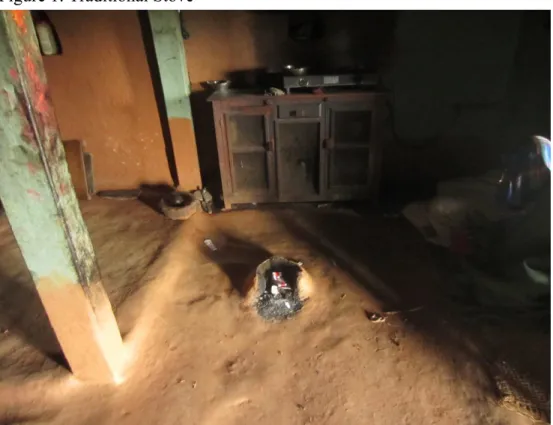
the land, depending on local habits, diets, and climate, most chulos are essentially holes in the kitchen’s (hard clay) floor. A simple brick and clay structure surrounds the hole, completing the chulo (Figure 1). An opening allows wood to be inserted horizontally and burned, its flames rising up through the opening on which rests the cooking vessel in which the meal is
prepared. In the middle and lower (terai) regions of Nepal, the meal generally consists of three items: rice, lentils (daal), and a vegetable curry, usually potatoes.
In the hilly and mountainous regions, or where corn is plentiful, or where work consists of labor in the fields and manual lifting of materials, the main meal consists of a porridge (dheedo), whose preparation requires the stove to withstand heavier and rougher use, and big
flames. These colder regions also use stoves to heat their homes as well as for brewing alcohol, cooked in large vats for long periods. As a result, the traditional chulo in those parts is larger and stronger built, with a grill strong enough to support heavy vessels placed over the opening (Figure 2).
Nepal is therefore a particularly apt context in which to study the pros and cons of both old and new cooking technologies. The problems with the traditional chulo are evident to generations of chulo users, poor and not so poor. The main fuel, wood, has heavy carbon content – the heavy emission of smoke is the single most prominent sensory experience (certainly to the uninitiated or less experienced outsider) of cooking in the traditional chulo. As we have noted, epidemiological studies indicate the smoke is likely to cause a host of health problems. The WHO acknowledges causal links between household air pollution exposure and these outcomes: lower respiratory infections; tracheal, bronchial, and lung cancers; IHD; cerebrovascular disease; COPD; and cataracts (see e.g. Lim et al. (2012) .
The quality of life of the users is affected as well; many respondents in our sample reported that they, their children, and their guests cannot sit inside the house at all for hours during and after the cooking of food. The smoke heavily soils clothing, and makes the cooking pots and interior walls black; this requires valuable time and effort to scrub clean.
In addition to the troubles caused by smoke, the chulos themselves are extremely inefficient. Cooking of every meal takes 1-3 hours, depending on the family size. Adding the time it takes to cook feed for livestock, the stove is in use for up to 8 hours every day. The traditional chulos also consume large amounts of wood, the necessary prolonged burning of which contributes to
environmental detriment, including pollution and deforestation. The wood is costly for some families, who do not own their own forests and have to pay for their timber; it is costly for the people (usually wives and daughters-in-law) who have to travel to the often faraway forests and spend time cutting and carrying the wood back to their homes. This is time that could be used to
care for their children. Additionally, wood needs to be stored in summer before the rainy season, taking up precious space only wealthier households can afford (Figure 3). And after all that, the invested time and effort fuels a dismaying 15% thermal efficiency at best.
Yet, there are perceived pros to the use of traditional chulos, which is the reason they have withstood the test of time. The health hazards from the smoke are believed to be balanced by positives. Users of traditional stoves believe that the smoke serves the purpose of killing termites that pose structural danger to the home. The blackening of the kitchen walls and ceilings is justified on those grounds. Anti-termite chemical treatment is expensive, and only recently introduced. Some of our survey respondents believed the smoke strengthened the wood roof and walls, although there is little scientific basis for this belief.
(Figure 4).
While Nepal is demographically young, the heads of households today still belong to a generation with a set of long-held beliefs that will likely change in the future, but are deep-rooted today. In many homes cooking is an activity with spiritual, social, and religious
associations. Nepal is a staunchly Hindu country; families adhere to traditions and Hindu rituals are passed down generations. The chulo is placed in the center of the kitchen in most homes because it gathers the family together around the chulo’s warmth. Prayer often takes place before the meal and portraits of Hindu gods are visible in village kitchens around the country, usually placed near the array of utensils and close to the chulo (Figure 5). Due to the need to keep the chulo surroundings unobstructed for both social and religious reasons, a characteristic of the traditional chulo is the absence of a chimney from which smoke can escape, since the
chimney would occupy and block the space where the pictures of gods are placed.
However, a generation gap within the same household is now increasingly noticeable. The younger generation is better informed about the world around, and feels the need to spend their time beyond cooking and cleaning. They have less time for soiled clothes, soiled pots and pans and looking clean and smart is important to them. There is therefore a divergence of opinions about the traditional chulo. While the younger generation loves sitting around the fire with the family, they are less tolerant of the smoke and it diminishes the experience. There is therefore an increasing demand for improved cooking technology in the form of “smokeless” chulos, as the improved cooking stoves (ICS) are also called.
The ICS is situated at the corner of the kitchen (Figure 6) with the chimney hugging the wall for about 5 feet (the precise length has been determined to produce the best engineering efficiency for the ICS) before the wall is pierced by a metal tube. The metal tube protrudes from the other side of the wall outside the home, and is capped by a chimney top which is visible (Figure 7). The smoke from the cooking is meant to escape outside and therefore minimize health and other hazards from the traditional chulo, sans the chimney. Blackening of the outside walls of homes with the ICS is testimony to this fact. Among the other engineering innovations in the ICS is better thermal efficiency, meaning the more of the heat produced by burning the wood is used in the cooking. Lab experiments indicate thermal efficiency of the ICS to be around 25%1, and that of the traditional chulo to be less than 15%. Although combustion efficiency of traditional wood fires is high, typically 85-90%, large thermal losses in the traditional chulo occur in transferring heat to the cooking pot. Thermal efficiency can be improved dramatically. For example, commercial wood-fired boilers can be over 80%
thermally efficient because they transfer heat well. Liquefied natural gas (LNG) or liquid petroleum gas (LPG) are already in highly combustible form and do not emit smoke, and burn highly efficiently (90% efficiency). However, they are expensive, not easily available in resource-poor Nepal.
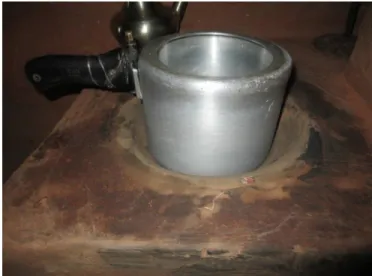
Thermal losses occur in traditional stoves because of three reasons. First, traditional chulos have a single opening, so cooking each dish is done sequentially, not simultaneously. This means the heat generated inside the stove must be used for that dish alone, and what is not used is wasted. Second, the single hole is often not perfectly covered by the variety of pots and pans used in cooking, so that much heat escapes from the sides. Even if the pot perfectly fills the hole, in many traditional chulos the pot rests on a clay tripod leaving large openings from which heat and fire escape continuously. The openings do, however, serve the purpose of mixing oxygen with the fire to make the heat more intense, opening up the possibility of better engineering design in the ICS. (Figure 8). Third, the slow draft of the traditional stove adversely affects both heat transfer and combustion. Insufficient draft also causes excessive smoke which is unburnt gas. Thus, actual cooking efficiency of the traditional chulo is less than 15%, that is, of the thermal energy (heat) produced by the wood- burning, only 15% or less is used in cooking.
1
According to lab experiment at Kathmandu University, the thermal efficiency of ICS disseminated by
Controlled cooking tests in which water is boiled from a cold state to its boiling point have been performed field studies in Nepal (cite some) and show this to be true. For users, low thermal efficiency implies that more wood is needed, producing more smoke.
The low cost of wood is the main component of the cost and benefit calculation made by village households, especially in poor homes where the marginal value of a rupee is very high. Labor income is often no more than NR (Nepalese Rupee) 300 or less than $3 for an 8-hour day. Because wood is cheap – the raw material is free and the labor cost of hauling wood is also low since it is done by a member of the household – low thermal efficiency is not costly for the household. The benefits are plentiful – dependable certain supply of heat and energy for the purpose of cooking and keeping the house warm in winters. The rituals of unobstructed fires and the value of the family being together are other benefits of the traditional chulo, further overriding the personal (often low) valuation of the health hazards and other negative externalities. 3. Data
The data for this study come from a primary survey of 101 rural households in Nepal taken during summer 2012. The sample comes from two distinct locations: Rayali VDC located 15 km. outside Kathmandu, and higher-altitude Barpak, located in the Gorkha province. All households had prior experience with a traditional chulo.
Four villages in the Rayali VDC provide information about an ICS that is a distinct
modification over the traditional three-stone chulo these households have used over previous generations. Since the chimney in this clay ICS is connected to the chulo in an integrated design, it requires adherence to engineering principles regarding the optimal height of the chimney given the heat throughput. This type of ICS has been introduced and experimented with in many parts of the world including India. As a result, the ICS is very different from the traditional chulo it replaces. The chulo needs to be relocated to a corner of the house so the chimney’s end can pierce the kitchen wall, allowing the smoke to escape outside the home.
The village of Barpak in Gorkha district is different in two respects. Previous experiments with the above type of ICS in Barpak showed that design to be ineffective. One reason for this is that Barpak is located at a higher altitude, with colder winters than the Rayali region. The second is
that food habits of the Barpak people require larger and heavier cooking utensils. Many homes brew alcohol at least once a month; since labor in the fields is part and parcel of many
livelihoods in this isolated and hard-to-reach village, many households cook dheedo, a corn- based porridge which is cooked in large quantities and requires constant stirring. The recently introduced ICS in Barpak leaves the bottom half of the traditional chulo – the heat generating
and cooking parts -- largely unmodified. The innovation is to attach an aluminum hood over the chulo to which a chimney is connected (Figure 9). What is required is the relocation of the chulo from the center of the kitchen to a corner so the chimney can have an outlet through the wall.
Within the Rayali region we sampled 43 households.2 Of these, 11 had received a government subsidy (in the Dhulikhel village) so the cost to them was a mere 50 Nepali rupees. 32 Rayali households that we sampled did not receive the subsidy and paid the full price of over NR 500 if they chose to adopt the ICS. In the Barpak region, we sampled 58 households. These ICS hoods cost NR 6000 each ($70), which is a substantial expense for the family. Much of this price is transportation cost as these chulos are not constructed locally; they are produced in small lots in the Gorkha region and then shipped to Barpak through the mountains.
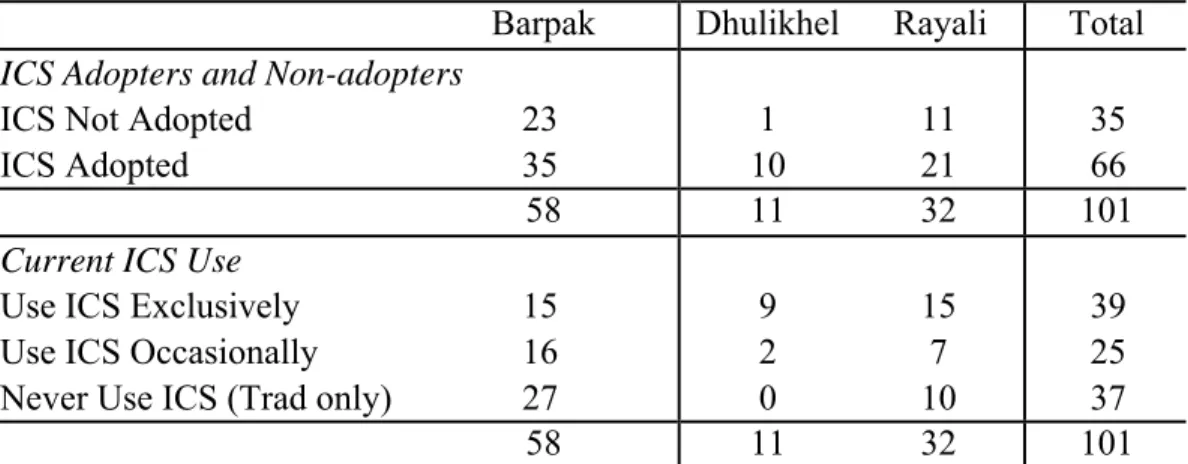
Table 1 shows the breakdown of our sample by their primary cooking stoves. In the Barpak region, 23 households continued to use the traditional chulo as their main stove while 28 had switched to the ICS with the metal hood. 7 households continued to use traditional stove with the ICS. In the Rayali villages, 27 households had switched completely to the ICS while 4 remained traditional. 6 other households shared their traditional stove with LPG. Very few households exclusively used LPG or biogas.
In Table 2, we break down the sample by adoption of ICS across regions. Adopting the ICS is defined as a household cooking more than 50% of its weekly meals on the ICS. Adoption does not imply exclusive use, but “majority” use. In the Barpak sample, approximately 60% adopted the hood ICS while 40% did not. In the subsidized Rayali village (Dhulikhel), 90% of the sample adopted the ICS, while in other unsubsidized Rayali villages, only 2/3 adopted. It is useful to distinguish our sample by those who use the ICS exclusively, occasionally, and
non-
2 This is not a randomized sample, and therefore our results are associations; causality may not be
ascribed. For example, the 10 Dhulikhel houses were indicated to us by an NGO, which had installed the ICS in the houses, and sought to uphold the Dhulikhel experience as a model for other villages to follow. The remaining Rayali villages were not thus “treated”.
users who exclusively use the traditional chulo. This distinction will be useful in analyzing the Nepali household, since more than 2 generations often coexist under the same roof. The three categories are intended to represent their perhaps dissimilar preferences. In the Barpak sample, 15 adopters discarded their traditional chulo, while 16 adopters retained the traditional chulo when ICS was adopted. In the Rayali and Dhulikhel villages, 24 adopters discarded their traditional chulo while 9 adopters retained it in conjunction with ICS. We now proceed to discuss the main results from the survey data.
4. Results
4.1 Distribution Tests of Adoption and ICS Use
We present results from two types of analyses: chi-squared equality-of-distributions tests, and regression analysis. A primary goal of the equality-of-distributions tests is to distinguish whether household attributes that correlate with ICS adoption in Nepal are different from what has been found in other country contexts. A second goal is to present evidence about questions that have yet to be answered in this context. The context of Nepal is different than other
countries in that, Nepal is natural resource rich in wood, many generations can live in the same household, there has been history of experimenting with the ICS and there is existence of community owned and governed forests. The regression analysis allows us, where continuity of the data permits, to quantify the impact of ICS use.
Age-Gender of Head of Household
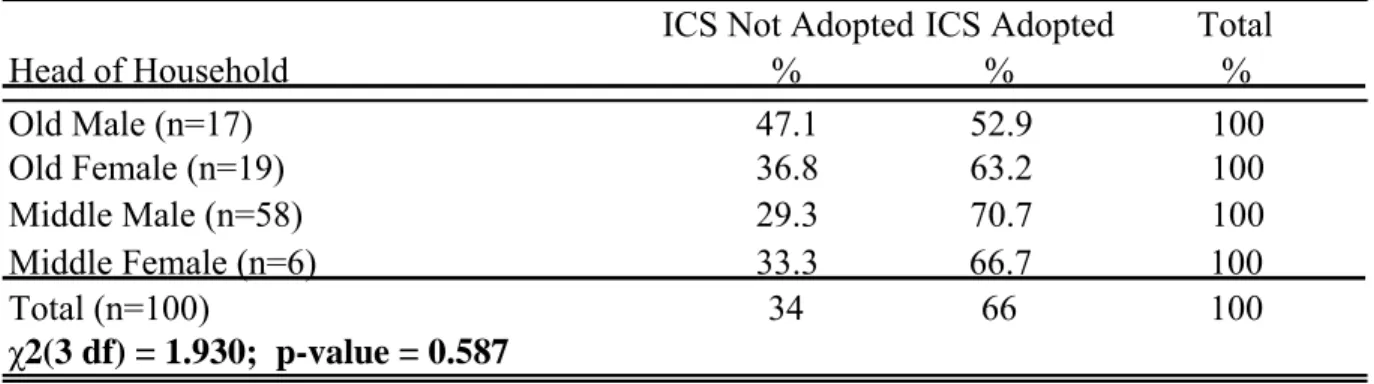
Table 3 presents the age-gender frequency distribution of ICS adopters versus non-adopters. The sample has 34 non-adopters and 66 adopters.3 The four age-gender categories in Table 3 have ratios similar to the expected ratio 34:66. Where households were headed by an old male, the ratio of non-adopters to adopters is 47:53, but the sample size is not large enough to make this statistically significantly different from the expected ratio. The overall chi-square statistic
χ2 (with 3 df) is 1.930, which cannot reject the hypothesis that the populations of adopters has the same age-gender distribution as the population of non-adopters. The literature indicates that age and gender of the head of household have sometimes played role in the decision to adopt
the ICS, but we do not find this to be the case in Nepal. In their survey, Lewis and Pattanayak note that only a few studies have included the gender of the head of household as a determinant in ICS adoption. Damte and Koch (2011), in their study of ICS adoption in urban Ethiopian households, find that gender of the head of household did not matter to the adoption of the charcoal ICS but age did – younger households were more likely to adopt the ICS. In their study in Sudan, El Tayeb and Mohamed (2003) find that the wife’s age is associated with non-adoption of biomass ICS. The authors ascribe this to Sudan’s patriarchal culture as in
patriarchal cultures women receive only a portion of family’s earnings with which to purchase fuel or an improved stove. We performed the same tests separately on the age distribution and gender distribution, but are unable to reject the equality of these distributions for adopters versus non-adopters (these results are not reported but available from the authors). We found this surprising, expecting households headed by older generation to be reluctant to change to the new technology.
Generation of Head of Household
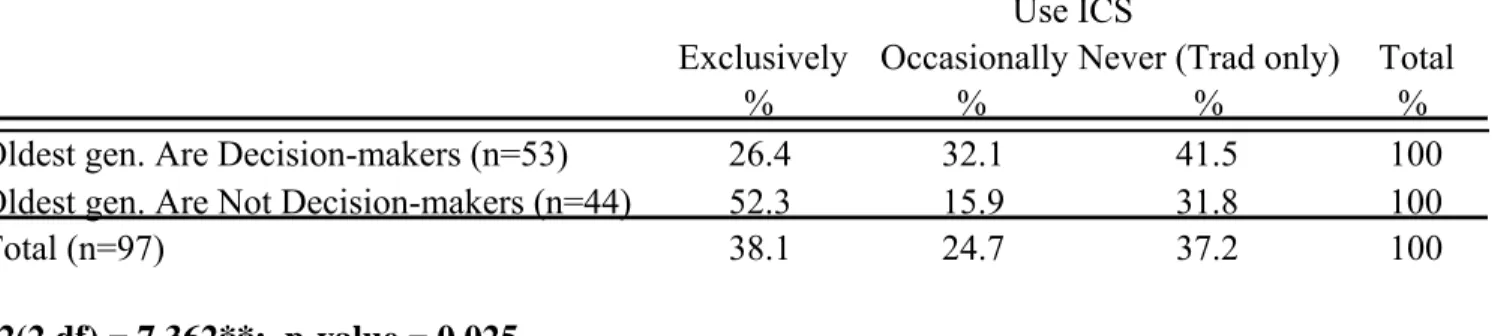
Perhaps, the older generation in Nepal is more willing to accept the choices of the younger generation in the same household than older generations in other cultures such as India. To investigate this issue further, we further distinguish ICS adopters by two types: those that use ICS exclusively, meaning they no longer own a traditional chulo, and those that use ICS occasionally, meaning they retained the traditional and use that as well. In Table 4 we compare the distribution over these choices by households in which decision-makers are the senior-most generation versus households in which decision-makers are the middle generation.4 The chi- squared statistic of 7.362 indicates that the distribution of exclusive/occasional/non-users of the ICS is distinctly different for these two types of households. The second row makes it clear that when the middle generation makes decisions, the ICS adopters overwhelmingly drop the
traditional chulo. The first row, in contrast, indicates that when the senior generation makes decisions, households that adopt the ICS keep both chulos.
This is a new finding, since the literature has not distinguished types of adopters between exclusive and occasional users of ICS as we have done. The finding suggests an intra-
4 The survey question that determined middle versus senior generation was the answer to the question
household bargain between generations among ICS adopters, whereby the senior generation agrees to adopt the ICS if they are also allowed to keep the traditional chulo. While not a conclusive finding, it deserves further study, since it implies that adoption of the ICS is easier if a known technology that has stood the test of time, despite their negative side effects, is allowed to co-exist with the new technology.
Subsidy
Among the four Rayali villages in the survey, only Dhulikhel was offered a subsidy. Adopters of the clay ICS were offered a subsidy of NR 500 so that their out-of-pocket cost was just NR 50. We would expect that all those that were offered the subsidy would adopt and among those that were not offered the subsidy, much fewer would adopt. Table 5 compares the distribution over exclusive/occasional/non-users for households that were offered the subsidy versus households that were not. The chi-squared statistic of 5.282 indicates that the distribution of
exclusive/occasional/non-users of the ICS is statistically significantly different at the 10% level of significance. Over 80% of the households offered the subsidy switched to using the ICS exclusively, while only 47% of the unsubsidized households did so. The subsidy therefore incentivized households to adopt. We think the smallness of the sample (n=43) is why the test is unable to reject the hypotheses that the two populations are different in how they respond to the subsidy at the 1% level of statistical significance.5 We think this hypothesis is important from a policy perspective, and would benefit from a study that collects a larger sample.
Health
Finally, we compare the distribution of exclusive/occasional/non-user decisions across
households that reported no health problems using the traditional chulo and households that did report such a problem (and described it as a physical, respiratory, and/or cosmetic issue). Since the Barpak ICS is of a different design than the Rayali ICS, we report the results of this
comparison separately in Tables 6 and 7. Surprisingly, the results are different across the two samples. Table 6 shows that the Barpak sample cannot reject the hypothesis that ICS use is
5 The Dhulikhel village has approximately 3000 households and a population of 14,000 residents (2011
independent of health concerns. Something other than health reasons appears to incentivize ICS use in this mountainous community. This is line with Mobarak et al. (2012) and Ramirez et al. (2012) who find that health concerns are not major factors motivating ICS adoption.
The Rayali sample (Table 7), on the other hand, appears to take into consideration health concerns in their ICS-use decision. Beliefs about physical, respiratory, and/or cosmetic issue (soot on clothing and face) clearly divide households that continue to use the traditional chulo from those that have rejected it in favor of the ICS. Of course, causality cannot be ascribed to these distribution tests – they are only tests of independence. It is entirely possible that households that continue to use the traditional chulo downplay health concerns in their self-report, in order to deflect questions about their rationality and/or authority within the household (especially for women). Once again, the small sample size suggests these explanations, but more importantly also suggests this as a direction for future research.
4.2 Fuel Economy, Breakage and ICS Adoption
Fuel Economy
Two reasons why a family may adopt the ICS are (i) the fuel economy promise of the ICS, and (ii) their more efficient cooking technology reflected in shorter cooking time. Fuel economy for rural households in Nepal has a different meaning than the same term in other countries. Nepal is unique for its large forest capacity relative to population. The stewardship of forestland de facto lies in the hands of the closest village. Governance over the use of these community forests resources takes the form of rules and norms formulated by the village and enforced by them. In Barpak, for example, each family is allowed a certain number of monthly visits for collecting wood from the community forest. To prevent overuse, households are penalized if they harvest firewood beyond the permitted volume. Further, use of community forest is
restricted to collecting branches and deadwood; cutting trees is seldom allowed. Approximately three-to-four hours of labor was sufficient to collect enough firewood for a 5-person household for 2-3 weeks. Many families reported buying the wood on the market (see e.g. Soussan et al 1991 for an account of the commercial and local fuelwood markets in Nepal). Finally many families in the Rayali villages had their own personal “forest” area adjoining their homes where they grew wood and harvested for fuel as and when needed. These are obviously very small “forests” and these families also supplemented by buying on the market as well as using
community forests resources.
All this is to say that wood in Nepal, though plentiful, is not a free resource. Either there are travel and effort costs (a half-day of work if harvesting in the community forest, for example), or monetary costs when purchasing on the market. It is therefore relevant to ask whether ICS adoption in Nepal is sensitive to fuel economy.
The design of the ICS promises both fuel economy and faster cooking times. The Rayali ICS is designed so that the heat does not immediately dissipate, as in the traditional chulo, but is trapped inside the ICS casing for a longer period of time so that more of the heat is available for cooking. The greater heat efficiency lowers fuel use. In the ICS with two openings (Figure 6), cooking may proceed in parallel rather than sequentially, resulting in even lower cooking time for a full meal. Do these theoretical design advantages translate to practical efficiency as perceived by ICS users? For example, Nepal et al. (2010) find, using nationally representative household survey data, that the ICS does not reduce firewood demand. They argue for cleaner fuel accessibility.
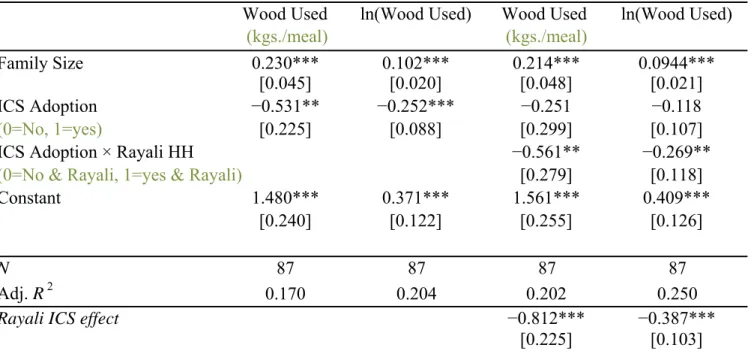
In Table 8 we report OLS regressions of fuel use, measured as kilograms/month of wood, on ICS adoption.6 The fuel use is self-reported by respondents. The coefficient on ICS adoption in the first and second columns of Table 8 affirms that ICS use is strongly associated with lower fuel use controlling for household size (the positive sign on the household size coefficient and its magnitude accords with intuition and serves to internally validate the survey). ICS adoption lowered fuel use by 0.531 kilograms of wood per meal, or more than 30 kilograms per month. The log-linear version of the same regression (second column) indicates that ICS adoption lowers fuel use by 25.2%..
Since the result is based on self-reported fuel use by survey respondents, it is suggestive but not conclusive.7 As an internal validation of the survey, we also compared fuel saving of ICS users as follows. On average ICS adopting households used 2.1 kilograms of wood per meal. From responses to questions pertaining to the quantity of wood used per meal in households that had
6 In the regressions we drop one observation that pertained to a household that also ran a hotel on the
premises, its fuel consumption being an outlier.
7 Respondents may also respond positively about fuel savings, because they think it is the “right answer” to
the question. (This framing issue is also relevant to the discussion of health benefits above.) The internal
both chulos (and hence controlled for household size), we calculated the average of the ICS-to-traditional chulo fuel use ratio to be 0.627. Therefore, the average saving per meal comes out to be 2.1×(1/0.627 - 1) = 1.25 kilograms per meal, or a fuel saving of 59.5%. This is twice what the regression implies, with the true value likely to be between 25.2% and 59.5%. Note that this validation assumes that the sample of ICS adopters is identical to the sample of mixed stove users, which may not be the case.
Since the main innovation in the Barpak ICS is the chimney, not in its heat efficiency per se, ICS adoption is interacted by the Rayali dummy to separate the Rayali effect from the Barpak effect. The last two columns sample in Table 8 indicates that indeed, ICS adoption in the Rayali villages lowered fuel use by 0.812 kilograms of wood per meal, or 38.7% (bottom row). The Barpak households also lowered their fuel consumption on average, but the amount is not statistically different from zero.
In Table 9 we investigate whether ICS adoption is associated with faster cooking times, measured as hours expended per meal. The first two columns indicate that for the full sample, cooking time was not perceptibly lowered in households that adopted the ICS -- the
coefficient on ICS adoption is neither statistically significant, nor especially large. Again, since the main innovation in the Barpak ICS is not in heat efficiency, we ran the regressions with the Rayali interaction. The last two columns indicate that Rayali households that adopted the ICS reported reduced cooking times by 0.26 hours per meal or by 23.8%.
Breakage
Among the important policy implications of promoting the ICS is after-sales service for the chulo. In the Rayali villages NGOs provided trained installers who were local to the village so that, at least in theory, there was after-sales service by the same person who installed chulos in the village (Figure 10). A government program funded the training of installers through NGOs. In Barpak on the other hand, there was no after-sales service since the main chulo was
unmodified – only a chimney was added to it. Further, the Barpak program was implemented on
a for-profit basis, and the chimney was bought at market price. An implication of the Hanna et al. study is that it is possible that due to the absence of post-installation service, the ICS failed to catch on once households experienced breakage. If such service were present, it would also be a
channel to provide feedback about where the design of the ICS was lacking so that newer generations of the ICS could correct this, much like how the private sector seeks to improve its product to keep their market share from being eroded by competing suppliers. Even though in Nepal, there is little private sector competition, the government has attempted to train local talent to both install and service households that adopt the ICS. In many cases the agent is overwhelmed by the demand and is unable to provide effective service, but it is possible to rectify this over time since the government has incurred the fixed cost of a training program that supplies local technicians.
In Table 10 we report results of regressions that help us understand the association of breakage with duration of ICS use. The sample is restricted to households that adopted the ICS, who answered our question about whether or not they had experienced defects or breakages with it. The coefficient on the incidence of breakage implies that the difference between experiencing and not experiencing breakage is about 1.5 years. This estimate is consistent with Hanna et al. – the first 1.5 years are expected to be the event-free phase.
In the second column, we estimate the reverse regression of duration of ICS use and breakage. The coefficient on ICS duration implies that an additional year of owning the ICS increases the probability of breakage by 5.5%. A use of the reverse regression is to estimate errors-in-variables (EIV) bounds if we assume that the duration and breakage errors-in-variables are measured with error in the standard sense that they are both equal to the true measure plus a normally distributed measurement error. The EIV bounds are easy to calculate in this simple regression. The true coefficient on the ICS Duration coefficient lies in the interval [1.50 and 18.2], while the true coefficient on the ICS Breakage coefficient lies in the interval [0.06 and 0.67]. In other words, the true probability of breakage for every additional year of use is between 0.06 and 0.67, while the true difference between experiencing and not experiencing breakage is anywhere between 1.5 and 18.2 years. It therefore appears that in Nepal the outcome is more optimistic than what Hanna et al. found in the case of India: the lower bound is at 1.5 years but the upper bound indicates that it may take longer before the ICS experiences breakage. Whether this is because Nepal’s ICS program in the Rayali village has already benefitted from the learning and feedback from similar programs implemented in other regions of Nepal (though the government’s partnerships with NGOs and academics) or for some other reason, is something that requires further study. Due to the small sample size, separating the Barpak
(n=23) and Rayali villages (n=25) did not yield statistically significant results. Research into this question with a larger sample would be a useful contribution to the ICS debate.
5. Conclusion
In concluding we relate our findings to an emerging literature on ICS adoption, which also indicate directions in which to take this research forward. Slaski and Thurber (2009) suggest three principal dimensions that affect successful adoption of any radically new product or service by the poor. Motivation based on user’s perceived value of this product/service; it affordability; and the extent of the user’s engagement, that is, the
availability of solutions to obstacles the user must overcome in adopting an inherently new technology. Behavior change involves all three dimensions. In Nepal, we empirically affirm this idea. The motivation of the younger generation of adopters is stronger; ICS affordability is a concern, both in terms of the ICS cost and fuel economy, both of which were seen to have a significant association with adoption; and Nepal’s government has made an attempt to reduce transactions cost of adoption by subsidizing and then provide the incentives to for an after-sales service with local knowledge content.
Bailis et al. (2009), in their comparative study of wood burning stoves in poor tropical highlands, compare appropriateness of different models of delivery and commercialization versus donor/state support for such dissemination. They find evidence, as in the case of China, that successful dissemination of ICS depends on adopting an approach that balances
commercialization and continued subsidization. They acknowledge that the adoption of certain business practices would lead to a more successful ICS dissemination. On the other hand, some level of long-term state and/or donor support for the success is necessary. The challenge lies in identifying the right combination of commercialization and state or donor support. Based on the cases discussed in the paper, the authors offer five areas in which donor/state support will be crucial to the success of stove interventions in conjunction with commercialization of the enterprise: research and development (R&D), marketing, financing, monitoring and evaluation (M&E), and quality control. This study suggests interesting directions in which to extend our paper’s research in the Nepal context.
In Nepal there has been conscious government policy for the last four decades, which has attempted to introduce and incentivize the use of ICS for the last two decades. As discussed in
the paper, NGOs have been encouraged to work alongside the government across the country. In our paper, we see an example of this in Dhulikhel, where the government has subsidized the ICS through the local NGO. There is also a conscious government policy that funds a training program of promoters that can construct, install, and maintain ICS. The training occurs various parts of the country, the attempt being to train local talent who reside in the village where the ICS is to be installed. Local capacity building in the construction of the chulo and repair services within the village cluster is thus facilitated.
Notably, this is different from the China experience. The government policy in Nepal is receptive to local condition. It is not a top down policy. Use of local materials which makes local or self- repair possible, and thus makes the new chulo sustainable in a decentralized
fashion. Although the Barpak chulo is not locally made, yet it is adapted to local use. Nothing so far has made this a perfect chulo and there are many examples of faults but there is clearly a formula for success with better engineering and more experience.
The real value of the findings in this paper lies in encouraging further research along these lines. The tests of independence and regression results of the paper, while new to the literature, are associations. In order to find out whether there are causal linkages, a complete randomized design is necessary. Our results suggest that it will be worth the effort and expense to undertake a randomized field experiment, which can then qualify, support, or refute the findings of
influential studies like Hanna et al. about what is necessary for programs that seek to implement the ICS successfully over the long term.
References
Amacher G.S., W. F. Hyde and K. R. Kanel. 1996. “Household fuelwood demand and supply in Nepal’s Tarai and mid-hills: Choice between cash outlays and labor opportunity.” World Development 24(11): 1725–1736
Bailis, R., A. Cowan, V. Berrueta and O. Masera. 2009. Arresting the killer in the kitchen: The promises and pitfalls of commercializing improved cookstoves. World Development
37(10): 1694-1705.
Boy E., N. Bruce, and H. Delgado. 2002. “Birth weight and exposure to kitchen wood smoke during pregnancy in rural Guatemala.”. Environmental Health Perspectives.110 (1) :
):109-–114.
Brinkmann, V. 2005. “Impact assessment at local level. Experiences from Malawi-Mulanje district.” GTZ, Eschborn.
Bruce N., R. Perez-Padilla, R. Albalak. 2000. “Indoor air pollution in developing countries: a major environmental and public health challenge.”. Bulletin of the World Health Organization. 78 (9):1078-–1092.
Damte A. and S.F. Koch. 2011. “Clean fuel saving technology adoption in urban Ethiopia.”
Department of Economics Working Paper Series. Pretoria:University of Pretoria
Dehejia, V.. 2012. “The cookstove conundrum” New York Times (April 23, 2012):
http://india.blogs.nytimes.com/2012/04/23/the-cookstove-conundrum/
Djédjé, M., A. Ingwe, P. Wanyohi, V. Brinkmann, and J. Kithinji. 2009. “Results assessment: Survey on impacts of the stove project in Transmara, Western and Central Cluster of Kenya.” (Conducted from October 2007 to January 2008. Final report Jacob Kithinji. Promotion of Private Sector, Development in Agriculture).
El Tayeb Muneer S, M. Mohamed EW. 2003. “Adoption of biomass improved cookstoves in a patriarchal society: An example from Sudan.: Science of the Total Environment 307(1-3):
259-266.
Ezzati M., D.M. Kammen. 2001. “Indoor air pollution from biomass combustion and acute respiratory infections in Kenya: an exposure-–response study.”. Lancet. 358: 619-–624.
Gauderman W.J., E. Avol, F. Gilliland, H. Vora, D. T. K. Berhane, R. McConnell, N. Kuenzli, F. Lurmann, E. Rappaport, H. Margolis, D. Bates, J. Peters. 2004. “The effect of air
pollution on lung development from 10 to 18 years of age.”. New England Journal of Medicine. 351: 1057-67–1067.
Gifford, M. L. 2010. “A global review of cookstove programs.” Manuscript.
http://mlgifford.wordpress.com/publications/.
Hanna, R., E.Duflo, and M. Greenstone. 2012. “Up In smoke: The influence of household behavior on the long-run impact of improved cooking stoves”. Manuscript.
Lewis J.J., S. K. Pattanayak. 2012. “Who Adopts Improved Fuels and Cookstoves? A Systematic Review.” Environmental Health Perspectives 120: 637-645.
Lim, S. S. et al. 2012. “A comparative risk assessment of burden of disease and injury attributable to 67 risk factors and risk factor clusters in 21 regions, 1990-2010: A systematic analysis for the Global Burden of Disease Study 2010.” Lancet 380(9859): 2224-60.
Manibog, F. R. (1984). “Improved cooking stoves in developing countries: Problems and opportunities.” Annual Review of Energy 9(1): 199-227.
McCracken J.P., K.R. Smith, A. Diaz, M.A. Mittleman, J. Schwartz. 2007. “Chimney stove intervention to reduce long-term wood smoke exposure lowers blood pressure among Guatemalan women.”. Environmental Health Perspectives. 115: 996-–1001.
Mobarak, A. M., P. Dwivedi, R. Bailis, L. Hildemann and G. Millerd. 2012. “Why are people not adopting improved cooking stoves in rural Bangladesh? Insights from a national survey.”
Proceedings of the National Academy of Sciences 109(27): 10815-20.
Myles, R., and S. Nathan. 2007. “Best practice case studies on sustainable energy technologies solutions for poverty reduction in South Asia. Improved chulha (cook-stove).”
International Network For Sustainable Energy (INFORSE)-South Asia.
Mishra V.K., R.D. Retherford, K.R. Smith. 1999. Biomass cooking fuels and prevalence of tuberculosis in India. International Journal of Infectious Diseases. 3: 119-–129.
Naeher L., M. Brauer, M. Lipsett, J. Zelikoff, C. D. Simpson, J. Koenig and K. Smith. 2007. Woodsmoke health effects: a review. Inhalation Toxicology. 19: 67-–106.
Nepal, M., A. Nepal, K. Grimsrud. 2010. “Unbelievable but improved cookstoves are not helpful in reducing firewood demand in Nepal.” Environment and Development Economics 16:
1-23
Palmer, B.. 2012. ‘Clean cookstoves’ draw support, but they may not improve indoor air quality”.
Washington Post (April 16, 2012): http://www.washingtonpost.com/national/health-
science/clean-cookstoves-draw-support-but-they-may-not-improve-indoor-air-
quality/2012/04/16/gIQAnjCvLT_story_1.htmlhttp://www.washingtonpost.com/national/h ealth- science/clean-cookstoves-draw-support-but-they-may-not-improve-indoor-air-
quality/2012/04/16/gIQAnjCvLT_story_1.html
Pandey, M.R.1984. Domestic smoke pollution and chronic bronchitis in a rural community of the Hill Region of Nepal. Thorax. 39: 337-339.
Perez-Padilla R., J. Regalado, S. Vedal, P. Pare, R. Chapela, R. Sansores, and M. Selman. 1996. Exposure to biomass smoke and chronic airway disease in Mexican women: A case-control study. American Journal of Respiratory and Critical Care Medicine. 154:
701-706.
Pokhrel A.K., K.R. Smith, A. Khalakdina, A. Deuja, M.N. Bates. 2005. Case-–control study of indoor cooking smoke exposure and cataract in Nepal and India. International Journal of Epidemiology. 34: 702-–708.
potentialenergy.com. 2012.”Recent articles about cookstoves miss the point”:
http://www.potentialenergy.org/2012/04/24/recent-articles-about-cookstoves-report-miss-the- point/
Ramirez S., P. Dwivedi, R. Bailis and A. Ghilardi. 2012. “Perceptions of stakeholders about nontraditional cookstoves in Honduras.” Environmental Research Letters 7(4): 044036
Shrestha, B. and B. P. Shrestha, (2012). Design Improvement on Metallic Improve Cooking Stove KU-3 Model by blending WAPIC system at Kathmandu University. International Journal of Advanced Renewable Energy Research 1 (2): 105-108.
Shrimali,G., X. Slaski, M. C. Thurber and H. Zerriffi. “Improved Stoves in India: A Study of Sustainable Business Models.” Energy Policy.
Sinton, J. E., K. R. Smith, J. W. Peabody, L. Yaping, Z. Xiliang, R. Edwards, G. Quan, 2004. An assessment of programs to promote improved household stoves in China. Energy for Sustainable Development 8 (3): 33-52.
Slaski, X. and M.C. Thurber. 2009. “Cookstoves and obstacles to technology adoption by the poor”. Freeman Spogli Institute for International Studies, Stanford University, WP #89.
Smith K.R., J.M. Samet, I. Romieu, N. Bruce. 2000. “Indoor air pollution in developing countries and acute lower respiratory infections in children.”. Thorax. 55: 518-–532.
Smith, K., R. Uma, V.V.N. Kishore, Junfeng Zhang, V. Joshi, and M.A.K. Khalil. 2000.
“Greenhouse Implications of Household Stoves: An Analysis from India.” Annual Review of Energy and the Environment 25: 741-763.
Smith, K.R., Gu S.H., Huang K., and Qiu D.X., 1993. “One hundred million improved cookstoves in China: how was it done?” World Development 21(6): 941-61.
Soussan, J., E. Gevers, K. Ghimire, and P. O’Keefe. 1991. “Planning for sustainability: access to fuelwood in Dhanusha District, Nepal.” World Development 19:1299–1314
Thakuri, M.B.M. 2009. “Revisiting the need of improved stoves: Estimating health, time and carbon benefits.” Manuscript. http://ideas.repec.org/p/snd/wpaper/37.html
Wallmo, K., and S. K. Jacobson. 2002. “A social and environmental evaluation of fuel-efficient cook-stoves and conservation in Uganda.” Environmental Conservation 25(02): 99-108.
Figure 1: Traditional Stove
-Figure 2: Traditional Stove in Barpak (hilly region)
Figure 3. Storage of firewood for rainy season in a wealthy household
Figure 4: Smoke blackened ceiling
Figure 5: Kitchen and worship Figure 6: ICS in Rayali
Figure 7: Chimney to ICS in Figure 6 Figure 8: Pot fits efficiently on the Rayali ICS in Figure 6
Figure 9: ICS in Barpak; Metal hood
Figure 10: After-sales service provided by local village promoter in Rayali
Table 1: Distribution of household sample across regions and primary cooking stoves
Number of responses to: "What is your current main stove"
Altitude: 2300 m. Barpak Altitude: 1500 m. Rayali Villages Dhulikhel Other Total Clay ICS 0 Trad 23 Trad but also own ICS 4
0.5 Trad / 0.5 LPG 0 0.5 ICS / 0.5 Trad 3 Hood ICS 28 LPG 0 Biogas stove 0 0.5 ICS / 0.5 Biogas 0 9 18 0 4 0 0 0 6 0 2 0 0 0 1 1 0 1 1 27 27 4 6 5 28 1 1 2 58 11 32 101 Note:
Table 2: Distribution of sample by (i) ICS adoption and (ii) ICS Use.
Number of households
Barpak Dhulikhel Rayali Total
ICS Adopters and Non-adopters
ICS Not Adopted 23 ICS Adopted 35 1 11 10 21 35 66 58 11 32 101
Current ICS Use
Use ICS Exclusively 15 Use ICS Occasionally 16 Never Use ICS (Trad only) 27
9 15 2 7 0 10 39 25 37 58 11 32 101 Note:
1. Household considered ICS Adopter if ICS is "main stove", i.e. used at least 50% of the time.
Table 3: Chi-square test: ICS Adoption and Head of Household
ICS Not Adopted ICS Adopted Total
Head of Household % % % Old Male (n=17) 47.1 52.9 100 Old Female (n=19) 36.8 63.2 100 Middle Male (n=58) 29.3 70.7 100 Middle Female (n=6) 33.3 66.7 100 Total (n=100) 34 66 100 χ2(3 df) = 1.930; p-value = 0.587 Note:
Table 4: Chi-square test: ICS Use and Within-Household Decision Makers
Use ICS
Exclusively Occasionally Never (Trad only) Total
% % % %
Oldest gen. Are Decision-makers (n=53) 26.4 32.1 41.5 100 Oldest gen. Are Not Decision-makers (n=44) 52.3 15.9 31.8 100
Total (n=97) 38.1 24.7 37.2 100
χ2(2 df) = 7.362**; p-value = 0.025
Note:
Table 5: Chi-square test: Subsidy and ICS Use
Use ICS
NR 500 subsidy Exclusively Occasionally Never (Trad only) Total % % % % No (n=32) 46.9 21.9 31.2 100 Yes (n=11) 81.8 18.2 0 100 Total (n=43) χ2(2 df) = 5.282*; p-value = 0.071 55.8 20.9 23.3 100 Note:
Table 6: Chi-square test: Health Issues and ICS Use: Barpak Sample
Use ICS
Exclusively Occasionally Never (Trad only)
% % % Total
Physical/Breathing/Cosmetic problems (n=45) 28.9 24.4 46.7 100
No problems with trad (n=8) 12.5 50 37.5 100
Total (n=53) 26.4 28.3 45.3 100
χ2(1 df) = 2.384 Pr = 0.304
Note:
Table 7: Chi-square test: Health Issues and ICS Use: Rayali Sample
Use ICS
Exclusively Occasionally Never (Trad only)
% % % Total
Physical/Breathing/Cosmetic problems (n=30) 58.1 25.8 16.1 100
No problems with trad (n=7) 28.6 14.3 57.1 100
Total (n=37) 52.6 23.7 23.7 100
χ2(1 df) = 5.319* Pr = 0.070
Note:
Table 8: Fuel Use and ICS Adoption
Wood Used
(kgs./meal)
ln(Wood Used) Wood Used
(kgs./meal) ln(Wood Used) Family Size 0.230*** 0.102*** 0.214*** 0.0944*** [0.045] [0.020] [0.048] [0.021] ICS Adoption −0.531** −0.252*** −0.251 −0.118 (0=No, 1=yes) [0.225] [0.088] [0.299] [0.107]
ICS Adoption × Rayali HH −0.561** −0.269**
(0=No & Rayali, 1=yes & Rayali) [0.279] [0.118]
Constant 1.480*** 0.371*** 1.561*** 0.409***
[0.240] [0.122] [0.255] [0.126]
N 87 87 87 87
Adj. R 2 0.170 0.204 0.202 0.250
Rayali ICS effect −0.812*** −0.387***
[0.225] [0.103]
Note:
1. Robust se's in brackets. *** p<0.01, ** p<0.05, * p<0.1 2. Primary survey data.
Table 9: Cooking Time and ICS Adoption
Cooking Time ln(Cooking Time ) Cooking Time ln(Cooking Time )
(hrs/meal)) (hrs/meal)) Family Size ICS Adoption 0.139*** [0.021] −0.090 0.109*** [0.015] −0.086 0.134*** [0.021] 0.061 0.105*** [0.015] 0.051 (0=No, 1=yes)
ICS Adoption × Rayali HH
(0=No & Rayali, 1=yes & Rayali)
Constant [0.087] 0.526*** [0.072] −0.422*** [0.104] −0.318*** [0.101] 0.551*** [0.081] −0.289*** [0.087] −0.399*** [0.125] [0.106] [0.124] [0.104] N 97 97 97 97 Adj. R 2 0.312 0.284 0.373 0.359
Rayali ICS effect −0.257***
[0.092]
−0.238*** [0.085]
Note:
1. Robust se's in brackets. *** p<0.01, ** p<0.05, * p<0.1 2. Primary survey data.
Table 10: Reverse regressions: Breakage and ICS Duration ICS duration (Years) Breakage (0=No, 1=yes) Breakage 1.501* (0=No, 1=yes) [0.833] ICS duration 0.055* (Years) [0.032] Constant 2.681*** 0.063 [0.333] [0.098]
Implied EIV bounds:
Breakage [1.50, 18.2] (0=No, 1=yes) ICS duration [.06, .67] (Years) N 48 48 Adj. R 2 0.062 0.062 Note:
1. Robust se's in brackets. *** p<0.01, ** p<0.05, * p<0.1 2. Primary survey data.