1
The Comer School Development Program:
Improving Education for Low-Income Students
Fred C. Lunenburg
Sam Houston State University
________________________________________________________________________ ABSTRACT
The Comer School Development Program (SDP), also known as the Comer Process or Comer Model, was developed to improve the educational experience of poor ethnic minority youth. The nine component process model includes three mechanisms (School Planning and Management Team, Student and Staff Support Team, and Parent/Family Team); three operations (Comprehensive School Plan, Staff Development Plan, and monitoring and assessment), and three guiding principles (collaboration, consensus decision making, and no-fault problem solving). Initially developed by James Comer and the Child Study Center at Yale University in 1968, the program is now being implemented in 1150 schools, 35 school districts, and 25 states. Studies of selected SDP schools show significant student gains in achievement, attendance, behavior, and overall adjustment in SDP schools.
________________________________________________________________________
The School Development Program (SDP), also known as the Comer Process or the Comer Model, is intended to improve the educational experience of poor minority youth. Improvement is attained by building supportive bonds among children, parents, and school staff to promote a positive school culture. Since 1968 when the model was created by child psychiatrist Dr. James Comer and his colleagues at the Yale University Child Study Center, it has been utilized in more than 1150 schools nationwide. While the SDP helps bring change to one school at a time, it has been used as a framework for system-wide reform.
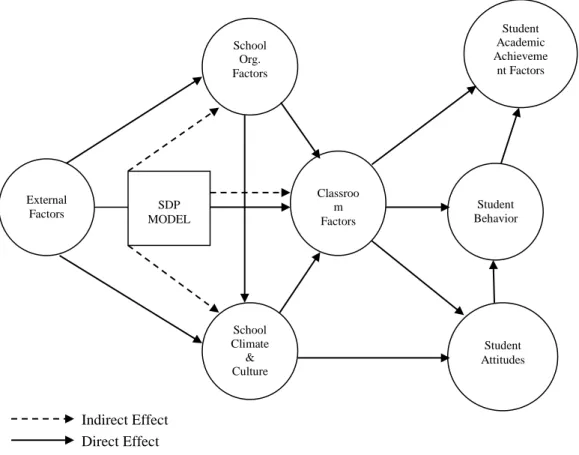
James Comer and the Yale University Child Study Center staff developed a SDP theory of change. They hypothesize that the introduction of the SDP model directly influences the proximal outcomes of school organization and management; influences school culture both directly and through its effect on organization and management; and affects classroom practices both directly and through its effects on organization and school culture. Classroom factors, in turn, affect the distal outcome of student achievement both directly and through their influence on other distal outcomes like student attitude and behavior.
In short, in the Yale University Child Study Center theory, implementation of the School Development Program transforms the school into a learning environment that: builds positive interpersonal relationships; promotes teacher efficacy; fosters positive student attitudes; increases students’ pro-social behaviors; and improves student academic achievement. While the arrows in the figure show principal direction of influence, in reality the relationships are reciprocal and feedback loops exist between virtually every pair of points in the model. The SDP theory of change is shown in Figure 1 (Yale University Child Study Center, 2011).
Rationale Underlying the Program
All the recent neuroscience research indicates that “nature versus nurture” is not an either or thing (Tyson, 2012). Development and learning are inextricably linked. To help children, schools need to address both learning and development (Bulach, Lunenburg, & Potter, 2008). The School Development Program takes a uniquely supportive view of education with a focus on developing “the whole child” (Joyner, Comer, & Ben-Avie, 2004a). Unlike models with a formulaic approach to curriculum or
School Climate & Culture Factors External Factors School Org. Factors SDP MODEL Student Academic Achieveme nt Factors Classroo m Factors Student Behavior Student Attitudes Indirect Effect Direct Effect
Figure 1.The Yale School Development Program Theory of Change
teaching methods, this holistic strategy links children’s academic growth with their emotional wellness and social and moral development in a collaborative school culture congenial to learning. The program is derived from the idea that when students feel supported and nurtured in school, their outlook, life skills, and academic performance will improve (Lunenburg & Ornstein, 2012).
Comer (2010) believes that for various reasons, many inner city children enter school “underdeveloped,” lacking the personal, social, and moral traits necessary for academic success. Consequently, students who have not had adequate support for their development may come to school lagging behind their classmates who may have had an optimal preschool developmental experience. This may have a negative effect on students’ learning skills. Comer also believes that many teachers lack adequate knowledge of child development or an understanding of their students’ home lives and culture, leaving them unprepared to deal appropriately with these children and their families to effectively foster their learning (Maholmes, Haynes, Bility, Emmons, & Comer, 1995).
History of the Program
The program began in two poor, predominantly African American elementary schools in New Haven, Connecticut, with low standardized test scores and high teacher and student absenteeism. Comer and his colleagues developed an organizational and management system based on child development issues that would encourage teachers, administrators, and parents to collaborate to address children’s needs (Comer, 1992, 1993; Comer & Haynes, 1991; Comer, Haynes, Joyner, & Ben-Avie, 1996).
The program was field-tested from 1978 to 1987 in additional schools in New Haven and in three other school districts: Prince George’s County, Maryland, Benton Harbor, Michigan, and Norfolk, Virginia. Beginning in 1988, the dissemination phase emphasized partnerships between teacher-training institutions and local school districts in New Orleans, Cleveland, and San Francisco, as well as the establishment of Regional Professional Development Centers.
In 1990 the Rockefeller Foundation granted a five-year, $15 million grant to aid national replication (Payne, 1991). Originally, any interested school could implement the model with technical assistance. In 1996, in response to research evidence, schools could not implement the full model without school district office support and the involvement of several schools in the same district (Comer, et al., 1996).
The replication model includes the following phases: (a) pre-orientation phase: School personnel become acquainted with the model and decide if it will be implemented and who will be the major participants; (b) orientation phase: Initial training of school personnel and parents and the establishment of a governing board; (c) transition phase: Goals and objectives are established by the governance board with input from all participants. Plans are made for parent involvement and staff development; (d) operation phase: Plans are implemented for parent activities and staff development; and (e) institutionalization phase: Outcomes are evaluated in terms of parent participation and student outcomes (Comer & Emmons, 2006).
Since 1968, the SDP has been implemented in more than 1150 schools, 35 school districts, 25 states, the District of Columbia, Trinidad and Tobago, South Africa, England, and Ireland. Approximately 300 schools are currently at different phases of implementing the model.
Program Components
In each participating school, a planning and management group is formed consisting of nine components: three mechanisms (a School Planning and Management Team; a Student and Staff Support Team; and a Parent/Family Team); three operations (a Comprehensive School Plan, staff development plan, and monitoring and assessment); and three principles (collaboration, consensus, and no-fault problem solving).
Mechanisms
Three mechanisms to promote the school vision and to organize and lead the students include: the School Planning and Management Team, the Student and Staff Support Team, and the Parent/Family Team. The School Planning and Management team is comprised of representatives of the parents/families, teachers, administrators, and support staff. The Student and Support Staff Team is comprised of student assistance staff and others with expertise in child development and mental health. The Parent/Family Team is comprised of parents and other family members.
School planning and management team. The School Planning and Management
team develops a Comprehensive School Plan, sets academic, social and community relations goals, and coordinates all school activities, including staff development programs. The team creates critical dialogue around teaching and learning and student progress and recommends mid-course adjustments and modifications in curriculum and teaching based on children’s changing needs. Members of the team include administrators, teachers, support staff, and parents. In middle and high schools, students are also represented.
The School Planning and Management Team (SPMT) model is critical to the success of the Comer Process in any school. It is essential that all aspects of the SPMT’s purpose, organization, and functioning be well understood by the entire school community. The SPMT is the lead decision-making and planning body of the school. Team members work to build a community where all members have a voice in the decision-making process. The SMPT must set the tone for all other teams and the entire school. Its members must be in accord, and their work should be characterized by a positive climate and the spirit on no-fault (McLaughlin, Ennis, & Hernandez, 2004).
Student and staff support team. The Student and Staff Support Team (SSST) is essential to solving individual and whole-school issues that can undermine learning and development. It is the role of the SSST to actively unite the whole school community in order to promote the development of children and adolescents along all the developmental pathways: physical, cognitive, psychological, language, social, and
ethical. The SSST is charged with the task of enabling students (as well as their teachers and families) to overcome the barriers to their learning by mobilizing the resources of the school, the district, and the surrounding community to meet the developmental needs of students. To fulfill this role, the team must possess a level of expertise in child development theory and practice. More specifically, the team should include some combination of the following individuals: administrator, psychologist, social workers and counselors, special education teachers, school nurse, and speech/hearing specialists and bilingual teachers. The SSST is also charged with helping the adults in the school community change how they view students and families and how they serve them (Brown & Joseph, 2004).
Parent/Family team. Parent/family involvement is a key element of the School Development Program. Comer (1991, 1992) recognizes the critical role parents can and should play in their children’s education. The intent of a formal program for parents and families is to establish a home-school partnership. It serves to reduce the cultural gap that may exist between the home and school, thereby fostering a climate of partnership. The School Development Program enables school personnel and parents/families who may be alienated from one another, for whatever reasons, to work together. By working together on specific tasks, school personnel and parents/families can begin getting to know one another, learn to respect one another, and eventually view themselves as participants in a collaborative enterprise rather than as adversaries.
The term parent/family involvement refers to all the different ways that parents and other family members can support their children. “Family members” may be biological relatives or other individuals who have some or total legal responsibility for a student’s well-being and school success. The home-school partnership is a process of building relationships that provide support to the children and adolescents in school so that all children achieve well in and out of school (Jackson, Martin, & Stocklinski, 2004). The Parent/Family Team also selects representatives to serve on the School Planning and Management Team.
Operations
Three operations for developing the vision through activities include: the Comprehensive School Plan, professional development that builds capacity to execute the Comprehensive School Plan, and periodic assessment and modification. The Comprehensive School Plan is the guiding document for the school, developed by the School Planning and Management Team. The plan includes measurable goals and objectives in the areas of academic performance and social climate. The professional development plan involves training and coaching to teach staff and parents what they need to know and be able to do to carry out the Comprehensive School Plan. Professional development is provided by building, district, region, or state school or community resource people. Monitoring involves evaluating the effectiveness of programs at least quarterly. It allows the School Planning and Management Team to identify gaps and modify strategies.
Comprehensive school plan. The SPMT designs and implements the Comprehensive School Plan (CSP), periodically assesses how well the goals in the plan are being met, modifies the plan accordingly, and ensures that the appropriate staff development activities are aligned with the goals in the plan. The CSP is central to a school’s improvement because it sets the direction and focus for the school.
The CSP not only charts progress in discrete areas of academic achievement, but also it promotes a thorough examination of the school as a whole: focusing on curriculum, instruction and assessment, on academic and psychosocial goals, and on public relations and communication strategies. The CSP enables the school to target with greater accuracy the factors that underlie school performance and achievement. Therefore, through establishing and updating the CSP, the school sets goals and objectives that place child development at the center of the planning process. These goals and objectives are supported by routinely gathered data about the whole school. Thus, they are timely, measurable, and achievable (Maholmes, 2004).
Professional development plan. The Comer School Development Program
(SDP) supports its network of schools and districts with professional development and consultation services. The SDP designs and delivers customized professional development experiences for PK-12 educators at the school and school district levels. The SDP provides participants with practical, effective, and research-based strategies that they can use immediately. They also offer on-site, customized professional development workshops.
School staff were originally trained directly by the SDP staff located at the Yale University Child Study Center. The SDP has created two professional development programs that are designed to improve instruction, foster collaboration, and tap the knowledge, skills, and experiences of veteran and novice teachers. They are Teachers Helping Teachers (THT) and the Balanced Curriculum Process (BC). Now following the THT and BC training models, school and district representatives are trained in two sessions (May and February) at the CSDP headquarters and expected return to their home districts and conduct local training sessions with participating schools.
Professional development activities in each participating school are based on the training needs that stem from the Comprehensive School Plan. The various staff development activities should involve every staff member in the school. Some examples include workshops that teach educators how to help parents learn to support reading initiatives at home; workshops to provide teachers with skills proven to be most effective in working with underdeveloped student populations, and integrating academic, arts, social, and extracurricular activities into a unified curriculum. By doing this, schools create a culture of ongoing reflection and renewal. In addition, schools build capacity to sustain the practices that support student learning and development.
Assessment and modification. Periodic assessment and modification of the Comprehensive School Plan (CSP) allows the School Planning and Management Team (SPMT) to systematically answer the following critical questions: “What are we doing?” “Why are we doing it?” “What needs to be changed?” Assessing the CSP involves taking
an extensive look at student data on such issues as achievement, attendance, behavior, and socioeconomic background.
The SPMT also must systematically collect and examine data on how the curriculum is being implemented, as well as data on how the Comer School Development Process is functioning and the impact it is having on the school. These data include perceptions of (a) school climate and academic focus, (b) implementation of the aligned and balanced curriculum, and (c) how well the nine elements of the Comer Process are being implemented. The SPMT should conduct a monthly “process check” to ensure that the activities are being carried out according to specifications in the Comprehensive School Plan. This allows the team to prevent important activities from being ignored. In addition, the process check enables the team to observe and monitor targeted initiatives and activities to help determine whether they will result in desired outcomes. Every three months, the SPMT should determine whether to continue with certain initiatives or activities, make changes, or discontinue progress. This assessment should be based on data (Maholmes, 2004).
Principles
The goal of the Comer School Development Program is to improve the educational experience of poor ethnic minority youth. Due to a lack of developmental support at home and in the community, Comer found that many children come to school with significant developmental gaps that impair their ability to learn. To address these deficits, the Comer School Development Program is designed to mobilize teachers, administrators, parents, and other concerned adults to support students’ personal, academic, and social growth. To accomplish this, the model advocates a collaborative, consensus-building, no-fault approach to problem solving (Comer, 2004).
Collaboration. The Comer School Development Program is based on Comer’s
belief that “the relationship between school and family is at the heart of a poor child’s success or lack of it” (Goldberg, 1990). In his book School Power (1980), Comer describes the dissolution of the communal bonds that once united poor communities and bound them to the educational institutions that served them, resulting in the loss of adult power to influence children.
Comer’s vision includes making poor communities once again “so cohesive and their fabric, the people, so tightly interwoven in mutual respect and concern that, even in the face of the potentially deleterious effects of poverty, their integrity and strength are maintained” (Haynes & Comer, 1990b, pp. 108-109). According to Comer, this can happen by building supportive bonds among children, parents, and school staff that promotes a positive school culture. As Comer states, “In every interaction you are either building community or breaking community. The mechanisms … are secondary” (Comer, Haynes, Joyner, & Ben-Avie, 1996, p. 148).
Consensus decision making. Another guiding principle of Comer’s School
Development Program is that decisions are made by consensus. What exactly is consensus, and how does one reach it? Consensus decision making is an ongoing process
(Ben-Avie, Steinfeld, & Comer, 2004). In School Development Program (SDP) teams, subcommittees, and classrooms, many important decisions are made by consensus. Consensus is actually the result of a process that takes place between people. Before there can be a collective opinion, there must first be a respectful process of gathering all individual opinions. Then there must be a respectful process of discussing, evaluating, combining, and choosing among them. It should be noted that any decision reached through consensus is only a temporary decision that will be reassessed whenever necessary. SDP school committees receive ongoing training and support from national and local trainers in consensus decision making.
The chief alternative way school committees make decisions is by majority vote. Voting produces the following drawbacks: (a) people focus on the option presented and limit their thinking about what is needed and possible, (b) because choice seems simple (yes or no), the vote may be taken before the voters have a chance to fully examine the option, and (c) there are winners and losers, and the losers may become disaffected from further participation in deliberations, or may be angry enough to undermine the outcome of the vote (Ben-Avie, et al., 2004, p. 186).
By contrast, a situation in which there is a continuum of options is consensus. The consensus process produces any manageable number of options on the table. The options are considered, and combined or selected until all participants feel well-represented and are clear that the students will be well-served by the decision. A type of polling or choosing is the last step of the consensus process, but this polling occurs throughout the process as (a) more participants indicate that they agree with what is being discussed, and (b) fewer participants offer objections while staying engaged in the discussion.
The continuum quality of the consensus process produces the following benefits: (a) the process continues until the options, (b) there is no formal choosing until everyone can agree at least to give the most-favored option a real-world try’ and (c) the option chosen is monitored as it is put into practice and will be reassessed as needed (Ben-Avie, et al., 2004, p. 187). In sum, whereas the voting-process is inherently exclusive, reducing choices to a single one, the consensus process is inherently inclusive because it brings not only more ideas but also more participants in the life of the school. In order to find the best ways to meet students’ needs, group members reach out to others inside and outside the school.
No-Fault problem solving. In every facet of school life and organization, the Comer Process links academic success with healthy child development. Various teams and groups meet frequently to discuss and work on specific problems and how to remove obstacles to learning. Teams analyze and solve problems using a “no fault, no blame” problem-solving approach. No fault problem solving helps teams focus on creating workable, effective solutions that serve the best interests of the students they serve. Instead of creating winners and losers, the idea is to encourage people to come together to find a common solution that everyone is willing to support and implement. More specifically, the focus is on problem resolution rather than blaming and fault finding.
No-fault problem solving is a key part of guiding effective student interactions as well. Using simple language to explain the three guiding principles (collaboration, consensus decision making, and no- fault problem solving), teachers are able to help
students learn an alternative way to solve problems. While they are taught that “no fault” does not mean “no consequences,” students learn to handle conflict in a much more reasonable and straightforward way. No-fault problem solving, when used properly, is effective beginning in kindergarten. Teachers note that there tends to be less negative interaction when children are fussing with each other. Comer allows teachers to put a better focus on positive language (Joyner, Comer, & Ben-Avie, 2004b).
Research and Evaluation
The School Development Program (SDP) has a substantial history of research and evaluation, both by its own staff (Comer & Emmons, 2006; Emmons & Baskerville, 2005; Emmons & Comer, 2009; Emmons, Ofimba, Hagopian, 1998; Haynes, 1998a, 1998b; Haynes & Comer, 1990a, 1990b, 1993, 1996; Haynes, Comer, & Hamilton-Lee, 1989a, 1989b; Haynes, Comer, & Roberts, 1993; Haynes, Emmons, Ben-Avie, 1997; Haynes, Emmons, & Woodruff, 1998; Haynes, Maholmes, Emmons, Gebreyesus, 1995; Maholmes, Haynes, Bility, Emmons, & Comer, 1995) and by external evaluators (Ascher, 1993; Borman, Hewes, Overman, & Brown, 2002; Cook, Murphy, & Hunt, 2000; Noblit, Malloy, & Malloy, 2001; Payne, 1991; Ramirez-Smith, 1995; Shipley, 1992; Smey-Richman & Barkley, 1990). Comer schools have been assessed on a variety of factors at different levels (primary, elementary, middle, and high school).
Comprehensive in nature, the SDP addresses the factors that have impact on student performance, development and well-being, including school organization, school climate, curriculum and instruction, level of program implementation, and students’ self-concepts, behavior, social competence, and achievement. Child and adolescent development principles serve as the foundation of the relationships among a wide variety of variables that impact the child in school (Comer, 2010; Joyner, Comer, & Ben-Avie, 2004a, 2004b, 2004c).
Such a comprehensive reform model requires an evaluation design that can address the interrelationships among these variables, many of which are not under the control of the program designers. The SDP evaluation process is designed to capture the complexity of whole-school district reform, and to attempt to trace cause and effect. As such, the SDP evaluation process has three main foci: contextual analysis, formative evaluation, and theory building. Therefore, it combines three major areas in the field: (a) expansion of scope and use of evaluation (Dunsworth, 2011), (b) integration of program and implementation theories (Weiss, 1997), and (c) the participatory approach (Mertens, 2012). The use of multiple data gathering methods, including quantitative and qualitative approaches in an effort to triangulate and better interpret the results, is essential (Creswell, 2012).
The Comer Model has been implemented in more than 25 states, 35 school districts, and 1150 schools. In a meta-analysis of 29 comprehensive school reform programs (Borman, Hewes, Overman, & Brown, 2002), SDP was singled out as one of three school reform models that have been proven to increase student achievement and improve the relationships among stakeholder groups. The other two models include Henry Levin’s (2012) Accelerated Schools and Robert Slavin’s (2008) Success for All.
All three models use staff collaboration, parent/family involvement, and expectations of high student achievement to improve schools. Where Levin’s program focuses on providing an enriched and accelerated curriculum for disadvantaged students, and Slavin’s program stresses cognitive practices that increase learning, the Comer Model emphasizes improved school climate.
Studies indicate significant effects on school climate, student attendance, and student achievement. Generally, effects are first manifested in the improvement of school climate, indicated by improved relationships among the staff and students in the school; better collaboration among staff members; and greater focus on the student as the center of the education process (Haynes & Comer, 1990a; Haynes, Comer, & Roberts, 1993; Haynes, Emmons, & Ben-Avie, 1997; Haynes, Emmons, & Woodruff, 1998; Haynes, Maholmes, Emmons, & Gebreyesus, 1995).
In addition, research has shown that in schools that used the Comer Model consistently, there was a significantly greater reduction in absenteeism and suspension than in the district as a whole. Furthermore, studies in New Haven, Connecticut, Benton Harbor, Michigan, and Norfolk, Virginia in which students in SDP schools were compared to students in matched non-SDP schools on achievement, attendance, behavior, self-concept, perceptions of school and classroom climate, and social competence showed significant gains in achievement, behavior, and overall adjustment in SDP schools (Haynes & Comer, 1990b; Haynes, Comer, & Hamilton-Lee, 1989a, 1989b).
In an extensive study of 10 inner city middle schools in Chicago that use the Comer Model, results indicate improvement in such factors as student achievement, attendance, behavior, and school climate (Cook, Murphy, & Hunt, 2000). Furthermore, a study of five urban Comer SDP schools (three elementary schools, one middle school, and a high school) show school successes for children from all income, geographic, language, and ethnic and cultural groups (Noblit, Malloy, & Malloy, 2001). Implications of the study reported by the authors indicate that all students can gain the social and academic skills needed to do well in school when the education enterprise adequately addresses their needs.
Conclusion
The Comer School Development Program (SDP), also known as the Comer Process or Comer Model, was developed to improve the educational experience of poor ethnic minority youth. The nine component process model includes three mechanisms (School Planning and Management Team, Student and Staff Support Team, and Parent/Family Team); three operations (Comprehensive School Plan, Staff Development Plan, and monitoring and assessment), and three guiding principles (collaboration, consensus decision making, and no-fault problem solving). Initially developed by James Comer and the Child Study Center at Yale University in 1968, the program is now being implemented in 1150 schools, 35 school districts, and 25 states, the District of Columbia, Trinidad and Tobago, South Africa, England, and Ireland. Approximately 300 schools are currently at different phases of implementing the model. Studies of selected SDP schools show significant student gains in achievement, attendance, behavior, and overall adjustment in SDP schools.
References
Ascher, C. (1993). Changing schools for urban students: The School Development Program, Accelerated Schools, and Success for All. New York, NY: ERIC Clearinghouse on Urban Education. (ERIC Document No. ED355313) Ben-Avie, M., Steinfeld, T. R., & Comer, J. P. (2004). Making decisions: Reaching
consensus in team meetings (pp. 185-190). In E. T. Joyner, J. P. Comer, & M. Ben-Avie (Eds.), Transforming school leadership and management to support student learning and development (pp. 185-190). Thousand Oaks, CA: Corwin Press.
Borman, G. D., Hewes, G. M., Overman, L. T., & Brown, S. (2002). Comprehensive school reform and student achievement: A meta-analysis (CRESPAR Publication No. R-117-D40005). Baltimore, MD: Johns Hopkins University.
Brown, W. T., & Joseph, S. B. (2004). The student and staff support team and the coordination of student services: Nine different people were helping one child. In E. T. Joyner, J. P. Comer, & M. Ben-Avie (Eds.). Transforming school leadership and management to support student learning and development (pp. 127-147). Thousand Oaks, CA; Corwin Press.
Bulach, C., Lunenburg, F. C., & Potter, L. (2008). Creating a culture for high-performing schools: A comprehensive approach to school reform and dropout prevention. Lanham, MD: Rowman & Littlefield.
Comer, J. P. (1980). School power: Implications of an intervention project. New York, NY: Free Press.
Comer, J. P. (1991). Parent participation: Fad or function? Educational Horizons, 69(4), 182-188.
Comer, J. P. (1992). Educational accountability: A shared responsibility between parents and schools. Stanford Law & Policy Review, 3, 113-122.
Comer, J. P. (1993). All children can learn: A developmental approach. Holistic Education Review, 6(1), 4-9.
Comer, J. P. (2004). Leave no child behind: Preparing today’s youth for tomorrow’s world. New Haven, CT: Yale University Press.
Comer, J. P. (2010). What I learned in school: Reflections on race, child development, and school reform. New York, NY: Wiley.
Comer, J. P., & Emmons, C. (2006). The research program of the Yale Child Study Center School Development Program. Journal of Negro Education, 75(3), 353-372.
Comer, J. P., Haynes, N. M. (1991). Parent involvement in school: An ecological approach. Elementary School Journal, 91(3), 271-277.
Comer, J. P., Haynes, N. M., Joyner, E. T., & Ben-Avie, M. (1996). Rallying the whole village: The Comer process for reforming education. New York, NY: Teachers College Press.
Cook, T. D., Murphy, R. F., & Hunt, H. D. (2000). Comer’s School Development Program in Chicago: A theory-based evaluation. American Educational Research Journal, 37(2), 535-597.
Creswell, J. W. (2012). Educational research: Planning, conducting, and evaluating quantitative and qualitative research, International edition. Upper Saddle River, NJ: Pearson.
Dunsworth, M. (2011). Effective program evaluation. Indianapolis, IN: Solution Tree Press.
Emmons, C., & Baskerville, R. (2005). Maintaining excellence while managing transitions: Norman S. Weir revisited. Journal of the Education of Students Placed at Risk, 10(2), 199-206.
Emmons, C. L., & Comer, J. P. (2009). Capturing complexity: Evaluation of the Yale Child Study Center School Development Program. In R. Deslandes (Ed.).
International perspectives on contexts, communities, and evaluated innovative practices: Family-school-community partnerships (pp. 204-219). New York, NY: Routledge.
Emmons, C., Ofimba, M. O., Hagopian, G. (1998). A school transformed: The case of Norman S. Weir. Journal of the Education of Students Placed at Risk, 3(1), 39-51. Goldberg, M. F. (1990). Portriat of James P. Comer. Educational Leadership, 48(1), 40-
42.
Haynes, N. M. (1998a). Changing schools for changing times: The Comer School Development Program. Journal of Education for Students Placed at Risk, 3(1), 27-34.
Haynes, N. M. (1998b). Creating safe and caring school communities: Comer School Development Program schools. Journal of Negro Education, 65(3), 227-238. Haynes, N. M., & Comer, J. P. (1990a). The effects of a school development program on
self-concept. The Yale Journal of Biology and Medicine, 63(4), 225-234. Haynes, N. M., & Comer, J. P. (1990b). Helping black children succeed: The
significance of some social factors. In K. Lomotey (Ed.), Going to school: The African-American experience. Albany, NY: State University of New York Press. Haynes, N. M., & Comer, J. P. (1993). The Yale School Development Program: Process,
outcomes, and policy implications. Urban Education, 28(2), 166-199.
Haynes, N. M., & Comer, J. P. (1996). Integrating schools, families, and communities through successful school reform. School Psychology Review, 25(4), 229-236. Haynes, N. M., Comer, J. P., & Hamilton-Lee, M. (1989a). The effects of parental
involvement on student performance. Educational and Psychological Research, 8(4), 291-299.
Haynes, N. M., Comer, J. P., & Hamilton-Lee, M. (1989b). School climate enhancement through parental involvement. Journal of School Psychology, 27, 87-90.
Haynes, N. M., Comer, J. P., & Roberts, V. (1993). A developmental and systems approach to mental health in schools. Educational Horizons, 71(4), 181-186. Haynes, N. M., Emmons, C., & Ben-Avie, M. (1997). School climate as a factor in
student adjustment and achievement. Journal of Educational and Psychological Consultation, 8(3), 321-329.
Haynes, N. M., Emmons, C., & Woodruff, D. W. (1998). School development program effects: Linking implementation to outcomes. Journal of the Education of Students Placed at Risk, 3(1), 321-329.
Haynes, N. M., Maholmes, V., Emmons, C., & Gebreyesus, S. (1995). An examination of the psychosocial and school achievement characteristics among SDP and non-SDP middle school students. New Haven, CT: Yale University Child Study Center. School Development Program Research Monograph, 1(1), 246-270. (ERIC Document No. ED 371 091)
Jackson, S., Martin, N., & Stocklinski, J. (2004). Families as partners: Parent teams and parent/family involvement. In E. T. Joyner, J. P. Comer, & M. Ben-Avie (Eds.),
Transforming school leadership and management to support student learning and development (pp. 105-126). Thousand Oaks, CA: Corwin Press.
Joyner, E. T., Comer, J. P., & Ben-Avie, M. (2004a). Six pathways to healthy child development and academic success: The field guide to Comer schools in action. Thousand Oaks, CA: Corwin Press.
Joyner, E. T., Comer, J. P., & Ben-Avie, M. (2004b). Transforming school leadership and management to support student learning and development: The field guide to Comer schools in action. Thousand Oaks, CA: Corwin Press.
Joyner, E. T., Comer, J. P., & Ben-Avie, M. (2004c). Dynamic instructional leadership to support student learning and development: The field guide to Comer schools in action. Thousand Oaks, CA: Corwin Press.
Levin, H. (2012). Effective schools in developing countries. New York, NY: Routledge. Lunenburg, F. C., & Ornstein, A. O. (2012). Educational administration: Concepts and
practices. Belmont, CA: Wadsworth/Cengage Learning.
Maholmes, V. (2004). Designing the comprehensive school plan. In E. L. Joyner, J. P. Comer, & M. Ben-Avie (Eds.), Transforming school leadership and management to support student learning and development (pp. 57-67). Thousand Oaks, CA: Corwin Press.
Maholmes, V., Haynes, N. M., Bility, K., Emmons, C., & Comer, J. P. (1995). Teachers attributions for student performance: The effects of race, experience, and school context. School Development Program Research Monograph, 1(1), 117-145. (ERIC Document No. Ed 371 091)
McLaughlin, M. Ennis, E., & Hernandez, F. (2004). The school planning and
management team: The engine that drives the school. In E. T. Joyner, J. P. Comer, & M. Ben-Avie (Eds.), Transforming school leadership and management to support student learning and development (pp. 25-39). Thousand Oaks, CA: Corwin Press.
Mertens, D. M. (2012). Program evaluation theory and practice: A comprehensive guide. New York, NY: Guilford Publications.
Noblit, G. W., Malloy, W., & Malloy, C. E. (2001). The kids get smarter: Case studies of successful Comer schools. Creskill, NJ: Hampton Press.
Payne, C. (1991). The Comer intervention model and school reform in Chicago: Implications of two models of change. Urban Education, 26(1), 8-24.
Ramirez-Smith, C. (1995). Stopping the cycle of failure: The Comer model. Educational Leadership, 52(5), 14-19.
Shipley, D. G. (1992). What is a community? A principal’s view of James Comer’s school development program. Equity and Choice, 8(3), 19-23.
Slavin, R. E., & Madden, N. A. (2008). 2 million children: Success for all. Thousand Oaks, CA: Corwin Press.
Smey-Richman, B., & Barkley, W. W. (1990). School climate resource document: Resources, strategies, and programs for low-achieving students. Philadelphia, PA: Research for Better Schools.
Tyson, P. (2012). Psychology in social context: Issues and debates. New York, NY: Wiley.
Weiss, C. H. (1997). Theory-based evaluation: Past, present, and future. New Directions for Evaluation, 76, 41-55.
Yale University Child Study Center (2011, August 26). SDP theory of change [Online forum]. Retrieved from http://childstudycenter.yale.edu/comer/about/change.aspx