THE SODANKYLÄ MUNICIPALITY The Lapland star
SOCIAL SERVICES municipality, lively
comfortable and developing
INTEGRATION PROGRAM 2014 – 2017
Sodankylä basic security committee 25.2.2015 Sodankylä municipality board 17.3.2015 Sodankylä municipal council 25.3.2015
INDEX
1. INTRODUCTION ... 1
1.1. Sodankylä – a globalizing, lively, pleasant and developing municipality in Lapland. ... 1
1.2. Act on the Promotion of Immigrant Integration ... 1
1.3. The number of immigrants in Sodankylä ... 2
1.4. Central concepts. ... 3
2. INITIAL SURVEY AND INTEGRATION PLAN... 5
2.1. Initial survey. ... 5
2.2. Integration plan. ... 6
3. INTEGRATION SERVICES IN THE SODANKYLÄ MUNICIPALITY ... 7
3.1. Social and health services. ... 7
3.2. All round education services ... 8
3.3. Housing services. ... 10
3.4. Technical services. ... 11
3.5. Interpretation and translation services. ... 11
4. INTEGRATION SERVICES BY OTHER AUTHORITIES OR INSTITUTIONS. ... 12
4.1. The TE-centers. ... 12
4.2. The Social Insurance Institution of Finland (KELA) ... 13
4.3 The Sodankylä parish ... 14
4.4.The Lapland technical college, the Lapland tourist institute and the Revontuli institute. ... 14
4.5. Mannerheim children’s protection agency. ... 14
5 ACTION PLAN ... 15
Useful links: ... 17
1. INTRODUCTION
1.1. Sodankylä – a globalizing, lively, pleasant and developing municipalityinLapland.
The objective of the Sodankylä municipality is to provide good living conditions for its inhabitants. Primary objectives are ecological, social and economic responsibility, as well as flexibility. In the future (year 2020) Sodankylä wants to be an international business- and service center, which grows under controlled conditions, which has good traffic conditions, and where people can safely live and found and manage enterprises. The population growth, a diversified economy and effective basic services make these visions for the future possible (Sodankylä’s municipial strategy of 27 March 2014). Due to the foundation of mines (Kevitsa, Pahtavaara) Sodankylä’s globalization has increased in the last few years. Immigrants in Sodankylä arrive mainly in search of jobs. However, the municipality has not yet made any decision concerning acceptance of refugees.
The integration program constitutes a part of the municipal strategy. In the program consideration is given to the question how to promote the integration of immigrants in the municipality’s general service network. Immigrants enrich life in many ways. They should feel themselves welcome and to be full and unrestricted inhabitants in the municipality. The discussion about integrating immigrants is a relatively new issue. One objective of the integration plan is to promote communication with the immigrants, to take account of their needs and wishes, as well as to respond by means of the action program. Immigrants had an opportunity to express their needs and wishes in the public meeting on 21 August 2014 under the auspices of the Connection project. All inhabitants of the municipality had an opportunity to comment on the integration program on the municipality’s website.
1.2.ActonthePromotionofImmigrantIntegration
The new Act (Finnish book of statutes 1386/2010) entered into force in the autumn of 2011. Its objective is to support and to promote integration and immigrants’ opportunities to actively participate in Finnish social life. Another objective is to promote equality and positive interaction between population groups. The Act applies to persons who have a valid residence permit in Finland pursuant to the Aliens Act (301/2004). The Act also applies to persons, who have a registered right of residence, or who have been granted a residence card pursuant to the Aliens Act (sections 1 and 2 of the Act on the promotion of immigrant integration).
The latter act obliges all municipalities to draw up an integration promotion program. It shall be approved by the municipal council and it shall be revised at least every fourth
year. In the program the provisions in section 65 of the Local Government Act concerning the budget and the economic plan shall be taken into account. Upon initiative of the municipality local authorities shall participate in drawing up the program, as well as in its implementation and monitoring. Chapter 6 of the Act on the promotion of immigrant integration contains provision concerning remuneration to the municipalities for the costs of providing these services.
Section 33 of the Act on the promotion of immigrant integration contains provisions about the integration plan. The Lapland immigrants scheme 2017 has been drawn up by the Lapland ELY-center in 2013 in the form of a regional and diversified network job. Its objective is to create an outline of a development plan for immigration and integration up to the year 2017. The intention is that this strategy shall constitute the basis of local integration plans according to the new Act on the promotion of immigrant integration.
The Sodankylä integration program has been drawn up as result of a diversified co-operation project with participation by Service Director Eija Sokero from the TE-office, Service Manager Heli Toivanen from KELA, Deacon Tiina Koski from the parish, the police, organizations and various projects (Project Manager Kaisa Kulmala from the Veka-project;); Marke Mäntynen and Johanna Mäki from the Mannerheim children’s protection agency (“Mannerheimin lastensuojeluliitto”). Further participants were representatives of various administrative agencies, e.g. director Paula Lintunen, communications and staff manager Katja Mäntylä, Vice-principal Irja-Kaisa Lakkala, librarian Tiina Heiskanen, job planner Marjut Hietanen (secretary) as well as
Milja Mettäinen, chairperson of the social security commission, Sanna Ylitalo, chairperson of the culture commission and Tuula Annala, representative of the municipal board. Kari Aikio, social worker, was chairperson of the project.
Immigrants are informed about municipal services mainly in the same way as other residents of the municipality. The integration program is put out on the municipality’s website. Municipal agencies are also informed so that integration can be implemented as diversified co-operation.
1.3. ThenumberofimmigrantsinSodankylä.
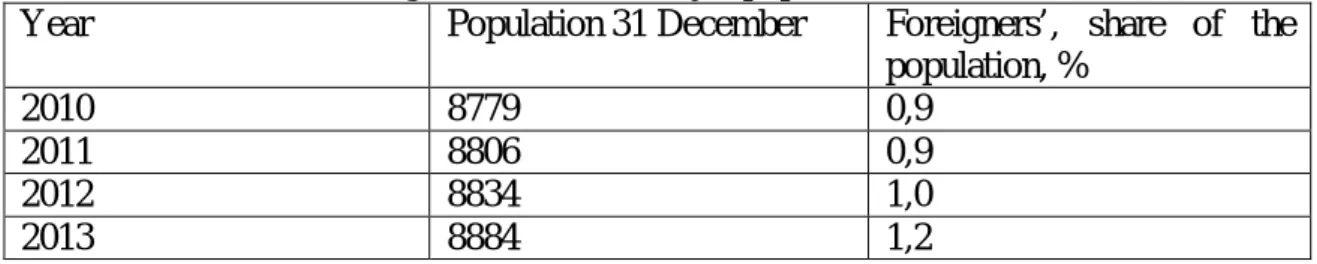
At the end of 2013 the number of inhabitants in Sodankylä was 8884. The share of foreigners was 1,2 % in 2013. At that time the aggregate number of foreigners in the whole country was 3,8 %. The municipality has not entered into any agreement with the State concerning the acceptance of foreigners. In Sodankylä their number has increased somewhat.
Table 1. The share of foreigners of the Sodankylä population 2010 – 2013
Year Population 31 December Foreigners’, share of the
population, % 2010 8779 0,9 2011 8806 0,9 2012 8834 1,0 2013 8884 1,2 Source: Sotkanet 2014
Table 2. Inhabitants in Sodankylä of foreign origin
Year Population % foreigners Number of persons
2009 8872 0,8 71
2010 8801 0,9 79
2011 8796 0,9 79
2012 8815 1 88
2013 8854 1,1 97
Table 3. Mother tongue other than Finnish, Swedish or Same/1000 inhabitants
Year Persons / 1000 inhabitants
2009 6,1 2010 6,9 2011 7,5 2012 8,3 2013 9,9 1.4. Centralconcepts. Immigrant.
A person staying in Finland for purposes other than tourism or a similar short-time stay on the basis of a residence permit, or whose stay in Finland has been registered, or who has been given a residence card. This is a general concept concerning all persons moving to Finland for various purposes.
Residence permit
A temporary or permanent permit granted by the State to live in the country. Foreigners, apart from citizens of the Nordic-, EU- or EEA-countries, must have a residence permit to stay in Finland for a period longer than three months. A residence permit can be granted for example on the basis of family ties to Finland, studies, work, Finnish origin, remigration or humanitarian or other special reasons.
Temporary residence permit
A temporary residence permit is granted to foreigners, who do not have any intention of staying permanently in Finland. The permit must be renewed at the end of its validity period. Such a permit is marked B.
Continuous residence permit.
A continuous residence permit is granted to foreigners who have entered the country with the intention of remaining here permanently. The permit must be renewed at the end of its validity period. Such a permit is marked A.
Permanent residence permit.
A permanent residence permit is granted to persons who have been living in Finland without interruption for four years on the basis of a continuous residence permit. The reason for the stay or other special reasons may constitute reasons for exceptions from the period of stay. The permit is granted until further notice and it need not be renewed. Such a permit is marked P.
Foreigner
According to Finnish law a foreigner is a person of citizenship other than Finnish. Asylum seeker
A person seeking protection and right of residence in a foreign country. Refugee status is not established until a decision has been given on the application so that the word “refugee” should be avoided before the decision has been made.
Refugee
A refugee is a foreigner who has reason to fear persecution because of his or her origin, religion, political views, nationality or membership of a certain social group. A person obtains the refugee status when a country grants asylum, or when the UN's Refugee Agency considers the person concerned to be a refugee.
Quota refugee
A person considered to be a refugee by the UN’s Refugee Agency, who has been granted an immigration permit under the auspices of the refugee quota established in the Finnish state budget.
Immigration
A mutual process between the immigrant and the society with the objective to give the immigrant the knowledge and proficiency required for becoming a member of the society and participating in working life. However, the immigrant’s opportunities to pursue his or her own language and culture are also supported.
Promotion of integration.
Promotion of integration is diversified support by means of services given by authorities and other instances for enabling immigrants to achieve, as quickly as possible, the knowledge and proficiency required by equal and independent citizens.
Integration program
An integration program is a program created by one or jointly by several municipalities for promoting integration and for strengthening diversified co-operation. The program is approved by the municipal council and it is revised not more than once every four years.
The program is taken into account when the budget and economic plans are made pursuant to the Local Government Act.
Integration plan.
A person or family specific plan for promoting immigrants’ possibilities to acquire sufficient knowledge of Finnish or Swedish, as well as other necessary abilities and proficiency.
Persons requiring special support.
A person who needs intensified integration support because of reduced capacity, age, family situation, illiteracy, or for some other similar reason, which is due to illness, injury or some other similar reason.
Multiethnic, multicultural
Ethnicity is an individual’s or a group’s way of discerning itself in relation to others. Ethnicity depends on the current situation and it can change over time. The terms multiethnic and multinational are also used in parallel with multicultural. ethnicity emphasizes a society’s composition of several ethnic or cultural groups. Multi-national emphasizes a society’s composition of different Multi-nationals, who according to law may be multi-national because of double citizenship.
Racism
Racism is an ideology, belief and/or action, which divides people into different races based on their cultural background. Racism is based on the notion that populations are culturally or biologically different and that for that reason they can be badly treated.
2. INITIAL SURVEY AND INTEGRATION PLAN
2.1.Initialsurvey.The initial survey is a preliminary estimate of an immigrant’s abilities for employment, studies or other integration, as well as the need for language training and other services for promoting integration. In that survey an investigation is made of the immigrant’s previous education, working history, language proficiency and other factors impacting his or her ability to have an employment and of being integrated in the society.
A TE-agency initiates an initial survey concerning an immigrant who is registered as an unemployed job applicant. A municipality initiates that survey when an immigrant gets subsistence support more than occasionally. A municipality or a TE-agency can also initiate an initial survey concerning an immigrant who has applied for it, if the person concerned is considered to need it. The survey shall be initiated not later than within two months after the application or after the person has become a public service customer.
On the basis of the initial survey the TE-agency or the municipality makes an estimate if an immigrant needs an integration plan. If such a plan is made, it shall be made not later than three years after granting the first residence permit or residence card, or the registration of a right of residence. The first plan is drawn up for up to one year. The right to the plan remains in force for up to three years and, if necessary, can by separate decision be prolonged by two years.
2.2.Integrationplan.
An immigrant is entitled to an integration plan if he or she is an unemployed job applicant, as defined in the Act on Public Employment and Enterprise Services, or if he or she receives more than occasional subsistence support according to the Subsistence Support Act. An integration plan can be made also for other immigrants, if they are considered to need such a plan on the basis of the initial survey.
An integration plan is an individual plan for measures and services with the purpose of supporting an immigrant’s capacity of acquiring a sufficient proficiency in Finnish or Swedish, other knowledge and abilities needed in the society and in working life, as well as his or her capability to participate as an equal member in social activities. Under an integration plan an agreement can be made concerning education in the immigrant’s own mother tongue, for familiarization with social life, for education improving literacy and for supplementing basic education, as well as integration education and other individual measures for promoting integration.
An integration plan is made in co-operation between the TE-agency, the municipality and the immigrant him- or herself. The plan shall be initiated not later than within a fortnight after the initial survey. The immigrant’s own ambitions for promoting integration shall be taken into account in making the integration plan. The TE-agency makes an agreement with the immigrant concerning education, job application and its objectives, as well as concerning measures and services for promoting job application and employment. Under the auspices of the plan the municipality and the immigrant make an agreement concerning municipal services or other measures for promoting integration and employment, in case the immigrant cannot profit from employment promotion services because of bad health, age or family related reasons. The plan is reviewed at least once a year.
The municipality shall make an integration plan with an underage immigrant, if there is a need because of his or her individual situation. The plan is made together with the underage person, his or her guardian or representative. The municipality shall also make an integration plan for a family in the form of diversified co-operation, if the family’s situation requires such a plan. When estimating the need for such a plan, particular attention should be paid to the age of the person concerned, as well as to his or her parents’ need of support and education.
During the time of participation in activities according to the integration plan the immigrant is granted integration support in the form of employment and subsistence allowance.
If the immigrant, without valid reasons, refuses to make an integration plan, to review it, or to participate in activities agreed in that plan, his or her right to integration support can be restricted by virtue of the Employment Support Act or the Subsistence Support Act.
3. INTEGRATION SERVICES IN THE SODANKYLÄ MUNICIPALITY
On local level a municipality has general responsibility for co-ordination in promoting immigrants’ integration, as well as for its planning and survey. A municipality shall also take care that its services are appropriate also for immigrants. Furthermore, a municipality shall ensure that the measures and services provided to immigrants pursuant to the Act on the Promotion of Immigrant Integration are organized according to the needs in the municipality concerned. A municipality shall also promote its own personnel’s know-how and proficiency in integration matters.In Sodankylä the services for immigrants are organized according to general municipal services and activities. If needed, immigrants’ special needs are provided for by diversified co-operation. In regard of basic services, the staff’s capability of handling meetings between persons with different cultural and linguistic backgrounds, as well as of using interpretation services, is ensured.
3.1.Socialandhealthservices.
Immigrants, as defined in the Act on the Promotion of Immigrant Integration and living in the municipality are entitled to social and health services on the same basis as other inhabitants. Together with the TE-agency the municipal social service authorities are responsible for making an integration plan. Those services also organize services for immigrants with present resources within the framework or normal patient and customer services.
Social services for adults can comprise an estimate of required economic support, of activation in the search for work or education, drawing up a customer plan, as well as information about other available services, e.g. employment and entrepreneurship agencies, KELA, immigration agencies , municipal advise about economic matters and advise for indebted persons and different opportunities of treatment of for example drugs, mental and physical health. Different immigrant groups and their right of subsistence services are emphasized in the instructions for granting subsistence support. In the application of the Act on the Promotion of Immigrant Integration on persons of less than 18 years of age, special attention should be paid to the child’s needs and development. In those cases the provisions of the Child Welfare Act should be taken into account. Services for children and families provide the same advantages for immigrants as for other inhabitants, e.g. support for open welfare and domestic services for families with children.
The Sodankylä health care station provides the same health services and medical treatment as to other inhabitants. Immigrants can get guidance how to use health care
services in connection with the integration plan, taking account of the immigrant’s age and health. Immigrants receive the same health care services as other inhabitants, e.g. physicians’ and nurses’ practice, dental treatment and mental health services.
For further information, see the website
www.sodankyla.fi/perusturvapalvelut
For urgent cases call number 112
Social services are on duty from 9 – 11 am, telephone 0400 694 024
Health care service are on duty in the Sodankylä health care center 8 am – 21 pm, telephone 020 692 881.
Night duty in the Lappi central hospital 21 pm - 8 am. 21 – 22 pm, telephone 016 322 4800
22 pm – 8 am, telephone 016 328 2100.
3.2.Allroundeducationservices Day care
In the Sodankylä education for small children emphasis is on culture in northern regions, nature, as well as all kinds of physical education. Home or private care subsidies are alternatives to municipal day care. In addition there is asupplementary municipal allowance. Primary education free of charge is organized in kindergartens and schools (19 hours / week.) Primary education in isolated villages is mainly organized in the form of joint classes.
There are three kindergartens in Sodankylä. Day care is organized so that small children can benefit from family day care and bigger ones can be in kindergarten. Special day care for small groups is provided in the Paulaharju kindergarten. The Kylälaakso kindergarten provides 24 hour care for children whose parent(s) do shift work. In the Poikkijoki kindergarten there is a supplementary care team and an office for the family day care manager. The day care system provides playing for children in the municipal center and in two external communities twice a week for three hours. In Vuotso there is education in the Sami language organized by a kindergarten teacher speaking that language. A Finnish day care group has been set up in Vuotso in 2013 by the name of Pikkupuro.
Primary and basic education
In Sodankylä account is taken in basic education of living conditions in the North and of the pupil’s cultural identity as a Lapp and a Finn. Everyone living in Sodankylä is entitled to equal treatment, freedom of belief and religion, as well as right to his or her own language and culture. The objective of basic education is to provide the pupil with the ability to live in Sodankylä, in Finland and in the world. In addition to internationalization, emphasis is put on the atmosphere, nature, livelihood, hobbies and the Lappish culture.
In Sodankylä preparatory education is provided to immigrants’ children of basic education age, who are not yet capable of participation in basic education groups. The pupil concerned is integrated into a basic education group as soon as he or she masters Finnish sufficiently to participate in a general education group. Further information can
be provided by Vice-principal Irja-Kaisa Lakkala in the Aleksanteri Kena school. See appendix 1.
Services for pupils and students are provided from basic education age to secondary school pupils. Such services consist of methodical common and individual study services.
Morning and afternoon activities are organized in accordance with the Basic Education Act for pupils in classes 1 – 2, as well as for pupils in classes 3- 9 who benefit from special support. Those activities organized by the municipal free time services agency, which purchases them from the Sodankylä parish. The objective of club activities is to support the child’s development according to the Basic Education Act. Mostly the clubs concentrate on physical education and handiwork.
Prefect activities is a system operating on secondary level of basic school and it is based on the idea of peer support. A prefect is a volunteer pupil who wants to work for the school community and to help other pupils. The objective of prefect activities is to promote friendship, wellbeing in school, joint responsibility, as well as a safe and encouraging atmosphere in the school.
Upper secondary school education.
The Sodankylä upper secondary school is a secondary level school providing general education, which gives the ability for further studies on high school level.
The Sompio library.
That library is a joint enterprise by the Sodankylä, Savukoski and Pelkosenniemi municipalities. Sodankylä serves as manager. There is a main library in each municipality, a library car in Sodankylä and two lending points in Savukoski. The objective of the Sompio library is to promote equal opportunities for everyone to have education, information and recreation. The Sompio library is a member of the Lapland library chain.
The Sompio library provides its customers with books to borrow, e-books. films, music, music notes, periodicals, hobby magazines and daily newspapers. There are also electronic newspapers. The Library Press Display service gives access to 1700 newspapers from 92 countries in 48 languages. They can be read already on the day of publication and most of them during a period of 60 – 90 days from publication. The Press Display can be used from a home computer with the library card and keyword. The library also has other material in foreign languages.
Material in foreign languages can be sent from other Finnish libraries and individual books can be borrowed as a distance service according to the customer’s needs.
The premises of the Sodankylä library serve the inhabitants also as self-service. An electronic key can be obtained to the newspaper room and it is available daily from 7 am. to 22 pm. The library also has a self-service meeting room, which can also be used with an electronic key. Computers are available and there is help for searching material. The library website serves customers 24/7.
Further information is available at the website
www.sompionkirjasto.fi
https://facebook.com/sompionkirjasto.
Leisure time and cultural services, youth council.
The objective of theleisure time services is to offer the inhabitants the most diversified sports, cultural, youth and leisure time services, as well as a service network for all ages. There are also activities that benefit from the environment and that adapt to changes of the society. The strategy of the leisure time service is to create, in co-operation with the relevant organizations, a diversified action network, as well as to provide diversified sports, youth and cultural services.
An important objective of the cultural services is to develop education in visual arts and their accessibility in the Sodankylä municipality. The cultural services annually arrange art- and cultural events in co-operation with various cultural associations and schools. The most important events for children and young people are the art camp in the beginning of June and the culture week in October.
The Sodankylä youth council is a politically independent group of young influential people. It works under the auspices of the municipal council. The youth council provides an opportunity for young people who are interested social affairs to exert an influence, to learn how to do it, as well as other social abilities.
Work for young people
In the municipality’s activity for young people the emphasis is on supporting a healthy and secure growth for them. Modes of activities are, among other things, providing support persons, family related activities, small group activities, rehabilitation work, preparation for working life and individual guidance. These services are implemented by an investigating youth worker together with the staff of the youth services. The premises are situated in the previous Kitisenranta school. The youth club NetC@ is also situated there. The activities of the youth services are also pursued from there. Youngsters have the possibility to spend their free time there, as well as to pursue various activities. The activities are intended for people aged 12 – 29 years. The youth service offers open and club activities, various events and camps. The open activities are intended for youngsters aged 13 - 17. Clubs for girls, media-clubs, floorball clubs, motor clubs, rinkball clubs, clubs for young children and the house managing committee operate there. These clubs mainly operate in the afternoon and in the evening they meet before 18.00 hours.
For further information, see
www.sodankyla.fi/sivistyspalvelut
3.3.Housingservices.
Immigrants have the same right as other inhabitants to rent housing in the municipality. The objective of the housing services is to ensure that homeless people and those living in inadequate conditions can obtain housing. The criteria for access to state-subsidized
housing are social and economic needs. The Government determines the detailed criteria, as well as the grounds for deviating from those criteria in particular cases. For further information, see
www.sodankyla.fi/asuntotoimi
Raija Kukkohovi, telephone
3.4.Technicalservices.
The primary objective of the technical services is to produce and to maintain safe and comfortable community technical services, as well as to maintain the municipality’s premises economically and efficiently. Technical services to immigrants are provided like to all other inhabitants with present available resources and benefitting from existing services.
www.sodankyla.fi/teknisetpalvelut
3.5.Interpretationandtranslationservices.
For immigrants who do not know Finnish interpretation services required by law are provided according to need. They ensure that immigrants can do their business with the authorities on the same basis as other inhabitants. There services ensure that immigrants’ legal rights are respected and that immigrants can integrate into the Finnish society.
According to section 5 of the Act on the Promotion of Immigrant Integration the authorities shall ensure interpretation or translation pursuant to the Language Act (423/2003), if the immigrant does not master Finnish or Swedish to the extent necessary to communicate with the authorities, or if he or she because of illness or injury cannot be understood in a matter, which has been brought up by the authorities. As far as possible the authorities shall arrange interpretation and translation also in other cases concerning an immigrant’s rights and duties. Interpretation or translation shall be arranged to a language, which the immigrant masters sufficiently, taking account of the case at hand. The authorities’ duty to arrange interpretation or translation does not concern material that is not relevant for handling the case.
The authorities shall arrange and pay for interpretation and interpretation in matters, which may be brought up by the authorities. For refugees interpretation costs are paid by the State without any time limit, if those costs concern social and health services, making an integration plan, initial integration services at the beginning of the stay, introduction to the municipality, as well as co-operation between the school or kindergarten and the immigrant. A professional interpreter should be used, but not the customer’s spouse, family member, or never a child.
The Sodankylä municipality has concluded a framework agreement concerning interpretation and translation services with the company “Tulkkaus ja käännöskeskus Professional Oy.” Telephone interpretation (distance interpretation) shall in the first hand be purchased from that service provider. The agreement concerns interpretation
and translation services from Finnish to a foreign language, or from such a language to Finnish.
Interpretation
The services of a business interpreter are ordered by telephone, by the reservation system of a website, or by e-mail from Tulkkaus- ja käännöskeskus Professional, which confirms the availability of an interpreter by e-mail. Interpreters also work outside office hours and on week-ends.
Translation services.
The texts to be translated are mainly sent to the customer as word-files. For further information, see
http://.tulkauspalvelut.fi/
4. INTEGRATION
SERVICES
BY
OTHER
AUTHORITIES
OR
INSTITUTIONS.
4.1.TheTE-centers.
Services for job applicants according to needs.
The offices of the Lappland TE-center are situated in Enontekiö, Ivalo, Kemi, Kemijärvi, Kittilä, Kolari, Muonio, Pello, Posio, Rovaniemi, Salla, Savukoski, Sodankylä, Tornio and Ylitornio.
Services for immigrants are integrated into TE-centers’ normal services, however taking into account their special needs. There are two fulltime officials specialized in employing immigrants. They form part of the services for subsidized employment. In
other sectors services for immigrants constitute part of officials’ job. The co-ordination of integration services is a part of the services for promoting proficiency and know-how. The service manager and director, as well as one expert, are responsible for managing those services. One service director is responsible for improving proficiency and know-how.
Education for integration is mainly given in the form of employment education, as provided in the Act on Public Employment and Enterprise Services. Such education can also be arranged in the form of independent studies. ELY-centers are responsible for arranging integration education as employment education in their field of operation. For immigrants who have passed the age of compulsory education for integration purposes there are courses in Finnish or Swedish. If needed they are also taught reading and writing, as well as other abilities necessary for participating in cultural activities and for managing their own lives. In respect of language teaching the objective is that the immigrant shall acquire sufficient basic proficiency in Finnish or Swedish.
The same service principles apply to immigrants as to other inhabitants. However, immigrants’ special needs are taken into account, e.g. interpretation. Generally more time than average is reserved for serving immigrants. As a whole, TE-services can be custom made in a very flexible manner for corresponding to immigrants’ needs.
Pursuant to the Act on the Promotion of Immigrant Integration the Lapland TE-center participates in integration activities in co-operation with other regional authorities and actors. The center is responsible for providing services for promoting immigrants’ employment, as well as for other services for job seeking immigrants. They can be offered custom made services.
The Lapland integration strategy 2017, which has been made in the form of a regional diversified network co-operation, constitutes a guide for applying the TE-centers’ integration services in all sectors where those centers work.
For further information, see
www.te-toimisto.fi/
4.2.TheSocialInsuranceInstitutionofFinland(KELA)
In Finland KELA takes care of the basic security of inhabitants in Finland in all phases of their lives. KELA’s customers are all those who live in Finland, as well as those living abroad and who are covered by the Finnish social security system. That system comprises support to families with children sickness insurance, rehabilitation, basic security for unemployed, housing allowances, study allowances and minimum pensions. In addition KELA takes care of allowances to invalids, social allowances and support to immigrants. KELA also
· informs about benefits and services,
· pursues research for developing and improving social services,
· produces statistics, estimates and forecasts required for predicting the need of benefits and activities,
For further information, see
www.kela.fi
4.3TheSodankyläparish
The Sodankylä parish provides help in spiritual, material and social matters, in co-operation with other helpers. Immigrants’ religious beliefs are respected, but opportunities are offered to get acquainted with the Evangelic-Luther church. Those interested in the parish’s activities are mainly encouraged to participate in existing activities. If needed, meetings with immigrants can be arranged, e.g. in the form of open-door events. The objectives of the integration program are implemented as general parish activities, social work of the church, youth and confirmation activities, child related activities, as well as evangelic and missionary work. The parish co-operates closely with various municipal agencies and organizations.
For further information, see
www.sodevl.fi
4.4.TheLaplandtechnical college,theLapland touristinstitute andthe Revontuliinstitute.
The Lapland technical college and the Lapland tourist institute.
The college and the institute, which are maintained by the Rovaniemi federation of municipalities for education, provide secondary level education. The Sodankylä office of the Lapland technical college also provides training for trainers and guides, i.e. “Ammattistartti” (vocational start) and preparatory and rehabilitation training (VaKu). For further information, see
www.lao.fi
The Revontuli institute
The institute is an adult education center maintained jointly by the municipalities Kittilä, Enontekiö and Sodankylä. It is administered in Kittilä. The center’s task is to provide all-round education for everyone that enables personal development, life-long learning, improvement of learning skills and social capabilities. It also supports physical, mental and social wellbeing. Residents of the municipality can present their wishes regarding language training.
For further information, see
www.revontuliopisto.fi
4.5. Mannerheimchildren’sprotectionagency.
In Sodankylä there is a local branch of that agency. It organizes excursions and other various events for families and the agency also participates in several other events. The board meets about once a month for planning future activities. Family cafeterias have
been organized occasionally, but there are none at the moment. They can be re-started, if there is enough interest.
Father-child activities provide opportunities for fathers and children to jointly pursue dabbling and various other activities. The agency has also organized parking of children in various events. From child welfare clinics it is possible to rent safety rinks and mobile beds. The agency supports mentorship in schools.
The agency’s Sodankylä branch trains child-minders and the Lapland branch of the agency organizes labor exchange. A family can have short time baby-sitting services at all times of the day. Those services can be used according to the family’s needs, e.g. when a child is ill, when the parents want a moment to catch their breath, pursue some hobbies or just spend time alone.
For further information see
http://sodankyla.mll.fi/ and https://.facebook.com/MLLSodankyla
5 ACTION PLAN
Primary objective: Promotion of good relations between ethnic groups and inter-cultural communication.
OBJECTIV E
MEASURES RESPONSIBLE PARTY TIME SCHEDULE
Language training according to immigrants’ needs Immigrants are familiarized with Sodankylä Immigrants are informed about Sodankylä organization Training organizers aware of immigrants’ needs Welcome to Sodankylä package to new inhabitants and employers - action calendar in English English websites - English brochures and available organizatio - Revontuliopisto - administrative services - administrative services - administrative services Kitinen organization center - continuous 2015 2015 2015 2015 2015
s and associations Inhabitants learn about other inhabitants’ culture Immigrant pupils feel well and learn in primary and basic education Support for immigrant families for adaptation to daily life. Immigrants participate in church activities. Monitoring and updating the integration program for immigrants. ns. - welcome to Sodankylä course - The culture cafeteria
Contact persons for immigrants in
school. Sponsor pupils for
immigrant pupils. Preparatory education, (Valo),
support pupils Home service for
families with children. Deputy grannies, Godfamilies, excursions in nature, father-child activities, the Terho-club Immigrants’ wishes
are taken into account in planning
activities. Working group, not
less than once a year. Kitinen organization center Education services/librar y and the Revontuli institute Education services, Aleksanteri Kena school Education services, Aleksanteri Kena school Basic security, child welfare clinic. MLL The Sodankylä parish. Basic security/social services 2015 2015 2015 continuous continuous 2015 2015 2015 2015 -- monitoring 2015-2016, - updating 2017
Usefullinks: www.ely-keskus.fi/lappi www.kela.fi www.seitasaatio.fi http://sodankyla.mll.fi/ https://www.facebook.com/MLLSodankyla. www.sodankyla.fi www.sodevl.fi www.tulkkauspalvelu.fi Sources:
Act on the Promotion of Immigrant Integration, 1386/2010.
Act on the Integration of Immigrants and Reception of Asylum Seekers, 493/1999. Lakkala, Irja-Kaisa 2013: Teaching of immigrants in the Aleksanteri Kena school. University of Lapland. Unpublished.
The Lapland integration strategy 2017. The immigrants’ future 2020 strategy.
The Sodankylä children and family policy program 2013 – 2016. The Sodankylä municipal strategy 2014 – 2020.
Instructions for applying subsistence support from 1 January 2015.
The Valo-teaching helps Finns to education, article in the newspaper “Lapin Kansa” on 16 May 2014.
The State integration program 2012 – 2015.
Our common village is international, release from a public event on 21 August 2014.
CONTACT – Communities for joint action, the ESR-project, interview of Tiina-Liisa Multamäki.