Penn Law: Legal Scholarship Repository
Penn Law: Legal Scholarship Repository
Faculty Scholarship at Penn Law4-23-2018
Was the AMT Effectively Repealed?
Was the AMT Effectively Repealed?
Reed Shuldiner
University of Pennsylvania Carey Law School
Follow this and additional works at: https://scholarship.law.upenn.edu/faculty_scholarship
Part of the Law and Economics Commons, Policy Design, Analysis, and Evaluation Commons, Political Economy Commons, Public Economics Commons, Taxation-Federal Commons, and the Tax Law
Commons
Repository Citation Repository Citation
Shuldiner, Reed, "Was the AMT Effectively Repealed?" (2018). Faculty Scholarship at Penn Law. 1979. https://scholarship.law.upenn.edu/faculty_scholarship/1979
This Article is brought to you for free and open access by Penn Law: Legal Scholarship Repository. It has been accepted for inclusion in Faculty Scholarship at Penn Law by an authorized administrator of Penn Law: Legal Scholarship Repository. For more information, please contact [email protected].
tax notes
®VIEWPOINT
Was the AMT Effectively Repealed?
by Reed Shuldiner
Introduction
One of the frequently criticized features of pre-2018 tax law was the individual alternative minimum tax. Its repeal was called for by both candidate and President Trump, and it was repealed in the House version of the Tax Cuts and Jobs Act (P.L. 115-97) and in the original draft of the Senate bill. In the final version of the Senate bill, however, the AMT survived, albeit with an increased exemption and an increased threshold for the phaseout of the exemption. The conference agreement followed the Senate bill in retaining the AMT with the increased exemption, but with a further substantial increase in the phaseout threshold.
The new AMT is a much-defanged version of the old AMT. Under old law, in broad income ranges the AMT was structured relative to the regular tax such that little preference income was required to trigger the AMT, and in some cases it could be triggered by a taxpayer taking no more
than the standard deduction and a minimum number of personal exemptions.1
By contrast, under the TCJA there is always a substantial cushion between the regular tax and the AMT, so substantial preference income is required to trigger the AMT.2
At the same time, the regular tax under the TCJA eliminates key preference items, including personal exemptions, the state and local tax deduction over $10,000, and miscellaneous itemized deductions over the 2 percent floor. The structural changes in the AMT combined with the reduction in potential preferences means that the AMT should cease to be of concern to all but a small number of taxpayers with unusual tax circumstances. Comparing the AMT under old and new law is useful not only for the light it sheds on current law, but also, given the 2025 sunset in the TCJA, because the old AMT is scheduled to return.3
In a sense, one might think of old law as both old and future law.
AMT Overview and TCJA Amendments
The AMT was introduced in 1969 in response to concerns that some high-income taxpayers didn’t pay any federal income taxes.4 The idea of the AMT was to impose a lower rate on a broader base and thereby guarantee that high-income taxpayers paid a minimum amount of taxes. Lower-income taxpayers were kept out of the Reed Shuldiner is the Alvin L. Snowiss
Professor of Law and co-director of the Center for Tax Law and Policy at the University of Pennsylvania Law School.
In this article, Shuldiner compares the alternative minimum tax before and after the Tax Cuts and Jobs Act, arguing that the new AMT is a much-weakened version of the old one. He writes that far fewer taxpayers will be exposed to the AMT and that the likely ones will be those high-income taxpayers taking advantage of loopholes — the original target of the AMT.
Copyright 2018 Reed Shuldiner. All rights reserved.
1
See the discussion of head of household status below. 2
I use the term “alternative minimum taxable income” to refer to the taxable excess as defined in section 55(b)(1)(A). I use the terms “preferences” and “preference income” to refer interchangeably to all adjustments and tax preferences. See sections 56-58.
3
See, e.g., section 1(j) (limiting changes to the regular tax brackets to tax years beginning before January 1, 2026) and section 55(d)(4) (limiting changes to the AMT exemption to tax years beginning before January 1, 2026).
4
For a history of the AMT, see Robert P. Harvey and Jerry Tempalski, “The Individual AMT: Why It Matters,” 50 Nat’l Tax J. 453-473 (1997). For a more recent look at the AMT, see Leonard E. Burman, “The Alternative Minimum Tax: Assault on the Middle Class,” Milkin Inst. Rev., at 12-23 (Fourth Quarter 2007).
domain
AMT through an exemption. Although originally targeting high-income taxpayers — the original AMT targets earned more than $1.5 million in today’s dollars — over time the AMT began to affect more and more middle-income taxpayers. There were two primary reasons for the increased scope and changed focus of the AMT. First, the key structural provisions were not indexed for inflation.5
Second, tax rates were reduced for the regular tax without adequate corresponding adjustments to the AMT. The situation became acute with the Bush tax cuts in 2001, which
significantly reduced rates for the regular tax while making only temporary and inadequate adjustments to the AMT.6
As a result of these factors, the number of taxpayers swept into the AMT began to rise sharply (see Figure 1). From 1987 to 2001, the number of taxpayers affected by the AMT increased on average by 21 percent a year, rising from 140,000 taxpayers to 1.6 million taxpayers.7
After the Bush tax cuts, for the period 2001-2005, the annual rate of increase jumped to 41 percent. By 2005, 5 million taxpayers were subject to the AMT. Congress tinkered with the
5
The unindexed provisions were the exemption amount, the phaseout threshold for the exemption, and the start of the 28 percent bracket. Indexing was added beginning in 2013 by section 104(b)(1) of the American Taxpayer Relief Act of 2012 (P.L. 112-240). See section 55(d)(4).
6
Economic Growth and Tax Relief Reconciliation Act of 2001 (EGTRRA, P.L. 107-16). On the relationship between the Bush tax cuts and the AMT, see, e.g., Burman, supra note 4, at 18 (“The Bush
administration and its allies understood at the time that the AMT would ‘take back’ a significant portion of the tax cuts.”).
7
All figures are geometric averages based on the data source noted in Figure 1.
domain
AMT, particularly the exemption level, to slow the increase in the number of taxpayers subject to it.
Finally, as part of the American Taxpayer Relief Act of 2012, Congress enacted a so-called permanent fix,
Table 1. AMT Preferences in 2012
Number of Taxpayers With AMT Preference
(thousands) Amount (millions of dollars) Percentage of All Preferences
Taxable income from Form 1040 (including negative amounts) + AMT adjustments and preferences
4,407 $1,499,292
Preference Number of Taxpayers Dollars (in millions) Percentage
State and local tax deductions net of refunds 4,140 $141,130 63.77%
Personal exemptions 4,327 $49,312 22.28%
Miscellaneous deductions above the 2% floor 1,009 $22,376 10.11%
Standard deduction 206 $1,705 0.77%
Passive activity loss 589 $1,595 0.72%
Incentive stock options 13 $1,482 0.67%
Beneficiaries of estates 103 $1,308 0.59%
Medical deductions 178 $837 0.38%
Private activity bond interest 654 $803 0.36%
Regular tax NOLs net of AMT NOLs 21 $666 0.30%
Depletion 15 $434 0.20%
Post-1986 depreciation 585 $429 0.19%
Long-term contracts 2 $344 0.16%
Other and related 61 $323 0.15%
Loss limitations 162 $322 0.15%
Certain home-mortgage interest 47 $274 0.12%
Intangible drilling costs 2 $195 0.09%
Capital gains exclusion (section 1202) 6 $107 0.05%
Mining costs 8 $82 0.04% R&E expenditures 1 $12 0.01% Circulation expenses 1 $1 0.00% Large partnerships — $1 0.00% Installment sales 1 -$8 -0.00% Investment interest 105 -$78 -0.04% Undetermined -$955 -0.43% Disposition of property 252 -$1,391 -0.63%
Total adjustments and preferences $221,306 100%
= AMTI 4,407 $1,720,598
Note: The table contains information on taxpayers who owe additional tax because of the AMT (including lost credits).
Source: Based on data available at http://www.taxpolicycenter.org/statistics/amt-preference-items-2002-2004-2012.
Underlying source: Office of Tax Analysis, Department of the Treasury (unpublished tabulation).
domain
further increasing the exemption level and indexing the AMT for inflation.8
These changes stabilized the number of taxpayers subject to the AMT. Thus, the projected number of taxpayers subject to the AMT for 2018 was 5.2 million, roughly the same as the number in 2005.9
The AMT broadens the tax base by adding back into income a series of tax preferences. Some of the preferences target what might be
considered traditional business and high-income taxpayer loopholes. Examples include passive activity losses, incentive stock options, interest on private activity bonds, some accelerated
depreciation, long-term contracts, intangible drilling costs, and mining exploration and development costs.10
Other preferences are more mundane personal deductions. For example, the AMT included the following personal deductions as tax preferences: (1) the SALT deduction; (2) personal exemptions; (3) miscellaneous itemized deductions in excess of the 2 percent floor; and (4) the standard deduction.11
Over time, as the AMT effectively shifted to upper-middle-income taxpayers, personal deductions made up the lion’s share of the tax preferences. As shown in Table 1, for 2012, the most recent year for which data is available, the SALT deduction alone accounted for 64 percent of all preferences. Personal exemptions accounted for another 22 percent, miscellaneous itemized deductions in excess of the 2 percent floor 10 percent, and the standard deduction another 1 percent.12 Taken together, personal deductions accounted for 97.4 percent of the preferences taken into account under the AMT. The AMT thus had lost its mooring as a tax on high earners using loopholes and had instead become a much-disliked tax on families, particularly in high-tax states.13
During his campaign, candidate Trump called for the elimination of the AMT.14
Repeal was again promised when the “Big Six” group of Republican leaders — Senate Majority Leader Mitch
McConnell of Kentucky, House Ways and Means Committee Chair Kevin Brady of Texas, House Speaker Paul D. Ryan of Wisconsin, Senate Finance Committee Chair Orrin G. Hatch of Utah, Treasury Secretary Steven Mnuchin, and then-National Economic Council Director Gary Cohn — released their framework for tax reform,15
and repeal was in both the bill passed by the House and the original chairman’s mark in the Senate.16
As the bill worked its way through the Senate, however, full repeal of the AMT was abandoned, presumably for revenue reasons.17
Instead, the bill passed by the Senate increased the AMT
exemption for married taxpayers filing jointly from $86,200 to $109,400 (from $55,300 to $70,300 for unmarried taxpayers and heads of household) and increased the threshold for the phaseout of the AMT exemption for married taxpayers filing jointly from $164,100 to $208,400 (from $123,100 to $156,300 for unmarried taxpayers and heads of household).18
The conference committee adopted a modified version of the Senate bill, increasing the exemption phaseout threshold substantially to $1 million for married taxpayers filing jointly ($500,000 otherwise).19
The primary question asked in this article is what the significance is of the failure to repeal the AMT. I argue below that the combination of increasing the AMT exemption, raising the exemption phaseout threshold, and eliminating
8
Seesupra note 5. 9
AMT taxpayers as a percentage of the U.S. population were projected to be slightly lower in 2018 than 2005.
10
See generally sections 56-58. 11
See section 56(b)(1). 12
I include in the category of personal deductions the disallowance of medical deductions between 10 percent and 7.5 percent and the disallowance of home equity interest, which accounted for 0.38 percent and 0.12 percent of all personal deductions, respectively.
13
See, e.g., David Cay Johnston, “Funny, They Don’t Look Like Fat Cats,” The New York Times, Jan. 10, 1999.
14
See, e.g., Jim Nunns et al., “An Analysis of Donald Trump’s Tax Plan,” Urban-Brookings Tax Policy Center (Dec. 22, 2015).
15
See Big Six, “Unified Framework for Fixing Our Broken Tax Code,” at 5 (Sept. 27, 2017).
16
See section 2001 of H.R. 1 as passed by the House on November 9, 2017. See also Joint Committee on Taxation, “Description of the Chairman’s Mark of the ‘Tax Cuts and Jobs Act,’” JCX-51-17 (Nov. 9, 2017).
17
Revenue estimates for the AMT provisions in the various bill stages are discussed below.
18
Section 12001 of the amendment to H.R. 1, as passed by the Senate on December 2, 2017. Married taxpayers filing separately aren’t discussed in this article, but the various amounts for married taxpayers filing separately are always half the amount for married taxpayers filing jointly. References to married taxpayers filing jointly include surviving spouses. References to unmarried individuals exclude surviving spouses and heads of household.
19
Section 12003, H.R. 1, as reported in H.R. Rep. No. 115-466. See section 55(d)(4).
domain
many AMT preferences greatly reduces the impact of the AMT and returns it closer to its original conception as a limited tax on individuals with substantial preference income. To see this, it is necessary to look at each filing status separately.
The AMT for Married Taxpayers Filing Jointly
Whether a taxpayer is subject to the AMT depends, of course, on the AMT preferences to which the taxpayer is entitled under the regular tax. However, it also depends critically on the relative rate structure of the regular and
alternative minimum taxes. The usual description of the AMT is that it has a broader base and lower rates, but that is not necessarily true. In significant ranges of income, the marginal rate under the AMT can exceed the marginal rate under the regular tax. Because the regular tax and the AMT use different definitions of taxable income, however, it is difficult to directly compare their rate structures. To do so, I assume a minimal set of AMT preferences and compare the marginal rates and total tax burdens under the regular and alternative minimum taxes. My base case is a married couple filing a joint return and taking the standard deduction. I assume the couple is not entitled to any credits and has no AMT
preferences other than the standard deduction and (under current law) the personal
exemptions.20
Figure 2 shows the marginal rates facing those taxpayers as a function of adjusted gross income — which is assumed to be the same under new and old law.21
Lines A and B indicate the regular tax, and lines C and D indicate the AMT. Lines A and C indicate old law, and lines B and D indicate new law. Old law reflects inflation adjustments through 2018. In other words, it is what old law would have been in 2018 if the TCJA hadn’t been enacted.22
Compare first lines A and B — the old and new regular taxes — noting that the horizontal
axis is measured in AGI, not taxable income. As expected, marginal rates under new law (Line B) are always at or below marginal rates under old law (Line A), reflecting the general decline in marginal rates under the TCJA.23
Now compare lines C and D — the old and new AMTs. There are two major changes. First, Line D rises from zero to 26 percent to the right of Line C, reflecting the increase in the AMT
exemption under new law.24
Second, compare the humps in lines C and D. The humps reflect the effective increase in marginal rates because of the phaseout of the AMT exemption. The exemption phases out at a rate of 25 cents on the dollar, effectively increasing the marginal rate by 6.5 or 7 percentage points.25
The hump shifts to the right under new law because of the increase in the phaseout threshold from $164,100 to $1 million.26
In assessing the likelihood of a taxpayer being subject to the AMT, we must compare the lines A, B, C, and D with each other. First, consider old law — lines A and C. From $86,000 (the AMT
exemption amount) to $320,000 (the start of the personal exemption phaseout under the regular tax), the marginal rate under the AMT exceeds the marginal rate under the regular tax. Of course, merely because the marginal rate under the AMT exceeds the marginal rate under the regular tax does not mean that the total AMT exceeds the regular tax. That depends on the cumulative area between the two lines and is difficult to determine from a graph of marginal rates, but Figure 2 does show that the story is more nuanced than the simple broad-base, low-rate description of the AMT.
What about under new law (lines B and D)? Under new law, there remains a region where
20
My base case is minimal in the sense that it is the simplest case. It is not minimal in the sense of minimizing AMT preferences because the standard deduction itself is an AMT preference item. Section 56(b)(1)(E).
21
I also assume that the taxpayer is not entitled to take the 20 percent deduction for qualified business income and has no income entitled to the capital gains preference. See sections 199A (qualified business income deduction under new law) and 1(h) (capital gains preference under old and new law).
22
Inflation adjustments are from Rev. Proc. 2017-58, 2017-45 IRB 489, issued by the IRS before the passage of the TCJA.
23
In lieu of the actual phaseout under section 151(d), I assume a smooth phaseout over $125,000 of AGI, which equals an increase in marginal rate of approximately 1.1 percent.
24
Compare section 55(d)(1) (AMT exemption under old law) as adjusted for inflation with section 55(d)(4) (AMT exemption under the TCJA).
25
Under new law, the entire phaseout is in the 28 percent bracket, leading to an incremental marginal rate of 7 percent (28 percent x 25 percent). Under old law, the phaseout begins in the 26 percent bracket, and thus initially raises the marginal rate by 6.5 percent (26 percent x 25 percent).
26
There is a third minor change in the AMT. While the TCJA did not directly change the start of the 28 percent bracket in section 55, it did change the method by which the 28 percent bracket is adjusted for inflation. As a result, under new law the 28 percent bracket starts at $191,100 rather than $191,500.
domain
Line D is above Line B — that is, an area where the marginal rate under the AMT exceeds the
marginal rate under the regular tax. That region, however, has shifted to the right, now extending from $109,400 (the AMT exemption level) to $339,000 (the start of the regular tax 32 percent bracket). By shifting to the right the region where the AMT rate exceeds the regular tax, the TCJA makes it less likely that the AMT will be binding on the taxpayer.27
Although looking at marginal rates is informative, ultimately what must be compared are total tax liabilities, not marginal rates. Total tax liabilities are compared in Figure 3. As in Figure 2, lines A and B are used for the regular tax and lines C and D for the AMT. Lines B and D are used for the new law, and lines A and C are used
for the old laws. The other lines are explained below.
As before, first compare lines A and B representing the old and new regular tax, respectively. As expected, Line B lies strictly below Line A, indicating a tax cut at all income levels for which tax was due.28
Similarly Line D (new AMT) is below Line C (old AMT), at least until an AGI of $1,437,600, at which point the exemption in the new AMT has been fully phased out and the two taxes are practically identical.29
Now compare lines A and C, the old regular and old alternative minimum taxes. What is
27
By shifting the region where the AMT rate exceeds the regular tax rate to the right, the TCJA expands the initial region where the regular tax rate exceeds the AMT rate.
28
Of course, the conclusion that the total tax liability is always less under new law holds only given my assumptions. For example, if the taxpayer had large SALT deductions, the tax could easily be greater under new law. All I have shown is that for a married couple filing jointly, the increase in the standard deduction and the revisions to the brackets more than make up for the loss of the personal exemptions.
29
The new AMT is $8 greater than the old AMT because the 28 percent bracket starts at $191,100 rather than $191,500, which has the effect of taxing the difference, $400, at an extra 2 percent rate. See supra note 26.
domain
striking is that for a significant region, from about $300,000 to $500,000 of AGI, the two lines are difficult to separate. In other words, without any preferences other than the standard deduction and the personal exemptions, the AMT is roughly the same as the regular tax. As a result, if
taxpayers in this region have any significant additional preference income, they are quickly subject to the AMT.
To see this more clearly, lines E and F show what I call the AMT cushion. I define the AMT cushion as the excess of the regular tax over the AMT as a percentage of the regular tax.30
The scale for the AMT cushion is shown on the right axis. At any given AGI, the larger the cushion, the greater the amount of preference income required to subject the taxpayer to the AMT. If the cushion is small, only a small amount of preference income
is required to trigger the AMT. If the cushion is less than zero, the taxpayer is subject to the AMT.
As can be seen from Line E in Figure 3, the AMT cushion is U-shaped. It initially plummets as AGI rises, flattens out, rises again sharply, and eventually levels off. What is striking about the graph is that the cushion is quite small for a substantial range of income. In particular, the cushion is less than 5 percent for AGI between about $250,000 and $560,000, and drops as low as 1 percent from about $320,000 to $500,000. Over this range, the difference between the two taxes is razor thin.
For example, as little in additional AMT preferences as a third personal exemption would be enough to subject the taxpayers in my example to the AMT over the region of roughly $290,000 to $370,000. Figure 3 makes clear why so many taxpayers were subject to the AMT under old law and that the primary target of the AMT was taxpayers roughly in the range of $250,000 to
30
AMT cushion = (regular tax - AMT)/(regular tax).
domain
$500,000 of income. Those taxpayers are well-off by any reasonable measure, but a far cry from the original targets of the AMT who earned over $1.5 million in today’s dollars. By contrast, for
taxpayers with AGI over $1 million, the cushion starts at 17.6 percent and increases gradually toward 29.3 percent.31
Thus, under old law, very high-income taxpayers were subject to the AMT only if they had large amounts of preference income.32
At the same time, taxpayers with incomes between roughly $250,000 and $500,000 were often caught in what might be called the AMT trap — the U-shaped region shown in Figure 3.
What about under new law? In comparing lines B and D in Figure 3, it’s clear that under new law there is generally more separation between the regular and alternative minimum taxes. The separation can be seen more clearly by looking at Line F, which shows the cushion between the regular and alternative minimum taxes under new law. For incomes under $1 million (when the AMT exemption begins to phase out), Line F lies well above Line E. Its minimum is about 6 percent, and given its sharp V shape, it is at its minimum only at a single point and then rises steeply.33
That contrasts starkly with old law, under which the AMT cushion was 5 percent or less for a range of over $400,000 of AGI. Thus, the AMT trap has been substantially reduced. Starting at $1 million, the cushion shrinks from a peak of about 18 percent to a trough of about 14 percent as the AMT exemption phases out. Once the exemption is fully phased out at $1,437,600, the cushion rises toward its asymptote of 24.3 percent.34
The
asymptote under new law is less than the
asymptote under old law because of the decline in the regular tax top bracket from 39.6 percent to 37 percent without a concomitant decline in the AMT top bracket.
It’s clear, therefore, simply by comparing the AMT cushion under old and new law, that the structure of the AMT under new law substantially reduces the impact of the AMT. What about AMT preferences? Will there likely be an increase in AMT preferences that will offset the structural advantages of the revised AMT? To the contrary, there will likely be a substantial decrease in preference income under new law. The most significant change is the $10,000 cap on the SALT deduction, which as shown in Table 1 accounted for over 60 percent of preferences in 2012.35
Of course, the capped SALT deduction is still a preference item, but as I argue below, it alone could never be sufficient to subject a taxpayer to the AMT.
The TCJA also eliminates personal exemptions and miscellaneous itemized
deductions, which together accounted for over 30 percent of preferences in 2012.36
Finally, although of much less empirical importance, the TCJA eliminated the deduction for interest on home equity indebtedness, thus further reducing potential AMT preferences. Of course, the TCJA substantially increases the standard deduction, which is also a preference item under the AMT. The increased standard deduction, however, has been fully accounted for in Figure 3.
At the AMT marginal rate of 26 or 28 percent, the $10,000 SALT deduction under the TCJA would increase the AMT by $2,600 or $2,800. Although unclear from Figure 3, the gap between the regular and alternative minimum taxes (in the
31
For very high incomes, the AMT approaches a flat tax at 28 percent, and the regular tax approaches a flat tax at 39.6 percent. The AMT cushion, therefore, approaches 29.3 percent ((39.6 percent - 28 percent)/ 39.6 percent) asymptotically.
32
Given their phaseout, personal exemptions could not be a source of preference income. Also, given the amount of preference income required, it is unlikely that state and local taxes alone could generate enough preference income to trigger the AMT.
33
The minimum point is at an AGI of $339,000, which, given the $24,000 standard deduction, gives a taxable income of $315,000. At that point, the marginal rate on the regular tax jumps from 24 percent to 32 percent as compared with an AMT marginal rate of 28 percent.
34
For very high incomes, the AMT approaches a flat tax at 28 percent and the regular tax approaches a flat tax at 37 percent. The AMT cushion, therefore, approaches 24.3 percent ((37 percent - 28 percent)/37 percent). Cf. note 31.
35
See section 174(b)(6) (imposing $10,000 cap on SALT deductions). 36
The old regular tax permitted miscellaneous itemized deductions only to the extent they exceeded 2 percent of AGI. Section 67. The AMT preference item, therefore, was the excess of those deductions over the floor. Under new law, the deductions are entirely disallowed. See section 67(g).
domain
range where the AMT is positive) is as small as $3,721. Adding a preference item of $10,000 at a 26 or 28 percent tax rate would thus appear to substantially eliminate the gap between the AMT and the regular tax, making it much more likely that other preference items would make the taxpayer subject to the AMT.37
The problem with this analysis is that it is inconsistent with the assumption that the
taxpayer takes the standard deduction. To take a SALT deduction, a taxpayer must itemize
deductions.38
And if the taxpayer itemizes, the taxpayer cannot also take the standard deduction. Thus, a taxpaying couple can have a $10,000 SALT preference only if they don’t have a $24,000 standard deduction preference. The effect of taking a $10,000 SALT deduction, therefore, is to reduce AMT preferences by $14,000. In other words, taking the SALT deduction makes a taxpayer less likely to be subject to the AMT. Consider again Figure 3. Line G shows the AMT cushion assuming the taxpayers have itemized deductions of $24,000, including $10,000 in SALT deductions and $14,000 in non-preference
deductions. As expected, the AMT cushion with the SALT deduction (Line G) lies strictly above the AMT cushion with the standard deduction (Line F). In particular, assuming the SALT deduction doubles the minimum AMT cushion from about 6 percent to about 12 percent.
The AMT for Unmarried Taxpayers
The analysis above is limited to married taxpayers filing jointly. This part provides a parallel analysis for individuals filing as unmarried, and the next part does so for
individuals filing as head of household. Figure 4 provides the same information as Figure 3, but assumes an unmarried taxpayer with (under old law) a single personal exemption. Consider first the change to the regular tax for unmarried taxpayers by comparing Line A (old regular tax) and Line B (new regular tax). While Line B is always below Line A, the two lines are closer together in Figure 4 than in Figure 3. The
closeness of the lines indicates that at least in some regions, the tax cut given by the TCJA to unmarried individuals was less generous than the tax cut for married couples. In particular, under new law the 35 percent bracket starts at a taxable income of $200,000, while under old law the 35 percent bracket does not start until $424,950. An unmarried taxpayer with AGI of $431,450 and taking the standard deduction under both old and new law would save only $807 under the new law, a reduction in taxes of only 0.65 percent. The fact that the TCJA is less generous to unmarried individuals is the flip side of the fact that it eliminated the marriage penalty for the regular tax in all but the top bracket.39
As discussed below, Congress took the opposite tack with the AMT.
In terms of the bite of the AMT under old law, Figure 4 tells a story that is qualitatively similar to the case of married filing jointly taxpayers. To see this, compare lines A and C (the regular and alternative minimum taxes under old law) as summarized by the again U-shaped Line E (the AMT cushion under old law). For unmarried taxpayers, there is a substantial region under old law where the AMT cushion is less than 5 percent (corresponding to an AGI of roughly $235,000 to $425,000). The cushion reaches a minimum of about 1.6 percent at an AGI of around $345,000. Under old law, the addition of as few as two personal exemptions would be sufficient to subject a taxpayer with AGI in the range of about $240,000 to $310,000 to the AMT.40
By contrast, under new law the U-shaped AMT trap has essentially disappeared. The
37
A $10,000 preference would reduce the minimum cushion from 5.8 percent to 1.4 percent.
38
See sections 62 and 63.
39
The marriage penalty is eliminated when married filing jointly brackets are twice unmarried brackets. Previously, the marriage penalty had been eliminated only for the 10 and 15 percent brackets and the standard deduction. See section 1(f)(8) (15 percent bracket), 1(i)(B) (10 percent bracket), and 64(c)(2) (standard deduction) as modified by EGTRRA, sections 302(a), 101(a), and 301(a), respectively). The TCJA extended the marriage penalty elimination to all but the top bracket. Compare section 1(j)(2)(A) with section 1(j)(2)(C). The top bracket for unmarried individuals begins at $500,000 under the TCJA, while for married taxpayers filing jointly it begins at $600,000, only 120 percent of the unmarried level. Moving in the other direction, the TCJA introduced a new marriage penalty in the cap on the SALT deduction. An unmarried couple can deduct a total of $20,000 in state and local taxes. If they are married, their deduction is capped at $10,000. See section 164(b)(6)(B). The maximum marriage penalty as a result of the start of the 37 percent bracket is $8,000 ($400,000 * (37 percent - 35 percent)). The cap on SALT deductions adds a potential marriage penalty of up to $3,700 ($10,000 x 37 percent).
40
An unmarried individual with more than one exemption might, but would not necessarily, qualify for head of household status. See section 2(b). Head of household status is discussed below.
domain
minimum cushion for AGI less than $500,000 — where the trap used to be — is more than 19 percent.41
The overall minimum cushion of approximately 14 percent is reached at $781,200 when the AMT exemption is fully phased out.42
The AMT trap is smaller (the AMT cushion is generally greater) for unmarried taxpayers than for married taxpayers under new law because the marriage penalty has been eliminated under the regular tax, while being maintained under the AMT. In other words, the treatment of unmarried
individuals is relatively harsh under the regular tax and relatively lenient under the AMT, thereby increasing the gap between the two taxes.
The AMT marriage penalty arises from both the AMT exemption and the start of the 28 percent bracket. The married AMT exemption amount, $109,400, is only 156 percent (rather than 200 percent) of the unmarried exemption, $70,300, and the 28 percent bracket starts at $191,100 for both married and unmarried taxpayers. On the other hand, the start of the phaseout for married filers, $1 million, is 200 percent of the unmarried threshold, $500,000, so no further marriage penalty is created by the phaseout threshold. The flip side of a marriage penalty is, of course, a single’s bonus. It is this single’s bonus in the AMT with no corresponding single’s bonus for the regular tax that explains why the AMT is less binding on unmarried than on married taxpayers under new law.
41
The cushion reaches a local minimum of approximately 19.4 percent at an AGI of about $210,000.
42
For an unmarried individual, the exemption is set at $70,300 and phases out between an AGI of $500,000 and $781,200. See section 55(d)(4).
domain
The AMT for Head of Household Taxpayers
The final filing status that should be considered is head of household.43
For my base case, I assume the taxpayer takes the standard deduction and, under old law, two personal exemptions: one for the taxpayer and one for the required dependent.44 I assume the dependent is eligible for the child tax credit under both old and new law.45
The results are shown in Figure 5.
Consider first the AMT under old law. Comparing Line C (AMT) and Line A (regular tax), it’s clear that the AMT line lies above the regular tax line over a substantial range, indicating that in the base case the AMT is binding. The binding nature of the AMT can also be seen by looking at the AMT cushion shown by Line E. Once again, the AMT cushion is U-shaped with a large region from about $145,000 to $490,000 of AGI that is less than 5 percent. This time, however, there is a significant region, from about $167,000 to $405,000, where the cushion is negative, meaning that the taxpayer would be subject to the AMT regardless of preferences other than the standard deduction and the two personal exemptions. Although the values shown on the graph are truncated at zero, the largest negative cushion (in percentage terms) is at an AGI of about $235,000, where the cushion is negative 6.6 percent, representing an AMT of about $3,300 over the regular tax. The obvious question is, why does the AMT cushion drop under head of
43
Head of household status is defined in section 2(b) as an unmarried individual who maintains his home as a household for a dependent or maintains a household for a parent who is a dependent.
44
Under old law, the standard deduction for a head of household is $9,550 for 2018. Under new law, it is $18,000. Compare section 63(c)(2)(B) with section 63(c)(7)(i).
45
See section 24(a) ($1,000 child credit under old law) and section 24(h)(2) ($2,000 child credit under new law). Since the credit is not an AMT preference, including the credit has no effect on the gap between the AMT and the regular tax. Including the credit does increase the AMT cushion because the cushion is defined as the gap divided by the regular tax.
domain
household status relative to unmarried status? The answer is simple: The benefits of head of household status apply only to the regular tax and not to the AMT. Thus, relative to an unmarried individual, the larger standard deduction and the additional personal exemption are both
additional preference items. Moreover, the more favorable head of household rate structure acts like an implicit AMT preference.
To put this result in context, it is worth making two points. First, although there is a substantial range of AGI for which the base case is subject to the AMT under old law, there are relatively few taxpayers who file as head of household and have income in that range. Based on 2015 data, the most recent year available, roughly 15 percent of tax returns are filed as head of household. Of those filing as head of household, only about 0.6 percent report AGI in the range of $200,000 to $500,000. This means that only 0.09 percent of taxpayers, or about 135,000 individuals, file returns that are likely to fall into this particular AMT trap.46 Of course, just because few taxpayers are affected does not mean it is sensible from a policy perspective. If, for example, it is believed that head of household benefits should be phased out for high-income taxpayers, it does not explain why the AMT should be designed to take away those benefits from taxpayers in the $200,000 to $500,000 range but not from those earning more than $500,000. It is also worth noting that when originally enacted, the AMT covered only 140,000 taxpayers, about the same number of taxpayers who are likely to be affected by this AMT trap.47
Second, as discussed above, since the standard deduction is an AMT preference, a taxpayer who itemizes can have reduced preferences. Consider, for example, a taxpayer who has itemized deductions equal to the standard deduction, all of which are non-preference items (for example, charitable
deductions and qualified housing interest). Such a taxpayer would have the same taxable income for the regular tax as a taxpayer taking the standard deduction, but her income subject to the AMT
would be reduced by $9,550, the amount of the standard deduction. Even then, however, that taxpayer would be subject to the AMT over the AGI region of approximately $225,000 to $370,000.
Under new law, however, the AMT trap shrinks substantially. As with married taxpayers filing jointly, the AMT cushion has a distinct V shape. The minimum cushion is 10.9 percent at $175,500 and rises steeply in both directions. This relatively generous cushion is attributable to the increased AMT exemption that along with the irrelevance of personal exemptions outweighs the loss of the increased standard deduction and special head of household brackets.
In summary, whether filing as unmarried or head of household, individual taxpayers are much less likely to be subject to the AMT under new law than under old law. Moreover, given the cap on SALT deductions, the repeal of personal
exemptions, and the nondeductibility of all
miscellaneous itemized deductions under the new regular tax, taxpayers who are subject to the AMT are likely to look a lot more like the original intended targets of the tax. They are likely to be very high-income taxpayers taking advantage of tax
provisions that look more like traditional loopholes.
Scoring the AMT Change
The analysis above is abstract in the sense that for the most part it is based on the law, but not on the application of actual taxpayer data to that law. It will be a few years before we have data on the number and types of taxpayers affected by the AMT under new law. We do, however, have a source of predictions based on historical taxpayer data. As part of the legislative process leading up to the enactment of the TCJA, the Joint Committee on Taxation provided revenue estimates both for AMT repeal and for retaining the AMT with increased exemptions and thresholds. By
comparing those revenue estimates, or scores, we can learn something about what the revenue estimators thought of the revised AMT based on existing taxpayer data.
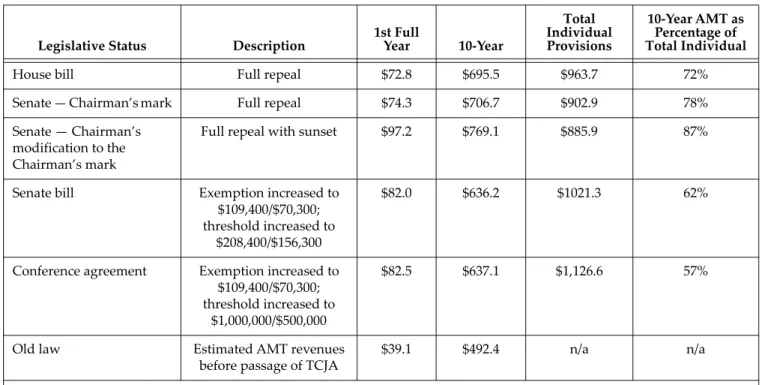
Table 2 shows a selection of revenue estimates from the legislation at different points in the legislative process. The House bill, which provided for full repeal of the individual AMT, was scored at $72.8 billion for the first full year and $695.5 billion over 10 years. To put that figure in perspective, the
46
Computations are based on IRS Statistics of Income division, “Individual Income Tax Returns (Complete Report),” Publication 1304, Table 1.2 (Sept. 2017).
47
See supra note 7.
domain
overall 10-year cost of the individual portions of the bill was $963.7 billion. Thus, AMT repeal accounted for some 72 percent of the overall cost of the bill. That figure is deceptive, however. In particular, it doesn’t mean that the AMT was raising that much revenue under old law. To the contrary, the Urban-Brookings Tax Policy Center estimated that under old law, the AMT was expected to raise $39 billion in calendar year 2018 and $492 billion over the 2018-2027 period. In other words, the revenue estimate for repeal was about 85 percent higher for the first year and about 40 percent higher over 10 years than the estimated revenue generated by the AMT.48
The explanation for this discrepancy is presumably that AMT repeal was scored after scoring the other individual provisions, including the rate changes and the increased standard deduction. In other
words, it was an estimate of the bite of the old AMT relative to the new regular tax. That in turn explains why the revenue estimate for the chairman’s mark (the first Senate draft), which also provided for full repeal, is a little higher (about 2 percent) than the House score. As the bill became more generous, the cost of AMT repeal relative to the new baseline increased. In turn, the second Senate draft, the chairman’s modification to the chairman’s mark, was more generous in its individual provisions, leading to a one-year estimate for AMT repeal of $97 billion, a 31 percent increase over the chairman’s mark.49
At the same time, the 10-year estimate rose only by 9 percent, reflecting the newly introduced eight-year sunset of the bill’s individual provisions.50
48
The Tax Policy Center estimates are based on calendar years, and the JCT estimates are based on fiscal years, so they are not strictly comparable.
49
JCT, “Description of the Chairman’s Modification to the Chairman’s Mark of the ‘Tax Cuts and Jobs Act,’” JCX-56-17 (Nov. 14, 2017).
50
In general, in the chairman’s modification to the chairman’s mark and in subsequent drafts, the bill’s individual provisions sunset after 2025.
Table 2. Revenue Estimates for TCJA Individual AMT Provisions
Legislative Status Description 1st Full Year 10-Year
Total Individual Provisions 10-Year AMT as Percentage of Total Individual
House bill Full repeal $72.8 $695.5 $963.7 72%
Senate — Chairman’s mark Full repeal $74.3 $706.7 $902.9 78%
Senate — Chairman’s modification to the Chairman’s mark
Full repeal with sunset $97.2 $769.1 $885.9 87%
Senate bill Exemption increased to $109,400/$70,300; threshold increased to
$208,400/$156,300
$82.0 $636.2 $1021.3 62%
Conference agreement Exemption increased to $109,400/$70,300; threshold increased to
$1,000,000/$500,000
$82.5 $637.1 $1,126.6 57%
Old law Estimated AMT revenues
before passage of TCJA
$39.1 $492.4 n/a n/a
All estimates are in billions of dollars.
Rows 1-5 show fiscal-year estimates from the JCT.
Sources: JCX-54-17, JCX-52-17, JCX-57-17, JCX-63-17, & H. R. Rep. No. 115-466, respectively. Row 6 shows calendar-year estimates from the Tax Policy Center.
Source: http://www.taxpolicycenter.org/model-estimates/baseline-alternative-minimum-tax-amt-tables-april-2017/t17-0145-aggregate-amt.
domain
The Senate bill and the subsequent conference agreement abandoned AMT repeal, and as discussed above, substituted a scaled-back AMT with an increased AMT exemption and phaseout threshold. Both were scored similarly.51
The revenue cost for the AMT changes in the
conference agreement was $82.5 billion in the first full year and $637.1 billion over 10 years (taking into account the sunset). The one-year figure of $82.5 billion is about 85 percent of the one-year cost of full repeal in the chairman’s modification — $97.2 billion. The relative costs suggest that the increase in the exemption and threshold were viewed as making substantial progress toward repeal. Thus, the revenue estimates support the argument that the AMT has been substantially tamed by the TCJA — at least until 2026 when the new law becomes old law and old law becomes
new law once again.
51
A separate question not addressed is why these scores were so similar given that the Senate bill had an exemption phaseout threshold of $208,400 for married taxpayers filing jointly and $156,300 for unmarried taxpayers, while the conference bill had a much greater exemption phaseout threshold of $1 million for married taxpayers filing jointly and $500,000 for unmarried taxpayers.
domain