SCALABLE ARCHITECTURE FOR INTEGRATED BATCH AND
STREAMING ANALYSIS OF BIG DATA
Xiaoming Gao
Submitted to the faculty of the University Graduate School
in partial fulfillment of the requirements
for the degree
Doctor of Philosophy
in the School of Informatics and Computing
Indiana University
ii
Accepted by the Graduate Faculty, Indiana University, in partial fulfillment of the requirements for the degree of Doctor of Philosophy.
Doctoral Committee
________________________________
Judy Qiu, Ph.D.________________________________
Geoffrey Charles Fox, Ph.D.
________________________________
Filippo Menczer, Ph.D.
________________________________
Dirk Van Gucht, Ph.D.
iii
Copyright © 2015
iv
Acknowledgements
First, I would like to thank Dr. Judy Qiu for being such a great advisor. She has been not only
insightful and inspiring in guiding me through the research projects, but also supportive and
encouraging when I need help in getting more resources or connecting to the right collaborators.
Let me also thank Dr. Geoffrey C. Fox for being on my research committee and offering
valuable discussions about my research. Every discussion with him is inspiring and pumps the
progress of my projects. Thanks to Dr. Fil Menczer for his tremendous help throughout our
collaboration and during my preparation for the dissertation proposal and defense, and for
putting trust in me to develop the data infrastructure for the Truthy project. Thanks also to Dr.
Dirk Van Gucht for having insightful discussions with me and guiding me through all the related
literature from the database field, which has been extremely valuable for defining the depth and
scope of this dissertation. His classes are the reason I chose database as a minor, which has
proven to be a very wise decision.
Next I would like to express my particular appreciation for the collaboration and help from my
colleagues in the SALSAHPC group: Bingjing Zhang, Stephen Wu, Yang Ruan, Andrew
Younge, Jerome Mitchell, Saliya Ekanayake, Supun Kamburugamuve, Thomas Wiggins,
Zhenghao Gu, Jaliya Ekanayake, Thilina Gunarathne, Yuduo Zhou, Fei Teng, Zhenhua Guo, and
Tao Huang. Thank you for continuously working with me on every concrete problem and giving
me all the great advice on my papers and presentations. Thanks to my early collaborators Marlon
Pierce, Yu Ma, Jun Wang, and Robert Granat for their guidance and help in developing the
QuikeSim project and writing related research papers. Thanks to the collaborators from the
Center for Complex Networks and Systems Research at Indiana University; Emilio Ferrara,
v
and Alessandro Flammini, for working together on the Truthy project and providing all the help
and information that has been necessary for the progress of my research work.
I would also like to recognize Prof. Yuqing Wu for helping me accelerate my progress towards
graduation. Thanks to Koji Tanaka, Allan Streib, Rob Henderson, and Gary Miksik for their help
in configuring and solving our problems with the computing infrastructures from FutureGrid,
Madrid, and Moe. Thanks to Lynne Mikolon, Patty Reyes-Cooksey, Becky Curtis, and Christi
Pike for their help on administrative issues related to my working contracts and course
registration.
Finally, I am especially grateful to my family and friends who have always supported and
vi Xiaoming Gao
Scalable Architecture for Integrated Batch and Streaming Analysis of Big Data
As Big Data processing problems evolve, many modern applications demonstrate special
characteristics. Data exists in the form of both large historical datasets and high-speed real-time
streams, and many analysis pipelines require integrated parallel batch processing and stream
processing. Despite the large size of the whole dataset, most analyses focus on specific subsets
according to certain criteria. Correspondingly, integrated support for efficient queries and post-
query analysis is required.
To address the system-level requirements brought by such characteristics, this dissertation
proposes a scalable architecture for integrated queries, batch analysis, and streaming analysis of
Big Data in the cloud. We verify its effectiveness using a representative application domain –
social media data analysis – and tackle related research challenges emerging from each module
of the architecture by integrating and extending multiple state-of-the-art Big Data storage and
processing systems.
In the storage layer, we reveal that existing text indexing techniques do not work well for the
unique queries of social data, which put constraints on both textual content and social context.
To address this issue, we propose a flexible indexing framework over NoSQL databases to
support fully customizable index structures, which can embed necessary social context
information for efficient queries.
The batch analysis module demonstrates that analysis workflows consist of multiple algorithms
with different computation and communication patterns, which are suitable for different
vii
based on YARN, and make novel use of customized indices in developing sophisticated analysis
algorithms.
In the streaming analysis module, the high-dimensional data representation of social media
streams poses special challenges to the problem of parallel stream clustering. Due to the sparsity
of the high-dimensional data, traditional synchronization method becomes expensive and
severely impacts the scalability of the algorithm. Therefore, we design a novel strategy that
broadcasts the incremental changes rather than the whole centroids of the clusters to achieve
scalable parallel stream clustering algorithms.
Performance tests using real applications show that our solutions for parallel data
loading/indexing, queries, analysis tasks, and stream clustering all significantly outperform
implementations using current state-of-the-art technologies.
________________________________
Judy Qiu, Ph.D.
________________________________
Geoffrey Charles Fox, Ph.D.
________________________________
Filippo Menczer, Ph.D.
________________________________
viii
Table of Contents
Acknowledgements ... iv
Table of Contents ... viii
List of figures and tables ... xi
Chapter 1 ... 1
1.1 Big Data: Emerging Characteristics ... 2
1.2 Social Media Data Analysis ... 3
1.2.1 Truthy Social Media Observatory ... 5
1.2.2 Other Similar Systems ... 10
1.3 Research Challenges ... 11
1.3.1 Review of State of the Art Big Data Tools ... 11
1.3.2 Requirements for Novel Text Indexing Techniques ... 14
1.3.3 Efficient Execution of Analysis Workflows ... 17
1.3.4 Parallel Processing of High-Speed Stream Data ... 18
1.4 Contributions and Outline ... 18
Chapter 2 ... 23
2.1 Overview ... 24
2.2 Related Work... 28
2.3 Review of NoSQL Databases ... 31
2.3.1 Data Model ... 32
2.3.2 Data Distribution Mechanism ... 36
2.3.3 Data Replication and Consistency Management ... 39
2.3.4 Data Indexing Support... 42
2.3.5 Distributed Data Processing Support... 47
2.3.6 Summary ... 50
2.4 Customizable Indexing Framework ... 51
2.4.1 Input Data Model... 51
2.4.2Abstract Index Structure ... 52
2.4.3Interface to Client Applications ... 55
ix
2.4.5Implementation on Other NoSQL Databases ... 60
2.5 Performance Evaluation ... 61
2.5.1 Table Schemas on IndexedHBase ... 61
2.5.2 Data Loading Strategies ... 63
2.5.3 Parallel Query Evaluation Strategy ... 64
2.5.4 Testing Environment Configuration ... 65
2.5.5 Configuration and Implementation on Riak ... 66
2.5.6 Data Loading Performance ... 68
2.5.7 Query Evaluation Performance ... 72
2.6 Conclusions ... 78
Chapter 3 ... 80
3.1 Overview ... 81
3.2 Analysis Algorithms ... 84
3.2.1 Related Hashtag Mining ... 84
3.2.2 Meme Daily Frequency Generation ... 86
3.2.3 Domain Name Entropy Computation ... 87
3.2.4 Graph Layout ... 89
3.2.5 Performance Analysis ... 91
3.3 Composition and Execution of Analysis Workflows ... 95
3.3.1 Analysis Workflow for Political Polarization Investigation ... 96
3.3.2 Analysis of Twitter Data from 2010 ... 97
3.3.3 Analysis of Twitter Data from 2012 ... 100
3.4 Related Work... 102
3.5 Conclusions ... 103
Chapter 4 ... 105
4.1 Background ... 106
4.2 Related Work... 111
4.3 Sequential Clustering Algorithm ... 113
4.3.1 Protomemes and Clusters ... 113
4.3.2 Sequential Clustering Algorithm ... 115
x
4.4 Parallel Implementation on Storm ... 118
4.4.1 Storm ... 118
4.4.1 Implementation with Cluster-Delta Synchronization Strategy ... 120
4.4.2 Implementation with Full-Centroids Synchronization Strategy ... 126
4.5 Evaluation of the Parallel Algorithm ... 127
4.5.1 Correctness Verification ... 127 4.5.2 Performance Evaluation ... 129 4.6 Conclusions ... 132 Chapter 5 ... 134 5.1 Conclusions ... 135 5.2 Future Work ... 137 Bibliography ... 139 Curriculum Vita ...
xi
List of figures and tables
Figure 1-1. Stages in a social media data analysis workflow ... 4
Figure 1-2. An example tweet in JSON format ... 6
Figure 1-3. Total number of tweets related to Occupy Wall Street between 09/2011 and 09/2012 [41] ... 9
Figure 1-4. Big Data processing and storage tools [169]... 12
Figure 1-5. A typical query execution plan using separate indices on meme and creation time .. 16
Figure 1-6. A customized meme index structure including time ... 16
Figure 1-7. A customized meme index structure including time and user ID ... 17
Figure 1-8. Integrated architecture for social media data analysis ... 19
Figure 2-1. Comparison between NoSQL databases and Parallel DBMSs ... 26
Figure 2-2. Limitations of Generalized Inverted Index in PostgreSQL [28] ... 30
Figure 2-3. An example of the BigTable data model ... 32
Figure 2-4. An example of the MongoDB document data model [84] ... 35
Figure 2-5. An example of the key/value data model in Riak ... 36
Figure 2-6. HBase architecture ... 37
Figure 2-7. Hash-based data distribution in Riak [124] ... 39
Figure 2-8. Data replication in Riak [124] ... 42
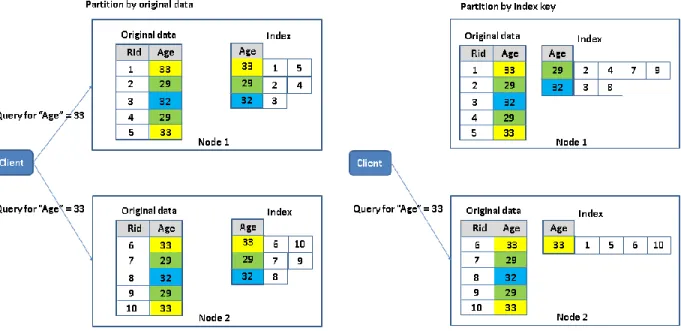
Figure 2-9. Partition by original data ... 43
Figure 2-10. Partition by index key ... 43
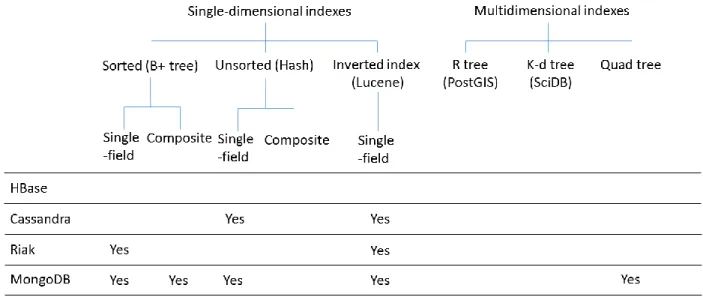
Figure 2-11. Varied level of indexing support among existing NoSQL databases ... 51
Figure 2-12. An example of the input data model to the customizable indexing framework ... 51
Figure 2-13. Abstract index structure ... 53
Figure 2-14. An example index configuration file ... 54
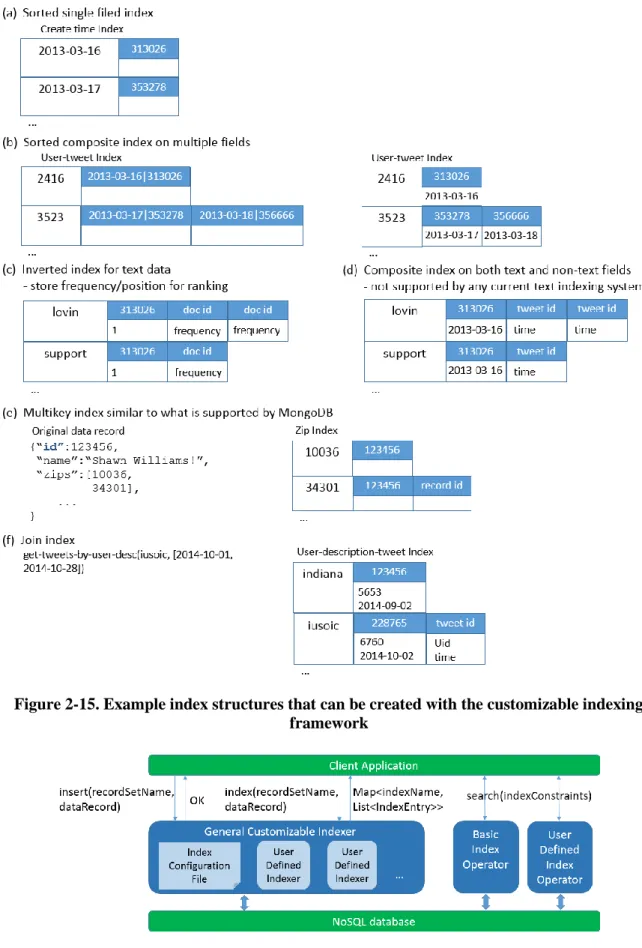
Figure 2-15. Example index structures that can be created with the customizable indexing framework ... 56
Figure 2-16. Interface to client applications ... 56
Figure 2-17. Implementation through mapping to the data model of NoSQL databases ... 58
Figure 2-18. Mapping between an abstract index structure and an HBase table ... 59
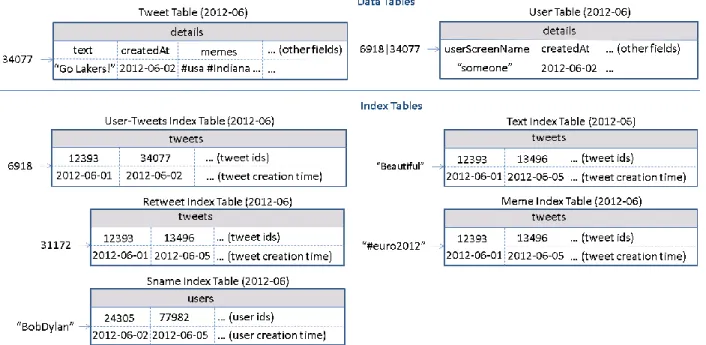
Figure 2-19. Table schemas used in IndexedHBase for data from Truthy ... 62
Figure 2-20. Streaming data loading strategy ... 64
Figure 2-21. Two-phase parallel evaluation process for an example user-post-count query ... 65
Figure 2-22. An example of inline field (created_at) in Riak ... 67
Figure 2-23. An example query implementation on Riak ... 68
Figure 2-24. Historical data loading scalability to cluster size ... 70
Figure 2-25. Results for streaming data loading test ... 71
Figure 2-26. Query evaluation time: separate meme and time indices vs. customized index ... 73
Figure 2-27. Query evaluation time for meme-post-count ... 74
xii
Figure 2-29. Query evaluation time for queries requiring MapReduce on both platforms ... 76
Figure 2-30. Result sizes for get-tweets-with-meme and get-mention-edges ... 76
Figure 2-31. Extended meme index including user ID information ... 78
Figure 2-32. Query evaluation time modified meme index structure ... 78
Figure 3-1. Internal interaction between batch analysis module and storage layer ... 82
Figure 3-2. MapReduce algorithm for mining related hashtags ... 85
Figure 3-3. An example meme evolution timeline on the Truthy website [145] ... 87
Figure 3-4. Map-only job for meme daily frequency generation... 87
Figure 3-5. MapReduce algorithm for domain name entropy generation ... 89
Figure 3-6. Parallel Fruchterman-Reingold algorithm using iterative MapReduce ... 91
Figure 3-7. Analysis algorithm performance comparison ... 93
Figure 3-8. Per-iteration execution time and speed-up of MRFR ... 95
Figure 3-9. End-to-end analysis workflow in [44]... 96
Figure 3-10. Per-iteration execution time and speed-up for MRFR for 2010 ... 99
Figure 3-11. Final plot of the retweet network in 2010 ... 100
Figure 3-12. Final plot of the retweet network (2012) ... 102
Figure 4-1. DESPIC architecture for meme clustering and classification [63] ... 107
Figure 4-2. An example of growing vector size of centroids ... 111
Figure 4-3. The social media stream clustering algorithm from [85] ... 116
Figure 4-4. An example topology in Storm ... 119
Figure 4-5. Storm architecture ... 120
Figure 4-6. Storm topology for the parallel stream clustering algorithm ... 121
Figure 4-7. Synchronization process of the cluster-delta strategy ... 125
Figure 4-8. Total processing time of Cluster-delta vs. Full-centroids ... 130
Figure 4-9. Scalability comparison between two versions of parallel implementations ... 131
Table 2-1. Suggested mappings for other NoSQL databases ... 60
Table 2-2. Per-node configuration on Bravo and Alamo Clusters... 66
Table 2-3. Historical data loading performance comparison ... 69
Table 3-1. Summary of analysis algorithms ... 84
Table 3-2. Hardware configuration of each node of the Madrid cluster ... 93
Table 3-3. Hardware configuration of each node of the Alamo cluster ... 94
Table 3-4. Sequential execution time (seconds) on R for Step (4) - (6) for 2010 ... 98
Table 3-5. Related hashtags for 2012 ... 101
Table 4-1. Runtime Statistics for the Sequential Algorithm ... 117
Table 4-2. LFK-NMI Values for Correctness Verification ... 128
Table 4-3. Statistics for Full-centroids Version Parallel Algorithm ... 130
Table 4-4. Statistics for Cluster-delta Version Parallel Algorithm ... 130
1 Chapter 1 Introduction
2 1.1 Big Data: Emerging Characteristics
Scientific research has entered a “Big Data” era [79]. As data is growing exponentially in every
area of science, more and more discoveries are driven by the capability of collecting and
processing vast amounts of data. Therefore, in order to boost the progress of scientific research,
scalable IT infrastructures are needed to deal with the high volume, high velocity, and high
variety of Big Data. This in turn brings up research challenges and opportunities for the
distributed data processing architecture running at the backend of IT infrastructures.
As Big Data processing problems evolve, many applications demonstrate special characteristics
with regards to their data and analysis process. First of all, besides a large amount of historical
data, streaming data plays a progressively more important role. For instance, earthquake
monitoring and prediction systems detect geological events based on real-time analysis of data
streams generated by GPS ground stations [117]; automated trading systems rely on the dynamic
stream of stock price values to make smart trading decisions [101]. Correspondingly, the data
processing architecture needs to provide scalable solutions not only for storing, querying, and
analyzing the static historical data, but also for loading and processing the streaming data in a
parallel fashion. The loading and analysis of static data and streaming data need to be handled in
an integrated way. For example, an integrated general storage substrate should be provided to
host both historical data and incremental changes coming from the streams. Additionally online
stream analysis should be able to use the results of batch analysis over static data for
bootstrapping or checkpointing purposes.
On the other hand, despite the large size of the whole dataset, most analyses tend to focus on
3
sequences [140], and social data analysis may concentrate on data related to certain global or
local events [131]. For such research scenarios, limiting analysis computation to the exact scope
of the target subsets is important in terms of both efficiency and better resource utilization.
Therefore efficient query mechanisms for quickly locating the relevant data subsets are needed
on the data storage and analysis architecture. Furthermore, queries need to be closely integrated
with post-query analysis tasks to support efficient end-to-end analysis workflows.
1.2 Social Media Data Analysis
Social media data analysis is one specific application domain that follows the Big Data trend.
Motivated by the widespread adoption of social media platforms such as Twitter and Facebook,
investigating social activities through analysis of large scale social media datasets has been a
popular research topic in recent years. For example, many studies investigate the patterns of
information diffusion on social networks by processing historical datasets generated during
real-world social events [119][130][162]. By analyzing real-time social media data streams, more
sophisticated applications such as online event detection [10][120] and social-bots detection
[63][64] can be supported.
Social media data analysis problems also reflect the emerging characteristics of Big Data, which
bring special research challenges for developing a scalable architecture. On the one hand, the
data source contains not only a large historical dataset at TB or even PB level, but also a
high-speed stream at the rate of tens to hundreds of millions of social updates per day generated by
people all over the world. On the other hand, most analyses focus on data subsets related to
specific social events or special aspects of social activities: congressional elections [42][44],
4
media data is unique in that it contains not only textual content, but also rich information about
the social context including time, geolocation, relationship among users on the social network,
etc. Most queries involve selection of data records following constraints over both text elements
and the social context such as temporal or geospacial information. The purpose of the queries is
to extract social information from all the selected data records rather than finding the top-K most
relevant data records according to a set of text keywords. As a result, traditional static text
indexing techniques [170] designed for information retrieval applications do not work well for
queries over social media data. Therefore, a novel indexing component that can help deliver the
most efficient queries over social media data is a necessary aspect of a scalable data analysis
architecture.
Figure 1-1. Stages in a social media data analysis workflow
Another important feature of social data analysis is that the analysis workflow normally consists
of multiple stages, as illustrated in Figure 1-1. The query stage is normally followed by a series
of analysis tasks for processing or visualizing the query results. Therefore, integrated support for
queries and post-query analysis tasks is required on the analysis architecture.
Due to its representative qualities, social media data analysis provides a good starting point for
investigating the general research challenges associated with the emerging characteristics of Big
Data problems. The target of this dissertation is to analyze such challenges and address them by
5
application domains. Specifically, we study the challenges related to the queries, batch analysis,
and streaming analysis through representative and published use cases from existing social media
data analysis systems. We propose corresponding solutions in different modules of the
architecture, and use real analysis workflows and applications from these systems to evaluate the
effectiveness and efficiency of our methods. To uncover the underlying research problems, we
start by reviewing the characteristics of existing social media data analysis platforms.
1.2.1 Truthy Social Media Observatory
Truthy [102] is a public social media observatory developed by the Center for Complex
Networks and Systems Research at Indiana University. It is designed for analysis and
visualization of information diffusion on Twitter. Research performed on the data collected by
this system covers a broad spectrum of social activities, including political polarization [43][44],
congressional elections [42], protest events [40][41], and the spread of misinformation [120].
Truthy has also been instrumental in shedding light on communication dynamics such as user
attention allocation [159] and social link creation [160].
Data Characteristics
Truthy has been collecting social media data through the Twitter gardenhose stream [67] since
May of 2010, which provides a sample of approximately 10% of their public tweets. The entire
dataset consists of two parts: historical data in .json.gz files, and real-time data coming from the
Twitter streaming API [148]. Currently, the total size of historical data collected continuously by
the system since August 2010 is approximately 20 Terabytes. At the time of this writing, the data
rate of the Twitter streaming API is in the range of 45-50 million tweets per day, leading to a
6
item, which is a structured JSON string containing information about a tweet and the user who
posted it. Furthermore, if the tweet is a retweet, the original tweet content is also included in a
“retweeted_status” field. For hashtags, user-mentions, and URLs contained in the text of the tweet, an “entities” field is included to give detailed information, such as the ID of the mentioned user and the expanded URLs.
Figure 1-2. An example tweet in JSON format
Queries
In social network analysis, the concept of “meme” is often used to represent a set of related posts corresponding to a specific discussion topic, communication channel, or information source
shared by users on platforms such as Twitter. Memes can be identified through elements
contained in the text of tweets, like keywords, hashtags (e.g., #euro2012), user-mentions (e.g., @youtube), and URLs. Based on rich experience from previous research projects, Truthy identifies a set of temporal queries that are generally applicable in many research scenarios for
7
be categorized into two subsets. The first contains basic queries for getting the ID or content of
tweets created during a given time window from their text or user information, including:
get-tweets-with-meme (memes, time_window) get-tweets-with-text (keywords, time_window) get-tweets-with-user (user_id, time_window) get-retweets (tweet_id, time_window)
For the parameters, time_window is given in the form of a pair of strings marking the start and end points of a time window, e.g., [2012-06-08T00:00:00, 2012-06-23T23:59:59]. The memes parameter is given as a list of hashtags, user-mentions, or URLs; memes and keywords may contain wildcards, e.g., “#occupy*” will match all tweets containing hashtags starting with “#occupy.”
The second subset of queries need information extracted from the tweets returned by queries in
the first subset. These include:
timestamp-count (memes, time_window) user-post-count (memes, time_window) meme-post-count (memes, time_window)
meme-cooccurrence-count (memes, time_window) get-retweet-edges (memes, time_window)
get-mention-edges (memes, time_window)
Here for example, user-post-count returns the number of posts about a given meme by each user. Each “edge” has three components: a “from” user ID, a “to” user ID, and a “weight” indicating how many times the “from” user has retweeted the tweets from the “to” user or mentioned the “to” user in his/her tweets.
8
The most significant characteristic of these queries is that they all take a time window as a
parameter. This originates from the temporal nature of social activities. An obvious brute-force
solution is to scan the whole dataset, try to match the content and creation time of each tweet
with the query parameters, and generate the results using information contained in the matched
tweets. However, due to the drastic difference between the size of the entire dataset and the size
of the query result, this strategy is prohibitively expensive. For example, in the time window
[2012-06-01, 2012-06-20] there are over 600 million tweets, while the number of tweets containing the most popular meme “@youtube” is less than two million, which is smaller by more than two orders of magnitude. As will be discussed in Section 1.3, proper indexing
techniques are needed for efficient evaluation of such queries.
Analysis Workflows and Streaming Applications
Most analysis workflows completed on Truthy follow the multi-stage pattern as illustrated in
Figure 1-1. For example, in the workflow for analyzing political polarization [44], the first stage
applies the get-retweet-edges and get-mention-edges queries to retrieve the retweet network and mention network from the tweets selected by a set of hashtags related to politics; the second
stage completes community detection analysis over the networks; finally, the third stage uses a
graph layout algorithm to visualize the polarization of communities on the social network. In
another project that investigates the digital evolution of the “Occupy Wall Street” event, the first
stage queries for tweets related to both general politics and the specific “Occupy” event based on
a manually selected set of hashtags (e.g. #p2, #tcot, and #occupy*), using a 15-month time window that covers most of the event’s development; the second stage processes the tweets and
measures the evolution of the amount of social network traffic, the degree of user engagement,
9
these patterns of evolution as time series plots. Figure 1-3 [41] shows an example plot that
illustrates the total number of tweets related to the “Occupy Wall Street” event during a one-year time period.
Besides batch analysis over historical data, applications that complete online analysis of
real-time streams are also being developed. In particular, Bot or Not [64] is an online service that can
dynamically classify a given user ID as a human user or social bot with a certain confidence
level by analyzing a small number of sample tweets retrieved from the Twitter Streaming API
[148]. To support more sophisticated application scenarios, the problem of social media stream
clustering [85] has also been investigated. The major discovery is that by using a combination of
proper data representations and similarity metrics, it is possible to generate high-quality clusters
that can effectively group messages with similar social meaning together.
Figure 1-3. Total number of tweets related to Occupy Wall Street between 09/2011 and 09/2012 [41]
Based on the tools and algorithms used in the analysis workflows, Truthy provides a nice web
interface [145] for users to retrieve derived data such as social network information and statistics
about certain users and memes, as well as visualization generated by some previous research
10
Despite the richness and scope of research that has been covered by Truthy, most projects
complete data processing in a sequential way or only with a limited level of parallelism (e.g.
using multi-thread solutions) over the raw data. As a result, the processing speed is
unsatisfactory when measured against the volume of the whole dataset. For example, it takes as
many as 43 hours for a sequential implementation of the stream clustering algorithm in [85] to
process one hour’s worth of data collected through the Twitter gardenhose stream [67]. Most data is stored as raw .json.gz files, which are not suitable for random access to individual social
messages. A MySQL database is used to maintain important sumarries about certain users and
memes, but is obviously not scalable enough to support fine-grained access and efficient queries
over the whole dataset. This situation forms a strong and practical motivation for the research
work of this dissertation.
1.2.2 Other Similar Systems
To the best of our knowledge, Truthy is the first complete social media observatory in terms of
functionality and interface. VisPolitics [155], TwitInfo [146], and Ripples [126] are similar
analysis systems that generate visualizations about different aspects of social media network, but
do not provide a rich set of statistics and derived data as Truthy does. Meanwhile, many query
patterns and analysis components defined by Truthy are generally useful for constructing the
functionality of these systems. For example, similar queries can be used to generate the ‘repost
network’ in Ripples, or support searching of topic keywords and URL counting in TwitInfo. Commercial entities such as PeopleBrowsr [116], Datasift [50], and SocialFlow [133] provide
consulting services to their customers through analytics over social media data, but they don’t expose their raw data or results to the public for research purposes. Padmanabhan et al. presented
11
processing of social updates collected from the Twitter streaming API. FluMapper applies a set
of advanced technologies, including NoSQL database (MongoDB [105]), GPU processing, and
flow mapping, to support its data collection, processing, and visualization modules.
While these systems demonstrate a broad scope of applications involving social media data, none
of them has done an in-depth investigation about the fundamental research challenges from the
perspective of distributed systems. On the other hand, many Big Data tools have been developed
in the recent past, but it is still unclear what extensions and combinations of them are necessary
for handling the new characteristics represented by social media data analysis. This dissertation
tries to bridge the gap between these two sides, and we start from studying the specific research
challenges.
1.3 Research Challenges
1.3.1 Review of State of the Art Big Data Tools
During the last 15 years, a variety of systems have been proposed to address the high volume,
high velocity, and high variety of Big Data problems, covering the requirements of both storage
and processing (Figure 1-4). First of all, based on various file systems such as Hadoop
Distributed File System (HDFS) [132], many NoSQL databases, e.g. HBase [19], MongoDB
[105], etc., have been developed to provide scalable storage solutions for large volume of data
with different data models. By sacrificing data consistency and real-time transactions, these
systems can achieve horizontal scalability to hundreds or even thousands of machines and
achieve increasing throughput for fine-grained real-time data access. In addition, data replication
is widely applied to ensure high availability. Compared with NoSQL databases, parallel
12
limited by the requirement for real-time transactions with ACID guarantee. Besides, parallel
DBMSs are not as well integrated with post-query processing frameworks as NoSQL databases.
Therefore, in analytic use cases where data consistency and transactions are not strongly required,
NoSQL databases are regarded as a better option for supporting integrated queries and analysis
workflows of Big Data.
Figure 1-4. Big Data processing and storage tools [169]
In the processing world, a large number of platforms have been proposed to handle various
computation and communication patterns. Specifically, Hadoop [19] provides an easy to use
MapReduce [53] programming interface to support single-pass parallel processing of Big Data,
and automatically handles issues such as locality-aware task scheduling, failure recovery, and
intermediate data transmission at the platform level. Beyond this, frameworks such as Twister
13
a MapReduce model. For iterative algorithms over graph data, frameworks such as Giraph [17]
and Harp [169] can directly support data abstraction in the form of nodes and edges in graphs. To
enable efficient queries over large-scale datasets, systems such as Power Drill [75], Pig [23], and
Hive [20] were developed with original support for high-level query languages. Finally, to
support distributed parallel processing of streaming data, stream processing engines such as S4
[108] and Storm [25] have been proposed.
Sensing the evolution of Big Data problems, many extensions and combinations of these tools
have been proposed to address the emerging characteristics analyzed in Section 1.1.
For starters, to enable efficient queries for interesting data subsets, many NoSQL databases start
to integrate indexing techniques from relational databases. For instance, MongoDB now supports
secondary indexing for primitive-type data, text data, and even spatial data [82]. However, as
will be demonstrated in Section 1.3.2, for sophisticated use cases such as social media data
queries, existing indexing techniques are still not working well enough.
In addition, some systems are trying to support integrated queries and post-query analysis tasks.
For example, by integrating components from Hive [20] and Spark [166], Shark [165] is able to
achieve efficient queries through HiveQL and sophisticated iterative analytics at a large scale.
Besides, Spark also tries to address batch processing and stream processing with a single unified
framework [167]. However, Shark does not pay special attention to indexing, thus misses the
opportunity of exploring the value of indices in supporting sophisticated analysis tasks.
Finally, Google has identified the case of integrated batch and streaming analysis as Cloud
DataFlow [71] and published their platform SDK for developing applications following such
14
though, is that they all organize distributed processing workers in the form of Directed Asynclic
Graphs (DAG), making it hard to synchronize the state of individual workers. As a result, many
non-trivial applications that do require global synchronization, such as clustering, cannot be
effectively supported.
Motivated by real use cases from social media data analysis, this dissertation follows this trend
and strives to solve new research challenges emerging from each of these aspects, as will be
analyzed in depth in the following subsections.
1.3.2 Requirements for Novel Text Indexing Techniques
First of all, as demonstrated in Section 1.2.1, most queries over social media data can be
categorized as text queries with constraints about social context. However, traditional text
indexing techniques (i.e. inverted indices [170]) supported by many existing distributed storage
systems such as distributed Solr [57], DataStax [52], and Riak [125] do not provide the most
efficient solution to such queries. One reason is that traditional inverted indices are mainly
designed for text retrieval applications where the main goal is to efficiently find the top K (with a
typical value of 20 or 50 for K) most relevant text documents regarding a query comprising a set
of keywords. To achieve this goal, information about the frequency and position of keywords in
the documents is stored and used for computing relevance scores between documents and
keywords during query evaluation. In contrast, social media data queries are designed for
analysis purposes, meaning that they have to process all the related tweets, instead of the top K
most relevant ones, to generate the results. This means data regarding frequency and position are
15
query evaluation process. The query evaluation performance can be further improved by
removing these items from traditional inverted indices.
Another issue with traditional text indexing techniques is that one separate inverted index
structure is maintained for every indexed field. However, social media queries do not favor query
execution plans using such separate one-dimensional indices. For example, Figure 1-5 illustrates
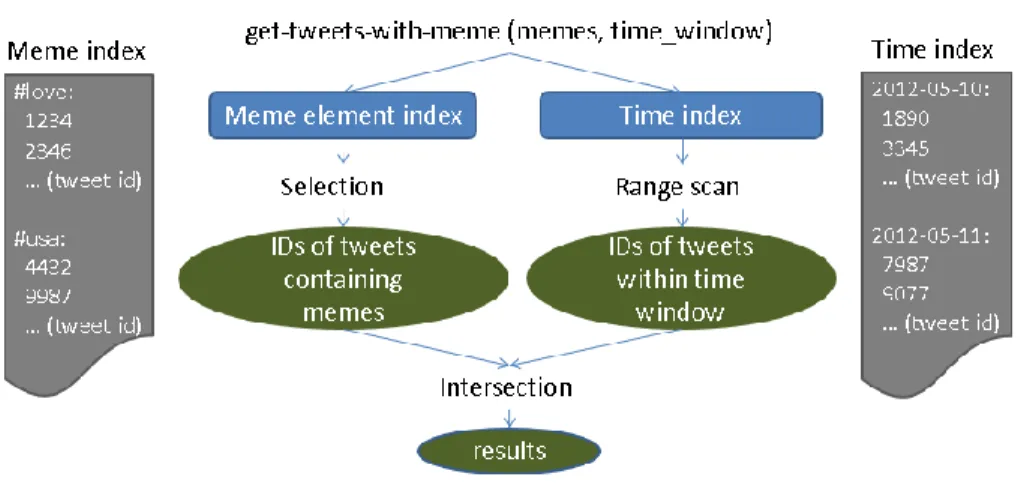
a typical query execution plan for get-tweets-with-meme, using two separate indices on memes and tweet creation time. This plan uses the meme index to locate the IDs of all tweets containing
the given memes and utilizes the time index to find the set of tweet IDs within the given time
window, finally computing the intersection of these two sets to get the results. Assuming the size
of the posting lists for the given memes to be m, and the number of tweet IDs coming from the time index to be n, the complexity of the whole query evaluation process will be O(m + n) = O(max(m, n)), using a merge-based or hashing-based algorithm for the intersection operation. However, due to the characteristics of large social media and microblogging datasets, there is
normally an orders-of-magnitude difference between m and n, as discussed in Section 1.2.1. As a result, although the size of the query result is bounded by min(m, n), a major part of query evaluation time is actually spent on scanning and checking irrelevant entries of the time index. In
classic text search engines, techniques such as skipping or frequency-ordered inverted lists [170]
may be utilized to quickly return the top K most relevant results without evaluating all the related
documents. Such optimizations are not applicable to the analysis-oriented social media data
queries. Furthermore, in case of a high cost estimation for accessing the time index, the search
engine may choose to only use the meme index and generate the results by checking the content
16
the given time window. The query evaluation performance can be further improved if the
unnecessary scanning cost can be avoided.
Figure 1-5. A typical query execution plan using separate indices on meme and creation time
To avoid the above-mentioned problems, a more suitable index structure would be the one given
in Figure 1-6. It merges the meme index and time index, and replaces the frequency and position
information in the posting lists of the meme index with creation time of corresponding tweets.
Facilitated by this customized index structure, the query evaluation process for get-tweets-with-meme can be easily implemented by going through the index entries related to the given memes and selecting the tweet IDs associated with a creation time within the given time window. The
complexity of the new query evaluation process is O(m), which is significantly lower than
O(max(m, n)). Moreover, if we can further extend this index structure to also include the user ID
of each tweet, as shown in Figure 1-7, it will be possible to evaluate the advanced query user-post-count by only accessing the index, without touching the original data at all.
17
Figure 1-7. A customized meme index structure including time and user ID
The ideas behind these index structures are similar to the features of multi-dimensional indices
and included columns that have been supported by relational databases for non-text data.
However, they are not supported by current state-of-the-art text indexing systems, such as
Lucene [22] and distributed Solr [57]. To enable them, a fully customizable text indexing
framework is needed. Considering the special characteristics of social media data, this
framework must provide both a scalable batch indexing mechanism for the static historical data
and an efficient online indexing mechanism for the high-speed streaming data. So building such
a framework in a scalable way is a major research challenge, as is knowing how to make use of
the various customized index structures to support efficient queries and analysis tasks.
1.3.3 Efficient Execution of Analysis Workflows
As demonstrated in Figure 1-1, social media data analysis workflows normally consist of
multiple stages, and each stage may apply a diversity of algorithms to process the target data
subsets. These algorithms demonstrate a high level of complexity in their computation and
communication patterns, including sequential, MapReduce, iterative MapReduce, and graph
style. Different patterns are suitable for different processing frameworks such as Hadoop [18],
Twister [60], Spark [166], and Giraph [17]. Moreover, to support online stream analysis
applications, distributed stream processing engines like Storm [25] may also be used. To achieve
efficient overall execution of the workflow, the analysis architecture must be able to dynamically
18
this in a distributed and shared environment is another major challenge. In case of integrated
workflows involving both queries and analysis tasks, another interesting research question is
how to explore the value of indices in supporting sophisticated analysis algorithms (beyond the
scope of queries).
1.3.4 Parallel Processing of High-Speed Stream Data
Due to the high speed of social media data streams, parallel processing is necessary for many
stream analysis applications such as clustering and classification. To support efficient parallel
processing of streaming data, many distributed frameworks have been proposed including
Apache Storm [25] and S4 [108]. Most of these frameworks organize the parallel stream
processing workers in the form of a direct acyclic graph (DAG), which makes it difficult to
complete dynamic status synchronization among the parallel workers, a crucial step for ensuring
the correctness of the parallel analysis algorithms. This is because the synchronization step
requires the parallel workers to send their local status updates either to each other or to a global
updates collector, which will then broadcast the updated global state back to the parallel workers.
Both ways will inevitably create cycles in the communication channel, which conflicts with the
DAG model. Meanwhile, to achieve high-quality analysis results, many stream analysis
applications represent the the social messages in the stream as multiple high-dimensional vectors
that reflect both the textual content and the social context of the data. The high-dimensionality
and sparsity of such vectors may bring extra complexity and cost to the synchronization
mechanism, and designing proper synchronization strategies to enable efficient parallel stream
analysis algorithms is an important research issue.
19
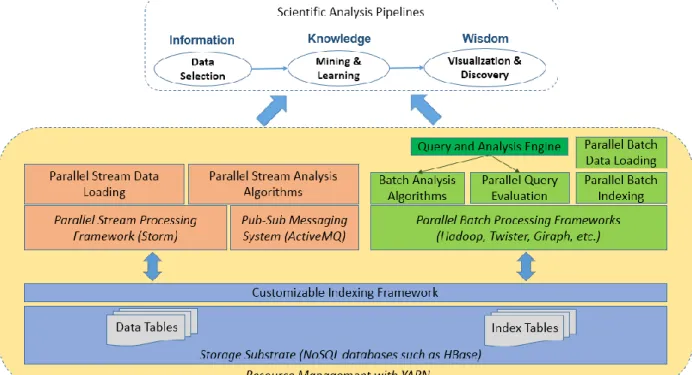
To address the research challenges discussed in Section 1.3, this dissertation proposes a scalable
and integrated analysis architecture as illustrated in Figure 1-8 to support modern scientific data
analysis pipelines in the cloud. The three stages in the pipeline demonstrate how Information,
Knowledge, and Wisdom [143] are eventually generated from Data. Correspondingly, we name
our architecture Cloud DIKW. The whole architecture comprises three modules; each module
extends and combines a set of big data storage and processing tools to tackle the corresponding
challenges.
Figure 1-8. Integrated architecture for social media data analysis
At the bottom layer, we use NoSQL databases as the storage substrate, which can provide
scalable storage of large social media datasets and efficient random access to fine-grained social
messages. To address the requirements for novel indexing techniques, we propose a fully
customizable indexing framework that can be generally integrated with most NoSQL databases.
20
necessary information about the original social media data, so as to achieve efficient evaluation
of queries about interesting social events and activities. By choosing proper mappings between
the abstract index structures and the storage units provided by the underlying NoSQL database,
efficient indexing of historical and streaming data can be achieved. We realize and verify our
framework with IndexedHBase [83], a specific implementation on HBase [19].
To achieve efficient execution of the whole analysis workflow, we extend IndexedHBase to
build an analysis architecture based on YARN (Yet Another Resource Negotiator) [154], which
is specially designed for dynamic scheduling of analysis tasks using different parallel processing
frameworks. In the batch analysis module, we develop a parallel query evaluation strategy and a
set of analysis algorithms using various parallel processing frameworks, including Hadoop
MapReduce [99], Twister [60], etc. These can be used as basic building blocks for composing
different workflows. In addition, parallel batch indexing and data loading mechanisms for
handling historical data are developed based on the functionality of the customizable indexing
framework. Moreover, we extend the usage of customized indices beyond basic queries to
sophisticated mining and analysis algorithms, and demonstrate the significant performance
improvement that can be achieved by exploring the value of indexing. We use real data, queries,
and previously published analysis workflows from Truthy to evaluate the performance of these
modules. Our results demonstrate that compared with implementations based on existing text
indexing techniques on a widely adopted NoSQL database (Riak [125]), our data loading
mechanism is faster by multiple times, and our query evaluation strategy can be faster by up to
two orders of magnitude. Finally, parallel analysis algorithms are tens to hundreds of times faster
than the old sequential implementation on Truthy, thus leading to much more efficient analysis
21
To achieve efficient parallel processing of stream data, we use the Storm stream processing
engine as the basis of the stream analysis module, and develop a parallel stream data loading
mechanism based on the online indexing functionality of the customizable indexing framework.
Preliminary performance tests show that we are able to process a stream whose speed is five
times faster than the current Twitter gardenhose stream [67] with only 8 parallel stream loaders.
To support more sophisticated stream clustering algorithms, we create a separate synchronization
channel by using the pub-sub messaging system ActiveMQ [16], and combine its functionality
together with Storm to coordinate the synchronization process. Furthermore, to deal with the
problem caused by the high-dimensionality of the data, we propose a novel synchronization
strategy that broadcasts the dynamic changes (“deltas”) of the clusters rather than the whole centroid vectors. Performance evaluation shows that this synchronization mechanism can help
the parallel algorithm achieve nice sub-linear scalability, and the algorithm can process the
Twitter 10% data stream (“gardenhose”) in real-time with 96-way parallelism.
The rest of this dissertation is structured as follows. Chaper 2 describes the customizable
indexing framework, the parallel data loading mechanism, and the parallel query evaluation
strategy, and compares them to solutions based on existing distributed text indexing techniques.
Chapter 3 explains the internal mechanism of the batch analysis module, and presents the
implementation of multiple parallel analysis algorithms based on different processing
frameworks. In addition we repeat a previously published analysis workflow [44] based on our
parallel queries and analysis algorithms, and demonstrate the significant speedup that can be
achieved for the overall execution of the whole workflow. Chapter 4 elaborates on the stream
analysis module, analyzes the research challenges related to parallel clustering of social media
22
algorithm on Storm. We demonstrate the scalability of our algorithm by comparing it against an
implementation using the traditional synchronization strategy that directly broadcasts the whole
centroids of the clusters. Chapter 5 concludes and proposes interesting future work for every
23 Chapter 2
24 2.1 Overview
As discussed in Section 1.3, the major research challenge to the storage layer of Cloud DIKW
roots in the scalability of the storage substrate and the efficiency of the query mechanisms for
finding interesting data subsets. This chapter makes the following contributions to resolve this
challenge:
We compare the features of two options for constructing a scalable storage solution – parallel relational databases and NoSQL databases, and choose the latter as the the basis of our storage layer based on analysis of the characteristics of social media data.
We provide a detailed review of multiple representative NoSQL database systems, and reveal that compared with the query patterns against social media data, the level of indexing support on current NoSQL databases is uneven and inadequate.
To enhance the indexing support of NoSQL databases, we propose a general customizable indexing framework that can be implemented on most NoSQL databases. This framework allows users to define customizable text index structures that are not supported by current distributed text indexing systems, so as to achieve the best query performance for social media data.
We provide one implementation of this framework, IndexedHBase, over HBase and develop parallel data loading and query evaluation strategies on top. Performance evaluation with real data and queries from Truthy shows that compared with solutions based on existing text indexing techniques provided by current NoSQL databases, our data loading strategy based on customized index structures is faster by multiple times, and our parallel query evaluation strategy is faster by one to two orders of magnitude.
The first step towards Cloud DIKW is to provide a scalable storage substrate. Specifically, it has
to properly handle the following characteristics of social media data:
First of all, since the whole dataset is composed of both a large scale historical dataset and a
25
and real-time online insertion of streaming data. Data access pattern is mostly
write-once-read-many, because historical data is rarely updated. Therefore, in cases where data is replicated,
consistency among dynamically changed replicas is not a strong requirement. And since data
processing is mostly analysis-oriented, sophisticated data manipulation through online
transcations with ACID (Atomicity, Consistency, Isolation, Durability) properties is not required
either.
Next, since data comes in the form of separate social messages, the storage substrate has to
support efficient random access to fine-grained data records. As illustrated in Figure 1-2, a social
message may be structured as a hierarchy of multiple levels that may evolve over time i.e. fields
could be dynamically deleted or added based on requirements of the application. For instance,
for tweets coming from the Twitter Streaming API [148], fields like “id_str”, “entities.symbols”,
“entities.media” are all added as the application evolves. The storage substrate should ideally be able to handle such dynamic data schema changes in a seamless way.
Since analysis workflows normally start with queries, the storage substrate must be equipped
with necessary indexing techniques to enable the most suitable index structures for efficient
evaluation of the queries.
Finally, due to the requirement for integrated queries and analysis tasks, the storage substrate
should have a natural integration with parallel processing frameworks such as Hadoop
MapReduce to support various analysis algorithms.
Due to the strong requirements for scalability and random data access, we mainly consider two
types of systems: parallel relational databases and NoSQL databases. The advantages and
26
in Figure 2-1 where we extend the advantages of NoSQL databases with two more features:
flexible schema and inherent integration with parallel processing frameworks.
Figure 2-1. Comparison between NoSQL databases and Parallel DBMSs
Parallel databases support the relational data model, and provide SQL for schema definition and
data manipulation. Most systems use a “shared nothing” architecture [97], where each computer node in the system maintains a partition of the data. Sophisticated indexing and query
optimization techniques are supported, and indices built for each data partition are maintained by
the same node hosting the data partition. A query execution plan is first decomposed into a
number of “sub-plans”, which are sent to every relevant node for local execution. Then the local
results from each node are combined to generate the global final result. Since supporting
efficient online transactions is a major goal of parallel database systems, most of them do not
scale to a large number of nodes because concurrency control grows more and more complicated
as further nodes are involved. To achieve low execution latencies for transactions, they are
27
Another disadvantage of parallel relational databases is they are hard to configure and maintain
[58][161].
Many new systems have been proposed since 2011 with the goal of supporting ACID
transactions at a much larger scale, represented by VoltDB [137][156] and Spanner [45].
Specifically, VoltDB relies on a new in-memory architecture, a single-threaded execution model,
and heavy use of stored procedures to eliminate the necessity of a big portion of locking.
Spanner builds a globally distributed architecture that may span across thousands of nodes, and
leverages a global time API backed by GPS and atomic clocks to achieve external consistency of
general transactions. Nonetheless, as discussed above, support for transactions is not a strong
requirement for our case of social media data analysis.
NoSQL databases, on the other hand, mainly sacrifice the ability to handle ACID transactions to
achieve high scalability over a large number (hundreds to thousands) of computer nodes. Data is
replicated across different nodes for fault tolerance, and many systems allow eventual
consistency among replicas of the same piece of data. Many NoSQL database systems are
open-source or free to download, and can be easily set up across a variety of heterogeneous
commodity machines. Flexible data schemas are usually allowed, meaning that every data record
can have a different set of fields and values. This provides a perfect fit for the evolving data
schemas of social media applications. Moreover, most NoSQL databases are inherently
integrated with parallel processing frameworks such as Hadoop MapReduce [99], which makes it
easier to support integrated queries and post-query analysis tasks.
Features required for handling the unique characteristics of social media data are marked with
28
plus a proper indexing mechanism for dealing with the special queries of social media data.
Since the access pattern for social media data is mostly write-once-read-many, eventual
consistency on NoSQL databases does not cause a big issue. As analyzed in Section 1.3.2, the
most suitable index structures required for handling the text queries with social context
contraints are not currently supported by the text indexing techniques from either side. Therefore,
we choose to use NoSQL databases as the storage substrate, and enhance them with a
customizable indexing framework to enable novel index structures for efficient query evaluation.
2.2 Related Work
The customized index structures we propose in this chapter aim to address the temporal
challenge in social media analytics scenarios. Derczynski et al. [54] provide a more complete list
of related work about temporal and spatial queries involving social data. In particular, Alonso et
al. [14] give a detailed discussion about the challenges in extracting temporal information from
online data and applying such information in text queries. Weikum et al. [158] further elaborate
on the open research problems in the context of longitudinal analytics on web archive data.
These papers focus on information retrieval applications, where ranking is still important. In
addition, they mainly deal with versioned documents in datasets like web archives, so similarities
and inter-connections among documents need to be considered in index structure designs. In our
case, social updates with different timestamps are independent, and the number of tweets within
a given time window is much larger than the number of versions per document. Information
retrieval queries need not analyze contents of the documents. In contrast, our queries need to
process the content of the related social updates to extract necessary information such as retweet
network, so parallel processing of data records is needed after accessing the index. Our
29
these papers in multiple aspects, including customizable index structures, scalable storage
platforms, and efficient index building strategies.
The customizable index structures we use share similar inspiration to composite indices used in
relational databases, but index a combination of full-text and primitive-type fields. Compared
with traditional inverted indices [170], our framework provides more flexibility about what fields
to use as keys and entries to achieve more efficient query evaluation with less storage and
computation overhead. Lin et al. [96] proposes text cubes to support multidimensional text
database analysis. Due to the requirement for efficient online indexing of high-speed stream data,
text cube is not suitable for our case.
Our online indexing mechanism for handling streaming data is comparable to early research on
online indexing and incremental index maintenance [32][33][93][94][100][130][144], but is
different in that we leverage the functionality of the underlying NoSQL databases to support
these features. By using a write ahead log (WAL), HBase helps our framework achieve
persistency of even unflushed index data in the memory, which is a missing feature in most
existing online indexing systems.
The problem of supporting extendable input data models has been a well researched topic in the
communities of object-oriented databases, nested relational databases, and object-relational
databases, represented by O2 [27], ANDA (A Nested Database Architecture) [47], and
PostgreSQL [127][135][136]. Based on a complete and clearly defined theoretical
object-oriented data model, O2 achieves many nice features. It provides well-defined semantics of
object identity, inheritance, and methods in a database context. The physical data storage and
30
into consideration, and the seamless integration of programming languages and query languages
are inspiring for our case of integrated queries and analysis tasks. Similarly, the VALTREE and
RECLIST structures in ANDA are optimized to support efficient nesting and unnesting
operations. Compared with these systems, our requirements for an extendable input data model
are simpler. We don’t need to handle the complexity of class hierarchies, composition graphs, or associated methods. Nor do we require nesting operations among subtuples. On the other hand,
we need to tackle more complicated issues in other respects, including customizable text index
structures, distributed index storage, scalable indexing performance, and dynamic load balancing.
The data model of PostgreSQL aims at supporting new abstract data types using general storage
management and index maintenance mechanisms. For example, the Generalized Search Tree
(GiST) [78] is designed to cover a wide range of tree-structured indices for data with
dynamically defined abstract data types. In comparison, our work emphasizes customizability of
the elements of index structure itself – namely what to use as index key, entry, and entry fields
(for included or computed columns). PostgreSQL extends GiST to build Generalized Inverted
Index (GIN) [28] for text data. However, as illustrated in Figure 2-2, it lacks several important
features that are needed in our queries for social media data, including multicolumn indices,
range queries, and full scans of indices.
31
Hadoop++ [58], HAIL [59], and Eagle-Eyed Elephant [61] are recent systems that try to extend
Hadoop with various indexing mechanisms to facilitate MapReduce queries. Since data is
directly stored as files in HDFS [132], these systems do not support efficient random access to
fine-grained data records, and thus do not address the requirements of social media data access.
Additionally, these systems all schedule MapReduce tasks based on data blocks or splits stored
on HDFS (or at least ‘relevant’ splits), and tasks may have to scan irrelevant data records during query evaluation. In contrast, by using NoSQL databases as the storage substrate, we aim to
support record-level indexing in our customizable indexing framework, and limit the post-query
analysis computation to only relevant data records.
Google’s Dremel [103] achieves efficient evaluation of aggregation queries on large-scale nested datasets by using distributed columnar storage and multi-level serving trees. Power Drill [75]
explores special caching and data skipping mechanisms to provide even faster interactive query
performance for certain selected datasets. Percolator [115] replaces batch indexing system with
incremental processing for Google search. The columnar storage of table data used by both
Power Drill and Dremel are inspiring to IndexedHBase in terms of more efficient query
evaluation. Conversely, our customizable indexing strategy could also potentially help Dremel
for handling aggregation queries with highly selective operations.
2.3 Review of NoSQL Databases
This section investigates and compares four representative distributed NoSQL database systems,
namely HBase, Cassandra, MongoDB, and Riak, in terms of five dimensions: data model, data
32
and distributed data processing support. Discussions here about NoSQL databases form the basis
for the customizable indexing framework presented in the next section.
2.3.1 Data Model
Data model defines the logical organization of data that is presented to the user or client
application by a NoSQL database system.
HBase
HBase supports the BigTable data model [37] that was originally proposed by Google. Figure
2-3 illustrates this data model. Data is stored in tables; each table contains multiple rows, and a
fixed number of column families. For each row, there can be a varied number of qualifiers
(columns) within each column family, and at the intersections of rows and qualifiers are table
cells. Cell contents are uninterpreted byte arrays. Cell values are versioned using timestamps,
and a table can be configured to maintain a certain number of versions. Rows are sorted by row
keys, which are also implemented as byte arrays. Within each column family, columns are sorted
by column names. Cell values under a column are further sorted by timestamps.
33
Compared with the data model defined by “relations” in traditional relational databases, HBase tables and columns are analogous to tables and columns in relational databases. However, there
are four significant differences:
(1) Relational databases do not have the concept of “column families”. In HBase, data from different columns under the same column family is stored together (as one file on HDFS). In
comparison, data storage in relational databases is either row-oriented, where data in the
same row is consecutively stored on physical disks, or column-oriented, where data in the
same column is consecutively stored.
(2) In relational databases, each table must have a fixed number of columns (or “fields”); thus every row in a given table has the same set of columns. In HBase, each row in a table can
have a different number of columns within the same column family.
(3) In HBase, cell values can be versioned with timestamps. The relational data model does not
have the concept of versions.
(4) Generally, NoSQL databases such as HBase do not enforce relationships between tables
through mechanisms such as foreign keys in the way relational databases do. User
applications have to deal with dependencies among tables through their application logics or
mechanisms such as “Coprocessors” supported by HBase [88]. Cassandra
The data model of Cassandra [89][150] is similar overall to HBase, but with several major
![Figure 1-3. Total number of tweets related to Occupy Wall Street between 09/2011 and 09/2012 [41]](https://thumb-us.123doks.com/thumbv2/123dok_us/1439791.2692832/21.918.120.805.601.781/figure-total-number-tweets-related-occupy-wall-street.webp)
![Figure 1-4. Big Data processing and storage tools [169]](https://thumb-us.123doks.com/thumbv2/123dok_us/1439791.2692832/24.918.111.816.335.756/figure-big-data-processing-storage-tools.webp)

![Figure 2-7. Hash-based data distribution in Riak [124]](https://thumb-us.123doks.com/thumbv2/123dok_us/1439791.2692832/51.918.260.633.378.626/figure-hash-based-data-distribution-riak.webp)