Research Online
Research Online
ECU Publications Post 2013
8-1-2020
The k-means algorithm: A comprehensive survey and
The k-means algorithm: A comprehensive survey and
performance evaluation
performance evaluation
Mohiuddin Ahmed
Edith Cowan University, [email protected]
Raihan Seraj
Syed Mohammed Shamsul Islam
Edith Cowan University, [email protected]
Follow this and additional works at: https://ro.ecu.edu.au/ecuworkspost2013 Part of the Computer Sciences Commons
10.3390/electronics9081295
Ahmed, M., Seraj, R., & Islam, S. M. S. (2020). The k-means Algorithm: A Comprehensive Survey and Performance Evaluation. Electronics, 9(8), 1295. https://doi.org/10.3390/electronics9081295
This Journal Article is posted at Research Online. https://ro.ecu.edu.au/ecuworkspost2013/8567
Review
The
k-means
Algorithm: A Comprehensive Survey
and Performance Evaluation
Mohiuddin Ahmed1,* , Raihan Seraj2and Syed Mohammed Shamsul Islam1,3
1 School of Science, Edith Cowan University, Joondalup 6027, Australia; [email protected]
2 Department of Electrical and Computer Engineering, McGill University, Montréal, QC H3A 0G4, Canada; [email protected]
3 School of Computer Science and Software Engineering, The University of Western Australia, Crawley 6009, Australia
* Correspondence: [email protected]
Received: 29 May 2020; Accepted: 7 August 2020; Published: 12 August 2020
Abstract: Thek-meansclustering algorithm is considered one of the most powerful and popular data mining algorithms in the research community. However, despite its popularity, the algorithm has certain limitations, including problems associated with random initialization of the centroids which leads to unexpected convergence. Additionally, such a clustering algorithm requires the number of clusters to be defined beforehand, which is responsible for different cluster shapes and outlier effects. A fundamental problem of thek-meansalgorithm is its inability to handle various data types. This paper provides a structured and synoptic overview of research conducted on thek-means
algorithm to overcome such shortcomings. Variants of thek-meansalgorithms including their recent developments are discussed, where their effectiveness is investigated based on the experimental analysis of a variety of datasets. The detailed experimental analysis along with a thorough comparison among differentk-meansclustering algorithms differentiates our work compared to other existing survey papers. Furthermore, it outlines a clear and thorough understanding of thek-meansalgorithm along with its different research directions.
Keywords: clustering; k-means; initialization; categorical attributes; cyber security; healthcare; unsupervised learning
1. Introduction
The advancements in computing, along with the rapid growth and availability of data repositories, have often emphasized the task of gaining meaningful insights from the data. This encourages taking appropriate measures based on knowledge discovery approaches. Machine Learning (ML) can be broadly classified into two: supervised and unsupervised learning. In the case of supervised learning, a function is learned that maps a given input to an output based on the available input–output pairs. These learning algorithms thus require the availability of labeled data with the desired output value [1]. The availability of labeled data represents an ideal scenario; however, such datasets are often expensive and challenging to obtain. For instance, in the intrusion detection domain, zero-day attacks are rare instances and obtaining labels for them is expensive. Hence, when the labels of the datasets are unavailable, unsupervised learning approaches are typically used [2]. Under such a learning framework, the algorithm has no prior knowledge of the true labels of the dataset and tries to draw inferences from the dataset itself. A more recent and popular set of algorithms referred to as semi-supervised learning consists of algorithms that lie in between supervised and unsupervised learning. Such a learning framework makes use of labeled and unlabeled data for better inference. Existing research on semi-supervised learning corroborates that adding a skimpy amount of labeled
data together with a large amount of unlabeled data produces considerable improvements in the accuracy of the predictive model. This manuscript primarily deals with different variations of the
k-meansalgorithm, which falls under the family of unsupervised learning. Therefore, this paper will focus only on unsupervised learning algorithms.
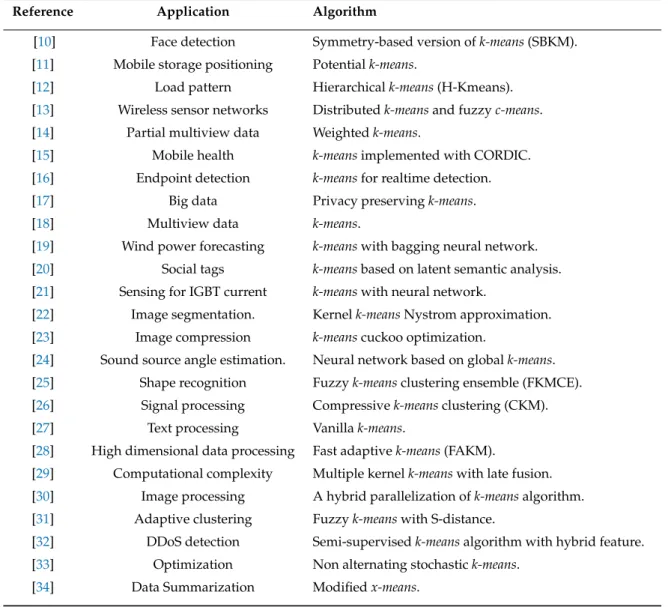
Clustering algorithms exploit the underlying structure of the data distribution and define rules for grouping the data with similar characteristics [3]. This process results in the partition of a given dataset according to the clustering criteria without any prior knowledge about the dataset. In an ideal clustering scenario, each cluster consists of similar data instances that are quite dissimilar from the instances in other clusters. Such a dissimilarity measure relies on the underlying data and objective of the algorithm. Clustering is central to many data-driven applications and is considered an interesting and important task in machine learning. It is also studied in statistics, pattern recognition, computational geometry, bioinformatics, optimization, image processing, and in a variety of other fields [4–7]. A plethora of clustering techniques have been invented in the last decade, which are being applied in a wide range of application domains [8]. Table1shows the recent applications onk-means
clustering [9] in different application domains.
Table 1.Applications of variants of thek-meansalgorithm in different application domains.
Reference Application Algorithm
[10] Face detection Symmetry-based version ofk-means(SBKM). [11] Mobile storage positioning Potentialk-means.
[12] Load pattern Hierarchicalk-means(H-Kmeans). [13] Wireless sensor networks Distributedk-meansand fuzzyc-means. [14] Partial multiview data Weightedk-means.
[15] Mobile health k-meansimplemented with CORDIC. [16] Endpoint detection k-meansfor realtime detection. [17] Big data Privacy preservingk-means. [18] Multiview data k-means.
[19] Wind power forecasting k-meanswith bagging neural network. [20] Social tags k-meansbased on latent semantic analysis. [21] Sensing for IGBT current k-meanswith neural network.
[22] Image segmentation. Kernelk-meansNystrom approximation. [23] Image compression k-meanscuckoo optimization.
[24] Sound source angle estimation. Neural network based on globalk-means. [25] Shape recognition Fuzzyk-meansclustering ensemble (FKMCE). [26] Signal processing Compressivek-meansclustering (CKM). [27] Text processing Vanillak-means.
[28] High dimensional data processing Fast adaptivek-means(FAKM).
[29] Computational complexity Multiple kernelk-meanswith late fusion. [30] Image processing A hybrid parallelization ofk-meansalgorithm. [31] Adaptive clustering Fuzzyk-meanswith S-distance.
[32] DDoS detection Semi-supervisedk-meansalgorithm with hybrid feature. [33] Optimization Non alternating stochastick-means.
This survey studies the problems of and solutions to partition-based clustering, and more specifically the widely usedk-meansalgorithm [9], which has been listed among the top 10 clustering algorithms for data analysis [35]. Due to their popularity and ease of use,k-meansclustering methods are being used in conjunction with deep learning for tasks such as image segmentation and handwriting recognition [36]. A more recent work in [37] used a fully connected deep convolution neural network along withk-meansand performed pixel matching between a segmented image and a convoluted image. This overcomes the problem that exists when useful information from images is lost by repeated convolution of the images [36]. Although thek-meansclustering algorithm itself performs well with compact and hyper-spherical clusters, we are interested in highlighting its limitations and suggesting solutions. The primary focus is given to two unavoidable problems of thek-meansalgorithm: (i) assignment of centroids and number of clusters and (ii) ability to handle different types of data.
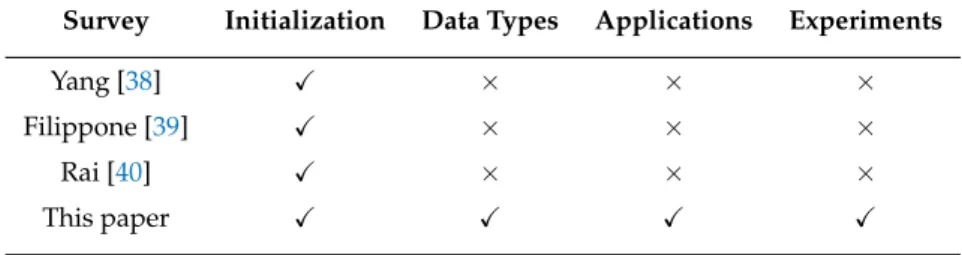
Although researchers have proposed variants (Figure1) ofk-meansalgorithms to overcome these impediments, they are however domain specific and do not generalize well. For example, ak-means
algorithm which can handle categorical data might perform poorly because of the initialization process used. Table2outlines a comparative analysis of existing surveys on clustering and highlights the contributions of this paper. The key contributions of this paper are listed below.
• Existing solutions of thek-meansalgorithm along with a taxonomy are outlined and discussed in order to augment the understanding of these variants and their relationships.
• This research frames the problems, analyses their solutions and presents a concrete study on advances in the development of thek-meansalgorithm.
• Experiments are performed using the improvedk-meansalgorithms to find out their effectiveness using six benchmark datasets.
Figure 1.A simple taxonomy of variants ofk-meansalgorithm.
Table 2.Comparison with existing surveys.
Survey Initialization Data Types Applications Experiments
Yang [38] X × × ×
Filippone [39] X × × ×
Rai [40] X × × ×
This paper X X X X
Paper Roadmap
Our paper is structured as follows. Sections2and3address the problems of thek-meansalgorithm and review the existing solutions for them. Section4showcases an experimental analysis of the representative algorithms (from Sections2and3) on six benchmark datasets widely used by the machine learning and data mining research community. Section5concludes the paper, summarizing the key insights regarding thek-meansalgorithm.
2.k-meansVariants for Solving the Problem of Initialization
Thek-meansalgorithm depends on the value ofk; which always needs to be specified in order to perform any clustering analysis. Clustering with differentkvalues will eventually produce different results. Different initialization problems that were analyzed in recent studies did not consider the problem where the algorithm only converges to a poor local minima. In [41], an alternative approach was adopted to prevent thek-meansalgorithm from being easily affected by noise and outlier values. The authors presented a modifiedk-meansalgorithm based on self-paced learning theory. Self-paced learning theory is used in order to select competing training subset that helps thek-meansalgorithm to build an initial cluster model. The generalization ability of the algorithm is then improved by subsequently adding training subsets found by self-paced learning until the model reaches an optimal performance or all the training samples have been used. The authors proposed this algorithm and demonstrated its performances on several real datasets.
The authors in [42] proposed an improvement to the vanillak-meansalgorithm that prevents it from getting stuck to a local minima. The improved algorithm incorporates cuckoo search along with thek-meansalgorithm. The method incorporates a modified cuckoo search algorithm, which helps to reach a better solution since the search step size factor is being changed. Overall, the proposed algorithm is robust as well as fast in reaching a near-optimal solution.
In [43], the authors discussed criteria concerning the stability and the performance of thek-means. Theoretical results of algorithm stability were proven as the number of instances approaches infinity. The authors in [44] analyzed the stability of thek-means clustering algorithm in a more practical scenario, the parameter (cluster number) is chosen by stability-based model selection. The primary focus was towards drawing random sample points to explain the effect on the stability of the algorithm. An initial estimation method for computing the covariance matrix for thek-meansalgorithm using Mahalanobis distance was proposed in [45]. It involves finding a group of points comprised of neighbors with a high density that represent the centroids of the selected clusters. These provide an approximate estimate of the covariance matrix, which is updated successively using the proposed algorithm.
Ball et al. [46] proposed the ISODATA algorithm to estimatekby parameter tweaking. A similar strategy is also adopted in adaptive resonance theory [47], which generates new clusters [48]. Since this approach requires a predefined threshold, it is generally avoided.
Inx-meansclustering [49], the BIC (Bayesian information criterion) or “Schwarz criterion” [50,51] is utilised to find the number ofkclusters. For a given set of data, a family of different models initialized with differentkvalues is used to compute the posterior probability distribution. These distributions are then used to find the score of the different models. This algorithm was utilized in identifying anomalous patterns in [52,53].
Bradley et al. [54] outlined methods for identifying a more fine grained starting condition that relies on the estimation of the distribution modes. The algorithm initially chooses small samples from the dataset and appliesk-meansclustering. These temporary sets are then further clustered using the
k-meansto find better initialization. This algorithm’s computational complexity is significantly lower compared to vanillak-meansand, more importantly, is scalable to large datasets. Figure2displays the methodology for obtaining refined initial points.
In [55], the author empirically compared four initialization methods. These are as follows: (i) RANDOM, (ii) FA [56], (iii) MA [9], and (iv) KA [57]. The RANDOM method divides the dataset randomly intoknumber of clusters and is one of the most popular initialization methods. The FA approach [56] randomly chooseskinstances from the given dataset and assigns the remaining instances to the nearest cluster centers. The MA approach [9] randomly selectskinstances of the dataset, similar to basick-means. The KA approach [57] provides a method where the initial clustering is done by selecting representative instances successively untilkinstances are found. The first representative instance is the most centrally located in the dataset. The remaining representative instances are chosen based on the heuristic that presents rules of choosing instances with higher numbers compared to
others. Based on their experimental analysis, the RANDOM and KA resulted in superior performance compared to the other two. Recently, in [58], a co-clustering algorithm is proposed for dealing with sparse and high dimensional data that outperforms the basick-means.
Initial Points
Dataset
Cluster Solutions (Multiple Starts) Cluster Multiple subsamples
Subsample
Select Best Solution
Refined Initial Points
Figure 2.Refined initial instances, adapted from [54].
These solutions can only handle numerical data. Hence such methods would not be suitable for datasets consisting of mixed attributes, for instance, categorical and binary. In the next section, we discuss the research progress dealing with mixed types of data for clustering.
3.k-meansVariants for Solving the Problem of Data Issue
In many application domains, datasets include attributes that are of mixed data types [59]. Therefore, a distance calculation scheme is necessary that is able to compute distances between instances having mixed types of data. This section discusses existing research onk-meansto find similarity or distance metrics between categorical attributes. Although the algorithms discussed in the previous section solve the initialization problem, they still rely on numerical data for distance calculation. Therefore, it is necessary to explore the distance calculation mechanism for thek-means
clustering algorithm and our investigation as follows.
Wang et al. [60] introduced an extended form of thefuzzy k-means(xFKM) algorithm for datasets with non-numerical attributes, such as categorical data. The centroids constitute an extended form to retain as much clustering information as possible. A computational cost comparison was made among thek-means, fuzzyk-meansand xFKM. They showed that the xFKM is most suitable for datasets with categorical attributes, where the attributes vary in a medium and acceptable range of diverse values. Amir et al. [61] offered a cost function and distance measure for clustering datasets with mixed data (datasets with numerical and categorical data) based on co-occurrences of values. In [62], a kernel function based on “hamming distance” [62] was proposed for embedding categorical data. The kernel-k-meansprovides an add-on to thek-meansclustering that is designed to find clusters in a feature space where distances are calculated via kernel functions.
Huang et al. in [63] provided a variant of thek-meansalgorithm, where a dissimilarity measure is used as a metric. The algorithm combines thek-meansandk-modesclustering for data having mixed attributes. In [64], the convergence of different versions of the modifiedk-modesalgorithms was analyzed. The authors proved that the modified algorithms fail to converge to a local minima without degrading the originalk-modealgorithm. To handle this issue, the authors presented two algorithms, MKM-NOF and MKM-NDM, that apply different methods for representing clusters by weighted cluster prototypes.
In [65], an “ellipsoidalk-means” algorithm was proposed that extends the “sphericalk-means” algorithm for selecting features in a sparse and high-dimensional dataset. In [66], an entropy weightingk-means(EWKM) clustering algorithm was presented for clustering sparse datasets with high dimensions. The algorithm reduces the dispersion within the cluster and increases the negative weight entropy.
Existing solutions for handling mixed data certainly enhanced the capability of thek-means; however, as the solutions do not address the initialization problem, several issues withk-meansstill remain. Among many proposed measures [67–69], theoverlapmeasure is considered to be the easiest and most computationally efficient method to find similarity between two categorical attributes [70]. One of the shortcomings of this method is inability to differentiate between the distinct attribute values, however, focuses on whether two categorical attributes attain equal values or not. However, after a thorough experimental analysis in [71] on a number of datasets, the authors came to the conclusion that “No single measure is always superior or inferior. This is to be expected since each dataset has different characteristics”. Hence, the overlap measure (for categorical attributes) and Euclidean distance (for numerical attributes) can be combined into a mixed distance measure, as also used in [6,72].
4. Performance Evaluation ofk-meansRepresentative Variants
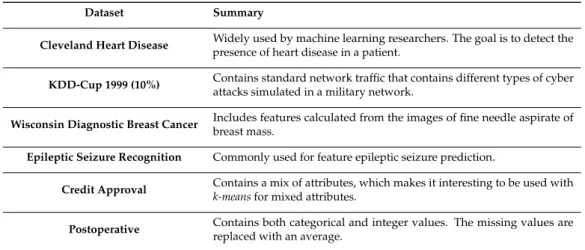
We performed an experimental analysis to investigate different versions of thek-meansalgorithms for different datasets, especially for the initialization and mixed-data-type problems (GitHub Link: shorturl.at/CR245). All datasets are available in te UCI machine learning repository [73]. Table3
briefly summarizes the datasets. The next subsections discuss the evaluation metrics used, results analysis and, last but not least, the analysis of computational complexity.
Table 3.Summary of datasets.
Dataset Summary
Cleveland Heart Disease Widely used by machine learning researchers. The goal is to detect the presence of heart disease in a patient.
KDD-Cup 1999 (10%) Contains standard network traffic that contains different types of cyber attacks simulated in a military network.
Wisconsin Diagnostic Breast Cancer Includes features calculated from the images of fine needle aspirate of breast mass.
Epileptic Seizure Recognition Commonly used for feature epileptic seizure prediction.
Credit Approval Contains a mix of attributes, which makes it interesting to be used with k-meansfor mixed attributes.
Postoperative Contains both categorical and integer values. The missing values arereplaced with an average.
4.1. Metrics Used for Experimental Analysis
To evaluate the performance of different algorithms, the following metrics [1–3] were chosen:
• Accuracy: This measure outlines the extent to which the predicted labels are in agreement with the true labels. The predicted labels correspond to the class labels where new instances are clustered. The accuracy is calculated by Equation (1).
Accuracy= Correctly identified class
Total number of class ×100 (1)
• Adjusted rand index (ARI): Provides a score of similarity between two different clustering results of the same dataset. For a given setSconsisting ofαelements andrsubsets and two partitions
Y = {Y1,Y2, . . . ,Yb}andX = {X1,X2, . . . ,Xc}, the overlap between the two partitions can be
Y1 Y2 . . . Yb Sums X1 α11 α12 α1b r1 X2 α21 α22 α2b r2 .. . ... ... . .. ... ... Xc αc1 αc2 . . . αcb rc Sums s1 s2 . . . sb
The adjusted rand index (ARI) is then calculated by Equation (2):
ARI= ∑ij( αij 2)−[∑i( ri 2)∑j(s2j)]/(α2) 1 2[∑i(r2i) +∑j( sj 2)]−[∑i( ri 2)∑j( sj 2)]/( α 2) (2)
The ARI score is adjusted to have values between 0 and 1 to represent scores for random and perfect clustering, respectively.
4.2. Results
Experimental analysis withk-means[9],x-means[49], constrainedk-means[54],k-prototype[63], and kernelk-means[74] was performed, and a performance comparison in terms of the metrics described above was made. For each of the experiments, a 10 fold cross validation scheme was used to split the dataset, and the reported results consist of average and standard deviation of the scores of these metrics across 10 validation folds. Table4addresses the algorithms that deal with initialization issues, while Table5encompasses mixed data type oriented methods.
Table 4.Comparison of different algorithms addressing initialization issue.
Metric k-means Constrained
k-means x-means Wisconsin Diagnostic Breast Cancer
Accuracy 0.223±0.310 0.596±0.406 0.086±0.042 ARI 0.690±0.134 0.682±0.13 0.683±0.128 KDD Cup 1999 Accuracy 0.195±0.077 0.118±0.087 0.045±0.034 ARI 0.004±0.007 0.107±0.059 0.085±0.169 Epileptic Seizure Accuracy 0.101±0.060 0.099±0.012 0.102±0.053 ARI 0.005±0.001 0.002±0.001 0.002±0.002
Table 5.Comparison ofk-prototypeand Kernel-k-meansalgorithm datasets with mixed data types.
Metric k-prototype Kernel-k-means
Credit Approval
Accuracy 0.456±0.061 0.437±0.283 ARI 0.004±0.005 0.044±0.092
Cleveland Heart Disease Accuracy 0.462±0.043 0.590±0.080
ARI 0.003±0.001 0.017±0.041 Post Operative
Accuracy 0.462±0.043 0.590±0.080 ARI 0.003±0.001 0.017±0.041
Table4summarizes the mean and the standard deviation across five validation folds and compares the performance between regulark-means,x-means, and constrainedk-meansalgorithms in terms of different metrics for the Wisconsin Diagnostic Breast cancer, KDD Cup 1999 (10%) and Epileptic Seizure datasets. In Figure3, it is shown that the algorithm performance varied with different datasets. For example, thek-meansperformed best with the KDD Cup datasets andx-meanshad the worst accuracy. However, the x-meansperformed better than the other two in the Epileptic dataset. The constrained-k-meansperformed best in the Wisconsin dataset. In terms of ARI score, the constrained-k-meansseemed to perform in a consistent manner. The key takeaway from these results is that there is no algorithm that will provide a consistent solution regardless of the dataset.
KDD Cup Wisconsin Epileptic
Datasets 0 10 20 30 40 50 60 Accuracy (%) k-means constrained k-means x-means a. Accuracy
KDD Cup Wisconsin Epileptic 0 0.5 1 ARI k-means Constrained k-means x-means b. ARI
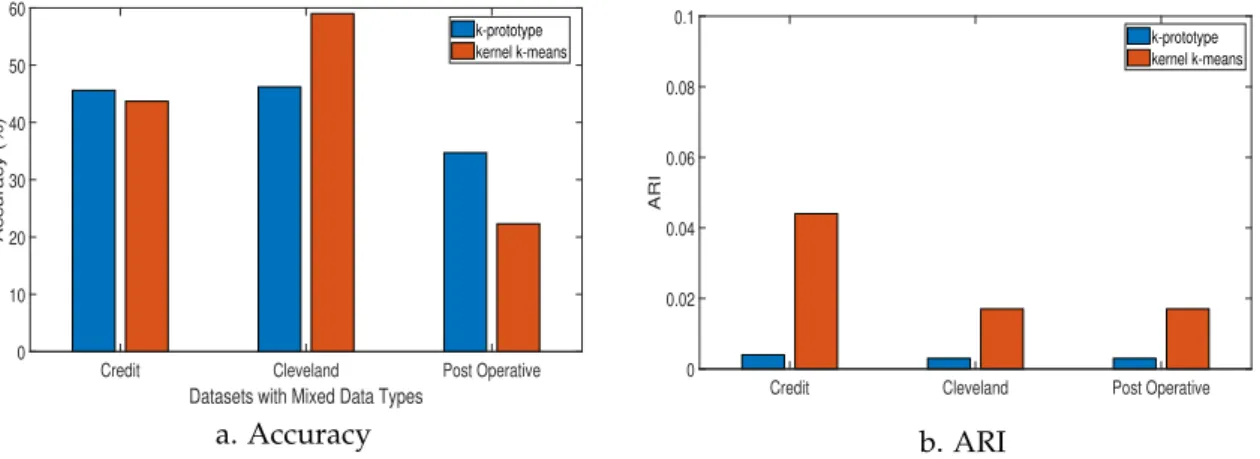
Figure 3.Performance ofk-meansvariants addressing initialization issue.
Table 5 compares the performance between the k-prototype and kernel-k-means algorithms. These algorithms are suitable for datasets that consist of mixed attributes. In Figure4, it is reflected that thek-prototypeperformed better using the Credit Approval and Post Operative datasets when considering the accuracy of clustering. However, kernel-k-meansperformed best using the Cleveland Heart Disease dataset. In terms of ARI score comparison, the kernel-k-meansalgorithm consistently performed better thank-prototypeusing all three datasets containing mixed data.
Credit Cleveland Post Operative
Datasets with Mixed Data Types
0 10 20 30 40 50 60 Accuracy (%) k-prototype kernel k-means a. Accuracy
Credit Cleveland Post Operative 0 0.02 0.04 0.06 0.08 0.1 ARI k-prototype kernel k-means b. ARI
Figure 4.Performance ofk-meansvariants addressing mixed data problem.
4.3. Computational Complexity Analysis
In addition to the comparison of these variants ofk-meansalgorithms in terms of different metrics on different datasets, a time and space complexity comparison of these algorithms was also carried out. Both the time and space complexities of these algorithms depend on the sizenof the datasets. Finding an optimal solution for thek-meansalgorithm is hard in the Euclidean space for both the binary and multi-class clustering problems. The regulark-meansalgorithm have a time complexity
ofO(n2), wherenis the size of the input data. However, it can be optimized to be linear and be in the order ofO(n)using certain heuristics mentioned in [75,76]. By contrast, the time complexity for constrained-k-meansis of the orderO(kn), wherekrepresents the amount of clusters. It reflects that the constrained-k-meanshas a lower time complexity than the regulark-meanswhen the dataset size grows. Thex-meansalgorithm, on the other hand, was mainly proposed in order to address the scalability issue of the regulark-meansalgorithm for large datasets, sincex-meansinvolves a progressive increase in the number of clusters within a user-supplied range (kmin,kmax). The time complexity of thex-means
algorithm is therefore in the order ofO(nlogkmax).kmaxis the maximum number clusters possible in
a dataset. The space complexity for all thesek-meansvariants isO((n+k)d), wheredis the number of features in a dataset. Table6shows the complexities of the different clustering algorithms.
Table 6.Complexities of different variants ofk-means.
Complexity k-means Constrained-k-means x-means
Time O(n2) O(kn) O(nlogkmax)
Space O((n+k)d) O((n+k)d) O((n+k)d)
5. Conclusions
In a wide range of application domains, data analysis tasks heavily rely on clustering. This paper focused on the populark-meansalgorithm and the issues of initialization and inability to handle data with mixed types of features. Unlike other review or survey papers, this paper contains both a critical analysis of the existing literature and an experimental analysis on half a dozen benchmark datasets to demonstrate the performances of different variants ofk-means. The experimental analysis divulged that there is no universal solution for the problems of thek-meansalgorithm; rather each of the existing variants of the algorithm is either application-specific or data-specific. Our future research will focus on developing a robustk-meansalgorithm that can address both problems simultaneously. This paper will also help the data mining research community to design and develop newer types of clustering algorithms that can address the research issues around Big Data [34,72].
Author Contributions:Conceptualization, M.A.; Data curation, R.S. and M.A.; Formal analysis, M.A., R.S., and
S.M.S.I.; Funding acquisition, M.A., R.S.; Investigation, M.A., R.S., and S.M.S.I.; Methodology, M.A; Project administration, M.A. and S.M.S.I.; Supervision, M.A. and S.M.S.I.; Validation, R.S. and M.A.; Visualization, M.A. and R.S.; and Writing—original draft, M.A. and R.S.; Writing—review and editing, M.A., R.S. and S.M.S.I. All authors have read and agreed to the published version of the manuscript. Authorship must be limited to those who have contributed substantially to the work reported.
Funding:This research received no external funding.
Conflicts of Interest:The authors declare no conflict of interest.
References
1. Mohri, M.; Rostamizadeh, A.; Talwalkar, A.Foundations of Machine Learning; MIT Press: Cambridge, MA, USA, 2012.
2. Bishop, C.M.Neural Networks for Pattern Recognition; Oxford University Press: Oxford, UK, 1995.
3. Jain, A.K.; Murty, M.N.; Flynn, P.J. Data clustering: A review.ACM Comput. Surv. 1999,31, 264–323. [CrossRef] 4. Ahmed, M.; Choudhury, V.; Uddin, S. Anomaly detection on big data in financial markets. In Proceedings of the 2017 IEEE/ACM International Conference on Advances in Social Networks Analysis and Mining, Sydney, Australia, 31 July–3 August 2017; pp. 998–1001.
5. Ahmed, M. An unsupervised approach of knowledge discovery from big data in social network. EAI Endorsed Trans. Scalable Inf. Syst.2017,4, 9. [CrossRef]
6. Ahmed, M. Collective anomaly detection techniques for network traffic Analysis. Ann. Data Sci.
2018,5, 497–512. [CrossRef]
7. Tondini, S.; Castellan, C.; Medina, M.A.; Pavesi, L. Automatic initialization methods for photonic components on a silicon-based optical switch.Appl. Sci.2019,9, 1843. [CrossRef]
8. Ahmed, M.; Mahmood, A.N.; Islam, M.R. A survey of anomaly detection techniques in financial domain Future Gener. Comput. Syst.2016,55, 278–288.
9. MacQueen, J. Some methods for classification and analysis of multivariate observations. In Proceedings of the Fifth Berkeley Symposium on Mathematical Statistics and Probability, Oakland, CA, USA, 1 January 1967; pp. 281–297.
10. Su, M.C.; Chou, C.H. A modified version of the k-means algorithm with a distance based on cluster symmetry. IEEE Trans. Patternanal. Mach. Intell.2001,23, 674–680.
11. Cabria I.; Gondra, I. Potential-k-means for load balancing and cost minimization in mobile recycling network. IEEE Syst. J.2014,11, 242–249. [CrossRef]
12. Xu, T.S.; Chiang, H.D.; Liu, G.Y.; Tan, C.W. Hierarchical k-means method for clustering large-scale advanced metering infrastructure data.IEEE Trans. Power Deliv.2015,32, 609–616. [CrossRef]
13. Qin, J.; Fu, W.; Gao, H.; Zheng, W.X. Distributedk-means algorithm and fuzzyc-means algorithm for sensor networks based on multiagent consensus theory.IEEE Trans. Cybern.2016,47, 772–783. [CrossRef] 14. Liu, H.; Wu, J.; Liu, T.; Tao, D.; Fu, Y. Spectral ensemble clustering via weighted k-means: Theoretical and
practical evidence.IEEE Trans. Knowl. Data Eng.2017,29, 1129–1143. [CrossRef]
15. Adapa, B.; Biswas, D.; Bhardwaj, S.; Raghuraman, S.; Acharyya, A.; Maharatna, K. Coordinate rotation-based low complexityk-means clustering Architecture.IEEE Trans. Very Large Scale Integr. Syst.2017,25, 1568–1572. [CrossRef]
16. Jang, H.; Lee, H.; Lee, H.; Kim, C.K.; Chae, H. Sensitivity enhancement of dielectric plasma etching endpoint detection by optical emission spectra with modifiedk-means cluster analysis.IEEE Trans. Semicond. Manuf.
2017,30, 17–22. [CrossRef]
17. Yuan, J.; Tian, Y. Practical privacy-preserving mapreduce based k-means clustering over large-scale dataset IEEE Trans. Cloud Comput.2017,7, 568–579.
18. Xu, J.; Han, J.; Nie, F.; Li, X. Re-weighted discriminatively embeddedk-means for multi-view clustering. IEEE Trans. Image Process.2017,26, 3016–3027. [CrossRef]
19. Wu, W.; Peng, M. A data mining approach combiningk-means clustering with bagging neural network for short-term wind power forecasting.IEEE Internet Things J.2017,4, 979–986. [CrossRef]
20. Yang, J.; Wang, J. Tag clustering algorithm lmmsk: Improved k-means algorithm based on latent semantic analysis.J. Syst. Electron.2017,28, 374–384.
21. Zeng, X.; Li, Z.; Gao, W.; Ren, M.; Zhang, J.; Li, Z.; Zhang, B. A novel virtual sensing with artificial neural network and k-means clustering for igbt current measuring.IEEE Trans. Ind. Electron.2018,65, 7343–7352. [CrossRef]
22. He, L.; Zhang, H. Kernel k-means sampling for nyström approximation. IEEE Trans. Image Process.
2018,27, 2108–2120. [CrossRef]
23. Manju, V.N.; Fred, A.L. Ac coefficient and k-means cuckoo optimisation algorithm-based segmentation and compression of compound images.IET Image Process.2017,12, 218–225. [CrossRef]
24. Yang, X.; Li, Y.; Sun, Y.; Long, T.; Sarkar, T.K. Fast and robust rbf neural network based on global k-means clustering with adaptive selection radius for sound source angle estimation.IEEE Trans. Antennas Propag.
2018,66, 3097–3107. [CrossRef]
25. Bai, L.; Liang, J.; Guo, Y. An ensemble clusterer of multiple fuzzyk-means clusterings to recognize arbitrarily shaped clusters.IEEE Trans. Fuzzy Syst.2018,26, 3524–3533. [CrossRef]
26. Schellekens, V.; Jacques, L. Quantized compressive k-meansIEEE Signal Process. Lett.2018,25, 1211–1215. 27. Alhawarat, M.; Hegazi, M. Revisiting k-means and topic modeling, a comparison study to cluster
arabic documents.IEEE Access2018,6, 740–749. [CrossRef]
28. Wang, X.D.; Chen, R.C.; Yan, F.; Zeng, Z.Q.; Hong, C.Q. Fast adaptive k-means subspace clustering for high-dimensional data.IEEE Access2019,7, 639–651. [CrossRef]
29. Wang, S.; Zhu, E.; Hu, J.; Li, M.; Zhao, K.; Hu, N.; Liu, X. Efficient multiple kernel k-means clustering with late fusion.IEEE Access2019,7, 109–120. [CrossRef]
30. Kwedlo, W.; Czochanski, P.J. A hybrid mpi/openmp parallelization ofk-means algorithms accelerated using the triangle inequality.IEEE Access2019,7, 280–297. [CrossRef]
31. Karlekar, A.; Seal, A.; Krejcar, O.; Gonzalo-Martin, C. Fuzzy k-means using non-linear s-distance.IEEE Access
32. Gu, Y.; Li, K.; Guo, Z.; Wang, Y. Semi-supervised k-means ddos detection method using hybrid feature selection algorithm.IEEE Access2019,7, 351–365. [CrossRef]
33. Lee, M. Non-alternating stochastic k-means based on probabilistic representation of solution space. Electron. Lett. 2019,55, 605–607. [CrossRef]
34. Ahmed, M. Data summarization: A survey.Knowl. Inf. Syst.2019,58, 249–273. [CrossRef]
35. Wu, X.; Kumar, V.; Quinlan, J.R.; Ghosh, J.; Yang, Q.; Motoda, H.; McLachlan, G.J.; Ng, A.; Liu, B.; Philip, S.Y.; et al. Top 10 algorithms in data Mining.Knowl. Inf. Syst.2008,14, 1–37. [CrossRef]
36. Tian, K.; Zhou, S.; Guan, J. Deepcluster: A general clustering framework based on deep learning. In Proceedings of the Joint European Conference on Machine Learning and Knowledge Discovery in Databases, Skopje, Macedonia, 18–22 September 2017; pp. 809–825.
37. He, B.; Qiao, F.; Chen, W.; Wen, Y. Fully convolution neural network combined with k-means clustering algorithm for image segmentation. In Proceedings of the Tenth International Conference on Digital Image Processing (ICDIP 2018), Shanghai, China, 11–14 May 2018; Volume 10806, pp. 1–7.
38. Yang, M.S. A survey of fuzzy clustering.Math. Comput.1993,18, 1–16. [CrossRef]
39. Filippone, M.; Camastra, F.; Masulli, F.; Rovetta, S. A survey of kernel and spectral methods for clustering. Pattern Recognit.2008,41, 176–190. [CrossRef]
40. Rai, P.; Singh, S. A survey of clustering techniques.Int. Comput. Appl.2010,7, 1–5. [CrossRef]
41. Yu, H.; Wen, G.; Gan, J.; Zheng, W.; Lei, C. Self-paced learning for k-means clustering algorithm. Pattern Recognit. Lett.2018. [CrossRef]
42. Ye, S.; Huang, X.; Teng, Y.; Li, Y. K-means clustering algorithm based on improved cuckoo search algorithm and its application. In Proceedings of the 2018 IEEE 3rd International Conference on Big Data Analysis (ICBDA), Shanghai, China, 9–12 March 2018; pp. 422–426.
43. Ben-David, S.; Von Luxburg, U.; Pál, D. A sober look at clustering stability. In Proceedings of the International Conference on Computational Learning Theory, San Diego, CA, USA, 13–15 June 2006; pp. 5–19.
44. Bubeck, S.; Meil˘a, M.; von Luxburg, U. How the initialization affects the stability of the k-means algorithm. ESAIM Probab. Stat.2012,16, 436–452. [CrossRef]
45. Melnykov, I.; Melnykov, V. On k-means algorithm with the use of mahalanobis Distances.Stat. Probab. Lett.
2014,84, 88–95. [CrossRef]
46. Ball, G.H.; Hall, D.J. A clustering technique for summarizing multivariate data. Syst. Res. Behav. Sci.
1967,12, 153–155. [CrossRef]
47. Carpenter, G.A.; Grossberg, S. A massively parallel architecture for a self-organizing neural pattern recognition machine.Comput. Vis. Graph. Image Process.1987,37, 54–115. [CrossRef]
48. Xu, R.; Wunsch, D.Clustering; Wiley-IEEE Press: Piscataway, NJ, USA, 2009.
49. Pelleg, D.; Moore, A.W. X-means: Extending k-means with efficient estimation of the number of clusters. In Proceedings of the 17th International Conference on Machine Learning, Stanford, CA, USA, 29 June–2 July 2000; Volume 1, pp. 727–734.
50. Bozdogan, H. Model selection and akaike’s information criterion (AIC): The general theory and its analytical extensions.Psychometrika1987,52, 345–370. [CrossRef]
51. Schwarz, G. Estimating the dimension of a model. Ann. Stat.1978,6, 461–464. [CrossRef]
52. Ahmed, M.; Barkat Ullah, A.S.S.M. Infrequent pattern mining in smart healthcare environment using data summarization. J. Supercomput.2018,74, 5041–5059. [CrossRef]
53. Ahmed, M.; Mahmood, A. Network traffic analysis based on collective anomaly Detection. In Proceedngs of the 9th IEEE International Conference on Industrial Electronics and Applications, Hangzhou, China, 9–11 June 2004; pp. 1141–1146.
54. Bradley, P.S.; Fayyad, U.M. Refining initial points for k-means Clustering.ICML1998,98, 91–99.
55. Pena, J.M.; Lozano, J.A.; Larranaga, P. An empirical comparison of four initialization methods for the k-means algorithm.Pattern Recognit. Lett.1999,20, 1027–1040. [CrossRef]
56. Forgy, E.W. Cluster analysis of multivariate data: Efficiency versus interpretability of classifications. Biometrics1965,21, 768—769.
57. Kaufman, L.; Rousseeuw, P.J.Finding Groups in Data: An Introduction to Cluster Analysis; John Wiley & Sons: Hoboken, NJ, USA, 2009; Volume 344.
58. Hussain, S.F.; Haris, M. A k-means based co-clustering (kcc) algorithm for sparse, high dimensional data. Expert Syst. Appl.2019,118, 20–34. [CrossRef]
59. Gupta, S.; Rao, K.S.; Bhatnagar, V. K-means clustering algorithm for categorical attributes. In Proceedings of the International Conference on Data Warehousing and Knowledge Discovery, Florence, Italy, 30 August–1 September 1999; pp. 203–208.
60. Jiacai, W.; Ruijun, G. An extended fuzzy k-means algorithm for clustering categorical valued data. In Proceedings of the 2010 International Conference on Artificial Intelligence and Computational Intelligence (AICI), Sanya, China, 23–24 October 2010; Volume 2, pp. 504–507.
61. Ahmad, A.; Dey, L. A k-mean clustering algorithm for mixed numeric and categorical data.Data Knowl. Eng.
2007,63, 503–527. [CrossRef]
62. Couto, J. Kernel k-means for categorical data. In International Symposium on Intelligent Data Analysis; Springer: Berlin, Germany, 2005; pp. 46–56.
63. Huang, Z. Extensions to the k-means algorithm for clustering large data sets with categorical values. Data Min. Knowl. Discov.1998,2, 283–304. [CrossRef]
64. Bai, L.; Liang, J.; Dang, C.; Cao, F. The impact of cluster representatives on the convergence of the k-modes type clustering.IEEE Trans. Pattern Anal. Mach. Intell.2013,35, 1509–1522. [CrossRef]
65. Dzogang, F.; Marsala, C.; Lesot, M.; Rifqi, M. An ellipsoidal k-means for document clustering. In Proceedings of the 2012 IEEE 12th International Conference on Data Mining (ICDM), Brussels, Belgium, 10–13 December 2012; pp. 221–230.
66. Jing, L.; Ng, M.K.; Huang, J.Z. An entropy weighting k-means algorithm for subspace clustering of high-dimensional sparse data.IEEE Trans. Knowl. Data Eng.2007,19, 1026–1041. [CrossRef]
67. Cramér, H.The Elements of Probability Theory and Some of Its Applications; John Wiley & Sons: New York, NY, USA, 1954.
68. Maung, K. Measurement of association in a contingency table with special reference to the pigmentation of hair and eye colours of scottish school children.Ann. Eugen.1941,11, 189–223. [CrossRef]
69. Pearson, K. On the general theory of multiple contingency with special reference to partial contingency. Biometrika1916,11, 145–158. [CrossRef]
70. Stanfill, C.; Waltz, D. Toward memory-based reasoning.Commun. ACM1986,29, 1213–1228. [CrossRef] 71. Boriah, S.; Chandola, V.; Kumar, V. Similarity measures for categorical data: A comparative evaluation.
In Proceedings of the SIAM International Conference on Data Mining, Atlanta, GA, USA, 24–26 April 2008; pp. 243–254.
72. Ahmed, M. Detecting Rare and Collective Anomalies in Network Traffic Data Using Summarization. 2016. Available online:http://handle.unsw.edu.au/1959.4/56990(accessed on 29 May 2020).
73. Dheeru, D.; Karra Taniskidou, E. UCI Machine Learning Repository. 2017. Available online: http://archive.ics.uci.edu/ml(accessed on 29 May 2020).
74. Likas, A.; Vlassis, N.; Verbeek, J.J. The global k-means clustering Algorithm. Pattern Recognit. 2003,36, 451–461. [CrossRef]
75. Pakhira, M.K. A linear time-complexity k-means algorithm using cluster Shifting. In Proceedings of the 2014 International Conference on Computational Intelligence and Communication Networks, Bhopal, India, 14–16 November 2014; pp. 1047–1051.
76. Kanungo, T.; Mount, D.M.; Netanyahu, N.S.; Piatko, C.D.; Silverman, R.; Wu, A.Y. An efficient k-means clustering algorithm: Analysis and Implementation. IEEE Trans. Pattern Anal. Mach. 2002,7, 881–892. [CrossRef]
c
2020 by the authors. Licensee MDPI, Basel, Switzerland. This article is an open access article distributed under the terms and conditions of the Creative Commons Attribution (CC BY) license (http://creativecommons.org/licenses/by/4.0/).
![Figure 2. Refined initial instances, adapted from [54].](https://thumb-us.123doks.com/thumbv2/123dok_us/1444875.2693412/6.892.233.663.214.520/figure-refined-initial-instances-adapted-from.webp)