A DELPHI STUDY ASSESSING
EFFECTIVE PEER FACULTY E-MENTORING
TO SUPPORT
SCALING DISTANCE EDUCATION PROGRAMS
A Dissertation by
JUDITH HOLBROOK LEWIS
Submitted to the Office of Graduate and Professional Studies of Texas A&M University
in partial fulfillment of the requirements for the degree of DOCTOR OF PHILOSOPHY
Chair of Committee, Christine A. Stanley Committee Members, Fredrick M. Nafukho
Yvonna S. Lincoln James R. Snell Head of Department, Fredrick M. Nafukho
May 2014
Major Subject: Educational Administration
ABSTRACT
This research addressed a gap in the literature regarding the use of e-mentoring as a successful infrastructure mechanism to support educators in delivery of higher education and metrics for its use in scaling online education programs.
The methodology applied to this research was a Delphi Study. The Delphi Technique is a qualitative methodology to build a consensus opinion from a panel of experts. This Delphi was based on a series of rounds in which a panel of experts responded to survey questions, each survey item presented as an essentiality statement ranked by a Likert-type scale index from Very Important down to Unimportant.
Descriptive statistics were calculated for each survey statement to determine consensus. This study addressed five research questions in the areas of support for distance education faculty: what attributes of an e-mentoring program for faculty engaged in teaching distance education classes lead to perceived effectiveness by coaches and practitioners (terms introduced to describe the mentoring relationship between peers in a community of practice), what formal and informal activities or processes provide for preparation for teaching online, collegiality, and professional development (previously published operationalized factors) (Velez, 2010), and what metrics can be used to determine that e-mentoring has led to increased spread, depth, sustainability, and sense of ownership in distance education, previously published factors for scaling (Coburn, 2003).
Based on the Delphi results, the highest consensus means concerned the importance of faculty and administrative support of distance education. For example, the study found high consensus that e-mentoring should be encouraged with release time, coaching should be considered in tenure and promotion decisions, and provision for communication allowances and technical support should be provided for e-mentoring sessions. Training topics of greatest interest included accessibility training, content delivery and teaching modalities, and copyright law and intellectual property
expectations. Important metrics included the number of “formerly coached” practitioners acting as e-mentoring coaches in the future, the number of semester-hours taught, the number of faculty initiating new practices, and faculty acceptance of delivering education online.
This study is significant because it researched the use of e-mentoring as a support for faculty in scaling online learning programs in higher education and provided expert evaluation of processes and procedures recommended by faculty to support their effort. It also evaluated metrics to assess the scaling of distance education programs.
DEDICATION
To my husband, Robert, for his unfailing belief in my potential and his
willingness to see me reach it; and, to my children, Katherine, Robert, and Rebecca, who have brought so much joy to my life, may they be successful in the pursuit of their dreams.
ACKNOWLEDGEMENTS
There are many people who encouraged and supported my efforts to earn a doctoral degree. I am very appreciative for all things, large and small, that helped me in my effort.
First, I would like to thank Dr. Christine Stanley, PhD, Vice President and
Associate Provost for Diversity and Professor of Higher Education Administration in the College of Education and Human Development at Texas A&M University, who so generously served as my dissertation chair. Her enthusiasm for the doctoral path and encouragement for individual accomplishments paved the way for steady progress. I would also like to recognize the other esteemed members of my committee, Dr. Fredrick Nafukho, PhD, Department Head of Educational Administration and Human Resource Development; Dr. Yvonna Lincoln, PhD, Distinguished Professor of Higher Education and Ruth Harrington Endowed Chair in the department of Educational Administration and Development, and Dr. James Snell, DVM, Director of Instructional Technology Services and Senior Lecturer in Veterinary Integrative Biosciences at Texas A&M University. Their encouragement for my topic of study and personal interest in my progress is greatly appreciated.
I had the distinct honor of interacting with the many fine members of the faculty in the department of Educational Administration and Human Resource Development. I would like to especially recognize Drs. Bryan Cole and Homer Tolson for taking time to
review strategy and statistics along the way. I would also like to thank Dr. Fred Bonner and Dr. Vincente Lechuga for their encouragement early in the dissertation process.
The Delphi Study could not have been completed without the conscientious efforts of my Delphi participants, both the members who vetted the preliminary survey instrument, the Pilot Panel, and the members of the Delphi Rounds, the Delphi Panel. Their commitment to provide responses to a substantial set of survey questions through multiple rounds is greatly appreciated. Their suggestions shaped the topics and their expert opinions formed the basis of this work.
On a personal note, I would like to recognize my husband, Bob, and my children Katherine, Robert, and Rebecca, for their unquestioning support of my academic pursuit.
I would like to thank Dr. Candace Schaefer, who introduced me to the
department, for “paying forward” with her good mentorship; Dr. Bari Brookins, who provided a sounding board for my plans; and to Dr. Luana Zellner, who has been so supportive and enthusiastic about my research.
I want to thank members of the Computing and Information Services department at Texas A&M University, who aided my pursuit of a terminal degree by providing a personally encouraging environment and formal educational leave policies, and the University Staff Council, whose advocacy for the employees at The University resulted in scholarship assistance for part of my studies.
Every day of this journey was touched by one of you and together we all made this dissertation possible. I will always be grateful.
NOMENCLATURE
Coach This term is used in conjunction with the term “practitioner” to describe a new type of relationship in a peer faculty environment. Historically, the terms of mentor/mentee or mentor/protégée have held certain connotations that are not appropriate for a peer-mentoring program. Therefore, this dissertation will refer to the coach/practitioner relationship as one in which one peer in the practice of distance education coaches another in a particular skill to enhance the ease of practice for a fellow practitioner.
Communities of
Practice For the purposes of this dissertation, the use of the term communities of practice (CoP) is consistent with that presented by Wenger when he published his conceptual framework for lifelong learning. Wenger’s definition of a CoP was based on a three dimensional community comprised of engagement, joint enterprise, and shared repertoire (Wenger, 1998, p. 73). In his most succinct description, Wenger defined CoPs as, “groups of people who share a concern or passion for something they do and learn how to do it better as they interact” (2006, p. 1).
Computer Mediated
Communication The use of computer-mediated technologies such as email, listserv lists, chat, webcam, and conferencing software, among others, to support communication, abbreviated CMC (Bierema & Merriam, 2002).
Delphi Technique The Delphi Technique is a qualitative methodology to build a consensus opinion from a panel of experts based on a series of rounds in which a panel of experts respond to questionnaires and are provided the results for their review. Their responses are then analyzed and grouped by the researcher. The summary of the results of each round is returned to the panel for their feedback, at which time they are at liberty to change their original responses. This is repeated for three, sometimes four, rounds until a
consensus on key topics is achieved. Skulmoski, Hartman and Krahn (2007) described the method as “an iterative process to collect and distill the anonymous judgments of experts using a series of questionnaires interspersed with feedback” (p. 2). An important strength of the Delphi is “its capacity to capture those areas of collective knowledge that are held within professions but not often verbalized” (Stitt-Gohdes & Crew, 2004, p. 58).
E-mentoring This term refers to a nontraditional form of mentoring,
specifically a mentoring relationship that is supported by the use of computer-mediated communication (CMC) (Bierema & Merriam, 2002). Examples of CMC include email, listserv lists, chat, webcam, and conferencing software, among others. For the purposes of this study, this term is used to refer to relationships that are primarily, but not exclusively, supported by CMC. While the literature points out that current traditional mentoring includes some form of CMC support, this term refers to the primary
support of the mentoring relationship through electronic means. Infrastructure A term advanced by Meyer and Barefield (2009) to represent a
multi-faceted support system for faculty engaged in the delivery of distance education, which included such services as readily available assistance when technology glitches occurred, help desk support to respond to a broad range of topics, team-based
development of course materials, staff development including peer-to-peer mentoring, and proactive administrative policies. Memetics This term is used to explain the transfer of cultural and cognitive
behavior based on a ‘meme’, “a unit of cultural information … that can be transmitted from one individual to another and, like genetic material, may undergo variation and selection” (Giordano, 2004, p. 224).
Practitioner This term is used in conjunction with the term “coach” to describe a new type of relationship in a peer faculty environment.
Historically, the terms of mentor/mentee or mentor/protégée have held certain connotations that are not appropriate for a peer-mentoring program. Therefore, this dissertation will refer to the coach/practitioner relationship as one in which one peer in the practice of distance education coaches another in a particular skill to enhance the ease of practice for a fellow practitioner.
Scaling As used for the purposes of this research, this term is used in the context of the multi-dimensional conceptualization of scaling as published by Coburn (2003). Coburn moved the concept of scale for social and educational projects beyond traditional expansion in the number of units, the dimension that she classified as Spread
(p.7), to encompass: “deep change” in foundational principles, classified as Depth (p. 4), the capacity to persist changes,
classified as Sustainability (p.6), and the assumed responsibility to initiate new change, classified as Shift in Ownership (p.7).
TABLE OF CONTENTS
Page ABSTRACT ... ii DEDICATION ... iv ACKNOWLEDGEMENTS ... v NOMENCLATURE ... vii TABLE OF CONTENTS ... ixLIST OF FIGURES ... xiii
LIST OF TABLES ... xv
CHAPTER I INTRODUCTION AND RATIONALE ... 1
Problem Statement ... 1
Purpose of the Study ... 2
Significance of the Study ... 3
Overview of Methodology ... 3
Objectives and Outcomes ... 4
Research Questions ... 4
Assumptions ... 5
Limitations of the Study ... 6
Delimitations ... 6
II LITERATURE REVIEW ... 7
Introduction to the Literature Review ... 7
History of Distance Education ... 7
The Rise of Distance Education ... 7
Digital Immigrants and Digital Natives ... 8
Issues of Scaling ... 11
Scaling ... 11
CHAPTER Page
Faculty Development for Online Teaching ... 17
Faculty Development and Mentoring ... 17
Traditional Mentoring ... 19 Virtual Mentoring ... 21 Organizational Implications ... 25 Strategic Leadership ... 25 Organizational Policy ... 29 Infrastructure ... 31 Conceptual Framework ... 31
Conclusion of the Literature Review ... 33
III METHODOLOGY ... 35
Introduction ... 35
Research Perspective ... 37
Research Design: The Delphi Method ... 37
Research Questions ... 39
Subjects, Participants, Population, and Sample ... 41
Unit of Analysis ... 43
Research Variables ... 43
Research Instrument: Delphi Study ... 43
Pilot Study ... 45
Response Rate ... 46
Data Collection Procedures ... 47
Consensus for the Delphi Study ... 50
Data Analysis ... 51
Setting and Environment ... 52
Bias and Errors ... 52
Validity ... 52
Trustworthiness ... 53
Reliability ... 54
Human Subjects Consideration ... 54
Summary ... 54
Conclusion ... 55
IV ANALYSIS AND PRESENTATION OF FINDINGS ... 56
Introduction ... 56
Description of Delphi Panel ... 56
CHAPTER Page
Interpretation of Results ... 59
Research Question One ... 59
Research Question Two ... 86
Research Question Three ... 92
Research Question Four ... 99
Research Question Five ... 105
Summary ... 135
V SUMMARY OF FINDINGS, CONCLUSIONS AND RECOMMENDATIONS ... 136
Introduction ... 136
Summary of Study Methodology and Procedures ... 136
Summary of Findings: Research Question One ... 137
Summary of Findings: Research Question Two ... 138
Summary of Findings: Research Question Three ... 139
Summary of Findings: Research Question Four ... 140
Summary of Findings: Research Question Five ... 140
Summary of Conclusions across Dissertation Research Questions 141
Recommendations and Implications for the Field ... 145
Suggestions for Future Research ... 147
Dissertation Study Significance and Closing Comments ... 148
REFERENCES ... 150
APPENDIX A DELPHI PANEL PARTICIPANTS ... 160
APPENDIX B IRB PILOT PANEL CONSENT FORM ... 163
APPENDIX C IRB DELPHI PANEL CONSENT FORM ... 168
APPENDIX D PILOT PANEL INFORMATION DOCUMENT ... 173
APPENDIX E SURVEY FOR PILOT PANEL REVIEW DOCUMENT ... 175
APPENDIX F ROUND ONE INSTRUCTIONS ... 185
APPENDIX G ROUND ONE SURVEY ... 189
APPENDIX I ROUND TWO SURVEY ... 204
APPENDIX J ROUND THREE INSTRUCTIONS ... 219
APPENDIX K ROUND THREE SURVEY ... 222
APPENDIX L RESPONSE FREQUENCIES ... 228
LIST OF FIGURES
FIGURE Page
1 Response Selection Drop Down Object ... 48
2 Response Selection Drop-Down Object with “No Change” Option ... 49
3 Age Distribution of the Delphi Participant Pool ... 57
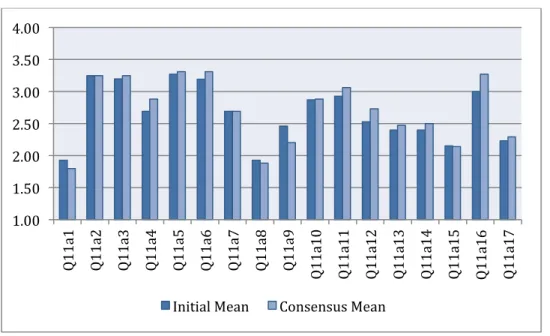
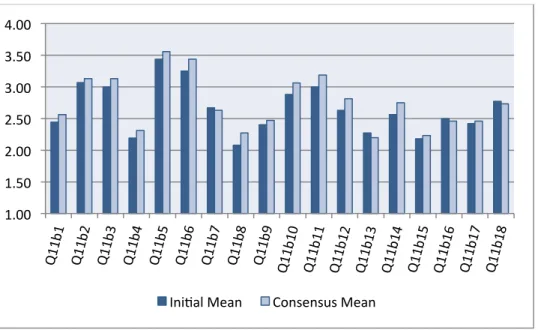
4 The Original Versus Consensus Means for Survey Area 1.1.a (Now). ... 66
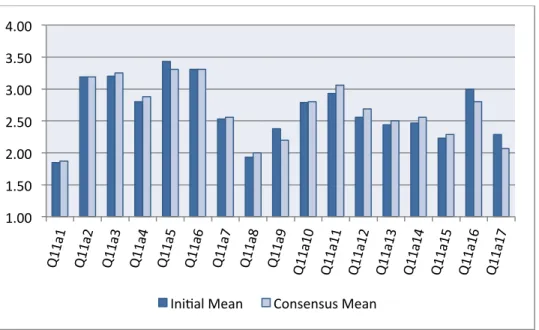
5 The Original Versus Consensus Means for Survey Area 1.1.a (Future). ... 70
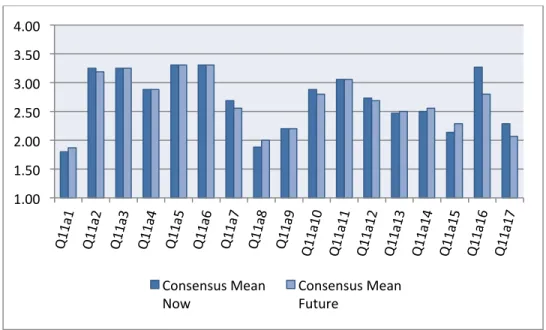
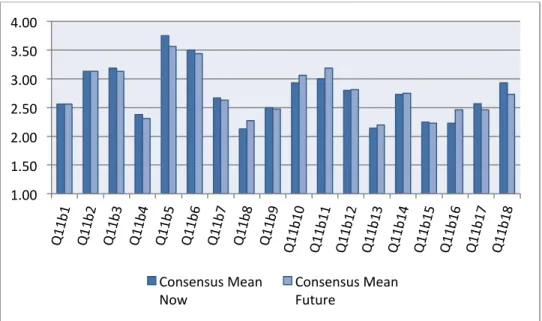
6 The Now Versus Future Consensus Means for Survey Area 1.1.a. ... 71
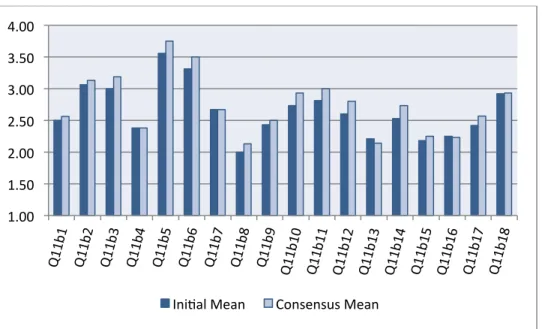
7 The Original Versus Consensus Means for Survey Area 1.1.b (Now). ... 75
8 The Original Versus Consensus Means for Survey Area 1.1.b (Future). ... 79
9 The Now Versus Future Consensus Means for Survey Area 1.1.b. ... 80
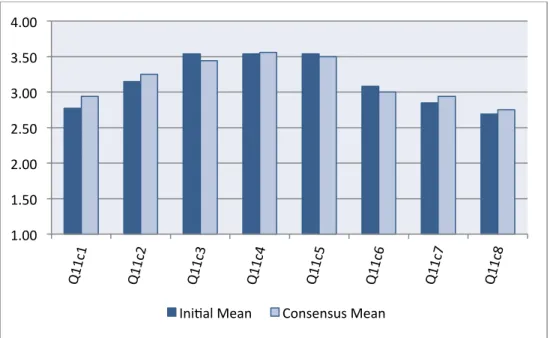
10 The Original Versus Consensus Means for Survey Area 1.1.c (Now). ... 83
11 The Original Versus Consensus Means for Survey Area 1.1.c (Future). ... 85
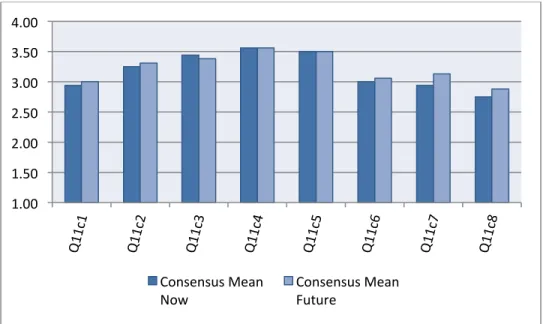
12 The Now Versus Future Consensus Means for Survey Area 1.1.c. ... 86
13 The Original Versus Consensus Means for Survey Area 2.1 (Now). ... 89
14 The Original Versus Consensus Means for Survey Area 2.1 (Future). ... 91
15 The Now Versus Future Consensus Means for Survey Area 2.1. ... 92
16 The Original Versus Consensus Means for Survey Area 2.2 (Now). ... 96
17 The Original Versus Consensus Means for Survey Area 2.2 (Future). ... 98
18 The Now Versus Future Consensus Means for Survey Area 2.2a. ... 99
FIGURE Page
20 The Original Versus Consensus Means for Survey Area 2.3 (Future). ... 104
21 The Now Versus Future Consensus Means for Survey Area 2.3. ... 105
22 The Original Versus Consensus Means for Survey Area 3.1 (Now). ... 111
23 The Original Versus Consensus Means for Survey Area 3.1 (Future). ... 114
24 The Now Versus Future Consensus Means for Survey Area 3.1. ... 115
25 The Original Versus Consensus Means for Survey Area 3.2 (Now) ... 118
26 The Original Versus Consensus Means for Survey Area 3.2 (Future). ... 121
27 The Now Versus Future Consensus Means for Survey Area 3.2a. ... 122
28 The Original Versus Consensus Means for Survey Area 3.3 (Now). ... 125
29 The Original Versus Consensus Means for Survey Area 3.3 (Future) ... 128
30 The Now Versus Future Consensus Means for Survey Area 3.3. ... 129
31 The Original Versus Consensus Means for Survey Area 3.4 (Now). ... 131
32 The Original Versus Consensus Means for Survey Area 3.4 (Future) ... 133
LIST OF TABLES
TABLE Page 1 Consensus Mean Interpretation Ranges ... 59 2 Round One, Survey Questions in area 1.1.a: Perceived Effectiveness by
Coaches ... 61 3 Round One, Survey Questions in area 1.1.b: Perceived Effectiveness
by Practitioners ... 62 4 Round Two, New Survey Items for Areas 1.1.a and 1.1.b ... 63 5 Round Two, New Survey Items for Area 1.1.c ... 63 6 Consensus Data for Research Question One, Survey Area 1.1.a (Now) .... 65 7 Consensus Data for Research Question One, Survey Area 1.1.a (Future) . 67 8 Consensus Data for Research Question One, Survey Area 1.1.b (Now) ... 72 9 Consensus Data for Research Question One, Survey Area 1.1.b (Future) . 76 10 Consensus Data for Research Question One, Survey Area 1.1.c (Now) .... 82 11 Consensus Data for Research Question One, Survey Area 1.1.c (Future) . 84 12 Round One, Survey Questions in area 2.1: Formal or Informal Activities
or Processes Related to E-Mentoring that Would Provide Preparation for Teaching Online ... 87 13 Round Two, New Survey Items for Area 2.1 ... 87 14 Consensus Data for Research Question Two, Survey Area 2.1 (Now) ... 88 15 Consensus Data for Research Question Two, Survey Area 2.1 (Future) ... 90 16 Round One, Survey Questions for area 2.2: Formal or Informal Activities
TABLE Page 17 Round Two, New Survey Items for Area 2.2 ... 93 18 Consensus Data for Research Question Three, Survey Area 2.2 (Now) .... 94 19 Consensus Data for Research Question Three, Survey Area 2.2 (Future) . 97 20 Round One, Survey Questions for Area 2.3: Formal or Informal Activities
or Processes Related to E-Mentoring that Would Provide for Professional Development ... 100 21 Round Two, New Survey Items for Area 2.3 ... 100 22 Consensus Data for Research Question Four, Survey Area 2.3 (Now) ... 101 23 Consensus Data for Research Question Four, Survey Area 2.3 (Future) ... 103 24 Round One, Survey Questions for Area 3.1: Metrics that Can Be Used to
Determine that E-Mentoring Has Led to Increased Spread ... 106 25 Round One, Survey Questions for Area 3.2: Metrics that Can Be Used to
Determine that E-Mentoring Has Led to Increased Depth. ... 106 26 Round One, Survey Questions for Area 3.3: Metrics that Can Be Used to
Determine that E-Mentoring Has Led to Increased Sustainability ... 107 27 Round One, Survey Questions for Area 3.4: Metrics that Can Be Used to
Determine that E-Mentoring Has Led to Increased Sense of Ownership .. 108 28 Round Two, New and Revised Survey Items for Survey Areas 3.1 - 3.4 .. 109 29 Consensus Data for Research Question Five, Survey Area 3.1 (Now) ... 110 30 Consensus Data for Research Question Five, Survey Area 3.1 (Future) ... 112 31 Consensus Data for Research Question Five, Survey Area 3.2 (Now) ... 116 32 Consensus Data for Research Question Five, Survey Area 3.2 (Future) ... 119 33 Consensus Data for Research Question Five, Survey Area 3.3 (Now) ... 123 34 Consensus Data for Research Question Five, Survey Area 3.3 (Future) ... 126
TABLE Page 35 Consensus Data for Research Question Five, Survey Area 3.4 (Now) ... 130 36 Consensus Data for Research Question Five, Survey Area 3.4 (Future) ... 132
CHAPTER I
INTRODUCTION AND RATIONALE
Online delivery of distance education is becoming increasingly widespread. While higher education departments are expanding in an effort to provide more courses to ever increasing student enrollments, little has been published to help them
successfully scale their operations. Recent research (Meyer & Barefield, 2009) has begun to investigate the appropriate infrastructure that should be provided for faculty and students engaged in online education. The researchers’ recommendations included technology support, faculty and staff development, and appropriate policies to achieve those ends. One recommended infrastructure support mechanism reported was an
effective peer-to-peer mentoring program. While much has been written on the merits of traditional mentoring, more recent research in workplace practices has begun to
investigate the merits of technology supported mentoring, or e-mentoring (Nafukho, Graham, & Muyia, 2010).
Problem Statement
Advances in communication technologies have provided an ease of access for relationships, both personal and business. Technologies such as e-mail, text messaging, web cameras, social media (e.g. Facebook), chat and conferencing software, referred to as computer mediated communication (CMC), offer an opportunity to extend the benefits of traditional face-to-face mentoring by transcending boundaries that would otherwise limit a more traditional mentoring relationship (Bierema & Merriam, 2002).
Work has been done in business applications of e-mentoring, but far less has been done to investigate its use in higher education. Recent dissertation research is beginning to investigate aspects of this infrastructure through a theoretical framework of Communities of Practice (Velez, 2010). Velez (2010) sought to operationalize specific constructs, namely effective preparation, collegiality, and professional development (p. 6) in virtual communities of practice for faculty engaged in online education. While the Velez research documented a need for infrastructure, including mentoring, it did not investigate e-mentoring topics and, by her own admission, was limited by the choice of her sampling.
Therefore, this researcher was spurred by promising findings for e-mentoring in recent research for both business and higher education applications. As a result of the literature review, the gap in the knowledge regarding e-mentoring as a successful infrastructure mechanism to support scaling online education programs was
demonstrated. Given the widespread growth of online education programs, research into e-mentoring in that context presented itself as an intriguing opportunity to address a gap in the current literature.
Purpose of the Study
The purpose of this study was to identify processes and procedures in the context of e-mentoring that would lead to successful scaling of distance education programs by providing faculty support in the following areas operationalized by Velez: preparation, collegiality, and professional development (2010, p. 6).
Significance of the Study
While the advantages of traditional mentoring programs, both formal and informal, have been documented, the use of e-mentoring has only more recently been investigated. While the benefits of e-mentoring in the workplace are beginning to be investigated, very little has been written about using e-mentoring to support faculty engaged in distance education. Therefore, this study sought to address that gap in the research.
Overview of Methodology
The data for this study were obtained through the Delphi technique. Powell (2003) described the strength of the Delphi Technique for “situations where individual judgments must be tapped and combined in order to address...[an] incomplete state of knowledge” (p. 376) and remarked it was “particularly valued for its ability to structure and organize group communication” (p. 376). Stitt-Gohdes and Crews (2004) described this technique as “a structured communication process” (p. 55) and recommended its use for the investigation of research problems in career and technical education that benefit from “subjective judgments on a collective basis” (p. 56). Skulmoski, Hartman and Krahn (2007) commented on the use of the Delphi Method in graduate research and described the method as “an iterative process to collect and distill the anonymous
judgments of experts using a series of questionnaires interspersed with feedback” (p. 2). One of the preeminent strengths of the Delphi is “its capacity to capture those areas of collective knowledge that are held within professions but not often verbalized”
(Stitt-Gohdes & Crew, 2004, p. 58). Given that this study was predicated on discovering just such collective expectations, there were many merits to using the Delphi approach. Objectives and Outcomes
While traditional mentoring has been researched at length, the area of e-mentoring has only more recently been investigated. Especially in the area of peer mentoring for faculty teaching distance education, there has been very little published. Based on the gap in research as demonstrated by this literature review, the researcher saw three main areas to address, which will be stated as the following objectives:
• To determine the characteristics of an effective e-mentoring program for faculty engaged in teaching distance education classes
• To extend previous research in communities of practice to identify specific aspects of e-mentoring that would enhance faculty preparation, collegiality, and professional development (Velez, 2010)
• To extend previous research in scaling distance education programs that concentrated on increasing the number of online classes in a department
(Mckenzie, Özkan, & Layton, 2006), to identify those aspects of e-mentoring that go beyond Spread to contribute to the Depth, Sustainability, and Shift in reform
ownership of distance education programs (Coburn, 2003)
Research Questions
• What attributes of an e-mentoring program for faculty engaged in teaching distance education classes lead to perceived effectiveness by coaches and practitioners?
• What formal and informal activities or organizational processes related to e-mentoring would provide for preparation for teaching online?
• What formal and informal activities or organizational processes related to e-mentoring would provide for collegiality?
• What formal and informal activities or organizational processes related to e-mentoring would provide for professional development?
• What metrics can be used to determine that e-mentoring has led to increased spread, depth, sustainability, and sense of ownership in the distance education community of practice?
The answers to these questions provide a significant advance in the body of knowledge extant in the literature on this topic.
Assumptions
The intent of this study was to leverage the combined expertise of a panel of distance education faculty to determine the most effective ways to use e-mentoring to support preparation, collegiality, and professional development as a mechanism to successfully scale distance education programs. As such, the researcher assumed that:
1. faculty would provide the best pool of expertise to enlighten this area of study, 2. the Delphi technique would produce the best consensus of those experts.
Limitations of the Study
The small sample size, while considered acceptable in the literature for a valid Delphi study, nonetheless limits the generalizability of the findings. Also, as a result of comments made to this researcher by some of the Delphi panelists, survey findings for the context of five to ten years into the future should be considered conservative
estimates. One panelist commented that so much is changing currently that it is hard to predict what the landscape will look like in five to ten years.
Delimitations
The sample chosen for this study was limited by the researcher to a cross-section of higher education (a tier one university, an emerging research institution, campuses of a state university system, a four-year college, and a community college) in the state of Texas. Therefore, the conclusions may not have applicability to every institution of higher education.
CHAPTER II
LITERATURE REVIEW
Introduction to the Literature Review
Online education as a method of delivering higher education is becoming increasingly prevalent. In order to continue to successfully expand online education, sound infrastructure and policy to proactively provide for it must exist. That
infrastructure requires several factors, including faculty support and professional development (Meyer & Barefield, 2009). One mechanism to provide these is a peer-to-peer mentoring program. This dissertation explored the use of a new nontraditional form of mentoring, referred to as e-mentoring, as one such mechanism for scaling distance education programs.
History of Distance Education
The Rise of Distance Education
Online programs are expanding to provide more students with increasing online classes. Institutions that offered only a handful of online courses a few years ago are now touting the number of not just courses, but programs and degrees offered entirely online. Shelton and Saltsman (2005) quoted a 2002 survey that reported, “1.6 million students took at least one online course” (p. 2). As reported in the Sloan Consortium report released in 2007, during that fall of 2006 almost 3.5 million students, representing nearly 20% of all those enrolled, took at least one class online (p. 1). Allen and Seaman predicted this trend was expected to continue (2007). In their tenth annual report, Allen
and Seaman validated their earlier prediction with findings that 6.7 million students took at least one course online in 2012. That number equated to an astounding 32.0 percent of all students (Allen & Seaman, 2013, p. 4)
Online education is a mode of distance education, which is believed to have first appeared in England in 1840 (Shelton & Saltsman, 2005). As an historical perspective, Rumble (2001) described four phases of technologically-delivered education. The first came into being in the 1840s when the cheap penny postage stamp in England prompted Sir Isaac Pitman to develop a correspondence course for teaching shorthand. The second major advance occurred when broadcasting education to remote areas of the world via radio was used in the 1940’s, followed by the Television Universities in the 1950’s and 60’s in such places as Mexico, Africa, South America and China. The next advancement came in the 1960’s and 1970’s as multi-media technology made audiocassettes and videocassettes widely available. The fourth and most recent phase in technologically-assisted education erupted on the scene in the 1970’s and 80’s as the Internet and powerful PCs made online education possible. Research shows that not just the technology; but, the students are changing, as well.
Digital Immigrants and Digital Natives
In 2001 Marc Prensky introduced the world to the startling difference between “digital natives” and “digital immigrants,” claiming that the emerging generation of students was fundamentally different from those of previous generations. Why? Because these digitally-fluent students, who grew up almost completely surrounded by technological advances, think differently than their teachers, the digital immigrants, who
have adopted technology like a second language later in life. Baird and Fisher (2006) reached similar conclusions, claiming the new Net Generation of students was
“hardwired” (p. 10) to use digital media. Ian Jukes said much the same, claiming that as a consequence of growing up digital, the Net Generation’s brains were wired differently (Jukes & Dosaj, 2006, p. 14). All these authors claimed to support the conclusion that the students entering schools today “are no longer the people our educational system was designed to teach” (Prensky, 2001). These authors assert that the students of today are tech savvy and expect their teachers to use technology in the delivery of their education. While some may not want fully online courses, they do expect that the convenience of technology be part of their educational experience (e.g. online course information and wireless internet) (Oblinger & Oblinger, 2005). Nontraditional students are even more interested in the online aspects of education (Oblinger & Oblinger, 2005).
Oblinger and Oblinger (2005) define the nontraditional student as follows: • “Delayed enrollment—did not enter postsecondary education in the same
year they graduated from high school
• Attend part-time, for all or part of the academic year • Work fulltime—35 hours or more —while enrolled • Financially independent as defined by financial aid
• Have dependents, other than a spouse, which may include children or others
• Single parent, having one or more dependents
• Lack of a high school diploma” (Oblinger & Oblinger, 2005, p. 2.8).
These “nontraditional” students are drawn to the delivery of higher education through online classes because of the flexibility it brings to their educational pursuits (Oblinger & Oblinger, 2005).
The Net Generation students bring to higher education an expectation that their learning styles will be accommodated. That coupled with the growing number of nontraditional students entering higher education has led to increased distance education and more technology-assisted classes being offered in higher education. Indeed, the market for technology-assisted distance education is growing and investors are pumping funds into distance education businesses (R. S. Friedman & Deek, 2003).
With its history dating back to the nineteenth century and its market growing in the twenty-first, what is the current definition of distance education? The Southern Association of Colleges and Schools stated:
Distance education is defined, for the purposes of accreditation review, as a formal educational process in which the majority of the instruction occurs when student and instructor are not in the same place. Instruction may be synchronous or asynchronous. Distance education may employ correspondence study, or audio, video, or computer technologies (The Commission on Colleges, 1997 as appears in Shelton & Saltsman, 2005). Technology now allows distance education to be delivered in many innovative ways. Shelton and Saltsman (2005) proclaim, “What academe is experiencing today is only the beginning of what may be the largest paradigm shift in education during our lifetimes” (p. 2).
Kuhn (1996) concluded that when paradigms shift, the shift provides researchers with a direction for their studies. In the case of technology-assisted education, the technology allows for innovation; but, the technology doesn’t do all of the work. As a distance education program grows, how does its administration successfully scale the operations of the original department tasked with its implementation? The topic of the
intriguing subject and there is very little published to help direct these growing departments in their endeavors. This dissertation explored one approach to support expanding the scale of distance education programs.
Issues of scaling
Scaling
In order to understand the growth of a system, one must understand what lies at its heart. Shelton and Saltsman (2005) stated, "The heart of any distance education program is its faculty" (p. 63). Their book on administration of online education dedicated almost a full chapter to support for faculty, providing assistance to faculty in the transition to online teaching, and mentoring faculty. In Scaling Up Success, the editors stress the importance of faculty development in dealing with “issues of scale” (Dede, Honan, & Peters, 2005, p. 84).
In her recently published article about scaling distance education, Jacqueline Moloney (2010) related the following about Upper Iowa University (UIU), "the main obstacle to continued scaling of online enrollments at UIU is identifying qualified faculty, and hiring and training them" (p. 85). She concluded her paper by saying that obstacles to scaling online education will be overcome by "creating new organizational structures that facilitate growth" (Moloney, 2010, p. 92).
Research published by Coburn (2003) provided a new conceptualization of
scaling that incorporated additional dimensions to the definition. Coburn moved in concept beyond traditional expansion in the number of units (whether modules or classes or schools), the dimension of scale that she classified as Spread (p.7), to encompass:
“deep change” in foundational principles, classified as Depth (p. 4), the capacity to persist changes “in the face of competing priorities”, classified as Sustainability (p.6), and the assumed responsibility to initiate new change, classified as Shift in Ownership
(p.7). Cromwell and Kolb (2002) alluded to how important social interaction is to the spread of change and that sustainability is a critical element in scaling reform.
Mentorship could provide that social interaction that leads to all of Coburn’s scaling dimensions. In the case of online faculty learning communities, mentorship could provide powerful support for establishing culture and sharing best practices. In 2004, Giordano published a paper on the power of shared values in an engineering learning community and reported how effective memetics is in establishing culture each semester for a new class of engineering design students (Giordano, 2004). The reuse of examples of other works from previous endeavors was found to quickly generate a sense of community and culture. The reuse of exemplars could be a powerful mechanism for a peer faculty community helping each other grow in the distance education modality and helping new members acculturate to the online academic community, extending a sense of community to remote as well as campus faculty.
This is an area of great interest in emerging distance education departments (Meyer & Barefield, 2009; Moloney, 2010). While this dissertation would most probably appeal to new or smaller campuses, the lessons learned may be of interest to larger campuses tweaking their programs. Dede published a treatment of the subject in 2005. His remarks were derived from a grant-based study. He commented, “During phase 2, new forms of interpersonal relationships play a central role in garnering and
maintaining support for the continuation of the challenge grant” (Dede, et al., 2005, p. 86). The purpose of the grant was to scale up a prototype for delivering education in grades K-12. The editors pointed out that professional development was key and “needs to take place within organizational structures that enable teachers to learn with their peers” (Dede, et al., 2005, p. 82). While the Dede study addressed scaling technology in the K-12 classroom, it did not research online or higher education approaches.
Virtual Communities of Practice
More recent research in the form of doctoral dissertations pointed to virtual communities of practice as a means to operationalize support for distance education faculty. For example, Velez (2010) investigated “preparation, collegiality, and professional development” as key constructs for creating successful communities of practice (CoPs) for distance education faculty (p. 5). Velez quoted Won Yoon and Johnson’s 2008 publication in saying, “Being part of a community of practice (CoP) is a major form of support for distance faculty” (Velez, 2010, p. 7). Velez echoed the
conclusions of Moloney when she wrote, “the most important issues to distance learning administrators are training and support of their online educators” (Velez, 2010, p. 8). Velez went on to elaborate about the university’s responsibility to share expectations for quality and culture with new faculty, promoting excellence through “continued
professional development” (2010, p. 9).
Laksov, Mann, & Dahlgren (2008) described an engineering department that embarked on a community of practice to improve its collective teaching skills. The department employed an educational developer to help to act as a broker to catalyze that
effort. Laksov, et al. (2008) were interested in how a CoP changes those who interact through it. The researchers referred to the work of Wenger (1998, as quoted in Laksov, Mann, & Dahlgren) when establishing their three criteria of a successful CoP: mutual engagement, joint enterprise, and shared repertoire (Laksov, et al., 2008, p. 123). These three terms are used to refer to how a CoP community establishes relationships, takes responsibility for its development, and produces shared resources, respectively. Wenger (2004) later published a paper on knowledge management in which he characterized knowledge as a “strategic asset” (p. 1) that “has to be managed like any critical organizational asset” (p. 1). By managed, he meant that knowledge must be cared for and grown to make it more useful to an organization (p. 1) and that there was growing awareness of the importance of accumulated knowledge within a community. Wenger claimed that the accumulated knowledge became a standard by which a community judged the world around itself (p. 1).
In the Laksov et al. (2008) study the motivating question was whether the
peripheral broker could influence a CoP to develop a new joint venture (here, teaching in addition to research). Their conclusions were that educational developers, as the
peripheral brokers, can influence the development of a joint venture, but should not lead it (p. 130). They concluded that it was critical that internal agents lead and own such a change for the CoP.
Lesser and Storck (2001) incorporated CMC in their research regarding Communities of Practice. They defined a CoP as “a group whose members regularly engage in sharing and learning, based on their common interests” (p. 831). Their paper
indicated that while most previous research has concentrated on the traditional, face-to-face communication, “there is nothing in the classical sociological definition of
community of practice that rules out communication media such as e-mail, discussion groups, or chat rooms as support mechanisms for participating in distributed
communities of practice” (p. 832). The primary focus of the CoP is that the interaction “emerges from a work-related or interest-related field” (p. 832). They included in their definition the phrase “and that its members volunteer to join” (p. 832). The authors noted that while the members of CoP are often considered the benefactors of their relationship in terms of heightened learning and motivation, it is now becoming recognized that CoPs themselves have value. Their value, which accrues to the organization to which its community members are attached, is manifested in terms of enhanced performance, problem solving, and “a means to developing and maintaining long-term institutional memory” (Lesser & Storck, 2001, p. 832). As such, a CoP becomes not only a repository, but also a wellspring, of organizational social capital (Lesser & Storck, 2001).
Lesser and Storck (2001) referred to the framework developed by Nahapiet at Oxford University and Ghoshal at the London School of Business with the following description of social capital:
“the sum of the actual and potential resources embedded within, available through, and derived from the network of relationships possessed by an individual or social unit” (Nahapiet & Ghoshal, as quoted in Lesser & Storck, 2001, p. 833).
Nahapiet and Ghoshal (1998) described three facets of social capital; namely,
criteria (mutual engagement, joint enterprise, and shared repertoire) that Wenger used to describe CoP (1998, p. 73). The Lesser & Storck (2001) research hypothesis was that “the vehicle through which communities [of practice] are able to influence
organizational performance is the development and maintenance of social capital among community members” (p. 833). They interviewed five to ten participants in each of the business CoPs at the seven companies engaging in the study. Their research
demonstrated significant evidence that CoPs undertake activities in the structural, relational, and cognitive dimensions, which influence the development of social capital (p. 834). Structurally, CoPs create communication channels that result in more rapid and efficient information transfer. The CoP develops relationships and networking
connections that articulate obligations, share norms, express trust and interpersonal bonds, which lead to a sense of identity for the group; all relational components of social capital according to Nahapiet & Ghoshal (1998). Finally, CoPs share a context through a common language or jargon, which is considered the cognitive dimension of social capital (Lesser & Storck, 2001, p. 834). Of significant importance in building context was the repository of shared artifacts maintained by the CoP for the purpose of reuse by other community members. Lesser & Storck (2001)referred to this as “storing the collective memory” (p. 836) of its members. Decided advantages listed by the
researchers were those of enhanced learning curves, increased responsiveness, reduced rework, especially by decreasing “reinvention of the wheel,” and increased creativity (p. 836). Significant to the relational connections spawned by CoP is the fostering of mentor-mentee relationships reported by Lesser and Storck, another way the CoP
protects and transfers institutional knowledge. This is an especially important feature for CoPs, as the researchers found they conserve tacit knowledge (p. 837). Lesser and Storck quoted one CoP member, “There was a sense of belonging to a family of like-minded people” (p. 839).
Another framework frequently cited in more recent literature is that of the
Community of Inquiry (CoI) advanced by Garrison, Anderson and Archer (2000). Their framework assumed that learning depends on the interaction of three factors: cognitive presence, social presence, and teaching presence (p. 88). Subsequently Garrison and Arbaugh (2007) published a review of earlier works that expanded upon the importance of “the intersection of social and cognitive presence” (p. 159). In that work, the
importance of community based on “common purpose and inquiry” is underscored (Garrison & Arbaugh, 2007, p. 159).
Friedman (2008) combined both frameworks, pointing out that in action science the same participants in a community can both produce knowledge and use it.
According to Friedman, when practitioners critically examine their own skills with the goal of improvement, the community of inquiry is created within the community of practice.
Faculty Development for Online Teaching
Faculty Development and Mentoring
Research points to the efficacy of a community both producing and leveraging its collective knowledge (V. J. Friedman, 2008; Nahapiet & Ghoshal, 1998; Wenger, 2004, 2006). Traditionally, face-to-face delivery of education has been studied. Now, with
increasing emphasis focused on delivering existing courses online, the need to do so with excellence is gaining attention.
In 2009, Sessums’ dissertation outlined the importance of faculty development. Sessums’ research indicated that “participants perceived value in the online learning community as a communication medium that supported collaborative learning and knowledge production” (p. 11). His research identified a number of roles that contribute to the online learning community. In particular, the role of the online coach was found to be “critical to the success of the community” (Sessums, 2009, p. 148).
In 2005, researchers at the University of West Georgia (UWG) sought to investigate a program to help face-to-face teachers to transition to teaching online. As part of the traditional orientation program, the faculty members of the College of Education at the UWG were each assigned a distance mentor. The mentor/mentee relationship included input from the mentor to assess the mentee’s usual class syllabi and suggest an appropriate course to convert to an online offering. Both the mentor and mentee received a reviewing fee of $100. The mentor could receive up to $600 for assisting a new faculty member in putting a course online. The mentee could receive up to $400 ($200 for up to two classes). The distance mentoring program was so well liked by the faculty that the Dean continued it into the spring of the next year (Mckenzie, et al., 2006). The main challenge to the program was that it was so well regarded that it was difficult to find enough distance mentors to support the number of mentees seeking to join the program.
The use of virtual learning in the workplace was further researched by Nafukho, Graham, and Muyia (2010), who reported, “advances in technology have led to a paradigm shift in the instructional processes for workplace learning and performance” (p. 649). In the area of Human Resource Development (HRD), there is growing
awareness of the institutional capital bound within the knowledge assets of organizations (p. 649). With increasing pressure on travel budgets, organizations are investigating the use of technology to enhance their workers’ abilities to collaborate, regardless of their geographic separation (p. 655). The authors pointed out that with the advent of new social media, such as blogs, tweets, texts, Skype calls, Chat, and YouTube, to name just a few, knowledge transfer can be accomplished for the worker in myriad of ways (Nafukho, et al., 2010, p. 657).
Traditional Mentoring
Mentoring has shown to be very valuable to career development in many professions (Baiocco & DeWaters, 1998, p. 265). The origins of mentoring have been widely attributed to ancient Greece. The epic Greek poem, the Odyssey, is a story about Odysseus, the King of Ithaca. Odysseus left his son Telemachus in Greece while he fought the Trojan Wars. Before his departure, Odysseus asked his friend Mentor to provide counsel for Telemachus during his absence (Kirk & Olinger, 2003). While the origins of the word in western civilization can be traced to Greek literature, scholars have found evidence of this kind of mentorship relationship in Africa long before the dawn of the Greek civilization (Kirk & Olinger, 2003). In short, this type of relationship has had a sustained presence down through the ages.
There are many benefits derived from successful mentoring relationships, not just for the learner but for the mentor and the organization, as well. The mentor enjoys
feedback from a fresh perspective and is often able to make his own efforts more
productive because of the assistance of the learner. The learner naturally derives benefit from improved skills, career opportunity, and a sense of accomplishment. Finally, the organization achieves immense benefits from successful mentoring relationships. Improved performance, increased organizational intellectual capital, higher retention of qualified individuals, and better understanding of organizational policies are all added benefits. Perhaps the most important organization benefit is a consequence of all the above. Employees that are confident, happy, rewarded, and feel secure in what they are doing are far more committed to their organization (Kirk & Olinger, 2003).
Kirk and Olinger (2003) reported that there are four primary roles in a mentoring relationship: Coach, Facilitator, Counselor, and Network provider. The Coach provides the learner with examples of successful work. The Facilitator creates opportunities for the learner to apply new knowledge and skills. With a Counselor, the learner can explore the ramifications of different approaches. Finally, the mentor provides a
network of other experts to continue to grow the skills of the learner when she begins to excel in the area of the mentor’s expertise (Kirk & Olinger, 2003).
Mentoring relationships require patience and sensitivity. Baiocco and DeWaters (1998) pointed out that feedback on teaching could be difficult because teaching styles are so personal; therefore, they recommended moving the focus away from improving teaching to one of improving learning. Focusing on solving learning problems allows
faculty to reflect and innovate to develop a solution (Baiocco & DeWaters, 1998, p. 250).
Baiocco and DeWaters (1998) did point out, however, that a mentoring community can prove to be ineffective in higher education if not properly conceived. There have been times when the expert-protégé paradigm may not work, as when the expert, the mentor, is a more junior member of the organization or when the student is already more advanced than the training being delivered. They concluded, “institutional initiatives which offer development options to all faculty based on their career stage needs are most likely to be successful” (p. 266).
Virtual Mentoring
While mentoring in the traditional sense offered many benefits, as universities move into the digital age, mentoring geographically dispersed faculty will require some innovation to be successful. Kirk and Olinger (2003) refer to that less traditional style of mentoring as “virtual Mentoring”(p. 12).
Bierema and Hill (2005) pointed out that “face-to-face mentoring relationships are not always practical in a knowledge society where communication is instantaneous, computer mediated, and global” (p. 557). As a consequence, they reported, virtual mentoring is on the rise (p. 557). One of the main reasons for its interest is because it does not require that the mentor and mentee be co-located, expanding the possibilities of relationships across time and geography (Bierema & Hill, 2005, p. 559).
Virtual mentoring is also referred to as “e-mentoring,” “telementoring,” and “online mentoring” (Kirk & Olinger, 2003, p. 13), and “cybermentoring” (Kasprisin,
Single, Single, & Muller, 2003, p. 68) and involves a relationship that is supported in a virtual fashion by use of digital media. At the time Kirk and Olinger published their work, the primary channels available were email, asynchronous discussion, and some online virtual mentoring programs. Since then synchronous chat boards, webcams, and SMS texting have joined the possibilities for virtual interaction.
The Kirk and Olinger (2003) article also pointed out that there are pitfalls associated with an approach to mentoring that removes human interaction. Their
recommendation was to provide training and encourage preparation. Similarly, the study documented by Kasprisin, Single, Single and Muller (2003) demonstrated that
participation in an online tutorial increased involvement in online mentorship programs. While they pointed out that it is sometimes easier to communicate in writing than face-to-face, they also point out that issues of confidentiality need to be understood before engaging in e-mentoring (Kasprisin, et al., 2003).
Some of the advantages of virtual mentoring are the flexibilities in terms of time and space that are afforded by this approach. The mentor and protégé need not be in the same place at the same time for the two to participate. This opens the possibility of faculty in remote areas participating in mentorship programs that ordinarily would not be available to them (Kirk & Olinger, 2003). Knouse (2001) also pointed out that virtual mentoring provided expanded opportunities for women and minorities to find successful mentoring relationships.
The Kirk and Olinger (2003) paper provided several examples of online
which is intended to provide nurses anywhere with a venue to discuss current medical issues and obtain answers to nursing questions (Kirk & Olinger, 2003, p. 16).
A singular work regarding memetics provided a striking prospect. Giordano’s (2004) research on the power of memetics to quickly bind a new cadre into a culture of accepted standards of best practice and supportive peer collaboration among engineering design students offered promise for investigation in a professional setting. Her research leveraged the theoretical framework of memetics, which explained the transfer of cultural and cognitive behavior based on a ‘meme’, “a unit of cultural information … that can be transmitted from one individual to another and, like genetic material, may undergo variation and selection” (p. 224). Kaagan and Headley (2010) believe that a culture of collaboration will bind and empower professional learning communities.
Tessmer’s research in 2008 investigated “the relationship between a professional learning e-community and transfer rate of learning in new adjunct faculty” (p. 6). She identified several critical insights, one of which was the importance of goal setting and practice to transfer of knowledge (p. 113). Tessmer also discussed a Virtual Adjunct Mentoring program documented by Puzziferro-Schnitzer (2005), which provided individual “collegial support” (p. 119). In that program, the mentors were matched to the new adjuncts “based on software expertise and discipline” and were compensated with a stipend “for each semester of service” (p. 119).
Velez (2010) also advocated for “a solid mentoring program for new faculty members” (p. 127) and “short, periodic online workshops focused on important issues related to online teaching and learning” (p. 127). In addition, she recommended
providing an “online portal” (p. 126). In research published by Sherer, Shea, and
Kristensen (2003), the authors described the increasing pressure on faculty to keep ahead of the torrent of new information they must process. They saw a need for the
traditionally lone researcher to “become more interdependent and mutually supportive” (p. 184) in that effort. They also felt that CoPs provided an ideal mechanism for faculty to work together to filter that information and make it more useful for their peers. Further, the combination of computer mediated communication (CMC) technology with a CoP afforded faculty the means for enhanced “teaching, learning, research, service and professional development” (p. 184). Referring to the CoPs as Faculty Learning
Communities (FLCs), faculty learning groups, and teaching circles, among others (p. 185), Sherer et al. advocated for an online one-stop shop where faculty could find an array of helpful services and information. They referred to that online, customizable center for faculty as an FLC portal. The authors described the effort to design such a portal as “daunting” (p. 191), but well worth it if successfully implemented, for it
becomes a university-wide resource for knowledge sharing, best practices, and academic development. One of the main benefits of such a portal, according to Sherer et al. (Kasprisin, et al., 2003), is that the relationships generated through the portal become “a virtual group of experts for colleagues” (p. 190). Purcell (2004) provided a commentary on the benefits of virtual mentor-mentee relationships, recommending that
administration provide for the time necessary to build successful mentoring relationships. Velez (2010) claimed that a virtual community of practice provides benefits “far beyond the faculty who participate in it” (Velez, p. 123).
While some of the mentoring programs described in the previous paragraphs were formally established programs with predetermined selection criteria for mentors, a process to match mentors with protégés, and a compensation scheme for the mentors (Mckenzie, et al., 2006), Thompson (2006) pointed out that not all mentoring relations are the result of formal programs. Indeed, her research investigated the informal faculty mentoring that spontaneously developed in one academic department that offered online courses but did not provide formalized faculty development. In that case the mentees sought out more experienced faculty members with whom they were comfortable to obtain mentorship as needed (Thompson, 2006). Bierema and Hill (2005) concluded their publication with the call to more fully investigate the potential, as well as the pitfalls, of this growing career development tool (p. 565). But, questions remained unanswered in the extant literature. One pressing question for administrators is whether faculty will adopt such a support mechanism. Little has been published on the subject. It is logical to ask if faculty will jump onboard. Departments starting or growing a distance offering would want to know if this approach works.
Organizational Implications
Strategic Leadership
Shelton and Saltsman (2005) summed it up, “In comparison to the numerous volumes of materials regarding the teaching and learning aspects of online education, there is substantially less written on the subject of leadership” (p. 10). This is an area that is extremely interesting to this researcher.
Velez (2010) pointed to the importance of nurturing online collegiality by providing “a forum for faculty with an area to interact and get answers to questions” (p. 125). She advocated for encouraging “both new and seasoned instructors” to participate (p. 125). In addition, “easy access to administrators and other support personnel” also play a part in developing an atmosphere of collegiality in an online environment (p. 125).
Similarly, one of Tessmer’s (2008) insights centered around the importance of “supervisor support and feedback,” which she claimed were “crucial to performance success” (2008, p. 115). Cromwell and Kolb (2002) found that trainees who felt supported at work reported they got more out of their training.
Cunningham and Cordeiro (2009) wrote about the importance of cultural leadership in building a cohesive organization, an organization that is responsive to the environment. They argued that a cohesive organization provides the flexibility and adaptability necessary to elicit solutions to challenges, yet still provides the stability that produces improvements in educational performance. “Leading requires breathing spirit and passion into the life of the organization” (p. 210). That kind of vigor in an
organization resonates with Moloney’s (2010) call for growth through innovative
organizational structures. Wenger (2004) strongly advocated for executive sponsorship, claiming it was critical to the successful establishment of CoPs as strategic sources to grow and protect organizational knowledge.
Cunningham and Cordeiro (2009) carried their treatment of leadership into a discussion of “transactional” versus “transformational” leadership (p. 210). Scaling
distance programs will require transactional leadership in terms of assessment of problems and providing solutions; but, sustainable growth will require transformational leadership. Transformational leadership leads to achievement through elevated goals and common commitments to innovation and continuous improvement (p. 210).
It can be argued, however, that change comes slowly in academia. Baiocco and DeWaters (1998) remarked that select faculty, while spending lifetimes dedicated to advancing new ideas in their own discipline, will resist change in educational delivery. The premise advanced by Baiocco and DeWaters is that academia is slow to accept change because academics are used to challenging new frontiers of knowledge before accepting new ideas. The result is that change is accepted at a much slower pace.
One can attribute this “institutional inertia” (Baiocco & DeWaters, 1998, p. 26) to academia’s time-tested traditions from a medieval heritage. However, a closer look at the medieval institution of higher education can be eye opening. Byrd’s (2001) research on the topic demonstrated that the medieval university was a response to a need for change in the educational delivery system during the eleventh century. Byrd recounted a medieval system responding to tremendous growth and energy in the trade and finance sectors of Europe at the time and that the medieval system was intended to increase access to education radically. The European university “was organized for the
dissemination of many branches of knowledge to a large number of students as cheaply and systematically as possible” (Byrd, 2001, p. 3).
The premise of Byrd’s (2001) paper is that the current university system is facing the same pressures of a paradigmatic shift in education. What he referred to as “the
shortened shelf life of knowledge” (p. 5) is motivating corporate universities to grow in delivery of adult education at a phenomenal rate. Byrd pointed to leveraging technology to provide virtual universities as a way for traditional universities to successfully scale to provide the access and affordability required to compete in the new higher education environment.
Technology now offers the promise of a college education to more people than ever. Massachusetts Institute of Technology (MIT) has embraced a new paradigm for delivering higher education. MIT’s 2002 initiative to make all their courses available freely and online, called MIT OpenCourseWare, “has attracted 150 million learners worldwide” according to MIT’s President L. Rafael Reif (2013). According to Reif, MIT now claims students from every country around the world, including students from every state in the U.S. He outlines many advantages of the digital learning approach, from more effective learning to more cost effective education delivery. MIT faculty, experimenting with course delivery by “strategically” incorporating blended online learning technologies, are finding innovative ways to deliver more engaging and effective course materials (Reif, 2013). As a consequence, they find they are opening time in their schedules “to focus on education: detailed discussions, personal
mentorship, project-based learning” (Reif, 2013). MIT is evaluating a new paradigm for a customized model of residential higher education that Reif anticipates could reform higher education delivery in ten to twenty years. Faculty development is the crucial element for educational reform (Baiocco & DeWaters, 1998). If higher education must move to online pedagogy to remain competitive, what would be more natural than to
provide the professional development necessary for that transition via an electronic medium, as well? One mechanism to aid the transition is an e-mentoring program. To quote Bierema and Merriam (2002), “possibilities for e-mentoring are as endless as the Internet” (p. 223).
Organizational Policy
With the extension of organizational theory comes the potential for major
changes to the policy that directs the activities of the online education department and its interrelationships with other traditional departments. Policy that assists in the scaling of online education departments will impact the traditional academic department. It is also an area that Velez (2010) remarked is of importance to online faculty. “Institutional policies, procedures, faculty expectations, the faculty evaluation policy, and
consequences of faculty performance” (p. 123) are important topics to new online instructors, as well as are examples of other online courses and tools, and the advice in handling “typical online student issues” (p. 124). Tessmer (2008) found that
“leadership-driven process” was critical in “promoting a culture of accountability” (p. 117). Snyder (2005) commented that “communication in a virtual university is critical to distributing organizational expectations with a physically dispersed faculty” (p. 84), pointing out that a “university needs to recruit, develop, and retain competent faculty”(p. 3).
Leadership and culture are critical to attracting and retaining faculty. These are aspects of socialization. Tierney (1997) pointed out, “socialization involves a give-and-take where new individuals make sense of an organization through their own unique
backgrounds and the current contexts in which the organization resides” (p. 6). Tierney advocated that technology and communication advances would “enable, indeed demand, that an organization’s participants work toward innovation and change rather than the status quo” (p. 14). This learning by doing was also researched by Levitt and March (1988) who referred to the effect of this learning as organizational memory (p. 327). Their research showed that successful innovations spread like a virus through a
susceptible group (p. 330), which they referred to as diffusion. Hence, if e-mentoring can be shown to be effective, new ways to handle online education could be communicated from coach to practitioner and shared from practitioner to practitioner, thereby diffusing throughout a supportive, collaborative community. This network could allow for diffusion of creativity, fostering growth and change within an online organization. This could be a very powerful aspect of mentoring and e-mentoring.
There is a wealth of research in organizational theory. Texas A&M is graced by the world’s preeminent researchers in this field. Their work is textbook, literally. The online dimension promises to leverage into a new environment the organizational theories that currently explain organizational dynamics. As previously mentioned, Moloney (2010) holds out great promise for organizational theory’s impact on the scaling of online education. In keeping with Moloney’s statements, Velez (2010) recommended that administrators monitor the turn-around time on support responses to online faculty, advocating that long lapses in responsiveness might provide a trigger to reorganize into “smaller, more manageable departments, or hiring a support person to deal with faculty issues, support, and concerns” (p. 126). Technical support for faculty